




Daily Intelligence Briefing — July 01, 2026 D31
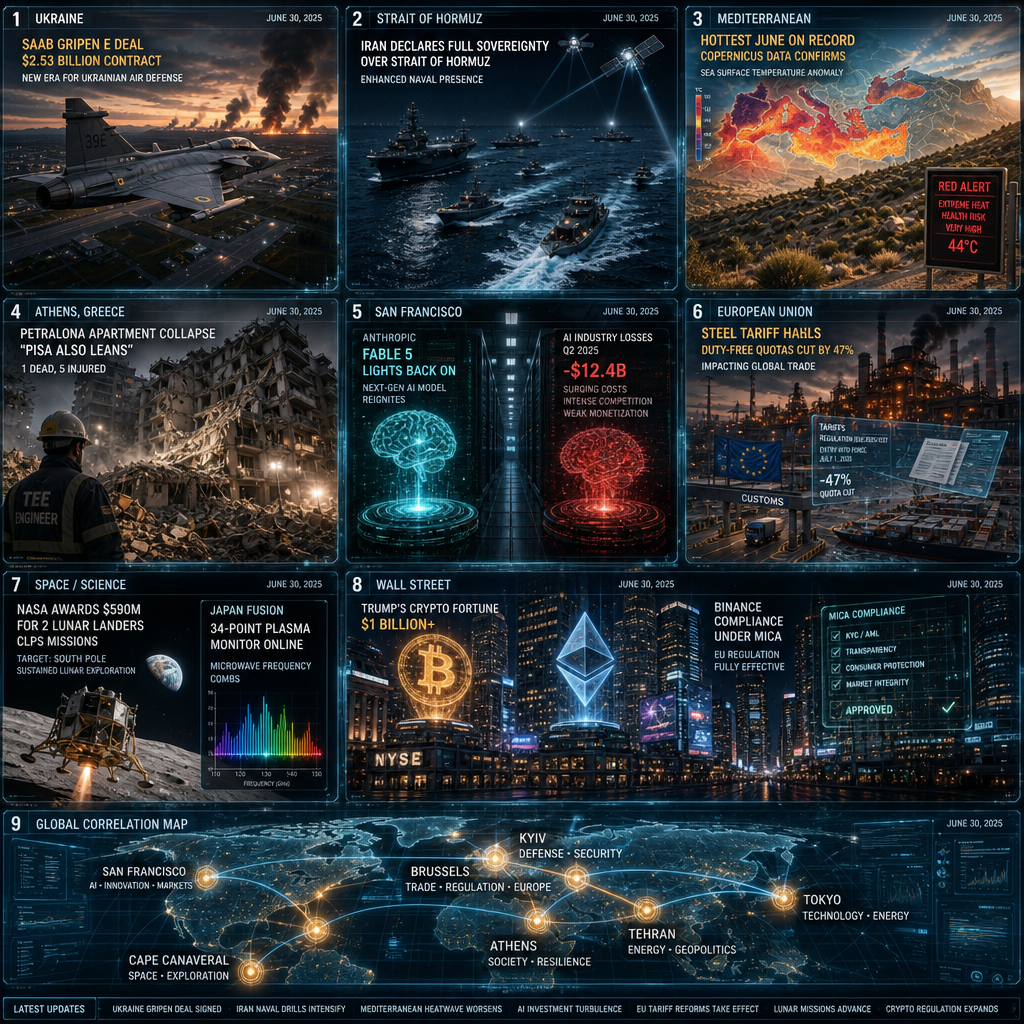
D31 Daily Intelligence Briefing — 1 July 2026. Ukraine signs a landmark $2.53B Saab Gripen E deal as its missile strikes trigger alerts across half of Russia. Iran's parliament declares Hormuz sovereignty non-negotiable while Vance claims the US holds leverage. Anthropic's Fable 5 returns after export controls are lifted; OpenAI posts a staggering $38.5B net loss. Copernicus confirms the hottest ocean June on record. EU halves steel quotas in a historic trade-defence move. 102 citations across geopolitics, climate, AI, economy, and science.
#IntelligenceBriefing #Geopolitics #Ukraine #Gripen #Iran #Hormuz #AI #Anthropic #OpenAI #ClimateChange #EU #Steel #Defense

Contents
- Geopolitics & Defence
- Ukraine’s $2.53 Billion Saab Gripen Contract Caps a Watershed Week for Kyiv’s Air Power
- Ukraine’s Expanded Missile Strikes and Putin’s Renewed Look at Kyiv
- Iran Reasserts Hormuz Sovereignty as Vance Says US Is in a ‘Great Position’
- Netanyahu Orders Hezbollah Infrastructure Flattened in Southern Lebanon
- Monaco Explosion: A Ukrainian-Cypriot Oligarch Survives a Targeted Attack
- China’s Mobile EMALS, Morocco’s Local Artillery, and the Manufacturing Race
- Starmer’s Defence Investment Plan, Edge Computing at the Front, and the UK Polling Map
- Burkina Faso Severs Relations with France, EU Looks to the Caucasus
- Modi-Pezeshkian Navigation Talks, Hormuz Shipping, and Other Diplomatic Threads
- Environment & Climate
- Copernicus Confirms Record Ocean Temperatures for June, with Mediterranean and Tropical Pacific Hottest on Record
- Bee Fertility Takes a Hit from Heatwaves, with Multi-Year Implications for Pollination
- Florida’s Anti-Net-Zero Law Takes Effect, While California Doubles Down on ZEVs
- Industrial Chemical Accidents Up 50%, Even as Puerto Rico’s $1B Solar Fund Is Diverted
- Grand Staircase Survives a Rollback Attempt, and Other Conservation Stories
- Society & Civil Issues
- Building Collapse in Petralona, Greece, Brings Five Arrests and Warnings the Engineer Said ‘Pisa Also Leans’
- UK Domestic Agenda: Sentencing Reform, Academy Pay Cap, Fuel Poverty
- Civil-Rights, Disability, and Religious-Institutional Tensions
- Indonesia’s Gojek Founder Jailed, and Other Justice Stories
- French Social, Religious, and Political Threads
- AI & Technology
- Anthropic’s Fable 5 and Mythos Models Are Coming Back Online
- OpenAI’s $38.5 Billion Net Loss and the Financial Question Around Frontier AI
- OpenAI’s Result, Anthropic’s Comeback, and the Capital Question
- Vinton Cerf Retires, Industrial AI Crosses New Frontiers, and Edge Compute Goes to War
- EU Industrial Strategy, Greek AI Chips, and the European Capital Question
- Economy & Business
- EU Slashes Steel Import Quotas in a ‘Historic Day’ for European Industry
- UK Household Wealth Slump, ECB Caution, and the BoJ’s Intervention Track
- Indian PMI, Dutch Q1 GDP, and Indonesian Inflation
- Indian IT M&A, Auto and Apparel Earnings, and a Rare-Earths Squeeze
- Energy Markets, Gas Pricing, and the Slow March of the Energy Transition
- Science & Space
- NASA’s $590 Million Lunar Bet and the Permanent-Moon-Base Architecture
- Japan’s 34-Point Fusion Plasma Monitor and the Microwave Diagnostic Architecture
- Exoplanet Atmospheres, Dark-Matter-Free Galaxies, and the Search for Biosignatures
- Claude and the 10-Year Jamming Conjecture, Ovaries After Menopause, and a Bipedal Crocodile Relative
- Blood Falls, Alaskan Earthquakes, and the Subduction Edge
- Crypto, Digital Assets & Blockchain
- Trump’s Crypto Fortune and the Disclosure Problem
- Binance’s $300 Million Compliance Spend and the Maturation of Exchange-Level Controls
- Circle’s Russell Reconstitution, Kalshi’s Sports-Betting Setback, and the European Regulatory Cliff
- Exchange Compliance, Stablecoin Strategy, and the Disclosure Era
- Correlations & Analysis
- References
Click any heading to jump to that section. Click the section heading to return to this menu.
Daily Intelligence Briefing — 2026-07-01 (D31)
Geopolitics & Defence
↑ ContentsUkraine’s $2.53 Billion Saab Gripen Contract Caps a Watershed Week for Kyiv’s Air Power
Ukraine signed a 24.6 billion Swedish krona (approximately $2.53 billion) contract with Saab on 30 June 2026 for sixteen new Gripen E multi-role fighters, with deliveries scheduled for 2029–2030[1][2][3]. The agreement, signed in Kyiv in the presence of President Zelensky and Swedish Defence Minister Pål Jönsson, marks the first Gripen E sale to Ukraine and is part of a longer-term ambition to acquire up to 150 aircraft. As an interim measure, Sweden will transfer up to sixteen older Gripen C/D airframes beginning in early 2027, allowing Ukraine to begin operational integration of the type while the new E-series airframes are being assembled. Defence-Point and the Ukrainian presidential office framed the deal as “historic,” with Zelensky emphasising that the partnership with Stockholm extends beyond fighters into unmanned systems and air defence[1][2]. The Gripen’s appeal for Ukraine lies in its low operating cost, modest maintenance footprint, and its capacity to operate from short runways, motorway stretches, and dispersed bases, attributes that materially improve survivability against Russian strikes on fixed airfields. With F-16 Fighting Falcons and Dassault Mirage 2000s already in service, the addition of Gripen E closes the loop on a more standardised, NATO-interoperable fighter force. The contract arrives just as Ukraine’s missile campaign deepens inside Russian territory.
Ukraine’s Expanded Missile Strikes and Putin’s Renewed Look at Kyiv
Two parallel developments underscore the escalatory logic on the ground. According to Crypto Briefing reporting, Ukraine’s expanded missile reach has triggered air-raid alerts across nearly half of Russia, straining Moscow’s air defence capacity and disrupting energy logistics in multiple regions[4]. At the same time, the Ukrainian military chief has confirmed that Vladimir Putin is personally evaluating scenarios for new ways to capture Kyiv, including potential axes of advance from Belarus and Bryansk[5]. The Independent’s live coverage notes that these contingency plans come as Zelensky’s government absorbs a more ambitious air-power package from Sweden. The juxtaposition is sharp: Kyiv is acquiring Western fourth-generation-plus fighters on a multi-year horizon while Moscow appears to be dusting off strategic options for the capital. The asymmetry of timing matters. The Gripen E deliveries in 2029–2030 are designed to be relevant to a long war, not the present one, meaning that Ukraine’s missile campaign, the interim Gripen C/D transfers, and any renewed Russian pressure on Kyiv are the immediate variables that will determine whether the air-power gap narrows in the medium term. European military planners, already tracking the €3.9 billion in additional EU drone financing that Brussels disbursed this week, are likely to view the Saab contract as a second pillar under Kyiv’s war effort, complementary to F-16s, Mirage 2000s, and the rapidly maturing unmanned systems forces.
Iran Reasserts Hormuz Sovereignty as Vance Says US Is in a ‘Great Position’
Mohammad Bagher Ghalibaf, speaker of Iran’s parliament, delivered an unusually forceful statement on the Strait of Hormuz on 1 July, declaring that the waterway “is ours” and that Iran does not negotiate its sovereignty[6]. Ghalibaf outlined five preconditions for continuing the US–Iran dialogue in Qatar: cessation of hostilities in Lebanon, protection of Iranian oil exports, unfreezing of Iranian assets abroad, and two further clauses relating to a “decompression core” mechanism in which Tehran and Washington have already named representatives. He claimed that since the US naval blockade was lifted, Iran has exported more than 40 million barrels of oil in under two weeks, and asserted that the missile programme and broader military capabilities remain “absolutely non-negotiable.” Vice President JD Vance, on the same day, told reporters that the United States is in a “great position” even if the Qatar talks fail, with Jared Kushner and Steve Witkoff set to discuss the state of negotiations with Qatari and Omani mediators[7]. The Trump administration is also reportedly considering military action against Iran but has hesitated in deference to the ongoing nuclear and Hormuz negotiations[8]. The combination of Iranian public hardline signalling and American confidence about leverage is consistent with the late-stage Qatar track described in D30, but the Ghalibaf intervention raises the risk that the technical progress reported over the past week is now politically exposed inside Iran.
Netanyahu Orders Hezbollah Infrastructure Flattened in Southern Lebanon
Israeli Prime Minister Benjamin Netanyahu, accompanied by Defence Minister Israel Katz and Deputy Chief of Staff Maj. Gen. Tamir Yadai, visited Israeli forces operating in the southern Lebanon security zone on 30 June and ordered the full destruction of Hezbollah’s surface and subterranean infrastructure[9]. Netanyahu claimed that the organisation’s arsenal has been reduced from approximately 150,000 rockets to roughly 8% of that figure, and that around 9,000 Hezbollah fighters have been killed in operations. He stated that Israeli forces will not withdraw from the territory they control until Hezbollah is fully disarmed. Lebanese sources assess the Israeli-controlled area at around 620 square kilometres, or nearly 6% of Lebanon’s total territory. The visit, and the destruction order, coincides with reported US-Iran MoU criticism from human-rights organisations, who argue the agreement ignores systematic violations[10]. The Israeli posture is the starkest illustration yet of the shift from cross-border deterrence to permanent ground presence in southern Lebanon, a posture that, in turn, has implications for the US-Iran track: any Israeli move that materially weakens Hezbollah may be tolerated in Doha as long as it does not collapse the broader framework being negotiated.
Monaco Explosion: A Ukrainian-Cypriot Oligarch Survives a Targeted Attack
An improvised explosive device detonated at the entrance of a residential building in Monaco on 30 June in what authorities are treating as a deliberate attack on a Ukrainian-Cypriot oligarch[11]. Three people were injured; security cameras reportedly captured a man placing a backpack at the entrance and fleeing on foot. The incident follows a string of operations targeting Ukrainian business figures in Western jurisdictions and lands during a week in which Ukraine’s formal defence relationships with Sweden were significantly upgraded. While no party has claimed responsibility, the attack is consistent with the long-running pattern of sabotage operations aimed at figures associated with the wartime Ukrainian state. The European intelligence services that will investigate the attack will be operating with a very different threat picture than they did before the war, and the Monaco setting suggests that the perpetrator expects the principality’s institutions to be a soft target.
China’s Mobile EMALS, Morocco’s Local Artillery, and the Manufacturing Race
Two defence-industrial stories underline how the production of weapons systems is moving to new geographies. China has released video of a modular mobile electromagnetic aircraft launch system (EMALS) successfully launching a drone, with each segment carried by an all-wheel-steered vehicle that can be assembled in convoy formation and oriented relative to wind direction[12]. Previous public appearances had shown the system statically configured with four vehicles; the latest demonstration shows a three-vehicle configuration actively launching an unmanned aircraft, with the same architecture also tested from a commercial test ship. Separately, Morocco has begun locally producing 155mm and 30mm artillery ammunition at the MMI Ammunition plant in Sidi Yahya under a partnership with Israel’s Elbit Systems, becoming the first facility in the country dedicated to large-calibre munitions production[13]. The two stories are unrelated in geography but related in logic. As unmanned systems multiply on the battlefield, the bottleneck is no longer airframes but launch and resupply infrastructure, and as the conflict in Europe continues, the same manufacturing logic is being applied to legacy artillery. In the Philippines, PT PAL Indonesia has launched the first of two Tarlac-class LPDs ordered in 2022, completing the hull in six months using an Industrial Maritime 4.0 production framework[14]. The convergence of unmanned, mobile-launch, distributed-manufacturing, and allied-vessel-construction stories shows that the production base supporting the next phase of military competition is no longer concentrated in a handful of Western primes.
Starmer’s Defence Investment Plan, Edge Computing at the Front, and the UK Polling Map
BBC political editor Chris Mason reported on 1 July that the UK Defence Investment Plan, unveiled last week with a £5 billion drone overhaul, leaves “crunching trade-offs” for Greater Manchester Mayor Andy Burnham, who will be required to defend difficult domestic priorities against a defence spending backdrop that absorbs significant additional resources[15][16]. The UK Defence Journal, which first reported the plan, frames it as a generational shift in UK forces toward unmanned systems. In the broader industrial context, Anduril and Amazon Web Services have announced a partnership to combine the Menace-I containerised command-and-data centre with AWS Outpost, with the integrated system capable of standing up in under ten minutes and moving by truck, rail, airlift, or helicopter sling load[17]. Both products were used during Operation Epic Fury, and AWS has named Anduril its “preferred edge provider” for defence customers. The same logic that pulls edge compute into containers also pulls it into smaller forward-deployable platforms, including the autonomous ground vehicle fleet that Overland AI is producing for the US Marine Corps under a $19.7 million agreement[18]. In Germany, polling data show the AfD holding a 26% lead, with the CDU/CSU narrowing the gap to 22%, while the SPD and Die Linke share fourth place at 12% each[19]; Chancellor Mertz’s satisfaction rating ticked up to 15%, its lowest negative reading since April. Pension reform is the top issue for 29% of respondents, ahead of the US-Iran conflict at 26% and the national football team’s World Cup performance at 22%.
Burkina Faso Severs Relations with France, EU Looks to the Caucasus
Captain Ibrahim Traoré’s announcement on 26 June that Burkina Faso is breaking diplomatic relations with Paris has produced a sharp rupture: the 2,500 French residents in the country can no longer rely on the embassy or consular services, both of which are repatriating their agents[20]. The decision extends a string of withdrawals from the French sphere of influence across the Sahel, and it raises questions about the future of French counter-terrorism operations and mining interests in the country. At the other end of the European diplomatic map, EPP President Manfred Weber spoke exclusively to Euronews on 1 July as European Commission President Ursula von der Leyen travelled to Baku to deepen EU influence in a region traditionally within Russia’s orbit[21]. Von der Leyen’s visit is a direct signal to Moscow that Brussels intends to compete in the South Caucasus, and it lands as China’s Xi Jinping reaffirms Taiwan reunification as a historical task for Beijing, a stance that Crypto Briefing analysts say may heighten geopolitical tensions and influence market perceptions of China’s stability[22]. In Beijing, Xi also pushed for stronger military and global influence amid US tensions, a phrase that in the Indo-Pacific context has direct implications for the continued pace of PLA modernisation[23].
Modi-Pezeshkian Navigation Talks, Hormuz Shipping, and Other Diplomatic Threads
Indian Prime Minister Narendra Modi and Iranian President Masoud Pezeshkian have discussed freedom of navigation amid the 2026 Iran war tensions, a diplomatic channel that, in the medium term, may shape the structure of the Hormuz arrangement under negotiation in Qatar[24]. A reminder of the physical risks in the waterway came on 1 July with the news that the South Korean bulk carrier Namu, damaged in a May attack initially blamed on Iran, is set to depart the Gulf[25]. In a separate front, a police officer was killed in an attack in Iran’s Sistan-Baluchestan province, an incident that Crypto Briefing analysts say underscores persistent regional instability and could undermine confidence in Tehran’s internal security posture at a delicate moment in the foreign negotiations[26]. In Washington, Congress blocked a vote on restricting military funding to Israel, a procedural outcome that nonetheless underscores the durability of the US-Israel defence relationship even amid active debates about the conduct of the war in Gaza and Lebanon[27]. And in the human-rights domain, the BBC reports that rights groups fear China’s new “ethnic unity” law gives Beijing legal authority to go after critics beyond its borders, a development that, if enforced, would represent a significant expansion of the extraterritorial reach of Chinese law[28].
Environment & Climate
↑ ContentsCopernicus Confirms Record Ocean Temperatures for June, with Mediterranean and Tropical Pacific Hottest on Record
The European Copernicus Marine Environment Monitoring Service announced on 1 July that the global ocean recorded its hottest June on record, with average surface temperatures approaching 21°C, and that the tropical Pacific and the Mediterranean each set their own individual June records[29]. The agency warned that 2026 may break further records under the combined effect of an El Niño pattern and continued anthropogenic warming. The data add a hemispheric context to the heatwave stories that have dominated European coverage in recent days: France’s national weather service placed four departments, including Corsica, Alpes-Maritimes, and Var, on orange heat alert, with inland Provence expected to see 36–38°C and coastal areas 32–35°C[30]. In New York, the mayor warned of “life-threatening heat” as the city prepared for temperatures approaching 40°C[31]. The combination of a record global ocean and record land heat is consistent with the projections made in the early-summer literature, and the implications for the rest of the northern-hemisphere summer are difficult to overstate: heat stress on labour productivity, electrical grids, water resources, and the natural systems that support pollination will all be tested.
Bee Fertility Takes a Hit from Heatwaves, with Multi-Year Implications for Pollination
Researchers at the University of Hull, in work published this week, have shown that a simulated three-day UK heatwave sharply reduces the fertility of solitary red mason bees, with knock-on effects on pollination of food crops in the following years[32]. The study, led by Prof. James Gilbert, addresses a question that has been largely absent from the public discussion of heatwaves, namely the impact on the reproductive biology of pollinators. The work adds a biological mechanism to the climate-driven concerns already visible across Europe. Germany reported that wind, solar, and hydro produced 58% of the country’s electricity in the first half of 2026, more than in the same period a year earlier, helped by strong offshore wind performance[33]. The transition in Germany’s generation mix is one of the few climate stories that cuts in the opposite direction: as renewables climb, emissions from the power sector continue to fall, but the overall energy mix still has to clear industrial heat, transport, and buildings.
Florida’s Anti-Net-Zero Law Takes Effect, While California Doubles Down on ZEVs
Florida’s anti-net-zero law takes effect on 1 July, codifying a stance that CleanTechnica describes as positioning the state as “the most backward state in the union” on climate policy[34]. The law marks the formalisation of an energy-policy posture that has been in place de facto for several years. In California, by contrast, state leaders reached a budget agreement to provide new funding for zero-emission vehicle incentives covering both light- and heavy-duty vehicles, reaffirming the state’s role as a national leader on clean transportation at the moment the Trump administration is rolling back affordable clean transport programmes at the federal level[35]. The federal-state divergence is now hardwired into American climate politics, with material implications for the location of EV supply chains and the price of compliance for automakers operating in both markets.
Industrial Chemical Accidents Up 50%, Even as Puerto Rico’s $1B Solar Fund Is Diverted
Inside Climate News reported on 30 June that hazardous chemical releases from industrial accidents that injured or killed people increased by more than 50% in recent years, with Inside Climate News attributing part of the rise to the Trump administration’s proposed weakening of safety rules[36]. The story lands in the same week that the US Court of Appeals for the Second Circuit upheld New York City and New York State laws prohibiting fossil fuel-burning appliances in new buildings, rejecting industry challenges and affirming the judgments of two lower courts[37]. In Puerto Rico, a $1 billion federal Energy Resilience Fund that was originally intended to install rooftop solar and batteries on 40,000 low-income and medically vulnerable households has been redirected by the Department of Energy, with $368.7 million moved to PREPA for near-term grid reliability work, and a separate $50 million earmarked for a new natural gas pipeline between San Juan and Palo Seco[38]. The redirection, which accepts a 1% local cost share from PREPA instead of the standard 50%, has drawn criticism from more than 40 Democratic lawmakers who argue the move locks Puerto Rico into more imported methane gas instead of the distributed solar power Congress originally prioritised. The 250-year history of US energy consumption, also released this week by the EIA, shows total US energy use at 96 quads in 2025, up 2% on 2024, a reminder that efficiency gains have not yet bent the absolute demand curve[39].
Grand Staircase Survives a Rollback Attempt, and Other Conservation Stories
Grand Staircase-Escalante National Monument in southern Utah has survived the latest attempt to weaken its 2025 management plan, after a Congressional Review Act push to overturn the plan missed a key Senate deadline[40]. The Bureau of Land Management’s 2025 Resource Management Plan, which was approved after more than two years of consultation with Tribal Nations, state and local governments, stakeholders, and the public, remains in effect, though supporters are watching for the measure to re-emerge under regular Senate rules. In the world’s rivers, a fourth confirmed sighting of the critically endangered Mekong giant salmon carp (Aaptosyax grypus) in Cambodian waters since 2020 has given researchers cautious optimism about the persistence of a species that had no formal records between 2005 and 2020[41]. And a group of more than 40 researchers, in a “Global Justice Report” coordinated by the World Inequality Lab, has proposed a multi-decade plan to achieve ecological sustainability within planetary boundaries while raising incomes for 98% of the global population and reducing working hours by half to two and a half days a week[42]. The report’s central insight, that productivity growth must be balanced by reduced working hours, is a structural response to the material-constraint problem that the climate transition will increasingly pose.
Society & Civil Issues
↑ ContentsBuilding Collapse in Petralona, Greece, Brings Five Arrests and Warnings the Engineer Said ‘Pisa Also Leans’
A four-storey residential building collapsed in the Petralona district of Athens on 30 June while excavation work was being carried out for a new five-storey building on the adjacent lot, reducing the older structure to rubble within minutes[43][44]. Five people, including the owner of the new-build project, the contractor, the responsible engineer, and two workers, were arrested and referred to a prosecutor. The prosecution is being conducted under Article 286 of the Greek Penal Code on planning violations and construction safety. A 14-degree lean was reported in the hours before the collapse, and a witness statement that a project engineer told an elderly resident that the building’s tilt was normal because “Pisa also leans, but it has not fallen” has produced particular public outrage. The collapse follows a separate Thessaloniki-area fire that killed one person near Liti on 29 June, with 105 firefighters, 32 vehicles, and three specialised dosoc-command teams still working the perimeter as of 1 July; a body found in a house near the forest may be the missing 12-year-old whose father was previously confirmed dead[45]. The two events, the Petralona collapse and the Liti fire, are being read together in the Greek press as a single indictment of the country’s construction-safety and fire-preparation regimes, both of which are under active review in the wake of the 2023 Tempi rail disaster.
UK Domestic Agenda: Sentencing Reform, Academy Pay Cap, Fuel Poverty
Justice Secretary David Lammy has announced an increase in the minimum sentence for domestic murder victims after years of campaigning by grieving mothers, including Carole Gould, whose 17-year-old daughter Ellie was killed in 2019, and Julie Devey, whose daughter Poppy Devey Waterhouse was murdered by her ex-boyfriend in 2018[46]. The reform closes a long-standing gap that campaigners argued had devalued the lives of women killed by partners or ex-partners. In education, the UK government has announced limits on executive pay at academy trusts, where nearly 100 chief executives earn more than £200,000 per year and at least one earns more than £500,000; only a quarter of the high-earners are women[47]. The “banker-style” framing of the announcement is a deliberate rhetorical positioning. And from Wednesday, Ofgem’s energy price cap will rise to £1,862 per year for a typical household, an increase of more than £220, with the number of UK homes forced to spend more than 10% of income on energy projected to rise from 11.3 million in April to 13.5 million[48]. The 17.5% drop in UK household wealth reported separately by St James’s Place is the most consequential single statistic: average household wealth has fallen by almost a fifth in a year, the largest annual decline on record, driven by rising bills, higher taxes, and global uncertainty[49].
Civil-Rights, Disability, and Religious-Institutional Tensions
Disability-rights advocates in the United States have warned that the Trump administration’s actions signal a movement toward institutionalising people with disabilities, reversing decades of progress on community-based and inclusive education[50]. The framing, drawn from Department of Justice and Department of Education actions over the past year, is contested inside the administration but is being read by advocates as a substantive shift in federal policy posture. In a separate institutional story, the ultratraditionalist Society of St. Pius X has announced that it will consecrate four bishops without the consent of Pope Leo XIV, an act that Vatican officials have said carries a risk of formal schism[51][52]. The move is the first major intra-Catholic confrontation of Leo XIV’s pontificate and, in its timing, comes as the Pope is hosting broader ecumenical and reform agendas. The institutional stakes are considerable: a formal schism would create parallel lines of apostolic succession and complicate sacramental practice for traditionalist communities and the families that support them.
Indonesia’s Gojek Founder Jailed, and Other Justice Stories
Nadiem Makarim, the founder of Indonesian super-app Gojek and a former education minister, has been sentenced to prison in connection with Indonesia’s Google Chromebook procurement scandal, in which he was accused of profiting from the government’s purchase of laptops for schools[53]. The case is one of the highest-profile corruption prosecutions in Indonesia in recent years and is being read as a signal of prosecutorial independence under President Prabowo’s administration. In Greece, prosecutors are pursuing charges against the five individuals arrested in connection with the Petralona collapse[43][44]. And in the United Kingdom, a cyclist who broke both arms in an Edmonton accident involving a cycle-safety lane divider has launched legal action against the London council responsible for the design of the lane segregation infrastructure[54]. The case, which turns on the engineering design of safety features, will be a closely watched test of how local authorities are held to account for active-travel infrastructure that fails to deliver the protection it promises.
French Social, Religious, and Political Threads
France has fixed the dates of the next presidential election for 18 April and 2 May 2027, with the first round falling during the spring school holidays and the second round the day after Labour Day[55]. The calendar, chosen over a week-earlier option, will shape the rhythm of political activity in the coming months. In a separate story, the French press has been covering the breaking of diplomatic relations between Burkina Faso and France, a rupture that has stranded 2,500 French residents in the country[20]. And in a deeply reported feature, Libération has profiled Marcel Lefebvre, the late archbishop of Dakar whose consecration of bishops in 1988 produced the last formal schism in the Catholic Church, a relevant historical reference point as the Society of St. Pius X’s planned consecrations unfold[56].
AI & Technology
↑ ContentsAnthropic’s Fable 5 and Mythos Models Are Coming Back Online
Anthropic announced on 1 July that the US Department of Commerce has lifted the export controls that had suspended access to its most powerful models, and that it will begin restoring Fable 5 access to users globally on Claude platforms on Wednesday, with re-enablement on AWS, Google Cloud, and Microsoft Foundry to follow in due course[57][58][59]. The two-and-a-half week shutdown of major Anthropic models, which Crypto Briefing analysts say highlighted regulatory unpredictability, was the most consequential AI policy event of the past month. The deal that ended the suspension appears to have involved export-control commitments on the part of Anthropic, though the full terms have not been made public. The Commerce Department also gave a green light for Anthropic to bring Fable 5 back to the public, weeks after it had been required to disable the model over potential security risks[60]. The episode is likely to be cited in the future as a precedent for how US AI policy can be deployed rapidly against frontier-model developers and then unwound under negotiation.
OpenAI’s $38.5 Billion Net Loss and the Financial Question Around Frontier AI
OpenAI’s net loss widened to $38.53 billion in 2025, up from $5.09 billion in 2024, according to figures reviewed by CleanTechnica[61]. The trajectory raises fundamental questions about the sustainability of the frontier-AI business model: the capital intensity of model training and inference infrastructure is being matched, for now, by aggressive revenue growth at the application layer, but the gap between operating costs and monetisation is widening, not closing. The structural risk is concentrated in a small number of large providers, and any meaningful disruption to compute supply, demand, or pricing would produce an outsized impact on the sector. The OpenAI result will inform the EU’s approach to the Industrial Accelerator Act, which T&E, EIES, and RECHARGE have argued should be the vehicle for a more assertive “Made in EU” strategy[62]. The lobbying effort is a direct response to the scale of the US capital base being committed to AI and to the risk that Europe falls structurally behind in the next industrial platform.
OpenAI’s Result, Anthropic’s Comeback, and the Capital Question
The juxtaposition of OpenAI’s widening losses and Anthropic’s regulatory reprieve captures the two-sided nature of the current AI moment. Anthropic is being treated by the US government as a national-security asset whose frontier capability must be controlled but also preserved; OpenAI is operating at a financial scale that is becoming a material consideration for capital markets, even though it remains a private company. The Wayve $85 million employee tender at an $8.5 billion valuation, announced this week, is a reminder that the AI valuation cycle is still producing large paper gains for early employees at autonomous-driving startups, and that the secondary-market for AI talent remains robust[63]. The two stories together suggest that the gap between capital-rich AI leaders and the rest of the industry is widening, and that the European and UK responses will increasingly be tested by their ability to maintain a competitive industrial base.
Vinton Cerf Retires, Industrial AI Crosses New Frontiers, and Edge Compute Goes to War
Vinton Cerf, one of the co-creators of the TCP/IP protocols that underlie the internet, is stepping down as Google’s chief internet evangelist next week[64]. Cerf’s career has spanned the full arc of the modern internet, from the original ARPANET research through the commercial and now regulatory eras, and his departure marks an inflection point for the field. The same week, the Fraunhofer IWU institute published the development of an AI-powered demand forecasting tool for frottana Textil, the German manufacturer behind the MÖVE brand, demonstrating how industrial AI is moving into the textile sector in a way that combines historical sales analysis with employee know-how[65]. And in the defence domain, Anduril and AWS have integrated the Menace-I containerised command-and-data centre with AWS Outpost, with the combined system able to stand up in under ten minutes[17]. The industrial pattern across the three stories is consistent: AI is moving from research lab to production deployment, with the boundary between consumer, enterprise, and military applications increasingly blurred.
EU Industrial Strategy, Greek AI Chips, and the European Capital Question
Axelera AI, a Dutch-registered AI-chip company founded by Greek engineer Evangelos Eleftheriou, has announced the establishment of a Greek subsidiary[66]. The move is one of a small but growing number of cases in which European semiconductor capacity is being established in southern member states with the support of national governments. The EU’s Industrial Accelerator Act, currently under negotiation, will be the venue in which the broader European response to AI capital concentration is set. T&E, EIES, and RECHARGE have argued that the IAA should include a more assertive “Made in EU” strategy that translates the bloc’s sustainability, competitiveness, and security goals into industrial reality[62]. The lobbying effort comes as German fusion startups are attracting investment from major corporations, with the German government identifying fusion energy as a strategic technology under its Fusion Energy Innovation Strategy[67]. Japan’s parallel achievement, a microwave-based plasma measurement system capable of monitoring fusion plasma at 34 points simultaneously, was announced by Mitsubishi Electric, Kyoto University, and the National Institute for Fusion Science[68]. The two stories point to fusion as a domain in which multi-decade capital and policy commitments are now translating into measurable technical milestones.
Economy & Business
↑ ContentsEU Slashes Steel Import Quotas in a ‘Historic Day’ for European Industry
The European Union on 1 July cut in half the quotas for steel imported into the bloc without customs duties, a measure that La Tribune characterised as a “historic day” for the European steel industry[69]. The reduction is designed to save the European steel sector, which has been buffeted by overcapacity in global markets and by energy-cost disadvantages relative to US and Asian producers. Crucially, the available quota volumes have been allocated through bilateral negotiations with around fifteen partner countries, with China excluded from the volume allocation framework[69]. The move is the most aggressive EU trade-defence action of the current cycle and is likely to draw a response from Beijing, particularly given the timing overlap with von der Leyen’s visit to Azerbaijan to deepen EU influence in the South Caucasus[21]. The measure also lands the same day that the EU begins charging customs duties on cheap parcels from Temu, Shein, and other Asian e-commerce platforms, extending the bloc’s trade-defence architecture across the consumer-goods chain[70].
UK Household Wealth Slump, ECB Caution, and the BoJ’s Intervention Track
UK household wealth has fallen by 17.5% in a year, the largest drop on record, with rising bills, higher taxes, and global uncertainty leaving many families worse off[49][71]. The figure, from a St James’s Place wealth poll, is consistent with the Ofgem price cap rise announced the same week and with the broader cost-of-living backdrop. The European Central Bank’s policymaker Demarco said on 1 July that the ECB should not rush any further rate hike, a position that sits in tension with the June inflation jump that the ECB’s own sources had warned about earlier in the week[72]. The internal debate, in other words, is unresolved. And in Japan, top currency official Atsushi Mimura told Bloomberg that the April yen intervention was successful and that some US authorities had voiced support, with Tokyo’s intervention since April having helped curb the yen’s slide against the dollar[73][74]. The yen continues to hover at multi-decade lows, raising the question of whether a further round of intervention is imminent.
Indian PMI, Dutch Q1 GDP, and Indonesian Inflation
India’s HSBC/S&P Global June final manufacturing PMI came in at 54.2, below the 55.0 forecast, with output, new orders, exports, and employment expanding at a slower pace[75]. The reading is consistent with a maturing Indian growth cycle but does not yet signal a meaningful deceleration. Dutch Q1 GDP grew 0.2% quarter-on-quarter, with non-seasonally adjusted year-on-year growth at 1.4%[76]. Indonesia’s June annual inflation rate accelerated to 3.34%[77]. The three readings together suggest a global manufacturing and inflation landscape in which the early-2026 disinflation narrative is encountering friction, with the question of whether the slowdown is cyclical or structural remaining open.
Indian IT M&A, Auto and Apparel Earnings, and a Rare-Earths Squeeze
Indian IT services companies are increasing M&A activity as AI restructures the industry growth model, according to Nikkei Asia reporting[78]. The pattern reflects a defensive consolidation in which the major Indian players are using balance-sheet strength to acquire capability that would otherwise take years to build. The T1 Energy stock, a solar turnaround story, was covered by Seeking Alpha as a play on US solar manufacturing with limited margin for error[79]. Nike’s latest earnings beat analyst expectations but the stock fell on skepticism about the outlook, a reminder that the consumer-discretionary sector is still being repriced[80]. BMW launched the fifth-generation X5 with five powertrain options, a model launch that reflects the broader German premium-auto effort to defend margin and brand in a market that is shifting toward electric and software-defined vehicles[81]. And Handelsblatt’s interview with rare-earths trader Andreas Kroll, who reported that “the Americans and Japanese are buying the market empty,” captures a critical-minerals squeeze that is now a structural feature of the industrial landscape[82].
Energy Markets, Gas Pricing, and the Slow March of the Energy Transition
ADNOC has proposed a shift to a Dubai benchmark for offshore crude pricing, a move that Crypto Briefing analysts say could reshape regional oil market dynamics[83]. The change, if implemented, would rebalance the reference price for Middle Eastern crude exports and would have implications for the relative competitiveness of Gulf exporters. China, in a separate move, has announced that its banks will suspend retail paper gold trading on the Shanghai Gold Exchange after 24 July, a step that is likely to shift investor focus toward physical gold and ETFs[84]. In France, Le Parisien reports that gas prices could rise by up to 3.5% per year, excluding inflation, until 2050, a “scissor effect” between decarbonisation costs and the loss of amortised infrastructure[85]. And in the global M&A market, the first half of 2026 closed with $2.5 trillion in announced deals, a pace that is likely to continue into the closing months of the year, according to Bloomberg reporting[86]. The capital-cycle dynamics across energy, metals, and M&A are consistent with a world in which industrial policy is increasingly the binding constraint on growth.
Science & Space
↑ ContentsNASA’s $590 Million Lunar Bet and the Permanent-Moon-Base Architecture
NASA has selected Astrobotic, Firefly Aerospace, and Intuitive Machines to fly four commercial lunar lander missions worth nearly $600 million as part of its lunar base ambitions[87][88]. The contracts, issued under the Commercial Lunar Payload Services (CLPS) initiative, are the most concrete step yet toward establishing a permanent US presence on the lunar surface. The missions, scheduled to fly by late 2028, will deliver three NASA instruments each, including a Stereo Camera for Lunar Plume Surface Studies, a Laser Retroreflector Array, and a Linear Energy Transfer Spectrometer, designed to inform the design of long-duration crewed missions. The program is also evaluating a hybrid Mars-rover-derived prospector for resource identification near the lunar south pole, a step toward in-situ resource utilisation that will be essential for any sustained human presence. The award is the largest single CLPS commitment to date and signals NASA’s confidence in the commercial lunar supply chain that emerged from the early CLPS missions.
Japan’s 34-Point Fusion Plasma Monitor and the Microwave Diagnostic Architecture
Researchers in Japan have demonstrated a microwave-based plasma measurement system that can simultaneously monitor fusion plasma at up to 34 points over extended periods, a capability that could materially improve the real-time monitoring needed for future fusion reactors[68]. The system, developed jointly by Mitsubishi Electric, Kyoto University’s Institute of Advanced Energy, and the National Institute for Fusion Science, was demonstrated on the Heliotron J device. It uses frequency-comb microwaves with a dual-comb down-conversion method, and it is designed to operate continuously throughout a plasma discharge. The diagnostic is a critical enabling technology for fusion reactor operation, where direct measurement inside the plasma becomes increasingly difficult as temperatures and neutron radiation levels rise. The system is one of several developments worldwide in the broader race to build the first commercially viable fusion reactor, in which German startups are also competing with support from major corporations and private investors[67]. The combination of national-lab capability and corporate investment is consistent with the post-2020 model of fusion development, in which public-sector research and private capital are increasingly complementary.
Exoplanet Atmospheres, Dark-Matter-Free Galaxies, and the Search for Biosignatures
The Nautilus Array concept has been proposed as a complement to ALMA and JWST for tracking exoplanet atmospheres, the primary targets for astrobiology in the search for life beyond Earth[89]. The architecture would help characterise how these atmospheres formed and evolved, providing a key data point for the search for biosignatures. Separately, a new star activity catalog has been released that helps prioritise exoplanet habitability targets by accounting for stellar activity and rotation, two factors that complicate the simple habitable-zone metric[90]. In the Milky Way neighbourhood, astronomers using the W. M. Keck Observatory on Maunakea have discovered the third known galaxy apparently lacking dark matter, part of a strange linear structure that may have formed during a violent collision between galaxies[91]. The cumulative effect of these three stories is to deepen the empirical basis for both the search for life and the search for the fundamental physics that governs the structure of the universe, with the surprise in each case being the same: the universe is more diverse than the models predicted.
Claude and the 10-Year Jamming Conjecture, Ovaries After Menopause, and a Bipedal Crocodile Relative
Physicists Giorgio Parisi, a Nobel laureate, and Francesco Zamponi at La Sapienza University of Rome have used the AI model Claude to prove a 10-year-old jamming conjecture in the physics of complex systems[92]. The collaboration is a notable example of AI-augmented mathematical reasoning and suggests a productive pattern for future research. In the life sciences, Northwestern University researchers have shown that mouse ovaries shift to an immune-dominant molecular signature after menopause, with implications for healthcare in post-reproductive years and for people who have their ovaries removed[93]. And a 212-million-year-old fossil found in New Mexico has been described as Labrujasuchus expectatus, a beaked, toothless, bipedal shuvosaurid and a distant relative of modern crocodiles[94]. The three stories together illustrate the range of contemporary science, from mathematical proof to reproductive biology to palaeontology, and the increasing role of cross-disciplinary methods in producing results.
Blood Falls, Alaskan Earthquakes, and the Subduction Edge
A new paper in Antarctic Science has shed light on how Antarctica’s Blood Falls periodically bursts through the Taylor Glacier, with new analysis showing that the trapped iron-rich brine forces its way out in pulses that measurably reshape the ice above, lowering the surface and slowing its movement[95]. Blood Falls has become a key study site for astrobiology because the subglacial microbial community, sustained by sulfate metabolism in the absence of sunlight and oxygen, is an analogue for environments that may exist elsewhere in the solar system. In Alaska, a machine-learning-based catalog of seismic activity has revealed a razor-sharp line of small earthquakes tracing the edge of the subducting Yakutat microplate, providing a new explanation for the location of the 2002 Denali earthquake[96]. The research, published in The Seismic Record, demonstrates how machine-learning methods can extract signals from seismic data that traditional methods miss, with implications for earthquake hazard assessment in subduction zones worldwide.
Crypto, Digital Assets & Blockchain
↑ ContentsTrump’s Crypto Fortune and the Disclosure Problem
President Donald Trump’s 2025 financial disclosure shows more than $1 billion in income from cryptocurrency ventures, including $588 million in World Liberty Financial token sales, with the figure exceeding his real estate and resort earnings[97][80][98]. The disclosure shows Trump’s personal fortune approaching $6.5 billion in 2026, with the largest single contributor to the year’s gain being crypto-linked activity. The combination of presidential policy influence, the largest disclosed crypto position of any sitting head of state, and a regulatory environment that has been broadly favourable to the crypto industry raises structural conflict-of-interest questions that are likely to be a continuing source of political friction. Critics have called for heightened scrutiny over what they describe as the growing ties between Trump and the crypto sector.
Binance’s $300 Million Compliance Spend and the Maturation of Exchange-Level Controls
Binance says it now spends about $300 million a year on compliance, with roughly one in four of its employees working in safety and oversight roles[99]. The exchange reported that its systems have intercepted $10.53 billion in potential fraud and supported more than 313,000 law-enforcement requests. The 1,500-person compliance team represents one of the largest dedicated compliance functions in the industry and is a structural response to the regulatory and enforcement environment that has built up around the major exchanges. The Binance disclosure is the most concrete piece of evidence to date that the major exchanges are now operating under compliance regimes comparable in scale to those of traditional financial institutions, and the implications for the industry’s political position are significant.
Circle’s Russell Reconstitution, Kalshi’s Sports-Betting Setback, and the European Regulatory Cliff
Circle Internet Group was removed from multiple Russell Growth Indexes in the semi-annual reconstitution, a development that Crypto Briefing analysts say may lead to reduced liquidity and increased volatility[100]. The removal is a function of the index methodology rather than a fundamental assessment of the company, but the practical effect on passive flows is real. Prediction-market platform Kalshi faces new Massachusetts claims over its sports event contracts, with the state alleging that Kalshi targets under-21 users and operates illegal sports-betting products[101]. The case is part of a wider CFTC court fight and will be a test of where the line between regulated prediction markets and sports betting is drawn. In Europe, the new EU MiCA-aligned crypto regulations take full effect on 1 July: from that date, crypto investment platforms without a Crypto-Asset Service Provider (CASP) authorisation cannot operate in France and must implement wind-down plans[102]. The European regulatory cliff is the most significant structural change in the European crypto market since the original MiCA negotiations, and the French implementation is likely to be a template for other member states.
Exchange Compliance, Stablecoin Strategy, and the Disclosure Era
The Binance compliance disclosure, the Circle Russell removal, and the European MiCA cliff together mark the maturation of the crypto industry’s regulatory and disclosure environment. The Binance figure, in particular, suggests that the largest exchanges are now spending at a scale and on a function that, until recently, was reserved for the largest banks. The structural risk is that the smaller exchanges, which cannot afford comparable compliance functions, will be increasingly marginalised, accelerating the consolidation of the industry around a small number of large players. The Circle Russell removal, meanwhile, is a reminder that the line between traditional and crypto finance is increasingly being drawn by index methodology rather than by regulatory status, and that the integration of crypto into mainstream capital markets is proceeding faster than the political debate would suggest. The European regulatory cliff, finally, will reduce the supply of crypto investment products available to French retail investors in the short term, but it will also create a clearer competitive landscape for the platforms that have invested in authorisation.
Correlations & Analysis
↑ ContentsThe pattern of this week’s news is dominated by three multi-day story arcs that were opened in D29 and D30 and that have now produced material new developments. First, the Iran–US technical track in Qatar, which D30 reported as pivoting from framework to implementation, has now produced the sharpest public hardline from Iran’s parliamentary leadership since the negotiations began. Ghalibaf’s declaration that the Strait of Hormuz is Iran’s and that sovereignty is non-negotiable, set against Vice President Vance’s assertion that the United States is in a “great position” even if the talks fail, captures the strategic paradox of the negotiations: both sides believe they have leverage, and both sides are signalling it. The structural risk, as the Monaco attack on a Ukrainian-Cypriot oligarch and the South Korean Namu cargo ship’s pending departure from the Gulf both illustrate, is that physical incidents in or near the waterway could destabilise the negotiating track at any moment.
Second, the Ukrainian defence modernisation arc, which D30 reported through the lens of Russia’s fuel stress and the B-2 LRASM disclosure, has now produced a major procurement milestone: the Saab Gripen E contract is the largest single fighter order Ukraine has placed with a non-US vendor and marks the consolidation of Ukraine’s air-power relationships across the F-16, Mirage 2000, and Gripen platforms. The contract sits alongside the EU’s €3.9 billion in additional drone financing, the continued missile strikes inside Russia, and Putin’s reported instructions to evaluate new ways to capture Kyiv. The four threads together describe a war that is being fought on a multi-year procurement horizon even as the immediate battlefield is escalating. The Greek collapse in Petralona and the Liti-area fire also belong in this broader category of safety and preparedness failures, though in a domestic context, and they are a reminder that the consequences of weak regulatory enforcement can be immediate and dramatic.
Third, the Anthropic export-control episode, which D30 reported as a developing story, has now resolved with the Commerce Department lifting the controls and Anthropic preparing to restore Fable 5 and Mythos access. The resolution is a positive outcome for the AI industry, but the mechanism by which it was achieved, a federal export-control action followed by private negotiation, is a precedent that will inform how the US government treats frontier-model developers in the future. The OpenAI net-loss figure of $38.5 billion in 2025, also reported this week, is a reminder that the financial sustainability of the frontier-AI business model remains an open question and that the gap between capital-intensive leaders and the rest of the industry is widening.
Three additional cross-theme observations stand out. The heatwave narrative that has dominated European coverage since the D28 report has now been extended globally: Copernicus confirms a record-hot June for the global ocean, the Mediterranean, and the tropical Pacific, while New York prepares for 40°C and France places four departments on orange alert. The University of Hull bee-fertility study adds a biological mechanism to the climate-driven concern, with implications for pollination in subsequent growing seasons. The European clean-energy story is also moving in two directions at once: Germany’s renewables reached 58% of electricity in H1 2026, while Florida’s anti-net-zero law takes effect and Puerto Rico’s $1 billion solar fund is being redirected to grid reliability. The bifurcation is now hardwired into the transatlantic climate debate, and the implications for industrial supply chains, EV adoption, and the relative cost of capital between clean and conventional energy are likely to deepen.
What to watch in the next reporting period. The Iran–US negotiations in Qatar are the single most consequential unresolved story; the public posture from Tehran and Washington over the next 72 hours will be the leading indicator. The ECB’s July rate decision, which falls against Demarco’s caution and the June inflation jump, is the most important monetary-policy event of the week. The Anthropic restoration of Fable 5 access will be a test of the export-control settlement’s durability. The Saab Gripen E contract, the EU’s new steel quotas, and the EU’s customs duties on Asian e-commerce parcels are the three trade-and-industry stories that will shape the European policy environment. And the global ocean-temperature record, combined with the New York heatwave and the French orange alert, makes the next ten days of Northern Hemisphere weather a high-priority watch.
References
↑ Contents1. “Ukraine signs with Sweden for first 16 Gripen E” — Defence-Point.gr, July 1, 2026. link
2. “Ukraine: 16 new and 16 older Gripens as interim solution” — Flight.com.gr, July 1, 2026. link
3. “Ukraine signs $2.53B agreement with Sweden for 16 Gripen E fighters” — DefenceNet.gr, July 1, 2026. link
4. “Ukraine expands missile strikes inside Russia” — Crypto Briefing, July 1, 2026. link
5. “Putin orders army to plan new ways to capture Kyiv” — The Independent, July 1, 2026. link
6. “Iran to US: Strait of Hormuz is ours” — DefenceNet.gr, July 1, 2026. link
7. “Iran-US war latest: Vance says US in ‘great position'” — The Independent, July 1, 2026. link
8. “Trump considers military action against Iran, hesitates for nuclear talks” — Crypto Briefing, July 1, 2026. link
9. “Netanyahu: ‘Flatten Hezbollah infrastructure in southern Lebanon'” — DefenceNet.gr, July 1, 2026. link
10. “US-Iran MoU criticized for ignoring human rights” — Crypto Briefing, July 1, 2026. link
11. “Monaco: Who wanted the Ukrainian-Cypriot oligarch dead?” — Defence-Point.gr, July 1, 2026. link
12. “Chinese mobile electromagnetic aircraft launcher in action” — Flight.com.gr, July 1, 2026. link
13. “Morocco locally produces 155mm and 30mm artillery ammunition” — Zona Militar, July 1, 2026. link
14. “PT PAL launches third Tarlac LPD for Philippines” — Asian Defence Journal, July 1, 2026. link
15. “Starmer’s defence plan leaves crunching trade-offs for Burnham” — BBC News, July 1, 2026. link
16. “Starmer backs £5 billion drone overhaul for UK forces” — UK Defence Journal, June 30, 2026. link
17. “Anduril and Amazon’s mobile data center venture” — Defense One, July 1, 2026. link
18. “US Marine Corps buys first autonomous ground vehicle fleet” — Interesting Engineering, July 1, 2026. link
19. “Germany poll: AfD remains first, CDU narrows the gap” — Flight.com.gr, July 1, 2026. link
20. “Burkina Faso breaks diplomatic relations with France” — Le Monde, July 1, 2026. link
21. “EPP boss Weber speaks to Euronews on EU influence in Caucasus” — Euronews, July 1, 2026. link
22. “Xi Jinping reaffirms Taiwan reunification as historical task” — Crypto Briefing, July 1, 2026. link
23. “Xi Jinping pushes for stronger military, global influence” — Crypto Briefing, July 1, 2026. link
24. “Modi, Pezeshkian discuss navigation freedom amid 2026 Iran War” — Crypto Briefing, July 1, 2026. link
25. “South Korean cargo ship damaged in Strait of Hormuz attack to depart Gulf” — The Independent, July 1, 2026. link
26. “Police officer killed in attack in Iran’s Sistan-Baluchestan” — Crypto Briefing, July 1, 2026. link
27. “Congress blocks vote on restricting military funding to Israel” — Crypto Briefing, July 1, 2026. link
28. “Can China target critics abroad with its new ‘ethnic unity’ law?” — BBC News, July 1, 2026. link
29. “Oceans record-high temperature for June at nearly 21°C” — Libération, July 1, 2026. link
30. “Heatwave: Four departments including Corsica on orange alert” — Libération, July 1, 2026. link
31. “New York prepares for heatwave” — Spiegel, July 1, 2026. link
32. “Specieswatch: How heatwaves play havoc with bees’ fertility” — The Guardian, July 1, 2026. link
33. “Wind, solar and water deliver 58% of Germany’s electricity” — Spiegel, July 1, 2026. link
34. “Florida Anti-Net Zero Law Takes Effect July 1” — CleanTechnica, June 30, 2026. link
35. “California Advances New Clean Vehicle Incentives” — CleanTechnica, June 30, 2026. link
36. “Chemical Accidents Rise as Trump Admin Weakens Safety Rules” — Inside Climate News, June 30, 2026. link
37. “Federal Appeals Court Upholds NY Building Electrification” — CleanTechnica, June 30, 2026. link
38. “Puerto Rico $1B solar fund diverted to old power grid” — EcoNews, June 30, 2026. link
39. “The 250-Year History of U.S. Energy Consumption” — CleanTechnica, July 1, 2026. link
40. “Grand Staircase-Escalante survives last-minute rollback attempt” — EcoNews, June 30, 2026. link
41. “Recent discoveries of ‘lost’ Mekong giant salmon carp” — Mongabay, July 1, 2026. link
42. “The blueprint for building a fairer world without breaking the planet” — Mongabay, June 30, 2026. link
43. “Petralona collapse: ‘Pisa also leans’ – 5 arrested” — Enikos.gr, July 1, 2026. link
44. “Petralona: ‘Pisa leans, doesn’t fall’ – testimony of the engineer’s reply” — PatrisNews, July 1, 2026. link
45. “Thessaloniki fire: body found in house near Liti” — Iefimerida, July 1, 2026. link
46. “‘Imagine this was your daughter’: grieving mothers campaigned to close sentencing gap” — The Guardian, July 1, 2026. link
47. “Academy school leaders in England face pay cap” — The Guardian, July 1, 2026. link
48. “Energy price cap rise will push millions into fuel poverty” — The Guardian, July 1, 2026. link
49. “UK households suffer 17.5% wealth slump in ‘biggest drop on record'” — Express, July 1, 2026. link
50. “Trump’s actions signal a move toward institutionalizing disabled” — The Independent, July 1, 2026. link
51. “Defying Pope Leo XIV, traditionalists go ahead with planned consecrations” — The Independent, July 1, 2026. link
52. “What to know about the breakaway traditionalist Catholics defying Pope Leo XIV” — The Independent, July 1, 2026. link
53. “Founder of Gojek Nadiem Makarim jailed over Chromebook scandal” — The Independent, July 1, 2026. link
54. “Cyclist launches legal action against London council” — Evening Standard, July 1, 2026. link
55. “French presidential election set for 18 April and 2 May 2027” — Libération, July 1, 2026. link
56. “Who is Marcel Lefebvre, the man who caused the last schism in the Catholic Church?” — Libération, July 1, 2026. link
57. “Anthropic’s long-sidelined Fable 5 is greenlit to return” — The Verge, July 1, 2026. link
58. “US government allows Anthropic to redeploy its Mythos and Fable AI models” — Engadget, July 1, 2026. link
59. “Trump drops restrictions on Anthropic’s Mythos and Fable models” — TechCrunch, June 30, 2026. link
60. “Commerce Department gives green light for Anthropic to bring back Fable 5” — NBC News, July 1, 2026. link
61. “OpenAI Went From $5.09 Billion Net Loss in 2024 to $38.53 Billion Net Loss in 2025” — CleanTechnica, June 30, 2026. link
62. “T&E, EIES and RECHARGE Joint Statement on the Industrial Accelerator Act” — CleanTechnica, June 30, 2026. link
63. “Wayve launches $85M employee tender offer at $8.5B valuation” — TechCrunch, June 30, 2026. link
64. “The ‘Father of the Internet’ is finally retiring” — TechCrunch, June 30, 2026. link
65. “AI-based demand forecasting creates planning reliability in the textile industry” — Phys.org, July 1, 2026. link
66. “Axelera AI B.V. Greece: subsidiary in Greece from AI chip unicorn” — Protothema, July 1, 2026. link
67. “Global firms and German startups compete in realizing nuclear fusion” — DW, July 1, 2026. link
68. “Japan develops world-class system to monitor fusion plasma at 34 points simultaneously” — Interesting Engineering, July 1, 2026. link
69. “Steel: ‘historic day’ – EU tightens imports and prioritizes partners” — La Tribune, July 1, 2026. link
70. “Temu, Shein & Co.: customs now also charged on cheap orders” — WirtschaftsWoche, July 1, 2026. link
71. “UK households suffer 17.5% wealth slump” — Express, July 1, 2026. link
72. “ECB should not rush any further rate hike, Demarco says” — Reuters via Investing.com, July 1, 2026. link
73. “Japan’s FX chief: past yen intervention demonstrated effect” — FinancialJuice, July 1, 2026. link
74. “Japan’s top currency diplomat: Tokyo’s April intervention helped curb yen slide” — FinancialJuice, July 1, 2026. link
75. “India manufacturing PMI falls to 54.2 in June” — Business Standard, July 1, 2026. link
76. “Dutch Q1 GDP grows 0.2% QoQ” — FinancialJuice, July 1, 2026. link
77. “Indonesia’s June annual inflation accelerates to 3.34%” — Reuters via Investing.com, July 1, 2026. link
78. “Indian IT firms ramp up acquisitions as AI reshapes growth” — Nikkei Asia, July 1, 2026. link
79. “T1 Energy: A Solar Turnaround With Limited Margin For Error” — Seeking Alpha, July 1, 2026. link
80. “Nike beats expectations but stock falls on skepticism” — WirtschaftsWoche, July 1, 2026. link
81. “New BMW X5 G65: BMW X5 comes in fifth generation with five powertrains” — WirtschaftsWoche, July 1, 2026. link
82. “Rare-earths trader: ‘Americans and Japanese are buying the market empty'” — Handelsblatt, July 1, 2026. link
83. “ADNOC proposes shift to Dubai benchmark for offshore crude pricing” — Crypto Briefing, July 1, 2026. link
84. “China banks suspend retail paper gold trading on Shanghai Gold Exchange after July 24” — Crypto Briefing, July 1, 2026. link
85. “Why the price of gas could increase up to 3.5% per year excluding inflation until 2050” — Le Parisien, July 1, 2026. link
86. “Global M&A Tops $2.5 Trillion After First-Half Deals Surge” — Bloomberg via Financial Post, July 1, 2026. link
87. “NASA awards nearly $600 million in lunar lander missions” — SpaceNews, July 1, 2026. link
88. “NASA commits $590 million to four Moon missions for permanent lunar outpost” — Interesting Engineering, July 1, 2026. link
89. “Nautilus Array to Track Missing Exoplanet Atmospheres” — Universe Today, July 1, 2026. link
90. “Habitable Worlds Targets in New Star Activity Catalog” — Universe Today, July 1, 2026. link
91. “Astronomers Discover Another Galaxy With No Dark Matter” — Universe Today, July 1, 2026. link
92. “Physicists and AI model Claude ‘collaborate’ to prove 10-year-old jamming conjecture” — Phys.org, July 1, 2026. link
93. “Ovaries Appear to Develop an Incredible Second Role After Menopause” — ScienceAlert, July 1, 2026. link
94. “Fossils reveal a prehistoric crocodile relative that walked on two legs” — Mongabay, June 30, 2026. link
95. “There’s a Waterfall in Antarctica That Bleeds Red” — ScienceAlert, July 1, 2026. link
96. “Scientists Find a Razor-Sharp Line of Earthquakes Hidden Beneath Alaska” — ScienceAlert, July 1, 2026. link
97. “Trump earned over $1 bn from crypto ventures in 2025” — France 24, July 1, 2026. link
98. “Donald Trump nearly tripled his personal fortune thanks to cryptocurrencies” — France 24, July 1, 2026. link
99. “Binance Says $300 Million Annual Compliance Spend Helped Stop $10.53 Billion in Fraud” — Bitcoin News, July 1, 2026. link
100. “Circle Internet Group removed from multiple Russell Growth Indexes” — Crypto Briefing, July 1, 2026. link
101. “Kalshi faces new Massachusetts claims over sports contracts” — Crypto.news, July 1, 2026. link
102. “Crypto: what the new European regulation changes for savers” — Le Monde, July 1, 2026. link
AI Disclosure: This post was created with the assistance of artificial intelligence. The ideas, analysis, and opinions expressed are my own — AI was used to help compose, structure, and refine my personal notes and thoughts into the final written content. Images, videos and music featured in this post were also generated using AI tools, based on my own creative prompts and direction.
