









Contents
- 1. Geopolitics & Defence
- 2. Environment & Climate
- The Emissions-Target Reckoning and Australia’s 2035 Gap
- The Peatland Legacy, Antarctic Retreat and a Changing Hazard Climatology
- The California King-Tide Front and the UK Season Shuffle
- The Energy-Transition Ledger: Solar’s Grid Constraint and Transport Electrification
- The Industrial-Regulatory Front and the Living Ledger
- 3. Society & Civil Issues
- 4. AI & Technology
- The Orbital-Compute Frontier: SpaceX’s Starmind Constellation
- The Nvidia Governance Continuum and the Compute-Ledger Question
- Neuralink’s Pivotal Trial and the Biomedical-Interface Frontier
- The AI-Laboratory Cryptography Anxiety and the Mathematics Frontier
- The Frontier-AI Free-Will Debate and the Economics of Model Access
- The State’s New Tools: Palantir, the Courts and Industrial Autonomy
- Chinese Robotics and the Militarised-Autonomy Frontier
- Platform Accountability, the Privacy-Auction Question and the German Courts
- 5. Economy & Business
- 6. Science & Space
- Hera’s Reckoning: The DART Impact Scene Four Years On
- Cosmic Frontiers: A Primordial Black Hole and Deep-Archive Mysteries
- The Biomedical Ledger: Sleep, Obesity, the Brain and Robotic Surgery
- The Questions of Knowing: Space vs. Ocean and the Mathematics Crisis
- Neural Ecology, AI’s Quiet Influence and the Media-Freedom Index
- Technology-Environment and the Deep-To-Industrial Interface
- 7. Crypto, Digital Assets & Blockchain
- 8. Correlations & Analysis
- 9. References
Click any heading to jump to that section. Click the section heading to return to this menu.
Geopolitics & Defence ↑ Contents
The Estonia Ultimatum and the Ukraine Long-Reach
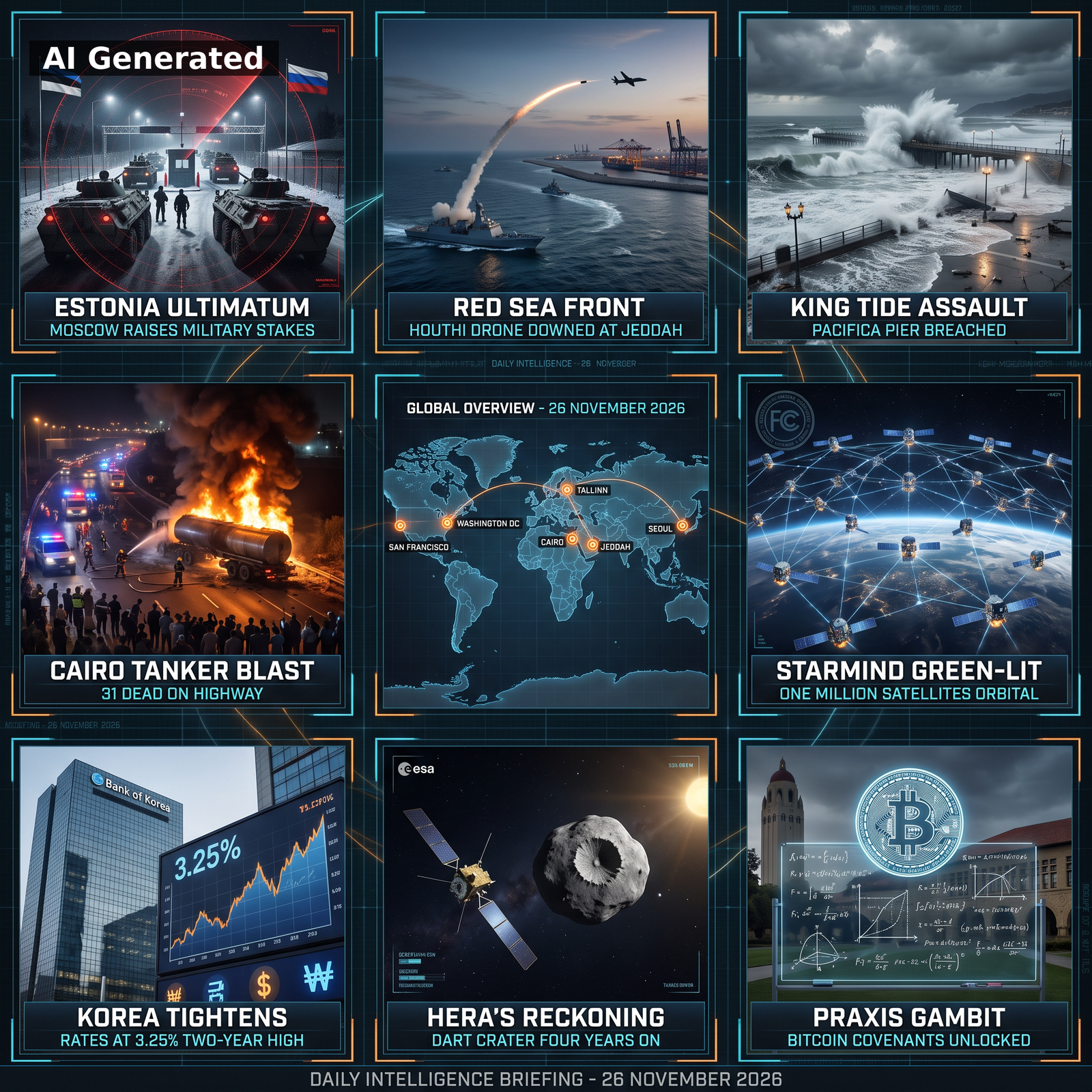
The D179 window opened with a sharp escalation at the Russian-Estonian frontier, where Moscow’s foreign ministry issued what the defence wire record reads as an explicit ultimatum: Tallinn was warned that if it did not stop Ukrainian drone overflights of its territory and what Moscow calls pressure on Russian-speakers, Russia would not rule out military action[1]. Delivered to Estonia’s chargé d’affaires on 23 November, the demand accompanied protests over Tallinn’s planned border-closure and grain-transit curbs. The episode matters because it injects a direct threat to a NATO and EU member into an already crowded security picture, and it is deliberately timed to force the alliance to price in a new flank of risk.
President Volodymyr Zelensky, for his part, signalled that Ukraine will not moderate its long-range campaign. Thanking his Special Operations Forces after Ukrainian drones struck a Russian military airfield, he declared Russian aircraft, warships and weapons-carriers legitimate targets[2]. The two statements, read together, mark a deliberate hardening on both sides of the Russia-NATO periphery. Into this frame, Trump envoy Jared Kushner claimed Putin had assured Washington that Russia would not use nuclear weapons in Ukraine, crediting the Russian leader with restraint while blaming Kyiv for stalled talks[3]. Separately, a Berlin court began the trial of a dual German-Ukrainian citizen accused of espionage for Russia’s GRU and of probing the federal defence ministry and arms industry[4] — evidence that European counter-intelligence is now actively prosecuting the Russian penetration of defence-industrial supply chains.
The F-16 Pipeline, Industrial Strikes and Nuclear Posture
Ukraine’s air force received a logistics boost as Belgium, Denmark, Norway and the Netherlands agreed to finance a sustainment package worth more than US$600 million for the US-approved sale of F-16 maintenance and spares material[5][6][7]. The move addresses the least-appreciated bottleneck of Kyiv’s air campaign — keeping maintenance-intensive fourth-generation fighters combat-ready. Russia, meanwhile, continued to absorb deep strikes on its industrial infrastructure, repelling a reported Ukrainian drone assault on the chemical-industry hub of Nevinnomyssk in the Stavropol region[8], a reminder that Kyiv now forces Moscow to spread air-defence coverage far behind the front.
Kim Jong Un’s call to broaden North Korea’s deployment of tactical nuclear weapons — warning that denial of its nuclear status would be treated as “an open declaration of war” — was the window’s most consequential nuclear development, with German and international wire reports both carrying the message[9][10]. It closes off negotiated denuclearisation and raises threshold risk in any future Korean crisis. On the energy front, a US-led consortium including a US government lender agreed to acquire the international energy assets of Russian oil giant Lukoil[11], a pragmatic carve-out that brings Russian-linked crude under Western oversight rather than sanctioning it into shadow markets.
The Gulf Clock, the Red Sea and the Mediterranean Periphery
Saudi Arabia intercepted a Houthi drone near Jeddah and reported limited damage to the port of Jazan after a projectile strike[12], keeping the Red Sea on the front line against the backdrop of Houthi threats and the Hodeidah strikes. In the wider Gulf, a UKMTO report described a tanker incident west of Dubai where a master reported an explosion from an unknown projectile, with the crew subsequently accounted for and no tanker damage or environmental impact confirmed[13] — evidence that the approaches remain a contested environment where a single event can move energy markets. A companion UKMTO message reported the incident at 50 nautical miles west of Dubai[165] and a further update confirmed the crew safe and accounted for with no environmental impact[166]. The Mediterranean supplied two further threads: a motorcycle-borne bombing in north-eastern Syria killed two security-force members, an attack attributed to the Islamic State group[14], and Greek analysis contended that Turkey had used the Clash Report outlet to spread the claim that the Ukrainian drones which struck a Russian corvette at Benghazi had departed from Albania, illustrating the growing role of disinformation in the Libyan theatre[15].
The Indo-Pacific Defence Ledger
India’s defence diplomacy was a distinct current. New Delhi and Tokyo explored hypersonic missile cooperation following their 2+2 dialogue, signalling an intent to build a credible counterweight in the region’s technological race[16]. External Affairs Minister S. Jaishankar marked the 18th anniversary of the 26/11 Mumbai attacks with a zero-tolerance statement on terrorism[17], while the Indian Coast Guard vessel ICGS Sujay concluded a Trincomalee visit that reinforced India-Sri Lanka maritime cooperation[18]. On the domestic front, police identified thirty men from J&K’s Reasi district who disappeared between 1991 and 2003 as Pakistan-based operatives linked to efforts to revive militancy[19].
At the diplomatic level, Jaishankar and Russian Foreign Minister Sergei Lavrov discussed bilateral and regional issues in a call[20], and the Colombo Security Conclave reaffirmed its commitment to the group’s five pillars across the Indian Ocean Region[21]. In Balochistan, the human-rights ledger produced a symbolic award, with Baloch Yakjehti Committee leader Dr Mahrang Baloch selected for the 2026 Edelstam Prize in recognition of her advocacy against enforced disappearances[22].
European Electoral Chessboards and the Atlantic Periphery
The European calendar moved toward decisive tests. Spain’s weekend election was framed as potentially ending the eight-year era of socialist premier Pedro Sánchez, with a conservative coalition including the far right potentially replacing him[23]. France’s 2027 contest loomed in commentary that argued the French left is mistaken to read the US Democratic midterm landslide as bad news for the far-right Rassemblement National, which remains the favourite[24]. In Germany, two Linke MPs staged a sit-in to protest a Bundestag meeting with former Mossad chief David Barnea, prompting president Julia Klöckner to weigh sanctions[25]. Rounding out the periphery, Colombia’s president directly confronted the men who had held 76 people hostage at a Cartagena supermarket[26]. Read together, the D179 window was dominated by a Russian escalation targeting NATO’s eastern flank, an Indo-Pacific acceleration of defence diplomacy and hypersonic competition, and a European electoral season poised to re-shape the continental balance between left and right.
Environment & Climate ↑ Contents
The Emissions-Target Reckoning and Australia’s 2035 Gap
Australia provided a sobering test of the gap between 2030 progress and the deeper cuts required by the 2030s, with official projections showing the country nearly on track for its 2030 emissions goal but likely to fall far short of the 2035 target absent substantially ramped-up policy[27]. Under existing policies Australia is on course to cut climate pollution by only 48% against 2005 levels by 2035, well below the 62-70% range required. Climate minister Chris Bowen’s talk of “undeniable headwinds” frames the political reality: the transition has entered a harder phase where easy wins are exhausted and entirely new policy instruments are needed. Even jurisdictions making relative progress against near-term goals are discovering that the 2030s targets, set under the post-Paris architecture, demand structural transformations rather than incremental efficiency gains — a theme this series has tracked since COP31’s difficult conclusion in D176-D178.
The Peatland Legacy, Antarctic Retreat and a Changing Hazard Climatology
A landmark study in Nature quantified the enduring burden of draining the world’s peatlands, attributing about 2.7% of present-day human-caused warming to historic drainage and warning that a drained peatland can keep emitting carbon dioxide for centuries[28]. The MIT-led research revealed that although drained land covers only about 0.5% of the surface, its dense carbon stocks continue oxidising for hundreds of years, and even halting new drainage would let maintained drained peatlands nearly double their cumulative warming contribution by 2100. It gives a precise anchor to the twin imperative of ending peatland drainage and rewetting drained land — deepening the carbon-cycle thread D175 and D177 explored through storage and soil-carbon accounting.
The cryosphere and hazard front rounded out the climate science. Researchers at the University of Colorado generated the most detailed picture yet of what lies beneath West Antarctica’s melting ice, illuminating the bedrock and mantle structure governing basal melting[29], while an international study led by TU Graz found lake-terminating glaciers lose a particularly large amount of ice[30]. Both confirm the cryosphere’s response is heavily modulated by local geometry and subsurface structure, complicating sea-level projections. Separately, a modelling study projected lightning could strike more than twice as often in a warming world, with Alaska potentially seeing increases approaching seven-fold by 2100[31] — a compound-hazard driver amplifying wildfire-ignition risk across drying landscapes.
The California King-Tide Front and the UK Season Shuffle
The coastal-hazard ledger was dominated by a historic king-tide episode battering California over the Thanksgiving travel period, reported across Le Monde, Al Jazeera and the BBC. In Pacifica, south of San Francisco, giant waves broke a pier and flooded streets, with researchers attributing the amplified tide both to climate-driven sea-level rise and a very intense El Niño[32]. Meteorologists warned the king tide could pair with high surf for historic surges[33], with systems also affecting British Columbia as millions travelled[34]. It is a textbook illustration of the compound-coastal-hazard theme D169-D178 tracked: seasonal tide, storm surge and climate-driven baseline sea-level rise converging on exposed communities. At the other end of the spectrum, the UK Met Office published guidance indicating the country’s seasons are shifting, with fewer frosts and more hot summer days as the climate warms[35], a shift already affecting wildlife and prompting some farmers to grow different crops[36] — climate change translated into the lived seasonal expectations of a temperate population.
The Energy-Transition Ledger: Solar’s Grid Constraint and Transport Electrification
Europe’s transition supplied a revealing paradox: SolarPower Europe’s assessment described a solar fleet delivering on energy security and affordability while policy support weakens, grids constrain deployment and insufficient flexibility threatens progress[37]. The insight — that “Europe’s solar problem is no longer solar” — captures a transition whose bottleneck has shifted from hardware to transmission, storage, flexibility and regulation, echoing the grid-collision theme D175 and D177 documented. The transport side advanced across several fronts: the East Midlands Mayor backed a £47.55 million investment in 189 battery-electric buses[38]; DTE Energy launched bidding for up to 150 megawatts of new solar in Michigan[39]; ChargePoint struck a deal with Germany’s Kässbohrer to electrify ski-resort charging[40]; Spanish firms unveiled plug-and-play solar carports with built-in EV chargers and prefabricated concrete bases[41]; and an analyst piece argued hybrids are “a waypoint, not the destination”[42]. A coalition warned that weakening EU CO’‘ emission standards by counting combustion vehicles as clean would let manufacturers meet targets without selling a single electric car[43].
Two resilience items rounded out the energy-security picture: a village in Upper Bavaria rehearsed a blackout, exercising self-sufficient energy supply[44], and the US Army detonated five tons of degraded lead-azide explosives in southeast Iowa after legal challenges, insisting health risks were “close to zero”[45]. Both reflect the growing salience of energy-resilience and environment-safety planning.
The Industrial-Regulatory Front and the Living Ledger
Louisiana took over federal coal-ash permitting from December 17, with the EPA approving a partial state-run program subject to 30-day public comment periods, while several legacy sites stayed under federal rules[46]. The handoff is a microcosm of the states-versus-federal dynamic in American environmental governance, with groundwater stakes given the mercury, cadmium and arsenic in coal ash. Beyond regulation, conservation stories were rich. In Malaysia, former egg collectors now work as “Terrapin Guardians” protecting the critically endangered river terrapin, having incubated more than 13,200 eggs and released over 8,200 young[47]. In the Atlantic, an ICCAT meeting adopted a compromise that could establish a “fins naturally attached” anti-finning rule by 2029 or 2030 but still allows alternatives for frozen sharks, drawing mixed reactions[48]. In Brazil, President Lula moved to formally recognise the Indigenous land of Amazon defender Chief Raoni over the 362,000-hectare Kapôt Nhãnore Territory[49]. In Kenya, Lamu residents took the Dangote group’s planned $16 billion East Africa refinery to court, arguing they had not been informed of the project[50], while in Nigeria relentless rains devastated the waterleaf crop that is a livelihood for women farmers in Calabar[51]. Finally, Schleswig-Holstein planned a reporting chain for whale strandings ahead of the environment ministers’ conference[52]. The D179 environment window was defined by a maturing transition whose bottleneck has shifted from hardware to grid, flexibility and regulation, and a climate-hazard ledger now embedded in governments’ daily operating reality.
Society & Civil Issues ↑ Contents
Disaster, Migration and the Mediterranean Crossroads
The human ledger opened with a catastrophic road accident in Egypt, where a fuel tanker overturned on a busy Cairo highway and exploded, killing at least 31 people and wounding 15, with many victims requiring DNA identification[53][54][55]. At sea, the migration ledger remained active, with the rescue of 42 migrants south of the Greek island of Gavdos[56], while in Indonesia recovery teams retrieved 13 bodies from a flooded illegal gold mine[57].
The British Institutional Ledger
The UK government made stalking a standalone offence, responding to estimates that around 1.9 million people experienced it in the year to March[58], introduced a Cutting Costs Bill implementing the UK-EU trade deal[59], and prepared to publish new treaties agreed at last week’s UK-EU summit, reported to contain a ten-year termination clause over border-checks infrastructure[60]. Nearly three in five parents reported feeling pressure to appear “perfect”, with more than 76% saying social media heightened their parenting anxiety[61][62]. Children in poor housing were found less likely to achieve five good GCSEs, with housing quality accounting for 10% of the grade gap between the richest and poorest households[63], and the Financial Conduct Authority warned investment-fraud victims are losing nearly £30,000 on average, with AI making scams harder to identify[64].
The Americas: Health-Care Strain, Deportation and the Courts
In British Columbia, the death of a woman outside a closed emergency room prompted the premier to pledge reforms to keep ERs and maternity wards open in smaller communities through flexible staffing and a $50-million rural health fund[65]. Conservative leader Pierre Poilievre said an Alberta nurse working on contract had been told she might lose her job after being photographed with him[66], and Montreal’s mayor was forced to apologise after a “Kraft Dinner” analogy amid a nearly 10% property-tax hike[67]. A British Columbia child-killer was granted temporary release over the Christmas period — his victim’s favourite holiday[68]. The Ukrainian-Canadian Congress urged more permanent-residency pathways[69], India reported 1,700 nationals had been deported from the US since the start of 2026[70], and a norovirus outbreak sickened students at a North Carolina elementary school[71].
France, Russia’s Information Apparatus and the Global Periphery
In France, two men were detained in Lyon on suspicion of reforming a dissolved ultra-left group[72], while Russia’s state television RT resurrected a digital image of Fyodor Dostoevsky to comment on current affairs in support of Vladimir Putin[73]. Hong Kong fire survivors marked an anniversary as questions lingered[74], and in Mali the jihadist coalition JNIM issued an ultimatum to residents of Tonka to leave before a blockade, while renewed fighting in Congo’s Ituri complicated an Ebola response[75].
The Australian Election Ledger and the Greek Interface
Victoria’s Coalition revealed pre-election plans to privatise sewage plants and sell state-owned land, renewables and “air rights” as part of a $14.47bn asset-recycling plan[76], while in Greece the Liakou affair over direct-award contracts shaped political positioning for Prime Minister Kyriakos Mitsotakis and opposition leader Alexis Tsipras[77]. The D179 society window was defined by the perennial human ledger — disaster, migration and inequality — alongside institutional and legislative responses across Canada, Britain, France and Australia reflecting a governing class straining to adapt to compounding social and fiscal pressures.
AI & Technology ↑ Contents
The Orbital-Compute Frontier: SpaceX’s Starmind Constellation
The defining technology development of the D179 window was the US Federal Communications Commission’s authorisation for SpaceX to pursue its Starmind program, permitting up to one million satellites to build data centres in orbit[78]. The approval, running through 2040, is the first for an entire constellation dedicated to space-based data centres, and it lands amid an intensifying race as Google pursues its own orbital-computing work and Blue Origin has submitted a request[79]. The architecture is an interconnected network of orbital computing modules that process information in space before transmitting results back, linked by optical laser inter-satellite links with radiofrequency back-up, framed as the most cost- and energy-efficient way to meet AI-computing demand since orbital facilities avoid terrestrial cooling and electricity constraints[80][81]. The deployment schedule is daunting: a first satellite by November 2033, 100,000 by 2035, half the constellation by 2038 and full deployment by 2040[82]. Moving elite AI-compute off-planet is a hedge against terrestrial power-grid constraints and a statement of intent in the compute-infrastructure race D175 and D177 documented.
The Nvidia Governance Continuum and the Compute-Ledger Question
The Nvidia story, dominant since D172, continued its second act. Vice-President Vance said White House counsel Todd Blanche had assured him Jensen Huang is “under no investigation”, even as lawmakers remain concerned ahead of his congressional testimony[83]; Huang insisted there is no need for a succession plan[84]; and the Pentagon reportedly weighed a Defence-Production-Act scheme to make Nvidia rehire him[85]. S&P is considering a downgrade of Nvidia’s credit rating to AA- over governance and “key-man” risks[86], while the AI-driven concentration of the S&P 500 has exposed retirement accounts built on index funds to a handful of stocks’ fates[87]. The whiplash — in which Huang’s resignation and reinstatement swung the chipmaker by 31% and some $950 billion in value before a slide — underscored how the whole global AI-chip industry vaults and dips on one company and its founder[88], the clearest illustration yet of the concentration risk D176 and D177 flagged.
Neuralink’s Pivotal Trial and the Biomedical-Interface Frontier
Beyond the corporate ledger, the human-AI interface advanced clinically. Neuralink secured FDA approval to launch the first pivotal clinical trial in the US for its LINK brain-computer interface, evaluating safety and effectiveness in people with severe paralysis from ALS[89]. The pivotal study is a later-stage investigation designed to generate evidence for a regulatory submission, building on early-feasibility programmes in the US, Canada and the UK. It moves the brain-computer interface from exploratory to pivotal-stage testing and connects to the neural-interface frontier D169 explored.
The AI-Laboratory Cryptography Anxiety and the Mathematics Frontier
The scientific anxiety about AI’s impact on encryption intensified, as computer scientists warned that AI labs are likely sitting on cryptography “bombshells”, with advances in AI-driven mathematics threatening to undermine encryption[90][91]. The speculation was fuelled by Anthropic and OpenAI producing proofs with cryptographic implications, and by the claim, tracked since D170, that an Anthropic mathematician solved the generalised Riemann hypothesis. If AI can be directed at the problems underpinning public-key cryptography, the integrity of the digital economy’s encryption layer becomes a strategic vulnerability.
The Frontier-AI Free-Will Debate and the Economics of Model Access
Amid this context, Anthropic CEO Dario Amodei denied wanting humanity to “surrender” free will to AI systems, insisting the future belongs to AI benefiting human autonomy[92] — a statement amplified by his adopting a t-shirt carrying a message against surrendering free will, echoing the increasingly apocalyptic vibes in Silicon Valley[93]. The episode captures the dual posture of frontier labs as both defenders of their technology and custodians of an uncertain future. In parallel, Anthropic moved to deliver agent “skills” over the Model Context Protocol into public beta, a shift that changes what companies must approve when connecting an MCP server[94].
The State’s New Tools: Palantir, the Courts and Industrial Autonomy
European digital-sovereignty dynamics produced a notable police-software development: Nordrhein-Westfalen, one of the first German states to use Palantir for police analytics, announced it would switch to Munich-based Celonis after a European procurement, while Bavaria indicated it would retain the contested US platform for now[95] — a microcosm of Europe’s search for digital sovereignty in security software. In the regulatory sphere, Amazon lost its effort to avoid handling more recall notices, with a US court accepting the Consumer Product Safety Commission’s argument that Amazon is a distributor rather than mere logistics, making it responsible for recalling over 400,000 hazardous products[96]. On industrial autonomy, a Hexagon survey found the UK lags China badly, with just 16% of UK firms reporting high autonomy against China’s 29%, even as 61% of companies expect to reach that level within a decade[97], warning that hype around generative AI distracts from the measurement and positioning that real autonomy requires.
Chinese Robotics and the Militarised-Autonomy Frontier
Two Chinese developments framed the autonomy frontier. XPENG unveiled its Turing Physical AI Architecture and the IRON humanoid robot, with 76 degrees of freedom and more than 1,500 tactile sensing points, planning to deploy it as a retail store assistant in 2027 and advancing a robotaxi programme toward L4[98]. The robot ties physical intelligence, autonomous vehicles and robotics onto one platform, an industrial-scale bet on embodied AI. On the military side, the Chinese PLAAF has integrated manned-unmanned teaming exercises into frontline aviation training, pairing J-20 and J-16 fighters with autonomous “loyal wingman” drones in simulated combat[99] — a concrete operationalisation of the manned-unmanned combat concept paralleling the militarisation of AI seen across this window.
Platform Accountability, the Privacy-Auction Question and the German Courts
Two accountability stories rounded out the technology ledger. Fast-fashion giant Shein agreed to pay $100 million in an FTC complaint alleging it deceived US customers[100], while a coalition of 42 US attorneys general sought to block Character.ai’s reported plan to sell millions of user chats, including sensitive disclosures about users’ mental health[101]. In Germany, the NRW state social court proposed a 15-euro filing fee to stem an AI-driven wave of litigation[102]. The platform and media ledger also included stablecoin giant Tether reportedly seeking a 20% cut to return stolen cryptocurrency after freezing funds[167], and Chinese model-maker Sand.ai claiming its MAGI-2 image-to-video system topped rivals at a fraction of their price[168]. The D179 AI and technology window was defined by the orbital-compute project that would relocate AI infrastructure beyond Earth, the continuing governance and concentration anxiety around the sector’s defining company, and a state and regulator dialectic trying to keep pace with technology’s acceleration.
Economy & Business ↑ Contents
Central Banks and the Global Tightening Ledger
The most consequential economic development of the D179 window was a coordinated tightening impulse across Asia’s central banks. The Bank of Korea raised its benchmark rate to 3.25%, the highest in two years and the third increase since July, to fight persistent inflation[103][104], while upgrading its 2027 growth outlook in the same move[105][106]. In Japan, Bank of Japan board member Tamura signalled the possibility of faster-pace rate hikes, hinting that the very gradual normalisation of Japanese policy could accelerate as inflation entrenches[107]. Together, the Korean and Japanese moves mark a decisive Asian pivot toward monetary restraint at a moment when the AI-driven reflationary impulse is colliding with resilient domestic demand — a dynamic D173 tracked through the IMF’s tightening call and now visible in hard policy action.
Global equities began Thursday on a firm footing as Asian markets rebounded and dip-buyers returned to technology stocks, the GIFT Nifty signalling a gap-up open for India[108], while the dollar held steady as sliding Treasury yields tempered the safe-haven bid[109]. The steadiness belies underlying fragility: with bond markets pricing greater near-term rate risk and the AI trade vulnerable to the Nvidia whiplash, the margin of comfort remains thin.
Tariffs, Trade and the Sovereign-Debt Warning
The trade ledger produced a series of friction points. India examined a US proposal to impose tariffs of up to 25% on its goods, rejecting Washington’s allegation of structural excess manufacturing capacity[110]; Taiwan expressed confidence in keeping previously agreed tariffs even as fears of conflict mounted[111]; Pakistan-US ties were set to grow further except in crypto[112]; and analysis warned fresh Trump tariffs, launched after voters responded to rising prices, would further jack up costs and risk a wider conflict[113]. A French-facing analysis warned that protests were tarnishing France’s image among foreign companies[114]. The Financial Stability Board flagged leverage risks in sovereign bond markets amid rising public debt[115], while the fall of Shanghai’s party chief clouded China’s leadership reset into 2027[116].
Europe’s Fiscal Exercise
Europe’s fiscal machinery was in motion. The German Bundestag resumed final budget deliberations, beginning with the interior ministry’s single budget set to rise to 16.8 billion euros with increases for federal police, the BKA and domestic intelligence[117], while EU leaders gathered for a two-day summit on the 2028-2034 Multiannual Financial Framework, with the €1.78-trillion proposal seen as too high by the “frugal” countries led by Germany[118]. In France, the Senate approved a five-billion-euro effort demanded of large companies in the 2027 deficit-reduction exercise[119]. The German pension-reform debate saw the CDU propose preserving early-retirement-without-deduction for those earning at or below 70% of average income, a framework the SPD initially deemed insufficient[120], while Germany’s health-data research centre was reported to be missing its first-year target[121].
Energy’s Cost Disadvantage and the Network-Bundling Rethink
Energy remained expensive for German industry by international comparison, an analysis found, posing the question of whether policy can remove this competitive disadvantage before 2050[122] — reinforcing the German industrial-winter narrative D173 tracked. The finance ministry was reported to be weighing an entry into network operator Amprion, reviving the possibility of a state-held association of all transmission-system operators to control Germany’s grids[123]. Crude oil prices rose on renewed Middle East tensions threatening supply, a development that could strain already-strained economies and complicate inflation and energy policy[124], underscoring how a single maritime disruption propagates into global prices.
Corporate and Industrial Ledger
Moody’s ruled that Nvidia’s CEO reinstatement restores strategic continuity while leaving governance questions unresolved, with rating and outlook unchanged[125]. Dekra, the Stuttgart certification group, expected revenue to rise about five percent to €4.7 billion in 2026 despite the crisis, positioning AI and cybersecurity certification as growth fields[126], while France unveiled the Oxygène train to replace the Corail stock on its Intercités routes[127]. Poundland fell into administration after failing to secure a takeover, prompting calls to save its Northern Ireland jobs[128]. In the US, a judge blocked the FCC from early licence review of ABC, a ruling the network said chilled its journalism[129], and another halted the revocation of Disney-owned channel licences — a setback for the administration — while a FedEx aircraft overran a Miami runway, closing all but one[130][131].
Investment, Data Centres and the Global Perimeter
The investment picture was positive in several jurisdictions. A data-centre rush drove the biggest rise in Australian business investment since the mining boom[132]; Indian start-up Green Aero raised $14 million to develop jet engines and drones[133]; Greece’s Corient grew through 57 wealth-management acquisitions into a major independent manager[134]. A New York court upheld Mayor Mamdani’s rent freeze[135], Brazil announced new credit rules to curb household indebtedness[136], and an Indian prime ministerial column committed to the Constitution[137]. The market-ledger summary showed a mixed session with the Sensex and Bovespa higher and the Nikkei lower, and Brent above $94[138]. The D179 economy window was defined by an Asian tightening impulse, a fiscal exercise straining against deficits, and an AI and energy cost structure reshaping investment and inflation worldwide.
Science & Space ↑ Contents
Hera’s Reckoning: The DART Impact Scene Four Years On
The scientific headline of the D179 window was the delayed confirmation of what humanity’s first asteroid-deflection test actually did to its target. Four years after NASA’s Double Asteroid Redirection Test (DART) spacecraft deliberately crashed into the small asteroid Dimorphos at more than 13,700 mph, the European Space Agency’s Hera probe — which reached the Didymos-Dimorphos system on 4 November 2026 — returned images revealing that the impact did vastly more than excavate a crater: it flattened Dimorphos’s once-rounded profile into a stadium-sized crater spanning the asteroid’s entire width, reshaped the rock, and set it tumbling wildly in its orbit[139][140]. The finding answered the open question of whether a rubble-pile asteroid would retain a crater or simply reorganise its constituent rocks into a new shape; the answer, in principal investigator Patrick Michel’s words, was “all three at once” — cratered, reshaped and reorientated[141].
The significance of the Hera images extends well beyond planetary-science curiosity. DART had already shown humanity can change an asteroid’s orbit, shortening Dimorphos’s period by a bulk 33 minutes; Hera’s follow-up reveals what happened to the asteroid itself, giving scientists the momentum-transfer calibration needed to predict how other asteroids might respond. With Hera to deploy two cubesats — Juventas, which will take the first radar measurements of an asteroid’s interior, and Milani — the mission will determine Dimorphos’s mass and structure, closing the loop on momentum-transfer efficiency. As mission manager Ian Carnelli put it, the DART-Hera pairing is humanity’s decisive step toward making asteroid deflection a reliable tool for planetary protection, continuing this series’ tracking of the mission since D171.
Cosmic Frontiers: A Primordial Black Hole and Deep-Archive Mysteries
Beyond the deflection experiment, the cosmic ledger produced a striking candidate: astronomers may have detected a primordial black hole named Phoebe, formed just after the Big Bang, which briefly magnified a distant star. With an estimated mass only three times that of the Moon, the object could be a 13-billion-year-old relic offering new clues to the dark-matter mystery, since primordial black holes of this mass class are candidate dark-matter constituents[142]. If confirmed, Phoebe would be among the strongest observational hints yet that a population of small black holes seeded the early universe and may account for some of dark matter — a finding with profound cosmological implications, and one that builds on the primordial-black-hole speculation D170 explored.
The deep archive also yielded. More than a mile beneath the Red Sea, scientists discovered rare underwater brine-pool “lakes” — extremely salty, oxygen-free environments teeming with microbial life — challenging our understanding of where life can survive[152]. A 9.5-million-year-old whale that sank to an ancient seabed was found to have attracted a hidden community of scavengers, showing the whale-fall ecology has ancient origins[143]; blue suckers in Montana’s Upper Missouri were confirmed to live up to 130 years[144]; and experiments suggested meat-eating dinosaurs fed by dragging their teeth backward through flesh like a saw[145].
The Biomedical Ledger: Sleep, Obesity, the Brain and Robotic Surgery
The biomedical front produced four results. A study found that for people living with heart disease, regularly clocking nine or more hours of sleep a day could be a clue to hidden health problems and a potential predictor of mortality risk[146]. Researchers discovered a surprising twist in how the body burns calories: a drug can increase energy expenditure without clearly activating brown fat, revealing a challenge in obesity treatment[147]. Experimental nose drops enhanced cognition in mice and may prevent Alzheimer’s, bypassing the blood-brain barrier[148]. And the world’s largest trial of robotic knee replacement found no meaningful improvement in pain, mobility or recovery versus conventional surgery after one year[149].
The Questions of Knowing: Space vs. Ocean and the Mathematics Crisis
Two reflective pieces rounded out the window’s content. An essay interrogated whether we know more about space than the ocean[150]. The mathematical sciences faced an existential reckoning after the claim that an Anthropic mathematician, working with Claude, had solved the generalised Riemann hypothesis — unsolved for 167 years — prompting debate about how mathematicians should adapt “from solving to digesting” as AI participates in proofs[151]. The Riemann claim frames the AI-mathematics frontier as a genuine crisis of verification.
Neural Ecology, AI’s Quiet Influence and the Media-Freedom Index
Research on bumblebees suggested ancient neural circuits hold clues to how intelligence evolved, with bees solving unfamiliar problems and transmitting emotion-like states using fewer than a million neurons[153]. A City St George’s study found aversion to AI does not lessen its influence on people’s decisions[154]. Sweden topped a global ranking of support for international media freedom, even as donor funding declined amid growing threats[155].
Technology-Environment and the Deep-To-Industrial Interface
The science window also touched the applied frontier. A University of Maine programme demonstrated that aerial surveillance — flying thousands of feet above northern and eastern Maine — is making timber harvesting and forest conservation more efficient, surveying easements for illegally dumped trash and supporting the New England Forestry Foundation’s work[156]. In the defence-industrial space frontier, Centum Electronics and SpacePixxel Technologies signed a memorandum of understanding to develop advanced satellite payloads and subsystems, strengthening India’s indigenous space-technology capabilities as announced during the India International Space-fest[157]. Read together, the D179 science window was defined by the Hera confirmation that asteroid deflection can reshape a world, the deepening AI-mathematics verification crisis set against the primordial-black-hole and deep-time archive, and a biomedical ledger testing the limits of precision intervention.
Crypto, Digital Assets & Blockchain ↑ Contents
Bitcoin’s Protocol-Design Frontier: Praxis and the Covenants Question
The most consequential Bitcoin development of the D179 window was a proposed cryptographic breakthrough from Stanford that could extend Bitcoin’s programmability without requiring a network-wide rule change. Stanford professor David Tse and his team unveiled “Praxis”, an approach using witness encryption to enable Bitcoin covenants — complex on-chain spending conditions, such as a loan being repaid automatically — without any soft fork[162]. The significance cannot be overstated: Bitcoin developers have tried for five to ten years to add covenants through soft forks, and every attempt has stalled because protocol changes require broad community consensus. If witness encryption works as described, it would let Bitcoin be spent according to pre-specified programs — an essential precondition for trustless lending, bridges and other DeFi-style functionality — while leaving Bitcoin’s core protocol untouched. The framing in the reporting connected Praxis directly to Aave’s interest in native Bitcoin collateral and to the long-term goal of making idle Bitcoin productive. For a network whose conservatism has long been both a feature and a limitation, Praxis opens a tantalising path: the ability to deploy sophisticated financial logic on top of Bitcoin’s settlement layer without forcing contentious consensus changes. It is the kind of protocol-innovation story this series has tracked through tokenised rails, and its verification will be closely watched in the months ahead.
The AI-Cryptography Nexus and Bitcoin’s Maker-Side Ledger
The parallel development connecting cryptography to the digital-asset world intensified, as computer scientists contended that AI research labs are likely sitting on cryptography “bombshells”, with AI-driven mathematical breakthroughs potentially undermining current encryption systems[91]. Anthropic and OpenAI proofs fuelled the speculation about AI’s threat to encryption, with the AI advancements in solving complex mathematical problems flagged as posing significant security risks[90]. For the digital-asset ecosystem, whose security and legitimacy rest on cryptography at every layer — from private-key security to the trust anchors of stablecoins — any credible advance toward breaking widely used encryption would be existential. The AI-cryptography nexus is therefore as much a crypto-sector story as a mathematics one, and it reinforces the urgency of the post-quantum and cryptographic-robustness agenda this series has previously flagged.
Regulatory Institution-Building and Custody Architecture
The regulatory front produced a landmark for a war-time economy, as Ukraine’s parliament approved a bill to regulate crypto trading and taxes starting in 2027, aiming to license Bitcoin exchanges and custodian services while clarifying tax details[160]. The move is notable because Ukraine’s crypto sector has remained active despite the ongoing war, and institutionalising it both legitimises a source of economic resilience and begins to tax a previously grey market. It also signals that even amid conflict, states are building the regulatory architecture for digital assets — a trend that connects to the MiCA-style institutionalisation of the European market and to the tokenisation projects this series has documented.
On the staking-ledger side, Lido tightened its Ethereum staking penalties as operators gained access to larger validators, with a March slashing involving six validators illustrating why the Lido DAO sought wider authority and how recovery could depend on future rewards or bond top-ups[161]. The change reflects the maturing governance of Ethereum’s restaking and liquid-staking layer, where risk-management rules are hardening as capital scales. The institutional-onramp theme continued with LayerZero adding Samsung Card, Kakao Pay and ZAN as validators for its upcoming “Zero” blockchain, an architecture that uses zero-knowledge proofs to separate execution from verification and so leaves validators to verify proofs rather than duplicate execution[159]. The move to recruit mainstream financial and payments entities as validators is a concrete step toward embedding blockchain infrastructure within incumbent financial rails.
The Market-Perception and Energy-Innovation Ledger
Finally, the D179 window carried two stories capturing the digital-asset economy’s wider footprint. Coinbase CEO Brian Armstrong argued that investors have historically swapped bitcoin for major initial public offerings and then rotated back, insisting bitcoin remains as important as ever for investors who expect higher inflation and more money printing[158] — a perception-shaping statement about bitcoin’s place in the institutional portfolio during a period of ETF-flow volatility. And on the energy-innovation front, mining-equipment manufacturer Canaan expanded its Nordic Bitcoin-mining district-heating network to nearly 8,000 homes, securing additional orders for hydro-cooled Avalon units and bringing its portfolio to nearly 12 megawatts[163]. The Canaan story is a counterweight to the environmental-critique narrative, showing the emerging “hash-to-heat” model in which mining waste heat is repurposed for residential heating — an integration of digital assets with the energy transition that D178 touched through the mining-economy reckoning. Rounding out the ledger, Bitcoin Lightning operators were shown to be able to recover stuck payments even after losing channel data, with the 26.12 release candidate helping recover eligible funds where the operator retains key records and can get help from the peer[164]. Read together, the D179 crypto window was defined by a protocol-design breakthrough that could expand Bitcoin’s programmability, the deepening AI-cryptography anxiety, and continued institutional and regulatory construction of the digital-asset economy.
Correlations & Analysis ↑ Contents
The D179 window opened with a geopolitical development that complicates the master narrative this series has tracked since D171. Where D177 and D178 closed on the gravitational pull of concentrated power — boardroom and courtroom drama displacing the war zones that dominated D171-D176 — today Russia drew a direct line toward a NATO member, delivering an ultimatum to Estonia over drone overflights and its border closure, the first such explicit threat to an alliance state since the war began[1], precisely as Zelensky reaffirmed Ukraine’s deep-strike doctrine[2]. The D179 window is therefore best understood as two narratives running in parallel — hard war and military escalation alongside corporate and electoral drama — each capable of re-imposing itself on the other at any moment.
The AI-compute-communications nexus that D172-D175 documented reached a new frontier with the FCC’s authorisation for SpaceX to deploy up to one million satellites for orbital data centres. The Starmind approval connects directly to the compute-infrastructure race D175 and D177 tracked: the same pressures that drove a terrestrial data-centre boom are now pushing elite AI-compute off-planet[78]. The orbital-compute project and the Nvidia concentration risk are two expressions of a single reality — that the AI era’s defining constraint is now less raw model intelligence than the physical and governance infrastructure required to power and manage it, as S&P’s key-man downgrade watch shows[86].
A third correlation binds the window together: the AI-cryptography anxiety. The claim that an Anthropic mathematician solved the generalised Riemann hypothesis — tracked since D170 — has matured into a genuine cryptography-destabilisation concern, with computer scientists warning that AI labs hold “bombshells” that could undermine encryption[91]. Every layer of modern finance and state communication rests on cryptography, so a credible AI-assisted advance toward breaking it would be existential for both the sovereign-bond and stablecoin systems examined here. The window frames the AI-mathematics frontier as a strategic vulnerability, not merely an intellectual curiosity.
The monetary and fiscal correlation is equally stark. The Bank of Korea’s move to 3.25% and the Bank of Japan’s hint of faster hikes arrive as Germany debates a budget and the EU a €1.78-trillion framework[103][118] — the coordinated-tightening-against-deficit story D173 and D174 identified, now made concrete. The stakes are elevated because the AI trade simultaneously drives record equity levels and the most volatile corner of the market, so when Asian central banks tighten into an AI-led reflationary impulse while sovereign-bond leverage rises, the margin for error narrows measurably.
Environmentally, the window reinforced that the transition’s bottleneck has migrated from hardware to grid, flexibility and regulation — Europe’s solar problem is no longer solar[37] — while the peatland-drainage study and the king-tide battering of California provide complementary evidence that both the carbon-stock and coastal-hazard ledgers are moving faster than policy anticipates[28][32].
What to watch: the Russia-Estonia confrontation and whether the ultimatum translates into concrete military pressure, immediately testing NATO Article 5 in a way no event since 2022 has; the SpaceX Starmind milestones (a first satellite by 2033 and 100,000 by 2035) making Starship’s progress a bellwether; the Nvidia downgrade watch; and whether the Asian tightening becomes a synchronised global impulse.
References ↑ Contents
1. ΕΚΤΑΚΤΟ: Τελεσίγραφο από Ρωσία σε Εσθονία – «Ή σταματάτε τα drones ή πόλεμος»! by DEFENCE via d k on Inoreader · Source ↑
2. Ζελένσκι: «Θα συνεχίσουμε τις επιθέσεις κατά ρωσικών στόχων» by DEFENCE via d k on Inoreader · Source ↑
3. Κούσνερ: Ο Πούτιν διαβεβαίωσε τις ΗΠΑ ότι δεν θα χρησιμοποιήσει πυρηνικά όπλα στην Ουκρανία by Άλκης Αποστολόπουλος · Source ↑
4. Prozess gegen mutmaßliche Russland-Spionin beginnt in Berlin by Germany via d k on Inoreader · Source ↑
5. Οι ΗΠΑ εγκρίνουν την πώληση υλικού για τη συντήρηση των μαχητικών F-16 της Ουκρανίας by Newsroom · Source ↑
6. Cuatro países de Europa financiarán un paquete logístico de US$621,9 millones para sostener los F-16 de Ucrania by Redacción Zona Militar · Source ↑
7. Οι ΗΠΑ ενέκριναν την πώληση ανταλλακτικών άνω των 600 εκατ. δολαρίων για τα F-16 της Ουκρανίας, πληρώνουν τέσσερις ευρωπαϊκές χώρες by Greece via d k on Inoreader · Source ↑
8. Η Ρωσία απέκρουσε επίθεση με drones σε βιομηχανική περιοχή στο Νιεβινομίσκ by Newsroom · Source ↑
9. Aufrüstung: Kim Jong Un fordert breiteren Einsatz taktischer Atomwaffen by DIE ZEIT: News – · Source ↑
10. Kim Jong Un says North Korea should widen deployment of tactical nukes by NEWS via d k on Inoreader · Source ↑
11. US-led consortium agrees to acquire assets from Russian oil company Lukoil by Alex Veiga · Source ↑
12. Σαουδική Αραβία: Αναχαίτισε drone των Χούθι κοντά στο λιμάνι της Τζέντα by DEFENCE via d k on Inoreader · Source ↑
13. FinancialJuice: UKMTO: Master of tanker reports explosion from unknown projectile near vessel by FinancialJuice · Source ↑
14. Συρία: Δυο νεκροί σε βομβιστική ενέργεια by Διογένης Ρωσσίδης · Source ↑
15. Επίθεση στη Λιβύη: Γιατί η Τουρκία κάρφωσε την Αλβανία και πώς εμπλέκεται το Ισραήλ στο επικίνδυνο παιχνίδι by Greece via d k on Inoreader · Source ↑
16. India-Japan Hypersonic Partnership Gains Momentum As Strategic Defence Ties Deepen by Indian Defence News · Source ↑
17. EAM Jaishankar Pays Tribute To 26/11 Mumbai Terror Attack Victims, Reaffirms Zero-Tolerance Stance On Terrorism by Indian Defence News · Source ↑
18. ICGS Sujay Strengthens India-Sri Lanka Maritime Partnership Through Trincomalee Visit And Youth Outreach by Indian Defence News · Source ↑
19. Jammu and Kashmir’s Reasi district’s 30 Missing Terrorists Identified As Pakistan-Based Operatives, Says DGP by Indian Defence News · Source ↑
20. EAM Jaishankar, Lavrov Discuss Bilateral Ties, Regional Developments And Global Conflicts In Telephone Call by Indian Defence News · Source ↑
21. Colombo Security Conclave Nations Reaffirm Commitment To Strengthening Security And Cooperation Across The Indian Ocean Region by Indian Defence News · Source ↑
22. Mahrang Baloch Awarded 2026 Edelstam Prize For Human Rights Advocacy In Balochistan by Indian Defence News · Source ↑
23. Spain’s election: the end of a leftwing icon? – podcast by Presented by Nosheen Iqbal with Sam Jones and Ashifa Kassam; produced by Tom Glasser, George McDonagh, Natalie Ktena and Ross Burns; executive producer Sami Kent · Source ↑
24. 2027 French Presidential Election: Why the Left Is Wrong to See Trump’s Defeat as Bad News for Le Pen by France via d k on Inoreader · Source ↑
25. Sitzblockade im Bundestag: Klöckner prüft Sanktionen nach Protestaktion gegen Ex-Mossad-Chef by DIE ZEIT: Deutschland – Jana Trietsch · Source ↑
26. Colombian president taunts arrested supermarket hostage-takers by NEWS via d k on Inoreader · Source ↑
27. Australia projected to completely miss 2035 emissions target without new climate policies by Donna Lu and Lisa Cox · Source ↑
28. César Terrer, MIT engineering professor: ”A drained peatland can keep emitting carbon dioxide for centuries by ECOnews Newsroom · Source ↑
29. What’s Going on Beneath West Antarctica’s Melting Ice? CU Researchers Help Generate the Most Detailed Picture Yet by Environment via d k on Inoreader · Source ↑
30. Glacier Retreat: Lakes Lead to Greater Mass Loss by Environment via d k on Inoreader · Source ↑
31. Lightning Could Strike Over Twice as Often in a Warming World by Environment via d k on Inoreader · Source ↑
32. Des grandes marées historiques inondent le littoral californien, San Francisco évite les dévastations redoutées by France via d k on Inoreader · Source ↑
33. Photos: Storms and an El Nino-charged king tide batter California’s coast by NEWS via d k on Inoreader · Source ↑
34. California warns of flooding as King Tides peak over Thanksgiving by Science & Space via d k on Inoreader · Source ↑
35. What UK season changes mean for you by Science & Space via d k on Inoreader · Source ↑
36. Expect fewer frosts and more hot days as UK seasons shift, says Met Office by Science & Space via d k on Inoreader · Source ↑
37. Europe’s Solar Problem Is No Longer Solar by Guest Contributor · Source ↑
38. The Mayor of the East Midlands is Backing a £47.55 Million Investment to Bring 189 Battery-Electric Buses by Guest Contributor · Source ↑
39. DTE Energy Advances New Michigan Solar Projects to Create Jobs & Save Customers Money on Fuel Costs by Press Release · Source ↑
40. ChargePoint and PistenBully have a charging plan for ski resorts by Michelle Lewis · Source ↑
41. Plug-and-play solar carports pair built-in EV chargers with 7,700-lb concrete bases by Muskan Bhatia · Source ↑
42. Hybrids Are a Waypoint, Not the Destination by Guest Contributor · Source ↑
43. Joint Letter on the Revision of the CO₂ Emission Standards for Cars & Vans by Transport & Environment · Source ↑
44. Autarke Energieversorgung: Ein Ort in Oberbayern übt den Blackout by DIE ZEIT: News – · Source ↑
45. After Detonating Five Tons of Lead Explosives, Army Says Health Risks Are ‘Close to Zero’ by Anika Jane Beamer, Jake Bolster · Source ↑
46. Confirmed by the EPA: Louisiana’s own coal ash permit program takes effect December 17, with at least 30 days for public comment on applications by Javier Niño · Source ↑
47. The night watchmen guarding Malaysia’s critically endangered river terrapins by Isabel Esterman · Source ↑
48. Nations hail new shark finning rules in the Atlantic. Conservationists say Japan blocked better ones by Rebecca Kessler · Source ↑
49. Brazil’s President Lula moves to recognize Chief Raoni’s Indigenous land by Bobbybascomb · Source ↑
50. Kenyan communities take on Nigerian billionaire’s $16 billion refinery project as court adjourns hearing by Malavika Vyawhare · Source ↑
51. Despite heavy rains, farmers hope for a viable waterleaf harvest in Nigeria by Karen Coates · Source ↑
52. Vor Umweltministerkonferenz: Schleswig-Holstein plant Meldekette für Walstrandungen by DIE ZEIT: News – · Source ↑
53. Ägypten: Tankwagen explodiert in Vorort von Kairo – 31 Tote und Verletzte by Germany via d k on Inoreader · Source ↑
54. En Egypte, un incendie meurtrier sur une autoroute de l’agglomération du Caire fait une trentaine de victimes by France via d k on Inoreader · Source ↑
55. En Égypte, un incendie sur une autoroute du Caire fait une trentaine de morts by FRANCE 24 · Source ↑
56. Διάσωση 42 μεταναστών νότια της Γαύδου, μεταφέρονται στην Παλαιόχωρα by Greece via d k on Inoreader · Source ↑
57. Illegaler Bergbau: 13 Tote aus überfluteter Goldmine in Indonesien geborgen by DIE ZEIT: News – · Source ↑
58. ‘Hideous crime’ of stalking to be made standalone offence by Y. Áine Fox · Source ↑
59. Ministers to introduce ‘Cutting Costs Bill’ to Parliament after EU deals by Christopher McKeon · Source ↑
60. UK government set to publish new treaties agreed with EU by NEWS via d k on Inoreader · Source ↑
61. Nearly three in five parents of young children feel pressure to appear ‘perfect’ by Eleanor Busby · Source ↑
62. Nearly three in five parents of young children feel pressure to appear ‘perfect’ by Eleanor Busby · Source ↑
63. Children living in poor housing ‘less likely’ to get five good GCSEs or do A-Levels by Eleanor Busby · Source ↑
64. Investment fraud victims losing nearly £30,000 typically, FCA warns by Vicky Shaw · Source ↑
65. B.C. premier pledges to bolster health-care staffing as woman dies outside closed ER by Amy Judd · Source ↑
66. Pierre Poilievre says Alberta nurse may lose job after photo with him in Wainwright by globalnewsdigital · Source ↑
67. Montreal mayor apologizes for Kraft Dinner comment amid tax hike backlash by Alessia Maratta · Source ↑
68. B.C. child-killer granted temporary release over Christmas — his victim’s favourite holiday by Amy Judd · Source ↑
69. Ukrainians in Canada wait for permanent residency as calls grow for more pathways by Klaudia Van Emmerik · Source ↑
70. US Deports 1,700 Indian Nationals Since Start of 2026, Says MEA by Indian Defence News · Source ↑
71. More than 120 students sickened at North Carolina elementary school after norovirus outbreak by Jasmine Fernández · Source ↑
72. Rhône : soupçonnés de reformer un groupe d’ultragauche dissous, deux hommes placés en garde à vue à Lyon by France via d k on Inoreader · Source ↑
73. En Russie, la chaîne de télévision RT ressuscite Fiodor Dostoïevski pour commenter l’actualité et soutenir Vladimir Poutine by France via d k on Inoreader · Source ↑
74. Hong Kong fire survivors and families mark anniversary as questions linger by Business via d k on Inoreader · Source ↑
75. Mali : le JNIM lance un ultimatum aux habitants de Tonka by N’daricaling LOPPY · Source ↑
76. Coalition would privatise Melbourne’s sewage treatment while selling state-owned land and renewables to fund Victorian election promises by Benita Kolovos Victorian state correspondent · Source ↑
77. Οι απευθείας αναθέσεις βάζουν δύσκολα σε Μητσοτάκη-Τσίπρα by ΒΗΜΑτοδότης · Source ↑
78. US authorizes SpaceX to launch up to one million satellites for orbital data centers by FRANCE 24 · Source ↑
79. SpaceX reçoit l’autorisation de lancer jusqu’à un million de satellites pour ses centres de données spatiaux by France via d k on Inoreader · Source ↑
80. SpaceX wins FCC approval for one million satellites to build data centers in space by Aamir Khollam · Source ↑
81. US approves SpaceX plan to send a million data satellites to space by Science & Space via d k on Inoreader · Source ↑
82. SpaceX wins FCC approval for one million satellites to build data centers in space by Aamir Khollam · Source ↑
83. Vance says Todd Blanche assured him Jensen Huang is ‘under no investigation’ by Jasmine Fernández · Source ↑
84. Nvidia CEO Huang says no need for succession plan, remains at helm by Estefano Gomez · Source ↑
85. The Pentagon Reportedly Had a Weird Plan to Make Nvidia Rehire Jensen Huang by Mike Pearl · Source ↑
86. S&P considers Nvidia credit downgrade over governance and ‘key man’ risks by Marina Temkin · Source ↑
87. The AI boom helped lift retirement accounts, but the Nvidia whiplash showed how much investors’ financial futures depend on a handful of stocks by Marco Quiroz-Gutierrez · Source ↑
88. Nvidia turmoil casts pall over high-flying global AI chip industry by Business via d k on Inoreader · Source ↑
89. Neuralink wins FDA approval for first pivotal brain-computer implant trial in the US by Neetika Walter · Source ↑
90. Anthropic and OpenAI proofs fuel speculation about AI’s threat to encryption by Diego Almada Lopez · Source ↑
91. AI labs likely sitting on cryptography ‘bombshells,’ computer scientist says by Cointelegraph by Felix Ng · Source ↑
92. Anthropic CEO Amodei denies wanting humanity to ‘surrender’ free will to AI by NEWS via d k on Inoreader · Source ↑
93. Anthropic CEO: My ‘I Don’t Believe We Should Surrender Human Free Will to AI Systems’ T-Shirt Has People Asking a Lot of Questions Already Answered by My Shirt by AJ Dellinger · Source ↑
94. MCP servers can now deliver AI agent skills, changing what companies approve when they connect one by Technology via d k on Inoreader · Source ↑
95. Wechsel von Palantir: NRW setzt auf Münchner Polizei-Software – und Bayern? by Germany via d k on Inoreader · Source ↑
96. Amazon loses its latest attempt to get out of handling more recall notices by Emma Roth · Source ↑
97. UK trails China on industrial autonomy, Hexagon survey finds by Business Matters · Source ↑
98. China’s new humanoid robot features 1,500 tactile sensors and 76 degrees of freedom by Neetika Walter · Source ↑
99. China’s 1,300-mph J-20 stealth fighter flies alongside autonomous wingman drones by Aamir Khollam · Source ↑
100. Fast Fashion Fiasco: Shein to Pay $100 Million in FTC Complaint by Aaron Pruner · Source ↑
101. Character.ai Wants to Sell Millions of User Chats to the Highest Bidder by Webb Wright · Source ↑
102. Justiz in Nöten: Klageschwemme mit KI: NRW-LSG möchte 15-Euro-Gebühr by DIE ZEIT: News – · Source ↑
103. South Korea’s central bank raises key interest rate to fight inflation by Kim Tong-Hyung · Source ↑
104. Bank of Korea hikes interest rates to 2-yr high by Investing.com · Source ↑
105. South Korea’s central bank raises rates, upgrades 2027 growth outlook by Reuters · Source ↑
106. FinancialJuice: Bank of Korea Base Rate Actual 3.25% (Forecast 3.25%, Previous 3.00%) by FinancialJuice · Source ↑
107. BOJ’s Tamura signals chance of faster-pace interest rate hikes by Reuters · Source ↑
108. Stock Market LIVE: GIFT Nifty signals gap-up open; Asia mkts rebound as dip-buyers return to tech by Business via d k on Inoreader · Source ↑
109. Dollar steady as sliding yields temper safe-haven bid by Reuters · Source ↑
110. India Weighs Response As US Proposes 25% Tariffs by Indian Defence News · Source ↑
111. Taiwan says it is confident of keeping previously agreed tariffs with US by Reuters · Source ↑
112. Pakistan-US economic ties to grow further, with exception of crypto by Business via d k on Inoreader · Source ↑
113. New Trump Tariffs — Nice by Z. S · Source ↑
114. “What is Happening in France?”: When Protests Tarnish the Country’s Image Among Foreign Companies by France via d k on Inoreader · Source ↑
115. FSB flags leverage risks in sovereign bond markets amid public debt rise by Business via d k on Inoreader · Source ↑
116. Fall of Shanghai party chief clouds China’s leadership reset in 2027 by Business via d k on Inoreader · Source ↑
117. Bundestag setzt Beratungen über Budgets der Ministerien fort by Germany via d k on Inoreader · Source ↑
118. EU-Haushalt: Staats- und Regierungschefs treffen sich zu zweitägigem Sondergipfel by Germany via d k on Inoreader · Source ↑
119. Budget 2027 : le Sénat approuve l’effort de cinq milliards d’euros demandé aux grandes entreprises by France via d k on Inoreader · Source ↑
120. Reformpläne: Union wirbt für neuen Vorstoß im Rentenstreit by Germany via d k on Inoreader · Source ↑
121. Forschung: Deutschlands Gesundheitsdaten sind verfügbar – doch die Forschungswelle bleibt aus by Britta Rybicki · Source ↑
122. Strom und Gas: Der Fluch der teuren Energie – worauf sich deutsche Unternehmen bis 2050 einstellen müssen by Klaus Stratmann · Source ↑
123. Energie: Finanzministerium erwägt Einstieg bei Netzbetreiber Amprion by Jakob Blume, Martin Greive, Catiana Krapp, Klaus Stratmann, Kathrin Witsch · Source ↑
124. Crude oil prices rise as Middle East tensions threaten supply by Estefano Gomez · Source ↑
125. FinancialJuice: Moody’s: Nvidia’s CEO reinstatement restores strategic continuity but leaves some governance questions unresolved; rating and outlook unchanged. $NVDA by FinancialJuice · Source ↑
126. Prüforganisation: Dekra wächst trotz Krise – KI wird zum Zukunftsfeld by Germany via d k on Inoreader · Source ↑
127. Le train Oxygène, destiné à remplacer les anciens Corail sur les liaisons Intercités Paris-Clermont et Paris-Toulouse, dévoilé au public by France via d k on Inoreader · Source ↑
128. Every effort needed to save Northern Ireland Poundland jobs – Economy Minister by Mícheál Ó Scannáil · Source ↑
129. Judge blocks FCC from early license review for ABC, which network says has had a chilling effect by Via AP news wire · Source ↑
130. Unterhaltungskonzern: US-Richterin stoppt Lizenzentzug für Disney-Sender – Rückschlag für Trump by Reuters · Source ↑
131. FedEx aircraft overruns runway at Miami airport, closing all but 1 runway by Via AP news wire · Source ↑
132. Data centre rush drives biggest rise in Australian business investment since mining boom by Reuters · Source ↑
133. Green Aero raises $14 million to develop jet engines and combat drones by Business via d k on Inoreader · Source ↑
134. Corient: Πώς πρώην σύμβουλος της McKinsey χτίζει κολοσσό διαχείρισης πλούτου 500 δισ. δολαρίων by Ευθύμιος Τσιλιόπουλος · Source ↑
135. New York court upholds Mayor Mamdani’s rent freeze by Reuters · Source ↑
136. Brazil announces new credit rules to curb household indebtedness by Reuters · Source ↑
137. A commitment to strengthen our Constitution, writes PM Narendra Modi by Business via d k on Inoreader · Source ↑
138. Market Talk – November 25, 2026 by Martin Armstrong · Source ↑
139. NASA Crashed a Spacecraft Into an Asteroid. 4 Years Later, We Can Finally See The Carnage. by Michelle Starr · Source ↑
140. European spacecraft finds chaotic scene after asteroid deflection experiment by Stephen Clark · Source ↑
141. We Shot a Ship Into an Asteroid to See if It Would Move. See the First Images of the Impact by Joe Hindy · Source ↑
142. Astronomers may have discovered a black hole born before the first stars by Science & Space via d k on Inoreader · Source ↑
143. Paleontologists Discover a Hidden Ecosystem Surrounding a 9.5-Million-Year-Old Whale by Museum Sønderjylland · Source ↑
144. Scientists Discover 130-Year-Old Fish Still Swimming in an American River by University of Minnesota · Source ↑
145. Dinosaurs likely tore meat like birds of prey by Science & Space via d k on Inoreader · Source ↑
146. Sleeping 9 hours a night could predict your risk of dying from heart disease by Mike McRae · Source ↑
147. Scientists discover a surprising twist in how the body burns calories by Science & Space via d k on Inoreader · Source ↑
148. Experimental Nose Drops Can Enhance Cognition in Mice and May Prevent Alzheimer’s by Environment via d k on Inoreader · Source ↑
149. World’s largest trial of robotic knee replacement reveals surprising results by Science & Space via d k on Inoreader · Source ↑
150. Do we really know more about space than the ocean? by Science & Space via d k on Inoreader · Source ↑
151. From solving to ’digesting’: How mathematicians can adapt to the dramatic changes AI has brought to their field by Science & Space via d k on Inoreader · Source ↑
152. Scientists discover mysterious lakes more than a mile beneath the Red Sea by Science & Space via d k on Inoreader · Source ↑
153. Bumblebees May Hold the Secret to How Intelligence Evolved by American Association for the Advancement of Science · Source ↑
154. Disliking AI doesn’t deter its influence by Science & Space via d k on Inoreader · Source ↑
155. Sweden tops global media freedom support rankings as international funding declines by Science & Space via d k on Inoreader · Source ↑
156. New eyes in the sky make timber harvesting and forest conservation easier and more efficient by Science & Space via d k on Inoreader · Source ↑
157. Centum Electronics, Pixxel Forge Partnership To Advance Indigenous Satellite Payload Technologies by Indian Defence News · Source ↑
158. Coinbase CEO Says Investors Swap Bitcoin for Big IPOs, Then Rotate Back by Kevin Helms · Source ↑
159. LayerZero adds Samsung Card, Kakao Pay, ZAN as validators for upcoming Zero blockchain by Danny Park · Source ↑
160. Ukraine parliament approves crypto tax, trading and custody rules for 2027 by İlayda Peker · Source ↑
161. Lido tightens Ethereum staking penalties as operators gain access to larger validators by Liam ‘Akiba’ Wright · Source ↑
162. Stanford professor unveils Praxis, enabling Bitcoin covenants without soft fork by Altar Kılıçarslan · Source ↑
163. Canaan Expands Nordic Bitcoin Mining Heat Network to Nearly 8,000 Homes by Jamie Redman · Source ↑
164. Bitcoin Lightning operators could recover stuck payments even after losing channel data by Liam ‘Akiba’ Wright · Source ↑
165. FinancialJuice: UKMTO reports incident 50nm west of Dubai, UAE by FinancialJuice · Source ↑
166. FinancialJuice: UKMTO: crew safe, accounted for; no tanker damage or environmental impact reported by FinancialJuice · Source ↑
167. Stablecoin Giant Tether Reportedly Sought a 20% Cut to Return Stolen Crypto by Kyle Torpey · Source ↑
168. Sand.ai’s MAGI-2 takes top image-to-video spot at a fraction of rivals’ price by Diego Almada Lopez · Source ↑
AI Disclosure: This post was created with the assistance of artificial intelligence. The ideas, analysis, and opinions expressed are my own — AI was used to help compose, structure, and refine my personal notes and thoughts into the final written content. Images, videos and music featured in this post were also generated using AI tools, based on my own creative prompts and direction.