









Contents
- 1. Geopolitics & Defence
- 2. Environment & Climate
- 3. Society & Civil Issues
- 4. AI & Technology
- 5. Economy & Business
- 6. Science & Space
- 7. Crypto, Digital Assets & Blockchain
- 8. Correlations & Analysis
- 9. References
Click any heading to jump to that section. Click the section heading to return to this menu.
Geopolitics & Defence ↑ Contents
The Nvidia Reversal Reshapes the Atlantic Order
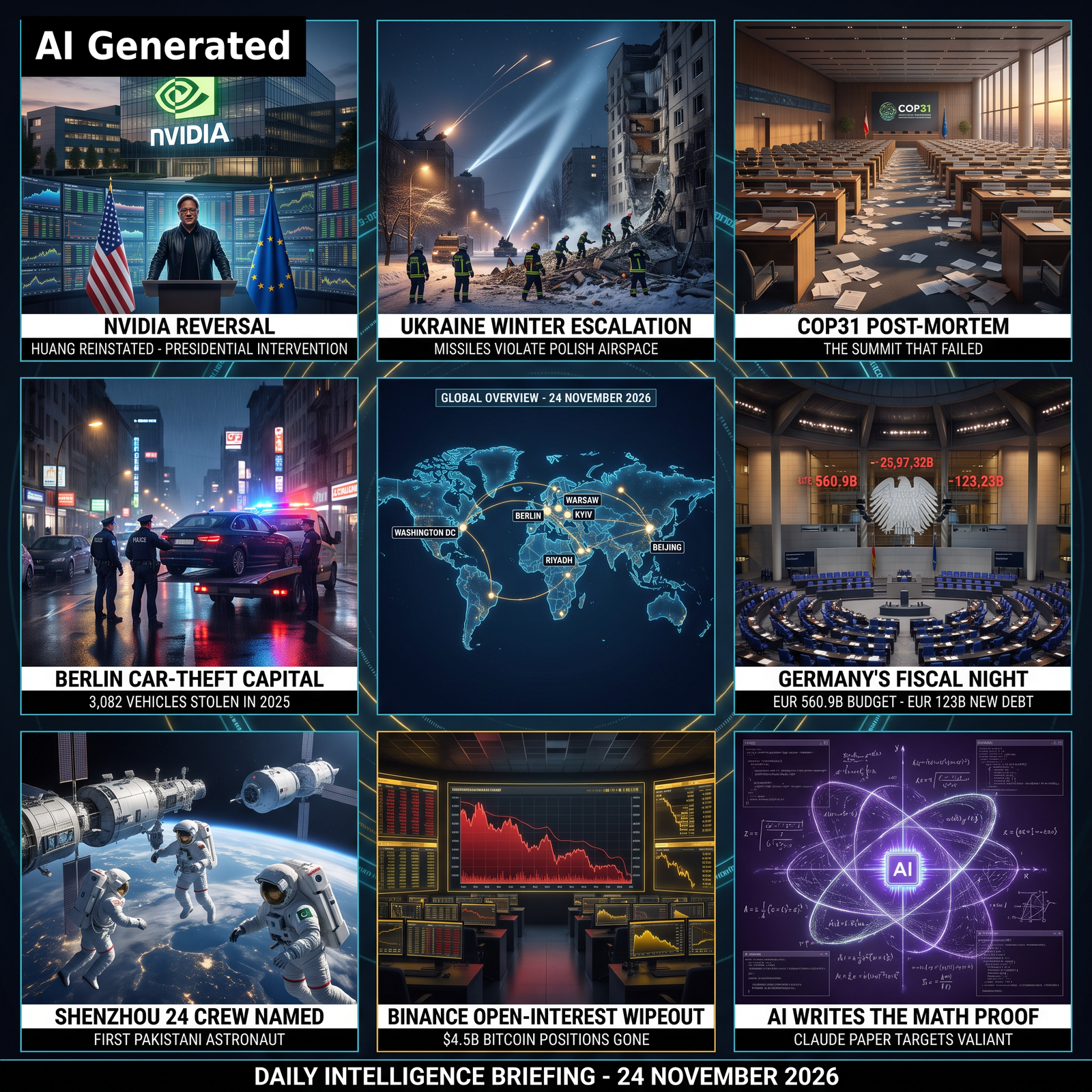
The reinstatement of Jensen Huang as chief executive of Nvidia, announced on Monday after an 11-day crisis that began with his resignation on 12 November, is the defining geopolitical-economic event of this reporting window. The board’s unanimous reversal came after direct presidential intervention: Donald Trump told CNBC he spoke to the board “directly and indirectly” and “made the deal,” while JD Vance personally lobbied for the founder’s return, a detail that widened the story beyond the White House’s official line[1][4]. The reinstatement followed a week in which the S&P 500 fell 8.6% and the Nasdaq roughly 10%, the worst sessions since April 2025 and March 2020 respectively, prompting an intervention that converted the sell-off into a state-level act of market management[3]. Bipartisan criticism was immediate: Democrats vowed investigations and prominent Republicans questioned whether the return posed a national-security risk, while the Commerce Department simultaneously blacklisted Megaspeed, the Singapore-based company at the centre of the smuggling allegations, barring it from receiving Nvidia chips without a licence[2][5]. The episode, covered in depth across D174–D176, has now moved from governance crisis to an open question about the boundary between executive power and corporate autonomy, with the SEC investigation into Nvidia’s disclosures and a California subpoena still unresolved[4].
Ukraine’s Winter Escalation and the Polish Airspace Crisis
Ukraine’s warning that Russia is preparing new air strikes dominated the eastern flank. President Zelensky said intelligence indicated preparations for fresh aerial attacks, appealing to the United States and other suppliers for more air-defence systems[27]. The warning lands days after Russian missiles violated Polish airspace, prompting NATO ambassadors to convene an emergency session in Brussels to examine Warsaw’s request for reinforced air defence[19]. Poland has now turned to the Visegrad Group after the missile incidents, seeking a coordinated response among the four central European states, while a separate incident saw a Russian drone enter Polish airspace with authorities ordering a shoot-down that was not carried out[30]. The UK Defence Secretary arrived in Kyiv the same day drones struck near the government district, pledging support “for as long as it takes” and reaffirming London’s backing for strikes inside Russian territory[28]. The Independent also reported that Russia is planning to launch a satellite carrying a nuclear weapon into space by the end of the year, a Pentagon warning that a nuclear detonation in orbit could disrupt communications and security on Earth[9].
The Gulf Clock: Yemen, Qatar and the Wider Middle East
Saudi airstrikes on vehicles and trucks in Yemen’s Lahj province killed or left missing 25 people, with the Houthis threatening retaliation and advancing toward Aden as they intensify attacks on Riyadh[8]. The strikes come as the Gulf war’s broader clock continues ticking, with Qatar’s Prime Minister looking to revive US–Iran talks after meeting Secretary of State Marco Rubio, part of Doha’s shuttle diplomacy to de-escalate tensions between Tehran and Washington before the New Year deadline signalled in D176[26]. Meanwhile, an Israeli airstrike near a police position in Khan Younis, southern Gaza, killed at least three people today[10]. The Mediterranean periphery saw a new front in Libya, where reporting examines how Albania and Turkey are “implicated” in the Ukrainian strike on a Russian corvette, with disinformation about the incident threatening fragile trust in Russia–Turkey relations[6].
Asia’s Security Geometry: Satellites, Submarines and Surveillance
Asia’s defence ledger is dense this window. Analysis by Indian firm Digantara found Chinese Earth-observation satellites carried out 37 unusual orbital manoeuvres to increase coverage over Pahalgam before the 22 April terror attack that killed 26 people, raising questions about Beijing’s role[11]. China also sentenced an official, surnamed Ma, to death for spying for a foreign country, receiving payments worth over $150,000 while working abroad[23]. The Lowy Institute’s Asia Power Index 2026 placed India third behind the US and China, with the gap to Beijing at its narrowest since 2018[12]. The Indian Navy and Coast Guard are preparing a ₹15,000 crore acquisition of 76 utility helicopters to replace ageing Cheetah and Chetak fleets, while PM Modi pushed DRDO to share technology with private industry[13][14]. On the subcontinent’s maritime flank, Pakistan’s Hangor-class submarine programme reveals deepening dependence on Beijing for propulsion, electronics and weapons, while Indonesia intercepted a China-to-Bangladesh ship carrying 405 tons of sodium perchlorate used in missile propellants, along with millions of blank SIM cards[15][20]. Italy’s defence industry is deepening ties with both India and Pakistan, a dual-track sales strategy, and Safran is investing ₹4,000 crore to expand its Telangana aerospace footprint[16][17]. India and Israel are exploring partnership on the Bharatiya Antariksh Station[18]. South Korea briefly issued an air raid warning after several Russian aircraft entered its air defence identification zone[24], and Pakistan-linked operatives are suspected of infiltrating defence WhatsApp groups used by Indian personnel, triggering a security alert[21].
The Western Hemisphere and the Wider Periphery
In the Americas, Mexico will try drug lord Fausto “El Chapo Isidro” Meza Flores despite a US extradition request, after his capture in a violent Sinaloa operation that was assisted by an American surveillance drone flown over Mexican territory[7][25]. In North Korea, Trump is trying to establish contact with Kim Jong Un but the North Korean leader is avoiding him, even as Pyongyang’s capabilities represent a potential threat to the US[22]. In Africa, the Democratic Republic of Congo is seeing church-state tensions after authorities prevented a march and a Mass, while the Rohingya genocide ruling continued to reverberate: fourteen countries, including the UK, Spain, Canada and Australia, formally recognised the ICJ decision and urged Myanmar to comply fully with international law[32][31]. Finally, Lockheed Martin’s third successful test of the reusable JR3 rocket training system, firing a full 24-round salvo from a HIMARS launcher, points to a future of more affordable artillery training[29].
Environment & Climate ↑ Contents
COP31’s Aftermath: The Post-Mortems and What They Reveal
The collapse of the COP31 climate summit in Antalya continues to dominate the climate-policy ledger, though this window’s coverage is analytical rather than event-driven. Nature’s reflection on the first international climate summit to fail since 2009 argues that the breakdown over fossil-fuel language sends an important message about the limits of consensus diplomacy[39]. Grist’s deep reconstruction describes the talks as climate diplomacy’s “darkest moment”: more than 90 nations, including the EU and the Marshall Islands, rejected a cover decision that omitted the words “fossil fuels,” while roughly 700 carbon-capture lobbyists registered for the summit—one more than the G7 delegations combined[42]. Experts quoted in AP coverage warn that the failure could worsen climate inequality, even as they note that progress continues on non-UN tracks[37]. The analytical consensus points to a structural conclusion first surfaced in D173–D176: petrostates, led by Saudi Arabia and Russia, blocked both the fossil-fuel reaffirmation and the “35% by 2035” electrification pledge, accelerating the shift of meaningful climate action to coalitions operating outside the UN framework[42].
America’s Weather and Hazard Ledger
On the domestic front, San Francisco is bracing for king tides, heavy rain and potential flooding at the airport ahead of Thanksgiving week, with the mayor warning of “extremely high tides, heavy rain, strong winds, and potential flooding”[36]. In Iowa, a federal appeals court has cleared the way for the Army to detonate nearly five tons of lead-based explosives in the southeast of the state on Wednesday, releasing a plume of lead dust; the Army had argued it does not need permission, and the case has become a test of environmental review under this administration[43]. In Alabama, the owner of a pipeline that exploded in a massive fireball visible from 50 miles away is simultaneously fighting to expand its network through rural, historically Black communities—an environmental-justice flashpoint that links the fossil-fuel build-out to the permitting fights tracked in D176[40].
The Energy-Transition Ledger: Electrification, Hydrogen and the Grid
The Bipartisan American Affordability and Jobs Act (BAAJA), which passed the Senate, has split the clean-energy community: the solar industry supports its permitting and transmission reforms while environmental organisations oppose it, a division that will shape the House debate[34]. In Europe, Barcelona’s hydrogen bus network is entering what analysts describe as a “death spiral” as fuel-supply contracts contract, exposing the financial risk of keeping hydrogen fleets running when support markets shrink—a cautionary data point for the EU’s hydrogen ambitions[48]. The UK’s tidal-stream sector argues that turbines in the Solent, off Anglesey and in Scottish waters could boost the transition and growth, while Aldi Süd’s disclosed sustainability strategy—centred on prioritised supply-chain interventions in coffee, cocoa, dairy, beef and fresh produce—shows a major retailer holding to its SBTi-validated targets despite a two-year reporting gap[38][41]. Australia and Singapore signed a carbon-capture treaty, a notable bilateral instrument for cross-border CO2 storage[35].
The Living and Water Ledger: From Kashmir to the Amazon
An excavator near the sacred alpine Sheshnag Lake in India-administered Kashmir has sparked outrage, with footage raising questions about construction in a protected high-altitude catchment[33]. In the Brazilian Amazon, longer droughts are drying the waterways that riverine communities and floating health clinics depend on, with river levels across the basin “below or far below average” and channels turning to mud[44]. China’s mangroves have bounced back—cover more than doubled between 1998 and 2020 and bird species rose from 148 to 397—offering a rare restoration success story[45]. In the United States, Lake Mead’s falling water has re-exposed the ruins of St. Thomas, a 19th-century Mormon town, and the park service is planning low-water operations at Temple Bar Marina as the reservoir continues its two-decade decline[46]. In South Africa’s Limpopo province, residents of Boelang are still uncertain whether repairs to flood-damaged water infrastructure will withstand the next flood—a reminder that adaptation spending lags disaster frequency[47].
Society & Civil Issues ↑ Contents
Germany’s Civic Ledger: Car Theft, Domestic Violence and the Left
Germany’s GDV insurance association released its 2025 vehicle-theft statistics, confirming Berlin as the “capital of car theft” with 3,082 insured vehicles stolen and an average claim of roughly €20,300, even as national thefts fell nearly 14% to 12,211—a decline attributed to mandatory immobilisers introduced in the 1990s and improved security technology[49]. The federal government and the BKA will present their annual situation reports on domestic violence and gender-specific crime against women on Tuesday; the 2024 report already showed a record 265,942 victims, over 70% female, and the new gender-specific report covers hate crime, digital violence and trafficking[50]. In Berlin politics, the Left party’s parliamentary group votes on expelling MP Vanessa Emde, criticised for anti-Israeli positions, with a two-thirds majority required; the party leadership has demanded she return her direct mandate, which she refuses[51].
France’s 2027 Chessboard: Attal, Lavalette and the Institutions
French political life continues to churn ahead of 2027. Gabriel Attal’s parliamentary group—described by Le Parisien as “neither fish nor fowl”—is preparing for a “grand clarification,” a realignment that could reshape the centre-right landscape[52]. The Rassemblement National is managing a different kind of crisis: party president Jordan Bardella deplored the “faute” of deputy Laure Lavalette, accused of having endorsed antisemitic writings in the 1990s, while ruling out any sanction against Marine Le Pen’s campaign spokeswoman[64]. Bardella separately told BFMTV that to his knowledge nobody in the RN benefited from leaks and called the timing of the raid on the party headquarters “strange”[65]. Six La France Insoumise deputies—Coquerel, Léaument, Legrain, Mesmeur, Portes and Bilongo—are filing a joint complaint over anonymous death threats that included swastikas[68]. Meanwhile, a student-and-teacher inter-union is calling for mobilisation on 26 November over higher-education funding and working conditions[63], and health authorities have flagged hundreds of poisonings linked to ultra-toxic “CBD” products containing synthetic drugs sold online and in shops[66].
The British Ledger: Policing, Immigration Perception and the Workplace
London’s Metropolitan Police announced more than 260 arrests and 500 confiscated knives in a crackdown that helped cut knife-enabled robbery by 16.6% over the past year[55]. A YouGov/King’s College London survey underlines how far public perceptions of immigration diverge from the data: 63% of Britons believed net migration rose in the year to June 2025 when it actually fell 66% from 649,000 to 219,000, and most respondents overestimate small-boat crossings and the UK’s refugee numbers relative to other large European countries[59]. On the workplace front, Acas research shows workplace conflict cost UK employers an estimated £51 billion a year, with 14 million employees experiencing conflict in 2025[62]. The Hong Kong fire anniversary also belongs in this ledger: a year after the territory’s deadliest blaze in decades killed 168 people across seven high-rise blocks, safety reforms and their enforcement remain contested[60].
The Americas’ Justice and Fiscal Ledger
In Washington, a magistrate judge has unsealed documents from the federal search of Representative Ilhan Omar’s home, ruling the Minnesota Democrat was entitled to congressional privacy protections; the filings show the administration believes violations may date back to 1980[56]. President Trump, in a speech at the Justice Department, asked prosecutors to seek the death penalty for child murderers, rapists and traffickers who killed their victims, and said he had asked to “accelerate” federal executions[57]. An Ohio woman who survived a brutal rape that went unsolved for decades was awarded a $98 million civil judgment against the doctor who admitted the assault but could not be prosecuted because the statute of limitations had expired[58]. In Canada, Montrealers face a nearly 10% property-tax hike in 2027, tied largely to aging-infrastructure investment including water systems[54]. And in Denmark, a Copenhagen court fined Greta Thunberg and five other activists between 159 and 958 euros for illegally entering Copenhagen University during a pro-Palestinian protest in 2024, with an appeal under consideration[53]. Australia’s Pauline Hanson faces her biggest electoral test as debt and anger align in a state vote[61], and a cyberattack on the Guadeloupe university hospital has prompted the Paris prosecutor’s office to open an investigation[67].
AI & Technology ↑ Contents
The AI-Mathematics Frontier: Valiant, Riemann and the Machine
Anthropic has published a 70-page mathematical paper credited entirely to Claude claiming to settle Valiant’s conjecture, the algebraic-complexity analogue of P versus NP: the paper, titled “VP ≠ VNP over every field,” establishes superpolynomial lower bounds on the operations required to compute the permanent of an m-by-m matrix, with a Lean 4 formalisation passing automated checks[71]. The claim remains unconfirmed—no human mathematician has yet reviewed the proof, and Anthropic itself warns the formalisation may not capture every claim—but it marks an unusual milestone in machine-generated mathematics. The context matters: the same week, Anthropic mathematician Levent Alpöge clarified that the widely circulated figure of a “250,000-page Riemann Hypothesis proof” was a joke, apologising for the confusion and explaining he published a Lean formalisation rather than a conventional paper because he considered a massive machine-generated explanation unsuitable for publication[74]. Together the two stories define the state of AI mathematics in late 2026: extraordinary formal productivity, unresolved epistemic standing, and a widening gap between machine-verified reasoning and human-understandable proof[71].
Security at the Frontier: Shirudo, Grok and the Platform Vigilante
OpenAI and Cisco released Shirudo, an open-source security runtime that uses eBPF to deploy temporary “shields” against vulnerable code paths without restarting services; in a demonstration, a shield generated by OpenAI’s Codex blocked a Java4Shell exploit against Elasticsearch while the application kept running[73]. The project addresses the gap between vulnerability discovery and patch deployment—days or weeks in which systems remain exposed—and OpenAI president Greg Brockman framed it as protecting systems that must remain operational while permanent fixes are developed. In a separate front, Oregon and Virginia sued SpaceX over Grok’s ability to generate sexualised images of women and children, citing millions of “spicy mode” images; the suit extends the AI-safety litigation wave tracked since D171[72]. And Elon Musk issued a striking ultimatum: “Those who violate the law on this platform WILL be prosecuted, WHEREVER they may be in the world,” after the Justice Department’s Criminal Division opened a fraud investigation into X Money under its Cyber-Enabled Scam Initiative[70].
Models, Products and Governance
Z.ai released GLM-5.4, its first flagship built on a Loop Transformer architecture that reuses the same layers twice rather than stacking new ones, aiming to match models up to four times its size without adding parameters—following Thinking Machines Lab’s Inkling 2 Mini in the looped-transformer trend[75]. Google is pursuing personalised AI-generated video: a patent filing reveals plans for a TV service that produces content based on viewing habits, effectively an AI “slop” channel starring the user[76]. In governance, UN Secretary-General Antonio Guterres called on member states to build a multilateral framework for managing AI risks within the next year, starting with common safety measures, evaluation systems and minimum independent-oversight requirements[79]. California’s Attorney General Rob Bonta submitted an amicus brief in Epic v. Apple, inserting the state into the app-store antitrust fight[78]. Uber expanded its in-car safety offer, letting riders in four cities request trips with drivers using the “Record My Ride” feature[69]. And the GTA VI hacker Arion Kurtaj—who leaked 90 videos of the game in 2022 and pleaded guilty to hacking Rockstar, Uber and Revolut—was sentenced to seven years but released on licence, with the judge urging him not to waste his talents[77].
Economy & Business ↑ Contents
The AI-Capital Storm: Anthropic’s Slide, DeepSeek’s Wealth and the Market’s New Beat
The AI-capital ledger remains the most volatile column in global markets. Anthropic’s shares slid in their first days on the Nasdaq after the record IPO, highlighting investor caution and the broader market’s sensitivity to AI-sector fluctuations[90]; CEO Dario Amodei unloaded 3.38 million Class A shares at $83 apiece on 20 November, per an SEC filing[102]. Asian stocks rallied as Jensen Huang’s return revived the AI trade, with the Nikkei and Hong Kong benchmarks surging after Wall Street’s rebound[94]. DeepSeek founder Liang Wenfeng’s fortune climbed to an estimated $55 billion after a new raise, underscoring China’s strategic push to bolster its AI sector[96]. Hewlett Packard Enterprise beat on EPS and revenue and lifted its fiscal 2027 outlook, a signal that AI-infrastructure demand remains strong at the enterprise level even as equity volatility persists[95]. The macro backdrop is being set by the Federal Reserve: John Williams, the New York Fed president, said 2027 will be a year of lower inflation and that the economy has been resilient, while cautioning that companies want to hire but are being careful[105].
Germany’s Fiscal Night and the Industrial Front
The Bundestag opened its four-day final budget debate for 2027 with spending of €560.9 billion and net new borrowing of almost €123 billion, with a last-minute coalition deal to cut the electricity tax to the European minimum adding €5.4 billion to the plan[81]. Handelsblatt’s analysis portrays Finance Minister Lars Klingbeil as a “debt trickster” exploiting new credit exemptions, questionable loans and shadow accounts that push the burden into the future[87]. On the industrial front, Volkswagen and IG Metall opened tariff negotiations in Emden with hardened fronts: VW has terminated its collective agreements and demands flexible working hours tied to utilisation with proportional pay cuts downward, zero rounds for 2027-2028 and the elimination of tariff allowances[82]; a confidential letter reveals the board’s savings demands go further than publicly known, reaching into earlier wage promises[88]. The retail sector is consolidating: Hellweg and Baywa Bau-&-Gartenmärkte closed their final stores after insolvency, with Obi, Bauhaus, Hornbach and Hagebau taking over roughly a quarter of the 114 sites and absorbing staff[80]. Meanwhile, US investors and companies are increasingly targeting German industrials—EBM-Papst, Trench and TKE among them—raising questions about whether the Mittelstand is facing an American takeover wave[89]. The Deutsche Bank data leak has parliamentary consequences, with the Greens pressing for answers on the security of covert investigators’ accounts[86].
Asia’s Ledgers: Rates, PMIs and Trade Policy
South Korea’s central bank is expected to raise rates on Thursday and once more next quarter, per a Reuters poll, as it fights inflation and currency pressure[97]. Singapore raised its 2026 growth forecast after a 6.1% Q3 expansion[98]. Japanese PMI flashes showed manufacturing at 53.7 (up from 53.3) while the composite dipped to 51.5 from 52.1, a mixed signal from the world’s fourth-largest economy[99][100]. India’s informal sector rebounded in Q2 FY27 with a 9.2% sequential rise in enterprises and 9.7% in employment, led by rural recovery, while industry body CII responded to PM Modi’s call by seeking greater regulatory transparency and easier cross-border capital flows[83][92]. The RBI proposed a “stop switch” for digital payments—customer-set transaction limits and trusted-person authentication for high-value transfers—to curb digital fraud[84]. The EU’s amended EV incentive proposal continues to exclude Japan-made cars, a protectionist signal that will feed the transatlantic and transpacific trade debates[93], while Malaysia’s PM said US chip curbs will not affect ties with China[85]. In the North Sea, decommissioning spending is forecast at £24.7 billion between 2026 and 2035, a structural cost for the energy transition[101]. The Canadian dollar neared an 18-month low ahead of US PCE data, with weakness pressuring the Bank of Canada’s policy calculus[91], and ANZ brought forward its first RBA rate-cut forecast to June 2027[104]. Meta Platforms disclosed in an SEC filing that it will delay its at-the-market programme until after its Class C stock dividend payment[103].
Science & Space ↑ Contents
The Cosmic Ledger: Shenzhou 24, Radar Satellites and the Solar Tail
China unveiled the crew for its Shenzhou 24 spacecraft, set to launch this week, including a Pakistani astronaut who will board the Chinese space station—a milestone in the Sino-Pakistani partnership and a signal of the expanding crewed-space club[106]. In the commercial-space domain, US firm Umbra unveiled Freetail 5 (FT-05), a 200-kilogram radar satellite combining a 5-metre mesh antenna with software-defined architecture to capture 5-cm imagery through clouds and darkness, with four times the radar power and twice the antenna area of existing spacecraft; first launch is targeted for early 2028 with applications in defence, intelligence and maritime surveillance[107]. Closer to home, a Southwest Research Institute-led study used NASA’s IBEX spacecraft to map the distinct motion paths of the heliotail lobes over 14 years, showing how solar activity shapes the tail of the heliosphere[118].
Physics Frontiers: Quantum, Gravity and the Maser Revival
Two quantum advances dominated the physics feed. Researchers at the Okinawa Institute of Science and Technology showed that a 72-year-old invention—the maser—is finding new life inside diamond, offering a potential route to more powerful quantum computers without overwhelming sensitive measurement systems[108]. A separate team demonstrated that local measurements can reveal global quantum properties in a constant number of experimental runs, tackling the state-tomography bottleneck that grows exponentially with qubit count[115]. At the University of Queensland, physicists transmitted a message through a solid wall using gravity rather than electromagnetic signals—an unconventional communication system built from a moving elevator counterweight and an extremely sensitive instrument, with implications for environments where radio is blocked[114]. Meanwhile, a CNRS-led study in Acta Acustica challenged the violinist’s belief that instruments “open up” with playing: after six months of regular play, the professional soloist felt the violin had improved, yet no physical or acoustic measurement confirmed the change[109].
The Biomedical and Deep-Time Ledger
Eight fossil teeth from two caves in southern China show Homo erectus survived in closed rainforest between 324,000 and 184,000 years ago, the youngest reliably dated occurrence of the species in China and the first clear direct evidence of another hominin living in rainforest habitats—previously considered the domain of Homo sapiens[110]. Researchers cracked part of the natural-production code for Taxol (paclitaxel), one of the world’s most important cancer drugs, opening the possibility that tobacco plants could produce the medicine more cheaply[113]. A 2024 King’s College London twin study cited increasingly often found that daily prebiotic supplements (inulin or FOS) improved memory-test scores in people over 60, with the Bifidobacterium microbiome link now being tested in the Wageningen-led PRECODE clinical trial[117]. Electron microscopy at ISTA uncovered the inner workings of the poxvirus core, showing gene-copying machines parked in dormant pairs and export portals in the core shell—relevant as mpox clusters persist in Brazil, Thailand and Austria[116]. Darwin’s finches provided another evolutionary window: a genetic-mosaic study explains the diverse beak forms of insect-eating tree finches, expanding understanding beyond the well-studied ground finches[112]. And a six-legged soft robot made entirely of 3D-printed, air-powered materials runs, swims and climbs without any electronics, reaching 10.6 mph—the fastest soft robot of its class, promising safe exploration of radiation- or magnetically-hostile environments[111].
Crypto, Digital Assets & Blockchain ↑ Contents
The Deleveraging and Treasury Ledger
The digital-asset market enters this window in a state of pronounced structural adjustment rather than directional panic. Binance recorded the largest Bitcoin open-interest decline in its history: roughly $4.5 billion in open interest was wiped out over the past year, with a 40% fall on the exchange and a 45% plunge in July alone, data that CryptoQuant attributes to macro concerns and elevated volatility rather than a single liquidation event[121]. The deleveraging is consistent with the institutional-flight dynamics tracked in D169–D176: speculative leverage is being priced out while regulated rails expand. Corporate treasury stress is visible on the Ethereum side: BTCS, a blockchain infrastructure firm, sold more Ethereum than it has left to repay $43.8 million in debt on Aave, a sale that also paused fees on withdrawn capital from a separate Imperium pool—a reminder that crypto-native balance sheets remain fragile in a high-rate environment[119]. DeFi credit dynamics are tightening in tandem: Aave’s USDC loans surged 36% to $2.6 billion while the share of liquid collateral plunged, and a TokenLogic model suggests roughly 240,000 USDC could sit above target if queued withdrawals follow historical rates—evidence that stablecoin credit demand is concentrating even as collateral quality thins[122].
Institutional On-Ramps and Tokenisation
Institutional adoption continues along the tokenisation and trading-infrastructure axis. Stellar (XLM) led major blockchains in 30-day tokenisation growth by net inflow—the difference between minted and burned tokens—even as the broader market stayed bearish, reinforcing the thesis that asset-tokenisation flows are decoupling from speculative price action[123]. OKX Australia opened equity and commodity perpetual futures to retail traders, democratising market access while raising familiar risk-management questions about platform stability and retail exposure[124]. On the legal front, a California court terminated a lawsuit against Coinbase over TerraUSD purchases: plaintiff Larry Pearl bought UST shortly before the token collapsed and accused the exchange of misrepresentation, but the court dismissed the claim—a data point in the still-evolving UST-litigation ledger that began with the 2022 collapse[120].
Protocol Governance: The Ethereum Foundation’s Overhaul
The most strategically significant development is the Ethereum Foundation’s reorganisation. The foundation doubled its protocol-security team ahead of a major overhaul, with leadership stating that the next upgrade will be harder than the Merge and that the required pace of development makes it easier to ship bugs—a candid admission that security engineering must scale faster than feature velocity[125]. The restructuring—which follows a 20% staff reduction reported in parallel coverage—prioritises protocol security and post-quantum research, signalling that Ethereum’s leadership now treats quantum resistance and defensive engineering as first-order protocol concerns rather than roadmap afterthoughts[125]. The timing is consequential: with institutional tokenisation activity concentrating on Ethereum-compatible rails and the SEC’s posture toward digital assets shifting under the new administration, the foundation’s ability to ship a harder-than-Merge upgrade without critical bugs will be a defining test of whether the protocol layer can absorb the institutional inflows that the exchange and custody infrastructure are already accommodating. The foundation’s move also validates the D171–D176 observation that the crypto ecosystem is bifurcating into speculative retail markets, where leverage is bleeding out, and institutional infrastructure, where capital is consolidating around compliant, security-hardened venues[121][124].
Correlations & Analysis ↑ Contents
The master variable of the D177 window is the same one that has governed this report series since D171: the gravitational pull of concentrated power—now corporate as much as military—on every other system. But this window the geometry has shifted decisively. Yesterday’s D176 report closed on the Gulf clock and Ukraine’s winter escalation; today the sharpest escalation happened not in a war zone but in a boardroom, when the Nvidia board reinstated Jensen Huang under direct presidential and vice-presidential pressure[1]. The event fuses the two narrative tracks this series has tracked for two weeks: the AI-capital storm that began with Huang’s 12 November resignation and the broader question of how much systemic risk a single executive carries. Fortune’s reconstruction makes explicit what the market already suspected—that the S&P 500’s worst week since April 2025 and the Nasdaq’s worst since March 2020 armed Huang’s supporters with the argument that his absence itself was a systemic threat[3]. The state-level intervention that followed converts the AI economy’s dependence on one individual into a matter of national industrial policy, with export controls, blacklists and presidential phone calls now part of the governance machinery of America’s largest chipmaker[5].
The second through-line is the continuation of D175–D176’s “escalation outward” pattern in the security domain. The Gulf clock that D176 framed around Trump’s New Year deadline now runs in parallel with Qatar’s shuttle diplomacy and fresh Saudi strikes in Yemen, while Poland’s airspace crisis—three Russian missiles, then a drone—has moved from NATO emergency sessions to the Visegrad Group and Kyiv’s warning of new Russian air strikes[26][30][27]. The pattern identified in D175—that escalation migrates horizontally into new rings rather than rising vertically—is confirmed: the Black Sea war has reached Benghazi harbour in Libya, the Baltic air-defence question has reached Polish villages, and the space domain has re-entered the nuclear conversation with reports of a Russian nuclear-armed satellite plan[6][9]. Each ring adds a new escalation surface that the alliance system must price into its response ladder, and none of the rings shows signs of de-escalation.
The climate ledger offers a contrasting lesson in systemic failure. D176 closed on COP31’s collapse with nothing adopted; this window’s post-mortems explain why the failure was structural—petrostates blocking fossil-fuel language and an electrification pledge while 700 carbon-capture lobbyists outnumbered G7 delegations[42]. The analytical consensus, echoed in Nature and Grist, is that climate action is migrating outside the UN framework into coalitions, corporate supply-chain programmes and bilateral instruments such as the Australia–Singapore carbon-capture treaty[39][35]. The correlation with the governance crisis in AI is instructive: both systems are experiencing a legitimacy deficit in their central institutions (UNFCCC consensus, corporate boards) while power concentrates in fewer hands (petrostates, founders, executives). Aldi’s decision to keep its SBTi targets while pausing full sustainability reporting is the corporate analogue of the same phenomenon—commitments persist, accountability lags[41].
The fourth thread connects the security and market ledgers through the concept of fragile concentration. The Nvidia episode, the Anthropic IPO slide, the Binance deleveraging and the Ethereum Foundation’s security overhaul all describe systems whose stability depends on a small number of critical nodes—an executive, a token, a team[90][121][125]. When those nodes fail or change, the entire system reprices. The same logic applies to the human ledger: the Rohingya genocide ruling’s endorsement by 14 countries, the Hong Kong fire anniversary and the German domestic-violence statistics all measure the cost of institutional failure at human scale[31][60][50]. The correlation between technical-system fragility and social-system fragility, tracked since D170’s “fragility wave,” remains the report’s most consistent finding: the same complexity that makes AI markets and energy grids efficient makes them brittle, and the brittleness is now visible simultaneously in markets, infrastructure, climate governance and democratic institutions.
What to watch in the next reporting period: (1) Whether the SEC investigation and California subpoena into Nvidia’s disclosures produce findings that complicate Huang’s reinstatement; (2) whether Qatar’s shuttle diplomacy converts into actual US–Iran talks before the New Year deadline, and whether Saudi strikes in Yemen trigger a Houthi response that reopens the Bab al-Mandab front; (3) the outcome of Poland’s Visegrad consultations and NATO’s air-defence reinforcement decisions after the missile and drone incidents; (4) the VW–IG Metall negotiations in Emden and whether the “zero-rounds” demand triggers warning strikes before year-end; (5) the Bundestag’s Friday vote on the 2027 budget and its record €210 billion debt footprint; and (6) whether the Ethereum Foundation’s security-first overhaul ships the next upgrade without incident—the first test of whether post-quantum and defensive engineering can keep pace with institutional adoption.
References ↑ Contents
1. It wasn’t just Trump: Vance also ‘personally’ pushed for Nvidia to reinstall Jensen Huang by Jasmine Fernández · Source ↑
2. Trump’s role in bringing Huang back to Nvidia met with bipartisan criticism by NEWS via d k on Inoreader · Source ↑
3. A selloff, a POTUS, or a recession: What really made Nvidia bring Jensen Huang back as CEO? by Morgan Chittum · Source ↑
4. The 11 days that brought Jensen Huang back to Nvidia by Sebastian Herrera · Source ↑
5. Megaspeed, société singapourienne au cœur du scandale Nvidia, placée sur liste noire américaine by FRANCE 24 · Source ↑
6. Λιβύη: Πώς «εμπλέκονται» Αλβανία και Τουρκία στο ουκρανικό πλήγμα κατά της ρωσικής κορβέτας; by Greece via d k on Inoreader · Source ↑
7. Mexico to try ‘El Chapo Isidro’ despite US extradition request by NEWS via d k on Inoreader · Source ↑
8. Σαουδαραβικοί βομβαρδισμοί με 25 νεκρούς ή αγνοούμενους στην Υεμένη, οι Χούθι απειλούν με αντίποινα by Greece via d k on Inoreader · Source ↑
9. Russia ‘planning to launch satellite with nuclear weapon into space by end of the year’ by James C. Reynolds · Source ↑
10. Τουλάχιστον 3 νεκροί σε νέα αεροπορική επιδρομή του Ισραήλ στη Γάζα by Newsroom · Source ↑
11. Chinese Satellites Made 37 Unusual Manoeuvres To Increase Coverage Over Pahalgam Before April 22 Terror Attack: Report by Indian Defence News · Source ↑
12. Asia Power Index 2026: India Retains Third Spot After US, China; Gap With China Narrows To Lowest Level Since 2018 by Indian Defence News · Source ↑
13. Indian Navy, Coast Guard Eye ₹15,000 Crore Deal For 76 Utility Helicopters To Replace Ageing Cheetah, Chetak Fleet by Indian Defence News · Source ↑
14. PM Modi Pushes DRDO To Share Technology With Private Industry And Deepen R&D Collaboration by Indian Defence News · Source ↑
15. Pakistan’s Hangor Submarines: An Unproven Chinese Engine And A Deepening Dependence On Beijing by Indian Defence News · Source ↑
16. Italy’s India-Pak Masterclass In Defence Sales: Keep Both Navies Busy, Keep Both Cheques Coming by Indian Defence News · Source ↑
17. Safran To Invest ₹4,000 Crores To Expand Telangana Aerospace Manufacturing Footprint by Indian Defence News · Source ↑
18. India And Israel Explore Partnership For Bharatiya Antariksh Station by Indian Defence News · Source ↑
19. Συναγερμός στην Πολωνία από ρωσικό drone, δόθηκε εντολή κατάρριψης αλλά δεν άνοιξαν πυρ by Greece via d k on Inoreader · Source ↑
20. China-To-Bangladesh Ship Carrying 405 Tons of Missile Material Intercepted By Indonesia, Millions of Blank SIM Cards Seized by Indian Defence News · Source ↑
21. Pakistan-Linked Operatives Suspected of Infiltrating Defence WhatsApp Groups, Triggering Security Alert by Indian Defence News · Source ↑
22. Ο Τραμπ προσπαθεί να επικοινωνήσει με τον Κιμ Γιονγκ Ουν και ο βορειοκορεάτης τον αποφεύγει by Σοφοκλής Αρχοντάκης · Source ↑
23. China sentences official to death for spying for foreign country by Associated Press · Source ↑
24. South Korea briefly issues air raid warning after Russian jets enter air defence zone by Via AP news wire · Source ↑
25. US flew surveillance drone over Mexico to help capture top drug lord by FRANCE 24 · Source ↑
26. Qatar PM looks to revive US-Iran talks after meeting Rubio by NEWS via d k on Inoreader · Source ↑
27. Β.Ζελένσκι: «Η Ρωσία ετοιμάζει νέα αεροπορικά πλήγματα στην Ουκρανία» by DEFENCE via d k on Inoreader · Source ↑
28. Στο Κίεβο ο Βρετανός υπ.Άμυνας – Υποσχέθηκε «στήριξη» για όσο χρειαστεί by DEFENCE via d k on Inoreader · Source ↑
29. US fires full 24-round load in third successful test of reusable rocket system by Aamir Khollam · Source ↑
30. +++ Ukraine-Krieg +++: Polen wendet sich nach Raketenvorfällen an Visegrad-Gruppe by Redaktion Handelsblatt · Source ↑
31. Génocide des Rohingya en Birmanie : 14 pays reconnaissent la décision de la CIJ by FRANCE 24 · Source ↑
32. RD Congo : une messe interdite, tensions entre l’Eglise et les autorités by Célia CARACENA · Source ↑
33. Excavator threatens sacred alpine lake in the Himalayas by NEWS via d k on Inoreader · Source ↑
34. Solar Industry Supports BAAJA While Environmental Orgs Oppose It by Z. S · Source ↑
35. Australian politics live: Australia and Singapore sign carbon capture treaty; ANZ predicts RBA could cut rates in June by Krishani Dhanji · Source ↑
36. San Francisco Airport Could Flood This Week Before Thanksgiving by Matt Novak · Source ↑
37. Experts say failed climate talks could worsen climate inequality, though all progress is not stalled by Tammy Webber · Source ↑
38. Tidal power across Solent and Wales can boost transition and growth, sector says by Rebecca Speare-Cole · Source ↑
39. COP31 went down in flames over fossil fuels — it sends an important message by James Dinneen · Source ↑
40. An Alabama Pipeline Exploded. Its Owner Is Fighting To Expand It. by Lee Hedgepeth, Dennis Pillion · Source ↑
41. No more ‘who shouts the loudest’: How Aldi decided where to spend on sustainability by Jim Giles · Source ↑
42. How COP31 became climate diplomacy’s ‘darkest moment’ by Joseph Winters · Source ↑
43. Court Decision Clears Way for Army to Detonate Lead Explosives in Iowa by Anika Jane Beamer · Source ↑
44. Longer droughts threaten floating health clinics as Amazon streams run dry by Alexandre de Santi · Source ↑
45. China’s mangroves have bounced back. Birds have returned too by Rhett Butler · Source ↑
46. More than 160 years ago, Mormon settlers founded a farm town on Nevada’s Muddy River; its last resident rowed away in 1938, and its ruins can be seen again with Lake Mead low by Adrián Villellas · Source ↑
47. In South Africa’s Limpopo, residents wonder what the next flood will bring by Calvin Rock · Source ↑
48. Barcelona Is Suffering From The Hydrogen Transport Death Spiral by Michael Barnard · Source ↑
49. Kriminalität: Berlin bleibt Hauptstadt des Autodiebstahls by Germany via d k on Inoreader · Source ↑
50. Regierung und BKA stellen Lagebild zu „häuslicher Gewalt“ vor by Germany via d k on Inoreader · Source ↑
51. Berliner Linksfraktion stimmt über Ausschluss von Abgeordneter Emde ab by Germany via d k on Inoreader · Source ↑
52. « Il y aura une grande clarification » : à l’Assemblée nationale, le groupe sans queue ni tête de Gabriel Attal by France via d k on Inoreader · Source ↑
53. Δανία: Πρόστιμο στην Γκρέτα Τούνμπεργκ και σε πέντε ακόμη ακτιβιστές για διαμαρτυρία υπέρ των Παλαιστινίων by Σταύρος Ιωακείμ · Source ↑
54. Montrealers could face nearly 10% property tax hike in 2027 by Alessia Maratta · Source ↑
55. Met Police make more than 260 arrests and confiscate 500 knives in crackdown by John Besley · Source ↑
56. Judge unseals documents related to search of Rep. Ilhan Omar’s home by Raquel Coronell Uribe · Source ↑
57. Donald Trump demande au ministère de la justice de requérir la peine de mort pour les meurtriers d’enfants by France via d k on Inoreader · Source ↑
58. $98 million civil judgment awarded in Ohio rape that could not be prosecuted by Tim Stelloh · Source ↑
59. Fact Check: What You’re Getting Wrong About The State Of UK Immigration by Kate Nicholson · Source ↑
60. A year on, what to know about Hong Kong’s deadly fire that killed 168 by Kanis Leung · Source ↑
61. Australia’s Pauline Hanson faces biggest test as debt and anger align in state vote by Reuters · Source ↑
62. Workplace conflict costs employers £51 billion a year, new data shows by Alan Jones · Source ↑
63. Une intersyndicale des étudiants et des enseignants du supérieur appelle à la mobilisation le 26 novembre by France via d k on Inoreader · Source ↑
64. Jordan Bardella déplore la « faute » de la députée RN Laure Lavalette, accusée d’avoir cautionné des écrits antisémites dans les années 1990 by France via d k on Inoreader · Source ↑
65. Jordan Bardella affirme qu’"à sa connaissance" personne au RN n’a bénéficié de fuites et juge "étrange" le "timing" de la perquisition du siège de son parti by France via d k on Inoreader · Source ↑
66. "Il y a des matins où je n’arrivais même plus à me lever" : alerte au CBD ultra-toxique, vendu sur internet et jusqu’en boutiques by France via d k on Inoreader · Source ↑
67. Le parquet de Paris ouvre une enquête après une cyberattaque visant le CHU de Guadeloupe by France via d k on Inoreader · Source ↑
68. Six députés de la France insoumise vont porter plainte pour des menaces de mort anonymes by France via d k on Inoreader · Source ↑
69. Uber Riders Can Now Request to Have Their Trips Recorded by Antuan Goodwin · Source ↑
70. Τελεσίγραφο Μασκ: «Όσοι παρανομούν στο X θα διώκονται όπου κι αν βρίσκονται» by DEFENCE via d k on Inoreader · Source ↑
71. Anthropic says Claude proved VP ≠ VNP, tackling Valiant’s 47-year-old conjecture by Aamir Khollam · Source ↑
72. SpaceX Sued by 2 States Over Grok’s Sexualized Images of Women and Children by Alex Valdes · Source ↑
73. OpenAI’s Codex builds security shields to block attacks on running Linux systems by Neetika Walter · Source ↑
74. 250,000-page Riemann Hypothesis proof ‘was a joke,’ Anthropic mathematician says by Aamir Khollam · Source ↑
75. Z.ai’s GLM-5.4 aims to match models up to four times its size by running 28 layers twice by Technology via d k on Inoreader · Source ↑
76. Google Imagines a Personalized TV Channel Full of AI Slop, Starring You by Ty Pendlebury · Source ↑
77. The hacker behind early GTA VI leaks has been sentenced — and released by Jay Peters · Source ↑
78. FinancialJuice: California AG: Attorney General Bonta submits amicus brief in Epic v. Apple by FinancialJuice · Source ↑
79. Le chef de l’ONU espère voir d’ici un an un mécanisme pour limiter les risques posés par l’IA by FRANCE 24 · Source ↑
80. Insolvenz: Hellweg verschwindet – Was wird jetzt aus den Baumärkten? by Germany via d k on Inoreader · Source ↑
81. Etat 2027: Was an dieser Bundestagswoche besonders ist by Germany via d k on Inoreader · Source ↑
82. Verhandlungen über VW-Haustarifvertrag beginnen in Emden by Germany via d k on Inoreader · Source ↑
83. India’s informal sector rebounds in Q2FY27 led by rural recovery: NSO by Business via d k on Inoreader · Source ↑
84. RBI looks to arm customers with a ‘stop switch’ for digital payments by Business via d k on Inoreader · Source ↑
85. US chip curbs won’t impact Malaysia’s China ties, PM says by Reuters · Source ↑
86. Sicherheit: Sorge um Tarnkonten verdeckter Ermittler – Datenleck bei Deutscher Bank hat Nachspiel im Bundestag by Dietmar Neuerer · Source ↑
87. Bundeshaushalt: Rechnung mit Risiken: Beim Haushalt 2027 wird Klingbeil zum Schulden-Trickser by Martin Greive, Jan Hildebrand · Source ↑
88. Volkswagen: VW will frühere Lohnzusagen kassieren – was jetzt im Tarifkampf droht by Lazar Backovic · Source ↑
89. M&A-Markt: Amerikas Griff nach deutschen Konzernen – droht der Ausverkauf? by Jakob Blume, Hannah Krolle · Source ↑
90. Anthropic shares slide in rocky first days on Nasdaq by Vivian Nguyen · Source ↑
91. USD/CAD steady as Canadian dollar nears 18-month low ahead of US PCE data by Estefano Gomez · Source ↑
92. India Inc responds to PM Modi’s call, seeks greater regulatory transparency by Business via d k on Inoreader · Source ↑
93. EU’s EV incentives to exclude Japan-made cars even in amended proposal by Business via d k on Inoreader · Source ↑
94. Asian stocks leap on return of Nvidia’s Jensen Huang by Business via d k on Inoreader · Source ↑
95. Hewlett Packard Enterprise beats on EPS and revenue, lifts fiscal 2027 outlook by Vivian Nguyen · Source ↑
96. DeepSeek founder Liang Wenfeng’s fortune climbs to an estimated $55 billion after new raise by Diego Almada Lopez · Source ↑
97. South Korea’s central bank seen raising rates on Thursday, once more next quarter – Reuters poll by Reuters · Source ↑
98. Singapore raises 2026 growth forecast after 6.1% Q3 expansion by Reuters · Source ↑
99. FinancialJuice: Japanese Mfg PMI Flash Actual 53.7 (Forecast -, Previous 53.3) by FinancialJuice · Source ↑
100. FinancialJuice: Japanese Composite PMI Flash Actual 51.5 (Forecast -, Previous 52.1) by FinancialJuice · Source ↑
101. Decommissioning spending in North Sea forecast to be almost £25bn to 2035 by Katrine Bussey · Source ↑
102. FinancialJuice: Anthropic PBC CEO Dario Amodei unloads 3.38 million class A shares at $83 apiece on Nov. 20: SEC filing by FinancialJuice · Source ↑
103. FinancialJuice: Meta Platforms – SEC Filing $META by FinancialJuice · Source ↑
104. FinancialJuice: ANZ Bank brings forward first RBA rate cut forecast to June 2027. by FinancialJuice · Source ↑
105. FinancialJuice: Fed’s Williams: 2027 will be a year of lower inflation by FinancialJuice · Source ↑
106. China unveils new space mission crew, with a Pakistani astronaut set to board its space station by Via AP news wire · Source ↑
107. 441-lb radar satellite aims to capture sharper 5-cm images through clouds and darkness by Neetika Walter · Source ↑
108. A 72-Year-Old Invention Could Be the Key to Unlocking More Powerful Quantum Computers by Okinawa Institute of Science and Technology Graduate University · Source ↑
109. Do a violin’s physical characteristics really improve with regular playing? by Science & Space via d k on Inoreader · Source ↑
110. Eight Homo erectus teeth from southern China show the species survived in closed rainforest between 324,000 and 184,000 years ago, challenging assumptions about their ecological limits by Science Blog Research Desk · Source ↑
111. This 3D-Printed Robot Runs, Swims, and Climbs Without Any Electronics by University of California San Diego · Source ↑
112. Genetic mosaic helps explain diverse forms of Darwin’s finches by Science & Space via d k on Inoreader · Source ↑
113. Recipe for one of the world’s most important cancer drugs uncovered: Tobacco plants could produce the medicine by Science & Space via d k on Inoreader · Source ↑
114. Researchers Just Sent an Unblockable Message Through a Solid Wall Using Gravity by University of Queensland · Source ↑
115. Local measurements reveal global quantum properties in a constant number of experimental runs by Science & Space via d k on Inoreader · Source ↑
116. Electron microscopy reveals the headquarters of poxviruses by Science & Space via d k on Inoreader · Source ↑
117. A Cheap Daily Supplement Seems to Boost Brain Function in Older Adults by Carly Cassella · Source ↑
118. NASA spacecraft data reveal how solar system’s tail shifts over 14 years by Science & Space via d k on Inoreader · Source ↑
119. BTCS sold more Ethereum than it has left to repay $43.8 million in debt by Liam ‘Akiba’ Wright · Source ↑
120. California court terminates lawsuit against Coinbase over TerraUSD purchases by Danny Park · Source ↑
121. Binance Bitcoin open interest falls 40% in record $4.5 billion deleveraging by Altar Kılıçarslan · Source ↑
122. Aave’s USDC loans surge 36% to $2.6 billion as liquid collateral share plunges by Liam ‘Akiba’ Wright · Source ↑
123. Stellar (XLM) Network Leads Top Blockchains in 30-Day Tokenization Growth by Steve Muchoki · Source ↑
124. OKX Australia opens equity and commodity perpetual futures to retail traders by John Chen · Source ↑
125. Ethereum Foundation doubles protocol security team ahead of overhaul by Cointelegraph by Felix Ng · Source ↑
AI Disclosure: This post was created with the assistance of artificial intelligence. The ideas, analysis, and opinions expressed are my own — AI was used to help compose, structure, and refine my personal notes and thoughts into the final written content. Images, videos and music featured in this post were also generated using AI tools, based on my own creative prompts and direction.