










Contents
- 1. Geopolitics & Defence
- The Gulf Clock’s Defiant Footprint: Missile City, Bessent’s Move and the Fairford Indictments
- Abu Dhabi’s Second Day, the Baltic Drone Front and the Espionage Ledger
- Jerusalem’s Clock and the Eastern Mediterranean NAVTEX War
- The Wider Periphery: Gaza and the Salvadoran Hammer
- India’s Defence-Industrial Autumn
- The Euro-Asian Defence-Industrial Base
- 2. Environment & Climate
- 3. Society & Civil Issues
- Washington’s Civic Square: Hegseth Spared, the Epstein Ledger and the Arch Fight
- The Media and the Courts: BBC’s Defamation Clock and Australia’s Ombudsman Question
- France’s Republic and the Papal Ledger
- Europe’s Public Square: Strike, Courts, Police and the State’s Reach
- The Global Civic Periphery: Rights, Migration and the Press
- 4. AI & Technology
- 5. Economy & Business
- 6. Science & Space
- 7. Crypto, Digital Assets & Blockchain
- 8. Correlations & Analysis
- 9. References
Click any heading to jump to that section. Click the section heading to return to this menu.
Geopolitics & Defence ↑ Contents
The Gulf Clock’s Defiant Footprint: Missile City, Bessent’s Move and the Fairford Indictments
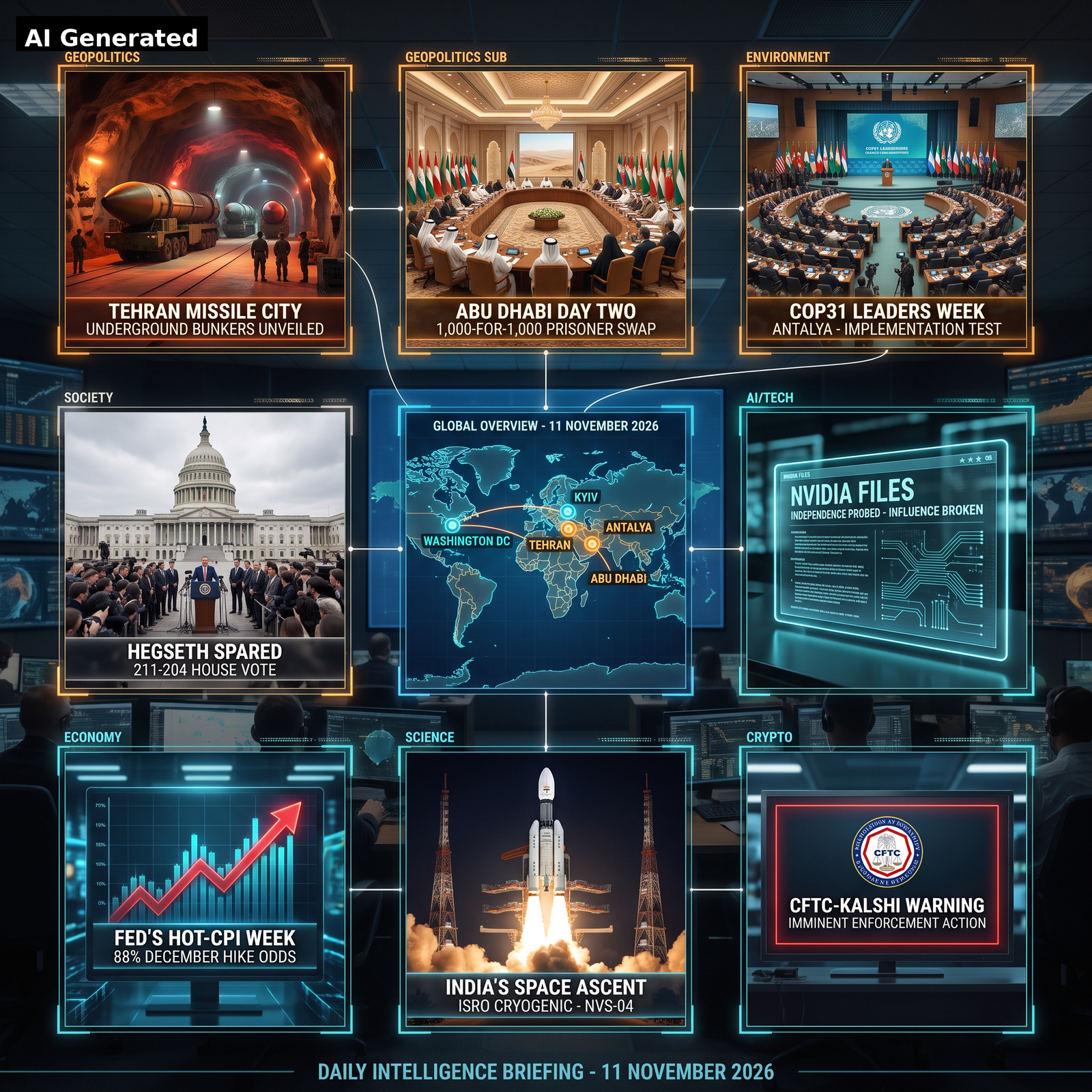
While Washington’s rhetorical endgame for the Iran war — Trump’s “essentially over” assessment recorded in D163 — holds, Tehran’s defiance is taking concrete operational form on three fronts that argue the military layer is far from settled. The armed forces unveiled a new underground “missile city” as Chief of Staff Ali Abdollahi again threatened Israel with destruction, publishing footage consistent with its pattern of hardened, dispersed launch sites; and the Treasury Secretary, architect of the economic siege, has moved from home onto a military installation after Iranian death threats[1]. Iran has also formally told the IAEA it cannot submit to full surveillance while under threat of strikes, leaving the UN unable to verify 441 kilograms of near-weapons-grade uranium for seventeen months — a file the agency’s Board of Governors takes up at month’s end[1].
The confrontation is generating new theatres far from the Gulf. Tehran opened its first all-women military training camp, drilling dozens of female “Janfadayan” volunteers at Azadi Square under the banner of readiness for renewed US attacks — an unprecedented mobilisation of gender as a patriotic resource[2]. In the United States, the Justice Department indicted three alleged Iranian agents over attacks chiefly in Europe, including a September plot against the RAF Fairford base that hosts US strategic bombers — the first judicial confirmation that Tehran’s campaign reached the doorstep of America’s European nuclear infrastructure[3]. At sea, UKMTO logged a fresh tanker incident in the Strait of Hormuz with crew and damage status unknown, keeping the war-risk premium in oil prices as diplomats speak of de-escalation[4].
Abu Dhabi’s Second Day, the Baltic Drone Front and the Espionage Ledger
The Ukraine track produced its first concrete deliverable: at the close of day one in Abu Dhabi, Kyiv and Moscow agreed in principle on a large prisoner exchange — with Kyiv citing 1,000-for-1,000, possibly 1,500-for-1,500 — while the sequencing dispute that will define the real negotiation hardened[5]. Zelensky demanded a strict order — end the war, then guarantees, then a European security dialogue — Lavrov insisted the architecture must come before any ceasefire, Rubio called day one “very productive” and promised to widen the format to Europe, whose representatives (France, Britain, Germany, the EU, NATO and Italy) were in the room despite Russia refusing their formal participation; Berlin pressed the same flank as Merz demanded every EU state commit a “fair share” of the estimated €45 billion financing gap for next year[5].
Beneath the diplomacy the infrastructure war intensified, with a decisive Baltic dimension. Russia said its air defence downed 92 drones over Leningrad region — home to the Baltic ports of Ust-Luga, Primorsk and Vysotsk and the Kirishi refinery — the governor confirmed the Ust-Luga port area ablaze after a drone strike, and insiders put refining capacity down roughly 30 percent since late October[5][6]. The fallout reached NATO: Latvia and Lithuania triggered airspace alerts and scrambled fighters as unidentified drones entered from Russia or Belarus. The first tanker carrying Russian diesel for the US under October’s Trump arrangement paused off the East Coast, New Jersey’s governor warning terminals the cargo may violate federal law[5]. The kinetic ledger added a first: Russia claims to have downed four of the new AGM-188A “Rusty Dagger” missiles — the Extended Range Attack Munition that reached Ukraine only in October against a planned 830 — a read-out on attrition for rushed US munitions[7]. Separately, Britain arrested a 41-year-old American serviceman on suspicion of espionage for Russia under the 2023 National Security Act, adding a US-military defendant to the hybrid ledger D162-D163 have tracked[8].
Jerusalem’s Clock and the Eastern Mediterranean NAVTEX War
Israel’s coalition geometry turned confrontational: the new Knesset was sworn in with its highest-ever female representation — 33 of 120 — as Netanyahu demanded a “unity government of Jewish parties” and Eisenkot, dismissing the speech as divisive, vowed to reverse key policies and left the door open to Arab-party participation on strict conditions[1]. The opposition is moving on the levers — seeking to unseat Speaker Amir Ohana and advance a 7 October state inquiry[1].
In the Aegean the Abeille Marengo file, tracked since D162, escalated into an explicit NAVTEX war: Ankara issued Turkish NAVTEX 1127/26 claiming the French vessel’s cable-laying for the Crete-Cyprus interconnector is conducted “with the consent of the Turkish authorities” on Turkey’s declared continental shelf for a window running to 19 March 2027, and Athens is expected to counter-notice it as void — the operationalisation of the consent-trap scenario D163 described[9][10]. The air ledger tightens in parallel: the Eurofighter consortium reportedly plans 24 further Typhoons for Turkey beyond the 20 already ordered from Britain, with one European country offering aircraft from its own programme for pre-2030 delivery[11].
The Wider Periphery: Gaza and the Salvadoran Hammer
Gaza’s ceasefire continued to erode: at least seven Palestinians, including a 13-year-old, were killed in Israeli strikes and gunfire, with strikes hitting a displaced-family shelter in Zaytoun and a smithy in Gaza City, as both sides trade accusations over violations of the October 2025 truce[12]. In Haiti, El Salvador’s military fired rockets at the compound of 400 Mawozo leader Wilson Joseph, destroying his alleged headquarters in an operation the UN says falls outside the mandate of the international gang-suppression force — a precedent beyond the UNSC umbrella that Santo Domingo endorsed and Amnesty says needs a published agreement[13].
India’s Defence-Industrial Autumn
New Delhi’s strategic machinery turned over on several files at once. Strategists framed the Malacca Strait axis as India’s true energy-security lifeline, the radar establishment set four priorities including countering nano-drones and stealth, and the CRPF is preparing loitering-munition capabilities while the Agnipath revision extends up to 25 percent of each cohort beyond four years[14][15][16][17]. New Delhi dismissed Pannun’s US suit as “fabricated and malicious”; Beijing’s fresh GJ-11 footage offered a comparator for India’s UCAV ambitions; DRDO completed security APIs for indigenous radios; and foreign ministry officials affirmed bipartisan US backing[18][19][20][21]. TKMS and Indian partner CFF formalised a joint venture deepening the underwater-warfare chain, the ORF’s Samir Saran distilled the consensus on a China combining LAC posture, supply-chain leverage and grey-zone tactics, and Assam’s 3,750-acre defence park was approved as a new eastern manufacturing node[22][23][24].
The Euro-Asian Defence-Industrial Base
The Indo-Pacific and European rearmament are converging on eastern Europe: Greece’s forces secured a new NSPA contract for additional V-BAT drones covering army and navy, with Shield AI’s Athens office consolidating the Aegean ISR build-out; BAE delivered all Lot 8 RF sensors for the US Navy’s LRASM with software-only upgrades; and Warsaw granted a tax break for local K2 assembly, advancing Hyundai Rotem’s European tank-hub plan — success now hinging on technology transfer and EU defence-financing rules[25][26][27]. China and ASEAN provisionally agreed about 80 percent of the South China Sea code-of-conduct paragraphs but left scope, sensitive terms and binding unresolved — completion slips to next year under Singapore, with Manila’s summit this weekend[28].
Environment & Climate ↑ Contents
COP31’s Leaders’ Week: The Implementation Test Arrives
The UN climate summit in Antalya moved into its decisive second week as roughly a hundred leaders opened formal discussions, with Brazil’s Lula, Britain’s Burnham and von der Leyen attending while the United States stays absent for a second year and Merz’s no-show — the first by a German chancellor in years — drew explicit criticism[29]. John Kerry’s demand that “we don’t need more promises, we need plans” captures the process’s defining tension after three venues — Dubai, Baku, Belém — produced pledges but little operational follow-through, and the Iran war’s price spike is simultaneously suppressing demand and complicating the investment case for transition technologies[29].
The Policy and Materials Front: Permitting, Steel, Borders and the Resource Squeeze
In Australia the civic climate front tightened: Newcastle council, home to the world’s largest coal port, banned the group Rising Tide from using council land for protests after the NSW premier warned councillors would be complicit in illegal activities — a clampdown on climate civil disobedience at the country’s energy export gateway[30]. On the American side, the Senate’s first procedural vote on the Bipartisan American Affordability and Jobs Act — the permitting-reform vehicle the solar and storage industries call a grid bottleneck-breaker — cleared the hurdle SEIA read as proof that grid expansion remains bipartisan[31]. Brussels faces the parallel question of demand: an industry letter pressed the EU to create “lead markets” for genuinely low-carbon steel via the CO2 car-emissions review, warning that without predictable demand, announced green-steel projects will stall[32]. In Texas, the blue wave’s ability to halt border-wall construction is being settled by money rather than votes: Democrats gained leverage in Congress and Austin, but the administration still holds billions of unspent wall funds[33]. At the technology margin, Norway’s electric snowplough has already worked mountain passes while Sweden’s hydrogen fuel-cell range-extender adds tanks and fuelling infrastructure without a proven business case — a compact parable of the transition’s maturity[34]. Agriculture contributes resource innovation with verification gaps: Australian farmers are spreading recycled-glass fertiliser, with the manufacturer conceding its headline savings are “being confirmed through our own field trials” — a healthy caution against mistaking a promising silicon pathway for proven technology[35]. And engineering is finally attacking “forever chemicals” at scale: new cyclodextrin-polymer and spectrometry work suggests remediation of PFAS at meaningful volumes is closer than the regulatory clock implies[36].
The Living Ledger: Penguins, Whales, Frogs, Coyotes and Elephants
Conservation science delivered recoveries and quiet alarms that complicate simple loss narratives. Antarctic blue whales have crept back — an estimate puts the population at 4,018, up from 418 at the end of whaling — with the authors urging sustained oversight rather than celebration[37]. Argentina’s Monte León park shows a subtler truth: the 40,000-plus Magellanic penguin pairs were already nesting on the old sheep ranch while flocks grazed down their cover, so the birds’ persistence owes much to pre-existing adaptation — conservation gains are seldom linear[38]. A forensic re-investigation in Brazil’s Atlantic Forest resolved a four-decade amphibian mystery: specimens show the chytrid fungus arrived and expanded with lethal speed in the early 1980s, implicating the pathogen — not acid rain or cold snaps — in a die-off predating its 1999 formal discovery[39]. Human-wildlife conflict remains the sharpest edge: coyotes are proving permanent on North Carolina’s Outer Banks despite removal programmes, threatening shore-nesting birds and sea turtles [40]; South African smallholders on restituted land are defending crops from elephants with drums, fire and improvised noise[41]. Beneath all of it, a global study in Science covering 34,120 terrestrial vertebrates finds 14,325 to 15,324 species — more than 40 percent of land vertebrates — will lose habitat to coastal inundation by 2100, with only 5.9 percent of exposed species listed as climate-threatened — a conservation-planning blind spot of the first order[42].
The Radiation and Seabed Ledgers
The environmental-insecurity file delivered two long-fuse items. Russia’s Shirshov Institute reported its 2025 survey of the sunken nuclear submarine K-27 — 30 metres down with two reactors still holding spent fuel sealed by bitumen and a furfural preservative whose lifespan estimates have shrunk from a century to no reliable figure — found no active release, while planning a permanent underwater monitoring station: the world’s most hazardous sunken object is being watched, not solved[43]. In the Pacific, the United States is challenging the International Seabed Authority’s licensing monopoly: a surge of Clarion-Clipperton Zone claims has been filed with Washington under US law, outside the UNCLOS framework it never ratified, leaving the ISA to seek legal counsel over overlapping claims — a jurisdictional rupture in the governance of the ocean floor[44].
Society & Civil Issues ↑ Contents
Washington’s Civic Square: Hegseth Spared, the Epstein Ledger and the Arch Fight
The first impeachment confrontation of the new Congress ended in a defensive victory for the war cabinet: House Republicans voted 211-204 to send Massie’s eight articles against Hegseth — covering the Iran and Yemen campaigns, the Maduro capture and strikes on drug boats — to the Judiciary Committee, effectively killing the measure in the current chamber while Trump celebrated and Hegseth, in his first press conference in more than 180 days, insisted every operation was lawful[45]. The vote is a pause, not a verdict: Democrats take the House in January and have promised to revive the articles, and Massie’s admission that colleagues backed only some charges guarantees a fractious floor fight when the majority flips[45]. In parallel, the House Oversight Committee’s 137-page Republican report on Epstein documented systemic failure — a 2005 investigation shelved by a 2007 non-prosecution agreement, jail guards who left his Manhattan cell unmonitored for nearly eight hours before his 2019 death, and conflicts of interest among prosecutors who later worked for his estate — while urging the Justice Department to re-interview witnesses and pass a Survivor’s Voice Protection Act[46]. Washington’s monument wars added the dynasty itself: nine Kennedy family members moved to intervene in the federal suits blocking Trump’s 76-metre “triumphal arch” near Arlington, arguing it would “fundamentally alter” the experience of the JFK gravesite and destroy a century-old sightline — joining veterans, historians and three local governments as plaintiffs — while whistleblowers allege the Trump team is destroying documents tied to the DC renovation projects’ approvals, a records-integrity question soon to become a subpoena campaign[47][48].
The Media and the Courts: BBC’s Defamation Clock and Australia’s Ombudsman Question
The transatlantic media-accountability ledger turned on two axes. A US judge refused to throw out Trump’s defamation suit against the BBC over what he calls a deceptive video edit, allowing the case toward a merits ruling with damages deferred — setting up one of the largest media-defamation proceedings in American history against a £7.5-10 billion claim[49]. In Canberra, the Labor government declined the antisemitism envoy’s suggestion to scrap the ABC and SBS ombudsmen for an “external independent ombudsman” over Gaza coverage, noting the media regulator already provides external review — a decision that will be revisited when the Royal Commission into Antisemitism reports in mid-December[50].
France’s Republic and the Papal Ledger
France’s political calendar hardened: interior minister Retailleau proposed right-and-centre primaries on 31 January and 7 February, arguing “time is working against us” in a crowded field[51]. The midterm realignment is reshaping the politics of the region: a Le Parisien analysis describes a pro-Israel lobby that has become “a handicap” after the American elections — the mirror image of the pressure D163 identified on the US side[52]. The papal ledger continued its Latin American arc: Leo XIV, before roughly a million young people in Buenos Aires, denounced the “idols of our time” — success at any price, money, the obsession with appearance, the unbridled pursuit of pleasure — before departing for Peru, his old mission territory, where he was expected to meet President Keiko Fujimori[53][54].
Europe’s Public Square: Strike, Courts, Police and the State’s Reach
Spain delivered the day’s most consequential civic event: for the first time since 2012, the two largest unions called a general strike, less than three weeks before the 29 November snap election that Sánchez called after the housing crisis — dramatised by the eviction of 87-year-old Maricarmen Abascal — broke his coalition, making rents the ballot’s central issue[55]. Austria’s courts produced a civic anomaly with rule-of-law weight: a Vienna court reversed a convicted man’s gender re-registration performed expressly to serve a sentence in a women’s facility — a striking correction of identity-law instrumentalisation[56]. Germany’s institutions are straining: disproportionately many police in Saxony-Anhalt have applied for transfers after the AfD’s state-election win, with the first AfD interior minister possible; and the Hamburg Hafencity shooting that ended at the Elbphilharmonie — a 68-year-old who killed his wife and father-in-law in the south-west, shot two people in Hamburg and took his own life — left police and the flagship concert hall at the centre of a national conversation about domestic violence and firearms[57][58]. Public health offered a parallel lesson: Saxony-Anhalt’s mobile breast-cancer screening now uses AI to triage mammograms in the countryside, yet roughly half of invitations still go unanswered[59].
The Global Civic Periphery: Rights, Migration and the Press
Civil-rights progress and civic decay advanced in parallel. A grassroots campaigner achieved the decriminalisation of homosexuality in Trinidad and Tobago — a Caribbean first[60]. Greece’s southern border compressed into focus: 2,186 migrant arrivals on Crete in the first ten days of November, with the temporary Athanatoi facility opening within days — a winter wave testing Athens’ reception capacity[61]. Kenya’s fitness boom collided with an uncomfortable material reality: almost no one asks what is in the synthetic activewear powering the country’s running clubs, even as noncommunicable diseases account for 41 percent of Kenyan deaths[62]. In Dublin, pro-Palestinian protesters hurled milk at Joe Biden over his Israel policy — a small sign of how far the Gaza war’s corrosion has reached[63]. Russia’s independent press took its final blow: Novaya Gazeta, founded in the early 1990s with a Nobel laureate among its founders and six journalists killed in the line of duty, closed under wartime censorship laws, staff carrying portraits of the slain from the office walls in a box labelled “ours — keep with care” and Muratov calling the repression “sweeping in nature”[64]. The crime-and-justice periphery contributed its share: the consultant convicted in Cash App founder Bob Lee’s stabbing was sentenced to 16 years to life; a vehicle ploughed into pedestrians in North Hollywood killing three; a commuter bus struck more than thirty vehicles in South Korea injuring dozens; DNA confirmed a grizzly family killed a mother and daughter in British Columbia; and Australia’s Big Build royal commission heard that underworld figure Mick Gatto attended a union meeting after construction-site assaults[65][66][67][68][69].
AI & Technology ↑ Contents
The Nvidia Files: Independence Probed, Influence Broken
The Jensen Huang affair — tracked since D162 — entered its institutional phase on three fronts. The independent Nvidia board members retained former acting US Attorney Joon H. Kim and Wachtell, Lipton, Rosen and Katz for an external inquiry into whether Huang’s relationship with the woman US intelligence identifies as a Chinese agent compromised corporate or national security — an external hire best read as insulation from shareholder litigation and congressional pressure[70]. The market delivered its own verdict: NVDA slid a further 5.47 percent to $168.89, its lowest since March, with roughly a trillion dollars of value erased across the affair’s first days as AMD surged over 13 percent[70][71]. A retail class action now joins three House chairmen’s summons for a closed-door hearing on 18 November — the day after Q3 earnings — while the FBI probe was reported to have been complicated by Nvidia’s general counsel moving a Commerce inquiry into Megaspeed toward the Justice Department in 2025[70]. The strategic read has sharpened: even if Huang survives as CEO — which Fortune deems plausible — his influence over US AI policy is effectively over, removing the industry’s most effective opponent of stricter China export controls and open-weight licensing at the moment Anthropic’s IPO tests the sector’s valuation ceiling[72].
The AI-Capital and Compute Frontier
Beside the drama, the sector’s capital machinery kept turning. CoreWeave is planning a multibillion-dollar chip-backed debt deal — the latest step in the collateralised-compute financing model that turns GPU pools into bondable assets[73]. SpaceX’s Starmind orbital-computing programme placed manufacturing muscle behind a $69 million-plus contract with Germany’s SINGULUS for heterojunction solar production lines, with Musk clarifying the ambition as 100 GW of solar manufacturing equipment a year — the AI build-out extending into orbit, and with it the energy arithmetic tracked since D159[74]. Anthropic claims Claude Mythos got Claude running on AMD MI355X GPUs in roughly three days — a portability demonstration challenging CUDA lock-in at a time of compute scarcity[75]. Khosla Ventures co-led Coframe’s $25 million round for AI websites that adapt to every visitor, extending generative AI into web-design infrastructure[76].
AI in the State and the Market
Governance and marketisation advanced in alternating measure. Berlin is moving to condition public research funding on espionage and knowledge-drain protection — an early signal of the research-security doctrine the Nvidia affair is accelerating across Western capitals[77]. In the German Mittelstand, AI agents already negotiate supplier prices autonomously with documented successes — a quiet procurement revolution raising the stakes of EU AI-Act enforcement[78]. Brussels is preparing the Digital Fairness Act to force two-click cancellation and ban dark patterns in subscription traps — the next major plank of EU platform regulation after the DSA and DMA[79]. The accountability layer filled in on two fronts: Brazil’s electoral court fined Meta roughly R$7.5 million for unequal treatment of Lula and Bolsonaro during the election — concrete enforcement of platform neutrality — and Reddit’s test of AI-generated product-review summaries drew sharp criticism from moderators worried that advertising will replace human advice[80][81].
Economy & Business ↑ Contents
The Fed’s Hot-CPI Week and the Dollar
The monetary-policy ledger flipped decisively toward tightening: a hotter-than-expected inflation print rewired expectations, with CME FedWatch pricing an 88 percent probability of a December hike, bond markets reeling on jumbo-hike fears, Fed official Paulson endorsing more gradual increases, and the dollar gaining as speakers warned of inflation risks[82][83][84][85]. The about-turn is the mirror image of D163’s peak-rate debate: the entire fixed-income complex is re-pricing higher-for-longer with the post-midterm debt-ceiling confrontation looming, making fiscal dominance the regime’s defining question.
Asia’s Macro and Credit Ledger
Asia’s financial plumbing tightened in the same direction: South Korea’s October household lending jumped to net 5 trillion won from 0.5 trillion in September; Prime Minister Takaichi said she expects the Bank of Japan to sustain 2 percent inflation while ruling out inflationary fiscal measures; and Beijing injected 187 billion yuan via overnight reverse repos while letting the yuan midpoint fix weaken to its softest since 22 October — three central-bank dialects of the same global re-pricing[86][87][88][89]. Markets responded constructively: GIFT Nifty jumped 300 points as Asian equities advanced with Brent below $92, and TSMC told the Nikkei Forum demand for its chips remains “insatiable” — the imbalance that keeps semiconductors the global economy’s key industrial variable[90][91].
Europe’s Industrial and Fiscal Front
Germany’s five “Wirtschaftsweise” handed Merz their annual report with the spring’s 0.5 percent growth forecast expected to be revised upward after unexpected resilience, even as their critique that special funds buy consumption rather than investment is set to be repeated[92]. The structural cost picture darkens underneath: a Deloitte study puts German care spending on a path toward €305 billion a year by 2050, with AI and robotics the only realistic brake; Chinese firms insist they will keep investing in Germany but increasingly worry about labour and energy costs; and a study of European property attractiveness finds German cities sliding out of the top tier[93][94][95]. Evidence that fiscal policy has real demand effects arrived from the academic ledger: a Review of Economic Studies paper shows Germany’s 2020 COVID VAT cut significantly boosted consumption, with lower-wealth and younger households benefiting most[96]. Greek housing policy contributed a cautionary tale as plans for a transferable building-coefficient scheme collapsed on political arithmetic, and Britain’s NIESR argued rates should rise to 5 percent, accusing policymakers of “deferring” decisions[97][98].
The Corporate and Capital Files
The corporate ledger is dominated by the AI-capital repricing: SoftBank fell as much as 10.5 percent in Tokyo after a quarterly loss of ¥1.12 trillion ($7 billion), driven by a $3.7 billion writedown on US data-centre power-equipment advances — the first major balance-sheet casualty of the post-midterm data-centre scepticism[99]. Trump Media disclosed that a substantial slice of revenue now comes from the Truth API, a service charging over $60,000 a month for early access to the president’s posts — monetising presidential speech itself[100]. In the real economy, tuner Unplugged Performance offered to buy Tesla’s Cybertruck line days after Musk said output would wind down around mid-2027 at roughly 12 percent of planned volumes; Venezuela’s parliament unanimously ended the state’s 19-year electricity monopoly; Thailand’s SCG said its Hormuz-affected Vietnam plant will reopen in mid-2027; and Pakistan’s leading three-wheeler maker entered the Philippines[101][102][103][104]. Finally, Anthropic expects to price between $70 and $78 on 18 November under the ticker ANT — a valuation between $1.26 trillion and $1.41 trillion, far below summer chatter but a near-record debut backed by $17 billion in Q3 revenue, with analysts reading the conservative pricing as expectation management in a nervous AI trade[105].
Science & Space ↑ Contents
India’s Space and Materials Ascent
India’s space-industrial machine recorded a week of quiet milestones mapping its trajectory from scientific programme to industrial base. ISRO’s cryogenic engine passed flight acceptance ahead of the GSLV-F19 launch of the NVS-04 navigation satellite[106]; Skyroot’s Raman-1 roll-control thruster passed hot-fire, moving the private Vikram-1 toward its second mission — proof that privatisation is producing flight-ready hardware, not just contracts[107]; minister Jitendra Singh argued the sector’s opening is creating opportunities for young scientists and reducing brain drain[108]; and IIT Jodhpur’s lightweight alloy resisting oxidation at 1,000°C could upgrade defence, aviation and space systems — the indigenous material capability that determines how much of the strategic build-out stays onshore[109].
Physics and the Cosmos
Fundamental physics produced two demonstrations of how theory constrains fancy. Physicists built a metric-affine gravity model — MAGIC — that would impose chronology protection by giving spacetime a built-in direction of time, but found its scalar mode suffers a gradient instability that would make disturbances grow exponentially: gravity may block time-travel paradoxes, but only in a theory that cannot describe our own stable universe[110]. At the quantum-materials layer, University at Buffalo researchers predicted a single missing atom in hexagonal boron nitride leaves a recognisable fingerprint in laser light — an optical read-out for defects that may serve as qubit platforms[111]. The observational ledger delivered two finds: astronomers used a digital twin of the James Webb Space Telescope to erase starlight, making faint exoplanets two to fifteen times easier to detect and immediately uncovering a hidden planet in existing data[112]; and Hubble showed a 93-billion-mile dust cloud around Beta Pictoris is likely the wreckage of colliding massive planets, rewriting assumptions about debris disks[113]. A Cambridge study argued comets probably destroyed life’s ingredients rather than delivering them — travelling too fast at unfavourable angles — pushing the balance toward asteroids or terrestrial chemistry, and even giving Mars a narrow edge over Earth[114].
The Biomedical Ledger
Medicine’s evidence base sharpened on four fronts. Mosquitoes of each species are attracted to distinct combinations of human skin odours, chemicals and bacteria — demolishing the universal-magnet idea and pointing toward species-specific repellents[115]. A review of more than 350 studies suggests eating less protein may slow ageing and improve metabolic health, challenging the “more is better” orthodoxy for sedentary adults[116]. Cardiology gained a missing-link explanation for heart attacks at low LDL: two fat-carrying particle types promote inflammation beyond cholesterol build-up[117]. And oncology gained a target: tumours release natural antioxidants to disarm immune cells, and blocking the mechanism in mice restored immune activity — a tractable combination-therapy avenue[118].
Deep Time and the Archive
Palaeontology’s record expanded in three directions. Thailand yielded Yakamys sirindhornae, a 66-pound giant rodent from 34 million years ago — showing enormous rodents evolved far earlier than assumed[119]. China produced a heavily armoured, giant-salamander-sized amphibian from 237 million years ago that appears to be the first fully marine amphibian — a group whose living members cannot survive in saltwater[120]. A “one-in-a-million” fossil preserved the soft tissues of a 450-million-year-old crinoid, revealing unexpected details of Earth’s earliest reef ecosystems[121]. Archaeology added a humbling lesson: a fir door found by a farmer in a Swiss marsh in 1868 and dated in 1998 to roughly 3,700 BC is one of Europe’s oldest preserved doors — ordinary artefacts often wait centuries for the techniques that reveal them[122].
The Space Programme’s Human and Hardware Frontiers
The human and engineering frontiers moved in step: NASA’s CHAPEA crew completed a year-long simulated Mars mission, emerging with data on food production and resource conservation that will shape real-Mars logistics[123]; the AMPERE Challenge offers $500,000 plus testing access to accelerate next-generation electric rocket engines[124]; and NASA accepted astronaut applications for the first time in two years, a cycle that defines the crews of the next lunar and Martian campaigns[125].
Crypto, Digital Assets & Blockchain ↑ Contents
The Regulatory Perimeter: CFTC-Kalshi and the Post-Midterm Geometry
The week’s defining regulatory development is the CFTC’s warning to Kalshi of imminent enforcement action over its notification of dozens of products, as reported by Politico: the agency is investigating whether the prediction-markets operator properly informed it about new contracts, with the private warning signalling that charges could follow after a probe of several months[126]. Kalshi’s response — that the issue is a procedural error affecting a handful of submissions, many of them never live, and already being addressed — is the standard pre-enforcement posture, but the timing matters: the CFTC is simultaneously fighting for exclusive jurisdiction over prediction markets against state regulators, while Kalshi has itself joined Coinbase and four other firms in backing the agency in a separate case over perpetual futures tied to individual US stocks[126]. The regulator and its most prominent counterparty are thus legal allies in one forum and adversaries in another — a structural awkwardness that will define the sector’s Washington relationship through the transition[126]. On Capitol Hill, the post-midterm geometry is set: Minnesota’s Tom Emmer — co-founder of the Congressional Crypto Caucus — was elected House GOP minority whip, keeping a crypto-literate ally at the senior leadership table of the new minority and preserving the sector’s bipartisan channel even as the Democratic majority prepares its own digital-asset agenda[127].
The Institutional Rails: Prime Brokerage, Treasuries and the Skepticism Ceiling
Institutional plumbing advanced on two fronts with opposite risk profiles. Standard Chartered expanded its prime-brokerage partnership with 24X to cover Bitcoin and Ether, allowing eligible institutional counterparties to face the bank as central counterparty across FX and digital assets on one execution infrastructure — a recognition that the primes of conventional markets are now, for their corporate clients, indistinguishable from the crypto rails, even as the release makes no claims about insurance or guarantees and the real test remains active client adoption rather than announced scope[128]. On the treasury side, Strategy’s week-41-42 disclosures show its STRC preferred instrument crossed $100 while common-stock issuance still funded last week’s bitcoin purchases and buybacks absorbed two-thirds of the MSTR proceeds — a capital-structure detail that matters because it reveals the marginal funding source of the largest corporate bitcoin balance sheet is shifting toward preferred and debt layers, raising the stakes of every future BTC price move for the company’s fixed-income holders[129]. The market’s scepticism ceiling is showing in the perpetual-DEX space: Hyperliquid claims billions in waiting capital but faces visible market doubt, with prediction contracts pricing only 16 percent YES on HYPE reaching $100 by year-end — a useful calibration of the gap between narrative and priced expectations for the sector’s highest-multiple derivatives venue[130].
The Market-Structure and Security Ledger
Market structure continued its drift toward derivatives even as spot thins: Solana perpetual volume exploded 65 percent week over week while spot activity shrank, with the venue now accounting for roughly 77 percent of weekly turnover in DefiLlama’s Solana table — a concentration of leveraged activity that, in the absence of corresponding spot depth, amplifies both upside beta and liquidation cascades[131]. Onchain forensics produced a slow-burn supply story: Checkonchain data reveals more than 227,000 BTC acquired before 2019 have been revived in 2026, with dormant-wallet investigations turning up colossal transfers, whale movements and ancient mining rewards dating to 2010 — a multi-billion-dollar supply overhang from the coin’s earliest era that long-term holders are now monetising at scale[132]. Security remained the sector’s chronic liability: the Bitcoin Lightning project LNbits rushed an emergency patch after reported wallet thefts, warning that installations on older versions were vulnerable and urging operators to rotate potentially exposed credentials even after upgrading — the familiar cadence of a self-custody ecosystem where a single library bug can empty thousands of channels, and the reason institutional adoption keeps colliding with the custody question[133]. Enforcement filled the compliance ledger from the consumer side: Massachusetts federal prosecutors sought forfeiture of roughly $456,000 in cryptocurrency traced to romance scams operating through dating sites and Facebook, a textbook illustration of how onchain tracing now underpins fraud remediation across the retail fraud economy[134].
The signal across all nine items is consistent: the sector’s centre of gravity has moved decisively toward regulatory engagement, institutional credit infrastructure and onchain forensics — the same institutionalisation arc D157-D163 described for the exchange recovery and ETF inflows, now operating in a tighter regulatory environment under a changed Washington. The Kalshi warning is the canary: prediction markets and derivatives venues built on contested jurisdictional claims are entering the enforcement phase of their life cycle, and the sector’s ability to keep institutional capital will depend on how cleanly it resolves the notification, disclosure and custody questions the CFTC, the SEC and MiCA-era regulators are each now asking.
Correlations & Analysis ↑ Contents
The D164 window resolves, in part, the endgame question tracked since D149. The US–Iran confrontation that D163 framed as rhetorically “essentially over” while its periphery kept firing has produced a texture that is neither war nor peace but institutionalised defiance: the Treasury Secretary relocated onto a military base under Iranian threats, Tehran unveiled a new missile city and its first all-women training camp, the Justice Department indicted three alleged agents over a plot aimed at RAF Fairford, and the IRGC kept reporting tanker strikes in Hormuz[1][2][3][4]. The correlation that mattered in D163 — a winding-down American coercive track versus escalation by actors Washington cannot control — has moved a stage further: the regime is answering America’s declared endgame with visible, gendered, missile-centred mobilisation while the US legal system processes the war’s aftershocks one indictment at a time. The “end” of this war may look less like a treaty and more like a durable standoff paid in espionage cases, insurance premiums and refugee flows.
The Ukraine track produced the first concrete artefact of the negotiation era that opened in D163’s Abu Dhabi session: a large prisoner exchange agreed in principle, a US delegation scheduled to carry the agenda to Moscow, and a hard sequencing dispute — Zelensky wants ceasefire, then guarantees, then European architecture; Lavrov wants the architecture first; the EU is in the room but not at the table[5]. Correlate that with the Baltics’ drone night, 92 intercepts over Leningrad, Ust-Luga’s burning port, a third of Russian refining capacity offline, and the first Russian diesel tanker for America pausing off the US East Coast over legal doubts — and a coherent picture emerges: the peace process and the energy war are the same process seen from two ends[5][6]. Moscow negotiates while its export infrastructure burns; Washington mediates a settlement whose own diesel agreement is colliding with federal law. Berlin’s demand for a fair-share €45 billion contribution and Wadephul’s insistence that Europe sit at the table reveal the coalition’s central anxiety: that the D158-D163 pattern of US-bilateral mediation will marginalise Europe in the settlement’s most consequential chapter.
Domestically, the post-midterm equilibrium is hardening into institutional combat with a defined calendar: Hegseth’s impeachment was killed 211-204, but only until January; the Epstein report, the Kennedy intervention against the DC arch, the destroyed-documents claims and the BBC defamation case all feed one dynamic — a Democratic Congress inheriting investigative machinery confronting a President determined to leave a physical and legal imprint on Washington[45][46][47][48][49]. The stakes now include the single largest balance-sheet risk in equities: the Nvidia affair — external probe, class action, congressional summons, an FBI investigation complicated by the company’s own counsel, a trillion dollars of value erased — has become the point where the D162-D163 counterintelligence narrative meets the AI complex’s capital reality, exactly as Anthropic’s IPO prices the sector’s future[70][71][105].
The monetary correlation pulls hawkish on both sides of the Atlantic: the hot US CPI print pushed December hike odds to 88 percent and re-armed the dollar, while the Bank of Korea, Tokyo’s political principal and the PBOC all conducted operations consistent with a global re-pricing of inflation risk[82][86][87][88]. Set against the war-economy data in the same window — SoftBank’s data-centre writedown, Thailand’s fixed mid-2027 reopening of a Hormuz-hit plant, Brent below $92 — the energy system is rewiring itself while monetary policy tightens into it: the stagflationary configuration D162 flagged is now live[99][103][90].
Environmentally, COP31’s paradox is confirmed: the climate process negotiates under a war-driven price shock that suppresses emissions short-term while the structural instruments — US permitting reform, EU low-carbon-steel demand, sea-level exposure for 40 percent of land vertebrates, the K-27 radiation watch — move in their own slower registers[29][31][42][41]. D163’s insight that the first emissions decline since 2020 is a war artefact is now visible in the leaders’ week: the US absent, Germany’s chancellor absent, the headline still “plans, not promises”. In digital assets, the CFTC-Kalshi warning, Standard Chartered’s prime-brokerage extension, Emmer at the GOP table and dormant coins reviving at scale extend the D157-D163 institutionalisation arc with a new edge: Washington’s post-midterm regulatory perimeter is becoming the sector’s binding constraint just as its capital-market integration accelerates[126][128][127][132].
What to watch in the next reporting period: (1) whether Abu Dhabi produces a formal prisoner-swap announcement and whether the US delegation’s Moscow leg implies a second summit track; (2) the IAEA Board of Governors’ end-of-month session on Iran’s 441 kilograms of unverifiable uranium — the most combustible file the missile-city theatre does not obscure; (3) the 18 November Nvidia hearing a day after Q3 earnings, and whether Kim’s external probe publishes first; (4) Anthropic’s pricing and debut under ANT against the hot-CPI, hawkish-Fed tape; (5) whether COP31’s leaders’ week converts the war-driven emissions dip into binding instruments; and (6) whether the Abeille Marengo NAVTEX war — Ankara’s consent claim versus Athens’ counter-notice — produces the Aegean’s first live encounter of the winter[9][10].
References ↑ Contents
1. +++ Iran-Krieg +++: US-Finanzminister zieht nach Drohungen des Irans auf Militärbasis by Redaktion Handelsblatt · Source ↑
2. Iran opens training camp for women in readiness for war by NEWS via d k on Inoreader · Source ↑
3. La justice américaine inculpe trois « agents iraniens » après l’incident près d’une base aérienne anglaise by France via d k on Inoreader · Source ↑
4. FinancialJuice: UKMTO: status of crew, damage evaluation, and environmental impact remain unknown at time of report by FinancialJuice · Source ↑
5. +++ Ukraine-Krieg +++: Lettland und Litauen warnen vor Drohnen im Luftraum by Redaktion Handelsblatt · Source ↑
6. FinancialJuice: Drones strike Ust-Luga Baltic Sea port in Russia’s Leningrad region, governor cites initial data by FinancialJuice · Source ↑
7. Μαζικές καταρρίψεις αμερικανικών πυραύλων ERAM από την ρωσική αεράμυνα by DEFENCE via d k on Inoreader · Source ↑
8. Un militaire américain arrêté en Angleterre, soupçonné d’espionnage au profit de la Russie by France via d k on Inoreader · Source ↑
9. Οι Τούρκοι έβγαλαν NΑVTEX για το Abeille Marengo: «Δώσαμε την συγκατάθεσή μας» by DEFENCE via d k on Inoreader · Source ↑
10. 5 το πρωί: Η «μάχη» των Navtex – Πρεμιέρα για το myΘέρμανση – Ανοίγει ξανά η Pizza Fan by Κουτσελάκη Κατερίνα · Source ↑
11. Τουρκία: Σχέδια για 24 νέα Eurofighter, πέραν των 20 που έχει ήδη παραγγείλει από τη Βρετανία by Greece via d k on Inoreader · Source ↑
12. Μπαράζ ισραηλινών αεροπορικών επιδρομών στη Λωρίδα της Γάζας by DEFENCE via d k on Inoreader · Source ↑
13. Αϊτή: Καταστράφηκε επιχειρησιακό κέντρο ισχυρής συμμορίας με τη συμμετοχή στρατιωτικών δυνάμεων του Ελ Σαλβαδόρ by Σωτήρης Ζιώμας · Source ↑
14. India’s Ocean Lifeline: Why the Strait of Malacca Holds The Key To Its Energy and Economic Security by Indian Defence News · Source ↑
15. India’s Radar Roadmap Focuses On Four Critical Priorities by Indian Defence News · Source ↑
16. Angry India Dismisses Khalistani Terrorist Pannun’s Lawsuit As ‘Fabricated And Malicious’, Rejects Allegations Against Senior Officials by Indian Defence News · Source ↑
17. CRPF Eyes Kamikaze Drone Capability To Strengthen Counter-Terror Operations by Indian Defence News · Source ↑
18. Agnipath 2.0: What The Six-Year Agniveer Actually Takes Home by Indian Defence News · Source ↑
19. China Unveils Closer Look At GJ-11 Stealth Combat Drone In New Official Footage by Indian Defence News · Source ↑
20. DRDO Releases Security APIs Completing India’s Military Radio Standard by Indian Defence News · Source ↑
21. India-US Ties Enjoy Bipartisan Backing Despite US Midterm Political Upheaval by Indian Defence News · Source ↑
22. TKMS And CFF Fluid Control Deepen India Underwater Defence Partnership With New Joint Venture by Indian Defence News · Source ↑
23. China A Clear And Present Threat To India’s Security And Strategic Architecture: ORF Chief Samir Saran by Indian Defence News · Source ↑
24. Assam Sets Out 3,750-Acre Defence Park Plan To Accelerate Defence Manufacturing Growth by Indian Defence News · Source ↑
25. Νέα παραγγελία V-BAT μέσω NSPA για τις Ελληνικές Ένοπλες Δυνάμεις by Γιάννης Ρέκκας · Source ↑
26. 200-mile US Navy missile gets smarter RF sensors without hardware replacements by Aamir Khollam · Source ↑
27. Hyundai Rotem plan to build EU tank hub in Poland takes shape by Business via d k on Inoreader · Source ↑
28. China and ASEAN make progress on South China Sea pact by Jim Gomez · Source ↑
29. World leaders begin talks at UN climate conference amid concerns that actions are inadequate, slow by The Associated Press · Source ↑
30. Rising Tide banned from using council land for protests at world’s largest coal port in Newcastle by Jordyn Beazley · Source ↑
31. Solar & Storage Industry Statement on Bipartisan Permitting Reform Bill Passing First Procedural Vote by Guest Contributor · Source ↑
32. Joint Letter on Low-Carbon Steel Credits in the Review of EU CO₂ Emission Standards for Cars by Transport & Environment · Source ↑
33. Can the Blue Wave Turn the Tide Against Border Wall Construction in Texas? by Martha Pskowski · Source ↑
34. Norway’s Electric Snowplow Worked. Sweden Added Hydrogen Anyway. by Michael Barnard · Source ↑
35. Farmers in Australia are spreading recycled glass fertilizer made from empty bottles, its maker relays a farm manager’s claim of lower inputs, and its own savings figures are still being confirmed by Adrian Villellas · Source ↑
36. Can Engineering Solve the Forever Chemical Problem? by Environment via d k on Inoreader · Source ↑
37. As Antarctic Blue Whales Advance Along the Road to Recovery, Continued Oversight is Key by Environment via d k on Inoreader · Source ↑
38. A Patagonian sheep ranch that once held 40,535 sheep is now home to one of Argentina’s main Magellanic penguin colonies, and the twist is that the birds were already nesting there while the flocks grazed down their cover by ECONEWS · Source ↑
39. Investigation: Fungus may have killed Atlantic Forest amphibians in the 1970s and ’80s by Sharon Guynup · Source ↑
40. Coyotes are likely a permanent fixture on the Outer Banks of North Carolina by Science & Space via d k on Inoreader · Source ↑
41. Beat it: Den Staat farmers in South Africa use drumming and fire to deter elephants by Karen Coates · Source ↑
42. Rising seas could reshape habitats for more than 40% of world’s land vertebrates by Isabel Esterman · Source ↑
43. The Soviet Union sank a nuclear submarine with its fuel still aboard about 100 feet down in the Arctic, and the material sealing its reactors has a lifespan no one can pin down by ECONEWS · Source ↑
44. US stakes competing claims to Pacific seabed mining areas, challenging UN authority by Mikedigirolamo · Source ↑
45. Trump takes victory lap after House GOP shelves Pete Hegseth impeachment articles by Rachel Dobkin · Source ↑
46. GOP-led House report slams systemic failures in handling of Epstein case by NEWS via d k on Inoreader · Source ↑
47. Kennedy family joins US lawsuits to block Trump’s ‘unlawful’ arch plan by NEWS via d k on Inoreader · Source ↑
48. Trump team is destroying documents related to his many DC renovation projects, whistleblowers claim by Rachel Dobkin · Source ↑
49. Aux Etats-Unis, un juge refuse de rejeter la plainte pour diffamation de Donald Trump contre la BBC, permettant à la procédure de se poursuivre by France via d k on Inoreader · Source ↑
50. Labor won’t scrap ABC and SBC ombudsmen in favour of external body as suggested by antisemitism envoy by Tom McIlroy Political editor · Source ↑
51. « Le temps joue contre nous » : Retailleau propose aux candidats de la droite et du centre une primaire les 31 janvier et 7 février by France via d k on Inoreader · Source ↑
52. « Ils sont devenus un handicap » : après les élections américaines de mi-mandat, le lobby pro-Israël en détresse by France via d k on Inoreader · Source ↑
53. «Succès à tout prix, argent, obsession de l’apparence, quête effrénée du plaisir» : Léon XIV dénonce les «idoles de notre temps» by France via d k on Inoreader · Source ↑
54. Papst Leo XIV. besucht seine alte Heimat Peru by Germany via d k on Inoreader · Source ↑
55. Knapp drei Wochen vor Parlamentswahl: Generalstreik in Spanien wegen Wohnungskrise by Germany via d k on Inoreader · Source ↑
56. Österreich: Gericht in Wien macht Geschlechtswechsel einer Person von Mann zu Frau wieder rückgängig by Germany via d k on Inoreader · Source ↑
57. Sicherheit: Kehren Polizisten Sachsen-Anhalt den Rücken? Überdurchschnittlich viele Versetzungsanträge nach AfD‑Sieg by Business via d k on Inoreader · Source ↑
58. Polizeieinsatz: Suche nach Motiv für Schüsse in Hamburger Hafencity by Germany via d k on Inoreader · Source ↑
59. Gesundheit: Wie die Brustkrebs-Vorsorge zu den Frauen aufs Land kommt by Germany via d k on Inoreader · Source ↑
60. « J’ai prouvé que tout le monde avait tort » : un militant fait dépénaliser l’homosexualité à Trinité-et-Tobago by France via d k on Inoreader · Source ↑
61. Κρήτη: 2.186 αφίξεις σε 10 ημέρες – Άμεσα ανοίγει η δομή στους Αθανάτους by Newsroom · Source ↑
62. Is your gym attire setting you up for health problems? by Karen Coates · Source ↑
63. Protesters throw milk at Joe Biden during Hunter event in Dublin by NEWS via d k on Inoreader · Source ↑
64. Russia’s most famous independent newspaper has shut down after more than 30 years by Charles Maynes · Source ↑
65. Tech consultant sentenced to 16 years to life in stabbing death of Cash App founder Bob Lee by Via AP news wire · Source ↑
66. Three dead after vehicle ploughs into pedestrians in Los Angeles by Reuters · Source ↑
67. Dozens injured in bus crash involving 32 vehicles in South Korea by Ap Correspondent · Source ↑
68. Kanada: DNA-Tests überführt Grizzly der Tötung von Mutter und Tochter by Germany via d k on Inoreader · Source ↑
69. Underworld figure Mick Gatto attended CFMEU meeting after construction site assaults, Big Build royal commission told by Nino Bucci and Jack Larkin · Source ↑
70. Nvidia Slides 5% Ahead of High-Stakes Independent Spy Probe by Steve Muchoki · Source ↑
71. Spionage-Affäre: Nvidia-Aktie auf tiefstem Stand seit März by Economy via d k on Inoreader · Source ↑
72. Nvidia CEO Jensen Huang might hang on as CEO. But his influence on U.S. AI policy is over by Jeremy Kahn · Source ↑
73. CoreWeave plans multibillion-dollar chip-backed debt deal for expansion by Estefano Gomez · Source ↑
74. SpaceX orders 100 GW of solar equipment to build Musk’s planned Starmind ‘sentient sun’ by Neetika Walter · Source ↑
75. Anthropic says Claude Mythos got Claude running on AMD GPUs in about three days by Diego Almada Lopez · Source ↑
76. Khosla Ventures co-leads Coframe’s $25M round to build AI websites for every visitor by Diego Almada Lopez · Source ↑
77. Forschungssicherheit: Fördergeld nur noch bei Schutz vor Spionage und Wissensabfluss by Daniel Delhaes · Source ↑
78. Mittelstand: Wenn KI die Lieferantenpreise herunterhandelt by Florian Kolf, Stephan Scheuer, Katrin Terpitz · Source ↑
79. Digital Fairness Act : l’UE veut imposer la résiliation en deux clics et interdire les pièges à abonnements by France via d k on Inoreader · Source ↑
80. Présidentielle au Brésil : Meta écope d’une amende pour traitement inégal entre Lula et Bolsonaro by FRANCE 24 · Source ↑
81. Reddit’s New AI-Powered Reviews Are Already Controversial by Omar Gallaga · Source ↑
82. Fed rate hike odds in December at 88% after hot CPI- CME Fedwatch by Investing.com · Source ↑
83. Bonds reel as hot inflation fuels jumbo Fed hike fears by Reuters · Source ↑
84. Fed’s Paulson says more, gradual rate hikes needed to curb inflation by Investing.com · Source ↑
85. Dollar gains traction as Fed speakers warn of risks from inflation by Reuters · Source ↑
86. FinancialJuice: S. Korea Oct bank lending to households net 5 trillion won vs net 0.5 trillion won in Sept: central bank by FinancialJuice · Source ↑
87. FinancialJuice: Japan PM Takaichi: Expect BoJ to implement suitable monetary policy to sustainably reach 2% inflation goal by FinancialJuice · Source ↑
88. FinancialJuice: China cbank injects 187 billion yuan via overnight reverse repos at 1.25%: statement by FinancialJuice · Source ↑
89. FinancialJuice: China fixes yuan midpoint at weakest level since Oct. 22, PBOC shows by FinancialJuice · Source ↑
90. Stock Market LIVE: GIFT Nifty jumps 300 pts; Asia markets advance; Brent below $92 by Business via d k on Inoreader · Source ↑
91. TSMC is seeing ‘insatiable’ demand for chips, executive tells Nikkei Forum by Business via d k on Inoreader · Source ↑
92. Wirtschaftsweise legen Jahresgutachten vor by Germany via d k on Inoreader · Source ↑
93. Deloitte-Studie: „Pflegefinanzen unter Druck“: Milliardenpotenzial durch KI und Robotik in der Pflege by Britta Rybicki · Source ↑
94. Asien: Chinesische Firmen halten an Deutschland fest by dpa · Source ↑
95. Immobilien: Deutschland verliert bei Immobilieninvestoren an Attraktivität by Carsten Herz · Source ↑
96. New study shows COVID value-added tax cut significantly boosted private consumption by Science & Space via d k on Inoreader · Source ↑
97. Πώς «κάηκε» η ιδέα για τον συντελεστή δόμησης by ΒΗΜΑτοδότης · Source ↑
98. Interest rates should rise to 5% to control inflation, says think tank by Anna Wise · Source ↑
99. Why Is SoftBank Stock Crashing Today? by Nidhi Kolhapur · Source ↑
100. Trump Media Brags About Revenue Surge From Service Charging $60K+ a Month to See Trump Posts Early by Tom McKay · Source ↑
101. Tesla tuner Unplugged offers to take over Cybertruck production by Fred Lambert · Source ↑
102. Τέλος στο κρατικό μονοπώλιο του ηλεκτρισμού στη Βενεζουέλα, ανοίγει η αγορά στους ιδιώτες μετά από 19 χρόνια by Greece via d k on Inoreader · Source ↑
103. Thailand’s SCG to reopen Hormuz-affected Vietnam plant in mid-2027 by Business via d k on Inoreader · Source ↑
104. Pakistan’s top 3-wheeler maker enters Philippines in ASEAN push by Business via d k on Inoreader · Source ↑
105. Anthropic’s lower-than-expected IPO valuation: smart strategy or sign of trouble? by Emily Forlini · Source ↑
106. Cryogenic Engine Successfully Clears Flight Acceptance Test Ahead of NavIC Sat NVS-04 Launch by Indian Defence News · Source ↑
107. Raman-1 Thruster Passes Hot Fire Trial in Readiness For Vikram-1 Second Mission by Indian Defence News · Source ↑
108. Opening of Space Sector To Private Players Creates New Opportunities For Young Talent, Helps Reduce Brain Drain: Dr Jitendra Singh by Indian Defence News · Source ↑
109. IIT-Jodhpur’s Indigenous High-Temperature Alloy Could Transform India’s Defence, Aviation And Space Capabilities by Indian Defence News · Source ↑
110. Gravity May Protect The Universe From Time Travel Paradoxes, But There’s a Catch by Michelle Starr · Source ↑
111. How a Single Missing Atom Can Leave a Secret Fingerprint in Laser Light by University at Buffalo · Source ↑
112. Astronomers discover hidden alien planet in James Webb images by Science & Space via d k on Inoreader · Source ↑
113. A mysterious 93-billion-mile cosmic structure may be the wreckage of colliding worlds by Science & Space via d k on Inoreader · Source ↑
114. Comets may have destroyed life’s ingredients instead of delivering them to Earth by Science & Space via d k on Inoreader · Source ↑
115. Scientists discover why some mosquitoes love you and others don’t by Science & Space via d k on Inoreader · Source ↑
116. Eating less protein could slow aging, review of 350 studies finds by Science & Space via d k on Inoreader · Source ↑
117. Why heart attacks can still happen even when bad cholesterol is low by Science & Space via d k on Inoreader · Source ↑
118. Cancer uses antioxidants to disarm the immune system, scientists discover by Science & Space via d k on Inoreader · Source ↑
119. Scientists discover a giant 66-pound rodent that lived 34 million years ago by Science & Space via d k on Inoreader · Source ↑
120. 237-million-year-old fossils reveal a bizarre armored sea amphibian by Science & Space via d k on Inoreader · Source ↑
121. Paleontologists discover “one-in-a-million” fossil with 450-million-year-old soft tissue by Science & Space via d k on Inoreader · Source ↑
122. A farmer digging in a Swiss marsh took a 5,500-year-old board for a box lid or a bench, and it turned out to be one of the oldest preserved doors in Europe by Adrian Villellas · Source ↑
123. NASA’s CHAPEA Mars crew finally emerges after more than a year in isolation by Science & Space via d k on Inoreader · Source ↑
124. NASA offers $500,000 to develop next-generation electric rocket engines by Science & Space via d k on Inoreader · Source ↑
125. NASA Is Accepting Astronaut Applications for the First Time in 2 Years by Anna Gragert · Source ↑
126. CFTC warns Kalshi of imminent charges over notification of contracts: Politico by Cointelegraph by Felix Ng · Source ↑
127. Crypto ally Tom Emmer elected House GOP minority whip by Cointelegraph by Felix Ng · Source ↑
128. Standard Chartered Expands Prime Brokerage Partnership With 24X to Cover BTC and ETH by NewsBTC Editorial Team · Source ↑
129. Strategy’s STRC hit $100, but common stock still funded last week’s Bitcoin purchases by Liam ‘Akiba’ Wright · Source ↑
130. Hyperliquid faces market skepticism despite claims of billions in waiting capital by Estefano Gomez · Source ↑
131. Solana perp volume explodes 65% amid shrinking spot activity by Liam ‘Akiba’ Wright · Source ↑
132. Dormant Bitcoin Data Reveals 227,196 BTC in Pre-2019 Coins Revived in 2026 by Jamie Redman · Source ↑
133. LNbits rushes emergency patch after reported Bitcoin wallet thefts by Cointelegraph by Felix Ng · Source ↑
134. US Targets $456K in Crypto Allegedly Tied to Dating Site, Facebook Fraud by Kevin Helms · Source ↑
AI Disclosure: This post was created with the assistance of artificial intelligence. The ideas, analysis, and opinions expressed are my own – AI was used to help compose, structure, and refine my personal notes and thoughts into the final written content. Images, videos and music featured in this post were also generated using AI tools, based on my own creative prompts and direction.