







Contents
- 1. Geopolitics & Defence
- The Gulf Clock’s Fifth Week: Iron Gate, Deadlocked Talks and the Qatar Channel
- Jerusalem’s Morning: The Formal Mandate and the Coalition Clock
- Ukraine’s Coalition Manoeuvre and the Paris G7
- The Great Sea Interconnector Fault Line: Ankara, Paris and the Abeille Marengo
- The Wider Periphery: Moldova, Sudan, Bangladesh, the Red Sea and the Congo
- India’s Defence-Industrial Month: Missiles, Trainers and the Export Chessboard
- Naval and Underwater Technology: The New Geometry of Sea Power
- Washington and Beijing After the Blue Wave
- 2. Environment & Climate
- 3. Society & Civil Issues
- America’s Morning After: Deportations, Prosecution Threats and a Child in Custody
- Germany’s Civic Square: Aigner, the Mauerfall and the Democratic Defence
- France’s Republic: The Social Conference and the Zecler Trial
- The British Civic Ledger
- The Periphery’s Civic Files
- Greece’s Welfare Files, China’s Safety Ledger and Delhi’s Smog
- The Papal Ledger: Leo XIV and Milei’s Argentina
- 4. AI & Technology
- 5. Economy & Business
- 6. Science & Space
- 7. Crypto, Digital Assets & Blockchain
- 8. Correlations & Analysis
- 9. References
Click any heading to jump to that section. Click the section heading to return to this menu.
Geopolitics & Defence ↑ Contents
The Gulf Clock’s Fifth Week: Iron Gate, Deadlocked Talks and the Qatar Channel
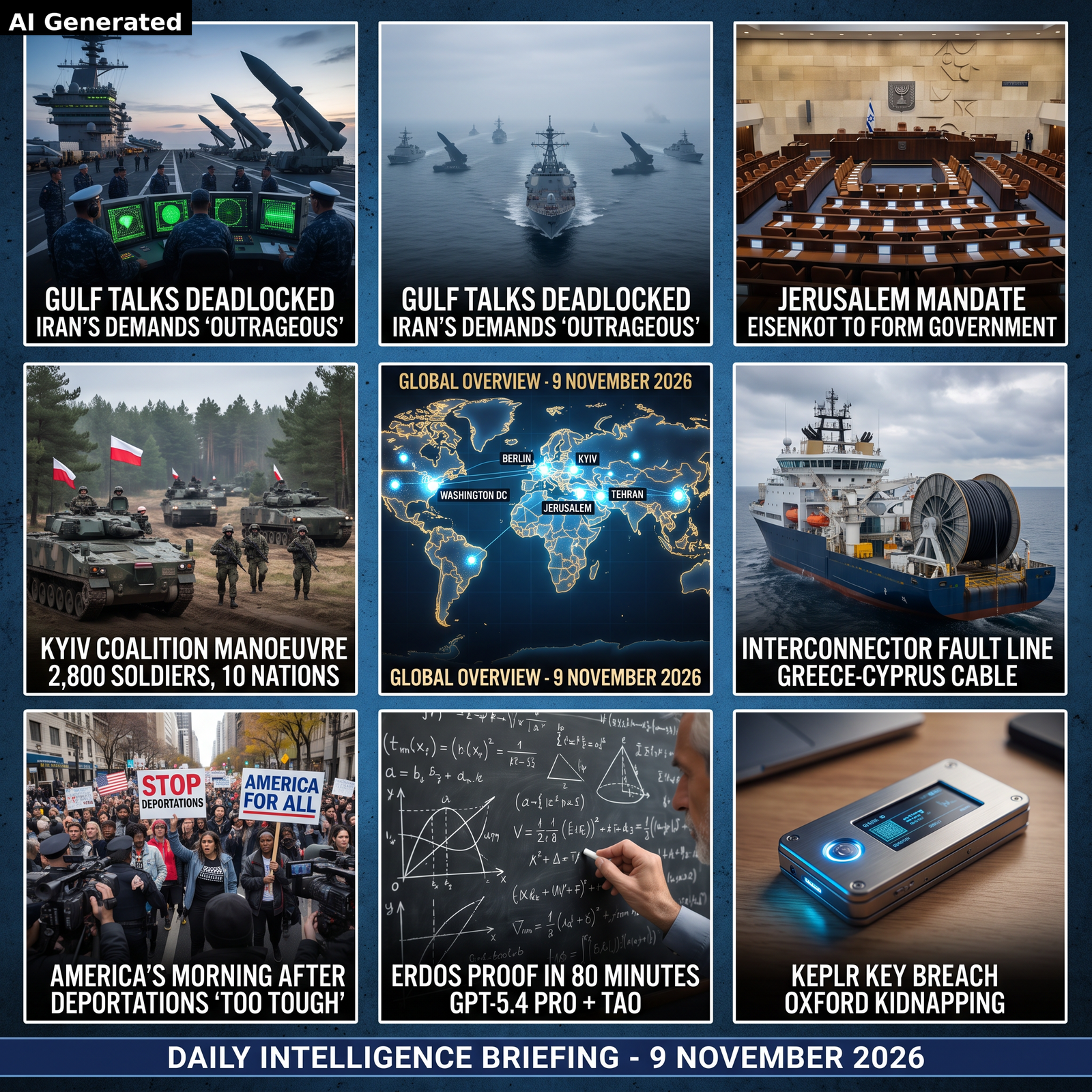
Week five of the US–Iran confrontation opened with diplomacy stalled. Secretary of State Marco Rubio said talks had failed to make meaningful progress, called Tehran’s demands “outrageous,” and departed for the Paris G7[1]. The admission frames Paris as a coordination exercise for continued pressure and leaves Qatar as the only live channel, ahead of Trump’s Monday meeting with Qatar’s prime minister, who is expected to push new proposals[2].
Coercion is deepening. Trump announced that CENTCOM’s “Task Force Iron Gate” is “in full force” inside Iran — the land-and-Caspian interdiction team ordered on 7 November to close the border lanes through which Tehran moves weapons, dual-use technology and illicit finance, on top of the maritime blockade Washington says has blocked over $25bn of oil exports[3]. This is the land dimension of the embargo D161 reported hardening at sea.
Around the straits the periphery tightens. Israel’s defence minister said the mission in Iran “is not finished”[4]. A drone strike halted production at Iraq’s Khor Mor gas field, leaving more than 70 percent of Iraqi Kurdistan without power[5] — the war economy now reaching civilian infrastructure deep inside Iraq.
Jerusalem’s Morning: The Formal Mandate and the Coalition Clock
Israel’s transition reached its formal stage. President Herzog granted Yashar leader Gadi Eisenkot the mandate to form the next government, with the Knesset swearing in on Tuesday; Eisenkot pledged “Zionism, solidarity and friendship,” casting his coalition as a response to a divided society[6]. The ceremony converts the “first bite” reported in D161 into a 28-day negotiating clock, and the new security cabinet’s Iran posture becomes the next variable.
Turkish analysts, meanwhile, argue Israel is systematically working to draw Turkey into a second front, and that the rising presence of Israeli officials in Greek media serves that goal[7]. Whether Ankara’s real assessment or a warning to Athens, the narrative poisons an Eastern Mediterranean already generating its own crisis over the Greece–Turkey cable dispute.
Ukraine’s Coalition Manoeuvre and the Paris G7
The multinational force designed to back-stop a Ukraine ceasefire held its first exercise Monday. “Koalicja” at Nowa Deba in south-eastern Poland, 100 kilometres from the Ukrainian border, assembles 2,800 soldiers from ten European countries until 22 November — France 1,100, Britain 300 with Typhoons, Germany in the low double digits — rehearsing the securing of a peace inside Ukraine, from Polish soil, a doctrinal first[8]. Diplomacy runs parallel: the G7 foreign ministers meet in Paris over Ukraine, Iran, Hormuz and AI’s security impact[9], and Rubio reported progress on the post-war “security architecture,” with US-mediated Russia–Ukraine talks set for Tuesday and Wednesday in Abu Dhabi[10]. The fighting continues to reach deep into Russia: drones struck an industrial zone in Kirishi in the Leningrad region, near a major refining complex[11].
The Great Sea Interconnector Fault Line: Ankara, Paris and the Abeille Marengo
A new Eastern Mediterranean flashpoint has crystallised around the Greece–Cyprus electricity cable. Turkish media, citing Ankara, report Turkey formally demands written notification-and-consent from Paris before the French survey vessel Abeille Marengo works on the interconnection, and Hurriyet warns of naval intervention if the ship enters the area Ankara claims under the Turkey–Libya memorandum[12]. Greek defence media go further, charging that France sent a written diplomatic note requesting transit — an act they read as de facto recognition of Turkish jurisdiction, delivered just as Athens has spent over €8bn on French Rafales and FDI frigates[13]. Athens calls it a “simple notification.” Either way, the episode has internationalised Greek–Turkish delimitation at the worst possible moment and exposed the tension between Paris-the-arms-supplier and Paris-the-broker.
The Wider Periphery: Moldova, Sudan, Bangladesh, the Red Sea and the Congo
Moldova launched a new power line to Romania as President Sandu announced two more are coming, cutting another thread of Russian energy leverage[14]. In Sudan, the arrest of a close Bashir aide wanted by the ICC for Darfur war crimes adds a judicial layer to a conflict defined by impunity[15]. Ousted Bangladeshi prime minister Sheikh Hasina has requested a new passport to return home from Delhi — a move that would inject a volatile variable into Bangladesh’s post-revolutionary politics[16]. India evacuated 19 seafarers stranded two weeks in Yemen[17], and in the DR Congo five C64 opposition leaders seek a national dialogue with Tshisekedi and Kabila, but the government threatens prosecution for meeting Kabila in Goma, leaving the road to the 2028 elections hostage to the eastern war[18].
India’s Defence-Industrial Month: Missiles, Trainers and the Export Chessboard
New Delhi’s indigenous push produced a cluster of signals. The DRDO ran a user evaluation trial of the Pralay quasi-ballistic missile off the Odisha coast on 5 November — a manoeuvring, unpredictable terminal-phase weapon nearing induction[19]. Leonardo is positioning its M-346 for the IAF’s Stage-III advanced jet trainer requirement[20], and defence minister Rajnath Singh told IAF personnel at Bagdogra that warfare now spans cyberattacks, drone swarms, proxy wars and information operations — the doctrinal frame for all of it[21].
In loitering munitions, Pixiu Systems’ backpack-portable SYENA ASTRA-1 brings fire-and-forget strike to small teams[22], while KNDS and SeaOwl agreed to develop an unmanned surface vessel carrying a 30kg qualified warhead with 200km combat range, to be shown at DronTech Asia from 11 November[23]. Russia keeps pushing the Su-57E export variant despite India’s rejection[24], and security forces in Chhattisgarh unearthed a Maoist dump with over 900 detonators[25].
Naval and Underwater Technology: The New Geometry of Sea Power
Three naval developments show where the maritime balance is heading. Corridian emerged from stealth with a $38m seed round to build ultra-large AUVs carrying ISO-containerised payloads thousands of nautical miles — “stealth logistics” for contested domains like the Western Pacific[26]. Thales used Euronaval 2026 to advance its Hybrid Fleet ASW vision with the M-Cube mission system, a lightweight dipping sonar and the CAPTAS-4 Mission Module bringing variable-depth sonar to ships without dedicated ASW frigates[27]. France’s Naval Group unveiled the SCX 26 concept for the 2040s: a double-superstructure warship with lasers, railguns and drone bays[28].
Washington and Beijing After the Blue Wave
The Democratic landslide is reshaping US–China relations more subtly than the campaign suggested. Nikkei Asia reports the victory heralds sharp congressional scrutiny of Trump’s dealings with Beijing but no broad reset: the cost-of-living agenda limits Democrats’ appetite for trade fights while technology controls could tighten[29]. Beijing’s restrained reaction reflects the awkward arithmetic of divided government — less trade escalation, but more aggressive tech-policy oversight, tested as G7 leadership passes to Washington in January.
Environment & Climate ↑ Contents
COP31 Opens in Antalya: The “Implementation COP”
The 31st UN climate conference opened Monday in Antalya with a Turkish-Australian co-presidency and over 100,000 attendees expected, framing two weeks of Paris-Agreement implementation talks around emissions action, a Turkish push to electrify energy use, and — the summit’s fault line — climate finance for the global South, where several industrialised countries, Germany among them, have cut rather than raised contributions[30]. Two structural issues drive the technical track: outdated power grids worldwide as the principal renewables bottleneck, now elevated to a headline theme[31], and the American split — a Republican executive negotiating fossil-fuel priorities while the incoming Democratic Congress promises clean energy as an answer to high costs[32].
The Energy Winter Arithmetic: Solar, Storage and the Grid’s Weakest Months
Europe enters its hardest season: prolonged cloudy, windless spells can throttle solar and wind simultaneously, forcing grids onto polluting backup — the “dunkelflaute” that D161 identified as the gap in the continent’s storage build-out[33]. Two supply-side answers are scaling: floating solar over fish and shrimp ponds could generate ~4,100 terawatt-hours a year while avoiding up to 2.5 billion tons of emissions[34], and California’s two largest ports are declining to bet on hydrogen for ships despite two decades of state subsidies — preferring electrification and other zero-emission paths[35]. Demand-side momentum is unambiguous: plugin vehicles took a 32 percent global share in September, with BEVs up 8 percent year-on-year while plug-in hybrids fell[36].
Water and the West: Lake Powell’s Dead-Pool Clock
The Colorado River basin hit a new threshold: Lake Powell recorded its lowest level on record, less than 150 feet above dead pool, the point at which water can no longer pass Glen Canyon Dam’s bypass tubes to Lake Mead[37]. The 27-year drought — the longest in 1,200 years — has cut hydropower, curtailed the environmental flows that rebuild Grand Canyon sandbars and protect native fish, and forced Lower Basin states to brace for sharply reduced deliveries. Draining Powell entirely through low-level diversion tunnels, once fringe, is now a serious option, even as the federal post-2026 plan excluded it and recreation and desalination interests push back. The basin is in triage: fallowed fields, paused housing, and a running argument over saving the dam or the river.
The Living Ledger: Forests, Corals and the Dormouse
The biological front brings warnings and one rare piece of good news. The Smithsonian’s TEMPEST experiment flooded a Maryland coastal forest with ~80,000 gallons of brackish water a day and watched ghost-forest chemistry shift within hours — soil salt rising more than tenfold and persisting while trees above showed no immediate signal, with tulip poplars the most sensitive[38]. The finding makes soil monitoring, not just canopy surveys, the sentinel for sea-level intrusion. Off Brazil, volunteer divers are manually ripping out invasive sun coral near Ipanema, a species with no local predators that threatens to smother native reef life[39]. In Britain, hazel dormice may finally be recovering after decades of decline, with warmer summers boosting survival[40] — a rare warming beneficiary. Even successes are ambiguous: the Yarmouth tire reef, 1,500 ballasted bundles sunk in 1978, attracts more fish where tires are thickest, yet NOAA has long advised against tires as reef material and the production-versus-attraction question stays open[41].
Climate and the Disease Frontier
Climate change is redrawing the disease map. Dengue, once strictly lowland, now reaches the high Himalayas as warming lets mosquitoes colonise higher, densely populated Nepali valleys[42], while a new synthesis shows drought — expanding globally — is redefining how water-dependent pathogens spread[43]. Both threads make COP31’s adaptation-finance gap a present-day public-health exposure, not a distant accounting item.
The Carbon and Cryosphere Ledger
Two results refine the carbon cycle and the ice record. Gooier “marine snow” — the particles that carry carbon to the deep sea — resists bacterial breakdown and transports more than six times as much carbon to depth, adding a significant variable to carbon-export models[44]. And Columbia-led research argues human warming may have stopped the next glacial period mid-birth: an Arctic ice cap expanding since about 2,000 years ago, the possible seed of a new ice age, has had its advance halted by greenhouse forcing[45] — the Anthropocene foreclosing a natural cooling cycle while creating its own danger. On the industrial side, Fortescue’s Pilbara plans include wind blades larger than Godzilla, pushing the supply-chain frontier of gigawatt-scale wind — blades, ports, ships and steel at dimensions never built[46].
Society & Civil Issues ↑ Contents
America’s Morning After: Deportations, Prosecution Threats and a Child in Custody
President Trump acknowledged in a “60 Minutes” interview that his mass deportation policy “was too tough” and hurt Republicans in the midterms, signalling openness to an immigration deal with the Democrats who will control the committees writing it[47]. The same weekend, however, he vowed a political comeback as incoming Democratic leaders pledged accountability and the attorney general promised to defend officials against threatened prosecutions[48] — conciliation on policy, defiance on accountability, the defining tension of the interregnum. The human ledger is stark: an eight-year-old Haitian boy stripped of Temporary Protected Status was placed in federal custody alone after an ICE check-in[49], while Native American women made electoral history across tribal, state and federal races[50] — the same election that hardened immigration politics also widened representation.
Germany’s Civic Square: Aigner, the Mauerfall and the Democratic Defence
Chancellor Merz will propose Bavarian state parliament president Ilse Aigner as the joint Union candidate to succeed Federal President Steinmeier, with the CDU committees to be asked on Monday; Aigner already draws approval from SPD and Greens and would be both the first woman and the first CSU member in the office[51]. After weeks of Merz’s silence while CSU leader Söder pushed her name, the compromise candidate has become the consensus one. On the 37th anniversary of the Berlin Wall’s fall, federal eastern commissioner Elisabeth Kaiser warns democracy is under pressure while the SED victims’ commissioner demands easier access to Stasi files — using the historical reckoning as a working argument for open archives and institutional vigilance[52].
France’s Republic: The Social Conference and the Zecler Trial
Prime Minister Lecornu convenes a social conference Monday with unions and employers to answer weeks of cost-of-living protests, pledging concrete answers on wages and purchasing power; education unions have called another strike day for Tuesday, and the eight largest unions will decide their next moves Monday evening with a 100-euro net minimum-wage rise among the demands[53]. Separately, three police officers go on trial in Paris for the filmed 2020 beating of music producer Michel Zecler — condemned by Macron as a “shame” — facing up to 15 years on charges of group violence and document falsification, a direct test of police accountability[54].
The British Civic Ledger
An inquiry into the underachievement of white working-class pupils concludes “society needs to act,” with the education secretary backing it — widening the debate from schools to family income, housing and health[55]. Urban policy offered evidence: Oxford Street’s first pedestrianised week lifted footfall 16 percent, with spending and Tube use up[56]. Two legal landmarks complete the file: Russell Brand is sentenced Monday for rape and sexual assaults[57], and a woman has alleged that Ali Fayed, brother of the late Harrods owner, drugged and repeatedly abused her at the Balnagown estate[58]. Scottish Conservatives are meanwhile demanding an SNP minister correct Israel–Gaza remarks, keeping the Middle East conflict inside UK politics[59].
The Periphery’s Civic Files
Australia’s premier and human rights commission condemned One Nation’s NSW ticket leader Stuart Bonds for “demographic replacement” rhetoric, Chris Minns calling it “frankly outrageous and racist”[60]. In Wagga Wagga, family members of a man accused of the domestic-violence murder of 23-year-old Danielle Madgwick have been charged as accessories after the fact[61]. Mexico, with US intelligence help, arrested “R2,” chief of a branch of the Jalisco Nueva Generación cartel[62]; Colombia’s president ordered all state means mobilised to protect media after threats[63]; and at least 35 migrants died when a pirogue sank off Senegal[64].
Greece’s Welfare Files, China’s Safety Ledger and Delhi’s Smog
Greek households got two support measures: the heating-allowance platform opens by Tuesday with amounts up 30 percent and a pre-Christmas first payout[65], and the state-guaranteed child “piggybank” savings scheme moves toward a parliamentary vote[66]. In China, a building fire in Taiyuan killed 14[67], renewing fire-safety questions. And New Delhi woke to toxic smog after Diwali firecrackers compounded the seasonal crisis[68] — an annual ritual with policy layers from stubble burning to vehicle emissions.
The Papal Ledger: Leo XIV and Milei’s Argentina
Pope Leo XIV arrived in Buenos Aires, the first papal visit in almost forty years, and his message drew a sharp line against Javier Milei’s austerity: “the economy must serve the person, not the person the economy,” with democracy framed as a heritage to be preserved and strengthened[69]. At a moment when Milei’s shock therapy has stabilised prices but deepened inequality, the papal critique supplies the opposition a moral vocabulary — and marks the Vatican’s re-engagement with Latin America’s most watched economic experiment.
AI & Technology ↑ Contents
The Model Frontier and Its Proof: Erdős, Eighty Minutes and the Book
Mathematics logged one of the strongest demonstrations yet of AI-assisted research: a forum user asked GPT-5.4 Pro about an Erdős problem open since 1966, and the model produced a proof in about eighty minutes of autonomous reasoning; within weeks, an eight-author team including Jared Duker Lichtman and Terence Tao verified it and used its central Markov-chain technique — built on the von Mangoldt function — to settle further open questions[70]. Lichtman called the argument “from the Book”; part of it has been formalised in Lean. Still an unrefereed preprint, the episode reframes research mathematics as human checking of machine drafts — and accelerates the race to build verification tooling around model-generated proofs.
Compute’s New Geography: Texas Test Floors and Chinese Hull Efficiency
The physical geography of AI supply chains keeps shifting. King Yuan Electronics reports its Texas AI-chip testing plant remains on schedule — moving advanced-package testing, the most capacity-constrained segment of the chip chain, from Asia to the US as part of the same de-risking traced in D160[71]. In parallel, Chinese engineers adapted torpedo drag-reduction to commercial shipping: a second-generation bubble-lubrication system on a 50,000-tonne product tanker cut net energy consumption about 5 percent — roughly a tonne of fuel per day — with automated controls adjusting air volume to speed and draught[72]. In a year of elevated bunker prices and tightening emission rules, hull-efficiency systems are among the fastest-returning decarbonisation investments available.
Policy and the Economy of Agents
The AI policy landscape shifted with the political balance. Trump now says AI risks are manageable and signals openness to guardrails — an evolution from his first-term posture that lands as Democrats take the committees that will write AI legislation, giving bipartisan guardrail bills their best structural odds in years[73]. The economics of the technology are being priced with new sobriety: DeepMind’s Alex Imas argues AI agents may yield only 4 to 5 percent GDP growth — significant, but far below the step-change narratives, and concentrated in specific sectors[74]. Competitive pressure continues from China: DeepSeek’s open-source Harness agent application reached 1.54 million daily users as the startup doubles down on agents and plugins[75].
The Greek SME AI Stakes
Greece shows the adoption gap in miniature: 47 percent of Greek SMEs now use AI applications, yet only 3 percent report measurable productivity results[76]. Tools are cheap to trial; reorganising work, training staff and measuring gains is where firms stall. For an economy where SMEs dominate employment, closing that gap is a management-capacity problem more than a technology one — and the real test of whether the AI wave lifts economy-wide productivity or concentrates it in a thin layer of large firms.
Economy & Business ↑ Contents
The Nvidia Files: Huang, the Board Probe and the Economic-Warfare Frame
The week’s dominant corporate story exploded over the weekend. Nvidia’s board announced an independent-director committee and outside counsel will investigate reports that CEO Jensen Huang was the target of a foreign intelligence effort, after Huang admitted to an affair with Megaspeed executive Alice Huang, whom US intelligence suspects of working for China’s Ministry of State Security; the board said it has no reason to believe secrets were compromised[77]. The stakes are maximal — Nvidia is the indispensable supplier of the AI build-out and its chips sit at the centre of the most sensitive export controls in US policy.
Fortune frames the affair inside an intensifying economic-warfare contest, citing the Pentagon’s reported Technology Support Office and Economic Defense Unit as Washington escalates espionage against Chinese AI, biotech and chip companies[78]. Megaspeed — a Singapore data-centre firm that bought over $4.8bn of Nvidia chips in two years and was previously investigated for allegedly smuggling restricted chips into China — sits exactly at that intersection of commerce and suspicion. Huang’s memo, published in full by The Verge, mixes personal contrition with a board process explicitly guarding national and economic security[79].
Semiconductors and Supply-Chain Stress
Separately from the scandal, the memory market is warning. Winbond CEO Arthur Chiao — the world’s largest NOR flash maker — says AI-driven price hikes are unsustainable: only AI companies can afford current DRAM and NOR prices, DRAM has doubled in 2026, and consumers and non-AI industries are “suffering and withering”[80]. In Malaysia, trade talks with Taiwan were shelved after Anwar Ibrahim’s “One China” remarks, and industry players warn strains could dent future Taiwanese chip investment just as firms like ASE expand there[81]. Beijing, for its part, extended its 24 percent US-tariff suspension for two months from 10 November while keeping the base 10 percent, and kept its shipping-supply-chain probe suspended to 10 January 2027 — de-escalation with a deadline, preserving leverage before the new Congress[82][83].
Asia’s Macro and Energy Ledger
The region’s data sketched an economy under divergent stress. Philippine GDP grew just 2.1 percent year-on-year in Q3 as inflation sapped household spending, with AI-driven semiconductor exports the only bright spot and the central bank already at 5.5 percent[84]. China’s October PPI quickened to 5.7 percent while CPI edged down to 0.7 percent — the classic upstream cost-shock squeeze[85]. Asian equities steadied as AI and Middle East jitters receded, the dollar firm on Fed expectations[86]. Japan’s yen has sat at 157–158 per dollar for over a month, with new intervention data — including the ~$96bn July–August operation — showing the limits of official action even after a BOJ hike to 1.25 percent[87]. China’s falling LNG imports threaten to soften crude at a moment of war-driven elevation[88], while Seoul stressed the projected $10bn remittance for US nuclear projects is preliminary pending feasibility review[89].
Europe’s Monetary and Regulatory Clock
The euro area opened its most important succession process: finance ministers of the 21 euro countries held a first discussion of the ECB presidency, with Klaas Knot and BIS chief Pablo Hernández de Cos the named candidates after Christine Lagarde announced her early departure for 7 February; a recommendation is expected in the coming weeks with a decision targeted this year[90]. The choice between a hawkish ex-Governor and a consensus technocrat will set the tone through the winter energy shock. Germany, meanwhile, looks set to keep Klaus Müller at the Bundesnetzagentur, the networks agency steering grid expansion and energy-market oversight through those same winters, ending months of controversy[91].
The Corporate and Fiscal Ledger
The UK register produced a striking number: 787,120 companies dissolved in the year to 31 March 2026, up 8.3 percent and the highest since the series began in 1939, with the Crown’s Bona Vacantia division collecting £129m from dissolved firms, up 24 percent[92]. Nearly half were voluntary strike-offs; the wave reflects pandemic-era churn and the steady flow of orphaned assets to the state. Against that churn, Starbucks will hire 7,500 UK staff over five years as part of a 500-store expansion by 2031[93]. In Washington, Democrats’ plans to dismantle the Trump tariffs face the hard constraints of Senate arithmetic and the presidential veto, keeping the tariff regime a standing friction[94]. And the war economy reaches the most local level: Mumbai’s fishing communities are squeezed by diesel costs and ambiguous fuel pricing, with some leaving boats for security-guard work[95].
Science & Space ↑ Contents
The Biomedical Ledger: Proteins, Engineered Cells and the Ageing Dog
Type 2 diabetes gained a new suspect: a buildup of the protein Miro1 may drive insulin resistance, with preclinical work showing removal restores muscle insulin response and exercise lowering Miro1 in people with diabetes — a potential pathway that connects molecular biology to an existing intervention[96]. Cancer immunology delivered a striking preclinical result: UC San Francisco’s B-SYNC CAR-T cells, engineered to stay inactive until they reach the brain, completely eliminated diffuse midline glioma — a childhood brain cancer almost always fatal within a year — in two mouse models[97]. And in 894 Dog Aging Project subjects, larger breeds lost epigenetic control over LINE1 “jumping genes” about 35 percent faster per year than smaller ones, linking the canine size-lifespan trade-off to transposable-element methylation — with implications, the authors argue, for mammalian health-span generally[98].
The Cosmic Ledger: A Reborn Planet and New Lunar Recruits
Warwick-led astronomers, decoding Hubble spectra from 1999 with newer TESS photometry, argue the white dwarf HS 0209+0832 may be feeding on a second-generation planet — a Jupiter-sized world apparently assembled from gas the dying star shed, identified by s-process metals (niobium over 1,000 times solar) that no first-generation planet should carry[99]. If confirmed, it would be the first such world found around a white dwarf — and it rewrites the late-stage story of solar systems, including our sun’s. Closer to home, NASA opened astronaut applications for a class explicitly tasked with living and working on the Moon, the first lunar-oriented call in over half a century[100].
Deep Time and the Archive
Sediment beneath Greenland’s Camp Century shows that roughly 416,000 years ago warmer summers pushed the ice sheet more than 60 miles behind its current edge, with summer temperatures about 4.7°C above present — a natural analogue for partial deglaciation with direct bearing on sea-level projections[101]. In Spain, DNA from a 7,000-year-old piece of goat leather ties prehistoric livestock to goats alive today, anchoring genetics to hide, not just bone[102]. Colombia’s Paja Formation yielded an ecosystem of giant reptiles and sharks thriving while older groups waned — a “Biotic Inflection,” or major transformation without mass extinction[103]. Drone mapping at Selinus, where Trajan died in AD 117, is surveying the site some scholars believe marks his cremation before excavation[104]. And a 1,500-kilometre trek across the Rub’ al Khali found ancient lakes at 55 of 125 sites but no human trace — because the central basin lacks knappable stone, making “Green Arabia” a “lithic archipelago” whose islands were defined as much by geology as by water[105].
Earth’s Inner Mechanics: The Apennines, the Moho and the Nankai Trough
Under Italy’s Apennines, the lower crust is peeling from the rock above along a front 30 kilometres down — delamination active for ~10 million years and now the primary driver of the range’s tectonics and seismicity, resolving with GPS and satellite radar why parts of the chain stretch and rise while others sink[106]. Nearby, the DIVE project plans a two-kilometre borehole in Valsesia to reach the crust–mantle boundary at record shallow depth, where the rock could be true mantle peridotite or a crustal gabbro body — either way settling a question no drilling mission has answered[107]. Japan’s Nankai Trough yielded “hidden” past earthquakes via a new radiocarbon technique on Kumano Sea sediments, extending the catalogue for the country’s next megaquake[108].
Life at the Extremes
A deep-sea lanternshark just 8.5 inches long, trawled off Mauritius, is a new species — Etmopterus bulbosus, the “big-nosed lanternshark” — set apart by a bulb-shaped snout, denticle patterns and a COI barcode differing from relatives by over 10 percent[109]. In the Brazilian Amazon, the jewel-toned killifish Laimosemion laranja, under three centimetres, was found in just three forest pools — a habitat so tight that mining and deforestation may already endanger it[110]. And a three-amino-acid variant of a histone, H3mm15, is required for normal sperm development and cannot be substituted by conventional H3.3 — tiny protein differences, distinct regulatory functions[111].
The Physics Frontier: Gravitational Reconnection
Researchers at Columbia and Universidad Adolfo Ibáñez have identified a new phenomenon hidden in Einstein’s equations: “gravitational reconnection,” a theoretical process in which gravitational-field structures break apart and reconnect, transferring energy into matter[112]. The analogue to the magnetic reconnection that powers solar flares is suggestive for black-hole mergers and the early universe — purely theoretical for now, but exactly the kind of named result that observational astrophysics chases.
Crypto, Digital Assets & Blockchain ↑ Contents
The Security Perimeter: Keplr’s Key Breach and the Oxford Kidnapping
The week’s most consequential crypto-security event is a key-management failure at the heart of the “no single party holds the key” architecture. Over the weekend, Keplr confirmed that some accounts created with Google or Apple login had been sending funds without their owners’ consent, and the wallet provider named Web3Auth — the infrastructure vendor now sold as MetaMask Embedded Wallets — as the source of the problem, with Web3Auth pausing its embedded wallet service on 6 November and Keplr suspending social logins[113]. What makes the incident uniquely damaging is what remains unknown: neither company has published a technical root-cause report explaining how the keys were exposed. The response itself is unprecedented in form — Web3Auth published twelve “recovery” addresses and confirmed it moved assets out of vulnerable accounts along the attacker’s own path, a whitehat operation so fast and so similar to the thefts that some of its own transfers were mistaken for attacker activity. The twelve addresses are demonstrably one team’s keys: ten of them carry the identical secp256k1 public-key segment rendered under different Cosmos network prefixes, which corroborates the containment narrative while deepening the paradox that a system advertised as non-custodial could be swept by a single key-holder.
The aggregate numbers remain disputed, and the dispute is itself instructive. Blockchain-analytics firm Bitquery estimated at least $6 million drained from more than 44,000 wallets across eight Cosmos networks — roughly $137 per wallet, which reads less like a treasury raid than a mass sweep of small balances, and part of even that total may be the recovery team’s own containment transfers[113]. Keplr’s cofounder put potentially affected accounts at about 20 percent of social-login accounts, with only a fraction exploited, but staked, bonded and locked assets remain in a queue with no published timetable. The deeper lesson is architectural: in a social-login wallet there is no private key for the user to rotate, and the “no single party” promise turns out to depend on the integrity of a threshold scheme whose failure mode nobody has yet explained. Regulators watching the post-Binance-theft security agenda (tracked in D154–D160) will treat this as further evidence that custody infrastructure — not protocol code — is where the systemic risk now concentrates.
A second story widened the physical-security ledger. Evan Luthra detailed being kidnapped in Oxford and losing more than $2 million in crypto, an incident that highlights the vulnerability of high-profile crypto holders to physical threats and the absence of adequate legal and security frameworks for digital-asset owners[114]. Kidnapping-for-crypto has been a recurring risk in the industry for years, but cases in Western Europe are comparatively rare, and Luthra’s public account reframes personal security as an industry-wide obligation — one that exchanges, custodians and insurers have been slow to price in.
The Regulatory Perimeter: Trump’s 60 Minutes and the Family Business
The intersection of the presidency and the digital-asset industry was on open display in the same “60 Minutes” interview in which the president conceded his deportation policy had been “too tough.” Trump defended his family’s crypto ventures, pre-empting what he presented as predictable attacks, but the defence itself underscores the conflict-of-interest questions that the incoming Democratic Congress has already signalled it will pursue[115]. With the family’s exchange-linked token holdings, WLFI involvement and the president’s stated pro-crypto policy posture all in play, the post-midterm regulatory geometry reported in D161 now has a specific investigative vector: congressional subpoenas targeting the boundary between the Oval Office and the family’s digital-asset businesses. The interview also confirms that digital assets have moved from niche policy to mainstream presidential politics—with all the regulatory volatility that implies.
The Miners’ AI Pivot: Core Scientific, Hut 8 and Cipher Digital
The data-centre transformation of the Bitcoin-mining industry continued to produce hard numbers. Core Scientific reported $215.4 million of AI colocation revenue in the third quarter, up from $136.7 million in Q2 and just $15 million a year earlier, billing 485 megawatts representing more than $700 million in average annualised GAAP colocation revenue — while the headline $1.18 billion quarterly net income was inflated by a non-cash fair-value change in warrants, and capex reached $985.1 million[116]. The metrics define the new discipline of the sector: megawatts billing, tenant acceptance and construction execution now matter more than hashrate, and the transition is consuming enormous capital before it produces reliable cash.
Hut 8’s update pushed the same story further: a second 352-megawatt IT lease fully commercialised the Beacon Point campus, expected aggregate base-term contract value across its AI data-centre portfolio is about $26.6 billion, and 1,330 megawatts of utility capacity are under construction[117]. Revealingly, Hut 8 also sold roughly 3,100 Bitcoin during the quarter to fund share repurchases of about $250 million — with the buyback authorisation raised to $1 billion and a $1.07 billion credit facility closed — a capital-allocation strategy that explicitly reduces treasury exposure to the coin in favour of contracted AI infrastructure. The market is repricing these companies as power developers with crypto heritage, and delivery dates in 2027–2028 are the real test. Cipher Digital provides the third data point: it recorded its first high-performance-computing lease revenue in Q3 and extended its Barber Lake lease to 20 years, lifting contracted revenue to $9.1 billion, while its 1-gigawatt Colchis project gained conditional base-load classification[118]. Contract value is not yet realised profit — the company itself distinguishes between signed leases and operating data halls — but the sector has crossed the line from “plan on a slide” to billing relationships.
Institutional and Exchange Files: Binance, Upbit and Solana’s Hong Kong Play
The exchange layer produced one notable departure and two structural signals. Binance’s chief financial officer, Kaiser Ng, left after five years to build ventures spanning AI, Web3 and tokenized assets across sports, entertainment, computing and physical assets — a personnel exit that, in the context of Binance’s post-settlement reorganisation and the exchange’s reopening arc tracked in D158–D159, signals where the industry’s most connected operators see the next growth cycle[119]. South Korea’s Upbit saw weekly trading volume fall 20.8 percent to 6.7 trillion won, with XRP leading activity — evidence of a cooling retail cycle even in the region’s most liquid market, and a caution flag for the broader exchange-revenue recovery[120].
The most interesting institutional signal, however, comes from Hong Kong: The Solana Company, holding 2.2 million SOL, is targeting a major APAC expansion in the city, which has identified tokenization as a key fintech development area, and the expansion could take its headcount toward 30 as it positions to serve local banks[121]. Hong Kong’s regulatory framework — the licensed-exchange regime and its stated ambition to be Asia’s tokenization hub — is exactly the on-ramp that the D161 report’s “institutional rails” narrative expected would attract protocol foundations; the Solana Company entity’s move suggests that foundations are now structuring regional operating arms to pursue licensed, bank-facing business rather than simply listing tokens. Keep watching the Hong Kong tokenization pipeline through the winter: it is the clearest institutional test of whether Asian licensed venues can convert regulatory intent into real asset flows.
Correlations & Analysis ↑ Contents
The D162 window is the fifth post-midterm read of the master variable this report has tracked since D149, and it shows the Gulf confrontation entering a qualitatively different phase. D161 closed on the maritime embargo hardening into a blockade regime; today the coercion architecture adds its land dimension — Task Force Iron Gate declared “in full force” alongside the naval blockade — while Rubio pronounces negotiations deadlocked and Trump prepares to receive Qatar’s prime minister with new proposals[1][3]. The running-context hypothesis, that coercion and diplomacy would run in parallel at maximum intensity, is now institutionally encoded: a dedicated CENTCOM interdiction team, a live Qatari channel and an Israeli transition government insisting its mission is unfinished, all in one cycle. The next hinge is whether the Qatari proposal produces a concrete bargaining position Tehran can accept, or the blockade simply tightens through the winter.
The post-election restructuring tracked since D157 is producing its first reversals. The most striking is the president’s admission that mass deportations were “too tough” and cost Republicans, coupled with an offer to negotiate with the Democrats who swept the midterms[47]. Read with Trump’s new openness to AI guardrails[73] and his family-crypto defence[115], the weekend’s interviews portray a president positioning transactionally for divided government: conciliatory where the electorate punished him, defensive where subpoenas will land. Beijing is reading the same tea leaves, extending tariff suspensions rather than escalating[82]. The D158 thread — a Democratic Congress policing tech and trade against a Republican executive — is now observable reality.
The Nvidia affair concentrates three running narratives into one event. D160 flagged the Huang spy case inside compute’s geopolitics; today the board probe, the public apology memo and the reporting on Pentagon economic-warfare escalation turn a personnel scandal into a governance-and-national-security event at the most systemically important company in the AI supply chain[77][78]. Simultaneously, Winbond’s warning that memory prices are unsustainable for everyone but AI buyers connects the governance story to D161’s “AI constraint”: the non-AI economy is being priced out of silicon, and the entity at the centre of the squeeze now faces an internal probe and congressional scrutiny at once[80]. Any finding touching export controls would re-shift the semiconductor trade geometry D156–D161 tracked — this time with Washington generating the shock.
Europe’s energy and defence front lines are converging as the running context signalled since D153. The Great Sea Interconnector dispute — Ankara demanding written consent from Paris for a French survey vessel, Greek media accusing France of de facto recognising Turkish claims — is a new Eastern Mediterranean variable that tests the €8bn France-Greece defence relationship against Paris’s need to manage Ankara[12][13]. In the same window, the Koalicja exercise began rehearsing post-ceasefire stabilisation of Ukraine with genuinely German participation, and COP31 opened with grid investment — D161’s “electricity bottleneck” — elevated to a headline theme[8][30]. The connective tissue is energy infrastructure: cables, grids, storage and the power lines determining whether a European winter and a Gulf war can be absorbed without political rupture, with Moldova’s interconnection and Müller’s continuity at the Bundesnetzagentur on the same ledger[14][91].
In digital assets, the Keplr-Web3Auth breach lands precisely where D154–D160 placed the systemic risk: not protocol code but custody and key-management infrastructure[113]. Its most corrosive feature is the missing root-cause explanation for how a “no single party holds the key” architecture could be swept by one key-holder; its most market-relevant feature is timing, since the same weekend produced the strongest evidence yet of the miner-to-data-centre pivot tracked since D149 — Core Scientific billing $215 million of colocation, Hut 8’s $26.6 billion contracted AI portfolio, Cipher Digital’s first HPC lease revenue[116][117][118]. The sector now borrows against 2027 delivery dates while regulators are handed a fresh custody scandal — the winter’s risk asymmetry.
What to watch in the next reporting period: (1) the Qatar channel — whether Monday’s Trump–Qatar meeting yields a concrete text on Hormuz and the nuclear file, and whether Iron Gate’s land interdictions produce a visible escalation on Iran’s borders or the Caspian; (2) the Eisenkot coalition clock and whether Israel’s new security cabinet alters the Iran posture reported since D149; (3) the Paris G7 communiqué, the first coordinated Western statement since the midterms and a test of European influence over US Iran policy in the lame-duck window; (4) the ECB succession, with the Knot-versus-Hernández de Cos choice framing euro-area policy through the winter energy shock; (5) the Nvidia probe and its congressional echo, which will move AI-chip expectations either way; (6) the Keplr root-cause report and whether US regulators convert it into custody-rule changes; and (7) Lake Powell’s winter drawdown, a functional test of dead-pool operations. Any one of these would justify its own report; together they are the load-bearing variables of the week.
References ↑ Contents
1. Marco Rubio Says US-Iran Peace Talks Remain Deadlocked Amid ‘Outrageous’ Iranian Demands by Indian Defence News · Source ↑
2. Trump plans to meet Qatar’s prime minister on Monday as the key mediator pushes new proposals in talks with Iran by The Independent · Source ↑
3. Trump: Task Force Iron Gate in full force inside Iran by DefenceNet · Source ↑
4. Israel: the mission in Iran ‘is not finished’, says defence minister by in.gr · Source ↑
5. Drone attack suspends production at Iraq’s Khor Mor gasfield by Al Jazeera · Source ↑
6. Israel President To Hand Government Formation Mandate To Eisenkot As New Knesset Prepares For Swearing-In by Indian Defence News · Source ↑
7. Turkey: Why the presence of Israeli officials in Greek media is increasing by in.gr · Source ↑
8. Multinationale Ukraine-Truppe hält in Polen ihr erstes Manöver ab by Stern · Source ↑
9. Wadephul bei Treffen der G7-Außenminister in Frankreich by Stern · Source ↑
10. EN DIRECT, guerre en Ukraine: Marco Rubio fait état de progrès pour l’architecture de sécurité après la guerre by Le Monde · Source ↑
11. Drones strike industrial zone in Kirishi in Russia’s Leningrad region: officials by FinancialJuice · Source ↑
12. Turkish media: Ankara formally demands written notification from Paris (GSI survey) by DefenceNet · Source ↑
13. New ‘Imia’: officially France recognised the Turkish EEZ (Great Sea Interconnector) by DefenceNet · Source ↑
14. Moldova launches new power line to Romania to cut reliance on Russia by Al Jazeera · Source ↑
15. Sudan: the wanted former president of the ruling party arrested by Zougla · Source ↑
16. Ousted Bangladeshi Prime Minister Sheikh Hasina requests new passport and ID card to return home by FinancialJuice · Source ↑
17. Indian Seafarers Safely Evacuated From Yemen After Two-Week Ordeal by Indian Defence News · Source ↑
18. Dialogue nationale en RD Congo: comment sortir de l’impasse? by France 24 · Source ↑
19. The Unpredictable Arrow, The Unscripted Missile: Pralay The Missile That Brakes The Ballistic Rulebook by Indian Defence News · Source ↑
20. Leonardo Positions M-346 As Strong Contender For IAF Stage-III Advanced Jet Trainer Requirement by Indian Defence News · Source ↑
21. Rajnath Singh Warns Warfare Now Spans Cyberattacks, Drone Swarms And Information Operations by Indian Defence News · Source ↑
22. Backpack-Portability Meets Precision: SYENA ASTRA-1 Delivers Long-Endurance Loitering Strike Capability by Indian Defence News · Source ↑
23. KNDS, SeaOwl Partner On Surface Drone With Naval Loitering Munition by Asian Defence Journal · Source ↑
24. Russia Keeps Su-57E Export Push Alive Despite India’s Rejection by Indian Defence News · Source ↑
25. Security Forces Unearth Maoist Cache Containing Over 900 Detonators In Bijapur, Chhattisgarh by Indian Defence News · Source ↑
26. Ultra-large autonomous underwater vehicles set to be built with $38 million new funding (Corridian) by Interesting Engineering · Source ↑
27. Anti-submarine warfare gets major boost with world-class variable-depth sonar performance (Thales) by Interesting Engineering · Source ↑
28. France’s vision for the warship of 2040 packs lasers, railguns and drones (Naval Group SCX 26) by New Atlas · Source ↑
29. Why China takes a back seat for Democrats after US midterms by Nikkei Asia · Source ↑
30. UN-Klimakonferenz beginnt im türkischen Antalya (COP31) by Stern · Source ↑
31. Upgrading power grids to accommodate renewable energy is a key issue at climate talks by The Independent · Source ↑
32. Democrats plan to push clean energy in Congress as Trump backs fossil fuels by AP News · Source ↑
33. ‘We’re hardly producing any power’: Can Europe’s solar boom survive a cloudy winter? by Euronews · Source ↑
34. Solar above, fish below: Double-decker farm’s vast energy potential (floating PV over aquaculture) by Anthropocene Magazine · Source ↑
35. Even California’s Biggest Ports Aren’t Betting On Hydrogen For Ships by CleanTechnica · Source ↑
36. Top Selling Electric Vehicles in the World — 32% EV Share in September! by CleanTechnica · Source ↑
37. As the Colorado River shrinks, calls to drain Lake Powell grow by Grist / Yale Environment 360 · Source ↑
38. Scientists flooded a Maryland forest with 80,000 gallons of salty water… (TEMPEST ghost forest) by EcoTicias · Source ↑
39. Killing a dangerous coral (invasive sun coral removal, Brazil) by Mongabay · Source ↑
40. A glimmer of good news for Britain’s sleepy dormouse by BBC News · Source ↑
41. A Cape Cod town sank about 1,500 bundles of old car tires to build an artificial reef… by EcoTicias · Source ↑
42. Climate change is bringing dengue fever to the high Himalayas by Inside Climate News · Source ↑
43. Drought driven by climate change is redefining how disease spreads, study finds by Mongabay · Source ↑
44. Hidden climate superpower: Why some ocean ‘snow’ carries six times more carbon by ScienceDaily · Source ↑
45. Scientists Discover Climate Change May Have Stopped Earth’s Next Ice Age by SciTechDaily / Columbia Climate School · Source ↑
46. Bigger than Godzilla! (Fortescue Pilbara wind turbine blades) by CleanTechnica · Source ↑
47. Trump says deportations were ‘too tough’ and hurt him during the midterms by NBC News · Source ↑
48. Trump vows comeback as parties clash over Democrat prosecution threats by France 24 · Source ↑
49. 8-year-old Haitian boy placed in federal custody alone after ICE check-in by ABC News · Source ↑
50. Native American women made history in tribal, state and federal elections by ABC News · Source ↑
51. Merz will Aigner in CDU-Gremien für Steinmeier-Nachfolge vorschlagen by Stern · Source ↑
52. Mauerfall: Ostbeauftragte Kaiser ruft zur Verteidigung demokratischer Werte auf by Die Zeit · Source ↑
53. Proteste in Frankreich: Premier Lecornu berät mit Gewerkschaften und Arbeitgebern by Stern · Source ↑
54. Schwarzen Musikproduzenten verprügelt: Prozess gegen Polizisten beginnt in Paris (Zecler) by Stern · Source ↑
55. Society needs to act to help white working-class pupils, inquiry says by BBC News · Source ↑
56. Oxford Street footfall jumps 16% in first week of pedestrianisation, City Hall says by Evening Standard · Source ↑
57. Russell Brand due to be sentenced for rape and sexual assaults by Evening Standard · Source ↑
58. Woman says Al Fayed’s brother drugged and sexually abused her at Highland estate by BBC News · Source ↑
59. Conservatives call for SNP minister to correct comments about Israel and Gaza by Evening Standard · Source ↑
60. ‘Outrageous and racist’: premier responds to NSW One Nation candidate’s ‘demographic replacement’ claim by The Guardian · Source ↑
61. Wagga Wagga family members of alleged DV murderer charged with being accessories after the fact by The Guardian · Source ↑
62. Localisé grâce aux États-Unis, le Mexique arrête « R2 », responsable d’une branche du cartel Jalisco by Le Parisien · Source ↑
63. Kolombia: authorities strengthen media security after threats by in.gr · Source ↑
64. Au large du Sénégal, une pirogue fait naufrage, provoquant la mort d’au moins 35 migrants by Le Parisien · Source ↑
65. Επίδομα θέρμανσης: Ανοίγουν έως την Τρίτη 10 Νοεμβρίου οι αιτήσεις στο myΘέρμανση by Ethnos · Source ↑
66. «Κουμπαράς» για παιδιά: Μέχρι πόσα χρήματα προσφέρει το κράτος και πότε γίνεται ανάληψη by Ethnos · Source ↑
67. China: building fire in Taiyuan kills 14 – Xinhua by FinancialJuice · Source ↑
68. New Delhi wakes to toxic smog after Diwali as firecrackers add to seasonal pollution crisis by The Independent · Source ↑
69. Papst Leo in Südamerika: Kritik an Mileis Sparpolitik in Argentinien by Der Spiegel · Source ↑
70. A forum user asked an AI model about an Erdős problem open for 60 years… (GPT-5.4 Pro proof) by EcoTicias · Source ↑
71. King Yuan Electronics keeps its Texas AI chip testing plant on schedule by Crypto Briefing · Source ↑
72. China’s new bubble-lubrication system could save large ships’ 1.1 tons of fuel daily by Interesting Engineering · Source ↑
73. Trump says AI risks are manageable and signals openness to guardrails by Crypto Briefing · Source ↑
74. Google DeepMind’s Alex Imas says AI agents may yield only 4% to 5% GDP growth by Crypto Briefing · Source ↑
75. DeepSeek: future plans, the battle for users and the new bet (Harness app, 1.54M daily users) by OT.gr · Source ↑
76. Μικρομεσαίες επιχειρήσεις: Η στροφή στο ΑΙ και τα «αγκάθια» (Greek SMEs, 47% AI use) by Ελεύθερος Τύπος · Source ↑
77. Nvidia CEO Huang admits affair with Chinese spy, company launches probe by Business Standard · Source ↑
78. The Pentagon is reportedly ramping up economic warfare and espionage. Nvidia CEO Jensen Huang’s affair with a suspected Chinese spy shows why by Fortune · Source ↑
79. Here’s the full text of Jensen Huang’s memo to Nvidia by The Verge · Source ↑
80. Taiwan chipmaker CEO warns memory price rises are unsustainable (Winbond) by Nikkei Asia · Source ↑
81. Malaysia-Taiwan fraying ties threaten future chip investments by Nikkei Asia · Source ↑
82. China to extend suspension of 24% US tariffs for two months from Nov. 10, maintain 10% tariffs by FinancialJuice · Source ↑
83. China transport ministry: to keep suspending probe into shipping/shipbuilding supply-chain security until Jan 10, 2027 by FinancialJuice · Source ↑
84. Philippine GDP grows 2.1% in Q3, dragged by high inflation by Nikkei Asia · Source ↑
85. China’s October producer inflation quickens further, consumer prices edge down by Investing.com / Reuters · Source ↑
86. Asian stocks steady as AI, Mideast jitters recede; dollar firm on Fed bets by Investing.com / Reuters · Source ↑
87. Japan FX intervention data underscores challenge of reversing weak yen by Nikkei Asia · Source ↑
88. China’s LNG import drop may shift global energy market dynamics by Crypto Briefing · Source ↑
89. South Korea finance minister: $10 billion remittance for US nuclear project to proceed only after feasibility review by FinancialJuice · Source ↑
90. Finanzminister der Eurogruppe beraten über Nachfolge von EZB-Chefin Lagarde by Stern · Source ↑
91. Regulierung: Klaus Müller soll Bundesnetzagentur auch künftig führen by Handelsblatt · Source ↑
92. UK company dissolutions reach 787,120 as Crown collects £129m by Business Matters · Source ↑
93. Coffee giant Starbucks to hire 7,500 new UK staff over next five years by The Independent · Source ↑
94. ΗΠΑ: Πώς οι Δημοκρατικοί σχεδιάζουν να ξηλώσουν τους δασμούς Τραμπ by OT.gr · Source ↑
95. Iran war and ambiguous fuel pricing squeeze Indian fishermen by Nikkei Asia · Source ↑
96. A little-known protein could be a major culprit in type 2 diabetes (Miro1) by ScienceDaily · Source ↑
97. Scientists wipe out deadly brain tumors in every mouse tested with new cancer therapy (B-SYNC CAR-T) by ScienceDaily · Source ↑
98. Larger Dogs Age Faster, And Scientists May Finally Know Why by ScienceAlert / Science · Source ↑
99. A dying star may have built a second-generation planet out of the gas it threw off (HS 0209+0832) by EcoTicias (EN) / Nature Astronomy · Source ↑
100. NASA is looking for astronauts to live and work on the Moon by NPR · Source ↑
101. Scientists Discover Greenland’s Ice Sheet Once Retreated 60 Miles by SciTechDaily / University at Buffalo · Source ↑
102. Researchers Recover DNA from 7,000-Year-Old Leather, Revealing a Link to Goats Alive Today by SciTechDaily / PLOS · Source ↑
103. An ancient ocean full of giant predators reveals a surprising twist in evolution (Biotic Inflection) by ScienceDaily · Source ↑
104. Emperor Trajan died at Selinus… archaeologists drone-mapping the site (Gazipaşa survey) by EcoTicias · Source ↑
105. The World’s Biggest Sea of Sand Shows No Trace of Ancient Humans. Here’s Why (Rub’ al Khali) by ScienceAlert / Nature · Source ↑
106. Italy’s Apennine Mountains are coming unzipped 19 miles underground (delamination) by EcoTicias (EN) / Communications Earth & Environment · Source ↑
107. Scientists want to drill about 1.2 miles beneath an Alpine valley in Italy to look for Earth’s mantle (DIVE) by EcoTicias · Source ↑
108. Radiocarbon analysis uncovers possible traces of hidden earthquakes off Japan’s coast (Nankai Trough) by Phys.org · Source ↑
109. Scientists trawling off Mauritius pulled up a deep-sea shark… a lanternshark nobody had ever named by EcoTicias · Source ↑
110. Scientists discover stunning new Amazon fish that may already be endangered (Laimosemion laranja) by ScienceDaily · Source ↑
111. Small histone differences help shape gene regulation during sperm development (H3mm15) by Phys.org · Source ↑
112. Einstein’s equations reveal how gravity could break, reconnect, and release energy (gravitational reconnection) by ScienceDaily · Source ↑
113. Twelve Recovery Wallets Later, Keplr Users Still Have No Explanation for the Key Breach (Web3Auth) by Blockchain Reporter · Source ↑
114. Evan Luthra details Oxford kidnapping, losing over $2M in crypto by Crypto Briefing · Source ↑
115. Trump defends family’s crypto business in 60 Minutes interview by Crypto Briefing · Source ↑
116. Core Scientific’s AI Colocation Revenue Jumps to $215M as Mining Role Shrinks by NewsBTC · Source ↑
117. Hut 8 Expands AI Campus Commitments While Funding Buybacks With Bitcoin Sales by NewsBTC · Source ↑
118. Cipher Digital Starts Booking HPC Lease Revenue as $9.1B Contract Takes Shape by NewsBTC · Source ↑
119. Binance CFO Exits After 5 Years to Pursue AI and Crypto Tokenization by Bitcoin.com News · Source ↑
120. Upbit weekly volume falls 20.8% to 6.7 trillion won as XRP leads trading by Crypto Briefing · Source ↑
121. The Solana Company Targets Hong Kong for Massive APAC Expansion by Bitcoin.com News · Source ↑
AI Disclosure: This post was created with the assistance of artificial intelligence. The ideas, analysis, and opinions expressed are my own — AI was used to help compose, structure, and refine my personal notes and thoughts into the final written content. Images, videos and music featured in this post were also generated using AI tools, based on my own creative prompts and direction.