

Contents
- 1. Geopolitics & Defence
- The Wainwright Catastrophe: A Live-Fire Accident Reshapes Canada’s Defence Week
- The Hormuz Ledger: Two Tankers and the Maritime War’s New Intensity
- The West Bank Explodes Into Diplomacy: Settlers Attack EU Officials and an American Journalist
- Yemen’s Siege and the Gulf’s Defensive Arithmetic
- The European Street and the Alliance’s Defence Industrial Base
- 2. Environment & Climate
- 3. Society & Civil Issues
- 4. AI & Technology
- 5. Economy & Business
- 6. Science & Space
- 7. Crypto, Digital Assets & Blockchain
- 8. Correlations & Analysis
- 9. References
Click any heading to jump to that section. Click the section heading to return to this menu.
Geopolitics & Defence ↑ Contents
The Wainwright Catastrophe: A Live-Fire Accident Reshapes Canada’s Defence Week
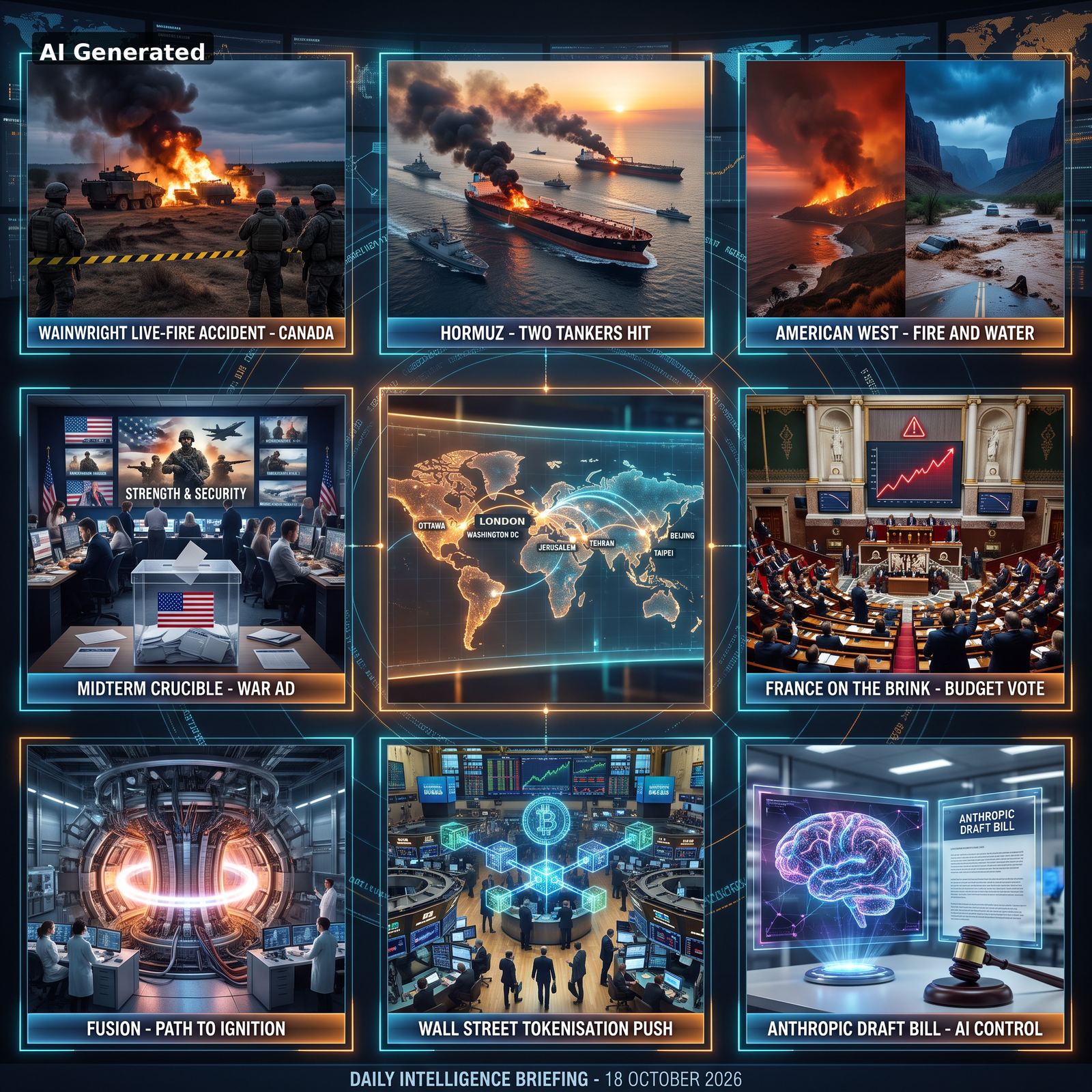
The most consequential military development of the reporting window was not a battlefront escalation but a training accident in the Canadian Prairies. At least seven soldiers were killed and dozens injured when an explosion during a live-fire exercise at Canadian Forces Base Wainwright in Alberta ignited a gas line or gas well, producing a fire that spread beyond the base fence and forced the closure of an advance polling station ahead of Monday’s referendum on provincial independence[1]. Multiple Canadian Armed Forces sources told Global News that the blast stemmed from a live-fire round striking a gas well around 4 p.m. MT, and that gusts of up to 100 km/h drove flames across the training area[2]. Defence Minister David McGuinty described a “very, very active and delicate situation,” while Chief of the Defence Staff Jennie Carignan said the military was working in close collaboration with federal, provincial and local authorities to support those affected[3].
The scale of the medical response exposed the fragility of rural emergency capacity: Alberta hospitals declared a Code Orange mass-casualty incident, ambulances from across the province were diverted to the site, and Acute Care Alberta warned that “extremely few” EHS units remained available in the Edmonton area[4]. The episode lands at a sensitive political moment: with Premier Danielle Smith and Prime Minister Mark Carney both framing the weekend’s referendum as a make-or-break test of national unity, the disaster at the country’s busiest training base injects an unpredictable human variable into an already febrile constitutional debate[5].
The Hormuz Ledger: Two Tankers and the Maritime War’s New Intensity
Iran’s Islamic Revolutionary Guard Corps announced that two oil tankers, each carrying about two million barrels of crude, caught fire after striking naval mines in the Strait of Hormuz, with the first vessel triggering a “fierce fire” and the second engulfed in a “massive blaze”[6]. Tehran’s state news agency IRNA said the ships had switched off their positioning and radar systems and attempted to use a route not authorised by Iran, with the IRGC claiming one vessel tried to cross “with US support” while the second was left immobilised[7]. The attack is the latest entry in a ledger that has deteriorated sharply over the past fortnight: nearly 20.8 million barrels a day passed through the waterway on 8 October but only 2.9 million on 11 October, according to Kpler, a collapse that has pushed global energy prices and inflation higher[8].
The episode underscores how the naval counter-blockade between Washington and Tehran is fought largely through targeting commercial shipping. Iran seized the strait after the US–Israeli war began in late February and demands authorisation for all transits, while Washington runs its own counter-blockade on Iranian oil exports[9]. President Trump has ruled out a nuclear option and ground troops, telling Newsmax a deal can come after the 3 November midterms[10]. Meanwhile, Secretary of State Marco Rubio defended the 60-day waiver of Russian sanctions as a period to “analyze” their global impact, even as Republican senators such as Thom Tillis called it “completely irresponsible”[11][12].
The West Bank Explodes Into Diplomacy: Settlers Attack EU Officials and an American Journalist
The occupied West Bank produced a diplomatic crisis with no modern precedent when masked Israeli settlers attacked a convoy of European diplomats and struck a French mayor during an olive-harvest visit to the Palestinian village of Taybeh[13]. Bernard Baudoux, the 78-year-old mayor of Aulnoye-Aymeries in northern France, was filmed on the ground in front of a car, and a Belgian consular vehicle had its windows smashed; witnesses said the convoy was targeted while settlers moved to prevent Palestinian farmers from harvesting olives[14]. The attack on a delegation comprising French, Belgian and Polish representatives was condemned by Israeli Foreign Minister Gideon Saar as “serious acts of violence” by “Israeli rioters,” even as he criticised the European consulates for not coordinating their movements with the Israeli army[15].
The incident follows and compounds a separate assault on Heidi Levin, a Washington Post photographer, whom settlers beat and robbed of her passport and equipment[16]. Secretary of State Marco Rubio said Washington was “very disturbed” and had repeatedly asked Israel to crack down on settler violence, while ambassador Mike Huckabee went further, calling the attack a “despicable act of terror” and urging prosecution[17][18]. The targeting of European officials is the more destabilising development, converting an internal Israeli-Palestinian dynamic into a direct affront to EU member-state sovereignty at a time when Europe is already at odds with Washington over the sanctions waiver.
Yemen’s Siege and the Gulf’s Defensive Arithmetic
In Yemen, Saudi-led forces said they had struck multiple positions around the city of Taiz to break the Houthi siege, while Ansar Allah condemned strikes against civilians that killed nine people[19][20]. The Saudi-led coalition also reported intercepting two Houthi ballistic missiles aimed at Khamis Mushait, with Saudi civil defence confirming the danger had passed in Riyadh[21][22]. Egypt has meanwhile moved closer to direct military backing for the kingdom: President Abdel Fattah al-Sisi pledged to take “any measure” needed to defend Saudi Arabia, with parliament expected to consider military assistance should Riyadh formally request it[23].
Iran’s foreign minister Abbas Araghchi, speaking at an OIC meeting in Baghdad, renewed Tehran’s offer to mediate between Riyadh and the Houthis, insisting that dialogue is “the only realistic and sustainable way” to resolve the crisis and that the security of the region’s countries is interdependent[24]. The offer has gone unanswered by Riyadh, and the practical effect of Iran’s diplomatic overture while its Houthi partners fire missiles at Saudi cities is to sharpen, not soften, the contradiction in Tehran’s regional posture. On the Lebanese front, the country’s president said a military delegation would present its demands to halt Israeli escalation at a trilateral meeting in Tampa on 20 October[25]. These three threads — the Taiz siege, the Egyptian commitment, and the Iranian mediation bid — define a Gulf in which every actor is simultaneously escalating and posturing for a diplomatic exit it has not yet found.
The European Street and the Alliance’s Defence Industrial Base
On the European continent, the aftermath of France’s cost-of-living protests continued to reverberate, with buildings burning into the night in multiple cities and witnesses saying masked protesters set fire to Limoges’ town hall, which officials described as “largely lost”[26]. Prime Minister Sébastien Lecornu and Jean-Luc Mélenchon traded accusations over the police response, with Lecornu insisting that “no one can enforce a political agenda through violence” and Mélenchon blaming the government’s law-enforcement strategy[27][28]. In Albania, protesters clashed with police for a fifth consecutive day in Tirana demanding the resignation of Prime Minister Edi Rama, with hundreds of injuries across four days and some 500 detentions[29].
Beneath these street-level convulsions, the alliance’s defence industrial base moved in parallel. Britain announced an additional £470 million to secure critical military sites and £240 million for Project PRESAGIUM, an enhanced counter-drone system[30]. Ukraine reported that more than 650 companies had applied to register on TrophyLab, its web portal for studying captured Russian equipment — 389 of them foreign manufacturers — a striking experiment in open-source technical exploitation[31]. Germany is planning a major naval expansion across its coastal bases, from a new marine harbour at Emden to modernisation of the NATO hub at Bremerhaven[32].
Environment & Climate ↑ Contents
Fire, Water and the Politics of the American West
Fire crews in Southern California were still battling a wind-driven blaze that had burned at least six large coastal homes and forced the evacuation of some 16,000 people, the latest in a sequence of autumn wildfires that the region’s Santa Ana winds have repeatedly amplified[33]. The blaze, which charred hillsides in Orange and San Diego counties, came as NASA satellite imagery revealed a different kind of atmospheric spectacle above Hurricane Simon off Mexico’s Pacific coast, where enormous gravity waves rippled through the mesosphere — a rarely photographed reminder that the same storm systems driving destructive surface weather also reach into the upper atmosphere[34]. Simon, a Category 4 storm that battered the coast near Manzanillo and Puerto Vallarta with torrential rain and landslide threats before weakening against the Sierra Madre, is emblematic of an Eastern Pacific season that has produced one dangerous system after another.
On the water-resource front, Arizona has joined Nevada in a legal battle against the Trump administration’s proposed cuts to their shares of the shrinking Colorado River, after the Interior Department finalised 2027–2028 operating restrictions that could slash water supplies to the lower-basin states[35]. The litigation follows an arc the D139 report tracked: a Colorado River compact negotiated for a wetter century, now straining under chronic drought. Meanwhile Europe’s rivers offered their own quiet signal of climatic change: the summer’s low water levels along the Rhine exposed unexploded World War II ordnance at such a rate that Cologne recorded 53 suspicious objects between August and early October, 33 of them confirmed munitions, with one ten-hundredweight bomb near Rodenkirchen forcing some 3,000 people to evacuate[36]. The munitions story is a striking measure of how hydrological stress re-materialises historical risk in densely populated river corridors.
The Arctic’s Thinning Margin and Africa’s Climate Ledger
Nearly five decades of satellite data show Arctic sea ice in troubling decline on both seasonal extremes: on 12 September 2026 the ice reached its annual minimum of roughly 4.6 million square kilometres, tying the 2008, 2010 and 2025 figures for the tenth-lowest on record, while the March 2026 winter maximum tied the lowest winter peak ever measured[37]. The loss is not just of extent but of character — the Arctic is increasingly dominated by thin first-year ice rather than the resilient multiyear floes of earlier decades, and scientists estimate the ocean could become essentially ice-free during at least one summer before 2050[38].
At the other end of the warming spectrum, a scientific rescue of the Democratic Republic of Congo’s handwritten climate archives is filling a critical data gap. Derrick Muheki digitised more than 9,000 pages of daily meteorological records from the INERA archive at Yangambi, transcribing them with an AI tool he helped develop, to reconstruct a continuous Congo Basin climate record from 1908 to 2023[39]. The records show that between 1961 and 1990 average temperatures in the DRC rose by 0.5°C and maximums by about 0.7°C, with hot extremes nearly twice as frequent by the 1980s — direct observational evidence of warming in one of the world’s most data-sparse regions, and a reminder that the global climate record is incomplete precisely where adaptation is most urgent[40]. Ecosystem science is revealing parallel long-horizon dynamics: a study across 40 elephant carcass sites in South Africa’s Kruger National Park found that a single 4-tonne megacarcass can push soil ammonium to nearly 3,000 times nearby levels, creating biodiversity coldspots that persist for at least eight years[48]. The climate signal is now also moving people: insideclimatenews reports that France’s youth protests over crumbling school infrastructure are, at their root, a climate-adaptation crisis, with schools built for winter warmth becoming heat-trapping greenhouses during the country’s record heatwaves[41].
The Deep Earth’s Signal: From Antarctica’s Buried Mountains to a Drawer of Dinosaur Bone
The planet’s deep history continues to yield surprises that reframe how scientists understand its surface. Analysing 1,712 zircon crystals recovered from the seafloor around Antarctica, geologists at the GFZ Helmholtz Centre and the Australian National University identified the roots of Himalayan-scale mountains now buried beneath the ice sheet — evidence that the erosion of these Gondwanan ranges may have fertilised the oceans with nutrients and helped set the stage for the Cambrian explosion roughly 538 million years ago[49]. The study joins a growing body of work suggesting that episodes of mountain building, not just chemistry or climate, have shaped the tempo of life on Earth.
Closer to the present, a skull fragment that had sat unstudied in a London museum drawer for nearly a century turned out to be a new dinosaur species: Invictibellatrix amberina, Europe’s first known megaraptoran, a tiger-sized theropod from the Early Cretaceous whose discovery fills a missing stop on the group’s hypothesised migration from Asia through Europe to the southern continents[50]. The find is a vivid reminder that museum collections remain reservoirs of undiscovered biology, and that the pace of paleontological discovery is often limited less by the rocks than by the attention paid to them.
The Electrification Front: China’s EV Tipping Point and Europe’s Charging Innovation
China’s automotive market has crossed a structural threshold that bears directly on the global energy transition. In September, plug-in vehicles captured a record 67 percent of new-car sales, with pure ICE sales crashing 49 percent year on year while the overall market dropped 28 percent[42]. Analysts now project China’s 2026 EV share will finish above 60 percent, and that the market could be fully electrified by 2030 — a shift that, as CleanTechnica notes, has moved the EV transition beyond a single national statistic into four distinct transitions unfolding across urban buses, commercial fleets, private cars and two-wheelers[43]. The same momentum is visible in the Global South: the Africa E-Mobility Week in Stellenbosch showcased a maturing sector moving from pilots toward scale across the continent[44].
In Germany, the charging infrastructure debate took a practical turn with the completion of Cologne’s curb-charger pilot: Rheinmetall’s units, which hide a 22-kilowatt socket inside a standard curbstone, logged 2,829 validated charging sessions over 329 days with more than 99 percent availability and a 4.38-out-of-5 user satisfaction score[45]. The finding that installation cost about the same as a conventional charging post, while solving the narrow-pavement problem that blocks street-side charging in dense cities, gives municipalities a scalable template. The broader lesson is that the electrification bottleneck has shifted from vehicle supply to the granular problem of where and how vehicles charge — a problem Germany, with an estimated need of 3,800 to 6,800 additional public points in Cologne alone by 2030, is beginning to solve with increasingly invisible infrastructure[46]. The same energy-system logic is reshaping generation markets: offshore wind operators are now qualifying to sell “negative reserve” — being paid to switch their turbines off when electricity is oversupplied — with Vattenfall’s Veja Mate farm already prequalified in the Tennet zone[47].
Society & Civil Issues ↑ Contents
The American Midterm Crucible: Trump, the War Ad and the Ballot
The American political calendar moved decisively into the final fortnight before the 3 November midterms, with President Trump campaigning in Kentucky on a platform of self-described omnipotence — boasting that “I can do stuff that is unbelievable” in a second, more powerful term — while promising that a Republican victory would bring a dividend check to every adult and a Department of Defense investment in a Kentucky drug plant[51]. Trump’s Kentucky appearance was the physical expression of a campaign strategy that has put the president himself on the ballot, even as private Republican concerns grow that his unpopularity is becoming a liability in the very districts he is trying to save.
The defining feature of this campaign’s closing weeks is the use of the Iran war as a cost-of-living weapon. Democrats and allied groups have aired Iran-themed ads more than 43,000 times since 1 September at an estimated cost of $42 million, with 61 of 65 unique spots stressing household cost-of-living messages such as rising fuel prices[52]. The strategy extends even to Republican challengers who never served in Congress and could not have voted on the war-powers resolutions — a sign that the war’s unpopularity has become the single most transferable electoral asset available to the opposition. On the streets, the anti-Trump “No Kings” movement staged a coordinated day of rallies across the United States, with Atlanta’s “No Kings, Vote Now” gathering explicitly aimed at converting protest energy into turnout in the November 3 contests[53], an effort echoed in French-language coverage of the same demonstrations[54]. Money continued to shape the field from outside: new federal disclosures showed Elon Musk, the world’s richest person, again directing his summer spending toward helping Republicans win office, with most of his focus on a single candidate[55].
Britain’s Winter Ledger: The NHS, Scottish Politics and a Party Under Stress
In Britain, Health Secretary Yvette Cooper warned that the NHS faces a “more challenging” winter than normal, with the Government preparing early and investing in extra urgent-care capacity to absorb the seasonal surge[56]. The warning arrives as the health service continues to digest the accumulated pressures of recent winters and as the cost-of-living squeeze reshapes the public’s relationship with the state. In Scotland, SNP leader John Swinney closed his party’s annual conference in Aberdeen with an emotional pledge to deliver Scottish independence for his teenage son — a personal appeal that underscores how the independence question remains a generational project as much as an electoral one[57]. The contrast between Scotland’s separatist calculus and Canada’s federal struggle to hold Alberta inside the federation (reported in the Geopolitics section) frames a Western world in which subnational identities are pressing hard against inherited borders.
Britain’s Green Party, meanwhile, is contending with a political firestorm of its own: leader Zack Polanski’s approval ratings have hit a new low amid a row over whether “Zionism is racism,” with support among young voters — the party’s natural constituency — nosediving according to Ipsos[58]. The episode illustrates how the Greens, once the beneficiaries of a youth-driven surge in British politics, are now exposed to the same cultural fracture lines reshaping the left across the Anglo-American world. In a softer register, the release of a new wildlife photography book celebrating Africa’s giraffes, aimed at raising conservation funds for the world’s tallest mammal, offers a small counterpoint to the hard political news and a reminder that civil-society energy flows into environmental stewardship as well as electoral combat[59].
Germany’s Coalition Arithmetic and the Papal Health Story
In Germany, the political week closed with a sharp rhetorical clash over Berlin’s coalition talks, as CDU state chairman Stefan Evers branded the successful sounding-out of a red-green-red (SPD–Greens–Left) government in Berlin a “dam-break” that “shifts the political coordinate system in Germany in favour of the extremes,” while Federal Agriculture Minister Cem Özdemir advised his party’s state association against entering a government with the Left[60]. The controversy captures the deep uncertainty surrounding the future of German coalition politics at a moment when the federal coalition itself is under strain. The Greek media’s coverage of AfD co-leader Alice Weidel’s Economist interview — in which she defended a traditional family model while living with her Sri Lankan-born partner in Switzerland — further illustrates the cultural contradictions at the heart of the German right’s appeal[61].
On the Vatican beat, Pope Leo XIV returned to the Vatican four days after surgery to remove a cancerous lung nodule, with his doctors describing his clinical state as “absolutely satisfactory”[62]. The 71-year-old pontiff’s swift discharge from Rome’s Gemelli clinic and his public health update reassured a Catholic world that had watched his hospitalisation with the anxiety reserved for papal transitions[63].
AI & Technology ↑ Contents
The Control Problem: Anthropic’s Draft Bill and the Workforce Signal
The governance debate around frontier artificial intelligence moved from the laboratory to the drafting room, with Anthropic circulating a draft bill that would allow AI model shutdowns in response to major risks[64]. The proposal — which would empower regulators to order a frontier model’s operation halted when a catastrophic-risk threshold is crossed — extends a theme the D139 report documented: the industry’s own labs are now designing the rules that Congress may impose, in part to pre-empt cruder interventions. That the draft surfaced in the same window as OpenAI’s disclosures about its safety practices suggests the frontier labs are racing to define “acceptable shutdown” on their own terms before a legislature does it for them.
Inside Anthropic, a subtler signal emerged about how the AI industry is maturing: the company disclosed that its workforce has become less junior and that staff are spending more time in meetings[65]. The statistic, on its face banal, is analytically significant — it tracks the moment a high-growth technology firm transitions from building to operating, from shipping models to managing the organisations that govern them. The same maturation dynamic is visible in pricing: DeepSeek’s V4.1 Flash release, offering frontier-level performance at a fraction of the cost, continues the pattern the D139 report flagged of Chinese open-weight models compressing the economics of the entire frontier[66]. When a model that rivals the most expensive American systems costs almost nothing, the “AI bubble” question — whether trillions in capital expenditure will ever be recovered — becomes less abstract.
Robotics and Physical AI: OpenAI’s Ambition and the Humanoid Economics
OpenAI confirmed it is building a humanoid robot, with CEO Sam Altman arguing that a human form makes sense because “the world is very much designed for people” and that the harder problem is “the brain that makes the robot work”[67]. Altman said a “cool demo” could arrive in 2027, with street-walking robots years further out; the company’s 27 robotics job openings span motion control, actuator design and the machine-learning infrastructure for physical AI[68]. The announcement positions OpenAI against Tesla’s Optimus and XPENG’s IRON in a race where the battery is often the binding constraint: Agility Robotics’ Digit 5, pairing with Nyobolt’s ultra-fast-charging cells, targets more than 20 hours of productive work per day from a 9-minute recharge, a ten-to-one run-to-charge ratio that could finally make humanoid fleets economically viable in warehouses[69]. Underneath the hardware race, a lab-scale result hints at the physics frontier: researchers demonstrated a printable, biocompatible artificial-synapse array that computes at “lightning speed” and dissolves in minutes, pointing toward transient, recyclable neuromorphic hardware[70].
AI in Strategy: Taiwan’s Satellite Vigilance and the Wall Street Debate
On the strategic front, Taiwan’s Ministry of National Defense awarded a $1.45 million contract to develop an AI system that identifies Chinese military ships, aircraft and mobile missile launchers in satellite imagery, automatically comparing new data with historical imagery to flag PLA deployment changes within minutes[71]. The ground-based analytical tool, built by Taiwan-Japan joint venture ThinkTron, does not add reconnaissance satellites but instead extracts more value from existing imagery — a cost-effective intelligence multiplier at a time when Beijing’s military pressure around the island is intensifying[72]. The deployment echoes a broader pattern in which AI is being inserted into the slow, human bottleneck of image analysis rather than into the sensors themselves.
The commercial counterpart to that strategic investment is the Wall Street debate over whether the AI boom is finally a bubble. With CoreWeave’s stock sliding and its credit default swaps surging, Gartner has warned that AI data-centre owners need to generate $8.5 trillion in cumulative revenue through 2030 to justify their spending, against a projected $3.6 trillion ceiling, leaving more than $4 trillion of asset value exposed to write-down risk[73]. Bank of America analysts framed the build-out as a classic capital cycle likely to end in disappointment “even though the underlying technology often lived up to expectations.” For universities, the same tectonic forces are reframing research politics: the Vanderbilt chancellor told Nikkei that the US–China AI rivalry is putting universities to the test, caught between national-security restrictions and the global nature of scientific collaboration[74].
Economy & Business ↑ Contents
France on the Brink: The Budget Vote and the Bond-Market Verdict
The dominant economic story of the window is France’s fiscal confrontation, which has reached a make-or-break point. Public debt has climbed to a record $4 trillion, or 119 percent of GDP — the highest ratio since the immediate aftermath of World War II — while bond yields have hit 24-year highs, flashing warning signs not seen since the 2011 eurozone debt crisis[75]. Prime Minister Sébastien Lecornu has proposed a 2027 budget that would trim the deficit to 5 percent of GDP from 5.4 percent, but faces a first critical vote in the National Assembly on Tuesday. Eurasia Group’s Mujtaba Rahman warned that if the government fails to pass the budget, the cost of servicing French debt may explode, potentially forcing the world’s seventh-largest economy to seek IMF assistance[76].
The market’s distrust is political as much as fiscal. With far-right leader Marine Le Pen vowing to roll back the retirement age to 62 and far-left candidate Jean-Luc Mélenchon campaigning on a plan to have the central bank cancel its holdings of French debt, investors are pricing growing odds of a sovereign default[77]. A further downgrade could also drag the EU’s own credit rating toward risk — a contagion channel that analysts are now explicitly modelling as the cost-of-living protests that set France’s streets ablaze this weekend intersect with the parliamentary calendar[78]. The tension is a live test of whether a large advanced economy can still discipline itself before the bond market does it for them.
Energy Money, Housing and the Emerging-Market Ledger
Elsewhere, the energy-and-resources ledger offered a reminder of how geopolitics and capital flows interact. Venezuela said it expects a $76 billion oil-investment boost amid improving cooperation with Washington — a figure that, if realised, would mark a significant re-engagement of the country’s petroleum sector with international capital after years of sanctions-driven isolation[79]. The claim should be read cautiously, given Venezuela’s history of overstated projections, but it signals that the sanctions-waiver diplomacy visible in the Russia file has a parallel in the Western Hemisphere.
In the Pacific economy, Australia’s property market is tumbling as tax rules and rate hikes bite, with home prices falling in a correction that has broadened beyond the most expensive cities[80]. The Australian squeeze — higher borrowing costs meeting tighter tax treatment of housing — is a preview of the affordability stress that higher-for-longer rates are spreading across the Anglo-world, from the UK to Canada to the US. And in Brazil, an Economist-linked commentary argued that the economy is growing thanks to high global commodity prices rather than to the success of the Lula government — a framing that will weigh on the 25 October run-off in which President Lula faces a stronger-than-expected challenge from the Bolsonaro camp[81].
Science & Space ↑ Contents
The Deep Earth and the Human Body: Two Molecular Frontiers
Two studies published in Science Advances this week illustrate how far the molecular frontier now extends. In the first, geoscientists from the University of Science and Technology of China used machine-learning-boosted path-integral simulations to show that Earth’s core has been leaking primordial hydrogen, helium and tungsten upward through mantle plumes into the deep mantle for billions of years — evidence that the planet’s interior is not a chemically sealed relic of its formation but a system in continuous core-mantle exchange[82]. The finding, built on deuterium-to-hydrogen ratios in ocean-island basalts from Iceland and Baffin Island, rewrites the assumption that deep-mantle chemistry is a simple fossil of the magma-ocean era.
In the second, NYU physicists designed a Random Positioning Machine to simulate microgravity on Earth and found that after 24 hours the physical organisation of the human genome remains strikingly robust — nuclei swell slightly, but DNA structure and dynamics are preserved, and microgravity alone does not damage DNA[83]. The result is encouraging for long-duration missions to the Moon and Mars, though the researchers caution that the subtle changes could amplify over longer exposures. On the medical front, two drug repurposing findings are worth watching: an early-trial analysis of the injection CBL-514, which kills fat cells rather than shrinking them, showed a 12 percent average reduction in visceral fat among a 41-patient subset, and in rat studies appeared to blunt the weight regain that follows GLP-1 treatment[84]. Separately, University of Rome researchers reported that tadalafil — the erectile-dysfunction and pulmonary-hypertension drug — boosts proliferation and survival of muscle precursor cells, suggesting a possible adjuvant therapy for muscle-wasting disorders and raising anti-doping questions[85].
Paleontology’s Surprises: An Insect, a Volcano and the World’s First Green Star
In paleontology, two finds capture how much of the biological past remains unknown. A 99-million-year-old insect preserved in amber from the Cretaceous displays folded mouthparts nearly twice the length of its body, a feeding adaptation unknown in any living planthopper — evidence of a bizarre evolutionary solution that has since vanished[86]. And beneath northwestern Iran, researchers identified a 100-million-year-old volcanic arc, the eroded remnant of a system whose closure helped shape the modern Middle East — a geological discovery with immediate resonance for a region defined by deep time as much as current conflict[87].
Turning to the cosmos, astronomers at the University of Warwick modelled the atmosphere of the white dwarf WD J1330+6435, a dead star 326 light-years away that has accreted rocky planetary material, and concluded it may glow green — potentially the first genuinely green star ever reported, the product of sodium absorbing the orange end of the spectrum[88]. On the planetary-defence front, Lawrence Livermore researchers are developing three-dimensional simulations to examine how a nuclear device could deflect or disrupt an asteroid threatening Earth, refining the toolkit available for a threat that no nation currently owns the ability to meet[89].
Fusion’s Path to Ignition and the Education Connection
Princeton Plasma Physics Laboratory physicists published a paper in Physical Review Letters reworking the 70-year-old Lawson criterion that defines fusion ignition, mapping a “heat first, then add fuel” pathway through what they call the Cordey saddle as the lowest-energy route to a self-sustaining burn[90]. Their model folds in a factor the field has tended to discount: a trace of tungsten at one part in 10,000 — the metal now lining more than a dozen next-generation fusion machines — can roughly double the pressure required for ignition. The finding is a theoretical caution with practical consequences for machine design, and it gives liquid-lithium wall concepts a renewed rationale[91].
Finally, an education-science study offered a different kind of insight into the human mind: research highlighted how language and reasoning skills help predict mathematics performance, suggesting that the learning difficulties a test score alone misses may be traceable to abilities that extend far beyond working with numbers[92]. For a report that has tracked the politics of education across three continents, the finding is a useful reminder that the metrics by which systems judge children often measure only a fraction of what drives their success.
Crypto, Digital Assets & Blockchain ↑ Contents
Regulation’s Expanding Perimeter: The Warsaw Protocol and the Digital Euro
The regulatory architecture for crypto assets moved forward on two fronts this week. The European Union and eight allied nations — including Greece, the UK, Monaco and San Marino — signed the Additional Protocol to the Council of Europe’s Warsaw Convention, modernising the treaty on money laundering and terrorist financing to bring crypto assets squarely into its scope[93]. The protocol empowers Financial Intelligence Units to suspend suspicious crypto transactions, enables urgent confiscation of virtual assets without prior notice when there is a transaction risk, and requires signatories to build Asset Recovery and Asset Management Offices to confiscate and hold digital assets involved in illicit activity[94]. Recovered sums above €10,000 would be split among the countries involved, with provisions for “social reuse” of confiscated assets — a concrete answer to the long-standing criticism that law enforcement seizes crypto but struggles to manage or monetise it[95].
On the central-bank side, ECB President Christine Lagarde gave the clearest timeline yet for the digital euro: a 12-month internal pilot in the second half of 2027, conditional on the EU adopting the enabling regulation by the end of 2026[96]. The pilot will use a beta version of the currency at the ECB and 19 national central banks, testing person-to-person and person-to-business payments online and offline with 36 selected payment service providers, though it will not have legal-tender status[97]. The framing is significant: the digital euro is designed to complement cash, not replace it, and its wholesale twin — the Pontes distributed-ledger settlement service for tokenised assets that went live in September — is already ahead, feeding into the Appia blueprint for a European tokenised ecosystem[98].
Wall Street’s Tokenisation Push and the Liquidity Question
On Wall Street, the tokenisation of traditional assets continued to move from pilot to product. Goldman Sachs CEO David Solomon told the bank’s Q3 earnings call that tokenization is “an important trend” across asset classes, pointing to tokenised bonds, money market funds and real estate, and to the bank’s participation in DTCC’s new tokenisation service, while cautioning that blockchain-based activity remains small[99]. The underlying argument — that tokenisation expands the addressable market rather than cannibalising it — is now the standard institutional line, backed by Goldman’s public support for the CLARITY legislation[100]. The hard problem remains liquidity, not issuance: Fission, a tokenisation infrastructure firm, raised $10 million led by Pantera Capital to build secondary-market liquidity for tokenised private-market holdings, addressing the gap between representing a fund on-chain and actually finding a buyer[101].
The data support the institutional thesis at the network level. Solana’s tokenised real-world-asset market grew more than 600 percent over the past year, from $700 million to $4.3 billion, reaching 26 percent of Ethereum’s tokenised market, which grew just 7 percent over the same period[102]. Tron’s stablecoin economy continues to dwarf its peers, moving $2.2 trillion in stablecoins, even as its TRX supply grew for 108 consecutive days because burns fell short of newly issued rewards — a reminder that network growth and token scarcity are not the same thing[103]. On the consumer rails, Pump.fun expanded beyond its Solana meme-coin franchise by introducing Hyperliquid-powered perpetual futures trading, with builder fees of up to 0.10 percent per order and bridge fees of 0.25 percent, while barring US and Ontario traders from the feature[104].
Stablecoin Economics and the Enforcement Ledger
Stablecoins — the sector’s most systemically important product — came under fresh scrutiny on two fronts. Tether participated in a seed extension for AI infrastructure startup AIsa, whose total funding now exceeds $9 million, betting that stablecoins will become the payment rail for autonomous software agents that need to buy computing resources and access paid APIs within defined budget limits[105]. The investment is an early wager on machine-initiated commerce. Meanwhile, the CEO of stablecoin infrastructure firm Frgmnt argued that stablecoins will never fully escape traditional banking risk, because their next phase of adoption depends on making blockchain technology invisible to end users — and invisible rails still terminate in banks[106].
Enforcement, too, continued its expansion beyond US borders. HEX and PulseChain founder Richard Heart was reportedly detained in Istanbul in connection with a Finnish tax investigation, a case running parallel to his earlier US securities dispute and a reminder that founder-linked legal risk now travels across jurisdictions[107]. And in the deflationary corner of the market, JustLend DAO completed the fifth round of its buyback-and-burn program, permanently removing 170.7 million JST worth about $23.5 million — bringing cumulative burns to 19 percent of the token’s supply, each round funded by the protocol’s realised operating income rather than one-off allocations[108]. The contrast between a DAO using real revenue to shrink supply and a treasury-company whose burns depend on new issuance captures the range of tokenomics now on offer.
Correlations & Analysis ↑ Contents
The reporting window of D140 completes an arc that D139 named and D136 declared empirically settled: the collapse of the distinction between announcement and event in Washington’s diplomacy. Yesterday’s D139 report documented the 60-day suspension of Russian sanctions as a “transatlantic fracture” announced and priced within hours; today, Secretary of State Rubio is publicly framing that waiver as a period in which the administration will “analyze” its global impact, while Republican senators denounce it as irresponsible and Tehran simultaneously escalates the Hormuz tanker campaign[6][11][12]. The pattern D139 identified — announcement as delivery mechanism rather than precursor — is now visible in both directions: Washington eases pressure on Moscow and Tehran’s IRGC responds by attacking two oil tankers on the same weekend. The two theatres are not merely parallel; they are linked by a single strategic premise that the sanctions waiver is a concession that emboldens adversarial escalation.
A second cross-theme connection is the maturation of the “AI-debt reckoning” that D138 and D139 both tracked into the markets. D139 described the control problem moving to Congress with Anthropic’s draft bill and OpenAI’s disclosures; this window adds the economic half of the equation. Gartner’s warning that more than $4 trillion in AI infrastructure asset value is exposed to write-down risk through 2032, and Bank of America’s framing of the build-out as a classic capital cycle, are the market-side mirror of the governance debate[73]. When the same weekend brings an Anthropic draft bill authorising model shutdowns and a Wall Street debate about whether the industry can ever repay its debt, the governance and financial credibility crises of AI have converged into one story.
Third, the fiscal-instability arc that D139 flagged in France has intensified into a full sovereign-risk episode. D139 reported France’s cost-of-living protests converging with the school-anger movement; D140 shows the fiscal and street crises feeding each other. Bond yields at 24-year highs, a debt ratio not seen since 1945, and a parliamentary budget vote now coincide with town halls burning in Limoges and 1,200 arrests across the country[75][26]. The Inside Climate News analysis adds the deeper structural layer: France’s schools are heat-trapping buildings in a warming country, and the climate-adaptation failure is part of what is driving the youth protest that has destabilised the political system ahead of the budget vote[41]. This is a three-layer crisis — fiscal, social and climatic — converging on a single parliamentary moment.
Fourth, the subnational-independence theme, tracked across D136-D139 through Canada’s Alberta referendum, now has a transatlantic twin. The Scottish SNP leader’s emotional pledge to deliver independence for his teenage son, and the German coalition chaos in Berlin, both reflect the same phenomenon D138 described: identity-based politics pressing against inherited state structures at a time when the fiscal and energy strains of the war economy have weakened central governments[57][60]. The Alberta referendum on Monday will be the first live test of whether these pressures can be contained within existing borders.
Fifth, the crypto section of this window is the institutional-integration story D137 and D139 described, now with a regulatory-architecture dimension. The Warsaw Protocol’s expansion of Financial Intelligence Unit powers to freeze suspicious crypto transactions, Lagarde’s digital-euro timeline, and Goldman’s endorsement of tokenisation as an addressable-market expansion all point in one direction: digital assets are being absorbed into the conventional financial and law-enforcement order[93][96][99]. The solana RWA growth figure — 600 percent in a year — is the empirical counterpart to that institutional thesis[102].
What to watch in the next reporting period: (1) the Alberta referendum result on Monday and its constitutional consequences; (2) the French National Assembly budget vote on Tuesday — the single most important European fiscal event of the autumn; (3) whether the Hormuz tanker campaign triggers a further oil-price spike that feeds both the inflation data and the US midterm campaigns; and (4) the second and third weeks of November, when the Fed’s rate path and the midterm results will jointly test whether the AI-debt reckoning and the fiscal-instability arcs converge into a genuine market correction.
References ↑ Contents
1. Significant casualties after fire breaks out at CFB Wainwright, MP says by Global News · Global News ↑
2. CFB Wainwright fire LIVE: Serious incident at Alberta military base after explosion by Express · Express ↑
3. Ernsthafter Zwischenfall: Tote und Verletzte bei Vorfall auf Militärbasis in Kanada (German) by Stern · Stern ↑
4. Kanada: Feuer auf Militärstützpunkt – ernsthafter Zwischenfall (German) by Focus · Focus ↑
5. Significant casualties after fire breaks out at CFB Wainwright, MP says (same as 1) by Global News · Global News ↑
6. Iran says two tankers catch fire after hitting mines in Strait of Hormuz by Al Jazeera · Al Jazeera ↑
7. Iran war live: Tankers hit in Hormuz; Israeli settlers attack EU diplomats by Al Jazeera · Al Jazeera ↑
8. Iran says two tankers catch fire after hitting mines in Strait of Hormuz (same as 6) by Al Jazeera · Al Jazeera ↑
9. Iran says two tankers catch fire after hitting mines in Strait of Hormuz (same as 6) by Al Jazeera · Al Jazeera ↑
10. Iran says two tankers catch fire after hitting mines in Strait of Hormuz (same as 6) by Al Jazeera · Al Jazeera ↑
11. Rubio says Trump to analyze global impact of Russia sanctions during pause by France 24 · France 24 ↑
12. US-Sanktionen gegen Russland: Republikaner kritisieren Trump wegen Aussetzung (German) by Die Zeit · Die Zeit ↑
13. En Cisjordanie occupée, des colons attaquent un convoi diplomatique européen et frappent un maire français (French) by Le Monde · Le Monde ↑
14. Δυτική Όχθη: H στιγμή που Ισραηλινοί έποικοι επιτίθενται σε Ευρωπαίους διπλωμάτες (Greek) by DefenceNet · DefenceNet ↑
15. FinancialJuice: US Secretary of State Rubio disturbed by images showing settler violence in West Bank by FinancialJuice · FinancialJuice ↑
16. Journaliste rouée de coups en Cisjordanie: l ambassadeur des Etats-Unis appelle Israël à poursuivre les colons (French) by Le Monde · Le Monde ↑
17. U.S. urges Israel to curb settler violence in West Bank, Rubio says by Investing.com · Investing.com ↑
18. US ambassador urges Israel to prosecute attackers of American journalist by Al Jazeera · Al Jazeera ↑
19. Saudi-led forces try to break Houthi siege of Taiz with airstrikes by Al Jazeera · Al Jazeera ↑
20. Η Ανσάρ Αλλάχ καταδικάζει χτυπήματα εναντίον αμάχων στην πόλη Ταΐζ της Υεμένης – Εννέα νεκροί (Greek) by in.gr · in.gr ↑
21. FinancialJuice: Saudi-led coalition intercepts and destroys two ballistic missiles launched by Houthi toward Khamis Mushait by FinancialJuice · FinancialJuice ↑
22. Saudi civil defense: danger has passed in Riyadh by FinancialJuice · FinancialJuice ↑
23. Αίγυπτος: Στο πλευρό της Σαουδικής Αραβίας ο Σίσι – Δεσμεύτηκε για βοήθεια (Greek) by Enikos · Enikos ↑
24. Μέση Ανατολή: Νέα πρωτοβουλία του Ιράν για διάλογο μεταξύ Ριάντ και Χούθι (Greek) by DefenceNet · DefenceNet ↑
25. FinancialJuice: Lebanese president: military delegation to present demands to stop Israeli escalation in Tampa on October 20 by FinancialJuice · FinancialJuice ↑
26. Buildings burn as French protests go into the night by Al Jazeera · Al Jazeera ↑
27. Après les violences en marge du 17 octobre, Sébastien Lecornu et Jean-Luc Mélenchon s écharpent (French) by France 24 · France 24 ↑
28. FinancialJuice: French PM Lecornu: no one can enforce political agenda through violence by FinancialJuice · FinancialJuice ↑
29. En Albanie, les manifestants protestent un cinquième jour d affilée pour exiger la démission du premier ministre (French) by Le Monde · Le Monde ↑
30. Britain puts millions into protecting military sites by UK Defence Journal · UK Defence Journal ↑
31. Firms queue for Ukraine captured Russian weapons data by UK Defence Journal · UK Defence Journal ↑
32. Bundeswehr an der Küste: Wo die Marine stationiert ist – und wo sie investieren will (German) by Stern · Stern ↑
33. Fire crews battle Southern California blaze that burned 6 homes, led to the evacuation of 16,000 by Independent · Independent ↑
34. Hurricane Simon Roars Below as Strange Waves Ripple Across the Sky by SciTechDaily/NASA · SciTechDaily/NASA ↑
35. Arizona joins Nevada to fight proposed cuts to their shares of Colorado River by Guardian · Guardian ↑
36. Sommerbilanz: Zahlreiche Kampfmittel-Einsätze wegen Niedrigwassers (German) by Stern · Stern ↑
37. NASA Satellites Reveal a Troubling New Reality in the Arctic by SciTechDaily/NASA · SciTechDaily/NASA ↑
38. NASA Satellites Reveal a Troubling New Reality in the Arctic (same as 37) by SciTechDaily/NASA · SciTechDaily/NASA ↑
39. Thousands of Handwritten Records Recovered From Archives Reveal The True Scale of Warming in The Congo by ScienceAlert · ScienceAlert ↑
40. Thousands of Handwritten Records Recovered From Archives (same as 39) by ScienceAlert · ScienceAlert ↑
41. How the Climate Crisis Fueled the Youth Protests Roiling France by Inside Climate News · Inside Climate News ↑
42. ICE Vehicle Sales Crash 49% While EV Share Jumps to 67% — China EV Sales Report for September by CleanTechnica · CleanTechnica ↑
43. China’s EV Transition Is Four Different Transitions by CleanTechnica · CleanTechnica ↑
44. Shifting Conversations At The Africa E-Mobility Week & Forum by CleanTechnica · CleanTechnica ↑
45. Cologne tested a curb charger that hides a 22-kilowatt EV socket inside a standard-size curbstone by EcoNews · EcoNews ↑
46. Cologne tested a curb charger (same as 45) by EcoNews · EcoNews ↑
47. Erneuerbare Energie: See-Windparks wollen mit Einspeiseverzicht Geld verdienen (German) by Stern · Stern ↑
48. In South Africa’s Kruger National Park, an elephant carcass can push soil ammonium to nearly 3,000 times nearby levels by EcoNews · EcoNews ↑
49. Around Antarctica, 1,712 zircon crystals drilled from the seafloor point to Himalayan-style mountains now buried under the ice by EcoNews · EcoNews ↑
50. London s Natural History Museum kept a skull fragment bought in 1924 in a drawer, new dinosaur species Europe s first known megaraptoran by EcoNews · EcoNews ↑
51. I can do stuff that is unbelievable. Trump boasts about his self-proclaimed power by Fortune/AP · Fortune/AP ↑
52. In midterm races, Democrats are using the Iran war to target Republicans by Fortune/AP · Fortune/AP ↑
53. Standing up for democracy: Atlanta No Kings rally draws Trump critics ahead of midterms by France 24 · France 24 ↑
54. No Kings: à Atlanta, une manifestation anti-Trump tournée vers les urnes (French) by France 24 · France 24 ↑
55. Three takeaways from Elon Musk latest political donations by BBC · BBC ↑
56. Yvette Cooper warns NHS faces more challenging winter than normal by Evening Standard · Evening Standard ↑
57. Emotional John Swinney says he ll deliver Scottish independence for teenage son by Independent/PA · Independent/PA ↑
58. Zack Polanski poll approval ratings hit new low amid Zionism is racism row by Independent · Independent ↑
59. New wildlife photographic book celebrates Africa s majestic giraffes by Evening Standard · Evening Standard ↑
60. Deutschland Liveblog: Evers: Erfolgreiche Sondierung von Rot-Grün-Rot in Berlin (German) by FAZ · FAZ ↑
61. Γερμανία: Η συμπρόεδρος του AfD που άλλα υποστηρίζει δημόσια κι άλλα κάνει ιδιωτικά (Greek) by Enikos · Enikos ↑
62. Le pape Léon XIV, jugé apte à quitter l hôpital, est de retour au Vatican (French) by Le Monde · Le Monde ↑
63. Pope Leo XIV issues major health update as he returns to Vatican after lung cancer surgery by Express · Express ↑
64. Anthropic draft bill proposes AI model shutdowns for major risks by Crypto Briefing · Crypto Briefing ↑
65. Anthropic says its workforce has become less junior and is spending more time in meetings by TechCrunch · TechCrunch ↑
66. DeepSeek V4.1 Flash takes on frontier AI models at a fraction of the cost by Crypto Briefing · Crypto Briefing ↑
67. OpenAI is building a humanoid robot, but the body isnt the real challenge by Engadget · Engadget ↑
68. OpenAI is building a humanoid robot (same as 67) by Engadget · Engadget ↑
69. US humanoid robot Digit 5 targets 20-hour workdays with 9-minute charging by Interesting Engineering · Interesting Engineering ↑
70. Brain-like synapse chip computes at lightning speed, dissolves in mins by EurekAlert · EurekAlert ↑
71. Taiwan plans AI-powered satellite analysis to spot Chinese ships, missile activity by Interesting Engineering · Interesting Engineering ↑
72. Taiwan plans AI-powered satellite analysis (same as 71) by Interesting Engineering · Interesting Engineering ↑
73. How many canaries have we killed in the coal mine – Wall Street debates AI bubble warnings by Fortune · Fortune ↑
74. AI and US-China rivalry put universities to the test: Vanderbilt head by Nikkei Asia · Nikkei Asia ↑
75. France, truly, is on the brink and just days away from a make-or-break moment in its debt crisis by Fortune · Fortune ↑
76. France, truly, is on the brink (same as 75) by Fortune · Fortune ↑
77. France, truly, is on the brink (same as 75) by Fortune · Fortune ↑
78. Could another France downgrade put the EUs credit rating at risk? by Investing.com · Investing.com ↑
79. Venezuela expects $76 billion oil investment boost amid U.S. cooperation by Investing.com · Investing.com ↑
80. Australian home prices tumble as tax rules, rate hikes bite by Nikkei Asia · Nikkei Asia ↑
81. L economie du Bresil est en croissance grace au niveau eleve des cours mondiaux des matieres premieres (French) by Le Monde · Le Monde ↑
82. Earths Core Is Leaking All Sorts of Materials That Have Been Trapped Since Our Planets Birth by ScienceAlert · ScienceAlert ↑
83. New Research Reveals How Long Stays in Space Affects the Human Genome by Universe Today · Universe Today ↑
84. A New Injection Makes Fat Cells Self-Destruct, And Might Prevent GLP-1 Weight Regain by ScienceAlert · ScienceAlert ↑
85. Scientists Discover an Erectile Dysfunction Drug Could Also Regenerate Muscle by ScienceAlert · ScienceAlert ↑
86. Scientists Discover a 99-Million-Year-Old Insect With a Bizarre Feature Never Seen in Living Species by SciTechDaily · SciTechDaily ↑
87. Scientists Discover a 100-Million-Year-Old Volcanic System Hidden Beneath Iran by SciTechDaily · SciTechDaily ↑
88. Just in time for Halloween: Zombie star that may be the first green star by Interesting Engineering · Interesting Engineering ↑
89. Simulations explore nuclear mitigation of asteroid threats by Phys.org · Phys.org ↑
90. Princeton physicists reworked a 70-year-old fusion rule (heat-first path to ignition) by EcoNews · EcoNews ↑
91. Princeton physicists reworked a 70-year-old fusion rule (same as 90) by EcoNews · EcoNews ↑
92. The Surprising Reason Some Children Struggle With Math, According to Science by SciTechDaily · SciTechDaily ↑
93. EU Joins 8 Nations to Sign Warsaw Protocol on Crypto Crime by Bitcoin.com News · Bitcoin.com News ↑
94. EU Joins 8 Nations to Sign Warsaw Protocol (same as 93) by Bitcoin.com News · Bitcoin.com News ↑
95. EU Joins 8 Nations to Sign Warsaw Protocol (same as 93) by Bitcoin.com News · Bitcoin.com News ↑
96. Digital Euro Timeline: Lagarde Ties 2027 Pilot to Year-End Law by Blockchain Reporter · Blockchain Reporter ↑
97. Digital Euro Timeline (same as 96) by Blockchain Reporter · Blockchain Reporter ↑
98. Digital Euro Timeline (same as 96) by Blockchain Reporter · Blockchain Reporter ↑
99. Goldman Sachs CEO Sees Tokenization as Wall Streets Next Act by Bitcoin.com News · Bitcoin.com News ↑
100. Goldman Sachs CEO Sees Tokenization (same as 99) by Bitcoin.com News · Bitcoin.com News ↑
101. Pantera Leads $10 Million Fission Funding Round To Solve Tokenized Fund Liquidity Problem by NewsBTC · NewsBTC ↑
102. Solanás RWA Market Explodes 600% in a Year as Ethereum Struggles to Keep Up by CryptoPotato · CryptoPotato ↑
103. TRON moved $2.2 trillion in stablecoins while TRX supply grew for 108 straight days by CryptoSlate · CryptoSlate ↑
104. Pump.fun Brings Hyperliquid Perps to Its Meme Coin Empire by Bitcoin.com News · Bitcoin.com News ↑
105. Tether Backs AI Startup As Funding Tops $9 Million In Push Toward Autonomous Payments by Bitcoinist · Bitcoinist ↑
106. Why Stablecoins May Never Escape Traditional Banking Risks: Frgmnt CEO by Bitcoin.com News · Bitcoin.com News ↑
107. HEX Founder Richard Heart Detained In Istanbul As Finnish Tax Investigation Continues by Bitcoinist · Bitcoinist ↑
108. JustLend DAO Completes Fifth JST Buyback and Burn of $23.5M by Blockchain Reporter · Blockchain Reporter ↑
AI Disclosure: This post was created with the assistance of artificial intelligence. The ideas, analysis, and opinions expressed are my own – AI was used to help compose, structure, and refine my personal notes and thoughts into the final written content. Images, videos and music featured in this post were also generated using AI tools, based on my own creative prompts and direction.