

Contents
- 1. Geopolitics & Defence
- The Transatlantic Rupture Hardens: Trump Against Zelensky, and Kyiv’s Technical Lifelines Fray
- The Iran-Gulf Ledger Expands: 135 Hidden Strikes, and a MOAB on the Table
- The Black Sea Front and Europe’s Infrastructure Vulnerability
- Middle East: Arrest Statistics, Rebuilding, and a Diplomatic Walkout
- Defence Industrial Base and the Alliance’s Procurement Math
- Peripheral Fronts: Greece-Saudi, Myanmar, Brazil, and South America’s Armies
- 2. Environment & Climate
- 3. Society & Civil Issues
- Canada’s Constitutional Autumn: Alberta’s Referendum and Quebec’s Oath
- America’s Gun Debate After Oregon
- AI and the Education-Civil-Liberties Frontier
- German Domestic Policy: The Frühstartrente Vote and the Bundesrat’s Rotation
- Latin America’s Social Fractures: Milei’s Cuts and Peru’s Eviction Violence
- Brazil’s Welfare Expansion, Greek Polls, and European Migration Bureaucracy
- Transport and Cartography: Two European Stories
- 4. AI & Technology
- 5. Economy & Business
- 6. Science & Space
- 7. Crypto, Digital Assets & Blockchain
- 8. Correlations & Analysis
- 9. References
Click any heading to jump to that section. Click the section heading to return to this menu.
Geopolitics & Defence ↑ Contents
The Transatlantic Rupture Hardens: Trump Against Zelensky, and Kyiv’s Technical Lifelines Fray
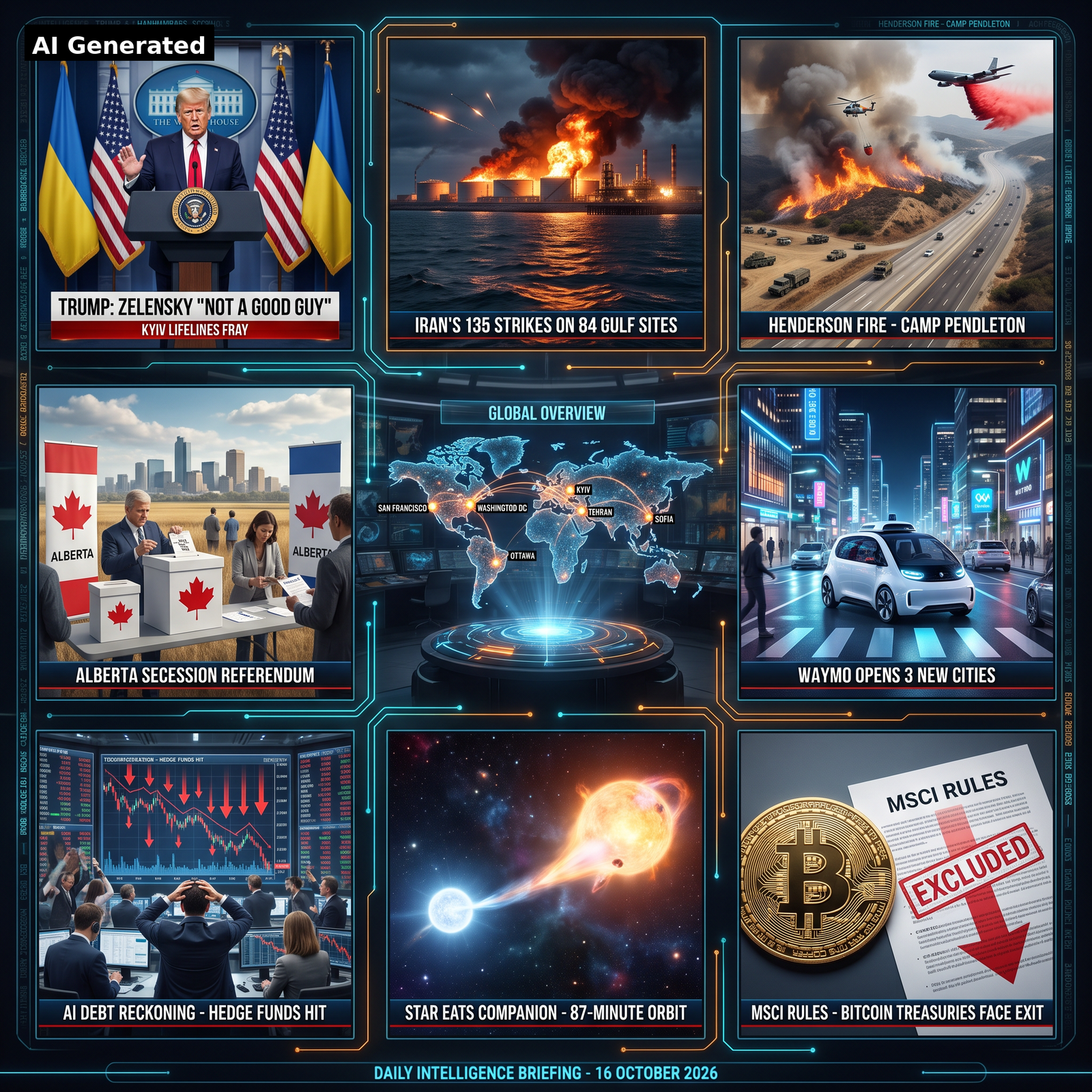
The most consequential development of the reporting window is the acceleration of Washington’s estrangement from Kyiv. President Donald Trump publicly branded Volodymyr Zelensky “not a good guy,” telling Newsmax that it is “harder to work with Zelensky than with Putin” and that the Ukrainian leader “says he wants to find an accord, but he does not want to,” effectively accusing Kyiv of prolonging the war for its own purposes[1][2]. The rupture is no longer confined to closed-door disputes; it is being conducted in public, aimed at a domestic audience increasingly sceptical of engagement[2]. It translated directly into operational friction: Trump called Ukraine’s renewed strikes on Russian oil refineries “a disgrace”[3], and within hours Ukrainian drones were reported hitting Moscow and industrial sites in Russia’s Rostov region — a demonstration that Kyiv will not bend to American pressure[4].
The strikes came after Ukraine reportedly regained access to Starlink communications; the Handelsblatt news-blog confirmed the White House had ordered a Starshield restriction on Ukraine and then lifted it, the second such reversal in a week[5]. This on-off control of Ukraine’s satellite backbone is the starkest illustration yet of the “announcement versus event” collapse identified in D136-D137: Washington’s leverage now operates at the level of a utility switch rather than grand strategy[5]. Behind the politics lies a deteriorating military ledger: according to CNN, Ukraine has run out of Patriot interceptors, and almost all Russian ballistic missiles fired in the latest attacks were not intercepted; other allied nations are similarly drained[6]. This is the scenario D137 flagged as the threshold that matters before winter: without the Patriot layer, Russian ballistic missiles become near-uncontested. The EU summit’s second day, where leaders met Zelensky directly, was therefore less about new commitments than about how to hold the line when the primary patron pulls back; 2026 financing is covered, but the 2027 hole remains open[7].
The Iran-Gulf Ledger Expands: 135 Hidden Strikes, and a MOAB on the Table
Reuters reported that Iran struck at least 135 infrastructure targets across Gulf states, costing billions, with many hits kept deliberately hidden from public view — a figure that revises the scale of what has been a shadow war of carefully managed perception[8]. The revelation changes the baseline: the confrontation has been far more destructive than the public record suggested. President Trump said he is considering more military action against Iran, while CNN reported the administration is weighing a MOAB-class strike — a 10-ton weapon whose value may lie as much in the threat as in its delivery[9][10]. The US embassy in Saudi Arabia issued a security alert warning of possible attacks on Saudi airports, with operations suspended at Riyadh and cancellations at Jeddah and Dammam[11] — an asymmetric threat to the region’s aviation lifeline. The Pentagon plans to delay publication of its report on the February 2026 attack on an Iranian school until after the US midterms, according to Bloomberg[12]. Meanwhile, the interdiction architecture shows its porosity: a massive cargo train carrying Iranian crude was reported ready to depart for China, underscoring how energy trade continues to flow even as military tension spikes, and how Beijing’s role as buyer of last resort insulates Tehran[13]. Secretary of State Marco Rubio pressed Lebanese President Joseph Aoun not to return half a tonne of seized explosives to Hezbollah, calling such a return “out of the question”[14].
The Black Sea Front and Europe’s Infrastructure Vulnerability
Bulgaria is reportedly ready to invoke NATO Article 4 after attacks on commercial shipping in the Black Sea and the sabotage that destroyed 11 Starlink antennas used by Ukraine near Sofia[15]. Article 4 does not commit allies to military action, but it forces a formal allied consultation and raises the cost of inaction; a Bulgarian invocation would be the first major test of NATO’s cohesion over the Black Sea. The EU’s climate commissioner warned that “the Russian threat to our infrastructure is real,” extending the vulnerability argument to energy and climate-critical installations[16]. Together these reports show the grey-zone attacks of the past year being reclassified as Article 4-adjacent events, forcing allies to define, in real time, what crosses the threshold of collective defence.
Middle East: Arrest Statistics, Rebuilding, and a Diplomatic Walkout
Palestinian prisoner organisations published aggregated figures showing more than 26,000 Palestinians arrested in the West Bank and Jerusalem, including some 2,000 children, with documentation of detention conditions and the legal framework underpinning them[17]. A Handelsblatt analysis found reconstruction in Gaza advances only where Israel has a strategic interest, leaving roughly one million Palestinians preparing for a fourth winter without shelter[18]. China’s foreign minister told Israel’s president that Israel “must halt and undo” the enforced creation of settlements in the West Bank — Beijing’s most explicit positioning yet on the settlements question[19]. In Baku, Turkish Foreign Minister Hakan Fidan led a coordinated walkout by 12 delegations when Israel’s president began to speak at the CICA summit, a piece of theatre signalling Turkey’s hardening line and its use of multilateral forums as pressure instruments[20].
Defence Industrial Base and the Alliance’s Procurement Math
Several reports illuminate the constraints of the Western defence-industrial response. The UK Ministry of Defence declined to break down Boxer armoured-vehicle deliveries by variant, citing commercial and operational sensitivity, limiting parliamentary oversight of a programme central to the Army’s modernisation[21]. A former NORAD deputy commander warned that the Royal Canadian Air Force lacks the pilots and technicians to stand up a mixed F-35 and Gripen-E fleet simultaneously, complicating Ottawa’s two-fighter strategy[22]. China announced its two-seat J-20S stealth fighter is now intended for strikes against ships at sea, without naming a single anti-ship missile — a deliberate ambiguity that keeps the carrier-killer question open[23]. Turkey’s air force is absorbing new batches of its domestically developed SOM-B1T and SOM-AT cruise missiles, signalling the maturation of an indigenous strike capability that reduces dependence on foreign munitions[24].
The technological frontier is moving quickly. Sikorsky demonstrated its Nomad 100 VTOL drone package in a standard shipping container — four aircraft, two launchable in 15 minutes, turning logistics containers into instant air bases[25]. A US company mounted its Archimedes autonomous laser weapon on an American Rheinmetall unmanned ground vehicle, integrating directed-energy counter-drone protection for autonomous logistics[26]. L3Harris and Skydio are integrating drones with tactical radios and jamming-resistant waveforms, a response to Ukraine’s electronic-warfare lessons[27]. Airbus demonstrated its MQ-72C cargo helicopter drone for the US Army, part of a push toward uncrewed logistics connectors[28]. President Trump announced a new “super range” testing complex in Montana to address a shortage of facilities for hypersonics, directed energy and autonomous systems[29]. The common thread is a Western military adapting to a battlefield where mass production of cheap systems and spectrum dominance matter as much as platform performance.
Peripheral Fronts: Greece-Saudi, Myanmar, Brazil, and South America’s Armies
Greek Defence Minister Nikos Dendias made a secret visit to meet Saudi Crown Prince Mohammed bin Salman, signalling deepening Athens-Riyadh defence ties beyond the public record[30]. ASEAN leaders are embracing Myanmar’s coup leader-turned-president Min Aung Hlaing despite the ongoing war and continued bombing of civilians, a diplomatic acceptance critics warn emboldens the junta[31]. In Brazil, a Datafolha poll shows the presidential run-off effectively tied at 51-49 ahead of the October 25 vote, tightening a race D137 assessed as Bolsonaro’s to lose[32]. The combined Arandu 2026 exercise brought together Argentina’s TAM 2C-A2 tanks, Stryker 8×8s, Brazil’s Centauro II and Astros rocket systems in one of the largest bilateral manoeuvres between the two armies, a reminder that South American defence integration proceeds even amid domestic turbulence[33].
Environment & Climate ↑ Contents
California Burns as Wind and Heat Converge; Regulation Moves to the Regulatory Agencies
Multiple wildfires ignited across California on Thursday as the state braced for more strong winds and high temperatures that could fuel rapid growth over several days; the largest, the Henderson fire, erupted on the Camp Pendleton Marine Corps training base near San Diego, forcing evacuations[34]. The timing is doubly consequential: fire season is now colliding with the political season, and the environmental stakes are being processed through a regulatory system under active redesign. The Federal Energy Regulatory Commission, at its monthly meeting, proposed two measures that would grant blanket authorisation to certain LNG projects and weaken air-quality reviews of methane gas projects, potentially allowing them to proceed without full assessment of harmful impacts[35]. The juxtaposition of burning forests and accelerated fossil-fuel permitting captures the central tension of American climate politics: physical risk rising while the administrative brake is lifted. A watchdog investigation questioned whether EPA Administrator Lee Zeldin’s travel to battleground districts in the run-up to the midterms is policy or politics, given the itinerary resembles a trail of campaign stops[36]. Governor Gavin Newsom and former Governor Arnold Schwarzenegger, meanwhile, used a joint appearance to tout California’s role as a climate leader, arguing that policies good for the environment and the economy need not be a red or blue issue[37].
The El Niño Complex: Global Food Security, Panama’s Drought, and Istanbul’s Flood
The International Monetary Fund warned that global food security is worsening amid El Niño, adding a systemic economic dimension to a climate pattern whose local manifestations are becoming harder to ignore[38]. In Panama’s Azuero Peninsula, extreme drought is stretching water resources thin, and some ranchers are switching to a more sustainable system of cattle ranching known as silvopasture, planting trees to maintain their water supply[39]. The IMF warning and the Panama case are two ends of the same chain: El Niño reshapes rainfall patterns across the tropics, and the countries that depend most directly on predictable rain for food and water are absorbing the first shock. At the same time, a heavy downpour shut down Istanbul, flooding homes and roads and killing at least three people, as rescuers evacuated hundreds — a reminder that the climate system producing drought in one hemisphere can produce lethal urban flooding in another[40]. The floods also connect to the region’s geopolitical fragility: Istanbul is a logistics and energy hub whose periodic paralysis carries costs that ripple beyond its borders.
Europe’s Methane Rules, Subsidy Reform, and Nature-Based Economies
Brussels said EU countries are partly to blame for failures on a key climate rule, in a circular blame game over the EU methane law that illustrates how implementation gaps, not just ambition gaps, are now the binding constraint on European climate policy[41]. On the private-sector side, more than 130 businesses and financial institutions, including Danone, H&M Group, Unilever and Rabobank, called on governments to reform the incentives that make environmentally damaging practices cheaper than sustainable alternatives — a business coalition pushing for the elimination of harmful subsidies ahead of COP17[42]. At the local level, two stories show how climate and biodiversity policy intersect with livelihoods. Switzerland’s Jurapark Aargau switched off streetlights in 29 towns for one night to launch a campaign against light pollution, which hurts hedgehogs and glow-worms; a police chief noted that dimmer towns saw no rise in burglaries, undercutting the usual safety objection[43]. In India, communities in Jharkhand earn a living collecting mahua flowers, gethi kanda and tendu leaves from forest plants, an economy that depends on healthy forest ecosystems rather than timber extraction[44]. Together these reports describe a climate agenda that is increasingly about the governance of common resources — subsidy design, light, forest products — as much as about headline emissions targets.
Society & Civil Issues ↑ Contents
Canada’s Constitutional Autumn: Alberta’s Referendum and Quebec’s Oath
Canada’s federal cohesion is being tested on two fronts simultaneously. Liberal leader Mark Carney addressed a “Forever Canadian” rally ahead of Monday’s Alberta referendum on whether the province should stay in Confederation or hold a second, binding referendum on separation, telling supporters to “vote like Canada depends on it”[45]. The Alberta vote is the sharpest test yet of whether the separatist wave that has reshaped Quebec politics spills into the country’s wealthiest energy province. In Quebec, Parti Québécois MNAs were sworn in without taking an oath to the monarchy, the first time a governing party has dispensed with the Crown oath as it prepares to form a minority government[46]. One province declining the sovereign’s oath while another contemplates leaving the country is difficult to overstate. Meanwhile, a fiery mid-day chain-reaction crash in Calgary left three dead and 19 injured, with two transit buses on fire — a reminder that the country’s political dramas unfold against ordinary, lethal risk[47].
America’s Gun Debate After Oregon
The Oregon elementary school shooting at Bend’s Silver Rail Elementary dominated the American news cycle: a 16-year-old killed three children and a teacher before being shot dead by an armed community member who followed him into the school; the student victims were aged five, eight and eleven, and a second teacher and a seven-year-old were hospitalised with critical injuries[48][49][50]. The pattern — an armed civilian intervening, an under-18 perpetrator, elementary-school victims — recapitulates every element that has made school shootings politically immovable in the US, and it arrives weeks before the midterms. The shooting also connects to the broader American legal drama. Nine FBI agents fired without notice by Director Kash Patel over their work on the classified-documents investigation into Donald Trump sued Patel and the Attorney General, the latest in a series of lawfare confrontations D137 identified as defining this political season[51][52]. Los Angeles County prosecutors are weighing charges against former Representative Eric Swalwell after a sheriff’s investigation into the misconduct allegations that ended his career, while a Handelsblatt analysis asked whether the Democrats are standing in their own way in an election Trump’s unpopularity alone should make winnable[53][54].
AI and the Education-Civil-Liberties Frontier
Vancouver police and the school board are investigating “disturbing online behaviour” after students reported that some male Grade 12 students had created AI-generated content of female students — an early, concrete case of the synthetic-media harms that policy debates have anticipated but school systems are now confronting in practice[55]. The case is a microcosm of a broader governance gap: the technology to generate realistic non-consensual imagery is freely available, while the machinery to detect and deter it lags. It sits alongside two policy stories in which governments use public instruments to shape household welfare. Britain’s DWP opens phone claims for this year’s Winter Fuel Payment on Monday, with up to £300 available to eligible pensioners, in a scheme at the centre of UK fiscal controversy since its means-testing was tightened[56]. Separately, older people are being urged to get flu jabs after an estimated 4,000 deaths were recorded last winter, with RSV — a virus that can be fatal in older people — compounding the seasonal toll[57].
German Domestic Policy: The Frühstartrente Vote and the Bundesrat’s Rotation
Germany’s Bundestag voted on the government’s planned Frühstartrente, under which the state would pay ten euros monthly into a capital-funded personal pension depot for every child aged six to eighteen, introducing young people to private pension provision[58]. The measure is the most concrete German attempt to shift pension expectations from pay-as-you-go to funded personal accounts, with signal for the broader European pension debate. On the same day, the Bundesrat elected North Rhine-Westphalia’s Hendrik Wüst (CDU) as its new president for a year and considered legislation on tax reform and early-childhood education[59]. A separate report examined how mobile phones keep being smuggled into prisons — 311 were found in Baden-Württemberg last year — and what authorities plan to do about a problem that undermines the integrity of custody[60].
Latin America’s Social Fractures: Milei’s Cuts and Peru’s Eviction Violence
Argentine students protested on campuses across the country over President Javier Milei’s austerity cuts to university funding, with a judge fining the government for failing to fund universities as protests turned violent[61]. The crisis is the most visible social front of Milei’s fiscal shock therapy, and the judicial intervention adds a rule-of-law dimension to a fight D137 flagged as an open thread. In Peru, residents of a condemned building threw flaming gasoline on eviction workers — an episode illustrating the explosive social consequences of housing insecurity[62]. In Britain, a teenage hitman — a footballer who agreed to shoot an unknown target for €25,000 — faces jail over a murder plot for an Iran-backed gang, a case connecting organised crime to the transnational security environment[63].
Brazil’s Welfare Expansion, Greek Polls, and European Migration Bureaucracy
Brazilian President Luiz Inácio Lula da Silva promised free weekend public transit for all, having already reduced the working week from 44 to 40 hours, abolished the six-day work schedule and announced debt write-offs — a burst of welfare-state expansion timed for the run-off campaign and aimed squarely at the working-class constituencies that will decide the October 25 vote[64]. In Greece, a Marc poll showed New Democracy at 30.4% on vote projection but 27% in voting intention, with SYRIZA slipping to 15.8% and PASOK narrowing the gap to 3.4 points, a picture of a fragmented system in which the conservative lead is real but softer than projection suggests[65]. In Denmark, the path to naturalisation has become littered with obstacles: thousands of foreign-origin applicants have waited since June 2025 for their dossiers to be examined, and parliament is preparing to restrict access further[66].
Transport and Cartography: Two European Stories
A serious accident between a bus and a train at the entrance of the Channel Tunnel near Calais left 19 injured, with five in absolute emergency but no lives threatened; the incident at Coquelles in the Pas-de-Calais closed part of the access route and raised familiar questions about the safety of road-rail interfaces at Europe’s busiest transit bottleneck[67]. In a quirkier register, UN members voted 164 to 1 to encourage adoption of the Equal Earth map projection, designed by Tom Patterson, Bernhard Jenny and Bojan Šavrič, which depicts Brazil as nearly four times the size of Greenland; Latin American geographers say the shift gives their region new visibility, while Japan complained that the disputed Kuril Islands were rendered awkwardly[68]. The vote is a reminder that even the most technical decisions — how we draw the world — carry geopolitical weight.
AI & Technology ↑ Contents
Autonomy at Scale and the Unknowability of AI
Waymo opened its robotaxi service to everyone in San Antonio, San Diego and Tampa, moving three mid-sized American cities from testing to full public availability in a single week and extending the country’s most mature autonomous-vehicle rollout beyond its traditional core markets[69]. The expansion matters less as a technical milestone than as a commercial and regulatory one: each city normalises driverless transport for a broader public and creates another jurisdiction whose regulators must decide how to treat fleets with no human at the wheel. It also deepens the gap between US operational reality and the far more cautious posture of most European regulators. The industry’s own uncertainty about where all this leads was captured by Marissa Mayer, who told Fortune’s Most Powerful Women summit that “anyone who says they know how AI will play out is either lying or arrogant or both” — a strikingly candid admission from a builder who has been inside Silicon Valley since the dawn of Google[70]. Mayer’s framing is a useful corrective to the market’s pricing of AI as a knowable stream of future value — a tension directly relevant to the AI-debt reckoning tracked in D134-D137.
AI in the Social Domain: Mobilisation and Erasure
In France, reporting found heavy use of artificial intelligence in organising the lycée (high-school) mobilisations, with AI tools boosting the logistics of blocus (school blockades) — an example of how generative and planning AI are becoming infrastructure for protest movements, lowering the coordination cost of collective action[71]. The same capabilities that make protests easier to organise also make them easier to surveil — a likely preview of how AI reshapes street politics across Europe. At the opposite end of the spectrum, a CNET investigation examined the claim that AI had “erased” an entire Swedish TV show; the network says a backup system failed but the raw material still exists, with AI systems implicated in the deletion pipeline[72]. Whether the blame lands on automation, human error or a combination, the episode is a cautionary tale about entrusting cultural archives to systems whose failure modes are poorly understood — a governance question that will only grow as media companies automate more of their storage and production chains.
Economy & Business ↑ Contents
The AI-Debt Reckoning Hits Markets, and Asia’s Outflows Continue
The financial aftershocks of the AI selloff continued to define the global market picture. Asian markets rebounded in early trade as tech shares recovered, but the week’s damage was concentrated in hedge funds, where Asia-based managers led losses as the AI complex unwound[73][74]. The euro got a much-needed reprieve as the AI wobble rocked the dollar, a currency read that shows the AI-debt story is now a macro driver rather than a sector story[75]. South Korea provided the clearest data point: September foreign net investment in local stocks swung to -$14.16 billion from +$0.04 billion in August, an unprecedented reversal that followed the sharpest Korean index selloff since the AI-driven crash D137 documented, and the finance ministry responded by vowing to “crack down firmly on market-disrupting behavior” and to track the effect of stock-market swings on bonds, forex and short-term money markets[76][77]. The juxtaposition of a $14 billion outflow with a surveillance crackdown captures the policy dilemma: Seoul cannot easily reverse capital flight driven by a global repricing, so it is reaching for market-shaping tools instead. JPMorgan and Goldman Sachs, in a further sign of recalibration, sweetened the terms on Volta’s $5 billion AI loan, reflecting growing caution among lenders about AI-infrastructure collateral[78]. Deutsche Bank’s chief investment strategist argued that investors “want to test the ECB” and that the AI rally retains potential even amid high bond yields — a dissenting voice against the risk-off narrative[79].
Monetary Policy and the Cost of Living
Bank of England Governor Andrew Bailey said inflation effects are likely subdued and businesses focus on cost-cutting, a signal the Bank sees price-setting pressures easing and may hold a steadier course than markets expect[80]. The real-economy costs of the energy complex were visible at the American grassroots: soaring diesel prices are taking a severe toll on Oklahoma ranchers, one telling ABC News it is “probably the most stressful time in my life”[81]. The Oklahoma story connects to the “diesel diplomacy” thread tracked since D132: when Washington executes fuel-price policy as foreign policy, the first casualties are domestic producers whose margins are measured in cents per gallon. Economist Isabella Weber argued in a Handelsblatt interview that private jets and superyachts should be banned in an energy crisis, calling for margin caps on essential goods and warning that economic policy determines the rise of the far right[82]. In the United States, a running legal and legislative fight over tipping — robot baristas requesting gratuities, New York forcing delivery apps to prompt, tax advantages contested in court — has turned the voluntary gratuity into a question of labour law[83].
Germany’s Industrial Strategy and the EU-China Front
The German Mittelstand is shedding its taboo about offshoring: an exclusive Forsa survey for Handelsblatt found that one in seven mid-sized manufacturers is relocating production abroad, rising to nearly one in three among larger firms, with executives citing energy costs, bureaucracy and China’s scale as the drivers[84]. The offshoring data is the industrial-structural counterpart to the fiscal debates that have dominated German economic policy since D134. On trade, Germany and France convinced the EU summit that the Commission should be able to regulate or even terminate other countries’ access to the single market, a new instrument aimed squarely at deterring China’s dumping and subsidies[85]. The instrument, if implemented, would be the most significant expansion of the EU’s defensive trade toolkit in a generation. France and Germany also reached a provisional agreement on the future of the automobile industry: Paris would make further concessions on car CO2 emissions, confirming the abandonment of the all-electric trajectory, in exchange for Berlin accepting a tightened European preference for the automotive sector against Chinese competition[86]. The global EV market is simultaneously cooling — worldwide sales fell 2% in September, with a European record offset by declines in North America and China[87] — and China adjusted its VAT exemption for exported vehicles[88]. The accord and the EV data together mark the end of the “all-electric” consensus D130-D136 had identified as fraying.
Corporate, Sovereign and Agricultural News
Several corporate and sovereign stories round out the picture. Barclays analyst Dan Levy said a Tesla-SpaceX partnership could be announced in weeks, potentially finalised before Tesla’s annual shareholder meeting ahead of December 6 — a combination that would rank among the decade’s most consequential corporate restructurings[89]. Pernod Ricard reported 19% sales growth in India for the September quarter with its IPO awaiting board approval[90]. China’s finance ministry will offer 15.5 billion yuan of government bonds in Hong Kong on October 23, a routine but symbolically loaded issuance maintaining the offshore yuan market’s depth[91]. The state planner set China’s corn import tariff quota for 2027 at 7.2 million metric tons[92]. In Pakistan, companies are moving into lithium battery assembly with Chinese partners, building domestic cell-assembly capacity on Chinese supply chains[93]. MSCI began a consultation on downgrading Indonesia from its indexes, a potential reclassification with significant implications for capital flows into Jakarta[94]. Airbus forecast the aviation services market will double to more than $420 billion by 2045, supporting a world fleet of 45,550 aircraft — a long-horizon bet on global aviation’s durability[95].
Fiscal Politics in the Anglo-World
In Britain, unions and the Trades Union Congress urged the government to hike taxes on banks’ “bumper profits” in the upcoming Budget, with Chancellor John Healey reportedly considering targeting banks to offset the damage the Iran war has inflicted on public finances[96]. The bank-tax push is a direct consequence of the war-economy fiscal squeeze: when an exogenous shock blows a hole in the public finances, the financial sector’s wartime windfalls are the most politically available target. In the United States, analysis of the “Walmart effect” — the theory that strong discount-retailer sales signal consumer stress — offered an offbeat indicator of an economy where aggregate data look resilient but households are trading down[97]. The two stories bracket the Anglo-American fiscal moment: governments under revenue pressure, consumers under cost pressure, with the AI-debt and energy shocks operating on both.
Science & Space ↑ Contents
Astronomy and the Search for Life
MIT astronomers caught a small star about 300 light-years from Earth slowly eating a companion that circles it every 87 minutes — an extraordinary cosmic feast that could last billions of years and a natural laboratory for understanding how mass-transfer shapes stellar ageing[98]. On the astrobiology frontier, researchers led by the University of Osaka developed a chip-based electrical technique for spotting signs of life outside Earth’s atmosphere, simpler than current methods and already past its first test[99]. In planetary science, scientists studying Mars’s Arsia Mons determined that the volcano’s 1,100-mile cloud forms ice without dust — a process never before seen in a planetary atmosphere, with implications for how water cycles operate on Mars and how clouds form in exoplanet atmospheres[100]. In astrochemistry, an international team using the ALMA COMPASS Large program detected a rare form of methanol in space for the first time, around young stars in the Perseus molecular cloud — a small but significant step in mapping the organic chemistry available to emerging planetary systems[101]. And in a historical-technical corrective, researchers found that the earliest account of a solar storm disrupting technology contained a serious typo — a reminder that foundational space-weather records require scrutiny[102].
Earth History, Biology and the Deep Past
Expanded excavations at White Sands National Park in New Mexico refined the age of the oldest human footprints in North America and deepened understanding of the environmental conditions when humans were present during the last ice age, including evidence of abrupt environmental shifts[103]. The refined chronology matters because White Sands sits at the contested edge of the debate over when humans first reached the Americas. In palaeontology, newly named dinosaurs from Zimbabwe’s fossil beds — including the genus Musango — show Africa’s ancient ecosystems were more distinct than expected, not simple analogues of South Africa’s[104]. Researchers at the University of Miami identified a group of previously unknown viruses that bridge an evolutionary gap between viruses and cellular protein compartments, a discovery with implications for biotechnology and for understanding the origins of life[105]. In conservation biology, researchers created a detailed, animated 3D model of the imperial woodpecker, a bird not confirmed in the wild since 1956, built from a museum specimen and the only known film footage — a digital resurrection of a species that may survive only in archives[106].
Materials, Energy and Health Science
Several applied-science advances crossed the boundary between fundamental research and technology. A new spectroscopy method enables direct comparisons of nuclear sizes across heavy elements, refining understanding of nuclear deformation in rare-earth nuclei[107]. Researchers at the University of Pittsburgh demonstrated a fiber-optic sensing system detecting acoustic signals above 100 kilohertz — roughly five times the frequency of conventional systems — for monitoring cracks and corrosion in nuclear fuel storage canisters, developed with startup Sensible Photonics[108]. The world’s first fast-spectrum molten chloride reactor experiment (MCRE), backed by the US Department of Energy, nears critical testing, with results that could deliver crucial operating data for next-generation reactors as early as 2027 and move the technology closer to commercial use[109]. Researchers at Binghamton University developed a bacteria-powered battery inspired by the human small intestine that maintained about 0.75 volts for 14 hours, using finger-like structures modelled on intestinal villi[110]. In health science, an estimated 22 million Americans use cannabis as a sleep aid, but the evidence increasingly suggests it can do the opposite — a population-scale example of a folk remedy colliding with the data[111]. Scientists also uncovered a 500-year-old secret hidden in a Catholic book Henry VIII wanted destroyed: six fragile pages suggest Sir John Gage, the royal official who helped dismantle monasteries, secretly saved a medieval religious book[112].
Spaceflight and the Planetary Frontier
Rigorous analysis confirmed the performance of NASA’s Artemis II heat shield, after the mission sent four astronauts around the moon and brought them safely home, laying a foundation for crewed flights to the lunar surface[113]. The heat-shield validation is the technical gate for Artemis III: with the shield confirmed, NASA can now focus on the landing systems that will put humans back on the Moon. New research showed how food, fear and physics together explain group behaviour from plankton to whales navigating patchy, predator-filled oceans[114]. And in an archaeological curiosity with genuine insight into Bronze Age technology, researchers examined the 3,400-year-old folding chair found in a Danish burial mound in 1891 — the only completely preserved chair from Bronze Age Europe — noting that its finder initially wondered whether it was a table[115]. The object’s endurance — a design that still resembles modern folding furniture — is a reminder of how little some fundamental engineering has changed. Finally, a study of Canada’s Species at Risk Act found that endangered species face extensive delays receiving protection, with the statutory machinery often slower than the pace of decline[116].
Crypto, Digital Assets & Blockchain ↑ Contents
The MSCI Index Decision and the Bitcoin-Treasury Structural Shock
The defining event of the crypto reporting window is the index-provider decision that turns the Bitcoin-treasury business model into a forced-seller risk. MSCI adopted new index rules, announced October 15, that establish financial tests which could exclude non-operating companies from its Global Investable Market Indexes, with Strategy, Metaplanet and Upexi previously identified for deletion under the methodology and the final list due November 11[117]. The mechanism is brutal: if a company’s principal business is holding bitcoin rather than operating a revenue-generating enterprise, MSCI’s new tests can deem it ineligible for index inclusion, triggering forced selling by index funds. For Strategy, the market’s largest treasury company, the exposure is estimated at $2.8 billion in potential liquidation pressure[118]. It is the first time a major index provider has formalised the “non-operating company” exclusion long discussed in market-structure circles, converting an accounting abstraction into a hard market constraint[119].
The strategic stakes extend well beyond Strategy. The MSCI rule change lands at the precise moment when the treasury-stock model was being aggressively expanded and imitated: Strive, the Bitcoin treasury firm, upsized its preferred-stock offering to 7 million shares with gross proceeds of about $630 million (a $700 million upsize to buy more BTC), selling 15% Series A Perpetual SATS Preferred Stock at $90 per share on October 15[120]. Capital B, another treasury-holding company, posted a €69.5 million net loss in H1 2026 even as revenue rose 3.5%, a demonstration of how volatile bitcoin marks can swamp operating results and of the financial strain of maintaining a treasury in a falling market[121]. The pattern is now clear: the treasury model’s viability depends on a persistently rising or at least stable bitcoin price, and the MSCI exclusion threatens to amplify precisely the downdraft that would make treasuaries insolvent — a procyclical trap that D137’s analysis of the Strategy liquidation math anticipated. The upshot is a structural regime shift: equity financing for bitcoin-holding companies has become more expensive and conditional.
The Fall of a Speculative Stack: Blur, Blast and the Retrenchment
The NFT and layer-2 ecosystem produced its most conspicuous collapse yet. Blur, the NFT marketplace that overtook OpenSea in trading volume shortly after its 2022 launch, announced it will shut down its website in a month; its NFT-lending platform Blend will stop matching new loans on the same day, and borrowers must repay or default[122]. In a companion announcement, Blast — the Ethereum layer-2 created by the same team — is shutting down less than three years after launch, disclosing that its costs exceed its revenue with “no credible path” to fixing that; despite once boasting more than $2 billion in total value locked in June 2024, its network-usage revenue had fallen to around $3.5 million[123]. The Blur-Blast double shutdown is the clearest evidence yet of the retrenchment that has been building in the sector: the 2021-2024 era of NFT mania and points-farming layer-2s attracted capital that was never converted into durable usage, and the current credit environment offers no refinancing path. The “infinite flywheel” model — marketplace fees reinvested into a tokenised chain — has failed its first full-cycle test.
Enforcement, Institutions and the Regulatory Perimeter
On the enforcement side, a federal judge refused to let Gemini and the CFTC undo a $5 million settlement, underscoring the permanence of legal settlements and limiting the impact of policy shifts on finalised judgments[124]. The ruling matters beyond the specific fine: it establishes that even in a deregulation-friendly administration, settled cases are not automatically reopenable, which preserves a body of precedent that constrained the industry. In Toronto, police laid 82 criminal charges following an armed crypto abduction in which attackers sought cryptocurrency and business security access, and searches uncovered ammunition stolen from the military — an illustration of how physical crime has become part of the crypto risk surface[125]. On the institutional front, Ripple CEO Brad Garlinghouse pointed to new options as the XRP treasury company Evernorth Holdings (Nasdaq: XRPN) made its public-market debut, suggesting the token could be used more through yield-generating strategies or institutional investment products[126]. The XRP-treasury debut is a direct extension of the Strategy playbook into altcoin treasuries, and it will face the same MSCI-style scrutiny that now applies to bitcoin treasuries.
Jurisdictional dynamics shifted on multiple fronts. Solana breached China’s crypto wall by establishing a new Foundation office in one of Shanghai’s highest commercial buildings, drawing criticism from industry leaders who wonder how a top-ten cryptocurrency entered the country given China’s historic anti-crypto stance[127]. Whether an opening of Chinese policy or a tolerated exception, the office gives Solana a physical presence in the world’s second-largest economy. Australia released a draft bill to adopt the OECD’s crypto-asset reporting framework (CARF), joining 77 jurisdictions committed to the standard with first international exchanges of crypto tax data expected in 2028[128]. The CARF adoption closes the reporting gap that had allowed crypto income to escape cross-border tax visibility. Finally, Coinbase laid out its thinking on how bitcoin should prepare for the quantum threat, arguing that a decision on Satoshi Nakamoto’s coins can wait — an indication that the industry is beginning to plan, at least in white-paper terms, for the day quantum computing erodes the elliptic-curve assumptions that secure bitcoin’s oldest holdings[129].
Correlations & Analysis ↑ Contents
The dominant structural theme of D138 is the convergence of two credibility crises that D137 identified as separate arcs: the collapse of “announcement versus event” in Washington’s diplomacy, and the AI-debt reckoning in global finance. Today they fused in a single pattern of behaviour. The White House ordered and then lifted a Starshield restriction on Ukraine within the same news cycle in which President Trump publicly branded Zelensky “not a good guy” and called Ukraine’s refinery strikes “a disgrace” — while separately the Pentagon delayed the Iran school-attack report until after the midterms and the MSCI index provider moved to exclude bitcoin-treasury companies from its indexes[5][1][3][12][117]. In each case, a powerful actor uses the machinery of announcement, delay or index methodology to manage perception rather than change the underlying event — the “disconnect between what governments say and what they do”, the diagnostic core of the D132-D137 arc, has become the operating system.
The Ukraine file illustrates the mechanism with unusual clarity. D137 reported Kyiv’s third night under attack, the satellite dispute and the first Starshield restriction; D138 adds the Patriot-interceptor depletion reported by CNN and the second restriction-reversal cycle[6]. The cumulative implication is that Ukraine’s ability to defend its cities and grid before winter now depends on the availability of US interceptors and the continuity of satellite service, both decided in Washington on a day-to-day basis. This is the material consequence of the “announcement versus event” collapse — a state’s defensive capacity is now itself an announcement. The EU summit’s second day, with Zelensky present in Brussels, is best read as the European attempt to build a firewall against this volatility, but its output — the FR-DE automotive accord and the new market-access instruments against China[86][85] — shows where European energy is going: not into a strategic rupture with Washington, but into economic self-defence and industrial preference.
The Iran-Gulf file deepens the same pattern on the military side. Reuters’ disclosure of 135 hidden strikes on Gulf infrastructure rewrites the scale of the shadow war that D123-D137 tracked from the Hormuz sinkings to the Saudi airport suspensions[8][11]. The MOAB consideration and Trump’s “considering more military action” statement are the escalation options being held open[10][9]. What connects the Gulf to the Ukraine theatre is the energy-economics axis: Iran’s crude train to China[13], the diesel squeeze on Oklahoma ranchers[81], and the EU’s new market-access instruments are all nodes of the same system in which fuel pricing is executed as foreign policy — the “diesel diplomacy” thesis first advanced in D135 and now visible from Tehran to Tulsa. The Oklahoma rancher’s distress is the domestic price of a foreign-policy instrument, just as the European consumer’s fuel bill is the price of the Ukraine war’s energy dimension.
The financial system is processing these geopolitical shocks through the AI-debt channel. South Korea’s swing to -$14.16 billion of foreign stock outflows in September — from +$0.04 billion in August — is the hard data behind the AI-selloff narrative, and Seoul’s surveillance crackdown is the policy response of a state that cannot reverse a global repricing but must be seen to act[76][77]. The sweetened Volta loan terms show lenders recalibrating AI-infrastructure risk[78]. The MSCI bitcoin-treasury exclusion adds a third leg: if the index rules force Strategy into $2.8 billion of liquidations[118], the selling would feed back into the treasury-company losses (like Capital B’s €69.5 million H1 deficit[121]) the model cannot survive. The circularity is the story: AI-debt, bitcoin-treasuries and war-driven energy costs are three procyclical loops transmitting shocks into one another through the same balance sheets.
The Americas add a fourth, political loop. The Brazil run-off tightened to a two-point 51-49 race[32], Lula is buying votes with welfare expansion[64], Alberta votes Monday on confederation[45], Quebec’s MNAs declined the monarchy oath[46], and the Oregon school shooting has injected gun politics into the US midterm stretch[48]. Argentina’s university crisis[61] completes a hemisphere in which every major electorate is being asked to choose between competing visions of state capacity — and the outcomes, from Brasília to Ottawa to Washington, will determine the policy environment for the loops above. A Bolsonaro victory on October 25 would add a second major economy to the bloc testing the post-2020 liberal order, while a Lula win would validate the welfare-expansion model at the exact moment the AI-debt shock is squeezing advanced-economy fiscal space.
What to watch in the next reporting period: (1) whether the EU summit produces a formal split with Washington’s approach to Ukraine, or settles for back-channel instruments; (2) whether the White House Starshield restriction recurs, and whether Ukraine’s Patriot shortage reshapes the air-defence ledger before winter; (3) whether the MSCI final list on November 11 triggers the anticipated Strategy liquidation math and spills into broader crypto credit; (4) whether the AI-debt selloff widens into systemic credit stress for data-centre finance; (5) the Alberta referendum result on Monday and its effect on Canadian federal politics; and (6) whether the US moves further on Iran — the MOAB question — as the midterms approach and the Pentagon’s own reporting constraints lift.
References ↑ Contents
1. Trump hits back at Zelensky and brands him ‘not a good guy’ in blistering attack by Paige Ingram · Paige Ingram ↑
2. EN DIRECT, guerre en Ukraine : Donald Trump juge que la reprise par l’Ukraine des frappes sur les raffineries russes est une « honte » by France via d k on Inoreader · France via d k on Inoreader ↑
3. Live: Trump calls renewed Ukraine attacks on Russian oil refineries ‘a disgrace’ by FRANCE 24 · FRANCE 24 ↑
4. Moscow burns as Ukraine launches devastating strike after Starlink access restored by Olivia Beeson · Olivia Beeson ↑
5. +++ Ukraine-Krieg +++: Weißes Haus hat offenbar Einschränkung von Starshield angeordnet by Redaktion Handelsblatt · Redaktion Handelsblatt ↑
6. Η Ουκρανία ξέμεινε από Patriot: «Δεν αναχαιτίζονται πλέον οι ρωσικοί βαλλιστικοί πύραυλοι» by DEFENCE via d k on Inoreader · DEFENCE via d k on Inoreader ↑
7. Staats- und Regierungschefs der EU beraten über Unterstützung der Ukraine by Germany via d k on Inoreader · Germany via d k on Inoreader ↑
8. Το Ιράν χτύπησε τουλάχιστον 135 φορές υποδομές στα κράτη του Κόλπου – Πολλά χτυπήματα έμειναν κρυφά by Greece via d k on Inoreader · Greece via d k on Inoreader ↑
9. Trump says considering more military action against Iran by Investing.com · Investing.com ↑
10. Trump va-t-il larguer “la mère de toutes les bombes” sur l’Iran ? by Cécile GALLUCCIO · Cécile GALLUCCIO ↑
11. Η Αμερικανική πρεσβεία προειδοποιεί τους πολίτες των ΗΠΑ για πιθανές επιθέσεις σε αεροδρόμια της Σαουδικής Αραβίας by Newsroom · Newsroom ↑
12. Μετά τις ενδιάμεσες εκλογές των ΗΠΑ το πόρισμα για την μαζική δολοφονία παιδιών σε σχολείο του Ιράν by Σοφοκλής Αρχοντάκης · Σοφοκλής Αρχοντάκης ↑
13. Αλλού ψάχνουν και αλλού περισσεύει: Τεράστιο φορτίο πετρελαίου από Ιράν για Κίνα by DEFENCE via d k on Inoreader · DEFENCE via d k on Inoreader ↑
14. Ο Ρούμπιο κάλεσε τον πρόεδρο του Λιβάνου, Αούν να μην επιστρέψει στη Χεζμπολάχ τα κατασχεθέντα εκρηκτικά by Newsroom · Newsroom ↑
15. Η Βουλγαρία έτοιμη να επικαλεστεί το Άρθρο 4 του ΝΑΤΟ by DEFENCE via d k on Inoreader · DEFENCE via d k on Inoreader ↑
16. « La menace russe sur nos infrastructures est réelle » : l’alerte du Commissaire européen au climat by France via d k on Inoreader · France via d k on Inoreader ↑
17. Ισραήλ: Περισσότερες από 26.000 συλλήψεις Παλαιστινίων και 2.000 συλλήψεις παιδιών σε Δυτική Όχθη και Ιερουσαλήμ by Σοφοκλής Αρχοντάκης · Σοφοκλής Αρχοντάκης ↑
18. Deep Read: Der Wiederaufbau in Gaza kommt nur dort voran, wo Israel ein Problem hat by Léonardo Kahn · Léonardo Kahn ↑
19. FinancialJuice: Chinese foreign minister to Israeli president: Israel must halt and undo its enforced creation of settlements in west bank by FinancialJuice · FinancialJuice ↑
20. Η Τουρκία ηγήθηκε ισλαμικής διαμαρτυρίας κατά του Ισραήλ στο Μπακού by DEFENCE via d k on Inoreader · DEFENCE via d k on Inoreader ↑
21. Ministry will not break down Boxer deliveries by variant by Craig Langford · Craig Langford ↑
22. ‘You Cannot Clone People’: A Former NORAD Deputy Commander Says Canada Does Not Have the Pilots or Technicians to Run F-35s and Gripens at the Same Time. Its Fighter Force Is at Two-Thirds Strength by Steve Balestrieri · Steve Balestrieri ↑
23. China Says Its 2-Seat J-20S Stealth Fighter Is Now Meant to Strike Ships at Sea. It Has Not Named a Single Anti-Ship Missile for the Jet or Said Whether One Fits Inside Its Weapons Bays by Harrison Kass · Harrison Kass ↑
24. Τουρκικοί πύραυλοι cruise SOM-B1T και SOM-AT παραδίδονται κατά δεκάδες στις Μοίρες κρούσης της ΤΗΚ by DEFENCE via d k on Inoreader · DEFENCE via d k on Inoreader ↑
25. Instant Air Base: Sikorsky packs Nomad 100 VTOL drone squad in a box by David Szondy · David Szondy ↑
26. Directed-energy weapon that can neutralize threats in seconds integrated on unmanned ground vehicle by Prabhat Ranjan Mishra · Prabhat Ranjan Mishra ↑
27. US Military drones tap 150,000 radios in push to beat battlefield jamming threats by Aamir Khollam · Aamir Khollam ↑
28. MQ-72C Cargo Helicopter Drone Capabilities Demonstrated For U.S. Army by Joseph Trevithick · Joseph Trevithick ↑
29. New Montana “Super Range” Complex Could Add Critical Weapons Testing Capacity by Howard Altman · Howard Altman ↑
30. Η μυστική επίσκεψη Δένδια by ΒΗΜΑτοδότης · ΒΗΜΑτοδότης ↑
31. As war rages, Myanmar’s coup leader-turned-president wins back neighbours by NEWS via d k on Inoreader · NEWS via d k on Inoreader ↑
32. Στο 51%-49% η μάχη Μπολσονάρου και Λούλα στη Βραζιλία, μειώθηκε στις δύο μονάδες η διαφορά πριν από τον δεύτερο γύρο by Greece via d k on Inoreader · Greece via d k on Inoreader ↑
33. Arandu 2026 reúne los TAM 2C-A2, Stryker 8×8, Centauro II y Astros en uno de los principales ejercicios entre los Ejércitos de Argentina y Brasil by Angelo Daniel Nicolaci Mota · Angelo Daniel Nicolaci Mota ↑
34. Evacuations issued as multiple wildfires ignite in hot, windy California by Gabrielle Canon in Oakland · Gabrielle Canon in Oakland ↑
35. FERC Proposes Blanket Authorization of Certain LNG Projects & Drafts Measures to Weaken Air Quality Reviews of Methane Gas Projects by Sierra Club · Sierra Club ↑
36. Watchdog Questions Zeldin’s Tour With Embattled GOP Candidates by By Marianne Lavelle · By Marianne Lavelle ↑
37. Gavin Newsom and Arnold Schwarzenegger tout California’s role as a climate leader by EHN Curators · EHN Curators ↑
38. IMF warns global food security worsening amid El Nino by Business via d k on Inoreader · Business via d k on Inoreader ↑
39. As El Niño fuels drought in Panama, trees help ranchers maintain their water supply by EHN Curators · EHN Curators ↑
40. Heavy rain shuts down Istanbul, causing flooding and 3 deaths by Mongabay Editor · Mongabay Editor ↑
41. Brussels says EU countries partly to blame for failure on key climate rule by EHN Curators · EHN Curators ↑
42. How your company can help eliminate harmful subsidies by Lucy Almond · Lucy Almond ↑
43. Switzerland’s Jurapark Aargau switched off streetlights in 29 towns for one night to launch a campaign against light pollution, which hurts hedgehogs and glow-worms, and a police chief says dimmer towns see no rise in burglaries by Adrian Villellas · Adrian Villellas ↑
44. How Indian communities earn a living from more than forest timber by Karen Coates · Karen Coates ↑
45. ‘Vote like Canada depends on it’: Carney tells Alberta referendum rally by Globalnews Digital · Globalnews Digital ↑
46. Parti Québécois MNAs sworn in as party prepares to form minority government by Alessia Simona Maratta · Alessia Simona Maratta ↑
47. Bus crash in Canada leaves 3 dead and 19 people injured, police say by Via AP news wire · Via AP news wire ↑
48. Three children and teacher killed by 16-year-old at Oregon primary school by NEWS via d k on Inoreader · NEWS via d k on Inoreader ↑
49. Shooter, 16, kills 3 students and a teacher in Oregon elementary school rampage before armed bystander stops him by Jasmine Fernández · Jasmine Fernández ↑
50. ΗΠΑ: Μακελειό σε σχολείο στο Όρεγκον -Τρία παιδιά και ένας δάσκαλος σκοτώθηκαν από 16χρονο εισβολέα, νεκρός ο δράστης by NEWSROOM IEFIMERIDA.GR · NEWSROOM IEFIMERIDA.GR ↑
51. États-Unis : neuf agents du FBI limogés portent plainte contre le directeur de l’institution et le ministre de la Justice by France via d k on Inoreader · France via d k on Inoreader ↑
52. Aux Etats-Unis, neuf agents du FBI limogés par le directeur Kash Patel portent plainte by France via d k on Inoreader · France via d k on Inoreader ↑
53. L.A. County prosecutors weigh charges in Eric Swalwell case after sheriff’s investigation by Andrew Blankstein · Andrew Blankstein ↑
54. US-Wahlen: Blaue Welle oder blaues Wunder – stehen die Demokraten sich selbst im Weg? by Dana Heide, Jens Münchrath · Dana Heide, Jens Münchrath ↑
55. Vancouver police, school board investigating ‘disturbing online behaviour’ by Alissa Thibault · Alissa Thibault ↑
56. DWP Winter Fuel Payment phone claims open Monday – pensioners urged to check eligibility by Taila Nichole Thompson · Taila Nichole Thompson ↑
57. Older people urged to get their flu jabs after 4,000 deaths recorded last winter by Stewart Carr · Stewart Carr ↑
58. Bundestag entscheidet über Frühstartrente by Germany via d k on Inoreader · Germany via d k on Inoreader ↑
59. Bundesrat wählt neuen Vorsitz und berät über Steuerreform und frühe Bildung by Germany via d k on Inoreader · Germany via d k on Inoreader ↑
60. Kriminalität: Wie schmuggeln Gefangene Handys ins Gefängnis? by Germany via d k on Inoreader · Germany via d k on Inoreader ↑
61. Argentine students protest on campus over Milei’s austerity by NEWS via d k on Inoreader · NEWS via d k on Inoreader ↑
62. Residents douse workers with flaming gasoline during eviction in Peru by NEWS via d k on Inoreader · NEWS via d k on Inoreader ↑
63. Teenage hitman facing jail over murder plot for Iran-backed gang by Emily Pennink · Emily Pennink ↑
64. Ο Λούλα υπόσχεται δωρεάν μετακινήσεις τα Σαββατοκύριακα – Πέρασε πενθήμερο – 40ωρο, ανακοίνωσε διαγραφή χρεών by Greece via d k on Inoreader · Greece via d k on Inoreader ↑
65. Marc: Στο 30,4% η ΝΔ στην αναγωγή αλλά 27% στην πρόθεση ψήφου by DEFENCE via d k on Inoreader · DEFENCE via d k on Inoreader ↑
66. Au Danemark, le parcours semé d’embûches des candidats à la naturalisation by France via d k on Inoreader · France via d k on Inoreader ↑
67. Un grave accident entre un bus et un train fait 19 blessés à l’entrée du tunnel sous la Manche, près de Calais by France via d k on Inoreader · France via d k on Inoreader ↑
68. UN members voted 164 to 1 to encourage the Equal Earth projection, where Brazil looks nearly four times the size of Greenland, a shift Latin American geographers say gives their region new visibility by ECONEWS · ECONEWS ↑
69. Waymo Opens To Everyone In San Antonio, San Diego, & Tampa by Z. S. · Z. S. ↑
70. Marissa Mayer: Anyone who says they know how AI will play out is ‘either lying or arrogant or both’ by Amanda Gerut · Amanda Gerut ↑
71. « Il y a une forte utilisation de l’IA sur les blocus » : comment l’intelligence artificielle a boosté la mobilisation lycéenne by France via d k on Inoreader · France via d k on Inoreader ↑
72. Did AI Just Erase an Entire Swedish TV Show? by Omar Gallaga · Omar Gallaga ↑
73. Stock Market LIVE: GIFT Nifty signals positive open; Asian markets rebound as tech shares recover by Business via d k on Inoreader · Business via d k on Inoreader ↑
74. AI selloff hammers hedge funds this week, Asia managers lead losses by Reuters · Reuters ↑
75. Euro gets much-needed reprieve as AI wobbles rock the dollar by Reuters · Reuters ↑
76. FinancialJuice: S.Korea: September foreign net investment in local stocks -$14.16 billion vs $0.04 billion in August – central bank by FinancialJuice · FinancialJuice ↑
77. FinancialJuice: South Korean finance ministry: authorities to crack down firmly on market-disrupting behavior by FinancialJuice · FinancialJuice ↑
78. JPMorgan and Goldman Sachs sweeten terms on Volta’s $5 billion AI loan by Diego Almada Lopez · Diego Almada Lopez ↑
79. Anleihen: Deutsche-Bank-Experte Stephan – „Investoren wollen EZB testen“ by Astrid Dörner · Astrid Dörner ↑
80. BOE’s Bailey sees subdued inflation effects, businesses focus on cost-cutting by Estefano Gomez · Estefano Gomez ↑
81. Soaring diesel prices taking a toll on Oklahoma rancher by NEWS via d k on Inoreader · NEWS via d k on Inoreader ↑
82. Interview: „Privatjets und Superjachten gehören in einer Energiekrise verboten“ by Sven Prange · Sven Prange ↑
83. USA: Gesetze, Klagen, Steuervorteil – so streitet Amerika über Trinkgeld by Laurin Meyer · Laurin Meyer ↑
84. Industrie: „Unternehmer warten nicht mehr“: Die Verlagerung ins Ausland ist im Mittelstand kein Tabu mehr by Anja Müller, Florian Kolf · Anja Müller, Florian Kolf ↑
85. Zugang regulieren: EU-Spitzen wollen neue Instrumente gegen Chinas Handelspraktiken by Economy via d k on Inoreader · Economy via d k on Inoreader ↑
86. La France et l’Allemagne trouvent un accord provisoire sur l’avenir de l’industrie automobile by FRANCE 24 · FRANCE 24 ↑
87. Autoindustrie: Globale Nachfrage nach Elektroautos sinkt im September by Reuters · Reuters ↑
88. China Adjusts VAT Exemption For Exported Vehicles by Steve Hanley · Steve Hanley ↑
89. Elon Musk’s Tesla-SpaceX Merger Is Just Weeks Away, Says Barclays by Kritika Mehta · Kritika Mehta ↑
90. Pernod Ricard India sales grow 19% in Sep quarter; IPO plan awaits approval by Business via d k on Inoreader · Business via d k on Inoreader ↑
91. FinancialJuice: China finance ministry to offer 15.5 billion yuan government bonds in Hong Kong on Oct. 23 by FinancialJuice · FinancialJuice ↑
92. FinancialJuice: China sets corn import tariff quota for 2027 at 7.2 million metric tons: state planner by FinancialJuice · FinancialJuice ↑
93. Pakistan companies move into lithium battery assembly with China partners by Business via d k on Inoreader · Business via d k on Inoreader ↑
94. MSCI considers Indonesia index downgrade as consultation process begins by Business via d k on Inoreader · Business via d k on Inoreader ↑
95. Airbus forecasts growing services market to double by 2045 by Γιάννης Ρέκκας · Γιάννης Ρέκκας ↑
96. John Healey urged to hike taxes on banks’ ‘bumper profits’ in Budget by Sophie Wingate · Sophie Wingate ↑
97. What the ‘Walmart effect’ is warning about the US economy by J.R. Duren · J.R. Duren ↑
98. MIT Astronomers Catch a Star Slowly Eating Its Companion 300 Light-Years Away by Massachusetts Institute of Technology · Massachusetts Institute of Technology ↑
99. A Simple New Chip Could Spot Signs of Alien Life. It’s Already Passed Its First Test. by David Nield · David Nield ↑
100. Mars’s Arsia Mons cloud stretches up to 1,100 miles from a 12-mile-high volcano every morning for months, and scientists think its ice forms without dust, a process never seen in a planetary atmosphere by ECONEWS · ECONEWS ↑
101. Scientists Detect Rare Type of Wood Alcohol in Space by Matthew Williams (https://www.universetoday.com/authors/houseofwilliams) · Matthew Williams (https://www.universetoday.com/authors/houseofwilliams) ↑
102. Earliest account of a solar storm disrupting tech contained a serious typo by Mike McRae · Mike McRae ↑
103. White Sands footprints suggest humans experienced abrupt environmental shifts during the last ice age by Science & Space via d k on Inoreader · Science & Space via d k on Inoreader ↑
104. Zimbabwe’s Ancient Dinosaurs Were Nothing Like Scientists Expected by Paul Barrett, Natural History Museum · Paul Barrett, Natural History Museum ↑
105. Newly discovered viruses reveal an evolutionary missing link by Science & Space via d k on Inoreader · Science & Space via d k on Inoreader ↑
106. Imperial woodpecker returns to life as a detailed digital specimen by Science & Space via d k on Inoreader · Science & Space via d k on Inoreader ↑
107. New spectroscopy method enables direct comparisons of nuclear sizes across heavy elements by Science & Space via d k on Inoreader · Science & Space via d k on Inoreader ↑
108. New nuclear waste sensor detects 100 kHz vibrations, could help spot canister cracks by Neetika Walter · Neetika Walter ↑
109. World’s first fast-spectrum molten chloride reactor experiment nears critical testing by Aamir Khollam · Aamir Khollam ↑
110. Human gut-inspired biobattery delivers 0.75 volts for 14 hours in US lab tests by Neetika Walter · Neetika Walter ↑
111. Millions of Americans Use Cannabis to Help Them Sleep. It Could Be Doing The Opposite. by Peter Dockrill · Peter Dockrill ↑
112. Scientists Uncover a 500-Year-Old Secret Hidden in a Book Henry VIII Wanted Destroyed by University of Cambridge · University of Cambridge ↑
113. Rigorous analysis confirms NASA’s Artemis II heat shield performance by Science & Space via d k on Inoreader · Science & Space via d k on Inoreader ↑
114. Food, fear and physics help explain group behavior from plankton to whales by Science & Space via d k on Inoreader · Science & Space via d k on Inoreader ↑
115. In a Danish burial mound in 1891, archaeologists found a 3,400-year-old Bronze Age folding chair, the only completely preserved chair from Bronze Age Europe, and its finder wondered if it was a table by ECONEWS · ECONEWS ↑
116. Endangered species in Canada face extensive delays receiving protection by Science & Space via d k on Inoreader · Science & Space via d k on Inoreader ↑
117. MSCI adopts index exclusion rules that could oust Strategy by Cointelegraph by Felix Ng · Cointelegraph by Felix Ng ↑
118. Strategy Braces for $2.8B Liquidation Shock as MSCI Changes Index Rules by Steve Muchoki · Steve Muchoki ↑
119. Bitcoin Treasury Firms Strategy, Metaplanet Face Potential Removal as MSCI Adopts New Index Rules by Boluwatife Adeyemi · Boluwatife Adeyemi ↑
120. Breaking: Bitcoin Treasury Strive Announces $700M Upsized Stock IPO To Buy More BTC by Kritika Mehta · Kritika Mehta ↑
121. Capital B posts €69.5M net loss in H1 2026 as revenue rises 3.5% by John Chen · John Chen ↑
122. Blur NFT marketplace to shut down by Molly White · Molly White ↑
123. Blur shuts down its Blast blockchain by Molly White · Molly White ↑
124. Judge refuses to let Gemini and CFTC undo $5 million settlement by John Chen · John Chen ↑
125. 82 criminal charges follow armed crypto abduction in Toronto by Liam 'Akiba' Wright · Liam 'Akiba' Wright ↑
126. XRP In Spotlight As Ripple CEO Brad Garlinghouse Reveals Bold Move At Evernorth Nasdaq Debut by Kritika Mehta · Kritika Mehta ↑
127. Solana Breaches China’s Crypto Wall With New Shanghai Office by Sergio Goschenko · Sergio Goschenko ↑
128. Australia releases draft bill to adopt OECD crypto tax reporting framework by Cointelegraph by Felix Ng · Cointelegraph by Felix Ng ↑
129. Coinbase Lays Out How It Thinks Bitcoin Should Prepare for the Quantum Threat by Kyle Torpey · Kyle Torpey ↑
AI Disclosure: This post was created with the assistance of artificial intelligence. The ideas, analysis, and opinions expressed are my own — AI was used to help compose, structure, and refine my personal notes and thoughts into the final written content. Images, videos and music featured in this post were also generated using AI tools, based on my own creative prompts and direction.