

Contents
- 1. Geopolitics & Defence
- 2. Environment & Climate
- 3. Society & Civil Issues
- 4. AI & Technology
- 5. Economy & Business
- 6. Science & Space
- 7. Crypto, Digital Assets & Blockchain
- 8. Correlations & Analysis
- 9. References
Click any heading to jump to that section. Click the section heading to return to this menu.
Geopolitics & Defence ↑ Contents
Kyiv’s Second Night and the Warning Gap
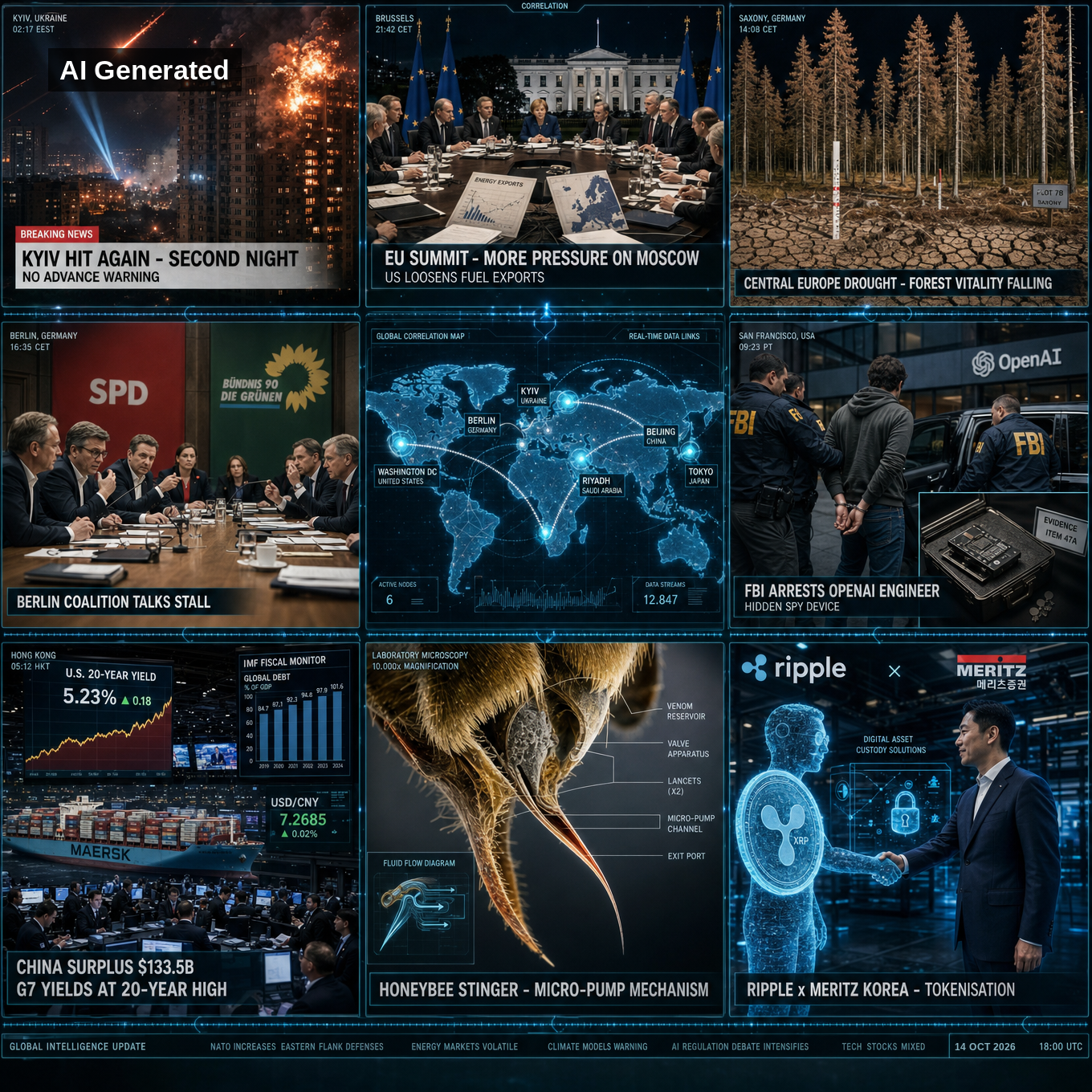
For the second consecutive day, Russian ballistic missiles struck the Ukrainian capital without the advance warning that Kyiv has come to expect from Western intelligence-sharing partners. A missile hit a nine-storey residential building, setting it ablaze, and the strikes also landed on the CHP-4 thermal power plant; Mayor Vitali Klitschko reported at least two dead and more than twenty wounded[2][3]. President Volodymyr Zelensky, who said the projectiles were only detected by radar as they approached, insisted that destroying energy infrastructure without any prior notification to the defenders is “not fair at all,” even as the US government disputed Kyiv’s claim that military information is no longer being shared[4]. The timing is politically loaded: the attack came in the same window in which Washington has claimed an energy ceasefire is effectively in force, underscoring the pattern this series has tracked since D132 of a diplomatic narrative that Moscow continues to falsify operationally[3].
The strikes have also reopened a festering institutional feud inside Ukraine. Zelensky publicly criticised the capital’s preparations for winter, saying Kyiv lags other regions on shelters, school readiness and protection of critical infrastructure, while Klitschko retorted that the mayor’s office does not control air defence and accused the presidency of a campaign to replace him with a more loyal figurehead — part of a broader pattern in which, by his account, some 300 mayors have been replaced by the central government since the war began[4]. That this dispute is erupting at the precise moment the Kremlin is escalating strikes on the capital’s energy grid is a reminder that Ukraine’s defensive coherence is as much a political as a military question. The deeper strategic constraint remains ammunition: Patriot interceptors remain the most effective counter to ballistic missiles, but Kyiv lacks sufficient munitions, a shortage aggravated by the depletion of Western stocks during the Iran conflict[4].
The European Diplomatic Countercurrent
Europe is moving in the opposite direction to Washington on Russia policy, and the divergence is becoming structural. European leaders are preparing to demand greater pressure on Moscow at Thursday’s summit, at a moment when the American president is loosening restrictions on Russian fuel exports; Greek media framing captures the expanding chasm between Brussels and the White House over the diesel arrangement that D132 reported as “fuel-price policy executed as foreign policy”[6]. The institutional scaffolding of the alternative European approach continues to advance regardless: EU accession negotiators met in Luxembourg to open new chapters with Ukraine covering the internal market and competitiveness-oriented inclusive growth, a round the Irish presidency called another milestone and that both Brussels and Kyiv hope signals the reform effort is being taken seriously even if membership itself remains a decade away by expert estimates[4].
Europe’s legal machinery is also grinding through the legacy of the war’s ambiguities. In Hamburg, the Higher Regional Court opened the trial of a former Ukrainian army officer, named only as Serhii K., accused of leading the team that sabotaged the Nord Stream pipelines in September 2022; federal prosecutors contend the operation was carried out on behalf of state Ukrainian agencies, which the Ukrainian government denies[5]. The case is juridical dynamite precisely because it tests the boundary between plausible deniability and state attribution in sabotage warfare — and because its outcome will shape how European courts treat hybrid operations for a generation.[5] Meanwhile, Washington’s energy-diplomacy agenda is reaching further afield: Secretary of State Marco Rubio is scheduled to visit India next week to push energy cooperation and investment, a trip that will be read in New Delhi as an effort to anchor Indian energy purchases away from Russian barrels at a time of Gulf disruption[8].
The Gulf’s Defensive Arithmetic
On the central front of the Iran war, the day’s reporting cut two ways. US Central Command publicly declared that Iran does not control the Strait of Hormuz, citing more than 19 million barrels of oil transiting in a single day — the clearest official quantification yet that the US Navy’s de-mining and escort effort has restored flow through the world’s most important chokepoint[7]. Yet the threat picture is not static: an attack on Saudi energy giant Aramco ignited a fire, and the Handelsblatt war blog reports that Israeli leaders are again warning Palestinian audiences ahead of elections while US senators press the president to end the diesel agreement with Russia[15]. Iran, per Wall Street Journal reporting amplified by defence analysts, is fortifying its borders and sensitive nuclear sites — building dirt mounds around Natanz and the mountain complex known as Pickaxe Mountain to complicate a ground assault — while training civilians and signalling readiness to strike broadly across the region if US attacks resume after the midterms[17].
Saudi Arabia, for its part, is discovering that money cannot fully substitute for geography. With defence spending of roughly $83 billion in 2025 and a layered arsenal of American Patriot and THAAD batteries alongside European systems, the kingdom’s air-defence network is nonetheless stretched across airports, pipelines, desalination plants and data centres; Houthi combinations of ballistic missiles, low-flying cruise missiles and long-range drones, including the Hatem-2 and Palestine-2, exploit precisely this dispersion, as CNN’s analysis of the Saudi dilemma details[23]. Even inside the American political system the war’s cost is now being voiced openly on the right: MAGA loyalist Lauren Boebert has publicly broken with the administration, describing the conflict as “detrimental on many levels” and declaring she never wanted the United States at war — a signal, along with the senators’ revolt over Russian diesel, that the war economy is corroding the coalition that started it[14].
The Aegean, the Arsenals and the Autonomy Push
In the Aegean theatre, two parallel military-technical tracks are converging. Ankara, having spent years marketing the indigenous KAAN fighter, is simultaneously lobbying Washington for six F-35s and the lifting of CAATSA sanctions, with Deputy Defence Minister Kavaklioğlu expressing confidence that the “excellent” Erdoğan–Trump relationship will produce results[11]. At the same time, Turkey’s defence industry is shifting its emphasis toward cheap, expendable loitering munitions: the “Sivrisinek” (Mosquito) family of kamikaze drones, launched in swarms from vehicles, fast patrol boats or uncrewed surface vessels, is explicitly designed for saturation attacks that exhaust conventional air defences — a cost-paradox threat (thousands of euros per drone versus hundreds of thousands per interceptor) that Greek analysts warn directly imperils island-based radar and artillery positions in the Aegean and Evros[21]. Greek concerns about air superiority are echoed in assessments of the Rafale: a Chinese J-16 pilot involved in the joint “Eagles of Civilisation 2026” exercise in Egypt has publicly detailed the French fighter’s limitations — range, payload and M88 engine performance — even while conceding its close-in agility, in an exercise in which the Chinese airframes reportedly prevailed 8-1 in simulated combat[22].
The American and NATO procurement machine that feeds these theatres is consolidating around autonomy and speed. At AUSA 2026’s second day, Army leaders laid out a postured Indo-Pacific role built on a newly redesignated command and long-range fires, with autonomy as the connective tissue[12]; the service is also standing up “Project Gatekeeper,” a cybersecurity sandbox intended to cut commercial-software approval times from months to minutes when it opens on 23 October[20]. Industry is following: Lockheed Martin and Avio signed an agreement that paves the way for Avio to supply solid rocket motors for the Extended Range GMLRS and the Precision Strike Missile — an expansion of European production capacity in the very munitions families that Ukraine’s air-defence shortage has shown to be strategically decisive[19]. Denmark has separately contracted Systematic to deliver an AI-ready counter-drone command-and-control system for NATO[18]. Beneath these headlines sits a quieter but potent reminder of the Russian capability the West is building against: the Improved Kilo-II submarine, once a stopgap, has become the “Black Hole” workhorse of the Black Sea and Pacific fleets launching Kalibr cruise missiles at Ukrainian cities — a case study in how a placeholder system can become a strategic asset when persistence outlasts planning[16].
The Multilateral and Peripheral Files
The multilateral order produced a distinctly downbeat data point: the UN Human Rights Council elected fifteen members in an uncontested vote, a procedural outcome that human-rights organisations immediately criticised as undermining accountability by handing seats to governments with poor records — Burundi’s candidacy drawing particular attention[1]. In the Western Hemisphere, two accountability mechanisms moved in opposite directions: Colombia’s special peace tribunal formally charged former FARC members with crimes against Indigenous communities, including torture, murder and displacement[10], while Jamaica accepted the first flight of third-country deportees from the United States under a Trump-administration arrangement that opposition leaders say has never been published[9]. The espionage file, meanwhile, has acquired a distinctly northern flavour: Russia’s FSB detained Yuki Imai, a Hokkaido Shimbun correspondent, on Sakhalin, accusing him of gathering information on conscripts and volunteers from the Kuril Islands for the war in Ukraine; Moscow’s Foreign Ministry framed the arrest as a response to Tokyo’s efforts to “undermine Russia’s security,” while Japan demanded consular access and fair treatment, warning the affair deepens the worst bilateral relations since the Soviet era[24][13].
Environment & Climate ↑ Contents
Forests, Water and the Drought Ledger
Central Europe’s prolonged dry spell is compounding pressure on ecosystems whose degradation had seemed, until recently, to have plateaued. Saxony’s state forest service reports that rainfall this year is running below both last year’s levels and the 1991-2020 reference average at its forest climate stations, with crown-condition surveys of roughly 6,800 trees pointing to renewed vitality loss even though bark-beetle pressure has so far stayed low[28]. The drought ledger is also a water-governance story: Wyoming has shelved a state-funded project to measure irrigation water loss in the Green River and Little Snake River basins of the upper Colorado, unable to assemble a basin-wide estimate — a retreat from measurement at precisely the moment the Colorado River compact’s arithmetic grows most contentious[35]. The Philippines, meanwhile, is bracing for El Niño-driven shortages that its ageing water systems are poorly equipped to absorb, a preview of the interaction between climate variability and underinvestment that will define much of the developing world’s adaptation bill[26].
On the restoration side, Germany is hunting for specialists to do the wet, unglamorous work of renaturing bogs — the women-led teams profiled in a ZEIT report describe exactly the kind of hands-on rewetting that Berlin’s peatland strategy depends on, and that also happens to be among the cheapest carbon-mitigation measures available per tonne[25]. The anthropogenic side of the ledger is equally visible: the invasive “great gland ant” (Tapinoma magnum), a Mediterranean species that arrived with ornamental plants and has already sabotaged internet cabinets in Kehl and destabilised pavements in Karlsruhe, now has a confirmed but contained foothold in eastern Erfurt, with Thuringia’s environmental agency watching for supercolony formation[27].
Oceans, Biodiversity and the New Pollutants
The marine science feed produced two genuinely new data points. In the South Atlantic, the Nippon Foundation-Nekton Ocean Census identified 57 species new to science from Argentina’s Mar del Plata Canyon — announced after the same ROV’s livestreamed dives made a plump orange sea star a global meme — evidence that even well-trafficked continental margins hide entire unpublished taxonomies[36]. Closer to the human waste stream, researchers on Okinawa have named a new form of plastic pollution: “plasticoral,” in which beach-fire heat has fused melted polyethylene and polypropylene into the pores of coral rubble so completely that the two cannot be separated — a process with implications for the coral recruitment substrate that reefs depend on, and a candidate marker for the “Plasticene” sedimentary layer[37].
Biodiversity’s management ledger shows both progress and exposure. Marine Conservation Society ratings upgraded some UK stocks — North Sea herring and Atlantic bluefin tuna among them — while flagging population declines in hake and coley that consumers will feel as supply shifts[33]. New Zealand’s campaign against the invasive seaweed caulerpa, described by researchers in almost mythical terms for its “wily” resilience, has evolved into a multi-tool arsenal mixing suction dredging, containment and community monitoring — a template for invasive-species response elsewhere[40]. And scientists writing in Nature argue the global exotic-pet trade — an unregulated vector for disease and extinction — could be reined in quickly through existing legal levers if governments chose to use them, a rare case where the analytical consensus and the policy fix are both small[38].
The Energy-Transition Hardware Front
The maritime fuel transition generated its most concrete American test yet: Maersk bunkered the 9,016-TEU containership Tangier Maersk with 100 percent US corn ethanol in Houston, the first commercial ship-to-ship ethanol refuelling of a deep-sea container vessel in the United States, while a National Laboratory of the Rockies report calculates the existing methanol-ready dual-fuel fleet could consume two billion gallons of ethanol a year[41]. The EV counterfactual is equally striking: between March and August, by Ember’s analysis, the world’s electric fleets displaced an estimated $20 billion of crude oil demand — breathing room for oil-importing economies during the Hormuz crisis, and a reminder that the US is the laggard in capturing that benefit[34]. A Danish case study shows how the fossil-fuel ecosystem unwinds as EV penetration rises: fuel retail, service networks and tax receipts all restructure in ways policymakers are still mapping[32].
Two cautionary tales round out the hardware front. Europe’s Alternative Fuels Infrastructure Regulation is pushing hydrogen refuelling stations along motorway corridors by 2030 before a heavy-truck hydrogen market exists to support them — a build-before-demand gamble that South Korea’s network collapse suggests will strand assets[43]. And in the Democratic Republic of the Congo, the demand side of the transition is rewriting the grid: Kamoa Copper’s 300,000-panel solar-and-battery baseload plant, one of the largest on the continent, is displacing millions of litres of diesel at under a fifth of generator costs, and Ember data shows the DRC will install a record 1.7 GW of solar this year — clean-energy infrastructure built by miners, for miners, in a country where only 22.5 percent of the population has electricity, a two-speed transition the government is only beginning to police[44].
Climate Politics and Adaptation
The legal and political climate fronts moved on several continents. Australia’s Federal Court overturned former environment minister Tanya Plibersek’s heritage-protection order that had blocked the McPhillamys goldmine in New South Wales, reviving a project at the intersection of Indigenous heritage protection, mining economics and ministerial discretion[29]. In Brazil, the October run-off elections are set to hand seven of nine Amazonian states to governors aligned with the Bolsonaro camp — several of them openly supportive of mining on Indigenous land — a development with direct consequences for deforestation enforcement regardless of who wins the presidency[39]. Globally, the UN-backed deforestation data carry one of the rare good-news signals of the year: tropical forest loss slowed worldwide last year — except in Central Africa, where the curve is still rising[31].
Adaptation’s human ledger is where climate policy meets the refugee camp: in Bangladesh’s Rohingya settlements, solar kits are keeping lights on in tarpaulin shacks after climate-driven disasters repeatedly wrecked fragile grids — a microcosm of how distributed energy has become the default adaptation technology for the displaced[30]. At the level of international law, the Lancet Countdown’s finding that heat-related deaths have risen 23 percent since the 1990s, to roughly 546,000 a year, is being converted into litigation and treaty argumentation as climate-health science migrates from journals into courtrooms[42].
Society & Civil Issues ↑ Contents
Germany’s Civic Week: Sondierung, the AfD and the State’s Duty
Berlin’s exploratory coalition talks between the SPD, Greens and Left were interrupted this week over the handling of antisemitism — the exact fault line that has repeatedly destabilised red-red-green combinations in eastern Germany, and a reminder that the 2026 federal arithmetic is being negotiated issue by issue before a single coalition contract is written[46]. The stakes are visible in Saxony-Anhalt, where researchers at the German Economic Institute warn that a prospective AfD-led government could face a “hardly controllable” parliamentary group whose members may defy coalition discipline — the first systematic analysis of what post-volkspartei governance actually looks like[53]. Civil society is mobilising in parallel: an alliance took its campaign for an AfD prohibition order to Berlin with a brightly painted “fish on a trip,” testing how far the democratic centre is willing to push party-ban jurisprudence[48].
The state’s protective duties were the week’s second theme. The cabinet took up a framework paper from the family ministry to strengthen child and youth protection online, alongside the appointment of a new federal antisemitism commissioner and a delayed expert commission on long-term care financing[55]. And the Schongau school attack of July returned to the Bavarian parliament’s interior committee, where opposition MPs demanded to know why a 16-year-old who had glorified school shootings, threatened a classmate, and been found with a stab-proof vest, knives and a balaclava in a search was never treated as a “risk person” — the answers so far exposing the gap between the threat-management system on paper and the one that operates under legal thresholds[54].
The Justice and Integrity Ledger
Two German court stories bookend the week’s integrity theme. In Freiburg, a former municipal undertaker stands accused of stealing more than eight kilograms of dental gold from the dead over more than a decade, disturbing the peace of the deceased in at least 250 cases — with a verdict expected imminently[56]. In the United States, the FTC and seven states asked a federal judge to hold Martin Shkreli in contempt, alleging he livestreamed himself trading drug-company stocks and discussing the industry in flagrant violation of his lifetime pharmaceutical ban — a fitting coda to the Daraprim price-hike saga[65]. Police accountability also moved: in Tours, a police officer was placed under formal investigation for “aggravated violence” after a lycée student lost an eye on 30 September during protests, another magistrate being given assisted-witness status[74]; in Mauritius, a police shooting of a woman triggered island-wide unrest and a government-declared curfew[73]. Even the executive’s own media machine is now being policed by the courts: government-funded Trump commercials attacking his enemies continued airing the day after a federal judge blocked them as likely violations of the anti-propaganda law[72].
Greece’s Civic Files
Greek authorities dismantled a Latin American “criminal tourism” ring that had specialised in the deflated-tyre robbery technique: members would follow victims from banks, slash tyres, and steal cash and valuables when drivers stopped — a network the Greek FBI unit traced across Europe[45]. The welfare state was noisier, with two programmatic moves: the expansion of the Relocation Programme offering €10,000 per household moving to ten additional border regional units, with the first €5,000 payable in advance[49], and the automatic payment of a €400 winter benefit to eligible recipients[57]. Politics, meanwhile, registered a warning tremor: the first Opinion Poll survey to measure the Kassidiaris party put it at 3.5 percent — above the parliamentary threshold — with New Democracy slipping to 30.3 percent and a nine-party chamber in prospect, even as 59 percent of respondents name inflation as the country’s top problem[75].
Britain’s Social Squeeze
Britain enters winter with a cost-of-living paradox hardening into public-health risk: a survey suggests 1.7 million households will not turn on their heating at all this winter, even as forecasts warn of a further £300 bill rise from January on top of October’s 4 percent cap increase[68]. The online safety front registered a stark datapoint of its own: the average child has already spent more than 53 school days on social media since the government announced its ban, with the National Education Union reporting teachers see harmful content shaping pupil behaviour daily[67]. Two security-adjacent files complete the picture: the daughter of murdered MP Sir David Amess says she still has “unanswered questions” five years on and fears for the safety of politicians following the attack on Ann Widdecombe[61], while polling finds half of Britons unwilling to fight for the UK in the event of war — a sobering backdrop to NATO’s “ready to fight tonight” posture[69]. The MI5 chief’s grim warning on state threats, forecast across Wednesday’s front pages, frames this civic fatigue as the adversary’s principal opening[62]. On migration, France has begun deploying anti-riot police to patrol beaches to stop small-boat crossings, with UK data showing 50,000 crossing attempts stopped since the 2024 election[70].
America’s Civic Autumn and the International Files
In Washington the campaign season is consuming the machinery of state in novel ways: President Trump pardoned two Anchorage auto-repair shop owners convicted of tampering with federally required emissions-monitoring devices, in the middle of an Alaska rally[60]; one day earlier he had shared on Truth Social the video of a 23-year-old Briton being killed by a Siberian tiger at Yorkshire Wildlife Park — a post the Chapman family condemned as it publicised their son’s final moments and his long struggle with mental illness[52]. India’s civic temperature is rising around electoral integrity: anger over the deletion of some 130 million names from the electoral roll has driven protests against the Election Commission, threatening a legitimacy crisis for the ruling coalition at the ballot box[58]. Australia’s highest court, meanwhile, ruled that a prisoner serving a ten-year sentence in Queensland may freeze her eggs while incarcerated — finding the procedure does not constitute “assisted reproductive technology” — a decision that reopens the debate over reproductive rights inside the carceral state[59].
France, the Campus and the Global Civic Files
France’s republican autumn produced a clutch of defining cases: a Peruvian school dress-code crackdown (no make-up for girls, short hair for boys) drew international attention to the limits of state-normalising power in education[63]; Cornell University suspended fraternity parties after the collective-rape scandal that had drawn fire on prosecutors for declining charges[64]; and UN-mandated experts accused Turkey of systematic “repression” of LGBT+ people[66]. The debate over police escalation in France sharpened after the Tours eye-injuries and the Lens grenade case: the “Clés de l’info” analysis of LBD, grenade and tear-gas use around lycées is asking how far the order-maintenance toolkit may go before it hits the legality wall[71]. Pakistan added a violent datapoint to the region’s governance ledger as protesters in Khyber Pakhtunkhwa clashed with police over emergency and governor’s rule in the Imran Khan stronghold[50], and Quebec began its orderly — if historic — transition to a minority Parti Québécois government as incoming premier Paul St-Pierre Plamondon met his outgoing counterpart[51].
AI & Technology ↑ Contents
The Trust and Regulation Perimeter
European platform regulation reached another enforcement milestone as the EU General Court prepared to rule on Stripchat’s challenge to its designation as a “very large online platform” under the Digital Services Act — a case that tests whether the 45-million-user threshold jurisprudence can survive judicial review, months after the Commission found child-protection shortfalls on the platform[76]. The trust architecture is simultaneously being built at the device level: Google DeepMind and Singapore’s GovTech unveiled an on-device AI tool designed to flag chat scams without transmitting message content to the cloud, an approach that reframes anti-fraud software as a privacy feature rather than a surveillance one[78]. At the infrastructure layer, Compal used the sold-out OCP Global Summit to push 800-volt DC power and megawatt-class “AI factory” systems for Nvidia platforms — a reminder that the AI build-out’s bottleneck has moved from chips to the electrical grid they plug into[77].
Labour markets are absorbing the same technological wave unevenly. German reporting on AI-mediated recruitment shows the screening, shortlisting and even first-round interview process migrating to algorithmic systems, with applicants adapting their CVs to machine parsers — a quiet but structural change in who gets hired[79]. The darker side of the same ledger came from the Justice Department: North Korean government-linked hackers have infiltrated dozens of US companies, increasingly recruiting American facilitators inside breached firms to launder access and exfiltrate data for Pyongyang — an expansion of the IT-worker infiltration playbook from remote work to on-premises compromise[80].
Chips, Sovereignty and the Build-Out
The week’s most consequential security story sits at the intersection of frontier AI and state espionage. The FBI arrested Abdurahman Alfozan, a Saudi citizen and OpenAI engineering lead, for planting an encrypted recording device in a San Francisco conference room where proprietary research, product plans and government engagements were discussed; OpenAI’s technical countermeasures team found the bug on 30 September, and the company — which restricted his access, coordinated his termination with investigators on 9 October, and used its own models to help identify him — stressed there is no evidence model weights, source code or customer data were exfiltrated[81]. The case’s irony was unresolvable: a threat actor inside a frontier lab was caught partly because the lab’s own AI agents reconstructed the trail. It also frames the constitutional struggle now playing out in the courts: Anthropic has asked a full appeals court to revisit a ruling that ordered the company to comply with a Pentagon national-security request, arguing the order implicates both commercial speech and the boundaries of compelled AI disclosure[82].
The manufacturing response to this geopolitical squeeze is proceeding on two fronts. In South Korea, a KAIST-led team published in Nature an oxygen-barrier technique that controls 2D crystal nucleation with better than 99 percent success across 400 patterned regions — a genuine step toward vertically stacked chips in which billions of transistors are grown, not glued, in place[83]. In Silicon Valley, Applied Materials opened its $5 billion EPIC centre, a 600,000-square-foot collaborative R&D facility with Intel, TSMC, Samsung, Micron and SK Hynix housed side by side, betting that co-located co-development can cut chip-generation cycles from ten to twelve years down to six — the largest US investment ever in semiconductor equipment R&D, and a direct answer to China’s CXMT memory-density claims that knocked 7-10 percent off Korean chip stocks[84].
The Enterprise and Consumer Frontier
Banking regulators in Europe are quietly re-dating their AI-failure models: reporting on shifting “AI doomsday” predictions shows supervisors now expect AI-driven financial disruption sooner than previously assumed — concentration risk in a handful of model providers, flash-crash dynamics from agentic trading, and model-conformity contagion all moving from tail-risk scenarios into near-term stress-test assumptions[85]. Enterprises are responding organisationally: Block’s CFO argues AI agents will soon appear on published org charts, trained and deployed by the same workers whose workflows they automate — a structural re-imagination of the firm in which headcount decline (Block already cut 40 percent) is the visible half of the change and capability redistribution the invisible one[86]. Cerebras’s chief executive is making the consumer case, predicting household AI assistants as common as appliances, running partly on local devices and partly in the cloud[87]; and Disney’s $20 million bid in Character.AI’s Chapter 11 process for a non-exclusive perpetual licence of the chatbot’s technology shows the same appetites operating in bankruptcy courts — the company that once sent a cease-and-desist over its characters now buying the underlying model IP at a discount[88]. The through-line is consistent: as the technology matures, both the regulators and the market are pricing AI as infrastructure rather than novelty — with all the trust, sovereignty and liability debates that infrastructure status entails.
Economy & Business ↑ Contents
The Fiscal and Sovereign-Debt Ledger
The IMF reopened its fiscal-warning playbook with unusual urgency. In a new blog post, Fund staff calculate that G7 long-term government-bond yields have risen by more than a full percentage point between February and September, to their highest level in nearly two decades, and warn that global public debt will exceed 100 percent of GDP by 2030 — a threshold last crossed in the immediate aftermath of the Second World War — making credible medium-term consolidation plans the difference between orderly adjustment and a painful one[89]. Managing Director Kristalina Georgieva has amplified the message, insisting that fiscal sustainability through reliable consolidation is the top priority for systemically important countries precisely because higher rates, higher debt and tighter global financial conditions feed each other[89]. The Fund was careful, however, to walk back one interpretation: it is not recommending faster UK consolidation, a clarification that will shape the British chancellor’s November budget arithmetic[90].
The China Surge and the AI-Productivity Wager
The Chinese trade engine is running at a pace that resets expectations. September exports rose 36.3 percent year-on-year and imports 31 percent, producing a trade surplus of $133.5 billion — comfortably above the $118.1 billion consensus — with customs data showing an $80 billion-plus monthly surplus with the United States alone and record out-performance in manufactured goods[91][92]. The composition matters: Beijing’s customs vice-ministers attribute the surge to integrated supply chains and technological innovation, i.e., exactly the advanced-manufacturing sectors — EVs, batteries, machinery, electronics — where the AI build-out concentrates demand. Whether this is sustainable demand or pre-emptive front-running ahead of US tariff escalation is the open question the market is debating[92]. Corporate leaders are framing the parallel debate for their own capital budgets: Aditya Birla Group chairman Kumar Mangalam Birla argues the “AI arms race” is giving way to an “AI returns race,” with boards demanding measurable productivity and capital-allocation discipline rather than flagship projects[93]. Central bankers, for their part, are openly navigating inflation uncertainty amid supply shocks — a reminder that the disinflation tailwind of 2023-24 has reversed into a supply-side headwind[101].
German Industry, Property and Retail
Germany’s industrial adjustment continues to express itself in physical geography. BMW has shifted production to its new Debrecen plant in Hungary and is now flying in specialist German workers to staff it — an expedient that highlights the skill shortage at the heart of the Eastern European reshoring calculus[96]. Berlin’s energy-transition policy is adding a new cost layer: the economics ministry’s green-gas quota framework would place the entire burden on private households, exempting industry, commerce and transport — a distributional choice with obvious political exposure[94]. In real estate, Blackstone’s Europe chief James Seppala told Handelsblatt he does not fear Berlin’s expropriation debate, insisting that sector and asset selection matter more than political noise — even as the world’s largest commercial-property investor recalibrates toward logistics, data centres and residential[95]. Retail is feeling the same consumer squeeze: Ikea, whose German revenues have fallen from their 2022-23 record, is launching a secondhand marketplace for members, cutting prices on 1,500 products and testing small-format inner-city stores to defend against Jysk and XXXLutz[97].
Banking Enforcement and the Trade-Technology Interface
American banking enforcement delivered its largest single fine of the cycle: the Treasury is imposing a penalty in excess of $1.2 billion on Bank of America for deficient anti-money-laundering controls, with regulators citing persistent failures to police suspicious transactions[98]. The enforcement message lands as the sector’s earnings fundamentals wobble: JPMorgan reported its first quarterly earnings miss since late 2023 — weaker bond trading, a sequential decline in investment-banking fees and investment-securities losses — yet the stock rose, a market verdict that the miss reflects a soft quarter rather than a broken franchise[102]. On the trade-technology interface, Transport & Environment’s analysis of the EU-UK Trade and Cooperation Agreement argues the rules-of-origin regime for EV batteries is Europe’s best existing “local content” instrument — and warns that the ACEA’s proposed dilution of it would export manufacturing value rather than protect it[99]. France’s public-finance position shows why the stakes are high across the Channel: the Nikkei’s assessment is that the problem is political as much as arithmetical, with no coalition majority willing to own spending cuts[100]. The French government nevertheless opened its 2027 budget debate with a €43 billion effort package and a commitment to a 5 percent deficit, after the Socialists’ rejection motion failed in the National Assembly[106].
Asia’s Growth and the British Consumer Files
Singapore’s Q3 GDP grew 5.4 percent year-on-year on sustained AI-driven demand — semiconductor production, data-centre construction and finance feeding a growth rate that the region’s neighbours can only envy[104]. The same AI wave is darkening the labour outlook in Britain: a Deloitte survey found 52 percent of UK CFOs expect AI to cut headcount, and more than a third see “jobless growth” as the likely near-term combination — a policy conundrum for a government whose fiscal credibility depends on tax receipts from employment[103]. Household finances are the final friction point: Which? is urging the regulator to ban the two-tier pricing that lets insurers charge monthly payers effective rates far higher than annual upfront customers — a consumer-market distortion with millions of drivers caught on the wrong side of the divide[105].
Science & Space ↑ Contents
The Brain and the Body Ledger
Alzheimer’s research produced two distinct and complementary advances. One team has found that the protein tangles at the disease’s core may harbour a “watery weakness” — evidence that hydration dynamics inside neurons interact with tau pathology in ways that could open a purely physical route to disrupting tangle formation[107]. The other, at Washington University in St. Louis, showed in mice that blocking the brain’s immune attack preserves neurons and memory performance without removing the tau tangles at all — a shift in strategy from clearance to protection that treats the inflammatory response as the primary lesion[110]. Cardiovascular epidemiology added a practical warning: among people with type 2 diabetes, highly variable systolic blood-pressure readings are associated with nearly triple the death risk of stable readings — a finding that reframes blood-pressure monitoring from a point-in-time check to a longitudinal signal[109].
Vision restoration delivered the decade’s most striking clinical demonstration of the optogenetic approach. In a small trial reported in the New England Journal of Medicine, ten patients with profound retinitis pigmentosa received a single injection of genes encoding a light-sensitive protein (ChrimsonR) into the retina, combined with special goggles that project amber light patterns onto the surviving ganglion cells; seven showed increased light sensitivity (ranging from roughly twofold to 62-fold), and four consistently improved at locating and reaching for objects over months of training[108]. The therapy remains far from restoring faces or reading — the authors concede those capabilities are missing — but safety was strong, and the same principle is being pursued commercially: Science Corporation (founded by former Neuralink president Max Hodak) has implanted its PRIMA subretinal chip in its first Stargardt-disease patient, framing it as a way-station on the road to a full brain-computer interface[118].
The Applied and the Cosmic Instruments
The physics and engineering feed produced a cluster of genuinely novel devices. High-speed imaging revealed the honeybee stinger to be a “double-piston micro-pump” — paired lancets and collapsible valves that deliver venom continuously after the bee has flown, a mechanism with no known analogue among other Hymenoptera and a plausible design inspiration for next-generation injectors and microfluidic pumps[112]. Yale researchers demonstrated a microfluidic chip whose flexible fibres store memory in flowing water, switching between two configurations that persist — a physical, electronics-free memory that could give soft robots a “brain” in environments where electromagnetic interference makes silicon useless[113]. German teams at Jena and Regensburg measured the electron Berry curvature in a single atomic layer of tungsten diselenide using ultrashort laser pulses — a long-inaccessible quantum-geometric quantity read out directly by light[114]. Rice University added a three-dimensional monolithic ion trap compatible with heavy ions such as ytterbium, easing a bottleneck that had forced researchers to choose between blade-trap performance and chip-trap reproducibility in quantum simulation[116]. At planetary scale, Juno data reveal that Jupiter’s magnetodisk is a rippling, wavy structure that rotates with the planet — overturning the static picture and forcing a revision of how the giant planet’s magnetosphere couples to its moons[115].
The Deep Archive and the Clinical Frontier
Palaeontology and mycology each added a headline specimen. A fossil braincase sitting unstudied in the Natural History Museum since a reverend donated it in 1924 has been identified as Invictibellatrix amberina, a three-to-four-metre, feathered, long-clawed predator of the Megaraptora group — the first megaraptoran found in Europe, and a missing link in the family’s spread from Asia through Europe to South America and Australia[121]. In Yunnan’s forests, scientists described Dianjunus rex, the “D-rex,” a fungus producing fruiting bodies up to 50 centimetres tall and 2.2 kilograms in mass — the largest known in the fungal phylum Ascomycota, with a lineage dating back 65 million years[117]. Animal cognition contributed a cross-species data point: domestic dogs associate the made-up sound “bouba” with rounded shapes and “kiki” with spiky ones, matching the human sound-symbolism bias — evidence that the effect reflects general perceptual mechanisms rather than language[119]. That discovery aligns with new work in language acquisition finding that people with finer “auditory precision” master the pronunciation of new languages faster and more accurately[120]. Dietary epidemiology delivered a caution: a French study of nearly 90,000 adults links higher intake of Neu5Gc — a sugar in red meat that the human body treats as foreign — with a 63 percent higher risk of type 2 diabetes, offering a mechanistic explanation for the meat-diabetes association that epidemiology has long observed[122].
From the Cretaceous to the Cosmos
Two archive stories bracket the cosmic ledger. At Dragomirna Monastery in Romania, a marble slab embedded in the porch floor carries a Greek decree from roughly the third century BC honouring the architect Epikrates of Byzantion with proxeny, citizenship and a golden crown; scholars have argued for a century over whether the city that issued it was Histria or Olbia — the presence of Sarmatian clan marks favouring the latter — a fragment of Hellenistic civic life preserved by a Moldavian monastery’s builders[124]. And in astrophysics, a new review contends that “hypernovae” — the supposed most-powerful stellar explosions, inferred from a handful of spectra — may not exist at all, arguing the evidence is thin enough to be explained by more mundane supernova variants; if correct, it removes an entire rung from the ladder of cosmic energetics[123]. Finally, a practical conservation note for the southern spring: simple cleaning and hygiene steps in the field can substantially curb the deadly fungal disease spreading among Australia’s wild reptiles — one of the rare biodiversity interventions where the treatment is cheaper than the monitoring[111].
Crypto, Digital Assets & Blockchain ↑ Contents
The Institutional Integration Rails
Institutional adoption moved deeper into Asia and the corporate treasury space. Ripple announced a partnership with South Korea’s Meritz Securities to explore custody and tokenisation — a step that, if it matures, would graft XRP-powered settlement and tokenised-asset services onto one of Korea’s largest securities houses, and a sign that the second-generation Ripple strategy is now geography-by-geography rather than platform-wide[125]. The same ecosystem is consolidating around the XRP Ledger protocol layer: Clearpool launched a redesigned decentralised application with a swap tool to migrate its institutional lending ecosystem from CPOOL to the new CLEAR token, completing a strategic pivot that ties digital-credit markets to the XRPL rails[126]. Corporate treasuries are following: Evernorth, the Nasdaq-listed entity whose balance sheet holds approximately 473 million XRP, has installed a former Coinbase Asset Management co-chief investment officer to run its treasury — an appointment that brings active crypto-asset management experience to a public-company balance sheet still rare in the asset class[130].
The financing machinery for Bitcoin treasuries is also maturing. Strive, the Bitcoin treasury company, announced a proposed initial public offering of Series A perpetual preferred stock under the ticker SATS — five million shares at $100 apiece, carrying a 15 percent cumulative annual dividend — with proceeds earmarked to fund further Bitcoin acquisition; the structure offers yield-seeking public-market capital a levered, dividend-bearing conduit into BTC accumulation[129]. The largest sovereign balance sheet in the space continues to move in the opposite direction: US government Bitcoin holdings have fallen to 328,372 BTC in 2026, a level that, read against the strategic-reserve framework, helps defuse the liquidation-risk narrative that has periodically spooked the market[132]. Metaplanet’s more turbulent path shows the same theme in distress mode: the Japanese treasury company is issuing ¥52 billion ($329 million) in zero-coupon Euro-yen convertible bonds due 2031 to refinance Bitcoin-backed loans and fund a $380 million share buyback, after its stock crashed nearly 90 percent from its peak — the most dramatic real-world illustration yet of the leverage embedded in corporate Bitcoin treasuries[133].
Ecosystem Build-Out and the Protocol Layer
The XRPL developer ecosystem is being deliberately seeded. XRPL Commons selected thirteen startups — spanning stablecoin payments, AI-commerce and blockchain lending — for its first fully online “Aquarium” cohort, pairing founders with coaching, investors and potential grants in a bid to expand XRP Ledger applications beyond transfers[127]. On the harder, more existential front, researchers at Imperial College London’s Centre for Cryptocurrency Research and Engineering (IC3E) published a proposal for making Bitcoin transfers private and quantum-resistant without any soft fork, building on the “Commit-Delay-Reveal” framework first sketched in 2018-2020 — an important result because it argues the quantum threat to Bitcoin’s elliptic-curve signatures can be neutralised within existing consensus rules, lowering the coordination barrier for a post-quantum transition that would otherwise require a contentious network upgrade[128].
The Regulatory Perimeter and the Hardware Trust
The regulatory perimeter tightened in Asia. The Philippines’ central bank is weighing action against Coins.ph, the country’s largest exchange with more than 18 million customers, over allegations that it handled transactions for restricted offshore gaming and gambling companies — a case that tests how aggressively regulators will police the “financial-inclusion” exchanges that grew on the back of remittance and casual-trading volume[131]. The hardware layer produced the day’s most consumer-relevant development: Ledger asked resellers across Southeast Asia and Hong Kong to pull devices from shelves while investigators establish where tampering occurred — a continuation of the hardware-trust crisis first reported in yesterday’s brief, in which tampered wallets were found in the distribution chain; the company’s response has been to interrupt sales before the forensic picture is complete, an acknowledgment that physical supply-chain integrity is now the binding constraint on self-custody[134].
Correlations & Analysis ↑ Contents
The defining pattern of this window is the maturation of what D135 called the collapse of the distinction between announcement and event. Yesterday’s brief tracked an “energy ceasefire” that existed only in a presidential post; today Russian ballistic missiles struck Kyiv’s CHP-4 power plant for a second consecutive night while US officials denied any halt in intelligence-sharing[3][4]. The operational lesson is now empirically settled: in this conflict, the credibility of Washington’s diplomatic constructs is being priced by the intensity of Moscow’s strikes, not by presidential statements. That is why the European reaction matters as much as the Ukrainian one — the EU’s decision to press for greater pressure on Moscow at Thursday’s summit, and its quiet advancement of Ukraine’s accession talks in Luxembourg, constitute the first organised institutional counterweight to the diesel policy that D132 analysed as fuel-price policy executed as foreign policy[6]. The transatlantic gap that D135 flagged as a rhetorical divergence is becoming a policy divergence with legal, fiscal and military consequences.
The intelligence and trust theme connects the war front directly to the technology section. The FBI’s arrest of the OpenAI engineer, the Justice Department’s warning on North Korean infiltration of US companies, and Russia’s detention of a Japanese correspondent for allegedly gathering conscription data all point to the same structural fact: espionage has moved from the classified channel into the boardroom, the talent pipeline and the newsroom[81][80][24]. This series has tracked the weaponisation of information since D123; today’s cluster adds the supply-chain dimension — an espionage device costing $13.99 hidden in a conference-room television is the physical-world analogue of the prompt-injection attacks and deepfakes tracked in the AI-security files of D131-D135. The counter-intelligence response is also converging: OpenAI used its own agents to reconstruct the trail, the US Army’s Project Gatekeeper is compressing software-clearance times, and Denmark is buying AI-ready counter-drone command-and-control for NATO — security infrastructure is now recursively built from the same technology it guards[81][20][18].
The fiscal story ties the economy to the security architecture. The IMF’s warning that G7 yields have hit two-decade highs and that global debt will pass 100 percent of GDP by 2030 lands at the precise moment the US is financing a war economy and a data-centre build-out simultaneously; China’s 36 percent export surge shows where the marginal manufacturing demand is coming from — the AI supply chain[89][91]. The bond-market discipline D126 identified as “America at the market’s mercy” has now gone global: France’s 5 percent deficit target, the UK’s IMF clarification, and Blackstone’s indifference to Berlin’s expropriation debate are all variations on one question — who pays for the convergence of rearmament, energy transition and AI capex[106][90][95].
Environment and energy form the fourth axis. The DRC’s mining-led solar surge, Maersk’s corn-ethanol bunkering and the EV fleet’s $20 billion oil displacement are the demand-side answer to the supply-side disruption of the Iran war — a structural hedge that D135’s energy-transition front anticipated[44][41][34]. Yet the same window shows the transition’s vulnerabilities: Europe’s hydrogen build-before-demand gamble, Wyoming’s retreat from water measurement in the Colorado basin, and the plasticoral discovery in Okinawa all demonstrate that the transition’s soft underbelly is governance, not hardware[43][35][37].
The crypto ledger confirms the institutionalisation trend this series has tracked since the CFTC grand-bargain of D132, now punctuated by corporate stress. Evernorth’s XRP treasury and Strive’s dividend-bearing SATS preferred stock are the “rails” maturing; Metaplanet’s 90 percent drawdown and consecutive refinancings are the counterexample — the asset class is becoming ordinary corporate finance, with ordinary leverage risk[130][129][133]. The Ledger supply-chain tampering, carried over from D135, may prove the more consequential story: if hardware trust fails, the entire self-custody thesis that underpins institutional participation is exposed[134].
What to watch in the next reporting period: (1) the EU summit’s Thursday decisions on Russia and whether the diesel agreement survives the senators’ revolt; (2) whether Kyiv receives advance warnings before the next missile wave, which will settle the intelligence-sharing dispute; (3) the first Q3 earnings from US money-centre banks after JPMorgan’s miss — the cleanest read on the AI-capex credit cycle; (4) the Coins.ph determination in Manila, which will set the regulatory template for exchange-adjacent gambling exposure; and (5) whether Iran’s post-midterm window produces the escalation that both 19FortyFive’s reporting and Tehran’s fortification works now explicitly anticipate[17][131].
References ↑ Contents
1. UN Human Rights Council elects 15 members in uncontested vote by NEWS via d k on Inoreader · NEWS via d k on Inoreader ↑
2. Kyiv hit by Russian ballistic missiles for second day with no warning by NEWS via d k on Inoreader · NEWS via d k on Inoreader ↑
3. Russian missile hits Kyiv power plant with no early warning from allies, Zelensky says by NEWS via d k on Inoreader · NEWS via d k on Inoreader ↑
4. Ukrainische Hauptstadt: Raketen treffen Kiew – Selenskyj beklagt fehlende Vorwarnung by Germany via d k on Inoreader · Germany via d k on Inoreader ↑
5. Prozess gegen Ukrainer wegen Nord-Stream-Sprengung beginnt in Hamburg by Germany via d k on Inoreader · Germany via d k on Inoreader ↑
6. «Σκληραίνει» τη στάση της η Ευρώπη κατά της Ρωσίας – Μεγαλώνει το χάσμα με Τραμπ by Greece via d k on Inoreader · Greece via d k on Inoreader ↑
7. CENTCOM: «Το Ιράν δεν ελέγχει τα Στενά του Ορμούζ» by Αλέξανδρος Παπαδόπουλος · Αλέξανδρος Παπαδόπουλος ↑
8. Rubio to visit India next week to boost energy cooperation, investment by Estefano Gomez · Estefano Gomez ↑
9. Jamaica accepts first flight of third-country deportations from US by NEWS via d k on Inoreader · NEWS via d k on Inoreader ↑
10. Colombia peace tribunal charges ex-FARC members with anti-Indigenous crimes by NEWS via d k on Inoreader · NEWS via d k on Inoreader ↑
11. Έμμονη΄των Τούρκων με το F-35: Δεν σταματούν να ονειρεύονται την απόκτησή του by DEFENCE via d k on Inoreader · DEFENCE via d k on Inoreader ↑
12. Army doubles down on autonomy, stakes out Indo-Pacific role: AUSA Day 2 by Breaking Defense Video · Breaking Defense Video ↑
13. Ρωσικό υπ. Εξωτερικών: «Η Ιαπωνία προσπαθεί να υπονομεύσει την ασφάλεια της Ρωσίας» by DEFENCE via d k on Inoreader · DEFENCE via d k on Inoreader ↑
14. Even MAGA stalwart Lauren Boebert is speaking out against the Iran war by Brendan Rascius · Brendan Rascius ↑
15. +++ Iran-Krieg +++: Angriff auf saudischen Ölkonzern Aramco löst Brand aus by Redaktion Handelsblatt · Redaktion Handelsblatt ↑
16. Russia Built the ‘Black Hole’ Kilo-Class Submarine as a Stopgap Until the Lada-Class Was Ready. The Stopgap Became One of Russia’s Most Important Submarines and Now Fires Kalibr Missiles at Ukraine by Brandon Weichert · Brandon Weichert ↑
17. A Warning to the US Military: Iran Is Fortifying Its Nuclear Sites and Borders and Signaling It Will Hit Back Across the Region by Caleb Larson · Caleb Larson ↑
18. Δανία: Αντι – drone σύστημα με AI της Systematic για το ΝΑΤΟ by Διογένης Ρωσσίδης · Διογένης Ρωσσίδης ↑
19. Avio, Lockheed sign agreement for solid rocket motor production by Valerie Insinna · Valerie Insinna ↑
20. Army’s Project Gatekeeper aims to cut software approval times from months to ‘minutes’ by Sydney J. Freedberg Jr. · Sydney J. Freedberg Jr. ↑
21. Σμήνος τουρκικών drones «Sivrisinek»: Η απειλή κορεσμού στο Αιγαίο by DEFENCE via d k on Inoreader · DEFENCE via d k on Inoreader ↑
22. Πιλότος κινεζικού J-16 αποκάλυψε την «Αχίλλειο Πτέρνα» των Rafale στην «αερομαχία» της Αιγύπτου by DEFENCE via d k on Inoreader · DEFENCE via d k on Inoreader ↑
23. Χούθι: Η απειλή που δοκιμάζει τα αμυντικά συστήματα των 83 δισ. δολαρίων της Σαουδικής Αραβίας by DEFENCE via d k on Inoreader · DEFENCE via d k on Inoreader ↑
24. Japanese Journalist in Russia Accused of Gathering Military Information by Тарас Сафронов · Тарас Сафронов ↑
25. Suche nach Spezialistinnen: «Ich mag das Raue» – Wie diese Frauen Moore retten sollen by DIE ZEIT: News – · DIE ZEIT: News – ↑
26. Philippines braces for El Nino impact as aging water systems falter by Business via d k on Inoreader · Business via d k on Inoreader ↑
27. Potenzielle Problemtiere: Wie verbreitet die Große Drüsenameise in Thüringen ist by Germany via d k on Inoreader · Germany via d k on Inoreader ↑
28. Zustand der Wälder: Wenig Regen setzt Sachsens Bäumen erneut zu by Germany via d k on Inoreader · Germany via d k on Inoreader ↑
29. Court overturns Tanya Plibersek’s protection order which company says blocked controversial NSW goldmine by Lisa Cox Environment reporter · Lisa Cox Environment reporter ↑
30. From climate-driven disasters to Rohingya refugee camps, solar kits help keep the lights on by Victoria Milko · Victoria Milko ↑
31. « Cela montre que le progrès est possible » : la déforestation a ralenti dans le monde l’an dernier, sauf en Afrique centrale by France via d k on Inoreader · France via d k on Inoreader ↑
32. What Happens To The Fossil Fuel Ecosystem As EVs Take Over The Road Fleet? Case Study: Denmark by David Waterworth · David Waterworth ↑
33. Some hake and coley stocks suffering from population decline, consumers warned by Josie Clarke · Josie Clarke ↑
34. Electric cars saved $20B in oil – and the US is falling behind by Michelle Lewis · Michelle Lewis ↑
35. Momentum for Measuring Water Lost in Wyoming’s Portion of the Colorado River Dries Up by By Jake Bolster · By Jake Bolster ↑
36. ‘Patrick’ sea star went viral, but Argentine deep-sea canyon held 57 new species by Liz Kimbrough · Liz Kimbrough ↑
37. Okinawa researchers found plastic fused to coral rubble in five pieces from three beaches, and the melted polymers had seeped into the coral’s pores so completely that the team named a new pollutant, plasticoral by ECONEWS · ECONEWS ↑
38. Solutions to the risks posed by the global pet trade could be enacted quickly by Mikedigirolamo · Mikedigirolamo ↑
39. Governors allied with Flávio Bolsonaro set to lead majority of Brazilian Amazon states by Shanna Hanbury · Shanna Hanbury ↑
40. New Zealand builds an arsenal of tools to battle a ‘wily’ invasive seaweed by Rebecca Kessler · Rebecca Kessler ↑
41. Maersk fueled the 9,016-TEU Tangier Maersk with 100 percent corn ethanol in America’s first ethanol bunkering of a deep-sea container ship, as a national lab says today’s methanol-ready fleet could burn 2 billion gallons yearly by ECONEWS · ECONEWS ↑
42. How climate and health science is turning international law into action by EHN Curators · EHN Curators ↑
43. Europe Should Learn From South Korea’s Hydrogen Station Failure by Michael Barnard · Michael Barnard ↑
44. DR Congo's power-hungry mining sector drives record solar surge by Environment via d k on Inoreader · Environment via d k on Inoreader ↑
45. Εγκληματικός τουρισμός: Χιλιανοί έσκαγαν τα λάστιχα και έκλεβαν οδηγούς [βίντεο] by Γιώργος Πρωτοψάλτης · Γιώργος Πρωτοψάλτης ↑
46. Umgang mit Antisemitismus: Rot-grün-rote Sondierung in Berlin unterbrochen – Und nun? by DIE ZEIT: News – · DIE ZEIT: News – ↑
47. Diagnose: Sorge um den Papst: Leo an Lungenkrebs erkrankt by DIE ZEIT: News – · DIE ZEIT: News –
48. Gesellschaft: Bunter Fisch auf Berlinreise: Bündnis wirbt für AfD-Verbot by DIE ZEIT: News – · DIE ZEIT: News – ↑
49. Πρόγραμμα Μετεγκατάστασης: Ανοίγουν σήμερα οι αιτήσεις για την ενίσχυση των 10.000 ευρώ – Οι δικαιούχοι και οι περιοχές by Σταύρος Ιωακείμ · Σταύρος Ιωακείμ ↑
50. Violence in Pakistan over emergency rule in Imran Khan stronghold by NEWS via d k on Inoreader · NEWS via d k on Inoreader ↑
51. Quebec’s incoming, outgoing premiers meet as transition of power begins by Alessia Simona Maratta · Alessia Simona Maratta ↑
52. «Μην τα βάζετε με τη φύση»: Η ανάρτηση του Τραμπ για τον 23χρονο που κατασπαράχθηκε από τίγρη -Οργή από την οικογένεια by NEWSROOM IEFIMERIDA.GR · NEWSROOM IEFIMERIDA.GR ↑
53. Sachsen-Anhalt: „Explosives Regierungsgemisch“ – Forscher warnen vor schwer kontrollierbarer AfD-Fraktion by Dietmar Neuerer · Dietmar Neuerer ↑
54. Gewalttat an Gymnasium: Hätte der Angriff von Schongau verhindert werden können? by Germany via d k on Inoreader · Germany via d k on Inoreader ↑
55. Kabinett befasst sich mit Stärkung von Kinderschutz im Netz by Germany via d k on Inoreader · Germany via d k on Inoreader ↑
56. Störung der Totenruhe: Zahngold von Toten gestohlen? Urteil erwartet by Germany via d k on Inoreader · Germany via d k on Inoreader ↑
57. Επίδομα 400 ευρώ: Ποιοι οι δικαιούχοι και πότε θα καταβληθεί by Newsroom · Newsroom ↑
58. ’How do you explain the deletion of 130 million names?’ Why Indian voters are on the streets by Hannah Ellis-Petersen and Shaikh Azizur Rahman · Hannah Ellis-Petersen and Shaikh Azizur Rahman ↑
59. Rachel Smith will turn 39 in prison. The high court says she could freeze her eggs from behind bars by Australian Associated Press · Australian Associated Press ↑
60. Trump pardons two vehicle repair shop owners during Alaska rally by NEWS via d k on Inoreader · NEWS via d k on Inoreader ↑
61. Daughter of MP Sir David Amess still has ‘unanswered questions’ five years on by Sam Russell · Sam Russell ↑
62. The Papers: 'Spy chief's grim warning' and 'tiger victim was child actor' by NEWS via d k on Inoreader · NEWS via d k on Inoreader ↑
63. Plus de maquillage ni de vernis pour les filles, cheveux courts pour les garçons : le tour de vis du Pérou dans les écoles du pays by France via d k on Inoreader · France via d k on Inoreader ↑
64. Affaire de viol collectif à l’université de Cornell : l’établissement suspend les fêtes des fraternités, ces associations étudiantes masculines by France via d k on Inoreader · France via d k on Inoreader ↑
65. Martin Shkreli livestreamed himself violating lifetime pharma ban, FTC says by Beth Mole · Beth Mole ↑
66. « La Turquie doit cesser le harcèlement » : des experts mandatés par l’ONU dénoncent une « répression » des personnes LGBT + by France via d k on Inoreader · France via d k on Inoreader ↑
67. Average child has spent over 53 school days on social media since ban announcement by Maryam Zakir-Hussain · Maryam Zakir-Hussain ↑
68. 1.7 million UK households 'will not turn heating on this winter' by Josie Clarke · Josie Clarke ↑
69. Half of Britons unwilling to fight for UK in the event of war, poll finds by Kate Devlin · Kate Devlin ↑
70. French anti-riot police to patrol beaches to stop small boat crossings to UK by Holly Bancroft · Holly Bancroft ↑
71. LBD, grenades, lacrymos : jusqu'où peut aller la police ? by Cécile GALLUCCIO · Cécile GALLUCCIO ↑
72. Trump commercial railing against his enemies kept airing after court blocked it by Jon Brodkin · Jon Brodkin ↑
73. Maurice : un policier tire sur une femme, l’île s’embrase et le gouvernement décrète un couvre-feu by France via d k on Inoreader · France via d k on Inoreader ↑
74. Lycéen éborgné à Tours : un policier mis en examen pour "violences aggravées" by FRANCE 24 · FRANCE 24 ↑
75. Opinion Poll: Πτώση για τη ΝΔ – Αυτό είναι το πρώτο ποσοστό για τη «Συμμαχία Ελλήνων» by DEFENCE via d k on Inoreader · DEFENCE via d k on Inoreader ↑
76. EU-Gericht urteilt über strengere Regeln für Porno-Seite Stripchat by Germany via d k on Inoreader · Germany via d k on Inoreader ↑
77. Compal brings Nvidia-focused AI factory gear to OCP Global Summit 2026 by Diego Almada Lopez · Diego Almada Lopez ↑
78. Google DeepMind and GovTech Singapore unveil on-device AI tool to fight chat scams by Diego Almada Lopez · Diego Almada Lopez ↑
79. Arbeitsmarkt: Künstliche Intelligenz verändert Bewerbungsverfahren im Job by DIE ZEIT: News – · DIE ZEIT: News – ↑
80. Justice Department says North Koreans have infiltrated dozens of U.S. companies by Zack Whittaker · Zack Whittaker ↑
81. FBI arrests OpenAI employee accused of planting secret recording device in conference room by Emily Forlini · Emily Forlini ↑
82. Anthropic asks full appeals court to revisit Pentagon national security ruling by Diego Almada Lopez · Diego Almada Lopez ↑
83. Oxygen-based chipmaking method controls 2D crystal growth with over 99% success by Neetika Walter · Neetika Walter ↑
84. Applied Materials’ $5 billion AI lab aims to cut chip development time in half—and restore Silicon Valley’s edge by Alexei Oreskovic · Alexei Oreskovic ↑
85. Shifting AI Doomsday Predictions Reportedly Worry Banking Regulators by Ece Yildirim · Ece Yildirim ↑
86. Tech companies are overhauling company structures to justify AI spending, and it means AI agents could start appearing on org charts, Block CFO says by Sasha Rogelberg · Sasha Rogelberg ↑
87. Cerebras CEO says we’re nearing a future where everyone has a personal AI assistant at home by Sarah Perez · Sarah Perez ↑
88. Disney offers $20M for Character.AI’s scandal-plagued chatbot tech by Ashley Belanger · Ashley Belanger ↑
89. «Καμπανάκι» του ΔΝΤ για αύξηση στις αποδόσεις των κρατικών ομολόγων και δημοσιονομική εξυγίανση by Γιώργος Κανελλόπουλος · Γιώργος Κανελλόπουλος ↑
90. IMF says it is not recommending faster UK fiscal consolidation by Reuters · Reuters ↑
91. China’s exports surge 36.3% y/y in September, imports up 31% by Reuters · Reuters ↑
92. FinancialJuice: China sept trade surplus $133.53 bln beats poll estimate of $118.1 bln by FinancialJuice · FinancialJuice ↑
93. AI arms race giving way to AI returns race: Aditya Birla Group chairman by Business via d k on Inoreader · Business via d k on Inoreader ↑
94. Wärmewende: Allein private Haushalte müssen Grüngasquote bezahlen – Kosten im Papier offen by Klaus Stratmann · Klaus Stratmann ↑
95. Interview: Blackstone-Europachef Seppala: „Entscheidend ist, in die richtigen Sektoren und Objekte zu investieren“ by Julian Trauthig · Julian Trauthig ↑
96. Autoindustrie: BMW verlagert Produktion nach Ungarn – und muss deutsche Fachkräfte einfliegen by Felix Stippler · Felix Stippler ↑
97. Möbelhandel: Wie Ikea gegen die Zurückhaltung der Kunden ankämpft by Germany via d k on Inoreader · Germany via d k on Inoreader ↑
98. Bank of America: Finanzministerium ahndet laxe Geldwäschekontrollen mit Milliardenstrafe by Germany via d k on Inoreader · Germany via d k on Inoreader ↑
99. EU-UK TCA: Getting Made in Europe Rules Right by Transport & Environment · Transport & Environment ↑
100. When it comes to France's public finances, the problem is politics by Business via d k on Inoreader · Business via d k on Inoreader ↑
101. Central banks navigate inflation uncertainty amid supply shocks by Business via d k on Inoreader · Business via d k on Inoreader ↑
102. JPMorgan Stock Rises Despite First Earnings Miss Since 2023 by Zabi · Zabi ↑
103. Deloitte survey: 52% of UK CFOs expect AI to cut headcount by Diego Almada Lopez · Diego Almada Lopez ↑
104. Singapore Q3 GDP grows 5.4% on sustained AI-driven demand by Business via d k on Inoreader · Business via d k on Inoreader ↑
105. Which? calls for ban on charging extra for pay monthly motor insurance by Vicky Shaw · Vicky Shaw ↑
106. Budget 2027 de la France : le débat s'est ouvert à l'Assemblée nationale, objectif déficit à 5 % by FRANCE 24 · FRANCE 24 ↑
107. Water could be the key to understanding Alzheimer's tangled mystery by Mike McRae · Mike McRae ↑
108. Partial Vision Restored in Some Blind Patients With New Experimental Treatment by Esra Öz · Esra Öz ↑
109. Unstable Blood Pressure Linked to Higher Risk of Death and Stroke by European Association for the Study of Diabetes · European Association for the Study of Diabetes ↑
110. Alzheimer’s Breakthrough: Scientists Protect Brain Cells Without Removing Toxic Tau by Washington University in St. Louis · Washington University in St. Louis ↑
111. Simple cleaning steps could curb deadly fungal disease risks for Australia's wild reptiles by Science & Space via d k on Inoreader · Science & Space via d k on Inoreader ↑
112. Incredibly Creepy Video Shows You a Bee Stinger Like You've Never Seen It Before by Jess Cockerill · Jess Cockerill ↑
113. Tiny chip stores memories in flowing water without conventional electronics by Aamir Khollam · Aamir Khollam ↑
114. Ultrashort laser pulses offer a new way to probe electrons' quantum geometry by Science & Space via d k on Inoreader · Science & Space via d k on Inoreader ↑
115. New Data from the Juno Spacecraft Reveals that Jupiter's Has a Rippling, Wavy Magnetodisk by Matthew Williams · Matthew Williams ↑
116. Researchers turn a glowing failure into a 3D monolithic trap for quantum simulation by Aamir Khollam · Aamir Khollam ↑
117. Scientists discover 'D-rex', a giant fungus from Chinese forests whose unique lineage dates back 65 million years by Science & Space via d k on Inoreader · Science & Space via d k on Inoreader ↑
118. Science Corporation implants its vision-restoring chip in its first Stargardt disease patient by Aisha Malik · Aisha Malik ↑
119. Dogs Seem to Agree With Humans That 'Bouba' Is Round And 'Kiki' Is Spiky by Jess Cockerill · Jess Cockerill ↑
120. People with a 'good ear' for sounds make better language learners, study suggests by Science & Space via d k on Inoreader · Science & Space via d k on Inoreader ↑
121. Dinosaur named new species 102 years after fossil found on Isle of Wight by Chris Simms · Chris Simms ↑
122. A Hidden Sugar in Red Meat Linked to a 63% Higher Risk of Diabetes by European Association for the Study of Diabetes · European Association for the Study of Diabetes ↑
123. Hypernovae May Be All Hype, No Nova by Evan Gough · Evan Gough ↑
124. Dragomirna Monastery in Romania has a Greek decree over 2,000 years old set into its porch floor honoring an architect from Byzantion, and scholars have long argued over which Black Sea city issued it by Adrian Villellas · Adrian Villellas ↑
125. Ripple partners with Meritz Securities to explore custody and tokenization in South Korea by John Chen · John Chen ↑
126. Clearpool launches redesigned dApp with swap tool for CPOOL to CLEAR migration by Estefano Gomez · Estefano Gomez ↑
127. XRPL Commons Selects 13 Startups for Payments, AI, and DeFi Push by Kevin Helms · Kevin Helms ↑
128. Quantum-Resistant Bitcoin Just Arrived – And It Doesn’t Need a Soft Fork by Steve Muchoki · Steve Muchoki ↑
129. Strive Announces 15% SATS Preferred Stock IPO to Fund Bitcoin Acquisition by Steve Muchoki · Steve Muchoki ↑
130. Former Coinbase Investment Chief Now Manages Evernorth’s 473M XRP by Kevin Helms · Kevin Helms ↑
131. Largest Philippines crypto exchange, Coins.ph, said to face central bank regulatory action by Ian Allison · Ian Allison ↑
132. US government Bitcoin holdings fall to 328,372 BTC in 2026 by Vivian Nguyen · Vivian Nguyen ↑
133. Metaplanet unveils $380 million share buyback after stock crashes nearly 90% from peak by Oluwapelumi Adejumo · Oluwapelumi Adejumo ↑
134. Ledger asks resellers to halt sales in Southeast Asia and Hong Kong by Cointelegraph by Felix Ng · Cointelegraph by Felix Ng ↑
AI Disclosure: This post was created with the assistance of artificial intelligence. The ideas, analysis, and opinions expressed are my own — AI was used to help compose, structure, and refine my personal notes and thoughts into the final written content. Images, videos and music featured in this post were also generated using AI tools, based on my own creative prompts and direction.