

Contents
- 1. Geopolitics & Defence
- The Gulf’s Escalation Ledger: Riyadh, the Aviation Quarantine and the Saudi Dilemma
- The War Economy’s Rhetoric Test: Diesel Diplomacy and Kyiv’s Night
- The Korean and Pacific Perimeter: Missiles, a Summit Gambit and the Sixth-Generation Race
- The Arsenal Ledger: AUSA 2026 and the Economics of Attrition
- The Periphery: Colombia, the Western Hemisphere and the Mediterranean Files
- 2. Environment & Climate
- 3. Society & Civil Issues
- 4. AI & Technology
- 5. Economy & Business
- 6. Science & Space
- 7. Crypto, Digital Assets & Blockchain
- 8. Correlations & Analysis
- 9. References
Click any heading to jump to that section. Click the section heading to return to this menu.
Geopolitics & Defence ↑ Contents
The Gulf’s Escalation Ledger: Riyadh, the Aviation Quarantine and the Saudi Dilemma
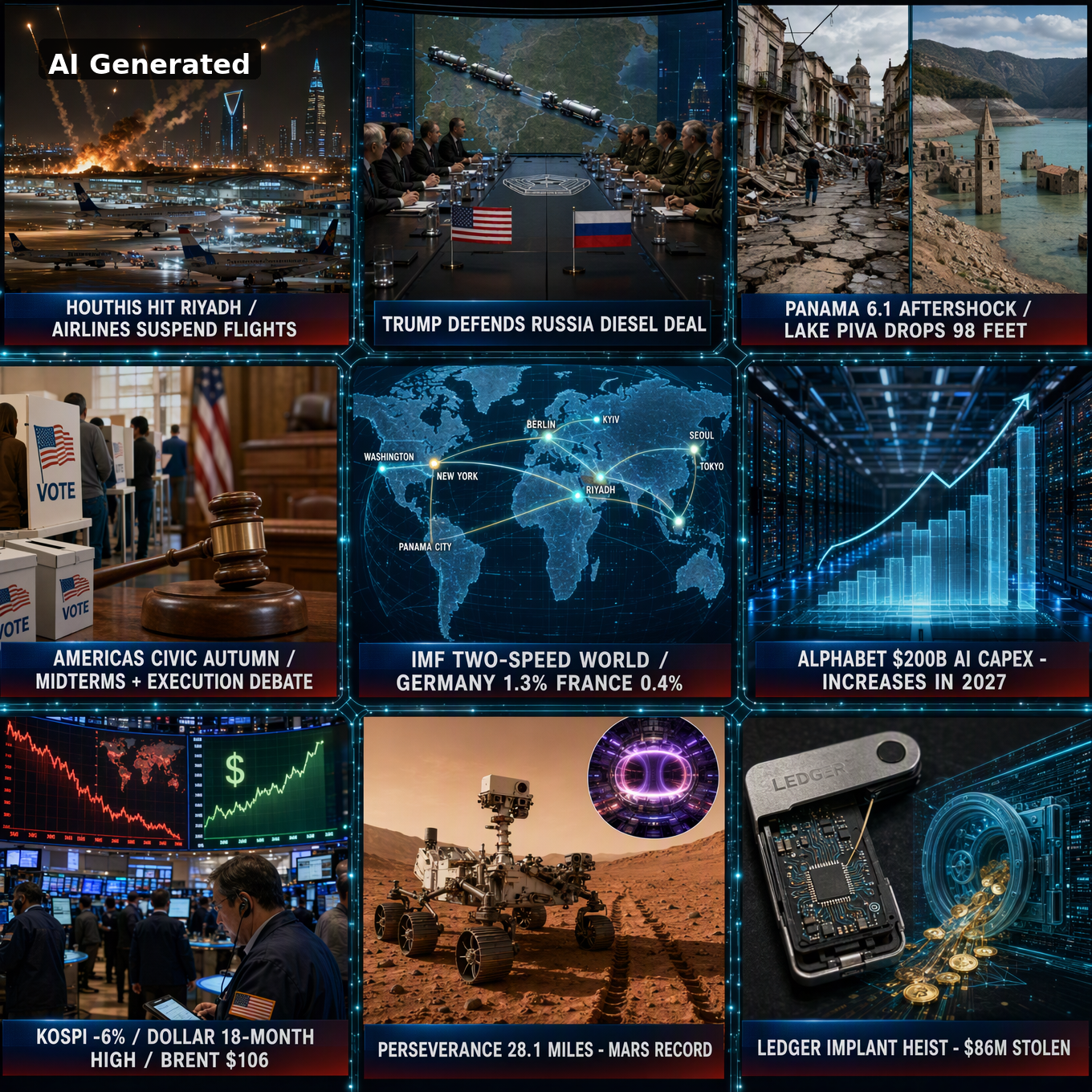
The most consequential development of this window is the operational quarantine tightening around Saudi Arabia as the Houthi missile campaign against the kingdom enters a new phase. On the night of Monday 12 October, ballistic missiles fired from Yemen struck Riyadh, with witnesses reporting three explosions and Saudi authorities issuing emergency mobile alerts before confirming air defences had intercepted the fire[2]. The strike came less than two weeks after the assault that killed a Pakistani national at King Khalid International Airport, reported in yesterday’s D134 brief, and the pattern of near-simultaneous claims against the capital, Dammam and Aramco infrastructure suggests the Houthis are deliberately saturating the kingdom’s air-defence network[3]. The market-facing consequence was aviation: Etihad suspended all flights between Abu Dhabi and Riyadh, Jeddah and Dammam through 19 October, while Qatar Airways halted services to Riyadh and Dammam — removing a significant share of Gulf air capacity[1]. Riyadh has responded with airstrikes on Yemen’s Amran and Hodeidah provinces[4], even as the Houthis warn that any direct American intervention “will not be tolerated” — leaving the kingdom exposed between a determined adversary and a Washington that has refused to commit combat support[5].
The analytical read from D133 and D134 — that the Gulf and Ukrainian theatres feed a single risk calculus — is reinforced by how these strikes are absorbed into the war economy’s price mechanism. The Saudi warning-system failure that preceded the deadly Riyadh attacks suggests the kingdom’s detection network is being probed for gaps[3]. In parallel, Iran’s Revolutionary Guard Corps claimed responsibility for striking a supertanker transiting the Strait of Hormuz, setting it ablaze — the latest attack reducing the strait’s role as a functioning artery for global energy trade and pushing regional economies toward a “longer-than-expected closure”[29]. Missile strikes on Riyadh, aviation suspensions, tanker attacks in Hormuz and an American posture of rhetoric without commitment: this is precisely the configuration the D132 analysis warned would convert the Iran war into a chronic supply crisis.
The War Economy’s Rhetoric Test: Diesel Diplomacy and Kyiv’s Night
On the Ukrainian front, the defining theme remains the gap between announcement and event that D134 identified. President Trump spent Monday defending the diesel-supply agreement with Russia as a diplomatic lever to bring Vladimir Putin back to negotiations, brushing aside bipartisan criticism that the arrangement violates the 2022 law barring imports of Russian energy until Moscow ends its aggression[6][7]. American envoys Steve Witkoff and Jared Kushner presented the deal to Ukrainian officials in Miami on 9 October as part of a broader effort to restart trilateral talks, while privately conceding that Putin is not currently willing to negotiate an end to the war[6]. The administration’s framing — that an economic agreement might create conditions for renewed diplomacy — is the purest articulation yet of the electoralised war economy the D132-D134 series has tracked, in which fuel-price policy is executed as foreign policy[7]. The ground truth remains brutal: a Russian drone strike on a 25-storey residential building in Kyiv killed a 59-year-old woman and another person[8], while a wave of Ukrainian drones targeted the industrial zone of Nevinnomyssk in southern Russia, where authorities confirmed multiple downings[9]. President Zelensky also claims Ukrainian strikes on Russian data centres silenced social-media bot networks, with Yandex’s automated traffic falling 94 percent — a signal that information infrastructure is now a target in both directions[10].
The European security establishment convened at the Warsaw Security Forum, where Polish Prime Minister Donald Tusk warned of a “real threat” from Russia and urged tighter sanctions, directly contradicting the logic of the diesel deal[16]. German Foreign Minister Johann Wadephul attended alongside his Polish, British and Norwegian counterparts[15], and NATO’s Supreme Allied Commander Europe, General Alexus Grynkewich, struck a bullish tone on the alliance’s “block, blunt, break” theory of victory[17]. Yet the German foreign-intelligence service (BND) is embroiled in a spy scandal that, in one expert’s words, “leaves partners doubting the BND’s integrity”[18].
The Korean and Pacific Perimeter: Missiles, a Summit Gambit and the Sixth-Generation Race
North Korea re-entered the escalation cycle on Monday morning, launching multiple ballistic missiles toward the Sea of Japan, with at least one flying more than 900 kilometres[11]. The launch, less than two weeks after a test on 3 October, drew an emergency session of Seoul’s National Security Council and fresh EU sanctions targeting three individuals and four entities linked to North Korea’s nuclear and missile programmes and its cooperation with Russia, including what Brussels described as “arms for oil” transactions[11]. The German business press reports President Trump is considering a meeting with Kim Jong-un in November — a gambit that would revive first-term personal diplomacy precisely as Pyongyang accelerates tests and deepens the Moscow partnership[12]. The risk is symmetrical with the diesel deal: a summit that produces no verifiable concessions would be another announcement-as-event.
The sixth-generation air-power race provides the backdrop. Beijing’s Xi’an H-20 stealth bomber remains frozen in what one analyst calls a development “doom loop,” with no confirmed test flights[13]. Yet Washington is not complacent: the Boeing F-47, not scheduled to fly until 2028, is being run through developmental and operational testing simultaneously, precisely because China is already flying two sixth-generation variants[14].
The Arsenal Ledger: AUSA 2026 and the Economics of Attrition
At AUSA 2026, the defining motif was interceptors and directed energy cheap enough to fight an attrition war against drones. BAE Systems unveiled a High-Power Microwave weapon built from more than 99 percent commercial off-the-shelf components that can engage successive drone swarms, alongside a Multi-Domain Artillery Cannon firing hypervelocity projectiles[23]. Anduril’s Steelfin interceptor family applies the same logic: a modular design that swaps boosters and seekers to match cost to threat, built on shared manufacturing capable of thousands of units a year and integrated with the Mk 41 VLS and AEGIS[24]. CHAOS Industries joined the parade with its VESPID design, while the Acting Army Secretary announced a “manufacturing rodeo” to fix “weak links” in the supply chain[25][26]. The Army also confirmed it sent balloon swarms to the Middle East for CENTCOM operations, a low-cost stratospheric sensing alternative[27], and the Airbus-Kratos U740 Valkyrie made its first European flight with a 3,100-mile range[28].
The Periphery: Colombia, the Western Hemisphere and the Mediterranean Files
Three peripheral files deserve attention. In Colombia, the new government told the UN that the 2016 peace agreement has not brought peace: more than 132,000 people have been killed and armed-group membership has grown from about 6,000 to almost 30,000 — an accounting of how a peace deal that eliminated one insurgency created space for its successors[19]. The statistic is being invoked to justify the Army’s plan to stage counter-drug training exercises across South America, explicitly shifting training “toward operations directly targeting drug cartels” under the “Donroe Doctrine”[20]. In the Mediterranean, Spanish Prime Minister Pedro Sanchez confirmed that Moroccan warships entered Spanish territorial waters near Ceuta without authorisation during the July migration crisis, and that a Spanish frigate escorted them out — a near-“hot incident” showing how close the two allies came to naval confrontation[21]. The Spanish King’s visit to Ceuta and Melilla this week is a deliberate show of sovereignty, yet Madrid’s need to be “prepared for every scenario” confirms the Morocco file remains a combustible flashpoint[22]. Finally, an examination of where the UAE and Saudi Arabia stand in Ethiopia’s Tigray war shows Gulf sponsorship networks threatening to draw the Red Sea’s principal powers into another proxy competition[30].
Environment & Climate ↑ Contents
The Disaster and Water Ledger: Panama’s Aftershocks and Europe’s Shrinking Reservoirs
A magnitude 6.1 earthquake jolted southern Panama on Monday evening, according to the US Geological Survey, striking roughly 30 kilometres south of Sona in Veraguas province days after Friday’s destructive tremors — a cluster that tests the region’s disaster-response capacity even as no immediate casualties were reported[31]. The deeper water story is unfolding in the Balkans, where Montenegro’s Lake Piva has dropped about 30 vertical metres after a long dry summer, exposing the drowned town of Pluzine — submerged when the Mratinje Dam filled 51 years ago — with its houses, bridges, a mill and the remains of more than 80 households[32]. The image of a reservoir revealing a town swallowed half a century ago is the starkest illustration of how drought converts infrastructure into archaeology, and it connects to the water-scarcity arithmetic western Texas now embodies in reverse: Corpus Christi’s attempt to beat drought by building a desalination plant to sell water to the oil-and-gas industry has landed the city in a financial and political quagmire[33]. Across all three, climate stress is no longer a slow background condition but a recurring operational variable for states and utilities.
The Energy-Transition Front: Nuclear Uprates, Wastewater Cooling and the Shipping Mechanism
Washington offered Vistra up to US$4.2 billion in federal loans for nuclear uprates at three plants in Ohio and Pennsylvania — upgrades adding 433 megawatts while extending operations 20 years past existing licences, underwritten by Meta’s 20-year power-purchase agreements for 2,176 megawatts[34]. The deal is the clearest signal yet of how AI-driven electricity demand is reshaping American energy policy: the fastest path is squeezing more power from existing reactors, with Perry’s uprate alone expected to add more than 200 megawatts and extend its life to 2066[34]. In parallel, University of Texas researchers propose using desalinated oilfield wastewater — the Permian Basin produces roughly 8 billion gallons a day — to cool data centres, relieving freshwater stress while reducing the seismic risk of underground injection[35]. On the maritime side, a proposal to reinforce the EU Emissions Trading System’s Sustainable Maritime Alternative Products mechanism, with an estimated 15 billion euros in support between 2028 and 2040, aims to give shipping a commercial path to green e-fuels[36]. Even buses are part of the ledger: Glasgow’s fragmented private bus market has become the testbed for Britain’s debate over whether deregulated transit can deliver the integration decarbonisation demands[37].
The Biodiversity and Wild Ledger: Salmon Returns, Orangutans and Climate Sovereignty
The removal of four dams on the Klamath River in 2024 has produced a faster and larger salmon recovery than anticipated: 7,742 Chinook migrated past the former dams in 2024, rising to more than 13,000 in 2025, recolonising 345 kilometres of blocked river and 88 percent of their historical habitat — a landmark demonstration that dam removal can restore ecosystems within a generation[38]. In Indonesia, wildfires sweeping Borneo have left endangered orangutans struggling to survive, with rescuers evacuating animals found injured and stranded in thick haze — including a young female whose burned palms and feet are a visceral reminder of how El Nino-amplified dry seasons convert habitat loss into direct animal suffering[39]. Indigenous Peoples’ Day brought climate-sovereignty advocates renewing calls to recognise Indigenous stewardship as a core climate instrument — reframing land rights as the frontline of biodiversity and carbon protection[40].
Climate Data, Health and Adaptation
Thousands of handwritten records recovered from archives in Belgium and the Democratic Republic of the Congo, spanning 1908 to 2023, reveal the scale of warming in the Congo Basin — one of the world’s most under-measured climate regions, where colonial-era meteorological ledgers are being digitised into a century-long dataset that could transform regional climate modelling[41]. The health interface of heat is increasingly explicit: European healthcare systems, designed for a cooler climate, are being stressed by extreme-heat events that overwhelm hospitals, degrade medicine storage and endanger vulnerable patients[42]. In Sri Lanka’s Colombo, rising temperatures are pushing urban dwellers toward energy-hungry air conditioning, while passive-cooling design offers a low-energy alternative — at a cost poor households can rarely afford, exposing the equity dimension of adaptation[43]. Finally, governments worldwide spend hundreds of billions of euros annually subsidising bioenergy and other industries that harm forests, even as the estimated cost of saving nature runs to roughly US$900 billion a year — an asymmetry central to the next round of biodiversity finance negotiations[44].
Society & Civil Issues ↑ Contents
America’s Civic Autumn: Midterms, the Execution Debate and the Courts
With three weeks until the US midterms, the American civic ledger is dominated by a presidency simultaneously pressuring its own base and expanding the boundaries of executive spectacle. At his rally in Youngstown, Ohio — once framed around a promised $5,000 cheque — President Trump berated his own voters from frustration as Republican anxiety grows over the Senate, with the House already written off by many in the party[45]. The same rally featured direct attacks on Representative Ilhan Omar and Senate hopeful Abdul El-Sayed, with the crowd chanting “deport”[46]. With three weeks to go, Elon Musk has already spent US$276 million on Republican causes, cementing his position as the cycle’s dominant donor and raising the question of whether the campaign has become a testbed for the political power of concentrated tech wealth[47]. In the justice ledger, the live-streaming of a federal execution has drawn rare bipartisan unease: House Speaker Mike Johnson publicly warned that broadcasting the military’s execution of the Muslim perpetrator of a 2009 Texas attack could serve “as a recruitment tool for future terrorists”[48]. The botched-execution file deepened as 911 calls from prison staff during the September 30 execution of Christa Pike revealed that emergency help was delayed by confusion[49]. A judge also ordered a halt to the felling of trees on a Washington golf course, a symbolic instance of courts as counterweight[50].
The judicial counterweight extends to campus and immigration. Lawyers for an accused Cornell University student — a recurring theme of this series since D125 — asked the judge for a gag order, underscoring how the case has become a national touchstone for the intersection of campus politics and criminal procedure[51]. In Houston, a man run over by an ICE vehicle will need additional surgery, with advocates noting he fled because the unmarked vehicle did not use sirens; ICE maintains he was not the target of the stop — an incident capturing the volatile human cost of immigration enforcement with minimal accountability[52].
Britain’s Civic Files: Justice, Care and Brexit
Britain’s civic ledger opened with a constitutional probe: an inquiry heard that military police were prevented from following evidence in the SAS murder probe in Northern Ireland, with an investigator saying the probe into suspected murders was “dictated” from above — a finding that will reverberate through the legacy-of-the-Troubles debate[53]. The mother of Baby P — jailed in 2009 for causing or allowing the death of her 17-month-old son — returned to a parole hearing after almost a year’s pause[54]. Hundreds more prisoners are to be freed in the second phase of the early-release scheme, including those serving up to two-and-a-half years, as the government relieves chronic overcrowding[55]. On care, the government is exploring automatically enrolling Britons into a savings scheme to cover social care costs later in life — a shift toward the compulsory social-insurance model long advocated by reformers[56]. In workplace justice, NHS staff secured a “landmark” payout over gas exposure following the largest group legal action brought by midwives in UK history[57].
Brexit has returned to the centre of British politics with a prime minister who, for the first time since the UK left the EU, is willing to “unflinchingly” debate the question — with Burnham reportedly ready to sign a new EU deal ahead of a UK-EU summit on 20 November[58]. Conservative leader Kemi Badenoch accused Burnham of “unpicking” the original Brexit deal, framing the renegotiation as a betrayal of the 2016 mandate — a clash that will define the autumn political calendar[59].
France’s Republican Autumn: Police, the VSS Law and the Budget
France’s civic season is defined by the tension between the street and the state. On the eve of a parliamentary vote on the “loi integrale” against sexist and sexual violence — prompted by 132,349 registered victims in 2025, six in ten of them minors — police and gendarmerie officers have publicly deplored the anti-police discourse that has intensified around such legislation, one officer insisting “it’s my job; if I were afraid of it I would change careers”[60][61]. The housing file is being shaped by the 2027 budget, with proposals that could change the economics of renting and ownership amid the affordability crisis tracked throughout this series[62]. The fiscal-justice front produced a notable legal escalation: the NGO Oxfam is taking the French state to court to “guarantee equality before tax,” challenging a tax system it argues systematically favours the wealthy[63]. And the long-running Marfin Bank case — the 2010 fire that killed three employees during a strike — has taken a new turn with a supplementary indictment, reviving a wound that has become a touchstone of Greek judicial accountability[64].
Germany and Greece: Coalition, Inheritance Tax and the Greek Files
Germany’s coalition is labouring under what the press has catalogued as “seven problems” — the structural tensions threatening the governing arrangement as the CDU’s crisis-retreat and the Merz candidacy reshape the calendar[65]. In Karlsruhe, the Federal Constitutional Court heard arguments on the constitutionality of inheritance-tax privileges for business assets — a case with billions at stake, pitting protection of family firms against tax equality, with the SPD pressing for reform and the government awaiting a verdict that could force a legislative overhaul[66]. In Greece, the internal war inside PASOK has escalated into open toxicity, with an article by an ally of Alexis Tsipras calling party leader Nikos Androulakis a “fool,” exposing the former prime minister and deepening centre-left divisions[67]. On the Greek-Egyptian front, the monastic community of St. Catherine’s Monastery at Sinai faces a deadline of less than two weeks before the publication of an Egyptian Supreme Court decision that will determine the monastery’s future — a case in which the Greek government is directly involved[68].
Public Health and the Integrity Ledger
The public-health ledger recorded the sixth death from measles in Pennsylvania’s ongoing outbreak — a 39-year-old unvaccinated woman in Franklin County who died on 10 October, in a state where more than a thousand people have been stricken since April[69]. Finally, a global report found that elections across the world faced persistent threats in 2025 — from violence and disinformation to electoral-management malfunctions, cyberattacks and natural hazards — framing the midterm campaign’s integrity challenges within a worldwide pattern of eroding trust in electoral processes[70].
AI & Technology ↑ Contents
Frontier Spending and the Data-Centre Build-Out
The AI capital cycle intensified on every front this window. Alphabet president and chief investment officer Ruth Porat told Fortune’s Most Powerful Women Summit that the company’s roughly US$200 billion of AI capital expenditure this year will “increase significantly” again in 2027, defending the spending against Jefferies’ warning that the AI boom may end in massive capital destruction as cheaper open-source Chinese models take share[71]. Porat’s rebuttal — that a capacity-constrained market with strong demand for compute is by definition investable, and that the 2016 pivot to AI-first has paid off — is the most senior articulation yet of the “build-out is rational” thesis this series has tracked[71]. NTT is in talks to build Anthropic’s first Japan data centre at up to US$6.3 billion, a landmark project that would anchor AI infrastructure in Asia and give Anthropic the sovereign-cloud footprint to serve Japanese enterprises and government[72]. Meta is positioning itself as a third pole: Zuckerberg has pledged vast AI spending aimed at OpenAI and Anthropic, and the new Muse Wonder model family — unveiled Monday — is explicitly framed as bringing Meta “to the forefront” of the frontier race[73][74]. For a company that spent more than $80 billion on the metaverse, Zuckerberg’s insistence that “Meta is on the frontier now” reframes that sunk cost as the foundation for a genuine AI challenge[75].
AI Security, Content and Sovereignty
On the security perimeter, Anthropic announced new defences that cut the data harvested from Claude via distillation attacks by 90 to 99 percent — a substantive answer to rivals extracting model behaviour through repeated queries, and a reminder that the frontier is as much about protecting weights as improving them[76]. The content economy’s collective-bargaining front advanced as the SPUR coalition added the New York Times, The Economist and AFP in its push for paid AI content use[77]. On sovereignty, sovereign wealth funds are demanding Perplexity’s AI run on their own hardware with no data access for Perplexity itself — a requirement that turns the AI company into a pure technology vendor and marks state-controlled AI deployment as a mainstream enterprise pattern[78]. Microsoft’s president sharpened the governance debate by noting that AI currently has fewer regulations than milk, a provocation designed to force a conversation about proportionate AI regulation[79].
Infrastructure, Chips and Autonomy
The physical layer of the AI economy is being re-engineered for scale. NVIDIA and Cisco announced plans for a new optical module — the Ultra-Dense Small Form Factor Pluggable — capable of up to 12.8 terabits per second, quadrupling bandwidth density while improving power efficiency by roughly 30 percent, an essential step for the “AI factories” training frontier models[80]. The chip-supply chain remains the binding constraint: China continues to struggle to shift its tech firms away from Nvidia chips despite export controls and a state push for self-sufficiency[81]. On autonomy, UCLA researchers created PhoneBot, a small humanoid that repurposes an old smartphone as the brain of a walking robot — a demonstration of how commodity hardware and on-device AI are democratising robotics[82]. Finally, a major UK internet outage affecting BT, Sky, Vodafone and EE, according to DownDetector, is a reminder that the digital economy’s dependence on a handful of network operators creates systemic fragility at the exact moment AI workloads increase demand for connectivity[83].
Economy & Business ↑ Contents
The IMF’s Two-Speed World: AI, Energy and the Split
The IMF’s World Economic Outlook, released at the Bangkok annual meetings, is the defining economic event of this window, and its central finding is a two-speed world increasingly driven by artificial intelligence. The Fund sharply upgraded Germany to 1.3 percent growth for 2026 — nearly double the July projection and in line with Berlin’s own numbers — attributing the resilience to infrastructure and defence investment, an export windfall from stockpiling of energy-intensive goods, and the AI boom’s benefit to German suppliers[84][85]. Yet the same report cut France to just 0.4 percent, a “net decoupling” that underscores how unevenly the war economy’s costs are distributed across the eurozone[93][94]. The Fund’s headline message — global growth of 3.1 percent propped up by AI investment even as war and debt threaten the outlook — comes with chief economist Silvana Tenreyro warning that trade in AI-related goods accounted for a major share of world-trade growth and that “resilience is under pressure, with risks to growth tilted to the downside”[87][88][91]. The German business press framed the same divergence as a world “growing ever further apart,” with gains concentrating in fewer countries[86]. The split is geographic as well as sectoral: Latin America and the Caribbean saw forecasts cut on the energy shock with little AI offset, while India and ASEAN were revised up[89][90]. The Fund explicitly framed AI investment as a demand “shock” that rescued global growth — while warning that if the AI hype proves unjustified, a sharp tech sell-off would dent global output, and that inflation, held at 4.7 percent for 2026, is being pushed up by the energy crisis and the AI build-out simultaneously[92]. For Greece, the Fund’s forecast of 1.8 percent growth with inflation at a problematic 4.2 percent captures the “big patient” problem: growth that continues at the price of persistent household price pressure[95]. On monetary policy, the IMF expects a gradual Bank of Japan rate hike toward neutral, while warning that higher energy prices and interest rates will hit UK growth next year[96][98].
The British case is politically loaded: the IMF upgraded UK GDP growth for 2026 even as it warned that households face sharper-than-expected inflation as energy prices jump and that rates will bite in 2027 — delivered just as Prime Minister Andy Burnham prepares his first Budget[97]. In Australia, the IMF’s stress scenario — oil at US$130 — would push petrol prices up another 30 cents a litre and pile pressure on the Reserve Bank to hike[99]. The RBA’s minutes confirmed the hawkish tilt, with board members judging that “some inflation upside risks have already unfolded or emerged since August,” even as falling house prices hint financial conditions are already quite tight[100]. Japan’s wholesale inflation remains elevated, keeping alive the BOJ rate-hike view the IMF endorsed[101].
Markets and Money: Asia’s Turbulence and the Dollar’s Climb
Asian stocks fell sharply as technology shares and the Korean exchange led declines — the KOSPI tumbling over 6 percent while Brent traded below US$106, and India’s GIFT Nifty signalling a positive open even as regional sentiment soured[102][103]. The dollar held near an 18-month high as geopolitical risk premium accumulated — a flight-to-safety that tightens conditions for emerging-market borrowers and reflects the market’s judgment that the Gulf crisis will persist[104]. The eurozone’s trade ledger carried a striking reminder of the war economy’s entanglement: Russia has delivered US$320 billion of hydrocarbons to Europe since 2022, including $21.3 billion in the first nine months of 2026 alone, despite sanctions — framing the diesel-deal controversy as the latest iteration of an energy dependency neither side has fully severed[105]. French reporting detailed how the regional economy is absorbing a “longer-than-expected” Hormuz closure[106].
Energy, Trade and the EV Ledger
Forty percent of Volkswagen Group’s European orders last month were fully electric — a record underscoring how the fuel-price shock is accelerating the EV transition, even as VW’s margins on electric models remain thinner than on combustion vehicles[107]. BYD has now produced 150,000 commercial plugin vehicles, with commercial sales up 113 percent year-on-year in September — evidence the commercial-vehicle electrification cycle is accelerating globally[108]. Global smartphone shipments hit a new low in the third quarter as memory-driven “RAMageddon” price increases squeezed consumer wallets — a reminder that the AI build-out’s competition for memory is cascading into the broader hardware economy[109].
Corporate, Fiscal and Infrastructure Files
Kroger plans to cut 3,000 corporate roles as it expands AI use — a concrete instance of the AI-productivity paradox D134 flagged, where efficiency gains translate into workforce reductions before they show up as economy-wide productivity[110]. In Germany, Vonovia CEO Luka Mucic gave his first extended interview on the Left’s plan to expropriate housing companies in Berlin, defending the group’s investment posture and framing the “rent mafia” rhetoric as a threat to housing supply[111]. A cross-institutional alliance — the IW, the Climate Economy Foundation and Fiscal Future — urged reform of Germany’s debt brake that would cap defence spending inside a revised framework, resolving the tension between fiscal discipline and rearmament[112]. In France, Edouard Philippe’s party proposed emergency budget measures on pensions, civil servants and sick leave[113]. In emerging Asia, Indonesia’s aggressive tax drive has upset e-commerce sellers and big businesses[114], while Pakistan’s finance minister is looking to Asian bond markets to diversify funding away from Gulf deposits and IMF programmes[115]. Greece extended its supermarket price-cap on profit margins through the holiday season[116]. On infrastructure, the US$1.5 billion Agua Negra tunnel between Argentina and Chile — approved in 2017 but never started — is back on the agenda, driven by the copper boom in San Juan and the chronic closure of the Cristo Redentor pass[117]. Finally, India’s equity mutual funds hit a five-month high in September inflows as investors used the correction to add risk, while the account-aggregator network adopted a rate card cutting out tech middlemen[118][119].
Science & Space ↑ Contents
Space and the Cosmic Ledger: Mars, Water and a Pacific Hunt
NASA’s Perseverance rover set a record for the longest distance driven by any vehicle on another world, passing 28.10 miles (45.22 kilometres) on Mars and overtaking Opportunity’s mark in about five and a half years thanks to AutoNav, which has guided more than 90 percent of its driving and processes roughly 600,000 measurement points per terrain scan[120]. Its new mission extension through 2028 will push it toward Idubi, where scientists hope to find evidence of ancient hydrothermal systems in rocks up to four billion years old[120]. On where Earth’s water came from, University of New Mexico scientists converted up to 70 percent of the iron oxide in melted basalt into metallic iron and water within three hours — a demonstration that a young Earth could have generated its own oceans during pebble accretion, “no exogenous source required”[121]. The finding, published in Nature Geoscience, is contested, but it is a serious candidate explanation for a problem that has frustrated planetary science since Halley’s comet failed the isotope test in 1986[121]. In the Pacific, a crew searching for Amelia Earhart has arrived at a remote island notorious for its giant coconut-cracking crabs, sleeping aboard ship to avoid the crustaceans that may have played a role in the aviator’s fate[122].
Fusion’s Digital Twin and the Human Body Ledger
A new US Department of Energy-backed project — part of the Genesis Mission’s Phase II — will build a digital twin of Commonwealth Fusion Systems’ SPARC tokamak, combining physics simulations, experimental data and machine-learning surrogate models to predict a complete plasma pulse in under 20 minutes, in collaboration with four national laboratories, NVIDIA, Google DeepMind and leading universities[123]. The ambition is to let fusion researchers iterate between experiments in near-real-time, compressing the timeline toward ARC, the commercial plant CFS plans after SPARC[123]. The medical ledger delivered several counterintuitive findings. A large study of older Americans found that people who are overweight or obese when diagnosed with dementia have a significantly lower risk of death than those at normal weight — an “obesity paradox” that complicates linear risk narratives[124]. A preclinical study in PLOS ONE found that pairing the cheap deworming drug mebendazole with the targeted lung-cancer therapy gefitinib restored vulnerability in drug-resistant tumours — in mice, extending tumour-doubling time from 6.2 days untreated to 25 days[125]. Researchers at the Francis Crick Institute showed that gut inflammation can reactivate dormant breast-cancer cells in the bone marrow years after treatment, offering a mechanism for late recurrences[126]. A separate study found that nearly one in three older adults with cognitive disorders still takes at least one potentially inappropriate medication[127]. Nanostructure-assisted ultrasound shows early promise for Parkinson’s treatment, and new work on inflammatory bowel disease suggests the gut lining retains a hidden vulnerability to abnormal cell death even during remission — pointing toward “molecular healing” as the therapeutic goal[128][129]. Finally, a new global mapping study reveals snakebite envenoming is a far bigger public-health problem than previously understood, concentrated in poor rural tropical communities[130].
The Molecular and Materials Ledger
Stabilising the simplest amino acid, glycine, opens a path to biodegradable sensors[131]. Columbia scientists discovered a bacterial antiviral defence system that appears to share an ancient ancestry with human chromosome-protection machinery — one that could be adapted into a gene editor to slow cellular ageing and improve cancer therapies[132]. New research derives Einstein’s equations from the behaviour of quantum information, linking the shape of spacetime to how information is stored in quantum fields[133]. In applied magnetics, researchers demonstrated “magnetic sculpting” — transforming single-source fields into predetermined shapes for MRI, accelerators and quantum computers — while a Penn State-led team showed that chemical disorder in a ceramic film can confer magnetic properties for low-power electronics, and NUS researchers made a 2D semiconductor magnetically switchable by electrical voltage for spintronics[134][135][136].
The Deep Archive and the Wild Ledger
Using tooth enamel from medieval graves in Derbyshire’s Peak District, researchers pinpointed when post-Roman lead production resumed in one of Europe’s largest lead regions — the mid-7th century — and documented how children’s lead exposure matched or exceeded that of the Industrial Revolution, with working-class families and women of child-bearing age bearing the heaviest burden[137]. In marine biology, drone surveillance off Australia’s east coast filmed dozens of young scalloped hammerhead sharks gathering in shallow waters near popular beaches — groups of up to 100 at Noosa — revealing likely juvenile habitat for a globally critically endangered species and highlighting the tension between shark conservation and the bather-protection nets that kill most captured sharks[138].
Crypto, Digital Assets & Blockchain ↑ Contents
The Hardware Trust Failure: Ledger’s Tampered Wallets and the Limits of Self-Custody
The crypto ledger’s most consequential story this window is a physical, not a digital, attack on the industry’s foundational security assumption. At least US$86 million — and by some estimates up to $93 million — was stolen from the users of more than 300 Ledger hardware wallets after thieves drained assets across Bitcoin, Ethereum and Tron, with Ledger confirming that at least one affected device “contained an unauthorized hardware implant”: a chip and antenna added to capture seed phrases and exfiltrate them over a cellular connection[139]. The affected devices appear to have been sold through CryptoBilis, a Southeast Asian reseller, meaning the compromise occurred in the supply chain, before the wallets reached their owners[139]. The analytical significance is profound: hardware wallets are marketed as the gold standard of self-custody, the physical embodiment of “not your keys, not your coins,” and the one layer supposed to be immune to remote compromise. A factory-stage seed-phrase implant attacks the very premise of the product category — and the fact that it required a physical, targeted compromise rather than a network exploit is both reassuring and alarming: the software layers held, but the hardware layer’s integrity is only as strong as the least-scrutinised reseller in the chain. Alongside the XRP supply-bug patch tracked in D134, this reinforces the pattern that the sector’s most damaging failures now come from the intersection of physical and software trust.
Institutional Integration: Evernorth’s Nasdaq Debut and BitMine’s Pause
The institutionalisation of digital assets reached a new milestone with Evernorth Holdings beginning Nasdaq trading under the ticker XRPN, bringing approximately 473 million XRP into a publicly traded company built around an actively managed XRP treasury that pursues strategies to increase its cryptocurrency holdings per share[140]. The listing gives mainstream equity investors direct exposure to a corporate XRP treasury — an instrument that barely existed a year ago — and follows the pattern tracked across D129-D134 of crypto balance sheets migrating onto traditional capital-markets rails[140]. In parallel, BitMine’s weekly Ethereum purchases shrank to 12,532 ETH in the week to 11 October — the third consecutive small weekly buy — with chairman Tom Lee declaring the company is “done stacking” after building a treasury of 6,028,946 ETH, or 4.9 percent of total supply, during what he called a bear market[141]. The company’s shift from accumulation toward monetising its staked ether — Lee projects US$336 million a year in staking revenue — marks a transition in the corporate-treasury playbook: from aggressive stacking to yield harvesting[141]. Read together, Evernorth’s listing and BitMine’s maturation suggest the treasury-company model is entering a second phase focused on monetising existing holdings rather than accumulating new ones — a shift with implications for supply dynamics and how investors value these vehicles.
Regulation, Market Structure and the AI-Payments Frontier
The regulatory perimeter tightened in Asia, where South Korea moved to block access to 27 unregistered overseas crypto exchanges — direct enforcement that tightens the practical geography of where global crypto traders can operate and channels activity toward licensed domestic platforms[142]. The market-structure ledger continued to evolve at the protocol layer. Uniswap’s Layer-2 network Unichain is migrating to Optimism’s OP Enterprise stack, handing production operations — sequencers, RPC access and incident response — to Optimism while leaving the chain’s user-facing state intact, with the testnet moving on 13 October and mainnet on 29 October[143]. The migration is invisible to users — chain ID, contracts, balances and applications all remain unchanged — but it concentrates operational control of one of DeFi’s most important chains in Optimism’s hands[143]. Aptos rolled out an encrypted mempool as an optional feature that hides transaction details until their order is finalised, curbing frontrunning and sandwich attacks by denying bots the information they need to exploit pending trades[144]. Two structural debates matured. ScopeLift’s CEO argued that the regulatory excuse for value-free governance tokens is fading — as regulatory fears diminish, governance tokens may need to capture real value to secure protocol security, reshaping DAO structures and investor expectations[145]. And on the AI frontier, Fortune’s reporting from TOKEN2049 captured a consensus among founders: “by 2028, the norm will be to trade with agents,” with Robinhood, OKX, Binance and Bybit introducing agentic trading — even as autonomous AI agents repeatedly attacked the exchange Quidax, making agents both the next distribution channel and the next threat vector[146]. Finally, in the payments-crossover space, South Korea’s KB Kookmin Card and Japan’s SBI Holdings are separately exploring AI-driven identity checks and crypto payments for cross-border transactions — mainstream-adjacent experiments in using digital assets to lower remittance costs[147].
Correlations & Analysis ↑ Contents
The defining pattern of this window is the consolidation of what D134 identified as “the collapse of the distinction between announcement and event.” Yesterday’s brief opened on a ceasefire that existed only in a presidential post, was disowned by Moscow, and was falsified by a strike on Kharkiv. Today the same logic has produced a diplomatic move that is simultaneously economic policy and political instrument: the diesel-supply agreement with Russia is now openly defended as a lever to bring Putin back to negotiations, with US envoys admitting in Miami that Moscow is not willing to negotiate an end to the war[6][7]. The D132 analysis — that the Trump-Putin framework is fuel-price policy executed as foreign policy — has been confirmed by the administration’s own framing, and the test remains the market’s conditional reaction rather than the headline. Meanwhile, a Russian drone killed two civilians in a Kyiv residential tower and Ukrainian drones struck Russia’s industrial zone at Nevinnomyssk the same night[8][9]. The war economy runs on its own logic, indifferent to the diplomatic theatre above it.
The Gulf theatre shows the same asymmetry between rhetoric and event escalating in parallel. D134 reported the strike on King Khalid International and the Pakistani deployment; the fresh ballistic strike on Riyadh, the Saudi airstrikes on Amran and Hodeidah, the IRGC’s tanker strike in Hormuz, and the suspension of Etihad and Qatar Airways flights all extend the arc without resolution[2][4][1][29]. The Houthis’ threat that any American intervention “will not be tolerated” confronts a Washington declining Riyadh’s request for combat support[5]. Both conflicts now feed a single risk calculus: the dollar at an 18-month high, the IMF’s Bangkok scenario of oil at US$130, and a eurozone absorbing an energy shock the Fund’s two-speed forecast quantifies — Germany upgraded to 1.3 percent while France is cut to 0.4 percent[104][85][93]. The two wars have fused into a single economic-political object, and the midterm calendar is its clock.
The technological economy is converging on the same verification-versus-announcement tension from a different direction. The Ledger hardware-wallet supply-chain compromise, in which tens of millions of dollars were stolen through a factory-stage implant, is the crypto mirror of the XRP supply-bug D134 reported: in both cases, the industry’s most fundamental guarantee — the integrity of private keys, or of a fixed token supply — proved only as strong as the least-audited link in the coordination layer beneath it[139]. And just as D134 found the AI-financing repricing underway at DBS, this window sees Alphabet’s Ruth Porat defending a $200 billion annual capex programme that will “increase significantly” in 2027, Meta launching Muse Wonder, and NTT building Anthropic’s first Japan data centre[71][74][72]. The IMF’s warning — that if the AI hype proves unjustified a sharp tech sell-off would dent global output — is the macro expression of the question the sector asks itself: how much of the build-out is durable demand, and how much is conviction spending markets will eventually discipline[88].
The midterm frame tightens every strand, exactly as the D123-D134 series predicted. The execution-live-streaming debate has drawn a public warning from the Republican Speaker; Elon Musk’s US$276 million in disclosed spending makes him the cycle’s dominant donor; and the president’s Youngstown rally deployed “deport” chants against Ilhan Omar and Abdul El-Sayed as the campaign enters its final three weeks[48][47][46]. Europe is not standing still — the Warsaw Security Forum’s sanctions push, Germany’s debt-brake reform debate, France’s VSS “loi integrale” vote and Philippe’s budget counter-proposals all reset the continental calendar[16][112][61][113]. The common thread across every section remains what D134 called credibility as the scarcest resource — rationed simultaneously by courts (the BVerfG inheritance-tax hearing, the Cornell gag-order request, the Oxfam suit), by markets (the dollar’s flight, the RBA’s hawkish minutes), and by voters[66][51][63][100].
What to watch in the next reporting period: (1) whether the diesel deal survives its first full trading week — the oil market’s reaction remains the first genuine test of whether the announcement moved anything real, and Moscow’s reported readiness to raise diesel exports to 3.5 million tonnes a month will test sanctions credibility[6]; (2) whether Washington follows the Houthi strikes on Riyadh with a direct response, and whether the Pakistani deployment changes the Gulf risk calculus; (3) whether the UK-EU summit of 20 November produces a concrete renegotiation, and how Burnham’s first Budget reconciles the IMF’s inflation warning with promised fiscal room; (4) whether the Ledger compromise triggers a chain-of-custody standard across the hardware-wallet industry, and whether Evernorth’s listing normalises crypto-treasury equities; and (5) whether AI-financing repricing spreads from commentary into credit conditions, with Alphabet’s 2027 capex guidance and the NTT-Anthropic deal as near-term tests[71][72]. The war economy’s electoral season is entering its final three weeks, and every instrument it has absorbed — ceasefires, diesel volumes, missile strikes, hardware wallets, capital expenditure — is now a campaign variable.
References ↑ Contents
1. Etihad und Qatar Airways streichen Fluege nach Saudi-Arabien by iefimerida.gr · iefimerida.gr ↑
2. Houthis hit Riyadh with missiles – strong explosions in the Saudi capital by DefenceNet · DefenceNet ↑
3. Saudi Arabia's warning system failure precedes deadly Riyadh airport attacks by Crypto Briefing · Crypto Briefing ↑
4. Saudi Arabia conducts airstrikes on Yemen's Amran and Hodeidah provinces by Crypto Briefing · Crypto Briefing ↑
5. Frappes en Arabie saoudite: les houthistes promettent une riposte en cas d'intervention americaine by Le Monde · Le Monde ↑
6. Trump defends diesel deal with Russia – goal to bring Putin back to negotiations by iefimerida.gr / Reuters · iefimerida.gr / Reuters ↑
7. Russland-Sanktionen: Trump verteidigt Diesel-Abkommen mit Russland by Handelsblatt / Reuters · Handelsblatt / Reuters ↑
8. Guerre en Ukraine: a Kiev, une attaque de drone russe contre un immeuble residentiel fait deux morts by Le Monde · Le Monde ↑
9. Wave of drones targets industrial zone in Nevinnomyssk, Russia by Skai.gr · Skai.gr ↑
10. Ukraine's Zelenskyy Claims Strikes on Russian Data Centers Silenced Social Media Bots by Gizmodo · Gizmodo ↑
11. North Korea launched ballistic missiles toward the Sea of Japan by DefenceNet · DefenceNet ↑
12. Trump erwagt Treffen mit Nordkoreas Machthaber Kim im November by Handelsblatt · Handelsblatt ↑
13. China's New 'Flying Wing' Xi'an H-20 Stealth Bomber Is Now Frozen In a Development 'Doom Loop' by 19FortyFive · 19FortyFive ↑
14. The Air Force's Boeing F-47 Stealth Fighter Is Not Scheduled to Fly Until 2028… by 19FortyFive · 19FortyFive ↑
15. Wadephul nimmt an internationalem Sicherheitsforum in Warschau teil by Stern · Stern ↑
16. At Warsaw Security Forum, Poland's Tusk raises alarm over 'real threat' from Russia by Breaking Defense · Breaking Defense ↑
17. Amid unease in Europe, NATO SACEUR bullish on 'block, blunt, break' theory of victory by Breaking Defense · Breaking Defense ↑
18. Interview: Der Fall lasst Partner an der Integritaet des BND zweifeln by Handelsblatt · Handelsblatt ↑
19. Colombia's new government: 2016 deal with rebel group has not brought peace – but 132,000 killings by The Independent / AP · The Independent / AP ↑
20. US Army to stage counter-drug training exercises in South America by Defense One · Defense One ↑
21. P. Sanchez: The Moroccans sent warships in the Ceuta crisis – we were ready for everything by DefenceNet · DefenceNet ↑
22. Spaniens Koenig Felipe VI. besucht Exklave Ceuta in Nordafrika by Stern · Stern ↑
23. New microwave weapon can zap drone swarms without burning through missiles by Interesting Engineering · Interesting Engineering ↑
24. Anduril's new missile swaps boosters to slash costs and take on hypersonic threats by Interesting Engineering · Interesting Engineering ↑
25. CHAOS Industries joins low-cost interceptor parade with VESPID design by Breaking Defense · Breaking Defense ↑
26. Acting army secretary announces 'manufacturing rodeo' to tackle 'weak links' in supply chain by Breaking Defense · Breaking Defense ↑
27. Army sent balloon swarms to Middle East to support CENTCOM operations by Breaking Defense · Breaking Defense ↑
28. Valkyrie combat drone makes first European flight with 3,100-mile range and Mach 0.8 by Interesting Engineering · Interesting Engineering ↑
29. Iran: The IRGC struck a tanker in the Strait of Hormuz by Defence-Point.gr · Defence-Point.gr ↑
30. Ethiopia's Tigray war: Where do the UAE and Saudi Arabia stand? by Al Jazeera · Al Jazeera ↑
31. A 6.1 earthquake jolts southern Panama after Friday's destructive tremors by The Independent / AP · The Independent / AP ↑
32. Montenegro's Lake Piva dropped about 98 feet in a drought, exposing houses and a mill from old Pluzine by EcoTICAS / ECONEWS · EcoTICAS / ECONEWS ↑
33. How a bid to beat drought drove Corpus Christi to the brink of disaster by Inside Climate News · Inside Climate News ↑
34. The Energy Department offered Vistra up to $4.2 billion for 433 more megawatts from nuclear uprates at three plants by EcoTICAS / ECONEWS · EcoTICAS / ECONEWS ↑
35. Texas oilfield wastewater could help cool data centers without draining freshwater by Interesting Engineering · Interesting Engineering ↑
36. Reinforcing the ETS SMAP to Guarantee Long-term Shipping Decarbonisation by CleanTechnica / Transport & Environment · CleanTechnica / Transport & Environment ↑
37. Glasgow's Buses Reveal Britain's Transit Experiment by CleanTechnica · CleanTechnica ↑
38. Chinook salmon return to historical habitat following removal of four US dams by Mongabay · Mongabay ↑
39. Wildfires threaten Indonesia's orangutans as rescuers find injured animals by Mongabay / AP · Mongabay / AP ↑
40. Indigenous Peoples' Day 2026: Celebrations Of Respect by CleanTechnica · CleanTechnica ↑
41. Thousands of handwritten records reveal scale of warming in the Congo by Yale e360 / EHN · Yale e360 / EHN ↑
42. What happens to healthcare in extreme heat? by Health Care Without Harm / EHN · Health Care Without Harm / EHN ↑
43. As Colombo heats up, passive cooling offers a low-energy solution – but at a cost by Mongabay · Mongabay ↑
44. To Save Nature, Countries Should Eliminate Subsidies That Harm Forests by CleanTechnica / NRDC · CleanTechnica / NRDC ↑
45. US-Praesident unter Druck: Trump poebelt nun aus Frust seine Waehler an by Stern · Stern ↑
46. Trump attacks Rep. Ilhan Omar and Senate hopeful Abdul El-Sayed at Ohio rally by NBC News · NBC News ↑
47. A trois semaines des midterms, Elon Musk a deja depense 276 millions de dollars pour les Republicains by Le Parisien · Le Parisien ↑
48. Execution en direct aux Etats-Unis: le speaker republicain Mike Johnson emet des reserves by Le Monde · Le Monde ↑
49. Emergency help for Christa Pike after botched execution was delayed due to confusion by The Express · The Express ↑
50. Donald Trump fait abattre des arbres sur un parcours de golf de Washington, une juge interrompt les travaux by Le Parisien · Le Parisien ↑
51. Accused Cornell University student asks for gag order by ABC News · ABC News ↑
52. Houston man run over by ICE vehicle will need additional surgery, advocates say by NBC News · NBC News ↑
53. Military police prevented from following evidence in SAS murder probe, inquiry hears by BBC News · BBC News ↑
54. Parole hearing to resume for mother of Baby P after almost a year's pause by Evening Standard · Evening Standard ↑
55. Hundreds more prisoners to be freed in second phase of early release scheme by BBC News · BBC News ↑
56. Britons could be automatically enrolled into social care savings scheme by The Express · The Express ↑
57. NHS staff get 'landmark' payout over gas exposure by BBC News · BBC News ↑
58. Why the prime minister wants to talk about Brexit again by BBC News · BBC News ↑
59. Kemi Badenoch accuses Andy Burnham of 'unpicking' original Brexit deal before UK-EU summit by The Express / PA · The Express / PA ↑
60. CRS, policiers, commissaires, gendarmes: ils deplorent le discours anti-flics by Le Parisien · Le Parisien ↑
61. VSS: La loi integrale, revolution ou illusion ? by France 24 · France 24 ↑
62. Logement: ce que le projet de budget 2027 pourrait changer by Le Parisien · Le Parisien ↑
63. Pourquoi l'ONG Oxfam attaque l'Etat en justice by Le Parisien · Le Parisien ↑
64. 5 to proi: Storm 48 hours – supplementary indictment for Marfin – Trump's oil poker by To Vima · To Vima ↑
65. Bundesregierung: Diese sieben Probleme belasten die Koalition by Die Zeit · Die Zeit ↑
66. Bundesverfassungsgericht: Um diese Summen geht es bei der Verhandlung zur Erbschaftsteuer by Handelsblatt · Handelsblatt ↑
67. 'Brazen' in PASOK over Tsipras' toxicity by Eleftheros Typos · Eleftheros Typos ↑
68. Decision time for St. Catherine of Sinai by To Vima · To Vima ↑
69. 39-year-old unvaccinated woman becomes 6th measles death in Pennsylvania by Ars Technica · Ars Technica ↑
70. Electoral integrity under pressure as elections faced persistent threats in 2025 by Phys.org / academic report · Phys.org / academic report ↑
71. Alphabet President Ruth Porat on how Google is funding AI to win long term, and the biggest risks ahead by Fortune · Fortune ↑
72. NTT to build first data center for Anthropic in Japan by Nikkei Asia · Nikkei Asia ↑
73. Mark Zuckerberg pledges vast AI spending as Meta takes aim at OpenAI and Anthropic by Crypto Briefing · Crypto Briefing ↑
74. Avec son nouveau modele d'IA, Muse Wonder, le groupe Meta affirme rivaliser avec OpenAI et Anthropic by Le Monde · Le Monde ↑
75. Mark Zuckerberg: Meta Is on the Frontier Now by Gizmodo · Gizmodo ↑
76. Anthropic says new defenses cut distillation data harvested from Claude by 90 to 99 percent by Crypto Briefing · Crypto Briefing ↑
77. SPUR coalition adds NYT, Economist and AFP in push for paid AI content use by Crypto Briefing · Crypto Briefing ↑
78. Sovereign wealth funds want Perplexity's AI on their own hardware, with no data access for Perplexity by Crypto Briefing · Crypto Briefing ↑
79. Microsoft President Says AI Has Fewer Regulations Than Milk. So Now What? by CNET · CNET ↑
80. Tiny pluggable optical module boosts data center bandwidth 4x without extra hardware by Interesting Engineering · Interesting Engineering ↑
81. China struggles to shift tech firms away from Nvidia chips by Crypto Briefing · Crypto Briefing ↑
82. Biped bot uses your old, dusty phone for brains (PhoneBot) by New Atlas / UCLA · New Atlas / UCLA ↑
83. Internet outage LIVE: BT, Sky, Vodafone and EE hit by major blackout by The Express / DownDetector · The Express / DownDetector ↑
84. Konjunktur: IWF hebt Prognose fuer deutsche Wirtschaft deutlich an by Spiegel · Spiegel ↑
85. Konjunktur: IWF blickt deutlich optimistischer auf deutsche Wirtschaft by Stern · Stern ↑
86. IWF-Konjunkturprognose: Die Weltwirtschaft klafft auseinander – die Gewinner und Verlierer by Handelsblatt · Handelsblatt ↑
87. IMF warns global economy 'could soon test the limits of resilience' by The Guardian · The Guardian ↑
88. IMF says AI investment propping up global growth, but war and debt threaten outlook by Investing.com / Reuters · Investing.com / Reuters ↑
89. IMF cuts Latin America, Caribbean growth forecasts on energy shock, little AI boost by Investing.com / Reuters · Investing.com / Reuters ↑
90. India, ASEAN growth revised up in IMF's latest world outlook by Nikkei Asia · Nikkei Asia ↑
91. Resilience is watchword in IMF's World Economic Report by Central Banking · Central Banking ↑
92. Un choc de demande: poussee par les investissements massifs dans l'IA, la croissance mondiale tire son epingle du jeu by Le Parisien · Le Parisien ↑
93. Le FMI pointe un net decrochage de l'economie francaise by Le Monde · Le Monde ↑
94. Une croissance meilleure que prevue en Europe mais moins bonne qu'esperee en France: les predictions du FMI by Le Parisien · Le Parisien ↑
95. DNT for Greece: 1.8% growth in 2026, inflation the 'big patient' at 4.2% by Naftemporiki · Naftemporiki ↑
96. IMF expects gradual BOJ rate hike towards neutral setting by Investing.com / Reuters · Investing.com / Reuters ↑
97. UK growth upgraded but energy prices and rates to bite in 2027 by BBC News · BBC News ↑
98. IMF sees higher energy prices and interest rates hitting UK growth by Investing.com / Reuters · Investing.com / Reuters ↑
99. 'Clear and present danger': fuel prices could rise by 30c a litre across Australia under IMF scenario by The Guardian · The Guardian ↑
100. RBA minutes signal further rate hikes as inflation risks intensify by Investing.com · Investing.com ↑
101. Japan's wholesale inflation remains elevated, keeps alive BOJ rate-hike view by Investing.com / Reuters · Investing.com / Reuters ↑
102. Stock Market LIVE: GIFT Nifty signals positive open; KOSPI tumbles over 6%; Brent below $106 by Business Standard · Business Standard ↑
103. Asian stocks dive as focus on earnings, geopolitics by Investing.com / Reuters · Investing.com / Reuters ↑
104. Dollar holds near 18-month high as geopolitical risks rise by Investing.com / Reuters · Investing.com / Reuters ↑
105. La Russie a livre pour 320 milliards de dollars d'hydrocarbures a l'Europe depuis 2022 by France 24 · France 24 ↑
106. Une fermeture du detroit d'Ormuz plus longue que prevu: l'economie du Moyen-Orient souffre du conflit en Iran by Le Parisien · Le Parisien ↑
107. 40% of Volkswagen Group's European Orders Were 100% Electrics Last Month by CleanTechnica · CleanTechnica ↑
108. BYD Has Now Produced 150,000 Commercial Plugin Vehicles by CleanTechnica · CleanTechnica ↑
109. Smartphone Shipments Just Hit a New Low. Thanks, RAMageddon by CNET / Counterpoint Research · CNET / Counterpoint Research ↑
110. Kroger plans to cut 3,000 corporate roles as it expands AI use by Crypto Briefing · Crypto Briefing ↑
111. Sind Sie der 'Kopf der Mietmafia', Herr Mucic? (Vonovia interview) by Handelsblatt · Handelsblatt ↑
112. Schulden: Buendnis ruft Politik zur Reform der Schuldenbremse auf by Handelsblatt · Handelsblatt ↑
113. Retraites, fonctionnaires, arrets maladie: les solutions d'urgence du parti d'Edouard Philippe sur le budget by Le Parisien · Le Parisien ↑
114. Indonesia's tax drive upsets ecommerce sellers, big businesses by Nikkei Asia · Nikkei Asia ↑
115. Pakistan's Aurangzeb looks to Asian bonds to diversify funding by Nikkei Asia · Nikkei Asia ↑
116. Theodorikakos: holiday package at supermarkets – profit margin cap extended by Skai.gr · Skai.gr ↑
117. The Agua Negra tunnel plan: a $1.5 billion Argentina-Chile project stuck since 2017 by EcoTICAS / ECONEWS · EcoTICAS / ECONEWS ↑
118. Equity mutual fund inflows hit 5-month high on small, midcap rush by Business Standard · Business Standard ↑
119. Account aggregator network gets a rate card; tech middlemen cut out by Business Standard · Business Standard ↑
120. NASA's Perseverance breaks 28-mile Mars driving record using autonomous navigation by Interesting Engineering / NASA JPL · Interesting Engineering / NASA JPL ↑
121. UNM scientists turned up to 70% of iron oxide in dry, melted basalt into iron and water – a hint Earth's water formed this way by EcoTICAS / ECONEWS · EcoTICAS / ECONEWS ↑
122. Crew searching for Amelia Earhart arrives at crab-infested island by BBC News · BBC News ↑
123. US Genesis Mission backs digital twin to predict fusion plasma in under 20 minutes by Interesting Engineering · Interesting Engineering ↑
124. Scientists Discover a Surprising Link Between Obesity and Dementia Survival by SciTechDaily / NYU · SciTechDaily / NYU ↑
125. A Cheap Deworming Pill Could Help Beat Drug-Resistant Lung Cancer by ScienceAlert / PLOS ONE · ScienceAlert / PLOS ONE ↑
126. Inflammation May Awaken Dormant Cancer Cells Years After Treatment by SciTechDaily / Francis Crick Institute · SciTechDaily / Francis Crick Institute ↑
127. One-Third of Older Adults With Cognitive Disorders Take Drugs That Could Harm Them by SciTechDaily / University at Buffalo · SciTechDaily / University at Buffalo ↑
128. Nanostructure-assisted ultrasound shows potential for Parkinson's treatment by Phys.org · Phys.org ↑
129. Why Does IBD Keep Flaring Up? Scientists Found a Clue in The Gut Lining by ScienceAlert / Science · ScienceAlert / Science ↑
130. Snakebites are a far bigger problem than we knew: new study maps the hidden dangers by Phys.org · Phys.org ↑
131. Stabilizing a simple amino acid opens a path to biodegradable sensors by Phys.org · Phys.org ↑
132. Bacterial antiviral defense suggests ancient link to human chromosome protection by Phys.org / Columbia · Phys.org / Columbia ↑
133. Gravity and quantum information linked through a derivation of Einstein's equations by Phys.org · Phys.org ↑
134. Magnetic sculpting transforms single-source fields into predetermined shapes with mathematical precision by Phys.org · Phys.org ↑
135. Chemical disorder gives new ceramic film magnetic properties for potential low-power electronics by Phys.org / Penn State · Phys.org / Penn State ↑
136. From nonmagnetic to magnetic: A 2D semiconductor with electrically tunable magnetism by Phys.org / NUS · Phys.org / NUS ↑
137. Human teeth pinpoint when lead began poisoning medieval town by Popular Science / Antiquity · Popular Science / Antiquity ↑
138. Dozens of Young Hammerhead Sharks Spotted Gathering Off Australian Beaches by ScienceAlert / Marine Biology · ScienceAlert / Marine Biology ↑
139. At least $86 million stolen via tampered Ledger hardware wallets resold by CryptoBilis by Web3 Is Going Just Great / BleepingComputer / CoinDesk · Web3 Is Going Just Great / BleepingComputer / CoinDesk ↑
140. Evernorth Hits Nasdaq With 473 Million XRP as XRPN Trading Begins by Bitcoin.com News · Bitcoin.com News ↑
141. BitMine's Weekly ETH Buys Shrink to 12,532 as Tom Lee Says Stacking Is Done by CryptoPotato · CryptoPotato ↑
142. South Korea blocks access to 27 unregistered overseas crypto exchanges by Crypto Briefing · Crypto Briefing ↑
143. Unichain Moves to OP Enterprise as Optimism Takes Over Production Operations by Blockchain Reporter / Uniswap · Blockchain Reporter / Uniswap ↑
144. Aptos rolls out Encrypted Mempool to curb frontrunning, sandwich attacks by Cointelegraph · Cointelegraph ↑
145. ScopeLift CEO says the regulatory excuse for value-free governance tokens is fading by Crypto Briefing · Crypto Briefing ↑
146. Crypto founders learn to love – and fear – AI: 'The norm will be to trade with agents' by Fortune · Fortune ↑
147. KB Kookmin Card and SBI Holdings separately explore AI identity checks and crypto payments by Crypto Briefing · Crypto Briefing ↑
AI Disclosure: This post was created with the assistance of artificial intelligence. The ideas, analysis, and opinions expressed are my own — AI was used to help compose, structure, and refine my personal notes and thoughts into the final written content. Images, videos and music featured in this post were also generated using AI tools, based on my own creative prompts and direction.