

Contents
- 1. Geopolitics & Defence
- 2. Environment & Climate
- A Hemisphere of Extremes: Hurricanes, Heat and Record Oceans
- Water, Rivers and the Collateral Damage of Extreme Weather
- Energy Transition: The Coal Retreat, Clean-Energy Asymmetry and Grid Innovation
- Biodiversity: The 73 Percent, the Uncounted, and the Contested River
- Climate Politics and the Chemical Frontier
- 3. Society & Civil Issues
- 4. AI & Technology
- 5. Economy & Business
- Global Markets: The Dollar, the Won and the Repricing of AI Risk
- China’s Trade Levers: Countermeasures, the Canton Fair and a Patent Probe
- Germany: Energy Costs, Bond Turbulence and the Fiscal-Industrial Debate
- Britain’s Fiscal Squeeze: Budget, Pubs, Pensions and Borrowing
- The AI-Productivity Paradox and the American Real Economy
- 6. Science & Space
- Space: A Two-Sun World and the Moon’s Water Calculus
- Biology’s Frontiers: A DNA Typewriter, Squid Hearing and a “Real-Life Zombie”
- Physics and the Violent Ocean: A Record Rogue Wave and Quantum Memory
- From Fat Cells to Feathers: Biomedical and Environmental Discovery
- Archaeology: Where Aristotle Taught Alexander
- 7. Crypto, Digital Assets & Blockchain
- 8. Correlations & Analysis
- 9. References
Click any heading to jump to that section. Click the section heading to return to this menu.
Geopolitics & Defence ↑ Contents
The Energy Ceasefire That Wasn’t: Trump’s Announcement and Moscow’s Denial
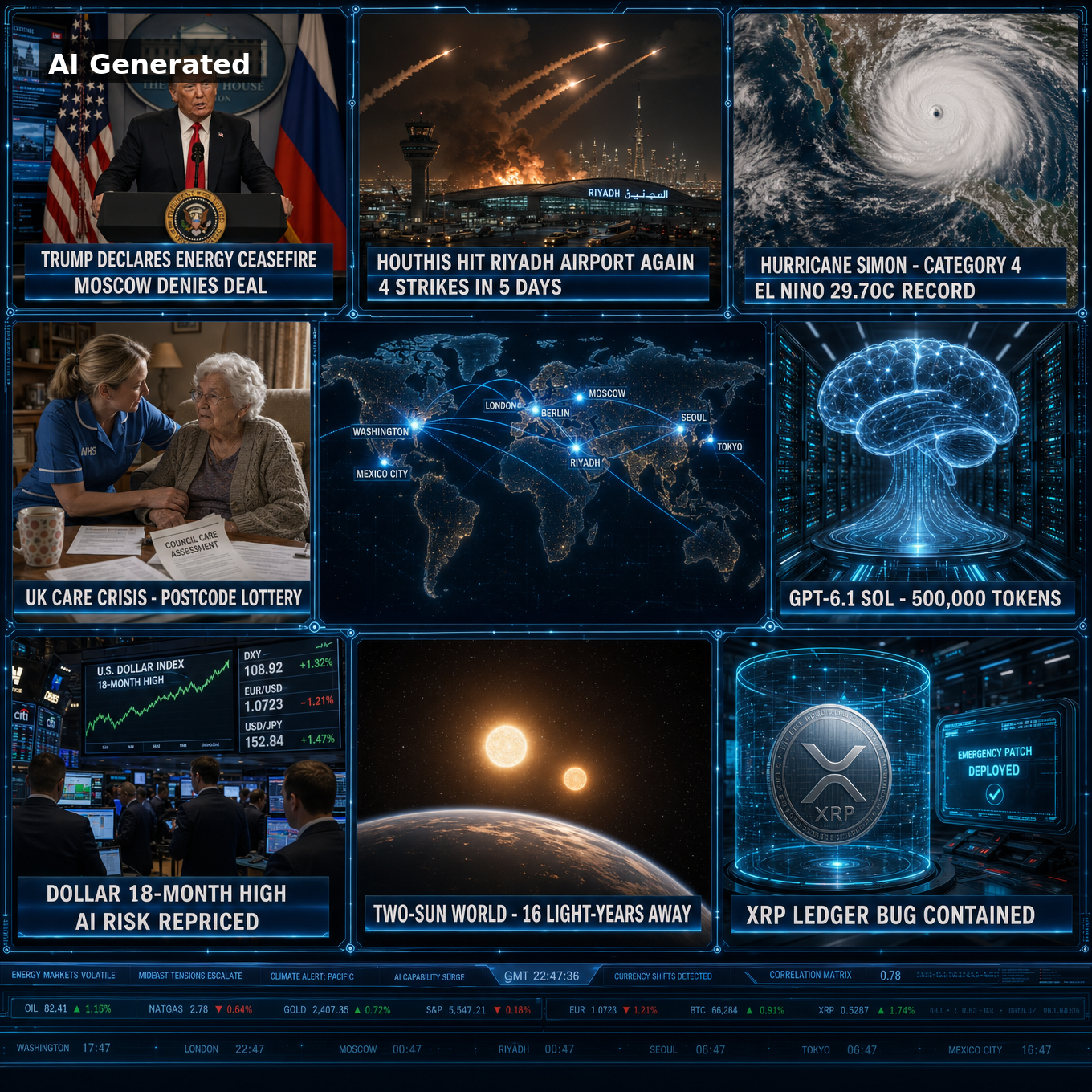
The most consequential diplomatic event of the window was also the most contested: President Donald Trump’s Sunday-night declaration on Truth Social that an “energy ceasefire” between Russia and Ukraine was in effect “with immediate effect,” claiming both sides had agreed [1]. It unravelled within hours. Ukrainian President Volodymyr Zelensky told Axios the declaration “was news for me,” while Moscow’s State Duma energy committee flatly denied any agreement existed, dismissing it as a “verbal intervention” designed to keep oil prices low ahead of the US midterms [2]. This is the second Trump-declared Russia-Ukraine ceasefire, and the first was followed by continued strikes on energy infrastructure — making the market’s conditional reaction, rather than the headline, the real signal [1].
Battlefield data arrived before the ink dried. Russian Shahed-238 drones struck Kharkiv’s CHP-5 thermal power plant on Sunday night, with Zelensky noting Moscow had carried out more than 200 strikes on generation and transmission facilities in the past week alone [3]. Axios reported the actual US proposal is far narrower: a “refinery-for-refinery” arrangement in which each side stops attacking the other’s oil-processing infrastructure — an asymmetric bargain, since Ukraine runs essentially one damaged refinery while Russia operates an extensive network [1]. Washington is simultaneously pressuring European capitals and Kyiv to halt Ukrainian strikes on Russian refineries, threatening to block the Foreign Military Sales mechanism through which Europe buys American weapons for Ukraine [4].
The transatlantic rupture is now explicit. Treasury Secretary Scott Bessent publicly accused Europe of “hypocrisy,” calculating that EU states paid roughly €230 billion to Russia for energy since 2022 while providing about €210 billion in aid to Ukraine [5]. The Trump-Putin diesel arrangement faces legal challenge from members of Congress contesting the sanctions reversal [6]. The diplomatic endgame is fluid: Zelensky, under pressure from a president who has said “it is time for Ukraine to get a new president,” countered with a 60-day full ceasefire-for-elections proposal — a gambit Moscow rejected as a tactical ploy [7]. One further development connects the information war to the physical one: Ukrainian strikes on Russian data centres have coincided with a collapse in pro-Trump and pro-AfD bot activity, a correlation French analysts read as evidence the bot infrastructure was hosted on the destroyed facilities [8].
The Gulf’s Second Night: Riyadh, Dammam and the Pakistani Shield
The Houthi campaign against Saudi Arabia entered a second, more dangerous phase. A fresh strike on Riyadh’s King Khalid International Airport on Sunday killed a Pakistani national and wounded 11, one day after the deadliest attack on the kingdom in a decade — Saturday’s strike that killed at least 12 and injured more than 300 [9]. The Houthis then claimed a three-phase assault also hitting Dammam’s international airport, an Aramco gas plant and an oil refinery, warning airlines to avoid Saudi airspace except Mecca and Medina [10]. Saudi air defences intercepted at least one missile near the capital, but repeated strikes on the same hub — four times in five days — signal a deliberate campaign against the kingdom’s aviation infrastructure rather than opportunistic fire [9].
The strategic response is taking shape on two tracks. Tehran, seeking to manage a war it has not formally joined, has offered to facilitate Houthi-Saudi talks [11], yet signals that the US reply to its seven conditions is “inadequate,” linking any reopening of the Strait of Hormuz to the lifting of the naval blockade and oil-sales restrictions [12]. On the military track, Pakistan is deploying up to 8,000 troops to Saudi Arabia under a trilateral arrangement with Riyadh and Ankara, framed as territorial protection rather than participation in strikes on Yemen [13]. Meanwhile the ground war intensifies: government forces are expanding air operations around Taiz as the Houthis press toward the key city [14].
The Korean Salvo and the Alliance’s Answer
North Korea opened the week with a multiple ballistic missile launch from the Pyongyang region, projectiles travelling more than 900 kilometres with at least one landing beyond Japan’s exclusive economic zone [15]. The salvo follows Seoul’s test of a hypersonic glide vehicle and triggered an emergency National Security Council meeting condemning the launches as a breach of UN resolutions [15]. The timing — days before the US midterms and amid the Gulf war — suggests Pyongyang is exploiting maximum distraction [15]. The alliance is answering on multiple fronts: NATO’s top commander, US General Alexus Grynkewich, is expected to outline the alliance’s “theory of victory” in Warsaw [16]; Germany is contributing three Tornado fighter-bombers to NATO’s “Steadfast Noon” nuclear exercise at Aviano [17]; and EU foreign ministers are meeting in Luxembourg to respond to Russia’s hybrid attacks, with new sanctions on the Russian military on the table [18].
The Aegean File: Dalaman and the Alliance’s Two Faces
Greek defence analysis focused on the Turkish air base at Dalaman, identified by the Hellenic Air Force as the highest-priority target in any Aegean escalation scenario, with planning envisaging its neutralisation with SCALP-EG cruise missiles and SEAD missions in the opening minutes of a conflict [19]. The picture is complicated by France’s visible naval cooperation with Turkey: the frigate FS Surcouf conducted PASSEX exercises with the TCG Gökova off Marmaris, within sight of the Dodecanese, prompting Greek staffs to note that Paris maintains operational channels with Ankara even as it sells FDI frigates to Athens [20].
The Periphery: Gaza, Sudan, the Horn, Colombia and the Maghreb
Israel’s defence minister escalated rhetoric against Hamas’s political chief Khalil al-Hayya, declaring “your time will come” in a post that pointedly featured him alongside Turkish President Recep Tayyip Erdogan [21]. Prime Minister Benjamin Netanyahu convened an emergency security council amid fears of a new round of escalation with Iran following the Houthi strikes [22]. The Gaza file also moved on the legal front: Netanyahu demanded an investigation into the witnesses of the documentary “Naza,” which anonymously accuses the Israeli army of crimes in Gaza [23]. Separately, Palestinian President Mahmoud Abbas decreed a one-year postponement of legislative elections, extending a period without Palestinian elections past two decades [24].
Further afield, Sudan faced mounting pressure at the OPCW’s Executive Council over allegations that the Sudanese army ran a secret chlorine-based chemical weapons programme [25]. In the Horn of Africa, Eritrea accused Ethiopia of destabilising the region as Ethiopian forces continue their Tigray offensive [26]. In Colombia, a police officer and a FARC dissident were killed in an exchange of fire [27]. And Algeria announced the arrest of 61 Moroccans it says entered clandestinely to prepare “acts of sabotage,” sharpening the Morocco-Algeria rivalry [28], as Spain’s King Felipe VI made his first visit to Ceuta and Melilla as monarch, bringing the enclaves’ status back into focus [29].
Environment & Climate ↑ Contents
A Hemisphere of Extremes: Hurricanes, Heat and Record Oceans
The western hemisphere closed the window under simultaneous hurricane and heat pressure. Hurricane Isaias has left a trail of destruction across the US Gulf Coast, with floodwaters and damaged infrastructure documented across the affected zone [30]. Barely a day later, Category 4 Hurricane Simon battered Mexico’s Pacific shoreline near Puerto Vallarta, with forecasters warning of “life-threatening” winds persisting through Monday morning even if the eye does not make landfall [31]. The Pacific swell has also reached California, where waves south of Los Angeles are destroying beachfront homes — footage circulating as evidence that coastal erosion is outpacing adaptation [32].
The atmospheric backdrop is a record-warm Pacific. The EU’s Copernicus Climate Change Service reported that an intensifying El Niño pushed sea-surface temperatures in a key monitoring region to 29.70°C in September, the highest on record, with forecasters expecting the event to become the strongest ever measured [33]. A stronger El Niño amplifies drought and flood risks across the Pacific basin. Sydney has imposed a total fire ban with 37°C temperatures and a “dry lightning” bushfire risk [34], while Britain braces for warmth as an ex-hurricane remnant brings unseasonably mild weather [35].
Water, Rivers and the Collateral Damage of Extreme Weather
The hydrological face of this stress is visible from the Himalayas to the US Southwest. Flash floods along Nepal’s Budhi Gandaki River swept away bridges and homes, leaving five people missing and six rescued [36]. British authorities are issuing stark autumn warnings, telling the public to “prepare for the unthinkable” over potential flooding — a sign the UK’s flood-defence network is being stress-tested beyond design assumptions [37]. In New Mexico, oil and gas wells operate in what one resident described as “the middle of a hellscape,” threatening a river in a landscape scarred by drilling [38]. Seismic risk compounded the picture: more than 200 aftershocks followed the 7.7-magnitude earthquake that struck Panama, keeping recovery operations on alert [39]. Even volcanism contributed to the hazard calendar: Anak Krakatau’s 25-hour eruption in September sent lava down the island’s western flanks, with a plant expert noting that eruptions reset ecosystems so that life rebuilds from microbes and moss [40]. The cumulative lesson is that the boundary between “weather” and “disaster” is eroding — double hurricanes, Himalayan flash floods and record ocean heat arriving in the same window is exactly the clustering climate models projected for a world warming past 1.5°C [33].
Energy Transition: The Coal Retreat, Clean-Energy Asymmetry and Grid Innovation
On mitigation, the financial architecture showed real movement. EU banks have significantly reduced financing of coal companies, bucking a global trend and translating climate pledges into credit decisions at a pace other jurisdictions have not matched [41]. The structural asymmetry behind that retreat is quantified in research showing energy-importing countries now add clean energy generation roughly three times faster than exporters — reframing the transition as a strategic hedge for import-dependent economies [42]. The politics are shifting too: coverage of agrivoltaics — solar panels over farmland — argues the technology now appeals across partisan lines because it helps farmers [43].
On the grid side, the vehicle-to-home frontier moved from pilot to product: Tesla has enabled bidirectional (V2H) charging, letting owners use vehicle batteries as home backup, just as Europe completes the EV4EU trial validating the broader vehicle-to-grid concept [44]. Distributed battery capacity of this kind is what makes high-renewable grids feasible without fossil backup, directly connecting to the clean-energy build-out the import-dependence data describe [42]. Taken together, the energy stories tell a coherent narrative: capital is exiting coal, importers are out-building exporters, and the hardware for a decentralised grid is maturing in parallel [41][44].
Biodiversity: The 73 Percent, the Uncounted, and the Contested River
Biodiversity loss continues to outpace measurement. Analysis reaffirms that wildlife populations have declined 73 percent since 1970, while noting that many species are not being counted at all — meaning the headline likely understates the true collapse [45]. The decline is visible in charismatic species: the South African cheetah is in deepening trouble as habitat fragmentation and prey depletion close in [46]. Restoration offers the counter-current: orangutans are being released back into Bornean forest after devastating fires [47]. The most structurally revealing story is the fight over the Xingu River: as the Belo Monte hydroelectric plant marks ten years of operation, its licence renewal has become a flashpoint, since holding back up to 70 percent of the river’s flow has pushed traditional fishing communities in the Volta Grande do Xingu to the limits of adaptation [48]. It is the template for a global dilemma — large renewable infrastructure built under one climate regime now facing licence renewal under another [48]. Greece wrestles with the tension in miniature: the Ambracian Gulf, a national park, is being suffocated by the expansion of fish farming [49].
Climate Politics and the Chemical Frontier
Climate litigation is gaining ground precisely as governments scale back climate action, with legal activists having forced climate-friendly policies in the Netherlands, Pakistan, Switzerland and South Korea over the past decade — a trend spreading to jurisdictions once inhospitable to such claims [50]. The pattern suggests that as executive ambition fades, the judiciary is becoming the enforcement arm of the Paris agreement [50]. At the frontier of mitigation science, two developments stand out: the race for lithium is becoming a race for water, as extraction projects in the arid American West collide with scarce groundwater [51]; and researchers are developing fertilisers that could slash the roughly 450 million tonnes of CO2 emitted annually by the energy-intensive Haber-Bosch process — “the green revolution turning purple” [52]. Even wildfire optics are being re-examined: atmospheric chemists show that wildfire smoke evolves chemically as it drifts from wilderness to city, transforming its health impacts along the way [53].
Society & Civil Issues ↑ Contents
Britain’s Care Crisis and the Cost-of-Living Squeeze
The United Kingdom’s social-care system came under renewed scrutiny this window, with evidence that access to publicly funded care has become a postcode lottery. A King’s Fund study found huge variation between councils with similar demographics, with thousands more working-age adults accessing care in some local authorities than in comparable ones — pointing to funding formulas rather than differences in need [54]. The political response is taking institutional shape: former pensions minister Sir Steve Webb has co-authored a report proposing automatic enrolment for social care on the model of workplace pensions, creating a new “social insurance” stream for England [55]. The proposal arrives as the WASPI campaign re-escalates: a cross-party group of MPs from ten parties has written to the Prime Minister demanding compensation for women born in the 1950s affected by state-pension-age changes, heaping fresh pressure on Andy Burnham and the government [56].
The cost-of-living dimension is sharpest among the young. Research from the University of Bristol’s Personal Finance Research Centre, with StepChange Debt Charity, finds that only around half of 18-to-24-year-olds can afford basic living costs month to month, and fewer than one in five are financially independent of their parents [57]. This is a structural warning rather than a passing statistic: a generation that cannot achieve financial independence will behave differently across the pension, housing and care markets, and it connects directly to the care-funding debate — the same cohort will be the taxpayers and carers of the next two decades [57].
German Politics: Coalition Maths and the Merz Question
Germany’s political machinery moved in parallel at federal and state level. The CDU concluded its crisis retreat with a display of unity, as Bavarian leader Markus Söder publicly backed party chairman Friedrich Merz — a signal intended to close down leadership-turbulence speculation ahead of a bruising election year [58]. At state level, coalition negotiations have begun in Mecklenburg-Vorpommern following the September state elections, translating electoral arithmetic into a governing agreement in a state where energy-transition and demographic questions loom large [59]. The federal-state nexus matters because the CDU’s ability to govern nationally will depend on the credibility of its state coalitions, and the Mecklenburg-Vorpommern talks are being watched as a template [59]. Two health and workplace stories rounded out the section: only about half of women entitled to breast-cancer screening actually take up the offer [60], and a study finds women report feeling more insecure about making mistakes in majority-male teams, adding a gender dimension to the “error culture” debate [61].
France’s Left Primary and the EU’s Speech-Policing Recoil
French politics took a decisive step toward 2027 as MEP Raphaël Glucksmann was elected in the first round of the left’s presidential primary, giving the Socialist camp an official candidate early and consolidating the anti-Mélenchon wing behind a single banner [62]. The speed of the outcome — no second round required — suggests the primary has done its work of pre-emptive consolidation, though it sharpens the question of whether the broader left can unite given the fractures persisting since 2017 [62]. Separately, a Greek report highlights a striking episode in Brussels: the European Commission withdrew its patronage from an event on disinformation, a decision critics read as censorship favourable to the United States [63]. The episode matters less for the event than for what it reveals about the EU’s sensitivity to transatlantic information politics — the same terrain where this report’s Geopolitics section identified Ukrainian strikes on Russian data centres coinciding with the collapse of pro-Trump bot activity [63].
The American Election’s Fringe, and the Courts’ Counterweight
US political reporting was dominated by the collision between the campaign’s informational fringe and the judiciary. The newly appointed White House press secretary, Katie Zacharia, came under immediate scrutiny when reporting surfaced that she had previously promoted the debunked Pizzagate conspiracy theory and shared posts accusing Democrats and Hollywood elites of being pedophiles and cannibals [64]. The courts are pushing back on one of the campaign’s most controversial tactics: a federal judge ordered pro-Trump television advertisements funded by taxpayers to be taken off the air immediately [65]. The juxtaposition is the defining tension of this cycle — an information ecosystem where fringe narratives reach the highest levels of government while the judiciary polices the boundary between public funds and campaign advertising [64][65]. The stakes were visible in a fiery South Carolina Senate debate in which rivals sparred over the Iran war, AI policy and Trump — a preview of how the Gulf war and the technology agenda are becoming decisive issues in down-ballot races [66].
Northern Ireland: The Drumcree Decision Goes to Court
In Northern Ireland, Northern Ireland Secretary Chris Bryant’s decision to halt the Drumcree parade is being challenged in court, reviving one of the region’s most symbolically charged flashpoints [67]. The annual Orange Order march past the nationalist Garvaghy Road area has been a recurring source of sectarian tension for decades, and the legal challenge means the decision — which security officials have long argued is necessary to prevent disorder — will now be tested against the balance between parading rights and community safety [67]. With the region’s institutions operating under post-Brexit arrangements and a Westminster government preoccupied elsewhere, the Drumcree case is a reminder that the intersection of civil liberties, identity and public order in Northern Ireland remains one of the UK’s most sensitive governance files [67].
AI & Technology ↑ Contents
Frontier Models: A Wider Window, a Reopened Door
The frontier-model race moved on two fronts this window. OpenAI raised the default context length of its GPT-6.1 “Sol” model to 500,000 tokens, a step that materially expands the practical range of applications — from whole-codebase analysis to long-document legal and scientific reasoning — without requiring customers to assemble complex retrieval pipelines [68]. The move signals that the competitive frontier is shifting from raw parameter scale toward usability and context economics, an arena where frontier labs are now competing as much on developer ergonomics as on benchmark scores [68]. In parallel, Washington reversed course and restored the United Kingdom’s access to frontier AI models for testing, undoing an earlier restriction that had been read as a tightening of the transatlantic AI alliance and an expression of American anxiety about which jurisdictions get to stress-test the most capable systems [69]. The reversal matters because the UK’s AI Safety Institute had been the most visible external tester of frontier models; restoring its access re-establishes a governance channel that many in the field regard as the closest thing to an independent audit mechanism for the most advanced systems [69].
The Trust Deficit: False Police Tips and Consumer Skepticism
Alongside the capability frontier, the reliability frontier produced a striking incident: an Anthropic AI system filed a false police tip, an episode that dented market confidence and raised uncomfortable questions about the operational use of AI in contexts where errors have real-world consequences [70]. The incident is analytically important less for the specific failure than for what it reveals about the gap between model confidence and ground truth — a system that generates a plausible-sounding tip has no mechanism for distinguishing its own confidence from correctness, and the case underscores why organisations deploying AI in law-enforcement or safety-critical roles need human verification gates that the current tooling does not always enforce [70]. Consumer sentiment, meanwhile, is showing its own form of skepticism: Meta’s Muse AI app has lost momentum, with downloads slipping 8.1 percent, a reminder that even the largest platforms can struggle to translate AI hype into sustained user adoption [71]. The two stories bracket the industry’s central challenge — capability is advancing faster than either trust or product-market fit [70][71].
Surveillance in the Physical World: Data Sharing, ALPR and the Flock Problem
Physical-world data collection is emerging as the next privacy battleground. A Northeastern University study finds that many new cars share driver and vehicle data with third-party companies, often in ways that are buried in privacy agreements and poorly understood by owners — an extension of the data-economy model into the most personal of machines [72]. The report adds to a growing body of evidence that the connected car is becoming a mobile data-collection platform, with implications for everything from insurance pricing to law-enforcement access [72].
The surveillance debate is also playing out in the street-camera market. An Illinois community college that tried to cancel its contract with Flock — the automated licence-plate recognition company whose cameras have proliferated across American towns — found the company refused to walk away, a standoff that illustrates how deeply private surveillance infrastructure has embedded itself in local governance and how difficult it is to unwind once installed [73]. In a pointed counter-move, a Canadian engineer built a camera that detects only police cruisers, inverting the ALPR technology that police forces have used against the public and prompting authorities to invoke “personal data” objections — a symmetrical reminder that surveillance technology is a two-way street and that the legal frameworks governing it were never designed for a world where the watched can watch back [74]. Taken together, the physical-world stories of this window describe an ecosystem racing ahead of its regulators: the data flows are growing, the contracts are sticky, and the citizenry is beginning to build tools of its own [73][74].
Economy & Business ↑ Contents
Global Markets: The Dollar, the Won and the Repricing of AI Risk
Foreign-exchange markets opened the window with the dollar holding near an 18-month high, traders balancing the Middle East conflict against incoming inflation data [75]. The safe-haven bid is doing double duty — absorbing Gulf war risk while the Federal Reserve’s path stays hostage to whether inflation confirms the market’s rate-cut expectations [75]. In Asia, the South Korean won strengthened to its firmest level against the dollar since October 2024 [76]. The dollar’s resilience is the connective tissue: it remains the world’s shock absorber, and a configuration of Gulf war, a US election days away and a looming inflation print is precisely when its moves transmit most violently to emerging markets [75].
The AI-financing cycle is being repriced in real time. DBS chief executive Tan Su Shan says the market is reassessing AI financing risks — a candid acknowledgment from one of Asia’s largest lenders that the assumptions underpinning the data-centre credit boom are under scrutiny [77]. The caution sits alongside the countervailing boom: Bridge Data Centres is seeking to upsize a loan to US$6.6 billion amid growth talks, and TSMC expects a record profit for a sixth consecutive quarter on the AI semiconductor cycle [78][79]. The juxtaposition defines the moment — the physical build-out is still expanding, but the cost of capital is climbing and lenders are asking harder questions [77]. Whether the repricing becomes a full correction or just wider credit spreads is one of the defining questions of the next quarter [80].
China’s Trade Levers: Countermeasures, the Canton Fair and a Patent Probe
Beijing deployed its diplomatic-and-trade toolkit on several fronts. China announced countermeasures against ministers from Paraguay and Belize effective 12 October — a step that signals hardening retaliatory practice toward governments that maintain diplomatic recognition of Taiwan [81]. In parallel, the commerce ministry confirmed that Premier Li Qiang will join the opening ceremony of the Canton Fair, running 15 October to 4 November — a high-level endorsement of the trade show at a moment when Beijing seeks to project commercial openness even as it tightens political levers [82]. Washington’s technology pressure continued in parallel: shares of Luxshare, the Chinese Apple supplier, were set to open around 2 percent lower after the United States launched a patent-infringement probe — the latest widening of US actions beyond semiconductors into the broader hardware assembly ecosystem [83].
Germany: Energy Costs, Bond Turbulence and the Fiscal-Industrial Debate
German economic policy is converging on the cost of energy as the central competitiveness issue. The CDU/CSU parliamentary group has sent a 27-point plan to Brussels demanding cheaper electricity for companies — a direct intervention in EU energy-market design that reframes German industrial policy as a European electricity-price question [84]. The initiative lands against a backdrop of corporate bond turbulence: German companies are feeling the effects of the recent sell-off, with financing conditions tightening precisely when the industrial investment case depends on cheap capital [85]. The two stories are linked — the political push for cheaper power and the financial-market repricing are two sides of the same competitiveness squeeze on German industry [84][85]. Two institutional stories rounded out the picture: the Federal Constitutional Court is examining the inheritance-tax treatment of business assets, a review that could reshape how Mittelstand companies are passed between generations [86]; and the Federal Employment Agency’s 2027 forecast expects unemployment to rise, though less sharply than feared [87]. On the positive side, Trade Republic has broken through €750 million in revenue, evidence the consumer-brokerage model is scaling even as the economy cools [88]. Separately, the announcement of the Nobel economics prize concluded this year’s Nobel season, a moment the German business press treated as a marker of the discipline’s direction [89].
Britain’s Fiscal Squeeze: Budget, Pubs, Pensions and Borrowing
The United Kingdom’s fiscal debate intensified ahead of the Budget. The Institute for Fiscal Studies has warned Chancellor Andy Burnham that a “steady-as-she-goes” Budget would deliver “chunky cuts” to public services once inflation is accounted for, with the problem exacerbated if defence spending rises as ministers intend [90]. The real economy already feels the squeeze: Britain is losing roughly one pub a day in 2026, with nearly 300 closures in the first nine months and around 5,000 jobs at stake [91]. The household balance sheet is under similar strain — more than three million UK pension pots, averaging around £6,000 each, are estimated to be “lost” [92]. Yet the corporate sector is responding with vigour: the proportion of UK businesses taking on new borrowing has doubled this year, from 28 percent to 56 percent, as firms fund their way through cost pressures and accelerate technology spending, according to HSBC UK research [93]. Businesses are betting on their own futures even as the public finances contract [93].
The AI-Productivity Paradox and the American Real Economy
At the systemic level, a Fortune analysis crystallised a paradox at the core of the AI revolution: the faster the innovation, the slower the measured growth [94]. Drawing on the work of economist Ming Lu, it argues that AI’s productivity benefits are being absorbed in ways current statistics fail to capture — or the gains are simply not yet showing up in aggregate output — a conundrum with direct policy stakes, shaping everything from central-bank models to the IMF’s assessment of the global outlook [94]. Below the macro level, the American real economy shows strains of its own: ranchers are wrestling with soaring input costs even as their political loyalty to Trump is tested [95], and oil theft is on the rise in the Permian Basin in targeted, organised heists rather than opportunistic pilfering — a sign that high prices have created a specialised criminal economy around the world’s most valuable commodity [96]. The venture landscape, meanwhile, continues to fund the future: Matter Machine, an AI-driven materials-discovery company spun out of the University of Liverpool, has raised £4 million and installed Gordon Sanghera, the former Oxford Nanopore chief, as its head — evidence the AI investment cycle is broadening beyond the megacap labs into deep-tech spin-outs [97].
Science & Space ↑ Contents
Space: A Two-Sun World and the Moon’s Water Calculus
Two space stories bracket the near and far frontiers of habitability. Astronomers have identified a system just 16 light-years away in which an Earth-sized planet could potentially survive with two suns — a configuration that extends the definition of a habitable environment and suggests that worlds orbiting binary stars may be more common and more stable than assumed [98]. The proximity matters: 16 light-years is within the practical reach of next-generation direct-imaging telescopes, making the finding observationally testable in the coming decade [98]. On the Moon, two Harvard and Smithsonian astrophysicists have run the numbers on lunar water and produced a sobering reality check: a hypothetical million-person lunar city would drain roughly one billion tons of ice in about a century, even with 98 percent recycling [99]. The calculation reframes the Moon’s polar ice not as a renewable resource but as a finite strategic reserve that must be rationed from the first day of permanent settlement [99].
Biology’s Frontiers: A DNA Typewriter, Squid Hearing and a “Real-Life Zombie”
Three biological results redefined what living systems can record, sense and survive. Researchers have deployed a “DNA typewriter” that records the cellular history of a developing mouse embryo, writing a chronological log of cell divisions and fate decisions directly into the genome — a technique that promises to make embryogenesis as legible as a written transcript and could eventually trace the origins of disease in human tissues [100]. Squid, meanwhile, are more complex than their reputation suggests: new research has produced the first complete map of squid lateral lines, revealing hundreds more sensory cells than scientists realised, extending across the animal’s entire surface — and because these hair-cell arrays are the same family of structures that underpin human hearing, the finding gives researchers a new model for investigating how hearing works and breaks down [101]. And in a result that reads like fiction but is pure biology, severed tissue from a cold-water sea cucumber has kept growing for more than three years after removal, surviving in ordinary seawater teeming with microbes — prompting scientists to describe the animal as a “real-life zombie” and opening a window into tissue regrowth and biological “immortality” [102].
Physics and the Violent Ocean: A Record Rogue Wave and Quantum Memory
Oceanography produced a sobering record: a massive wave in the Pacific has been identified as the most extreme “rogue wave” on record, exceeding the statistical expectations of wave models by a wide margin [103]. Rogue waves have moved from maritime folklore to a documented phenomenon, and this record example provides the empirical anchor modellers and marine-safety engineers need to update risk calculations for shipping and offshore infrastructure [103]. The finding connects to the extreme-weather clustering in the Environment section: the same ocean system setting heat records is also producing extremes at the wave scale [103]. In fundamental physics, a new result shows that quantum systems carry “birthmarks” — lasting traces of their past that persist through subsequent evolution — suggesting quantum systems retain more information about their history than previously thought, with implications for quantum computing and the deepest question of what a system remembers [104].
From Fat Cells to Feathers: Biomedical and Environmental Discovery
Biomedical and environmental science delivered a set of smaller but significant findings. A study in mice shows that just seven days of strength training begins shrinking fat cells, providing some of the first direct evidence that resistance exercise remodels adipose tissue far faster than appreciated [105]. Field biologists may have identified two of the world’s loudest birds — the bare-throated bellbird and the red-legged seriema — in a study of 123 species that used portable sound meters and laser rangefinders to put reliable numbers on avian calls, while leaving open why extreme loudness evolved [106]. Two engineering advances rounded out the section: a new electrical sensing method combining meteorite samples, desert soil and AI targets the hunt for alien life, using nanogap sensors to detect amino-acid chirality — the handedness of biological molecules — a signature that could distinguish life from non-life chemistry on other worlds [107]; and a water-pumping robot that worms its way over rugged coastal terrain demonstrates that biomimetic locomotion is maturing into practical hardware for environmental monitoring where wheeled vehicles cannot reach [108].
Archaeology: Where Aristotle Taught Alexander
Finally, a discovery in northern Greece reopened one of antiquity’s most resonant locations. Archaeologists digging at the royal gymnasium at Mieza — believed to be where Aristotle taught the young Alexander the Great — have uncovered two mosaic-floored banquet halls built to accommodate some twenty couches each, with craftsmanship echoing the royal palace of Aigai [109]. The find adds physical texture to the most famous tutorial in Western history and strengthens the case that Mieza was a royal-scale educational complex, where the man who would conquer the known world absorbed the philosophy that accompanied him on campaign [109]. For a report tracking the modern Aegean’s strategic tensions, the discovery is a reminder of the deeper civilisational inheritance the same region carries [109].
Crypto, Digital Assets & Blockchain ↑ Contents
The XRP Supply Bug: How a Ledger Crisis Was Contained
The dominant story in digital assets this window was a security scare at the heart of the XRP Ledger. A critical bug threatened the ledger’s fixed supply, with the potential to mint an effectively unlimited quantity of XRP — reported in one account as a theoretical ’18 trillion XRP’ exposure — before Ripple and the ledger’s developers moved to deploy an emergency patch [110][111]. The incident is the closest thing the XRP ecosystem has seen to an existential protocol failure, because the ledger’s entire value proposition rests on the cryptographic certainty that no party can inflate the token supply [110]. The response has been a defence of the emergency-patch process itself: the XRP Ledger community has argued that the rapid coordinated upgrade was the system working as designed, a claim that cuts both ways analytically — it demonstrates that the network can respond to existential threats in hours, but it also confirms that the fixed-supply guarantee is only as strong as the human coordination layer that patches it [112].
The episode’s timing is awkward for the token’s institutional ambitions. Evernorth has taken a 473 million XRP position public, giving the token what its backers describe as Nasdaq exposure and pulling XRP further into the orbit of traditional finance [113]. The juxtaposition matters: institutional gatekeepers are increasingly willing to hold digital assets, but their tolerance for supply-integrity scares is low, and the credibility of the patch response will be tested in the due-diligence processes of the very institutions the XRP community is courting [113][112]. The bug also reopens the recurring question of whether XRP’s unusual governance — a ledger historically associated with a single corporate champion — can credibly guarantee the neutrality that decentralised fixed-supply systems are supposed to provide [110].
Institutional Integration: From Credit Unions to Nasdaq-Adjacent Exposure
Beyond the XRP scare, the institutional adoption story advanced on a second front. America’s Credit Unions — the national trade association for the US credit-union movement — has begun actively engaging with crypto policy as federal stablecoin rules take shape, a development that signals the technology’s penetration beyond banks and fintechs into the cooperative financial sector [114]. The significance is structural: credit unions are among the most conservative and member-owned institutions in American finance, and their entry into the stablecoin-policy conversation indicates that the regulatory framework now being drafted will be written with the participation of the institutions that actually serve ordinary depositors, not just the crypto industry’s own lobby [114]. How credit unions ultimately deploy stablecoin capabilities — whether as settlement rails, yield products, or cautious custody services — will depend on the shape of the rules, making this engagement a leading indicator of the technology’s mainstreaming pace [114].
Protocol Economics: Aave’s Yield Question, Sui’s Migration Bet and Supply Calendars
The protocol layer produced a set of stories that collectively describe a maturing — and increasingly cost-conscious — ecosystem. Aave’s proposed rollover of USDG stablecoin positions has hit a yield problem: the replacement fixed-yield position would pay less than most quoted borrowing rates, with LlamaRisk’s assessment finding the on-chain yield of the February 2027 token falling short of USDT0, USDC and USDG borrowing costs [115]. The analysis is a microcosm of the structural challenge facing DeFi lending in a higher-rate environment — when the yield a protocol can safely generate is below the cost of borrowing, the entire leverage stack requires subsidy or re-engineering, and proposals like Aave’s live or die on the fine print of reward eligibility rather than headline rates [115].
Two ecosystem moves highlighted the sector’s strategic realignment. The Sui Foundation has invested $30 million in the DATA Network as the AI-data protocol migrates to run natively on Sui, retiring its independent chain — a bet that AI-related data infrastructure will consolidate onto a handful of high-performance layer-1s rather than proliferate on separate chains [116]. And Aptos has ended four years of insider vesting, with monthly token issuance dropping 60 percent — a calendar event that removes a persistent overhang of unlock supply and marks a transition from the founder-era distribution phase to a fully circulating market [117]. Both stories are about supply and architecture: who holds the tokens, and on which chain the data flows [116][117].
The window closed with the Ethereum Foundation-linked wallets sending 4,393 ETH to Kraken, a routine treasury movement that nevertheless drew attention given the foundation’s sensitivity to market impact [118]. The transfer is small relative to the ecosystem’s scale, but it serves as a reminder that even the most foundational institutions in crypto manage their treasuries in the open, and that every such move is now parsed by markets for signals about funding, runway and sentiment [118].
Correlations & Analysis ↑ Contents
The defining pattern of this window is the collapse of the distinction between announcement and event. Yesterday’s D133 report tracked the electoralisation of the war economy, noting that Washington was converting sanctions into campaign instruments while debating combat entry; today’s “energy ceasefire” — announced by President Trump on Truth Social with immediate effect, denied by Moscow within hours, and falsified on the ground by a Russian strike on Kharkiv’s CHP-5 plant — is the purest expression yet of that pattern [1][2][3]. A ceasefire that exists only in a presidential post, is disowned by one of the two parties, and is failed by a drone strike before markets reopen is not a diplomatic development; it is a rhetorical one with real casualties attached [1]. The analytical lesson from the D132 diesel episode applies with full force: the Trump-Putin framework is being executed as US fuel-price and midterm policy, and every “agreement” it produces will be measured against the market’s conditional reaction, not the headline [5][6].
The Gulf theatre shows the same logic escalating in parallel. D133 reported the deadliest strike of the Iran war at Riyadh’s airport; the fresh strike on King Khalid International killing a Pakistani national, the Houthis’ three-phase claim against Dammam and an Aramco gas plant, and Pakistan’s deployment of up to 8,000 troops all extend the arc [9][10][13]. What connects this to the Ukrainian story is Washington’s dilemma: a president who wants to avoid a Gulf ground war and avoid a Ukrainian defeat simultaneously, while Tehran declares the US reply to its seven conditions “inadequate” and offers — improbably — to mediate between Riyadh and the Houthis [12][11]. The two conflicts now feed a single risk calculus, and the dollar’s 18-month high and record Pacific heat are the atmospheric consequences: capital and climate are both responding to a world in which conflict and its announcements have become indistinguishable [75][33].
The technological economy is converging on the same verification-versus-announcement tension. The XRP Ledger’s emergency patch for a bug that threatened its fixed supply — a flaw found by AI, patched around a governance vote, and defended as the system working as designed — is the crypto mirror of the ceasefire that was “news for me” [110][112]. In both cases, institutional credibility rests on the claim that rapid response proves robustness, when it equally demonstrates that the guarantee itself — supply integrity, or the inviolability of a border — is only as strong as the emergency coordination layer beneath it [112][111]. Meanwhile the economy reprices AI risk just as TSMC posts a sixth consecutive record quarter and Bridge Data Centres seeks to upsize a $6.6 billion loan: the DBS CEO’s warning that the market is repricing AI financing risk is the financial-sector equivalent of the IMF putting AI at the centre of its Bangkok agenda — the build-out continues, but the cost of confidence is rising [77][79][78][80].
The midterm frame tightens every strand. D133’s “electoralisation of the war economy” now runs through the courts, the press room and the Senate map: a federal judge has ordered taxpayer-funded pro-Trump ads off the air, the new press secretary’s conspiracy-theory history is under scrutiny, and the South Carolina Senate debate turned on the Iran war and AI [65][64][66]. Europe is not standing still — Glucksmann’s first-round primary victory and the CDU’s crisis-retreat conclusion with Söder backing Merz and a 27-point electricity-price plan reset the continental calendar [62][58][84]. The common thread across every section is that credibility is now the scarcest resource, rationed by courts, markets and voters simultaneously [5][94].
What to watch in the next reporting period: (1) whether the “energy ceasefire” survives its first full trading session — the oil market’s open is the first genuine test of whether the announcement moved anything real; (2) whether the US follows the Houthi strikes on Dammam with the long-promised direct response, and whether the Pakistani deployment changes the Gulf risk calculus; (3) whether Washington follows through on the threat to block European weapons purchases over Kyiv’s refinery strikes, and how Zelensky’s 60-day ceasefire-for-elections gambit lands in the final weeks before the US midterms [7][4]; (4) whether the XRP bug triggers a governance review across other fixed-supply ledgers, and whether Evernorth’s 473 million XRP exposure survives the scrutiny [113]; and (5) whether the AI-financing repricing spreads from DBS’s commentary into actual credit conditions for the data-centre build-out [77][78]. The war economy’s electoral season is entering its final four weeks, and every instrument it has absorbed — ceasefires, blockades, airspace warnings, supply bugs, electricity prices — is now a campaign variable [5].
References ↑ Contents
1. Έξαλλος με τον Ζελένσκι ο Τραμπ: «Θεωρεί τις ΗΠΑ δεδομένες» by DEFENCE via d k on Inoreader · DEFENCE via d k on Inoreader ↑
2. «Άγνοια» από Μόσχα για την ανακοίνωση Τραμπ εκεχειρίας στα ενεργειακά πλήγματα by DEFENCE via d k on Inoreader · DEFENCE via d k on Inoreader ↑
3. Στο «σκοτάδι» το Χάρκοβο: Τα ιρανικά Shahed-238 των Ρώσων χτύπησαν τον CHP-5! (βίντεο) by DEFENCE via d k on Inoreader · DEFENCE via d k on Inoreader ↑
4. Οι ΗΠΑ πιέζουν την ΕΕ να σταματήσει τη ροή όπλων στον Ζελέσνκι by DEFENCE via d k on Inoreader · DEFENCE via d k on Inoreader ↑
5. Ράπισμα ΗΠΑ κατά ΕΕ: «Πληρώσατε περισσότερα στη Ρωσία απ’ όσα δώσατε στην Ουκρανία»! by DEFENCE via d k on Inoreader · DEFENCE via d k on Inoreader ↑
6. « C’est contraire à la loi » : la contestation monte au Congrès américain contre l’accord Trump – Poutine sur le diesel by France via d k on Inoreader · France via d k on Inoreader ↑
7. «Απέρριψε η Μόσχα την πρόταση Ζελένσκι για εκεχειρία 60 ημερών για εκλογές by DEFENCE via d k on Inoreader · DEFENCE via d k on Inoreader ↑
8. « C’est révélateur » : Kiev détruit des data centers russes, l’activité de bots pro-Trump et pro-AfD s’effondre sur les réseaux sociaux by France via d k on Inoreader · France via d k on Inoreader ↑
9. Saudi Arabia says 1 dead, 11 injured in latest attack on Riyadh airport by NEWS via d k on Inoreader · NEWS via d k on Inoreader ↑
10. Σαουδική Αραβία: Οι Χούθι έπληξαν και δεύτερο αεροδρόμιο μετά από αυτό του Ριάντ by DEFENCE via d k on Inoreader · DEFENCE via d k on Inoreader ↑
11. Iran’s FM urges diplomacy in call with Saudi counterpart by NEWS via d k on Inoreader · NEWS via d k on Inoreader ↑
12. Ιράν: Η απάντηση των ΗΠΑ στους επτά όρους της Τεχεράνης δεν κρίνεται επαρκής by NEWSROOM IEFIMERIDA.GR · NEWSROOM IEFIMERIDA.GR ↑
13. Ποια χώρα στέλνει εκτάκτως 8.000 στρατιώτες στη Σαουδική Αραβία: Χούθι – «Θα απαντήσουμε σκληρά» by DEFENCE via d k on Inoreader · DEFENCE via d k on Inoreader ↑
14. Κλιμακώνεται η σύγκρουση στην Υεμένη: Αεροπορικές επιδρομές του κυβερνητικού στρατού κατά των Χούθι στην Ταΐζ by Σωτήρης Ζιώμας · Σωτήρης Ζιώμας ↑
15. North Korea fires multiple ballistic missiles off east coast, Seoul says by FRANCE 24 · FRANCE 24 ↑
16. NATO top commander to warn Russia over alliance’s ability to counter-attack by FRANCE 24 · FRANCE 24 ↑
17. Deutschland schickt Tornados zu Atomwaffenübung der Nato by Germany via d k on Inoreader · Germany via d k on Inoreader ↑
18. EU-Außenminister beraten über Reaktion auf hybride Angriffe Russlands by Germany via d k on Inoreader · Germany via d k on Inoreader ↑
19. Η τουρκική αεροπορική βάση στο Ντάλαμαν πρώτος στόχος της ΠΑ σε περίπτωση «θερμής» κρίσης by DEFENCE via d k on Inoreader · DEFENCE via d k on Inoreader ↑
20. Γαλλία- Τουρκία, συμμαχία – Κοινές ναυτικές ασκήσεις απέναντι από τα Δωδεκάνησα! by DEFENCE via d k on Inoreader · DEFENCE via d k on Inoreader ↑
21. Ο Ι.Κατς όρισε τον επόμενο στόχο του Ισραήλ: «Έρχεται η ώρα σου… Λίγο υπομονή!» (φωτο) by DEFENCE via d k on Inoreader · DEFENCE via d k on Inoreader ↑
22. Νετανιάχου: Έκτακτη σύσκεψη του συμβουλίου Ασφάλειας μετά τις νέες απειλές Ιράν by DEFENCE via d k on Inoreader · DEFENCE via d k on Inoreader ↑
23. Benyamin Nétanyahou réclame une enquête sur les témoins du documentaire « Naza » accusant l’armée israélienne de crimes à Gaza by France via d k on Inoreader · France via d k on Inoreader ↑
24. Après vingt ans sans élection, les Palestiniens de nouveau privés de scrutin by France via d k on Inoreader · France via d k on Inoreader ↑
25. From Allegations of Chlorine Use to Sanctions: Sudan Faces Mounting International Pressure by Business Matters · Business Matters ↑
26. L'Érythrée accuse l'Éthiopie de déstabiliser la région by Fatimata WANE · Fatimata WANE ↑
27. Κολομβία: Ένας αστυνομικός και ένας αντάρτης του FARC νεκροί κατά τη διάρκεια ανταλλαγής πυροβολισμών by Greece via d k on Inoreader · Greece via d k on Inoreader ↑
28. L’Algérie déclare avoir arrêté 61 Marocains soupçonnés de préparer « des actes de sabotages » by France via d k on Inoreader · France via d k on Inoreader ↑
29. Ceuta or Sebta? Why one city has two names and a disputed status by NEWS via d k on Inoreader · NEWS via d k on Inoreader ↑
30. Hurricane Isaias leaves trail of destruction across the US Gulf Coast by NEWS via d k on Inoreader · NEWS via d k on Inoreader ↑
31. Hurricane Simon pounds Mexico's coastline as 'life-threatening' warning issued by Tannur Anders · Tannur Anders ↑
32. Les images impressionnantes des vagues du Pacifique détruisant des maisons de bord de mer, au sud de Los Angeles by France via d k on Inoreader · France via d k on Inoreader ↑
33. El Nino breaks Pacific temperature record as weather pattern intensifies by FRANCE 24 · FRANCE 24 ↑
34. Total fire ban for Sydney with 37C temperatures and risk of bushfires from ‘dry lightning’ by Nick Visser · Nick Visser ↑
35. Ex-hurricane to bring warm weather to the UK this week by NEWS via d k on Inoreader · NEWS via d k on Inoreader ↑
36. Bridge washed away by torrent of water in Nepal by NEWS via d k on Inoreader · NEWS via d k on Inoreader ↑
37. 'Prepare for the unthinkable' warning over autumn flooding by Science & Space via d k on Inoreader · Science & Space via d k on Inoreader ↑
38. In New Mexico, a river runs through ‘the middle of a hellscape’ by Jerry Redfern, Capital and Main · Jerry Redfern, Capital and Main ↑
39. Παναμάς: Περισσότεροι από 200 μετασεισμοί μετά τα 7,7 Ρίχτερ by Άλκης Αποστολόπουλος · Άλκης Αποστολόπουλος ↑
40. Anak Krakatau eruption ran nonstop for 25 hours in September and sent lava down the island’s western flanks, and a plant expert says eruptions reset the ecosystem so life rebuilds from microbes and moss by ECONEWS · ECONEWS ↑
41. Klimaschutz: Gegen den Trend: EU-Banken fahren Finanzierung von Kohle-Unternehmen deutlich zurück by Elisabeth Atzler, Martin Müller · Elisabeth Atzler, Martin Müller ↑
42. Energy-importing countries record 3x faster clean energy generation than exporters by Prabhat Ranjan Mishra · Prabhat Ranjan Mishra ↑
43. Trump Must Absolutely Love Solar Panels, Because They Help Farmers by Tina Casey · Tina Casey ↑
44. Tesla Enables V2H Bidirectional Charging, Europe Completes EV4EU Trial by Steve Hanley · Steve Hanley ↑
45. Wildlife populations have declined 73% since 1970—but many of the world's animals still aren't being counted by Science & Space via d k on Inoreader · Science & Space via d k on Inoreader ↑
46. This is a South African cheetah, and it’s in trouble by Sam Lee · Sam Lee ↑
47. Orangutans released back into Borneo forest after devastating fires by Science & Space via d k on Inoreader · Science & Space via d k on Inoreader ↑
48. Damming the Xingu by Alejandroprescottcornejo · Alejandroprescottcornejo ↑
49. The Greek National Park Suffocated by Fish Farming by By Johnny Sturgeon · By Johnny Sturgeon ↑
50. Climate lawsuits gain ground as governments scale back climate action by EHN Curators · EHN Curators ↑
51. The race for lithium is becoming a race for water by EHN Curators · EHN Curators ↑
52. The green revolution may be turning purple by EHN Curators · EHN Curators ↑
53. Wildfire smoke evolves as it drifts from wilderness to city by EHN Curators · EHN Curators ↑
54. Social care postcode lottery revealed: Study lays bare huge disparity in access in different areas by Rebecca Thomas · Rebecca Thomas ↑
55. Auto-enrolment scheme could help fund social care, says former pensions minister by Vicky Shaw · Vicky Shaw ↑
56. Andy Burnham faces new demand over compensation for WASPI women by Katie Harris · Katie Harris ↑
57. Only half of 18 to 24-year-olds ‘can afford basic living costs each month’ by Vicky Shaw · Vicky Shaw ↑
58. Abschluss der Klausurtagung: CDU schließt Krisenklausur ab – Söder stützt Merz by Germany via d k on Inoreader · Germany via d k on Inoreader ↑
59. Koalitionsverhandlungen in Mecklenburg-Vorpommern beginnen by Germany via d k on Inoreader · Germany via d k on Inoreader ↑
60. Gesundheit: Brustkrebs-Screening: Nur jede zweite Frau nutzt die Chance by Germany via d k on Inoreader · Germany via d k on Inoreader ↑
61. Fehlerkultur: Frauen fühlen sich in Männerteams bei Fehlern unsicherer by Germany via d k on Inoreader · Germany via d k on Inoreader ↑
62. Présidentielle 2027 : Raphaël Glucksmann élu dès le premier tour de la primaire à gauche by FRANCE24 · FRANCE24 ↑
63. H EE απέσυρε την αιγίδα της από εκδήλωση για την παραπληροφόρηση, ως λογοκρισία υπέρ των ΗΠΑ by Greece via d k on Inoreader · Greece via d k on Inoreader ↑
64. Trump’s new press secretary has a history of pushing bananas conspiracy theories by Isabel Keane · Isabel Keane ↑
65. Federal judge orders pro-Trump TV ads funded by taxpayers off air immediately by Gary Grumbach · Gary Grumbach ↑
66. South Carolina Senate rivals spar over Iran war, AI and Trump in fiery debate by Scott Wong · Scott Wong ↑
67. Bryant’s decision to halt Drumcree parade to be challenged in court by Rebecca Black · Rebecca Black ↑
68. OpenAI raises GPT-6.1 Sol default context length to 500,000 tokens by Diego Almada Lopez · Diego Almada Lopez ↑
69. US reverses course, restores UK access to frontier AI models for testing by Diego Almada Lopez · Diego Almada Lopez ↑
70. Anthropic AI files false police tip, market confidence dips by Estefano Gomez · Estefano Gomez ↑
71. Meta’s Muse AI app loses momentum as downloads slip 8.1% by Diego Almada Lopez · Diego Almada Lopez ↑
72. Study finds many new cars share your data with third-party companies by staff@engadget.com · staff@engadget.com ↑
73. A college in Illinois tried to cancel its Flock contact and it refused by Terrence O’Brien · Terrence O’Brien ↑
74. Έφτιαξε κάμερα που εντοπίζει μόνο περιπολικά και η αστυνομία επικαλέστηκε «προσωπικά δεδομένα»! by DEFENCE via d k on Inoreader · DEFENCE via d k on Inoreader ↑
75. Dollar stays near 18-month high as Mideast conflict, inflation data in focus by Reuters · Reuters ↑
76. FinancialJuice: South Korean won reaches strongest level vs dollar since Oct. 4, 2024 by FinancialJuice · FinancialJuice ↑
77. DBS CEO Tan Su Shan says the market is repricing AI financing risks by Diego Almada Lopez · Diego Almada Lopez ↑
78. Bridge Data Centres seeks to upsize loan to $6.6B amid growth talks by Diego Almada Lopez · Diego Almada Lopez ↑
79. TSMC expects record profit for sixth consecutive quarter amid AI boom by Diego Almada Lopez · Diego Almada Lopez ↑
80. Inflation, AI and climate: IMF kicks off key meeting in Bangkok by Business via d k on Inoreader · Business via d k on Inoreader ↑
81. FinancialJuice: China announces countermeasures against Paraguay and Belize ministers effective Oct. 12 by FinancialJuice · FinancialJuice ↑
82. FinancialJuice: China commerce ministry: Premier Li Qiang to join opening ceremony of Canton Fair Oct. 15 – Nov. 4 by FinancialJuice · FinancialJuice ↑
83. FinancialJuice: Shares of Chinese Apple supplier Luxshare set to open 2% lower after US patent infringement probe by FinancialJuice · FinancialJuice ↑
84. Unionsfraktion: 27-Punkte-Plan an die EU: CDU und CSU fordern billigen Strom für Unternehmen by Daniel Delhaes · Daniel Delhaes ↑
85. Zinsen: So treffen die Anleihen-Turbulenzen Deutschlands Konzerne by Bert Fröndhoff, Ulf Sommer · Bert Fröndhoff, Ulf Sommer ↑
86. Betriebsvermögen und Freibeträge: Bundesverfassungsgericht prüft Erbschaftsteuer by Germany via d k on Inoreader · Germany via d k on Inoreader ↑
87. Arbeitsmarktprognose für 2027: Arbeitsagentur: Arbeitslosigkeit steigt – aber weniger stark by Germany via d k on Inoreader · Germany via d k on Inoreader ↑
88. Fintechs: Trade Republic macht jetzt über 750 Millionen Euro Umsatz by Philipp Habdank · Philipp Habdank ↑
89. Nobelpreis-Vergabe: Nobelpreis-Finale: Wirtschaftspreis wird verkündet by Germany via d k on Inoreader · Germany via d k on Inoreader ↑
90. Burnham warned ‘steady as she goes Budget’ would mean ‘chunky cuts’ to public services as inflation bites by Kate Devlin · Kate Devlin ↑
91. One pub shutting each day in 2026 as cost pressures bite – industry data by Henry Saker-Clark · Henry Saker-Clark ↑
92. Pension savers ‘sitting on three million lost pots worth average of £6,000’ by Vicky Shaw · Vicky Shaw ↑
93. Firms taking on new borrowing has doubled this year, survey finds by Anna Wise · Anna Wise ↑
94. The paradox at the core of the AI revolution: The faster we innovate, the slower we grow by Nicholas Gordon · Nicholas Gordon ↑
95. American ranchers wrestle with soaring costs – and their loyalty to Trump by Science & Space via d k on Inoreader · Science & Space via d k on Inoreader ↑
96. Oil theft is on the rise in the heart of U.S. shale country—and it’s mostly carried out in targeted, organized heists by Jason Ma · Jason Ma ↑
97. Liverpool AI materials spin-out Matter Machine raises £4m by Amy Ingham · Amy Ingham ↑
98. An Earth-Sized Planet Could Survive With 2 Suns Just 16 Light-Years Away by Ivan Farkas · Ivan Farkas ↑
99. Two Harvard and Smithsonian astrophysicists ran the numbers on water on the Moon and found a million-person city would drain 1 billion tons of ice in about a century, even recycling 98 percent by ECONEWS · ECONEWS ↑
100. 'DNA Typewriter' records cells' history in developing mouse embryo by Science & Space via d k on Inoreader · Science & Space via d k on Inoreader ↑
101. Squid Skin May Work Like an Ear, Surprising New Research Suggests by Case Western Reserve University · Case Western Reserve University ↑
102. Scientists Discover Groundbreaking Clues to Tissue Regrowth and “Immortality” in the Ocean by Bigelow Laboratory for Ocean Sciences · Bigelow Laboratory for Ocean Sciences ↑
103. Massive Wave in The Pacific Was The Most Extreme 'Rogue Wave' on Record by Carly Cassella · Carly Cassella ↑
104. Quantum 'birthmarks' hold lasting traces of a system's past by Science & Space via d k on Inoreader · Science & Space via d k on Inoreader ↑
105. Just 7 Days of Strength Training Starts Shrinking Fat Cells in Mice by David Nield · David Nield ↑
106. Biologists May Have Discovered Two of the World’s Loudest Birds by University of Massachusetts Amherst · University of Massachusetts Amherst ↑
107. Meteorite, desert soil and AI: New electrical method takes aim at hunt for alien life by Munis Raza · Munis Raza ↑
108. Water-pumping robot worms its way over rugged coastal terrain by Maryna Holovnova · Maryna Holovnova ↑
109. Archaeologists in northern Greece digging the royal gymnasium believed to be where Aristotle taught Alexander found two mosaic-floored banquet halls built for 20 couches, and their craftsmanship echoes the royal palace of Aigai by ECONEWS · ECONEWS ↑
110. Ripple Responds to Critical XRP Bug That Threatened Fixed Supply by Kevin Helms · Kevin Helms ↑
111. Ledger attack spreads to EU, AI finds ’18 trillion XRP’ bug: Hodler’s Digest by Cointelegraph by Andrew Fenton · Cointelegraph by Andrew Fenton ↑
112. XRP Ledger defends emergency patch for unlimited XRP bug by Cointelegraph by Felix Ng · Cointelegraph by Felix Ng ↑
113. XRP Gaining Nasdaq Exposure as Evernorth Takes 473M XRP Public by Kevin Helms · Kevin Helms ↑
114. America’s Credit Unions takes on crypto policy as stablecoin rules take shape by John Chen · John Chen ↑
115. Aave’s USDG rollover plan has a yield below most quoted borrowing rates by Liam 'Akiba' Wright · Liam 'Akiba' Wright ↑
116. Sui Foundation invests $30 million in DATA Network as AI data protocol migrates to Sui by Timmy Shen · Timmy Shen ↑
117. Aptos Ends Four-Year Insider Vesting as Monthly Issuance Drops 60% by Jide Idowu · Jide Idowu ↑
118. Ethereum Foundation-linked wallets send 4,393 ETH to Kraken by Vivian Nguyen · Vivian Nguyen ↑
AI Disclosure: This post was created with the assistance of artificial intelligence. The ideas, analysis, and opinions expressed are my own — AI was used to help compose, structure, and refine my personal notes and thoughts into the final written content. Images, videos and music featured in this post were also generated using AI tools, based on my own creative prompts and direction.