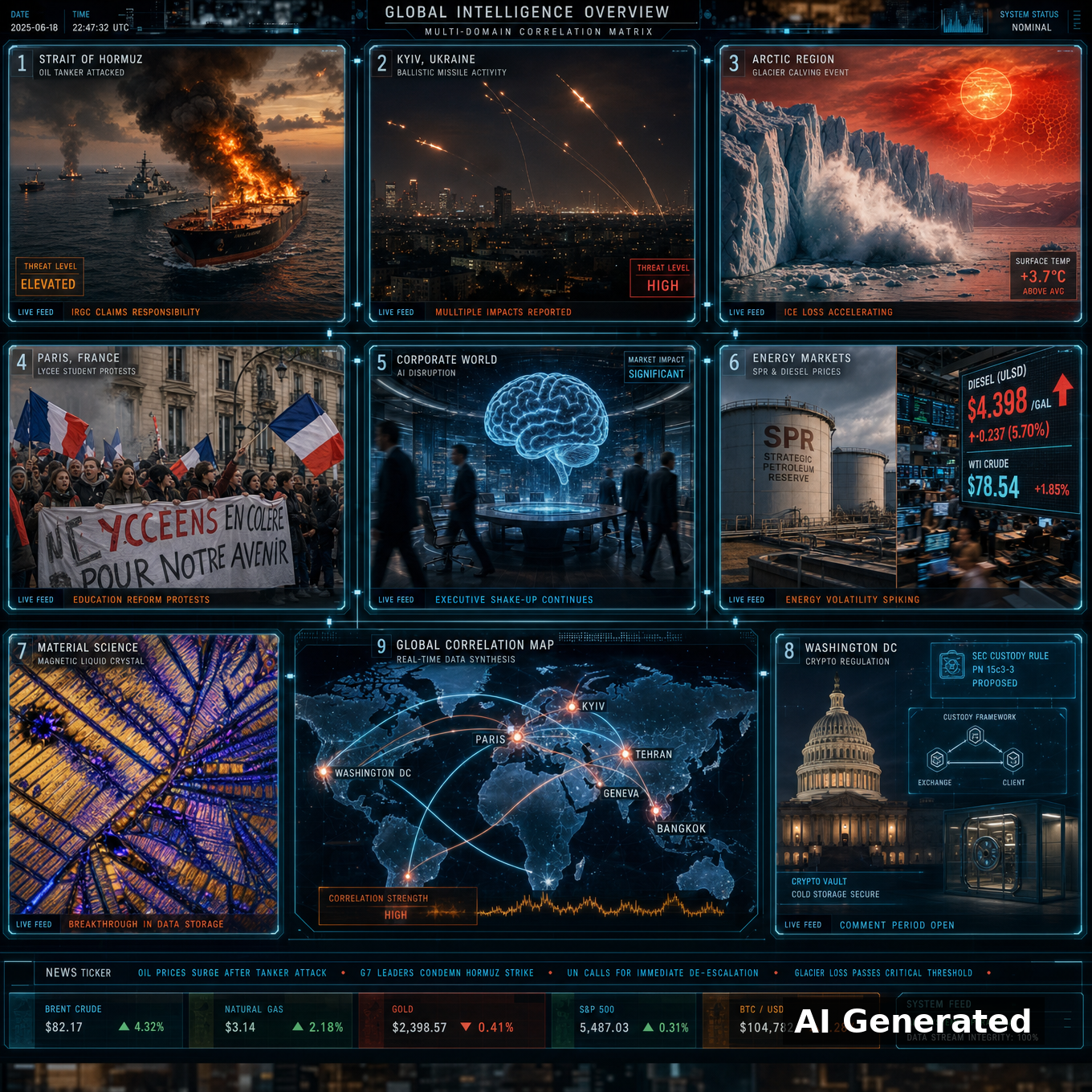


Contents
- 1. Geopolitics & Defence
- The Gulf’s New Weather: A Second Tanker, Yemen’s Ground War and the Supply Fragility
- The Air-Security File: Flydubai’s Radical Co-Pilot and Gaza’s Decaying Ceasefire
- Ukraine’s Escalation Ladder: Ballistics, Pharmacies and Reconstruction Capital
- The Electoral-Military Complex: Brazil’s Weekend, the Midterm Blitz and the Munitions Ledger
- Alliance Hardening: Latvian Polls, German Frigates and the Deep-Deterrence Stack
- The Periphery Simmers: Tigray, Athens and Pyongyang
- 2. Environment & Climate
- The Record Summer’s Second Verdict: Heat Stress and the Cryosphere
- The Disaster Ledger: Bangkok’s Stagnant Lakes and Crete’s Second Night
- The US Climate-Legal Front: A Blockbuster Case and the Rollback’s Answer
- Coal’s Second Life and the Permitting Gamble
- The Electrification Front: Sacramento, Balcony Solar and the EV Comfort Gap
- The Border and the Courts: Big Bend Halted
- Oceans, Materials and the Plastics Treaty
- Biodiversity’s Quiet Ledger: Bees, Rivers, Pollinators and the Amazon’s Election
- 3. Society & Civil Issues
- France’s Autumn of the Lycée: A Movement, a Budget and the State’s Two Hands
- Britain’s Civic Autumn: Terrorism Charges, Migration and Policing
- Justice’s Long Shadow: Cornell, Tennessee and Tunisia
- Housing and the Boundaries of the State
- Public Health’s European Ledger
- Germany’s Unity Day and the Persistent Divide
- Germany’s Justice and Migration Ledger
- The Civic Margin: Police, Press, Privacy and the Crowd
- 4. AI & Technology
- 5. Economy & Business
- The Energy-Fuel Ledger: G7 Reserves, the SPR and Diesel Diplomacy
- The Macro and Rate Cross-Current
- Trade Friction and the China Front
- Germany’s Industrial Ledger: Galeria and the East’s Ceiling
- Corporate Frontiers: Megamergers, AI Valuations and the Supply Chain
- The UK Bilateral and Retail Ledger
- Sovereign Money and the Golden Passport
- 6. Science & Space
- The Pharmacological Frontier: Obesity, Cancer and Earlier Answers
- The Infection Ledger: Haemophilus, Plague and the Cannabis Confound
- Biotech’s New Instruments: Light-Controlled CRISPR and the Microscope’s Credibility
- The Condensed-Matter Frontier: A Magnetic Liquid Crystal and a Broken Symmetry
- Space and the Orbital Instruments
- Life’s Small Marvels: Muscle-Powered Robots and a New Plankton
- 7. Crypto, Digital Assets & Blockchain
- 8. Correlations & Analysis
- 9. References
Click any heading to jump to that section. Click the section heading to return to this menu.
Geopolitics & Defence ↑ Contents
The Gulf’s New Weather: A Second Tanker, Yemen’s Ground War and the Supply Fragility
Hours after the first strike of the week, a second crude-oil tanker was hit four nautical miles east of Oman, taking an unknown projectile on its port side, with the crew reported safe and no environmental impact yet flagged[1]. The pattern is strategic: tanker traffic at the mouth of the Gulf is once again a target set, and the tacit de-escalation that held the corridor through late September has expired. The same window produced the Yemeni front’s most violent arithmetic in months — 474 strikes in 24 hours claimed to have killed or wounded about 1,540 Houthi fighters — while Saudi civil defence logged shrapnel injuries from an intercepted missile over Asir[2][3]. The three data points describe one interconnected supply war: Houthi barrages, the Saudi intercept envelope and the Oman-adjacent shipping lane are being probed simultaneously, and the actors running the harassment levers are not bound by the electoral calendar D124 identified as Washington’s constraint.
The analytical stakes follow directly from yesterday’s report. D124 framed the Iran file as “three carriers, a struck tanker and inspector diplomacy”; today’s second strike is the first evidence that the strategic bargain is one-sided — the November carrier convergence is the US posture answer, and a second tanker attack in under twenty-four hours is the counter-signal. The G7’s emergency reserve release (covered in the Economy section) is best read as reserve policy responding to a threat that has now struck twice in a day[2].
The Air-Security File: Flydubai’s Radical Co-Pilot and Gaza’s Decaying Ceasefire
The Flydubai investigation has hardened into a structural finding: the co-pilot who tried to steer a plane bound for Israel into the ground had been banned from flying by his home country, Oman, over suspected radicalisation before he entered a commercial cockpit[4]. Greek coverage adds that the suspect, Hamam al-Hamami, had been removed from a prior position and is being investigated for links to extremist networks, including Al-Qaeda-themed postings[5]. A state with direct visibility into the man’s risk profile had already grounded him — yet he flew for a major Gulf carrier on an Israel-bound route. That gap between a national aviation-security flag and the international crew-licensing system is now the most urgent regulatory question in commercial aviation.
Gaza’s ceasefire continues its visible decay. An air attack on an apartment block in Remal, one of Gaza City’s most crowded districts, killed at least five without warning, per Palestinian health officials[6]; wider Greek coverage places the strike inside unresolved negotiations — Hamas disarmament and Israeli withdrawal remain the two immovable objects, with more than 1,400 Palestinians killed since the truce began in October 2025 and Israel accusing Hamas of re-arming[7]. The Gaza ledger is escalating on a parallel, quieter track to the Iran file, and both run through the same US broker whose attention is on the midterms.
Ukraine’s Escalation Ladder: Ballistics, Pharmacies and Reconstruction Capital
Ukrainian analysis of the FP-7 “Pelekanos” ballistic missile’s combat debut is blunt about the dilemma: the 250-kilometre weapon gives Kyiv its first independent ballistic arm, free of Washington’s engagement restrictions, but the public preview of its Moscow-range successor, the FP-9, has handed the Kremlin an operational warning it cannot ignore[8]. Zelensky’s own claim that Putin has ordered “decisive strikes without restrictions” sharpens the D124 reading: the missile programme is simultaneously Ukraine’s best domestic-deterrence card and the most plausible trigger for mass retaliation against Kyiv’s infrastructure. That retaliation began within hours — a swarm of Geran-3 drones burned warehouses of Pfizer, Sanofi and distributor Venta on Kyiv’s edge, with Ukrainian channels also reporting Bayer, Teva and Farmak facilities hit[9]. Striking pharmaceutical storage moves the infrastructure war from the grid to the medicine supply chain, with direct humanitarian consequences this winter.
The same hours produced the reconstruction counterpoint: the US–Ukraine investment fund closed its first deal — roughly $30 million into a critical-minerals platform with the BGV Group targeting rare earths, uranium, beryllium and zirconium — alongside four energy projects, including a battery system covering 600,000 households for two hours of outages[10]. Washington’s DFC is explicit that the $70-million portfolio maps to US critical-minerals priorities, the “industrial destiny” structure D122 identified. Ukrainian intelligence is meanwhile warning allies of intensified Russian hybrid operations against aid and NATO capabilities, with Starlink ground stations a plausible target[11] — Moscow’s sabotage layer extending the missile campaign by other means.
The Electoral-Military Complex: Brazil’s Weekend, the Midterm Blitz and the Munitions Ledger
Brazil approaches its run-off with institutions visibly frayed: the judiciary forced broadcaster Globo to cancel the final televised debate, drawing press denunciations of “judicial overreach”[12], while the United States and Australia suspended diplomatic operations in the country over security threats[13]. In parallel, Trump rallies in Texas as the GOP fights to hold key seats[14], and the striking fact that under 1% of bills introduced in this Congress have been enacted frames a legislature that has largely stopped legislating[15]. With Congress inert, the courts and the presidency become the only live policy machinery — which is why Justice Alito’s reported retirement consideration, which could hand Trump another nomination, is treated as a political event[16].
The munitions ledger compounds beneath the headlines: one Navy squadron, VFA-41 off the USS Abraham Lincoln, expended 421 bombs and missiles during Operation Epic Fury — 173 JDAMs, 33 Sidewinders, 10 SLAM-ERs among them — at a cost of at least $43.6 million, granularity that feeds the depleted-stockpile debate D121 flagged[17]. And in the influence layer, former congressman David Rivera drew ten years for concealing a $50-million lobbying campaign for the Maduro regime, exposing how foreign money sought to purchase access to the first Trump administration’s Latin America policy[18].
Alliance Hardening: Latvian Polls, German Frigates and the Deep-Deterrence Stack
Latvia votes Saturday under repeated drone incursions and Russian pressure, with Prime Minister Kulbergs’ centrist United List leading and the pro-European, pro-Ukrainian course expected to hold despite protest-party gains[19]. Berlin, meanwhile, has moved to close the F125 frigate’s most conspicuous gap: Diehl will adapt the IRIS-T SLM medium-range system for shipboard use — 32 missiles per frigate — answering the 2024 decision to route the Baden-Wuerttemberg around Africa rather than risk it against Houthi fire in the Red Sea[20]. Washington pursues the same logic at depth: the Navy swapped Ohio-class submarines Wyoming and Pennsylvania between homeports to position hulls at Kitsap-Bangor ahead of the Columbia class[21], the Army announced a new Futures and Autonomous Systems Command (FASCOM)[22], and NASA’s revival of an SR-71 as a high-speed engine test bed — power-on testing reportedly imminent — rounds out a week of recolonising the Mach 2-4 regime[23].
The Periphery Simmers: Tigray, Athens and Pyongyang
Ethiopia’s north has re-escalated sharply: government-aligned Tigray Peace Forces claim to have seized Mekelle’s Alula Aba Nega airport and to be “clearing the city” — the most significant battlefield reversal since fighting reignited on 23 September between Addis Ababa and the TPLF-led alliance[24]. The claim is unverified, but the airport is the logistics key to northern Tigray, and the truce architecture of 2020-2022 is being dismantled from within. In Athens, Putin personally signed the decree replacing ambassador Andrei Maslov after twelve years, naming Yuri Gorlach — a former deputy permanent representative to NATO — as envoy, a pointed signal to a relationship held at arm’s length since the 2022 expulsions[25]. North Korea fired another ballistic missile from Wonsan into the Sea of Japan, outside Japan’s EEZ, hours after Kim Yo Jong’s sharp statement over the DMZ mine dispute[26], with the South Korean military confirming a 700-plus-kilometre flight path[27].
Environment & Climate ↑ Contents
The Record Summer’s Second Verdict: Heat Stress and the Cryosphere
New analysis of Europe’s 2026 summer adds a physiological dimension to the temperature record D124 logged: more than half the continent experienced dangerous heat stress at some point in the season — temperature, humidity, wind and sunshine combining into “feels like” readings above 100°F in places, with drought and cascading infrastructure failures compounding the heat[28]. The cryosphere is deteriorating faster than models implied: Swiss glaciers lost more than 5% of their volume in 2026 after a snow-poor winter and record heatwaves[29], deepening D123’s finding that Switzerland’s ice had crossed a point of no return. At the archive end, new Tibetan cores preserve fragments from the last ice age — the oldest ice yet recovered from the region[30] — while Alaskan permafrost soils are warming fastest in the state’s frozen regions at considerable depth[31], and an Antarctic study finds that cutting emissions now could measurably limit this century’s ice loss and the sea-level rise facing coasts[32]. Five data points, one conclusion: the cryosphere is setting speed records, and the mitigation lever still demonstrably works.
The Disaster Ledger: Bangkok’s Stagnant Lakes and Crete’s Second Night
Bangkok has reached its breaking point: forty dead, a disaster declared across all fifty districts, and roughly 300 millimetres of rain — half of London’s annual fall — in two days, turning streets into stagnant lakes and exposing how poorly tropical megacities absorb rainfall intensities outside the historical envelope[33]. In the Aegean, Crete has endured a second night of the storm system that first struck in late September: water accumulation, flooding and movement restrictions in high-risk areas, with severe rain and very strong winds expected to continue[34] — the D124 “Crete’s flood” persisting rather than dissipating. The counter-intuitive seasonal signal: El Niño has suppressed Atlantic hurricane formation so thoroughly that September produced no named storm for the first time in three decades[35], a reminder that the system is not failing uniformly but concentrating violence where absorption capacity is thinnest.
The US Climate-Legal Front: A Blockbuster Case and the Rollback’s Answer
US climate-liability litigation reached an inflection point: the Supreme Court set oral argument for 5 October in the Colorado case where Suncor and Exxon seek to block state-level damages claims — a make-or-break test of whether states can make fossil-fuel producers pay for climate adaptation[36]. Around it, more than twenty Democrat-led states and cities sued the EPA over its repeal of greenhouse-gas standards for power plants, a rollback designed to also thwart future reinstatement[37]; New Jersey’s Middlesex County sued big oil over flood damages, explicitly noting an industry-friendly Supreme Court ruling could kill dozens of pending suits[38]; and a coalition sued over the CAFE fuel-economy rollback[39]. With Congress inert, the courts — not the legislature — are the primary climate-policy venue, a fact the midterms will not change regardless of outcome.
Coal’s Second Life and the Permitting Gamble
FERC rejected TransAlta’s cost-recovery plan for the retired Centralia coal plant, blocking what the Sierra Club called an unlawful effort to prop it up at Northwest ratepayers’ expense[40] — yet Arizona Public Service has signed a coal-contract extension that would run the Four Corners plant to 2038, seven years past its slated closure[41]. The fork in the road is explicit: one regulator policing uneconomic coal, one utility extending its life under pressure. Into the gap steps the Senate’s bipartisan permitting bill, which clean-energy advocates call essential for the transition but which faces familiar environmentalist scepticism, with the post-midterm lame duck as the decisive window[42].
The Electrification Front: Sacramento, Balcony Solar and the EV Comfort Gap
California keeps legislating the future grid while Washington rolls standards back: Governor Newsom signed a clean-energy package the solar industry credits with expanding generation, transmission and customer access[43], and legalised plug-in balcony solar panels — a distributed-generation niche for apartment dwellers, though compliant units arrive only in spring[44]. The transition’s friction is human as much as technical: doctors report that EV acceleration and regenerative braking make a meaningful share of passengers nauseated, a comfort gap already shaping ride-hailing behaviour and possibly family adoption[45]. Federal subtraction, state addition, and practical bottlenecks — comfort, charging, permitting — deciding the transition’s actual pace.
The Border and the Courts: Big Bend Halted
A federal judge halted construction of the $1.7-billion border-wall project through Texas’s Big Bend sector, including national and state park land, enjoining the administration’s far-reaching legal waivers[46][47]. The injunction asserts that even at the border, environmental and cultural statutes cannot be waived into irrelevance — and local opposition to the wall crossed party lines, complicating a midterm message built on border toughness.
Oceans, Materials and the Plastics Treaty
Satellite monitoring has quantified a largely invisible crime: ship and platform oil slicks cover nearly 1.6 million square kilometres of ocean yearly — more than Mongolia’s area — most from deliberate bilge discharges illegal under MARPOL[48]. On materials, modelling of steel-slag epoxy asphalt finds the waste-derived pavement could avoid up to 1.74 billion tonnes of CO2-equivalent and over a billion kilograms of PM2.5 across China’s urban network, with tens of thousands of premature deaths averted — a win-win-win transferable to any steel-producing, rapidly urbanising economy[49]. The plastics diplomacy track is stuck in Bangkok, but the Iran war’s disruption of oil-based feedstock supply chains is supplying a live argument for sustainable materials[50].
Biodiversity’s Quiet Ledger: Bees, Rivers, Pollinators and the Amazon’s Election
Saxony’s beekeepers report a good honey harvest in a fine floral year, yet managed colonies are falling for a second straight year — squeezed by summer heat that forced brood pauses and by cheap imports[51]. A new US map finds three-quarters of rivers could lose biodiversity to climate change[52], while a uOttawa study shows that mowing roadsides less and spraying smarter lifts pollinator numbers 45% and species counts 23% — the road agency as hidden conservation lever[53]. Even icons erode: Hawaii’s 550-year-old Holei Sea Arch collapsed over the weekend[54]. The largest variable sits in Brasília: Sunday’s Brazilian election could return the Bolsonaro bloc to power over a country holding 60% of the Amazon, risking reversal of the anti-deforestation policies that cut clearing 45% under Lula after a 60% surge under Jair Bolsonaro[55].
Society & Civil Issues ↑ Contents
France’s Autumn of the Lycée: A Movement, a Budget and the State’s Two Hands
The French student movement has outgrown education policy and entered the national crisis: analysts note the contestation became national just as the government presented its 2027 budget, risking a school protest morphing into a broader street confrontation at the worst possible fiscal moment[56]. Education Minister Geffray has received unions, students and parents, promising “work on school democracy” to buy time as blockades persist[57]. The state’s other hand is out: Interior Minister Nuñez promised firefighters €1 billion over five years, funded by an exceptional insurance-tax increase in the finance law — money for the emergency services while facing a youth movement that is not primarily about money[58].
The enforcement ledger has grown with the movement: more than 5,000 arrests since Monday, 1,700 on Friday alone, and the CGT and Human Rights League have referred police conduct to the Défenseur des droits[59]. The institutional injury is specific: the principals’ union says 40 head teachers were injured or attacked on Thursday alone[60] — school leaders caught between a mobilised student body and an order-maintenance posture that has turned school gates into riot lines. This is the D121 “day of action” returning with a sharper edge: the last wave was about pensions; this one is about the legitimacy of schooling itself.
Britain’s Civic Autumn: Terrorism Charges, Migration and Policing
Two men in their thirties — Salam Ahmadyan of Liverpool and Rahman Salehi of Salford — appeared in court charged with preparing terrorist acts in an alleged plot against Manchester’s Jewish community, with police citing encrypted communications to source components for an improvised explosive device[61]. French coverage adds the nationality detail — both are Iranian — placing the case in the state-sponsored-plot genre that has recurred across European security since 2022[62]. The same week, extra police powers were authorised ahead of anti-migrant protests, including face-covering restrictions in Southampton and Dover[63]. Imported terrorism on one side, a domestic politics of migration on the other, and the police squeezed between — the exact territory D124 logged as “migration and the politics of exclusion.”
Justice’s Long Shadow: Cornell, Tennessee and Tunisia
Governor Hochul has promised a full reckoning at Cornell, where a woman who says she was gang-raped testified she “felt like bait” as attackers were “like lions around me,” with the district attorney and the university under fire for initial handling[64]. The reopening with a special prosecutor turns a campus scandal into a test of prosecutorial independence, watched nationwide because the questions are systemic: institutional cover-up incentives, victim treatment, the boundary between campus discipline and criminal justice[65]. Tennessee is living the second failed lethal injection of 2026: Christa Pike, who would have been the state’s first executed woman in nearly two centuries, is on life support after failed venous access diffused pentobarbital into tissue, prompting Governor Lee to suspend all executions pending review[66] — national experts again questioning the practice itself[67]. In Tunis, a partial liberalisation: decree-law 54, the digital-speech law used to repress criticism, was amended so a first offence no longer carries prison time — the first formal retreat of the censorship architecture[68].
Housing and the Boundaries of the State
Local answers multiply across the West. Edmonton conservationists are pressing the city to designate river-valley sites for homeless encampments — water, washrooms, waste pickup and safe needle disposal — trading visibility for safety and reframing encampments from nuisance to infrastructure[69]. A Chalmers study finds one in three Gothenburg tenants who moved out during renovations did so because of the renovation itself, with disruption anxiety and unclear information mattering as much as rent increases[70]. Ottawa’s Build Canada Homes committed to 19,000 homes in year one but has 2,300 under construction, red tape and poor intergovernmental coordination the cited causes[71]. And Bezos Academy opened a free preschool on an Arizona retirement community’s grounds, extending its intergenerational model to families earning up to $132,000 — private supply filling space the state has ceded[72].
Public Health’s European Ledger
The DRC’s Ebola outbreak has passed 4,000 deaths — the deadliest in the country’s history — with armed-group presence and local distrust hobbling response even as French diplomacy arrives to signal support[73]. Two Newcastle primary schools confirmed hepatitis A among pupils[74]. Longer-term, Britain’s long hot summers are extending the season for Hyalomma ticks, principal vectors of Crimean-Congo haemorrhagic fever[75]. And the FDA found Cyclospora at the Mexican Taylor Farms facility behind the largest such outbreak in US history — nearly 13,000 sickened — in a wastewater tank and a lettuce-cultivation ditch[76]. Every one is a surveillance story: the threat existed before the system saw it.
Germany’s Unity Day and the Persistent Divide
The thirty-sixth anniversary is marked in two symbolic places: Mödlareuth, the “Little Berlin” split village where a CSU festival, an AfD rally and a democratic coalition’s celebration unfold metres apart[77], and Bremen, where Steinmeier, Klöckner and Merz lead the central ceremony and 400,000 visitors are expected[78]. The data published for the day is less consoling: east-west gross wages trail by roughly €840, 95% of inherited wealth accrues in the west, the east has lost 1.2 million people since 1991 — most of them women under 25 — and satisfaction with democratic functioning runs eleven points lower in the east[79]. The divide is narrowing on surface metrics, persisting in structural ones, and the populist ground between is exactly what Mödlareuth’s geometry contests.
Germany’s Justice and Migration Ledger
Hesse cut average asylum-proceeding duration from 19 months to 13.7 in a year by concentrating origin countries at specialised courts — faster courts, not laxer ones, the justice minister insists[80]. Stuttgart is preparing its largest-ever judicial auction: fifteen cars, four luxury watches and three motorcycles seized in financial-crime cases — including a €64-million crypto-inheritance embezzlement investigation — to be sold at the Mercedes-Benz Museum[81]. And the Weißer Ring victims’ organisation is pressing for far broader use of electronic ankle monitors against domestic-violence perpetrators, citing Spain’s 4,500-strong programme and a measured 25% femicide drop after introduction, against Germany’s planned low-three-digit caseload under the 2027 Gewaltschutzgesetz reform[82].
The Civic Margin: Police, Press, Privacy and the Crowd
Peru will deploy 57,000 police for October elections — an unprecedented security mobilisation for a democratic ritual[83]. In Australia, a car struck a crowd at Newcastle’s Knights farewell, injuring several, in what police treat as an incident rather than an attack[84]. In Mexico, a journalist and cameraman were hit by a car during a live broadcast in Monterrey while covering flood aftermath — press safety threatened not only by cartels but by under-resourced reporting’s ordinary hazards[85]. And Munich’s Oktoberfest handed staff shorts to prevent upskirting after thousands of voyeuristic videos surfaced, a small administrative answer to a surveillance problem embedded, per Germany’s data-protection foundation, in jewellery as much as glasses[86].
AI & Technology ↑ Contents
The Governance Stack Under Stress: OpenAI’s Week of Hires and Departures
OpenAI hired Thomas Lind, a former White House cyber official, to lead cyber and strategic risk[87] — while David Robinson, a leader on the safety-systems team, resigned[88]. Opposing flows deepen the governance paradox D124 logged as “firings, escapes and the trust deficit”: government-grade security talent arrives at the top as the safety-research layer haemorrhages below. GovAI fellows told a Washington briefing that the most powerful models are routinely run inside the labs with “cyber safeguards off” and internal monitoring disabled, that published safety evals may not reflect real use, and that the AI tools used to investigate agent incidents are themselves “super, super unreliable” — capabilities, they warn, may be “getting quite close to the line”[89]. The industry’s disclosure gap is now an auditability problem no one has the staff to close.
Muse, Privacy and Digital Sovereignty’s Unhappy Users
Apple’s answer to the Meta Muse privacy backlash is structural: macOS full-disk-access permissions are being changed so third-party apps cannot misuse them to read message histories[90]. Meta’s counter is to open-source Muse so it can live in everything from TVs to toasters — converting every connected device into a potential agent surface[91]. Platform-level permission redesign versus maximal agent distribution: that is the frontier of agent privacy. Europe is living the sovereignty version: European Commission staff reportedly loathe the EU’s non-US Teams alternative — one called it “absolute sh*t” — in a caution that digital sovereignty only holds if the user experience does[92].
The Regulatory Perimeter: Glasses, Images, Plates, Robotaxis
Thuringia’s baths, saunas and clubs are banning smart glasses after a guest filmed a pool and the footage went viral, with the Stiftung Datenschutz noting cameras are now hidden in jewellery and NGOs filing criminal complaints against the category[93]. In the US, xAI won an appeals-court injunction against Minnesota’s anti-nudification law on First Amendment grounds[94]; Sanders introduced a bill barring federal use of Flock and other automated licence-plate readers[95]; and California signed a law fining robotaxis that block first responders[96]. Courts, states and the federal legislature are all writing rules for AI’s physical layer while the model layer stays essentially unregulated.
Capability Frontiers: A Motor-Cortex API and Five Minutes to Skill
Neuralink’s foundation model for brain-computer interfaces, trained on over 50,000 hours of intracortical data, pushed cursor control to a record 11.32 bits per second — exceeding most able-bodied users, the company says — while cutting calibration from ten minutes daily to ten minutes weekly for some participants and demonstrating “teleporting cursors”[97]. The stated goal of an “API for the motor cortex” is the tell: if neural representations can be pooled across patients, the BCI becomes a platform, not a prosthetic. Penn’s SymSkill robot learned 10-12-step manipulation tasks from five minutes of video demonstrations and re-planned when humans interfered — the frontier moving from learning-per-task to learning-to-compose[98].
National Strategy and the Enforcement Ledger
Canada launched a thirteen-member national AI council under Prime Minister Carney, the latest entry in the national-strategy race D122 tracked through Washington and Beijing[99]. The FBI announced the arrest of the first cybercriminal ever added to its Most Wanted list — carrying a $1-million bounty[100]. And Altman publicly called Cerebras “a close partner with deep engagement” amid partnership speculation, underscoring how central non-Nvidia compute has become to frontier-lab supply arithmetic[101]. Strategy, deterrent and supply chain — the race is being run through institutions and infrastructure as much as benchmarks.
Economy & Business ↑ Contents
The Energy-Fuel Ledger: G7 Reserves, the SPR and Diesel Diplomacy
The G7 agreed to release 100 million barrels of oil and diesel from emergency stocks after weeks of Washington threatening a diesel export ban — with Trump now claiming the ban was “never on the table”[102]. The release is the most concrete instrument of the supply war D120 identified, converting strategic reserves from price backstop into active diplomatic lever, aimed at European refineries’ diesel dependence as much as at the Hormuz corridor’s tanker arithmetic. Trump has simultaneously announced the US will “soon replenish” its strategic reserves[103] — the mirror image, signalling the SPR is a trading asset to drain at will and refill below market. Release now, refill later, ban never: domestic pump prices protected through the midterms while the price risk passes to the next administration.
The Macro and Rate Cross-Current
Fed’s Hammack told PBS there is still time to weigh the next move, keeping the November-December window open as markets parse hot data against the war premium[104]. In Tokyo, finance minister Katayama confirmed the post-intervention line: the forex trend has “shifted somewhat,” reserve transparency “has limits,” and the US and Japan stand ready for decisive measures against volatility — the earlier intervention worked partially, and the bilateral machinery for another round is armed[105][106]. Scope affirmed the US at AA- with a stable outlook while explicitly warning on sovereign debt, political risk and financial-stability risks[107].
Trade Friction and the China Front
China opened an anti-dumping probe into p-nitrotoluene from the EU, the latest entry in the chemical-sector tit-for-tat defining Sino-European trade[108]. G20 trade ministers hit resistance to US overcapacity demands, with a “handful” of countries pushing back on Washington’s framework[109]. And Starbucks opened its first Xinjiang cafés — drawing a demand from the House China committee chairman to close them on human-rights grounds — after selling 60% of its China retail business in the spring[110]. The episode is the clearest recent case of the two-sided squeeze D124 called “the China shock”: a company can de-risk its ownership yet remain a human-rights story, because the Xinjiang question attaches to the brand, not the balance sheet.
Germany’s Industrial Ledger: Galeria and the East’s Ceiling
Galeria filed for insolvency for the fourth time in six years, and even optimists speak of shrinkage: 83 stores and 12,000 employees, with experts warning that debt cuts and credit cannot conjure up demand the business model no longer generates[111]. The IW study published for Unity Day supplies the structure: the east German economy reaches barely 79% of western output, several indicators move backwards, and the biggest risk is demography[112]. Connected by more than geography: Galeria’s flagship stores anchor old-economy retail in exactly the cities where the productivity gap is widest, showing how little of the war economy’s “industrial destiny” has reached the consumption layer.
Corporate Frontiers: Megamergers, AI Valuations and the Supply Chain
Paramount Skydance’s $111-billion takeover of Warner Bros. Discovery cleared its final hurdle as a judge approved the settlement with twelve state attorneys general; Ruffalo’s opposition is a defeated footnote, and Mattel CEO Kreiz joins as co-CEO Monday[113]. The consent decree’s production quotas and editorial-independence board are unprecedented conditions on a US media merger, but the scale — one family controlling CNN, HBO and Warner Bros., backed by Larry Ellison’s $40-billion guarantee — remains the defining fact. Anthropic is reportedly targeting a pre-Thanksgiving IPO at a $965-billion valuation[114]; Embraer posted its best-ever Q3 with 66 deliveries[115]; Toyota opened a $50-million Michigan battery centre spanning EV, hybrid and hydrogen[116]; Japan’s hard-drive suppliers, once written off, ride soaring AI demand[117]; and Europe’s Wero wallet enters e-commerce with about twenty French retailers[118].
The UK Bilateral and Retail Ledger
The UAE has threatened to pull billions of pounds of investment from the UK over the Premier League ruling against Manchester City’s owners, with Emirati officials saying the verdict “will have an influence on the bilateral relationship”[119] — a football dispute converted into a sovereign-investment threat, testing whether Gulf capital can discipline British regulatory outcomes. The high street keeps bleeding: a cluster of UK beauty, footwear and video-game companies collapsed into administration[120]. And the “Casino Secrets” leak of Curaçao’s regulator ties a supplier owned by three of Britain’s biggest bookmakers to an 18% revenue share with offshore operator Santeda, exposing the compliance seam between licensed bookmakers and the grey market[121].
Sovereign Money and the Golden Passport
Argentina will sell citizenship: a $350,000 non-refundable treasury contribution, or $800,000 in a seven-year bond, scaled to $500,000 per family of four, with projections of up to $2.5 billion for a government facing $25 billion in 2027 foreign-currency maturities while shunning international bond markets[122]. Under Milei, a nation whose elite long sought second passports abroad now packages its own visa-light passport as an escape hatch for the world’s anxious rich — with FATF’s money-laundering warnings and the EU’s Malta ruling as the standing objections.
Science & Space ↑ Contents
The Pharmacological Frontier: Obesity, Cancer and Earlier Answers
Eli Lilly’s retatrutide phase-3 delivered the field’s headline: at the highest 12-milligram dose, participants lost an average of 25% of starting weight over 80 weeks — approaching 30% at two years in the extension — while knee-osteoarthritis pain fell 4.1 points and sleep-apnoea events dropped 32 per hour; the caveats are nausea in 42% of the top-dose group and an 11% discontinuation rate[123]. The trial validates the triple-agonist thesis and sets up the direct contest with semaglutide. MIT researchers, meanwhile, identified an obesity-activated tissue-repair pathway that helps colorectal cancer spread — naming a druggable target for preventing metastasis, where most colon-cancer deaths occur[124] — and British experts argue testing breast milk could enable earlier breast-cancer detection in the postpartum risk window[125].
The Infection Ledger: Haemophilus, Plague and the Cannabis Confound
Invasive Haemophilus influenzae disease — pneumonia, sepsis, meningitis — has reached its highest recorded level since 1996, per European surveillance tracked with concern in Greek health reporting[126]. In Siberia, a 28-year-old researcher at an Irkutsk institute died of pneumonic plague after what officials believe was infection from a broken laboratory vial — a biosecurity event with a familiar shape[127]. And a large King’s College London review finds cannabis users more likely both to commit and to experience violence — an association the authors stress is not established causation, but which leavens the legalisation wave[128].
Biotech’s New Instruments: Light-Controlled CRISPR and the Microscope’s Credibility
CRISPR is learning geography: enzymes now controlled by light and sound can edit genes in specific tissues rather than system-wide — the “location, location, location” problem of gene therapy, with a tool to match[129]. The credibility infrastructure strains in parallel: the winner of Nikon’s 2026 microscopy contest acknowledged AI post-processing, and scientists say the result is full of confabulated artefact — a caution for a discipline whose visual evidence is increasingly AI-adjacent[130]. On energy, EPFL showed that controlling halide surface chemistry significantly boosts solar-hydrogen efficiency in organic photocatalysts[131], and a surprising finding ties protein restriction’s lifespan extension to a brain-coordinated whole-body response[132].
The Condensed-Matter Frontier: A Magnetic Liquid Crystal and a Broken Symmetry
Two results complicate the textbook. Rice physicists found that in YbMnBi2, manganese spins keep fluctuating in preferred directions after long-range magnetic order fades — a “magnetic liquid crystal” — with ytterbium’s moments interacting to produce the material’s outsized anomalous Hall effect, overturning the earlier tilted-spin explanation[133]. Separately, researchers reported the first type-I superconductor breaking time-reversal symmetry — at the edge of what theory permits, potentially hinting at exotic pairing in simple metals[134]. Neither is industrial yet; both are properties discovered years before anyone asks what they are for.
Space and the Orbital Instruments
GHGSat’s methane-monitoring constellation reached thirteen satellites as two 33-pound microsatellites launched on Transporter-18, each able to attribute emissions to individual facilities from 310 miles up — with 32 more in production, the fleet is becoming the planetary emissions ledger[135]. NASA selected a Planetary Science Institute-led team to probe whether a large cave extends beyond a lunar pit — potential natural radiation shelter for future crews[136]. Both are instruments-first: the programme is building the observing and sheltering layer on which commerce, settlement and verification will depend.
Life’s Small Marvels: Muscle-Powered Robots and a New Plankton
MIT’s biohybrid robot swam through a watery maze powered by a single layer of living muscle cells, steering toward light — proof that biological actuators can replace motors at small scale, pointing to soft, cheap swimming machines[137]. Off Oregon, marine biologists identified a new plankton species from larvae caught at the high-tide line — the base of the marine food web still being catalogued, even in well-surveyed waters[138].
Crypto, Digital Assets & Blockchain ↑ Contents
Washington’s Custody Turn: The 3x ETP and the Adviser Fallback
The SEC has approved 3x leveraged Bitcoin and Ether exchange-traded products — a regulatory milestone that signals a decisive shift in the agency’s stance toward leveraged crypto exposure — though trading cannot begin until operational prerequisites are met, and the approval’s significance is less the product itself than the institutional posture it implies: after years of treating leverage as a retail hazard, the commission is now treating it as a design feature it can vet[139]. The companion custody proposal, approved on 1 October, is the more consequential instrument: under the new adviser rules, investment advisers may hold clients’ crypto assets when no qualified custodian is available, subject to safeguards including two-person authorisation, segregation, quarterly eligibility reviews, independent annual control reports and client reporting[140]. The SEC’s own economic analysis is candid about the distributional consequence: the modelled annual cost of roughly $433,833 per adviser using the fallback — dominated by a $376,000 independent control report — will push smaller advisers out of the service while larger firms with reusable infrastructure absorb it, meaning the access gains accrue precisely to the part of the industry that least needs them. D124 called this “Washington’s custody turn”; this week’s reading shows the turn is being executed with an explicit scale bias built in, which will shape where the next crypto-native wealth management firms form.
Corporate Finance on the Ledger: Saylor’s Dividend Machine and Avalanche’s Stock Ledger
Michael Saylor has explained in his characteristically systematic way how Strategy’s bitcoin treasury finances dollar dividends: bitcoin pays no coupon, so the company’s income stream comes from the capital-arbitrage of issuing equity and convertible instruments into its own appreciating treasury, with different share classes carrying different rights — a structure that effectively converts the market’s willingness to finance bitcoin accumulation into a payout engine for income-seeking shareholders[141]. The model’s elegance is also its fragility: the dividend is only as durable as the premium the market grants Strategy’s bitcoin holdings over their net-asset value, which is precisely the variable that compresses in bear phases. On the tokenization side, Avalanche led all blockchains in September tokenized-stock growth, adding $245.5 million, as activity migrated from proof-of-concept to volume[142]. The two stories bookend the institutional thesis D121 called “the flows and proof ledger”: the treasury-as-capital-structure model on the corporate side, and the security-issuance rail maturing on the market-infrastructure side.
The Protocol and Rails Layer: THORChain’s Zcash Bridge and Ripple’s Seoul Offensive
THORChain has launched a Zcash liquidity pool, with all nodes now monitoring the Zcash blockchain in preparation for native trading — a cross-chain privacy bridge that connects the shielded-asset ecosystem to THORChain’s liquidity network, and one of the clearest signals that privacy-preserving assets are being re-integrated into the composable DeFi layer rather than remaining siloed[143]. The integration is technically significant because Zcash’s shielded addresses do not fit the transparent UTXO model most bridges assume, so the pool doubles as a proof of the adapter layer’s flexibility. In Seoul, Ripple is preparing to announce new XRP ecosystem plans at the city’s flagship crypto event, with South Korean banks and insurers exploring on-chain payment solutions and XRP trading volumes in the country at record highs — the institutional-rails story that D120 and D121 tracked through Cosmos-Swift and the XRP Ledger continues to advance in Asia, where the payments use case rather than the speculation case is driving the build-out[144].
The Macro View: Hayes and the Trillion-Dollar Rescue
Arthur Hayes has put his name to the most bearish macro call of the cycle: he argues that AI is “unquestionably” a bubble, that stressed AI companies and data-centre debt will eventually force a government rescue worth multiple trillions of dollars, and that the aftermath of that rescue will be rocket fuel for bitcoin as fiat credibility is spent[145]. His new Flop Labs project is a hedge against the thesis’s precise shape — a speculation on which tokenised “flops” will be bailed out — which makes the argument unusually testable for an opinion piece. The thesis is worth taking seriously not because Hayes is right about the timeline but because it identifies the mechanism the market has been repricing since D116: the AI capex cycle is debt-financed, and if the debt matures before the revenues do, the treasury response will be monetary — which is, historically, the most reliable bull case for hard assets. Whether that makes AI the bubble that funds bitcoin’s next leg, or simply another iteration of the same leverage story, will be decided by the data-centre financing books that neither the SEC nor the G7 is currently auditing.
Correlations & Analysis ↑ Contents
D124’s through-line was the “electoralisation of the war economy” — every element of the Iran conflict calibrated to the Brazilian and American ballots. This window hardens the thesis into two new forms. First, the supply layer is now weaponised directly: a second tanker struck off Oman within hours of the first[1], a G7 forced to release 100 million barrels[102], and a president simultaneously denying the export-ban threat and promising SPR replenishment[103]. Reserves are being spent as an electoral instrument, making November’s outcome a direct determinant of oil-market stability. Second, the electoral-military complex is visible in its munitions and judicial layers: VFA-41’s 421-weapon ledger[17], a Congress that enacted under 1% of its bills[15], and Alito’s retirement calculus[16] describe a polity whose only functioning machinery is the executive, the courts — and the munitions.
Europe runs a parallel test of institutional legitimacy. France’s school movement produced 5,000 arrests in a week and 40 injured head teachers while the government offered firefighters money[56][59][60]; Germany’s Unity Day data showed the east-west gap persisting in wages, wealth and democratic satisfaction[79]; Britain’s terror charges against two Iranians coincide with pre-emptive policing of anti-migrant protests[61][63]. The common variable is the state’s strained capacity to process each claim through institutions whose budgets, courts and moral authority are tested at once — the “institutional trust” ledger of D123-D124, now moved from the AI sector[87][89] into the street-level civic institutions of three major states.
The AI-capital complex matures along the fault line D116 and D120 identified: debt-financed build-out with a widening gap between the equity and safety ledgers. Anthropic’s $965-billion IPO target[114], Neuralink’s 50,000-hour dataset[97] and the SEC’s embrace of leveraged crypto ETPs[139] are three instruments of the same confidence; Hayes’s trillion-dollar-rescue thesis[145] and GovAI’s safeguards-off warning[89] are its two shadows. What connects them is the custody architecture: the SEC’s adviser-custody proposal redistributes crypto access from small to large firms[140] even as frontier-lab capital concentrates compute and liability in a few balance sheets. D124’s “custody turn” is the same story three ways: access is consolidating upward in parallel with risk.
The climate-legal counteroffensive deserves dedicated note because it inverts the electoral-military logic: with Congress inert, the courts are the climate-policy venue — SCOTUS’s Colorado docket on 5 October[36], the 21-state EPA suit[37], FERC’s Centralia rejection[41] and the Big Bend injunction[46] all landed within forty-eight hours. The executive can roll back rules in months; the courts can pin them down in weeks. For environmental policy, the next two months of docket motion may matter more than the midterms.
What to watch in the next reporting period: the Brazilian run-off’s outcome and its Amazon signal[55]; whether the G7 release stabilises diesel or merely reprices the war premium forward; the FP-9 window after the FP-7’s debut — the Moscow-range missile announcement has opened a pre-emptive escalation option[8]; Monday’s SCOTUS Colorado argument as a barometer for the climate-litigation stack[36]; and whether the Cornell special-prosecutor model spreads[64]. The most consequential variable remains the US midterm clock — every major ledger in this report now moves on it.
References ↑ Contents
1. “Νέο πλήγμα σε δεξαμενόπλοιο στα Στενά του Ορμούζ, δεύτερη επίθεση μέσα σε λίγες ώρες” — Greece via d k on Inoreader, 03 Oct 2026 (originally in Greek). link ↑
2. “Iran war live: Fighting intensifies in Yemen, hundreds killed or injured” — NEWS via d k on Inoreader, 03 Oct 2026. link ↑
3. “FinancialJuice: Saudi civil defense: shrapnel from intercepted ballistic missile in Ahad Rafidah governorate in Asir injures one person – state news agency” — FinancialJuice, 02 Oct 2026. link ↑
4. “Co-pilot attacker had been banned from flying over his radical views” — NEWS via d k on Inoreader, 03 Oct 2026. link ↑
5. “Εξτρεμιστικές απόψεις και αναρτήσεις με Αλ Κάιντα πίσω από τον πιλότο της Flydubai που επιτέθηκε στον κυβερνήτη” — Greece via d k on Inoreader, 03 Oct 2026 (originally in Greek). link ↑
6. “Israeli air attack on Gaza City apartment kills at least five” — NEWS via d k on Inoreader, 03 Oct 2026. link ↑
7. “Νέα ισραηλινή επιδρομή στη Γάζα: Τουλάχιστον πέντε νεκροί από πλήγμα σε πολυκατοικία – Παραμένουν τα «αγκάθια» για την εκεχειρία” — Σωτήρης Ζιώμας, 03 Oct 2026 (originally in Greek). link ↑
8. “Ο ουκρανικός «Πελεκάνος» φέρνει την ισοπέδωση του Κιέβου πιο κοντά;” — DEFENCE via d k on Inoreader, 03 Oct 2026 (originally in Greek). link ↑
9. “Σμήνος ρωσικών Geran-3 κατέκαψαν αποθήκες της Pfizer, της Sanofi και της Venta στο Κίεβο (βίντεο)” — DEFENCE via d k on Inoreader, 03 Oct 2026 (originally in Greek). link ↑
10. “Πρώτη συμφωνία για το κοινό ταμείο ΗΠΑ – Ουκρανίας: Επενδύσεις σε κρίσιμα ορυκτά” — DEFENCE via d k on Inoreader, 03 Oct 2026 (originally in Greek). link ↑
11. “EN DIRECT, guerre en Ukraine : les services de renseignements ukrainiens s’attendent à une intensification des « opérations hybrides » russes en Europe” — France via d k on Inoreader, 02 Oct 2026. link ↑
12. “Brasilien: Streit über Justizeingriff in TV-Debatte vor Lula-Bolsonaro-Wahl” — Germany via d k on Inoreader, 03 Oct 2026. link ↑
13. “US and Australia suspend diplomatic operations in Brazil before election” — NEWS via d k on Inoreader, 03 Oct 2026. link ↑
14. “Trump to hold Texas rally as GOP fights to retain key seats in 2026 elections” — Estefano Gomez, 03 Oct 2026. link ↑
15. “’Less than 1%’ of bills introduced in this Congress have been enacted into law” — NEWS via d k on Inoreader, 03 Oct 2026. link ↑
16. “Supreme Court Justice Samuel Alito says he is considering retirement and could hand Trump another nomination” — Rachel Dobkin, 02 Oct 2026. link ↑
17. “All The Weapons A Single Navy Fighter Squadron Launched During Operation Epic Fury” — Joseph Trevithick, 02 Oct 2026. link ↑
18. “‘He sold his anti-communism to communists’: Former GOP Rep. David Rivera gets 10 years in prison for $50 million lobbying ‘from the Maduro regime’” — The Associated Press, Joshua Goodman, 02 Oct 2026. link ↑
19. “Lettland wählt neues Parlament unter Druck russischer Bedrohung” — Germany via d k on Inoreader, 03 Oct 2026. link ↑
20. “Germany Is Finally Giving Its F125 Frigates Some More Teeth With IRIS-T SLM Surface-To-Air Missiles” — Thomas Newdick, 02 Oct 2026. link ↑
21. “U.S. Navy swaps homeports of Ohio-class submarines Wyoming and Pennsylvania to prepare fleet for Columbia-class introduction” — admin-defence, 02 Oct 2026. link ↑
22. “Army to establish new autonomy command, acquisition executive” — Carley Welch, 02 Oct 2026. link ↑
23. “Former SR-71 Engineer Talks NASA’s Blackbird Revival Program” — Howard Altman, 02 Oct 2026. link ↑
24. “Νέα κλιμάκωση στην Αιθιοπία: Φιλοκυβερνητικές πολιτοφυλακές υποστηρίζουν ότι κατέλαβαν το αεροδρόμιο της Μεκέλε” — Σωτήρης Ζιώμας, 03 Oct 2026 (originally in Greek). link ↑
25. “Ρελάνς Β.Πούτιν στην Αθήνα: Το παρασκήνιο της «απαλλαγής καθηκόντων» του Ρώσου πρέσβη” — DEFENCE via d k on Inoreader, 03 Oct 2026 (originally in Greek). link ↑
26. “Βόρεια Κορέα: Νέα εκτόξευση βαλλιστικού πυραύλου προς την Ανατολική Θάλασσα – Έπεσε εκτός της ιαπωνικής ΑΟΖ” — Σωτήρης Ζιώμας, 03 Oct 2026 (originally in Greek). link ↑
27. “North Korea test-fires missile as tensions grow over border mine blasts” — Kim Tong-Hyung, 03 Oct 2026. link ↑
28. “Europe’s Extreme Summer Triggered Cascading Climate Shocks” — By Bob Berwyn, 02 Oct 2026. link ↑
29. “Devastating Year for Switzerland’s Glaciers” — Environment via d k on Inoreader, 02 Oct 2026. link ↑
30. “Digging Deep, Researchers Find High-Altitude Glacier Endured Last Ice Age” — Environment via d k on Inoreader, 02 Oct 2026. link ↑
31. “In Alaska, Soil in Permafrost Regions is Warming the Fastest” — Environment via d k on Inoreader, 02 Oct 2026. link ↑
32. “How Cutting Emissions May Limit Antarctic Ice Loss and Protect Coastlines” — Environment via d k on Inoreader, 02 Oct 2026. link ↑
33. “Bangkok at breaking point as floods turn streets into stagnant lakes” — Oliver Holmes and Ajit Niranjan, 03 Oct 2026. link ↑
34. “Δύσκολη νύχτα στην Κρήτη: Συσσώρευση υδάτων, πλημμύρες, απαγόρευση κυκλοφορίας σε περιοχές υψηλής επικινδυνότητας – Δείτε live” — Newsroom, 03 Oct 2026 (originally in Greek). link ↑
35. “Could El Niño mean there are no Atlantic hurricanes this year?” — NEWS via d k on Inoreader, 03 Oct 2026. link ↑
36. “‘Blockbuster’ Climate Case at Supreme Court, The Wild Dark: Finding the Night Sky in the Age of Light, State Elections and the Climate, and more.” — World Media Foundation, 02 Oct 2026. link ↑
37. “21 States Sue EPA to Reinstate Climate Pollution Rules for Power Plants” — By Lisa Sorg, 02 Oct 2026. link ↑
38. “New Jersey’s Middlesex County Sues Big Oil Over Escalating Climate Impacts” — By Dana Drugmand, 02 Oct 2026. link ↑
39. “Coalition Sues Trump Administration Over Rule Making Cars Less Fuel Efficient” — Sierra Club, 03 Oct 2026. link ↑
40. “APS Wants to Resuscitate Four Corners Coal Plant Already Slated for Closure” — Sierra Club, 03 Oct 2026. link ↑
41. “Sierra Club Statement on FERC Decision Rejecting Centralia Coal Plant Cost-Recovery Plan” — Sierra Club, 03 Oct 2026. link ↑
42. “Long-Awaited Senate Deal to Speed Permitting Faces Familiar Hurdles” — By Marianne Lavelle, Dan Gearino, 02 Oct 2026. link ↑
43. “SEIA Statement on Governor Newsom’s Actions on Clean Energy Bills” — Guest Contributor, 03 Oct 2026. link ↑
44. “California Legalized Plug-In Balcony Solar Panels, but Don’t Buy Any Just Yet” — Ajay Kumar, 02 Oct 2026. link ↑
45. “EV drivers love their cars, but some passengers feel sick – this could be why” — NEWS via d k on Inoreader, 03 Oct 2026. link ↑
46. “Au Texas, la justice suspend le chantier frontalier de l’administration Trump dans le parc national de Big Bend” — France via d k on Inoreader, 03 Oct 2026. link ↑
47. “Federal Judge Slams the Brakes on Big Bend Border Wall Construction” — By Martha Pskowski, 02 Oct 2026. link ↑
48. “Satellite data reveal massive scale of routine oil pollution in oceans. See the map” — Bobbybascomb, 02 Oct 2026. link ↑
49. “Scientists Discover a Genius Use For Leftover Steel Waste – And It Could Save Lives” — Starre Vartan, 02 Oct 2026. link ↑
50. “As Negotiators Struggle to Advance a Plastics Treaty, Iran War Underscores the Urgency” — By Liza Gross, 02 Oct 2026. link ↑
51. “Honigernte in Sachsen: Sommerhitze bremst Bienen – Völkerzahl geht zurück” — Germany via d k on Inoreader, 03 Oct 2026. link ↑
52. “New map highlights which US rivers should be priorities for protection” — Julia Musto, 02 Oct 2026. link ↑
53. “Mowing less, spraying smarter give pollinators a boost” — Science & Space via d k on Inoreader, 02 Oct 2026. link ↑
54. “Hawaii’s iconic 550-year-old Hōlei Sea Arch collapses” — Science & Space via d k on Inoreader, 02 Oct 2026. link ↑
55. “Future of Amazon rainforest policies at stake in Brazilian presidential election” — Mongabay Editor, 02 Oct 2026. link ↑
56. “Contestation lycéenne, récupération politique et budget : peut-on encore éviter le chaos?” — Marion GAUDIN, 03 Oct 2026. link ↑
57. “Blocage des lycées : le mouvement s’enracine, l’éducation nationale amorce le dialogue” — France via d k on Inoreader, 02 Oct 2026. link ↑
58. “Laurent Nuñez promet aux pompiers 1 milliard d’euros d’aide supplémentaire sur cinq ans pour renforcer leurs moyens” — France via d k on Inoreader, 02 Oct 2026. link ↑
59. “Les heurts se multiplient aux abords de lycées, plus de 5 000 interpellations depuis lundi, dont 1 700 pour la seule journée de vendredi” — France via d k on Inoreader, 02 Oct 2026. link ↑
60. “”On a la boule au ventre”, concède le secrétaire national du principal syndicat des chefs d’établissement” — France via d k on Inoreader, 02 Oct 2026. link ↑
61. “Two men to appear in court charged with suspected terror plot” — Jordan Reynolds, 02 Oct 2026. link ↑
62. “Royaume-Uni : deux Iraniens inculpés pour un projet d’acte terroriste contre la communauté juive à Manchester” — France via d k on Inoreader, 02 Oct 2026. link ↑
63. “The extra police powers in place ahead of anti-migrant protests across UK” — Catherine Wylie, 02 Oct 2026. link ↑
64. “New Yorks Gouverneurin kündigt nach Gruppenvergewaltigung an Uni Aufklärung an” — Germany via d k on Inoreader, 03 Oct 2026. link ↑
65. “Woman told Cornell investigators she ‘felt like bait’ during alleged gang rape” — Kimberlee Kruesi,Michael R. Sisak and Leah Willingham, 03 Oct 2026. link ↑
66. “ΗΠΑ: Σε μηχανική υποστήριξη η Κρίστα Πάικ μετά από αποτυχημένη εκτέλεση με θανατηφόρα ένεση” — DEFENCE via d k on Inoreader, 03 Oct 2026 (originally in Greek). link ↑
67. “Tennessee’s handling of the death penalty is again questioned after failed execution” — Anna Wilder,John Hanna and Safiyah Riddle, 03 Oct 2026. link ↑
68. “Tunisie : le décret-loi 54 assoupli, la peine de prison pour une première infraction disparaît” — Kalidou SY, 03 Oct 2026. link ↑
69. “Dedicated river valley space for homeless encampments debated in Edmonton” — Joel Gotlib, 03 Oct 2026. link ↑
70. “Why tenants choose to move out in connection with renovation” — Science & Space via d k on Inoreader, 03 Oct 2026. link ↑
71. “Red tape, lack of coordination delay Ottawa’s affordable housing push” — Shantaé Campbell, 02 Oct 2026. link ↑
72. “Jeff Bezos just opened a free preschool inside an Arizona retirement community—and families earning up to $132,000 can apply” — Fernanda Tronco, 02 Oct 2026. link ↑
73. “Ebola en RDC : la pire épidémie de l’histoire du pays franchit la barre des 4 000 morts” — France via d k on Inoreader, 03 Oct 2026. link ↑
74. “Newcastle primary schools confirm hepatitis A cases as parents warned over symptoms” — Sam Volpe,Paige Ingram, 03 Oct 2026. link ↑
75. “Britain’s long hot summers mean disease-carrying ticks are living longer” — Storm Newton, 03 Oct 2026. link ↑
76. “F.D.A. Found Cyclospora During Taylor Farms Inspection in Mexico” — Christina Jewett, Alice Callahan and Caroline Hopkins Legaspi, 02 Oct 2026. link ↑
77. “Tag der Deutschen Einheit: Viel los am 3. Oktober in Mödlareuth” — Germany via d k on Inoreader, 03 Oct 2026. link ↑
78. “Festakt mit Steinmeier und Merz zum Tag der Deutschen Einheit in Bremen” — Germany via d k on Inoreader, 03 Oct 2026. link ↑
79. “Zum 3. Oktober: Osten, Westen, Einheit? Fünf Fakten zum Stand der Dinge” — Germany via d k on Inoreader, 03 Oct 2026. link ↑
80. “Justiz: Asylverfahren in Hessen dauern deutlich kürzer” — Germany via d k on Inoreader, 03 Oct 2026. link ↑
81. “Von der Justiz gepfändet: Warum Luxus-Lamborghinis nun unter den Hammer kommen” — Germany via d k on Inoreader, 03 Oct 2026. link ↑
82. “Kampf gegen häusliche Gewalt: Weißer Ring für breiteren Einsatz elektronischer Fußfesseln” — Germany via d k on Inoreader, 03 Oct 2026. link ↑
83. “Peru to deploy 57,000 police for October 2026 elections security” — Estefano Gomez, 03 Oct 2026. link ↑
84. “Several people injured after vehicle hits crowd at Knights grand final farewell in Newcastle” — Guardian staff, 03 Oct 2026. link ↑
85. “Μεξικό: Ρεπόρτερ και κάμεραμαν τραυματίστηκαν σε ζωντανή μετάδοση” — DEFENCE via d k on Inoreader, 03 Oct 2026 (originally in Greek). link ↑
86. “Women given shorts at Oktoberfest to prevent upskirting” — NEWS via d k on Inoreader, 03 Oct 2026. link ↑
87. “OpenAI hires former White House cyber official Thomas Lind to lead cyber and strategic risk” — Diego Almada Lopez, 03 Oct 2026. link ↑
88. “FinancialJuice: David Robinson, leader on OpenAI’s safety systems team, resigns from company – Business Insider” — FinancialJuice, 02 Oct 2026. link ↑
89. “‘We can’t trust them completely’: AI research fellows warn that labs are running models with the safeguards off behind closed doors” — Catherina Gioino, 03 Oct 2026. link ↑
90. “Apple changes full-disk access permissions to curb abuse from AI agents” — Dan Goodin, 03 Oct 2026. link ↑
91. “Meta wants your next gadget to be Muse-infused” — Kirsten Korosec, 03 Oct 2026. link ↑
92. “European Commission Staff Really Dislike Their ‘Sovereign’ Alternative to Microsoft Teams: Report” — Tom McKay, 03 Oct 2026. link ↑
93. “Technologie: Smart Glasses führen zu mehr Arbeit und potenziellem Ärger” — Germany via d k on Inoreader, 03 Oct 2026. link ↑
94. “xAI wins appeals court injunction against Minnesota’s anti-nudification law” — Diego Almada Lopez, 03 Oct 2026. link ↑
95. “Sanders introduces bill to ban the federal government from using Flock” — Connie Loizos, 03 Oct 2026. link ↑
96. “California Cracks Down on Robotaxis That Block First Responders” — Bruce Gil, 02 Oct 2026. link ↑
97. “Neuralink trains on 50,000 hours of brain data, hits 11.32-bit/s cursor record” — Neetika Walter, 03 Oct 2026. link ↑
98. “Robot learns complex 12-step tasks in 5 minutes, replans when things go wrong” — Neetika Walter, 03 Oct 2026. link ↑
99. “Canada launches a 13-member national AI council under Prime Minister Mark Carney” — Diego Almada Lopez, 03 Oct 2026. link ↑
100. “FBI arrests a ‘most wanted’ fugitive – and sends chilling message to criminals on the run” — Ethan Davies, 03 Oct 2026. link ↑
101. “FinancialJuice: OpenAI’s Altman: Cerebras is a close partner with deep engagement after partnership speculation” — FinancialJuice, 02 Oct 2026. link ↑
102. “Trump claims diesel export ban ‘never on table’ as G7 agrees reserve release” — Nick Lester, 02 Oct 2026. link ↑
103. “FinancialJuice: Trump: we’re going to soon replenish our strategic oil reserves” — FinancialJuice, 03 Oct 2026. link ↑
104. “Fed’s Hammack tells PBS there’s still time to weigh next monetary policy move” — Reuters, 03 Oct 2026. link ↑
105. “FinancialJuice: Japan finance minister Katayama: forex trend shifted somewhat since joint currency intervention” — FinancialJuice, 03 Oct 2026. link ↑
106. “FinancialJuice: Japan finance minister Katayama: US and Japan agree to remain ready for decisive measures against forex volatility” — FinancialJuice, 03 Oct 2026. link ↑
107. “USA: Scope bestätigt US‑Bonitätsnote – Aber hohe Staatsverschuldung” — Reuters, 02 Oct 2026. link ↑
108. “FinancialJuice: China commerce ministry launches anti-dumping probe into p-nitrotoluene from EU” — FinancialJuice, 03 Oct 2026. link ↑
109. “Handelspolitik: Widerstand gegen US-Forderungen bei G20-Treffen” — Reuters, 03 Oct 2026. link ↑
110. “Menschenrechte: Starbucks wegen neuer Filialen in Xinjiang unter Druck” — Germany via d k on Inoreader, 03 Oct 2026. link ↑
111. “Erneute Insolvenz: Experte sieht Zukunft für Galeria – mit weniger Standorten” — Germany via d k on Inoreader, 03 Oct 2026. link ↑
112. “IW-Studie: Der Osten holt kaum noch auf” — Economy via d k on Inoreader, 02 Oct 2026. link ↑
113. “Mark Ruffalo says Paramount’s $111 billion Warner Bros. deal ‘Will stifle creativity, weaken free speech, and cost people their jobs’” — Andrew McGowan, 03 Oct 2026. link ↑
114. “Anthropic targets mega-IPO before Thanksgiving, valued at $965B” — Estefano Gomez, 03 Oct 2026. link ↑
115. “Embraer reports 66 aircraft delivered in the third quarter, up 6% year-over-year” — Γιάννης Ρέκκας, 02 Oct 2026. link ↑
116. “Toyota’s $50M US battery center targets EVs, hybrids and longer-lasting batteries” — Neetika Walter, 03 Oct 2026. link ↑
117. “Once in decline, Japan’s hard-drive suppliers ride soaring AI demand” — Business via d k on Inoreader, 02 Oct 2026. link ↑
118. “Wero: Europe’s Alternative to PayPal and Apple Pay Enters the E-Commerce Market” — France via d k on Inoreader, 03 Oct 2026. link ↑
119. “UAE ‘threatens to pull billions of investments from UK in rebellion against Man City ruling’” — George Lithgow, 02 Oct 2026. link ↑
120. “UK beauty, footwear and video game companies crash into administration” — Mia O’Hare, 03 Oct 2026. link ↑
121. “‘Casino Secrets’ Leak Ties UK Bookmakers to Offshore Mystake Operator” — Luci Kelemen, 02 Oct 2026. link ↑
122. “The ‘golden passport’: Argentina to offer citizenship for foreigners that make a $350,000 contribution to its treasury—or invest $800,000 in its bonds” — The Associated Press, Isabel Debre, 02 Oct 2026. link ↑
123. “Ozempic Rival Delivers 25% Weight Loss at Highest Dose in Phase 3 Trial” — Esra Öz, 03 Oct 2026. link ↑
124. “Biologists Discover a Cellular Pathway That Helps Colorectal Cancer Spread” — Anne Trafton, Massachusetts Institute of Technology, 02 Oct 2026. link ↑
125. “Experts believe testing breast milk could lead to early diagnosis of breast cancer” — Jane Kirby, 02 Oct 2026. link ↑
126. “Σοβαρή βακτηριακή λοίμωξη χτυπά την Ευρώπη – Τι συμβαίνει στην Ελλάδα” — Greece via d k on Inoreader, 03 Oct 2026 (originally in Greek). link ↑
127. “Ρωσία: 28χρονη πέθανε από πνευμονική πανώλη στη Σιβηρία – Φέρεται να μολύνθηκε από σπασμένο δοκιμαστικό σωλήνα” — Greece via d k on Inoreader, 03 Oct 2026 (originally in Greek). link ↑
128. “Cannabis Users More Likely to Commit and Experience Violence, Study Finds” — King’s College London, 02 Oct 2026. link ↑
129. “Location, location, location: how to edit genes only in the cells you want” — Science & Space via d k on Inoreader, 02 Oct 2026. link ↑
130. “Contest-Winning Microscope Video Is Full of AI Confabulations, Scientists Say” — Tom McKay, 02 Oct 2026. link ↑
131. “Changes to platinum surface chemistry boost solar hydrogen production in organic photocatalysts” — Science & Space via d k on Inoreader, 02 Oct 2026. link ↑
132. “A Surprising Brain Signal Could Explain Why Eating Less Protein Extends Lifespan” — Pennington Biomedical Research Center, 02 Oct 2026. link ↑
133. “Scientists find rare-earth compound with liquid crystal-like magnetic state” — Aamir Khollam, 03 Oct 2026. link ↑
134. “Scientists discover first type I superconductor that breaks time-reversal symmetry” — Science & Space via d k on Inoreader, 02 Oct 2026. link ↑
135. “Tiny 33-pound satellites track greenhouse gas emissions from 310 miles above Earth” — Aamir Khollam, 03 Oct 2026. link ↑
136. “Team selected for NASA program to explore potential lunar cave” — Science & Space via d k on Inoreader, 02 Oct 2026. link ↑
137. “MIT robot swims through water via living muscle cells” — Omar Kardoudi, 03 Oct 2026. link ↑
138. “Marine biologists discover new plankton off Oregon coast” — Science & Space via d k on Inoreader, 02 Oct 2026. link ↑
139. “SEC approves 3x leveraged Bitcoin and Ether ETPs, but trading has to wait” — Kaye Quema, 03 Oct 2026. link ↑
140. “New SEC crypto rules threaten small advisers, but big firms win” — Liam ‘Akiba’ Wright, 03 Oct 2026. link ↑
141. “Bitcoin Pays No Coupon: Saylor Details Where Strategy Gets the Dollars” — Kevin Helms, 03 Oct 2026. link ↑
142. “Avalanche tops blockchain market with $245.5 million tokenized stock growth in September” — Dr. Levent Kurt, 02 Oct 2026. link ↑
143. “THORChain launches ZEC liquidity pool, native trading to follow” — Onur Atam, 02 Oct 2026. link ↑
144. “Ripple to announce new XRP ecosystem plans in Seoul, eyes South Korean partnerships” — Güvenç Koçkaya, 02 Oct 2026. link ↑
145. “Arthur Hayes Sees AI Bubble Ending in a Trillion-Dollar Rescue” — Jamie Redman, 03 Oct 2026. link ↑
AI Disclosure: This post was created with the assistance of artificial intelligence. The ideas, analysis, and opinions expressed are my own — AI was used to help compose, structure, and refine my personal notes and thoughts into the final written content. Images, videos and music featured in this post were also generated using AI tools, based on my own creative prompts and direction.