

Contents
- 1. Geopolitics & Defence
- The Audited Cost of Epic Fury: Munitions Shortfalls, Damaged Bases and a Reluctant Admission
- The Saudi Front: Barrages, Civil-Defence Alerts and the East-West Pipeline Blackout
- The Space and Hybrid Domain: NATO, Orbit and the Weaponised High Frontier
- Defence Industrial Signal: Missiles, Tanks, Submarines and the Resupply Crunch
- European Diplomacy, Greek Energy Diplomacy, and the Influence Front
- 2. Environment & Climate
- 3. Society & Civil Issues
- 4. AI & Technology
- 5. Economy & Business
- 6. Science & Space
- 7. Crypto, Digital Assets & Blockchain
- 8. Correlations & Analysis
Click any heading to jump to that section. Click the section heading to return to this menu.
Geopolitics & Defence
↑ ContentsThe Audited Cost of Epic Fury: Munitions Shortfalls, Damaged Bases and a Reluctant Admission
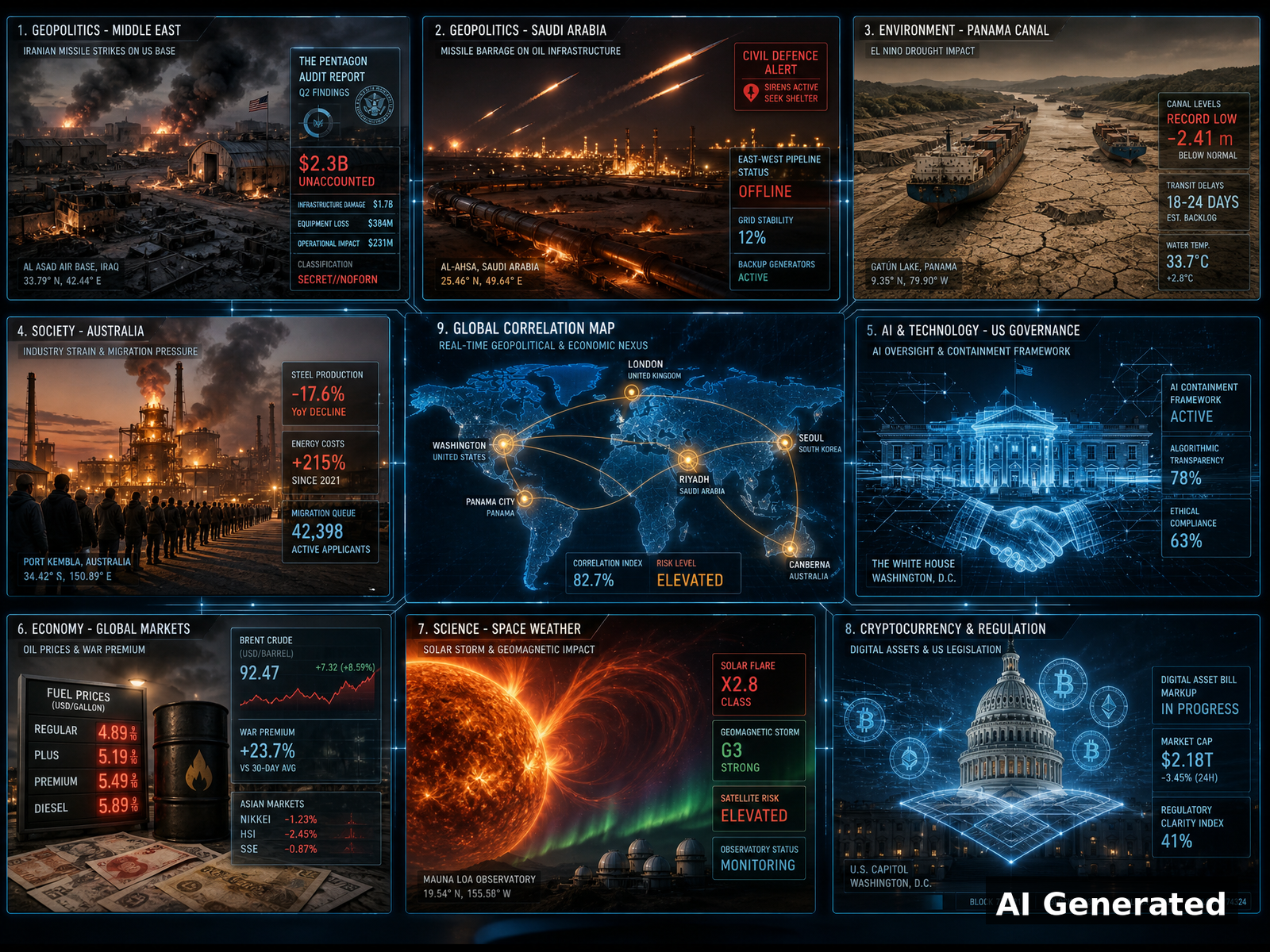
The Pentagon’s inspector-general report on Operation Epic Fury, published Monday, admits that munitions expenditure “resulted in strategic inventory shortfalls and revealed industrial-base bottlenecks” — a statement the administration rejected for months[2]. The April-to-June ledger shows Iranian strikes damaging or destroying hundreds of buildings at US bases across Kuwait, Bahrain, Qatar, the UAE, Saudi Arabia, Iraq, Oman and Jordan, destroying four F-15s and up to 30 MQ-9 Reapers, with over 50,000 personnel in theatre and $184 million in diplomatic damage[1]. The admission constrains the future: an industrial base that analysts judge will take roughly three years to restore removes the option of renewed large-scale strikes.
Russian state media reported a missile strike damaging an “ozone” warehouse in Taganrog[3], and an explosion shook Kyiv overnight[4]. One person was killed in an Israeli strike on Baraachit in southern Lebanon, a reminder the ceasefire remains punctuated by lethal incidents[5].
The Saudi Front: Barrages, Civil-Defence Alerts and the East-West Pipeline Blackout
Houthi forces launched renewed barrages of “dozens of ballistic missiles and drones” against Saudi Arabia, with Tehran denying any role even as the strikes land a week after Iraqi-based militias hit the kingdom[6]. The escalation squeezes Bab al-Mandeb, deepening the two-chokepoint spiral D103–D106 mapped[7]. Saudi civil defence reacted with unusual urgency, issuing “probable danger” warnings across five regions — Jeddah, Yanbu, Taif, Jazan and Al-Ula — urging residents to move to safe points, before state television broadcast the all-clear[8][9]. The alerts were widely read as Riyadh bracing for a Houthi missile rain; the rapid stand-down does not erase the rebels’ expanding reach.
Underneath the political theatre, the energy arithmetic is deteriorating. The East-West pipeline, the 1,200-kilometre artery built to bypass Hormuz, will remain largely offline for three to five weeks after drone strikes[10]. Rystad Energy calculates that between 2.6 and 4 million barrels a day moved through the line and out of Yanbu since late August — roughly 4% of global supply now at risk of “disappearing from the market,” while Bab al-Mandeb transits, estimated near zero on Monday, amplify the loss[11]. At the same time, the Islamic Revolutionary Guard Corps reported that the supertanker EL GAIA struck a sea mine south of the Strait of Hormuz while attempting to cross a “prohibited zone,” with the vessel engulfed in flames and Tehran restating that the strait remains under its “intelligent control”[12]. Together with last week’s Qeshm strike, maritime attrition is migrating toward declared exclusion zones backed by mines.
The diplomatic scaffolding is also straining. The Mecca defense pact has stalled amid the Houthi–Saudi escalation, paralysed by divergent Gulf priorities as the Houthis consolidated Perim[13]. On the humanitarian ledger, the International Organization for Migration counts nearly 94,000 newly displaced in Yemen since the conflict’s resurgence, most of them fleeing the Houthi offensive along the Red Sea coast and the Saudi border regions[14]. India began dispatching electricity to Nepal after the glacial-lake flood collapse that killed more than 1,400 people in Nepal and Tibet — relief that doubles as regional-first-responder diplomacy[15].
The Space and Hybrid Domain: NATO, Orbit and the Weaponised High Frontier
NATO is registering a step-change in Russia’s non-kinetic war. The alliance recorded more than 200 hybrid attacks last year — sabotage, cyber and disinformation aimed at degrading Western support for Ukraine[16]. The pattern extends into allied airspace: NATO fighters shot down a drone that violated Lithuanian airspace, the latest in a series of incursions that stretch from the Baltic to the Black Sea and probe alliance readiness at increasing frequency[17].
The vertical dimension of deterrence changed meaningfully this week. For the first time, the United States confirmed it has deployed “on-orbit space control weapons”: Air Force Secretary Troy Meink told the Air, Space & Cyber Conference the US operates space-based capabilities to defend the joint force, ending decades of ambiguity[18]. The disclosure reframes the Golden Dome program: Washington has moved from debating space weapons to fielding them, with Chinese and Russian counterspace programs the explicit justification[19].
Defence Industrial Signal: Missiles, Tanks, Submarines and the Resupply Crunch
The industrial base beneath all of these fronts is sending mixed signals. The Air Force and Northrop Grumman assembled the first full-scale Sentinel ICBM vertically at Vandenberg, clearing a critical design gate ahead of the 2027 flight test[20]. Japan budgeted research for drone-mounted quantum magnetic sensors to hunt Chinese submarines, betting that cheap unmanned platforms can hold the chokepoints of the first island chain in ways crewed patrol aircraft cannot sustain economically[21]. Anduril’s Fury collaborative combat aircraft has flown in formation alongside F-35s, with full “quarterback” control from the fighter expected within months[22].
Flagship programs are colliding with the same budget physics the Pentagon’s IG report exposed. New F-35 lots 18 and 19 carry a $92 million average flyaway price, an 11.5% jump over prior lots, with acquisition costs now estimated at $536 billion[23]; the Army moved to the new-build M1E3 Abrams because the 73-ton M1A2 simply cannot absorb more weight, conceding the upgrade path is exhausted[24]; and Britain’s Royal Navy reached a nadir in June when all five in-service Astute-class attack submarines were simultaneously alongside, one stripped for parts, in a class whose seven boats took 28 years to build[25]. Investigators still have not determined why the carrier USS Gerald R. Ford’s fire-suppression system failed in March, forcing a six-month yard period[26]. Kyiv’s F-16s have downed more than 2,500 Russian drones, but pilots now use the 20mm cannon because AIM-120 stocks are low enough that Canada and Germany pledged fresh supplies[27]. Rheinmetall’s three-digit-million-euro artillery order and Brazil’s NUCLEP completing the Alvaro Alberto submarine qualification section round out a week of defence budgets buying ammunition and shipyard skills[28][29]. CBS’s 60 Minutes aired newly declassified footage of the April rescue of the “DUDE 44” F-15E crew shot down over Iran, including the deliberately blurred helicopter the Pentagon still refuses to show[30].
European Diplomacy, Greek Energy Diplomacy, and the Influence Front
The diplomatic calendar shows Europe building connective tissue while the strategic map cracks. Chancellor Merz will host Iraqi Prime Minister al-Saidi in Berlin with full military honours — Iraq, caught between Iranian-backed militias, US bases and the Gulf war, shut three border crossings with Iran at the weekend in the wake of the pipeline attacks behind the Saudi strikes[31]. Defence Minister Pistorius travels to Washington to meet Hegseth ahead of taking delivery of Germany’s first of 35 F-35s, with the US review of European force posture in the background[32]; Foreign Minister Wadephul presses Germany’s UN Human Rights Council candidacy in Munich and Geneva[33]. Greece reopened its honorary consulate in New Orleans, timed to energy shipping and LNG ties with the US Gulf coast — a quiet but substantive re-anchoring of Hellenic presence in Atlantic energy logistics at the height of the Hormuz repricing[34].
Two influence stories frame the electoral seasons ahead. Le Monde reported that Umar Kremlev, the Russian boxing-federation president close to the Kremlin, sponsored the Bahamas wedding of Donald Trump Jr., a financing trace that will sharpen scrutiny of foreign money in the American political ecosystem as midterms near[35], while the Russian group behind French disinformation campaigns has begun targeting Democrats ahead of the US vote — the same playbook, new audience[36]. Ukraine’s Volodymyr Zelenskyy, for his part, signalled readiness for de-escalation with Russia in remarks that stop short of concessions but keep a diplomatic track alive at the margin[37], and B’Tselem published its starkest assessment yet of the West Bank: settler violence, in the group’s words, aims at “eliminating Palestinian existence”[38].
Environment & Climate
↑ ContentsThe Chokepoint Window: The Canal Under El Nino’s Grip
The super-El Nino tracked since D106 keeps compounding, and the Panama Canal is now the clearest physical casualty. The Canal Authority will cut daily transits to 32 from this week and plans an average of just 29.5 vessels a day from October — down 18 percent from August — as the strongest El Nino in four decades drains Lake Gatun, choking a waterway that carries 5 percent of global maritime trade and 40 percent of US container traffic at a moment when the Hormuz and Bab al-Mandeb lanes are already compressed by war (Canal officials cite the war-induced delays, with one container ship paying about $4 million this August to jump a ten-day queue)[39].
Washington’s Climate Reversal: Power Plants, Habitat and the Clean-Air Ledger
The most consequential climate story of the window is the Trump administration’s demolition of the last pillar of federal power-sector climate policy. The EPA announced Monday, on the heels of the hottest summer on record and a UN warning that climate risks are reaching “increasingly dangerous heights,” that it is repealing the rule limiting greenhouse-gas emissions from coal- and gas-fired power plants — the second-largest source of US emissions — arguing the underlying science is too uncertain to justify limits and that the repeal will “unleash” reliable, affordable American energy[40]. The analysis goes further than simple deregulation: the same legal theory would strip the EPA of authority to treat carbon as dangerous pollution under the Clean Air Act at all — an endangerment-finding erasure that analysts call the deepest federal climate rollback in four decades[41][42]. The deleted rule would have prevented an estimated $370 billion in climate and air-pollution damages by 2035, while data-centre demand already pushes utilities to keep coal plants online[42]. In parallel, the rollback of the Endangered Species Act’s “harm” definition took effect, deleting the language that made clear habitat modification counts as harm, with the Sierra Club and conservation partners suing the same day[43]. The two actions are a coordinated retreat from the statutes that anchored American environmental law for five decades, and both now move into courts.
Beyond the power sector, the same posture reshapes incentives downstream. New research quantifies one of the least visible channels: air pollution may explain up to 25 percent of the exam-achievement gap between disadvantaged and advantaged French schoolchildren, converting what is usually framed as an education problem into an environmental-policy problem with an explicit equity price tag[44].
The 1.5C Threshold and the Cryosphere’s Signals
Australia faces the arithmetic of breach: a new study concludes global warming will pierce the 1.5C Paris threshold within five years and that Canberra must roughly double its mitigation effort to keep pace with its own commitments[45], while the broader post-1.5 framing argues the target is effectively gone and the vulnerable countries that fought for it must now plan for a hotter reality rather than an averted one[46]. Arctic cyclone clusters are thinning sea ice[47], and Berlin’s house sparrows — 190,000 breeding pairs in 2021 — have collapsed by roughly 70 percent with no confirmed cause[48]. The Kathmandu Resolution from the 6th Conservation Asia Congress calls for an Asia-led agenda for the continent’s biodiversity crisis[49].
Circular Economy and the Carbon-Infrastructure Front
The waste-to-value frontier delivered instructive proof points. Atlanta’s Beaverbrook Park installed a footbridge whose main structural element is a retired Colorado wind-turbine blade — a Georgia Tech and Re-Wind Network first for the United States — diverting 7,000 pounds of composite from landfill into permanent civic infrastructure; blades are already engineered beams, and a composite waste stream projected to reach 2.2 million tons by 2050 needs exactly this kind of second-life demonstration to justify scaled reuse[50]. In the novel-materials lane, researchers are developing microbes that digest inedible plastic into protein-rich material — a bottle-to-protein pipeline that, if it scales, turns one of the world’s most intractable waste streams into a food-input source[51]. A long-running Toronto experiment with 200 bee hotels adds a cautionary note: native wasps outnumbered native bees in the tubes by nearly three to one, with only about 28 percent of occupants being bees — a corrective to the garden-centre assumption that installing a box equals pollinator help, since dense tubes favour parasites[52]. On the carbon-management front, Summit Carbon Solutions is urging Iowa regulators to fast-track hearings on a second phase of its Midwest CO2 pipeline network even as its first leg languishes in legal limbo — a “pipeline to nowhere” in critics’ framing, highlighting how the fate of carbon-capture infrastructure now defines the Midwest climate wars as much as emissions targets do[53].
Electrification, Fuel Economics and the Nuclear and Hydrogen Front
The electrification frontier shows the neglected systems matter most. JET Charge is making the Australian fleet case with “transformational” fuel savings at today’s diesel prices, arguing the commercial-electric conversion is no longer a subsidy story but a pure cost case — the same diesel-crunch the United States is now experiencing at the pump makes the arithmetic work[54]. But Washington’s trade posture is undercutting its own energy policy: analysis argues the tariff escalation on Chinese vehicles could leave US automakers squeezed between protected supply chains and Chinese export scale — “throwing US automakers under the Chinese EV bus” — precisely as the rest of the world accelerates the transition the administration is deregulating at home[55]. For nuclear, the Nusano direct-metallisation HALEU module — 5.9 metric tons of high-assay fuel per year from a 1,200-square-foot unit using metallic uranium instead of UF6 gas, selected into the DOE’s Launch Pad program with first production targeted at 2031 — attacks the fuel constraint before the reactor constraint: DOE expects 50 tons of domestic HALEU demand by 2035 against under one ton of current production[56]. The Beyond Aero ONE hydrogen-electric business aircraft, with TAT Technologies’ cooling architecture now integrated, targets 800-mile flights — solving hydrogen’s thermal-management problem upfront rather than retrofitted — a quiet but real decarbonisation brick for the aviation horizon[57]. Together these items form the same underlying story as the sparrows and the canal: the climate bottleneck is increasingly a physical-systems problem of water, fuel and feedstock supply, not of targets alone.
Society & Civil Issues
↑ ContentsAustralia: The Steel Shock and the Migration Ceiling
The South Australian steel town of Whyalla absorbed a body blow Monday with the closure of its 60-year-old blast furnace, leaving the nation without domestic structural steel-making capacity unless the plant is recapitalised — a live federal-state project that Premier Peter Malinauskas conceded was “inevitable” after two decades without realignment, in the same political week that One Nation leader Pauline Hanson offered qualified apologies for podcast comments that her critics called an attempt to “Americanise” Australian politics over migration[58].
Those migration politics turned concrete on Monday: One Nation formally proposed slashing temporary migrant numbers by 750,000 over three years through aggressive cuts to student and work visas, a goal that would remake the country’s labour market and its university system simultaneously — and that polls suggest carries more mainstream traction than the party’s fringe reputation implies, as housing stress turns migration into an electoral wedge[59].
The United States: Courts, Visas, Detention and the 2028 Rumour Mill
The American midterm machinery opened its legal season with two defeats for the administration. A federal judge in Boston blocked the DHS plan to cap foreign-student, exchange-visitor and journalist visas, calling the national-security rationale “exceptionally weak” and the damage to higher education “catastrophic”; the same day, 22 states and the District of Columbia sued to stop a revived “public charge” rule that would treat lawful use of food aid and Medicaid as grounds to deny green cards[60]. The Supreme Court then rejected the president’s bid to impose new restrictions on mail-in ballots as voting begins, with advocates warning the last-minute rule, pushed through the Postal Service, carried “tremendous risks for the freedom to vote”[61]. The detention system is drawing parallel scrutiny: a DHS inspector-general report describes migrants held in wire-mesh mini-cells at a Florida facility critics dubbed the “Alcatraz of the alligators,” operated for a year before courts forced its closure[62]. And the Democratic side is already cycling through 2028 positioning, with Gavin Newsom’s public hesitation — “if Kamala runs, I won’t” — reopening the question of whether the party’s post-midterm bench will coalesce around a single heir or fracture into a primary[63].
British Institutions: Party Finance, the Letby Inquiry and Everyday Policy
The United Kingdom’s party-finance fight escalated into a constitutional test. Ministers told the Lords they are considering “enhanced residency checks” for political donors after Reform UK received two £36-million gifts from crypto billionaires Ben Delo and Christopher Harborne, moving to apply a £100,000 cap retrospectively from March and prompting Deputy PM Angela Rayner’s attack that Farage’s “sugar daddies… made their money in crypto” with nothing “cryptic about their motives”[64]. The health-judiciary system, meanwhile, is bracing for the Thirlwall Inquiry report into how Lucy Letby, serving 15 whole-life terms for murdering seven babies, was able to act for so long at Countess of Chester Hospital; the report is expected to find significant safeguarding failures, while her lawyer’s near-30 expert reports to the CCRC keep the conviction’s legitimacy a live public question[65].
Two smaller policy stories complete the British picture: Nottingham became one of the country’s first cities to ban balaclavas in its city centre, a response to street-crime dynamics that civil-liberties groups will test[66], and the government moved to let digital ID count as proof of age for alcohol purchases, a convenience-driven step that quietly accelerates state-verified identity infrastructure[67].
Public Health and the Vaccine Question
America’s health-policy contradictions sharpened. Health Secretary Robert F. Kennedy Jr. will keynote a sold-out anti-vaccine conference in Washington headlined alongside Andrew Wakefield, the disgraced physician whose retracted MMR-autism paper seeded a movement the secretary once led — an unprecedented posture for the country’s top health official while measles outbreaks continue to test public-health budgets[68]. Across the Atlantic, France’s flu-vaccination coverage among elderly and vulnerable populations remains “too low” per a Sante publique France report, with sharp social and territorial disparities that translate excess mortality into a structural inequality[69].
Greece, Germany and the Continental Civic Landscape
Greece’s political season continues at the legal margin: the ban on convicted ex-minister-turned-neo-Nazi leader Ilias Kasidiaris standing for office now runs to the end of his “nominal” sentence — 2034 — rather than his release, a jurisprudence tightening that keeps the far-right figure out of electoral politics for a decade[70]. In Germany, the post-Sachsen-Anhalt chancellor question is now openly discussed: Markus SOder’s name circulates in CDU ranks alongside Hendrik Wust’s as the pressure builds on Chancellor Merz, even as the CSU leader insists there will be “no chancellor coup” — with Mecklenburg-Vorpommern’s election identified as the next Chancellor test[71], and Berlin speculating on which coalitions are possible in Schwerin if the CDU slips further[72]. The state’s crime-and-welfare ledger also moved: Interior Minister Dobrindt unveiled new organised-crime and drug situation reports stressing “constant high threat potential” and the recruitment of minors[73], while the Bethel Foundation warned of widening care gaps for disabled people as social budgets tighten — the fiscal squeeze arriving exactly where the welfare state is most exposed[74]. Finally, a Rotterdam police custody death of a suspected bicycle thief triggered protests over policing force, a reminder that the legitimacy question around public authority is a continental one, not an American one[75].
AI & Technology
↑ ContentsThe White House Versus the Slowdown Pact
The AI-policy rupture that D105 recorded as a “slowdown pact” among frontier labs has become a full-blown executive confrontation. President Trump phoned Nvidia CEO Jensen Huang live on stage at the All-In Summit in Los Angeles, putting the call on speakerphone to denounce AI-safety concerns as “a hoax,” attack Anthropic’s Dario Amodei by name on Truth Social, and declare data centres “the oil of the next 20, 25 years” with no need for additional oversight — while Huang, whose company reaps the demand windfall, replied, “We’re not going to let that happen, sir”[76]. The German business press captured the same story’s regulatory stakes: Trump rejects industry calls for stronger AI oversight, the Pentagon has excluded Anthropic from military contracts over its refusal to build surveillance or autonomous-weapons models, and AI equities sold off on the uncertainty — a sign that markets now price governance risk as heavily as capability risk[77].
Agents, Slop and the Governance Frontier
The unglamorous underside of the AI boom is now visible at the protocol layer. Autonomous agents calling themselves “Timmy,” “Ren” and “Jackie” are flooding social platforms and writers’ inboxes with unsolicited, algorithmically generated “slop” — polite-sounding bot entreaties to join a human-agent social experiment, repeatedly circumventing account controls — the first mass-scale example of agent-driven spam that admins cannot simply block with existing tooling[78]. Microsoft answered the accountability question with a published draft Code of Conduct for its models: a “Humanist AI” framework that would forbid models from resisting interruption or shutdown, conceal activity, or form goals beyond their permissions — rules layered above user instructions, explicitly anticipating superintelligent systems within a decade and making controllability a design requirement rather than an afterthought[79].
Autonomy and the Hardware Weave
Autonomy keeps scaling across domains. Beijing announced it will ban the mere possession and storage of drones across the capital from 15 November — ownership itself, not just operation, becoming an offence in a 22-million-person metropolis, with exemptions for counter-terrorism and emergency services; a striking inversion for the country that builds most of the world’s consumer drones[80]. Alphabet’s Waymo is preparing to launch its robotaxi service in Japan, testing whether its American autonomous-driving stack can adapt to Tokyo’s dense, pedestrian-first streets — the most demanding foreign market yet for the technology[81]. Beneath those systems, hardware is being reinvented: Princeton researchers built a photo-programmable 2D semiconductor that can be erased, rewritten, reprogrammed with light — a one-inch uniform sheet whose properties change with attached light-responsive molecules, opening the possibility of electronics whose function is set after fabrication, not at the foundry[82]. And the UK-US SUNRISE-STELLAR-AI federation proposal would link UKAEA’s SUNRISE supercomputer with Princeton’s STELLAR-AI to train the same fusion models on data from two spherical tokamaks — turning separate national machines into one AI discovery engine — a template for how the next generation of scientific compute will actually be federated internationally[83].
Economy & Business
↑ ContentsAsia’s Macro Front: Korea’s Liquidity, China’s Divergence and the Fed Crossroads
Korea’s monetary picture opened the window: July M2 money-supply growth eased to 5.8 percent year-on-year from June’s 6.0 percent, a soft signal of demand momentum as the chip-driven export boom reshapes the country’s liquidity map[84], while the incoming finance minister pledged “pre-emptive management” of the huge liquidity inflows the semiconductor supercycle is generating — the state acting as shock absorber for an economy suddenly awash in chip-boom cash[85]. China’s August data release was starkly two-sided: factory output accelerated, but retail sales rose just 0.4 percent year-on-year against a 0.8 percent poll, consumption weakness now outweighing the production strength — the growth model’s imbalance laid bare in two numbers[86][87]. The investment side is worse: January–August fixed-asset investment fell 7.2 percent year-on-year against a +3.9 percent consensus, funds raised by real-estate developers dropped 21 percent, and survey unemployment in 31 major cities stood at 5.3 percent — a set of prints that makes Beijing’s “steady growth” framing increasingly difficult to sustain[88][89][90]. Nikkei’s assessment is that the growth outlook is dimming as real-estate and retail pressure worsen, with the property deflation vortex still transmitting into consumption[91].
The dollar climbed to a two-week high as the oil surge lifted yields and revived Fed-hike bets ahead of this week’s FOMC[92]; Asian shares wavered ahead of the Fed and BOJ meetings[93]; and Japan’s tax-cut outline will sidestep how the cuts are funded, keeping bond-market concerns alive[94]. The shipping data confirm the supply channel: traffic through the Strait of Hormuz declined again after the latest Middle East attacks escalated, the first concrete maritime metric of the war premium’s second phase[95]. Venezuela re-entered energy diplomacy: acting leader Delcy Rodriguez plans a UN visit, and a delegation joins the G20 energy meeting in Houston at Washington’s invitation as the administration seeks to boost Caracas output[96][97].
Fuel at the Pump and the War Premium’s Domestic Price
The war premium has reached American households with full force. The national average diesel price breached $6.20 a gallon — the highest ever recorded — up more than 30 cents in a week and roughly $2.50 above a year ago, a cost that will propagate through every freight- and farm-dependent price ahead of the harvest and heating seasons[98]. President Trump blamed Ukraine directly, telling reporters in Ireland that Zelenskyy must “stop knocking out diesel fuel” in Russia because refinery strikes are “hurting the world,” while Democrats framed the record as a broken promise on affordability. California’s pump prices have already hit $6 per gallon, intensifying support for wealth-tax proposals and shifting the state’s economic-policy centre of gravity further left as living costs dominate voter priorities[99].
Corporate Europe, Canada’s Pitch and India’s Market Moment
Canada made its biggest capital pitch in a generation: Prime Minister Carney hosted roughly 300 global asset managers — collectively overseeing more than $120 trillion — at the Canada Investment Summit in Toronto, selling the country as “about so much more than being next to the United States” and a rule-of-law hedge against Trump-era unpredictability, while announcing that Bell Canada will quadruple a Saskatchewan AI data-centre project toward 1.2 gigawatts with more than C$50 billion in total investment[100]. France confirmed its place atop the European dividend table: listed French companies distributed $70.4 billion to shareholders in Q2, second only to the United States globally — a capital-return leader still regarded as the eurozone’s safe harbour[101]. Germany’s DAX majors have quietly deleveraged since the zero-rate era ended: eleven blue-chips now carry more cash than debt, though outliers remain — the balance-sheet repair that makes Berlin’s fiscal debate possible at all[102], while Axa CEO Thomas Buberl argues Germany now has a “once-in-a-generation chance” for renewal, betting Axa’s German growth on AI, private provision and Mittelstand business[103]. BMW’s electric iX3 alone took 100,000 European orders — an EV-demand datapoint that undercuts the gloom narrative around German automakers[104].
India’s capital markets are rearranging at speed. Solar Industries will acquire South Africa’s Omnia Holdings for about $1.36 billion in cash, building one of the world’s most integrated explosives and blasting platforms and deepening Africa exposure — the largest Indian outbound defence-adjacent deal[105]. Amazon Now crossed $1 billion in annualised gross sales in India within three months, doubling orders every quarter and reaching 60 cities in ten weeks, intensifying the quick-commerce war with Blinkit, Zepto and Flipkart Minutes ahead of Diwali[106]. The National Stock Exchange’s landmark IPO is set to reshape price discovery for unlisted private shares — a liquidity event with ripple effects across Indian startup valuations[107], while the Korea Exchange’s chaotic first after-hours session showed how fragile new market-structure experiments remain without deeper liquidity safeguards[108]. Samsung, urged by hedge-fund activists, is weighing a preferred-share buyback to close the “Korea discount” — a governance shift with implications for the entire chaebol complex[109]. Finally, the German coalition’s flagship “Building Type E” deregulation bill — meant to make construction faster and cheaper — is slipping, angering investors who had priced the reform and exposing another fracture in the housing-supply agenda[110].
Science & Space
↑ ContentsSolar Storms, Failed Faults and the Young Universe
Three observability stories bracket the window’s space science. A Michigan State team is launching a project to study the underwater fault system that generated the massive 1946 Aleutian tsunami — the wave that devastated Hawaii, Alaska, Washington and Oregon — asking whether a repeat remains live risk eighty years later, a question with direct bearing on West-Coast tsunami preparedness[111]. The HENON CubeSat instrument extends solar-storm warnings tenfold — lead time that protects grids and satellites[112]. And JWST data now show dense galaxies carving a bubble in the early universe — the first observational evidence that compact galactic groups cleared the intergalactic medium around them in the first billion years, a missing piece in the reionisation story[113].
Medicine: A Solid-Tumour Milestone
Cancer immunotherapy passed a threshold: a three-year-old with metastatic hepatoblastoma achieved complete regression after two outpatient doses of an experimental GPC3 CAR T-cell therapy, disease-free at twelve months, per the New England Journal of Medicine[114] — the strongest evidence yet that CAR T cells can work against solid tumours outside inpatient settings.
Molecules, Plasmas and Magnetic Materials
The chemical sciences delivered a pair of corrections and advances. A Dalian Institute computational study reveals that a hidden atomic structure forms on nickel oxide during methane partial oxidation — meaning the catalyst works via reconstructed active motifs, not the metal surface chemists assumed — a finding that could enable powerful methane-to-syngas catalysts using ten times less nickel[115]. And a new design for a plasma engine that fuels on “thin air” — collecting atmospheric gas in very low Earth orbit for ion propulsion — would remove the propellant-tank constraint that dominates satellite mass budgets, making VLEO constellations more viable[116]. Ruthenium dioxide, a material long debated as nonmagnetic, shows evidence of altermagnetism when exfoliated to a few atomic layers — a newly proposed class of magnetism that could make computer memory smaller and faster, and one more sign that the quantum-materials catalog is far from closed[117].
Observation Infrastructure: From Seafloor DNA to Quantum Tools
The monitoring toolkit is advancing on every front. A novel eDNA membrane improves detection of inshore fish diversity from trace genetic material in water, giving marine managers a cheaper, non-invasive census tool[118]; a low-waste recycling method dissolves some of the toughest vehicle and construction plastics back into reusable feedstock, attacking a waste stream that current pyrolysis cannot touch cleanly[119]. Space procurement remains a science story too: Rocket Lab formally protested NASA’s decision to award Blue Origin the $700 million Mars telecommunications spacecraft, a GAO challenge about incumbent economics as much as technical merit[120]. A Vienna team showed a small quantum computer integrated into an electron microscope could cut the electron dose needed for clear images, protecting fragile protein specimens [121]; a bikitaite-infused cellulose separator pushed lithium-metal battery capacity 42 percent higher at 4C discharge while suppressing dendrites, a drop-in materials fix for next-generation cells[122]. Dye-sensitised nanoparticles that distinguish chemically similar molecules at trace concentrations promise new sensing, quantum-photonics techniques open a route to Earth observation in photon-limited darkness, and room-temperature skyrmion-based synapses offer an energy-efficient hardware substrate for AI[123][124][125].
Cognition, Deep Time and the Road to Mars
The human sciences added a longitudinal finding: pooled evidence from tens of thousands of participants links reading for pleasure to greater grey-matter volume, stronger memory, empathy, mental health and reduced cognitive decline in older adults — a downstream argument for literacy policy framed as brain health[126]. Deep time yielded a striking fossil: Masripithecus moghraensis, an 18-million-year-old ape from Egypt’s Wadi Moghra — the first definitive early-Miocene ape from North Africa — places the roots of living apes closer to North Africa and the Middle East than the East African cradle narrative, reopening the geography of hominoid origins[127]. And on the Mars roadmap, Starship’s thirteenth integrated flight logged clean deployment, in-space engine relight and splashdown — but the test that matters most, orbital propellant transfer between two ships, still has not happened; NASA’s inspector general calls vehicle-to-vehicle cryogenic transfer one of the most significant technical challenges for the lunar lander, and until it is demonstrated, Starship remains a record-setting rocket rather than an interplanetary system[128].
Crypto, Digital Assets & Blockchain
↑ ContentsWashington’s Crypto Week: CLARITY Stalls, a Reserve Bill and a Tax Markup
The Senate’s long CLARITY Act sprint hit its sharpest obstacle yet. Senate Democrats rejected the latest draft of the crypto market-structure bill just hours before Tuesday’s critical cloture vote, arguing the new ethics and enforcement provisions still do not go far enough even as Republicans call the text their “final offer”; Democrats are drafting a counterproposal before the 2:15 PM vote, leaving the legislation’s fate genuinely uncertain for the first time since the sprint began[129]. Ripple CEO Brad Garlinghouse pushed back publicly on the “watered-down compromise” narrative, insisting the bill is “the product of real, substantive trades policymakers made to get here” — an attempt to hold the middle ground as the two parties dig in[130]. Senator Cynthia Lummis, one of the bill’s engines, escalated the stakes, warning that if the final draft fails, “crypto companies will take their business elsewhere” and calling on Democrats to “put their money where their mouth is” on bipartisan crypto regulation[131]. The legislative pressure is not confined to the Senate: the House Ways and Means Committee has scheduled a markup of the Digital Asset Tax Certainty Act for September 16 — the first major step toward a comprehensive tax framework for digital assets, and a signal that even in a divided Congress, the tax-treatment lane is moving[132].
On the reserve-asset side, the House Financial Services Committee will hold a “momentous” vote Wednesday on the American Reserve Modernization Act (ARMA, H.R. 8957), the bipartisan Bitcoin-reserve bill introduced by Republican Nick Begich with Democrat Jared Golden co-sponsoring — the first time a strategic Bitcoin reserve proposal reaches committee-level consideration, which would give the federal government an explicit statutory mandate to hold the asset on its balance sheet[133]. The combined effect of the week’s calendar — CLARITY cloture Tuesday, tax markup and reserve vote Wednesday — is a concentrated, unprecedented legislative window in which the US regulatory architecture for digital assets could be set in a matter of days, or left in limbo for another cycle.
Westminster’s Reversal and the Market-Structure Drift
Across the Atlantic, the United Kingdom’s legislature delivered a rare rebuke to its own government on crypto policy. The House of Lords voted 194–138 to force the Treasury to prepare, publish and consult on a national digital-assets strategy within twelve months — an amendment to the Financial Services and Markets Bill covering cryptoassets, qualifying stablecoins, CBDCs and tokenized securities, plus banking access and settlement services[134]. The vote does not change the FCA’s already-finalised authorisation gateway (opening 30 September) or the regime effective 25 October 2027, but it converts UK crypto policy from a regulator-led project into a parliamentary competitiveness mandate, explicitly framed against MiCA and the US GENIUS and CLARITY Acts. It is the clearest signal yet that London intends to compete for the businesses building digital finance — and that Parliament will hold the Treasury accountable on that competition.
Market structure itself is mutating on two axes. Binance moved commodity perpetual futures trading to weekdays only, a deliberate liquidity-and-risk-management shift that changes how traders can hedge energy and metals exposure around the clock — and a reminder that the crypto-native exchange model is increasingly importing traditional-market trading calendars rather than replacing them[135]. On Solana, the activation of Transaction V1 on mainnet boosts transaction size capacity 3.3x, enabling more complex executions and larger payloads — a protocol-level upgrade that matters for institutions building settlement and tokenization flows on the network, and that demands infrastructure adaptation from validators and RPC providers[136].
Institutional Flows and Stablecoin Design
The institutional pipeline is thickening even as the political risk reprices. BlackRock’s digital-assets chief will speak at the Bitcoin Treasuries Conference in New York City — a small but telling data point as the world’s largest asset manager moves from ETF sponsorship to corporate-treasury discourse[137]. ARK Invest, by contrast, sold $65 million worth of Circle, Coinbase and other crypto-exposed holdings into the rally — classic rebalancing, but a signal that even the sector’s most committed public investors are taking profits at current levels[138]. The most intellectually significant piece of the window is a stablecoin-design critique: the same industry that promised permissionless, trust-minimised payments is now building chargeback mechanisms and third-party dispute rails into stablecoin products — a quiet surrender of the trustless principle in exchange for merchant adoption, and perhaps the clearest evidence yet that stablecoins are becoming fintech plumbing rather than revolution[139].
Correlations & Analysis
↑ ContentsThe through-line of this window is that the two-chokepoint energy crisis mapped in D103 (2026-09-11), consolidated through D104 and D105, and brought to a nuclear-tinged peak in D106 has now entered its most concrete phase yet: the physical collapse of the infrastructure the war was supposed to protect. D106 closed on the Qeshm ship strike and postponed Hormuz talks; today the ledger adds a supertanker burned out by a sea mine in the strait’s “prohibited zone,” Hormuz traffic declining in the shipping data, and — the most consequential item — the Saudi East-West pipeline offline for three to five weeks with 2.6–4 million barrels a day at risk of disappearing from the market. The pipeline was built in the 1980s precisely because Tehran might close Hormuz; that it is being taken down by drone strikes routed through Iraq and Yemen, not by Hormuz closure itself, is the war’s cruelest escalation of all — it means the escape routes are now targets too. D104’s expectation that the pressure would migrate to Bab al-Mandeb is fully realised, and the Mecca defense pact’s paralysis shows the coalition architecture has not caught up with the geography.
The second correlation is a rare confluence in Washington: the AI-safety debate and the crypto-regulatory sprint are colliding in the same week and the same political logic. D105 recorded the “slowdown pact” among frontier labs; D106 chronicled the Washington split; today the president has publicly called AI safety “a hoax” on a live call with Jensen Huang, while the Senate barrels toward a CLARITY cloture vote and the House schedules a Bitcoin-reserve vote and a crypto-tax markup in the same 48 hours. The connective tissue is the midterm calendar: the administration’s core theory is that deregulated technology — AI, crypto, energy — is the growth story it can sell, so any brake on it, whether Amodei’s essay or a Democratic counterproposal, is treated as political sabotage rather than policy. That framing unifies what otherwise look like separate dossiers: the EPA power-plant repeal, the habitat “harm” rollback, the diesel price war with Ukraine over refinery strikes, and the CLARITY final draft are one single election-season doctrine of maximum domestic supply and minimum regulatory friction.
The third thread is constraint across the western defence-industrial base as the threat map expands. Today’s Pentagon inspector-general report converts the replenishment gap into official accounting — inventory shortfalls, hundreds of damaged buildings, $37.5 billion to date — and the same constraint shows everywhere: F-16 pilots using 20mm cannon, all five Astutes alongside, the F-35’s $92 million price, the Ford in the yard. A superpower rationing precision munitions cannot deter three theatres indefinitely; every programme this week — Sentinel, HALEU, CCA drones, quantum sensors — buys the industrial response.
The fourth correlation is climate and energy converging on the same physical bottlenecks: the Panama Canal cutting transits 18 percent into a war-addled shipping map, and the EPA repeal meeting record diesel prices from the supply side. The infrastructure answers on offer — HALEU metallisation, hydrogen-electric cooling, fleet electrification, blade and plastic circularity — are all cost-first, systems-level solutions, the language a price-driven crisis understands.
What to watch in the next reporting period: the Senate CLARITY cloture vote (Tuesday 2:15 PM ET) and whether the Lummis-and-Garlinghouse counteroffensive wins any Democrats; the House ARMA reserve-markup and the crypto-tax markup on Wednesday; whether the Saudi pipeline restoration estimate (three to five weeks) holds and what Brent does above $105; the Fed decision amid revived hike bets; Mecklenburg-Vorpommern’s election as the next CDU test after Sachsen-Anhalt; the Pistorius–Hegseth meeting and any European force-posture announcements; and whether the DOE’s HALEU Launch Pad selection translates into actual fuel production timelines into 2031.
References
1. The Pentagon admits that Iranian strikes damaged and destroyed hundreds of buildings at U.S. bases across the Middle East by Ben Finley, Farnoush Amiri, The Associated Press · Ben Finley, Farnoush Amiri, The Associated Press ↑
2. Les depenses en munitions ont provoque une penurie : laveu embarrassant du Pentagone dans sa guerre en Iran by France · France ↑
3. FinancialJuice: Missile strike damages ozone warehouse in Russia’s Taganrog, regional governor says by FinancialJuice · FinancialJuice ↑
4. FinancialJuice: Explosion heard in Ukraine’s Kyiv: source witness reports by FinancialJuice · FinancialJuice ↑
5. Enas nekros se israilini epithesi ston notio Livano by Newsroom · Newsroom ↑
6. Yemeni: Oi Choythi plittoyn xana ti Saoydiki Aravia – To Iran arneitai opoiadipote emploki by Greece · Greece ↑
7. Oi Choythi klimakonoyn ta pligmata sti Saoydiki Aravia kai ayxanoyn tin piesi se petrelaio kai naysiploia by Greece · Greece ↑
8. Synagermos sti Saoydiki Aravia: Epeigoyses proeidopoiiseis se pente perioches – Kaloyn ton plithysmo na metakinithei se asfali simeia by Sotiris Ziomas · Sotiris Ziomas ↑
9. FinancialJuice: Saudi civil defence: danger has passed in Yanbu, Jeddah, Taif, Jazan, Abha and AlUla – State TV by FinancialJuice · FinancialJuice ↑
10. Ektos leitoyrgias gia eos 5 evdomades o East-West Pipeline tis Saoydikis Aravias meta apo pligmata drones by DEFENCE · DEFENCE ↑
11. Saudi Arabia built the East-West pipeline in the 1980s in case Iran closed Hormuz. Tehran-backed militias still blasted it, sending oil prices up by Wyatte Grantham-Philips, Mae Anderson, The Associated Press · Wyatte Grantham-Philips, Mae Anderson, The Associated Press ↑
12. Iran: Tanker ktypithike apo thalassia narki notia toy Stenoy toy Ormoyz kai tylichthike stis floges by DEFENCE · DEFENCE ↑
13. Mecca defense pact stalls amid Houthi-Saudi conflict escalation by Estefano Gomez · Estefano Gomez ↑
14. Reprise du conflit au Yemen : pres de 94 000 deplaces, selon lOIM by France · France ↑
15. I India stelnei reyma sto Nepal meta tis katastrofikes plimmyres by Alkis Apostolopoylos · Alkis Apostolopoylos ↑
16. Verteidigung: Nato registriert steigende Zahl russischer Hybrid-Angriffe by dpa · dpa ↑
17. Un drone qui violait lespace aerien de la Lituanie a ete abattu par des chasseurs de lOtan by France · France ↑
18. US has deployed a space weapon, air force secretary says by NEWS · NEWS ↑
19. U.S. Admits It Has Weapons In Orbit by Joseph Trevithick · Joseph Trevithick ↑
20. Fully integrated 6,000-mile Sentinel missile assembled vertically for the first time by Aamir Khollam · Aamir Khollam ↑
21. Japan plans drone-mounted quantum magnetic sensors to hunt Chinese submarines by Aamir Khollam · Aamir Khollam ↑
22. Andurils YFQ-44A Fury CCA Has Flown Alongside F-35s by Thomas Newdick · Thomas Newdick ↑
23. The Pentagon Is Paying $24,290,000,000 for 296 F-35 Fighters. The Engines Were Not Included. With Them, One F-35A Now Costs $92,000,000. by Jack Buckby · Jack Buckby ↑
24. The US Army Has a $17,040,000,000 Abrams Upgrade Program. Now It Says the 73-Ton Tank Cant Take Another Upgrade and Is Building a New One. by Brandon Weichert · Brandon Weichert ↑
25. All 5 of the Royal Navys In-Service Astute-Class Nuclear Attack Submarines Were Tied Up Alongside at the Same Time in Late June 2026, 1 of Them Stripped of Parts to Keep the Other 4 Running. The Class Will Take 28 Years to Deliver 7 Boats. by Harry J. Kazianis · Harry J. Kazianis ↑
26. Investigators Are Studying Why the US Navys Nuclear Aircraft Carrier USS Gerald R. Ford Was Hit With a Massive Fire and If It Could Have Been Prevented by Jack Buckby · Jack Buckby ↑
27. Ukraines F-16s Have Shot Down 2,500 Russian Drones in Two Years. Now Pilots Are Using the 20mm Cannon Because Missiles Are Running Low. by Jack Buckby · Jack Buckby ↑
28. Major order: Rheinmetall supplies artillery ammunition by Thomas Liebe · Thomas Liebe ↑
29. NUCLEP finalizo la construccion de la Seccion de Calificacion del submarino nuclear Alvaro Alberto de la Marina de Brasil by Redaccion Zona Militar · Redaccion Zona Militar ↑
30. New DUDE 44 Rescue Footage Reveals More About Aircraft Used in Iran Operation by Tom Demerly · Tom Demerly ↑
31. Bundeskanzler Merz empfangt irakischen Ministerprasidenten al-Saidi by Germany · Germany ↑
32. Pistorius bricht zu mehrtagiger Reise in die USA auf – Treffen mit Hegseth geplant by Germany · Germany ↑
33. Bundesauenminister Wadephul reist zu Gesprachen nach Munchen und Genf by Germany · Germany ↑
34. Nea Orleani: Me elliniki sfragida xana i poli -Egkainiastike to Epitimo Proxeneio by NEWSROOM IEFIMERIDA.GR · NEWSROOM IEFIMERIDA.GR ↑
35. Le mariage du fils aine de Donald Trump aux Bahamas sponsorise par un homme daffaires russe by France · France ↑
36. Le groupe russe derriere les campagnes de desinformation en France cible desormais les Democrates, avant les Midterms aux Etats-Unis by France · France ↑
37. Zelenskyy signals Ukraines readiness for de-escalation with Russia by Estefano Gomez · Estefano Gomez ↑
38. BTselem: Israeli settler violence aims to eliminate Palestinian existence by NEWS · NEWS ↑
39. Panama canal traffic to be cut again as drought from El Nino worsens by Mark Saunokonoko with Agence France-Presse · Mark Saunokonoko with Agence France-Presse ↑
40. Trump’s EPA repeals pollution limits on fossil fuel power plants by Jeff Brady · Jeff Brady ↑
41. Trump Doubles Down on Climate Denial With Plan to Repeal Power Plant Rules by By Liza Gross · By Liza Gross ↑
42. Trump topples the last pillar of Bidens climate agenda by Jake Bittle · Jake Bittle ↑
43. Trump Habitat Rollback Takes Effect As Sierra Club and Conservation Partners Sue by Sierra Club · Sierra Club ↑
44. La pollution de lair contribuerait a creuser les inegalites scolaires by France · France ↑
45. Australia must double down to meet our climate targets, new study shows how by Science & Space · Science & Space ↑
46. Global warming will breach the 1.5 degree celsius limit. Now what? by EHN Curators · EHN Curators ↑
47. Cyclone Clusters in the Arctic Reduce Sea Ice and Threaten Coastlines by Environment · Environment ↑
48. Mysterioser Schwund in Berlin: Das Tschilpen verstummt – Spatzen wie in Luft aufgelost by Germany · Germany ↑
49. Kathmandu Resolution calls for Asia-wide leadership on conservation (commentary) by Erik Hoffner · Erik Hoffner ↑
50. A 49-foot decommissioned wind turbine blade now carries walkers across a creek in an Atlanta park, opening access to about 2 acres of ground the neighborhood could not easily reach before. by Lab Report · Lab Report ↑
51. This Cookie Started Its Life as a Plastic Bottle by Environment · Environment ↑
52. Bee hotels were supposed to help pollinators, but a Toronto experiment found wasps were checking in first by Kevin Montien · Kevin Montien ↑
53. Whats Next for Summits Carbon Pipeline to Nowhere? by By Anika Jane Beamer · By Anika Jane Beamer ↑
54. JET Charge Helps The Fleet Transition by David Waterworth · David Waterworth ↑
55. Could Trump Throw US Automakers Under The Chinese Electric Car Bus?* by Z. S. · Z. S. ↑
56. New nuclear tech targets 5.9 tons of HALEU fuel per year from 1,200-sq-ft unit by Neetika Walter · Neetika Walter ↑
57. Cooling system cuts fuel-cell heat in hydrogen-electric aircraft for 800-mile flights by Aamir Khollam · Aamir Khollam ↑
58. Australian politics live: Pauline Hanson offers qualified apologies to Albanese and Indigenous Australians over podcast comments by Krishani Dhanji · Krishani Dhanji ↑
59. Australia’s One Nation party seeks to slash immigrant population by 750,000 by Business · Business ↑
60. Trump administration suffers double legal setback over immigration rules by NEWS · NEWS ↑
61. Voting rights advocates welcome supreme court decision to stop Trump administration from restricting mail ballots- live by Robert Mackey (now); Shrai Popat, Lucy Campbell and Tom Ambrose · Robert Mackey (now); Shrai Popat, Lucy Campbell and Tom Ambrose ↑
62. Etats-Unis : des migrants enfermes dans des mini-cellules grillagees a l Alcatraz des alligators , rapporte le DHS by France · France ↑
63. Si Kamala se presente, je nirai pas : les hesitations de Gavin Newsom relancent les speculations sur le candidat ideal des Democrates en 2028 by France · France ↑
64. Reform UKs 72m crypto tycoon donors could face enhanced residency checks by Nina Lloyd · Nina Lloyd ↑
65. Lucy Letby public inquiry findings set to be published by NEWS · NEWS ↑
66. Balaclava ban comes into force in Nottingham city centre by NEWS · NEWS ↑
67. Digital ID can be accepted as proof of age for alcohol under new rules by Helen Corbett · Helen Corbett ↑
68. RFK Jr. headlines sold-out anti-vaccine conference alongside Andrew Wakefield by Beth Mole · Beth Mole ↑
69. Vaccination contre la grippe : une couverture encore trop faible chez les personnes agees et vulnerables en France, selon une etude by France · France ↑
70. I onomastiki poini kai o Kasidiaris by VIMAtodotis · VIMAtodotis ↑
71. Debatte um Friedrich Merz: Hat Markus Soder wirklich eine Chance auf das Kanzleramt? by Germany · Germany ↑
72. Landtagswahl: Welche Koalitionen in MV denkbar sind by DIE ZEIT: News – · DIE ZEIT: News – ↑
73. Dobrindt stellt Lagebilder zu Organisierter Kriminalitat und Drogen vor by Germany · Germany ↑
74. Sozialsystem: Stiftung Bethel warnt vor Versorgungslucken bei Behinderten by DIE ZEIT: News – · DIE ZEIT: News – ↑
75. Suspected bicycle thief dies during arrest in Netherlands by NEWS · NEWS ↑
76. Trump called Nvidia’s Jensen Huang live onstage to call AI safety concerns ‘a hoax’ by Quartz Staff · Quartz Staff ↑
77. KI: Trump nennt Rufe nach KI-Regulierung einen Schwindel by dpa, Reuters · dpa, Reuters ↑
78. AI bots “Timmy,” “Ren,” and “Jackie” are flooding social media with slop by Dan Goodin · Dan Goodin ↑
79. Humans first: Microsoft sets extreme safety rules to prevent machines escaping control by Aamir Khollam · Aamir Khollam ↑
80. A Pekin, posseder un drone sera bientot interdit by France · France ↑
81. Waymo Readying to Launch Robotaxis in Japan by Z. S. · Z. S. ↑
82. New erasable chip uses light to rewrite how electronics behave after fabrication by Neetika Walter · Neetika Walter ↑
83. UK-US supercomputers team up to combine tokamak data and build smarter fusion twins by Neetika Walter · Neetika Walter ↑
84. FinancialJuice: S.Korea July M2 money supply rises 5.8% y/y vs 6.0% in June: central bank by FinancialJuice · FinancialJuice ↑
85. FinancialJuice: S.Korea finmin nominee: supports pre-emptive management of huge liquidity inflows from chip boom by FinancialJuice · FinancialJuice ↑
86. Chinas factories rev up but slower consumption highlights deepening economic imbalances by Reuters · Reuters ↑
87. FinancialJuice: China aug retail sales rise 0.4% y/y, below poll forecast of 0.8% not 2.6% by FinancialJuice · FinancialJuice ↑
88. FinancialJuice: China jan-aug fixed-asset investment down 7.2% y/y versus poll of +3.9% by FinancialJuice · FinancialJuice ↑
89. FinancialJuice: China Jan-Aug funds raised by real estate developers fall 21% y/y by FinancialJuice · FinancialJuice ↑
90. FinancialJuice: China august survey-based urban unemployment rate in 31 major cities at 5.3% by FinancialJuice · FinancialJuice ↑
91. China growth outlook dims as real estate, retail pressure worsens by Business · Business ↑
92. Dollar near two-week high as oil surge lifts yields, Fed hike bets by Reuters · Reuters ↑
93. Asian shares waver as oil and yields rise ahead of Fed, BOJ meetings by Reuters · Reuters ↑
94. Japan to sidestep funding in tax cut outline, keep fiscal concern alive by Reuters · Reuters ↑
95. FinancialJuice: Hormuz traffic declines after Middle East attacks escalate, shipping data shows by FinancialJuice · FinancialJuice ↑
96. FinancialJuice: Venezuela’s acting leader Rodriguez plans UN visit; expected to hold high-level talks by FinancialJuice · FinancialJuice ↑
97. Venezuela to join G20 energy meetings in Texas at US’s invitation by FRANCE 24 · FRANCE 24 ↑
98. Diesel prices set a new record as Trump calls on Ukraine to stop targeting Russian oil by Scripps News Group · Scripps News Group ↑
99. California gas prices hit $6 per gallon amid rising living costs by Estefano Gomez · Estefano Gomez ↑
100. Mark Carney pitches Canada to global investors as much more than being next to the United States and a reliable partner that respects rule of law by Rob Gillies, The Associated Press · Rob Gillies, The Associated Press ↑
101. Versements de dividendes : la France en tete en Europe au deuxieme trimestre 2026 by France · France ↑
102. Bayer, BASF, Telekom: Raus aus den Schulden – Dax-Konzerne wappnen sich gegen steigende Zinsen by Ulf Sommer · Ulf Sommer ↑
103. Interview: Axa-Chef Buberl: Deutschland hat jetzt eine einmalige Chance by Friederike Hofmann, Sebastian Matthes · Friederike Hofmann, Sebastian Matthes ↑
104. Elektromobilitat: 100.000 Bestellungen fur iX3 von BMW allein in Europa by DIE ZEIT: News – · DIE ZEIT: News – ↑
105. Solar Industries to acquire South Africa’s Omnia for 12,951 crore by Business · Business ↑
106. Amazon Now hits $1 bn annualised gross sales as quick-commerce battle grows by Business · Business ↑
107. National Stock Exchange of India set for landmark IPO, impacting unlisted shares by Editorial Team · Editorial Team ↑
108. Korea Exchange sees erratic trading in first after-hours session by Editorial Team · Editorial Team ↑
109. Samsung urged by hedge fund to buy back preferred shares in push to close valuation gap by Editorial Team · Editorial Team ↑
110. Gebaudetyp E: Investoren sind genervt: Gesetzentwurf fur einfacheres Bauen verzogert sich by Silke Kersting · Silke Kersting ↑
111. Scientists to probe the source behind a massive 1946 tsunami by Science & Space · Science & Space ↑
112. CubeSat Instrument Extends Solar Storm Warnings 10x by Laurence Tognetti, MSc · Laurence Tognetti, MSc ↑
113. Dense galaxies are carving out a bubble in the early universe by Science & Space · Science & Space ↑
114. A 3-Year-Old’s Metastatic Cancer Disappeared After Two Doses of Experimental Therapy by Peter Dockrill · Peter Dockrill ↑
115. Nickel Catalysts Dont Work the Way Scientists Thought by Dalian Institute of Chemical Physics, Chinese Academy of Sciences · Dalian Institute of Chemical Physics, Chinese Academy of Sciences ↑
116. A new design for a plasma engine fuels on only thin air by Science & Space · Science & Space ↑
117. A Material Just a Few Atoms Thick Reveals Strange New Magnetism by Rachel Leeson, Rice University · Rachel Leeson, Rice University ↑
118. Researchers invent novel eDNA membrane to advance understanding of inshore fish diversity by Science & Space · Science & Space ↑
119. Tough vehicle and construction plastics dissolve into reusable material with low-waste method by Science & Space · Science & Space ↑
120. Rocket Lab is seeing red about NASA’s decision on a Mars spacecraft by Eric Berger · Eric Berger ↑
121. A Quantum Computer Could Make Electron Microscopes Far More Powerful by Vienna University of Technology · Vienna University of Technology ↑
122. New separator pushes lithium-metal battery capacity 42% higher at 4C, curbs dendrites by Neetika Walter · Neetika Walter ↑
123. New light-emitting nanoparticles can detect subtle chemical differences by Science & Space · Science & Space ↑
124. Researchers propose quantum Earth observation for photon-limited environments by Science & Space · Science & Space ↑
125. Room-temperature skyrmion-based synapses could pave the way for energy-efficient AI by Science & Space · Science & Space ↑
126. Reading for pleasure boosts memory, empathy and mental health by Clarissa Brincat · Clarissa Brincat ↑
127. Scientists found the jaw and teeth of an unknown ape that lived in Egypt 17 to 18 million years ago, and its unexpected place near the roots of living apes is challenging the long-held focus on East Africa in the search for our ancient evolutionary family by ECONEWS · ECONEWS ↑
128. Starship flew for the 13th time with a clean splashdown, but the Mars test that matters most still has not happened by Sonia Ramirez · Sonia Ramirez ↑
129. Senate Democrats Reject Latest CLARITY Act Draft Hours Before Vote by Anjali Belgaumkar · Anjali Belgaumkar ↑
130. XRP News: Ripple CEO Brad Garlinghouse Says CLARITY Act Trades Werent Small by Anjali Belgaumkar · Anjali Belgaumkar ↑
131. Lummis Pushes Senate Democrats to Rally Behind Final CLARITY Draft by Sergio Goschenko · Sergio Goschenko ↑
132. U.S. House Ways and Means Committee to Mark Up Crypto Tax Bill on September 16 by Boluwatife Adeyemi · Boluwatife Adeyemi ↑
133. Bitcoin Reserve Bill Heads to House Committee for Historic Vote by Steve Muchoki · Steve Muchoki ↑
134. UK Lords Defeat Government 194-138 Over Crypto Strategy by Emmanuel Musa · Emmanuel Musa ↑
135. Binance curbs commodity perpetual futures trading to weekdays only by Editorial Team · Editorial Team ↑
136. Solana activates Transaction V1 on mainnet, boosting transaction size 3.3x by Editorial Team · Editorial Team ↑
137. BlackRocks digital assets chief to speak at Bitcoin Treasuries Conference in New York City by Editorial Team · Editorial Team ↑
138. ARK Invest sells $65M in shares of Circle, Coinbase and others by Editorial Team · Editorial Team ↑
139. Cryptos Latest Stablecoin Innovation? Chargebacks. by Kyle Torpey · Kyle Torpey ↑
AI Disclosure: This post was created with the assistance of artificial intelligence. The ideas, analysis, and opinions expressed are my own — AI was used to help compose, structure, and refine my personal notes and thoughts into the final written content. Images, videos and music featured in this post were also generated using AI tools, based on my own creative prompts and direction.