

Contents
- 1. Geopolitics & Defence
- U.S. Strikes Iranian Rocket Launchers on Larak Island, Reigniting Hormuz Confrontation
- Iran’s President Admits Economic Crisis as Hormuz Traffic Collapses to Five Ships Per Day
- Turkey, Saudi Arabia, Pakistan Hold First “Mecca Pact” Defense Committee Meeting in Istanbul
- Turkey Reveals 40 Special Forces Brigades and $100 Billion Defense Program
- SCO Summit Opens in Kyrgyzstan as China, Russia, and Iran Test Alliance Resilience
- Russia Strikes Western Multinational Facilities in Ukraine in Escalating Economic Warfare
- Kyrenia Ferry Disaster Kills Eight Off Cyprus; Iranian Disobedience Wave Grows
- 2. Environment & Climate
- Germany Records One of Warmest Summers Since Measurements Began; 15,800 Heat Deaths Estimated
- Grand Canyon Flash Flood Leaves Over 15 Missing; Search Operations Underway
- Tunisia Under Near-50°C Heat as Power Cuts Disrupt Water Supplies Across North Africa
- Jellyfish Swarm Forces France’s Largest Nuclear Plant to Shut Three Reactors Again
- COP17 in Mongolia Concludes with $1.3 Billion Green Investment Pledge Amid Multilateral Skepticism
- 3. Society & Civil Issues
- Notting Hill Carnival Opens With Knife Attacks and 169 Arrests Amid Policing Controversy
- UK Schools Face Forced Marriage Crisis: Over 100 Children Under 12 at Risk
- Freediving Australian Nobel Prize Winner and California Grand Canyon Evacuation Drama
- West Point’s Only Climate Scientist Fired After Refusing to Stop Teaching Human-Caused Warming
- Australia Responds to Nepal Flood Crisis; Smartglasses Privacy Debate Intensifies
- 4. AI & Technology
- Meta Testing Data Centre Robots That Could Automate 80% of Some Technicians’ Workloads
- 12TB “Steam Teraleak” Exposes Decade of Lost PC Gaming History Including Half-Life 2: Episode 3
- Nvidia Supplier Unimicron Investigated for Allegedly Relabeling China-Made Components
- AI Agents Need Their Own Identity Layer Before Enterprise Security Can Work, Experts Warn
- 5. Economy & Business
- U.S. National Debt Reaches 124% of GDP, Four Times Higher Than 1980s Levels
- China Manufacturing PMI Improves to 49.8 but Remains in Contraction for Second Month
- Shein Completes Hong Kong IPO at $26.5 Billion Valuation, Down Over 70% From Peak
- Dollar Hits Two-Week High as Warsh Boosts Rate-Hike Expectations; Yen Slips Past 160
- G20 Finance Ministers Meet in North Carolina as U.S. Bars Some Journalists
- 6. Science & Space
- NASA’s Nancy Grace Roman Space Telescope Launches Successfully Aboard SpaceX Falcon Heavy
- Alzheimer’s Nanoparticle Treatment Shows Promise in Reversing Cognitive Decline
- Coffee Consumption Linked to Leaner Body Composition and Sex-Specific Hormonal Profile
- Arthritis Drug Upadacitinib Restores Hair in Severe Alopecia Areata Trials
- 7. Crypto, Digital Assets & Blockchain
- 8. Correlations & Analysis
Click any heading to jump to that section. Click the section heading to return to this menu.
Daily Intelligence Briefing — 2026-08-31 (D92)
Geopolitics & Defence
↑ ContentsU.S. Strikes Iranian Rocket Launchers on Larak Island, Reigniting Hormuz Confrontation
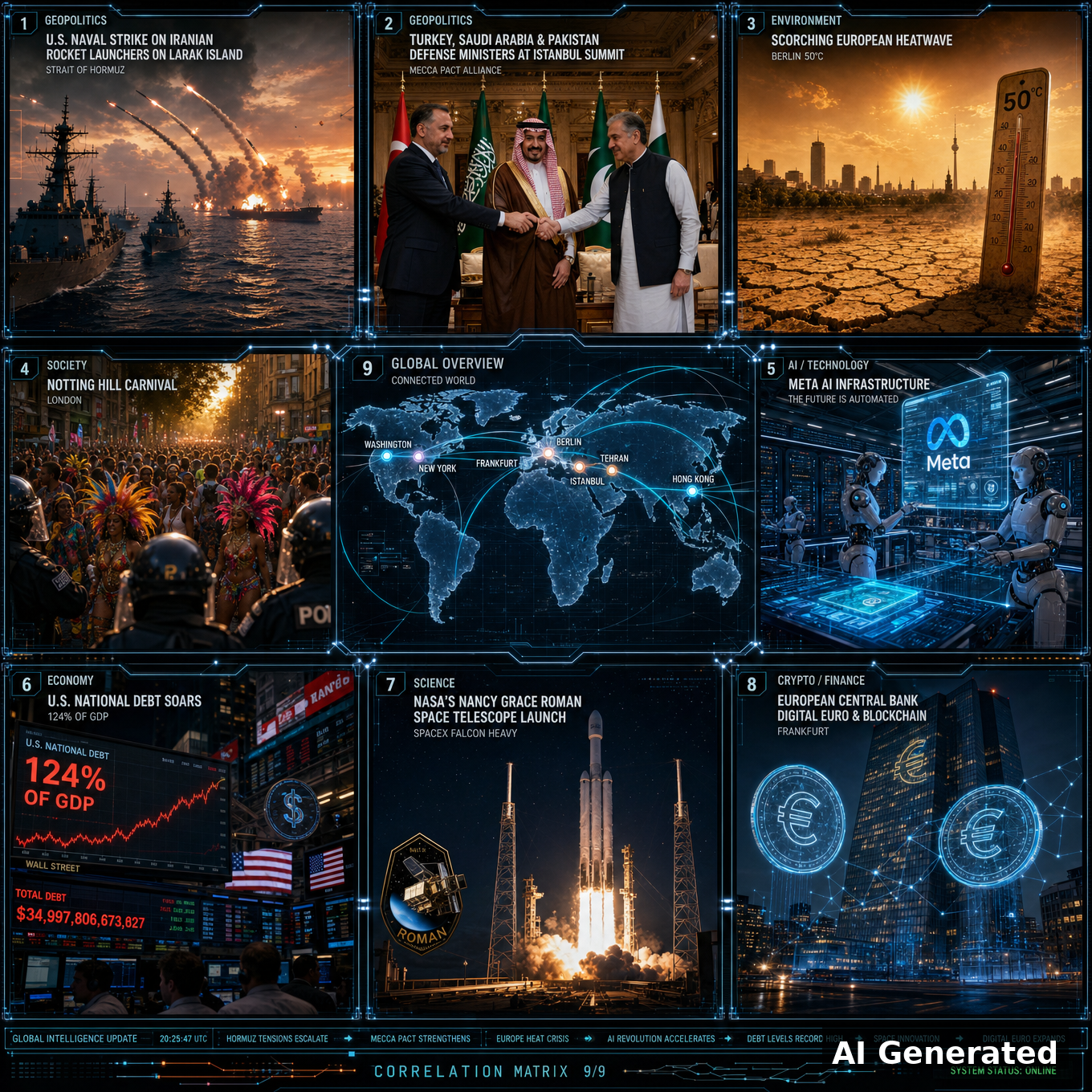
United States forces struck two Iranian mobile rocket launchers positioned on Larak Island in the Strait of Hormuz on Sunday evening, marking the first publicly reported direct American military action against Iranian territory in more than a month and immediately sending Brent crude back above $90 a barrel. The Iranian Revolutionary Guard Corps confirmed casualties from the strike, which CENTCOM spokesman Tim Hawkins said targeted launchers that had been preparing to deploy naval mines toward international shipping lanes through the strait.[1] The attack shattered a fragile military ceasefire that had held since late July, when the last major exchange of hostilities occurred between the two adversaries. Within hours, the IRGC announced retaliatory missile launches from at least four Iranian provinces aimed at what it described as American military targets in Jordan, though no immediate damage reports emerged from Amman.[2] Oil markets reacted sharply, with Brent futures climbing 2.52% to $90.32 per barrel and West Texas Intermediate rising 2.41% to $85.41, as traders priced in renewed supply disruption risk for the 20% of global seaborne oil that normally transits the Hormuz chokepoint.[3]
Iran’s President Admits Economic Crisis as Hormuz Traffic Collapses to Five Ships Per Day
In a striking admission broadcast on Iranian state television, President Masoud Pezeshkian acknowledged that Iran faces “many problems” including inflation that has soared above 80%, unemployment, and a trade contraction of 25-35% since the naval blockade was reimposed. In an interview with Tasnim News on Friday, Pezeshkian stated bluntly that “we may even have missiles and bombs, but they are of no use,” in an apparent rebuke of hardliners who reject negotiations with Washington.[4] Meanwhile, traffic through the Strait of Hormuz has collapsed to just five visible merchant vessels per day according to tracking data released over the weekend, though the actual number may be higher as many ships now disable transponders when transiting the waterway. U.S. forces have redirected 82 commercial vessels, disabled three, and boarded two since the blockade was reimposed, while Central Command said a two-week bombing campaign in late July degraded Iran’s radar and maritime surveillance systems enough to allow nighttime tanker transit through an Omani corridor defended by the U.S. military.[4] The combination of Pezeshkian’s public desperation and the resumed kinetic strikes suggests Washington is pursuing a dual-track strategy of maintaining economic strangulation while neutralizing Iran’s remaining capacity to threaten shipping.
Turkey, Saudi Arabia, Pakistan Hold First “Mecca Pact” Defense Committee Meeting in Istanbul
Senior defense and foreign ministers from Turkey, Saudi Arabia, and Pakistan convened in Istanbul on Monday for the inaugural meeting of the Strategic Political and Defence Committee established under the Mecca Joint Defence Agreement signed on August 7. Turkish Foreign Minister Hakan Fidan hosted his Saudi and Pakistani counterparts to translate what had been a political-level commitment into operational military coordination, including joint exercises, interoperability standards, and a shared roadmap for co-production of missile systems, drones, and air defense platforms.[5] The pact represents the most significant Sunni military alignment in the Middle East since the formation of the Gulf Cooperation Council, combining Turkey’s conventional military capacity and domestic arms industry, Pakistan’s nuclear deterrent, and Saudi Arabia’s financial resources into what analysts have termed an “Islamic NATO.” The committee session comes amid extreme regional instability driven by the Iran war, and Turkish officials have openly discussed potential Egyptian membership to further expand the alliance’s geographic reach. The three nations also plan to formalize a mutual defense clause modeled on NATO’s Article 5, under which an attack on any member state would automatically trigger collective military response.[6]
Turkey Reveals 40 Special Forces Brigades and $100 Billion Defense Program
Turkey disclosed it has reorganized its military into 40 special forces brigades as part of an ambitious restructuring aimed at projecting power across the Aegean, Eastern Mediterranean, and broader Middle East. President Recep Tayyip Erdoğan announced at a military graduation ceremony that the country is simultaneously executing 1,468 defense projects with a combined value exceeding $100 billion, with domestic production now accounting for more than 82% of military hardware — up from negligible levels two decades ago.[7] Separately, Turkish Aerospace Industries confirmed that the first live-fire weapons tests for the KAAN fifth-generation stealth fighter are scheduled for 2027, when a third prototype equipped with internal weapons bays will begin releasing guided munitions from both external pylons and stealth-conformal internal stores.[8] The combined effect of the Mecca Pact, the special forces expansion, and the KAAN timeline positions Turkey as the dominant military power in a reshaped regional order where traditional Western security guarantees have been severely weakened by the Iran conflict’s demands on American and European resources.
SCO Summit Opens in Kyrgyzstan as China, Russia, and Iran Test Alliance Resilience
The Shanghai Cooperation Organisation convened its annual summit in Bishkek, Kyrgyzstan on Monday, bringing together Russian President Vladimir Putin, Chinese President Xi Jinping, and Iranian President Masoud Pezeshkian at a moment when each leader faces significant external pressures. The gathering marks the SCO’s 25th anniversary and occurs against the backdrop of the Iran war’s economic fallout, Russian battlefield attrition in Ukraine, and Chinese economic contraction that saw the official manufacturing PMI improve slightly to 49.8 in August but remain below the 50-point threshold separating expansion from contraction.[9] The summit’s primary agenda centers on expanding the organization’s economic cooperation mechanisms as an alternative to Western-dominated financial architecture, though differences between member states on Iran war mediation and Ukraine conflict positions have exposed fault lines that theSCO’s consensus-based decision-making has thus far failed to resolve.
Russia Strikes Western Multinational Facilities in Ukraine in Escalating Economic Warfare
Russian forces intensified their campaign against Western corporate infrastructure operating in Ukraine, striking facilities associated with Mondelez International, Beiersdorf, Danone, and PepsiCo across Kyiv, Trostyanets, and the Mykolaiv region in what Moscow characterized as legitimate retaliation against economic targets supporting Kyiv’s war effort. A major fire broke out at the SP Hall business center in central Kyiv, damaging offices occupied by several international firms, while a PepsiCo production facility in Mykolaiv was hit for the second time in a month.[10] Separately, Russian ballistic missiles struck a village near Kyiv that housed ammunition storage facilities, killing at least 38 people according to Ukrainian authorities and prompting President Zelensky to reiterate bans on positioning military assets near populated areas. The targeting of Western commercial assets represents a dangerous escalation in the economic dimension of the conflict, forcing multinational corporations and their home governments to weigh the cost of maintaining operations in an active war zone against the precedent of retreating under military pressure.
Kyrenia Ferry Disaster Kills Eight Off Cyprus; Iranian Disobedience Wave Grows
A passenger ferry carrying approximately 270 people capsized off the coast of Kyrenia in northern Cyprus on Sunday, killing at least eight people and triggering a major rescue operation. The vessel, which was traveling between Gazimagusa and Kyrenia, overturned in waters near the occupied coastline, with survivors reporting that the boat listed suddenly before capsizing. Authorities arrested the captain and crew members on charges of negligence and endangering passengers, while Erdoğan confirmed Turkey had mobilized all available rescue assets.[11] In a separate development with potentially far-reaching implications, reports emerged from multiple Iranian cities including Isfahan, Tabriz, and Mashhad of security forces members refusing to execute orders and in some cases publicly denouncing the regime’s failure to pay salaries. Video footage appeared on social media showing police and Basij militia members removing their uniforms, while mass executions of political prisoners at Ghezel Hesar prison near Karaj were reported as the regime attempts to prevent potential mass breakouts during any generalized unrest.[12]
Environment & Climate
↑ ContentsGermany Records One of Warmest Summers Since Measurements Began; 15,800 Heat Deaths Estimated
The German Weather Service (DWD) officially declared the 2026 summer one of the warmest since systematic record-keeping began, with extreme heat events reaching what officials described as “dimensions never before observed in Germany.” A catastrophic heat wave in late June pushed temperatures above 40 degrees Celsius during the day, followed by tropical nights where temperatures failed to drop below 20 degrees — conditions that contributed to an estimated 15,800 heat-related deaths between June and mid-August, according to projections by the Robert Koch Institute.[13] The DWD explicitly linked the unprecedented conditions to anthropogenic climate change, noting that while individual heat events cannot be attributed solely to global warming, the frequency, intensity, and duration of this summer’s heat exceeds natural variability by a significant margin. Agricultural impacts were severe across Bavaria, where cucumber farmers reported that irrigation had become a controversial issue, with authorities receiving reports of illegal water extraction during drought conditions as the water table dropped to historically low levels.[14]
Grand Canyon Flash Flood Leaves Over 15 Missing; Search Operations Underway
A devastating flash flood tore through the Bright Angel Canyon and Phantom Ranch area of Grand Canyon National Park on Saturday, leaving at least 15 people unaccounted for and forcing the evacuation of dozens of hikers from remote backcountry trails. The National Park Service issued an urgent appeal for information about approximately 15 individuals who may have been swept away or lost contact as muddy floodwaters surged through the narrow canyon, destroying infrastructure and cutting off access routes. Helicopter rescue teams from multiple agencies deployed to search the affected area, which includes some of the most remote and inaccessible terrain within the park.[15] The disaster struck during the tail end of the North American monsoon season, when intense localized rainfall can trigger sudden and catastrophic flooding in desert canyons. The event adds to a growing pattern of extreme weather emergencies in the American Southwest this summer, from the wildfire crisis in the Pacific Northwest to record-breaking heat across the southern plains.
Tunisia Under Near-50°C Heat as Power Cuts Disrupt Water Supplies Across North Africa
Tunisia has been pushed to the edge of its infrastructure capacity by temperatures approaching 50 degrees Celsius that have shattered electricity demand records and triggered rolling blackouts affecting water treatment and distribution systems across the country. The extreme heat, which has persisted for more than a week, has overwhelmed a power grid already stressed by aging generation capacity and limited investment, forcing authorities to implement emergency load-shedding that has left hospitals and residential areas without reliable electricity for hours at a time.[16] The crisis is not isolated to Tunisia: across North Africa and the eastern Mediterranean, the combination of drought, heat, and infrastructure under-investment is creating compounding humanitarian risks as populations increasingly depend on electricity for water supply, refrigeration, and cooling. German Foreign Minister Johann Wadephul has scheduled visits to both Tunisia and Algeria this week, where energy security and climate adaptation funding are expected to feature prominently in discussions with counterparts.
Jellyfish Swarm Forces France’s Largest Nuclear Plant to Shut Three Reactors Again
For the second consecutive year, a massive swarm of barrel jellyfish (Rhizostoma octopus) forced the shutdown of three reactors at France’s Gravelines nuclear plant — the largest power station in Western Europe — and reduced a fourth to half power, leaving the facility operating at a fraction of its 5,400-megawatt capacity during peak summer demand. EDF’s preventive patrol boats and thermal monitoring systems, deployed after the 2025 incident at a cost of hundreds of thousands of euros, proved unable to contain the bloom, which local fishermen eventually cleared to the tune of 26 tonnes extracted from the intake channels.[17] Marine scientists have linked the increasing frequency and intensity of jellyfish blooms along European coastlines to warming sea temperatures, overfishing that removes both competitors and predators, and coastal construction that provides ideal colonization surfaces for jellyfish polyps. The incident underscores a growing vulnerability in seawater-cooled nuclear infrastructure that was designed around assumptions of a stable marine ecosystem — assumptions that climate change is systematically dismantling.
COP17 in Mongolia Concludes with $1.3 Billion Green Investment Pledge Amid Multilateral Skepticism
The seventeenth Conference of Parties to the United Nations Convention to Combat Desertification concluded in Mongolia with participating nations pledging $1.3 billion for green investment projects targeting land degradation and drought resilience, though the summit once again fell short of producing a legally binding comprehensive agreement. The difficulty in achieving unanimity was compounded by the broader crisis of multilateralism, as major powers questioned the principle of binding commitments while smaller nations most vulnerable to land degradation pressed for more ambitious targets.[18] The Mongolian presidency emphasized practical cooperation over rhetorical ambition, highlighting specific projects for grassland restoration in Central Asia and sustainable agriculture programs in sub-Saharan Africa. However, environmental organizations criticized the funding level as inadequate relative to the scale of degradation, noting that annual desertification-related economic losses exceed $490 billion globally and are accelerating.
Society & Civil Issues
↑ ContentsNotting Hill Carnival Opens With Knife Attacks and 169 Arrests Amid Policing Controversy
London’s Notting Hill Carnival, Europe’s largest street festival celebrating Caribbean culture, opened its two-day run with two knife attacks and 169 arrests on the first day, prompting Metropolitan Police to declare the event “overwhelmingly positive” despite the security incidents. The arrests covered a range of offenses including possession of offensive weapons, drug offenses, and assault, with the knife attacks — both of which occurred in the early hours of Sunday morning — drawing particular attention given ongoing concerns about violent crime at large public gatherings.[19] The event, which draws approximately two million visitors to west London over the August bank holiday weekend, has long been a flashpoint for debates about policing, cultural celebration, and community relations. The police response this year emphasized proportionality, noting that arrest rates remained well below the historical average for an event of this scale while acknowledging the need for continued vigilance.
UK Schools Face Forced Marriage Crisis: Over 100 Children Under 12 at Risk
More than 100 children aged 12 or younger have been identified in forced marriage concerns in the United Kingdom, prompting warnings that schools reopening in September will reveal additional cases among students who disappeared from educational records during the summer. The revelation came from data released by the government’s Forced Marriage Unit, which handles cases involving British nationals and residents both domestically and abroad, with campaigners noting that school closures during summer holidays provide cover for families to take children abroad for marriages without detection.[20] The Liberal Democrats called for emergency measures to prevent teachers from leaving the profession, citing a separate survey showing nearly half of teachers have considered quitting within the next five years — a trend that would exacerbate the monitoring gaps through which vulnerable children fall undetected. The forced marriage data highlights the intersection of safeguarding, immigration policy, and educational infrastructure challenges facing the UK system.
Freediving Australian Nobel Prize Winner and California Grand Canyon Evacuation Drama
A 34-year-old Sydney woman recounted the extraordinary details of a June encounter with a great white shark at Coogee Beach, describing how she punched the animal repeatedly during the mauling in a fight she compared to “fighting a dinosaur.” Leah Stewart’s account of surviving the attack, which occurred during a morning swim and resulted in significant but non-life-threatening injuries, drew international attention as one of the most vivid shark attack survival stories in recent years.[21] Separately, a dramatic evacuation unfolded in the Grand Canyon where flash floods forced park rangers to rescue dozens of hikers from increasingly dangerous conditions, with helicopter teams searching for at least 15 people who remain unaccounted for in one of America’s most iconic natural landscapes.
West Point’s Only Climate Scientist Fired After Refusing to Stop Teaching Human-Caused Warming
Dr. Adam Kalkstein, the only climate scientist on the faculty of the United States Military Academy at West Point, was fired after he refused to comply with an order to remove content about human-caused climate change from his geography curriculum, according to a federal lawsuit filed in the Southern District of New York. Kalkstein, who taught at the academy for 17 years and describes himself as a conservative Republican, told a November 2025 meeting with then-dean Brigadier General Shane Reeves that the directive was “immoral and potentially illegal,” comparing it to teaching law without mentioning the Constitution.[22] The lawsuit, which is the second legal challenge to academic freedom restrictions at West Point filed this year, comes amid broader Trump administration efforts to reshape the content of military education institutions, including the brief removal of hundreds of books from the Naval Academy’s library earlier this year.
Australia Responds to Nepal Flood Crisis; Smartglasses Privacy Debate Intensifies
Australia’s diplomatic engagement with the Nepal flood disaster deepened as Penny Wong and government officials coordinated international assistance while simultaneously managing domestic political pressures over the response to the Bhote Koshi catastrophe, which has killed at least 690 people with more than 2,400 still missing. Australian nationals remain among those unaccounted for, with the Department of Foreign Affairs working to confirm the status of more than 41 citizens believed to have been in the affected region.[23] In a separate domestic development, Australia’s eSafety Commissioner published new guidance urging smartglasses manufacturers to automatically blur the faces of people filmed without their consent, warning that while devices like Meta’s Ray-Ban smartglasses can offer accessibility benefits to visually impaired users, companies should not “pit accessibility benefits against safety and privacy considerations.”
AI & Technology
↑ ContentsMeta Testing Data Centre Robots That Could Automate 80% of Some Technicians’ Workloads
Meta is actively testing a range of robots inside its data centres that can perform physical maintenance tasks including swapping networking cables, restarting servers, and moving heavy equipment racks, according to a WIRED investigation published this week. The experiments involve machines at different stages of development, from a remotely controlled device that presses power buttons to more ambitious dual-arm robots built by Watney Robotics that have been tested for cabling work at the Altoona, Iowa facility since June 2025. One unnamed Meta data centre worker estimated that a successful cable-swapping robot could automate up to 80% of some technicians’ workloads, though the company declined to confirm this figure and emphasized it was investing heavily in hiring and training data centre workers.[24] The reported programme is not a single humanoid robot but rather a collection of specialized machines: a Kinova Gen3 arm evaluated for power cycling, self-driving tuggers for rack transport, wheeled inventory scanners, and ABB platforms with lift arms for component reseating. Current limitations remain significant — the robots cannot yet work as quickly as humans, struggle with dense cabling in newer Nvidia GB300 systems, and require human intervention for door access and error recovery — but the direction of travel is clear.
12TB “Steam Teraleak” Exposes Decade of Lost PC Gaming History Including Half-Life 2: Episode 3
A massive data leak encompassing more than 12 terabytes of content from Valve’s defunct “Steam2” server architecture has surfaced online via BitTorrent, containing what appears to be every version of every game uploaded to those servers between 2003 and 2013. The collection includes pre-release builds, prototype versions, and playtest builds of titles from both Valve and third-party publishers, with early discoveries including abandoned assets from the never-released Half-Life 2: Episode 3, cut content from Portal 2, and a build of a Portal-universe game called F-Stop that centred on a camera mechanic.[25] The leak also yielded early versions of Call of Duty and Resident Evil installments, Mirror’s Edge prototypes, and Batman: Arkham Asylum builds. The data originates from Valve’s migration from Steam2 to the current SteamPipe distribution system in 2013, and while the gaming community has welcomed the historical preservation value, the leak raises significant questions about digital asset security and the long-term stewardship of proprietary game development archives.
Nvidia Supplier Unimicron Investigated for Allegedly Relabeling China-Made Components
Unimicron Technology, a major printed circuit board supplier to Nvidia and other semiconductor companies, is under investigation for allegedly relabeling components manufactured in China as originating from other countries, in potential violation of U.S. export controls designed to restrict advanced chip technology flows to Beijing. The probe, which has not been officially confirmed by either company, centres on whether Unimicron systematically altered country-of-origin documentation to circumvent restrictions on the sale of sophisticated PCB substrates used in AI training chips and other advanced processors.[26] If confirmed, the case would represent one of the most significant supply chain circumvention incidents in the semiconductor industry’s ongoing effort to comply with U.S. trade restrictions, and could trigger broader enforcement actions across the PCB manufacturing ecosystem where documentation integrity has become a critical compliance battleground.
AI Agents Need Their Own Identity Layer Before Enterprise Security Can Work, Experts Warn
Two major cybersecurity analyses published this week converge on the same conclusion: enterprise AI agents cannot be secured with traditional gateway-and-perimeter approaches and require fundamentally new identity and attribution infrastructure before runtime security controls can function effectively. VentureBeat’s analysis argues that authentication establishes identity but not trust, and that enterprises must implement runtime trust mechanisms that continuously validate autonomous agent behaviour against organizational policy throughout execution.[27] A parallel analysis by principal engineer Nik Kale describes a six-gate dependency model in which agent inventory, distinct identity, scoped credentials, attributable telemetry, and runtime enforcement must be deployed in strict sequence — with the gateway, which most enterprises reach for first, correctly positioned as the fifth gate. Both analyses cite the June CISA advisory on a LiteLLM vulnerability as evidence that the current tool-first approach to agent security has already created exploitable attack surfaces, with the bug allowing command execution on host systems through the gateway itself.
Economy & Business
↑ ContentsU.S. National Debt Reaches 124% of GDP, Four Times Higher Than 1980s Levels
The United States national debt has reached 124% of gross domestic product, a level that exceeds even the peaks recorded during World War II and stands approximately four times higher than the ratio during the 1980s when fiscal conservatism dominated political discourse. The milestone comes amid a period of relative economic stability, raising questions about the sustainability of fiscal policy as interest payments on the debt consume an increasing share of federal revenue and constrain future spending flexibility on defence, infrastructure, and social programmes.[28] The debt trajectory has accelerated since the pandemic-era spending surge, with neither political party demonstrating willingness to address the structural imbalance through either spending cuts or revenue increases. Analysts note that the combination of elevated interest rates, mandated entitlement spending, and expanding defence commitments driven by the Iran war and Indo-Pacific competition creates a fiscal environment where the debt-to-GDP ratio is likely to continue climbing absent significant policy intervention.
China Manufacturing PMI Improves to 49.8 but Remains in Contraction for Second Month
China’s official manufacturing purchasing managers’ index rose to 49.8 in August from 49.2 in July, marking a marginal improvement that nonetheless left the sector in contraction for a second consecutive month, while the non-manufacturing PMI held flat at 49.0 — below both the expansion threshold and the market forecast of 49.5. The composite index came in at 49.5, confirming that China’s economy continued to contract overall despite Beijing’s recent stimulus measures including interest rate cuts and targeted lending facilities.[29] Goldman Sachs analysis projects that China’s domestic supply shortfall for advanced semiconductor wafers (7nm and below) will fall from 92% in 2025 to 34% by 2035 as SMIC expands capacity, though lithography remains the critical bottleneck with the country still reliant on ASML for advanced systems and blocked from extreme ultraviolet machines. The data suggests that China’s industrial base is stabilising but not recovering, with the technology sector’s relative dynamism masking continued weakness in traditional manufacturing and property-related industries.
Shein Completes Hong Kong IPO at $26.5 Billion Valuation, Down Over 70% From Peak
Chinese fast-fashion giant Shein completed its long-delayed initial public offering in Hong Kong at a valuation of approximately $26.5 billion, representing a decline of more than 70% from the $100 billion valuation it commanded in 2022. CEO Sky Xu’s personal wealth has fallen from over $23 billion to approximately $8 billion based on his 30% stake, as the company battled tariff headwinds, political scrutiny over labour practices, growing competition from AI-powered rivals, and a general investor rotation away from e-commerce toward artificial intelligence companies.[30] The IPO’s subdued reception reflects broader challenges facing Chinese consumer brands seeking international capital market access, with several recent Hong Kong listings — including beverage maker Eastroc Beverage and pig breeder Muyuan Foods — trading below their debut prices. Shein’s core strategy of bypassing import taxes through small shipments has been upended by the Trump administration’s elimination of the de minimis tariff exemption and the European Union’s imposition of fixed customs duties on small parcels.
Dollar Hits Two-Week High as Warsh Boosts Rate-Hike Expectations; Yen Slips Past 160
The U.S. dollar climbed to its highest level in two weeks as Federal Reserve Chair Kevin Warsh’s Jackson Hole speech strengthened expectations for an imminent interest rate increase, while the Japanese yen slipped past the psychologically significant 160-per-dollar threshold, prompting renewed warnings from Treasury Secretary Scott Bessent about the potential for currency volatility to destabilize global markets. Warsh emphasized that the 2% inflation target measured by the PCE index represents a “firm, fixed target” and that interest rates remain the Fed’s “predominant tool” for achieving price stability, effectively dismissing speculation that the central bank might revise its inflation goal upward.[31] European Central Bank Governing Council member Dolenc signaled that the Middle East conflict’s impact on energy prices and regional economic resilience argue for further rate increases at the September meeting, while Bank of England Governor Andrew Bailey adopted a more cautious posture, citing “subdued second-round effects” and a “softening labour market” as reasons for patience on tightening.
G20 Finance Ministers Meet in North Carolina as U.S. Bars Some Journalists
G finance ministers and central bank governors convened in Asheville, North Carolina for a two-day meeting overshadowed by U.S. restrictions on media access that drew sharp criticism from press freedom organizations. Bloomberg and the New York Times reported limited accreditation for the event, while German Finance Minister Lars Klingbeil’s delegation included media representatives who were also reportedly affected. U.S. Treasury Secretary Bessent used the forum to press for continued enforcement of Iran sanctions and to promote what he described as the economic isolation of Tehran, while also advocating for supply chain resilience in strategically critical resources including energy and critical minerals.[32] Klingbeil held bilateral meetings with his Canadian and Indian counterparts and visited BMW’s South Carolina manufacturing facility on Tuesday, underscoring the transatlantic dimension of industrial policy discussions at a time when both Europe and the United States are grappling with the fiscal demands of simultaneously funding defence expansion, energy transition, and social spending.
Science & Space
↑ ContentsNASA’s Nancy Grace Roman Space Telescope Launches Successfully Aboard SpaceX Falcon Heavy
NASA’s Nancy Grace Roman Space Telescope launched successfully on Sunday from Kennedy Space Center aboard a SpaceX Falcon Heavy rocket, beginning what the agency describes as a transformative mission to map dark matter, dark energy, and exoplanets across the observable universe with capabilities orders of magnitude beyond the Hubble Space Telescope. The launch proceeded on schedule with favourable weather conditions, and during the post-launch news conference an unusual interruption occurred when NASA Administrator Jared Isaacman received a phone call from President Trump, who personally congratulated the mission team — marking the first time a sitting president has dialed into a NASA post-launch briefing in recent memory.[33] The telescope will spend approximately three months on instrument deployments and calibrations before settling into its operational orbit around Lagrange Point 2, nearly one million miles from Earth, where it will conduct wide-field surveys taking thousands of images daily while conducting new research into the nature of dark energy, the distribution of dark matter through gravitational lensing, and direct imaging of exoplanets around distant stars.
Alzheimer’s Nanoparticle Treatment Shows Promise in Reversing Cognitive Decline
A single injection of an engineered nanoparticle treatment was sufficient to reverse cognitive decline in an animal model of Alzheimer’s disease, according to research from the University of South Carolina published this week. The treatment works by encouraging the generation of new brain cells — specifically astrocytes, the star-shaped support cells that play crucial roles in maintaining neural health and modulating inflammation — effectively reversing the cellular damage that characterises the disease’s progression. The one-time injection approach represents a significant departure from existing Alzheimer’s therapies that require repeated dosing, and if translated successfully to human trials could address one of the most debilitating conditions affecting the ageing global population.[34] The research adds to a growing body of evidence suggesting that regenerative approaches targeting the brain’s support cells may be more effective than treatments focused exclusively on the amyloid plaques and tau tangles that have dominated Alzheimer’s research for decades.
Coffee Consumption Linked to Leaner Body Composition and Sex-Specific Hormonal Profile
A study published in the European Journal of Nutrition has found that higher coffee consumption is associated with reduced body fat, increased skeletal muscle mass, and distinct sex-specific hormonal differences, including elevated testosterone levels in men. Researchers from the University of Oulu in Finland analysed data from 2,264 participants and found that the metabolic benefits of coffee persisted even after controlling for body mass index and lifestyle factors, suggesting that hormonal pathways — particularly those involving sex hormone-binding globulin and branched-chain amino acids — may mediate coffee’s metabolic effects.[35] The findings are correlational rather than causal, and the researchers note that the cross-sectional design means the direction of the relationship cannot be established with certainty. Nevertheless, the study adds to evidence that coffee’s bioactive compounds — of which there are over a thousand — influence human metabolism through mechanisms far more complex than caffeine’s stimulant effects alone.
Arthritis Drug Upadacitinib Restores Hair in Severe Alopecia Areata Trials
An oral drug originally developed to treat rheumatoid arthritis has demonstrated significant efficacy for severe alopecia areata in two international clinical trials, with approximately half of patients achieving at least 80% scalp hair coverage after 24 weeks of treatment and some participants experiencing complete restoration. The trials, published in JAMA Dermatology, tested upadacitinib — a Janus kinase inhibitor that suppresses the inflammatory immune response responsible for attacking hair follicles — in patients who had lost an average of 84% of their scalp hair before entering the studies.[36] The results are particularly notable given the severity of baseline hair loss, and suggest that targeting the underlying autoimmune mechanism rather than stimulating hair growth directly could provide a more effective treatment approach for the estimated 2% of the global population affected by alopecia areata. Longer-term studies will be needed to assess durability of the response and potential risks of sustained immune suppression.
Crypto, Digital Assets & Blockchain
↑ ContentsECB to Launch Tokenized Euro for Institutional Settlement in September
The European Central Bank announced it will launch a tokenized version of the euro for institutional financial settlement in September 2026, marking the central bank’s most significant foray into distributed ledger technology to date. The initiative targets regulated financial institutions rather than retail users, and aims to create a central bank digital currency infrastructure that can facilitate real-time, programmable settlement of interbank transactions on blockchain-compatible platforms.[37] The move positions the euro as the first major reserve currency to deploy institutional-grade tokenization, potentially challenging the dominance of U.S. dollar-denominated stablecoins that currently account for the vast majority of value transferred on public blockchains. European policymakers have emphasized that the project complements rather than replaces existing payment systems, and that the digital euro for retail users remains under separate development with no confirmed launch date. The announcement comes amid growing regulatory clarity in Europe under the Markets in Crypto-Assets framework, which has created what many in the industry describe as the most comprehensive legal environment for digital asset operations globally.
Steak ‘n Shake Officially Declares Itself a “Bitcoin Company”
Steak ‘n Shake, a burger chain founded in 1934, has formally rebranded its corporate identity around Bitcoin, declaring itself a “Bitcoin company” following what the company describes as successful implementation of Bitcoin payments across its restaurant network. The chain reports that Bitcoin transactions have strengthened sales, reduced processing costs, and supported investment in food quality, while extending its Bitcoin strategy beyond checkout to include a corporate Bitcoin reserve and employee bonuses denominated in the cryptocurrency.[38] The move represents one of the most visible examples of mainstream corporate Bitcoin adoption to date, and follows a broader trend of traditional businesses incorporating Bitcoin into their treasury management and payment infrastructure strategies. While the practical impact on the broader crypto ecosystem is limited to one mid-sized restaurant chain, the symbolic significance of an 92-year-old brand explicitly defining itself through a digital asset highlights the continued normalisation of cryptocurrency in conventional business operations.
Geopolitical Tensions and Fed Rate Expectations Weigh on Crypto Markets
The resumption of U.S.-Iran military hostilities and strengthening expectations for Federal Reserve rate increases created headwinds for digital asset markets over the weekend, with Bitcoin and major altcoins trading under pressure as investors sought the perceived safety of the dollar and traditional fixed-income instruments. The combination of an energy price shock from renewed Hormuz instability and tighter monetary policy expectations — driven by Chair Warsh’s Jackson Hole remarks — has historically been challenging for risk assets including cryptocurrencies, which tend to underperform when real interest rates rise and dollar liquidity tightens.[39] However, analysts noted that the crypto market’s response was more muted than during previous geopolitical escalation cycles, suggesting that institutional adoption through ETFs and corporate treasury allocations has created a partial buffer against the kind of panic selling that characterized earlier episodes of macro-driven volatility in digital asset markets.
Correlations & Analysis
↑ ContentsThe D92 reporting period reveals a global order in which the overlapping crises tracked since the D80 cycle are entering a new and more dangerous phase, characterised by the simultaneous resumption of kinetic hostilities between the United States and Iran, the institutionalisation of a Sunni military counter-alliance, and the accelerating erosion of the post-Cold War security architecture in both Europe and the Middle East. The U.S. strikes on Larak Island — the first direct attack on Iranian territory in more than a month — shattered a ceasefire that was never formally negotiated and existed primarily as an absence of active combat rather than a genuine diplomatic achievement. Iran’s retaliatory missile launches from four provinces toward American targets in Jordan suggest that Tehran’s capacity for proportional response remains intact despite months of degradation, creating a cycle of escalation that neither side has yet demonstrated the political will or military capability to break.[1]
The economic dimensions of this escalation are now producing second-order effects that extend well beyond energy markets. The U.S. national debt reaching 124% of GDP creates a paradoxical situation in which the fiscal resources required to sustain a multi-theatre military posture — Iran, Ukraine, Indo-Pacific commitments — are being consumed by rising interest payments on previous borrowing, while the Fed’s determination to maintain the 2% inflation target through rate increases simultaneously tightens financial conditions for the very economies that must fund both defence expansion and energy transition. The G20 finance ministers’ meeting in North Carolina crystallised this tension: Bessent pressed for Iran sanctions enforcement while European counterparts raised concerns about the cascading effects of American monetary tightening on emerging market currencies, with the baht and rupiah identified as particularly vulnerable to capital outflows driven by widening interest rate differentials.[28]
The Mecca Pact’s inaugural ministerial session in Istanbul represents perhaps the most significant structural shift in Middle Eastern security architecture since the formation of the Gulf Cooperation Council in 1981. By combining Turkish conventional military capacity and arms manufacturing, Pakistani nuclear deterrent capability, and Saudi financial resources under a mutual defence framework, the three nations are constructing what amounts to an alternative security order that reduces — and potentially eliminates — dependence on American security guarantees. This development, tracked since the pact’s signing on August 7, now has operational significance as the committee moves from political declarations to concrete interoperability planning, joint exercises, and weapons co-production agreements.[5] For Greece and Cyprus, the implications are immediate and uncomfortable: Turkish military capabilities are expanding at precisely the moment when Greece’s Patriot deployments in Saudi Arabia tie down significant air defence assets in a theatre where their strategic value is increasingly questionable.
The environmental dimension continues to compound in ways that connect directly to the geopolitical instability. Germany’s record heatwave, with an estimated 15,800 deaths attributed to extreme temperatures, coincides with Tunisia’s infrastructure collapse under near-50C heat and France’s nuclear fleet vulnerability to marine biological disruption — all manifestations of the same underlying climate system under stress. The COP17 outcomes in Mongolia, while modest, at least acknowledge the financial scale of the adaptation challenge, even as the $1.3 billion pledge falls orders of magnitude short of what the physical reality demands. These environmental pressures are not abstract future risks but present-day drivers of migration, food insecurity, and political instability that feed directly into the geopolitical dynamics this report tracks.[13]
What to watch in the next reporting period: Whether the resumed U.S.-Iran exchanges remain contained to military targets or escalate to civilian infrastructure; the operational output of the Mecca Pact committee session and any announcements regarding Egyptian participation; the trajectory of Iranian internal security force defections and whether they signal regime-level instability; and the economic fallout of sustained oil prices above $90 on European industrial competitiveness and consumer inflation heading into the autumn.
References
1. “Oil jumps more than 2% after US attack on Iran’s Larak island” — Reuters, 2026-08-31. link ↑
2. “En direct : frappes en Iran, des cibles militaires américaines attaquées en Jordanie” — FRANCE 24, 2026-08-30. link (originally in French) ↑
3. “Πετρελαιο: Άνοδος άνω του 2% μετά την αμερικανική επίθεση στο ιρανικό νησί Λαράκ” — iefimerida.gr, 2026-08-31. link (originally in Greek) ↑
4. “Iran’s president admits ‘we have many problems’ and missiles ‘are of no use’ as the U.S. chokes its economy” — Fortune/AP, 2026-08-30. link ↑
5. “Turkey, Saudi Arabia, Pakistan to hold first defence pact meeting, source says” — Reuters, 2026-08-30. link ↑
6. “Erstes Ministertreffen von neuem Verteidigungsbündnis in Istanbul” — stern.de, 2026-08-31. link (originally in German) ↑
7. “Τουρκική αμυντική βιομηχανία: 1.468 προγράμματα ύψους 100 δισ.$ λέει ο Ερντογάν” — defencenet.gr, 2026-08-30. link (originally in Greek) ↑
8. “Ξεκινούν το 2027 οι πρώτες δοκιμαστικές βολές όπλων για το τουρκικό stealth μαχητικό KAAN” — defencenet.gr, 2026-08-31. link (originally in Greek) ↑
9. “China-led SCO gathers in Kyrgyzstan as Iran tensions test its reach” — Financial Times/Nikkei, 2026-08-31. link ↑
10. “Στο στόχαστρο της Μόσχας οι δυτικές πολυεθνικές στην Ουκρανία” — defencenet.gr, 2026-08-31. link (originally in Greek) ↑
11. “Kyrenia ferry LIVE: Cyprus horror as ferry carrying 270 people capsizes — eight dead” — Express.co.uk, 2026-08-31. link ↑
12. “Ιράν: Κύμα απειθαρχίας στα σώματα ασφαλείας – Μαζικές εκτελέσεις και νέκρωση σε καίριες υποδομές” — defencenet.gr, 2026-08-30. link (originally in Greek) ↑
13. “Sommer 2026: Deutscher Wetterdienst meldet einen der wärmsten Sommer seit Aufzeichnung” — Spiegel, 2026-08-31. link (originally in German) ↑
14. “Landwirtschaft: Endspurt bei der Gurkenernte — Bewässerung sorgte für Fragen” — stern.de, 2026-08-31. link (originally in German) ↑
15. “Une crue soudaine frappe le Grand Canyon aux États-Unis, plus de 15 personnes recherchées” — Le Monde, 2026-08-31. link (originally in French) ↑
16. “Tunisia swelters as power cuts disrupt water supplies” — Al Jazeera, 2026-08-31. link ↑
17. “Jellyfish took three of the six reactors at France’s Gravelines nuclear plant offline this summer” — ScienceBlog, 2026-08-31. link ↑
18. “COP17 in Mongolia wraps up with 1.3 billion dollars for green investment pledge” — Euronews, 2026-08-29. link ↑
19. “Notting Hill Carnival LIVE: Police hail ‘overwhelmingly positive’ vibe despite 169 arrests” — Express.co.uk, 2026-08-31. link ↑
20. “Warning as at least 100 children aged 12 or younger in ‘forced marriage’ concerns” — Independent, 2026-08-30. link ↑
21. “‘Like fighting a dinosaur’: Sydney woman recalls how she punched shark during attack” — BBC News, 2026-08-31. link ↑
22. “West Point’s only climate scientist fired after continuing to teach human causes of climate change” — Grist/Guardian, 2026-08-30. link ↑
23. “Australia news live: new regulations planned for smartglasses” — Guardian, 2026-08-31. link ↑
24. “Meta is reportedly testing robots inside its data centres” — ScienceBlog, 2026-08-31. link ↑
25. “A 12TB Steam ‘teraleak’ spills more than a decade of lost PC gaming history” — Ars Technica, 2026-08-30. link ↑
26. “Nvidia supplier Unimicron probed over allegedly relabeling China-made parts” — Financial Times/Nikkei, 2026-08-31. link ↑
27. “AI agents need their own identity before they need a gateway” — VentureBeat, 2026-08-30. link ↑
28. “US national debt hits 124% of GDP, four times higher than 1980s levels” — Crypto Briefing, 2026-08-31. link ↑
29. “China’s factory activity improves in August but stays stuck in contraction” — Crypto Briefing, 2026-08-31. link ↑
30. “Shein CEO’s wealth slumps $15 billion after whittled-down IPO” — Fortune/Bloomberg, 2026-08-30. link ↑
31. “Dollar near two-week high as Warsh boosts rate-hike bets; yen slips past 160” — Reuters, 2026-08-31. link ↑
32. “G20-Treffen in North Carolina: US-Finanzministerium verweigert Journalisten Zugang” — Die Zeit, 2026-08-31. link (originally in German) ↑
33. “Roman Rises! Five Things to Know About NASA’s New Space Telescope” — Universe Today, 2026-08-30. link ↑
34. “Alzheimer’s hope: Nanoparticles regenerate cells to restore memory” — New Atlas, 2026-08-31. link ↑
35. “Coffee Drinkers Have Less Fat, More Muscle, And Surprising Sex Hormone Differences” — ScienceAlert, 2026-08-31. link ↑
36. “Arthritis drug proves efficacy, some patients report hair regrowth in trial” — Interesting Engineering, 2026-08-30. link ↑
37. “ECB to launch tokenized euro for institutional markets in September” — CoinTurk News, 2026-08-31. link ↑
38. “Why a Famous Burger Chain Now Calls Itself a ‘Bitcoin Company'” — Bitcoin.com, 2026-08-31. link ↑
39. “CNBC Daily Open: War by other means escalates to armed conflict” — Crypto Briefing, 2026-08-31. link ↑
AI Disclosure: This post was created with the assistance of artificial intelligence. The ideas, analysis, and opinions expressed are my own — AI was used to help compose, structure, and refine my personal notes and thoughts into the final written content. Images, videos and music featured in this post were also generated using AI tools, based on my own creative prompts and direction.