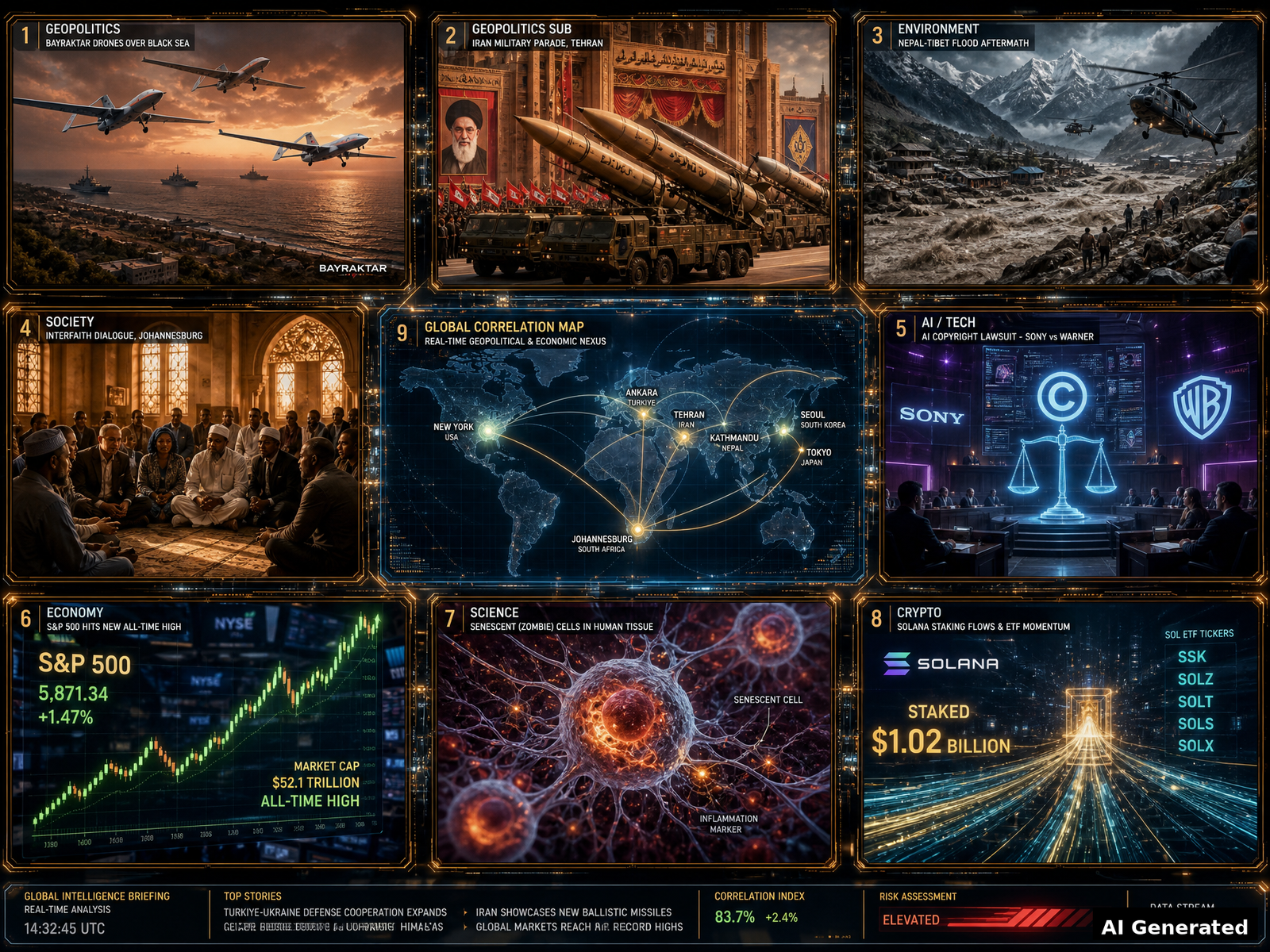


Contents
- 1. Geopolitics & Defence
- Turkish Drones Hit Turkish Vessels in Black Sea, Escalating Ankara-Kyiv Crisis
- Turkey-Somalia Anti-Piracy Operation Kills 14, Signals Expanding Ankara Footprint
- Russia Deploys New Starlink-Jamming Electronic Warfare System at Scale
- Iran Spending Way to Stronger Military Than Pre-War Levels
- Niger Military Uprising Crushed With Russian Assistance
- NATO’s European Missile Defence Faces Dangerous Gap as Russia Eyes Belarus Offensive
- Netanyahu Condemns Settler Violence in Qusra After U.S. Pressure
- 2. Environment & Climate
- 3. Society & Civil Issues
- 4. AI & Technology
- 5. Economy & Business
- US Treasury Bessent Warns Yen Volatility Could Destabilise Global Markets
- S&P 500 Adds $8.7 Trillion Across 22 Sessions Without Decline
- Fossil Fuel Importers Face $330 Billion Cost Surge Amid Iran Tensions
- New U.S. Sanctions Target Ordinary Iranians, Not Just the Regime
- UAE Investigates Egypt’s Banque Misr Following U.S. Dollar Clearing Block
- Iceland Votes Narrowly for EU Accession Talks
- Warsh at Jackson Hole: Key Takeaways on Fed Policy Direction
- 6. Science & Space
- NASA’s Roman Space Telescope Ready for Launch Aboard SpaceX Falcon Heavy
- Scientists Discover ‘Zombie’ Cell Mechanism Driving Chronic Inflammation
- Psilocybin Shows Promise in Treating Post-Treatment Lyme Disease
- Scientists Melt Diamond to Unlock Secrets of Ice Giant Planets
- Prosthetic ‘Skin’ Mimics Pain Sensation to Protect Amputees
- 7. Crypto, Digital Assets & Blockchain
- 8. Correlations & Analysis
- 9. References
Click any heading to jump to that section. Click the section heading to return to this menu.
Daily Intelligence Briefing — 2026-08-30 (D91)
Geopolitics & Defence
↑ ContentsTurkish Drones Hit Turkish Vessels in Black Sea, Escalating Ankara-Kyiv Crisis
Ukrainian drones struck two Turkish-linked commercial vessels carrying goods to Russia’s Black Sea coast in the first major incident directly threatening Turkish maritime commerce in the ongoing Russia-Ukraine conflict, prompting Ankara to summon Ukraine’s ambassador for formal explanations.[1] The first vessel, the Lider Bordo Mavi, was hit by three drones on August 26 near Tuapse on Russia’s Black Sea coast while carrying fresh produce from Samsun to a Russian port, injuring five crew members.[1] The second vessel, Lider Kocatepe, was dispatched to assist the stricken ship and was itself targeted by drone fire on August 27, sustaining material damage before returning to Samsun.[2] Turkey has repeatedly expressed concern about the expansion of the Russia-Ukraine conflict into maritime spaces and the danger of civilian ships being caught in combat operations, making this escalation a significant diplomatic test.[2] Ankara’s summoning of the Ukrainian ambassador signals that Turkey, which has maintained a delicate balancing act throughout the conflict, may be forced to recalibrate its position if civilian shipping continues to be targeted.[1]
Turkey-Somalia Anti-Piracy Operation Kills 14, Signals Expanding Ankara Footprint
Turkish and Somali naval forces completed a ten-day operation off the coast of Somalia to liberate the Cameroon-flagged cargo vessel MV LATUF, killing 14 pirates and destroying four pirate craft in a significant escalation of maritime security operations in the region.[3] The Turkish navy conducted the operation in coordination with the Somali military, locating the vessel near Eyl in the Nugaal region of Puntland and applying sustained pressure until the pirates abandoned the ship.[3] Reports indicated the vessel may have been carrying Turkish military equipment, though this was not officially confirmed by either government.[3] The operation comes amid a resurgence of piracy off the Horn of Africa, with at least 15 incidents recorded since the beginning of 2026 — the highest level since 2013.[3] At least five vessels remain under pirate control, including a seizure as recent as August 20 off the coast of Yemen.[3] The operation demonstrates Turkey’s expanding naval capabilities and its strategic interest in protecting maritime commerce across multiple theatres simultaneously.[3]
Russia Deploys New Starlink-Jamming Electronic Warfare System at Scale
Russia has begun mass production of the Volna Kupol Garant electronic warfare system, designed to disrupt and blind Starlink satellite terminals that have become critical to Ukrainian military operations, representing a significant escalation in the electronic domain of the conflict.[4] The system, manufactured by Russkii Kupol based in Sevastopol, creates interference across eight frequency bands in the 14 to 14.5 GHz range with 62.5 MHz bandwidth each, and a single system can cover approximately 20 square kilometres.[4] It is deployed on six towable platforms, each carrying two antennas, allowing for extensive interference coverage.[4] The development is considered particularly significant because Starlink has acquired a critical role in Ukrainian military operations, providing satellite connectivity in areas where conventional communications infrastructure has been destroyed.[4] Disruption of Starlink connections could create “dead zones” for ground terminals, severely hampering the coordination of Ukrainian units and their ability to operate systems that depend on the satellite connection, including real-time drone operations.[4]
Iran Spending Way to Stronger Military Than Pre-War Levels
Despite six months of war, devastating sanctions, and a naval blockade that has collapsed trade by 35%, Iran is accelerating military spending to levels exceeding its pre-war capabilities and actively preparing for a future rematch, according to analysis of Tehran’s budget allocations and procurement patterns.[5] The IRGC’s expanding influence has effectively sidelined President Pezeshkian, raising stability concerns about the presidential office’s future role in governance.[6] New U.S. sanctions targeting ordinary Iranians — including digital assets, gold, technology, aviation, and shipping — are described by analysts as the lifelines that keep the civilian economy functioning rather than regime channels, raising questions about whether economic pressure can achieve strategic objectives when it primarily damages the population rather than the military apparatus.[7] Parliamentary Speaker Ghalibaf acknowledged the country faces “great, complex, and multiple open and hidden challenges,” while oil workers in Asaluyeh staged protests demanding relief from the cost-of-living crisis.[7]
Niger Military Uprising Crushed With Russian Assistance
Soldiers from multiple regions of Niger converged on Niamey and attempted to seize control of several strategic sites in the capital, including the presidential palace and airport, before the junta — with the assistance of Russia’s Africa Corps — repelled the attackers.[8] Heavy fighting broke out around key installations, with exchanges of fire and explosions reported in the capital overnight.[8] The junta subsequently confirmed it had regained control of the situation, marking the latest instance of Russia’s military presence in Africa being deployed to shore up allied governments against internal military threats.[8] The incident underscores the fragility of military governments in the Sahel region and the growing role of Russian military contractors in sustaining their grip on power.[8]
NATO’s European Missile Defence Faces Dangerous Gap as Russia Eyes Belarus Offensive
Europe faces a critically thin missile defence posture at the precise moment when intelligence assessments indicate Russia may be preparing a potential ground offensive from Belarus, creating a vulnerability that could reshape the continent’s geopolitical landscape.[9] The assessment arrives as multiple NATO allies have depleted interceptor stocks supplying Ukraine and as the Iran war has stretched U.S. military capacity across multiple theatres simultaneously.[9] Finnish President Stubb indicated he does not currently believe in a Russian attack on NATO but acknowledged the threat environment required continued vigilance.[9] The gap between Russia’s demonstrated willingness to escalate and Europe’s declining ability to absorb and deter such moves represents what analysts describe as the most dangerous security configuration on the continent since the Cold War’s final phase.[9]
Netanyahu Condemns Settler Violence in Qusra After U.S. Pressure
Israeli Prime Minister Benjamin Netanyahu issued rare public criticism of Israeli settlers, condemning the violent attacks in the West Bank villages of Qusra and Jalud and stating that such actions damage Israel’s position in the world.[10] The condemnation came after footage showed dozens of masked settlers attacking homes and besieging Palestinian residents, with at least seven Palestinians reportedly trapped inside a house while attackers threw stones.[10] Separately, the Israeli military conducted strikes near the Al-Aqsa Martyrs Hospital in central Gaza, claiming to target a Hamas commander, though the hospital reported three people injured by the strike.[11] The combination of the Netanyahu statement and the continued hospital-area strikes illustrates the competing pressures facing the Israeli government — international demands to restrain settler violence alongside ongoing military operations in Gaza.[10]
What to watch: Whether Turkey formally adjusts its diplomatic stance toward Ukraine following the drone strikes on Turkish vessels; the trajectory of the Russia-Ukraine electromagnetic contest around Starlink; Iran’s next military procurement moves as spending accelerates; and whether Netanyahu’s settler condemnation translates into operational enforcement on the ground.
Environment & Climate
↑ ContentsNepal-Tibet Flood Death Toll Surpasses 690; International Search Intensifies
The death toll from the devastating Bhote Koshi flash floods along the Nepal-Tibet border has climbed to at least 690, with more than 2,400 people still missing, as rescue operations face increasingly difficult conditions from deposited mud and secondary flood risks.[12] The disaster, triggered by a glacial collapse that registered as a magnitude 5.2 seismic event, represents a compounding crisis linked to accelerating Himalayan glacial retreat driven by climate warming.[12] Among those unaccounted for are more than 30 British nationals and 41 Australians, with teaching hospitals in Kathmandu posting photographs of unidentified victims on walls as families continue their search.[13] Chinese authorities warned of continued danger from an unstable upstream lake formed from the debris-dammed river, though water has begun draining naturally from the barrier.[12] The disaster has prompted urgent calls for climate action, with Nepal and the United Nations invoking climate change as the underlying driver of the catastrophe.[13] Rising temperatures have destabilised glaciers across the Himalayas, creating the conditions for precisely this type of glacial lake outburst and debris flow event that scientists have warned about for decades.[13]
European Summer Drought Drives Desertification Threat and Agricultural Collapse
Persistent drought and scorching heat across Europe have reached levels where desertification is emerging as a genuine threat, with Hungary declaring that 99% of its lands are under severe or extreme drought conditions.[14] The country’s approximately 27,000 hectares of fish ponds have been devastated, with 1,588 hectares drying out and nearly 280 metric tons of fish dying at 20 farms, causing estimated revenue losses of 1.3 billion forints ($4.2 million).[14] In Romania, fish farmers describe compounding losses from repeated drought years in 2023 and 2024, with the three-to-four-year carp production cycle meaning that this year’s losses will continue to compound through 2028.[14] The Danube’s side channels in Serbia have shrunk to mere ponds, with water temperatures exceeding 30 degrees Celsius threatening fish survival.[14] Slovenia’s firefighters have pumped 8 million litres of water into Lake Pristava to prevent mass fish suffocation, representing the kind of emergency intervention that is becoming routine across the region.[14]
Climate Change as Driving Force Behind Nepal Disaster
Scientists examining the Nepal-Tibet flood have identified rising temperatures as the primary driver, with Himalayan glaciers losing nearly a quarter of their area between 1970 and 2010 and more than 160 smaller glaciers in the country having vanished entirely.[13] A 2,000-foot-wide section of ice is believed to have fallen nearly 4,000 feet, “pulverising the ice into water” with catastrophic force, while warm temperatures that week may have contributed to the initial glacier instability.[13] The disaster carries grim implications as Himalayan glaciers retreat at accelerating rates, creating the conditions for more frequent and destructive glacial lake outburst floods across South Asia.[13] A study published in Science of 23,424 investment funds holding $25 trillion found that only 1.5% were aligned with limiting warming to 1.5 degrees Celsius, and none once emissions from suppliers and products were counted — a finding that underscores the systemic failure of financial institutions to address the crisis driving these disasters.[15]
What to watch: Whether the Nepal-Tibet debris dam breaches creating a secondary flood event; the trajectory of European drought through the autumn agricultural season; and whether glacial lake outburst events in the Himalayas increase in frequency as the 2026 monsoon season continues.
Society & Civil Issues
↑ ContentsAnti-Muslim Backlash Collides With Different Reality in South Africa
South Africa faces a growing disconnect between online anti-Muslim rhetoric that has intensified in recent months and the more complex reality of inter-community relations on the ground, as social media amplification drives a narrative of religious conflict that does not reflect lived experience in many areas.[16] The online backlash has gained traction partly through the political positioning of certain South African parties seeking to consolidate support in certain communities, but analysts note that the ground-level reality of daily coexistence tells a different story from the online narrative.[16] The phenomenon mirrors a global pattern where social media platforms amplify minority views into perceived majorities, with real consequences for community cohesion and the potential for actual violence.[16] Community leaders and civil society groups are working to counter the online rhetoric through grassroots dialogue, but the challenge of combating viral misinformation in a society still deeply marked by apartheid-era divisions remains formidable.[16]
US Court Protects Students Criticising Israel From Deportation
A federal judge in California ruled that the Trump administration’s targeting of students who criticise Israel for deportation violates the First Amendment, finding that “freedom of speech is illusory if we are only free to express complementary views about the government and its leaders.”[17] Judge Noël Wise cited retaliation against people who engaged in speech supporting Palestinians, as well as retaliation against those critical of Charlie Kirk after his assassination, as evidence of the administration’s use of deportation threats to silence protected political expression.[17] The decision builds on similar findings by a Boston district judge nearly a year ago, and noted that at The Stanford Daily, noncitizen staff had quit, withheld articles, and refused assignments due to fear of adverse immigration consequences.[17] The ruling represents a significant judicial check on the administration’s efforts to use immigration enforcement as a tool for suppressing campus political speech.[17]
Peru’s Fujimori Requests Emergency Powers to Combat Organised Crime
Peru’s President Keiko Fujimori has requested extraordinary powers from Congress to combat the country’s worsening security crisis, proposing that criminal organisations be classified as “terrorist organisations” and seeking authority to legislate for 120 days through executive decree.[18] The request comes as the country faces its worst security crisis since the end of the Maoist insurgency in 2000, with homicides more than doubling from 1,000 in 2018 to 2,600 in 2025, and extortion reports increasing dramatically from 3,200 to 26,500 over the same period.[18] Prime Minister Galarreta stated that criminals “defy the state, looking for places where there are neither soldiers nor police” and argued that citizens want to see “strong reactions” to the crime wave.[18] The government is also addressing the effects of El Niño, which meteorologists warn could be the strongest on record this year, compounding the security challenge with climate-driven agricultural disruption.[18]
What to watch: Whether Congress grants Fujimori’s emergency powers request and what restrictions might accompany them; the effect of South Africa’s online-to-real-world dynamics on community relations; and how the US judicial ruling on student speech may affect broader deportation enforcement patterns.
AI & Technology
↑ ContentsSony and Warner Sue Anthropic in Largest AI Copyright Case
Sony Music and Warner Chappell filed suit against Anthropic in the US District Court for the Northern District of California, seeking damages for what they describe as “tens of thousands” of copyrighted works used without permission to train Claude, the company’s flagship AI system.[19] The companies are asking for up to $150,000 per work and up to $25,000 for each instance where identifiable copyright data was stripped, meaning total damages could amount to several billion dollars if the court finds in their favour.[19] The lawsuit comes just weeks after Anthropic settled a separate publishing industry copyright case for $1.5 billion, and adds to a growing catalogue of legal challenges from Universal Music, Concord, ABKCO, and other rights holders who allege the company built its commercial advantage on stolen intellectual property.[19] The breadth of this latest filing — spanning music, lyrics, and compositions across multiple decades — makes it one of the most comprehensive copyright challenges to the AI industry’s training data practices to date.[19]
China Could Slash Advanced Chip Supply Gap to 34% by 2035
A Goldman Sachs analysis projects that China’s domestic supply shortfall for wafers manufactured using advanced processes of 7 nanometres and below is set to fall from 92% in 2025 to 34% by 2035, as SMIC expands production capacity and improves yields.[20] The analysis assumes SMIC will add between 30,000 and 50,000 advanced-node wafers in monthly capacity each year from 2026 through 2031, with production yields projected to increase from 23% in 2026 to 50% in 2030 and 75% by 2035.[20] For comparison, TSMC began mass-producing 7nm chips in 2018 and can achieve yields exceeding 90%, highlighting the gap that remains.[20] China’s semiconductor capital expenditure is expected to continue growing at double-digit annual rates, reaching $82 billion in 2030, while lithography remains the critical bottleneck, with the country still reliant on ASML for advanced systems and blocked from extreme ultraviolet machines.[20]
Elon Musk Warns 15GW of AI Compute May Sit Stranded in 2027
Elon Musk has warned that approximately 15 gigawatts of AI compute infrastructure may sit stranded by 2027, with the potential delay in infrastructure readiness threatening to hinder technological advancements and economic returns for the broader industry.[21] The warning comes as US investment-grade corporate bond issuance has totalled approximately $1.7 trillion year-to-date, about 27% above last year’s pace, with AI-related bonds generating enormous demand despite the deployment risks Musk identified.[21] The prospect of stranded compute creates a scenario where billions in capital expenditure could generate insufficient returns, potentially triggering a broader reassessment of the AI investment cycle and its economic sustainability.[21]
AI-Equipped Robots and Drones to Assist Fukushima Nuclear Cleanup
Japan’s ongoing efforts to decommission the Fukushima Daiichi nuclear plant will increasingly rely on AI-equipped robots and drones, as radiation levels in certain areas remain too dangerous for human workers to approach.[22] The technology represents a growing deployment of artificial intelligence in hazardous environments where human risk is unacceptable, combining autonomous navigation with radiation-tolerant construction and real-time decision-making capabilities.[22] The initiative draws lessons from earlier robotic deployments at the facility, where previous robots experienced failures from radiation damage to electronic components.[22] The Fukushima application is part of a broader trend of AI deployment in nuclear environments worldwide, from power plant inspection to waste management.[22]
What to watch: Whether the Sony-Warner case establishes new legal frameworks for AI training data in the music industry; China’s progress toward semiconductor self-sufficiency as US export controls evolve; and the real-world implications of Musk’s stranded compute warning for the AI investment cycle.
Economy & Business
↑ ContentsUS Treasury Bessent Warns Yen Volatility Could Destabilise Global Markets
US Treasury Secretary Scott Bessent has warned that disorderly moves in the Japanese yen risk spilling over into global markets, raising concerns about currency intervention policy and the potential for competitive devaluations amid geopolitical uncertainty.[23] Bessent stated that volatile yen movements “can destabilize global markets” in a warning directed at both Japanese authorities and international traders, coinciding with South Korea’s appointment of a new finance minister as part of regional economic management changes.[23] The statement reflects growing anxiety about the interconnected risks of the Iran war’s effect on energy prices, central bank policy divergences, and the potential for sharp currency moves to trigger cascading market disruptions across Asia and beyond.[23]
S&P 500 Adds $8.7 Trillion Across 22 Sessions Without Decline
The S&P 500 has achieved a rare extended period of stability, trading for 22 consecutive sessions without a decline and adding approximately $8.7 trillion in market capitalisation during the streak.[24] However, analysts caution that the extended stability may mask underlying risks, as historically, periods of low volatility often precede sharp corrections rather than reflecting genuine market strength.[24] The rally has persisted despite elevated interest rates, geopolitical uncertainty, and mixed economic signals, suggesting either genuine economic resilience or the build-up of complacency that typically precedes a market reversal.[24]
Fossil Fuel Importers Face $330 Billion Cost Surge Amid Iran Tensions
Global fossil fuel importers face a projected $330 billion additional cost burden driven by the sustained elevated energy prices resulting from the U.S.-Iran conflict, according to an analysis by the Centre for Research on Energy and Clean Air.[25] The analysis projects that geopolitical tensions could drive sustained high energy prices, potentially reaching record crude oil levels and increasing market volatility, particularly for countries dependent on Middle Eastern supplies that transit the Strait of Hormuz.[25] The projected cost surge underscores the massive economic externalities of the conflict and the structural damage to global energy supply chains that may persist for years even after a diplomatic resolution.[25]
New U.S. Sanctions Target Ordinary Iranians, Not Just the Regime
The latest round of U.S. sanctions against Iran targets what Treasury Secretary Bessent described as five “most vital lifelines” — digital assets, technology, gold, aviation, and shipping — but analysts note these are primarily the mechanisms through which ordinary Iranians, not the regime, access the global economy.[7] Esfandyar Batmanghelidj of the Bourse and Bazaar Foundation explained that “digital assets and gold are how ordinary Iranians protect their savings from inflation,” while technology keeps them connected and shipping moves essential goods including food and medicine.[7] Despite the economic pressure, preliminary shipping data showed only seven commodity vessels crossed the Strait of Hormuz, down from 10 the previous day, indicating that even nominal de-escalation has not translated into material improvement in maritime commerce.[7] Oil workers in Asaluyeh staged protests against the cost-of-living crisis, while teachers and steelworkers reported not being paid, suggesting the sanctions may be generating domestic unrest that could complicate any diplomatic resolution.[7]
UAE Investigates Egypt’s Banque Misr Following U.S. Dollar Clearing Block
The United Arab Emirates central bank has launched a special urgent investigation with forensic review of Egypt’s Banque Misr branches in the UAE, following U.S. authorities’ decision to block the bank’s access to dollar-clearing infrastructure over its dealings with Iran.[26] The UAE central bank stated that banks licensed in the UAE “should avoid exposing the financial system to reputational risks,” signalling that the move represents both compliance with American sanctions pressure and a broader assertion of regulatory control.[26] The investigation extends the U.S. secondary sanctions regime into the Gulf financial architecture, potentially creating ripple effects across the entire network of Middle Eastern banking relationships with Iran.[26]
Iceland Votes Narrowly for EU Accession Talks
Early results from Iceland’s referendum on restarting EU accession talks showed a narrow majority in favour of re-engaging with the European Union, potentially reversing the island nation’s 2015 decision to suspend its membership application.[27] The vote, still being counted, reflects growing concerns about economic security in a world where small nations face heightened vulnerability to geopolitical disruption and trade fragmentation.[27] A “yes” result would mark a significant shift in European geopolitical dynamics, particularly given Iceland’s strategic North Atlantic location and its role in undersea cable infrastructure and Arctic shipping routes.[27]
Warsh at Jackson Hole: Key Takeaways on Fed Policy Direction
Federal Reserve Chair Kevin Warsh’s speech at the Jackson Hole symposium established that curbing inflation remains the central bank’s top priority, with financial conditions described as not sufficiently restraining the economy and interest rates identified as the Fed’s “predominant tool” for achieving its mandate.[28] Warsh emphasised that 2% inflation as measured by the PCE index is a “firm, fixed target,” dispelling fears that he intended to alter the Fed’s inflation goal.[28] European Central Bank officials at the conference also signalled a need for continued vigilance, with Governing Council member Dolenc arguing that the Middle East conflict and regional economic resilience suggest a case for further rate hikes in September.[28] Bank of England Governor Andrew Bailey took a notably different position, suggesting no urgency to increase rates and noting “subdued second-round effects” and a “softening labour market for some time now.”[28]
What to watch: Whether Warsh’s Jackson Hole hawkishness translates into an actual September rate hike at the FOMC meeting on 15-16 September; the trajectory of Japanese yen policy as Bessent’s warning shapes market expectations; and whether the Iceland EU vote result triggers broader North Atlantic security recalculations.
Science & Space
↑ ContentsNASA’s Roman Space Telescope Ready for Launch Aboard SpaceX Falcon Heavy
NASA’s Nancy Grace Roman Space Telescope is set for launch tomorrow (August 30) aboard a SpaceX Falcon Heavy rocket, marking a new era in astronomical observation that mission managers compare to “kicking the door down” after Hubble and James Webb “peer through a keyhole.”[29] The telescope will spend roughly three months on instrument deployments and calibrations before settling into its operational orbit around Lagrange Point 2, nearly one million miles from Earth.[29] Once operational, Roman will conduct wide surveys of the entire universe, taking thousands of images daily while conducting new research into dark matter, dark energy, and directly imaging exoplanets around distant stars.[29] The launch weather forecast shows a 50% chance of favourable conditions for the initial window, with conditions improving for backup opportunities on Monday and Tuesday.[29]
Scientists Discover ‘Zombie’ Cell Mechanism Driving Chronic Inflammation
Senescent “zombie” cells — cells that have stopped dividing but remain metabolically active — appear to drive age-related inflammation through dysfunctional mitochondria that help switch on inflammatory genes, in findings that identify a previously unrecognised mechanism underlying persistent inflammation associated with frailty, cardiovascular disease, cancer, and neurodegeneration.[30] The research found that blocking the transporter protein SLC25A1 reduced inflammatory activity, suggesting a potential therapeutic target for the chronic low-grade inflammation that accelerates ageing and disease.[30] The discovery adds to a growing body of evidence connecting cellular metabolism to the broader ageing process and opens new avenues for senolytic therapies that could address multiple age-related conditions simultaneously.[30]
Psilocybin Shows Promise in Treating Post-Treatment Lyme Disease
A pilot study at Johns Hopkins has found that two doses of psilocybin, administered under clinical supervision, were associated with significant improvements in post-treatment Lyme disease, with participants reporting a 52% reduction in overall symptom burden two weeks after the second dose.[31] Six months after the final dose, symptoms remained roughly 40 to 50% below baseline, with depressive symptoms 50 to 60% lower, sleep disturbance 40 to 50% lower, and fatigue severity 25 to 30% lower than at the start of the trial.[31] The researchers noted that the results are “sufficiently positive” but acknowledged they are preliminary, requiring randomised, controlled, and blinded trials to establish causation.[31] The study suggests that psilocybin-assisted therapy could represent a novel approach to treating infection-associated chronic conditions including ME/CFS, post-acute COVID, and fibromyalgia.[31]
Scientists Melt Diamond to Unlock Secrets of Ice Giant Planets
For the first time, scientists have replicated the process believed to create diamond rain inside ice giant planets like Neptune and Uranus, providing empirical support for a phenomenon that has long been predicted by theory but never directly observed in laboratory conditions.[32] The experiment, published in the journal Nature, represents a breakthrough in understanding the extreme conditions that exist within planetary interiors and could help explain the unusual electromagnetic properties observed in the outer planets.[32] The findings provide crucial data for understanding how carbon behaves under the immense pressures and temperatures found deep within planetary bodies, with implications for both planetary science and materials research.[32]
Prosthetic ‘Skin’ Mimics Pain Sensation to Protect Amputees
Scientists in China have developed a bioinspired sensor layer designed to sit inside prosthetic sockets, functioning as artificial skin that monitors where the socket presses, how hard, and for how long — potentially preventing the tissue damage that frequently affects amputee users.[33] The device uses two complementary pathways: a haptic pathway reporting pressure location and intensity, and a pain-inspired pathway combining signals over time and across sensing points, with synapse-like transistors that change responses according to previous signals, giving the system a simple form of memory.[33] Testing on three participants showed the system correctly identified 86.4% of brief discomfort events and 90.9% of prolonged ones, though researchers cautioned that larger and longer studies are needed to validate clinical utility.[33]
What to watch: Whether the Roman Space Telescope successfully achieves launch and initial orbit; the progression of psilocybin clinical trials toward Phase III studies; and the implications of the zombie cell mechanism for therapeutic approaches to ageing.
Crypto, Digital Assets & Blockchain
↑ ContentsDeribit Moves 90% of Client Assets to Coinbase, Kills Daily Proof-of-Reserves Check
Deribit has moved approximately 90% of client assets into Coinbase custody arrangements following its acquisition by Coinbase in August 2025, and announced it will discontinue its daily public Proof of Reserves publication on September 1, removing one of the most transparent accountability mechanisms in the crypto derivatives market.[34] The exchange’s existing system used a privacy-preserving binary Merkle tree and a daily snapshot that allowed clients to verify their balances were included in the aggregate, while anyone could compare total liabilities with published wallet holdings.[34] After the September 1 deadline, Deribit has not promised a replacement public dashboard or continued client-level Merkle verification, instead offering audited financial statements and due diligence material on request.[34] The removal does not cancel Dubai VARA regulatory obligations, which require 100% reserve coverage and regular independent audits, but it reduces what customers can test for themselves each day.[34]
$1.1 Million Crypto Card Hack Crashes Neobank’s AVICI Token 49%
A security exploit of approximately $1.1 million on a crypto card platform caused the associated neobank’s AVICI token to drop 49% from its 24-hour high, hitting a record low before paring some of the losses.[35] The exploit highlighted the persistent vulnerability of crypto-card infrastructure to compromise and the cascading price effects that security breaches can generate across connected token ecosystems.[35] The incident comes as crypto insurance coverage has dropped 20% to just $130 million, even as hacks continue to drain billions from the ecosystem, creating a growing protection gap that smaller platforms cannot bridge.[36]
Bitwise’s Solana Staking ETF Crosses $1 Billion in 10 Months
Bitwise’s Solana staking ETF (BSOL) has surpassed $1 billion in assets under management just 10 months after its launch, marking the fastest accumulation by any staking-based ETF and demonstrating investor appetite for yield-generating crypto products in an institutional context.[37] The rapid growth highlights investor confidence in staking rewards, but analysts caution that the ETF’s dominance poses concentration risks to Solana’s market stability should significant outflows occur.[37]
South Korea to Require Mock Trading Before Leveraged ETF Access
South Korea’s financial regulators have announced plans to require retail investors to complete mock trading exercises before they can access leveraged ETFs, a measure designed to curb impulsive trading in complex financial instruments that carry amplified risk profiles.[38] The new rules aim to promote informed investment and reduce potential financial losses from products whose daily compounding mechanics can produce returns significantly different from what retail investors intuitively expect.[38] The approach represents a paternalistic but increasingly common regulatory response to retail participation in sophisticated financial products across Asian markets.[38]
What to watch: Whether Deribit’s removal of public proof-of-reserves triggers regulatory action from VARA; the broader implications of declining crypto insurance coverage for market stability; and how South Korea’s approach to retail investor protection might be adopted by other jurisdictions.
Correlations & Analysis
↑ ContentsThe D91 reporting period reveals a global order in which the multiple overlapping crises documented since the D80 cycle are beginning to produce second-order institutional and strategic consequences that reshape the operating environment for every actor in the system. The Ukraine-Turkey maritime incident — Ukrainian drones hitting Turkish commercial vessels carrying goods to Russia — represents a particularly dangerous convergence: it simultaneously draws Turkey deeper into the conflict as a party rather than a mediator, degrades the fragile consensus that commercial shipping should be protected, and demonstrates that the war’s geographic boundaries continue to expand in unpredictable ways.[1]
The economic dimensions of this convergence are becoming measurable. Bessent’s warning about yen volatility destabilising global markets, combined with the $330 billion projected cost surge for fossil fuel importers and the ECB’s signals of continued rate hikes, suggests that the economic consequences of the Iran war and the Russia-Ukraine conflict are no longer isolated shocks but structural shifts in global finance.[23] The Jackson Hole conference crystallised this: Warsh’s determination to hold the 2% target despite war-driven inflation creates a scenario where the Fed may raise rates precisely when the economy is being squeezed by energy costs and weapons procurement — a combination that tightens financial conditions from multiple directions simultaneously.[28]
Iran’s spending trajectory presents a paradox that neither sanctions nor strikes have resolved: Tehran is investing in a military capability designed to survive a second confrontation, while ordinary citizens suffer the economic consequences of the sanctions intended to change the regime’s behaviour. The UAE’s investigation of Banque Misr and the expansion of secondary sanctions into Gulf financial architecture suggest that the U.S. strategy of coercing third-party compliance may create as many diplomatic problems as it solves.[7]
The environmental dimension continues to compound. Nepal-Tibet flood deaths approaching 700, Europe’s drought pushing 99% of Hungary into extreme conditions, and the climate-research finding that essentially none of the $25 trillion in managed funds is aligned with the 1.5-degree target create a picture in which the institutional response to climate change remains fundamentally inadequate to the physical reality of a warming planet.[12]
What to watch in the next reporting period: whether the Turkey-Ukraine maritime incident triggers a formal Turkish diplomatic response or operational adjustment; whether Fed rate-hike expectations shift again following the September 11 inflation data release; and whether the Nepal-Tibet disaster translates into meaningful international climate financing commitments at the upcoming season’s diplomatic meetings.
References
↑ Contents1. Ukrainian drones hit Turkish ships in Black Sea; Ankara summons Ukraine ambassador by defencenet.gr · Source ↑
2. Ankara to Kyiv: Demands explanation for attacks on Turkish vessels by defencenet.gr · Source ↑
3. Turkey, Somalia forces free cargo vessel hijacked by pirates by Al Jazeera · Source ↑
4. Russia begins mass production of Volna Kupol Garant electronic warfare system against Starlink by defencenet.gr · Source ↑
5. Iran is spending its way to a stronger military than it had before the war by Crypto Briefing · Source ↑
6. IRGC power surge sidelines Iran President Pezeshkian, raising stability concerns by Crypto Briefing · Source ↑
7. New U.S. sanctions will hit ordinary Iranians hard. That may be the whole point by Fortune/AP · Source ↑
8. Soldiers’ uprising in Niger crushed with Russian help by FAZ · Source ↑
9. Europe faces low missile defence amid potential Russian offensive from Belarus by Crypto Briefing · Source ↑
10. Netanyahu condemns settler violence in Qusra and Jalud by defencenet.gr · Source ↑
11. Israeli strike on hospital compound in Gaza targets Hamas commander by defencenet.gr · Source ↑
12. Nepal Flash Floods Leave 675 Dead and Over 2,400 Missing by Indian Defence News · Source ↑
13. How rising temperatures likely contributed to Nepal’s deadly flood by Grist · Source ↑
14. Europe’s summer drought is so extreme that desertification is a growing threat by Fortune/AP · Source ↑
15. An analysis of 23,424 investment funds holding $25 trillion by ScienceBlog · Source ↑
16. Online anti-Muslim backlash collides with different reality in South Africa by Al Jazeera · Source ↑
17. Trump cannot deport students for criticizing Israel, judge rules by Fortune/AP · Source ↑
18. Peru: President Fujimori requests emergency powers to combat organised crime by enikos.gr · Source ↑
19. Sony and Warner sue Anthropic for ‘blatant violation’ of copyright law by Engadget · Source ↑
20. China could slash advanced chip supply gap to 34% by 2035, Goldman Sachs claims by Interesting Engineering · Source ↑
21. Elon Musk warns 15GW of AI compute may sit stranded in 2027 by Crypto Briefing · Source ↑
22. AI robots and drones to assist in Fukushima nuclear plant cleanup by Nikkei Asia · Source ↑
23. US Treasury’s Bessent warns yen volatility risks spillover to global markets by Investing.com · Source ↑
24. S&P 500 trades 22 sessions without a decline, adds $8.7T in market cap by Crypto Briefing · Source ↑
25. Fossil fuel importers face $330B cost surge amid US-Iran tensions: CREA by Crypto Briefing · Source ↑
26. UAE central bank: special urgent probe covering period cited by U.S. authorities for Banque Misr branch by FinancialJuice · Source ↑
27. EU-Referendum: Erste Ergebnisse in Island zeigen knappe Mehrheit pro EU by FAZ · Source ↑
28. Key takeaways from the Fed’s annual Jackson Hole conference by Fortune/Bloomberg · Source ↑
29. NASA’s Roman Space Telescope is ready for launch aboard SpaceX Falcon Heavy rocket by Space.com · Source ↑
30. ‘Zombie’ Cells Reveal a Surprising New Driver of Chronic Inflammation by SciTechDaily · Source ↑
31. These Patients Couldn’t Beat Lyme Disease, So Scientists Tried Giving Them Psilocybin by ScienceAlert · Source ↑
32. Scientists melted a diamond and cracked a secret of ice giants by Phys.org · Source ↑
33. Scientists Built Prosthetic ‘Skin’ That Mimics One Crucial Feature of Pain by ScienceAlert · Source ↑
34. Deribit moved 90% of client assets to Coinbase, then killed its daily proof-of-reserves check by CryptoSlate · Source ↑
35. A $1.1 million crypto card hack crashed a neobank’s token 49% by CoinDesk · Source ↑
36. Crypto insurance coverage drops 20% to $130M as hacks drain billions by Crypto Briefing · Source ↑
37. Bitwise’s Solana staking ETF crosses $1B in assets under management in just 10 months by Crypto Briefing · Source ↑
38. South Korea to require mock trading before retail investors can touch leveraged ETFs by Crypto Briefing · Source ↑
AI Disclosure: This post was created with the assistance of artificial intelligence. The ideas, analysis, and opinions expressed are my own — AI was used to help compose, structure, and refine my personal notes and thoughts into the final written content. Images, videos and music featured in this post were also generated using AI tools, based on my own creative prompts and direction.