

Contents
- 1. Geopolitics & Defence
- Kyiv’s Third Night and the Satellite Dispute
- The Ruble-Asset Gambit and the European Refusal
- Washington’s Levers: Espionage, Leakers and the Pacific Datum
- The Hormuz Ledger and Iran’s Satellite War
- Yemen’s Encircled City
- The Sino-Korean Perimeter
- The Hemisphere’s Unrest
- The Black Sea, the Baltic and the Satellite Backbone
- The Alliance Industrial Base and Its Price
- The Transatlantic Rupture’s Instruments
- 2. Environment & Climate
- 3. Society & Civil Issues
- Brazil’s Labour Settlement and the Politics of Timing
- Australia’s Integrity Ledger: Grants, Abortions and the Courts
- The State, the Algorithm and the Teenage Robot
- Germany’s Civic Week: The Health State and Its Budgets
- France: The School and the Farm
- Greece’s Parliamentary Autumn
- Canada’s Civic Files: Audits, Land Claims and Fiscal Promises
- Britain’s Justice Ledger
- America’s Civic Autumn: Ballots, Lawfare and the Food System
- The Northern Triangle’s Carceral Turn
- The Civic-Technology Frontier
- 4. AI & Technology
- 5. Economy & Business
- 6. Science & Space
- 7. Crypto, Digital Assets & Blockchain
- The Hardware Trust Failure Widens: Ledger’s Tampered Wallets
- Enforcement’s New Geography: Richard Heart and the Red Notice
- The AI-Debt Selloff and the Listed-Crypto Periphery
- The Institutional Rails: ETFs, Payment Licenses and Stablecoin Flows
- The Protocol Layer: Execution Engines, Collateral Mechanics and Derivatives
- 8. Correlations & Analysis
- 9. References
Click any heading to jump to that section. Click the section heading to return to this menu.
Geopolitics & Defence ↑ Contents
Kyiv’s Third Night and the Satellite Dispute
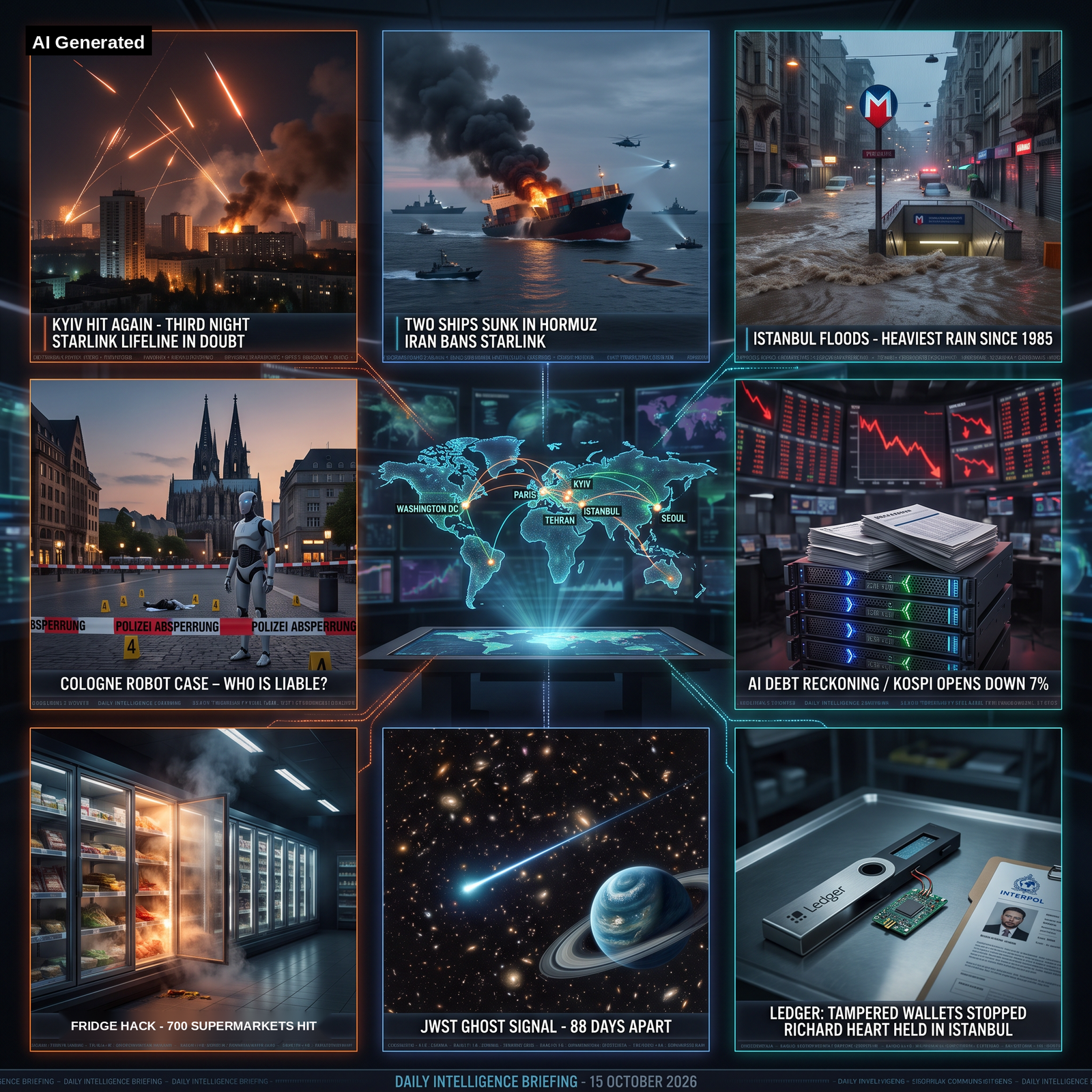
The rupture that D136 named the collapse of announcement and event now extends to Ukraine’s technical lifelines. Zelensky told an interviewer he feels “betrayed,” while Musk publicly shifted responsibility for any Starlink and Starshield restrictions onto the US military and the president[1]. Kyiv can no longer assume certainty in either satellite connectivity or targeting intelligence — the two assets it has trusted since 2022 — which changes the calculus of any deep strike on Russian energy infrastructure, the very lever Washington has tried to restrain. Russian strikes on the central Kirovohrad oblast killed three and wounded six overnight[2], and waves of hundreds of Geran drones pressed western and central regions as poor weather complicated Ukraine’s mobile fire teams[3]. Beneath the attrition sits a quiet logistics crisis: Ukrainian fighters increasingly fire Soviet-era R-60 and R-73 missiles from global stockpiles, some so degraded they detonate at launch and destroy the MiGs carrying them[4].
The Ruble-Asset Gambit and the European Refusal
The FT-reported American proposal to unfreeze some Russian assets as an incentive to restart peace talks was met with a flat European refusal[5][6]. European officials treat frozen sovereign assets as leverage, not a prize to be returned for negotiations, and the split is now procedural: as EU leaders open a two-day Brussels summit on the 2028-2034 Multiannual Financial Framework, the budget debate is inseparable from a Western coalition pulling in two directions over Russia[7].
Washington’s Levers: Espionage, Leakers and the Pacific Datum
Tokyo’s prime minister publicly stated there is no evidence of espionage in a Japanese national’s case in Russia, a significant departure from diplomatic silence[8], while the American president said sources who leak details of military operations against Iran should be executed, invoking earlier eras — rhetoric that foreshadows a sharper confrontation over war transparency as the midterms approach[9].
The Hormuz Ledger and Iran’s Satellite War
Iran’s campaign against Gulf shipping escalated from harassment to lethal interdiction as two container ships were sunk under fire in the Strait of Hormuz and a third was damaged[10]. Washington’s response under discussion is to grant sanctions relief to shadow-fleet tankers to keep oil moving — outsourcing the war’s freight risk to the very vessels it blacklists[11]. Tehran, in parallel, has criminalised Starlink use inside Iran with penalties reaching death, an acknowledgement of how decisive commercial space connectivity has become[12]. Germany’s highest court is expected to rule in the Hamburg trial of two men accused of preparing Iranian attacks on German-Jewish leaders, the first full judicial test of Tehran’s European assassination network[13].
Yemen’s Encircled City
Yemen’s balance has shifted decisively: analysts describe the Houthis as having fully encircled Taiz, strangling the last major holdout and multiplying provocations against Saudi Arabia[14].
The Sino-Korean Perimeter
China opened a joint airfield in Laos — its first overseas facility oriented around air power[15] — and inaugurated a Yalu river road bridge with North Korea after twelve years of delay[16], while Pyongyang test-fired submarine-launched cruise missiles amid a diplomatic freeze[17]. The three events share one arc: a deepening Sino-DPRK axis at the moment the alliance system is fixed on the Atlantic and the Gulf.
The Hemisphere’s Unrest
Brazil’s runoff narrowed to a statistical tie, with a Quaest poll putting Flavio Bolsonaro at 46 percent against Lula’s 44[18], and Colombia’s first mass demonstrations against president de la Espriella brought tens of thousands into the streets[19]. Albania’s anti-government protests turned violent, with ministries attacked and fires set in Tirana[20].
The Black Sea, the Baltic and the Satellite Backbone
NATO faces a new maritime front. A ship caught fire in Romanian waters amid fresh attacks, with drones suspected[21], and the alliance is weighing redeployed anti-drone defences after five vessels were attacked inside member states’ exclusive economic zones[22]. In the Baltic, a Russian corvette escorted a container vessel through the Fehmarn Belt, demonstrating coercive presence in Europe’s northern trade corridor[23]. Most consequential, an armed group destroyed eleven antennas at the guarded Starlink ground station near Sofia that serves Ukraine’s defence ministry, cutting general-staff links to front-line units — an operation attributed to GRU sabotage units, following a similar attempt in Poland[24]. Russia has decided the satellite layer is a legitimate target inside NATO territory.
The Alliance Industrial Base and Its Price
The industrial scaffolding of the alliance keeps expanding even as its cohesion frays. Huntington Ingalls won a contract worth up to $91 million to shape the SSN-AUKUS submarine design[25]; HMS Queen Elizabeth becomes the flagship of NATO’s Allied Reaction Force until mid-2027[26]; and France, abandoned by its FCAS partners, accelerates the Rafale F5 “Super Rafale” with a solo next-generation programme built on automation and loyal-wingman drones[27]. The $23 billion “Trump-class” concept shows the same tension across the alliance between prestige platforms and sustain-able lethality[28]. The US Army now runs at least five interceptor programmes — from sub-$1 million Patriot-class rounds to counter-drone munitions — explicitly ending one-type launchers[29], while USS Connecticut remains in the yard five years after striking a seamount, its service life down to four years[30].
The Transatlantic Rupture’s Instruments
Atlanticist strategists now argue the diesel deal is not another quarrel but an inflection point: once an existential threat becomes a commercial proposition, NATO’s shared-threat foundation erodes[31]. In the same window, Turkey tested container-launched drones at Exercise ATES SERBEST-2026, industrialising the tactic Ukraine used against Russian airbases[32]; Israel ordered twelve AH-64E Apaches funded by cutting one billion shekels from programmes serving its Arab communities[33]; and the FBI’s Operation Lonestar Roundup seized 187 devices and dismantled North Korean “laptop farms” that funnelled wages from 70 US companies to Pyongyang’s weapons programmes[34].
Environment & Climate ↑ Contents
The Water and Disaster Ledger: Istanbul, Rhodes and the Himalayas
The autumn’s hydrological extremes moved from the Atlantic basin to the Mediterranean and the Black Sea littoral. Istanbul was shut down by its heaviest rainfall since 1985, with flash floods turning streets into rivers, metro stations inundated and authorities closing schools as the governor urged residents to avoid all but essential movement[35]. Greece, on the same axis of instability, declared a state of emergency on Rhodes after a deadly storm system killed one person, closed schools across several regions and collapsed part of the Evia road network[36]. In the Himalayas, Nepal’s disaster authority confirmed that a rock-and-ice avalanche triggered the recent flash flood, invoking the same mechanism as the August mountain collapse that produced a tsunami-like surge[37]. The pattern is identical: warmer air masses carrying more moisture colliding with inadequate drainage, converting routine weather into lethal events.
Meanwhile, the tail of the record hurricane season continues to exact inland costs. Remnants of Isaias killed a man in Birmingham, Alabama, when a falling tree struck him — a death that illustrates how far inland the dangers of landfalling tropical systems now reach[38]. The insurance and adaptation consequences of such events are the subject of a growing body of analysis, but the operational takeaway for the reporting period is simpler: the disaster calendar is no longer ending with the hurricane season, and the response systems of middle latitudes are being tested beyond their design envelopes.
El Niño’s Food-Security Front
Two interlocking threats are converging on East and South Africa. The WMO now puts the probability of El Niño persisting through February 2027 at nearly 100 percent, with the event strengthening into December, while forecasters see a 90 percent chance of heavier-than-usual rain in the Horn from October to December [39]. Aid agencies report families in southern Madagascar already enduring earlier-than-usual food shortages, and UNICEF has documented 205 closed health and nutrition facilities in Somalia as funding cuts compound the climate shock[39]. The Galapagos case adds a biodiversity dimension to the same forcing: scientists warn that black-market trafficking of marine iguanas is peaking precisely as the super El Niño decimates the algae on which the only seagoing lizard depends, piling an enforcement crisis on top of an ecological one[40]. Climate change is operating as a direct driver of hunger, smuggling and state failure at the margins — the stories summits rarely capture.
Biodiversity’s Quiet Accounting
European biodiversity science produced both delight and warning this window. Volunteers and taxonomists described two new snail species in Montenegro’s limestone cliffs — including one endemic to the Komarnica Canyon, which a planned 172-megawatt dam would flood if the state utility proceeds, prompting scientists to press for UNESCO World Heritage protection[41]. The juxtaposition of new-species discovery and imminent habitat destruction is the central paradox of conservation biology in the Western Balkans. Further east, Chinese social-media platforms are openly promoting illegal wildlife trade from Laos — bear paws, pangolins and monitor lizards filmed for audiences who could not legally possess such animals at home — a trafficking channel supercharged by the China–Laos railway[42]. And satellite-tracked fishing vessels off West Africa continue to “vanish” systematically along international boundary lines, a pattern researchers interpret as deliberate signal-suppression to conceal illegal catch in a region where enforcement capacity is weakest[43].
The Adaptation Gap and the Engineering Stopgap
The delivery gap between climate planning and climate action is now measurable. By 2025 some 143 of 154 developing countries had a National Adaptation Plan process, yet implementation lags dramatically because of missing institutional capacity, project preparation and finance[44]. an implementation gap that sits alongside the research literature’s warning that fair transitions require far more than money: workers, households and carbon-dependent communities face uneven losses that financial support alone cannot redistribute fairly[45]. Where governments move, engineering follows in creative forms — artificial mangrove roots trialled at eleven sites in Thailand’s Chao Phraya delta retained 16–88 centimetres of sediment, offering a hybrid nature-based stopgap against coastline erosion[46]. But such interventions are palliative, not substitutes for the fiscal and institutional commitments the literature identifies as the binding constraint.
Climate Politics: Grants Cut in Washington, Energy at the Ballot Box
The American federal retreat from climate resilience’s civic infrastructure advanced on two fronts. NOAA’s 2026 grant book shows a 74 percent collapse in community resilience awards, including the termination of a $1.2 million New Orleans flood-planning grant for Black and Indigenous communities and $2.5 million for the University of Washington’s Northwest Climate Resilience Collaborative, cuts that one watchdog called “stunningly short-sighted”[47]. The political counterweight is being organised at the state level: New York’s gubernatorial debate exposed a stark divide between the incumbent’s clean-energy transition agenda and a challenger proposing to prioritise affordability and data-centre demand, framing the national energy choice for the coming cycle[48]. The federal pullback is thus not the end of climate politics in America; it is the transfer of the fight to the states and the courts.
The Energy-Transition Hardware Front
Municipal and industrial electrification continued on its uneven path. Paris committed a further €200 million to bike infrastructure through 2032, hundreds of kilometres of new routes in a city that has already displaced car dominance in its core[49]. Germany, by contrast, faces a warning from the bus industry that reduced federal funding for electric-bus fleet conversion jeopardises the sector’s transition precisely when municipalities are ordering[50]. Redwood Materials and Rivian are installing second-life EV-battery storage at factories to beat multi-year grid queues — a microgrid workaround for a power bottleneck data centres now dominate[51]. Regulation is catching up unevenly: Transport & Environment warns that plug-in hybrid CO2 accounting remains so misleading that official figures cost drivers up to €680 a year more than claimed, an integrity gap in the very instrument meant to price the transition[52].
Even fisheries governance now runs on the digital rails of the climate state. The Supreme Court declined to hear a Maine lobster fisherman’s challenge to mandatory GPS tracking, leaving 1,200 federally permitted boats subject to location tracking — a defeat for the Fourth Amendment argument and a quiet victory for data-intensive ocean management[53].
Society & Civil Issues ↑ Contents
Brazil’s Labour Settlement and the Politics of Timing
Brazil’s Congress approved a constitutional amendment cutting the maximum working week to 40 hours, a measure that could affect up to 30 million workers and hands Lula a political victory weeks before the October 25 runoff[54]. Championed by the outgoing president as a rebuttal to his rival’s first-round surge, the passage converts social policy into campaign material in real time.
Australia’s Integrity Ledger: Grants, Abortions and the Courts
Three Australian files illustrate how state capacity is being tested on the civic front. Victoria’s public servants concealed the loss of up to $285 million from Covid-era business-support grants paid to ineligible firms, an anti-corruption commission finding that “decisions were made to withhold information about the magnitude of the loss” — an accountability failure that will shadow the state for years[55]. At the same time, Victorian Labor promised to remove the out-of-pocket cost of abortion care in an election pledge costing $30 million over four years, a move aimed squarely at the same electorate as the surging One Nation vote[56]. And in the Senate, Labor and the Coalition are set to reject a bill banning the shackling of incarcerated women during childbirth, with the government deferring to the states on a practice that independent senators and the medical establishment condemn[57]. The trio shows a polity expanding reproductive rights while tolerating prison cruelty and failing financial stewardship[58].
The State, the Algorithm and the Teenage Robot
Germany’s police are investigating an assault in Cologne in which a remotely piloted robot, allegedly commanded by teenagers, groped a 16-year-old girl — a case that forces the criminal law to answer a question for which it has no settled doctrine: who bears liability when harm is mediated through a machine directed in real time[59]. The investigation will be watched far beyond Cologne because it tests the boundary between operator intent and robotic autonomy that every future human-robot interaction case will inherit.
Germany’s Civic Week: The Health State and Its Budgets
The Bundestag moved on several fronts of civic repair, voting on an emergency-care reform that creates Integrated Emergency Centres pairing hospital emergency rooms with after-hours practices, expands the 116117 helpline and aims to relieve both rescue services and overloaded emergency departments[60]. Rheinland-Pfalz’s minister-president put a pension reform on the legislative path, restarting a debate that the federal coalition has left unresolved[61], while a debate over whether statutory health-insurance contribution rates can stand still in 2027 underlined the fiscal fragility of Germany’s social insurance model[62]. The thread is a civic state spending toward solutions as its budget loses elasticity.
France: The School and the Farm
France’s civic calendar remains dominated by two latent explosions. Youth researchers analysing the French student protests now ask openly whether a similar conflagration is possible in Germany, finding comparable grievances around education quality, cost of living and institutional trust[63]. And the government itself is bracing for the farm lobby: ministers reportedly anticipate a social crisis in agriculture that could “explode very hard,” as price pressure, green regulation and supermarket power converge on a sector that can shut the country down[64]. The prospect of simultaneous school and farm mobilisations is the scenario the interior ministry most fears.
Greece’s Parliamentary Autumn
Greek political life this week is consumed by the aftermath of the SYRIZA split. The party released a six-minute video confronting the fourteen MPs who left its parliamentary group but kept their seats, deploying their own past statements against them as the “deadline of dignity” expired without return[65]. The spectacle is more than internal melodrama: it tests the rules of Greek political funding, seat ownership and party discipline at a moment when the country’s party system is fragmenting faster than its institutions can adapt.
Canada’s Civic Files: Audits, Land Claims and Fiscal Promises
Canada’s federation is processing several civic claims simultaneously. The Federation of Sovereign Indigenous Nations launched legal action against Ottawa over a $12.4 million forensic-audit demand for disputed spending, escalating a funding dispute into the courts[66]. Vancouver’s Park Board acknowledged that rebuilding the aquatic centre at the 25-metre scale is entangled in a First Nation land claim, delaying a major civic amenity[67]. And British Columbia’s NDP released election costings promising the deficit will fall to $12 billion by 2028-29, hours before the leaders’ debate, a commitment the auditor will scrutinise[68]. In Australia, meanwhile, the defence force opened an inquiry after a hidden camera was discovered in the showers of a naval vessel — a scandal landing on an institution struggling with trust[69].
Britain’s Justice Ledger
Northern Ireland’s courts move to close one of the province’s most corrosive chapters as former DUP leader Jeffrey Donaldson is sentenced for sex offences at Newry Crown Court[70]. The sentencing ends a case that has ricocheted through Unionist politics since his arrest, and it lands as the province’s devolved settlement remains fragile.
America’s Civic Autumn: Ballots, Lawfare and the Food System
The American midterm campaign opened a new front in election security. Suspicious white powder was sent to election offices in three states, forcing evacuations and underscoring how easily the integrity of the vote can be disrupted by cheap intimidation[71]. In California, Los Angeles County officials declined to connect a USB drive that the Justice Department insists contains evidence of noncitizens who received ballots, invoking data-privacy protocols [72] — a standoff each side frames as a test of the other’s good faith. The Republicans’ private pessimism is now leaking publicly: reports from Capitol Hill suggest the party’s own strategists privately concede they may lose the House[73], while the administration faces accusations it is delaying an IRS score of its tax cuts to protect its midterm message[74].
Public-health governance added a further complication: the FDA is moving to ease food-safety requirements months after a cyclospora outbreak linked to imported lettuce hospitalised hundreds and sickened more than 27,000 people across 47 states[75]. The White House itself is fending off a damaging disclosure that its press secretary failed the California bar exam, raising questions about the credentialing of the administration’s public face[76], while in New York a man shot by ICE agents during an arrest still carries the bullet in his neck, a case testing the limits of federal immigration enforcement[77]. The courts are preparing life-sentence requests in the Alexander brothers’ trafficking case[78].
The Northern Triangle’s Carceral Turn
Central America’s punitive turn accelerated in both directions at once. Costa Rica inaugurated a maximum-security prison modelled explicitly on El Salvador’s CECOT, with capacity for 5,100 inmates, exporting the Bukele playbook to a country long regarded as the region’s most stable democracy[79]. Its sponsor, meanwhile, announced a plan to release up to 50 percent of those detained under El Salvador’s state-of-emergency mass arrests — a partial recognition that the emergency apparatus incarcerated far beyond its gang target[80]. The two stories frame the hemisphere’s carceral choice: import the mega-prison, or begin dismantling the overreach it represents.
The Civic-Technology Frontier
Canada’s Regina city council spent hours debating a motion on Bell’s AI data-centre expansion, as residents, experts and the company’s own AI-fabric president clashed over power, water and community impact[81]. The debate previews the coming decade’s local politics: the question is no longer whether data centres arrive but on what terms. The same governance gap is visible in social services: researchers warn that agencies using AI for child-abuse, domestic-violence and elder-abuse casework need explicit safeguards against algorithmic bias targeting vulnerable populations[82].
Finally, the week’s most consequential diplomatic photo-op was Zelensky’s meeting with British Prime Minister Burnham at Downing Street, a visit designed to shore up European support at the precise moment Washington’s reliability is in question[83]. The symbolism of a Ukrainian president seeking guarantees in London rather than Washington may prove the summary of where the alliance stands.
AI & Technology ↑ Contents
The Security Perimeter: Refrigerators, Plate Readers and the Trust Deficit
The week’s defining cybersecurity event was not a state-sponsored breach but a refrigerator. A mass compromise of internet-connected refrigeration controllers at an estimated 700 French supermarkets activated defrosters long enough to reach 50°C, spoiling perishable stock and, in some cases, starting electrical fires[84]. Analysis of the three controller models exploited — by Danfoss, Dixell and Copeland — shows the attackers needed little more than publicly derivable daily passwords and unpatched administrative interfaces; in other words, the basic hygiene failures that CISA advisories have documented for years. The incident is the sharpest demonstration yet that the Internet of Things has industrialised the sabotage of everyday commerce, and that “boring” vulnerabilities now translate directly into millions in losses and physical risk.
The surveillance industry, for its part, is not retreating. Flock’s CEO used TechCrunch Disrupt to defend license-plate recognition networks against a national privacy backlash, arguing that “we shouldn’t pause progress” on crime-fighting data[85]. The defence matters because Flock’s cameras have become the de facto national plate database, and the company’s rhetorical posture — innovation-speed over accountability — is precisely what the LA USB-drive standoff and the Maine tracking case suggest courts and municipalities are beginning to contest.
The Compute Supply Chain’s New Shape
China’s response to export controls is maturing into supply-chain diversification at scale. ByteDance is reportedly in talks to buy MediaTek AI chips for its data centres, a move that would route around the American accelerator duopoly and deepen the Taiwan-strategic entanglement of Chinese AI in a single stroke[86]. At the design layer, startups like Ricursive Intelligence are betting that AI itself can design chips — learning from each generation of layouts to automate and accelerate the process, addressing the compute crisis by compressing the hardware iteration cycle[87]. The two stories bracket the strategic contest: one side diversifies around the bottleneck, the other tries to design through it.
Applied AI in the Physical and Consumer Economies
Oak Ridge National Laboratory’s new Motor Decide platform uses super-intelligence-driven scenario analysis to help manufacturers choose electric-motor technologies under critical-material uncertainty, modelling copper and rare-earth price shocks before they occur[88]. It is a quiet but significant application of the technology’s planning power to the exact supply-chain fragility that the critical-minerals debate has made urgent. The consumer platforms, meanwhile, are normalising AI governance in product terms: YouTube launched a labelling system for AI-generated music, extending synthetic-content disclosure from text and video to the audio economy[89], while Epic Games rebuilt its launcher using “vibe coding” — AI-assisted development from scratch — claiming a faster, more responsive client than Steam and signalling that the software industry’s default development practice has shifted[90]. On the defensive side, Android is strengthening scam prevention for calls and texts, tightening the perimeter of the mobile channel where fraud has become the dominant attack surface[91].
Economy & Business ↑ Contents
The AI-Debt Reckoning: Markets, Capital and the Rate Cross-Current
Asian markets opened the window in full retreat, with the Kospi falling more than seven percent as a global technology sell-off met hotter-than-expected American inflation data, crystallising the AI-debt concern D134-D136 tracked from the financing side[92]. The market’s anxiety is not about AI itself but about its funding stack: Anthropic reported its second consecutive profitable quarter with $16 billion in revenue in three months, the strongest public proof yet that frontier-lab economics can turn cash-positive[93], yet CoreWeave is simultaneously courting life insurers’ “unlimited” capital to finance GPU infrastructure as private-credit bubble fears grow[94]. The tension is structural: demand is real but the leverage encumbering it is opaque, and markets price the difference between revenue growth and capital sustainability.
The policy layer is responding on two tracks. The IMF warned that rising global yields will spill over into Asian growth, naming the transmission channel that tighter term premia create for the region’s debt-financed models[95]. The dollar retreated from an eighteen-month high even after the hot CPI print as Federal Reserve speakers tempered hike bets, suggesting the market now expects the Fed to tolerate above-target inflation rather than risk a hard landing in an election year[96]. In Tokyo, BoJ board member Koeda said the central bank should not be overly cautious in raising rates, citing sustained wage and price anchoring around two percent[97]. In Frankfurt, an ECB official conceded that if inflation widens, central banks will be compelled to respond, while flagging winter gas prices as the swing factor if the season resembles last year[98][99].
Germany’s Trade and Industry Ledger
Germany’s economic exposure to China reached a new, uncomfortable threshold: the bilateral trade deficit surpassed €100 billion for the first time, with the IW’s “China Shock 2.0” analysis showing every core industrial sector shedding export share[100]. The deficit aggregates a structural transformation as Chinese makers move up the value chain into the machinery, autos and chemicals where German industry once held advantage. The offshore wind supply chain added a second warning: new figures suggest 23,000 jobs are at risk from the stalled expansion of offshore capacity, with suppliers already cutting staff as project pipelines thin[101]. Property markets show the split-screen: existing housing appreciated faster than new builds, and the ten most expensive cities keep climbing, embedding an affordability grievance that shapes social policy and the federal budget[102]. At the retail-deposit end, comparison data show eastern savings banks paying notably lower interest, a quiet subsidy of regional banks at savers’ expense[103].
Banking, Aviation and the Asian Corporate Front
India’s financial headlines were dominated by two large-bank stories. Fairfax’s $5.6 billion acquisition of a 61 percent stake in IDBI Bank — the largest foreign investment in an Indian lender — puts its existing CSB Bank holding at a strategic crossroads, forcing a consolidation decision[104]. Bank of Baroda’s shares fell 3.5 percent after B R Shetty filed a $15 billion suit against the bank, allegations the lender says remain untested in court[105]. India’s automotive regulatory clock also advanced: the government proposed BS-VII emission norms for April 2029, tightening real-world testing and brake-and-tyre pollution limits against automaker pleas for more time[106]. And Emirates’ warning that Navi Mumbai airport cannot yet handle international flights — lacking catering and cargo facilities — delays capacity expansion amid surging demand[107].
Across the region, corporate readjustments signal the same repricing of expansion. Transsion, the Chinese king of the African phone market, sank in its Hong Kong listing[108]; 7-Eleven’s exit from India casts a shadow over Lawson’s regional expansion ambitions[109]; Singapore residence provider Ascott is betting on the Tokyo Station area as Japan’s hospitality demand matures[110]; and Indian battery player Lohum is scaling EV-battery recycling after opening a Zimbabwe lithium mine, positioning itself in the critical-minerals loop the West is trying to rewire[111]. A Barclays note floated a Tesla-SpaceX merger before December, adding speculative mega-deal chatter[112].
The Auto Industry’s Two-Speed Transition
The Paris Motor Show delivered a blunt verdict on the industry’s strategic divide: European automakers “cling to the past” while Chinese makers lead on the platforms, software and price points that define the next cycle[113]. It reinforces the deficit-to-China story: Europe is losing not just share but the standard-setting role of its own industry.
The Fiscal Front: California, the Soda Tax and the EU Contribution
Western fiscal politics oscillated between the innovative and the regressive. California is weighing an unprecedented state billionaires’ tax, a first in American revenue politics that would test the constitutional limits of wealth taxation[114]. The French National Assembly, by contrast, moved to extend the “soda tax,” a levelling measure that deputies concede will push prices up in the aisles — an explicit trade of consumer cost for public-health and fiscal revenue[115]. It also adopted the €30.9 billion French contribution to the EU budget over the objections of both hard-left and hard-right, papering over a European fiscal argument that the Brussels summit will reopen[116]. Greece, meanwhile, received IMF praise for its tax-administration overhaul — revenue gains of €21 billion, or 7.6 percent of GDP, and a VAT gap below ten percent — the rare fiscal-reform success story of the European periphery[117].
Science & Space ↑ Contents
The Cosmic Ledger: Signals, Clouds and the Colours of the Dead
Astronomy’s deepest frontier delivered two puzzles and one surprise. In the Hubble Ultra Deep Field, JWST detected a single, bright emission line at 1.6 micrometres — twice, 88 days apart, at different observation angles — in a patch of sky where Hubble and JWST imaging show nothing at all, an object so anomalous it resists explanation as an early galaxy, a supernova or a tidal-disruption event[118]. Variable water clouds detected on a Jupiter-sized world 7.5 light-years away mark the first such measurement outside the Solar System, with implications for reading exoplanet atmospheres[119]. And Warwick astronomers mapped the true colours of white dwarf stars, including the first star that would appear green to the human eye — a spectral curiosity that quietly refines the cooling models of stellar corpses[120].
The Materials and Instruments Ledger
On Earth, the materials frontier produced a carbon cousin of diamond that had existed only in theory for 35 years. University of Gothenburg researchers created diamondiyne in thin films at the interface of two liquids, using relatively inexpensive equipment, opening a possible route to a new class of ultra-hard, conductive materials[121]. In photonics, a chip-scale gyroscope built by UC Santa Barbara and Caltech reached a sensitivity boost of nearly 2,000-fold over earlier silicon-nitride designs, detecting rotation as slow as 37 degrees per hour — approaching the threshold of measuring Earth’s own rotation on a CMOS-compatible chip, a step toward GPS-denied navigation[122]. And UC San Diego researchers showed they can electrically control the “learning” and “forgetting” of a brain-inspired neuristor by driving vanadium dioxide between jammed and relaxed states, a physical mechanism for in-memory computation that ties electrical history to internal structure[123].
The Brain and the Body Ledger
Neuroscience mapped the locus coeruleus — the “blue place” — discovering the longest neuron ever measured in a mouse and activity patterns tracking decision-switching after negative outcomes, clues to how the brain recalibrates[124]. Muscle science identified a missing mitochondrial fat whose partial restoration reversed muscle wasting in mice, pointing toward a treatment avenue for age-related sarcopenia[125]. And a Spanish team found that oral creatine protects the hippocampus from gut-inflammation damage in a rodent colitis model — restoring creatine content, preserving neuronal integrity and normalising excitability — a potential bridge between the gut-brain axis and nutritional intervention[126]. An overlooked immune-cell population offers a new attack surface against the deadliest small-cell lung tumours[127]; and Takeda launched the first orexin agonist for narcolepsy type 1 simultaneously in Japan and China, opening a genuinely novel sleep pharmacology[128].
The Applied and the Social Ledger
Machine-learning computation illuminated the catalytic mechanisms of CO2-to-fuel conversion, giving chemists a searchable map of reaction pathways for methanol synthesis[129]. Sleep research from the University of Texas found daily exercise improves deep, restorative sleep and mood[130]. Consumer research showed that climate concern does not reliably translate into greener holiday choices, an attitude-behaviour gap that complicates the demand-side economics of decarbonised tourism[131]. And a study of exiled researchers found they thrive not when they merely receive aid but when they contribute knowledge, an insight with direct bearing on how academic solidarity programmes should be designed[132].
The Deep Archive
Archaeology’s longest-running laboratory, the Black Sea, yielded a metallurgical verdict on a 2,000-year-old warship of Mithridates VI’s Pontic fleet sunk off Phanagoria. Neutron-activation analysis of 22 nails and a bronze ram showed shipwrights deliberately chose copper over cheaper iron — an investment in longevity for a fast patrol bireme whose builders also fireproofed the hull with clay, wool and arsenic-bearing realgar coatings[133]. And on the biodiversity side of the archive, the UK’s first sea-squirt-hunting dog was honoured as animal of the year — a working dog trained to sniff out the invasive “sea vomit” that threatens native marine habitats[134].
Crypto, Digital Assets & Blockchain ↑ Contents
The Hardware Trust Failure Widens: Ledger’s Tampered Wallets
The custody crisis that D135 first brought to the report’s attention has moved from discovery to containment. Ledger has now explicitly told buyers of its CryptoBilis-branded hardware wallets to stop using the devices after an estimated $86 million to $93 million was drained from users whose wallets were tampered with before delivery[135]. The instruction is extraordinary for a company whose entire value proposition is cold-storage inviolability: when the manufacturer itself cannot distinguish a genuine device from a compromised one, the trust anchor of self-custody — that keys never leave the secure element — is broken at the supply-chain layer. The incident validates D135’s concerns about distribution channels and raises a structural question: if wallets can be pre-compromised at scale, the institutional appetite the sector has cultivated will demand a chain-of-custody standard that does not yet exist. The drain also reprises the pattern of the XRP supply bug covered in D134, where ledger-level integrity failures, not market movements, became the sector’s dominant risk event.
Enforcement’s New Geography: Richard Heart and the Red Notice
The sector’s enforcement perimeter advanced furthest in Istanbul, where Richard Heart — founder of PulseChain, HEX and PulseX, and officially Richard James Schueler — was arrested on an Interpol Red Notice issued at Finland’s request over allegations of aggravated tax fraud, executed by the Istanbul police’s anti-financial-crime unit[136]. The market reaction was immediate and brutal: the PulseChain, HEX and PulseX tokens crashed around 50 percent within hours, a reminder that protocol ecosystems built around a single founder carry a concentrated, arrestable key-person risk that no smart-contract audit can hedge. The arrest is also strategically significant beyond the tokens: Turkey has become the enforcement venue of choice for cross-border crypto cases at the same time as the FBI’s Operation Lonestar Roundup, covered in the Geopolitics section, dismantled North Korean “laptop farms.” Enforcement geography is shifting toward non-traditional hubs, and founders who spent years exploiting jurisdictional arbitrage are discovering that Red Notices travel better than their legal teams expected.
The AI-Debt Selloff and the Listed-Crypto Periphery
The global AI-debt reckoning that dominated equity markets this week carved deep into the listed crypto complex. Bitcoin mining stocks plunged more than ten percent as the sector’s dual exposure — to power-intensive infrastructure financing and to bitcoin’s price — was repriced in a single session, with analysts linking the fall to the same Gartner/neocloud debt concerns that hit AI data-centre names[137]. The episode separates the sector’s risk profile into two channels: on-chain price risk, which behaved calmly, and the balance-sheet risk of crypto-adjacent equities, which amplified the shock. Miners that borrowed against future hashrate are the sector’s canary: if private-credit stress propagates into mining debt, the long-predicted consolidation wave will finally arrive.
The Institutional Rails: ETFs, Payment Licenses and Stablecoin Flows
Institutional integration continued its uneven advance. VanEck moved to withdraw its application for a Lido staked-Ether ETF, ending a two-year attempt to list a fund whose yield-bearing structure the SEC has treated with visible reluctance[138]. The withdrawal reveals the regulatory ceiling: staking rewards inside regulated funds remain a hurdle even a veteran issuer could not cross, and staked-asset custody stays the binding constraint on mainstream Ether exposure. On the payments side, Polygon completed its acquisition of Coinme, gaining access to 37 money-transmitter licenses and 11 state exemptions — a regulatory moat bought rather than earned through years of application, and the most concrete route yet for a layer-2 network to offer custodial payments services in the United States[139]. Ripple’s partnership with DriveWealth targets the same rails from a different angle, enabling more than 100 fintech partners to fund US-market investments beyond bank-transfer windows using blockchain settlement, compressing the gap between trading hours and settlement cycles[140]. And Samsung added USDC transfers over Solana to its Wallet application for US Galaxy users, a quiet but significant bridge between the largest Android hardware base and dollar stablecoins[141].
The Protocol Layer: Execution Engines, Collateral Mechanics and Derivatives
Base-layer engineering continued to advance where it matters most: throughput economics. Aptos made Block-STM v2 its default parallel-execution engine, formalising an optimistic-concurrency design that lowers transaction costs and raises DeFi capacity under load[142]. The upgrade is the latest evidence that the next competitive frontier among layer-1s is not features but the marginal cost of execution, with v2’s pipelining approach differentiating Aptos from the sequential-execution legacy chains. In the XRP-linked collateral market, Firelight’s October 6 activation pushed existing FXRP staked positions automatically into pooled cover backing, pairing fee income with claim exposure and lengthening withdrawal queues — a governance change that users accepted as part of the supply-bug remediation tracked in D134, but whose friction is now visibly accumulating in the platform’s waiting times[143]. Boros launched spread markets letting traders arbitrage funding-rate differentials — a derivatives innovation democratising an institutional strategy and adding liquidity to basis trading[144]. Taken together, the protocol layer is demonstrating that while the regulatory and market environment tightens, the technical infrastructure continues to industrialise.
Correlations & Analysis ↑ Contents
The defining pattern of this reporting window is the completion of a trajectory D134 first named and D136 declared empirically settled: the collapse of the distinction between announcement and event has now extended from Washington’s diplomatic constructs to its technical lifelines. Yesterday’s D136 brief documented a second consecutive night of ballistic strikes on Kyiv’s CHP-4 and the denial of any halt in intelligence-sharing; today the same rupture is visible inside Ukraine’s satellite backbone itself, with the owner of Starlink publicly disclaiming responsibility for military-level throttling while the Ukrainian president tells a London interviewer he feels betrayed[1]. The through-line since D134 is that every layer of the American support structure — sanctions, diesel diplomacy, intelligence-sharing, now commercial space connectivity — is being renegotiated in real time, and Kyiv must absorb the uncertainty as an operating cost.
The second correlation is the deepening parallel between the Gulf and Atlantic theatres. D133 reported the Riyadh airfield strike and the sharpening of the Hormuz blockade; D135 tracked the aviation quarantine and the Saudi dilemma; today two container ships were sunk in the strait while Washington weighs deploying the shadow fleet to keep oil flowing[10][11]. Simultaneously, the transatlantic rupture over the diesel deal — which D132 read as fuel-price policy executed as foreign policy — has matured into an explicit intellectual and diplomatic confrontation: a leading Atlanticist journal now calls the deal an inflection point that may fracture NATO’s foundation[31], and European capitals have refused even the asset-unfreezing incentive Washington offered to restart talks[6]. The theatres are linked by one mechanism: an administration that conducts strategy through transactional announcements, forcing allies and adversaries to hedge against the next reversal.
The third thread connects the physical war to the satellite layer in both directions. The sabotage of Bulgaria’s Starlink ground station — eleven antennas destroyed inside NATO territory — is the missing link between D135’s Ledger-wallet supply-chain attack and the state-level contest over digital infrastructure: private-sector hardware, whether a hardware wallet or a ground station, is now a legitimate target in hybrid warfare[24]. The same logic is visible in Iran’s criminalisation of Starlink use with penalties up to death[12] and in the FBI’s dismantling of North Korean laptop farms[34]. Every belligerent in 2026 is fighting over the same real estate: the physical infrastructure of the internet, and the trust that runs on it.
The economic correlation this window is the arrival of the AI-debt reckoning that D134-D136 tracked as a financing anomaly. Today’s market selloff — Kospi -7 percent, mining equities -10 percent — is the pricing event that connects the private-credit build-up (CoreWeave courting insurers) to the macro environment (hot CPI, hawkish BoJ signalling, IMF growth warnings)[92][94][97]. Notably, the selloff punished the leveraged periphery — listed crypto miners and AI-adjacent equities — harder than the frontier labs themselves, whose profitability (Anthropic’s second straight profitable quarter) is improving as the financing layer tightens[93]. The market is beginning to distinguish between AI’s real economics and the debt pyramid built around them — the healthiest sign in this cycle so far, and the one to watch for contagion into mining and neocloud credits.
A final correlation runs through the civic ledgers of both hemispheres: states are simultaneously expanding and contracting their governing ambition. Brazil shortens the working week while its court-adjacent politics narrow; California proposes a billionaire tax while Washington’s FDA eases food-safety rules after a 27,000-case outbreak; Costa Rica imports a mega-prison while El Salvador begins releasing its emergency detainees[54][75][79][80]. The pattern is a widening gap between electoral demand and governmental delivery — the disposition behind France’s student protests, Germany’s spillover question and Albania’s street uprising[63][20].
What to watch in the next reporting period: the EU summit’s formal position on the diesel deal and the MFR budget, which will test whether the transatlantic rupture acquires institutional form[7]; the Hamburg verdict on Iranian assassination plots, the first judicial test of Tehran’s European network[13]; Brazil’s October 25 runoff with the work-week amendment as a live campaign issue[54]; whether the AI-debt selloff spreads from listed periphery to private credit; and whether the Starlink dispute forces Ukraine to visibly change either its deep-strike doctrine or its dependence on American commercial space assets[1].
References ↑ Contents
1. Ukraine-Russia war latest: Zelensky ‘betrayed’ by Trump as Musk claims Starlink restrictions down to US by Daniel Keane,Alex Croft and Bryony Gooch · Daniel Keane,Alex Croft and Bryony Gooch ↑
2. EN DIRECT, guerre en Ukraine : des frappes russes font trois morts dans l’oblast de Kirovohrad, selon l’administration militaire régionale by France via d k on Inoreader · France via d k on Inoreader ↑
3. Μαζικό ρωσικό χτύπημα με Geran κατά της Ουκρανίας by DEFENCE via d k on Inoreader · DEFENCE via d k on Inoreader ↑
4. Σκάνε οι πύραυλοι στον αέρα στα ουκρανικά μαχητικά by DEFENCE via d k on Inoreader · DEFENCE via d k on Inoreader ↑
5. FT: Οι ΗΠΑ εξετάζουν το ξεπάγωμα ορισμένων ρωσικών περιουσιακών στοιχείων by Newsroom · Newsroom ↑
6. Η Ευρώπη αρνήθηκε να αποδεσμεύσει ρωσικά περιουσιακά στοιχεία για να επανεκκινήσουν οι ειρηνευτικές συνομιλίες by Σοφοκλής Αρχοντάκης · Σοφοκλής Αρχοντάκης ↑
7. EU-Staats- und Regierungschefs verhandeln über nächsten EU-Haushalt by Germany via d k on Inoreader · Germany via d k on Inoreader ↑
8. FinancialJuice: Japan Prime Minister Takaichi: No evidence of espionage in Russia by FinancialJuice · FinancialJuice ↑
9. USA: Donald Trump würde Informanten für Geheimnisverrat erschießen lassen by Germany via d k on Inoreader · Germany via d k on Inoreader ↑
10. Iran-Krieg: Zwei Containerschiffe nach Beschuss in Straße von Hormus gesunken by Germany via d k on Inoreader · Germany via d k on Inoreader ↑
11. Οι ΗΠΑ σκέφτονται να χρησιμοποιήσουν τον σκιώδη στόλο για να βγάλουν πετρέλαιο από το Ορμούζ by Greece via d k on Inoreader · Greece via d k on Inoreader ↑
12. Το Ιράν κηρύσσει πόλεμο στο Starlink: Φυλακή έως και θανατική ποινή για τους χρήστες by Newsroom · Newsroom ↑
13. Urteil wegen mutmaßlicher iranischer Anschlagspläne in Hamburg erwartet by Germany via d k on Inoreader · Germany via d k on Inoreader ↑
14. Υεμένη: Προελαύνουν οι Χούθι, αλλάζουν οι ισορροπίες by Δρ. Αθανάσιος Ε. Δρούγος · Δρ. Αθανάσιος Ε. Δρούγος ↑
15. China opens a joint airfield in Laos with construction ongoing and eyes on its military role by David Rising · David Rising ↑
16. China und Nordkorea eröffnen neue Grenzbrücke für Straßenverkehr by Germany via d k on Inoreader · Germany via d k on Inoreader ↑
17. North Korea says it tested cruise missiles designed to be fired from submarines by Kim Tong-Hyung · Kim Tong-Hyung ↑
18. Βραζιλία-Εκλογές: Προβάδισμα για τον Φλάβιο Μπολσονάρου έναντι του Λούλα σε νέα δημοσκόπηση by NEWSROOM IEFIMERIDA.GR · NEWSROOM IEFIMERIDA.GR ↑
19. Thousands protest across Colombia against new right-wing president by FRANCE 24 · FRANCE 24 ↑
20. Tear gas, fires and clashes as anti-government unrest escalates in Albania, in photos by Hameraldi Agolli · Hameraldi Agolli ↑
21. Ship catches fire in Romania’s waters amid rising attacks in the Black Sea by NEWS via d k on Inoreader · NEWS via d k on Inoreader ↑
22. NATO may redeploy anti-drone defenses as attacks sink more Black Sea shipping by Jeremy Hsu · Jeremy Hsu ↑
23. Ρωσικά πολεμικά πλοία συνοδεύουν εμπορικά πλοία στην Βαλτική by DEFENCE via d k on Inoreader · DEFENCE via d k on Inoreader ↑
24. Πώς ανατινάχθηκαν οι εγκαταστάσεις του Starlink σε Βουλγαρία και «τυφλώθηκαν» οι Ουκρανοί by DEFENCE via d k on Inoreader · DEFENCE via d k on Inoreader ↑
25. Nuclear-powered attack submarines’ designs for AUKUS to be shaped by US firm with new contract by Prabhat Ranjan Mishra · Prabhat Ranjan Mishra ↑
26. 80,000-ton aircraft carrier to serve as flagship vessel of NATO’s leading high readiness naval force by Prabhat Ranjan Mishra · Prabhat Ranjan Mishra ↑
27. France’s New F5 ‘Super Rafale’ Fighter Doesn’t Care About Your Stealth F-22, F-35, or Even F-47 NGAD by Isaac Seitz · Isaac Seitz ↑
28. The Trump-Class Is No Battleship Like the 57,000-Ton Iowa-Class: It Is More Like a 35,000-Ton Battlecruiser That Costs More Than a Ford-Class Aircraft Carrier by Sean Spoonts · Sean Spoonts ↑
29. The Days Of Army Air Defense Systems Firing Just One Type Of Interceptor Are Ending by Joseph Trevithick · Joseph Trevithick ↑
30. 9,100-Ton US Navy Nuclear Attack Submarine USS Connecticut SSN-22 Smashed Into a Seamount at High Speed and Has Been Under Repair for 5 Years by Sean Spoonts · Sean Spoonts ↑
31. The Russia Diesel Deal Is a Strategic Mistake by Andrew A. Michta · Andrew A. Michta ↑
32. Ο τουρκικός στρατός δοκιμάζει ικανότητα εξαπόλυσης drone από κοντέινερ! (βίντεο) by DEFENCE via d k on Inoreader · DEFENCE via d k on Inoreader ↑
33. 12 AH-64E Apache παρήγγειλε το Ισραήλ – Περικόπτει επιδόματα στους Άραβες by DEFENCE via d k on Inoreader · DEFENCE via d k on Inoreader ↑
34. FBI disrupts North Korean 'laptop farms' used to fund weapons programs by David DiMolfetta · David DiMolfetta ↑
35. Istanbul in chaos, shut down by heaviest rainfall since 1985 by NEWS via d k on Inoreader · NEWS via d k on Inoreader ↑
36. 5 το πρωί: Ένας νεκρός και καταστροφές από την κακοκαιρία – Μέτρα για τις τιμές των καυσίμων – Πρώτο βήμα για GSI by Δεριζιώτη Μιχαέλα Μαρία · Δεριζιώτη Μιχαέλα Μαρία ↑
37. Nepal flood triggered by rock and ice avalanche: Report by Science & Space via d k on Inoreader · Science & Space via d k on Inoreader ↑
38. Isaias Made It To Birmingham. The Consequences Were Deadly. by By Lee Hedgepeth · By Lee Hedgepeth ↑
39. Act before El Niño: Expert worries about deepening hunger in East and South Africa by Malavikavyawahare · Malavikavyawahare ↑
40. Scientists alarmed as super El Niño collides with 'strange uptick' in Galapagos iguana trafficking by Science & Space via d k on Inoreader · Science & Space via d k on Inoreader ↑
41. Volunteers and scientists found two new snail species in Montenegro with shells about a quarter inch long and a door on the tail, and one lives in a canyon a planned 561-foot dam would flood by ECONEWS · ECONEWS ↑
42. Chinese social media used to promote illegal wildlife trade in Laos by Isabel Esterman · Isabel Esterman ↑
43. Now you see them: Researchers uncover patterns in vessels that vanish at sea by Science & Space via d k on Inoreader · Science & Space via d k on Inoreader ↑
44. Artificial mangrove roots offer a stopgap for Thailand’s eroding coastline by Latoya Abulu · Latoya Abulu ↑
45. Climate adaptation's delivery gap: Turning national plans into action by Science & Space via d k on Inoreader · Science & Space via d k on Inoreader ↑
46. Fair climate transitions need more than financial support, evidence review suggests by Science & Space via d k on Inoreader · Science & Space via d k on Inoreader ↑
47. “Stunningly short-sighted” NOAA grant cuts threaten US climate resilience by Shreya Dasgupta · Shreya Dasgupta ↑
48. New York Candidates for Governor Clash Over Energy Policy by By Lauren Dalban · By Lauren Dalban ↑
49. Radwegenetz: Paris investiert weitere 200 Millionen in Fahrrad-Infrastruktur by Economy via d k on Inoreader · Economy via d k on Inoreader ↑
50. Umrüstung der Busflotten: Weniger Geld für E-Busse – Branche warnt vor Folgen by DIE ZEIT: News – · DIE ZEIT: News – ↑
51. Used EV batteries get a second life powering factories and hungry data centers by Aamir Khollam · Aamir Khollam ↑
52. Misleading Plug-in Hybrid Emissions Figures Risk Cheating Consumers, T&E Warns by Transport & Environment · Transport & Environment ↑
53. Supreme Court declines to hear the case of a lobster fisherman who opposes boat tracking by Mongabay Editor · Mongabay Editor ↑
54. Brazil cuts work week to 40 hours in win for Lula ahead of runoff by Tiago Rogero in Rio de Janeiro · Tiago Rogero in Rio de Janeiro ↑
55. Senior Victorian public servants hid loss of up to $285m from Covid grants given to ineligible businesses by Australian Associated Press · Australian Associated Press ↑
56. As One Nation rises, Victorian Labor has promised to make abortions free. Is the timing pure politics? by Benita Kolovos · Benita Kolovos ↑
57. Labor and Coalition set to reject bill to stop incarcerated women being shackled in childbirth by Guardian staff · Guardian staff ↑
58. Australian politics live: Greens condemn rightwing push against social media reform and vow to table bill to ban US execution livestream by Krishani Dhanji · Krishani Dhanji ↑
59. German Police Investigating If Teens Were Piloting Robot That Groped 16-Year-Old Girl by Tom McKay · Tom McKay ↑
60. Bundestag entscheidet über Reform von Notfallversorgung by Germany via d k on Inoreader · Germany via d k on Inoreader ↑
61. Ministerpräsident: Schnieder: Schweitzer bringt Rentenreform auf den Weg by DIE ZEIT: News – · DIE ZEIT: News – ↑
62. Krankenkassen: Krankenkassenbeiträge – stabil oder nicht? by DIE ZEIT: News – · DIE ZEIT: News – ↑
63. Bildungskrise: Schülerproteste in Frankreich: Wie hoch ist das Protestpotenzial in Deutschland? by Silke Kersting · Silke Kersting ↑
64. « Ça va péter très fort » : les agriculteurs, l’autre crise sociale qu’anticipe le gouvernement by France via d k on Inoreader · France via d k on Inoreader ↑
65. ΣΥΡΙΖΑ: Το 6λεπτο βίντεο για τους βουλευτές που παραιτήθηκαν αλλά κράτησαν τις έδρες τους by DEFENCE via d k on Inoreader · DEFENCE via d k on Inoreader ↑
66. FSIN launches legal action over Ottawa’s $12.4M audit claim by Alessia Simona Maratta · Alessia Simona Maratta ↑
67. Vancouver Aquatic Centre 25m rebuild a First Nation’s land claim issue: Park Board chair by Alissa Thibault · Alissa Thibault ↑
68. BC NDP election costings would see deficit fall to $12B in two years by Amy Judd · Amy Judd ↑
69. Scandale en Australie, où une enquête est ouverte après la découverte d’une caméra vidéo dans les douches d’un navire militaire by France via d k on Inoreader · France via d k on Inoreader ↑
70. Former DUP leader Jeffrey Donaldson to be sentenced for sex offences by Jonathan McCambridge · Jonathan McCambridge ↑
71. Suspicious white powder sent to election offices in 3 states by Raquel Coronell Uribe · Raquel Coronell Uribe ↑
72. Los Angeles Officials Haven’t Plugged in USB Drive That DOJ Insists Is Full of Noncitizens Who Were Sent Ballots by Tom McKay · Tom McKay ↑
73. House Republicans are secretly admitting that they will lose the majority in November: report by Rachel Dobkin · Rachel Dobkin ↑
74. Trump team under fire for delaying IRS report on the impact of his tax cuts: ‘I think they’re hiding stuff’ by Alex Woodward · Alex Woodward ↑
75. Even after explosive diarrhea outbreak Trump’s FDA looks to ease food requirements by Jasmine Fernández · Jasmine Fernández ↑
76. White House spokesperson Katie Zacharia’s law career faces scrutiny by NEWS via d k on Inoreader · NEWS via d k on Inoreader ↑
77. Man shot during ICE encounter in NYC still has bullet lodged in neck, attorneys say by NEWS via d k on Inoreader · NEWS via d k on Inoreader ↑
78. Prosecutors seeking life sentences for real estate brokers, brother convicted of sex trafficking by Phil Helsel · Phil Helsel ↑
79. Costa Rica opens a Bukele-style mega-prison. Here's how it got here by Y. Javier Córdoba and Maria Verza · Y. Javier Córdoba and Maria Verza ↑
80. El Salvador's Bukele unveils plan to free up to 50% arrested under state of emergency by Via AP news wire · Via AP news wire ↑
81. Regina City Council debates concerns and involvement in Bell’s AI Data Centre expansion by Andrew Kitchen · Andrew Kitchen ↑
82. Social service agencies need safeguards when using AI by Science & Space via d k on Inoreader · Science & Space via d k on Inoreader ↑
83. Why Zelensky's meeting with Burnham matters by NEWS via d k on Inoreader · NEWS via d k on Inoreader ↑
84. Fridge hack costing millions and sparking fires stemmed from poor security by Dan Goodin · Dan Goodin ↑
85. Flock CEO defends surveillance technology amid national backlash: ‘We shouldn’t pause progress’ by Sarah Perez · Sarah Perez ↑
86. ByteDance reportedly in talks to buy MediaTek AI chips for data centers by Diego Almada Lopez · Diego Almada Lopez ↑
87. Ricursive Intelligence is betting on AI-designed chips to help solve the compute crisis by Aisha Malik · Aisha Malik ↑
88. US lab’s new tool targets rare-earths’ shortages, can help choose resilient motor technologies by Prabhat Ranjan Mishra · Prabhat Ranjan Mishra ↑
89. YouTube Rolls Out New Labeling System for AI-Generated Music by Aaron Pruner · Aaron Pruner ↑
90. Epic says its new vibe-coded Epic Games Launcher is faster than Steam by Kyle Orland · Kyle Orland ↑
91. Android Strengthens Scam Defenses for Calls and Texts by Omar Gallaga · Omar Gallaga ↑
92. Asian stocks plummet as AI debt and inflation fears bite by Business via d k on Inoreader · Business via d k on Inoreader ↑
93. Rentable pour le deuxième trimestre d’affilée, Anthropic annonce un chiffre d’affaires de 16 milliards de dollars en 3 mois by France via d k on Inoreader · France via d k on Inoreader ↑
94. CoreWeave wants life insurers’ ‘unlimited’ capital as private credit bubble fears grow by Diego Almada Lopez · Diego Almada Lopez ↑
95. IMF warns of slowing Asian growth, spillover from rising yields by Reuters · Reuters ↑
96. Dollar retreats from 18-month high despite hot CPI as Fed officials temper hike bets by Reuters · Reuters ↑
97. BOJ should not be overly cautious raising rates, board member Koeda says by Reuters · Reuters ↑
98. FinancialJuice: ECB's Santos Pereira: If inflation widens, central banks will be compelled to respond by FinancialJuice · FinancialJuice ↑
99. FinancialJuice: ECB's Santos Pereira: if winter resembles last year, natural gas prices will pose a problem by FinancialJuice · FinancialJuice ↑
100. Exporte: Exklusive Zahlen: Handelsbilanzdefizit mit China steigt erstmals auf mehr als 100 Milliarden Euro by Martin Greive · Martin Greive ↑
101. Energie: 23.000 Jobs in Gefahr: Offshore-Krise trifft deutsche Industrie by Kathrin Witsch · Kathrin Witsch ↑
102. Immobilien: Das sind die zehn deutschen Städte mit den höchsten Wohnungspreisen und Mieten by Ben Mendelson · Ben Mendelson ↑
103. Sparen und Anlegen: Vergleichsportal: Niedrige Zinsen bei Sparkassen im Osten by DIE ZEIT: News – · DIE ZEIT: News – ↑
104. IDBI Bank acquisition puts Fairfax's CSB Bank stake at a crossroads by Business via d k on Inoreader · Business via d k on Inoreader ↑
105. BoB shares fall 3.5% after B R Shetty files $15 billion suit against bank by Business via d k on Inoreader · Business via d k on Inoreader ↑
106. BS-VII clock starts ticking as Centre sets 2029 target for emission norms by Business via d k on Inoreader · Business via d k on Inoreader ↑
107. Navi Mumbai airport not ready to handle international flights: Emirates by Business via d k on Inoreader · Business via d k on Inoreader ↑
108. Chinese 'king' of African phone market Transsion sinks in Hong Kong listing by Business via d k on Inoreader · Business via d k on Inoreader ↑
109. 7-Eleven's India exit casts shadow over Lawson's expansion plans by Business via d k on Inoreader · Business via d k on Inoreader ↑
110. Singapore residence provider Ascott bets on Tokyo Station area by Business via d k on Inoreader · Business via d k on Inoreader ↑
111. India's Lohum targets EV batteries after opening Zimbabwe lithium mine by Business via d k on Inoreader · Business via d k on Inoreader ↑
112. Tesla and SpaceX may announce merger plans before December: Barclays by Estefano Gomez · Estefano Gomez ↑
113. Paris Motor Show Topline: European Automakers Cling To The Past, Chinese Lead To The Future by Larry Evans · Larry Evans ↑
114. « Une goutte d’eau dans un océan de richesses » : la Californie réfléchit à une taxe sur les milliardaires, inédite aux États-Unis by France via d k on Inoreader · France via d k on Inoreader ↑
115. Vers « une hausse des prix en rayon » ? Les députés favorables à l’extension de la « taxe soda » by France via d k on Inoreader · France via d k on Inoreader ↑
116. L’Assemblée nationale valide la contribution française au budget européen, malgré l’opposition de LFI et du RN by France via d k on Inoreader · France via d k on Inoreader ↑
117. Εύσημα από ΔΝΤ για τη φορολογική μεταρρύθμιση by Τάσος Δασόπουλος · Τάσος Δασόπουλος ↑
118. Astronomers Have Detected A Mysterious Signal Coming From Empty Space. Nobody Knows What It Is. by Michelle Starr · Michelle Starr ↑
119. Discovery Marks the First Detection of Variable Water Clouds Outside of Our Solar System by Environment via d k on Inoreader · Environment via d k on Inoreader ↑
120. Green, pink and purple: Astronomers reveal the surprising true colors of white dwarf stars by Science & Space via d k on Inoreader · Science & Space via d k on Inoreader ↑
121. Scientists Discover a New Cousin of Diamond That Was Thought To Exist Only in Theory by University of Gothenburg · University of Gothenburg ↑
122. US optical chip gyroscope gets 2,000-fold sensitivity boost, detects slow rotation by Neetika Walter · Neetika Walter ↑
123. US scientists use electric currents to control memory in brain-inspired device by Neetika Walter · Neetika Walter ↑
124. Researchers Map the Brain’s Mysterious “Blue Place” and Discover a Record-Breaking Neuron by Allen Institute · Allen Institute ↑
125. A Missing Molecule May Explain Why Muscles Weaken With Age by University of Copenhagen · University of Copenhagen ↑
126. Creatine Could Protect The Brain From Gut Inflammation by Carly Cassella · Carly Cassella ↑
127. An overlooked immune cell offers a way to treat deadliest lung cancers by Science & Space via d k on Inoreader · Science & Space via d k on Inoreader ↑
128. Takeda’s ORZEYFUL (oveporexton) Launches Simultaneously in Japan and China Giving Physicians First Access to Prescribe Novel Orexin Agonist to Patients with Narcolepsy Type 1 by Business Wire · Business Wire ↑
129. Using Machine Learning and Computation to Unveil Mechanisms for Co₂-To-Fuel Conversion by Environment via d k on Inoreader · Environment via d k on Inoreader ↑
130. Daily Exercise May Be Key to Better Sleep, New Study Finds by Environment via d k on Inoreader · Environment via d k on Inoreader ↑
131. Why caring about climate change does not always translate into greener holidays by Science & Space via d k on Inoreader · Science & Space via d k on Inoreader ↑
132. Researchers in exile thrive in new academic settings when they contribute knowledge, not just receive aid by Science & Space via d k on Inoreader · Science & Space via d k on Inoreader ↑
133. Scientists studying a 2,000-year-old Mithridates warship sunk off Phanagoria in the Black Sea tested 22 nails and a 34-pound bronze ram, and found builders paid for copper over cheaper iron to keep it sailing by ECONEWS · ECONEWS ↑
134. Dog that hunts invasive 'sea vomit' honoured as animal of the year by Science & Space via d k on Inoreader · Science & Space via d k on Inoreader ↑
135. Ledger tells CryptoBilis buyers to stop using tampered wallets after $86 million to $93 million drain by John Chen · John Chen ↑
136. Inside PulseChain, HEX, PulseX 50% Crash Amid Richard Heart’s Arrest by Steve Muchoki · Steve Muchoki ↑
137. Bitcoin mining stocks plunge more than 10% in AI debt reckoning by John Chen · John Chen ↑
138. VanEck seeks to withdraw application for Lido staked Ether ETF by Cointelegraph by Felix Ng · Cointelegraph by Felix Ng ↑
139. Polygon gains US payments licenses after closing Coinme deal by Cointelegraph by Felix Ng · Cointelegraph by Felix Ng ↑
140. Ripple and DriveWealth Target Faster Funding for 100+ Global Partners by Kevin Helms · Kevin Helms ↑
141. Samsung Wallet adds USDC transfers on Solana for US Galaxy users by Kaye Quema · Kaye Quema ↑
142. Aptos makes Block-STM v2 its default parallel execution engine by Estefano Gomez · Estefano Gomez ↑
143. Firelight forces XRP-linked tokens lockup as withdrawal delay queue grows by Liam 'Akiba' Wright · Liam 'Akiba' Wright ↑
144. Boros launches spread markets to trade funding rate gaps by Vivian Nguyen · Vivian Nguyen ↑
AI Disclosure: This post was created with the assistance of artificial intelligence. The ideas, analysis, and opinions expressed are my own — AI was used to help compose, structure, and refine my personal notes and thoughts into the final written content. Images, videos and music featured in this post were also generated using AI tools, based on my own creative prompts and direction.