
Contents
- 1. Geopolitics & Defence
- 1.1 Hamas Agrees to Disarm: Historic Deal Tied to Israeli Gaza Withdrawal
- 1.2 Netanyahu Visits Washington: Iran War Coordination with Trump
- 1.3 Russia Launches 35 Missiles and 185 Drones at Kyiv, Killing Nine
- 1.4 Iran Attacks Kuwait Directly: Air Defences Intercept Missiles and Drones
- 1.5 Ceuta Aftermath: Migrants Return as EU Debates Border Architecture
- 2. Environment & Climate
- 3. Society & Civil Issues
- 4. AI & Technology
- 5. Economy & Business
- 6. Science & Space
- 7. Crypto, Digital Assets & Blockchain
- 8. Correlations & Analysis
- 9. References
Click any heading to jump to that section. Click the section heading to return to this menu.
Daily Intelligence Briefing — 2026-08-01 (D62)
1. Geopolitics & Defence
1.1 Hamas Agrees to Disarm: Historic Deal Tied to Israeli Gaza Withdrawal
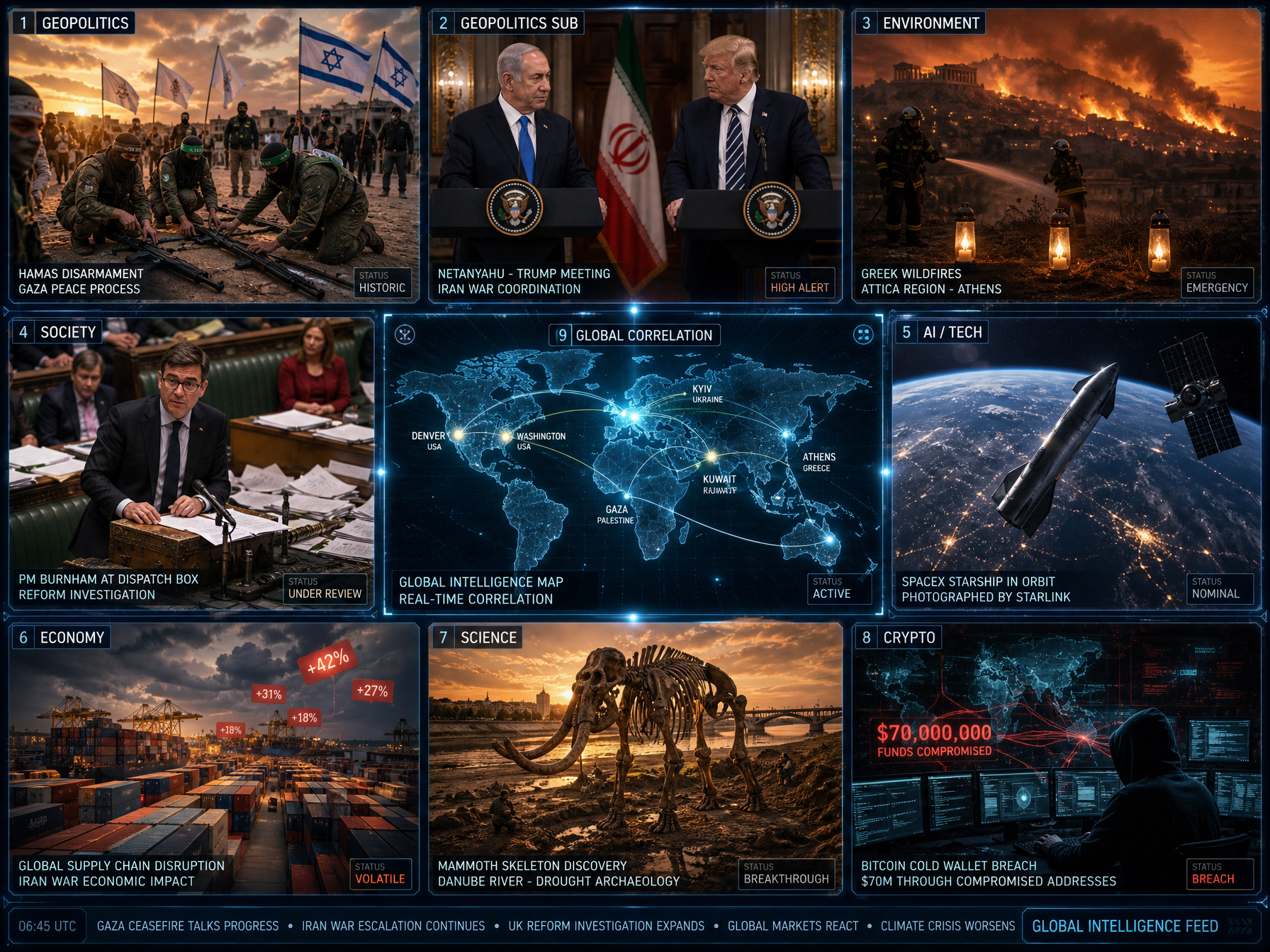
Hamas has formally agreed to a disarmament plan brokered by US President Donald Trump’s “Board of Peace”, marking what multiple world powers have described as a historic breakthrough in the eight-month Gaza conflict[57]. Under the terms of the agreement, Hamas and other Palestinian armed factions will hand over their weapons to a Palestinian governing committee in phased stages, matched by Israeli withdrawal from the Gaza Strip[58]. The full text of the deal, released by the Board of Peace, calls for disarming Palestinian factions after Israel carries out its withdrawal commitments, a sequencing that creates mutual accountability but also introduces the risk that either side could defect before completing their obligations[59]. Hamas described the first step as a commitment from Israel to halt military operations, while Trump declared the agreement “historic” and said Israel was “very happy” with the arrangement[60].
However, the agreement’s viability faces immediate challenges. Al Jazeera reports that Israel launched attacks across Gaza just one day after Hamas agreed to disarm, raising serious questions about whether Netanyahu’s government is genuinely prepared to implement the withdrawal component of the deal[61]. The attacks on Gaza following the agreement suggest a disconnect between Trump’s diplomatic announcement and Israel’s military posture on the ground — a pattern that Le Monde’s analysis characterises as Trump attempting to pressure Israel to accept a deal tying Hamas disarmament to Israeli withdrawal, while Israel’s actions indicate resistance to the withdrawal timetable[62]. Germany has welcomed the disarmament plan, with Foreign Minister Johann Wadephul describing it as a positive step, while the UAE and other Gulf states have issued similar statements of support[63]. The Egypt-backed roadmap represents the most ambitious attempt to resolve the Gaza conflict since the October 2023 attack, but its success depends on both parties honouring commitments that neither has a strong track record of fulfilling.
1.2 Netanyahu Visits Washington: Iran War Coordination with Trump
Israeli Prime Minister Benjamin Netanyahu travelled to Washington for a two-day visit that included a meeting with President Trump at Blair House and attendance at Senator Lindsey Graham’s funeral — a visit that took place against the backdrop of the Iran conflict and the Gaza disarmament announcement[64]. The visit — Netanyahu’s eighth meeting with Trump since the president’s re-election — was described by the Israeli PM as both “a great privilege” and “a great responsibility”, noting that acting with “great determination and great wisdom” was essential during the current complex period[65]. Politico reported that Netanyahu may not like what comes with the visit, suggesting that Trump pressed Israel on the Gaza withdrawal timeline as part of the broader diplomatic package[66]. The closed-door meeting at Blair House also included discussions with US Secretary of State Marco Rubio and National Security Advisor JD Vance, indicating that the talks covered the full spectrum of regional security issues[67].
The timing of Netanyahu’s visit — coinciding with Iran’s attacks on Kuwait and the Hamas disarmament announcement — creates a dense diplomatic calendar in which multiple interconnected negotiations are proceeding simultaneously. The Israel-Iran dimension of the conflict, which D61 documented through Trump’s declaration of “complete Hamas disarmament”, now has concrete implementation mechanics through the Board of Peace agreement, but the question of whether Israel will actually withdraw from Gaza remains the critical unknown. The visit also provides a venue for coordinating the US and Israeli responses to Iran’s expansion of attacks to Gulf states, a military escalation that demands the kind of high-level strategic alignment that only face-to-face meetings between heads of state can achieve.
1.3 Russia Launches 35 Missiles and 185 Drones at Kyiv, Killing Nine
Russia launched one of its most intense combined aerial assaults on the Ukrainian capital overnight, firing 35 ballistic and cruise missiles alongside 185 attack drones in a coordinated barrage that killed at least nine civilians and wounded 28 others[1]. President Zelenskiy confirmed that Ukrainian air defences managed to shoot down only one Russian ballistic missile due to acute shortages of interceptor missiles, a disclosure that underscores the widening gap between the scale of Russia’s offensive campaign and Ukraine’s increasingly strained defensive capacity[2]. France 24 reported that the attacks targeted residential areas across Kyiv, with the death toll confirmed by the city’s mayor[3]. The assault represents a continuation of the escalation pattern documented in D61, but the scale of this attack — particularly the near-total failure of ballistic missile interception — marks a qualitative deterioration in Ukraine’s air defence posture that could embolden further Russian strikes against critical infrastructure as autumn approaches.
Meanwhile, Russia’s grain lobby has warned of a potential halt to Black Sea exports, a threat that, if executed, would disrupt global food supply chains already stressed by the Iran conflict’s impact on shipping routes[68]. A Kh-101 cruise missile crashed in Polish territory, prompting Warsaw to consider transferring Patriot air-defence systems to Ukraine — a decision that would mark a significant escalation of Poland’s direct military contribution to the war effort[19]. The US Air Force has also issued a solicitation for a reusable hypersonic VTOL bomber, a programme that, if realised, would represent the most ambitious military aviation project since the B-2 Spirit[18].
1.4 Iran Attacks Kuwait Directly: Air Defences Intercept Missiles and Drones
Iran has launched a direct military attack on Kuwait, with the Kuwaiti Army General Staff confirming that air defence systems are actively intercepting hostile missiles and drones launched from Iranian territory[69]. The Anadolu Agency reports this marks the third time since Monday that Kuwait’s military has been engaged in active air defence operations against Iranian projectiles[70]. Al Arabiya quotes the Kuwaiti Army as stating it is “confronting hostile drone attacks” from Iran, with the General Staff confirming that any explosions heard are the result of air defence systems intercepting hostile targets[71]. The attack on Kuwait — a US-allied Gulf state hosting approximately 13,000 American military personnel and the Combined Air Operations Centre — transforms the conflict from a bilateral Iran-US confrontation into a regional war affecting sovereign Gulf states directly.
The UKMTO has reported a maritime incident 11 nautical miles northeast of Lima, Oman, where a tanker’s Chief Security Officer reported the vessel being hit by an unknown projectile that damaged the engine room[72]. Jordan and Bahrain have also reported intercepting Iranian missiles and drones in recent weeks, confirming that the conflict has expanded to a multi-state Gulf theatre[63]. India’s External Affairs Minister Jaishankar has urged Iran to avoid attacks on commercial shipping and seafarers, while the MEA confirmed it remains in contact with families of two Indian nationals still missing after the vessel MV AG N Ragnar was attacked leaving Ukraine’s Odesa port[73]. The confluence of direct attacks on Kuwait, continued maritime harassment, and the broader economic fallout creates a picture of a conflict that has metastasised beyond its original bilateral framework.
1.5 Ceuta Aftermath: Migrants Return as EU Debates Border Architecture
Following the unprecedented 49,000-person crossing documented in D61, most migrants who entered the Spanish enclave of Ceuta have returned to Morocco, but the political aftershocks continue to reshape European border policy discourse[74]. Spain’s deployment of military units to Ceuta — an extraordinary measure signalling the government’s assessment that the situation exceeded civilian law enforcement capacity — represents the most significant use of Spanish military forces on domestic soil since the transition to democracy[75]. Italy’s Prime Minister Meloni has threatened to suspend the Schengen free-movement agreement, while France has reinforced its border controls unilaterally[76]. The crisis connects directly to the migration dynamics this report has tracked since D55’s coverage of the Polish border crisis: European migration pressure is not a single-vector phenomenon but a convergence of African, Middle Eastern, and Central Asian flows that interact with and amplify each other.
2. Environment & Climate
2.1 Greek Wildfires Reach Attica Heartland, Three Firefighters Killed
Wildfires have struck at the very heart of Attica, Greece’s most densely populated region, with a massive blaze on Poikilo Ori near Athens forcing evacuations of the Afaias and Ano Dasos Chaidari neighbourhoods and coming within metres of the Dafni Psychiatric Hospital[5]. At least 17 patients from the hospital were transferred to other medical facilities as a precautionary measure, while 95 firefighters with six special disaster response units, 22 vehicles, seven aircraft, and seven helicopters deployed to contain the fire[6]. The proximity of the flames to a major psychiatric institution housing vulnerable patients exposed critical deficiencies in Greece’s fire preparedness for critical infrastructure, with hospital workers’ representatives subsequently issuing a damning assessment of the government’s fire prevention investments.
The Greek firefighting tragedy deepened with three firefighters killed in the line of duty across multiple fire fronts, prompting the Deppy Vasileiadis public benefit organisation to announce a donation of 150,000 euros to the families of the fallen[7]. The fires have simultaneously consumed areas across Boeotia, where the Porto Germeno coastal settlement saw residents trapped by encircling flames and evacuated by sea, and in Aigialeia in the Peloponnese, where 83 firefighters battled a blaze that forced two overnight 112 emergency alerts[8]. Chief Fire Marshal Vasilis Vathrakogiannis announced that 51 new wildfires erupted within a single 24-hour period, with forces simultaneously engaged on 73 fire fronts nationwide — a scale that overwhelmed available aerial resources as gale-force winds prevented safe water-dropping operations[9]. This represents a significant escalation beyond the crisis documented in D61, which reported 16,000 excess deaths and 430,000 hectares burned across Europe: the fires have now penetrated Attica’s urban fringe, threatening the capital itself.
2.2 El Niño “Adding Fuel to a Planet Already on Fire” — UN Chief Warns
United Nations Secretary-General Antonio Guterres has issued a stark warning that a strengthening El Niño event, potentially on track to shatter all-time temperature records, is “adding fuel to a planet already on fire” and pushing the world into “uncharted territory”[15]. The warning comes as the Greek wildfires — now penetrating the Athens metropolitan area — provide a visceral illustration of the compound effects of anthropogenic warming and El Niño amplification that D61’s coverage of the “super El Niño” had identified as a primary driver of the 2026 summer crisis. The UN chief’s language represents an escalation from the scientific framing used in earlier D-numbers, signalling that the diplomatic and political establishment has moved from describing climate risk to characterising it as an ongoing emergency demanding immediate response.
The El Niño phenomenon is simultaneously manifesting through drought and heat stress across Central Europe, where Hungary’s sole nuclear power plant will be shut down next week because low water levels in the Danube cannot provide adequate cooling[16]. Prime Minister Peter Magyar confirmed the shutdown, which represents the first time a European nuclear facility has been forced offline due to climate-related water scarcity — a precedent that carries implications for nuclear energy planning across the continent, where cooling-water availability has traditionally been treated as a constant rather than a variable. In France, the Var department in southeastern France has been engulfed by wildfires that consumed over 1,000 hectares, forcing the evacuation of 2,500 residents, with authorities describing the fire as advancing “faster than a horse at full gallop”[17].
2.3 Colorado River Crisis: Federal Government Imposes Steep Water Cuts
The Trump administration has released a final environmental impact statement imposing steep water cuts on Arizona, California, and Nevada from the Colorado River, leaving water users across the American Southwest confronting the possibility of reducing usage by hundreds of billions of gallons over the coming decade[18]. The Bureau of Reclamation’s plan leaves the door open for states to negotiate their own sharing agreements, but also preserves the option for protracted legal battles — a dual-track approach that reflects the federal government’s reluctance to impose a settlement that would alienate key southwestern constituencies. The Colorado River crisis connects to the broader water-security theme that D61 traced through the Danube’s climate-driven low water levels: freshwater scarcity is no longer a regional concern but a convergent global pressure that simultaneously affects nuclear power generation, agricultural production, urban water supply, and ecosystem health.
In Australia, authorities have reported what is suspected to be the country’s first mass mortality event from the deadly H5N1 bird flu virus, with helicopter surveillance revealing 49 dead greater crested terns and 35 more sick birds on Baudin Rocks off the South Australian coast[19]. The discovery comes only six weeks after bird flu arrived in Australia, and its rapid escalation to mass mortality raises serious concerns about the virus’s capacity to devastate native bird populations that have no prior exposure or immunity. The event illustrates how zoonotic disease risk — a category that includes both avian influenza and the broader pandemic preparedness challenge — is accelerating under climate-change conditions that alter migration patterns and stress animal populations.
2.4 Danube Drought Uncovers Mammoth Skeleton
Record-low water levels in the Danube River have exposed the bones of a woolly mammoth (Mammuthus primigenius) in the riverbed near the village of Ryahovo in Bulgaria, providing an unexpected archaeological discovery that simultaneously illustrates the severity of the ongoing drought[20]. The exposure of geological and paleontological material that has been submerged for millennia under normal conditions is a tangible indicator of how far water levels have fallen — a visual counterpart to the statistical data on drought severity that climate scientists have been publishing. The mammoth discovery, while scientifically fascinating, serves as a reminder that the environmental extremes of 2026 are not merely uncomfortable but are reshaping physical landscapes in ways that reveal normally hidden aspects of the Earth’s geological record.
3. Society & Civil Issues
3.1 UK Prime Minister Burnham’s Policy Blitz: Buying Time for Tough Decisions
Prime Minister Andy Burnham’s first two weeks in office have been characterised by an unprecedented policy blitz covering social care, devolution, and cost-of-living measures, with Downing Street aides candidly acknowledging that the announcements were as much about political positioning as substantive reform[21]. Bloomberg’s analysis described the strategy as a “Trump-style show” designed to buy time for the harder fiscal decisions that Treasury projections suggest will be necessary — a framing that connects Burnham’s domestic strategy to the broader populist playbook that has reshaped Western democracies. The Independent reported that Burnham has shifted significant political power from Downing Street to Manchester through the creation of “No. 10 North,” a structural reform that redistributes the geography of British political authority away from the traditional Westminster-centred model[22].
The policy blitz extends to infrastructure and public services, where MPs and mayors close to Burnham have proposed turning failing water companies into not-for-profit cooperatives — a “third way” between full nationalisation and the status quo that would place public control on water companies without adding debt to the government’s balance sheet[23]. This proposal addresses the Thames Water crisis that has been a persistent feature of UK domestic politics, while also representing a broader shift in how British policymakers conceptualise the relationship between public utilities and private capital. In Manchester, Labour candidate Bev Craig has swept to victory in the largest by-election in British history, consolidating the party’s dominance in England’s second city and reinforcing the regional power base from which Burnham governs[24].
3.2 Reform UK’s Tangled Financial Web Under Investigation
The Guardian has published further details of its investigation into the financial relationships at the heart of Reform UK, revealing an increasingly clear nexus of connections between Nigel Farage’s undisclosed 5-million-pound gift from crypto billionaire Christopher Harborne, the Cottrell family’s links and donations, and Richard Tice’s business dealings[25]. The investigation, which began three months ago with the revelation of the Harborne gift, has progressively uncovered a web of financial relationships that raises questions about the transparency and accountability of a political party that campaigns on the slogan of cleaning up British politics. The Reform UK financial investigation connects to the broader theme of money’s influence on democratic processes that has featured across multiple D-number series coverage, from US campaign finance to European political party funding.
3.3 France Livret A Rate Rises to 1.7% on Resurgent Inflation
France’s government-regulated savings account, the Livret A, has seen its interest rate rise from 1.5% to 1.7% effective 1 August, a decision driven by the resurgence of inflation linked to the Middle East crisis and the associated spike in energy prices[26]. The Livret A rate, which affects the returns on savings for millions of French households, is set by government formula tied to inflation metrics, making it a direct barometer of how geopolitical conflict translates into domestic economic pressures. The increase follows the pattern documented across D-numbers of how the Iran conflict’s energy-price effects cascade through European economies, from the ECB’s rate decisions to the cost of living for ordinary citizens — the inflationary transmission mechanism that D61 identified as self-reinforcing continues to operate with measurable consequences for household finances.
4. AI & Technology
4.1 SpaceX’s Starship Seen in Space by Next-Generation Starlink Satellite
SpaceX has released dramatic video footage captured by one of its next-generation Starlink V3 satellites showing the Starship vehicle cruising through space following its 13th test flight from South Texas on 24 July[27]. The 65-second video, stitched together from four cameras on a single Starlink V3 satellite, provides an unprecedented view of the 171-foot-tall vehicle as the two spacecraft drifted apart, eventually showing Starship’s full profile with three of its six Raptor engines firing and reaction control thrusters firing small puffs of white vapor[28]. The imagery serves a dual purpose: it validates the heat-shield inspection capability that the camera-equipped satellites were designed for, and it demonstrates the operational maturity of the Starlink V3 constellation that SpaceX intends to scale to 100,000 satellites — a massive expansion from the current fleet of nearly 11,000 V2 craft[29]. Starship remains in its development phase, but is slated to fly on NASA’s Artemis III astronaut mission to low Earth orbit in mid-2027 and land a crew near the moon’s south pole on Artemis IV in late 2028.
4.2 Leopold Aschenbrenner’s Hedge Fund Crashes; AI Safety Reckoning Continues
Leopold Aschenbrenner, the German-born AI researcher who was widely regarded as an industry prophet for his writings on AI safety and superintelligence, has experienced a dramatic fall from his position atop the hedge fund Situational Awareness, which has been partially liquidated[30]. The FAZ reported that the 24-year-old’s fund, which had attracted significant capital based on his reputation for prescient AI predictions, suffered losses that forced the partial unwinding of positions — a collapse that illustrates the difficulty of translating theoretical AI foresight into investment returns. The Aschenbrenner case connects to the broader AI industry reckoning that D60 and D61 traced through the OpenAI and Anthropic security incidents: the gap between predicting AI’s trajectory and profiting from that prediction remains vast, and the market’s willingness to capitalise on AI narrative has collided with the reality of investment risk.
In a parallel development concerning the governance of AI platforms, Google has revealed plans to exempt developers in sanctioned nations — currently Iran, Cuba, North Korea, and occupied areas of Ukraine — from its new Android developer verification system[31]. The policy, which will block the installation of apps from unverified developers on Android devices running Google services starting next month, effectively creates a sanctioned-nation exception that leaves developers in those countries in a regulatory limbo: they can neither verify through normal channels nor receive explicit permission to operate outside the system. Reddit has also advanced its legal campaign against AI web scraping, with a judge largely denying a motion to dismiss from SerpApi, which is accused of conspiring with Perplexity AI to circumvent Google access controls and scrape copyrighted Reddit content from search results[32].
5. Economy & Business
5.1 Iran War Pushes Companies to Raise Prices Across Supply Chains
The economic consequences of the Iran conflict have reached consumer-facing businesses, with companies across multiple sectors announcing price increases directly attributed to war-related disruptions in supply chains and energy costs[33]. The price increases — reported across sectors as diverse as beer, paint, and processed food — represent the latest stage in the conflict’s inflationary transmission mechanism that D61 traced from crude oil prices through to euro-area inflation data. The US Senate has passed a Russia sanctions bill with an 86-12 vote that authorises tariffs of up to 100% on nations purchasing Russian oil and gas, legislation that India is closely monitoring given its status as one of the largest importers of Russian crude[34]. However, analysis from Euronews suggests the sanctions bill risks backfiring against European allies who have been purchasing Russian energy under various exemptions, potentially turning a tool designed to pressure Moscow into an instrument of transatlantic friction[35].
5.2 South Korea Exports Beat Forecasts on AI Chip Demand; India RBI Raises $41B
South Korea’s exports exceeded analyst expectations in July, with the AI-driven semiconductor boom continuing to underpin the economy and strengthening the case for further monetary tightening by the Bank of Korea[36]. The export performance extends the pattern documented in D61 of South Korea’s chip rally boosting global AI trade, with Samsung and SK Hynix capitalising on insatiable demand for advanced memory chips that power AI training and inference workloads across the global technology ecosystem. In a parallel financial development, India’s central bank has attracted $41 billion in foreign currency through targeted capital-flow measures in just two months, exceeding the mobilisation achieved during the 2013 taper tantrum crisis[37]. The Reserve Bank of India’s FCNR(B) deposit facility contributed $36.7 billion to this total as banks competed for non-resident funds before the concessional swap window closes, a mobilisation speed that reflects both the attractiveness of Indian yields and the effectiveness of regulatory innovation in attracting capital during periods of global financial stress.
China’s crude oil imports declined in the second quarter of 2026, a contraction driven by elevated prices resulting from disrupted flows through the Strait of Hormuz — the same chokepoint that D61 documented as the site of IRGC claimed tanker strikes[38]. China’s reduced imports, while driven by cost rather than demand destruction, have had a softening effect on global crude prices that partially counterbalances the supply disruption from the Strait. Meanwhile, Japan’s Ministry of Finance has confirmed the deployment of a wide array of tools to address market liquidity needs, a statement that signals Tokyo’s readiness to intervene in currency and bond markets as the conflict’s financial spillovers create volatility across Asian financial systems[39].
5.3 UK PM Burnham’s “Trump-Style” Strategy and Treasury Implications
Bloomberg’s analysis of Burnham’s early governance strategy characterises the policy blitz as deliberately modelled on the Trump administration’s communication approach — front-loading announcements to create an impression of momentum while deferring the harder fiscal decisions that Treasury projections suggest will be necessary[40]. Inside Downing Street, aides are candid that the announcements serve a political as much as a policy function, a transparency that itself represents a departure from the traditional British governmental communication style. The question for markets and investors is whether the political theatre will translate into substantive reforms or merely delay the fiscal consolidation that the UK’s structural deficits demand.
6. Science & Space
6.1 Mysterious “Ghost Lineage” in Human DNA: Third Unknown Ancestor Discovered
Researchers have found evidence in modern human DNA of two previously unknown ancestors — extinct human forms that left no fossils and have never been genomically decoded, yet have left traces in our genome that distinguish them from the known Neanderthal and Denisovan lineages[41]. The discovery, reported by Euronews, represents the latest chapter in the evolving understanding of human evolutionary history, which has progressively revealed that our species’ ancestry is more complex and interconnected than the tidy Neanderthal-and-Denisovan narrative suggested. The use of newly developed analytical techniques to identify these “ghost lineages” — so called because no physical specimens exist — demonstrates how computational genomics is expanding the boundaries of what can be known about human origins from DNA alone, a methodological advance that will continue to reshape our understanding of the deep past.
6.2 Scientists Solve the Sun’s Missing Silver Mystery; Metformin Found to Act on the Brain
An international team of researchers has resolved a long-standing puzzle about the composition of the Sun, finding that it contains 55% more silver than previous estimates had indicated — a discrepancy that had puzzled scientists because ancient meteorite fragments contain much more silver than the Sun, despite both forming from the same material 4.6 billion years ago[42]. The revised estimate, published in Astronomy & Astrophysics, was derived from a significantly more detailed 3D model of the Sun’s atmosphere developed with the help of a supercomputer, which allowed more accurate interpretation of how silver atoms interact with solar light. The finding reconciles the Sun’s composition with meteorite data and provides a more reliable reference point for understanding the chemical evolution of the Milky Way[43].
In medical science, a study published in Science Advances has revealed that metformin — the second most commonly prescribed medication in the United States, used to treat type 2 diabetes for over 60 years — also acts directly on the brain to regulate blood glucose levels, a mechanism that had not previously been recognised[44]. Researchers at Baylor College of Medicine demonstrated that when the Rap1 protein was genetically deleted from a specific region of the mouse brain called the ventromedial nucleus of the hypothalamus, metformin lost its glucose-lowering effect, suggesting the drug depends on a brain pathway that was previously unknown. The discovery opens the door to new diabetes treatments that target this brain pathway directly, and may help explain other well-documented effects of metformin, including its association with slowed brain aging and exceptional longevity in women.
6.3 SpaceX Falcon 9 Rocket to Crash Into the Moon; August Sky Events Preview
NASA has announced that a SpaceX Falcon 9 rocket stage, launched in 2022, is on a collision course with the Moon’s far side, with the impact expected to kick up a debris plume so high that it may be visible through telescopes on Earth[45]. The unplanned lunar impact — the result of the upper stage failing to achieve a stable trajectory after a geostationary transfer orbit — will provide scientists with an unexpected opportunity to study how impact debris disperses in the lunar environment. Separately, NASA has previewed August’s astronomical highlights, which include a total solar eclipse on 12 August crossing northern Russia, Greenland, Iceland, and northern Spain, the Perseid meteor shower peaking under ideally dark skies on 12-13 August, and a partial lunar eclipse on 27-28 August visible from the Americas and Europe[46]. The conjunction of a total solar eclipse with peak Perseid conditions makes the night of 12 August potentially the most spectacular astronomical viewing opportunity of the year.
7. Crypto, Digital Assets & Blockchain
7.1 Bitcoin Cold Wallets Lose $70M in Attack That Never Touched the Devices
Galaxy Research has published findings revealing that weak seed generation — the process by which users create the random numbers that form the basis of their private keys — allowed an attacker to recreate likely private keys offline, sweeping more than 1,000 BTC from nearly 1,200 wallets without ever accessing the physical devices themselves[47]. The attack, which resulted in approximately $70 million in losses, represents a qualitatively different threat model from the Coldcard hardware wallet exploit documented in D61: rather than compromising the security architecture of a device, the attacker exploited the mathematical weakness of user-generated randomness, a vulnerability that exists at the human-computer interface rather than in the cryptographic system itself. This distinction matters because it means that the most sophisticated hardware protections are irrelevant if the underlying seed generation process is flawed — the security chain is only as strong as its weakest link, and in this case, the weakest link was the entropy source that users relied upon to generate their keys.
7.2 RWA Market Hits $36B as Tokenisation Accelerates Into Institutional Infrastructure
The tokenised real-world asset (RWA) market has surpassed $36 billion in on-chain value, representing one of the fastest-growing segments of digital finance as blockchain-based representations of traditional assets continue to attract institutional capital[48]. Bybit has expanded its collateral options to include six tokenised stocks — representing shares in companies like Tesla, Apple, and MicroStrategy — that can now be used as collateral across margin trading, crypto loans, and institutional lending products, effectively integrating tokenised equities into the plumbing of a major exchange’s credit and leverage systems[49]. The move signals a shift in how major exchanges view tokenised real-world assets: rather than treating them as isolated trading pairs, Bybit is integrating them directly into core financial infrastructure, a development that blurs the line between traditional equity markets and crypto-native lending.
The XRP Ledger is preparing its v3.3.0 release with five proposed amendments targeting institutional features including privacy enhancements, atomic settlement, and streamlined onboarding for institutional users[50]. Two of the revised features had been previously withdrawn after researchers discovered bugs that could have allowed unauthorised transactions or fee draining, and their reintroduction after fixes demonstrates the iterative security process that mature blockchain protocols must undergo. HIVE Executive Chairman Frank Holmes has disclosed that the firm’s AI compute GPUs are generating approximately 10 times more revenue per hour than its Bitcoin mining rigs, a comparison that illustrates the economic migration of GPU assets from crypto mining to AI compute — a trend with significant implications for the cryptocurrency mining industry’s long-term business model[51].
7.3 Tether Excess Reserves Halve; Russia Expands Mining Ban to Moscow
Tether has reported that its excess reserves fell from a record $8.23 billion at the end of Q1 to $4.11 billion as of June 30, while its first-half comprehensive financial result was approximately negative $3.17 billion — a swing that raises fundamental questions about the stablecoin issuer’s financial resilience and the sustainability of its reserve buffer[52]. The reduction in excess reserves, combined with the comprehensive loss, creates a more fragile financial position for the world’s largest stablecoin issuer at a time when regulatory scrutiny of stablecoin reserve practices is intensifying globally. Meanwhile, Russia has expanded its cryptocurrency mining ban to Moscow and surrounding regions, affecting an area responsible for approximately 17% of global Bitcoin hash rate, with the restriction taking effect from 15 August[53]. The expansion follows earlier bans that impacted roughly 50,000 Russian miners and has driven mining capacity migration to the United States and Central Asia, reshaping the geographic distribution of the Bitcoin network’s computational infrastructure.
BlackRock’s Bitcoin ETF, the iShares Bitcoin Trust (IBIT), recorded a $122.7 million net outflow on 31 July, part of a broader pattern of US spot Bitcoin ETF withdrawals totalling more than $265 million in a single day[54]. The outflows reflect declining investor appetite amid Bitcoin’s bear market conditions and the broader macro uncertainty driven by the Iran conflict’s economic spillovers. Bitcoin gained nearly 8% in July despite the turbulence, but remains down more than 28% year-to-date as investors await new catalysts — a positioning that suggests the market is in a holding pattern between the exhaustion of the bear’s selling pressure and the emergence of a fresh bullish narrative[55]. A Hong Kong woman lost approximately $3.3 million in a crypto romance scam where an online partner directed her to a fraudulent investment platform, illustrating the persistent human vulnerability that underlies the crypto ecosystem’s security challenges[56].
The Colorado River cuts also have implications for the US defence-industrial base: military installations across the Southwest, including major bases in Arizona and California, depend on Colorado River water for operations, and any reduction in availability could affect readiness and training schedules. Meanwhile, the convergence of the Australian bird flu event with the European wildfire crisis underscores a planetary pattern in which climate-driven disruptions cascade across ecosystems and geographies, affecting human health, energy systems, food production, and biodiversity simultaneously. The scale of the fires, droughts, disease events, and water crises documented in today’s report suggests that the 2026 summer may represent a structural breakpoint in how societies manage environmental risk — a moment when incremental adaptation gives way to the recognition that the baseline conditions for civilisation’s infrastructure have fundamentally shifted.
Correlations & Analysis
The D62 intelligence picture reveals two converging crisis arcs that connect today’s disparate events into coherent strategic narratives. The first is the compound climate-fire-energy nexus, which has now expanded from the European wildfire crisis documented in D61 to include the Greek fires’ penetration of the Athens metropolitan area, Hungary’s nuclear plant shutdown due to drought, the Colorado River water cuts, and the UN Secretary-General’s escalation of rhetoric to “uncharted territory.” What makes this convergence significant is that it is no longer a matter of isolated extreme events but a systemic pattern in which climate change simultaneously degrades fire management capacity, reduces nuclear power generation, threatens agricultural water supplies, and amplifies the political pressure on governments already strained by the Iran conflict’s economic effects. The Greek firefighters killed while defending a psychiatric hospital from flames that approached the capital’s suburban fringe provide the most visceral illustration of how climate-driven disasters interact with infrastructure vulnerability to produce outcomes that exceed what either factor would produce alone. As D61 documented, the European wildfire crisis had already produced 16,000 excess deaths; today’s reporting confirms that the worst of the summer may still lie ahead.
The second structural dynamic is the financial-system stress test being conducted by simultaneous geopolitical shocks. The Iran conflict’s disruption of Hormuz — first through tanker strikes documented in D61 and now through confirmed price increases across consumer supply chains — is combining with Russia’s Kyiv barrage to create a two-front economic pressure system that affects energy markets, food supply chains, defence budgets, and migration dynamics simultaneously. South Korea’s export beat on AI chips and India’s $41 billion forex mobilisation demonstrate that some economies are finding ways to thrive within this stress environment, but the French Livret A rate increase, the US Russia sanctions bill’s potential to alienate European allies, and China’s crude import decline all confirm that the conflict’s economic transmission mechanisms are operating at continental scale. The crypto ecosystem’s internal dynamics — Tether’s reserve deterioration, the $70 million cold wallet attack, and BlackRock’s ETF outflows — suggest that digital assets are not immune to the macro uncertainty but are instead amplifying it through their own structural vulnerabilities.
The third dynamic connecting today’s intelligence is the emerging convergence between climate-driven infrastructure stress and geopolitical supply-chain fragility. Hungary’s nuclear plant shutdown due to Danube water scarcity, the Colorado River cuts affecting Arizona and California, and the Greek fires’ penetration of Attica all represent climate impacts on critical infrastructure — while the Iran conflict’s disruption of energy supply chains through the Strait of Hormuz and Russia’s missile barrages on Ukrainian energy systems represent geopolitical impacts on the same infrastructure. These two categories of disruption are not independent: climate-driven drought reduces hydroelectric output, forcing greater dependence on natural gas and oil — precisely the commodities whose supply chains the Iran conflict is disrupting. The 2026 summer may therefore represent a structural breakpoint in how societies manage the compound risk of climate change and geopolitical conflict, a dual vulnerability that existing governance frameworks — designed for either environmental or security crises, but not both simultaneously — are poorly equipped to address.
What to watch in the next reporting period: The Greek fires will dominate headlines through the weekend, with wind conditions forecast to maintain extreme fire risk across Attica and the Aegean. The Colorado River cuts will trigger immediate legal challenges from Arizona and California water users, testing whether the federal government’s environmental impact statement can withstand judicial review. The US Senate’s Russia sanctions bill moves to the House of Representatives, where its passage will determine whether the 100% tariff threat becomes law and triggers a trade confrontation with European allies. And the 12 August total solar eclipse and Perseid meteor shower will provide a brief moment of astronomical wonder that contrasts sharply with the geopolitical turbulence — a reminder that the universe operates on timescales that make even the most dramatic human events appear transient.
References
1. “Russia Launches 35 Missiles, 185 Drones in Ukraine Attack: Zelenskiy” — Crypto Briefing, 1 Aug 2026. link ↩
2. “Zelenskiy: Ukraine Shot Down Only One Russian Ballistic Missile” — FinancialJuice, 1 Aug 2026. link ↩
3. “Russia’s Assault on Ukraine’s Capital Kyiv Kills Nine, Wounds 28” — FinancialJuice, 1 Aug 2026. link ↩
4. “Mindestens neun Tote: Russischer Angriff auf Kiew” — Tagesschau, 1 Aug 2026. link ↩
5. “Sto Eleos tou Theou i Chora — Terastia Oikologiki Katastrofi” — Dimokratia, 1 Aug 2026. link ↩
6. “Sovares Katangelies Apo toys Ergazomenoys tou PSNA” — Dimokratia, 1 Aug 2026. link ↩
7. “Dorea 150.000 Euro Apo ton Koinofeli Organismo Deppy Vasileiadis” — Protothema, 1 Aug 2026. link ↩
8. “Mainontai oi Foties se Porto Germeno, Boiotia kai Aigialeia” — Iefimerida, 1 Aug 2026. link ↩
9. “51 Nees Agrotodasikes Pyrkagies se 24 Ores” — Dimokratia, 1 Aug 2026. link ↩
10. “Nach Ansturm auf Ceuta: Migranten Kehren Zurueck” — Tagesschau, 1 Aug 2026. link ↩
11. “Katastrophen: Braende in Griechenland Wueten” — Stern, 1 Aug 2026. link ↩
12. “I Just Want a Chance: Moroccans Sought Better Future in Ceuta Crossing” — The Independent, 1 Aug 2026. link ↩
13. “India Urges Iran to Avoid Attacks on Commercial Shipping” — Indian Defence News, 1 Aug 2026. link ↩
14. “MEA In Touch With Families of Two Missing Indian Seafarers” — Indian Defence News, 1 Aug 2026. link ↩
15. “Strengthening El Nino Adding Fuel to a Planet Already on Fire: UN Chief” — Phys.org, 1 Aug 2026. link ↩
16. “Hungary to Shut Nuclear Plant as Heatwave Hits Central Europe” — Phys.org, 1 Aug 2026. link ↩
17. “Incendies dans le Var: Un Feu Qui Progresse Plus Vite Qu’un Cheval au Galop” — Liberation, 1 Aug 2026. link ↩
18. “Federal Plan Makes Steep Colorado River Water Cuts” — Inside Climate News, 31 Jul 2026. link ↩
19. “First Australian Mass Mortality Event Suspected as Deadly Bird Flu Escalates” — The Guardian, 1 Aug 2026. link ↩
20. “Danube Dries in Heat: Skeleton of Giant Mammoth Uncovered in Bulgaria” — Euronews, 1 Aug 2026. link ↩
21. “Burnham Bets a Trump-Style Show Buys Time to Fix the Hard Stuff” — Bloomberg/Financial Post, 1 Aug 2026. link ↩
22. “Britain’s New Leader Shifts Power from Downing Street to Manchester” — The Independent, 1 Aug 2026. link ↩
23. “Turn Failing Water Firms into Not-for-Profit Cooperatives, MPs Tell PM” — The Guardian, 1 Aug 2026. link ↩
24. “Greater Manchester Mayoral By-Election: Bev Craig Sweeps to Victory” — Evening Standard, 1 Aug 2026. link ↩
25. “The Tangled Financial Web at the Heart of Reform UK” — The Guardian, 1 Aug 2026. link ↩
26. “Epargne: le Taux du Livret A Remonte a 1,7%” — La Tribune, 1 Aug 2026. link ↩
27. “SpaceX’s Starship Seen in Space by Next-Gen Starlink Satellite” — Space.com, 31 Jul 2026. link ↩
28. “Starship in Space from Starlink V3 — Composite Video” — SpaceX/X, 31 Jul 2026. link ↩
29. “SpaceX Wants to Launch 100,000 Starlink V3 Satellites” — Space.com FCC filing, 31 Jul 2026. link ↩
30. “Leopold Aschenbrenner: Deutsches KI-Wunderkind in Noeten” — FAZ, 1 Aug 2026. link ↩
31. “Google Plans to Exempt Sanctioned Nations from Android Developer Verification” — Ars Technica, 31 Jul 2026. link ↩
32. “Reddit Keeps Its Strange DMCA Fight Over Google Search Results Alive” — Ars Technica, 31 Jul 2026. link ↩
33. “Iran War Pushes Companies to Raise Prices on Beer, Paint and Fries” — Investing.com, 1 Aug 2026. link ↩
34. “India Monitors US 100% Tariff Threat on Russian Oil Buyers” — Indian Defence News, 1 Aug 2026. link ↩
35. “US Senate Bill on Russia Sanctions Risks Backfiring Against European Allies” — Euronews, 1 Aug 2026. link ↩
36. “South Korea Exports Beat Forecasts in July on AI Chip Demand” — Investing.com, 1 Aug 2026. link ↩
37. “RBI’s Special Forex Swap Window Outpaces 2013 Inflows” — Business Standard, 1 Aug 2026. link ↩
38. “China’s Crude Oil Imports Fell in the Second Quarter” — CleanTechnica/EIA, 31 Jul 2026. link ↩
39. “Japan Finance Ministry: Wide Array of Tools to Tackle Market Liquidity” — FinancialJuice, 1 Aug 2026. link ↩
40. “UK PM Burnham Uses Policy Blitz to Buy Time for Tougher Decisions” — Investing.com, 1 Aug 2026. link ↩
41. “Mysterious DNA: Two Unknown Ancestors Found in Human Genome” — Euronews, 1 Aug 2026. link ↩
42. “Scientists May Have Finally Solved The Sun’s Missing Silver Mystery” — ScienceAlert, 1 Aug 2026. link ↩
43. “Solar Silver Abundance Revised Up 55%” — Uppsala University/Astronomy & Astrophysics, 2026. link ↩
44. “Diabetes Drug Metformin Found to Unexpectedly Affect the Brain” — ScienceAlert, 1 Aug 2026. link ↩
45. “SpaceX’s Falcon 9 Rocket Is About to Crash Into the Moon” — Wired, 31 Jul 2026. link ↩
46. “What’s Up: August 2026 Skywatching Tips from NASA” — NASA, 31 Jul 2026. link ↩
47. “How Bitcoin Cold Wallets Lost $70 Million in an Attack That Never Touched the Devices” — CoinDesk, 1 Aug 2026. link ↩
48. “RWA Market Hits $36 Billion: Why Tokenization Is Transforming Global Finance” — Coinpedia, 1 Aug 2026. link ↩
49. “Bybit Expands Collateral Options, Adding Six Tokenized Stocks” — Blockchain Reporter, 1 Aug 2026. link ↩
50. “XRP Ledger Upgrade Brings Back Features Once Pulled Over Critical Bugs” — CoinDesk, 1 Aug 2026. link ↩
51. “HIVE Exec: AI GPUs Earn 10x More per Hour Than Mining Rigs” — Bitcoin.com, 1 Aug 2026. link ↩
52. “Tether News: Q2 Excess Reserves Halve as Financial Result Swings to Loss” — Coinpedia, 1 Aug 2026. link ↩
53. “Russia Expands Crypto Mining Ban to Moscow, Affecting 17% of Global Hash Rate” — CoinTurk, 1 Aug 2026. link ↩
54. “BlackRock Bitcoin ETF Records $122.7 Million Outflow” — Coinpedia, 1 Aug 2026. link ↩
55. “Bitcoin Gains Nearly 8% in July, Eyes on US Jobs Data and ETFs” — CoinTurk, 1 Aug 2026. link ↩
56. “Hong Kong Crypto Romance Scam Costs Woman $3.3M” — Crypto.news, 1 Aug 2026. link ↩
57. “Full Text of Board of Peace Deal for Hamas to Disarm, Israel to Withdraw from Gaza” — Times of Israel, 31 Jul 2026. link ↩
58. “Hamas Agrees to Disarm Under Trump Plan” — Global News, 1 Aug 2026. link ↩
59. “Trump’s Gaza Deal Sparks Questions on Whether Israel and Hamas Will Follow Through” — New York Times, 31 Jul 2026. link ↩
60. “Hamas Agrees to Gaza Disarmament Deal” — Dawn, 1 Aug 2026. link ↩
61. “Israel Launches Attacks Across Gaza One Day After Hamas Agrees to Disarm” — Al Jazeera, 1 Aug 2026. link ↩
62. “Trump Tries to Pressure Israel to Accept Deal Tying Hamas Disarmament to Israeli Withdrawal” — Le Monde, 1 Aug 2026. link ↩
63. “Germany Welcomes Hamas Disarmament Plan; UAE Welcomes Agreement” — DW, 1 Aug 2026; SANA, 24 Jul 2026. link ↩
64. “Netanyahu Lands in US for Talks with Trump on Iran” — Jerusalem Post, 28 Jul 2026. link ↩
65. “Prime Minister Netanyahu Before Departing on Visit to Washington” — IsraeliPM/X, 27 Jul 2026. link ↩
66. “Netanyahu Is Finally Getting His White House Meeting. He May Not Like What Comes With It” — Politico, 27 Jul 2026. link ↩
67. “Maps of Syria, Meeting Trump and Vance” — Jerusalem Post, 30 Jul 2026. link ↩
68. “Russische Getreidelobby Warnt Vor Stopp der Exporte im Schwarzen Meer” — Handelsblatt, 1 Aug 2026. link ↩
69. “Kuwait Army: Air Defenses Currently Intercepting Hostile Iranian Missiles” — FinancialJuice, 1 Aug 2026. link ↩
70. “Kuwait Intercepts New Wave of Iranian Attacks Amid Escalating Regional Tensions” — Anadolu Agency, 1 Aug 2026. link ↩
71. “Kuwait Air Defenses Responding to Iranian Drones” — Al Arabiya, 1 Aug 2026. link ↩
72. “UKMTO: Tanker Chief Security Officer Reports Vessel Hit by Unknown Projectile” — FinancialJuice, 1 Aug 2026. link ↩
73. “India Urges Iran to Avoid Attacks on Commercial Shipping; MEA In Touch With Missing Seafarers’ Families” — Indian Defence News, 1 Aug 2026. link ↩
74. “Nach Ansturm Auf Ceuta: Migranten Kehren Zurueck” — Tagesschau, 1 Aug 2026. link ↩
75. “Spain Deploys Military to Ceuta as Largest Migrant Influx Since 2021” — flight.com.gr, 31 Jul 2026. link ↩
76. “I Just Want a Chance: Moroccans Sought Better Future in Ceuta Crossing” — The Independent, 1 Aug 2026. link ↩
AI Disclosure: This post was created with the assistance of artificial intelligence. The ideas, analysis, and opinions expressed are my own — AI was used to help compose, structure, and refine my personal notes and thoughts into the final written content. Images, videos and music featured in this post were also generated using AI tools, based on my own creative prompts and direction.