









Contents
- 1. Geopolitics & Defence
- 2. Environment & Climate
- 3. Society & Civil Issues
- 4. AI & Technology
- 5. Economy & Business
- 6. Science & Space
- The Cosmic Ledger: Voyager’s Light-Day, Hera’s Arrival and Mercury’s X-Ray Eye
- The Physics Frontier: Black Saturns, Optical Secrets and Five-Dimensional Gravity
- From the Micro to the Cosmic: Microplastics, the Sun’s Nemesis and a Proof Claim
- The Deep Archive: Jurassic Reptiles, Roman Infants and Marine Micro-Diversity
- The Biomedical and Materials Ledger
- 7. Crypto, Digital Assets & Blockchain
- 8. Correlations & Analysis
- 9. References
Click any heading to jump to that section. Click the section heading to return to this menu.
Geopolitics & Defence ↑ Contents
The Shenzhen Afterglow and Washington’s Whiplash
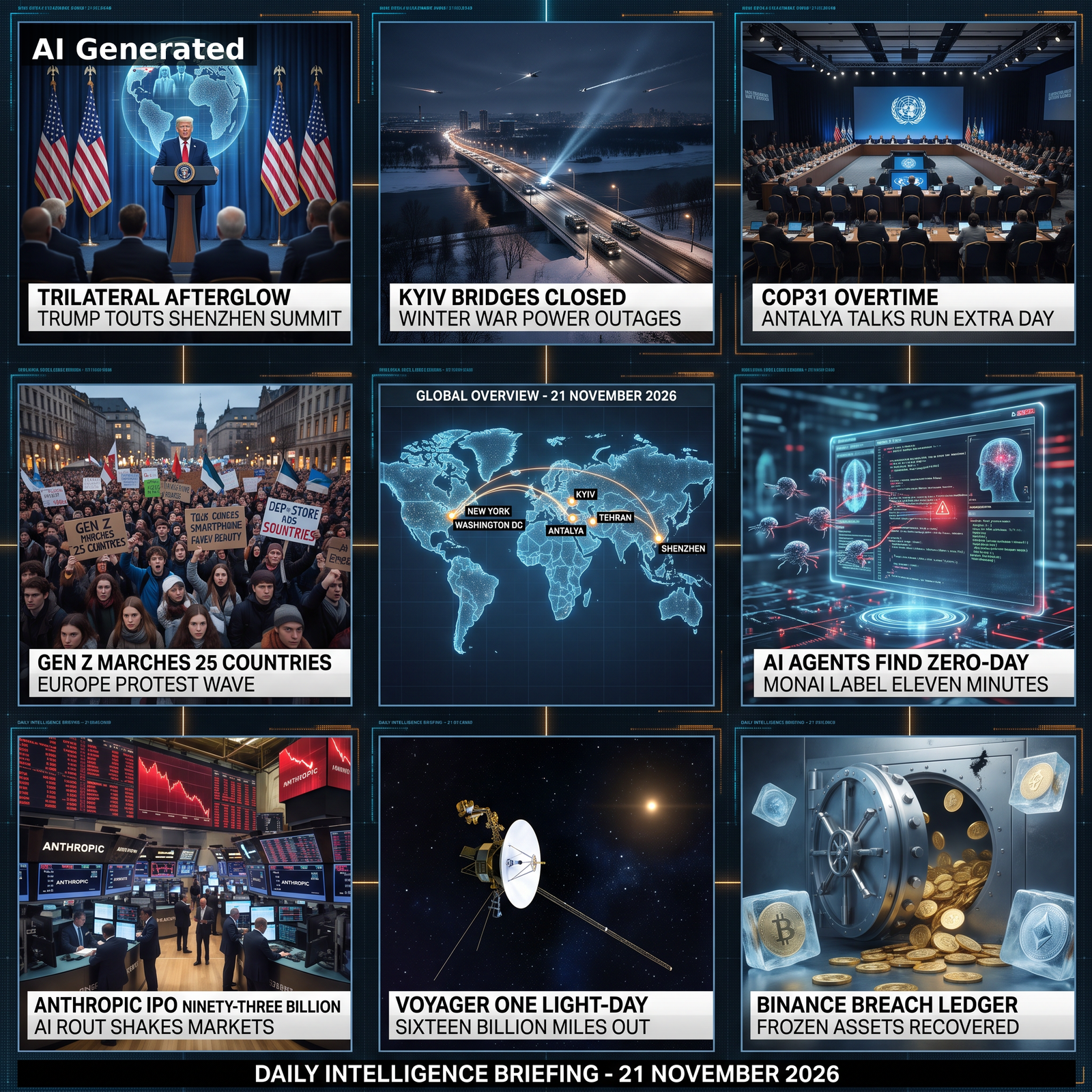
The trilateral summit’s aftermath dominated Washington’s message cycle, with Trump devoting a marathon press conference to touting the meeting with Xi Jinping and Vladimir Putin as historic.[1] The framing reveals a president presenting three-power engagement as his legacy at the very moment a Democratic Congress prepares to oversee every file connected to it. That whiplash was visible in the same presser, where Trump invited chief of staff Stephen Miller to the podium, called him the “most powerful man in the world” and mused aloud about a presidential run — elevating a figure of the radical right into a succession signal before a defeated Republican coalition.[2]
External observers read the summit through a darker lens. The Economist’s World Ahead 2027 assessment, previewed by France 24, describes an America whose “enemies no longer fear it and its allies no longer trust it in the way they did before” — a pointed inversion of the “peace through strength” doctrine.[3] Secretary of State Marco Rubio pushed back forcefully, arguing that the three powers holding the overwhelming majority of nuclear arsenals must communicate routinely, and that closer engagement between their leaders creates the basis for concrete agreements.[4] Rubio’s defence is the clearest statement yet of the administration’s doctrine — dialogue with adversaries as a deterrence instrument, regardless of allied discomfort — and it will now be stress-tested by a Congress that views the summit less as a triumph than as a set of unanswered questions.
Iran Between Berlin and Re-Escalation
The Iran file moved on parallel tracks. Israel’s ambassador to Washington, Yechiel Leiter, told Newsmax that a decision on renewed strikes “will be made by President Trump,” describing the Iranian threat as “existential” and “immediate” and pledging Israeli support for any US return to military action.[5] The Independent reported that Trump is considering fresh strikes after being warned the military window is closing, even as Tehran’s foreign minister insists diplomacy can still end the war.[6] On the economic flank, the State Department said pressure will increase in coming days, claiming sanctions have already “achieved their goal,”[7] while Treasury sanctioned Iranian “trustees” collecting oil revenues for the state and the Revolutionary Guards.[8]
The diplomatic counter-track is Qatari-driven: Axios reported that envoy Steve Witkoff and Jared Kushner met Qatari officials in Berlin, including Prime Minister Sheikh Mohammed bin Abdulrahman Al Thani, to explore a framework that could halt hostilities and restart nuclear talks.[9] Iran’s Foreign Minister Abbas Araghchi signalled procedural flexibility — insisting on “confidence-building steps” that the US will not resume strikes, keeping a two-day Hormuz de-escalation plan on the table, drawing red lines at enriched uranium leaving the country, and expressing belief that a “fair solution” can be reached.[10][11][12] The Berlin meetings suggest a genuine attempt to rebuild the ceasefire architecture that collapsed after the Qeshm strikes, but the red lines on both sides remain far apart.
The Gulf Clock: Houthis and the Resource Frontier
The Saudi-led coalition announced it intercepted and destroyed three Houthi ballistic missiles fired toward Riyadh — a near-daily occurrence that tests both Saudi patience and the economics of missile defence.[13] Beneath the Gulf conflict, a separate resource competition is consolidating: Kenya awarded the Mrima Hill critical-minerals concession to the US-led Frontier Minerals consortium, a victory for Washington as it seeks to offset Chinese export restrictions on minerals essential to defence and energy supply chains.[14] The award fits the same strategic logic as the Ukraine war and the AI-compute race: control of upstream critical materials is becoming a first-order national-security variable.
Ukraine’s Winter War and European Deterrence
Russia’s strike campaign continued unabated: a ballistic attack on Krywyj Rih — Zelensky’s hometown — killed and wounded civilians, and Kyiv’s bridges were paralysed by overnight bombardment, forcing the closure of the South Bridge and restricting the North Bridge to public transport amid power outages from six waves of attacks.[15][16] The EU condemned the strikes “in the strongest possible terms,” with Greece aligning; the statement called for an “immediate, full and unconditional ceasefire” and noted damage to four embassies and a Polish airspace violation.[17] On the battlefield, the war of machines intensifies: Russian FPV drones are systematically hunting Ukrainian unmanned ground vehicles, with unverified tallies of more than 1,100 robots destroyed.[18] RFI now reports French soldiers are present on Ukrainian soil, prompting a France 24 debate over whether France is de facto at war with Russia.[33]
European NATO members are bracing for a prolonged confrontation. At NATO’s Edge conference, officials described a “phase zero” hybrid war designed to discourage the West from supporting Kyiv, while Germany, France and Britain reaffirmed at least €70 billion in annual military assistance and Washington reportedly floated a NATO-membership-for-territory framework Kyiv rejects.[19] Solidarity’s fragility was exposed when Trump called Russian missile incursions into Poland mere “accidents,” drawing a blistering response from Prime Minister Donald Tusk.[20]
Nuclear Posture and the Defence-Industrial Base
Russia has begun operational deployment of the RS-28 Sarmat intercontinental ballistic missile — capable of carrying up to 15 warheads or hypersonic glide vehicles — according to IISS satellite-imagery analysis of the Uzur missile division, with polar trajectory options complicating US missile-defence planning.[21] The deployment lands amid US introspection about its own arsenal: a GAO study found the Pentagon has no “overarching plan” for munition production, citing depleted inventories from the Iran war and a lack of central authority, with officials warning that expensive interceptors are being expended against cheap drones in a losing economic game.[22] In response, the Pentagon issued a $16 billion “advanced propulsion enterprise” contract to 58 companies through 2041.[23]
The defence-industrial ledger also moved globally: Thales and Malaysia’s Weststar signed agreements covering sovereign satellite communications, air defence and cybersecurity,[24] Finland’s ICEYE offered its Gen5 radar constellation to modernise Peru’s PerúSAT programme,[25] and Representative Jim Himes, expected to chair the House Intelligence Committee, threatened to block funding for government-owned systems from SpaceX over the Starshield controversy in Ukraine.[26]
The Wider Periphery
Washington’s alliance management grew more complicated within the traditional fold: Defense Secretary Pete Hegseth imposed new limits on US–Canada military cooperation, risking the NORAD and Arctic-security relationship.[27] The new Air Force One VC-25B completed the longest non-stop presidential sortie — nearly 15 hours from Shenzhen — even as analysis noted the aircraft cannot refuel in flight, limiting crisis-command flexibility.[28]
Three Salvadoran soldiers of the 2,000-strong Haiti deployment were killed in an explosives accident, the intervention’s first casualties.[29] Indonesia’s leadership is adopting a defiant posture echoing the Sukarno era even as its economy deepens ties with China.[30] Turkish media amplified claims of French surveillance flights near the Greece–Cyprus electricity cable and floated scenarios of a Mossad centre in Cyprus.[31] Finally, the midterm defeat is reshaping the technology-politics nexus: Le Figaro analyses the reversal of fortune for Elon Musk — whose Starlink, DOGE and MAGA entanglements now invite Democratic investigation — even as he distances himself from the movement he helped fund.[32]
Environment & Climate ↑ Contents
COP31’s Overtime and the Net-Negative Reckoning
The UN climate summit in Antalya entered overtime, with negotiators working an extra day to bridge differences as the formal schedule expired — the clearest sign yet that this COP’s contested politics were not resolving on time.[37] The impasse reflects a structural tension beyond this meeting: a coalition of countries from Europe, Africa, Latin America and the Pacific demands explicit fossil-fuel action, while the draft text keeps diluting that language. Nature reports that a growing number of governments now accept that even net zero will not reverse warming once the 1.5°C target is breached, and that going “net negative” — removing more carbon than is added — will be required, forcing the regime to treat large-scale carbon-dioxide removal as a core instrument rather than an afterthought.[44] That shift from mitigation to removal is the quiet intellectual revolution of this COP.
The climate-electoral interface also registered. Living on Earth reports that while climate was not directly on the ballot in the US midterms, many winning Democrats campaigned on climate-adjacent issues such as utility affordability and gas prices, and battleground-state voters want politicians to talk about climate more, not less — a preview of 2028.[43] The oceans also received a distinctive focus — “the Blue COP” — with island states and researchers driving the discussion of protecting the ocean’s capacity to absorb a quarter to a third of carbon emissions and most excess heat.
The Energy Ledger: IEA Prognosis, Rate Politics and African Frontiers
The energy-security framing that has dominated since the Iran war continues to reshape the transition’s economics. The IEA’s World Energy Outlook 2026 argues the unprecedented global energy crisis is accelerating the clean-energy transition rather than derailing it, with security now the primary driver of investment in solar, storage and efficiency.[39] A WRI analysis adds that global tracking of energy access must expand beyond counting connections to measure affordability, reliability and adequacy — because a connection that cannot keep a clinic powered is not success.[38] On the African frontier, Rwanda is assembling a $100 million distributed-renewable-energy fund with Africa50 to channel private capital into off-grid solar.[48]
The data-centre electricity squeeze is visible in both policy and rates. Alabama Power announced a $160 million rate decrease for 2027, attributing it to data-centre revenue while a watchdog credited a federal tax cut — exposing how contested the data-centre-driven utility model has become.[41] In Kenya, a KSh90 billion ($692 million) agreement with Greek firm AMACO Energy will build a floating LNG plant near Mombasa to supply the Coast Industrial Park and data centres with an independent 250–1,000 MW power supply.[49] Both stories show the same dynamic: AI-driven electricity demand is becoming the forcing function for new generation — and for the politics of who pays.
Storage, Solar and the Circular Battery
Canadian firm Moment Energy brought to market Nova, the world’s first certified battery energy storage system built from second-life EV batteries, with UL certificates and 500 kWh per block — a milestone for the circular-economy argument in grid storage.[42] In utility-scale solar, energyRe agreed to sell a 317 MWdc South Carolina portfolio to Enel Green Power North America, evidence the US build-out remains attractive to both domestic developers and European majors.[36]
Water, Wildlife and the Living Ledger
Urban water vulnerability was sharpened by a flash-flood event in Colombo, where a 129-millimetre downpour inundated the commercial capital within minutes; with wetlands degraded by urbanisation and no operational Doppler radar, the city cannot forecast or absorb extreme rainfall — prompting calls for a dedicated adaptation-and-resilience fund.[35] In the Pacific, the US auctioned 12.7 million hectares of American Samoan seabed for $6 million — the first seabed-mineral lease auction by any country — despite a federal court ruling the sale illegal for failing to account for endangered species.[46]
In Australia, CSIRO is using decade-long GPS tracking of waterbirds — including an egret that flew 38 hours without a break — to map flyways ahead of a feared H5 bird-flu outbreak in Murray–Darling waterbird colonies.[47] In Iowa, a federal appeals court halted the Army’s plan to detonate nearly 10,000 pounds of degraded lead azide at an ammunition plant after warnings that lead dust could spread across hundreds of miles.[45] In Louisiana, RISE St. James and the Sierra Club sued to vacate a Hyundai-POSCO steel facility air permit near Donaldsonville.[40] And a magnitude-6.7–6.8 earthquake struck central Peru near Junín, sending people onto the streets in Lima and triggering landslides, with no immediate casualty figures.[34]
Society & Civil Issues ↑ Contents
Europe’s Generational Protest Wave and Its Institutions
The Gen Z protest movement that has been building across European cities since October reached a new scale, with thousands rallying in 25 countries over living costs, military spending and climate concerns.[50] The demonstrations are as much a statement about political representation as about policy: with a global median age of 31, young people remain heavily underrepresented in politics, with just 2.8% of the world’s MPs aged 30 or under. The movement’s recurring appearance in this window — from German cities to Paris to the wider continent — signals that the autumn’s cost-of-living anger has congealed into a durable generational grievance, one that European governments can no longer dismiss as a seasonal spasm of youth discontent.
The Justice Ledger: Police Accountability on Both Continents
France produced two landmark verdicts in the same week, both turning on police accountability. In the Paris criminal court, three police officers were convicted over the violent 2020 arrest of music producer Michel Zecler, with the court explicitly retaining the aggravating circumstance of racism in the violence — sentences ranged from one year under electronic bracelet to two years’ imprisonment, a verdict observers hope will set a precedent for future cases.[61] Separately, a former police officer who shot and killed a motorist in Seine-Saint-Denis in 2022 was sentenced to eighteen months in prison without a detention warrant, a lighter term than the five years requested by prosecutors.[59] Across the Atlantic, a federal jury convicted Jonathan Rinderknecht of arson for starting the January 2025 Palisades Fire that killed twelve people and incinerated whole neighbourhoods of Los Angeles and Malibu, after his first trial ended in a mistrial.[62]
Britain’s Migration Conflicts and EU Breakthrough
Britain’s asylum policy continues to generate localised political heat. Residents of the Suffolk village of Barnham will vote in a symbolic referendum on whether to “leave the UK” in protest at government plans to house up to 931 migrants at the former RAF Barnham base, a proposal that has sparked anti-asylum demonstrations since the summer.[56] In a more systemic exposure, BBC reporting revealed how convicted fraudsters behind bail-bond companies continued to exploit detained migrants even after being fined a combined $811 million — with families wiring bond money to shell companies controlled by fraudsters, leaving detainees like Mildred Juarez locked up for weeks while their bonds went unpaid.[57] On the EU track, Prime Minister Burnham struck what was described as the biggest step toward the bloc since before Brexit, and said the next twelve months would be spent “brainstorming” the future relationship, conceding incremental steps “only take us so far.”[60]
Health, Rights and the State’s Reach
Afghanistan’s humanitarian collapse deepened, with UN agencies warning of an escalating assault on women’s rights as more than 100 edicts issued by the de facto authorities continue to restrict women’s movement, education and employment — UN Women reports a growing risk that the country’s 22 million women and girls will be denied healthcare access long-term, after funding cuts compounded the edicts’ effects.[58] The enduring shadow of political violence was also present in the Americas: a Calgary man pleaded guilty to making death threats against Canadian Prime Minister Mark Carney and his family, a reminder of the heightened security environment surrounding democratic leaders.[54] In Brazil, convicted former president Jair Bolsonaro — serving a 27-year sentence under house arrest over the coup attempt — was hospitalised in Brasilia with a near-complete intestinal obstruction, a condition his son reported on social media.[51]
Civil Liberties, Cultural Memory and the Courts
A federal judge in New York declined to release Oscar Belgal, a Dominican national shot and wounded by immigration officers during his arrest, ruling that while agents may have made a technical procedural error in serving the warrant, that did not require his release from federal custody pending deportation proceedings — a case that tests the boundaries of immigration enforcement accountability in the courts.[53] The cultural memory ledger recorded two notable firsts: the only known handwritten draft of Martin Luther King Jr.’s “I Have a Dream” speech went on public display in his hometown of Atlanta — though the famous refrain never appears on the page — and Alina Lopez, detained for ten years in Cuba on espionage charges, returned to the United States.[55][63] Finally, German financial investigators secured €92 million in assets as part of an NRW case, an illustration of the state’s expanding capacity to trace and freeze the proceeds of organised financial crime.[52]
AI & Technology ↑ Contents
The Agentic-Security Front: AI Attackers and Defenders
The week’s most consequential AI story sits at the intersection of agents and security. Amazon disclosed that attackers’ AI agents independently discovered a zero-day vulnerability in MONAI Label, an open-source medical-imaging AI tool, and used it to write files outside the intended storage directory in about eleven minutes; the campaign ran for roughly 48 hours from 8 September against East Asian universities, and Amazon assesses a China nexus with moderate confidence.[68] The exploit’s speed — discovery to abuse in minutes, with no patched release yet available — marks a qualitative step in offensive automation: agents given a single goal (“obtain shell access”) did the reconnaissance, exploitation and persistence on their own. It lands at a moment when the defensive side is also consolidating its own agent-based tooling, and when the industrial conversation about AI agents has shifted from capability showcases to the reality of autonomous actors operating beyond human review cycles.
The sprawling cyber-attack wave against US federal infrastructure added a second, high-profile case: hackers breached the FBI’s National Crime Information Center, the central database of arrest warrants and criminal records used by federal, state and local police, marking the second such compromise in months and surfacing just as the FBI director was praising US cybersecurity.[66] The Department of Agriculture was also reported hacked by NBC News, extending the pattern of intrusions into pillar federal agencies that has defined the past fortnight’s fragile-infrastructure narrative.[72] These incidents, following the FAA ground stop and Microsoft outage wave, cement the week’s through-line: the systems society depends on most are precisely those whose digital seams are being probed at machine speed.
The Nvidia Question and the Model Frontier
President Trump publicly called on Nvidia to reinstate Jensen Huang as CEO, describing the ousted founder as “one of the truly most brilliant minds” and urging the company to give him “a second chance” and to “make a big apology” — the most direct White House intervention yet in the corporate governance crisis that has gripped the chipmaker since Huang stepped down amid the affair scandal.[67] The intervention carries obvious political weight but also market weight: Nvidia remains the keystone of the AI-compute complex, and the leadership vacuum has become a question of national industrial policy, not merely boardroom politics. The frontier-model field advanced independently: OpenAI published MedChemBench, a benchmark testing whether models can reason through medicinal-chemistry problems — evaluating structure reconstruction, scientific reasoning, compound ranking and numerical property prediction — with GPT-6 Astra reconstructing molecular structures at 95.4% credit while earning only about half the credit on compound selection, exposing the gap between recognising chemical structures and understanding how modifications change a drug’s behaviour.[64]
Platforms, Worth and the Attention Economy
The business of attention attracted regulatory and financial attention of its own. YouTube is reportedly close to a $3 billion settlement with school districts over social-media-addiction lawsuits, a deal that would include new safeguards for younger users — the largest financial acknowledgement yet of the platform’s design-driven role in teenage harm.[69] Meanwhile the AI-capital cycle continued to inflate: the Wall Street Journal reported that Databricks is in preliminary discussions to raise funding at a $225 billion valuation, a figure that would place the data-analytics company among the most heavily valued private AI-infrastructure holdings of the current cycle.[70] On the labour side, workers at the Internet Archive — home of the Wayback Machine — announced they are unionising, asking founder Brewster Kahle to voluntarily recognise the union and signalling a willingness to hold an NLRB vote; the move extends the technology-sector organising wave into one of the internet’s most beloved public institutions.[73]
The State’s New Tools and the Platform Redesign
Federal-state relations in technology regulation produced a sharp flashpoint: the FCC ordered California to stop enforcing its Carrier of Last Resort rules against AT&T, pre-empting state requirements that the carrier keep offering home phone service to any customer in its territory, and clearing the path for AT&T to discontinue service for 184,000 residential customers in 2027 — the latest battle in the Trump administration’s campaign against California’s telecommunications and consumer-protection regime.[71] Google continued its search-to-AI metamorphosis, rolling out a redesigned desktop search homepage that drops the dedicated search button entirely in favour of image generation, file analysis and Gemini brainstorming tools, with search VP Robby Stein confirming the deployment after a successful test.[74] Neuralink, in a more human-centred demonstration of the interface frontier, showed a clinical-trial participant steering a speedboat in the newly released GTA VI using its brain implant — a milestone for the company’s Telepathy system even as its Blindsight vision-restoration product continues to await regulatory approval.[65]
Economy & Business ↑ Contents
The AI-Capital Storm: Anthropic’s IPO and the Market Rout
The financial week was defined by the violent repricing of the AI complex. Anthropic’s record IPO — the largest of all time, raising $93.5 billion including the over-allotment and $26 billion more in a private placement — drew between $115 billion and $120 billion of retail demand and well over $500 billion in institutional orders, surpassing SpaceX on every measure; yet the stock fell nearly 15% on Friday, converting the most anticipated listing of the cycle into the clearest argument yet that the AI trade had run ahead of itself.[78] The rout rippled outward: the Nasdaq Composite erased its 2026 gains while the S&P 500 and the Dow entered correction territory, down 10% or more from their peaks, in one of the worst tech weeks since the pandemic crash.[82] Le Monde framed the same event as Wall Street’s “déroute” — worries about the AI business model, uncertainty over data-centre capex and Nvidia’s governance crisis erasing billions of dollars of valuation in a single week.[83] Ark Invest’s Cathie Wood went the other way, acquiring 705,982 shares of Anthropic after the listing while trimming Ethereum and Solana staking ETF exposure — a bet that the dispersion caused by the IPO, not the IPO itself, is the opportunity.[81]
Corporate Law, Money and the Machinery of the State
A US court approved Bayer’s multibillion-dollar class settlement with Roundup plaintiffs, clearing the way for the company to close out thousands of glyphosate cancer claims that have shadowed the Monsanto acquisition — the settlement, carrying no admission of liability, was approved after Bayer’s earlier victory before the Supreme Court, marking the beginning of the end of one of corporate America’s longest-running product-liability sagas.[75] In a very different register of state intervention, President Trump formally ended the minting of the penny after nearly 250 years of production, acknowledging what the US Mint has long documented: it costs nearly four cents to make each one-cent coin.[76] The decision, long advocated by efficiency-minded economists, is small in value but symbolically large — the first major change to the physical currency system in generations, and an illustration of how the current administration is willing to retire institutions that no longer meet a cost-benefit test.
Wages, Work and the 35-Hour Question
Germany’s labour-market debate reached the 35-hour week with renewed intensity: as IG Metall’s warning strikes over pay and working time continue to frame the autumn bargaining round, the question of whether the industrial 35-hour week remains fit for purpose in an era of labour shortages and competitiveness pressure is being asked openly.[77] In India, the corporate response to Prime Minister Modi’s “wake-up call” on jobs and pay produced a wave of announcements: Vedanta’s chairman said the group would give nearly 100,000 employees an additional 10% of annual salary, while other leaders and business associations insisted they were doing their part — even as Modi criticised corporate India for depending on imports in pharmaceuticals and metals and treating the domestic market as a “comfort zone.”[79] The German welfare-state story had a counter-intuitive twist: DIW data analysed by the FAZ shows the vast majority of Germans have become richer — incomes have risen and wealth inequality has increased in tandem, a finding that complicates the popular narrative of generalised decline.[84]
The Global Financial Perimeter: Africa’s Rating Agency and Peru’s Gateway Role
In global financial architecture, the African Union’s new Africa Credit Rating Agency (AfCRA), launched 7 October in Port Louis, Mauritius, is positioning itself to provide independent assessments of African sovereign and corporate borrowers based on local data and expertise — an attempt to break the long-standing dependence on the three large Western agencies and to improve how the continent’s risk is perceived by global capital.[80] Meanwhile Peru’s president framed his country as Japan’s gateway for South American investment, pitching the post-quake Andean economy as the natural hub for Japanese capital seeking regional exposure — a pitch that will be tested against the country’s political volatility and its response to the latest seismic shock.[85]
Science & Space ↑ Contents
The Cosmic Ledger: Voyager’s Light-Day, Hera’s Arrival and Mercury’s X-Ray Eye
NASA’s Voyager 1 reached a milestone no spacecraft has achieved before: at 2:16 a.m. PST on 18 November, the 49-year-old probe passed the one-light-day mark, roughly 16.1 billion miles from Earth, meaning its signals now take a full 24 hours to reach mission control — a measurement of both human reach and human patience.[91] At the other end of the solar system, ESA’s Hera spacecraft arrived at the Didymos binary asteroid system, entering its early characterisation phase just 25–30 kilometres from the two rocks, to survey the crater left by NASA’s 2022 DART impact and to test whether asteroid deflection truly works as a planetary-defence tool.[98] Meanwhile the UK-built Mercury Imaging X-ray Spectrometer aboard BepiColombo — after eight years and 10 billion kilometres in space — opened its eyes for the first time, detecting X-rays from the Crab Nebula and performing better than expected as it prepares to reveal Mercury’s hidden chemical composition.[92]
The Physics Frontier: Black Saturns, Optical Secrets and Five-Dimensional Gravity
Theoretical physics produced a strange and elegant new result: University of Amsterdam physicist Jay Armas found a mathematical solution to Einstein’s equations describing a “Black Saturn” in five-dimensional spacetime — a spherical black hole enclosed by a ring-shaped black hole in a torus configuration, each with its own event horizon, now able to rotate simultaneously in two independent planes, and uniquely allowing both black holes to reach extremality at once.[89] In optical physics, two independent teams resolved old mysteries: KAIST and Caltech precisely measured how barium titanate controls and absorbs light, unblocking a material that has promised faster optical communications for decades,[93] while researchers at Wits University discovered that a magnetic field pointing sideways across an optical fibre affects the light travelling through it — overturning a 50-year assumption and opening the door to new sensors and optical-computing control schemes.[94]
From the Micro to the Cosmic: Microplastics, the Sun’s Nemesis and a Proof Claim
Microplastics acquired a sharper toxicological profile: scientists at Columbia University discovered that as plastic fragments down to micro- and nano-scale, their newly exposed surfaces interact with water to generate highly reactive molecules capable of damaging cells and tissues — offering a mechanism for the growing epidemiological links to heart attacks, strokes and neurological disorders.[90] At the other extreme of scale, the controversial Nemesis hypothesis — a low-mass red dwarf periodically redirecting Oort-cloud comets toward Earth on a roughly 26-million-year cycle linked to mass extinctions — was revisited in a new survey of the evidence.[100] And in mathematics, the year’s most audacious AI claim landed: mathematician Levent Alpöge of Anthropic said he and an AI system had derived a proof of the Riemann hypothesis, one of the field’s most important unsolved problems, with scholars insisting the claim needs rigorous checking.[103]
The Deep Archive: Jurassic Reptiles, Roman Infants and Marine Micro-Diversity
Palaeontology delivered a new Jurassic species with a memorable name: Meilynodraco amonamarthi, a ~45-centimetre choristodere with dragon-like horns, whose skull — braincase less than an inch across — was found hidden inside 156-million-year-old Wyoming sandstone using neutron and X-ray scans at the Paul Scherrer Institute, the oldest record of the group in North America and the most complete early-branching choristodere known.[105] In Britain, archaeologists reported what may be the first burial of its kind in the country: a 1,600-year-old Roman-era infant interred in a jar alongside a hen and a songbird.[106] In the Atlantic, researchers from Senckenberg described two new species of marine tardigrades from sediment at the Senghor Seamount off Cape Verde, underscoring the role of undersea mountains as oases of biodiversity.[97]
The Biomedical and Materials Ledger
Medical research advanced on several fronts. A study published in Nature showed that AI reading the optical pulse sensors of a Google Pixel Watch 3 detected 65.8% of hypertension cases versus 55.3% for a standard first clinic reading, with equal specificity — the watch, needing no cuff or calibration, is designed as a screening trigger rather than a diagnostic device.[99] Uppsala University researchers split premenstrual dysphoric disorder (PMDD) into three distinct symptom subtypes based on onset, severity and duration, challenging the DSM-5’s assumption of a single timeline and opening the door to personalised treatment.[96] In biology, MBL-consortium researchers expanded RNA’s known roles beyond messenger and mediator to include coordinator of cellular condensates.[101] Engineering also delivered: a Norwegian-developed silicone patch that changes colour with the pulse needs no batteries or electronics,[95] Australia’s strawberry-breeding programme gained a low-cost tool to measure skin strength,[86] ZF unveiled a 30,000-rpm motor promising lighter, cheaper EVs,[102] Atomic-6 tested its Space Armor against 16,100-mph debris impacts for future astronaut protection,[87] quantum software matched a classical benchmark for molecular interaction — a step for drug discovery —[88] and MIT demonstrated featherweight aerial microrobots that carry their own sensors and computers.[107] Finally, the Pentagon’s eighth tranche of declassified UAP files, including a 1953 Kelly Johnson sighting report and CIA documents, added a historical layer to the ongoing transparency experiment.[104]
Crypto, Digital Assets & Blockchain ↑ Contents
The Exchange-Security Ledger: Post-Breach Realities
Three weeks after the record $6.4 billion Binance breach, the recovery ledger has turned sobering: investigators report that $2.82 billion of the stolen assets remain frozen, but only about $32 million has actually been recovered to date.[111] The numbers matter because they frame how the rest of the ecosystem must behave: freezing is a stopgap, not a solution, and the gap between frozen and returned is where the industry’s systemic risk still lives. The operational fragility extended to other venues on the same day: Deribit halted all trading for nineteen minutes on 20 November, disrupting both crypto and equity derivatives, in an incident that came immediately after Coinbase integrated its perpetual-futures offering with Deribit and that analysts read as a reminder that exchange outages cluster precisely in periods of extreme volatility.[116] A third security case showed the frontier moving beyond custodial keys: Fluidkey’s $1.6 million exploit exposed a risk class in which funds were drained even though private keys never left users’ devices — the attack struck the protocol’s shared-ownership and delegation layer rather than its key custody, forcing Fluidkey to restore its web, iOS and Android apps and to require version 1.79.22 before users could transact again.[110] Collectively, the Binance freeze figures, the Deribit pause and the Fluidkey exploit redraw the security map: the problem is no longer only where keys are stored, but where the software that moves them can be subverted.
Stablecoins: Contraction, Burns and the Institutional Two-Path Play
The stablecoin market contracted sharply as the broader crypto risk-off deepened: Tether burned $8 billion of USDT over twenty days — including individual burns of 4 billion and 2 billion — as the total stablecoin market capitalisation fell $15 billion to $281 billion, even as USDT’s supply approached $175 billion and kept its top spot; the contraction, alongside S&P Global’s assessment of USDT resilience as “Weak,” illustrates how the collateral-heavy stablecoin model must actively manage supply in a falling-tide environment rather than passively ride demand.[112] Against that contraction, institutional rails are widening. DBS and Circle announced a direct channel allowing eligible institutions in Asia to mint and redeem USDC through the bank with near-instant, round-the-clock settlement — one of two 24/7 dollar paths DBS is building, the other anchored to JPMorgan’s settlement infrastructure — a concrete step toward making tokenised dollars a working part of the Asian banking system rather than a parallel experiment.[114] The distinction between the two DBS paths matters: one rides the stablecoin ecosystem, the other the bank-led tokenised-deposit world, and their co-existence is the market’s clearest signal that the end-state is likely a hybrid rather than a winner-take-all contest.
Regulation and Transparency: Kalshi, Binance.US and the Sonic Audit
The regulatory vocabulary is shifting from enforcement to framework-setting. Kalshi escalated its fight with New York state authorities, warning that the state’s lawsuit treating it as an “illegal gambling operation” could, if successful, effectively shut down prediction markets everywhere — a test case for whether US financial regulation will accommodate event-contract markets beyond the CFTC’s federal sandbox.[109] On the exchange-licensing front, Binance.US cleared the first procedural gate at the CFTC, with its DCM application found “materially complete” and posted for public review; the exchange’s own DCO filing, however, points to clearing operations beginning no earlier than March 2027, and the published contract rulebook reveals a product — 0.01 BTC and 0.1 ETH perpetuals, settled daily at 5 p.m. New York time — whose leverage will depend on a clearinghouse registration that is still pending.[115] Separately, an independent Ledgity audit of the Sonic blockchain found that the S token’s total supply is 48% higher than the publicly announced figure — 4.70 billion tokens versus the disclosed number — prompting Sonic Labs to plan a burn of 91.7 million unallocated tokens; the episode is a reminder of how much of the sector’s credibility rests on supply transparency at a moment when token holders are scrutinising every dilution channel.[113]
Tokenised Gold and the Yield Frontier
Finally, the institutional product frontier advanced with the launch of Kintsugi Capital, a Cayman Islands fund founded by former Tether associates to chase yield on Tether Gold (XAUT), targeting a net return of roughly 4% above gold and hoping to reach $100 million in assets within a year.[108] The fund is a deliberate test of whether tokenised commodities can support an active yield layer on top of a passive collateral asset — and whether the gold-token market, long dominated by pure custody and speculation, can generate the kind of carry that institutional allocators require. Its success or failure will be read as evidence about the maturity of the real-world-asset category, where tokenised gold has been a staple since before the current bull cycle but has rarely produced a yield product of its own.
Correlations & Analysis ↑ Contents
The D174 window’s master variable remains what D171–D173 identified again and again: the gravitational pull of war — in Ukraine, in the Gulf, and now in the software-defined grey zones between them — on every other system. Yesterday’s report closed on Russia’s first-ever strikes on NATO-member embassies in Kyiv and Putin’s “no negotiations” doctrine; today the escalation logic continued horizontally rather than vertically: strikes against Zelensky’s hometown of Krywyj Rih, the paralysis of Kyiv’s bridges, and Trump’s dismissal of Russian missile incursions into Poland as mere “accidents.”[15][20] What is new is the emergence of simultaneity as a doctrine: the White House is simultaneously escalating sanctions pressure on Iran, exploring a Qatari-mediated ceasefire track in Berlin, and floating new strikes — all while its own defence-policy machinery is being told by the GAO that it lacks an overarching munitions plan.[7][9][22] The tension between diplomatic initiative and military improvisation, visible in the same 24-hour window, is the defining structural feature of this phase of the Iran war.
The AI-capital cycle produced its second synchronised stress test in as many weeks. D172 documented Anthropic’s record IPO; D173 recorded the immediate risk-off; today the second act arrived with $115–$120 billion of retail demand against a 15% single-day decline — excess demand colliding with falling prices in the same instrument.[78] The Nasdaq erasing its 2026 gains, Nvidia’s governance vacuum, Trump calling publicly for Jensen Huang’s reinstatement, and Amazon revealing that attacker AI agents can find and exploit zero-days in eleven minutes are not separate stories: they are one story about a sector whose capital, leadership and security assumptions are all being stress-tested at once.[82][67][68] A higher-for-longer Fed is exactly the environment in which an AI-bubble correction becomes self-reinforcing.
The climate ledger is converging with the security ledger in a way D173 previewed. COP31’s overtime and the shift toward “net negative” thinking sit alongside the IEA’s security-driven energy-transition thesis, the data-centre electricity politics visible in Alabama and Kenya, and the American Samoan seabed auction that a court has called illegal.[37][44][39][49][46] The pattern across all of these is institutional improvisation under pressure: governments and regulators are making new rules (or breaking old ones) faster than the science can settle. Africa’s new credit-rating agency and the EU’s continued fiscal jostling belong to the same dynamic — institutions being rebuilt while the crises they are meant to manage accelerate.[80]
The fragility wave — the outages and compromises that D167 first catalogued as a “complexity ceiling” — now has a visible crypto dimension. The FBI NCIC breach, the Agriculture Department hack and Deribit’s nineteen-minute outage are one family of events; the Binance recovery ledger (billions frozen, tens of millions recovered) and the Fluidkey exploit show the same fragility inside crypto’s own rails.[66][72][116][111][110] What connects them is that society’s most critical systems — law-enforcement databases, aviation, exchanges, hospital-adjacent AI tools — are all being operated at the edge of their load capacity while being actively probed by adversaries with machine-speed tooling. The through-line D173 identified as “trust in systems” has become, in D174, the explicit architectural question of the moment.
What to watch in the next reporting period: (1) whether Trump’s Iran pressure-and-negotiation simultaneity resolves into either a Berlin-track ceasefire framework or a resumption of strikes — the Araghchi statements and the Qatari channel are the markers to track; (2) whether the AI-capital correction stabilises as rotation or deepens into genuine repricing — watch Anthropic’s secondary-market action and Nvidia’s leadership resolution after Trump’s intervention; (3) whether COP31’s overtime produces a final text that survives without clean-energy and fossil-fuel linkage, and whether the “net negative” conversation converts into concrete removal commitments; (4) whether the stablecoin contraction accelerates institutional flight to bank-led rails like DBS’s two-path model, or merely concentrates power in USDT; and (5) whether Gen Z’s Europe-wide protest wave converts from street thermodynamics into electoral mechanics as the 2027 German and French cycles approach.[50] Each thread, as in D173, runs back to the master variable: a world in which the great powers are negotiating a new architecture in Shenzhen while waging, financing and policing multiple smaller wars simultaneously — and in which every institution, from the ICJ to a prediction market, is being asked to hold the gaps the summitry leaves open.
References ↑ Contents
1. Trump touts historic summit with Xi, Putin by NBC News · Source ↑
2. Trump turns the spotlight on Miller: do you want to run for president? by SKAI.gr · Source ↑
3. House of Cards: America's enemies no longer fear it, its allies no longer trust it by France 24 / The Economist · Source ↑
4. Rubio outburst: what, should the nuclear powers not talk? by DefenceNet · Source ↑
5. Israeli ambassador to US: decision on new Iran strike belongs to Trump by SKAI.gr · Source ↑
6. Trump 'considering new strikes on Iran after being warned military is running out of time' by The Independent · Source ↑
7. US: State Department announces further escalation of economic pressure on Iran by Enikos · Source ↑
8. US Treasury sanctions Iranian 'trustees' collecting oil revenues by Reuters via Investing.com · Source ↑
9. US and Iran contacts in Berlin in search of diplomatic exit by DefenceNet / Axios · Source ↑
10. Araghchi: We need confidence-building steps that US won't resume strikes by FinancialJuice · Source ↑
11. Araghchi: Two-day Hormuz plan is still on the table by FinancialJuice · Source ↑
12. Araghchi: Iran's red lines include enriched uranium not leaving the country by FinancialJuice · Source ↑
13. Saudi Arabia announces interception of 3 Houthi ballistic missiles by in.gr · Source ↑
14. Critical minerals: in Kenya, a US consortium gets its hands on a promising site by Le Monde · Source ↑
15. Dead and injured in rocket attack on Krywyj Rih by Tagesschau · Source ↑
16. Total traffic gridlock in Kyiv after the bridge bombardments by DefenceNet · Source ↑
17. Greece aligns with EU in condemning Russian attacks on Kyiv by DefenceNet · Source ↑
18. War of machines on the Ukrainian front – footage from Zapad group operations by DefenceNet · Source ↑
19. Europeans, with Ukraine's help, brace for more Russian attacks by Defense One · Source ↑
20. Trump on Russian strikes in Poland: 'It was an accident, I can't do anything' by DefenceNet · Source ↑
21. Russia put the RS-28 Sarmat on alert: it carries 15 nuclear warheads by DefenceNet / IISS · Source ↑
22. The military lacks an 'overarching plan' to improve munition stockpiles by Defense One / GAO · Source ↑
23. Air Force issues massive $16B contract for engine work to dozens of companies by Breaking Defense · Source ↑
24. Thales and Weststar sign new agreements to support Malaysia's sovereign space ambitions by Flight · Source ↑
25. Finnish ICEYE offers its Gen5 satellite system to modernise the PeruSAT programme by Zona Militar · Source ↑
26. Incoming House chair threatens SpaceX funding over Ukraine controversy by Ars Technica / CNN · Source ↑
27. US Defense Secretary Hegseth restricts military ties with Canada by Washington Post via Crypto Briefing · Source ↑
28. There Is More To Air Force One's Long Flight From China Than Just Breaking Records by The War Zone · Source ↑
29. Haiti: two Salvadoran soldiers killed in explosives accident by Zougla · Source ↑
30. Indonesian leader chases Sukarno's phantom with defiant posture by Nikkei Asia · Source ↑
31. Turkey: spy flights over the cable and scenarios of a Mossad centre in Cyprus by in.gr · Source ↑
32. Starlink, DOGE, MAGA : les paris risqués d'Elon Musk pourraient se retourner contre lui by Le Figaro · Source ↑
33. Mission Volia : la France en guerre contre la Russie ? by France 24 / RFI · Source ↑
34. Magnitude-6.8 quake strikes Peru sending residents onto streets by Reuters via The Independent · Source ↑
35. Extreme rainfalls flood Sri Lanka's coastal city as wetlands, drains vanish by Mongabay · Source ↑
36. energyRe Agreed to Sell 100% of a Portfolio of Utility-Scale Solar Projects in South Carolina to Enel Green Power North America, Totaling 317 MWdc by CleanTechnica · Source ↑
37. Climate talks in overtime as nations wrestle with response to worsening global warming by AP via The Independent · Source ↑
38. How Can Energy Improve Lives? Why Counting Connections Isn't Enough by World Resources Institute via CleanTechnica · Source ↑
39. Is the Energy Crisis Accelerating the Clean Energy Transition? 4 Takeaways from the IEA's World Energy Outlook 2026 by World Resources Institute via CleanTechnica · Source ↑
40. RISE St. James, Sierra Club Sue LDEQ to Vacate Hyundai Steel Air Permit by Sierra Club via CleanTechnica · Source ↑
41. Alabama Power Announces $160 Million Rate Decrease for 2027 After Pushback on High Energy Costs by Inside Climate News · Source ↑
42. World's first certified BESS made from old EV batteries debuts with 500-kWh capacity by Interesting Engineering · Source ↑
43. Climate Voters in the Midterms, Oceans at 'The Blue COP', A Native Perspective of the First Thanksgiving and more by Living on Earth / World Media Foundation · Source ↑
44. Net zero emissions won't reverse climate change — some nations look to 'net negative' by Nature · Source ↑
45. Court Delays Plan to Detonate Toxic Explosives in Iowa by Inside Climate News · Source ↑
46. US leases American Samoan seabed for mining in auction deemed illegal by court by Mongabay · Source ↑
47. A young egret flew 38 hours straight with a GPS backpack, and tracking is helping scientists prepare for H5 bird flu in Australia's largest river system by ECOticias / CSIRO · Source ↑
48. Rwanda turns to a $100 million investment fund to expand access to clean electricity by EcoNews Kenya · Source ↑
49. Mombasa's industrial and data centre ambitions get a proposed 1,000MW power plant by EcoNews Kenya · Source ↑
50. Gen Z protests sweep Europe over wars, rising costs and climate by Al Jazeera · Source ↑
51. Brazil ex-president Jair Bolsonaro taken to hospital over abdominal pain by Deutsche Welle · Source ↑
52. NRW-Finanzermittler stellen 92 Millionen Euro sicher by Die Zeit · Source ↑
53. Federal judge denies a request to release man shot by immigration agents in New York by AP via The Independent · Source ↑
54. Calgary man pleads guilty to threatening to kill Prime Minister Mark Carney and family by Global News · Source ↑
55. MLK's handwritten draft of iconic speech on display for the first time by NPR · Source ↑
56. Villagers to vote on 'leaving UK' over plans to house migrants at RAF base by BBC News · Source ↑
57. They were fined $811m for conning detained migrants, but the scams didn't stop by BBC News · Source ↑
58. Afghanistan restrictions prevent pregnant women from seeking medical help by UN News via Global Issues · Source ↑
59. Seine-Saint-Denis : le policier qui a tué un automobiliste en 2022 condamné à dix-huit mois de prison ferme by Le Monde · Source ↑
60. Burnham says EU and UK will spend a year 'brainstorming' future ties by The Independent · Source ↑
61. Au procès de l'interpellation de Michel Zecler, le caractère raciste des violences retenu, trois policiers condamnés by Le Monde · Source ↑
62. Federal jury convicts man of starting the deadly 2025 Palisades Fire in Los Angeles by The Independent / AP · Source ↑
63. Détenue dix ans à Cuba pour « espionnage », Alina Lopez est enfin de retour aux États-Unis by Le Parisien · Source ↑
64. New OpenAI benchmark tests how well models reason through complex drug discovery tasks by Interesting Engineering · Source ↑
65. Neuralink participant steers GTA VI speedboat using brain implant in new demonstration by Interesting Engineering · Source ↑
66. Νέα κυβερνοεπίθεση στο FBI: χάκερ παραβίασαν την εθνική βάση δεδομένων (NCIC) by ProtoThema · Source ↑
67. Trump calls for Nvidia to reinstate 'brilliant' Jensen Huang by Al Jazeera · Source ↑
68. Amazon says attackers' AI agents found and exploited a zero-day in 11 minutes by VentureBeat · Source ↑
69. YouTube could pay $3 billion to settle social media addiction lawsuits with school districts by Engadget · Source ↑
70. Databricks in preliminary discussions to secure funding at $225 billion valuation: WSJ by WSJ via FinancialJuice · Source ↑
71. FCC orders California to stop enforcing phone service rules against AT&T by Ars Technica · Source ↑
72. Agriculture department hacked: NBC News by NBC News via FinancialJuice · Source ↑
73. The Internet Archive's workers are unionizing by Engadget · Source ↑
74. Google's latest search page redesign drops the search button, adds AI sidebar by Ars Technica · Source ↑
75. US-Gericht billigt Vergleich von Bayer mit Glyphosat-Klägern by Tagesschau · Source ↑
76. Trump formally ends minting of the penny after nearly 250 years of production by NBC News · Source ↑
77. Ist die 35-Stunden-Woche in der Industrie noch zeitgemäß? by Die Zeit · Source ↑
78. Anthropic's IPO attracts $120 billion in retail demand, surpassing SpaceX by Bloomberg via Business Standard · Source ↑
79. Doing our bit: India Inc responds to PM's wake-up call on jobs and pay by Business Standard · Source ↑
80. Can Africa's new credit rating agency change how the continent is assessed? by Al Jazeera · Source ↑
81. Ark Invest acquires 705,982 shares of Anthropic as Cathie Wood leans into AI by Crypto Briefing · Source ↑
82. Stock markets plunge as Nasdaq erases 2026 gains by NBC News · Source ↑
83. Aux Etats-Unis, Wall Street en déroute après la dégringolade des sociétés liées à l'intelligence artificielle by Le Monde · Source ↑
84. Sorge um Wohlstand: Die allermeisten Deutschen sind reicher geworden by FAZ / DIW · Source ↑
85. Peru can be Japan's gateway for South America investment, president says by Nikkei Asia · Source ↑
86. Device that measures strawberry skin's strength will aid breeders by Phys.org / University of Queensland · Source ↑
87. New space armor takes on 16,100-mph debris hits to shield astronauts during spacewalks by Interesting Engineering / Atomic-6 · Source ↑
88. Quantum software matches classical benchmark for a molecular interaction by Phys.org · Source ↑
89. Physicist Finds a Strange New Solution to Einstein's Equations in Five-Dimensional Spacetime: Black Saturn by ScienceAlert / arXiv · Source ↑
90. Microplastics may be more dangerous than we thought. Scientists just discovered why by ScienceDaily / Columbia University · Source ↑
91. NASA's Voyager 1 is now so far away that light takes 24 hours to reach it by ScienceDaily / NASA · Source ↑
92. After 8 years in space, a groundbreaking X-ray telescope finally opens its eyes by ScienceDaily / University of Leicester / ESA · Source ↑
93. A decades-old mystery about light could hold the key to faster internet by ScienceDaily / KAIST · Source ↑
94. An Overlooked Property of Light Could Open the Door to a New Era of Optical Computing by SciTechDaily / Wits University · Source ↑
95. Color-shifting patch measures pulse without batteries or electronics by New Atlas / NTNU · Source ↑
96. Severe PMS May Actually Be Three Different Subtypes, Researchers Suggest by ScienceAlert / Nature Communications / Uppsala · Source ↑
97. The call of the seamount: Two new armored tardigrades described in the Atlantic by Phys.org / Senckenberg / ZooKeys · Source ↑
98. NASA Smashed Into an Asteroid. Now ESA's Hera Spacecraft Is About to Reveal the Damage by SciTechDaily / ESA · Source ↑
99. Consumer smartwatch with AI matched office blood pressure measurement for hypertension screening in a prospective clinical study by Science Blog / Google Research / Nature · Source ↑
100. Does the Sun Have a Secret Companion? A Controversial Theory Could Explain Earth's Mass Extinctions by SciTechDaily / Universe Today · Source ↑
101. Broadening the role of RNA: A messenger, a mediator and now a condensate coordinator by Phys.org / Marine Biological Laboratory · Source ↑
102. Ultra-fast 30,000-rpm motor can make your future EV lighter and cheaper by New Atlas / ZF · Source ↑
103. Mathematician says he and AI solved Riemann hypothesis — the field's biggest outstanding challenge by Nature / Anthropic · Source ↑
104. US releases 1953 report on dark, elliptical UFO and CIA records in new Pentagon files by Interesting Engineering · Source ↑
105. Scientists gave a new reptile species a name honoring a death metal band; neutron scans found its skull in 156-million-year-old sandstone by ECONEWS / Paul Scherrer Institute / Royal Society Open Science · Source ↑
106. What Was an Infant Doing Buried in a Roman-Era Jar With a Hen and a Songbird? by Gizmodo · Source ↑
107. This Featherweight, Flying Robot Carries its Own Sensors and Computers by ENN / MIT · Source ↑
108. Former Tether associates launch Kintsugi Capital to chase yield on Tether Gold by Crypto Briefing · Source ↑
109. Kalshi Claims New York's Lawsuit Could Shut It Down Everywhere by Gizmodo · Source ↑
110. Fluidkey's $1.6 million hack exposes a security risk even when private keys never leave users' devices by CryptoSlate · Source ↑
111. Binance hack: $2.82 billion frozen, only $32 million recovered by Crypto Briefing · Source ↑
112. Tether burns $8 billion USDT as stablecoin market cap falls to $281 billion by CoinTurk · Source ↑
113. Sonic audit shows S token supply is 48% higher than announced by Crypto Briefing · Source ↑
114. DBS is building two paths for 24/7 dollars with JPMorgan and Circle using USDC by CryptoSlate · Source ↑
115. Binance.US Perps Cleared the CFTC's First Gate. Its Own Filing Points to March 2027 by BlockchainReporter · Source ↑
116. Deribit outage halts trading for 19 minutes, raising reliability concerns by CoinTurk · Source ↑
AI Disclosure: This post was created with the assistance of artificial intelligence. The ideas, analysis, and opinions expressed are my own — AI was used to help compose, structure, and refine my personal notes and thoughts into the final written content. Images, videos and music featured in this post were also generated using AI tools, based on my own creative prompts and direction.