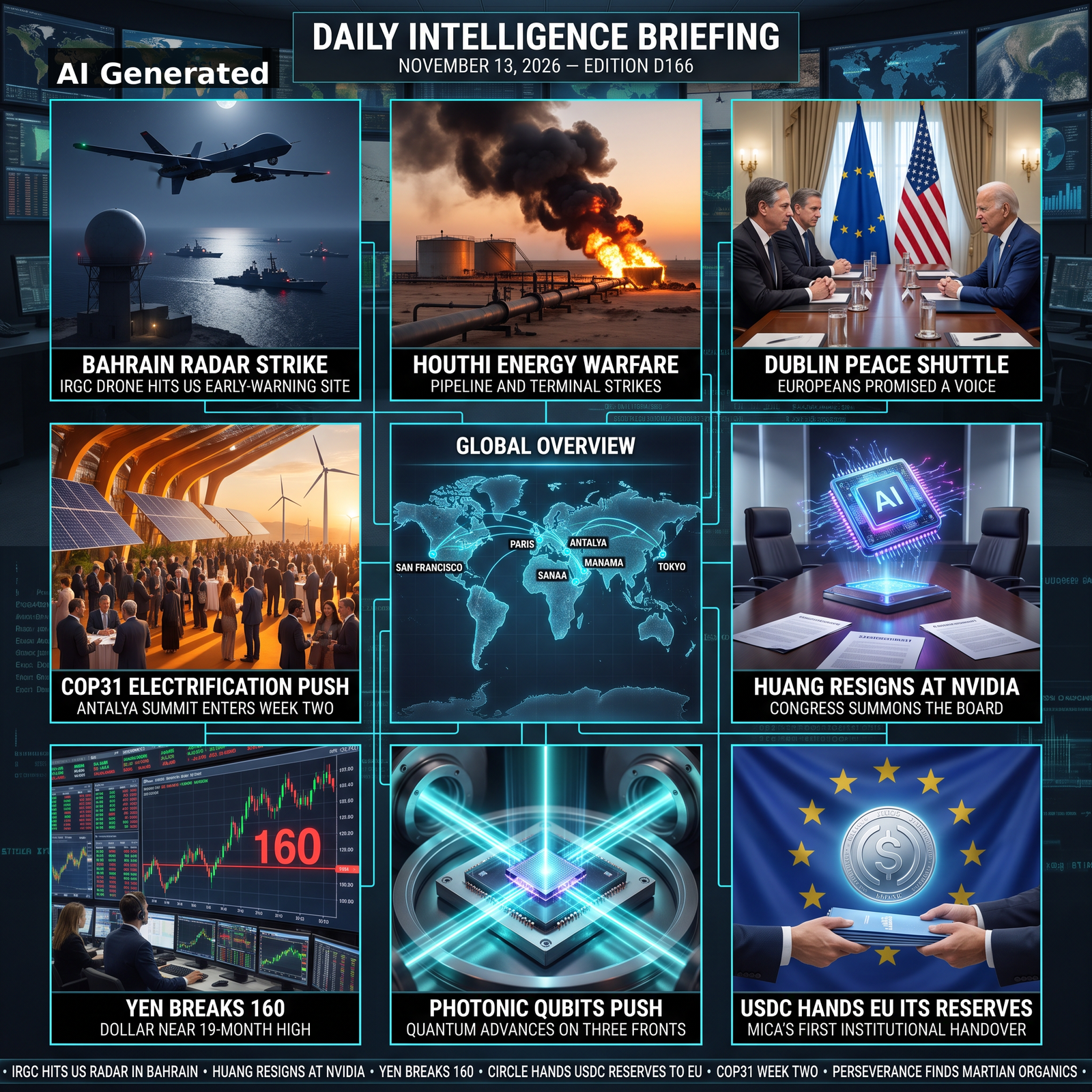











Contents
- 1. Geopolitics & Defence
- The Gulf Clock’s Threshold: A Radar Site in Bahrain and a Third Carrier
- Houthi Energy Warfare and the Gaza Hospital Ledger
- Europe at the Ukraine Table: Dublin, Moscow and the Prisoner Exchange
- The Periphery’s Files: Espionage, Venezuela, Lebanon, Turkey and the Aegean
- Defence-Industrial Signals: Kestrels, Quarterhorses and the Blockade’s Veterans
- 2. Environment & Climate
- 3. Society & Civil Issues
- 4. AI & Technology
- 5. Economy & Business
- 6. Science & Space
- 7. Crypto, Digital Assets & Blockchain
- 8. Correlations & Analysis
- 9. References
Click any heading to jump to that section. Click the section heading to return to this menu.
Geopolitics & Defence ↑ Contents
The Gulf Clock’s Threshold: A Radar Site in Bahrain and a Third Carrier
Iran’s Islamic Revolutionary Guard Corps claimed it struck a US early-warning radar installation in Bahrain with a drone, in retaliation for an air attack on a telecommunications tower near Sirik in Hormozgan province — the first Iranian claim of an attack on US military assets in a Gulf state since early September [1][2]. Bahrain hosts the US Fifth Fleet’s headquarters, and the “serious warning” framing deliberately attached the strike to the blockade regime that has defined the confrontation since February; the IRGC’s pledge to “engage without limits” is signalling, but it lands as Washington hardens its own posture [1]. President Trump pulled Vice-President J.D. Vance off the Iran file, declaring “we have their money and their strait” — the most explicit statement yet that coercion has displaced negotiation in the White House’s framing — even as the US concentrates roughly 200 aerial-refuelling aircraft in the region and prepares a third carrier group, with the USS Theodore Roosevelt expected by the weekend [3][4]. Trump’s simultaneous musing about “toppling” Cuba’s authorities and his threat to double tariffs on Mexico over a migrant caravan widened the coercive aperture in a single afternoon [5][6][7].
Ghalibaf’s insistence that the Strait “will never go back” to its pre-war state keeps the diplomatic door ajar, while Rubio’s argument that economic pressure is “working well enough” exposes the friction inside the administration that D165 identified as this phase’s central question [1][3]. The Bahrain claim changes the geography of retaliation: Iran is asserting a credible reach onto US basing, and Washington’s studied silence will determine whether this is a probe or a second front [1].
Houthi Energy Warfare and the Gaza Hospital Ledger
Yemen’s Houthis claimed a fresh wave of strikes on Saudi energy infrastructure — against pumping station No 7 of the East–West pipeline, the Yanbu terminal and an ARAMCO facility in Riyadh — targeting the kingdom’s strategic bypass around the blockaded Strait [8]. The claims lack independent confirmation, but the Monday fire at a pipeline facility confirms the pattern, and this theatre is now explicitly co-escalating with the Hormuz blockade [1][8]. In Gaza, Israeli strikes on the Nasser Medical Complex killed six inside the surgical building per Palestinian Civil Defence, with at least ten Palestinians dead across the enclave since dawn, including near al-Shifa; Israel said the target was Hamas Khan Younis brigade commander Mohammed Abu Ismail and accused Hamas of using the hospital as a command centre [9]. MSF described “absolute horror and indignation” at the deaths of patients and staff, and a British volunteer surgeon’s filmed account has become the day’s defining humanitarian artefact — hospital strikes corrode the legitimacy of any targeted-kill doctrine without resolving the command problem they purport to solve [10][11].
Europe at the Ukraine Table: Dublin, Moscow and the Prisoner Exchange
The Ukraine file produced the window’s most consequential diplomatic movement. US envoys Steve Witkoff and Jared Kushner shuttled from Abu Dhabi to Moscow — Putin reiterated that Russia’s territorial demands have not changed — and then to Dublin, where they briefed Zelensky on the eve of the European Council summit [12][13]. Washington and Kyiv announced that Europeans “will have a voice” in the next round, Zelensky welcomed the pledge, and Kushner said Putin is “willing to give it a try” on European participation; Thursday also produced agreement on the war’s largest prisoner exchange, returning “thousands of people” [13][14][15]. Leaders gathered in Dublin for the European Political Community and Council sessions, with Ukraine financing, AI governance and the format on the agenda, as Taoiseach Martin argued the region’s security has been “fundamentally reshaped” [16][17]. Macron was the frankest European voice: “there is no longer American support,” Europe is now the primary pillar, and Europeans must open their own channel to Moscow [18]. NATO’s Rutte declined to say peace is closer; Witkoff reported “progress” after the Moscow meeting, pointing to the resumed trilateral format and a joint humanitarian mission proposal for Kostiantynivka [19][38].
The Kremlin quickly tempered the table. Ushakov conditioned European participation on halting military aid, warning that European actions so far point toward war, not peace — the negotiation’s real fault line [20]. On the ground, Kyiv absorbed eight missiles in fifteen minutes after a promised “long night,” Finland detected a strike on a Russian warship in the Gulf of Finland, and cross-border raids killed two in Sumy and one in Belgorod [21][22][23]. The kinetic baseline is intensifying even as officials describe progress, which is why prisoner exchanges and humanitarian corridors remain the only measurable de-escalation instruments in motion [21][23].
The Periphery’s Files: Espionage, Venezuela, Lebanon, Turkey and the Aegean
Chinese dissident Yuanjun Tang, who admitted spying for Beijing decades after the 1989 Tiananmen demonstrations, avoided prison in a US sentencing that underscores the quiet normalisation of diaspora recruitment [24]. In Venezuela, Delcy Rodríguez plays for time while María Corina Machado presses for elections [25]. Germany’s domestic intelligence chief warned of espionage risks from connected vehicles, prompting Bundeswehr restrictions on Tesla access to bases — the same supply-chain anxiety as the Nvidia files [26]. Lebanon asked Syria to extradite suspects in the killing of a former Iraqi MP, an Iran critic reportedly strangled in Beirut [27]. Haitian police, with foreign mercenary support, retook the Sylvio-Cator stadium in Port-au-Prince from gangs, placing it under Salvadoran protection [39]. In Guinea, at least ten died in clashes between gold panners and security forces, witnesses describing “manhunts” [40].
Turkey held the NATO exercise “Blue Whale-2026” with twenty-two warships and eight submarines in precisely the waters where the Abeille Marengo will survey for the Great Sea Interconnector cable — a flag-showing that contests the cable’s maritime claims without a confrontation, the coercive-geology playbook identified in D162 [28]. Erdoğan cast Turkey as Libya’s “guarantor” after meeting Dbeibah at COP31 [29]. Greek airspace logged seven violations and a mock dogfight, while Greece and Jordan signed a 2027 military-cooperation programme and the MINOAS-2026 exercise ran in Crete attended by Defence Minister Dendias [30][31][32].
Defence-Industrial Signals: Kestrels, Quarterhorses and the Blockade’s Veterans
The US defence-industrial base pointed toward cheap, fast, autonomous systems. The Air Force Academy’s T-19A Kestrel trainer — four donated aerobatic aircraft delivered in ten months — is really a recruiting and airmanship tool for a pilot force still 1,900 short of requirements [33]. Hermeus and Northrop Grumman will integrate electronic-warfare, sensing and autonomy packages onto the Quarterhorse high-Mach family, institutionalising the reusable hypersonic ambition [34][35]. L3Harris completed FleetLink communications trials aboard a destroyer, extending NSA-certified high-speed networking across the fleet [36]. And the USS Michael Murphy’s eleven-month deployment — twelve contested Hormuz transits, dozens of Tomahawk strikes, the first naval blockade enforcement in sixty years — is the operational baseline for whatever comes next in the Strait [37].
Environment & Climate ↑ Contents
COP31’s Electrification Push Meets Unchecked Warming
COP31 in Antalya entered its second week with the presidency doubling down on electrification as the summit’s mobilising theme. COP31 President Murat Kurum urged countries to pledge clean public transport, energy-efficient buildings and affordable power, while civil-society groups simultaneously pressed for hard safeguards on the mining that electrification demands — the same tension between ambition and extraction the D162 report identified when the summit opened [41]. Two reports on the margins punctured the upbeat mood, warning current climate and energy policies will have devastating consequences and that global warming remains unchecked against the Paris trajectory [42]. The juxtaposition is the summit’s core paradox: negotiating electrification’s pace against an evidence base that says current policy is insufficient [41][42].
US domestic climate politics are now moving in the opposite direction from the COP agenda. Senate Republicans have begun the process of ramming through the Bipartisan American Affordability and Jobs Act while President Trump threatens to ignore it — whose energy and permitting provisions Democrats argue would gut climate protections [43]. At the same time, the Nuclear Regulatory Commission this week granted a construction permit for four next-generation reactors at a Dow petrochemical complex on the Texas Gulf Coast, a Dow–X-energy project meant to kickstart a new nuclear era and industrial decarbonisation by another route [44]. The simultaneous advance of an adversarial affordability bill and an enabling nuclear permit captures the administration’s split personality on energy: fossil deregulation on one track, advanced nuclear on another [43][44]. Hoosiers turned out at an EPA hearing in Indiana to oppose a coal-ash permitting programme that would weaken federal protections — a rare citizen-level defence of the regulatory floor [45]. Nevada’s workplace heat standard, highlighted in new research as a model for the rest of the country, shows the sub-national climate-response layer continuing to move even as federal policy stalls [46].
The Energy-Materials Ledger: Green Hydrogen, Solid-State Batteries and the Pacific
The energy transition’s industrial ledger delivered a cautionary tale. Four of the seven Dutch green-hydrogen electrolysis projects awarded €783.5 million in 2022 have been cancelled, none operates, and the government is preparing another subsidy round — a textbook case of subsidy-led pipeline collapse [47]. The lesson is that capex-heavy decarbonisation requires demand guarantees, not just production subsidies [47]. On the battery front, QuantumScape unveiled its “Osprey” sulfide-based solid-state platform, positioning it to kickstart mass-market solid-state EV batteries — a technology inflection worth watching [48].
The US renewed its push to open part of a Pacific marine protected area to commercial fishing, publishing proposed rules that would lift restrictions across roughly one million square kilometres around Johnston Atoll, Wake Island and Jarvis Island inside the Pacific Islands Heritage Marine National Monument, waters within 50 nautical miles staying closed [49]. NOAA’s own assessment concedes the fishing gain may be only “minor” while activists call the cultural-harm finding “negligible” — a reversal of a decade of marine-policy direction that will draw court challenge [49]. Suriname, by contrast, protected its forest estate by evicting more than fifty Mennonite settlers farming in the Amazon with expired residency permits, ending years of controversy over projects that threatened its net-negative-carbon status [50]. The two decisions are converse expressions of the same policy question — what a forest or ocean is worth — and both will reverberate through the COP31 implementation debates [49][50].
The Living Ledger: Salmon, Jaguars, Elk and the Research Chill
Restoration biology offered one unambiguously good-news thread. A dam removal on California’s Neefus Gulch reopened spawning habitat shut for more than seventy years; juvenile steelhead appeared within months, and by January 2026 biologists counted eight spawning nests above the former barrier, part of a record 30,000-adult coho return [51]. The Pantanal’s jaguars proved more social than textbooks allow: thirteen years of photo-ID data showed frequent pairing — half of 167 interactions were between two males [52]. Kentucky’s elk-restoration programme, which released 1,541 elk onto reclaimed coal mines between 1997 and 2002, has grown into a herd estimated at 10,000–13,000 — an ecological and hunting success in productive tension with federal guidance warning that the grassy mine lands that feed elk also arrest native forest succession [53]. All illustrate the same point across the biodiversity arc: wild populations recover fast when the binding constraint is removed, but every restoration choice embeds a trade-off [51][52][53].
Beneath these wins: Arctic wildlife research is suffering as geopolitical competition grows, with collaborative science networks fraying [54]. The Shanghai plastic-road experiment — Dow and dairy brand Shiny Meadow paving 300 metres using more than 6,000 milk bottles too contaminated for conventional recycling — shows the circular-economy frontier pushing into asphalt chemistry, though the company’s claims of reduced bitumen use and extended road life remain largely unquantified [55]. On the design side, a Kiel art-school project hung a laser-cut tarpaulin canopy over a market square and measured pavement shade nearly matching a live maple — a small but transferable reminder that urban-heat mitigation need not wait decades for mature canopy [56]. Climate-health research added a gender dimension: women and men face different climate-related health risks, yet policy and health services largely ignore the divergence [57]. The section, like the summit itself, is caught between measurable restoration wins and the hardening arithmetic of an overheating planet [54][55][56][57].
Society & Civil Issues ↑ Contents
France’s Social Squeeze: Theatres, Functionaries and the Police Question
France’s civic file remains dominated by the aftershocks of a month of protest. Theatre directors report cancelling fourteen performances as the demonstrations hollow out audiences, exposing the cultural economy’s dependence on social calm [58]. The fonctionnaires’ unions took their “smicardisation” grievance — the claim that public-sector pay is being flattened toward the minimum wage — to Matignon, demanding salary restoration against a backdrop of inflation-adjusted pay erosion [59]. Interior Minister Laurent Nuñez, under pressure after several journalists filed criminal complaints over injuries at recent protests, committed to protecting reporters and reminded all police forces of crowd-control rules effective Friday — an attempt to arrest the legitimacy erosion of the order-maintenance regime [60]. LFI deputy Sébastien Delogu, on trial for outraging police after an altercation, announced he will seek annulment of his custody, keeping parliamentarians’ interactions with police in the headlines [61]. The Paris judicial calendar compounds the civic strain: the long-running trial over the 2019 rue de Trévise explosion heard victims’ testimonies of shattered lives, while the A10 “inconnue” trial saw a father accused of complicity in the torture and killing of his daughter explain his silence by “fear” of his ex-wife [62][63]. A Corsican independence activist received five years for appearing in an armed FLNC video — a sentence that keeps the island’s low-grade armed nationalism on the state’s radar [64].
The Global Civic Ledger: Hong Kong, Italy, Spain, Sri Lanka and the US Senate
Beyond France, the civic ledger turned on several distinct axes. Hong Kong dissident Joshua Wong, already an icon of the pro-democracy movement, was sentenced to another ten years, bringing his total to more than sixteen — a sentence that consolidates the squeeze on the city’s remaining activists and drew international attention just as the podcast revisiting his trajectory was released [65]. Italy is puzzling over a coordinated wave of bomb threats against schools — the latest in a “broader strategy” that has already seen supermarket hacks and plane threats, prompting the government to speak of an “age of uncertainty” [66]. A Spanish court suspended a far-right group over alleged hate crimes, ordering its office shut and accounts blocked after fourteen arrests and the seizure of more than twenty firearms [67]. Sri Lanka’s parliamentary Committee on Public Enterprises concluded the public had been “misled” over the 1,109-pound sapphire cluster that left the country valued at $10 million and was re-exported at $10,700 — a governance scandal wrapped in a gemology story [68]. On the German side, overnight fires destroyed several electric buses in Lorsch, authorities investigating cause — an incident that will feed the running debate over battery-vehicle fire risk as the energiewende electrifies public transport [69].
US politics supplied the window’s most conventional story: Senator Chris Van Hollen announced he will challenge Chuck Schumer for Senate majority leader, the first formal challenge to Schumer’s leadership as Democrats reorganise after their midterm losses [70]. The papers are dominated by the two scandal arcs the report tracks elsewhere — the Nvidia chief’s resignation and six more women alleging predation by Russell Brand, whose reported transfer to the notorious “Monster’s Mansion” jail hangs over the UK justice conversation [71][72]. Britain’s housing file deteriorated measurably: first-time-buyer inquiries fell 27% at Zoopla as buyers “pause and wait” after the Bank of England’s rate rise to 4% [73]. The SNP attacked Andy Burnham’s record on families after Commons Library data showed a 40% rise in food prices, with the Bank forecasting food inflation near 5% next year — cost-of-living arithmetic that continues to define the UK’s political season [74]. New York City’s council passed Introduction 891-A, banning algorithmic “surveillance pricing” — the practice of charging different prices to different customers based on their personal data — in what is among the strongest consumer-protection restrictions on personalized pricing in the country, with fines up to $1,000 per violation [75].
AI & Technology ↑ Contents
The Nvidia Files: Resignation, a Third Affair and Congress’s Summons
The Nvidia crisis reached its denouement phase. Jensen Huang resigned as CEO on Thursday after a week in which reports of his relationship with Alice Huang — a former Megaspeed executive suspected by US intelligence of working for China — were followed by revelations of a second relationship with Nvidia health-business vice-president Kimberly Powell, and then, hours after the resignation, by a Reuters report of a third relationship with another female employee, a claim Nvidia declined to comment on and Huang has not addressed [77][78][79]. His fall has now been formally institutionalised: House intelligence, foreign-affairs and China-panel committees have summoned Huang for a closed-door interview on 1 December, Senator Tim Scott has requested voluntary testimony before the Senate Banking Committee on 3 December and warns a subpoena may follow, and Commerce Secretary Howard Lutnick — under scrutiny over stalled export restrictions — has “proactively” agreed to appear in December as bipartisan pressure grows [76][80]. The company has lost roughly $550 billion in market value in five days, its worst such stretch since going public, and is now searching for a permanent replacement; CFO Colette Kress is interim CEO [76].
The national-security question is the reason this is a technology story and not merely a corporate soap opera. The BBC’s explainer on how the affair could threaten US national security frames the core risk: a chief executive compromised in his private life is a vulnerability surface for foreign intelligence that has spent years trying to move advanced chips into China [82]. That frame is given concrete form by Fortune’s report that Nvidia abruptly changed its Singapore revenue reporting last year — dropping Singapore from its geographic breakdown around the time it added Megaspeed, the Singapore-based buyer at the centre of chip-smuggling allegations, to its internal block list; Columbia accounting professor Shiva Rajgopal says the timing will inevitably draw DOJ and Commerce scrutiny into how Nvidia accounted for revenue from a client suspected of diverting $7.5 billion of chips to China [81]. Singapore authorities investigated Alice Huang and Megaspeed from February 2025 but found insufficient evidence of espionage, while barring her re-entry — an ambiguous verdict that leaves the espionage question formally open, as Attorney General Todd Blanche acknowledged [76][81]. The investigation’s supply-chain implications ripple outward: Nikkei reports that the case is putting Singapore and Malaysia companies in the spotlight, and that Nvidia’s “Jensen problem” is becoming one for the whole AI supply chain, as customers and partners reassess compliance exposure [83][84].
The succession endgame is now a political matter. President Trump posted on Truth Social that former Apple CEO Tim Cook — who stepped back in September — is “the one man” to run Nvidia, injecting the White House directly into the board search [85]. Tech commentators argue the affair should push Big Tech toward greater CEO accountability, a governance conversation that will now run on two tracks: the board’s search and Congress’s hearings [86]. The D162 report’s framing of the Nvidia files as “espionage at the CEO layer” and D165’s “board, two affairs, $450 billion” ledger now look prescient in scale if not in timing; the D166 window adds the third affair, the Congressional summons and the Cook gambit [76][81][85].
Platforms and Infrastructures: The Microsoft Outage and the State’s New Tools
Outside Nvidia, the technology calendar was dominated by a global Microsoft outage. Outlook, Teams and Copilot suffered disruptions across 74 countries and territories on Thursday, with Downdetector logging nearly 130,000 Outlook reports at the evening peak; Microsoft blamed elevated infrastructure loads, acknowledged its fix attempts were not working as expected, and reported only limited recovery by late evening, with capacity rebalancing ongoing [87][88]. The incident’s significance extends beyond email: the outage also affected downstream AI assistants — Copilot as well as integrations with Claude and ChatGPT — a reminder that the AI stack now depends on the same brittle cloud substrate that enterprise communications do [89]. It is the second major infrastructure event this quarter to expose concentration risk in the digital backbone, and it will sharpen the European conversation about cloud resilience and the AI supply chain’s single points of failure [87][88][89].
The state’s adoption of AI accelerated on the safest possible front. The FAA is rolling out its SMART air-traffic-management AI nationwide, a decision-support tool that suggests routes without altering safety-critical authority — the most significant federal deployment of AI into live safety infrastructure so far [90]. The contrast with the commercial layer could not be sharper: hiring data gathered around the emerging agent economy shows “AI agents can’t find anyone to help yet,” capturing the gap between agent capability and agent employment — the technology works at task level but has not yet become a labour-market force [91]. A Brown University breakthrough eliminating the “dead layer” problem in multiferroic materials could make AI chips dramatically more energy-efficient, attacking the power constraint that this report’s compute-geography arc has identified as the industry’s binding limit [92]. On the supply side, TSMC’s new investment arm aims to back the next chip titan and Vietnam is pushing hard for homegrown semiconductors — the manufacturing layer of the AI economy remains structurally stretched even as its flagship company reels [93][94]. SpaceX’s planned 6-gigawatt Arizona supercomputing campus, with a dry-cooling system that skips groundwater use, and a $24 billion Texas facility with its own gas-fired generation, show the hyperscale GPU-builders internalising power and water risk — the physical expression of compute’s new geography that D165’s “power is the constraint” thesis predicted [95].
Economy & Business ↑ Contents
The Dollar, the Yen and the Nvidia Whiplash
The currency market delivered the window’s most market-moving signal. The dollar traded near a nineteen-month high on continued Federal Reserve rate-hike bets, while the yen breached the psychologically critical 160 threshold against the dollar, prompting Japan’s finance minister to vow action — the clearest verbal intervention signal since the currency’s last slide, and a reminder that the post-BoE-hike world this report tracked in D158 now has its second major central bank at the intervention frontier [96][97]. The dollar’s ascent is being driven by repricing of the Fed path rather than by any single data print, which makes the intervention calculus harder for Tokyo: verbal warnings are cheap, but actual intervention against a fundamentally strong dollar has a poor track record [96][97]. Equity markets recovered from the Nvidia whiplash, with stocks stabilising as the dollar climbed with US yields — a sign that investors are treating the Nvidia saga as company-specific rather than systemic, at least for now, even as the “Magnificent-7” concentration risk that the D160 correlation flagged remains embedded in the index [98]. Applied Materials’ earnings beat on profit and revenue provided the counter-signal that the semiconductor demand cycle itself remains intact beneath the scandal noise [99].
The Asian macro ledger turned quietly hawkish. China’s finance ministry offered three-year bonds at a yield of 1.22%, a print that illustrates the persistent deflationary underpricing of Chinese duration even as the government runs larger deficits to stabilise growth [100]. South Korea’s September M2 money supply rose 5.5% year-on-year, easing marginally from August’s 5.6% — consistent with the Bank of Korea’s cautious normalisation path and a backdrop of still-tight credit conditions in the region’s fourth-largest economy [101]. In a separate data-sovereignty tussle, the South Korean government said it may suspend or cancel Google’s map export permit over serious breaches, confirming that Google deleted coordinates for South Korean territory from Google Maps and Earth and agreed to remove Street View imagery in and around military and security sites [102][103][104]. The episode is a live example of the cartography-as-national-security problem that has shadowed the platform economy for a decade: private geospatial data with military adjacency is now a diplomatic and regulatory battleground, and Seoul’s move sets a precedent other states may copy [102][103][104].
Europe’s Fiscal and Industrial Night: Berlin’s Budget, Intelligence Reform and the Steel Summit
Germany’s fiscal machine dominated the European calendar. The Bundestag’s budget committee concluded a night-time “clean-up session” reconciling the 2027 federal budget, with factions briefing on Friday on an etat that authorises rising spending and debt — the D165 report’s “Berlin’s 2027 budget” thread continuing to its final act before the plenary vote scheduled for late November [105]. Political scientist Albrecht von Lucke assessed that the coalition lacks a common course, calling the electricity-tax compromise a setback for the chancellor — a verdict that crystallises the governing alliance’s structural weakness as it approaches the budget vote [106]. On the same Friday agenda, the Bundestag decided on the government’s intelligence-service reform, which grants the German agencies expanded surveillance powers and, notably, active countermeasures against threats — a response to the post-2022 threat environment that substantially enlarges the state’s digital-espionage toolkit and drew sharp criticism over the new surveillance capabilities [107]. The chamber also voted on the EU–Mercosur trade agreement and the Bundeswehr’s Mediterranean deployment extension, bundling trade liberalisation with force posture in a single sitting [107]. The EU’s informal Dublin council separately took up Ukraine financing for next year — a file Chancellor Merz has controversially tied to the next EU budget, drawing criticism from Slovakia — alongside AI governance [17].
Industry’s winter is not over. The “national steel summit” convenes Monday in Salzgitter with the eleven steel-state premiers, employers and IG Metall, and the run-up is defined by a blunt demand set: competitive energy prices, effective protection against global overcapacity, and binding lead markets for green steel — with union deputy Jürgen Kerner insisting the summit must be an “implementation summit,” not another analysis round [108]. The backdrop is sobering: roughly 80,000 direct steel jobs and four million more in steel-intensive industries, squeezed by high energy costs and Asian overcapacity, with companies like ThyssenKrupp, Salzgitter and ArcelorMittal all in the balance between decarbonisation investment and competitiveness [108]. And in the retirement-policy arena, the Altersvorsorgedepot (provision-depot) replacing the Riester scheme from 2027 got a qualified endorsement from one of its architects, economist Martin Werding, who called it “a giant step in the right direction” while flagging where savers must be careful — a generational reform whose design details will be fought over in the 2027 budget cycle [109].
Science & Space ↑ Contents
The Quantum Frontier: Photons, Trapped Ions and a Captured Positron
Quantum computing advanced on three fronts in the D166 window. New research pushes toward photonic qubits — quantum computers built with photons as basic units, which could be faster and more energy-efficient than their matter-based counterparts — a direction that addresses both the speed and the power-consumption ceilings that have constrained superconducting and trapped-ion architectures [110]. Cornell researchers demonstrated a chip-based laser-cooling technique that brings trapped ions close to their quantum ground state in 150 microseconds, roughly three times faster than conventional arrangements, while cooling three motional modes simultaneously and experimentally verifying cooling below the Doppler limit — a practical attack on the cooling bottleneck that current trapped-ion systems face as they scale [111]. And Northwestern University physicists trapped a single positron in a precisely controlled quantum state for months, opening a new empirical window on the matter–antimatter asymmetry that remains one of physics’ deepest unsolved questions [112]. Together these results show a field converging on engineering discipline: the raw physics claims are giving way to device-level demonstrations of the infrastructure — cooling, control, trapping — that scaling actually requires [110][111][112].
Mars and the Orbital Economy: Organics, Swarms, Refuelling and a Lunar Moratorium
NASA’s Perseverance rover confirmed the presence of complex organic carbon just beneath the surface of ancient Martian rocks, preserved well enough to suggest the building blocks of life may once have been widespread across the planet — a confirmation that strengthens the case for sample-return science and for the astrobiological value of the Jezero delta [113]. The robotic-exploration toolkit advanced in parallel: German researchers are developing a GPS-free navigation system for Mars robot swarms combining star and Sun sensors with ultra-wideband radio beacons under the DLR-funded VaMEx-ARES project, targeting the Valles Marineris canyon system for flying, walking and wheeled robots — a capability that would remove the single biggest constraint on multi-robot planetary operations [114]. NASA’s wider in-space-assembly push is maturing through NOM4D, the program arguing that automated assembly in orbit — rather than ever-larger rocket fairings — is the route to building big structures, an approach the report first flagged in the orbital-fragility discussion of D165 [115].
The commercial orbital economy produced one genuinely novel standard. Spaceium released “OpenPort,” an open-source, androgynous spacecraft refuelling interface that any company can licence for one dollar, with a first-ever orbital xenon transfer demonstration planned aboard the ISS — a classic interoperability play designed to make propellant-as-a-service stations the real business, with the port as the lock-in device [116]. AST SpaceMobile, meanwhile, pressed its case for developing its own reusable launch vehicle within two years, despite industry-wide skepticism — a bet that vertical integration will beat the current launch-supply constraints on its direct-to-cell constellation [117]. The same commercialisation wave has triggered a governance counter-movement: researchers in Lithuania and the Netherlands published a call for a moratorium on lunar industrialisation, arguing that the Moon is not a “Wild West” and that extraction and infrastructure racing ahead of agreed environmental and benefit-sharing rules will create irreversible harms [118]. The juxtaposition of OpenPort’s private standard-setting with the academic moratorium demand frames the decade’s central space-policy question: whether rules for the orbital and lunar economies are built by companies, by states, or by neither in time [116][118].
Biomedicine and the Body’s Ledger
The biomedical block delivered high-signal results. The FDA approved a first-in-class blood thinner to prevent repeat strokes after serious events or “mini” episodes — a new therapeutic option in a space dominated by decades-old molecules, with direct implications for stroke’s disability burden [119]. Muscle-repair research uncovered a hidden function of the telomere-protecting protein TRF2: it also helps muscle stem cells regenerate injured tissue, and removing it in mice made muscular dystrophy progress dramatically faster — a potential therapeutic axis for the dystrophies [120]. A study of more than 2,500 men linked higher animal-protein intake, particularly dairy, with lower testosterone, while plant protein tracked with higher levels [121]. Stanford researchers showed that children with developmental dyscalculia are slower to switch problem-solving strategies and less responsive to difficulty changes [122]. In oncology, a major new study found colorectal cancer rates rising across nearly every age group under seventy after more than twenty years of decline — a reversal that will reset screening conversations [123]. And in neurotechnology, an AI-powered approach made bionic vision more precise, learning how an individual’s brain responds to electrical stimulation to predict perceived flashes of light, edging cortical implants toward restoring functional sight [124].
Deep Time, Behaviour and the Archive
The science “archive” front delivered a set of quieter but durable results. A sweeping analysis of 540 million years of marine fossils produced a “treasure map” of unexplored fossil-rich regions, showing the greatest discovery opportunities lie in recent periods rather than the deep past [125]. Researchers untangled a tropical butterfly that has fooled science for two centuries: it is three nearly identical species, one new to science, distinguished by hidden ultraviolet wing patterns and DNA [126]. Behavioural research at Tübingen found crows can make visual decisions in 235 milliseconds on average, twice as fast as humans and monkeys, the fastest vertebrate visual-decision speed measured [127]. A Welsh shipwreck’s 400-year-old brass padlock was opened non-destructively using a micro-CT scanner normally reserved for bone, revealing a four-letter combination that now poses its own historical riddle [128]. On the geodesy front, Chinese researchers combined machine vision with interferometry to calibrate large monolithic telescope mirrors — a metrology refinement for the next generation of large optics [129]. A study on how populist leaders dismantle intelligence agencies from within — the “intelligence cyclone” — warns that treating secret services as “deep state” adversaries disrupts objective threat analysis and can leave democracies blind to surprise attack [130]. Finally, a new study suggests most of Earth’s carbon arrived late, from the outer solar system, reframing how the planet got its atmosphere [131].
Crypto, Digital Assets & Blockchain ↑ Contents
MiCA’s First Institutional Handover: Circle Delivers USDC Reserves to the EU
Europe’s MiCA regime crossed its most consequential practical milestone to date: stablecoin issuer Circle handed the reserves backing USDC to EU regulators, with 12 November as the disclosed transfer date for the financial safeguards and France’s ACPR retaining governance responsibilities [132]. The move operationalises the European stablecoin framework’s core promise — that euro-zone users of dollar-pegged stablecoin will be protected by EU-held collateral — but it carries a direct cost tension: holding reserves in EU-regulated custody may raise fees, and the governance split between the issuing entity and the French supervisor introduces a new layer of compliance complexity that will be tested in the first market stress [132]. Analysts should read this as the first fully executed instance of the “regulated self-custody” model that MiCA envisioned, and as the template the European Commission will point to when other issuers seek EU passports [132]. The counterpart on the supply side is contraction: stablecoin supply fell by $14.2 billion over thirty days, with USDT’s market value dropping $6.6 billion — a decline more than double the post-FTX contraction — even as US spot Bitcoin ETFs saw $1.6 billion in net outflows, indicating that the deleveraging now visible across derivative markets is hitting the on-chain liquidity layer as well [133]. The two signals together — EU-held reserves rising while aggregate stablecoin float shrinks — describe a market migrating toward regulation faster than toward growth [132][133].
Enforcement and Market-Structure: Brazil’s Capital Rules and the SEC/CFTC Nomination Blitz
Regulatory capacity is being tested on two continents. Brazil’s central bank warned that roughly thirty percent of the 120 cryptocurrency exchanges that filed to continue operating as VASPs fail to meet the share-capital requirements set under the new framework, meaning their applications could be rejected after review — the first hard quantification of MiCA-adjacent solvency standards outside Europe, and a signal that capital-adequacy enforcement, not merely registration, is becoming the sector’s new clearing mechanism [134]. In Washington, President Trump nominated Steven Levine to replace outgoing SEC crypto advocate Hester Peirce, alongside Kristin Johnson for the SEC and two further nominees for the CFTC, filling major vacancies as the Senate confirmations loom — nominations with immediate political complication, since Democrats are set to take control of the Senate before confirmations can proceed [135][136]. The personnel shift matters beyond personalities: Peirce’s departure marks the end of the commission’s most sustained pro-innovation voice, and the incoming slate will inherit the unresolved classification fights — single-stock perpetuals, tokenised securities, and the definitional core of the Howey test — that define the sector’s regulatory horizon [135][136].
Tokenisation’s Credit Renovation and the Post-Quantum Bidding War
Tokenised-equity credit continued to accelerate. Spout Finance now lets investors use Ondo Finance’s tokenized equities as collateral for USDC loans on Solana, allowing borrowers to access up to fifty percent of their holdings with zero traditional interest charges, against a Solana tokenized-equity volume of $8.8 billion — up 325% in Q2 2026 [137]. The mechanic — earning yield on tokenised stocks while borrowing stablecoin against them — is the first retail-accessible fusion of the two most mature pillars of the collateral economy (tokenised RWA and stablecoin lending), and it points to the emerging hierarchy: tokenised assets are becoming the collateral, stablecoins the settlement layer, and the interest-free loan a marketing instrument that will face intense scrutiny in a downturn [137]. On the securities side, the legal front remains active: the American Securities Association filed an amicus brief urging a federal court to consider retail-investor harm in the challenge to single-stock perpetuals approved by the CFTC, arguing leverage and forced liquidation could transmit stress into underlying shares — the first retail-protection voice in a fight between exchanges and the regulator over whether such contracts are lawfully authorised [138].
At the protocol layer, the security conversation is turning post-quantum in earnest. Ethlabs proposed making quantum protection and resilience against advanced AI-assisted attacks the priority for the 2027 Ethereum upgrade cycle, arguing for withdrawing “quick slots” work from the Hegotá fork and focusing engineering effort on quantum-safe migration paths under proposals like EIP-8141, which would separate validation, fee approval and execution within a transaction to enable key rotation away from elliptic-curve signatures [139]. The proposal’s significance lies in resource allocation: every added feature competes with migration work, and the Ethereum ecosystem now faces a coordination test — agreeing measurable milestones for client implementations and migration behaviour rather than a calendar target alone [139]. On the hardware-wallet side, Foundation’s QuantumLink aims to bring post-quantum encryption to Bluetooth-based hardware-wallet connectivity, an attempt to future-proof the private-key channel against harvest-now-decrypt-later threats before they materialise [140]. The pattern across both is defensive engineering: with no current break of existing cryptography, the market is nonetheless pricing in the long migration tail that a cryptographic transition requires [139][140]. The institutional mood, meanwhile, remains cautious: Gemini’s quarterly retail trading volume sank to a three-year low even as its Q3 headline trading rebounded, quantifying the retail retreat that underlies the market’s recent thinness and reinforcing the shift of volume toward institutional rails [141].
Correlations & Analysis ↑ Contents
The D166 window resolves, in part, the endgame question the D165 report left open. Yesterday’s report closed on the convergence of the Gulf clock and the Nvidia files into a single systemic-risk calculus — Tehran’s seven-point “ball in the US court” running parallel to a board’s two-affair, $450-billion ledger. Today both arcs crossed thresholds within hours: Iran claimed its first strike on US military assets in a Gulf state since early September, targeting an early-warning radar beside the Fifth Fleet’s headquarters, while Jensen Huang resigned and was summoned before Congress [1][76]. The D163–D165 “coercion-and-diplomacy” framing now looks stark: the radar strike is Tehran’s bid to raise the cost floor of the blockade, and Trump’s “we have their money and their strait” is Washington’s refusal to negotiate against that backdrop [1][3]. The two crises are correlated through the dollar and the AI supply chain: Nvidia’s $550-billion, five-day value loss landed the same week the yen breached 160 and the dollar touched a nineteen-month high [76][96].
The Ukraine file connects to the same structural theme: the American pivot. D163 recorded Trump’s “essentially over” characterisation; D164 and D165 tracked the Abu Dhabi and Moscow tracks; today the envoys added Dublin, committed European participation in the next round, and announced the largest prisoner exchange of the war [12][13]. Macron’s blunt “there is no longer American support” and his call for Europe to open its own channel to Moscow define the new equilibrium: Europe is offered a seat at a table it must help finance and defend, while the Kremlin conditions participation on the end of military aid [18][20]. The Gulf and Ukraine theatres now share an identical geometry — Washington delegating the burden of settlement while retaining the levers of coercion, leaving European capitals to convert participation into influence [15][17][18].
The environmental and technological arcs extend the pattern of institutional strain. COP31 pushed its electrification pledge while reports warned warming remains unchecked; the US reopened a Pacific marine monument to fishing and Texas greenlit advanced nuclear on the same day [41][42][44][49]. Executive preference is running ahead of legislative and international constraint, which is why the Nevada heat standard, the Indiana coal-ash hearings and the Dutch hydrogen cancellations matter — they are the residual sites where old rules still bind [45][46][47]. The Microsoft outage — 74 countries, 130,000 reports, AI assistants caught in the blast radius — is the second infrastructure event this quarter to expose single points of failure in the cloud-and-AI stack, and Nvidia’s collapse is the third and most consequential [87][88][89][76]. The Singapore-Megaspeed trail connects directly to the trade-and-espionage axis tracked since the D156 files: export controls only work if intermediaries are policed, and the affair exposed where that policing failed [77][81][83].
What to watch in the next reporting period: (1) whether the Bahrain radar strike is followed by further IRGC claims against US basing, and whether the USS Theodore Roosevelt’s weekend arrival changes CENTCOM’s rules of engagement; (2) the December 1 House and December 3 Senate hearings on the Nvidia affair — specifically whether Lutnick’s testimony exposes export-control decisions; (3) whether European delegates actually sit at the next Russia–Ukraine round, and how the largest prisoner exchange is executed; (4) the yen’s path past 160 and whether Tokyo moves beyond verbal intervention; (5) confirmation of the SEC/CFTC nominees against the Senate’s Democratic takeover, and the first EU enforcement test of the USDC reserve handover; and (6) Monday’s German steel summit as the bellwether for Europe’s industrial-winter politics. The D166 lesson is that the coercion-and-diplomacy duality identified in D163 remains the master variable — but it is no longer confined to the Gulf; it is now the organising logic of the Nvidia crisis, the Ukraine settlement and the climate-policy reversals simultaneously [1][76][13][41].
References ↑ Contents
1. Iran says it targeted US radar site in Bahrain by Al Jazeera · Source ↑
2. Iran: Attack on the city of Sirik near the Strait of Hormuz by DefenceNet · Source ↑
3. “We have their money and their strait”: Trump unplugs J.D. Vance from the Iran file by Le Parisien · Source ↑
4. The US has concentrated 200 tanker aircraft in the Middle East by DefenceNet · Source ↑
5. Trump moots toppling Cuba authorities before leaving office by Al Jazeera · Source ↑
6. Trump already eyeing another war before he leaves office by The Independent · Source ↑
7. Trump threatens to double tariffs on Mexico after migrant caravan arrives by Le Monde · Source ↑
8. Tensions escalate in the Middle East: New wave of Houthi attacks on Saudi oil facilities by Enikos · Source ↑
9. New Israeli strikes on the Gaza Strip: at least ten dead by DefenceNet · Source ↑
10. Gaza: MSF expresses “absolute horror and indignation” at Israeli hospital bombardment by in.gr · Source ↑
11. Gaza surgeon films aftermath of Israeli strike by Al Jazeera · Source ↑
12. What’s next for Ukraine-Russia peace talks as war approaches fifth year? by The Independent · Source ↑
13. Zelensky welcomes US bringing Europe into Russia-Ukraine peace talks by BBC News · Source ↑
14. “They will have a voice”: Europeans at the next Ukraine negotiations, according to Kyiv and Washington by Le Parisien · Source ↑
15. Ukraine war: Europe should in future be at the table in talks between Ukraine and Russia by Die Zeit · Source ↑
16. EU leaders to meet in Dublin amid prospect of Europe joining Ukraine peace talks by Evening Standard · Source ↑
17. EU countries discuss Ukraine financing and AI by Stern · Source ↑
18. E. Macron: “Dialogue with V. Putin must be held” by DefenceNet · Source ↑
19. Mark Rutte: “We do not know if peace in Ukraine is approaching” by DefenceNet · Source ↑
20. V. Putin: “Europeans should halt military aid to Ukraine” by DefenceNet · Source ↑
21. Kyiv: came under 8 missiles in 15 minutes by DefenceNet · Source ↑
22. Finland detects strike on Russian warship as Zelenskyy meets US envoys by Al Jazeera · Source ↑
23. Two dead in Ukraine, one in Russia as air strikes continue by Skai · Source ↑
24. Who is Yuanjun Tang? Chinese dissident who admitted to spying for Beijing avoids prison time by The Independent · Source ↑
25. Venezuela: President Rodríguez plays for time, Machado pushes for elections by Handelsblatt · Source ↑
26. Defence: domestic intelligence warns of espionage via Tesla cars by Handelsblatt · Source ↑
27. After Iraq ex-MP’s killing, Lebanon asks Syria to extradite suspects by Al Jazeera · Source ↑
28. With exercises Turkey deploys 22 warships and 8 submarines to the Eastern Mediterranean by DefenceNet · Source ↑
29. R.T. Erdogan “guarantor” of Libya: “We have interests” by DefenceNet · Source ↑
30. Seven violations by Turkish aircraft over the Aegean and a mock dogfight by DefenceNet · Source ↑
31. Greece–Jordan Military Cooperation Programme 2027 signed by Defence-point · Source ↑
32. Tactical exercise with troops “MINOAS – 2026” (PHOTOS) by Defence-point · Source ↑
33. The Air Force’s Newest Trainer Is An Aerial Stunt Plane by The War Zone · Source ↑
34. High-Speed Aircraft Startup Hermeus Joins Forces With Northrop Grumman by The War Zone · Source ↑
35. 930 mph unmanned supersonic aircraft gets advanced systems for military missions by Interesting Engineering · Source ↑
36. L3Harris completes FleetLink communications trials aboard a U.S. Navy destroyer by Defence Industry Europe · Source ↑
37. U.S. Navy destroyer USS Michael Murphy completes 11-month deployment after dozens of Tomahawk strikes by Defence Industry Europe · Source ↑
38. S. Witkoff after meeting V. Putin: “Progress was made” by DefenceNet · Source ↑
39. In Haiti, police recapture the national football team’s stadium from gangs by France 24 · Source ↑
40. “We witnessed manhunts”: at least 10 dead in clashes between gold panners and security forces in Guinea by Le Parisien · Source ↑
41. UN climate summit pushes electrification goal as groups call for mining safeguards by The Independent · Source ↑
42. Global Warming Remains Unchecked, Experts Warn at UN’s COP31 Climate Summit by Inside Climate News · Source ↑
43. Senate Republicans Begin the Process of Jamming BAAJA While Trump Threatens to Ignore It by CleanTechnica · Source ↑
44. Feds Greenlight Construction of Advanced Nuclear Reactors in Texas by Inside Climate News · Source ↑
45. Hoosiers Call on EPA Not to Weaken Coal Ash Rules at Public Hearing by CleanTechnica · Source ↑
46. What Happens in Vegas Should Inform the Rest of the Country by CleanTechnica · Source ↑
47. Four of Seven Dutch Green Hydrogen Projects Have Been Cancelled. The Subsidies Keep Coming. by CleanTechnica · Source ↑
48. QuantumScape Has An Osprey Up Its Solid-State EV Battery Sleeve by CleanTechnica · Source ↑
49. US renews push to open Pacific marine protected area to fishing by Mongabay · Source ↑
50. After years of speculation, Suriname evicts Mennonites farming in the Amazon by Mongabay · Source ↑
51. Salmon were shut out of this California creek for more than 70 years until a dam removal reopened it by EcoTicias · Source ↑
52. In Brazil’s prey-rich Pantanal, jaguars reveal a surprisingly social side by Mongabay · Source ↑
53. Kentucky released 1,541 elk onto old coal mines and the herd is now put at 10,000 to 13,000 by EcoTicias · Source ↑
54. Arctic Wildlife Research Suffers as Geopolitical Competition Grows by Environment News Service · Source ↑
55. Dow says it built China’s first plastic road with more than 6,000 used milk bottles by EcoTicias · Source ↑
56. A German designer cut the shadow of a tree into two sheets of tarpaulin for his bachelor’s project by EcoTicias · Source ↑
57. Climate change has different consequences for the health of women and men by Phys.org · Source ↑
58. “I cancelled 14 performances”: after a month of protests, theatres struggle by Le Parisien · Source ↑
59. Civil-servant unions denouncing the “smicardisation” of agents, at Matignon today for better wages by Le Parisien · Source ↑
60. Police violence during protests: Laurent Nuñez commits to protecting journalists and upholding the right to inform by Le Monde · Source ↑
61. Tried for outrage after an altercation with police, LFI deputy Sébastien Delogu will seek the annulment of his custody by Le Parisien · Source ↑
62. At the trial of the rue de Trévise explosion in Paris, the broken lives of the victims by Le Monde · Source ↑
63. Trial of the parents of the “unknown of the A10”: “I am a wretch. I could not protect my children” by Le Monde · Source ↑
64. After a FLNC video with armed men, a Corsican independence activist sentenced to five years in prison by Le Parisien · Source ↑
65. Teen prodigy, Netflix star, prisoner: the story of Hong Kong dissident Joshua Wong – podcast by The Guardian · Source ↑
66. Crime: “Age of uncertainty” – Italy puzzled by wave of bomb threats against schools by Handelsblatt · Source ↑
67. Spanish court suspends far-right group over alleged hate crimes by Al Jazeera · Source ↑
68. Sri Lanka’s 1,109-pound sapphire cluster left the country with a $10 million value on its paperwork and was re-exported at $10,700 by EcoTicias · Source ↑
69. Electric buses go up in flames at night by Focus · Source ↑
70. Sen. Chris Van Hollen says he will challenge Sen. Chuck Schumer for majority leader by NBC News · Source ↑
71. The Papers: ‘Nvidia chief quits’ and ‘Six women say they too were preyed on by Brand’ by BBC News · Source ↑
72. Russell Brand could serve seven years at notorious ‘Monster’s Mansion’ jail by Daily Express · Source ↑
73. 27% fall in first-time buyer inquiries seen by Zoopla as people ‘pause and wait’ by The Independent · Source ↑
74. Andy Burnham ‘failing families’ as data shows 40% rise in food prices, says SNP by Evening Standard · Source ↑
75. NYC cracks down on algorithmic price hikes with sweeping new surveillance pricing ban by Interesting Engineering · Source ↑
76. Ousted Nvidia CEO Jensen Huang summoned to testify before Congress by BBC News · Source ↑
77. Nvidia News: Jensen Huang Third Affair Report Lands Hours After His Resignation by Coinpedia · Source ↑
78. Jensen Huang's third affair with Nvidia employee emerges after exit by Business Standard · Source ↑
79. Nvidia: Report of a third relationship with Huang shortly after his resignation by Stern · Source ↑
80. Howard Lutnick agrees to testify as bipartisan pressure grows over Nvidia scandal by NBC News · Source ↑
81. Nvidia abruptly changed how it reported revenue in Singapore last year by Fortune · Source ↑
82. How could the Nvidia CEO’s affair threaten US national security? by BBC News · Source ↑
83. Nvidia case puts Singapore, Malaysia companies in spotlight by Nikkei Asia · Source ↑
84. Nvidia's Jensen problem set to become one for AI supply chain by Nikkei Asia · Source ↑
85. Donald Trump really wants Tim Cook to run Nvidia by The Verge · Source ↑
86. After Jensen Huang, Big Tech Has a Chance to Learn From Nvidia’s Mistakes by CNET · Source ↑
87. Major Microsoft Outlook outage disrupts services in 74 countries by France 24 · Source ↑
88. Microsoft 365 Outage Stretches Late Into the Evening by Gizmodo · Source ↑
89. A global Outlook outage disrupts access to emails by Le Monde · Source ↑
90. The FAA Is Rolling Out Its AI Air Traffic Tool Nationwide by Gizmodo · Source ↑
91. The AI Agents Can’t Find Anyone to Help Yet by Gizmodo · Source ↑
92. A breakthrough in magnetism could make AI chips use dramatically less energy by ScienceDaily · Source ↑
93. TSMC seeks to back next chip titan with new investment arm by Nikkei Asia · Source ↑
94. Vietnam pushes for homegrown chips in semiconductor drive by Nikkei Asia · Source ↑
95. SpaceX’s 6-gigawatt supercomputing campus will use dry cooling, skip groundwater use by Interesting Engineering · Source ↑
96. Dollar near 19-month high on Fed hike bets, yen tests 160 by Investing.com · Source ↑
97. Japan’s finance minister vows action as yen breaches 160 threshold by Investing.com · Source ↑
98. Stocks recover from Nvidia whiplash, dollar climbs with US yields by Investing.com · Source ↑
99. Applied Materials earnings beat on profit, revenue by Crypto Briefing · Source ↑
100. China finance ministry offers 3-year bonds at 1.22% yield by FinancialJuice · Source ↑
101. S. Korea Sept M2 money supply rises 5.5% y/y vs 5.6% in Aug: C.Bank by FinancialJuice · Source ↑
102. South Korea government: may suspend or cancel Google map export permit over serious breaches by FinancialJuice · Source ↑
103. South Korea government: confirms Google deleted coordinates for South Korean territory from Google Maps, Earth by FinancialJuice · Source ↑
104. South Korea government: Google to remove street view in and around all military and security sites by FinancialJuice · Source ↑
105. Factions brief on results of the budget committee session by Stern · Source ↑
106. Political scientist von Lucke sees coalition without a common course by ZDFheute · Source ↑
107. Bundestag decides on intelligence-service reform by Stern · Source ↑
108. “National steel summit”: what future for the steel industry in Germany? by Stern · Source ↑
109. Interview: economist Werding: “We have made a giant step in the right direction” by Handelsblatt · Source ↑
110. Research advances quantum computing that harnesses speed of light by Phys.org · Source ↑
111. Chip-based laser cooling brings trapped ions near ground state in 150 microseconds by Interesting Engineering · Source ↑
112. Scientists Trap a Single Antimatter Particle for Months in Quest To Solve the Universe’s Biggest Mystery by SciTechDaily · Source ↑
113. NASA’s Perseverance confirms a key ingredient for life hidden in ancient Mars rocks by ScienceDaily · Source ↑
114. Mars robot swarms to use star sensors, radio beacons for autonomous navigation by Interesting Engineering · Source ↑
115. Automated assembly in space is the future and NOM4D is showing the way by Phys.org · Source ↑
116. Two-way spacecraft refueling port costs just $1, set for first-ever orbital xenon test by Interesting Engineering · Source ↑
117. AST SpaceMobile presses case for developing own launch vehicle by SpaceNews · Source ↑
118. The moon is not the Wild West: Experts call for a pause on lunar industrialization by Phys.org · Source ↑
119. Stroke prevention advances with first-in-class drug approved by FDA by New Atlas · Source ↑
120. Without this protein, damaged muscle fills with fat and scar tissue by ScienceDaily · Source ↑
121. Animal vs. plant protein reveals a surprising testosterone divide by ScienceDaily · Source ↑
122. A surprising brain difference may explain why some kids struggle with math by ScienceDaily · Source ↑
123. Colorectal cancer is rising again after 20 years, and scientists don’t know why by ScienceDaily · Source ↑
124. AI-powered bionic eye breakthrough could help the blind see again by ScienceDaily · Source ↑
125. A new treasure map reveals where Earth’s lost prehistoric life may be hiding by ScienceDaily · Source ↑
126. A butterfly that fooled scientists for 200 years finally reveals its secrets by ScienceDaily · Source ↑
127. Crows can make decisions twice as fast as humans, scientists discover by ScienceDaily · Source ↑
128. A 400-year-old padlock from a shipwreck on a Welsh beach stayed locked until a scanner revealed its four-letter code by EcoTicias · Source ↑
129. Vision and interferometry improve calibration of large monolithic mirrors by Phys.org · Source ↑
130. How populist leaders dismantle intelligence agencies from within: New study reveals the ‘intelligence cyclone’ by Phys.org · Source ↑
131. Earth’s ‘Core Carbon’ May Have Come From the Far Reaches of the Solar System by Environment News Service · Source ↑
132. Circle hands USDC reserves to EU regulators risking higher fees by CryptoSlate · Source ↑
133. Stablecoin supply drops $14.2 billion in 30 days, Glassnode reports by CoinTurk · Source ↑
134. Brazil Regulator Warns That 30% of Crypto Exchanges Fail New Capital Rules by Bitcoin.com News · Source ↑
135. Trump nominates Steven Levine and Kristin Johnson for SEC, 2 others for CFTC by CoinTurk · Source ↑
136. Trump nominates Hester Peirce successor among SEC, CFTC picks by Cointelegraph · Source ↑
137. Spout Finance adds USDC loans on Solana using Ondo tokenized equities by CoinTurk · Source ↑
138. ASA Presses Court to Halt Stock Perpetuals, Putting Retail Risk at Center of Fight by NewsBTC · Source ↑
139. Ethlabs Calls for Ethereum Quantum Protection in 2027 as Upgrade Priorities Shift by NewsBTC · Source ↑
140. Zach Herbert explains Foundation’s QuantumLink, a post-quantum Bluetooth bet for hardware wallets by Crypto Briefing · Source ↑
141. Gemini’s quarterly retail trading volume sinks to 3-year low by Cointelegraph · Source ↑
AI Disclosure: This post was created with the assistance of artificial intelligence. The ideas, analysis, and opinions expressed are my own — AI was used to help compose, structure, and refine my personal notes and thoughts into the final written content. Images, videos and music featured in this post were also generated using AI tools, based on my own creative prompts and direction.