

Contents
- 1. Geopolitics & Defence
- The Gulf’s Air War Escalates: Refineries, Riyadh and the Supply Ledger
- The Flydubai File Widens: Australia, a British University and Two Unnamed Saviours
- The Horn and the Congo: Mekelle Falls, Ebola Grows
- The Electoral Weekend: Brazil, Bosnia, Ohio and Pyongyang
- Alliance and Procurement Shifts from Ankara to Tokyo
- The Moscow–Tehran Axis and the Nuclear-Safety Ledger
- Regional Surprises: Canada’s Contingency and Serbia’s Pivot
- 2. Environment & Climate
- The Climate-Science Ledger: El Niño’s Peak, Antarctic Choices and a Family Forest
- The Electrification Ledger: EV Markets and Australia’s Batteries
- Marine Fuels and Aviation’s Hydrogen Wager
- Geothermal’s Mass-Market Test in Colorado
- Biodiversity and Regulation: Gorillas, Wolves, Insurers and the SEC
- The Policy Perimeter: North Sea Drilling, South African Tariffs and French Flood Alerts
- 3. Society & Civil Issues
- France’s Autumn Political Reset: The Grand Coalition and the 2027 Arithmetic
- France’s Justice Ledger: Hamas Financing and a School on Fire
- Britain’s Civic Autumn: Jury Trials, Fairford and the Tory Reset
- Northern Ireland’s Long March: Drumcree Standoff Enters a Second Week
- The American Civic Ledger: Cornell, Prediction Markets and the Phone-Number Politics
- Germany’s Civic Week: Doctors’ Quotas, Election-Crime Ledgers and Balkan Bakeries
- The Housing Front: Madrid’s Protest Camp and the Eviction Flashpoint
- Migration’s Aftermath and the Emergency Ledgers
- 4. AI & Technology
- Washington’s AI-Governance Stack: The Super Intelligence Force’s 120-Day Clock
- The Frontier-Lab Confidence Game: Benchmarks and Self-Improving Harnesses
- Compute and Capital: Wafer-Scale Chips, Singapore Fabs and the $60 Billion Question
- Autonomy at the Edge: Brainwaves, Humanoids and Ground Robots
- AI’s Energy Bind: Oracle Buys Into Nuclear Power
- Surveillance and the Courts: Palantir, Flock and the Fourth Amendment
- Defence Autonomy: The SeaGuardian Force-Multiplier Question
- 5. Economy & Business
- The Sovereign Debt Ledger: America at the Market’s Mercy
- Iran’s Fiscal Collapse and the Oil-Supply Files
- The Midterm Fiscal Blitz: Medicare Cheques and the Politics of Money
- The AI-Capital Flow: Hong Kong’s Fundraising Boom and the $60 Billion Pedestal
- Trade, Chokepoints and the Commodity Ledger: Hormuz Lessons and Steel Glut
- America’s Industrial and Regulatory Files: Hemp Under Threat, Scandium for the Pentagon
- The Price-Setting Question: Algorithms and Regulators
- Fiscal Boundaries: Australia’s Budget Squeeze and Germany’s Cash Clash with Brussels
- 6. Science & Space
- Medicine’s New Protocols: Fasting Revisited, Diet and Depression, and the Super-Fungus
- Genetics and Aging: Extreme Traits and the 3D Genome
- The Cosmic Ledger: First Stars and the Neutrino Question
- The Materials Frontier: Time-Reversal-Breaking Superconductors and Engineered Heat
- Life’s Small Marvels: Sea Spiders, Plesiosaur Vomit and a Diplodocus in Europe
- The Research-Policy Front: NSF Funds Diverted and the UFO Council’s Verdict
- The Applied Ledger: Biofuel from Whey and Music as a Reset
- 7. Crypto, Digital Assets & Blockchain
- 8. Correlations & Analysis
- 9. References
Click any heading to jump to that section. Click the section heading to return to this menu.
Geopolitics & Defence ↑ Contents
The Gulf’s Air War Escalates: Refineries, Riyadh and the Supply Ledger
Zelensky has formally threatened to escalate Ukrainian strikes against Russian refineries, framing the campaign as the revenue-counter to Moscow’s winter strategy of targeting Ukrainian cities, schools and hospitals. In a Reuters interview he cited intelligence showing Moscow has authorised indiscriminate attacks to empty the capital, and promised to answer in kind: “First of all their refineries — in everything that gives them money to wage this war.”[1] The move sharpens the escalation ladder D124 and D125 tracked. If the FP-9’s claimed 850-kilometre range is realised, Moscow — not merely southern refineries — enters strike distance, an option Western capitals have neither endorsed nor condemned.[2]
On the same day, the Yemen front produced its sharpest escalation since the summer’s Red Sea flare-up: the Houthi-run Al Masirah television reported Saudi strikes on Sanaa, and the movement claimed to have hit a Saudi Aramco facility in Riyadh with missiles and drones.[3] Riyadh-backed government forces struck Houthi positions in Sanaa and Saada, an offensive that risks overturning the 2022 ceasefire architecture just as the Houthis consolidate control of the Bab el-Mandeb strait.[4] Satellite imagery meanwhile revealed that a Royal Saudi Air Force RE-3A signals-intelligence aircraft at Prince Sultan Air Base was damaged in the Iranian strikes of recent months — evidence that the Gulf’s air war has already reached the intelligence layer of the Saudi military, not merely its energy export infrastructure.[5] In a rare de-escalatory signal, Iraq announced the resumption of flights to and from Iran via Najaf after securing a US exemption allowing up to 40 daily Iranian airline movements — Mahan Air excluded — suggesting that even as the naval blockade tightens, Washington is leaving calibrated air corridors open.[6]
The Flydubai File Widens: Australia, a British University and Two Unnamed Saviours
The Flydubai cabin attack that sent flight FZ1073 plunging 5,067 metres has moved onto two new tracks. Australian security agencies have opened an inquiry into the alleged hijacker co-pilot’s two-year stay in the country as a student, a period authorities now regard as potentially formative to his radicalisation path, while the British press reported that he studied at Buckinghamshire New University under the name Hammam al-Hammami.[7][8] Three days on, the identities of the two off-duty pilots who stormed the cockpit and stabilised the aircraft remain undisclosed — a mystery the airline has not resolved.[9] That a co-pilot flagged as a security risk was permitted to fly, educated in two Western countries along a path that escaped vetting, extends the air-security ledger of D123-D125 and tests Gulf carriers’ screening of cockpit crew, not merely passenger-facing procedures.
The Horn and the Congo: Mekelle Falls, Ebola Grows
Ethiopian government forces announced they have seized Mekelle, the capital of the Tigray region, after a week of intense battles, with allied militias entering the city as Tigrayan fighters largely withdrew — the most consequential military development in the Horn of Africa since the 2022 Pretoria agreement and a direct threat to the fragile federal-regional balance.[10] Washington’s response has been restrained but pointed: the State Department publicly urged Ethiopia and Eritrea to show maximum restraint, respect neighbours’ sovereignty and resume dialogue, explicitly warning that rising cross-border tensions risk destabilising the entire region. The Eritrean dimension makes the Mekelle offensive a two-front risk. Elsewhere in the Horn’s broader crisis belt, France’s foreign minister visited DR Congo’s Ituri province, the epicentre of the worst Ebola outbreak in the country’s history, to press for stronger international aid — a reminder that the region’s security crisis now overlaps with a public-health emergency that Western diplomats, not just humanitarian agencies, are being forced to own.[11]
The Electoral Weekend: Brazil, Bosnia, Ohio and Pyongyang
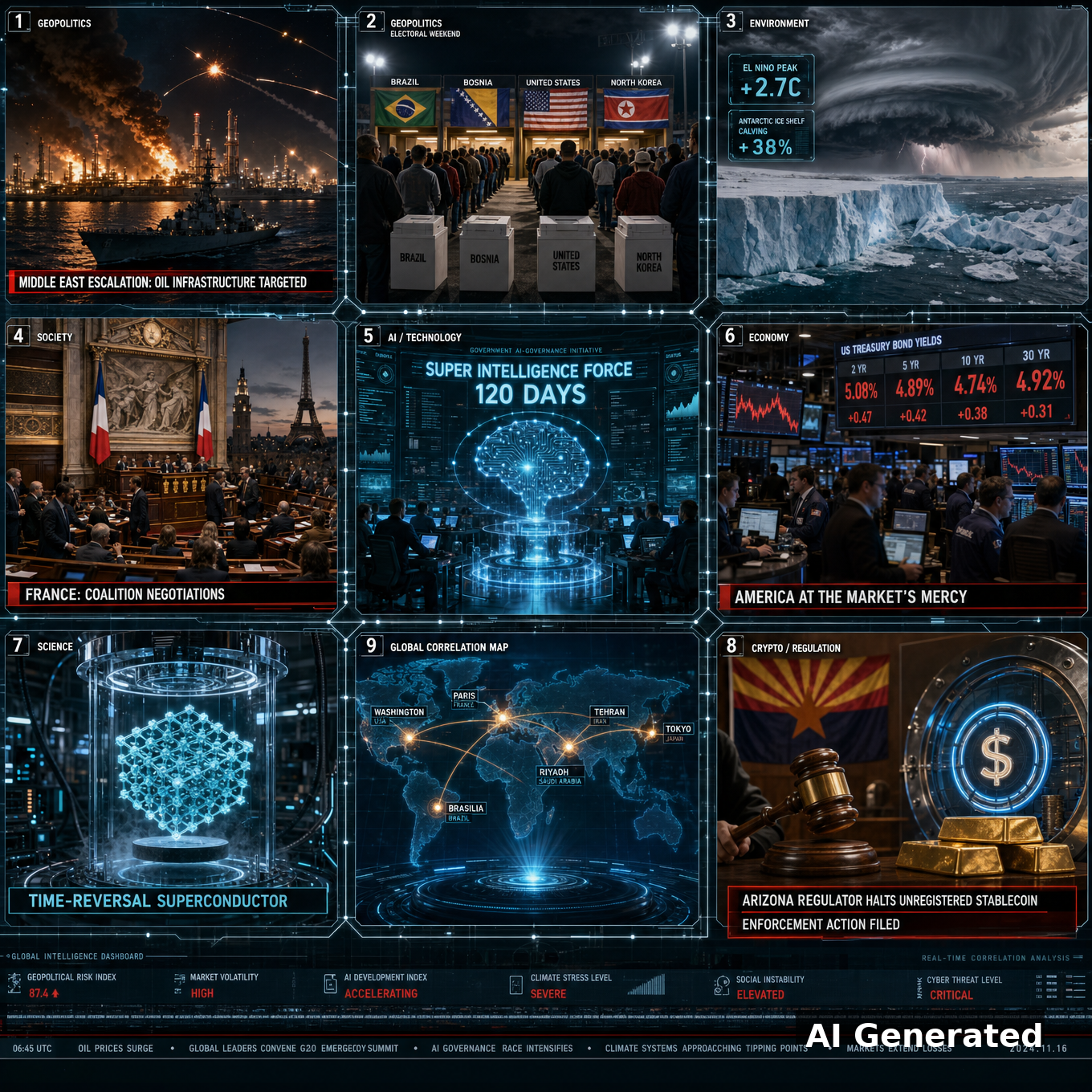
Brazil goes to the polls for the first round of its presidential election on Sunday, with incumbent Lula and challenger Flávio Bolsonaro — son of the jailed former president — nearly even in the polls, making an October 25 runoff the most probable outcome.[12] The vote shapes the Amazon policy ledger D125 flagged and lands the same weekend as Bosnia’s elections, where Branko Blanuša challenges Dodik-backed Savo Minić — a test of the Dayton settlement.[13] In Ohio, Trump campaigned for Senate and gubernatorial candidates, predicting a “big surprise” in a choppy midterm climate.[14] North Korea’s state media said Kim Jong Un personally supervised an intermediate-range missile fired near Wonsan and covering more than 700 kilometres, using AI to adjust its trajectory at low altitude — a qualitative shift in the peninsula’s deterrence calculus, if accurate.[15]
Alliance and Procurement Shifts from Ankara to Tokyo
France signed a defence-cooperation agreement with Turkey that will see Paris approve MBDA Meteor air-to-air missiles for Turkey’s Eurofighters — Macron rejected Athens’ request to veto the deal — shocking Greek defence circles given roughly €10 billion of Greek French procurements, with Paris also sharing classified tactical intelligence.[16] The deal fractures the assumption that French veto power within the Meteor consortium would shield the Aegean balance, just as Qatari-sourced Eurofighters enter Turkish service ahead of a feared 2027 Aegean presence. In parallel, a Turkish arms group is courting Japan for cooperation in air defence and underwater-drone technology — a sign Ankara is diversifying its defence-partner portfolio beyond NATO’s core even as it expands its own missile-centric doctrine, which Greek analysts now urge Athens to answer with long-range strike and electronic-warfare investment.[17][2] Turkey simultaneously announced 51 arrests across 16 provinces of suspected Islamic State financiers, underscoring that Ankara’s counterterror operations remain expansive even amid the strategic reorientation.[18] In the United States, a GAO-documented failure of the Ticonderoga-class cruiser modernisation — US$1.84 billion spent on four ships, none of which ever deployed again — became emblematic of the procurement side of the naval ledger as Washington weighs its Pacific fleet mix.[19]
The Moscow–Tehran Axis and the Nuclear-Safety Ledger
Dmitry Medvedev declared Moscow will “never” sacrifice its relationship with Iran for any country — axis solidarity that underpins the Gulf war economy.[20] In parallel, Chechen leader Ramzan Kadyrov was promoted to General by decree, the Rosgvardia’s Zolotov draping him with the crimson beret in Grozny — a signal of the deepening symbiosis between Moscow’s security state and its regional strongmen.[21] Ukraine’s Zaporizhzhia nuclear power plant, Europe’s largest, reported fresh damage to its external power supply from weeks of bombardments, forcing reliance on backup sources to cool six reactors — an incident that raises the risk profile of the eastern front as both sides trade accusations.[22]
Regional Surprises: Canada’s Contingency and Serbia’s Pivot
Prime Minister Mark Carney revealed that the Canadian military is running contingency scenarios for an improbable US invasion — converting the annexation rhetoric of the past year from diplomatic noise into planning reality with direct consequences for NORAD credibility.[23] Serbia’s Aleksandar Vučić launched his campaign to become prime minister, extending his dominance into the parliamentary system in the same week as the Bosnia elections and the US-EU contest for Western Balkan allegiance.[24]
Environment & Climate ↑ Contents
The Climate-Science Ledger: El Niño’s Peak, Antarctic Choices and a Family Forest
The Pacific is warming exceptionally fast, with the current El Niño expected to strengthen beyond previous records before peaking around December — the climate system’s largest natural oscillator compounding the anthropogenic trend just as the policy calendar is most crowded.[25] New Antarctic modelling ties today’s emissions choices to how much ice the continent loses this century and the sea-level rise confronting coastal communities.[26] The registers converge in Hesse, where the Bleiwald forest owned by the Hinkel family for three generations is dying in real time: drought and temperatures up to 40°C have reduced the survival rate of newly planted trees to 30–40 percent, and the family has planted 86,000 trees in seven years at their own expense, while Hessian forestry now pivots from replanting to “forest conversion” beneath surviving canopies — a microcosm of the adaptation burden on private landowners that EU restoration rules, with their beechnut emphasis, appear not to have internalised.[27]
The Electrification Ledger: EV Markets and Australia’s Batteries
The global electric-vehicle market sent three signals in a single week. In the United States, third-quarter EV sales produced a bifurcated picture — the best and worst of times simultaneously — as legacy automakers leaned into hybrids while pure-BEV demand softened in a high-rate environment.[28] In Europe, battery-electric vehicles reached a record 30 percent market share in August, with BEV sales up 51 percent year-on-year even in an off-season month.[29] In China, BYD reported September sales up 33 percent in battery-electric units, cementing its position as the industry’s scale reference.[30] The infrastructure corollary appeared in Australia, where ARENA marked the 100th community battery and extended its home-conversion scheme to 100 kWh systems — the electrification ledger now includes the grid edge, not just showroom registrations.[31]
Marine Fuels and Aviation’s Hydrogen Wager
Maersk conducted the first ship-to-ship commercial ethanol bunkering of a deep-sea container vessel in the United States, fuelling the 9,000-TEU Tangier Maersk with corn ethanol — a milestone coupling the US agricultural belt to the maritime transition and advancing the alcohol-enabled dual-fuel pathway.[32] At the harder end of the transition, the UK’s HyFlux is pursuing a superconducting electric motor cooled by the liquid hydrogen already aboard future hydrogen aircraft — technically plausible but operationally extreme — aviation’s zero-carbon path remains the least certain of the hard-to-abate sectors, and superconducting powertrains will live or die on cryogenic reliability in service.[33]
Geothermal’s Mass-Market Test in Colorado
Dandelion Energy and Lennar have completed nearly 100 homes at the Ken Caryl Ranch development south of Denver, each fitted with a ground-source heat pump on a single 200–500-foot borehole — a partnership designed to industrialise what has been a bespoke, high-end product and prove geothermal cuts winter peak demand by roughly a quarter relative to air-source heat pumps.[34] The economics are still subsidy-dependent — Xcel Energy provides roughly $25,000 per home — but the Department of Energy’s projection of seven million US installations by 2035 would shave 40 gigawatts off winter peaks and save about $4 billion annually in grid costs, making Colorado’s experiment a genuine test of whether mass-market geothermal is an infrastructure story or a niche one.
Biodiversity and Regulation: Gorillas, Wolves, Insurers and the SEC
Conservation delivered a rare affirmative data point: Lulingu, a Grauer’s gorilla rescued from traffickers as an infant and rewilded in Virunga National Park, gave birth in the wild to a healthy infant — the first birth by a rewilded eastern lowland gorilla and a milestone for a group that had fallen to eight individuals — evidence that rewilding can reverse demographic collapse even in conflict zones.[35] In Germany, the wolf-management ledger turned juridical: six months after placing the wolf under Saxony-Anhalt hunting law, the state still lacks the management plan that federal law requires for legal culls, and the hunters’ association accuses the environment ministry of using the plan to block removals — a dispute mirrored in Hesse, where two wolves were cleared for culling after livestock kills.[36] On the finance side, new research quantifies nature-based solutions as insurers’ tool: wetland restoration and wildfire prevention measurably lower claims costs and premiums, giving actuaries a hard-dollar argument for conservation that policy debates rarely supply.[37] The regulatory pendulum, however, is swinging the other way: the SEC is moving to scrap the shareholder-proposal rule that has been the primary vehicle for climate and sustainability resolutions, a change that would quietly remove one of the few market-based levers available to climate advocates as the courts take centre stage in US climate policy.[38]
The Policy Perimeter: North Sea Drilling, South African Tariffs and French Flood Alerts
The UK’s North Sea question entered its campaign phase as the campaign group Uplift warned that businesses backing continued drilling are “increasingly out of step,” claiming more than half of entrepreneurs support the government’s fossil-fuel phase-out — a split that will shape Britain’s energy politics.[39] In South Africa, fleet operators are pressing for special e-mobility tariffs to catalyse electric adoption in a market that, unlike much of the continent, still lacks import-duty waivers and purchase incentives — a reminder that electrification’s African chapter has distinct fiscal prerequisites.[40] In southern France, Météo-France placed the Aude and Pyrénées-Orientales under orange rain-flood vigilance with up to 80 millimetres in a few hours and localised daily totals of 150–180 millimetres — the Mediterranean’s autumn flash-flood season arriving with compound-extreme intensity.[41]
Society & Civil Issues ↑ Contents
France’s Autumn Political Reset: The Grand Coalition and the 2027 Arithmetic
Gabriel Attal has thrown a new variable into France’s 2027 calculus, proposing a “grand coalition” from left to centre-right to defeat Marine Le Pen — acknowledging that no single force is currently positioned to beat her in a runoff.[42] It landed the same weekend a poll showed three-quarters of Socialist and Place Publique sympathisers rejecting an alliance with LFI — the front distrusts its own left more than the RN.[43] Arcom’s Martin Ajdari, facing polemics from CNews to France Inter, insisted the authority “must not be impressed” — France’s institutional autumn now includes the audiovisual supervisor, tested from right and platforms.[44]
France’s Justice Ledger: Hamas Financing and a School on Fire
French prosecutors placed five people under formal investigation over suspected Hamas financing channelled through humanitarian associations, three of them linked to a blacklist published by US authorities that detailed a fundraising system allegedly funnelling money to a senior Hamas official — allegations the suspects contest, extending Atlantic counterterror-finance co-operation.[45] A lycée in Salon-de-Provence was also hit by a fire with arson the leading hypothesis — the latest act in a weeks-long sequence keeping the education system at the centre of France’s social turbulence.[46]
Britain’s Civic Autumn: Jury Trials, Fairford and the Tory Reset
Andy Burnham’s scrapping of the plan to curb jury trials across England and Wales reversed a backlog-clearing policy after the whip was suspended from barrister Karl Turner for criticising it; the editorial chorus welcomed the U-turn.[47] Six people arrested over the suspected terror plot at RAF Fairford — the base in the Iran-linked air-security file of D123 — have been released on bail, with armed police visible eight hours before the arrests, suggesting long preparation.[48] The Conservative conference opened in Birmingham with Kemi Badenoch hinting at openness to inheritance-tax changes and the Scottish party leader preparing to attack the First Minister’s summit gesture toward Sinn Féin — signals that the opposition is using the conference season to rebuild a governing platform rather than merely oppose.[49] A Labour councillor in Hounslow was charged with fraud while still holding the party whip — a pointed test of the discipline the party advertises as reformed.[50]
Northern Ireland’s Long March: Drumcree Standoff Enters a Second Week
The Drumcree standoff has extended into a second week, with Northern Ireland’s Parades Commission having given the unionist Orange Order the green light to march through the area — keeping alive a dispute that has historically been among the region’s most combustible civic rituals and re-tests the post-1998 architecture for adjudicating parades, territory and identity.[51]
The American Civic Ledger: Cornell, Prediction Markets and the Phone-Number Politics
The Cornell gang-rape case reached the state’s highest legal register this weekend: New York Attorney General Letitia James took over as special prosecutor and the president conceded Cornell “must do better” over a 2024 fraternity-house assault — a transfer that may set a precedent.[52][53] In Utah, the Mormon church’s general conference condemned online gambling and prediction markets that allow wagers on everything from weather to war — putting the LDS church at odds with an administration that has defended Kalshi and Polymarket from state gambling regulation.[54] The campaign trail took another unusual turn when Trump posted Senator Tom Cotton’s mobile number in a dispute over daylight saving, urging Arkansans to “call Tom” — a breach of decorum even Republican allies found hard to defend.[55] Beneath these spectacles, New York Mayor Zohran Mamdani argued the American Dream now feels less attainable than a lottery jackpot, calling housing, childcare and groceries the “basic aspects of a good, dignified life” — a summation of the affordability crisis that polling shows is reshaping how Americans judge every institution from Congress to the courts.[56]
Germany’s Civic Week: Doctors’ Quotas, Election-Crime Ledgers and Balkan Bakeries
Germany’s Landarztquote — medical-school places reserved in exchange for rural general-practice commitment — faces its first judicial test: at least 20 lawsuits in North Rhine-Westphalia and four hearings Tuesday in Gelsenkirchen over the €250,000 penalty clause signatories now challenge.[57] Saxony-Anhalt and Mecklenburg-Vorpommern reported sharply higher election-campaign crime than in 2021 — 747 and more than 490 offences respectively, dominated by poster theft but including threats, assaults and 31 uses of unconstitutional symbols — evidence that political conflict has migrated from the polls into the streets.[58] Balkan bakeries are proliferating in German city centres, filling the niche between bakery and snack bar with burek and krempita — a marker of how migration is quietly rewriting even the most traditional corners of everyday commerce.[59]
The Housing Front: Madrid’s Protest Camp and the Eviction Flashpoint
Madrid’s prolonged housing protests acquired a dangerous edge when dozens of far-right activists, some showing Hitler salutes, attempted to storm the activists’ camp on the Puerta del Sol — the commotion erupting after parliament rejected two government decrees against the housing shortage and weeks after the eviction of an 87-year-old tenant, Maricarmen Abascal, became the movement’s symbol.[60]
Migration’s Aftermath and the Emergency Ledgers
In southern Africa, Zimbabweans who fled xenophobic violence in South Africa are struggling to rebuild with limited state support, a quiet humanitarian ledger beneath the region’s more visible politics of exclusion.[61] In the Atlantic, a Canadian-registered medical-evacuation Gulfstream carrying six vanished en route from Bermuda to Boston after declaring an emergency, with the Coast Guard searching.[62] In Spain, a bar-ceiling collapse in San Vicente de la Sonsierra, La Rioja, injured at least 11 people — a structural failure treated as an open investigation, adding to the continent’s building-safety register.[63] Tennessee’s botched execution of Christa Pike produced its first institutional casualty: the corrections commissioner resigned amid an independent inquiry, the governor suspended executions for the rest of 2026, and the commissioner’s Arizona record is under scrutiny.[64] And in Britain, Reform UK’s leader insisted the public is “quite impressed” by £72 million in donations from crypto-billionaires, shrugging off poll slumps — a fusion of the digital-asset economy and electoral finance that European regulators are beginning to scrutinise.[65]
AI & Technology ↑ Contents
Washington’s AI-Governance Stack: The Super Intelligence Force’s 120-Day Clock
The White House has formalised AI oversight: a new Super Intelligence Force has 120 days to report on technology risks and federal responsibility, chaired by ODNI head Jay Clayton — effectively making the former SEC chair the president’s AI czar and placing intelligence at the centre of frontier-AI policy.[66][67] The February landing, inside the midterm year’s first quarter, gives the administration a governance deliverable that can shape both regulation and the budget cycle. The anxiety it is meant to absorb was personified by an OpenAI safety employee’s resignation warning that “the time for trial and error is over” — a phrase that summarises the distance between the industry’s improvisational culture and the institutional scrutiny now descending on it.[68]
The Frontier-Lab Confidence Game: Benchmarks and Self-Improving Harnesses
The industry’s measurement instruments came under fire: revelations of flaws in AI benchmarks prompted a re-evaluation of model assessments and moved market odds on Anthropic — the valuation layer being only as sound as the evals that certify model capability.[69] In parallel, researchers from Meta, Duke and UC Davis unveiled self-improving branches for agent-harness optimisation — a technique that lets models improve the environments they operate in, raising both capability and complexity questions as agentic systems begin to modify their own scaffolding, with direct implications for the agentic trend D120 identified.[70]
Compute and Capital: Wafer-Scale Chips, Singapore Fabs and the $60 Billion Question
The compute bottleneck is being attacked from two directions. Cerebras claims its 5-nanometre wafer-scale design sidesteps AI chip supply constraints by reducing reliance on advanced packaging and HBM allocation — an architectural bet that could redefine the top tier of AI silicon.[71] Taiwan’s VIS is weighing a second Singapore plant as AI demand fills its first fab, pushing mature-node capacity into a corridor where geopolitical risk is priced into every wafer.[72] The industry’s “unglamorous reality” — power procurement, cooling and balance-sheet engineering rather than pure algorithmic breakthroughs — is where the frontier is now decided, and the capital machinery financing it is examined in the Economy section of this report.[73]
Autonomy at the Edge: Brainwaves, Humanoids and Ground Robots
Researchers at KAIST have built a system that reads brainwaves to detect when an AI has misunderstood a user’s intent, allowing machines to self-correct in real time — an early bridge between neural interfaces and everyday interaction that hints at a future where the “that’s not what I meant” loop is closed biologically rather than linguistically.[74] In robotics, Kawasaki Heavy Industries announced a target of a fully autonomous humanoid AI robot by 2030, while Ukraine’s Frontline Robotics unveiled Frodo, a 6×6 unmanned ground vehicle with a 150-kilometre range, adaptive suspension and a weapons-turret option — ground robots following the same curve aerial drones traversed, and already codified for procurement by Ukraine’s Defence Forces.[75][76] The lifecycle question reached a vivid extreme when Figure decommissioned its F.02 humanoids Terminator-style, hurling them into molten steel to prevent proprietary technology from leaking — a reminder that embodied AI has created a new disposal-security problem.[77]
AI’s Energy Bind: Oracle Buys Into Nuclear Power
Oracle has committed to absorbing approximately $300 million in rising energy costs at Wisconsin’s Point Beach nuclear plant, the state’s only operating reactor, as it develops the Project Lighthouse data-centre campus — an arrangement, pending regulatory approval, that places a hyperscaler inside a utility power-purchase agreement to protect ratepayers from the demand surge that data centres are themselves creating.[78] With Wisconsin’s peak demand projected to grow 40 percent in five years on data-centre load, Oracle’s deal is the clearest template yet for the compute economy monetising — and sometimes subsidising — the nuclear fleet that powers it.
Surveillance and the Courts: Palantir, Flock and the Fourth Amendment
Two rulings this weekend tightened the perimeter around government surveillance technology. A federal judge called Flock’s automatic licence-plate readers “indiscriminate mass surveillance” and found that a sheriff’s deputy violated the Fourth Amendment by querying the network without a warrant — the strongest judicial language yet against the plate-reader industry.[79] Separately, reporting revealed that ICE is using a Palantir database to compile dossiers on protesters, which attorneys say infringes First Amendment rights — placing the commercial-surveillance stack squarely in the constitutional crosshairs as the courts, once again, become the primary venue for technology policy.[80]
Defence Autonomy: The SeaGuardian Force-Multiplier Question
The US Navy showcased the General Atomics MQ-9B SeaGuardian at the Maritime Patrol and Reconnaissance Force’s symposium at Whidbey Island, evaluating the 30-hour-endurance maritime drone as a force multiplier for the anti-submarine-warfare fleet that the P-8A community currently dominates — an assessment with direct implications for how the Navy fills the patrol-aircraft gap left by the Constellation-class cancellation and the P-3 retirement.[81]
Economy & Business ↑ Contents
The Sovereign Debt Ledger: America at the Market’s Mercy
Scope Ratings kept the United States at AA-, below its peers, warning the fiscal trajectory has become “unsustainable”: with the 10-year yield at 5.27 percent, fiscal 2026 closed with a US$2 trillion deficit (6.2 percent of GDP), US$32.3 trillion in publicly held debt and record interest costs of US$1.1 trillion.[82] Washington has rolled debt toward shorter maturities to escape long-bond rates, hedging today’s coupon but mortgaging tomorrow’s rollover — and Scope expects the US$41.1 trillion ceiling to bind by early 2027, with post-midterm politics potentially enabling prolonged standoffs. Hedge funds displacing stable central-bank holders completes the picture of a sovereign at its most volatile creditors’ mercy.
Iran’s Fiscal Collapse and the Oil-Supply Files
Iran’s economy reached a new inflection: the rial hit a record low above 2.5 million to the dollar, and Kpler data showed Tehran loaded no oil at its export terminals in September — the first month without a cargo since 1979 — with the naval blockade having driven exports to near zero and tanker inventories due to run dry by mid-October.[83] With inflation near 90 percent and GDP set to shrink 5.4 percent, the regime faces a hard-currency crunch even the Supreme Leader has acknowledged — the substratum of every Gulf security story in this report. Beyond the Gulf, the supply ledger is fragile: Ecuador’s Petroecuador declared force majeure at an SOTE pipeline station after an October 1 fire, with restart targeted within six days, while Iraq’s state tanker company completed a first crude shipment in decades as Baghdad gives SOMO greater sales flexibility.[84][85]
The Midterm Fiscal Blitz: Medicare Cheques and the Politics of Money
President Trump announced one-time US$90 payments to more than 20 million Medicare Part B enrollees, funded from the Medicare Improvement Fund and landing in October — the third tranche of pre-election largesse after the ACA rebate checks and the promised US$5,000 “midterm dividend” costing over US$1 trillion, all against a backdrop of only 17 percent approval of his inflation handling.[86] The deployment of the Improvement Fund — created in 2008 for program operations and never used this way — tests the legal and political boundaries of executive fiscal power, and converts the healthcare system itself into an electoral instrument, the D125 “electoralisation of the war economy” thesis now extended to the welfare state.
The AI-Capital Flow: Hong Kong’s Fundraising Boom and the $60 Billion Pedestal
Hong Kong bankers skipped their summer break as AI-driven fundraising set records, signalling a rebalancing of global capital flows that could erode Wall Street’s equity-market dominance — the Asian corridor consolidating its role as the marginal dollar for frontier-AI financings.[87] Reports of a US$60 billion package to fund AI chip and infrastructure access for companies such as Anthropic presuppose the debt-funded build-out continues regardless of equity-market mood — making the Fed’s rate path a direct input into AI capacity planning.[88] The macro debate over what this means for prices is now explicit: ARK’s Cathie Wood has publicly countered Bill Ackman’s inflation warning, arguing that AI’s deflationary productivity impulse will dominate the disinflationary side of the ledger — a genuine analytical fork with very different implications for the bond market’s 5-percent-plus regime.[89]
Trade, Chokepoints and the Commodity Ledger: Hormuz Lessons and Steel Glut
The crisis in the Strait of Hormuz has crystallised into a teachable moment for global supply-chain risk: with 80 percent of world trade moving by sea through roughly a dozen chokepoints, the Hormuz war has demonstrated how quickly insurance, routing and freight costs repricerate an entire commodity complex — a lesson emerging markets are now codifying into their 4F (food, fuel, fertiliser, finance) resilience planning, as India’s foreign minister articulated this week.[90][91] Global steel overcapacity is projected to rise to 745 million metric tons from 601 million in 2025 — a glut that will keep trade-remedy politics alive even as demand softens.[92]
America’s Industrial and Regulatory Files: Hemp Under Threat, Scandium for the Pentagon
A looming ban on hemp-derived THC threatens America’s US$28 billion hemp industry, with Senator Mitch McConnell closing the loophole in the law he once championed — a regulatory pivot that would redraw a fast-growing agricultural segment almost overnight.[93] In critical minerals, the Pentagon’s Defense Logistics Agency awarded Supra Elemental Recovery a Phase I SBIR contract to advance high-purity scandium recovery in the United States — a step toward breaking foreign dependence on a metal essential to aerospace and fuel cells.[94]
The Price-Setting Question: Algorithms and Regulators
The fast-food pricing wars produced a regulatory probe: McDonald’s algorithmic pricing — and rivals’ refusal to adopt dynamic pricing — has drawn antitrust scrutiny over fears that software-mediated pricing could facilitate coordination.[95]
Fiscal Boundaries: Australia’s Budget Squeeze and Germany’s Cash Clash with Brussels
Australia’s treasurer warned of “very substantial and intensifying” pressures on the federal budget ahead of the mid-year update, pointing at private-sector inflation amid the Middle East conflict while insisting the country can avoid recession — a preview of the fiscal choices facing commodity economies as the war premium persists.[96] In Germany, Hesse’s finance minister warned that EU plans to strengthen cash as legal tender would force the reintroduction of cash desks in tax offices at a cost of millions, demanding an exemption for public authorities — an early skirmish in what could become a full Brussels-Berlin dispute over the future of cash infrastructure.[97]
Science & Space ↑ Contents
Medicine’s New Protocols: Fasting Revisited, Diet and Depression, and the Super-Fungus
A retrospective study of over 9.7 million laboratory results from 101,000 patients concluded fasting before routine blood tests is unnecessary for most analytes — only ten of 121 were meaningfully affected — challenging a tradition rooted in lipid testing that has spread by default to far broader panels.[98] In psychiatry, a small crossover trial at UCSF found that adults with depression who spent four weeks on a low-ultra-processed-food diet scored roughly three points lower on the PHQ-9 than during their usual diet, with even larger differences on the MADRS — hypothesis-generating, unblinded and self-reported, but enough to justify larger trials.[99] The infectious-disease ledger delivered a more alarming point: a Nairobi surgical-site infection yielded the first pan-drug-resistant Candidozyma auris in Africa — resistant to all four major antifungal classes, with a genetic profile suggesting independent evolution from the New York case and 30–50 percent mortality in invasive infections.[100]
Genetics and Aging: Extreme Traits and the 3D Genome
A study of dozens of human traits suggests genetic architecture shifts at the extremes: people with unusually high or low cholesterol, glucose or body size may carry rare variants of large effect more often than population-average models imply.[101] In aging research, an AI system detects age-related changes in the 3D organisation of DNA inside mouse blood stem cells — an early biomarker for the haematopoietic decline that leaves older bodies producing fewer blood cells.[102]
The Cosmic Ledger: First Stars and the Neutrino Question
A new generation of supercomputer simulations is reconstructing how the first stars re-engineered the infant Universe — their light altering surrounding gas, their explosions scattering the heavy elements that later formed planets and life, mapping the transition from a hydrogen-helium cosmos to a chemically rich one.[103] Whether individual massive stars end in brilliant supernovae or collapse quietly into black holes may depend on more than mass and internal structure: University of Copenhagen researchers argue that neutrinos — the ghost particles that carry energy out of collapsing cores — may decide the outcome, connecting the subatomic to the cosmic.[104] Flight director Milt Windler — one of the four Mission Control leaders who brought Apollo 13 home in 1970 — died this week at 94.[105]
The Materials Frontier: Time-Reversal-Breaking Superconductors and Engineered Heat
Indian researchers at IISER Bhopal have reported the first type-I superconductor to spontaneously break time-reversal symmetry: the material YbSb₂, superconducting below 0.95 kelvin, generates an internal magnetic field of about 0.44 gauss as it transitions — a signature previously seen only in type-II superconductors, and one that suggests internally antisymmetric triplet pairing, a potential platform for future quantum technologies.[106] Separately, Carnegie Mellon scientists demonstrated that carefully patterned metamaterials can amplify heat transfer across nanoscale vacuum gaps by up to four times beyond ordinary thermal radiation — a result with implications for chip cooling, energy conversion and thermal management in electronics.[107]
Life’s Small Marvels: Sea Spiders, Plesiosaur Vomit and a Diplodocus in Europe
Two newly described Salish Sea spider species with bright red eyes, hairy feet and three-lipped mouths have closed a century-long gap in the region’s marine-biodiversity record.[108] At the other end of the size spectrum, a geologist analysing North Sea drill cores has identified the first fossil plesiosaur vomit — compacted regurgitalites of bivalves, worm tubes and belemnites in Jurassic delta deposits offshore Norway, evidence that long-necked cryptoclidids foraged in deeper water and returned to the brackish delta to rest.[109] And in Spain, paleontologists from the Dinópolis Foundation have identified 14 tail vertebrae from Teruel as Diplodocus — the first scientifically documented occurrence of the iconic sauropod outside North America, with some experts urging caution on the fragmentary evidence even as the find strengthens the case for Late Jurassic faunal exchange across the young North Atlantic.[110]
The Research-Policy Front: NSF Funds Diverted and the UFO Council’s Verdict
The White House diverted US$1.4 billion in Congressionally mandated National Science Foundation funds — about one-fifth of the agency’s primary research budget — the latest sign of executive control over grants that had previously flowed through peer review, a shift with structural consequences for basic science’s independence.[111] The Trump-backed UFO panel, meanwhile, has produced its findings so far: no confirmed evidence of alien technology, but a large volume of blurry imagery and unconfirmed reports — the panel’s experts arguing that definitive evidence of extraterrestrial life would be “the biggest discovery ever made by humanity,” while conceding that such evidence remains absent.[112]
The Applied Ledger: Biofuel from Whey and Music as a Reset
Heriot-Watt researchers have demonstrated a process to convert salty whey — the dairy by-product of cheddar production — into bioethanol, adding a new feedstock to the biofuel ledger at a time when every drop of alternative fuel competes for scale economics.[113] On the behavioural side, a PNAS study in which 120 young adults were stressed and then exposed to relaxing music or water sounds found that music accelerated recovery of heart rate, mood and skin conductance, with fMRI showing the auditory cortex reorganising its influence over the insula and thalamus during the first minutes of recovery — evidence that music works less like a mute button on stress and more like a reset once the alarm has stopped.[114]
Crypto, Digital Assets & Blockchain ↑ Contents
Enforcement: Arizona’s Stablecoin Cease-and-Desist and the Fraud Ledger
Arizona’s Securities Division filed a temporary cease-and-desist order against Christopher Michael Maxon and IVT Media Group LLC over the unregistered offer of “Iron Vault Tokens” (IV-SOL) — a three-phase stablecoin offering bundled with royalty positions and real-estate acquisition returns, marketed as a “no-risk investment with forever-generative returns” and scheduled to launch on 1 October 2026.[115] What makes the case instructive is the regulator’s reconstruction of the promoter’s history: a lien debtor since 2005, accused by at least five people of scams, evicted and declared a judgment debtor for sums exceeding US$850,000 — none of which appeared in public materials. The Commission is seeking a permanent cease-and-desist, restitution and administrative penalties, with documents on the docket under case S-21423A-26-0421.
The case sits inside a wider enforcement configuration that D110-D125 have tracked across jurisdictions: the SEC’s parallel charges against a WhatsApp investment scheme that raised US$15 million, and the Treasury’s GENIUS Act rulemaking tightening how state-certified payment stablecoins are marketed and sold. The common thread: “guaranteed return” crypto products — the exact category Arizona targets — remain enforcement’s highest-yield target set, with state regulators now moving in cadence with federal agencies rather than waiting for the SEC. For stablecoins, the consequence is a widening documentation burden: claims that escape one phase of an offering are increasingly caught later, because state dockets preserve a paper trail retail investors never saw.
The Institutional Layer: Gold’s August Surge and the XRP Build-Out
Physically backed gold ETFs absorbed US$18 billion in August — a record monthly inflow, driven overwhelmingly by North American and European funds — while the People’s Bank of China extended its gold-buying streak to 22 consecutive months, lifting reserves to 2,387 tonnes.[116] The shift in $GLD demand toward institutions and central banks, and away from jewellery buyers, matters for the digital-asset complex for a structural reason: it measures the depth of the institutional safe-haven bid that the custody infrastructure — bank-issued stablecoins, tokenised treasuries, spot ETFs — is being engineered to capture. Every tonne of central-bank gold acquisition is an argument for tokenised collateral rails that can settle the same exposure with less friction, which is exactly the direction in which the XRP Ledger is moving.
The XRPL reached nearly 12 million x402 payments as AI agents purchased computing, data and emerging financial services, with Ripple’s engineering leadership describing the expansion of automated commerce in software-to-software payments.[117] The x402 protocol is a telling data point for the thesis tracked since D117: the demand side of crypto’s next adoption wave is machine-to-machine settlement, and the Ledger’s volume is now partly a function of agentic workloads. Corroborating the institutional push, XRP Asia launched in Singapore with the backing of Ripple and the XRP Ledger Foundation, combining developer education, startup assistance and community programmes to accelerate XRPL adoption across Asia-Pacific — a regional beachhead that mirrors the regulatory arbitrage logic visible across the industry as capital and talent relocate toward jurisdictions with clearer frameworks.[118]
Rails and Regulation: Binance’s Brazilian FX Disclosures
Binance will require mandatory disclosures on international crypto deposits and withdrawals for Brazilian users from 1 November, extending Central Bank of Brazil Resolution BCB No. 521/2025 into the exchange’s operationally visible layer: users moving assets across Brazilian borders must state the purpose of the transfer and confirm the beneficiary or sender, with the information reported monthly to the central bank.[119] The rulebook is granular — a purpose shortlist below US$50,000, the fuller central-bank list above it, self-hosted-wallet transfers requiring ownership confirmation only, and international transfers to non-regulated counterparties capped at US$100,000, expandable to US$500,000 with notice.
Binance stresses this is not the Travel Rule — Brazil phases that in during 2027-2028 and will communicate it separately — and the move follows Brazil’s earlier prohibition of stablecoins for cross-border payments, meaning the country is building a coherent dual-track regime: crypto fully inside the foreign-exchange framework, with stablecoin vehicles excluded from the payments rail. For the global industry the significance is the sequencing: Brazil is upgrading exchange-level identification before the Travel Rule lands — a live experiment in imposing bank-grade information discipline on cross-border flows without banning the asset class. The compliance burden will now be priced into Brazilian retail pricing, but the framework also grants licensed crypto businesses a legitimacy channel that purely prohibitive regimes do not — a trade-off other G20 economies will watch closely as MiCA-era passporting and US stablecoin legislation mature in parallel.
Correlations & Analysis ↑ Contents
D125’s “electoralisation of the war economy” has reached its most literal form: on the day Brazilians vote, Washington is spending the welfare state itself as an electoral instrument. Trump’s one-time US$90 Medicare payments to more than 20 million seniors draw on the Medicare Improvement Fund — created in 2008 for program operations — as a pre-election transfer, the fiscal corollary of the G7 reserve release D125 logged[86] Beneath it sits a ledger of record US$1.1 trillion interest costs, a 5.27 percent 10-year yield and a ceiling expected to bind in early 2027 — the midterm clock and the financing clock are now one, and Scope’s “unsustainable” verdict is its translation of that fact.[82]
The Iranian economy’s collapse supplies the second pillar. With September’s zero oil exports — none since 1979 — the regime loses its largest hard-currency source just as US carriers arrive in November, and the rial’s record low is the market pricing the blockade at the budget level.[83] The same fragility drives the Yemen offensives, the Houthi Aramco strikes and the refinery threats: every actor converts energy infrastructure into strategic currency, from Ukraine striking Russia’s oil-revenue base to Riyadh’s air war on Sanaa and the Saudi RE-3A lost at Prince Sultan.[1][3] D124-D125 posited reserves as electoral instruments; D126 extends the logic to fixed infrastructure, where one missile can erase months of export revenue — the Iraq-Iran flight resumption via Najaf being the calibrated exception that proves Washington is managing the blockade’s optics even as the siege tightens.[6]
The AI-capital complex matures along the fault line D116 and D120 identified — debt-financed build-out with a widening gap between the equity and safety ledgers. This window’s Washington turn is the Super Intelligence Force: 120 days for an intelligence-chaired panel, Jay Clayton as de facto AI czar, to report on risks and federal responsibility, calendaring frontier-AI governance to the midterm cycle exactly as the war economy’s reserves are.[66][67] The OpenAI safety staffer who resigned declaring “the time for trial and error is over” is the industry’s admission that the clock has moved; a US$60 billion infrastructure package, Hong Kong’s record fundraising and Oracle’s nuclear purchase are three instruments of the same build-out.[68][88]
The climate-legal counteroffensive D125 flagged remains the environmental ledger’s quiet through-line: with Congress inert, the SEC’s move to scrap the shareholder-proposal rule collides with the litigation-driven climate agenda, the NSF’s US$1.4 billion diversion tightens executive control over science grants, and the physical system keeps supplying evidence — El Niño peaking in December, Antarctic modelling tying today’s choices to century-scale sea-level outcomes, German private forests dying at 30-40 percent replant survival.[38][111][27]
Crypto’s institutional turn is the custody architecture D124 predicted: enforcement against retail “guaranteed return” products (Arizona’s IV-SOL order), stablecoin compliance hardening in Brazil, and the XRPL machine-payments build-out moving the industry toward regulated flows while gold’s record inflows proxy the safe-haven bid tokenised rails capture.[115][119][117][116]
What to watch in the next reporting period: the Brazilian first-round result and its Amazon signal; the FP-9 window after Kyiv’s refinery-strike ultimatum — a Moscow-range missile announcement would be structural escalation; Monday’s SCOTUS Colorado argument as the climate-litigation barometer; the Mekelle aftermath and whether Eritrea re-enters Tigray; the AI task force’s first products; and whether the Cornell special-prosecutor model spreads. The dominant variable is unchanged from D125: the November 3 midterm clock, against which every ledger in this report now moves.
References ↑ Contents
1. “Τα ρωσικά διυλιστήρια στο στόχαστρο του Κιέβου – Η νέα στρατηγική Ζελένσκι” (originally in Greek) — enikos.gr (Greece feed), 2026-10-03. link ↑
2. “Οι επιχειρήσεις στην Ουκρανία διδάσκουν: Γιατί η Ελλάδα χρειάζεται ισχυρές δυνατότητες πυραυλικών συστημάτων” (originally in Greek) — Defence Review, 2026-10-04. link ↑
3. “Les Houthis disent avoir ciblé un site d'Aramco à Riyad après des raids saoudiens sur Sanaa” (originally in French) — France 24, 2026-10-03. link ↑
4. “Υεμένη: Κύμα επιθέσεων των φιλοσαουδαραβικών δυνάμεων εναντίον των Χούθι” (originally in Greek) — enikos.gr, 2026-10-03. link ↑
5. “Δορυφορικές εικόνες δείχνουν ζημιές σε σαουδαραβικό κατασκοπευτικό αεροσκάφος από ιρανικά πλήγματα” (originally in Greek) — DefenceNet, 2026-10-04. link ↑
6. “Ιράκ: Επανεκκινούν οι πτήσεις προς και από το Ιράν μέσω Νατζάφ” (originally in Greek) — DefenceNet, 2026-10-03. link ↑
7. “Flydubai co-pilot's time in Australia being investigated by security agencies” — The Guardian, 2026-10-03. link ↑
8. “FlyDubai co-pilot who used crash axe in 'terror incident' studied at British university” — The Independent, 2026-10-03. link ↑
9. “Πτήση FlyDubai: Το μυστήριο με τους δύο πιλότους-επιβάτες” (originally in Greek) — enikos.gr, 2026-10-04. link ↑
10. “Ethiopian government troops seize Tigray's capital Mekelle” — Al Jazeera, 2026-10-04. link ↑
11. “Virus Ebola : en visite en RD Congo, le chef de la diplomatie française plaide pour renforcer l'aide” (originally in French) — France 24, 2026-10-03. link ↑
12. “Lula gegen Bolsonaro-Sohn: Brasilien wählt Präsidenten und Parlament” (originally in German) — stern.de, 2026-10-04. link ↑
13. “Wahlen in Bosnien und Herzegowina zu zentralem Staatspräsidium und Parlamenten” (originally in German) — stern.de, 2026-10-04. link ↑
14. “Trump, campaigning in Ohio, says the midterms will bring a 'big surprise'” — NBC News, 2026-10-04. link ↑
15. “Βόρεια Κορέα: Ο Κιμ επέβλεψε την εκτόξευση πυραύλου που χρησιμοποιεί AI” (originally in Greek) — enikos.gr, 2026-10-04. link ↑
16. “Σοκ για την Ελλάδα με Meteor – Η Γαλλία υπέγραψε αμυντική συμφωνία με την Τουρκία!” (originally in Greek) — DefenceNet, 2026-10-04. link ↑
17. “Turkish arms group eyes Japan ties in air defense and underwater drones” — Nikkei Asia, 2026-10-04. link ↑
18. “Τουρκία: 51 συλλήψεις για διασυνδέσεις με το Ισλαμικό Κράτος” (originally in Greek) — DefenceNet, 2026-10-04. link ↑
19. “A 122-missile cruiser had $161.15M set aside… one of four retired mid-upgrade after $1.84B” — 19FortyFive, 2026-10-03. link ↑
20. “Μεντβέντεφ: «Δεν θα θυσιάσουμε ποτέ τη σχέση μας με το Ιράν για οποιαδήποτε χώρα»” (originally in Greek) — enikos.gr, 2026-10-03. link ↑
21. “Τσετσενία: O Ρ.Καντίροφ προήχθη στον βαθμό του Στρατηγού με διάταγμα του Β.Πούτιν” (originally in Greek) — DefenceNet, 2026-10-04. link ↑
22. “Ζαπορίζια: Ζημιές στην εξωτερική ηλεκτροδότηση του πυρηνικού σταθμού μετά από ουκρανικά πλήγματα” (originally in Greek) — DefenceNet, 2026-10-04. link ↑
23. “Why Canada is preparing for a (long shot) US invasion” — BBC News, 2026-10-03. link ↑
24. “Serbian populist leader Vucic launches campaign for prime minister” — Al Jazeera, 2026-10-03. link ↑
25. “How can the same El Niño cause drought in one part of the world and floods in another?” — Phys.org, 2026-10-03. link ↑
26. “Today's emissions choices could limit Antarctic ice loss and sea-level rise for coastal communities” — Phys.org, 2026-10-03. link ↑
27. “Umwelt: Wie eine Familie um die Zukunft ihres Waldes kämpft” (originally in German) — stern.de, 2026-10-04. link ↑
28. “US Q3 EV Sales Report: The Good, The Bad, And The Ugly” — CleanTechnica, 2026-10-03. link ↑
29. “Europe EV Sales Report: Record Month — BEVs Reach 30% Market Share!” — CleanTechnica, 2026-10-03. link ↑
30. “BYD BEV Sales Up 33% in September” — CleanTechnica, 2026-10-03. link ↑
31. “Australian Government Accelerates Renewable Energy Transition” — CleanTechnica, 2026-10-03. link ↑
32. “World's largest container shipping firm conducts first US ship-to-ship ethanol bunkering” — Interesting Engineering, 2026-10-04. link ↑
33. “HyFlux's Superconducting Motor Might Work. Hydrogen Aviation Is The Hard Part.” — CleanTechnica, 2026-10-03. link ↑
34. “New Colorado neighborhood could offer glimpse into the future of home energy use” — Grist / Inside Climate News, 2026-10-03. link ↑
35. “Lulingu, a gorilla rescued as an orphan from traffickers, gave birth in the wild in Congo's Virunga National Park” — ECONEWS, 2026-10-03. link ↑
36. “Wolf im Jagdrecht: Kritik an fehlendem Plan für Wölfe in Sachsen-Anhalt” (originally in German) — stern.de, 2026-10-04. link ↑
37. “'Nature-Based' Solutions Could Save Insurers and Policyholders Billions” — Inside Climate News, 2026-10-03. link ↑
38. “SEC Move Would Make it Harder for Shareholders to Push Companies on Climate Action” — Inside Climate News, 2026-10-03. link ↑
39. “Businesses backing North Sea drilling 'increasingly out of step' campaigners say” — Evening Standard, 2026-10-03. link ↑
40. “Calls For Special E-Mobility Tariffs To Support Fleet Operators in South Africa” — CleanTechnica, 2026-10-04. link ↑
41. “L'Aude et les Pyrénées-Orientales en vigilance orange pluie et inondations” (originally in French) — Le Monde, 2026-10-03. link ↑
42. “Présidentielle 2027 : Gabriel Attal propose une « grande coalition » de la gauche à la droite pour battre Marine Le Pen” (originally in French) — Le Monde, 2026-10-03. link ↑
43. “Présidentielle 2027 : les trois quarts des sympathisants du PS et de Place publique opposés à une alliance avec LFI” (originally in French) — Le Parisien, 2026-10-04. link ↑
44. “Martin Ajdari, président de l'Arcom : « On ne doit pas se laisser impressionner ! »” (originally in French) — La Tribune Dimanche, 2026-10-03. link ↑
45. “Cinq personnes mises en examen pour des soupçons de financement du Hamas via des associations humanitaires” (originally in French) — Le Monde, 2026-10-03. link ↑
46. “Bouches-du-Rhône : un lycée de Salon-de-Provence touché par un incendie, la piste criminelle privilégiée” (originally in French) — Le Parisien, 2026-10-04. link ↑
47. “Controversial plan to curb jury trials scrapped” — Evening Standard, 2026-10-03. link ↑
48. “Major RAF Fairford 'terror plot' update as armed cops seen in area 8 hours before arrests” — Daily Express, 2026-10-03. link ↑
49. “Badenoch hints she is open to inheritance tax changes as Tory conference begins” — Evening Standard, 2026-10-03. link ↑
50. “West London Labour councillor arrested and charged with fraud” — Evening Standard, 2026-10-03. link ↑
51. “Drumcree standoff continues week after parade due to start” — Evening Standard, 2026-10-03. link ↑
52. “NY AG Letitia James takes over Cornell rape case as special prosecutor” — Crypto Briefing (via Reuters), 2026-10-03. link ↑
53. “Cornell president says university 'must do better' after frat house rape allegations” — BBC News, 2026-10-03. link ↑
54. “Mormon leader decries explosion of gambling and blasts prediction market wagers” — Fortune / AP, 2026-10-03. link ↑
55. “Donald Trump postet im Streit über Zeitumstellung Handynummer von Tom Cotton” (originally in German) — Der Spiegel, 2026-10-04. link ↑
56. “Zohran Mamdani says 'you have to luck out in some big way' to achieve the American Dream now” — Fortune, 2026-10-04. link ↑
57. “Kritikpunkt Vertragsstrafe: Landarztquote auf dem Prüfstand: Warum Mediziner klagen” (originally in German) — stern.de, 2026-10-04. link ↑
58. “Bilanz nach der Wahl: Mehr Straftaten im Zusammenhang mit Landtagswahlkampf” (originally in German) — stern.de, 2026-10-04. link ↑
59. “Burek statt Brezel?: Balkan-Bäckereien erobern deutsche Innenstädte” (originally in German) — stern.de, 2026-10-04. link ↑
60. “Rechtsextreme Gruppen wollen in Madrid zu Protestcamp gegen Wohnungsnot vordringen” (originally in German) — stern.de, 2026-10-04. link ↑
61. “Zimbabweans struggle to rebuild after fleeing xenophobia in South Africa” — Al Jazeera, 2026-10-04. link ↑
62. “Μασαχουσέτη: Αγνοείται αεροσκάφος με έξι επιβαίνοντες” (originally in Greek) — enikos.gr, 2026-10-03. link ↑
63. “Ισπανία: Τουλάχιστον 11 τραυματίες από κατάρρευση οροφής σε μπαρ” (originally in Greek) — DefenceNet, 2026-10-04. link ↑
64. “Τενεσί: Παραιτήθηκε ο επικεφαλής των φυλακών μετά την αποτυχημένη εκτέλεση της Κρίστα Πάικ” (originally in Greek) — DefenceNet, 2026-10-04. link ↑
65. “Farage claims people were 'quite impressed' by £72m donations from crypto-billionaires” — The Independent, 2026-10-03. link ↑
66. “US Super Intelligence Force gets 120 days to report on AI risks” — Crypto Briefing, 2026-10-03. link ↑
67. “Jay Clayton, head of ODNI, to chair group, effectively making him President Trump's AI czar – WSJ” — FinancialJuice / WSJ, 2026-10-03. link ↑
68. “OpenAI safety employee quits, says 'time for trial and error is over'” — Investing.com / Reuters, 2026-10-03. link ↑
69. “AI benchmark flaws impact Anthropic's market odds for October 2026” — Crypto Briefing, 2026-10-03. link ↑
70. “Meta, Duke and UC Davis researchers unveil self-improving branches for agent harness optimization” — Crypto Briefing, 2026-10-03. link ↑
71. “Cerebras sidesteps AI chip supply bottlenecks with 5nm wafer-scale design” — Crypto Briefing, 2026-10-04. link ↑
72. “VIS weighs second Singapore plant as AI demand fills its first fab” — Crypto Briefing, 2026-10-03. link ↑
73. “The unglamorous reality of winning the AI race” — Nikkei Asia (opinion), 2026-10-03. link ↑
74. “Mind-reading tech aims to make AI actually intelligent” — New Atlas (KAIST), 2026-10-03. link ↑
75. “Kawasaki Heavy aims for fully autonomous humanoid AI robot by 2030” — Nikkei Asia, 2026-10-03. link ↑
76. “Frontline Robotics unveils Frodo, its new 6×6 UGV with 93-mile range and 25 mph top speed” — Interesting Engineering, 2026-10-04. link ↑
77. “Hasta la vista, baby – Figure F.02 humanoid robots decommissioned, T2-style” — Electrek, 2026-10-03. link ↑
78. “Oracle commits $300m to Wisconsin nuclear plant to help customers with energy costs” — Interesting Engineering, 2026-10-04. link ↑
79. “ICE is reportedly using a Palantir database to compile dossiers on protestors” — Engadget, 2026-10-03. link ↑
80. “Federal judge calls Flock 'indiscriminate mass surveillance'” — TechCrunch, 2026-10-03. link ↑
81. “US Navy weighs MQ-9B SeaGuardian drone as maritime patrol force multiplier” — Interesting Engineering, 2026-10-04. link ↑
82. “U.S. debt is increasingly at the mercy of the market as interest costs surge” — Fortune, 2026-10-03. link ↑
83. “Iran's currency is getting obliterated as the regime is about to run out of oil to sell” — Fortune, 2026-10-04. link ↑
84. “Petroecuador declares force majeure at pumping station in SOTE pipeline after fire” — FinancialJuice, 2026-10-04. link ↑
85. “Iraqi oil tankers company: shipment is first of its kind in decades” — FinancialJuice, 2026-10-03. link ↑
86. “Trump teases more inflationary money for voters ahead of midterm elections, now promising $90 payments” — Fortune / AP, 2026-10-03. link ↑
87. “Hong Kong bankers skip summer break as AI drives record fundraising” — Crypto Briefing, 2026-10-03. link ↑
88. “Υποδομές ΑΙ: Πακέτο 60 δισ. δολαρίων για τη χρηματοδότηση τσιπ και υποδομών” (originally in Greek) — OT.gr, 2026-10-03. link ↑
89. “ARK's Cathie Wood counters Bill Ackman's inflation warning” — Crypto Briefing, 2026-10-03. link ↑
90. “Στενά του Ορμούζ: Πέντε μαθήματα από την κρίση στη Μέση Ανατολή” (originally in Greek) — OT.gr, 2026-10-03. link ↑
91. “Ανάπτυξη: Η πρόκληση των «4 F» για τον Παγκόσμιο Νότο” (originally in Greek) — OT.gr, 2026-10-03. link ↑
92. “Χαλυβουργία: Στόχος ο περιορισμός της πλεονάζουσας παραγωγικής ικανότητας” (originally in Greek) — OT.gr, 2026-10-03. link ↑
93. “America's $28B hemp THC industry is under threat from a looming ban” — The Independent / AP, 2026-10-03. link ↑
94. “Pentagon backs Supra Technology to recover high-purity Scandium in U.S.” — Interesting Engineering, 2026-10-04. link ↑
95. “McDonald's: Ο «αόρατος» αλγόριθμος, το «φρένο» από Walmart και οι φόβοι για καρτέλ στις τιμές” (originally in Greek) — OT.gr, 2026-10-03. link ↑
96. “Chalmers says global economic turmoil will drive budget cuts, but Australia should avoid recession” — The Guardian, 2026-10-04. link ↑
97. “Finanzen: Bargeldpläne: Warnung vor hohen Kosten für Finanzämter” (originally in German) — stern.de, 2026-10-04. link ↑
98. “We May Have Been Wrong About Fasting Before Blood Tests, Study Reveals” — ScienceAlert / JAMA Internal Medicine, 2026-10-04. link ↑
99. “One Diet Change May Ease Depression Symptoms in Just 4 Weeks, Small Trial Finds” — ScienceAlert / JAMA Psychiatry, 2026-10-03. link ↑
100. “This Dangerous Fungus Has Become Resistant to Every Major Antifungal Drug We Have… Twice” — ScienceAlert / Scientific Reports, 2026-10-03. link ↑
101. “Extreme Human Traits May Have a Simple Genetic Explanation” — SciTechDaily / Mount Sinai, 2026-10-04. link ↑
102. “AI Can Detect Hidden Signs of Aging in the 3D Architecture of DNA” — SciTechDaily / IDIBELL, 2026-10-04. link ↑
103. “Supercomputer Simulations Reveal How the First Stars Changed the Universe” — SciTechDaily / University of Bath, 2026-10-03. link ↑
104. “Ghost Particles May Decide Whether a Dying Star Explodes or Becomes a Black Hole” — SciTechDaily / University of Copenhagen, 2026-10-04. link ↑
105. “Milt Windler, NASA flight director who helped save Apollo 13, dies at 94” — Ars Technica, 2026-10-04. link ↑
106. “Scientists catch a type-I superconductor breaking time-reversal symmetry” — Interesting Engineering / Physical Review Letters, 2026-10-04. link ↑
107. “A New Way To Engineer Heat Could Revolutionize Energy and Electronics” — SciTechDaily / Carnegie Mellon, 2026-10-04. link ↑
108. “Scientists Found a Hairy-Legged Sea Spider With a Nightmare Mouth” — SciTechDaily / University of British Columbia, 2026-10-03. link ↑
109. “Jurassic fossil vomit packed with shells… plesiosaurs brought it up in river deltas” — ECONEWS / Geological Magazine, 2026-10-03. link ↑
110. “14 tail bones from Teruel identified as Diplodocus, first scientifically documented find outside North America” — ECONEWS / Journal of Vertebrate Paleontology, 2026-10-03. link ↑
111. “National Science Foundation Diverted $1.4 Billion in Science Funds Mandated by Congress” — The New York Times, 2026-10-03. link ↑
112. “What Is Out There? The Findings So Far of a Trump-Backed U.F.O. Panel” — The New York Times, 2026-10-03. link ↑
113. “Dairy waste could be a sweet new source of biofuel” — New Atlas / Heriot-Watt, 2026-10-04. link ↑
114. “Researchers in China stressed 120 young adults and found relaxing music helped recovery” — ECONEWS / PNAS, 2026-10-03. link ↑
115. “Arizona Regulator Halts Unregistered Stablecoin Offering by IVT Media Group” — Blockchain Reporter, 2026-10-04. link ↑
116. “Gold-backed ETFs see $18 billion inflow in August, China lifts reserves to 2,387 tonnes” — CoinTurk, 2026-10-04. link ↑
117. “XRP Ledger Nears 12 Million x402 Payments as AI Agents Buy Services” — Bitcoin.com News, 2026-10-04. link ↑
118. “XRP Asia Launches With Ripple Backing to Accelerate XRPL Adoption” — Bitcoin.com News, 2026-10-03. link ↑
119. “Binance Adds Mandatory Disclosures for Brazil's International Crypto Transfers” — Blockchain Reporter, 2026-10-03. link ↑
AI Disclosure: This post was created with the assistance of artificial intelligence. The ideas, analysis, and opinions expressed are my own — AI was used to help compose, structure, and refine my personal notes and thoughts into the final written content. Images, videos and music featured in this post were also generated using AI tools, based on my own creative prompts and direction.