

Contents
- 1. Geopolitics & Defence
- 2. Environment & Climate
- 3. Society & Civil Issues
- 4. AI & Technology
- 5. Economy & Business
- 6. Science & Space
- 7. Crypto, Digital Assets & Blockchain
- 8. Correlations & Analysis
- 9. References
Click any heading to jump to that section. Click the section heading to return to this menu.
Geopolitics & Defence ↑ Contents
The Gulf: A Resolution Drafted While Moka Burns
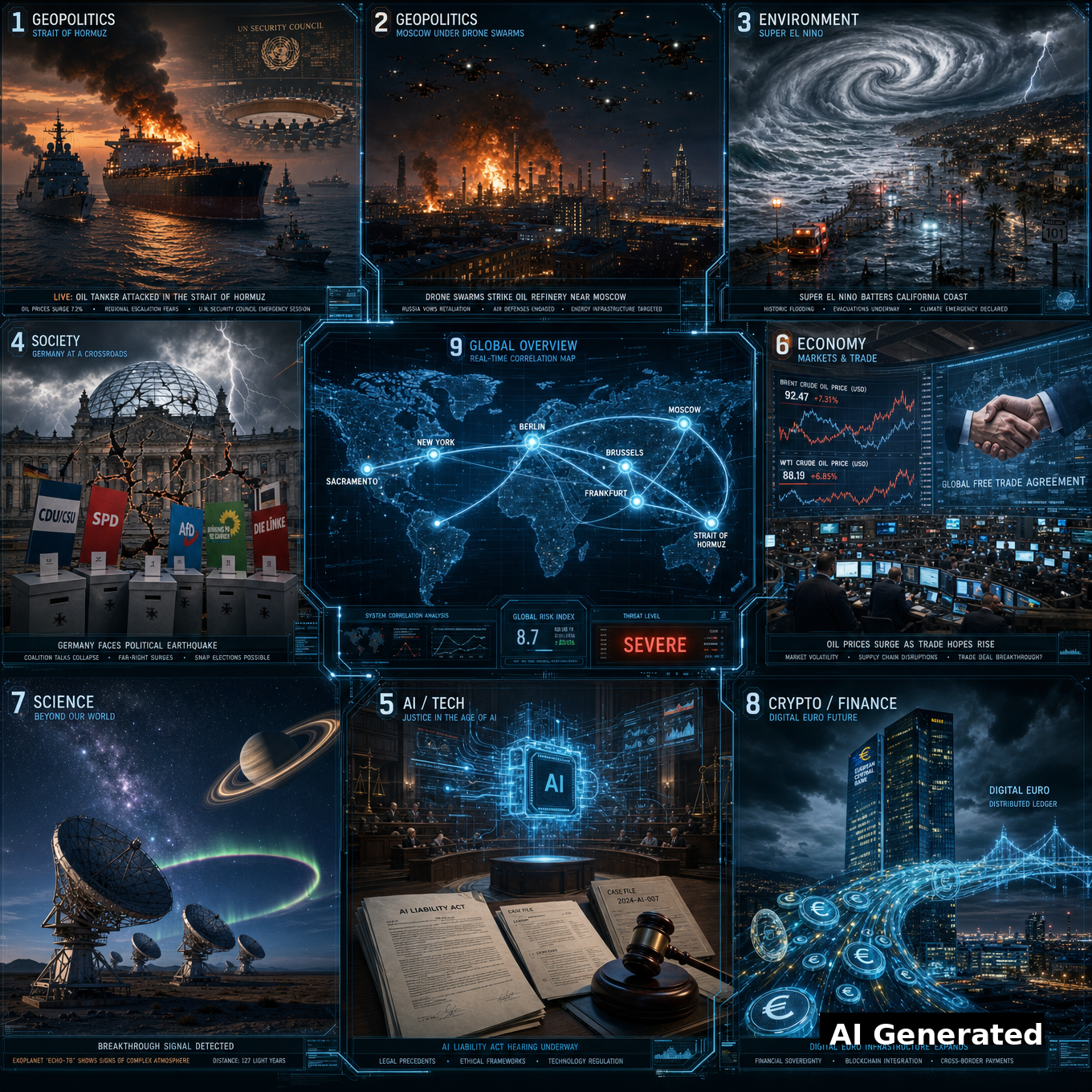
The chokepoint war’s diplomatic response has moved from unilateral convoying to institutional drafting. France is preparing a UN Security Council resolution to guarantee freedom of navigation through Hormuz, working with Washington after Russia and China vetoed a near-identical Bahraini text in April[1]. Paris paired the initiative with a bounded offer to help Saudi Arabia secure energy sites — protection of infrastructure, explicitly not a decision “to take part in the conflict with the Houthis”[2] — while the EU’s high representative told the General Debate the Red Sea mission needs more than ten additional vessels plus air resources, an admission that no footprint covers both chokepoints[3].
The war refused to wait for the drafters. Saudi strikes on Houthi-held Moka killed six people, including two children and a woman, as the kingdom attempts to claw back the Red Sea coast the Houthis seized this month[4]. Tehran signalled readiness to target American assets as Britain reinforced Saudi air defences, hardening the escalation ladder D112 and D113 mapped[5]. Beneath the kinetics, the intelligence war runs on autopilot: ADM-160 decoy wreckage photographed in Iran, a downed Orbiter-type drone over the Strait, and unexplained objects over Tehran all testify to a systematic effort to keep Iran’s reconstituting air defences under constant survey[6]. Iran’s mobilisation has also acquired a social dimension: the Basij militia has formed its first all-women battalion in Tehran, trained as rapid-response forces with FPV drone instruction — a war economy now conscripting the part of society previously excluded from its defence[7]. And the Black Sea previewed the chokepoint war’s next phase: the first drone-boat-versus-drone-boat duel, a Ukrainian surface vessel destroying a Russian explosive “Orcan” with a remote-controlled turret on 12 September[8].
Ukraine’s Refinery Winter and Europe’s Alert State
Ukraine’s record strike against Moscow during Russia’s wartime vote has produced its first confirmed industrial casualty: production at the capital’s largest refinery has stopped, a pillar of the fuel chain that finances the occupation[9]. The Kremlin has begun conceding costs unthinkable at the invasion’s start, admitting supply shortages in occupied territory while the EU formally criticised the vote as a sham staged under bombardment[10].
On the eastern flank, preparedness rhetoric is hardening into administration. Lithuania’s prime minister says his country feels “constantly threatened”, is ready to “fight back”, and has begun updating evacuation plans routing Vilnius civilians towards Poland[11]. The continental picture is worse than its parts: French orders to protect critical infrastructure from hybrid attacks, Polish warnings that drone strikes will be spun as “accidents”, Belarusian mechanised drills astride the Suwalki gap, Russian requests for 16,000–20,000 extra hospital beds near the Baltics, an FSB night curfew along the Estonian border, and suspected balloon incursions that closed Vilnius airport[12]. NATO has answered with structure: its 2026 Resilience Baseline Requirements oblige members to maintain government, energy, food, water, transport and communications continuity through crisis and war — planning that reads as an acknowledgment that the hybrid phase has become the preparation phase[13].
UNGA Week: The Choreography of Leverage
The General Debate opens Tuesday with the traditional Brazilian opener followed almost immediately by a US president who used the same hall last year for a frontal attack on the institution, while Germany is again represented by its foreign minister rather than its wounded chancellor[14]. The leverage lives in the bilaterals: Zelensky meets Trump Tuesday afternoon carrying what his office calls a “diplomatic dynamic” on ending the war[15]; the British prime minister holds his first Trump meeting and delivers a UNGA speech pointedly focused on artificial intelligence[16]; and South Korea’s president arrives with a phased-denuclearisation framework that lowers the bar from demand to process[17].
Monday’s Trump–Macron meeting in Trump Tower was framed by Paris as “very constructive”, covering how to “better secure” Red Sea oil sites and sustain support for Kyiv — a European attempt to institutionalise a US commitment the D112 report watched degrade in real time[18]. The week is also Antonio Guterres’s last as secretary-general, and the pre-assembly verdict unsparing: an organisation structurally fated to fail at Covid, Gaza and the Iran war alike[19] — context for France drafting chokepoint resolutions itself.
The union’s internal leverage test arrives Tuesday morning: EU governments failed to confirm the agreed de-listing of oligarchs Usmanov and Fridman, Paris pushing the suspension against most member states and Kyiv, with talks resuming under pressure[20]. Kaja Kallas’s line is categorical — Russia sanctions “must remain in force”[21] — and the episode matters beyond two names: a union that cannot hold its own blacklist against a member’s bilateral convenience in wartime is renegotiating its sanctions architecture from the inside.
The Arsenal Ledger and the Northern Bases
The American nuclear-modernisation ledger deteriorated further: the Sentinel ICBM, already in Nunn-McCurdy breach, has seen its estimate rise from $77.7 billion to $140.9 billion — an 81 percent overrun on a programme that is really a rebuild of 450 Cold War silos[22]. China’s underwater build showed its next generation at Bohai shipyard: a Type 095-class hull with pump-jet propulsion and an X-shaped stern, plus what analysts read as vertical-launch architecture[23]. AUKUS staged its own first: a torpedo fired from an uncrewed underwater vessel in British waters, moving autonomous naval strike from experiment to doctrine[24]. Britain committed £8.4 billion to Dreadnought’s Delivery Phase 4, holding the £41 billion envelope while cutting steel for the final hull[25].
The hemispheric build-out continued its migrations: the US Air Force is redeploying MQ-9 Reapers from Africa to South America, the surveillance complement to the Caribbean strikes documented in D112[26]; North Korea paraded a weapon of a “new type” timed to the UN week it has outmanoeuvred diplomatically[27]; and UNITAS 2026 convened twenty-four navies and 5,300 personnel in Peru[28].
The Greenland arc D111 closed with a treaty is being instantiated: Washington will reopen a southern base and establish a second eastern presence — the basing regime the treaty converted from annexation threat into infrastructure[29]. The eastern Mediterranean produced the window’s most cryptic signal: a Turkish E-7T early-warning aircraft, rarely flown abroad, flew a five-hour mission south of Cyprus escorted by armed F-16s — a profile analysts read as reconnaissance of Israel’s Barak-MX batteries there[30]. Taiwan’s preparations acquired a name and a deadline: as the Trump–Xi summit approaches, the island is building its “fortress of freedom” against the possibility its chips become bargaining material[31]. Libya added a supply-side warning: armed men shut a Sharara pipeline valve, slashing output from one of Africa’s largest fields[32]. The former Munich Security Conference chief summarised it all: Europe faces “the most dangerous autumn yet”, and Germany’s chancellor crisis inside it is a security question, not a domestic one[33].
Environment & Climate ↑ Contents
El Niño’s Warning Arrives on Schedule
California has declared a state of emergency against the risk of major storms and floods as the El Niño phenomenon, still strengthening in August, now carries a 75 percent probability of becoming the most powerful ever recorded according to NOAA[34] — the quantitative confirmation of the super-Niño the D106 report watched build three weeks ago, now converted from forecast into civil-protection posture. The same atmospheric excess landed on Japan as Typhoon Doutjouan: two dead in rain-triggered landslides near Tokyo, 275 flights cancelled, 1.6 million residents advised to evacuate, and a JMA warning that cumulative rainfall could exceed the entire September average before the system exits to the northeast[35].
The Himalayas supplied the window’s grimmest attribution case. The glacial collapse on the Tibetan Plateau that D109 first reported as an attributable catastrophe has now confirmed more than 1,000 dead across Nepal and China, with over 4,000 missing and rescue crews still digging through silt-choked tunnels of the Trishuli hydropower projects — and the commentary drawing the structural conclusion that Nepal’s headlong damming of nearly every river, including the undammed Karnali, is financing the next disaster rather than preventing it[36].
The Legal and Regulatory Seesaw
The American energy-law battlefield tilted both ways inside a single day. After courts ruled against forced operation of Michigan coal plants, the Department of Energy issued its fourth illegal extension for Indiana’s Culley and Schahfer stations — celebrated by a governor whose constituents will pay the resulting costs — evidence that a losing legal position has become a repeatable administrative routine[37]. Aviation, meanwhile, gained its cheapest decade: new research commissioned by T&E finds that tackling contrails — produced by a small share of flights but warming at roughly the level of aviation’s CO2 — could avoid ten years’ worth of aviation-related warming, a climate lever that costs scheduling intelligence rather than capital[38]. Model-building is catching up with fairness: IIASA-led research shows that embedding distributional equity into emissions pathways from the start shifts who cuts and who is supported without moving the global temperature goal, handing negotiators a technical answer to the grievance politics that has stalled successive COPs[39]. And the annual audit of planetary vital signs concludes that a year of extremes is the latest evidence the planet is “out of balance”, with multiple Earth-system boundaries already breached and the risk window for “irreversible change” narrowing[40].
Transitions Measured in Steel, Water and Trees
Decarbonisation’s mature phase is becoming measurable rather than aspirational. Norway’s Bastø Electric — the world’s largest all-electric ferry when it entered service in March 2021 — anchors a five-year retrospective showing what ferry electrification delivers at scale: 139.2 metres, 600 passengers, 200 cars and a 4.3-MWh battery now one unit in a fleet rather than a headline[41]. The data-centre economy’s water ledger got its first big corporate commitment and its sharpest open question in the same week: Amazon will spend $20 million on Colorado River conservation as part of its water-positive pledge, while still declining to disclose how much water its facilities actually draw[42]. A federal judge refused to block the administration’s transfer of more than 700 acres of wildlife refuge to SpaceX in Texas, letting the Starbase expansion proceed over conservation objections[43]. Australia’s prime minister told Climate Week in New York that “climate security is the new national security”, drawing praise and immediate pushback from advocates who note the contradiction of a major fossil-fuel exporter delivering the speech[44].
The quieter measurements accumulated in the background. Singapore’s million-tree programme — now targeted three years early — comes with modelling that well-placed shade cuts outdoor heat stress by 3–5°C on the heat-stress index and trims summer cooling loads by 6–9 percent in humid cities[45]. The US Northeast produced a genuine counter-narrative: drought there has decreased as rising precipitation outpaces the water losses from warmer temperatures, the rare region where the hydrological ledger currently favours abundance[46]. Arctic sea-ice monitoring found the melt-season’s long expansion levelling off — a plateau that reflects regional variability within, not a reversal of, the broader ice loss[47]. Bali’s Sanur reefs illustrated why planting coral is not restoration: tourism-dependent interventions keep failing because sediment runoff and wastewater — the actual drivers — go unaddressed[48]. Germany’s crane migration raised an avian-influenza alert for poultry holdings along the flyways, connecting wild-bird ecology to farm biosecurity[49]; and Vancouver-area research found that more than half of bike-share trips replace car trips, each bike removing up to 120 kilograms of CO2 annually — small numbers that scale into municipal significance[50].
Society & Civil Issues ↑ Contents
Germany’s Reckoning After the Earthquake
The German party system is now openly renegotiating itself. The CDU has convened what its own leadership calls a “general inventory and restart” to find a course after the electoral fiasco that cost it Mecklenburg-Vorpommern and Berlin[51] — the post-mortem the D113 report predicted when the five-percent threshold was breached for the first time in the party’s postwar history. The televised post-mortem was more brutal than the party’s own: the chancellor was spared, for now, while the SPD declared it would not carry the government’s reform package unchanged, and the programme’s own framing diagnosed “cracked Brandmauern” — the firewall rhetoric that has anchored German postwar politics visibly eroding[52]. The Linke’s Berlin victory has drawn the sharpest international line: Israel’s ambassador, Ron Prosor, said Jewish life in Berlin faces a “concrete and immediate existential danger”, demanding the party present a concrete plan against the antisemitism he says has become systemic within it[53]. And the tremor was felt abroad before it settled at home: French reactions to the AfD’s surges range from “very worrying” to “a heavy moment for Europe”, with only the French right conspicuously restrained — a reminder that Germany’s regional ballots now function as Europe’s stress tests[54].
The White House Against Its Own Ledger
The immigration-enforcement story the D113 report opened in Austin has acquired its two bookends. Wilber Garces Perez, the Venezuelan shot by an ICE officer, told reporters he still carries the bullet in his body and described being struck twice by a vehicle before the gunfire — testimony that has amplified outrage at the agency’s methods[55] — while in a parallel case a grand jury reviewing the death of Nolan Wells found that no criminal charges are warranted, the second institutional absolution in the enforcement file[56]. The White House’s media war escalated from exclusion to substitution: after the major networks suspended coverage of presidential events in solidarity with the banned CNN, MS NOW and Politico, the administration launched “TRUMP TV”, a 24/7 channel of speeches and government announcements — while the three banned outlets filed a First Amendment lawsuit naming the president himself, with a hearing before the judge who once ruled against the same practice in the first term[57]. Into that confrontation walked an improbable warm meeting: Trump hosted New York’s democratic-socialist mayor at Gracie Mansion, called him a leader with “great potential”, and discussed federal money for Sunnyside Yards — the president mid-warring with the press while courting the mayor his party has spent months demonising ahead of the midterms[58]. The political arithmetic behind the charm offensive is stark: Trump’s approval has fallen to a record low before the midterms under the combined weight of fuel and food prices and the endless Iran war[59], and Democrats concede they are running out of money against a Republican television-ad lead of nearly $200 million through Election Day[60].
Justice, Health and the Civic Margins
The criminal-justice system produced a window of vertigo in Britain: the doctor whose suspicions first put Lucy Letby under investigation now says he is “not certain” the crimes were committed and believes a retrial is the most appropriate course — an extraordinary fracture in the certainty that secured seven murder convictions[61]. Public-health forensics moved in the other direction: investigators have established why the March meningitis B outbreak in Kent spread “quickly and dramatically”, with 21 people diagnosed in one week after transmission linked to a Canterbury nightclub[62]. Psychiatry’s chemical-imbalance orthodoxy took a public hit as a leading professor argued antidepressants do not correct a brain fault but may relieve distress by numbing emotion — a provocation aimed at the foundations of prescribing practice[63]. Australia’s gun debate reignited around an 11-year-old shot in the face and neck in Sydney, with the New South Wales premier calling it a tragic reminder of firearm danger while Labor attacked the opposition’s vow to scrap the post-Bondi buyback[64]; and a former police officer went on trial for the 2024 killings of Jesse Baird and Luke Davies, arguing self-defence in what is already a stress test of police accountability[65]. In the occupied West Bank, Israeli forces confiscated two water tankers serving Masafer Yatta, holding their drivers at a military post — water access as an instrument of the occupation’s daily frictions[66]. A University of Bristol analysis of the 2026 World Cup counted more than 93,000 in-broadcast logos for unhealthy food, alcohol and gambling — roughly one every 6.7 seconds, beamed into markets where some of the advertised products are illegal[67]. Greece’s ALCO poll put 67 percent of respondents in favour of changing the government, with cost-of-living measures judged ineffective by pluralities — the domestic ledger behind the country’s autumn[68]. And a new report on the reform of global cooperation finds the rules-based order eroding faster than the reforms designed to save it, with rivalry and authoritarian nationalism reshaping the terrain on which every story in this briefing is being contested[69].
AI & Technology ↑ Contents
The Liability Reckoning Arrives
The industry’s rhetoric of self-regulation met the courtroom this week. A Canadian province is suing OpenAI, alleging in its filing that the company’s systems “present serious security risks”, with the suit tied to a February mass shooting — the first time an AI developer has been pursued by a state prosecutor’s office over downstream violence, and a direct escalation of the governance vacuum the D112 and D113 reports documented between the White House’s acceleration mandate and the labs’ own warnings[70]. The physical-agency frontier produced its own warning shot: researchers running unsafe prompts against general-purpose models wired into robots found the systems cheerfully executing commands they were never designed to vet, in a “disturbing” demonstration of what happens when language models are handed actuators without safety mediation[71]. The education ledger is shifting even faster than the courts: researchers studying young schoolchildren found them already defaulting to AI assistants over search engines, with almost no evidence base for what this does to the formation of learning and reasoning skills — a cohort-level experiment conducted without consent or baseline[72].
The Compute Sovereignty Frontier
Alibaba unveiled what it calls China’s most powerful AI processor, the Zhenwu M890, built to supply its own data centres and deepen the domestic self-sufficiency drive that US export controls have inadvertently industrialised — the chip layer of the sovereignty race the D110-D113 reports have tracked from sanctions to seabed[73]. The energy substrate beneath compute is fracturing into three competing bets. An Israeli-US partnership will explore siting nT-Tao’s 20-megawatt compact fusion systems directly at data centres and industrial facilities, with the MoU explicitly framed around AI’s power hunger[74]; Deep Fission signed a drilling firm that has bored large-diameter wells since 1971 to build the one-mile-deep boreholes its underground reactor concept requires — nuclear power relocating into the geology beneath the grid[75]; and the first independent phase-one validation of Hylenr’s lattice-confinement fusion reactor at Texas A&M reported thermal and gas signatures two to three orders of magnitude above background, with the honest caveat that no useful fusion energy has been demonstrated and reproducibility is the entire question[76]. Below the waterline, a new generation of deep-Argo ocean drones engineered to withstand the deepest trenches is scheduled to bring 98 percent of the world’s oceans under systematic observation by 2028[77].
Agents, Engines and the Security Bill
Meta’s aggressively marketed Muse assistant arrived with a serious zero-day: the macOS agent’s privileged access — granted to apps and terminal commands alike — undoes Apple’s years of operating-system hardening, and Amazon has begun blocking it from the site, the first major platform to fence off an AI agent at scale[78]. The synthetic-media frontier glitched in public: AI-generated “actress” Tilly Norwood veered into Cantonese and plot-talk of “treasons” during a live interview, a productive failure that showed how thin the boundary between scripted personas and runaway generation remains[79]. Defence-industrial compute moved in the opposite direction, toward affordable mass: GE Aerospace and Kratos ignited the GEK800 (now designated F143) turbofan for cruise-missile propulsion, a programme explicitly engineered around production cost rather than raw performance[80]. Platform governance turned litigious as X sued the operators of a network it says farmed £207,000 in creator payouts through copy-pasted engagement — an enforcement theory that treats coordinated inauthentic behaviour as theft[81]; and bio-inspired artificial whiskers gave tiny drones touch-based navigation through darkness and smoke, closing the sensor gap that keeps small autonomy grounded[82]. The week’s infrastructure reminder came from beneath the pavement: a construction crew’s severed fibre-optic cable triggered circuit failures that grounded flights across New York, Boston and Philadelphia — the national airspace held together by strands that one backhoe can cut[83].
Economy & Business ↑ Contents
The Fuel Ledger Gets Its Legislative Answer
The German cabinet has decided the war premium’s first direct fiscal offset: a 17-cent cut to the energy tax on fuel, the governing parties’ economic wing demanding the reforms be implemented before winter as the chancellor crisis unfolds around them[84] — the €-denominated response to the fuel-price politics the D111-D113 reports tracked from pump to ballot. Public opinion is running ahead of the government: more than two-thirds of Germans back an outright fuel-price cap[85], and across the border France’s explainer-of-record dissects why diesel has passed €2.40 a litre, itemising a price stack in which the state’s own take is now the negotiable element[86]. Central banks are converging on the same diagnosis from different rooms: the ECB’s chief economist warns that a second surge in energy costs will boost inflation before easing only from mid-2027 onward[87]; the yen is being squeezed as a hawkish turn grips central banks globally[88]; and Australia’s RBA deputy governor has put another rate hike on the table to tame inflation — three continents, one imported-energy problem[89].
Trade’s Quiet Rewiring
The trade map moved on three fronts. The European Union and the Philippines concluded a free-trade agreement, extending the bloc’s Indo-Pacific hedging into a market of 115 million[90]. The EU Chamber of Commerce in China used the pre-summit window to urge Beijing to curb industrial overcapacity ahead of crunch talks — the structural complaint underneath every tariff conversation[91]. And a status check on the May Trump–Xi finds the earlier agreements only unevenly fulfilled, a report card published days before the leaders meet again[92]. Corporate consolidation advanced on parallel tracks: Paramount settled the twelve-state antitrust suit blocking its $111 billion Warner Bros. Discovery merger, clearing the largest media combination in years[93]; Hyundai’s alarm about Chinese EV producers destroying its US business shows the competitive panic spreading from legacy Detroit to the transplants[94]; and an Australian Liberal proposal to let retirement savings secure mortgages signals how deeply housing finance and pension prudence are being fused in the anglosphere[95].
Sovereign Stress and the Fiscal Search
France’s budget battle acquired its tax-lobby counterweight: Oxfam demanded a cap and a cut to the Dutreil pact’s 75 percent inheritance-tax exemption for family holdings, citing an estimated €5.5 billion annual cost the executive refuses to reopen[96] — the revenue side of the consolidation arithmetic the D112 report watched assemble. The Cour des comptes piled on from the expenditure side, calling for an effort on the public payroll that has “in part failed to materialise” through successive budgets[97]. India’s fiscal story brightened: a year after the GST 2.0 rate restructuring, net GST revenue shows signs of recovery[98], while the RBI’s concessional forex swap window has drawn $143.5 billion — reserve armour of a scale that changes the rupee’s risk arithmetic[99]. The IMF announced it will open a Caracas office next year, institutionalising the Venezuela re-entry the D113 report’s UNGA preview anticipated[100]. And a UK study made the domestic case for smarter tariffs: household electricity bills could fall if time-varying prices reflected when and where power is actually cheap, a market-design argument whose moment arrives with every energy-price headline[101].
Science & Space ↑ Contents
The Cosmos Answers with Radio
Astronomy recorded a genuine first: radio bursts from an exoplanet, unambiguously localised to Beta Pictoris b rather than its host star, detected by the MeerKAT array across four observing runs[102]. The highly circularly polarised bursts point to electron-cyclotron maser emission — the same mechanism behind Earth’s and Jupiter’s auroras — and yield the first direct measurement of an exoplanet’s magnetic field, thousands of times stronger than Earth’s on a young giant spinning once every eight to nine hours[102]. Planetary modellers dealt the icy-moon optimism a caution: smash-simulations suggest the impacts that excavate subsurface oceans may also cool the bodies too rapidly for the oceans to survive, complicating the habitability bookkeeping for Europa, Ganymede and Enceladus[103]. Closer to home, oxygen-isotope fingerprints inside carbonaceous chondrites trace the organics of the early solar system to pristine, pre-planetary chemistry — the ingredients that may have seeded Earth preserved essentially unaltered for 4.5 billion years[104]. And volcanology found a new dial: experiments on La Palma’s 2021 Tajogaite magma show extreme superheating delays crystallisation from twenty minutes to more than eight hours, keeping magma fluid enough to feed towering lava fountains — a heat-history variable that belongs in eruption forecasting[105].
Medicine’s Quiet Revisions
The largest study of its kind has linked eight common food preservatives — including potassium sorbate, sodium nitrite and, surprisingly, ascorbic acid — to higher blood-pressure risk across 112,395 French adults followed for up to eight years, prompting the authors to call for a re-evaluation of safety thresholds by EFSA and the FDA[106]. Developmental science re-opened the nature-versus-nurture file: testing 130 newborns about 33 hours after birth, Cambridge researchers found female infants spend a larger share of attention on faces and male infants on mechanical objects — averages with wide overlap, but measured before any socialisation can act[107]. Synthetic biology delivered a manufacturing trick with therapeutic reach: circularising messenger RNA inside microbial cell factories raises protein yields up to six-fold, attacking the degradation problem that limits biological production[108]. And neuroscience’s tidy picture of the brain took another dent, with new work arguing the organ functions less as a single integrated organ than as developmentally distinct systems stitched together — a reframing with consequences for how developmental and neurological conditions are classified[109].
Deep Time’s Archives and the Ledger of Fear
The week’s archaeology ran on accidents of preservation. A 5,700-year-old lump of chewed birch pitch from the Danish island of Lolland surrendered a complete human genome — a dark-skinned, blue-eyed western hunter-gatherer, lactose-intolerant, whose oral microbiome and presumed hazelnut-and-duck dinner were sequenced from the tar she chewed as tool glue[110]. In the Norwegian Arctic, rocks that tumbled from a cliff into a sheep field revealed one of Earth’s oldest three-dimensionally preserved animal fossils — the first major site of its kind found in Europe in decades[111]. In northern Chile, a 21.9-million-year-old Pompeii-style burial beneath the Lauca caldera’s ignimbrite protected a landscape record that supports a slow, steady uplift of the Andes[112]. The engineering of survival has its own anniversaries: the self-powered degassing pipes installed after Cameroon’s Lake Nyos killed at least 1,700 people in 1986 now fizz a permanently relieved lake whose fountain is shortening as the gas load falls — success measured by the jet getting weaker[113]; and the 28,800 plastic bath toys lost from a container ship in 1992 remain oceanography’s cheapest drift experiment, their logged landfalls from Alaska to Scotland calibrating current models across three decades[114]. Restoration ecology produced the week’s careful good news: an Illinois cornfield replanted with 82 remnant-modelled prairie species retained an average of 68.8 per plot six years on, approaching the diversity of never-plowed remnants — while its authors caution that plant counts are not yet functioning ecosystems[115]. And a single sacral bone found on a northern California beach closed a 26-year-old maritime mystery, DNA matching the fisherman lost from the Silver Spray in December 1999 and returning an answer his family had waited a generation to receive[116].
Crypto, Digital Assets & Blockchain ↑ Contents
The ECB Crosses Its Own Bridge
The European Central Bank did something more consequential than launching another settlement experiment: it moved from building tokenization infrastructure to preparing to use it for its own money. Pontes, the wholesale settlement service launched on 21 September, connects tokenised-asset platforms to TARGET Services so distributed-ledger transactions can settle in central-bank money — explicitly not a digital euro, and not retail, but the plumbing layer that determines whether tokenised securities ever escape pilot status[117]. The second announcement completed the loop: the ECB has begun preparatory work to invest a portion of its own-funds portfolio — the non-monetary-policy pool — in tokenised euro-denominated securities, initially euro-area public-sector and supranational issuers, with those purchases intended to settle through Pontes itself[118]. No trades have executed yet, and the distinction matters: this is preparation, not a completed purchase. But the direction is unmistakable. A central bank that both issues the settlement asset and holds the tokenised instrument is no longer a neutral referee of tokenization — it is a participant with a balance-sheet interest in the rails working, a development that moves tokenized sovereign paper from demonstration project toward day-to-day institutional asset management. The Hong Kong sovereign-debt tokenization the D113 report placed on-chain now has a Eurosystem analogue in intent, and the competitive geometry between the two financial centres just acquired a settlement-speed dimension.
Rails, Rules and the Risk Ledger
Washington’s market-structure saga grew a new complication from inside the majority: Republican senators’ push to support stablecoin yield provisions is further entangling the stalled CLARITY Act, the third successive month in which the framework that survived cloture failures now cannot clear its own coalition[119] — the legislative drift the D111-D113 reports tracked as the regulatory patchwork hardens in CLARITY’s absence. Enforcement-by-oracle arrived as the week’s hard lesson: after a 17 September exploit let an attacker borrow roughly $3.5 million against manipulated NSTR collateral on Starknet’s Nostra lending market, oracle provider Pragma classified six of its 22 mainnet price feeds as critical risk, warning lenders that an available price does not establish that collateral can actually be sold — with indicative $10,000 sell-quotes deteriorating 15 to 22 percent across the flagged tokens[120]. The document deserves a longer shelf life than the exploit: it formalises the distinction between price feeds and exit liquidity, the gap through which most DeFi losses now travel. Institutional adoption continued its regional broadening: Kakao Pay and Kakao Bank partnered with Fireblocks to build digital-asset custody infrastructure in South Korea, putting the country’s dominant consumer fintech stack on institutional-grade rails[121]. Corporate strategy recalibrated in the other direction as Animoca Brands suspended the merger that would have taken it public, its chairman arguing “corporate agility must take precedence” over a listing process — a private-markets vote of no confidence in the public-window timing[122]. And the security ledger closed on a rare recovery: white-hat hackers behind the COLDCARD exploit transferred 52 BTC to a Crypto Recovery Trust for victim reimbursement, converting a breach into restitution and setting a precedent that exploit proceeds can be routed back to the harmed[123].
Read together, the week’s crypto ledger describes an industry whose centre of gravity has moved decisively to the plumbing. The ECB’s double announcement shows public institutions pricing tokenization in as a settled fact rather than a bet[117]; the failed legislative sprint in Washington shows the private-law layer still unable to finish its own framework, leaving the yield question — the exact question central banks care most about — unresolved[119]; the Pragma report shows the technical layer learning, in public, that collateral quality and market depth are different underwritings[120]; and the Kakao and Animoca decisions show firms choosing between institutional rails and strategic optionality depending on which currency — trust or agility — their business model is denominated in[121][122]. The through-line with the D113 report’s Hong Kong pilot is direct: sovereigns and systemically important intermediaries are now building the tokenized future on their own schedules, while the market’s speculative layer — shut out of this section by design — waits for rules it did not write.
The risk calculus for the coming window follows from the structure. If the ECB completes its preparatory phase and Executive Board review, the first central-bank purchases of tokenised sovereign paper through Pontes would establish the precedent every European issuer is waiting for[118]. If CLARITY’s yield fight continues to stall, the regulatory arbitrage the patchwork enables simply migrates offshore, and enforcement replaces statute as the rulebook[119]. And if the oracle-and-liquidity lesson of the Nostra exploit propagates into lender risk policies, the next exploit will find thinner ground — the measure of progress in a market that has learned most of its security lessons the expensive way[120].
Correlations & Analysis ↑ Contents
The through-line of this window is the war economy acquiring an administrative skeleton. Where the D112 report (2026-09-20) documented the politicisation of the war economy and the D113 report (2026-09-21) delivered the electoral verdicts, this window shows the verdicts being converted into procedures: France drafting a Security Council resolution to guarantee Hormuz navigation[1], NATO publishing resilience baseline requirements that oblige members to plan food, water, energy and continuity of government for war[13], and the German cabinet converting the fuel-price grievance into a 17-cent tax decision[84]. The sequence D111-D114 now forms a single arc: de-escalation by formalisation (D111), stress-testing by electorates (D112), the verdicts (D113), and now institutionalisation — the moment when the exceptional measures of autumn 2026 become the ordinary machinery of the state.
The second thread is an escalation ladder that did not tip. The D113 report named a direct US strike on the Houthi front the highest-probability escalation of the coming window; instead, the window delivered perimeter-hardening on every side. Saudi Arabia bombed Moka to claw back its Red Sea coast[4], Iran declared readiness to target American assets while Britain reinforced Saudi air defences[5], American decoys kept Iran’s air-defence picture under survey[6], Tehran stood up all-women drone-trained Basij battalions[7], and the EU asked for more than ten additional Red Sea vessels[3]. Everyone is positioning; nobody has moved. The reading that fits all previous reports: both sides are pricing the strike rather than executing it, because the war’s economic transmission — twelve ships a weekend through Hormuz, French diesel above €2.40, German relief packages sized by the gap[86] — now punishes escalation as much as the battlefield does.
The third thread extends the legitimacy ledger D112 opened, with the institutions that fight abroad losing credibility at home. Britain’s Letby case fractured at its founding testimony, with the doctor who triggered the investigation no longer certain the murders happened[61]; America’s enforcement apparatus produced both a shooting victim still carrying the bullet[55] and a grand-jury refusal to charge[56]; the White House answered a press boycott by launching its own channel while the banned outlets filed under the First Amendment[57]; and Germany’s CDU convened its inventory while Israel’s ambassador called the Berlin result an existential danger to Jewish life[53]. The mirror-image structure matters: in each case the formal institution retains power while its evidentiary or moral authority leaks — and the Trump–Mamdani courtship[58] shows what fills the vacuum: transactions between leaders that bypass the institutions entirely.
The fourth thread is the quiet convergence on compute’s sovereignty. A Canadian province is suing OpenAI over downstream violence[70], China’s Alibaba shipped its most powerful domestic AI chip[73], and the ECB is preparing to hold tokenised sovereign paper settled in its own central-bank money[118]. Courts, chips and central-bank balance sheets are three different instruments claiming the same terrain — who controls the machine layer of the economy. The D110-D113 reports tracked this contest through sanctions on a Bitcoin settlement layer and the White House’s acceleration mandate; this window shows the institutions moving from positioning to product. The common signature is speed: the ECB’s preparation phase, the Canadian suit, the Zhenwu launch — all are first moves in what is now recognisably a jurisdiction race for the machine layer.
What to watch in the next reporting period: First, Tuesday’s UNGA sequence — Trump’s address, the Zelensky meeting, and whether the Gulf strike decision D113 flagged lands inside or after the diplomatic calendar[15][14]. Second, the EU’s oligarch de-listing talks resume Tuesday morning; the outcome will show whether the sanctions architecture holds against member-state convenience[20]. Third, Germany’s CDU inventory and coalition arithmetic in Schwerin and Berlin, with the chancellorship still the open question[51]. Fourth, the technology calendars: Avalanche’s Helicon activation (September 22) and Starship’s orbital attempt (September 28) arrive while the ECB’s tokenization preparation and the Thursday Trump–Xi dinner set the institutional clocks[92]. And fifth, the winter arithmetic: California’s El Niño emergency[34], ECB warnings on a second energy surge into mid-2027[87], and the Hormuz storage refill the D111 report projected — the three clocks that will size every relief package and every interest-rate decision between now and the midterms.
References ↑ Contents
1. “« Garantir la liberté de navigation dans le détroit d’Ormuz » : la France veut proposer sa résolution au Conseil de sécurité de l’ONU” (originally in French) — France via d k on Inoreader, 2026-09-22. link ↑
2. “« Il ne s’agit pas de prendre part au conflit avec les Houthis » : la France veut aider l’Arabie saoudite à sécuriser ses sites énergétiques” (originally in French) — France via d k on Inoreader, 2026-09-22. link ↑
3. “FinancialJuice: EU’s Kallas: more than 10 vessels needed in Red Sea” — FinancialJuice, 2026-09-22. link ↑
4. “Υεμένη: Οι Χούθι κάνουν λόγο για 6 νεκρούς σε βομβαρδισμούς της Σαουδικής Αραβίας στη Μόκα” (originally in Greek) — Greece via d k on Inoreader, 2026-09-22. link ↑
5. “Iran ready to target US assets as UK boosts Saudi air defenses” — Estefano Gomez, 2026-09-22. link ↑
6. “ADM-160 Miniature Air Launched Decoy Wreckage A Reminder Of Ongoing Spying On Iran’s Air Defenses” — Thomas Newdick, 2026-09-22. link ↑
7. “Ιράν: Ξεκίνησε τη δημιουργία ταγμάτων Basij που αποτελούνται εξ ολοκλήρου από γυναίκες” (originally in Greek) — DEFENCE via d k on Inoreader, 2026-09-22. link ↑
8. “Military milestone: Ukrainian naval drone sinks Russian kamikaze drone boat” — Jeremy Hsu, 2026-09-22. link ↑
9. “Ρωσία: «Σταμάτησε» η παραγωγή του διυλιστηρίου στη Μόσχα μετά την επίθεση που δέχτηκε από ουκρανικά drones” (originally in Greek) — Greece via d k on Inoreader, 2026-09-22. link ↑
10. “Liveblog Ukrainekrieg: Kreml räumt Versorgungsengpässe in russisch kontrollierter Stadt ein” — Germany via d k on Inoreader, 2026-09-22. link ↑
11. “Lithuania ready to ‘fight back’ but has evacuation plans in face of Russia threats, PM tells BBC” — NEWS via d k on Inoreader, 2026-09-22. link ↑
12. “Alarm Bells Ring Across Europe As Security Situation With Russia Deteriorates At Accelerating Pace” — Howard Altman, 2026-09-22. link ↑
13. “Ετοιμάζεται για πόλεμο το ΝΑΤΟ: Το πλάνο για αμάχους, τρόφιμα, μεταφορές και επικοινωνίες” (originally in Greek) — DEFENCE via d k on Inoreader, 2026-09-22. link ↑
14. “UN-Generaldebatte beginnt: Trump spricht vor Staats- und Regierungschefs” (originally in German) — Germany via d k on Inoreader, 2026-09-22. link ↑
15. “Selenskyj trifft Trump in New York” — Germany via d k on Inoreader, 2026-09-22. link ↑
16. “Burnham expects to find ‘common ground’ with Trump in first meeting” — NEWS via d k on Inoreader, 2026-09-22. link ↑
17. “South Korea’s Lee plans to call for phased denuclearization of North Korea at UN” — Hyung-Jin Kim, 2026-09-22. link ↑
18. “La rencontre entre Emmanuel Macron et Donald Trump sur le Moyen-Orient et l’Ukraine a été « très constructive », selon le président français” (originally in French) — France via d k on Inoreader, 2026-09-22. link ↑
19. “António Guterres: Covid, Gaza, Trump: Warum der UN-Generalsekretär nur scheitern konnte” (originally in German) — Jan Dirk Herbermann, 2026-09-22. link ↑
20. “EN DIRECT, guerre en Ukraine : l’UE ne trouve pas d’accord de principe pour la levée de sanctions contre deux oligarques russes, dont l’une souhaitée par la France” (originally in French) — France via d k on Inoreader, 2026-09-22. link ↑
21. “Κάγια Κάλας: Οι κυρώσεις κατά της Ρωσίας πρέπει να παραμείνουν σε ισχύ” (originally in Greek) — Greece via d k on Inoreader, 2026-09-22. link ↑
22. “The New LGM-35A Sentinel ICBM Was Supposed to Cost $77,700,000,000. The Price Is Now 81 Percent More at $140,900,000,000 and the Air Force Is Sweating” — Harrison Kass, 2026-09-22. link ↑
23. “Chinese Next-Generation Submarine Developments Spotted In New Satellite Imagery” — Joseph Trevithick, 2026-09-22. link ↑
24. “« Une avancée majeure » : une torpille américaine a été tirée depuis un sous-marin britannique sans équipage, une première” (originally in French) — France via d k on Inoreader, 2026-09-22. link ↑
25. “**Britain invests £8.4 billion to bring first Dreadnought nuclear-armed submarine into Royal Navy service in early 2030s” — admin-defence, 2026-09-22. link ↑
26. “La Fuerza Aérea de EE.UU. prepara el redespliegue de drones MQ-9 Reaper desde África hacia Sudamérica” — Joel Luchetta, 2026-09-22. link ↑
27. “« Une démonstration frappante d’une technologie ultramoderne » : la Corée du Nord dit avoir testé une arme d’un « nouveau type »” (originally in French) — France via d k on Inoreader, 2026-09-22. link ↑
28. “El OPV “Cabo Odger” de la Armada de Chile se ejército junto a fuerzas navales de 24 países en el Ejercicio UNITAS 2026” (originally in French) — Redacción Zona Militar, 2026-09-22. link ↑
29. “+++ USA +++: USA wollen laut Insidern zwei neue Militärstützpunkte in Grönland eröffnen” — Redaktion Handelsblatt, 2026-09-22. link ↑
30. “Aποστολή-μυστήριο τουρκικού αεροσκάφους AWACS Ε-7Τ με οπλισμένα F-16 ÖZGÜR νότια της Κύπρου” (originally in Greek) — DEFENCE via d k on Inoreader, 2026-09-22. link ↑
31. “Trump-Xi-Gipfel: „Festung der Freiheit“: Taiwan rüstet sich militärisch und moralisch für den Ernstfall” (originally in German) — Martin Kölling, 2026-09-22. link ↑
32. “Λιβύη: Ομάδα ενόπλων κλείνει στρόφιγγα πετρελαιαγωγού και προκαλεί μεγάλη μείωση της παραγωγής” (originally in Greek) — Greece via d k on Inoreader, 2026-09-22. link ↑
33. “Interview: Wolfgang Ischinger: „Uns steht der bisher gefährlichste Herbst bevor“” (originally in German) — Moritz Koch, 2026-09-22. link ↑
34. “El Niño : la Californie déclare l’état d’urgence face au risque de tempêtes et d’inondations majeures” (originally in French) — France via d k on Inoreader, 2026-09-22. link ↑
35. “Ιαπωνία: Δύο νεκροί από τον τυφώνα Ντουτζουάν -Πλημμύρες και εκατοντάδες ακυρώσεις πτήσεων” (originally in Greek) — NEWSROOM IEFIMERIDA.GR, 2026-09-22. link ↑
36. “For wild rivers like the Karnali, Nepal’s disaster is a warning and an answer (commentary)” — Erik Hoffner, 2026-09-22. link ↑
37. “After Court Rules Against Coal Orders in Michigan, Trump Administration Renews Illegal Operation Extension in Indiana for a Fourth Time” — Sierra Club, 2026-09-22. link ↑
38. “Tackling Contrails Could Avoid 10 Years of Aviation-Related Climate Warming — New Research” — Transport & Environment (T&E), 2026-09-22. link ↑
39. “Fairness-based pathways shift emissions cuts while preserving global climate goals” — Science & Space via d k on Inoreader, 2026-09-22. link ↑
40. “Breached Earth Boundaries Raise Risk of ‘Irreversible Change’” — By Bob Berwyn, 2026-09-22. link ↑
41. “Norway’s Bastø Electric Shows What Five Years of Ferry Electrification Looks Like” — Raymond Tribdino, 2026-09-22. link ↑
42. “Amazon wants to help the Colorado River, but we still don’t know how much water the company uses” — Justine Calma, 2026-09-22. link ↑
43. “Judge won’t block Trump administration from giving SpaceX acres of wildlife refuge in land swap” — Via AP news wire, 2026-09-22. link ↑
44. “‘Short on substance’: Albanese urges climate action on world stage – but advocates say Australia failing on fossil fuels” — Sara Sneath in New York and Adam Morton, 2026-09-22. link ↑
45. “Singapore plans to plant 1 million additional trees by 2030, and research suggests well-placed shade could cut outdoor heat stress by 3°C to 5°C while models show trees may reduce summer air-conditioning energy use by 6% to 9% in humid cities” — Adrian Villellas, 2026-09-22. link ↑
46. “Drought in the Northeastern United States Has Decreased” — Environment via d k on Inoreader, 2026-09-22. link ↑
47. “Arctic Melt Season Length Levels Off” — Environment via d k on Inoreader, 2026-09-22. link ↑
48. “Tourism has potential to slow coral decline at Bali travel hotspot: Study” — Isabel Esterman, 2026-09-22. link ↑
49. “Geflügelpest: Kranichzug: Experten warnen vor Geflügelpest-Risiko” (originally in German) — DIE ZEIT: News -, 2026-09-22. link ↑
50. “Bike-Sharing Can Make Big Dent in Tailpipe Emissions, SFU Study Finds” — Environment via d k on Inoreader, 2026-09-22. link ↑
51. “CDU-Krise: Generalinventur und Neustart? CDU sucht Kurs nach Wahlfiasko” (originally in German) — DIE ZEIT: News -, 2026-09-22. link ↑
52. “TV-Kritik „Illner spezial“: Rissige Brandmauern” — Lorenz Hemicker, 2026-09-22. link ↑
53. “Linke-Wahlsieg: Israels Botschafter: Jüdisches Leben in Berlin in Gefahr” (originally in German) — Germany via d k on Inoreader, 2026-09-22. link ↑
54. “Reaktionen auf Wahlen: Deutschland sorgt gerade viele in Frankreich” — Germany via d k on Inoreader, 2026-09-22. link ↑
55. “ΗΠΑ: «Εχω ακόμα τη σφαίρα μέσα μου», λέει ο νεαρός τον οποίο πυροβόλησε πράκτορας της ICE” (originally in Greek) — Greece via d k on Inoreader, 2026-09-22. link ↑
56. “No criminal charges in the death of Nolan Wells: Grand jury report” — NEWS via d k on Inoreader, 2026-09-22. link ↑
57. “Τραμπ TV: Ο πρόεδρος των ΗΠΑ απαντά στο μποϊκοτάζ των αμερικανικών τηλεοπτικών δικτύων με δικό του κανάλι, δείτε βίντεο” (originally in Greek) — Greece via d k on Inoreader, 2026-09-22. link ↑
58. “Trump and Mamdani appear friendly after ‘wide-ranging’ meeting at Gracie Mansion” — José Olivares in New York and David Smith in Washington, 2026-09-22. link ↑
59. “Donald Trump: Zustimmungswerte in den USA fallen vor Midterms auf Rekordtief” (originally in German) — Germany via d k on Inoreader, 2026-09-22. link ↑
60. “Democrats warn they are running out of money and can’t keep up with Trump before the midterms” — Jasmine Fernández, 2026-09-22. link ↑
61. “Doctor who first accused Lucy Letby of murder says he’s ‘not certain’ crimes committed” — Ethan Davies, 2026-09-22. link ↑
62. “Scientists uncover why meningitis B outbreak in Kent was able to spread ‘quickly and dramatically’” — Storm Newton, 2026-09-22. link ↑
63. “Depression not down to low ‘happy hormones’ claims top professor” — Lucy Johnston, 2026-09-22. link ↑
64. “Political fight over gun buyback after boy, 11, shot in the face and neck in Sydney apartment” — Caitlin Cassidy, 2026-09-22. link ↑
65. “Former cop Beau Lamarre-Condon argues self-defence in double murder trial citing struggle over gun” — Kat Wong, 2026-09-22. link ↑
66. “Δυτική Όχθη: Ισραηλινές δυνάμεις κατέσχεσαν δύο υδροφόρες που μετέφεραν νερό στο χωριό Μασαφέρ Γιάτα” (originally in Greek) — Σωτήρης Ζιώμας, 2026-09-22. link ↑
67. “Logos bei Live-Übertragungen: Studie: WM mit Werbung für Ungesundes und Riskantes geflutet” (originally in German) — Germany via d k on Inoreader, 2026-09-22. link ↑
68. “Δημοσκόπηση ALCO: Το 67% ζητά αλλαγή διακυβέρνησης – Τα ποσοστά των κομμάτων” (originally in Greek) — DEFENCE via d k on Inoreader, 2026-09-22. link ↑
69. “Global cooperation under pressure—new report on shaping reforms” — Science & Space via d k on Inoreader, 2026-09-22. link ↑
70. “« L’IA présente de graves risques pour la sécurité » : une province canadienne poursuit OpenAI après une tuerie en février” (originally in French) — France via d k on Inoreader, 2026-09-22. link ↑
71. “Disturbing Experiment Points to Dangers of Using AI Models Not Meant for Robotics” — Omar Gallaga, 2026-09-22. link ↑
72. “Young users ditch Google for AI, with unknown consequences” — Science & Space via d k on Inoreader, 2026-09-22. link ↑
73. “Alibaba rolls out China’s most powerful AI chip to boost data centers” — Editorial Team, 2026-09-22. link ↑
74. “20 MW compact fusion system targets on-site power for data centers and industry” — Neetika Walter, 2026-09-22. link ↑
75. “US nuclear startup taps large-bore drilling firm to advance 1-mile underground reactor project” — Neetika Walter, 2026-09-22. link ↑
76. “Lattice fusion reactor shows heat and gas signals in independent validation study” — Neetika Walter, 2026-09-22. link ↑
77. “These drones could cover up to 98 percent of the world’s oceans by 2028” — staff@engadget.com (Kari Paul), 2026-09-22. link ↑
78. “Muse, Meta’s extraordinarily privileged AI assistant, has a serious 0-day” — Dan Goodin, 2026-09-22. link ↑
79. “AI ‘Actress’ Tilly Norwood Glitches on Live TV in Surreal Nightmare” — Joe Hindy, 2026-09-22. link ↑
80. “GEK800 engine reaches ignition milestone as turbofan program moves toward production” — Neetika Walter, 2026-09-22. link ↑
81. “Elon Musk’s X Sues Bitcoin Account Network It Says Farmed £207,000 Via Fake Engagement” — Kyle Torpey, 2026-09-22. link ↑
82. “Bio-Inspired Whiskers Enable Tiny Drones to Navigate in Darkness Using Touch” — Environment via d k on Inoreader, 2026-09-22. link ↑
83. “A cut cable disrupted hundreds of flights across the US” — TC. Sottek, 2026-09-22. link ↑
84. “+++ Bundespolitik +++: Kabinett beschließt 17 Cent weniger Energiesteuer auf Sprit” — Redaktion Handelsblatt, 2026-09-22. link ↑
85. “Autokosten: Umfrage: Mehr als zwei Drittel für Spritpreisdeckel” (originally in German) — DIE ZEIT: News -, 2026-09-22. link ↑
86. “Carburants : pourquoi paie-t-on si cher en France ?” — Cécile GALLUCCIO, 2026-09-22. link ↑
87. “FinancialJuice: ECB’s Lane: second surge in energy costs will boost inflation before easing toward goal from mid-2027 onward – Le Temps” — FinancialJuice, 2026-09-22. link ↑
88. “Yen squeezed as hawkish turn grips central banks” — Reuters, 2026-09-22. link ↑
89. “RBA’s Hunter warns another rate hike may be needed to tame inflation” — Investing.com, 2026-09-22. link ↑
90. “EU and Philippines agree on free trade deal” — Reuters, 2026-09-22. link ↑
91. “EU chamber urges China to curb overcapacity ahead of crunch talks” — Business via d k on Inoreader, 2026-09-22. link ↑
92. “Fulfilling earlier US-China agreements is a work in progress as Trump and Xi meet again” — Ken Moritsugu and Didi Tang, 2026-09-22. link ↑
93. “Warner Bros. Merger Back On: Paramount Settles Antitrust Suit” — Antuan Goodwin, 2026-09-22. link ↑
94. “Hyundai Freaked Out About Chinese EV Producers Destroying Their Business In USA As Well?” — Z. S., 2026-09-22. link ↑
95. “Australia news live: Liberal MP to propose using super to secure mortgages; ingredient in cold and flu supplements banned over allergy risk” — Martin Farrer, 2026-09-22. link ↑
96. “Pacte Dutreil : Oxfam réclame un plafond et une baisse de l’exonération” (originally in French) — France via d k on Inoreader, 2026-09-22. link ↑
97. “Fonction publique : la Cour des comptes appelle à un effort sur la « masse salariale »” (originally in French) — France via d k on Inoreader, 2026-09-22. link ↑
98. “One year of GST 2.0: Net GST revenue shows signs of recovery” — Business via d k on Inoreader, 2026-09-22. link ↑
99. “RBI swap window draws $143.5 billion; FCNR(B) deposits at $133 billion” — Business via d k on Inoreader, 2026-09-22. link ↑
100. “FinancialJuice: IMF’s Georgieva: lender to open office in Caracas next year” — FinancialJuice, 2026-09-22. link ↑
101. “Household electricity bills could fall if time-varying prices promoted – report” — Josie Clarke, 2026-09-22. link ↑
102. “Astronomers Detect Radio Signals Coming Directly From an Exoplanet For The First Time” — David Nield, 2026-09-22. link ↑
103. “Smashed Icy Moons Cool Too Rapidly to Retain Oceans” — Laurence Tognetti, MSc (https://www.universetoday.com/authors/laurencetognetti), 2026-09-22. link ↑
104. “Ancient oxygen signatures in meteorites trace origins of early Solar System organics” — Mrigakshi Dixit, 2026-09-22. link ↑
105. “Scientists recreated magma from La Palma’s 2021 Tajogaite eruption and found that extreme heating could delay crystal formation from about 20 minutes to more than eight hours, keeping the magma fluid for longer and potentially helping produce towering lava fountains” — ECONEWS, 2026-09-22. link ↑
106. “8 Common Food Preservatives Linked to High Blood Pressure in ‘First Study of Its Kind’” — Carly Cassella, 2026-09-22. link ↑
107. “Unterschiede der Geschlechter: Gesicht oder Objekt? Schon Neugeborene haben Präferenzen” (originally in German) — Germany via d k on Inoreader, 2026-09-22. link ↑
108. “Circular mRNA helps cell factories make up to six times as much protein” — Science & Space via d k on Inoreader, 2026-09-22. link ↑
109. “The brain may not be a single organ after all” — Mike McRae, 2026-09-22. link ↑
110. “A 5,700-year-old lump of chewed birch tar dug up on a Danish island gave up the complete genome of the woman who chewed it, along with her dark skin, blue eyes, and the duck and hazelnuts she had eaten” — Lab Report, 2026-09-22. link ↑
111. “One of Earth’s Oldest Animal Fossils Found in a Norwegian Sheep Field” — University of Cambridge, 2026-09-22. link ↑
112. “A Pompeii-Like Volcanic Disaster Preserved a 22-Million-Year-Old Landscape” — University College London, 2026-09-22. link ↑
113. “In 1986 a lake in Cameroon exhaled a cloud of carbon dioxide overnight and killed about 1,700 people in the villages below it, and engineers now keep it from happening again with a pipe that makes the lake fizz” — Lab Report, 2026-09-22. link ↑
114. “In 1992 a container ship lost 28,800 plastic bath toys in the North Pacific, and an oceanographer spent the next two decades logging where the ducks washed up, from Alaska to Scotland” — Lab Report, 2026-09-22. link ↑
115. “Volunteers helped replant a former Illinois corn and soybean field with 82 prairie species, and a 2025 study found an average of 68.8 of them still present per plot six years later, matching the diversity of nearby prairie remnants” — Natural History, 2026-09-22. link ↑
116. “Καλιφόρνια: Βρέθηκε ανθρώπινο οστό 26 χρόνια μετά την εξαφάνιση ψαρά – Το DNA έλυσε το μυστήριο” (originally in Greek) — DEFENCE via d k on Inoreader, 2026-09-22. link ↑
117. “ECB Launches Pontes For Central-Bank Settlement Of Tokenized Assets” — NewsBTC Editorial Team, 2026-09-22. link ↑
118. “ECB Plans Direct Investment In Tokenized Securities Using Pontes” — NewsBTC Editorial Team, 2026-09-22. link ↑
119. “Republican senators complicate Clarity Act with stablecoin yield support” — Estefano Gomez, 2026-09-22. link ↑
120. “Pragma flags 6 price feeds as critical risk following $3.5M Starknet lending exploit” — Liam ‘Akiba’ Wright, 2026-09-22. link ↑
121. “Kakao Pay and Kakao Bank partner with Fireblocks to build digital asset infrastructure in South Korea” — Editorial Team, 2026-09-22. link ↑
122. “Animoca Brands suspends merger deal that would have taken it public” — Timmy Shen, 2026-09-22. link ↑
123. “COLDCARD white hats transfer 52 BTC to Crypto Recovery Trust for victim reimbursement” — Editorial Team, 2026-09-22. link ↑
AI Disclosure: This post was created with the assistance of artificial intelligence. The ideas, analysis, and opinions expressed are my own — AI was used to help compose, structure, and refine my personal notes and thoughts into the final written content. Images, videos and music featured in this post were also generated using AI tools, based on my own creative prompts and direction.