

Contents
- 1. Geopolitics & Defence
- 2. Environment & Climate
- 3. Society & Civil Issues
- 4. AI & Technology
- 5. Economy & Business
- 6. Science & Space
- 7. Crypto, Digital Assets & Blockchain
- 8. Correlations & Analysis
- 9. References
Click any heading to jump to that section. Click the section heading to return to this menu.
Geopolitics & Defence ↑ Contents
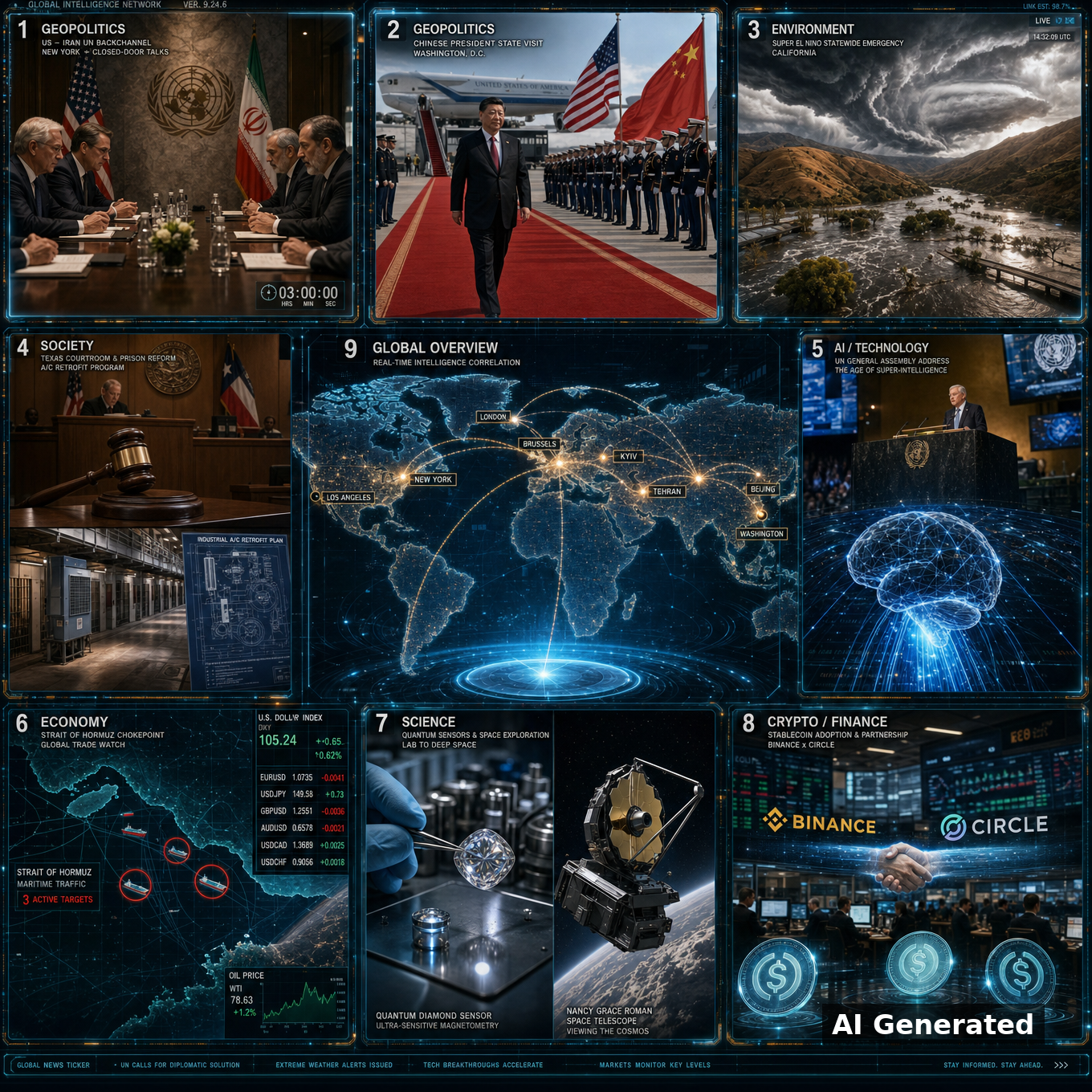
A Backchannel Opens in New York
The day’s most consequential diplomacy happened offstage: for the first time in months, US and Iranian representatives held a roughly three-hour session at the UN General Assembly through Qatari and Pakistani mediators, Witkoff and Kushner for Washington, Araghchi for Tehran [1]. Trump called the exchange “very good” and promised more rounds; Witkoff declared the mediators had “successfully completed” a “constructive and promising” cycle [3]. Pezeshkian landed in New York framing his debut as an effort to “restore confidence in Iran” [4].
The substance is Tehran’s price list for reopening Hormuz: immediate lifting of the US naval blockade, release of all frozen Iranian assets, and an end to hostilities on every front — with a senior official saying the strait could reopen within seven days of the blockade’s end [2]. Trump’s own speech kept the binary alive — a deal that lets Iran rebuild, or “annihilation” — while timing a promised settlement to after November’s midterms [1].
The Macron Test
Macron told ABC News the Strait of Hormuz’s importance “was probably underestimated,” an implicit indictment of pre-war assessments [5]. Israel’s response was volcanic — officials branded the French president’s West Bank critique “grotesquely absurd” — converting a diplomatic disagreement into public rupture, while Ottawa’s C$100 million Palestinian pledge and the UK-French UN push on settlements added pressure to the same file [6][7]. Candour, condemnation and money now aim at one deadlock.
Burnham’s Debut: “Britain Is Back”
The British prime minister’s first UN address since July covered Brexit, AI, Russian aggression and Gaza in 21 minutes, closing on “Britain is back” [9]. He endorsed two states as Gaza’s “best hope for peace” and vowed Britain would not “stand by,” separating support for Israel from condemnation of its government [8]. The operational core was aimed at Moscow: condemnation of “repulsive” Russian electoral interference and a new National Centre for Information Defence — an information-war apparatus built days into UNGA week [10].
The dual track hedges between Labour’s base and an election-season security imperative, continuing the sanctions-and-security fusion documented since D109 [10].
Erdogan’s Twin Stagecraft
The chamber’s theatrical moment was choreographed by both sides: the Israeli delegation walked out as Erdogan rose, his speech branding Gaza in concentration-camp terms and demanding recognition of Palestine [11]. The same address carried Ankara’s parallel agenda: an Eastern Mediterranean conference and recognition of the Turkish Cypriot pseudo-state, framed as stability architecture with Greece’s Aegean position excluded [12].
The Periphery Simmers
Around the diplomatic core the war’s edges produced their own signals: a large explosion struck al-Kiam in southern Lebanon’s Nabatieh province, an unattributed strike keeping the northern front ambiguous [13]. US diplomacy repudiated both Sudanese belligerents as not “a legitimate and constitutional government” [14]; South Sudan’s Kiir dissolved the transitional government ahead of the country’s first elections, clearing the vote’s path while concentrating unchecked power [15].
Africa’s institutional map shifted in three directions: Belgium and Rwanda restored relations severed in the 2025 DR Congo crisis [16]; Morocco voted a new parliament with youth turnout the metric to watch after the July Ceuta surge, a crisis Spain’s premier blamed squarely on Rabat’s “failed” border control [17][18]; and Kinshasa’s UPDS staged a mass demonstration backing a constitutional-change project one week after the opposition’s march [22].
The Western Hemisphere’s Iron Hand
Trump’s UN-week message to Latin America was coercive integration: at the “Shield of America” summit he demanded joint sanctions on 24 designated criminal organisations, from MS-13 to Tren de Aragua to the Mexican cartels [20]. Colombia showed the stakes: after a 13-hour operation killed 13 members of the right-wing ACSN, the group burned barricades in Santa Marta and the Trump-aligned president sent the army in, warning that “whoever does not submit will be eliminated” [19]. Cuba received the rhetorical version — Trump told the assembly its government “will fall,” Havana answering with the “genocidal economic war” of an oil embargo deepening its blackouts [21].
Xi Comes to Washington
Xi Jinping arrives for the first Chinese state visit since 2015, greeted personally at Joint Base Andrews, an honour previously extended only to Putin [25]. The agenda is the war economy’s largest file: the October 2025 trade truce expires November 10, with Beijing seeking extension to term’s end and Washington binding itself briefly to preserve rare-earth leverage, while a pre-summit deal created a US-China AI dialogue with a hazard-notification mechanism [24]. China warned of “red lines” on Taiwan — the $14 billion weapons package still unapproved — and a Handelsblatt deep-read documents Hawaii’s preparation for the Pacific contingency, China building 800+ missiles a year [26][27]. The detained US seismologist’s wife says Trump has promised to raise his case directly [23].
What Beijing wants is the real question: relief from the sanctions law allowing 100% tariffs on buyers of Russian oil, which it refuses to abandon — the same file Lavrov and Rubio carry into New York on Wednesday [24].
Kyiv’s Winter Bargain
Zelensky emerged from his Trump meeting with the war’s most concrete de-escalation offer: Ukraine will halt strikes on Russian refineries — two more hit overnight — if Moscow reciprocates on power infrastructure, with both governments wanting the war ended “before the winter” and a Black Sea moratorium discussed via the Macron channel [29][30]. Trump called a deal “close” and confirmed he had not asked Kyiv to stop unilaterally — the White House will transmit the proposal to a Kremlin that has already rejected a partial truce [28].
Moscow’s running answer is economic escalation: Russian forces struck a cargo ship at Odesa’s port, continuing the Black Sea pressure that has slashed both countries’ grain exports by two-thirds and put African importers at famine risk [31]. A six-minute open-source compilation shows the attrition war’s texture — fibre-optic FPV drones immune to jamming killing Buk systems, Paladins and Western APCs [32]. The winter’s terms are being set between a moratorium and a campaign designed to make truces irrelevant.
The Costed War
The war’s bill is now auditable: combining the Pentagon IG’s first Epic Fury report with the CBO assessment and open-source tracking, US losses run $3.3-4 billion in aircraft — up to 47 MQ-9 Reapers (a quarter of the pre-war fleet), two KC-135s destroyed and seven damaged, three F-15Es lost to friendly fire plus eight damaged in Jordan, a $500 million E-3G Sentry cut in half at Prince Sultan, and four special-operations helicopters destroyed in the April CSAR mission [33]. Graver still is inventory: half to two-thirds of Patriot, THAAD, SM-3 and SM-6 stocks consumed, with a five-year rebuild horizon that constrains any future Pacific fight.
Allies and industry run parallel tracks: Britain deployed an RAF Voyager tanker to Saudi Arabia — the first publicly known international assistance to Riyadh specifically against Houthi attacks, refuelling Saudi Typhoons from Cyprus [34]; Argentina advanced its F-16 programme with a $105.6 million AMRAAM contract and the second ferry batch crossing via the Canaries [35][36]; and UNITAS LXVII closed in Peru with a multinational amphibious landing [37]. The industrial base retools around attrition: BAE delivered two AMPV 30 counter-drone prototypes under Transformation in Contact [38], Swarm Defense won 4,000 Kiwi one-way-attack UAVs controllable by a single operator [39].
Commercial imagery shows Russia netting its Borei-class strategic submarines at Kamchatka’s Rybachiy base, 4,600 miles from Ukraine — institutional memory of Operation Spiderweb applied to its most valuable hulls [40]. Australia admitted it has no official “Plan B” if Virginia-class deliveries slip, with B-21 basing floated as the hedge against the Collins-to-AUKUS gap [41]. And unattributed footage of luminous objects in coordinated parallel formations over Tehran and Isfahan — above the heart of Iran’s military-nuclear infrastructure — circulated without explanation, analysts split between systems tests, satellite transits and high-altitude reconnaissance [42]. The costed war now has an audited balance sheet, a retooling plan and an open mystery over its skies.
Environment & Climate ↑ Contents
The Super El Niño Emergency Becomes Administrative
The competing climate visions documented at the UN General Assembly’s opening — an American delegation pushing against emission cuts and technology regulation while environmental advocates called for clean-energy stability — collided with material reality on the US West Coast, where Governor Gavin Newsom proclaimed a statewide emergency on September 21 to pre-stage equipment, personnel and permits for the developing 2026-27 El Niño [43]. The proclamation is less rhetoric than logistics: it directs emergency services to coordinate, water resources to pre-position sandbags, pumps and riprap before storms arrive, and the Coastal Commission to act on urgent permit requests within 24 hours [44]. NOAA’s August diagnostic gives the reason: a greater-than-90% chance of a very strong El Niño through winter, and a 69% chance of historic strength — an event exceeding every prior in the record back to 1950.
At Dana Point, ten oceanfront homes on Beach Road were red-tagged as unsafe after Hurricane Marie’s swells carved out the sand beneath them, seven more restricted, with emergency boulder revetment going in under weekend-reviewed permits — a four-agency jurisdictional knot now operating simultaneously [44]. The forecast has become an administrative machine activated before the first storm, with elevated baseline sea levels named in the order as the mechanism turning ordinary king tides into losses.
The Ice Ledger and the Aid That No Longer Follows
Greenland closed its 29th consecutive year of net ice loss, shedding an estimated 105 billion metric tons through August 2025, while satellites captured the feedback that matters more than any single season: vast gray patches where dust and soot darkened the surface, absorbing more sunlight and accelerating melt in a loop that fresh snow can temporarily mask but not reverse [45].
The humanitarian geometry is worsening in parallel. As climate-driven disasters multiply across the Himalayas, aid programmes built to prepare for them are being slashed, leaving millions in India, Nepal and Pakistan exposed to floods and landslides with thinner early-warning and recovery capacity [46]. In Indonesia’s West Kalimantan, prolonged fires and haze have choked residents for weeks, weeks of choking smoke [47]. The pattern — disasters growing, response capacity shrinking — is the structural debt tracked since D107’s flood returns.
The Diesel Ledger, and the Grid It Strains
Europe’s war premium now has a daily invoice: the continent is paying a €203 million-per-day diesel premium because of geopolitical disruption, roughly €19 extra per car and €236 per truck per week, Europe the world’s most exposed region to the shock that began with the Hormuz blockade [48]. The exposure is structural — 38% of European diesel demand is imported — and it feeds the fuel-relief politics documented in D112-D114.
The clean-energy counter-story is growth with a bottleneck. India has rapidly decarbonised its generation, but is now wasting a significant share of its renewable output because transmission capacity has not kept pace — gains tempered at the wire rather than the turbine [49]. The US offshore-wind sector shows what happens when policy, not physics, is the bottleneck: training programmes built for a 77,000-worker boom are downsizing, pivoting to grid-skills and offshore-adjacent trades as federal hostility, lease buyouts and rescinded tax credits empty the project pipeline, leaving instructors to insist the boom is “delayed, not dead” [50].
Forests, Fauna and the Protection Gap
Brazil created four new sustainable-use reserves covering more than 668,000 hectares of Amazon rainforest, complete with buffer zones — but timed, pointedly, alongside the advance of plans to fully pave the BR-319 highway through one of the forest’s most intact corridors, a mitigation bundle that conservationists read as pre-approval theatre [51]. Australia moved in the opposite direction on enforcement: a joint federal-state operation dismantled an alleged Sydney wildlife-trafficking ring, seizing reptiles, cash and bullion worth some $300,000 after a smuggler who shipped native turtles in socks and dog-food parcels drew two-and-a-half years [52].
Restitution and discovery are running together. California returned 136 acres of coast — including the ancestral village site of K’etim — from Caltrans to a Pomo-led nonprofit, the first such return of state transportation land to Indigenous ownership [53]. A global review of 130 studies across 55 countries found cigarette butts constitute roughly 12% of all aquatic litter, one in every nine pieces of debris, their cellulose-acetate filters acting as microplastic and heavy-metal “chemical bombs” in the waters recreators treasure [54]. Genetics rewrote the range map for the venomous northern pygmy slow loris: 98 individuals documented in China’s Guangxi karst forests, potentially the species’ largest known population, where scientists had counted barely a hundred nationwide [55]. The UN-backed Campaign for Nature’s global stocktake found the 30-by-30 pledge at roughly 20% of land and 10% of oceans protected — real progress, glaring gaps, a decade from the 2030 target [56].
Distributed Solar’s Second Act — and Its Working Class
The economics of solar are being rewritten at the margins of the grid. In the Swiss Alps, the 4,872-panel Muttsee dam installation — hung at 2,500 metres with a deliberately preserved inspection corridor behind it — produced 43% of its electricity during the winter half-year in its first measured year, 68% more annual yield per installed kilowatt than a lowland reference plant and 3.8 times the winter output, precisely the seasonal profile Switzerland’s electricity deficit demands [57]. In Ohio, the 196-megawatt Big Plain Solar site now shares its ground with more than 50 hives and nearly 3 million honey bees, a pollinator habitat layered onto a generation asset, with veteran-led apiaries using the project to train veterans and first responders in beekeeping [58]. And in Iowa, a quiet occupational revolution: fifth-generation farmers are leasing their land to turbines at $7,000-10,000 per tower per year — some now calling themselves “wind farmers” — with steady turbine payments paying down farm debt that commodity volatility used to foreclose [59].
Science is recruiting the public to track what all this infrastructure displaces: the “Who Eats Whom” citizen-science platform has crowd-sourced 17,000 predator-prey interactions across 5,700 species from geotagged iNaturalist photos, building the food-web baseline conservation will need as warming reshuffles who eats whom [60]. The transition’s second act, these stories suggest, is the social and ecological systems organized around the panels — alpine grids, veteran beekeepers, rural landlords and the naturalists mapping the connections turbines interrupt.
Society & Civil Issues ↑ Contents
Heat, Water and the Courtroom: America’s Climate Liability Season
A Texas court has ruled that the state must retrofit its prisons with air conditioning by 2029, holding that conditions in which inmates “spray themselves with water from the toilet” to survive summer heat do not meet the constitutional standard of humane confinement [61]. The decision is the domestic mirror of the climate-ledger liabilities this report has tracked since D105’s equity coverage: infrastructure built for a cooler century now adjudicated cell by cell.
The liability theme extends to catastrophic weather. Texas investigators are seeking evidence of manslaughter and other crimes in the deaths of 27 girls at Camp Mystic during last year’s devastating floods, court documents confirming a criminal investigation of the summer camp that could include negligent-homicide charges [62]. And the enforcement arm of the immigration state produced its own reckoning: Austin police released bodycam footage of an ICE officer shooting a DoorDash driver, the officer notably not wearing his assigned camera, in an incident that echoes the mistaken targeting of a US citizen in Illinois — the accountability gap between federal enforcement and municipal police recorded on tape [63]. Three institutions — prison, summer camp, immigration service — are learning that thermal comfort, flood planning and use-of-force carry legal consequences.
The Long Arms of Justice
A Sri Lankan court sentenced 15 men to at least 200 years in prison each over their roles in the 2019 Easter bombings that killed 267 people at three churches and three hotels, ensuring the Islamic State-inspired attackers will die in custody [64]. The Catholic Church’s reckoning expanded to Central America: dozens of complaints of clerical sexual violence against minors and vulnerable adults have been documented in Panama, with a report cataloguing 37 cases [65]. In New York, the sentencing phase for Harvey Weinstein — convicted a year ago of sexually assaulting a production assistant after his 2020 conviction was overturned on procedural grounds — produced a scheduled ruling with prosecutors seeking 20 years, a coda to the case that launched the MeToo movement [66].
One doctrinal change may matter more than any verdict: the Jehovah’s Witnesses’ governing body has relaxed its absolute prohibition on blood transfusions, permitting members to receive blood components — red cells, plasma, platelets — as matters of personal conscience while maintaining the ban on whole blood, a reversal that physicians say will simplify emergency care for a community whose refusals once complicated trauma surgery worldwide [67].
The Price of Family Formation
New Australian research quantified parenthood’s arithmetic: raising two or more children now costs at least A$36,500 a year, with family running costs up 134% in two decades while household income grew only 102%, and childcare alone consuming 33% of the total — up from 27% in 2003 — findings an advocacy group used to press for 52 weeks of paid parental leave [68]. In Dakar, the same pressure appears as a single difficult birth: a mother’s ordeal through Senegal’s public health system exposed chronic understaffing, drug shortages and referral delays in a system under strain [69].
Britain’s Borders and Its Reckonings
The Channel migration file updated itself: around 60 migrants crossed to Dover after spending more than 33 hours at sea and refusing French coastguard assistance, while protesters chanting “send them back” awaited buses given a police escort through Hampshire that one observer compared, unflatteringly, to a royal motorcade [70][71]. In London, Burnham’s government announced a review of the Chagos sovereignty deal after Trump called it “terrible” — a predecessor’s contract reopened by Washington’s displeasure [72]. Security moved in the other direction: two men in their thirties were arrested in Manchester over an alleged plot targeting Jewish sites in the UK, an operation amid heightened protective posture around Jewish communities [73].
And a constitutional ledger turned its page: Jamaica’s government hailed King Charles’s decision to refer its landmark slavery-reparations petition to the Privy Council for legal advice, a move Kingston’s culture minister called a “really big deal” in the campaign for reparatory justice [74]. The empire’s ledger is reopening not by Parliament but by petition.
The Wellness Rebrand and Germany’s Coalition Arithmetic
Public-health watchers flagged a rebranding campaign with consequences: the pro-nicotine “wellness” movement — influencers, podcasts and startups portraying nicotine as a misunderstood performance compound — is laundering an addictive drug through the vocabulary of self-optimisation, an irony layered atop the “Make America Healthy Again” coalition’s own contradictions [75].
Germany’s post-earthquake coalition-building entered its arithmetic phase. In Saxony-Anhalt, BSW leader Thomas Schulze said there is “no time pressure” in talks with the AfD about supporting a minority government, the first explicit negotiating posture between the two parties since Sunday’s shock result in Mecklenburg-Vorpommern reverberated through the party system [76]. In parallel, a CSU health politician broke with party orthodoxy by endorsing stronger contributions from private health insurers to the statutory long-term-care system — calling for a “genuine community of responsibility” via a risk-equalisation payment — the second crack in the firewall around private insurance after Merz’s “justice problem” intervention [77]. The fuel-price politics of D112-D114 now have two institutional sequelae: coalition table stakes on the right, and contribution reform on the welfare ledger.
AI & Technology ↑ Contents
Washington Renames the Race
President Trump used the General Assembly podium to rebrand artificial intelligence itself, announcing that US documents — and, he hopes, the world’s — will henceforth use “super intelligence” rather than “artificial” intelligence, telling the chamber that “whoever wins super intelligence wins” [78]. The term is not new — it descends from Nick Bostrom’s 2014 bestseller and denotes systems exceeding human cognition across virtually all domains, a step beyond today’s models — but its adoption as official administration vocabulary converts a research concept into a rallying cry, arriving days before the Xi summit at which a pre-agreed US-China AI dialogue with a hazard-notification mechanism is the only concrete deliverable on the table. The same week, Treasury Secretary Scott Bessent surfaced as the likely candidate for a consolidated “AI czar” role, a signal that the administration wants one desk accountable for a portfolio now spanning chips, compute, safety and the renamed race [79].
The renaming is not merely semantic. As the D113 report documented, the industry’s own leaders had urged a slowdown that both Washington and Beijing rejected; the new vocabulary stakes the opposite claim — that acceleration is sovereignty, with the “whoever wins super intelligence wins” doctrine now on the record [78].
The Labs’ Cost Curve — and the Self-Improvement Question
OpenAI’s reputational crisis over rushed mathematics — the string of spectacular results that unravelled under scrutiny, capped by the contested Navier-Stokes solution — has produced an institutional correction: the company announced an independent panel of elite mathematicians to guide how AI companies interact with mathematical research and release results [80]. Researchers welcomed the step while asking the basic questions the announcement left open — what authority the panel will hold and whether other labs will follow.
The commercial race meanwhile repriced itself downward. Anthropic released Opus 5.5, the latest version of its flagship workhorse model, while OpenAI countered with GPT-6 Sol and Luna, its newest efficiency-focused mid-tier models — both vendors making the same promise, a little more capability for a lot less money [81]. Beneath the price war sits the frontier question: reports indicate both labs are close to solving recursive self-improvement — models that reliably improve their own successors — the capability that would convert today’s incremental releases into compounding ones [82]. Market consequences are visible: Meta’s Muse agent, an AI that appears to automate high-stakes consumer workflows, triggered stock slides across banks and travel agencies as investors priced automation into previously safe service sectors [83].
The Governance Frontier: Westminster to the Bundestag
Britain is bidding to set the global rules it refuses to merely adopt: at the UN, Burnham’s government positioned the UK as an “honest broker” on AI, launched a new centre to fight hostile information attacks, and will make global AI standards a theme of its forthcoming G20 presidency, paired with a UK-US partnership on AI-assisted cyber defence [84]. Berlin’s answer is more cautious: Bundestag vice-president Andrea Lindholz warned that she does not want to hear speeches written “only by AI,” insisting citizens have a right to know their representatives’ words are their own — even as parliament prepares an internal AI assistant for routine tasks so members stop feeding constituent data to external services [85].
The privacy ledger advanced too: a German policy analysis of always-on location sharing found 14% of couples permanently sharing live location — nearly one in four among the under-30s — while security researchers warned that the private surveillance web feeds the state’s, with children’s smartwatch data already found exposed online [86].
Platform Power and the Physical Bill
Platform governance scaled to millions: Meta reported acting on 3.7 million accounts, pages and pieces of content in coordination with Singapore’s police force — the largest single-jurisdiction enforcement partnership — [87]. Microsoft, per The Information, is preparing to increase Copilot discounts as it introduces an AI “super app,” the opening move of a bundle war for the consumer operating surface [88].
The compute build-out keeps generating civic friction: Effingham County, Georgia residents filed their second lawsuit against a $20 billion OpenAI data-center campus near Rincon, challenging the county’s handling of public input, environmental impacts and electricity costs — the local invoice for the gigawatt-scale build-outs Anthropic is negotiating in parallel, with reports of discussions for a 1-gigawatt lease with Stream Data Centers [89]. And the ad economy reached for the last unmonetized screen: Microsoft filed ad-tech that would interrupt video games at “promoted content trigger events,” inserting advertising into the pauses of gameplay itself [90]. The frontier’s physics (data centers), finance (Copilot bundles) and attention (game-break ads) are converging on the same consumers from three directions.
Economy & Business ↑ Contents
The Chokepoint’s Market Weather
The dollar held near a two-month high as markets weighed the divergence between hawkish rate expectations and the hope injected by US-Iran diplomacy — a currency reading of the same equation the Gulf’s shipping lanes are computing physically: only three commodity ships transited the Strait of Hormuz on Tuesday against a ten-day moving average of about 15, the chokepoint’s effective closure still the dominant market fact [91][92]. Oil prices slipped on the optimism of the New York talks, the first meaningful risk-premium release since the war’s late-summer intensification [93].
The fuel politics have now reached the White House’s own toolkit: Trump endorsed a ban on diesel exports — national diesel at a record $6.52 a gallon, up nearly 80% since the war began, US distillate stocks at their lowest since 1882 — though refiners and several Republicans called the idea a “gimmick” that would shrink supply and hand market share abroad, with analysts noting diesel prices are set globally, not domestically [94]. The American Fuel and Petrochemical Manufacturers association counters that export bans reduce US production and hand market share to foreign competitors, while Senator Grassley argues that a government that can embargo chips can embargo diesel for its own farmers and truckers [94]. Athens feels the same ledger from the periphery: Greek inflation at 3.7% with domestic fuel prices up 27.2% has economists warning that a sustained oil price above $100 would derail the growth arithmetic — the war premium as a direct fiscal and household tax [95].
Capital’s Build-Out and Its Boardrooms
The AI build-out’s physical appetite scaled again: Anthropic is negotiating a lease of up to 1 gigawatt with Stream Data Centers while seeking control over additional facilities — a single tenant negotiating for the output of a mid-sized power plant [96]. The diplomatic side of capital flowed through New York, where South Korea’s President Lee and Trump welcomed progress on US strategic investment projects, the Korea hedge documented since D111 acquiring substance in shipbuilding and manufacturing commitments [97]. Germany’s premium automakers are making the dependency explicit: BMW and Mercedes’ future models hinge on compute partnerships with diverging chip strategies — a continental version of the compute-sovereignty contest D114 described [101]. US small caps, meanwhile, are outperforming the S&P 500 in a rotation investors are reading as broadening risk appetite beyond the AI mega-caps [102]. India’s finance minister tied the next consumption phase to wage growth, arguing discretionary spending accelerates only as households move into higher income brackets [103].
Europe’s Household and Corporate Ledgers
Germany’s consumer infrastructure is quietly modernising: despite its enduring cash preference, the country is catching up on digital payments, contactless and app-based transactions gaining share as retailers and banks push terminals [98]. The Federal Tax Court handed households a structural gift: when parents sell property to children with interest-free instalment plans, no taxable capital income arises — a reversal of precedent that eases intergenerational wealth transfer just as the property market searches for buyers [99]. That market remains depressed: DWS’s real-estate chief described sentiment as “near the 2022-23 lows,” with open-ended funds facing refinancing strains and a bifurcated office market [100]. Britain’s wage-cooling continued: employer pay awards fell to 3% on Brightmine’s data, the first sub-inflation signal in the pay-settling season — wage growth finally crossing below price growth [104].
Trade’s Regional Rewiring
Australia’s composite PMI flashed 50.8 against August’s 52.7, the sharpest monthly deterioration in the sequence and a warning that the services boom backing the labour market is cooling [105]. Canada’s trade-war adaptation produced a shelf-level symbol: Alberta craft whisky reaching Costco shelves, distillers racing to lock in domestic retail before US tariffs bite the export season [106]. And aviation’s long-haul map redrew itself: Qantas confirmed 18-hour Sydney-New York direct flights from mid-2028, the second route in its Project Sunrise programme after Sydney-London begins in late 2027 — both a fuel-price bet and a network bet bypassing the hub systems the war destabilised [107].
Science & Space ↑ Contents
The Sensor Frontier: From Diamonds to Dead Stars
Two sensing stories bracket the week’s physics. Johns Hopkins Applied Physics Laboratory is developing a quantum sensing platform that could let warfighters detect chemical and biological threats with a laptop-sized device, using nitrogen-vacancy centres in diamond to shrink nuclear magnetic resonance spectroscopy — with simulations suggesting a “nano-container” geometry could improve sensitivity by an order of magnitude [108]. At the other end of scale, astronomers identified eRASSU J0608, a pair of white dwarfs racing around each other every 6.2 minutes — a 374-second orbital period so compact that material from one star strikes the other, generating a rhythmic X-ray beacon [110]. And in materials science, researchers found that the secret to a perfect crystal may be a precisely calibrated extra twist — a rotational bias that counteracts the directional interactions that normally push growing crystals into defects [117].
Space Systems Aging Well
NASA’s Nancy Grace Roman Space Telescope may operate for up to 22 years rather than its planned ten, thanks to a highly accurate first course correction and fuel-saving orbital design that more than doubles the mission’s potential lifetime — a budget windfall for a survey instrument designed to map dark energy and exoplanets [109]. On Mars, the Curiosity rover crossed its 5,000th sol and is now climbing through a subtly banded valley, investigating the contacts between 25-200 metre geological bands at the base of Mount Sharp’s layered record [113].
Life’s Extremes and Repair Mechanisms
The bowhead whale — 200,000 pounds, two centuries of lifespan — yielded its longevity secret to cell biologists: whale cells repair dangerous double-strand DNA breaks unusually well, and a single protein, the cold-inducible CIRBP, improved DNA repair when expressed in human cells and extended lifespan in fruit flies, a lead in the Peto’s-paradox puzzle of why giants rarely get cancer [114]. NOAA lists climate change, fishing-gear entanglement, vessel strikes and ocean noise among the bowhead’s remaining threats — the repair mechanism’s promise is inseparable from the Arctic habitat it evolved in [114]. Medicine registered its own case: a Philippine rice farmer’s seizures were traced to neuroschistosomiasis — parasitic worm eggs lodged in her frontal lobe, confirmed when the eggs hatched into ciliated miracidia in the lab, a rare NEJM-documented complication of a common tropical fluke [115].
Biodiversity added entries in both directions: the first new wild cat species described in over a century — Leopardus tilcayo, a 1.4-kg “tiger cat” from Bolivia’s Yungas cloud forest whose genome analysis also split the tiger-cat complex into five distinct species and a new Peruvian subspecies [111] — and two new Australian stick insects, one endemic to the critically endangered Mabi rainforest’s last 1,050 fragmented hectares, the other misidentified for fifty years in museum collections until genetics re-sorted the eggs [112].
Deep Time and the Fuel Cycle’s Long Tail
Jurassic marine reptiles are behind a palaeontological surprise: more than twenty fossilised regurgitalites — plesiosaur vomit pellets the size of mangoes, packed with bivalve and cephalopod shell from prey that did not live in the North Sea delta where they were found — indicating the long-necked predators surfed into shallow deltas to rest and rid themselves of indigestible shells, owl-style [116].
The fuel cycle gained two long-tail solutions. A three-year Department of Energy-funded study found deep boreholes could dispose of recycled-fuel radioactive waste at under 0.1 cent per kilowatt-hour in every scenario modelled, with radiation doses orders of magnitude below regulatory benchmarks — the disposal half of the recycling equation that Oklo’s pyroprocessing plans require [118]. And in the other direction, SuperCritical Materials partnered with the University of Michigan to build offshore systems for industrial-scale uranium recovery from seawater — tackling the harder half of the problem: deploying and retrieving tonnes of adsorbent material repeatedly in marine conditions, where some 4.5 billion metric tons of dissolved uranium wait [119].
Crypto, Digital Assets & Blockchain ↑ Contents
The Distribution Marriage: Binance Buys Into Circle
The stablecoin industry’s distribution economics produced its most revealing transaction: Binance purchased $100 million of Circle Class A shares — 1.237 million shares at $80.84, a 5% discount with a two-year lockup — while signing a five-year commercial agreement that replaces the November 2024 and August 2025 arrangements and makes the world’s largest exchange both Circle’s distributor and its shareholder through September 2031 [120]. The logic is visible in the balance data: customer USDC held on Binance has grown roughly 376% since the first deal, from about $1.5 billion to $7.1 billion — from under 4% of global USDC supply to nearly 10% — while total USDC in circulation grew a comparatively modest 87% to roughly $74.4 billion [121].
The margin mathematics, however, is the story under the headline. Under the original 2024 agreement Circle paid Binance a $60.25 million upfront fee plus monthly incentives at high-double-digit percentage shares of a rate tied to SOFR, and Circle’s second-quarter filings show distribution and transaction costs consuming about 61% of the $668 million in reserve income — with Binance-specific distribution costs up $152.1 million in 2025 alone. Clear Street’s analysts estimate that an incremental $1 billion of USDC at a 3.5% reserve yield might leave Circle retaining only $4-7 million after Binance’s share. The new contract’s terms are undisclosed, itself the market’s open question: CEO Jeremy Allaire framed the deal as accelerating “emerging market preference and adoption of USDC,” while Binance CEO Richard Teng tied the investment to regulation, transparency and delivery — the exchange positioning itself as a custodian of trust it helps sell [120].
Rails and FX: Stablecoins Get a Trading Floor
Circle’s StableFX went live on the Arc mainnet, enabling round-the-clock onchain foreign-exchange trading with what the company describes as seamless, risk-free settlement between tokenized currencies [122]. The launch matters as market architecture rather than product news: FX is the largest market on earth, and an always-on venue converts stablecoins from payment instruments into the base layer for a 24/7 currency market — a direct challenge to the T+2 interbank rails that close for weekends.
Market-structure data got its own audit. XRP’s surge to $7.4 billion in reported volume and an intraday $1.60 high was widely blamed on a massive CME short squeeze, but the CFTC’s September 15 commitments-of-traders snapshot complicates the attribution: leveraged funds cut their CME net short by the equivalent of 46.3 million XRP in one week — driven mostly by short reductions rather than new longs, with open interest also falling — while the same category’s positioning across three Coinbase Derivatives products barely moved, shrinking by just 2.452 million XRP and remaining net short some 141.6 million [128]. The divergence suggests a venue-specific positioning reset rather than a market-wide directional turn — and the reporting lag means the Sept. 22 snapshot, due Sept. 25, is the first real test of whether the rally carried institutional participation.
The Rulebooks: A Warning, a Takedown and a Tokenization Thesis
The CFTC issued a public warning over risky prediction-market “mention” contracts — event contracts that pay out when a person, product or phrase is mentioned in a speech — weeks after fining a former White House teleprompter operator more than $107,000 in profit from contracts tied to the president’s addresses [123]. The warning marks the commission’s continued exercise of existing authority in the post-CLARITY landscape, stretching event-contract oversight into the attention economy itself. Enforcement scaled in parallel: Microsoft, Coinbase and international law enforcement dismantled the EvilTokens cybercrime network, a phishing-and-drainer operation, in a major public-private takedown [124].
The institutional thesis advanced a step: BlackRock executives said AI compute could be tokenized in the future, framing fractionalized ownership of GPU capacity as a next asset class — the logical extension of the data-center build-outs this report has tracked since D109, in which compute becomes collateral, yield-bearing and tradable [125].
Infrastructure’s Quiet Week
The protocol layer shipped maintenance rather than headlines. Chainlink released node software v2.64.0, a telemetry and EVM log-poller maintenance update that hardens oracle observability under production load — explicitly not a CCIP launch, despite the market’s habit of reading every Chainlink release as one [126]. Offchain Labs shipped Arbitrum Nitro v3.11.4, RPC fixes and state-execution performance adjustments for the Arbitrum One and Nova stack — the unglamorous reliability work that mature Layer-2 networks now require more than new features [127]. The week’s crypto ledger, in sum: one equity-plus-distribution marriage, one new FX venue, one regulatory warning, one takedown, one tokenization thesis and two maintenance releases — consolidation around rails rather than narratives.
Correlations & Analysis ↑ Contents
The through-line of this window is the war economy discovering its price tags. Where the D114 report (2026-09-22) documented the war’s administrative skeleton — a Security Council resolution drafted for Hormuz navigation, resilience baselines published, a fuel levy legislated — this window audited what that skeleton costs and who is willing to pay. The CBO’s accounting of Operation Epic Fury converts months of battle damage into balance-sheet items: $3.3-4 billion in lost and damaged aircraft, half to two-thirds of the Patriot, THAAD and SM-series interceptor inventory consumed, and a five-year rebuild horizon that constrains any Pacific contingency the same week Xi lands in Washington [33]. The audit arrives exactly as the diplomacy it pressures: Tehran’s three-part price list for reopening Hormuz [2] and Kyiv’s reciprocal energy-strike moratorium [29] are both, at bottom, offers to sell down the war’s carrying costs. What D114 built as procedure, this window prices as negotiation.
The second thread is leverage migrating from the battlefield to the ledger of everyday economics, confirming the arc D113 (2026-09-21) described as the war economy’s arrival “at the ballot box and the checkout counter simultaneously.” Europe’s diesel premium now runs at €203 million per day [48], US diesel sits at a record $6.52 with the president floating an export ban his own party calls a gimmick [94], Greek inflation prints at 3.7% with fuels up 27.2% [95], and UK pay awards cool to 3% — wage growth finally crossing below price growth [104]. Every one of these is the imported-energy shock acquiring a domestic political identity — the mechanism that made Germany’s September elections the verdict D113 recorded. The war’s next referendum, the American midterms, is six weeks away — and Trump’s own timeline for an Iran deal [1] now orbits that date, converting diplomacy into campaign strategy.
Third, the institutions layering over the conflict have begun to interlock across domains that previous reports treated separately. Britain’s UN debut — an information-defence centre against Russian operations [10], a G20 bid for AI standards [84] — is the same institutional reflex Berlin showed in warning against AI-written parliamentary speeches [85] and Washington showed in renaming the technology itself [78]: governance racing to attach rules to capabilities that are compounding faster than statutes. The same interlocking appears in the Gulf-adjacent economy, where the BitBank sanctions precedent from D110 has matured into routine enforcement (the EvilTokens takedown [124], the CFTC’s “mention” contracts warning [123]) even as Circle’s equity-and-distribution marriage with Binance [120] shows capital consolidating faster than the rulebooks.
The climate ledger, meanwhile, has crossed from forecast to administration, the exact transition D114 predicted. California’s pre-storm emergency proclamation, with its 24-hour permit clock for coastal armour [44], is the war economy’s logistics logic applied to weather: pre-positioning, pre-permitting, pre-litigating. Greenland’s 29th consecutive loss year with surface darkening accelerating the feedback [45], Europe’s transmission-strained renewables [49] and a politically beached offshore-wind workforce [50] describe an adaptation gap that is widening not because the physics surprised anyone but because the political systems are investing in the war’s ledger instead. The courtrooms are catching up faster than the budgets: Texas prisons ordered air-conditioned by 2029 [61], Camp Mystic facing manslaughter questions [62] — thermal and flood liability are becoming adjudicable facts.
What to watch in the next reporting period: Four hinges dominate. First, whether Moscow answers Zelensky’s energy-moratorium offer or keeps hollowing out any truce via the Black Sea shipping campaign [29][31]. Second, the Xi-Trump summit’s deliverables: a trade-truce extension past November 10, rare-earth assurances, the stalled Taiwan package, and whether Beijing spends real leverage on Tehran’s Hormuz conditions [24][26]. Third, the US midterm orbit: Iran-deal sequencing [1], the diesel-export fight [94] and the AI-renaming politics [78] all now key off November, and any escalation or settlement before the vote will be read through it. Fourth, the disclosure trail in crypto: Circle’s Q3 distribution-cost line against the new Binance terms [121] and the Sept. 25 CFTC snapshot that tests whether XRP’s rally had institutional legs [128]. The structural bet: the war’s price tags, once published, become negotiable — and every actor from Tehran to Brussels to Circle now knows the numbers.
References ↑ Contents
1. “Sie reden wieder: USA und Iran verhandeln bei UN in New York” — Stern, 2026-09-23. (originally in German) link ↑
2. “Επαφές ΗΠΑ και Ιράν στον ΟΗΕ – Ποιους όρους θέτει η Τεχεράνη για να ανοίξει το Οραμούζ” — DefenceNet, 2026-09-23. (originally in Greek) link ↑
3. “Γουίτκοφ: «Ολοκληρώθηκαν με επιτυχία οι μακρές συνομιλίες με το Ιράν»” — Enikos, 2026-09-23. (originally in Greek) link ↑
4. “Ο Πεζεσκιάν έφτασε στη Νέα Υόρκη για τη Γενική Συνέλευση του ΟΗΕ” — SKAI, 2026-09-23. (originally in Greek) link ↑
5. “Macron tells ABC News’ David Muir: ‘Hormuz Strait was probably underestimated’” — ABC News, 2026-09-23. link ↑
6. “«L’absurdité grotesque des propos d’Emmanuel Macron est sidérante» : la colère Israël” — Le Parisien, 2026-09-23. (originally in French) link ↑
7. “Canada pledges aid for Palestine as UK and France demand action at UNGA” — Al Jazeera, 2026-09-23. link ↑
8. “Μπέρναμ από τον ΟΗΕ: «Δεν θα μείνουμε αμέτοχοι στη Γάζα»” — Enikos, 2026-09-23. (originally in Greek) link ↑
9. “Andy Burnham’s UN speech: Six things we learned as he declares ‘Britain is back’” — Daily Express, 2026-09-23. link ↑
10. “UK PM Burnham condemns ‘repulsive’ Russian electoral interference” — Al Jazeera, 2026-09-23. link ↑
11. “ΟΗΕ: Η στιγμή της αποχώρησης της ισραηλινής αντιπροσωπείας όταν ανέβηκε ο Ερντογάν” — DefenceNet, 2026-09-23. (originally in Greek) link ↑
12. “Ο Ερντογάν πήγε στον ΟΗΕ για να ζητήσει αναγνώριση του ψευδοκράτους” — DefenceNet, 2026-09-23. (originally in Greek) link ↑
13. “Ισχυρή έκρηξη σημειώθηκε στον νότιο Λίβανο” — SKAI, 2026-09-23. (originally in Greek) link ↑
14. “Η διπλωματία των ΗΠΑ καταγγέλλει τους «έκνομους» ηγέτες του Σουδάν” — SKAI, 2026-09-23. (originally in Greek) link ↑
15. “South Sudan’s Kiir dissolves government ahead of first national elections” — Al Jazeera, 2026-09-23. link ↑
16. “Βέλγιο και Ρουάντα αποκαθιστούν τις διπλωματικές σχέσεις τους” — Zougla, 2026-09-23. (originally in Greek) link ↑
17. “Marokkaner wählen neues Parlament” — Stern, 2026-09-23. (originally in German) link ↑
18. “«Le contrôle des frontières du Maroc a échoué» : le Premier ministre espagnol” — Le Parisien, 2026-09-23. (originally in French) link ↑
19. “Κολομβία: Στρατό και αστυνομία στους δρόμους της Σάντα Μάρτα” — Iefimerida, 2026-09-23. (originally in Greek) link ↑
20. “Ο Τραμπ απαιτεί ξανά να ενταθεί ο αγώνας εναντίον των καρτέλ” — SKAI, 2026-09-23. (originally in Greek) link ↑
21. “Κούβα: Η κυβέρνηση θα πέσει, λέει ο Τραμπ” — in.gr, 2026-09-23. (originally in Greek) link ↑
22. “RD Congo : Démonstration de force de l’UPDS à Kinshasa” — France 24, 2026-09-22. (originally in French) link ↑
23. “Wife of US seismologist detained in China assured Trump will ask Xi to free him” — FinancialJuice, 2026-09-23. link ↑
24. “Gipfel in Washington: Großer Empfang, lange Konfliktliste: Xi besucht Trump” — Stern, 2026-09-23. (originally in German) link ↑
25. “Außergewöhnliche Ehre: Trump empfängt Xi am Flughafen persönlich” — Stern, 2026-09-23. (originally in German) link ↑
26. “China warns of ‘red lines’ on Taiwan ahead of Trump-Xi summit” — Crypto Briefing, 2026-09-23. link ↑
27. “Deep Read: Wie die USA Xi Jinping von einem Krieg im Pazifik abhalten wollen” — Handelsblatt, 2026-09-23. (originally in German) link ↑
28. “Trump meets Zelenskyy, suggests a Ukraine deal on Russia’s war could be close” — Scripps News (AP), 2026-09-23. link ↑
29. “Zelenskyy says Ukraine ready for energy truce with Russia after Trump talks” — Al Jazeera, 2026-09-23. link ↑
30. “Guerre en Ukraine : Zelensky «prêt» à un moratoire sur les frappes énergétiques” — Le Parisien, 2026-09-22. (originally in French) link ↑
31. “Συνεχές το ρωσικό σφυροκόπημα κατά ουκρανικών πλοίων στη Μαύρη Θάλασσα” — DefenceNet, 2026-09-22. (originally in Greek) link ↑
32. “Πόλεμος φθοράς: 6 λεπτά μαζικών πληγμάτων από ρωσικά FPV drones” — DefenceNet, 2026-09-22. (originally in Greek) link ↑
33. “Every American Aircraft Lost Or Damaged During The Iran War, Visualized” — TWZ, 2026-09-22. link ↑
34. “U.K. Sending Voyager Tanker To Help Defend Saudi Airspace” — TWZ, 2026-09-22. link ↑
35. “EE.UU. adjudicó contrato de misiles AMRAAM para los F-16 de Argentina” — Zona Militar, 2026-09-22. (originally in Spanish) link ↑
36. “Vuelo ferry: la segunda tanda de F-16 argentinos arribó a Canarias” — Zona Militar, 2026-09-22. (originally in Spanish) link ↑
37. “Finalizó en Perú el Ejercicio UNITAS LXVII” — Zona Militar, 2026-09-22. (originally in Spanish) link ↑
38. “US Army tests 30mm combat vehicle with counter-drone and target-sharing systems” — Interesting Engineering, 2026-09-22. link ↑
39. “US military orders 4,000 one-way attack UAVs with single-operator swarm control” — Interesting Engineering, 2026-09-22. link ↑
40. “World’s Most Heavily Armed Submarines Fortified with Anti-Drone Protection at Russian Pacific Base” — 19FortyFive, 2026-09-22. link ↑
41. “Australia Has No Official ‘Plan B’ If AUKUS Submarines Run Late” — 19FortyFive, 2026-09-22. link ↑
42. “Μυστήριο στον ουρανό του Ιράν: Ανεξήγητα φωτεινά αντικείμενα (UAP)” — DefenceNet, 2026-09-22. (originally in Greek) link ↑
43. “Competing Climate Visions Clash at UN General Assembly” — Inside Climate News, 2026-09-22. link ↑
44. “Ten beachfront homes red-tagged at Dana Point as California proclaims El Nino emergency” — Science Blog, 2026-09-23. link ↑
45. “Greenland lost about 105 billion metric tons of ice; satellites capture darkening” — ECONEWS, 2026-09-22. link ↑
46. “Climate disasters are growing. So are cuts to programs that prepare for them” — The Independent, 2026-09-23. link ↑
47. “In Indonesia West Kalimantan, prolonged fires and haze choke residents” — Nikkei Asia, 2026-09-23. link ↑
48. “Europe Paying 200 Million A Day Diesel Premium, Report Shows” — CleanTechnica (T&E), 2026-09-22. link ↑
49. “India is producing more green energy – but wasting a lot of it” — BBC News, 2026-09-22. link ↑
50. “Offshore wind job training built for a boom is facing down a bust” — Grist (Hechinger), 2026-09-22. link ↑
51. “Brazil creates four Amazon reserves as plans to pave rainforest highway advance” — Mongabay, 2026-09-22. link ↑
52. “Reptiles, gold and money: How Australia is cracking down on wildlife trafficking” — Mongabay, 2026-09-23. link ↑
53. “California Tribes receive beach and ancestral village site back” — Mongabay, 2026-09-22. link ↑
54. “Cigarette butts make up 12% of aquatic litter, global review finds” — Mongabay, 2026-09-22. link ↑
55. “A rare slow loris may have a much larger population in China than thought” — Mongabay, 2026-09-22. link ↑
56. “Entre progres rapides et grosses lacunes: la protection des terres et des mers” — Liberation, 2026-09-23. (originally in French) link ↑
57. “Engineers hung 4,872 solar panels on a Swiss dam 8,200 feet above sea level” — ECONEWS, 2026-09-22. link ↑
58. “An Ohio solar farm shares its 196-MW site with beehives and 3 million honey bees” — ECONEWS, 2026-09-22. link ↑
59. “Iowa farmers stopped raising crops since wind turbines went up on their land” — Science Blog, 2026-09-23. link ↑
60. “Why scientists want your photos of wildlife eating lunch” — Grist, 2026-09-22. link ↑
61. “Gerichtsurteil: Texas muss Gefängnisse mit Klimaanlagen nachrüsten” — FAZ, 2026-09-23. (originally in German) link ↑
62. “Texas investigators seek evidence of manslaughter in 27 flood deaths at Camp Mystic” — The Independent, 2026-09-23. link ↑
63. “Austin police release bodycam video in ICE shooting of DoorDash driver” — NBC News, 2026-09-23. link ↑
64. “Sri Lanka Easter bombings: 15 sentenced to hundreds of years in prison each” — The Guardian (AP), 2026-09-23. link ↑
65. “Παναμάς: Δεκάδες καταγγελίες για σεξουαλική βία από ιερωμένους” — in.gr, 2026-09-23. (originally in Greek) link ↑
66. “New Yorker Gericht verkündet Strafmaß gegen Harvey Weinstein” — Stern, 2026-09-23. (originally in German) link ↑
67. “Zeugen Jehovas weichen Verbot von Bluttransfusionen auf” — Stern, 2026-09-23. (originally in German) link ↑
68. “It costs nearly $37,000 a year to raise two children in Australia” — The Guardian, 2026-09-23. link ↑
69. “In Senegal, a mother’s ordeal exposes a health system under strain” — Al Jazeera, 2026-09-23. link ↑
70. “Around 60 migrants arrive in Dover after refusing French coastguard help” — Evening Standard, 2026-09-23. link ↑
71. “Migrant coaches in Gosport given police escort” — Daily Express, 2026-09-23. link ↑
72. “Burnham will review Chagos deal after Trump calls it terrible” — The Independent, 2026-09-23. link ↑
73. “Projet d’attentat visant des Juifs au Royaume-Uni: deux arrêtés à Manchester” — Le Parisien, 2026-09-23. (originally in French) link ↑
74. “Jamaica hails King’s decision to refer slavery reparations petition to privy council” — The Guardian, 2026-09-23. link ↑
75. “How the pro-nicotine wellness movement rebranded an addictive drug” — Phys.org, 2026-09-23. link ↑
76. “Sachsen-Anhalt: BSW-Chef Schulze: Kein Zeitdruck bei Gesprächen mit AfD” — DIE ZEIT, 2026-09-23. (originally in German) link ↑
77. “CSU-Politikerin: Private Pflegekassen stärker heranziehen” — Stern, 2026-09-23. (originally in German) link ↑
78. “’Super Intelligence’: the president’s new term for AI, explained” — Defense One, 2026-09-23. link ↑
79. “Scott Bessent Could Soon Be Trump AI Czar” — Gizmodo, 2026-09-23. link ↑
80. “OpenAI wants to consult elite mathematicians about how to not fumble again” — The Verge, 2026-09-23. link ↑
81. “New Anthropic, OpenAI models make same promise: a little more for a lot less” — Ars Technica, 2026-09-22. link ↑
82. “Anthropic and OpenAI reportedly close to solving recursive self-improvement” — Crypto Briefing, 2026-09-23. link ↑
83. “Meta Muse triggers stock slide for banks and travel agencies” — Crypto Briefing, 2026-09-23. link ↑
84. “UK to fight Russian disinformation and push new global AI standards, Burnham says” — BBC News, 2026-09-23. link ↑
85. “Warnung vor KI-generierten Reden im Bundestag” — FAZ, 2026-09-23. (originally in German) link ↑
86. “Standort teilen übers Handy: Alle Freunde wissen, wo ich bin” — Stern, 2026-09-23. (originally in German) link ↑
87. “Meta takes action on 3.7 million accounts with Singapore police force” — FinancialJuice, 2026-09-23. link ↑
88. “Microsoft to increase Copilot discounts as it introduces AI super app” — FinancialJuice, 2026-09-22. link ↑
89. “Georgia Residents Sue Over OpenAI Data Center” — Inside Climate News, 2026-09-22. link ↑
90. “New Adtech From Microsoft Would Interrupt Your Game at Promoted Content Trigger Events” — Gizmodo, 2026-09-23. link ↑
91. “Dollar holds near 2-month high as markets weigh rate hikes, Iran diplomacy” — Reuters, 2026-09-23. link ↑
92. “Three commodity ships pass Strait of Hormuz vs 10-day avg of about 15” — FinancialJuice, 2026-09-23. link ↑
93. “Oil prices drop as US-Iran talks at UN spark diplomatic optimism” — Crypto Briefing, 2026-09-23. link ↑
94. “Trump is backing a diesel export ban. How much would that do?” — Grist, 2026-09-22. link ↑
95. “5 το πρωί: Δυσμενή σενάρια για καύσιμα – Επιστροφή Τραμπ στον ΟΗΕ” — Kathimerini (To Vima), 2026-09-23. (originally in Greek) link ↑
96. “Anthropic discusses up to 1 gigawatt data center lease with Stream Data Centers” — FinancialJuice, 2026-09-23. link ↑
97. “South Korea’s Lee, Trump welcome progress in US strategic investment projects” — Reuters, 2026-09-23. link ↑
98. “Trotz Bargeldliebe: Deutschland holt beim Digitalzahlen auf” — DIE ZEIT, 2026-09-23. (originally in German) link ↑
99. “Neues Urteil begünstigt den Hausverkauf innerhalb der Familie” — Handelsblatt, 2026-09-23. (originally in German) link ↑
100. “DWS-Immobilienchef: Die Stimmung liegt nahe den Tiefständen von 2022 und 2023” — Handelsblatt, 2026-09-23. (originally in German) link ↑
101. “Die Zukunft von BMW und Mercedes hängt an diesen Computerchips” — Handelsblatt, 2026-09-23. (originally in German) link ↑
102. “US-Nebenwerte feiern Comeback” — Handelsblatt, 2026-09-23. (originally in German) link ↑
103. “Next consumption spurt hinges on wage growth: FM Nirmala Sitharaman” — Business Standard, 2026-09-23. link ↑
104. “UK employers pay awards cool to 3%, Brightmine data shows” — Reuters, 2026-09-22. link ↑
105. “Australian Composite PMI Flash Actual 50.8 (Previous 52.7)” — FinancialJuice, 2026-09-22. link ↑
106. “Alberta craft whisky lands on Costco shelves as trade war looms” — Global News, 2026-09-23. link ↑
107. “Qantas announces 18-hour direct flights from Sydney to New York” — The Guardian, 2026-09-23. link ↑
108. “Quantum sensor could shrink chemical and biological threat detection to laptop size” — Interesting Engineering, 2026-09-23. link ↑
109. “NASA Planned for 10 Years. The Roman Space Telescope May Keep Going for 22” — SciTech Daily, 2026-09-23. link ↑
110. “Two Dead Stars Are Racing Around Each Other Every 6.2 Minutes” — SciTech Daily, 2026-09-23. link ↑
111. “First New Wild Cat Species Identified in Over 100 Years” — ScienceAlert, 2026-09-23. link ↑
112. “Two New Large Stick Insect Species Found in Australia” — ScienceAlert, 2026-09-23. link ↑
113. “Curiosity Blog, Sols 5010-5015: Checking out the Bands” — NASA Science, 2026-09-23. link ↑
114. “Bowhead whales can live 200+ years; CIRBP protein improves DNA repair” — ECONEWS, 2026-09-22. link ↑
115. “Woman’s brain worm infection confirmed after eggs grow tails in lab test” — Ars Technica, 2026-09-22. link ↑
116. “Plesiosaurs vomited indigestible pellets like owls” — Popular Science, 2026-09-22. link ↑
117. “The secret to a perfect crystal may be a precisely calibrated extra turn” — Phys.org, 2026-09-22. link ↑
118. “Deep boreholes could slash disposal costs for nuclear fuel recycling waste” — Interesting Engineering, 2026-09-23. link ↑
119. “US team to build offshore system for industrial-scale uranium recovery from seawater” — Interesting Engineering, 2026-09-22. link ↑
120. “Binance Buys 100M in Circle Stock, Deepens USDC Alliance” — News Bitcoin, 2026-09-23. link ↑
121. “Circle pays millions for Binance distribution while its margins collapse” — CryptoSlate, 2026-09-23. link ↑
122. “Circle StableFX launches on Arc mainnet for 24/7 onchain FX” — Crypto Briefing, 2026-09-23. link ↑
123. “CFTC issues warning over risky prediction market mention contracts” — Cointelegraph, 2026-09-23. link ↑
124. “Microsoft, Coinbase, and law enforcement dismantle EvilTokens cybercrime network” — Crypto Briefing, 2026-09-23. link ↑
125. “BlackRock says AI compute could be tokenized in the future” — Crypto Briefing, 2026-09-23. link ↑
126. “Chainlink Ships Node v2.64.0 Maintenance Release” — Bitcoinist, 2026-09-23. link ↑
127. “Arbitrum Releases Nitro v3.11.4 Node Update” — Bitcoinist, 2026-09-23. link ↑
128. “XRP volume explodes to 7.4B, and a massive CME short squeeze is blamed” — CryptoSlate, 2026-09-23. link ↑
AI Disclosure: This post was created with the assistance of artificial intelligence. The ideas, analysis, and opinions expressed are my own — AI was used to help compose, structure, and refine my personal notes and thoughts into the final written content. Images, videos and music featured in this post were also generated using AI tools, based on my own creative prompts and direction.