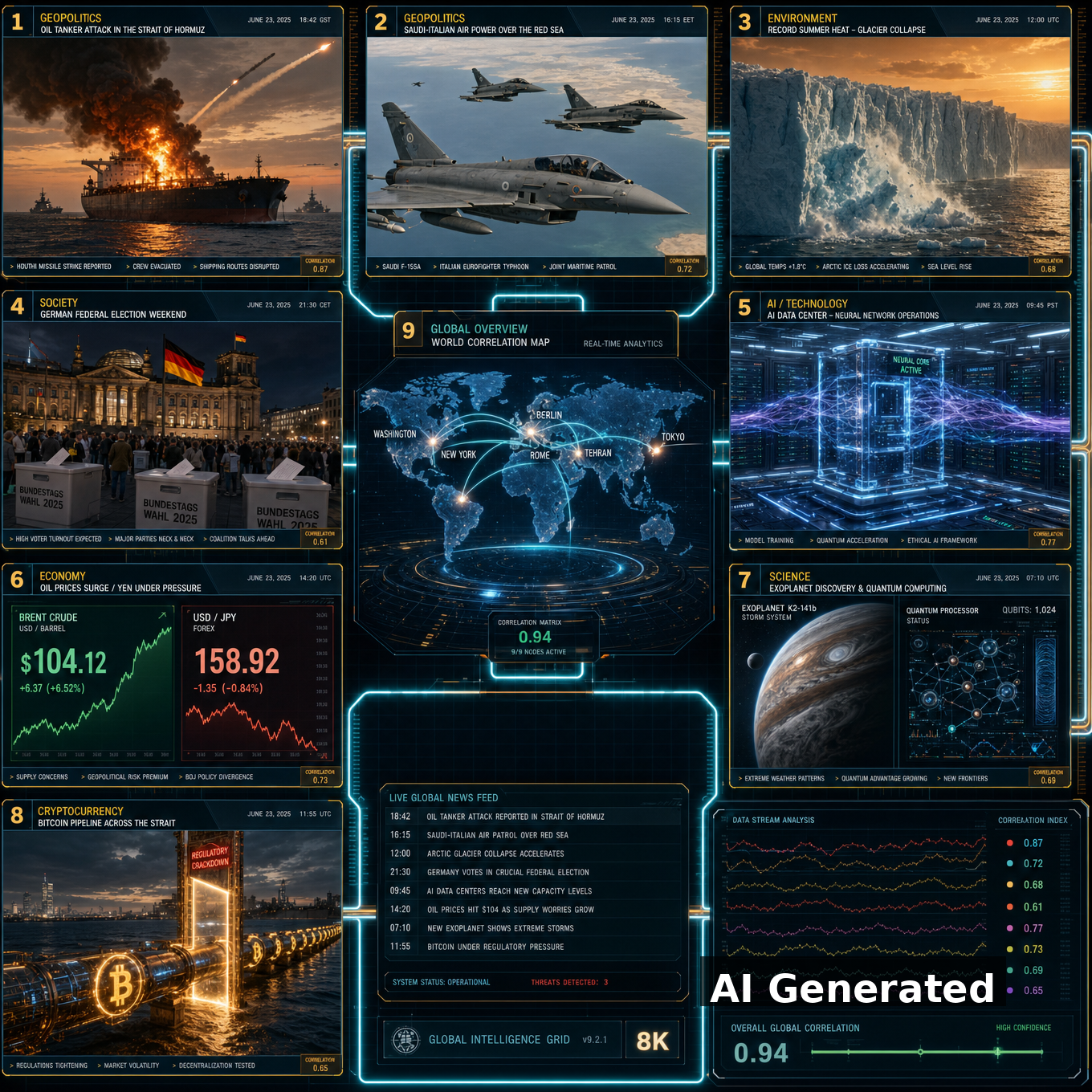


Contents
- 1. Geopolitics & Defence
- Hormuz’s Second Strike Wave and Tehran’s Annihilation Question
- The Red Sea Multiplication: Italy Acts Alone, Riyadh Buys an Air Force
- The Black Sea, a Managed Election, a Base Advanced
- Expulsions, Ultimatums and a French Exit
- Airpower’s Industrial Multiplier
- Budgets, Doctrine and Readiness
- UN Week’s Fragile Center, Korea’s Hedge, and the Campaign Map
- 2. Environment & Climate
- 3. Society & Civil Issues
- 4. AI & Technology
- 5. Economy & Business
- 6. Science & Space
- 7. Crypto, Digital Assets & Blockchain
- 8. Correlations & Analysis
- 9. References
Click any heading to jump to that section. Click the section heading to return to this menu.
Geopolitics & Defence
↑ ContentsHormuz’s Second Strike Wave and Tehran’s Annihilation Question
The ceasefire arithmetic that has governed Hormuz since D101 (2026-09-09) broke down again: strikes resumed in the strait and Iran claimed it attacked a tanker directly[1]. The timing is the story — it follows the secret US–Houthi understanding reported in D109, so the two chokepoints have formally diverged: one negotiated, one re-escalated. Traffic data confirms the asymmetry, with just four commodity ships transiting Thursday against a ten-day average near sixteen[2]. A blockade holding at one-quarter throughput is no longer a shock; it is the operating baseline for the world’s oil artery.
Trump’s account to Axios — “I want to go in and annihilate them, or not; it’s a big decision” — reframes the Gulf theatre as a decision awaiting signature days before his meeting with six Gulf leaders at UNGA[3]. Simultaneously, a UN-backed commission found the earlier Minab strikes could constitute war crimes, formally entering the legal ledger[4], while the House again voted against an Iran war authorization[5] — three branches of one state pulling in three directions.
The Red Sea Multiplication: Italy Acts Alone, Riyadh Buys an Air Force
Italy will deploy warships to guarantee its commercial shipping’s passage through Bab al-Mandab — explicitly bypassing EU decision-making and the Aspides mandate debate[6]. Crosetto framed it in cost terms: delays raise prices for households, and Rome will not wait for Brussels. A European navy has now publicly chosen national convoy protection over collective process — a template others under fuel pressure may copy. Washington’s counterweight: a $24.3 billion sale of 48 F-35s to Saudi Arabia, the Kingdom’s first and the first to any Arab state, raising dual anxieties over Chinese technology exposure and Israel’s qualitative edge[7]. Defencenet reads it as Riyadh paying for American protection against the Houthis[8]. The Houthis, meanwhile, projected power outward: a 48-hour ultimatum to Syria’s al-Sharaa to withdraw Syrian units fighting in Yemen — or Damascus’s Republican Palace gets hit with missiles[8].
The Black Sea, a Managed Election, a Base Advanced
Russia’s drone campaign reached the Danube delta: the strike on Turkish-linked, Tanzania-flagged M/V Mariam M in the Bystre canal killed the captain and left the bridge ablaze as the ship ran from Latakia toward Galati[9] — the shipping war now at NATO’s southeastern border waters. Russia’s Duma elections opened Friday, a three-day controlled vote from which the only anti-war party was excluded[10] — removing any electoral brake on war policy through 2031. On NATO’s side, Trump declared “major progress” toward a US Army base in Poland, converting the 10,000-soldier presence toward a permanent foothold[11].
Expulsions, Ultimatums and a French Exit
The drone tit-for-tat has consumed both consular footprints: Germany closed Russia’s Bonn consulate over the Leipzig incident; Moscow retaliated by shutting Germany’s St Petersburg consulate after 50 years, staff expelled by 18 September[12][13]. Wadephul calls the measures harsh but insists dialogue continues — a posture harder to sustain as every channel but diplomacy itself is dismantled. Armenia’s Pashinyan escalated his rupture with Moscow, declaring the Gyumri base unnecessary and Moscow’s troops can leave “even tomorrow” — against a deployment formally extended to 2044[14]. In Paris, rural-affairs minister Michel Fournier left the Lecornu government, expected to resume his rural mayors’ association presidency — more attrition in an executive whose market standing is fraying[15].
Airpower’s Industrial Multiplier
Lockheed Martin and the Pentagon signed a framework to accelerate AIM-260 JATM production, the classified air-to-air missile meant to counter Chinese long-range munitions, groundwork for a multi-year procurement after Australia signed on first[16]. A $74.9 million contract brings the B-21’s first Missouri RF hangar to Whiteman AFB, extending stealth-bomber basing beyond Ellsworth[17]. Watching the Navy’s MQ-25 enter low-rate production, Air Mobility Command openly questioned whether the next USAF tanker needs to be manned, with Merlin’s C-130J autonomy kit as bridge[18]. On the ground, GM Defense delivered its first PAC-3 MSE Patriot components to Lockheed just 22 days after signing, as Washington pushes output from ~600 toward 2,000 interceptors a year[19]. The asymmetry persists: China now builds roughly 70 percent of global shipping and is outpacing US nuclear-submarine production from Bohai, with two Type-096 SSBNs and the nuclear Type-004 carrier visibly under construction[20].
Budgets, Doctrine and Readiness
Space Force warned the continuing resolution will stall about 10 percent of its programs — precisely the new-start modernization the threat demands[21]. Britain is seeking NATO partners for a space-based missile-warning network inside a £790 million Integrated Air and Missile Defence investment[22]. Greece’s Houpis used the IISS Prague summit to detail the “Oplitis-Politis” model — home-region conscription, 70 percent operational readiness within 14 weeks, digital mobilization, women’s pilot programmes, dual-use infrastructure — arguing a professional army alone cannot produce the mass a long European war requires, with nine EU states now keeping conscription[23]. Readiness incidents bracketed the week: a Texas Air National Guard F-16 crashed in Michigan, pilot ejected, one-mile evacuation for a chemical spill[24], and seven contractors were injured — four critically — in an ordnance-clearance explosion at a Swedish firing range[25].
UN Week’s Fragile Center, Korea’s Hedge, and the Campaign Map
Guterres, leaving office, conceded a world “deeply divided” and a Security Council paralyzed on exactly the conflicts dominating this report[26]. The UNSC Syria session turned confrontational, Damascus calling Israel “the greatest threat” to regional stability as Israel and Türkiye traded accusations over troops on Syrian soil[27]. South Korea’s Lee is reviewing expanded involvement over Hormuz while ruling out troops[28], and confirmed Trump is seeking direct talks with Kim Jong Un — an opening Seoul itself called uncertain[29]. Washington also signalled its closest Caracas ties since the rupture: a planned first Trump–Rodríguez meeting in New York[30], even as Venezuela only partially lifted censorship — 188 sites including 79 media remain blocked, and an opposition mayor was arrested the same day[31]. Netanyahu opened Israel’s campaign pledging “we take land instead of giving it”[32]; Abyei’s interethnic clashes killed 26[33]; and Colombian armed groups’ drone attacks more than doubled in early 2026, civilians caught between insurgents and the state[34].
Environment & Climate
↑ ContentsA Summer That Broke the Baseline, Glaciers Included
Europe closed the hottest summer in its instrumental record as the single “most unusually hot place on the planet”, and Euronews’ reporting frames the season explicitly as the human and economic cost of fossil fuels playing out in real time — with the awkward corollary that renewables are now expected to supply the cooling that fossil combustion has made necessary[35]. The Alps provided the sharpest physical data point: Switzerland’s Glacier Loss Day — the date when winter snow accumulation is fully melted — fell on 29 June 2026, which GLAMOS head Matthias Huss called “three months too early compared to a healthy state”, making this the earliest glacier-loss day in the monitoring record[36]. Glacier mass balance is the cleanest single climate indicator precisely because it integrates temperature and precipitation without urban interference; an earliest-ever loss day is the Alps telling the network what the thermometers already know.
The cryosphere’s losses are now being confirmed as permanent rather than episodic. A new study confirms that Canada’s last Arctic epishelf lake — a rare freshwater body held behind the Milne Ice Shelf — drained permanently into the Arctic Ocean after the 2020 ice-shelf breakup and will not recover[37]. That is a habitat category erased from the Arctic, not merely reduced.
Water Everywhere and Nowhere: Krakatoa, Tunis, Vietnam, the Mekong
Indonesia’s Krakatoa search operation formally ended after ten days, with authorities terminating efforts to find the eight missing — among them five journalists who had travelled to record the eruption[38]. The case underscores how volcanic monitoring remains lethal work even for professionals equipped to be there. In Tunisia, recurring flash floods again paralysed central Tunis, trapping motorists and residents and renewing questions about drainage capacity and flood preparedness in a capital repeatedly caught out by Mediterranean rain events[39]. Northern Vietnam’s flooding was more severe still: more than 50 centimetres of rain in places submerged over 2,000 homes, isolated more than 1,000 households, and damaged roughly 10,000 hectares of rice and other crops across Ninh Binh, Thanh Hoa and Nghe An — in one of the world’s most climate-vulnerable countries, which reorganised its flood management after last year’s storm sequence[40].
The Mekong’s Irrawaddy dolphins — the river’s sole cetaceans and the economic anchor of Cambodian dolphin-watching communities — show cautious stabilisation in the Kampi pool even as the river’s ecological crisis deepens around them, a reminder that species protection and river health are now the same policy problem[41]. In the American West, Idaho’s water managers are describing a regime shift: Snake River flows declining and allocations tightening to the point that the state’s water reality “can no longer be ignored”, with this year framed as structurally different from past droughts[42].
Heat Equity, Smoke Forecasting and the Advertising Ledger
South Tacoma’s pole-by-pole temperature network — 53 utility poles, 46 usable loggers, one low-canopy neighbourhood — found same-moment temperature differences averaging 2.57°C and modelled a full tree canopy at roughly one degree of cooling, enough to materially change the odds of crossing human-health temperature thresholds; the study area’s poverty rate was roughly triple the county’s[43]. Stanford’s new smoke-forecasting approach takes the same granular logic to wildfires, bolting briefcase-sized toxic-metal monitors onto fire trucks dispatched to active fires, aiming to forecast heavy-metal exposure rather than merely smoke density[44].
The war economy is now visible in the climate-communications economy: advertising and PR contracts with Big Oil hit a record high as Iran-war profits soared, with campaigners noting agencies are “nowhere close” to dropping fossil clients[45]. The connection to the week’s geopolitics is direct — the same war that broke $100 oil is financing the industry’s public-image defence.
CCS Grows Up, Aviation Burns Cleaner, Tunnels Take Longer
Denmark’s Greensand project formally entered regular operation, with King Frederik X opening the first EU industrial-scale CO2 storage site beneath the North Sea — 400,000 tonnes a year initially, with ambitions of four to eight million — even as Aalborg professor Brian Vad Mathiesen called the volumes “unfathomably small” in a European climate-neutrality perspective and price remains the binding constraint[46]. EASA’s first full ReFuelEU annual report found the SAF blending mandate functioning in its first mandatory year, shifting the bottleneck to e-fuel investment rather than compliance[47]. Air France changed the trajectory of 130 flights specifically to avoid condensation trails, the first visible operational response by a major carrier to contrail-induced warming[48].
Infrastructure stories carry their own climate timelines: New York’s 1,350-tonne tunnel boring machine Nora completed its 2.5-mile Delaware Aqueduct bypass beneath the Hudson years ago, but the city now expects the connections — and another shutdown of the aqueduct that carries half its drinking water — only around 2031-32[49]. Geothermal and battery capital kept flowing: Khosla-backed Mazama Energy raised $135 million to drill three miles into super-hot rock, targeting 15 MW baseload per well[50]; Arevon broke ground on the expanded 250 MW/1,000 MWh Cormorant lithium-iron-phosphate facility in California, dispatchable for four hours and contracted to MCE[51]; and Cabot Corporation put $125 million into conductive carbons and carbon nanostructures in Louisiana and Texas with a $50 million DOE grant, explicitly targeting battery demand from storage, electrification and AI data centers[52].
The common thread across the energy buildout is that capital is arriving faster than physics allows. Mazama’s super-hot-rock wells, Arevon’s four-hour battery and Cabot’s conductive carbons all serve the same grid-stability problem from different directions — firm geothermal baseload, evening peak shifting, and electrode chemistry — yet all three name the same bottleneck: interconnection queues and specialized materials supply, not financing[48][49][52]. Denmark’s CCS operators make the identical complaint from the capture side, with price, not geology, limiting volumes[44]. The pattern echoes what earlier reports traced through grid storage: the transition’s binding constraints have migrated from capital markets to industrial inputs and permitting time.
Society & Civil Issues
↑ ContentsGermany’s Super-Election Weekend: Berlin’s Knife-Edge and Merz’s Numbers
Berlin goes to the polls on Sunday with the Linke at 22 percent and the CDU at 20 in the final ZDF Politbarometer, the AfD on 18, and 23 percent of voters still undecided — with no two-party combination mathematically able to govern, making a three-party coalition the near-certain outcome of the capital’s vote[53]. Chancellor Merz made his first and only campaign appearance two days out, calling for a united fight against antisemitism and framing the election as a referendum on his reform course[53]. In Mecklenburg-Vorpommern, the same weekend’s other contest, polling now puts the SPD back ahead of the AfD ahead of Sunday’s vote — a modest but symbolically loaded reversal in the east[54].
The national mood underneath is darker: 48 percent of Germans expect Friedrich Merz to be replaced as chancellor before 2027 following his electoral losses, even as he states plainly that he will not resign[55]. The Handelsblatt’s immersion in the right-wing media ecosystem — where the Merz government’s crisis reads as the prelude to a “third German dictatorship” and the AfD stands at the brink of another Landtag triumph — documents the parallel information sphere in which this weekend’s ballots will be interpreted[56].
Mobility, Machine-Border and Organ Donation
Germans are emigrating to Poland at rates unseen in years, a Handelsblatt analysis finding the eastern neighbour newly attractive on cost, housing and distance — an intra-EU migration flow with direct implications for Germany’s structural labour debate[57]. Washington’s immigration machine hit its own turbulence: Trump abruptly withdrew the ICE director nomination of Lance Schroyer without explanation, while the agency sits at the centre of criticism over arrest and deportation operations[58]. In the Bundestag, 58 cross-party MPs have lined up against the planned organ-donation presumed-consent (Widerspruchsregelung) model ahead of next week’s debate[59].
Public health stories bracketed the continent: two new malaria cases in Frankfurt — one fatal — push local transmission beyond the airport perimeter for the first time, a small number with outsized signal value for vector-borne disease in a warming Germany[60]. Across the wider continent, a Lancet-published study found child vaccination coverage declining for at least four of seven tracked vaccines in sixteen EU countries since the pandemic, reversing decades of accumulated gains[61].
Mass Deaths, Accountability and the Justice Ledger
Nigeria’s detention system produced two separate catastrophes this window: 48 people died and 182 were poisoned, apparently by methanol-laced herbal drinks — “after two drinks I could not see anything,” one survivor told Der Spiegel[62] — while separately, 37 men suspected of being illegal miners died in a Niger-state detention cell, prompting three days of mourning and a postponed presidential campaign in a gold-rush region flooded with artisanal miners[63]. In Egypt, the killing of a teenage girl by her brother ignited a debate about the police itself after officers circulated images of her with a man — the exposure preceding the killing[64].
Montreal police ordered officers to stop using the “hog-tie” restraint after a coroner found it likely contributed to a man’s death, a direct policy reversal from a coroner’s finding[65]. In Haiti, a new human-rights report laid out new details of one of the country’s biggest recent massacres and blamed police security failures as gangs continue to outgun the state[66]. And a US federal court sentenced a former Assad-regime officer to 60 years for torturing prisoners under the fallen regime — one of the first major judicial accountings of Syria’s security apparatus on American soil[67].
Free Expression Under Pressure, and the Midterm Message
PEN America’s incoming president, decorated veteran-author Phil Klay, inherits an organisation riven by the Israel-Hamas war, an institutional rift he inherits at exactly the moment PEN’s own community is fracturing over the same questions roiling the week’s diplomacy[68]. Independent voters delivered a blunt verdict on the Republican midterm convention in Dallas: no impact — despite Trump’s promised $5,000 checks contingent on the party holding Congress, the key bloc was unfazed, sharpening the stakes for the midterm map[69]. And in London, Kemi Badenoch instructed lawyers to challenge a 94 percent council-tax increase in a Tory-run Wandsworth council, blaming central-government cuts — a constitutional-finance fight that tests who owns local austerity[70].
The connective tissue between these stories is institutional trust under load. The Bundestag’s organ-donation revolt is a legislature second-guessing its own health bureaucracy ahead of the vote[59]; Washington’s unexplained withdrawal of an ICE director nomination leaves the deportation machine without confirmed leadership mid-controversy[58]; and the new German migration to Poland reads as households voting with moving vans on affordability[57]. Where institutions cannot resolve distribution questions, the pressure moves to exits — emigration, nomination withdrawal, cross-party rebellion — rather than policy settlement.
AI & Technology
↑ ContentsFrontier Labs: Self-Assembly, a Breach, an IPO and a Math Problem
Anthropic confirmed that Claude is now materially accelerating the development of its own successor, a milestone in recursive AI development framed with unusual openness by the lab[71]. OpenAI, meanwhile, is reportedly trying to solve the Hodge Conjecture — one of the Millennium Prize Problems — with The Information reporting the company’s primary concern is not the mathematics but being able to announce a result without further enraging the mathematics community it is already feuding with[72].
Security and capital converged on the same labs. A security breach exposed OpenAI vulnerabilities via Anthropic’s Claude system, the Wall Street Journal reported, with potential fallout for OpenAI’s security credibility and investor trust precisely as competition intensifies[73]. Anthropic’s IPO, meanwhile, is drawing attention as AI-infrastructure spending is set to rise, with markets pricing an above-$200 billion valuation by December[74]. Crusoe raised $3.9 billion at a $30.9 billion valuation to build massive data centers and modular “AI factories”, extending the compute-buildout financing arc that previous reports have tracked[75].
The Slop Reckoning: From the Podium to the Inbox
The AI-workplace backlash gained its most vivid language yet: Shopify CEO Tobias Lütke — who ordered AI use as a “baseline expectation” last year — now says employees’ unexamined AI output amounts to “slop grenades” that colleagues must clean up, with BetterUp/Stanford surveying 962 desk workers and finding 52.7 percent admitted sending such output, costing receivers an average 3.4 hours a month[76]. Pangram extended its AI-detection tool into Gmail, flagging machine-written emails — the detection arms race moving into everyday communication[77]. Google’s revamped CC pushes the agent frontier in the opposite direction, giving families and groups a shared AI agent with its own account and daily briefings[78]. And a Pew poll across 37 countries found 46 percent of people expect AI to eliminate more jobs than it creates, against just nine percent who expect net creation — a stark baseline for the labour-politics argument now reaching school gates and ad breaks[79].
Autonomy Moves Into Regulated Space
AI-assisted air-traffic control is coming to some of the United States’ busiest skies, initially as a real-time decision tool during unexpected disruptions and eventually to predict traffic flows days ahead — a landmark deployment of AI into safety-critical national airspace[80]. Waymo named Singapore as its next international robotaxi city, with vehicles arriving within months and public service targeted by 2028 pending LTA safety assessment[81]. Amazon-owned Zoox’s 100-robotaxi cap in Nevada expires this month just as Las Vegas competition intensifies[82], while NHTSA’s 21-point information demand on Tesla’s Cybercab rollout showed regulators pulling the robotaxi sector under formal scrutiny[83].
Startup activity rounded out the picture: PrismML’s tiny LLM is betting that small, efficient models can change how AI is consumed[84], and Google DeepMind launched an institute to widen the AGI debate — explicitly designed to surface disagreement between Google, DeepMind and the global research community as the frontier moves[85]. On the hardware side, a mist-based aerosol-jet printing method now deposits precision circuits on complex curved 3D surfaces with NASA-backed commercialization behind it[86], and Royal Mail is deploying an AI calculator to estimate the supply-chain emissions of new vendor contracts before they are signed — AI applied to Scope-3 carbon governance[87].
The financing pattern completes the picture: Anthropic’s IPO track toward a $200 billion-plus valuation, Crusoe’s $3.9 billion for AI factories, and PrismML’s efficiency-first seed thesis represent three different bets on the same compute demand curve — equity in frontier models, debt-financed infrastructure, and a hedge that small models collapse the cost curve from below[74][75][82]. The breach disclosure landing mid-raise shows the risk these valuations now carry: security incidents at frontier labs are no longer operational footnotes but pricing events for the entire AI capital complex.
Economy & Business
↑ ContentsDigesting the Hike: Oil Near $104, Yen at 156, a Strong Yuan
Markets opened Friday on a tepid footing after the Federal Reserve’s hike, with Asian indices mixed as traders assessed the hawkish dot-plot and Brent crude holding near $104 — the war premium still embedded in every barrel[88]. Japan’s core inflation has now run below the Bank of Japan’s target for eight consecutive months, yet the mix of stable core prints and a wobbling yen has made a rate hike “ever more likely”, with the yen sliding to 156 per dollar ahead of the decision[89][90]. The BOJ-versus-Fed divergence is now the central banks’ chapter of the same chokepoint story D109 traced through households.
China’s currency crossed a milestone of its own: the offshore yuan hit its strongest level since July 2022, a signal of capital flows turning with the dollar’s post-hike course[91].
Sovereigns Under the Microscope: France, Greece, India
France is becoming the eurozone’s cautionary tale: rising protest risk and rising risk premia are compressing the government’s room for manoeuvre, with Handelsblatt reporting investors now demand visibly higher risk premia on French debt as social-unrest fears grow — a sovereign that has become a “risk case” for the euro area[92]. Greece’s energy inflation is back on the political agenda, with the government preparing support measures as high fuel prices return pressure to households — the cost-of-living season D109 opened now producing concrete intervention[93]. And India is quietly recruiting its diaspora: overseas deposits are being recruited to bolster rupee stability, boosting reserves while storing up future outflow risk[94].
Athens’ market season added a corporate data point: Athens International Airport hit a five-month high at €11.29 as investors rewarded its revised expansion-project timing — Greek equities riding the same tourism-and-infrastructure story previous reports tracked[95].
Automakers, Conglomerates and Media Money
Volkswagen exited the EuroStoxx 50 after Friday’s close — Europe’s largest automaker falling out of the eurozone’s benchmark index after a 22 percent year-to-date share decline and a nearly 60 percent five-year drawdown, to be replaced by Engie and Nokia[96]. Yet the same stock is suddenly the DAX’s best performer, up seven percent in a month on its restructuring plan — a divergence that says more about index mechanics than fundamentals[97]. India’s Tata Group moved closer to the market’s most-watched listing as the central bank pushes the holding company toward an IPO, with a behind-the-scenes leadership battle still unresolved[98].
Industrial policy and media consolidation moved in parallel: Thailand’s chip industry body called for front-end fabrication investment to move the country up the semiconductor value chain[99]; Panasonic Energy positioned its battery business squarely in the AI-demand boom[100]; the FCC cleared the Paramount-Warner fusion to take foreign financing — with voting control staying with the Ellison family — freeing Middle Eastern capital into US media[101]; and BYD is planning four European factories, a scale of localization that resets the EV trade map[102]. The structural caveat comes from Hamburg’s HRI institute: growth may return, but Germany’s population will get poorer as demographic and structural problems compound[103].
Asia’s industrial-financing realignment ran in parallel: Tata’s forced march toward listing under central-bank pressure, Panasonic positioning batteries for AI demand, and Thailand’s bid to climb the chip value chain all point the same direction — state-capital pushing industrial champions up the value chain while the war economy reprices their input costs[98][100][99]. That the FCC simultaneously waved Middle Eastern sovereign capital into Hollywood ownership shows how far the capital-map redraw extends beyond manufacturing into content itself.
Science & Space
↑ ContentsMedicine’s Vascular Frontier
A Nature Aging study has repaired the leaky blood-brain barrier in Alzheimer’s models by identifying fibronectin — a repair-scaffold protein — as the driver of barrier breakdown in APOE4-linked disease: APOE4, inflammation and amyloid-beta push astrocytes to overproduce fibronectin, which crowds the signals keeping brain vessels sealed; reducing the protein restored the barrier in zebrafish and human-cell models[104]. Columbia’s Çaghan Kızıl notes nature has already run the experiment: a rare loss-of-function FN1 variant cuts Alzheimer’s risk in APOE4 carriers by 71 percent. The therapeutic goal is now framed as selective curbing of pathological accumulation rather than elimination — a mechanistic, preclinical result, but a genuinely new target class for Alzheimer’s beyond plaque and tangles.
Natural History: A New Cat, Bumblebees and Crocodile Homing
Taxonomists announced Leopardus tilcayo, the first new wild-cat species identified in more than a century, arriving to immediate public affection and immediate conservation questions[105]. Meanwhile, hidden toxic-metal pollution is hitting bumblebees far harder than honeybees: Cambridge researchers found bumblebee pollen carried two to seven times the heavy-metal concentrations of honeybee pollen in the same Cambridgeshire landscape, meaning pollution exposure varies sharply between species sharing the same fields[106].
Bangladesh’s Sundarbans provided the week’s longest-running natural experiment: satellite-tracking five saltwater crocodiles — three held in captivity, one for roughly 22 years — found the captive-raised animals showed no homing toward their former enclosures, ranging on scales similar to wild crocodiles, while one translocated male travelled up to 34.3 kilometres a day covering an estimated 2,515 square kilometres in a bid to return toward his capture site[107]. The findings bear directly on how countries should release captive-bred crocodiles: captivity may not imprint a home, but translocation creates one worth escaping.
From Exoplanet Weather to Quantum Interfaces
Trinity College researchers developed a method to decode weather on the brown dwarf SIMP 0136, finding its variability driven by just two dominant processes — temperature change and vertical cloud structure — the closest thing yet to an exoplanet weather report[108]. KAIST’s 15-year graphene-oxide liquid-crystal program has matured from antibacterial toothbrushes into heat-conducting graphene fibres aimed at thermal management in aerospace[109]. And City College of New York physicists demonstrated microwave-to-optical conversion in the 2D magnetic semiconductor CrSBr across a 300 MHz bandwidth — magnons imprinting microwave signals onto laser light, a candidate interface between quantum processors and optical networks[110].
And a century-scale dataset underlined how environment shapes biology: South Korean women born in 1996 average about 20 centimetres taller than those born in 1896 — the largest female height gain recorded worldwide — with childhood nutrition and living conditions explaining more than genes, and North-South comparisons on the peninsula underscoring the divergence[111].
The week’s biomedical and physical results share a methodological signature: intervene on mechanism, not symptom. Repairing the blood-brain barrier by curbing fibronectin rather than attacking plaques[104], and converting quantum information between microwave and optical domains by exploiting a single material’s dual exciton-magnon physics[108], both reflect the shift from treating outputs to engineering the underlying substrate — in medicine and in quantum networking alike.
Crypto, Digital Assets & Blockchain
↑ ContentsHormuz Gets a Bitcoin Pipeline — and Washington Cuts It
The week’s most consequential crypto story sits exactly at the intersection of this report’s two dominant arcs: the US Treasury sanctioned Iran’s BitBank exchange, alleging it processed payments for the “Hormuz Safe” maritime scheme and moved hundreds of millions of dollars in Bitcoin to the IRGC[112]. For the first time since D101 opened the tanker war, the blockade itself has a cryptocurrency settlement layer, and Washington has responded with the sanctions tool rather than the interceptor. The intelligence picture that follows is direct: maritime-protection schemes and digital-asset rails are now fused, meaning enforcement actions against exchanges have become naval-policy instruments — and every shipping operator watching Hormuz must now also watch OFAC.
Washington’s Regulatory Chess: CLARITY’s Ghost, Tokenized Stocks Exempt
On Capitol Hill, the CLARITY Act’s collapse continues to organize both parties: Rep. Tom Emmer is still pushing for renewed discussion and possible passage before year-end, while Rep. Maxine Waters argues that passing the current text would effectively condone what she calls Trump’s “worst actions” in his family’s crypto deals — the same ethics-versus-market-structure tension that stalled the bill at cloture in D108[113]. The disagreement is now institutional rather than procedural: the failure has become a standing feature of the digital-asset agenda rather than an episode in it.
The Securities and Exchange Commission, meanwhile, moved where legislation could not: a new exemption pathway for tokenized US stocks buoyed Ondo Finance’s ONDO token and signalled a regulatory turn toward securities-on-chain — with Ondo positioned as the direct beneficiary and analysts eyeing resistance levels[114]. The regulatory optimism rather than price is the story: US policymakers signalled a structural shift on tokenized equities.
Institutional infrastructure is being assembled quietly and quickly. S&P Global agreed to acquire OpenZeppelin, the smart-contract security firm whose open-source contracts have secured more than $37 trillion in transferred value, days after leading a $110 million Series B extension in crypto-data provider Kaiko — a buildout of benchmarks, pricing and on-chain risk infrastructure for markets that never close[115]. When the world’s dominant ratings company owns the pricing data layer and the security layer, tokenized finance acquires a credit-infrastructure spine that did not exist two years ago.
Protocol Economics: Fees Collapse, Privacy Goes Default
Ethereum’s Fusaka upgrade is transmitting as a user-experience revolution: transaction fees dropped 87 percent as network capacity expanded, with average transfer costs falling from $0.72 in April to $0.095 — layer-2 scaling and a higher gas limit together easing mainnet congestion to levels that change what mainnet can economically host[116]. It is the first major protocol-arc data point since Glamsterdam was debated in D103, and it reframes Ethereum’s competitive position in cross-border payments.
NEAR Protocol launched the industry’s first “Confidential by Default” perpetuals trading, masking positions, sizes, entry times and direction on near.com — a direct challenge to the transparency orthodoxy that has defined DeFi market structure, powered by Hyperliquid integrations[117]. Sui, meanwhile, partnered with Daya to roll out gasless stablecoin payments across Africa, letting companies send USDC and other stablecoins without holding SUI tokens — stablecoin rails moving deeper into African payment networks where cross-border cost is the binding constraint[118].
Enforcement, Prohibition and the North Korean Ledger
Brazil’s government is drafting a provisional measure to ban online casino games and restrict sports betting by decree, a move reported weeks before an election that President Lula enters amid gambling-related concern — a prohibition track that would directly hit the crypto-casino nexus[119]. In Asia, Cointelegraph’s Asia Express documents North Korea and Iran accounting for the majority of on-chain malware deployments, while CoinEx shut operations — a reminder that the state-actor threat model that emptied Bybit in prior reports remains the industry’s most persistent security tail risk[120]. The week’s pattern is coherent: crypto’s rails are being pulled simultaneously into statecraft (Iran), securities law (SEC exemption), institutional benchmarks (S&P-Kaiko-OpenZeppelin), and criminal enforcement (Lazarus malware) — with each leg reinforcing the others.
The synthesis is that crypto’s institutional capture has crossed a threshold: when S&P Global owns the pricing data (Kaiko), the security layer (OpenZeppelin) and the benchmark rails, tokenized finance stops being an alternative market and becomes an extension of the rated, audited one[116]. The flip side is enforcement symmetry — the same state machinery that blesses tokenized equities with exemptions can freeze an Iranian exchange’s Bitcoin pipeline[115][112] or shutter a casino-adjacent sector by decree[120]. Integration, not permissionless drift, is now the industry’s governing reality.
Correlations & Analysis
↑ ContentsThe through-line of this window is the institutionalisation of everything D109 (2026-09-17) left hanging. The two-chokepoint war has now produced its first two formal test cases: Italy’s decision to convoy its own shipping past EU and Aspides decision-making [6] answers the question D108 raised about whether European states would act when Washington’s commitment wavered, while the BitBank sanctions [112] reveal that Hormuz’s blockade has acquired a Bitcoin settlement layer that Washington now treats as a naval target. Where D107 closed on physical infrastructure collapsing, this window shows the enforcement perimeter widening into finance — exchanges, not just tankers, are now in the line of fire.
The second structural continuity is the separation of political authority from operational reality. The UN commission’s finding that the Minab strikes could constitute war crimes [4] landed in the same window as a fresh House vote against war authorization [29] and a president openly weighing annihilation [3] — three branches of the same state pulling in three directions. That pattern extends to Russia, where a Duma election with no anti-war party [9] removes the last domestic brake through 2031, and to Armenia, where Pashinyan’s “leave even tomorrow” ultimatum [13] shows the post-Soviet security order being dismantled faster than any treaty process can manage. Germany’s consular expulsions [12] are the same story in diplomatic form: channels closing faster than they can be rebuilt.
The economy window confirms the transmission mechanics D107 and D109 mapped. Brent near $88 with Japan’s BOJ being pushed toward a hike by a 156 yen [88][89][90] is the chokepoint premium working through policy, not just prices; France’s risk-premium spiral [92] and Greece’s returning fuel measures [93] show the same scarcity transmitting into sovereign debt and household budgets. The week’s index news — VW leaving the EuroStoxx 50 while its stock rebounds [96][97] — is the same divergence in corporate form, and HRI’s warning that Germans will grow poorer regardless of growth [103] matches the anthological thread running from D103’s fuel-inflation coverage.
The AI arc has crossed from capability to accountability in a single window. Claude building its successor [71] arrived alongside a breach that exposed OpenAI through Anthropic’s own model [113], NHTSA’s formal demand list for Tesla’s robotaxi rollout [81], and a Pew poll showing 46 percent of 37 countries expecting net job destruction [79]. The Shopify “slop grenades” exchange [76] is the cultural hinge: the same executives who mandated AI are now naming its failure mode. Google DeepMind’s AGI institute [83] and the SEC’s tokenized-stock exemption [115] show regulators and labs both building institutions around a debate that has outgrown their control.
What to watch in the next reporting period: First, whether Hormuz traffic recovers after Thursday’s four-ship transit or the BitBank enforcement marks the start of a broader maritime-crypto enforcement campaign. Second, Sunday’s Berlin and Mecklenburg-Vorpommern results — a Linke-led Berlin or an AfD breakthrough rewrites the Brandmauer arithmetic D106 documented. Third, whether the Emmer-track CLARITY revival produces text before year-end, and whether the SEC exemption and the reserve bill converge into a single market-structure package. Fourth, whether the US–Houthi understanding holds formally or leaks, and whether Hormuz’s postponed diplomatic track resumes before the nuclear threshold D106 flagged gets crossed. Finally, watch the AIM-260 multi-year procurement and GM’s PAC-3 output for the industrial-base data points that will tell us whether the war economy is becoming permanent.
References ↑ Contents
1. “Les frappes reprennent dans le détroit d’Ormuz, l’Iran affirme avoir attaqué un pétrolier” — France via d k on Inoreader, 2026-09-18. (originally in French) link ↑
2. “FinancialJuice: Four commodity ships pass Strait of Hormuz on Thursday vs 10-day average near 16, data shows:” — FinancialJuice, 2026-09-18. link ↑
3. “Ν.Τραμπ: «Να μπω μέσα στο Ιράν να τους εξοντώσω ή όχι – Έχω απόφαση να πάρω»” — DEFENCE via d k on Inoreader, 2026-09-17. link ↑
4. “UN findings show US strikes on Minab could be war crimes” — NEWS via d k on Inoreader, 2026-09-18. link ↑
5. “+++ USA +++: US-Post stoppt Arbeit an umstrittenem Computersystem für Briefwahl” — Redaktion Handelsblatt, 2026-09-18. link ↑
6. “Italy to deploy warships to protect shipping through Bab al-Mandeb” — NEWS via d k on Inoreader, 2026-09-18. link ↑
7. “L’administration Trump vent 48 avions F-35 à l’Arabie saoudite, malgré des craintes que la Chine en étudie la technologie” — France via d k on Inoreader, 2026-09-18. (originally in French) link ↑
8. “Οι Χούθι προειδοποιούν τον Α.Τζολάνι: «Απέσυρε τον στρατό που έστειλες στην Υεμένη άμεσα»” — DEFENCE via d k on Inoreader, 2026-09-17. link ↑
9. “Ρωσικό drone κτύπησε τουρκικό φορτηγό πλοίο στο κανάλι Μπίστρε στο Δέλτα του Δούναβη (βίντεο)” — DEFENCE via d k on Inoreader, 2026-09-17. link ↑
10. “Russians go to polls against backdrop of Ukraine war and Putin’s tightening grip” — Pjotr Sauer, 2026-09-18. link ↑
11. “Création d’une base américaine en Pologne : Donald Trump fait état de “progrès majeurs”” — FRANCE 24, 2026-09-18. (originally in French) link ↑
12. “Nach Schließung des Konsulats: Deutschlands schwieriger Kurs gegenüber Russland” — Germany via d k on Inoreader, 2026-09-18. (originally in German) link ↑
13. “H Ρωσία έκλεισε το γερμανικό προξενείο στην Αγ.Πετρούπολη! – Κατέβασε την σημαία της Γερμανίας!” — DEFENCE via d k on Inoreader, 2026-09-17. link ↑
14. “Ο Ν.Πασινιάν δεν έχει πρόβλημα να κλείσει η ρωσική βάση στην Αρμενία: «Ας φύγουν και αύριο»” — DEFENCE via d k on Inoreader, 2026-09-17. link ↑
15. “Michel Fournier, ministre délégué chargé de la ruralité, quitte le gouvernement” — France via d k on Inoreader, 2026-09-17. (originally in French) link ↑
16. “Lockheed Martin and Pentagon Agree Framework to Ramp Up AIM-260 JATM Production” — Kai Greet, 2026-09-18. link ↑
17. “US Air Force starts Missouri’s first $75M hangar for $700M stealth B-21 bomber fleet” — Aamir Khollam, 2026-09-17. link ↑
18. “Air Force contemplates unmanned tankers” — Lauren C. Williams, 2026-09-17. link ↑
19. “Η αμερικανική βιομηχανία μεταπίπτει σε πολεμική: Η General Motors θα κατασκευάζει πυραύλους Patriot” — DEFENCE via d k on Inoreader, 2026-09-17. link ↑
20. “China Is Building Nuclear Submarines and Aircraft Carriers Faster Than the US Navy Ever Dreamed Possible” — Isaac Seitz, 2026-09-17. link ↑
21. “Space Force braces for stalled progress amid lack of full funding” — Lauren C. Williams, 2026-09-17. link ↑
22. “UK seeks allies for space-based missile warning network” — Lisa West, 2026-09-17. link ↑
23. “Ο Α/ΓΕΕΘΑ μίλησε για την ανάγκη του «Οπλίτη-Πολίτη» – Περιέγραψε τις αλλαγές που πρέπει να γίνουν” — DEFENCE via d k on Inoreader, 2026-09-17. link ↑
24. “F-16 fighter jet crashes in residential area in northern Michigan” — Joe Kottke, 2026-09-18. link ↑
25. “Σουηδία: Ισχυρή έκρηξη σε πεδίο βολής – Τουλάχιστον επτά τραυματίες” — DEFENCE via d k on Inoreader, 2026-09-17. link ↑
26. “Preparing to leave office, with world beset by problems, UN chief talks of a way forward” — Edith M. Lederer, 2026-09-18. link ↑
27. “Syria warns Israel poses ‘the greatest threat’ to Middle East stability” — NEWS via d k on Inoreader, 2026-09-18. link ↑
28. “South Korean President Lee Jae Myung faces pressure from Trump amid policy struggles” — Estefano Gomez, 2026-09-18. link ↑
29. “FinancialJuice: S.Korea president Lee: Trump seeks talks with N.Korea” — FinancialJuice, 2026-09-18. link ↑
30. “Axios: Ο Τραμπ σχεδιάζει να συναντηθεί με την υπηρεσιακή πρόεδρο της Βενεζουέλας” — Άλκης Αποστολόπουλος, 2026-09-18. (originally in Greek) link ↑
31. “Le Venezuela débloque l’accès en ligne à plusieurs médias censurés depuis des années” — FRANCE 24, 2026-09-18. (originally in French) link ↑
32. “Netanjahu startet Wahlkampf: „Wir nehmen Land, anstatt es abzugeben“” — Germany via d k on Inoreader, 2026-09-18. (originally in German) link ↑
33. “Des affrontements interethniques font 26 morts dans la région d’Abyei que se disputent les deux Soudan” — France via d k on Inoreader, 2026-09-18. (originally in French) link ↑
34. “Drone attacks by Colombian armed groups more than double in early 2026” — NEWS via d k on Inoreader, 2026-09-18. link ↑
35. “Europe was the ‘most unusually hot place on the planet’ this summer. Can renewables cool us down?” — EHN Curators, 2026-09-17. link ↑
36. “Europe’s earliest glacier loss day in years signals a reckoning for the Alps” — Science & Space via d k on Inoreader, 2026-09-18. link ↑
37. “Study Confirms Permanent Loss of Canada’s Last Arctic Epishelf Lake” — Environment via d k on Inoreader, 2026-09-17. link ↑
38. “Δέκα ημέρες αγωνίας στο Κρακατόα: Τερματίστηκε η επιχείρηση για τους 8 αγνοούμενους” — Greece via d k on Inoreader, 2026-09-18. (originally in Greek) link ↑
39. “Tunisia floods disrupt capital as heavy rain traps motorists and residents” — NEWS via d k on Inoreader, 2026-09-18. link ↑
40. “Heavy rain and floods in northern Vietnam submerge homes and disrupt economy” — Mongabay Editor, 2026-09-17. link ↑
41. “Mekong’s Irrawaddy dolphins find cautious hope amid a river in crisis” — Isabel Esterman, 2026-09-17. link ↑
42. “‘This year is different’: The water reality Idaho can no longer ignore” — EHN Curators, 2026-09-17. link ↑
43. “Researchers bolted temperature loggers to 53 utility poles in South Tacoma and got usable data from 46, the rest lost to vandalism, theft or other damage. Readings taken at the same moment differed by 2.57 degrees Celsius on average, and full tree canopy within 10 meters was modeled to make a location 1 degree cooler than one with none.” — Natural History, 2026-09-18. link ↑
44. “A New Approach to Forecasting Toxic Metals in Wildfire Smoke” — Environment via d k on Inoreader, 2026-09-17. link ↑
45. “Advertising contracts with Big Oil hit record high as profits soar from war in Iran” — EHN Curators, 2026-09-17. link ↑
46. “Kohlendioxid-Lagerung: CO2-Lager im Meeresgrund: Dänemark feiert Regelbetrieb” — Germany via d k on Inoreader, 2026-09-18. (originally in German) link ↑
47. “ReFuelEU’s First Year Shows the Mandate Works” — Transport & Environment (T&E), 2026-09-18. link ↑
48. “Pour éviter les traînées de condensation, qui aggravent le réchauffement, Air France a changé la trajectoire de 130 vols” — France via d k on Inoreader, 2026-09-17. (originally in French) link ↑
49. “A 1,350-ton machine named Nora dug a 2.5-mile tunnel 600 feet beneath the Hudson River to bypass a leak that can lose up to 35 million gallons of water a day, but New York may not connect it until 2031” — ECONEWS, 2026-09-17. link ↑
50. “Khosla-backed Mazama Energy just raised $135M to drill deeper into super-hot-rock geothermal” — Tim De Chant, 2026-09-18. link ↑
51. “California’s new 1,000 MWh energy storage facility can deliver 250 MW for four hours” — Neetika Walter, 2026-09-17. link ↑
52. “$125 million boost takes advanced battery materials toward US-scale production” — Neetika Walter, 2026-09-17. link ↑
53. “Abstimmung am Sonntag: Wahlkampf in Berlin geht zu Ende – Linke in Umfrage vorn” — Germany via d k on Inoreader, 2026-09-18. (originally in German) link ↑
54. “Γερμανία: Το κεντροαριστερό SPD περνά την ακροδεξιά AfD ενόψει των εκλογών στο Μεκλεμβούργο-Πομερανία” — Greece via d k on Inoreader, 2026-09-18. (originally in Greek) link ↑
55. “Σχεδόν οι μισοί Γερμανοί βλέπουν τον Μερτς εκτός καγκελαρίας πριν το 2027” — Greece via d k on Inoreader, 2026-09-18. (originally in Greek) link ↑
56. “AfD-Medien: „Es wäre der Beginn der dritten deutschen Diktatur“” — Sebastian Dalkowski, 2026-09-18. link ↑
57. “Migration: Warum wandern immer mehr Deutsche nach Polen aus?” — Christian Wermke, 2026-09-18. link ↑
58. “Ανατροπή Τραμπ στην ICE: Απέσυρε τον διορισμό του επικεφαλής της υπηρεσίας απελάσεων” — Greece via d k on Inoreader, 2026-09-18. (originally in Greek) link ↑
59. “Organspende: 58 Abgeordnete stellen sich gegen Widerspruchsregelung” — DIE ZEIT: Politik – Simon Sales Prado, 2026-09-18. (originally in German) link ↑
60. “Deux nouveaux cas de contamination de paludisme, dont un mortel, à Francfort, l’extérieur de l’aéroport maintenant concerné” — France via d k on Inoreader, 2026-09-18. (originally in French) link ↑
61. “La vaccination des enfants en recul dans plusieurs pays d’Europe, selon une étude” — France via d k on Inoreader, 2026-09-18. (originally in French) link ↑
62. “Mindestens 48 Tote durch gepanschten Kräuterdrink in Nigeria” — Germany via d k on Inoreader, 2026-09-18. (originally in German) link ↑
63. “Nigeria : enquête après la mort en détention de 37 hommes soupçonnés d’être des mineurs illégaux” — France via d k on Inoreader, 2026-09-18. (originally in French) link ↑
64. “En Égypte, une adolescente tuée par son frère, la police mise en cause pour avoir diffusé des images d’elle avec un homme” — France via d k on Inoreader, 2026-09-18. (originally in French) link ↑
65. “Montreal police order officers to stop using controversial ‘hog-tie’ restraint” — Alessia Simona Maratta, 2026-09-18. link ↑
66. “New human rights report unveils details and blames police for recent massacre in Haiti” — Danica Coto, 2026-09-18. link ↑
67. “Former Assad officer sentenced to 60 years in US for torture” — NEWS via d k on Inoreader, 2026-09-18. link ↑
68. “Prize-winning author Phil Klay takes over at PEN America amid Israel-Hamas war rifts” — Hillel Italie, 2026-09-18. link ↑
69. “Independent voters give Trump the truth: His midterm convention made no impact” — Rachel Dobkin, 2026-09-18. link ↑
70. “Badenoch has ‘instructed lawyers’ to challenge cuts to Tory-run London council” — Abbie Llewelyn, 2026-09-17. link ↑
71. “Anthropic says its model Claude is helping to build the next version of itself” — Kaitlyn Huamani, 2026-09-18. link ↑
72. “OpenAI Reportedly Trying to Solve Hodge Conjecture Amid Feud With Math Community” — Tom McKay, 2026-09-18. link ↑
73. “Security breach exposes OpenAI vulnerabilities via Anthropic’s Claude AI: WSJ” — Estefano Gomez, 2026-09-18. link ↑
74. “Anthropic IPO draws attention as AI infrastructure spending set to rise” — Estefano Gomez, 2026-09-18. link ↑
75. “Crusoe raises $3.9B to build massive data centers and small modular “AI factories”” — Marina Temkin, 2026-09-17. link ↑
76. “Shopify CEO says employees’ ‘slop grenades’ are making more work for everyone else” — Mia Osmonbekov, 2026-09-18. link ↑
77. “Pangram Can Now Check Your Gmail for AI Slop” — Bruce Gil, 2026-09-17. link ↑
78. “Google’s revamped CC is an AI agent for families and groups” — staff@engadget.com (Anna Washenko), 2026-09-17. link ↑
79. “Pessimism Reigns Over AI and Jobs, Pew Poll Finds” — Tom McKay, 2026-09-18. link ↑
80. “AI-assisted air traffic control is coming to some of the nation’s busiest skies” — Jasmine Fernández, 2026-09-18. link ↑
81. “Waymo says Singapore will be its next international robotaxi city” — Andrew J. Hawkins, 2026-09-18. link ↑
82. “Amazon-owned Zoox’s 100-robotaxi limit in Nevada is about to disappear” — Kirsten Korosec, 2026-09-17. link ↑
83. “No Wonder The Tesla Cybercab Launch Was So Underwhelming” — Tina Casey, 2026-09-17. link ↑
84. “PrismML hopes its tiny LLM could change how we all use AI” — Julie Bort, 2026-09-17. link ↑
85. “Google DeepMind launches institute to widen the AGI debate” — Aditya Mehta, 2026-09-17. link ↑
86. “New mist-based printing method builds precise circuits on complex curved 3D surfaces” — Neetika Walter, 2026-09-18. link ↑
87. “How Royal Mail will use AI to calculate supplier emissions” — Heather Clancy, 2026-09-17. link ↑
88. “Stock Market LIVE: GIFT Nifty signals tepid open; Asia markets rise; Brent crude near $104” — Business via d k on Inoreader, 2026-09-18. link ↑
89. “Asien: Japans Kerninflation bleibt stabil – Notenbank vor Zinserhöhung” — Reuters, 2026-09-18. link ↑
90. “Yen falls to 156 per dollar on softer inflation before BOJ rate move” — Business via d k on Inoreader, 2026-09-18. link ↑
91. “FinancialJuice: China’s offshore yuan hits strongest level since July 2022” — FinancialJuice, 2026-09-18. link ↑
92. “Staatsdefizit: Proteste, Schulden, Nervosität: Frankreich wird an den Finanzmärkten zum Risikofall” — Friederike Hofmann, 2026-09-18. link ↑
93. “5 το πρωί: Ερχονται μέτρα για τα καύσιμα – Νέα ερωτήματα για τον ΙΣΑ – 13 χρόνια από τη δολοφονία Φύσσα” — Μανιαδάκη Κατερίνα, 2026-09-18. (originally in Greek) link ↑
94. “Indian government recruits overseas Indians to bolster rupee stability” — Editorial Team, 2026-09-18. link ↑
95. “Χρηματιστήριο: Τι απογειώνει τον ΔΑΑ” — Γεράσιμος Χιόνης, 2026-09-18. (originally in Greek) link ↑
96. “Abstieg aus Aktienindex: Warum VW nicht mehr zur europäischen Börsen-Elite gehört” — Germany via d k on Inoreader, 2026-09-18. (originally in German) link ↑
97. “Aktie im Blick: Warum boomt mit einem Mal die Volkswagen-Aktie?” — Ulf Sommer, 2026-09-18. link ↑
98. “Tata-Gruppe: Börsengang von Indiens größtem Konglomerat rückt näher” — Mathias Peer, 2026-09-18. link ↑
99. “Thailand must invest in front-end chip production, industry body says” — Business via d k on Inoreader, 2026-09-18. link ↑
100. “Panasonic Energy gets in on AI demand boom” — Business via d k on Inoreader, 2026-09-18. link ↑
101. “Entertainment: US-Aufsicht FCC erlaubt ausländische Gelder für Paramount-Warner-Fusion” — Reuters, Bloomberg, 2026-09-18. link ↑
102. “BYD Planning 4 Factories in Europe” — Z. S., 2026-09-18. link ↑
103. “HRI-Konjunkturprognose: Wachstum ja, aber Deutschlands Bevölkerung wird trotzdem ärmer” — Dennis Huchzermeier, Bernhard Köster, Axel Schrinner, 2026-09-18. link ↑
104. “Blood-Brain Barrier Successfully Repaired in Alzheimer’s Models” — Esra Öz, 2026-09-18. link ↑
105. “Congratulations, World: A New Super-Cute Cat Species Has Been Found” — Tyler Lacoma, 2026-09-17. link ↑
106. “Hidden Toxic Metal Pollution Is Hitting Bumblebees Much Harder Than Honeybees” — University of Cambridge, 2026-09-18. link ↑
107. “Three saltwater crocodiles that had spent years in captivity in Bangladesh, one of them held for about 22 years, showed no sign of heading back toward the facilities that had kept them over as many as 127 days of satellite tracking in the Sundarbans, while a wild-caught male released what the paper puts at 131.8 kilometres from his capture site ranged over an estimated 2,515 square kilometres and moved up to 34.3 kilometres in a day” — Science Blog Editorial Team, 2026-09-18. link ↑
108. “Researchers Develop a Way to Check the Weather on a Exoplanet” — Matthew Williams (https://www.universetoday.com/authors/hous, 2026-09-18. link ↑
109. “From toothbrushes to aerospace: Graphene research advances fibers that conduct heat efficiently” — Science & Space via d k on Inoreader, 2026-09-18. link ↑
110. “2D magnetic semiconductor bridges microwaves and light in 300MHz quantum push” — Aamir Khollam, 2026-09-18. link ↑
111. “South Korean women born in 1996 were about 20 centimeters taller on average than those born in 1896, the biggest gain recorded for women worldwide, and researchers say childhood nutrition and living conditions explain more than genes” — Adrian Villellas, 2026-09-17. link ↑
112. “US sanctions Iran’s BitBank, saying it processes ‘Hormuz Safe’ Bitcoin payments” — Cointelegraph by Felix Ng, 2026-09-18. link ↑
113. “Waters and Emmer Clash Over CLARITY Act Failure and Trump Deals” — Sergio Goschenko, 2026-09-18. link ↑
114. “SEC exemption boosts ONDO, price rises 13% as Ondo Finance eyes tokenized stocks” — Onur Atam, 2026-09-18. link ↑
115. “From Kaiko to OpenZeppelin, S&P Global is quietly preparing for markets that never close” — Oluwapelumi Adejumo, 2026-09-18. link ↑
116. “Ethereum transaction fees drop 87% as Fusaka upgrade boosts network capacity” — Onur Atam, 2026-09-18. link ↑
117. “NEAR Surges 21% as It Launches Historic Confidential Perps Powered by Hyperliquid” — Steve Muchoki, 2026-09-18. link ↑
118. “Sui partners with Daya for gasless stablecoin payments across Africa” — İlayda Peker, 2026-09-18. link ↑
119. “Brazil Weighs Banning Online Casino Games by Decree” — Luci Kelemen, 2026-09-18. link ↑
120. “North Korea drives onchain malware surge, CoinEx shuts: Asia Express” — Cointelegraph by Andrew Fenton, 2026-09-18. link ↑
AI Disclosure: This post was created with the assistance of artificial intelligence. The ideas, analysis, and opinions expressed are my own — AI was used to help compose, structure, and refine my personal notes and thoughts into the final written content. Images, videos and music featured in this post were also generated using AI tools, based on my own creative prompts and direction.