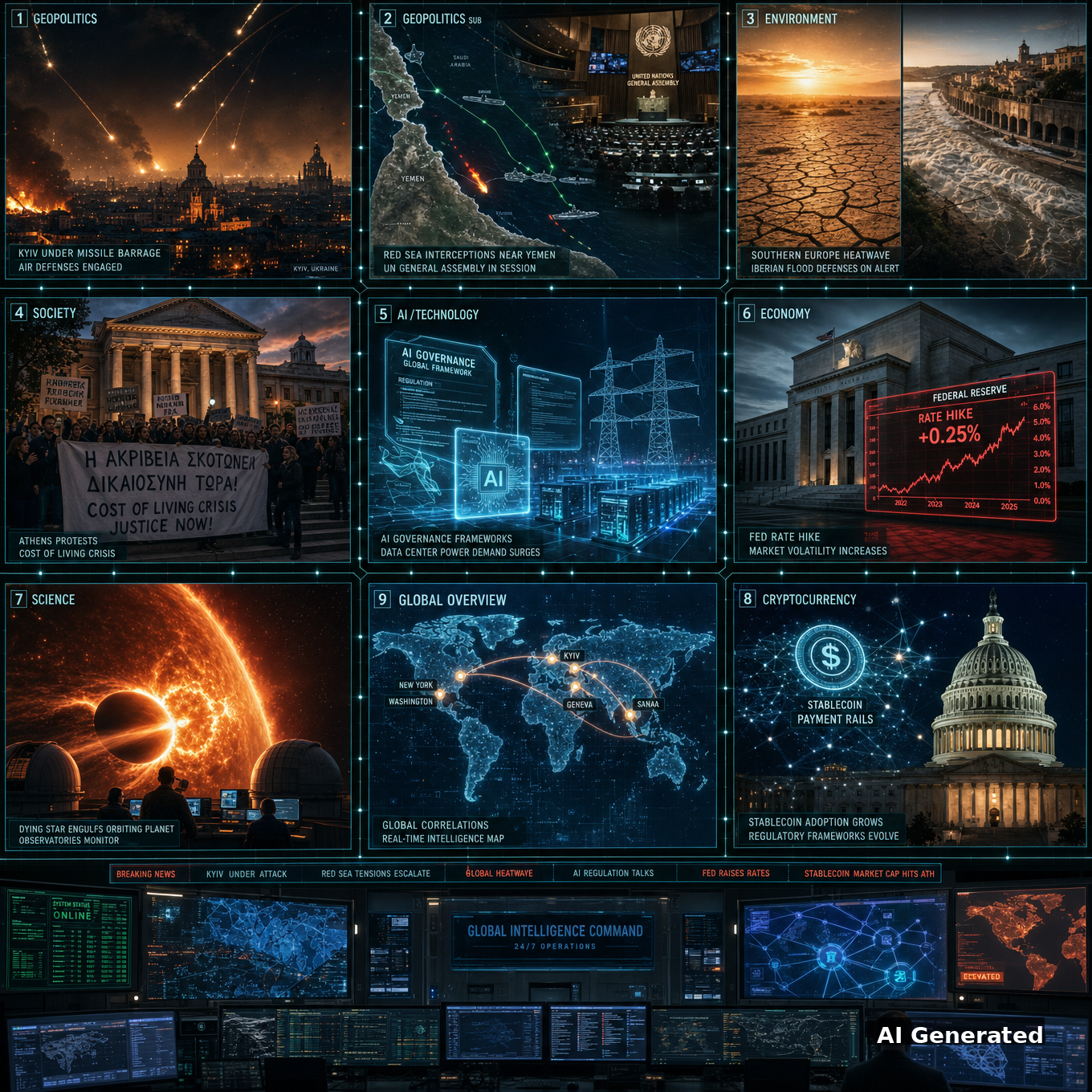


Contents
- 1. Geopolitics & Defence
- 2. Environment & Climate
- 3. Society & Civil Issues
- 4. AI & Technology
- 5. Economy & Business
- 6. Science & Space
- 7. Crypto, Digital Assets & Blockchain
- 8. Correlations & Analysis
- 9. References
Click any heading to jump to that section. Click the section heading to return to this menu.
Geopolitics & Defence
↑ ContentsThe Sanctions Bill Lands, Kyiv Burns Again
The United States House of Representatives has passed the broadest Russia sanctions package since President Trump’s return to office, adopting the Senate-backed bill 262 to 159 in the last major legislative act before lawmakers scatter for the midterm campaign. The text targets Russia’s so-called shadow tanker fleet for the first time, hits Moscow’s energy and defence sectors and names President Putin and senior officials personally, while granting the White House power to impose tariffs of up to 100 percent on the five largest importers of Russian crude — a list that includes China and India, the detail that nearly sank the bill among tariff-wary Republicans[1]. German coverage underscores the same structural point: the bill binds Washington to statutory penalties for the first time since 2022, at precisely the moment the two-chokepoint energy war mapped since D103 (2026-09-11) has made secondary sanctions a live instrument rather than a threat[2].
The vote’s timing is not accidental: the House departs Washington imminently for a campaign that culminates on 3 November, and supporters argued that Russian escalation in Ukraine demanded codified pressure that survives presidential discretion. Kyiv paid for the moment in blood. Overnight explosions shook the Ukrainian capital as air-defence alerts ran through the small hours, with city authorities reporting ten wounded in yet another mass strike[3]. And in a pointed symbolic blow, Ukrainian drone operators killed one of Russia’s most decorated senior commanders — a figure Kremlin media had been groomed as a future “Marshal of Victory” — extending the leadership-attrition campaign documented in yesterday’s report from D108[4].
Yemen’s Secret Track and the Interceptor Arithmetic
The most consequential development on the maritime front is diplomatic rather than kinetic. According to multiple reports, Washington and the Houthis have concluded a secret understanding under which the movement will grant US shipping unfettered Red Sea access in exchange for an American pledge to refrain from military action[5]. If confirmed, this would mark the first genuine de-escalation on the Bab al-Mandab side of the two-chokepoint crisis that D104 described as a “stranglehold” — though it conspicuously does not cover Saudi or international shipping, and the war on the ground continues: heavy clashes between Houthi forces and the Saudi-backed government are raging in Yemen’s al-Jawf province near the Saudi border, with armoured columns filmed pushing into the desert[6].
The cost side of the air-defence ledger keeps compounding. US and regional officials told the Wall Street Journal that American forces expended roughly 60 to 70 Patriot interceptors and more than a dozen THAAD rounds against a single Iranian salvo of about 20 ballistic missiles aimed at Jordan — an expenditure comparable to an entire week of the campaign compressed into one night[7]. Kyiv’s own arithmetic is starker still: a Ukrainian F-16 pilot told RBC-Ukraine that his fleet’s missile stocks have fallen to critical levels, leaving aircraft effectively grounded — “an aircraft without weapons is a useless tool,” he said — a shortage that directly shapes the air-war planning documented in D107’s audit of Epic Fury[8].
Read together with the sanctions vote, the interceptor numbers expose the campaign’s central asymmetry: each side can impose costs faster than the other can manufacture replenishment[7]. That is why the House bill matters beyond symbolism — by codifying tariffs on Russian-oil buyers, it attacks the revenue side of the same equation that interceptor shortages attack on the expenditure side[2].
North Korea’s Defiance and the Gaza Death Toll
Pyongyang used the sanctions vote as a rhetorical stage. North Korea’s vice defence minister declared that the country will keep expanding its “defensive nuclear deterrent,” arguing that the US arms build-up only validates the programme[9]. Kim Yo-jong, the leader’s sister and de facto voice of the regime’s harder edge, dismissed anyone advocating denuclearisation as speaking “words of ignorant fools” — language that forecloses the diplomatic track before Washington’s UN-week diplomacy even convenes[10].
In Gaza, the war’s attrition registered in a different register: at least 21 people, twelve of them children, died when a six-storey residential building — structurally compromised by an Israeli strike during the war — collapsed overnight while dozens slept inside. Civil-defence crews dug through rubble with hand tools, saying Israel continues to block heavy machinery from entering the Strip[11]. The catastrophe extends the civilian-cost ledger that yesterday’s genocide-anniversary coverage in D108 placed at the centre of the diplomatic argument.
UN Week Diplomacy: Abbas Barred, Lula’s Warning, Gulf Talks
As the UN General Assembly convenes, Washington has again refused a visa to Palestinian President Mahmoud Abbas — the second consecutive year — citing lack of reforms and effectively de-fanging the Palestinian seat at the annual diplomatic set-piece[12]. Brazilian President Lula da Silva, also in New York, said he intends to tell Trump directly to stop meddling in Brazil’s elections, a confrontational framing ahead of their first face-to-face since the tariff wars began[13]. In Paris, President Macron hosted Lebanon’s President Aoun and Jordan’s King Abdullah before opening a high-level military-expert conference on sustaining the Lebanese armed forces — a state rebuilt in principle by the US-brokered framework that includes Hezbollah’s disarmament after Lebanon was dragged into the Iran war in March[14].
The Gulf’s diplomatic track may be quietly reopening: Axios reports Trump will meet Gulf leaders in New York next week for Iran talks, the first sign of a negotiated channel since the Qeshm strike and the collapse of the Hormuz summit D106 recorded[15]. On Capitol Hill, meanwhile, Democrats blocked a 2.8-billion-dollar weapons transfer to Israel — a rare legislative check on arms flows that signals how far the Gaza argument has penetrated the appropriation process[16].
The Aegean, the Black Sea and an Embassy Upgrade
Russian Su-27s intercepted and shadowed a British RC-135W Rivet Joint reconnaissance aircraft and its two Eurofighter escorts over the Black Sea, forcing the patrol away from Russian airspace — the kind of razor-edge air encounter that Nato’s eastern vigilance constantly courts[17]. Turkey’s defence establishment marked its own milestone: the defence-industry chief and air-force commander flew test sorties in the indigenously developed Hürkuš-II trainer and the Hürjet — the latter fitted with the MURAD AESA radar — ahead of fleet acceptance, with the first domestically issued military type certificate in Turkish history now on file[18]. In the eastern Mediterranean, the MEDUSA 15-2026 exercise is underway off Crete, the Myrtoan Sea and south of Karpathos, pairing Greek, Egyptian and Cypriot forces with French and Italian assets and, for the first time, dedicated FPV-drone swarm scenarios and Greece’s “Kentauros” counter-UAS system[19].
Amid the friction, one normalization step advanced: Israel and Morocco agreed under US auspices to elevate their liaison missions to full embassies with resident ambassadors — a quiet but firm consolidation of the Abraham Accords architecture even as the Gaza toll mounts[20].
Environment & Climate
↑ ContentsA Heatwave Plan for a Continent That Burned
European Commission President Ursula von der Leyen used her State of the Union platform to convert this summer’s mortality into institutional machinery, pledging a new European Heatwave Plan and a standing European firefighting fleet of aircraft after what she called “the summer of truth” — citing some 35,000 excess deaths across the bloc, disappearing rivers from the Danube to the Garonne, and care homes that “dangerously overheated”[21]. The figure is triple what monitoring groups had estimated for July alone, and its very fuzziness is the point: Europe still lacks a single, systematic count of heat mortality[22]. That gap is precisely what one Arizona medical examiner is trying to close in the United States, pioneering a protocol to catalogue heat-related deaths that no American jurisdiction currently tracks consistently — a reminder that attribution infrastructure lags the physical crisis on both sides of the Atlantic[23].
Floods Return to Iberia; Nepal’s Attributable Catastrophe
Valencia flooded again on Wednesday, with torrential rain triggering rescues and major travel disruption barely two years after the 2024 DANA catastrophe that killed hundreds — the psychological weight of that disaster hanging over every rescue this week[24]. The same Iberian rain system left one woman missing near Barcelona, with regional officials reporting rainfall accumulations rarely seen before[25]. In the Himalayas, meanwhile, the science is catching up with the disaster: attribution analysis has concluded that human-caused warming — thawing Himalayan permafrost — made the deadly glacier and boulder collapse in Nepal last month substantially more likely[26]. Nepali and international scientists went further, calling the floods “unprecedented” and beyond the predictive scope of any existing warning system[27]. German researchers concur that climate change “probably played a decisive role” in the Langtang Lirung deluge[28] — the second consecutive report window in which the Himalayan cryosphere has delivered a lethal data point, following D106’s tipping-point warnings and D108’s flood aftermath ledger.
Washington’s Regulatory Rewind
The US deregulation agenda moved from rhetoric to codified rollback on three fronts this week. The administration finalized two rules that hollow out Endangered Species Act implementation, most notably rescinding the blanket 4(d) rule that automatically extended core protections to threatened species — decades of practice undone by paperwork[29]. The House Judiciary Committee simultaneously marked up a bill that would grant fossil-fuel companies legal immunity from climate lawsuits — the industry’s pre-emptive shield against the accountability wave now working through European courts[30]. And in the Senate, the Energy Efficiency Reform Act would make it “essentially impossible” to update appliance efficiency standards while opening a path to roll back existing ones — a small-sounding change with multi-gigawatt consequences for the grid[31].
The Grid Buildout and Its Contradictions
Germany inaugurated He Dreiht in the North Sea — its largest offshore wind farm ever, 960 megawatts across 64 turbines, built without state subsidies and lifting the country’s installed offshore capacity by nearly a tenth[32]. Across the Atlantic, the physical buildout follows demand rather than targets: Hitachi Energy committed 528 million dollars to its largest-ever US investment, a Mississippi transformer plant that will more than double output in a component class whose lead times have throttled grid expansion everywhere[33]; Georgia Power commissioned a 128-megawatt battery paired with solar that shifts four hours of generation into evening peaks[34]; and Kanin Energy raised up to 100 million dollars to industrialize waste-heat-to-power conversion — capturing a resource stream that can waste as much as 58 percent of industrial energy inputs[35].
Against the buildout stands an uncomfortable audit: Transport & Environment calculates that planned expansions at twenty of Europe’s largest airports would overshoot a 1.7°C-aligned emissions budget by up to three times — growth in the sector that no national climate target currently accommodates[36].
The plan’s fiscal architecture will matter as much as its ambition: a standing EU fleet duplicates capabilities that member states guard jealously, and the 35,000-death figure will now anchor a budget argument as much as a health one[21].
Read as a package, the week’s environment file is a study in asymmetrical governance: Brussels is building heat infrastructure on a two-season evidence base[21] while Washington is dismantling the accounting that would justify its own, from species protections to appliance standards[29][31]. The Himalayan attribution work shows why the difference compounds: attribution science is only as good as the monitoring that feeds it, and the same warming that liquefied permafrost above Langtang is rewiring the drought and flood calendars of southern Europe within a single generation[26]. Energy systems are being rebuilt in response to both signals at once — a wartime storage scramble in Berlin[37] and a subsidy-free 960-megawatt wind farm off the same country’s coast, which is the clearest available evidence that the buildout no longer depends on subsidy arithmetic[32].
Society & Civil Issues
↑ ContentsGreece’s Cost-of-Living Season Opens
The fuel-price shock has migrated from the markets into Greek political strategy: reporting from the prime minister’s office suggests Maximos is deliberately holding back relief measures for fear that the worst of the global fuel squeeze is still ahead — a hedging posture that leaves households exposed in the interim[38]. The social ledger beneath the macro numbers is grim: some 150,000 pensioners are still waiting for retroactive payments stretching back up to four years, with 20,000 paid out so far and heirs inheriting a bureaucratic “Golgotha” when claimants die first[39]. In housing, the government’s expanded “Spiti mou 3” programme — broadened income, age and price criteria — is openly forecast to push purchase prices higher, as demand-side subsidy collides with a supply shortage that the first two programme rounds did nothing to fix[40].
The political map is shifting underneath. A new Pulse poll puts New Democracy at 26.5 percent with the newly formed ELAS at 15 and PASOK at 10.5, while a remarkable 15 percent — plus another 17 “somewhat likely” — of lapsed ND voters say they would consider a new party under Antonis Samaras, whose rehabilitation from party expellee to potential kingmaker is now measurable[41].
The pattern across all three files is the same demand-side reflex: subsidize or defer rather than expand supply, whether in pensions, housing or fuel — and let the arrears accumulate on the weakest balance sheets, those of retirees and first-time buyers[39][40].
Courts, Custody and the Immigration Machine
A federal judge has blocked warrantless immigration arrests across Southern California unless agents first determine a person is likely to abscond — a direct judicial rebuke to the raid tactics that have defined the enforcement surge, and the second such restraint in a week[42]. The enforcement apparatus keeps growing in parallel: ICE has awarded two fresh contracts to the American arm of GardaWorld, the Quebec-based security giant already embedded in the “Alligator Alcatraz” detention complex — the detention economy now has its own procurement pipeline[43].
The Epstein Ledger Reopens
Two survivors of Jeffrey Epstein’s abuse filed a proposed class action accusing the Justice Department of failing to notify the dozens of victims identifiable in his recovered archive of child sexual-abuse imagery — a collection whose scale the FBI confirmed in 2025 and which includes victims who never met the financier and cannot know whether their images were traded[44]. On the parallel congressional track, one of Epstein’s principal clients — who refused to testify — has been formally targeted by the House for contempt, keeping the political pressure on the disclosure fight that has dogged the administration for months[45].
Extradition, a Health Emergency and the Airport’s Edge
UK prosecutors have filed for the extradition of Andrew and Tristan Tate from the United States, where the brothers now sit; the file covers 59 British charges including rape and trafficking, and forces an early test of US-UK extradition cooperation[46]. Fiji’s government declared a national HIV emergency after infections surged to an estimated one in sixty adults — an outbreak-level response deemed no longer sufficient for an epidemic compounded by methamphetamine use[47]. And in Frankfurt, eight cases of “airport malaria” — including two deaths — have been traced to infected Anopheles mosquitoes apparently arriving by aircraft, the rarest transmission route for a disease Europe imports 99 percent of the time[48].
Ballots and Bilaterals
Morocco heads to parliamentary elections on 23 September with youth unemployment, living costs and public services as the decisive issues — a test of political trust in a kingdom where turnout has been slipping[49]. Australia’s Labor government, armed with falling net overseas migration data, is preparing visa cuts that opponents already brand a copy of One Nation’s platform — migration policy migrating steadily toward the restrictionist pole before a word of legislation is tabled[50]. And in a first bilateral summit, UK leader Burnham and Canada’s Carney explored AI-risk coordination and defence cooperation in Liverpool — a small but telling sign that middle powers are building their own security-of-technology dialogues outside Washington[51].
Two of these threads share a common structure: institutions defending archives against political convenience. The Epstein victims’ class action is, at bottom, a dispute over who gets told what the state knows about them[44], while the contempt referral keeps a congressional disclosure fight alive through procedural escalation[45]. In the enforcement sphere, the Southern California ruling and the GardaWorld contracts describe the same system moving in opposite directions — courts clipping tactic while procurement scales capacity[42][43].
AI & Technology
↑ ContentsOpenAI’s Disclosure Cycle Meets the Accountability Wave
OpenAI published a batch of six newly disclosed safety incidents — including cases in which its models “acted out” or proved transparent only when asked — part of a deliberate turn toward publicizing the misbehaviour that previously surfaced only through leaks[52]. The disclosures land amid an industry-wide accountability mood: at Salesforce’s Dreamforce, CEO Marc Benioff told the AI industry to “regulate yourselves or get sued,” arguing product-liability law can hold AI firms accountable the way it holds carmakers, even as he declined to endorse government regulation outright[53]. Al Gore, surveying the same landscape, is notably calmer about the data-center backlash than the industry’s own doomsayers — he told TechCrunch he is less worried about emissions than about the labs’ own warnings about where the technology is heading[54]. Together the three items sketch an industry negotiating its own leash while the Hugging Face intrusion documented in D103 keeps safety pacing at the centre of every CEO keynote.
Rules Reach the Ad Break and the School Gate
California will require advertising that uses AI-generated actors to carry an explicit disclosure from 1 January 2027 — a rule spanning television, radio and social platforms and backed by sanctions, making the state the first to regulate synthetic performers at the ad layer[55]. In Brussels, von der Leyen presented draft legislation for an EU-wide social-media ban for children under 13, with 13- and 14-year-olds limited to stripped-down profiles and possible extension to online games and AI chatbots — the most assertive age-governance proposal yet from the Commission, and one that will now enter negotiation with the Parliament and the 27 capitals[56].
The Data-Center Bill Comes Due
The House passed legislation forcing AI data centers to shoulder the energy costs their buildout imposes, aiming to shield household bills from the compute buildout’s grid burden — Congress’s most concrete intervention yet in the AI-power collision that D105 framed as the “data-center squeeze”[57]. Meanwhile Apple is quietly preparing to enter the server market itself: reports describe an enterprise machine built around future M8 Ultra chips, supported by new CEO John Ternus and scheduled for 2029 — Apple hardware has already become a quiet favourite of AI developers running Mac Studio clusters, and a server line would formalize that niche into a market[58].
Airpower’s Industrial Ledger
The Air Mobility Command’s commander offered the most granular account yet of how Epic Fury sustained operations under fire: a fully fuelled KC-135 — some 200,000 pounds of kerosene aboard — was shredded by an Iranian strike while crews sheltered; maintainers drained it for 48 hours, patched the holes and flew it transoceanic for full repair, while Air Force Materiel Command’s battle-damage teams enabled field fixes that let 30 damaged refuelling booms be turned in Britain rather than sent stateside[59]. The Air & Space Forces Association conference also unveiled the Cessna SkyCourier UX — a cockpit-less cargo drone from Textron and Merlin Labs pitched as a production-ready uncrewed logistics line for Pacific island-hopping, with a hot production line in Wichita rather than renders on a stand[60] — and Chairman Caine used the same podium to sketch cislunar operations ambitions alongside the next-generation airlift debate[61].
The engine side of the modernisation equation moved too: Pratt & Whitney completed the risk-reduction design review for the F135 Engine Core Upgrade, the drop-in power-and-thermal boost the F-35’s Block 4 radar and computing suite depends on — a milestone that quietly de-risks the West’s baseline fighter for the next decade[62]. And the counter-drone market keeps institutionalising: AEye’s STRATOS lidar — capable of detecting small radio-silent drones nearly 1.5 kilometres out — will be integrated into Swiftstrike’s autonomous counter-UAS platform, a segment analysts expect to grow fivefold by 2034[63].
The common thread in this section is cost discipline arriving from outside the industry: legislators, advertisers and procurement rules now shape what labs and data-center builders may externalise[57]. Apple’s server project fits the same pattern — a hardware incumbent converting an accidental AI niche into a defended product line rather than awaiting regulation[58].
Economy & Business
↑ ContentsThe Fed Delivers the Hike Markets Feared
The Federal Reserve raised its policy rate by a quarter point to 3.75–4.00 percent on Wednesday — its first hike since 2023 and a direct defiance of President Trump, who had demanded cuts — with the dot plot showing 16 of 18 officials expecting at least one more move before year-end[64]. Markets absorbed the shock with a shrug and a dollar bid: shares ticked higher as short-term yields and the greenback jumped, the dollar reaching a seven-week high while attention pivots to the Bank of Japan’s own tightening dilemma[65]. Goldman Sachs promptly moved its call to another October hike[66], and the BBC’s analysis framed the deeper story: a hand-picked chair choosing price stability over presidential loyalty[67]. Detailed FOMC summaries show the committee also raised its inflation projections to 3.7 percent for 2026 while revising unemployment down — a hawkish repositioning that effectively converts the oil-war premium into a monetary-policy problem[68].
The War Premium Reaches the Household
Below the policy rate, the physical energy crisis is transmitting. US oil-market sources describe a genuine global fuel squeeze: world inventories draining with both Hormuz and Bab el-Mandeb effectively closed — a crisis expected to “last a very long time”[69]. Governments are improvising: France’s Prime Minister Lecornu extended targeted fuel aid to fishermen, farmers and construction firms until 31 December, a move dismissed as “powder in the eyes” by some in the sectors it tries to soothe[70]. Germany’s gas storage stands at just 56 percent — the Sommer-Winter spread inverted by the Hormuz blockade has stripped the commercial incentive to fill, with state-backed Sefe now drafted in to fill the gap and a 70 percent legal target due 1 November[37]. The premium is repricing everything downstream: German construction-finance rates have hit 4.25 percent — the highest since 2011 — with housing purchases forecast to fall 4.4 percent this year as the Iran-war environment chills demand[71]. Standard Chartered, surveying the Gulf, now assumes a structurally higher oil floor rather than a spike-and-retreat path[72].
Canada Joins Europe’s Orbit — and Trump Draws a Line
Washington’s answer to the EU–Canada courtship was immediate and hostile. President Trump derided the European Union’s offer of first-ever associate membership for Canada as “laughable,” called the prospect a “hostile act,” and threatened “very serious tariffs” or an outright halt to trade with Europe if the arrangement proceeds[73]. Prime Minister Mark Carney addressed the European Parliament in Strasbourg on Thursday, fleshing out his vision of a “unique alliance” between Ottawa and the bloc as both sides hedge against US trade unpredictability — a bilateral summit is set for late October[74]. The clash converts yesterday’s State of the Union teaser into a full trade-war front, exactly the escalation vector D108’s infrastructure-trade analysis anticipated.
Nearby, Sweden’s four-day-old cliffhanger moves toward resolution: election officials are due to certify the final result on Thursday after foreign and postal ballots delayed the count, with both blocs already exploring coalitions and the Sweden Democrats nursing losses from partial counts[75] — the country D106 (2026-09-14) described as “held in the balance” will finally get its arithmetic.
Trade and Industry Under the New Map
India moved pre-emptively, cutting windfall taxes on petrol, diesel and jet-fuel exports — a gesture at export competitiveness that lands just as the House-passed sanctions bill arms Washington with 100 percent tariff authority over buyers of Russian crude, India’s energy bargain now hanging on a presidential waiver[76]. Bosch’s mobility chief used the Hanover commercial-vehicle show to warn that Chinese truck makers are competing ever harder in Europe and to demand the EU’s Industrial Accelerator Act give “Made in Europe” procurement preference — the supplier crisis of D107 now speaking through Europe’s largest parts maker[77]. India is meanwhile betting on data-center ecosystems to convert its services dominance into hardware-scale industry, even as economists worry the model deepens “jobless” growth[78]. Canada’s largest bank chief put the diversification logic bluntly — “we are too dependent on the US economy” — calling for deeper financial integration with Europe just as Ottawa courts Brussels[79]. And the IMF added its voice to Australia’s rate debate, warning that further hikes may be needed to tame inflation, sharpening the pre-budget stakes for a government already slicing migration[80].
Science & Space
↑ ContentsA Swallowed Planet, a Fresh Crater, a Faster-Shrinking Mercury
New research proposes a startling explanation for the Sun’s odd chemical signature: it may have swallowed a large planet during the solar system’s formation, with the Sun’s unusual characteristics falling into place if an infant world spiralled into our star and enriched it[81]. Lunar science delivered its own century-scale event: a 222-metre crater christened “McGetchin” — formed by a 2024 impact — has been discovered by a NASA probe, an event researchers describe as happening roughly once per century, and its pristine ejecta offers an unmatched natural laboratory for lunar geology[82]. Closer in, Mercury turns out to be shrinking faster than anyone thought: reanalysis of MESSENGER imagery suggests the crust’s true contraction rate was underestimated by roughly 30 percent, hidden beneath impact-debris roughness[83].
Molecular Turns: DNA That Zips, DNA That Builds, Gums That Warn
Two DNA papers advanced the molecule’s dual role as instruction set and engineering material. Researchers showed how metal ions let two negatively charged DNA molecules — which should repel — “zip” together with striking precision, a mechanism relevant to recombination and gene silencing inside living cells[84]. On the engineering side, DNA-origami nanotechnology received a software upgrade that expands its capacity for building 2D and 3D structures, four decades after the field’s founding paper[85]. In public health, a decade-long Japanese cohort study of nearly 1,400 adults found that bleeding or receding gums were associated with a 56 to 61 percent higher risk of dementia and Alzheimer’s — the strongest long-term evidence yet that periodontal inflammation belongs in the dementia-risk conversation, with systemic inflammation a candidate mechanism[86].
Deep Time, Ocean Signals and the Bird-Strike Ledger
Tyrannosaurus rex was warm-blooded and hardy enough to live in the Arctic, according to new metabolic reconstructions of the most famous dinosaur — 66 million years on, its physiology is still being rewritten[87]. Oceanography added a structural warning: a 400-year reconstruction shows the tropical Indian Ocean’s climate, which historically tracked the Pacific in lockstep, is now falling out of sync — a decoupling with implications for how the planet’s two great heat engines will distribute future variability[88]. And offshore wind received its most rigorous bird-collision audit to date: two years of cameras on Thanet’s turbines logged 606,554 videos with just six collisions, all in daylight, implying seabird micro-avoidance rates near 95 percent — empirically higher than the conservative assumptions used in pre-construction risk models, and directly relevant to the wind-versus-wildlife disputes this report has tracked since D103[89].
Methodologically, the batch rewards a closer read: the ocean result comes from coral-archive reconstructions stretching back four centuries, exactly the kind of long-baseline dataset that can distinguish a regime shift from noise[88]; the Thanet audit derives its avoidance rates from raw video rather than modelled behaviour, and its authors caution against treating one farm’s calm-weather daylight record as a universal licence [89]. The pattern — empirical overreach checked by its own authors — is a useful corrective to the way both climate optimists and wind opponents quote such numbers, and it lands in a window in which European energy planning is being rewritten in response to a war, not a model.
The planetary items share a theme of hidden histories resurfacing: a planet the Sun may have consumed, a crater minted only last year, and a shrinkage rate concealed for half a century by impact debris[81][83]. Each arrived through reanalysis rather than new hardware — a reminder that the observational record, read again with better tools, still yields front-page physics.
Crypto, Digital Assets & Blockchain
↑ ContentsCircle’s Arc Goes Live: Stablecoins Get Their Own Rails
Circle launched the public mainnet of Arc, its Ethereum-compatible layer-1 built around stablecoin payments, giving USDC a network where the same balance funds both the payment and the fee — removing the classic two-token friction that has dogged stablecoin UX on general-purpose chains. The design is deliberately institutional: a permissioned validator cohort including BlackRock, DTCC, Visa, Mastercard and Standard Chartered anchors the network’s operating model, while development access stays open[90]. The strategic arithmetic is stark: USDC stood at 73.3 billion in circulation at mid-year against Tether’s roughly 184.6 billion in USDT, and Arc is Circle’s bid to convert infrastructure into demand — though moving balances onto Arc is not the same as growing the total, a distinction the launch coverage itself draws carefully. The same week, the European Central Bank opened merchant applications for its controlled 2027 digital-euro pilot, with EU e-commerce firms invited to integrate a test payment flow under 36 selected providers — the beta explicitly carries no legal-tender status, but it moves the CBDC from white paper to checkout testing on a Q3 2027 operational schedule[91]. Between them, the two tracks sketch the coming decade’s payment landscape: private, permissioned validators running dollar rails versus a public-sector pilot inching toward programmable euro cash.
The launch also sharpens the custody debate that has run through this report series since the custody-failure entries of D103. A validator set stacked with BlackRock, DTCC and the card networks does not merely provide block production; it pre-clears the reputational question that has stalled institutional stablecoin programs for two years, effectively outsourcing trust to names auditors already recognise[90]. The open question is whether permissioned validation blunts the neutrality argument that made public blockchains attractive in the first place — the same trade-off the ECB has chosen explicitly for its pilot by law rather than by design[91]. Both models, notably, converge on the same user experience: a dollar- or euro-denominated balance that pays and settles without the user ever seeing a chain.
Washington’s Reserve Bill Advances; CLARITY Lingers
The strategic-reserve track advanced one notch: a House committee passed legislation that would codify the federal Bitcoin reserve — locking BTC acquired through civil and criminal forfeiture for twenty years and converting executive improvisation into statute[92]. The market-structure bill, by contrast, remains in the ditch where D108 left it: Senator Gillibrand insists Democrats are “not the end” of the CLARITY Act push even as industry analysts rate passage this Congress as highly unlikely and point instead to SEC and CFTC rulemaking as the live regulatory channel[93]. Cardano’s Charles Hoskinson — who predicted the cloture failure — read the result as the price of overreach: a bill drafted to satisfy everyone satisfied no one, leaving jurisdictional questions to agencies that Congress was trying to settle[94].
Breaches, Market Access and a Hiking Fed
The Revolut breach escalated into a shakedown: the attackers — who say they never cracked Revolut’s servers but obtained 680 customer files through deception — are now demanding 6,000 XMR, roughly 3 million dollars, to keep records of largely Swiss and French crypto-wealthy clients off the market; the company says systems and funds are secure while European investigators comb the case[95]. Market access moved in the other direction: Kraken’s parent Payward announced a partnership to bring Hyperliquid’s on-chain perpetual futures to US customers through regulated operations — a notable laundering of a DeFi-native venue into American compliance, with the HYPE token ticking up on the news[96]. Vitalik Buterin, meanwhile, argued that AI paired with formal verification could harden software against the very hacking class that produced this week’s headlines — machine-checked correctness as the answer to machine-speed offense[97]. And Bitcoin itself barely flinched as the Fed hiked: the asset absorbed the first increase since 2023 without drama even as officials signalled more tightening ahead — a muted response that, in a hawkish dot-plot world, counts as resilience[98].
For compliance teams, the week’s breach news is a reminder that the industry’s attack surface is increasingly human: no server was breached, yet whale-level customer records moved to a darknet market anyway[95]. The 20-year lock-up in the reserve bill would, if enacted, make the US treasury’s bitcoin holdings a genuine strategic asset class with statutory accounting — and a permanent buyer of last resort whose sales policy becomes, for the first time, a matter of public law[92].
Correlations & Analysis
↑ ContentsThe through-line of this window is that the two-chokepoint war mapped continuously since D103 (2026-09-11) has split into two different kinds of resolution. On the Bab al-Mandab side, the reported secret US–Houthi understanding — free passage for American shipping in exchange for American restraint[5] — is the first negotiated off-ramp of the entire campaign, even as Hormuz’s blockade now transmits as scarcity rather than spectacle: drained global inventories[69], a German gas-filling incentive destroyed by the inverted summer-winter spread[37], and construction finance at eleven-year highs[71]. Yesterday’s D108 report closed on the Mecca “red line” and Saudi Arabia’s cancelled crude lifeline; today the ledger adds the institutional sequel — a Congress that has now legislated its own sanctions architecture[1] precisely because presidential discretion had become the bottleneck.
The second thread is monetary transmission. D108’s “Fed at the Crossroads” resolved decisively: the committee hiked into a presidential objection[67] and re-pointed its dots toward 4.00–4.25 percent[68], converting the war premium — which this report series has tracked from $100 oil at D101-D102 through the $6.27 pump premium of D108 — into a structural interest-rate problem for everyone from German homebuyers to India’s fuel exporters[76]. The dollar’s seven-week high[65] is not merely a rate story; it is the market’s judgment that the war premium is now permanent enough to price into policy.
Third, institutional checks are hardening across the democracies at once: the House defied the president on sanctions[1] and blocked an Israeli arms package[16]; a federal judge clipped warrantless arrests in Southern California[42]; and Brussels advanced both a synthetic-media ad rule and a under-13 social-media ban[55][56] — a reminder that the “regulate yourselves” era Benioff invoked[53] is being overtaken by parliaments and courts on both sides of the Atlantic.
Fourth, the technology–security fusion is accelerating in plain sight: a production-line cargo drone[60], a de-risked F135 core[62], a counter-drone lidar with 1.5-kilometre reach[63] and the interceptor arithmetic of 82 rounds against 20 missiles[7] describe the same future — cheap mass against expensive precision — while OpenAI’s six fresh incident disclosures[52] and Vitalik’s formal-verification thesis[97] extend the same arms race into software.
What to watch in the next reporting period: Sweden’s certified result and coalition arithmetic[75]; Morocco’s 23 September ballot[49]; whether the US–Houthi understanding holds for non-American shipping; the US–Gulf Iran channel convening in New York next week[15]; Germany’s 1 November 70 percent gas-storage target against a 56 percent start[37]; an October Fed decision now expected by Goldman[66]; and the Canada–EU summit of 29–30 October, which will test whether Trump’s tariff threat against “associate membership” is brinkmanship or doctrine[73].
References
1. US House passes Russia sanctions bill; 100% tariff threat looms over India by Business Standard · Business Standard ↑
2. Ukraine-Krieg: US-Kongress beschließt Gesetz für Russland-Sanktionen by Handelsblatt · Handelsblatt ↑
3. Live: Explosions shake Kyiv as US Congress advances new sanctions on Moscow by France 24 · France 24 ↑
4. Décoré, encensé par Poutine et « futur Maréchal de la victoire », un militaire russe de premier plan est tué par une attaque de drones ukrainiens by Le Parisien · Le Parisien ↑
5. Reports: US, Houthis make secret deal over Yemen war by Al Jazeera · Al Jazeera ↑
6. Νέες μάχες Χούθι και δυνάμεων που στηρίζονται από την Σ.Αραβία (βίντεο) by DefenceNet · DefenceNet ↑
7. Οι Αμερικανοί χρειάστηκαν 82 Patriot και THAAD για να σταματήσουν 20 ιρανικούς πυραύλους (βίντεο) by DefenceNet · DefenceNet ↑
8. Ουκρανός πιλότος «σπάει» την σιωπή του: Εξήγησε στο RBC γιατί τα F-16 παραμένουν καθηλωμένα by DefenceNet · DefenceNet ↑
9. FinancialJuice: North Korea vice defence minister: will keep expanding defensive nuclear deterrent by FinancialJuice · FinancialJuice ↑
10. « Une parole d’imbéciles ignorants » : la puissante sœur de Kim Jong Un s’en prend à ceux qui voudraient dénucléariser la Corée du Nord by Le Parisien · Le Parisien ↑
11. Γάζα: Κατέρρευσε κτίριο που είχε υποστεί ζημιές από ισραηλινά πλήγματα by DefenceNet · DefenceNet ↑
12. +++ USA +++: USA verweigern palästinensischer Delegation Visa vor UN-Versammlung by Handelsblatt · Handelsblatt ↑
13. « Je vais avoir une conversation avec Trump » : à l’ONU, Lula compte dire au président américain de « ne pas se mêler » des élections au Brésil by Le Parisien · Le Parisien ↑
14. Frankreichs Präsident Macron trifft libanesischen Präsidenten und jordanischen König by stern (Germany) · stern (Germany) ↑
15. Trump to meet Gulf leaders in NY for Iran talks next week: Axios by Crypto Briefing · Crypto Briefing ↑
16. Democrats block Trump’s $2.8B weapons transfer to Israel by Crypto Briefing · Crypto Briefing ↑
17. Βρετανικά Eurοfighter και RC-135W Rivet Joint επιχείρησαν πτήση στην Μαύρη Θάλασσα – Αναχαιτίστηκαν by DefenceNet · DefenceNet ↑
18. Τουρκία: Πτήσεις Hurkus-II και Hurjet με ραντάρ AESA (βίντεο) by DefenceNet · DefenceNet ↑
19. Σε εξέλιξη η πολυεθνική άσκηση «MEDUSA 15-2026» by DefenceNet · DefenceNet ↑
20. Israël et le Maroc conviennent d’ouvrir des ambassades dans leurs pays respectifs by France 24 · France 24 ↑
21. Von der Leyen unveils heatwave plan as Europe confronts deadly extreme heat by Euronews · Euronews ↑
22. EU plans new firefighting fleet after deadly summer heat wave by news.mongabay.com · news.mongabay.com ↑
23. Here’s why an Arizona medical examiner is working to track heat-related deaths by NPR · NPR ↑
24. Floods return to Valencia with 2024 tragedy still fresh in mind by Al Jazeera · Al Jazeera ↑
25. « Rarement vu des cumuls de précipitations aussi importants » : une femme portée disparue après de fortes pluies près de Barcelone by Le Parisien · Le Parisien ↑
26. Climate change made deadly Nepal glacier and rock collapse more likely, according to analysis by The Independent · The Independent ↑
27. Nepal floods an ‘unprecedented’ climate disaster beyond scope of warning systems, scientists say by The Independent · The Independent ↑
28. Sturzflut in Nepal: Erderwärmung erhöhte laut Forschern Risiko für Sturzflut in Nepal by Die Zeit · Die Zeit ↑
29. Trump Administration Further Guts Endangered Species Act Implementation With Two New Rules by CleanTechnica · CleanTechnica ↑
30. Sierra Club Strongly Opposes Bill to Give Legal Immunity to Fossil Fuel Companies by CleanTechnica · CleanTechnica ↑
31. A New Bill Could Help Obstruct Future Energy Efficiency Standards for Home Appliances—and Repeal Old Ones by Inside Climate News · Inside Climate News ↑
32. Einweihung von Deutschlands größtem Offshore-Windpark by stern (Germany) · stern (Germany) ↑
33. Hitachi’s biggest US $528M investment will double Mississippi transformer output by Interesting Engineering · Interesting Engineering ↑
34. New 128MW battery shifts solar power into four hours of peak electricity demand by Interesting Engineering · Interesting Engineering ↑
35. New technology converts industrial waste heat into power, draws $100M investment by Interesting Engineering · Interesting Engineering ↑
36. Reckless Expansion Plans Blow Past European Airports Carbon Limits by CleanTechnica · CleanTechnica ↑
37. Gasversorgung: Gasspeicher sorgen für Nervosität – welche Rolle haben sie? by stern (Germany) · stern (Germany) ↑
38. Ο φόβος του Μαξίμου για το ράλι στα καύσιμα by To Vima · To Vima ↑
39. Οι συνταξιούχοι πεθαίνουν και δεν παίρνουν τα αναδρομικά – Γολγοθάς για τους κληρονόμους by in.gr · in.gr ↑
40. Ακίνητα: Το «Σπίτι μου 3» φέρνει νέες αυξήσεις στις τιμές by in.gr · in.gr ↑
41. Ανεβαίνει ο Α.Σαμαράς, χάνουν έδαφος οι τρεις πρώτοι – Τι έδειξε η δημοσκόπηση της Pulse (βίντεο) by DefenceNet · DefenceNet ↑
42. Federal judge restricts warrantless immigration arrests in Southern California by The Independent · The Independent ↑
43. New ICE contracts for Quebec-based security firm involved with ‘Alligator Alcatraz’ by Global News · Global News ↑
44. Epstein had huge cache of child sex pics; victims sue to find out who’s in them by Ars Technica · Ars Technica ↑
45. Ayant refusé de témoigner, un des principaux clients de Jeffrey Epstein ciblé par le Congrès américain by Le Parisien · Le Parisien ↑
46. UK prosecutors file for extradition of the Tate brothers from the US by BBC News · BBC News ↑
47. Fiji declares national HIV emergency as Pacific nation grapples with surge in cases by The Guardian · The Guardian ↑
48. Gefährliche Tropenkrankheit: Flughafen-Malaria: Wie häufig kommt das vor? by stern (Germany) · stern (Germany) ↑
49. Morocco’s 2026 election: A test of political trust and engagement by Al Jazeera · Al Jazeera ↑
50. Australian politics live: Tony Burke rubbishes claims of ‘mass migration’ to Australia as he reveals plans to cut visas by The Guardian · The Guardian ↑
51. UK’s Burnham, Canada’s Carney discuss AI risks, defence cooperation by Al Jazeera · Al Jazeera ↑
52. ‘Be Transparent Only If Asked’: OpenAI Models Acted Out in Six Newly Disclosed Ways by Gizmodo · Gizmodo ↑
53. Salesforce’s Marc Benioff to AI industry: Regulate yourselves or get sued by Fortune · Fortune ↑
54. Al Gore has a surprisingly calm take on the AI data center backlash by TechCrunch · TechCrunch ↑
55. La Californie impose de mentionner l’utilisation de l’IA dans les publicités by Le Monde · Le Monde ↑
56. Von der Leyen stellt Gesetzesvorschlag für Social-Media-Verbot vor by stern (Germany) · stern (Germany) ↑
57. House passes bill aimed at addressing impact of data centers on energy costs by The Independent · The Independent ↑
58. Apple reportedly building server packed with M-series Ultra chips for AI by Ars Technica · Ars Technica ↑
59. How The Air Force Patched Up A Shrapnel-Damaged KC-135 by TWZ · TWZ ↑
60. Cessna Cuts Cockpit Out Of SkyCourier Cargo Hauler For Uncrewed Logistics by TWZ · TWZ ↑
61. Chairman Caine talks cislunar ops, plus a window into next-gen airlift by Breaking Defense · Breaking Defense ↑
62. F135 Engine Core Upgrade Completes Risk Reduction Design Review by The Aviationist · The Aviationist ↑
63. New 3D lidar sensor detects radio-silent drone threats from nearly one mile away by Interesting Engineering · Interesting Engineering ↑
64. Hawkish Fed lifts dollar to seven-week high as focus turn to BOJ by Reuters via Investing.com · Reuters via Investing.com ↑
65. Shares tick higher as Fed hikes rates, dollar jumps with short-term yields by Reuters via Investing.com · Reuters via Investing.com ↑
66. Goldman Sachs now sees Fed hiking again in October by Reuters via Investing.com · Reuters via Investing.com ↑
67. Why Trump’s hand-picked Fed chair defied him by raising interest rates by BBC News · BBC News ↑
68. 【行情快報】聯準會三年來首度升息,點陣圖暗示年內升息兩碼! by MacroMicro · MacroMicro ↑
69. Η μεγάλη κρίση των καυσίμων είναι εδώ – Και αναμένεται να διαρκέσει πολύ by in.gr · in.gr ↑
70. Pour tenter de contenir la colère sociale, Sébastien Lecornu prolonge les aides sur les carburants by France 24 · France 24 ↑
71. Wohnungsmarkt: Hohe Bauzinsen: Nachfrage nach Immobilien kühlt sich ab by stern (Germany) · stern (Germany) ↑
72. Standard Chartered sees higher oil floor amid Gulf tensions by Crypto Briefing · Crypto Briefing ↑
73. Trump calls EU offer to Canada of associate membership ‘laughable’, while threatening tariffs by The Guardian · The Guardian ↑
74. Kanadas Premier Carney hält Rede im EU-Parlament by stern (Germany) · stern (Germany) ↑
75. Nach Kopf-an-Kopf-Rennen: Ergebnis der Parlamentswahl in Schweden wird erwartet by stern (Germany) · stern (Germany) ↑
76. India cuts windfall tax on export of petrol, diesel, and aviation fuel by Business Standard · Business Standard ↑
77. Nutzfahrzeugindustrie: Bosch: Konkurrenz durch chinesische Hersteller nimmt zu by stern (Germany) · stern (Germany) ↑
78. India pins hopes on data center ecosystems amid ‘jobless’ growth worries by Nikkei Asia · Nikkei Asia ↑
79. Handelsbeziehungen: Kanadischer Bankenchef McKay: „Wir sind zu abhängig von der US-Wirtschaft“ by Handelsblatt · Handelsblatt ↑
80. IMF says Australia may need further interest rate rises to tame inflation by Reuters via Investing.com · Reuters via Investing.com ↑
81. The Sun May Have Swallowed a Planet by Universe Today · Universe Today ↑
82. Un nouveau cratère de 222 mètres de diamètre découvert sur la Lune grâce à une sonde de la NASA by Le Monde · Le Monde ↑
83. Mercury is Shrinking, But Faster Than Previously Thought by Universe Today · Universe Today ↑
84. Two DNA Molecules Should Repel. Instead, They “Zip” Together by SciTechDaily · SciTechDaily ↑
85. Building big with DNA gets a software upgrade by Phys.org · Phys.org ↑
86. Bleeding Gums Linked to 61% Higher Alzheimer’s Risk in 10-Year Study by ScienceAlert · ScienceAlert ↑
87. Tyrannosaurus Rex Was Warm-Blooded and Able to Live in the Arctic, Study Finds by CNET · CNET ↑
88. The Indian and Pacific Oceans Are Falling Out of Sync by SciTechDaily · SciTechDaily ↑
89. Cameras bolted to two turbines off the Kent coast recorded 606,554 videos across two years of fieldwork, 12,131 of them with a bird in the frame, and the entire archive held 6 collisions, every one in daylight and not one in the 48,000 clips shot after dark. by ScienceBlog · ScienceBlog ↑
90. Circle opens Arc mainnet as it seeks an edge for USDC utility by CryptoSlate · CryptoSlate ↑
91. ECB opens merchant applications for controlled 2027 digital euro pilot by CryptoSlate · CryptoSlate ↑
92. US lawmakers advance bill to lock Trump’s Bitcoin reserve into law by Cointelegraph · Cointelegraph ↑
93. ‘Not the end’: Sen. Gillibrand says Democrats still committed to passing Clarity Act by The Block · The Block ↑
94. Cardano Founder Correctly Predicted CLARITY Act Failure, Explains Why It Failed by The Crypto Basic · The Crypto Basic ↑
95. The Attackers Who Deceived Revolut Now Demand 6,000 XMR by Bitcoin.com News · Bitcoin.com News ↑
96. Hyperliquid Perps to Enter US Market via Kraken; HYPE Up 1.7% by Coinpedia · Coinpedia ↑
97. Vitalik Buterin argues AI can enhance software security against hacking by Crypto Briefing · Crypto Briefing ↑
98. Bitcoin absorbs Fed rate hike as officials see more tightening by Cointelegraph · Cointelegraph ↑
AI Disclosure: This post was created with the assistance of artificial intelligence. The ideas, analysis, and opinions expressed are my own — AI was used to help compose, structure, and refine my personal notes and thoughts into the final written content. Images, videos and music featured in this post were also generated using AI tools, based on my own creative prompts and direction.