

Contents
- 1. Geopolitics & Defence
- The Hormuz Freeze: A Struck Ship, Postponed Talks and the Nuclear Threshold
- Saudi Arabia’s Two Fronts: Yanbu, the Mobilisation and Yemen
- The G20 Energy Round as a War Council
- Niger: The Mutiny That Exposed the Russian Lifeline
- Bangsamoro’s First Parliament
- Sweden: A Country Held in the Balance
- Germany: The Brandmauer Under Siege
- Europe’s Arctic and Eastern Diplomacy
- The Ukraine Front: Firepower, Sanctions and Rhetoric
- Israel’s Cultural Front
- The Wider Strategic Map
- Greece’s Political Season Opens
- 2. Environment & Climate
- The Fossil-Power Legal Rebound
- A Super El Niño Builds
- The Himalayan Tipping Point
- The Cryosphere’s Carbon and Cold
- Germany’s Energy at a Crossroads
- Defence Energy: The Seafloor Station
- Wind at Scale: Blockage, Blades and Economics
- Forests and the Energy Transition
- The Monitoring Gap
- Positive Tipping Points
- 3. Society & Civil Issues
- 4. AI & Technology
- 5. Economy & Business
- 6. Science & Space
- 7. Crypto, Digital Assets & Blockchain
- 8. Correlations & Analysis
Click any heading to jump to that section. Click the section heading to return to this menu.
Geopolitics & Defence
↑ ContentsThe Hormuz Freeze: A Struck Ship, Postponed Talks and the Nuclear Threshold
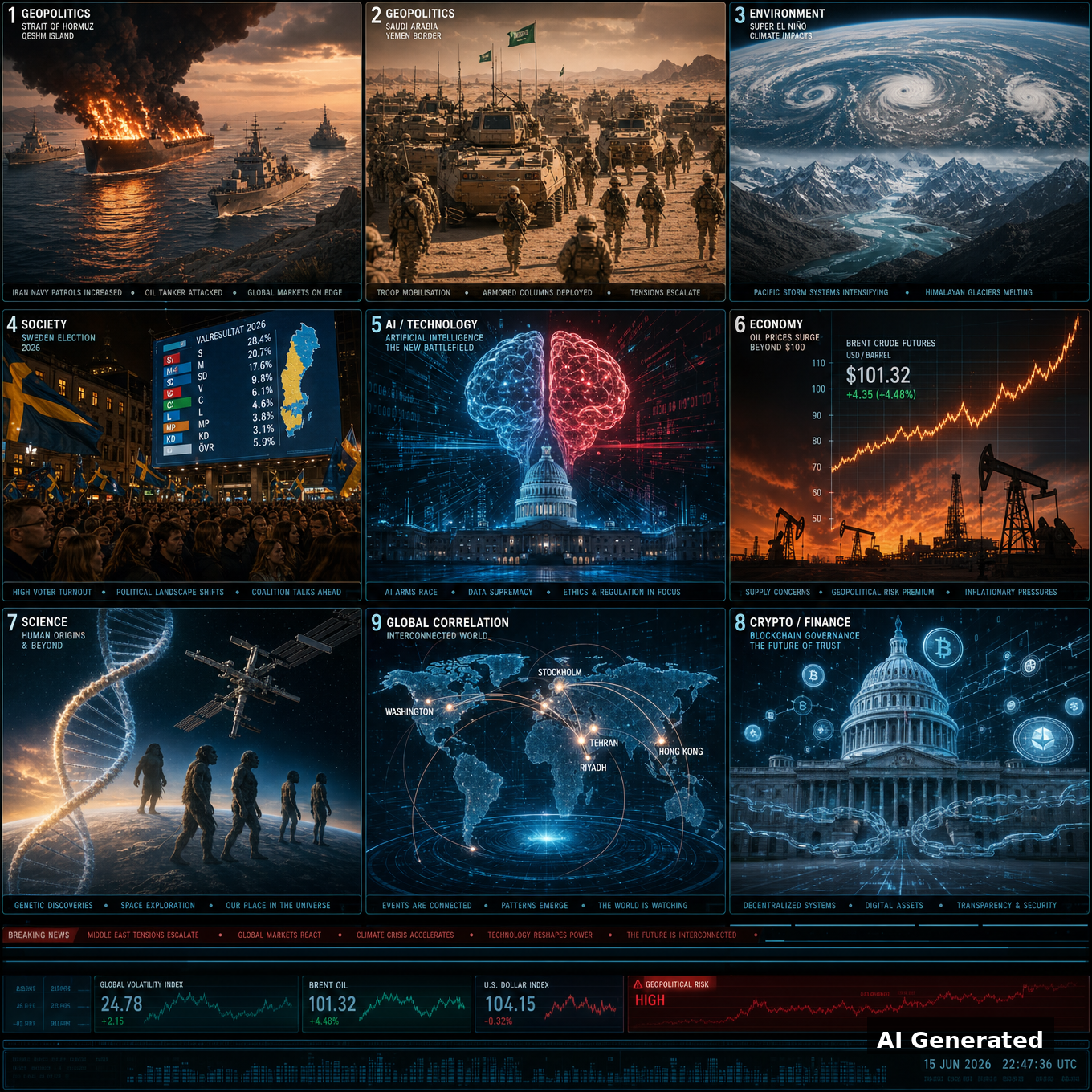
The two-chokepoint energy war entered a distinctly Iranian phase when a cargo vessel was struck off Qeshm Island in the Strait of Hormuz, killing one crewman and wounding four, with Tehran blaming a “terrorist enemy”[1]. The attack landed as Oman postponed the Gulf-Iran ministerial meeting on the strait scheduled for Salalah, a joint Tehran-Muscat decision framed as building “consensus”[2]. With the diplomatic track that D104 had identified as the soft exit now frozen, Washington and Tehran are left to manage the waterway through strikes and intercepts alone.
More consequential is the legal escalation: Iranian lawmakers are advancing a triple-urgency bill to withdraw from the Nuclear Non-Proliferation Treaty and authorise a weapons test “as soon as possible”[3]. It is the first credible legislative move toward a test since February, forcing Washington and Israel — which have already struck Iranian nuclear infrastructure — to decide whether a test crosses a new line. In the attrition arithmetic of D102-D105, the NPT bill is Tehran monetising its weakest asset: the fear of a nuclear Iran.
Saudi Arabia’s Two Fronts: Yanbu, the Mobilisation and Yemen
Saudi Arabia is absorbing strikes on both flanks of its export system. Houthi ballistic missiles hit the Yanbu industrial area on the Red Sea, where Aramco refineries, the East-West pipeline terminus and the Greek Patriot battery are concentrated, with smoke columns over the zone and the Hellenic battery on maximum alert inside the launch corridor[4]. Greek defence sources report Riyadh staging a “massive” mobilisation — tens of thousands of troops, Apache squadrons and fighters — described as the largest in the east, with the earlier Bayhan and Harib withdrawals reinterpreted as tactical re-concentration[5]; the operation appears aimed as much at Emirati ambitions in Yemen as at the Houthis. On the battlefield, Houthi fighters are advancing on the government strongholds of Marib and Taiz[6] — the Bab al-Mandab front tracked through D104-D105 becoming a grinding land offensive.
The G20 Energy Round as a War Council
The United States opened G20 energy meetings in Houston under an “energy abundance” banner undercut by the war it is fighting: delegations from China, India, Japan and Germany arrive alongside Canada and Saudi Arabia, with Russia expected[7]. Its outcomes — or lack of them — will be read directly by a market repricing oil structurally, not episodically.
Niger: The Mutiny That Exposed the Russian Lifeline
Detailed reporting on the 29-30 August Niamey mutiny confirms President Tchiani depends on Moscow to a degree previously unadmitted: when mutineers of the Armed Forces for the Restoration of the Homeland attacked Air Base 101, the palace and the broadcaster, some 200 Russian Africa Corps troops, backed by drones, helped loyalists retake the base, with at least 27 killed and about 100 arrested[8]. Analysts trace the insurrection to a pay-and-deployment schism — junior soldiers dying on jihadist fronts versus a better-paid presidential guard — a grievance no Russian partnership cures. The Alliance of Sahel States’ near-paralysis, and a Nigerien officer’s allegation of foreign (including Emirati) involvement, expose the AES as a paper structure[8]; the post-2023 pivot has produced a regime protected by a foreign force whose presence is itself a governance problem.
Bangsamoro’s First Parliament
Nearly 2.4 million voters in the Bangsamoro Autonomous Region in Muslim Mindanao cast ballots on Monday for the region’s first parliament, an 80-seat contest ending the transition begun under the 2014 peace deal and converting Moro insurgency into elective politics — including 40 party-list, 32 district and 8 sectoral seats, with the chief minister chosen by the new chamber[9]. Violence marred the eve of the vote: three killed and 15 wounded in a Cotabato City shooting, improvised bombs, and the elections commission placed Cotabato and parts of Basilan under its control after pre-shaded ballots appeared in 36 of 68 Maluso precincts[9]. Analysis frames the poll as the decisive test of whether self-governance survives its first generational transfer[10].
Sweden: A Country Held in the Balance
Sweden’s election is too close to call: with over 90 percent counted, the left bloc led by the Social Democrats’ Magdalena Andersson is ahead by roughly 20,000 votes, projected at 176 seats against 173 for Ulf Kristersson’s right-wing coalition[11]. Two novelties hide in the arithmetic: the Social Democrats face their worst result in over a century at about 28 percent, while the far-right Sweden Democrats — losing support for the first time since 2010 at roughly 17.6 percent — still hold the right’s coalition arithmetic, with Kristersson promising them cabinet seats[12][11]. A formal SD entry into government would be the first Nordic breakthrough at the moment Germany wrestles with its own firewall. Results land within a week.
Germany: The Brandmauer Under Siege
Lower Saxony’s municipal elections delivered the post-Sachsen-Anhalt shock in live data: the CDU held first place on 27.7 percent but lost four points, the SPD collapsed to 24.5, and the AfD more than tripled to 16.5 [14]. The “Brandmauer” question — the cross-party cordon sanitaire, already weakened by Sachsen-Anhalt — has become operational: the Reservistenverband is planning to keep the “Operationsplan Deutschland” blueprint out of a potential AfD state government’s hands, warning material could leak to Russia[15][13]. The security establishment builds contingencies for the firewall’s absence while Berlin offers none.
Europe’s Arctic and Eastern Diplomacy
At the Arctic summit in Rovaniemi, EU leaders — a crisis-bound Chancellor Merz and a Greenland-pressured Mette Frederiksen among them — confronted melting ice, Russian cable-sabotage and Chinese ambition, with a European icebreaker fleet the flagship proposal[16]. On the eastern flank, Foreign Minister Wadephul makes his first Budapest visit since 2019 [17], and Canada explores “associate member” EU status as a hedge against the US trade war — a constitutional novelty Washington will read as Atlantic realignment[18]. Europe consolidates its periphery while its largest member is paralysed.
The Ukraine Front: Firepower, Sanctions and Rhetoric
Ukraine has received its first RCH 155 wheeled howitzers nearly four years after ordering them, becoming the only operator of the automated 155mm Boxer-mounted gun, which fires eight rounds a minute, reaches 54km with rocket rounds and engages while moving[19]. Germany, Britain, Qatar and Switzerland ordered it and received nothing — Berlin delivered Kyiv a weapon its own army lacks. Hensoldt’s CEO echoed the urgency: after the Leipzig drone attack “there is no time for fundamental debates” on air defence[20]. President Zelensky sanctioned his former press secretary and nine others over “Russian propaganda”, extending the 2025 Poroshenko precedent[21], while Polish Foreign Minister Sikorski said “if Russia attacked us, we would take the gloves off” and defeat it quickly on allied airpower — the bluntest statement of the war[22].
Israel’s Cultural Front
Israel’s culture minister has called for stripping the citizenship of the Oscar-winning directors of NAZA, the Guardian-produced documentary on civilian targeting in Gaza, accusing Yuval Abraham and Rachel Szor of “treason against the state” after their Venice prize[23]. The demand escalates state pressure on cultural production from screening decisions to nationality itself — a constitutional threshold even if unrealised.
The Wider Strategic Map
The regional picture is filling: North Korea staged a joint live-fire drill of missiles, artillery and drones claiming “huge destructive power”[24]; China restored the airborne leg of its nuclear triad, footage showing the H-6N carrying the JL-1 air-launched ballistic missile beyond the western Pacific[25]. In Syria, fuel-price hikes triggered protests with echoes of 2019[27] and a device was thrown at a Greek Orthodox church in Hama[28]. The human ledger reaches Washington through the Air Force officer who “free-fell” after his jet was shot down over Iran in April[26]. Congo took a first step toward its national dialogue with the decree establishing the preparatory committee[29].
Greece’s Political Season Opens
At the Thessaloniki International Fair, PASOK leader Nikos Androulakis made the party’s programme explicit: first place in the next election, a 13th pension in two instalments, a 13th salary, restored EKAS, doubled VAT-exemption threshold for small firms, and no post-election cooperation with New Democracy[30]. It opens a campaign season that will shape Greece’s EU bargaining stance into 2027.
Environment & Climate
↑ ContentsThe Fossil-Power Legal Rebound
The D.C. Circuit rejected the use of Federal Power Act emergency powers to keep the 64-year-old J.H. Campbell coal plant in Michigan running past retirement, Judge Pillard writing the statute “is essentially a narrow, last-resort backstop”[31]. Seven fossil facilities were forced to stay open under the same “national energy emergency”, and parallel suits had frozen awaiting this ruling. The ledger is stark — 1,000 tons of nitrogen oxides, 2,000 tons of sulfur dioxide and 140 tons of particulates since May 2025, an estimated 100 new asthma cases nearby, and $259 million sought from customers in 11 states[31] — while the EPA moves to repeal carbon limits on coal and gas plants[32]: the executive props up coal by order as the judiciary rules there is no emergency.
A Super El Niño Builds
Forecasters put the odds of a strong, possibly “super”, El Niño above 90 percent, peaking between January and March — the pattern behind the 1998 Florida tornado outbreak that killed 42, nearly all in mobile homes[33]. The vulnerability map is unchanged: manufactured-home residents are 15-20 times likelier to die in a tornado, roughly 600,000 of Florida’s 830,000 such homes pre-date the 1994 wind codes, and two decades of FEMA records show no community safe room ever funded for a manufactured-home community[33]. The BRIC shelter program was terminated in 2025 (restored by court order in March 2026) and Milton-era warnings went out largely in English only[33]. Nature notes warming widens the distribution of once-rare events[34] — meteorology and injustice converging on the most exposed.
The Himalayan Tipping Point
A Systemiq report with ICIMOD finds Himalayan glaciers losing mass 65 percent faster than a decade ago while only about 21 of ~40,000 glaciers are monitored — a blind spot over unstable lakes (India counts 56 “very high risk”) and destabilising permafrost behind this year’s 1,300-plus flood deaths in Nepal and Tibet[35]. Himalayan water underpins roughly 20 percent of India’s GDP, yet mountain states capture about five percent of that value[35]. A third of the melting comes from black carbon that India can cut directly — the rare lever that makes the cryosphere’s balance-sheet argument actionable.
The Cryosphere’s Carbon and Cold
Two satellite-era findings complicate the Arctic story. Much of the ancient carbon released by thawing permafrost appears trapped in seabed sediments rather than quickly returning to the atmosphere — a sink that, if it holds, would moderate a feared feedback loop[36]. And satellite data from 2004-2016 found about 100 shallow hollows on the East Antarctic Plateau where snow surfaces plunged to -98°C, the coldest surfaces measured on Earth — while the continent still loses roughly 135 billion tons of ice a year on average[37]. Local extremes do not cancel global warming; the pairing is the nuance that separates analysis from headline.
Germany’s Energy at a Crossroads
Economics Minister Katherina Reiche’s plan to synchronise renewables with grid buildout is drawing warnings that the “rich” network package would produce unnecessary costs and could make green power dearer[38]. Industry confidence is in freefall: the Baden-Württemberg barometer shows the share of firms expecting climate neutrality by 2045 halved from 80 to 43 percent in a year, while those with no target at all jumped from 12 to 44 percent, citing bureaucracy (66 percent) and unreliable policy signals (62 percent)[39]. Germany’s climate framework is failing on delivery credibility, not ambition — and the political class, absorbed in the chancellor’s survival, has not offered a reset.
Defence Energy: The Seafloor Station
The Pentagon awarded Zeno Power a $7.5 million contract to develop a seafloor power station converting strontium-90 — recycled from a 1980s Oak Ridge radioisotope generator stored for 40 years — into electricity via Stirling converters, for decades of untended power to underwater sensors and AUV charging nodes[40]. The significance is the pattern: the military treats distributed energy as a strategic asset, and recycling legacy radioactive material into a mission gives the DOE a disposal pathway with operational value.
Wind at Scale: Blockage, Blades and Economics
Doppler lidar at the Global Tech I farm in the North Sea shows the wind slows about four percent nearly two miles before the first turbine row under stable conditions — a “global blockage” distinct from wakes, implying ~11.5 percent less kinetic power in that instant[41]. At the life-cycle end, Stena Recycling and Vestas demonstrated chemical separation of composites from decommissioned blades, attacking a waste stream Europe banned from landfill in 2026[42]. A Kansas rancher shows coexistence: 50 turbines on 7,000 acres since 2005, half his income in royalties, the footprint ~50 acres[43]. Rhode Island Energy’s 150 MW Maine wind contract extends regional diversification[44], and CleanTechnica argues geothermal — championed even by the Trump administration — has become coal’s existential threat by offering firm power without emissions[45].
Forests and the Energy Transition
Japan’s biomass boom is exporting deforestation: satellite analysis documents how its wood-pellet and chip industry is eating into Indonesian primary forests, Key Biodiversity Areas and Indigenous territories as Tokyo counts biomass as renewable — a carbon-accounting paradox at the heart of the trade[46]. At the positive pole, households inside Vietnam’s Annamite biodiversity corridors earned more from conservation-linked payments than neighbours outside, evidence that corridor designation can carry economic value alongside restrictions[47]. In Kenya’s Maasai Mara, rangers patrol on solar-charged electric motorcycles, bringing the transition into wildlife protection[48]. Together they bracket the transition’s moral range: biomass can be a deforestation subsidy or, tubed properly, a payment mechanism that keeps forests standing.
The Monitoring Gap
A Floodlight/Grist investigation documents the hollowing-out of America’s air-monitoring system: grants down over 35 percent in real terms, the monitor count halved, carcinogen networks (vinyl chloride, benzene) shrunk by half, while wildfire smoke and ozone rise — and for 71 of 100 large facilities in four states, the top emitted chemical is measured by no government monitor at all[49]. Louisiana, Kentucky and Ohio have since passed industry-backed laws barring enforcement use of community-collected data unless it meets EPA reference standards[49]. When the official network is blind and community sensors are legally neutered, the public loses the power to expose polluters — the accountability the Clean Air Act was built to provide.
Positive Tipping Points
Earthshot Prize and University of Exeter research identifies 51 solutions capable of triggering “rapid and transformative change” within five years, arguing recovery becomes self-propelling as reinforcing loops flip[50]. It is the mirror image of climate tipping-point literature: the same non-linearity that makes breakdowns fast can make build-outs fast too — a reminder that the direction of the system’s non-linearities is still a policy choice.
Society & Civil Issues
↑ ContentsMeasles: A Preventable Ledger
Pennsylvania recorded its third vaccine-preventable measles death in less than three weeks when a 40-year-old unvaccinated woman died of complications, per the county coroner — punctuating a statewide outbreak of over 670 cases and 124 hospitalisations across 37 counties in a state that had not reported a measles death in 35 years[51]. The case is a textbook demonstration of what anti-vaccination norms cost: a disease eliminated in the US in 2000 now kills adults in a low-vaccination pocket.
US Institutions: 9/11 Records and the Kennedy Center
On the 25th anniversary of September 11, President Trump said he will look into requests from 9/11 families to declassify records that could shed light on Saudi Arabia’s alleged role, telling reporters “I’m going to look at it when I get back”[52]. Fifteen of the nineteen hijackers were Saudis and the government has long denied involvement; the president’s openness, however provisional, reopens a dormant diplomatic file with Riyadh at the precise moment Washington is pressing the kingdom in the Hormuz-Bab al-Mandab war. The Kennedy Center’s near-collapse is the mirror story: documents show the Trump-aligned board’s control has driven the performing-arts complex to the brink of bankruptcy, with a possible vote as soon as Tuesday to close the main building[53]. One case is about withholding records, the other about political capture destroying a cultural institution — together they frame the midterm question of whether American institutions survive partisan capture.
UK Constitutional and Health Currents
The leaders of the SNP, Plaid Cymru and Sinn Féin are expected to sign a joint agreement in Cardiff, coordinating Scottish, Welsh and Northern Irish self-determination agendas — the first such trilateral pact across the UK’s nations, symbolic rather than governmental but a milestone in nationalist coordination[54]. In the same civic space, Alzheimer’s Research UK launched its “Ready for a Cure” campaign with actor Brian Cox, pressing the government to bolster NHS diagnostic capacity ahead of an anticipated wave of disease-modifying dementia therapies — a planning issue with fiscal consequences: if Britain licences Alzheimer’s drugs, it needs the diagnostic infrastructure to find the patients[55].
Data Protection and Pharma Safety
Revolut disclosed that a limited number of customers had data exposed in a scam using a legitimate government email domain, saying it blocked the address, notified authorities and contacted those affected[56]. The episode follows the 2025 HSBC and Harrods third-party breaches and lands as Revolut — valued at $115 billion and approved for a US national bank charter in early September — scales into one of the world’s largest retail bank challengers; a data-protection blemish at this stage is exactly the trust event regulators watch. In Australia, the medicines regulator warned of serious risks from counterfeit peptides after a patient tore their oesophagus taking a fake version of the unapproved weight-loss drug retatrutide — the grey market at the intersection of social-media wellness culture and online peptide clinics[57].
Australian Migration Politics
One Nation has pledged to cut temporary migration by more than 750,000 over three years, targeting international students and skilled-migrants’ families in a “net-negative” plan that drew bipartisan condemnation, with Labor warning it would damage construction, healthcare and agriculture without lifting living standards[58]. The politics are transparent, but the economics are the detail: migration is the load-bearing wall of Australia’s care and construction labour, and the proposal is a live preview of the 2027 campaign, where migration is set to be the defining cleavage — echoing the UK and US debates this series has tracked.
AI & Technology
↑ ContentsThe Washington Split on AI Speed
The week’s most consequential AI news is political. President Trump rejected calls to slow the industry — “whoever wins AI wins”, with warnings dismissed as “negative forces” raising things “that won’t happen” — even as he conceded “we can put guardrails”[64]. The remark lands atop the D105-tracked Amodei slowdown essay, whose proposals — independent evaluators, cross-democracy coordination, international agreements — were endorsed by Altman and Musk[66]. House Speaker Johnson floats summoning industry to the White House, but the president’s competitive framing is the opposite of Amodei’s premise that safety coordination is the condition for sustainable speed. The legislative lane opened separately with the “Ban Artificial Superintelligence Act”, and Obama urged Democrats to make AI oversight a central midterm issue[66][65] — the industry D105 framed as united in alarm is now the object of a political fight it cannot control.
Capital’s Two-Track Bet: Profitability and IPOs
The money moves even as the politics churn. Anthropic is reportedly anticipating a second straight profitable quarter and weighing a Nasdaq IPO that could value it at $2 trillion — up from $965 billion in May — with filings projecting up to $200 billion of revenue by 2028[59]. SoftBank, in parallel, secured a $12 billion loan to fund its OpenAI investment[60]. Against that euphoria, Sam Altman declared OpenAI will not file for an IPO this year — an “ill-advised moment to go public” — the cleanest indicator of how divided the frontier labs are about what a listing would do to the political climate they depend on[67]. Markets hinted at the answer: SoftBank shares tumbled 13 percent as safety warnings hit sentiment, punishing the complex most exposed to AI-IPO concentration[61].
Chinese AI and the Hong Kong Circuit
Zhipu AI raised $4 billion in a Hong Kong placement after its lockup expired, riding the territory’s resurgence as the listing venue for Chinese tech[62]. The raise marks the structural bifurcation in AI capital: US labs consolidate around US listings and Gulf money while Chinese frontier labs tap Hong Kong’s deep-liquidity circuit — and US sanctions have yet to slow the flow. Weeks after D103 documented DeepSeek’s cache-war economics, the $4B print suggests Chinese AI is not capital-starved; it is priced by a different exchange.
Compute’s Power and Materials Wall
Two infrastructure stories locate the real bottleneck. Samsung and SK Hynix rejected KEPCO’s $17 billion prepayment proposal for grid upgrades, refusing to front transmission money even as their customers demand more electricity — the clearest evidence that power is the binding constraint on the AI buildout and that grid-finance free-riding is unresolved[63]. USA Rare Earth broke ground on a $1.2 billion magnet plant in South Carolina, backed by $1.6 billion in federal support, targeting 6,400 tons of NdFeB magnets a year in the opening move of a domestic supply chain that currently passes through China[69]. Both are the same story: AI growth is bounded by industrial inputs — power, magnets, chips — that no model improvement can conjure.
Diversification and Defence Tech
Insight Partners’ Devin Parekh explained why the $90 billion firm stays diversified across rival labs rather than betting the farm on OpenAI and Anthropic — a stance that looks increasingly prescient as safety concerns collide with valuations[68]. At the hardware edge, a battery-powered drone shattered the endurance record with an 8-hour-41-minute flight at Edwards Air Force Base, powered by motors assembled at Tobyhanna Army Depot inside a mobile 3D-printing factory — a demonstration of the organic industrial base rebuilding domestic drone-component supply at the moment the Gulf war is proving drone-cheap asymmetry[70].
Economy & Business
↑ ContentsOil Beyond $100: The War Premium Matures
Oil opened the week with conviction: Brent for November rose 2.8 percent to $107.54 and WTI 2.29 percent to $102.34, extending weekly gains of ~9 percent [71]. Hormuz commodity-vessel crossings fell to single digits per day against a ten-day average near fourteen, confirming the D104-D105 thesis of structural repricing[72]. The critical variable is the Saudi relief lane: the struck East-West pipeline is in a repair race in which every day of downtime loads more onto Yanbu’s terminals — which the Houthi missile campaign is simultaneously targeting[73]. Hence this week’s $107 print is a floor, not a spike.
The Fed’s Hawkish Pivot and China’s Liquidity
Monetary policy is being dragged into the energy war. Goldman Sachs expects a 25bp Fed hike next week to stabilise sentiment[78], and the yen sits near a seven-month high at 154.02 ahead of the Fed-BOJ pairing[75][74] — a hike into a war-driven shock being the classic trap, yet now the consensus read. Beijing steers its own course: the PBoC injected 504 billion yuan while setting the yuan midpoint at its strongest since February 2023[77][76]. Copper edged lower on Fed-hike bets, a textbook read for importers[79].
Bubble Signals at Treasury
The equity complex received its loudest crash warning yet: Capital Economics’ James Reilly calls the data “consistent with a late-stage bubble”, forecasting the S&P 500 at 8,250 for end-2026 then a 21-percent plunge by end-2027, citing dotcom-era P/E, peak earnings growth, negative free cash flow across top AI hyperscalers in 2027, and an IPO gusher[80]. Rockefeller International’s Ruchir Sharma adds the trigger — a decisive breach of 5 percent on the ten-year Treasury (now 4.97) would herald tight money that starves AI mega-projects; even optimist Ed Yardeni has cut his “Roaring 2020s” odds to 70 percent[80]. With the Fed expected to hike and oil above $100, both bubble conditions converge.
Corporate Europe: Banks and Automakers
Finance Minister Lars Klingbeil received UniCredit chief Andrea Orcel to restate Berlin’s opposition to a “hostile takeover” of Commerzbank even as UniCredit holds almost half the votes in the bank the state rescued in 2008 and still has 12.1 percent of[81]. The meeting sets the tone for cross-border bank consolidation in a fragmentation era. VW’s rescue plan is the deeper wound: it rests on finally breaking through in China’s EV market, an assumption WirtschaftsWoche calls “dangerously optimistic” given BYD’s dominance and the price war[82] — a failed bet would turn restructuring into a national crisis just as Lower Saxony’s elections underscored industrial anger.
Trade and Tariffs
Trade oscillated between gesture and strategy. Trump said he will remove the 10 percent tariff on Irish whiskey during the Irish Open trophy ceremony — “I am going to take the tariffs off” — after the May carve-out for UK spirits, the clearest evidence yet that this administration treats tariffs as negotiable instruments attached to personal relationships[84]. Strategically, Trump left the door open to Chinese carmakers ahead of his Xi summit, declining to rule out their entry to the US market — a signal that auto policy may be a bargaining chip separable from the AI competition[83].
Canada Bets on Capital
Prime Minister Mark Carney used the eve of the inaugural Canada Investment Summit to sell a “new, powerful, confident, united Canada” to the global asset managers arriving in Toronto, casting the summit as the country’s answer to US tariff pressure — redirecting capital toward Canadian energy, minerals and technology[85]. The summit is the economic arm of the Canada-EU alignment reported in Geopolitics: a hedge portfolio against a US relationship that has become risk rather than security. The pledge numbers, when they come, will test whether the money follows the confidence.
Supply Chains: Aviation, Power, Metals
Amazon suspended operations with cargo carrier 21 Air after the fatal Miami crash killed five — acting within days of the accident, before the investigation concluded, and signalling that supply-chain operators are now expected to pre-empt regulatory findings[86]. India’s data-centre boom is becoming a load anchor for new renewable capacity[87], while a Chinese deep-sea expedition claims high-grade gold and silver in hydrothermal mounds inside its EEZ — a resource that will sharpen the seabed-mining contest[88]. The three stories share a theme: critical supply chains are being re-engineered faster than the rules governing them.
The UK Tech Economy’s Geography
Data show the UK’s university spinout economy is brutally concentrated: Oxford, Cambridge and London produced almost half of all spinouts founded between 2013 and 2024, attracted two-thirds of sector venture capital and took two-thirds of that into a Golden Triangle while companies elsewhere struggle for the residue[89]. Just 36 percent of spinouts that went public did so in the UK, down from 79 percent before 2013, as scale-up capital and a “technical literacy” gap push firms to the US — a geography-of-finance case study that mirrors the transatlantic AI-IPO arbitrage of Section 4. A rumoured exit tax on emigrating spinouts was ruled out — a concession to forces the financial system cannot yet serve[89]. Finally, Larry Ellison cancelled his planned $7.5 billion Oracle share sale at the same moment outsiders pile into AI valuations — the most prominent insider signal yet that AI-equity sellers are losing confidence in buy-side price discovery[90].
Science & Space
↑ ContentsGenomes and Ghost Lineages
UC Berkeley researchers used a new method, TRACE, to infer that three to five percent of Denisovan DNA came from an unidentified “super-archaic” lineage that diverged from ours roughly 1.8 million years ago — the Denisovans who later interbred with modern humans were already hybrids, and some deeper DNA travelled into living people inside Denisovan-derived chromosome segments[93]. The signal is enriched in Oceanian Denisovan regions but not Neanderthal ones, implying a two-step route — and it emerged without a donor genome, from genealogies of phased whole genomes and 92 Oceanian samples. A divergence near 1.8 million years overlaps early Homo erectus, a hypothesis, not an identification.
Antimicrobial Archaeology
The past keeps yielding antibiotics leads. University of Oregon researchers reconstructed antimicrobial peptides dating back 160 million years, some outperforming modern counterparts against resistant infections[97]. The medieval variant remains instructive: the 2015 reconstruction of a tenth-century eye salve from Bald’s Leechbook — garlic, onion or leek, wine, cow bile and brass, aged nine days — killed more than 99.99 percent of S. aureus in biofilms and cut MRSA ~90 percent in excised tissue in four hours, a performance vancomycin did not match[92]. Reproduction followed, and a 2022 phase-1 study found the formulation skin-tolerable. The takeaway is procedural: combination chemistry and preparation time matter, and neither finding is a drug — but both are legitimate leads.
Habitats Off-World and On
A UCLA-led study using NASA’s Diviner radiometer estimates that permanently shaded recesses inside the Mare Tranquillitatis lunar pit stay near 17°C with under a degree of daily variation, against the surface’s 127°C to -173°C swing, because the pit recycles infrared among its walls — and 2024 radar analysis found a cave conduit beyond the pit wall[94]. A base in such a cave would shed most of its thermal burden. Meanwhile JWST ruled out tiny exomoons around a nearby exoplanet, constraining formation channels[100], and a star long watched as an imminent supernova was unmasked as a case of mistaken identity, its outbursts likely from an unseen companion[99].
Materials from Waste and Sand
RMIT’s decade-long cigarette-butt brick programme reached a mature summary: a one-percent addition to fired clay retains substantial strength (30.8 vs 48.6 MPa control), cuts firing energy ~10 percent, reduces thermal conductivity 17 percent and immobilises over half of tested heavy metals, with 90-plus percent of chromium locked in the ceramic[95]; the dramatic 58-percent energy figure belongs to five-percent bricks too weak for load-bearing use, so the practical centre is the one-percent recipe amid a 4.5-trillion-butts litter stream and real collection-and-emissions logistics[95]. Separately, Empa’s “living sand” uses biopolymer fibres to bind desert grains into a water-retaining soil for infertile wastelands[102]. Both are the same lesson: waste and sand are feedstocks whenever an engineered matrix reorganises them into value.
Quantum Thermodynamics
An international team demonstrated in a photonic experiment that heat can flow from cold to hot — and a modified quantum Otto cycle can extract net work while cooling another system — without violating the second law, because the anomalous flow is conditioned on information: a control qubit’s measurement determines the ordering of thermal interactions, and the energy ledger closes once the measurement’s cost is counted[103]. Reproduced with photon polarisation in a Mach-Zehnder interferometer and published in Physical Review Letters, the result is a demonstration of coherence and information as thermodynamic resources — potentially the seed of quantum processors that cool themselves while working, though applied heat management is far off. The boundary conditions of the second law are being redrawn by quantum information.
Biology’s Extremes
Botany delivered one of the year’s stranger finds: Thismia daemona, the “devil flower”, discovered in a Thai park at ~1,000 metres, grows without chlorophyll and feeds through soil fungi, its known population fewer than 50 plants — a provisional Critically Endangered listing for a species found in a popular, protected park[101]. Human physiology supplied a companion: geneticists comparing elderly Korean haenyeo breath-hold divers with non-divers found their hearts drop sharply on simulated dives (one by more than 40 beats in 15 seconds), carrying blood-pressure and cold-tolerance variants at four times the mainland rate — a possible signature of selection on diving mothers[104]. Paleontology added the middle: a 90-million-year-old small iguanodontian from Japan’s coast shows Late Cretaceous shorelines hosted dinosaurs of very different body sizes[96]. Evolution is a tinkerer with unbounded patience.
Space Infrastructure and the Record Books
SpaceX’s Falcon family notched its 700th mission, deploying the final three O3b mPOWER satellites to complete SES’s 13-satellite medium-Earth-orbit constellation on a booster making its 29th flight — an infrastructural milestone wrapped in reusability economics that make the constellation workable[98]. The completion also carries a geopolitical undertone: a European operator depending on a US launcher is exactly the dependency Europe’s new launch policies are designed to break.
The Science of Reading
A registered report in Royal Society Open Science put Bionic Reading before an eye tracker: with 90 skilled readers, bolding the first half of each word moved first-fixation landing points on long words but produced no gain in speed, skipping or comprehension[91]. Registered Bayes-factor thresholds give the null real weight, and the middle-bolded control isolates word-initial cues from general disruption. Against a convergent null literature, the technique’s 100,000-plus app downloads show how marketable “science” can outrun its evidence.
Crypto, Digital Assets & Blockchain
↑ ContentsThe CLARITY Act’s “Final” Offer: Ethics, Enforcement and the Tuesday Vote
The US crypto-regulatory endgame arrived in its clearest form when Senate Republicans released revised CLARITY Act text on Sunday, calling it their “last, best and final” offer ahead of Tuesday’s cloture vote[105]. The new language folds in a Trump-agreed ethics proposal that a GOP aide says accepts roughly 80 percent of the Tillis-Gallego framework — the compromise requiring the president to either divest substantial crypto holdings or place them in a blind trust — converting the bill from a market-structure fight into a presidential-ethics test[105]. The White House has signed off on the ethics language, and the proposal separately authorises state attorneys-general to sue the Justice Department and crypto exchanges over violations, giving enforcement a decentralised, anti-capture design unusual in federal financial law[106][107].
Against the running context, the CLARITY sprint has followed a distinctive arc: D101 tracked the bill’s arrival amid the market-structure fight, D103 its acceleration under the Russia-sanctions calendar, and this window shows the ethics file weaponised as the final condition. The politics are transparent — the ethics clause is what Democrats demanded to move at all — but the market consequence is substantial either way: a federal statute with state-level enforcement teeth would end jurisdiction-shopping. Tuesday’s cloture vote is the most important scheduled event in US digital-asset policy since the ETF approvals.
SGX and the Institutional Perimeter
Singapore Exchange has become the first major Asian bourse to open its crypto derivatives market to US institutional money, receiving CFTC authorisation under Regulation 48.10, the pathway letting US persons trade a foreign board of trade’s products without domestic registration[108]. The products are Bitcoin and Ether perpetual futures — contracts that never expire, tethering to spot via periodic funding rates — wrapped in a regulated exchange’s full infrastructure: traditional margin calls, collateral top-ups and central clearing, with one deliberate choice: SGX does not accept stablecoins as collateral, separating its rails from the DeFi-adjacent practices of offshore venues[108]. The contracts launched in November 2025 and have cleared $5.8 billion in cumulative volume across ~400,000 lots, Bitcoin taking 83 percent of average daily volume[108].
The structural significance is that perpetuals are the most-traded crypto derivative on the planet yet have lived almost entirely outside the US perimeter — CME lists none, and no CFTC-regulated domestic venue offers them. SGX’s authorisation gives US desks a regulated middle path between CME’s dated contracts and offshore perpetuals, with two-to-four-week onboarding[108]. The competitive implication for CME is direct, and the template — an Asian exchange using Reg 48.10 to front-run the US domestic market — writes the reform argument Washington will hear as CLARITY comes to a vote: if a foreign venue can serve US institutions with the world’s most-wanted crypto product while US law stays silent, the case for domestic reform writes itself. The refusal of stablecoin collateral is equally telling: a hedge against regulatory scrutiny that projects the very guardrail ethos the Act tries to codify.
Tokenized Supply and Governance Theory
Institution-adjacent issuance kept climbing the Solana ecosystem: Backpack Securities launched its $WEN token on Solana, adding a tokenized asset to a network where perpetual-futures volume has surged and tokenized equities have grown past $684 million as stocks trade around the clock[109]. The launch continues the pattern D105 documented when tokenized equities crossed the billion-dollar weekend threshold: Solana’s low-cost, fast-settlement architecture has made it the preferred launchpad for tokenized instruments[109]. Whether $WEN attracts durable liquidity or evaporates like most meme-adjacent issuances is the open question, but the direction is structural: each launch normalises on-chain issuance of real assets while the regulatory conversation trails the settlement infrastructure by a widening margin.
On governance, Vitalik Buterin argued that adversarial governance theory — how systems stay robust when actors behave adversarially — could be the key to AI safety, a pivot that matters here because crypto’s hardest-won lesson is that code alone is not enough: incentive design, decentralised checks and formalised veto points are what keep adversarial systems stable[110]. His bridge reframes AI alignment as a governance problem, extending the ethos that produced Ethereum’s own adversarial-tested consensus layer. For decision-makers tracking both files, the usable hypothesis is simple: the industries that survive scaling are those that build adversarial governance into the protocol layer before the crisis, not after it.
Correlations & Analysis
↑ ContentsThe through-line of this window is that the two-chokepoint energy crisis mapped in D103 (2026-09-11), consolidated in D104 (2026-09-12) and D105 (2026-09-13), has moved into its most dangerous phase: the strike-and-blockade logic is now interacting with a nuclear threshold. Today’s window adds the Qeshm ship strike and the postponed Iran-Oman Hormuz summit [1][2] — removing the soft diplomatic track D104 identified — and a triple-urgency bill in Tehran to quit the NPT and test a weapon [3]. The attrition war D102 measured in interceptors and dollars keeps finding escalation vectors: tankers (D101), pipelines (D103-D104), strikes on Saudi export infrastructure near a Greek Patriot battery (today) [4], and now the legal architecture of nuclear breakout. Each step pushed oil higher — to a $107.50 Brent print this morning [71] — and the Hormuz crossing data [72] confirm the band is structural, not panic-driven.
The second correlation links the energy shock to the monetary regime: the hawkish turn D101-D102 tracked becomes a rate decision, with Goldman expecting a 25bp hike next week [78] and the yen at a seven-month high ahead of the Fed-BOJ pairing [74][75]. The hike would arrive into a war-driven import shock — fighting inflation with demand destruction just as bubble analysts expect a 21-percent equity correction [80]. Oil, rates and AI valuations are no longer separable: the same $107 barrel feeds the inflation that justifies the hike that threatens the AI complex pricing on $200-billion revenue projections [59] — and the SGX Reg 48.10 authorisation [108] reads as the system preparing for exactly that volatility.
The third thread is the absorption of both crises into the autumn 2026 political machinery. Germany’s post-Sachsen-Anhalt turbulence, tracked since D99, produced two concrete symptoms: the CDU’s slump in Lower Saxony alongside the AfD’s tripling [14], and the Reservistenverband planning to keep the war plan out of AfD hands [15] — the firewall debate D101 raised now resolved at the level of contingency planning. In parallel, the AI-safety debate D105 documented as an industry pact has become a Washington fight, with Trump’s competitive nationalism [64], a Democratic oversight platform [65] and a Senate bill to ban superintelligence [66]. And the CLARITY Act, tracked through D98-D103, has reached its “last, best and final” offer with a presidential-ethics clause and state-AG enforcement [105][107], its Tuesday cloture vote now a date with consequences for both the industry and the president’s holdings. The pattern across energy, money, AI and crypto is institutional: technical or market crises are being absorbed into the electoral machinery of a super-election autumn.
The environmental ledger completes the correlation. The Himalayan tipping-point analysis — glaciers melting 65 percent faster, 56 very-high-risk lakes, 20 percent of India’s GDP at stake [35] — connects to a super El Niño forecast with a greater-than-90-percent chance of a January peak aimed at Florida’s most exposed, least protected residents [33], and both are worsened by the fossil-policy whipsaw documented in the coal-plant ruling [31] and the proposed EPA repeal [32]. The climate system does not respect the electoral calendar, and the D.C. Circuit’s binding of the “energy emergency” doctrine [31] is the one item of this window that reduces a risk rather than deferring it. The monitoring-gap investigation [49] converts the rest into actionable specificity: if communities cannot measure what they breathe, no climate policy can be enforced.
What to watch in the next reporting period: (1) The Senate cloture vote on the CLARITY Act on Tuesday 16 September — the most market-moving scheduled event, the ethics-and-divestment clause the decisive coin. (2) The Fed decision next week: a hike into a war shock, and the Bank of Japan’s response at the yen’s seven-month strength. (3) Whether Tehran’s NPT withdrawal bill advances — a step that would reframe the whole Gulf conflict. (4) The Houthi advance on Marib and Taiz and the Saudi mobilisation’s first contact. (5) German Landtag elections on 21 September — the first test of whether the brandmauer’s erosion reaches state governments. (6) Sweden’s coalition arithmetic as full results arrive — the first potential SD entry into a Nordic government.
References
1. Iranian ship struck near Qeshm Island, Tehran postpones Hormuz talks with neighbours by FRANCE 24 · FRANCE 24 ↑
2. Hormuz: Iran–Gulf meeting put on ice – what Oman decided by iEfimerida · iEfimerida ↑
3. Iran prepares triple-urgency bill to quit the NPT and test a nuclear weapon by DefenceNet.gr · DefenceNet.gr ↑
4. Houthi ballistic missiles strike the area of the Greek Patriot battery at Yanbu by DefenceNet.gr · DefenceNet.gr ↑
5. EXCLUSIVE: Massive Saudi Arabian military mobilisation by DefenceNet.gr · DefenceNet.gr ↑
6. Yemen’s Houthis advance on government strongholds of Marib, Taiz by Al Jazeera · Al Jazeera ↑
7. US hosts G20 energy talks in Texas as Iran war disrupts global fuel markets by FRANCE 24 · FRANCE 24 ↑
8. Niger mutiny exposes growing reliance on Russia by Al Jazeera · Al Jazeera ↑
9. Philippines’ Muslim-majority Bangsamoro region votes for first parliament by Al Jazeera / AP · Al Jazeera / AP ↑
10. Historic southern Philippines assembly election tests stability, self-rule by Nikkei Asia · Nikkei Asia ↑
11. Swedish party blocs tied after Sunday vote, projections say by BBC News · BBC News ↑
12. Sweden’s centre-left edges ahead by three seats in preliminary results by Euronews · Euronews ↑
13. Nach Sachsen-Anhalt: Ist die Brandmauer jetzt Geschichte? (After Saxony-Anhalt: is the firewall now history?) by Tagesschau (J.P. Lang) · Tagesschau (J.P. Lang) ↑
14. Wahlen: Drei Lehren aus den Kommunalwahlen in Niedersachsen (Elections: three lessons from the Lower Saxony municipal elections) by Stern · Stern ↑
15. Reservistenverband will „Operationsplan Deutschland“ vor AfD verstecken (Reservist association wants to hide the Germany Operations Plan from the AfD) by Frankfurter Allgemeine Zeitung · Frankfurter Allgemeine Zeitung ↑
16. Arktis-Gipfel in Finnland: Europäer nehmen Kampf um Einfluss in der Arktis auf (Arctic summit in Finland: Europeans take up the fight for Arctic influence) by Stern · Stern ↑
17. Wadephul reist zu Besuch nach Budapest (Wadephul travels to Budapest) by Stern / dpa · Stern / dpa ↑
18. Konflikt mit USA: Kanada strebt „einzigartige Allianz“ mit EU an – keine Mitgliedschaft (Conflict with the US: Canada seeks ‘unique alliance’ with the EU – no membership) by Frankfurter Allgemeine Zeitung · Frankfurter Allgemeine Zeitung ↑
19. Ukraine Has Received Its First RCH 155 Wheeled Howitzers Nearly 4 Years After Ordering Them by 19FortyFive · 19FortyFive ↑
20. Hensoldt-Chef Oliver Dörre: „Im Ernstfall ist keine Zeit für Grundsatzdiskussionen“ (Hensoldt CEO Oliver Dörre: ‘In an emergency there is no time for fundamental debates’) by Handelsblatt · Handelsblatt ↑
21. Zelensky sanctions former associates for spreading Russian propaganda by DefenceNet.gr · DefenceNet.gr ↑
22. Polish FM: ‘If Russia attacks us we will take the gloves off and defeat it in record time’ by DefenceNet.gr · DefenceNet.gr ↑
23. Israeli minister threatens to strip Israeli film-makers of citizenship over Gaza documentary NAZA by The Guardian · The Guardian ↑
24. North Korea says its recent live-fire drill demonstrated ‘huge destructive power’ by The Independent / AP · The Independent / AP ↑
25. China’s nuclear triad gains flexibility as H-6N bomber gets airborne nuclear strike capability by Interesting Engineering · Interesting Engineering ↑
26. Air Force officer recalls ‘free-falling’ after jet was shot down over Iran by NBC News · NBC News ↑
27. Protests erupt across Syria over sharp fuel price hikes by Al Jazeera · Al Jazeera ↑
28. Explosion outside a Greek Orthodox church in Hama, Syria – vehicle damage by DefenceNet.gr · DefenceNet.gr ↑
29. Première étape vers un dialogue national en RDC (First step toward a national dialogue in the DRC) by FRANCE 24 · FRANCE 24 ↑
30. Androulakis at DETH – ‘Goal: PASOK first party’ by DefenceNet.gr · DefenceNet.gr ↑
31. A federal judge just told Trump there’s no ’emergency’ to justify keeping a Michigan coal plant open by Grist · Grist ↑
32. US EPA set to repeal carbon limits for coal, gas power plants by FinancialJuice · FinancialJuice ↑
33. A Super El Niño Is Building. Florida’s Most Vulnerable Homes Aren’t Ready by Inside Climate News · Inside Climate News ↑
34. The super El Niño is already wreaking havoc: here’s what’s in store by Nature · Nature ↑
35. The Himalayas are melting faster – and India’s economy is ‘at risk’ by BBC News · BBC News ↑
36. Thawing Permafrost Is Releasing Carbon, but Something Unexpected Happens by SciTechDaily / Alfred Wegener Institute · SciTechDaily / Alfred Wegener Institute ↑
37. Satellites scanned Antarctica between 2004 and 2016 and found about 100 shallow hollows where the snow plunged to roughly -144F (-98C) by EcoTicias / NSIDC · EcoTicias / NSIDC ↑
38. Erneuerbare Energien: Fachleute warnen: Reiches Netzpaket produziert unnötige Kosten (Experts warn: rich grid package produces unnecessary costs) by Handelsblatt (Klaus Stratmann) · Handelsblatt (Klaus Stratmann) ↑
39. Energiepolitik: Klimaneutral bis 2045? Immer mehr Firmen geben auf (Climate-neutral by 2045? More and more companies are giving up) by Stern / BW-IHK · Stern / BW-IHK ↑
40. Old radioactive material from Oak Ridge could power the seafloor, but the underwater station still exists mostly in tests by EcoTicias / ECONEWS · EcoTicias / ECONEWS ↑
41. The wind changed before reaching a North Sea wind farm, and lasers caught the slowdown almost two miles away by EcoTicias / ForWind · EcoTicias / ForWind ↑
42. Wind turbine blades are built to survive storms for decades, but Sweden is testing how to take them apart afterward by EcoTicias · EcoTicias ↑
43. A Kansas rancher let 50 wind turbines rise across his 7,000-acre cattle ranch in 2005 – 20 years later wind royalties provide roughly half his income by EcoTicias / EDF Vital Signs · EcoTicias / EDF Vital Signs ↑
44. Rhode Island Energy looks to Maine onshore wind farm to boost renewable electricity supply by Rhode Island Current · Rhode Island Current ↑
45. Trump’s Geothermal Energy Time Bomb Is About To Explode by CleanTechnica · CleanTechnica ↑
46. Japan’s biomass energy boom threatens further deforestation in Indonesia by The Independent / AP · The Independent / AP ↑
47. Biodiversity corridor payments boost household incomes in Vietnam’s Annamite mountains by Mongabay · Mongabay ↑
48. Electric mobility brings Africa’s energy transition into the wild by The Independent / AP · The Independent / AP ↑
49. America’s air monitors are disappearing. So is your power to expose polluters. by Grist / Floodlight · Grist / Floodlight ↑
50. ‘Recovery becomes self-propelling’: Five positive tipping points that can save the world by Euronews / EHN · Euronews / EHN ↑
51. Unvaccinated Pennsylvania woman died of measles complications, coroner says by Ars Technica · Ars Technica ↑
52. Trump will look into requests from families of 9/11 victims to release records that could shed light on Saudi Arabia’s alleged role by Fortune / AP · Fortune / AP ↑
53. Kennedy Center may shut as soon as Tuesday, warns of bankruptcy, documents show by FinancialJuice / Washington Post · FinancialJuice / Washington Post ↑
54. SNP, Plaid and Sinn Féin leaders expected to sign joint agreement in Cardiff by Evening Standard / Press Association · Evening Standard / Press Association ↑
55. Succession’s Brian Cox calls on government to bolster NHS for dementia treatment by Evening Standard · Evening Standard ↑
56. Revolut says customer data exposed in government email domain scam by Business Matters / TechCrunch · Business Matters / TechCrunch ↑
57. Peptide user tore oesophagus after using counterfeit product, Australian regulator warns by The Guardian · The Guardian ↑
58. One Nation vows to cut migration by 750,000 amid warnings move would damage economy by The Guardian · The Guardian ↑
59. Anthropic expects second straight profitable quarter ahead of potential Nasdaq IPO valued at $2 trillion, per FT by Crypto Briefing / FT · Crypto Briefing / FT ↑
60. SoftBank secures $12B loan for OpenAI investment by Crypto Briefing · Crypto Briefing ↑
61. SoftBank shares tumble 13% as AI leaders call for safety slowdown by Crypto Briefing · Crypto Briefing ↑
62. Zhipu AI returns to Hong Kong equity market after lockup, raises $4B in massive placement by Crypto Briefing · Crypto Briefing ↑
63. Samsung, SK Hynix reject KEPCO’s $17B prepayment proposal for power grids by Crypto Briefing · Crypto Briefing ↑
64. Trump rejects calls to slow AI as Amodei urges global limits by Business Matters · Business Matters ↑
65. While Barack Obama urges Democrats to make AI a campaign issue, Trump downplays the need to slow development despite dire warnings by Fortune / AP · Fortune / AP ↑
66. Anthropic CEO, tech leaders building world’s most powerful AIs now want to slow it down by Interesting Engineering · Interesting Engineering ↑
67. Altman Says OpenAI Won’t IPO This Year by Gizmodo · Gizmodo ↑
68. Insight Partners’ Devin Parekh on why the firm is diversifying while everyone else bets the farm on OpenAI and Anthropic by TechCrunch · TechCrunch ↑
69. $1.2 billion mega-facility to boost America’s domestic magnets production by Interesting Engineering · Interesting Engineering ↑
70. Battery-powered drone shatters world record, uses propulsion system assembled at US Army depot by Interesting Engineering · Interesting Engineering ↑
71. Πετρέλαιο: Πάνω από τα 107 δολάρια το Brent – Νέα άνοδος υπό τη σκιά της κρίσης στη Μέση Ανατολή (Oil: Brent above $107 – fresh rise under the shadow of the Middle East crisis) by enikos.gr · enikos.gr ↑
72. Strait of Hormuz commodity vessel crossings drop to single digits per day over weekend by FinancialJuice · FinancialJuice ↑
73. Wirtschaft von oben: Wie schnell kann die saudische Pipeline nach dem Treffer wieder fördern? (Business from above: how fast can the Saudi pipeline produce again after the strike?) by WirtschaftsWoche (Thomas Stölzel) · WirtschaftsWoche (Thomas Stölzel) ↑
74. Dollar steady, yen near 7-month high ahead of Fed, BOJ meetings by Investing.com / Reuters · Investing.com / Reuters ↑
75. Dollar/yen rises 0.3% to 154.02 by FinancialJuice · FinancialJuice ↑
76. China sets yuan midpoint at strongest level since Feb. 3, 2023 by FinancialJuice · FinancialJuice ↑
77. China’s central bank injects 504 billion yuan via overnight and one-day reverse repos by FinancialJuice · FinancialJuice ↑
78. Goldman Sachs expects Fed to hike rates 25bp next week due to market pressures by Crypto Briefing · Crypto Briefing ↑
79. Copper edges lower as US inflation boosts bets on Federal Reserve rate hikes by Crypto Briefing · Crypto Briefing ↑
80. Stocks are in a late-stage bubble and poised to crash 21% next year, while Treasury yields above 5% will signal a new era of tight money by Fortune · Fortune ↑
81. Commerzbank-Übernahme: Klingbeil empfängt Unicredit-Chef (Commerzbank takeover: Klingbeil receives UniCredit chief) by Stern · Stern ↑
82. Rettung von Volkswagen: VWs gefährlich optimistischer Plan für China (Saving Volkswagen: VW’s dangerously optimistic plan for China) by WirtschaftsWoche · WirtschaftsWoche ↑
83. Trump leaves door open to Chinese carmakers ahead of summit with Xi by Nikkei Asia · Nikkei Asia ↑
84. ‘Everybody’s been bugging me’ – Trump says he’ll remove his 10% tariff on Irish whiskey during a trophy ceremony in Ireland by Fortune / AP · Fortune / AP ↑
85. Carney touts ‘new, powerful, confident’ Canada to business leaders ahead of summit by National Post / Financial Post · National Post / Financial Post ↑
86. Amazon pauses operations with cargo carrier after fatal Miami crash by BBC News · BBC News ↑
87. India’s data center boom creates new engine for renewable energy by Nikkei Asia · Nikkei Asia ↑
88. China’s deep-sea expedition uncovers high-grade gold, silver deposit in the Pacific by Interesting Engineering · Interesting Engineering ↑
89. Golden Triangle takes two-thirds of UK spinout venture capital by Business Matters · Business Matters ↑
90. Larry Ellison cancels $7.5 billion sale of Oracle stock by TechCrunch · TechCrunch ↑
91. Bionic Reading: eye-tracking study of 90 readers finds bolding moved first fixation but no gain in speed, skipping or comprehension by ScienceBlog / Royal Society Open Science · ScienceBlog / Royal Society Open Science ↑
92. Bald’s Leechbook 1,000-year-old eye remedy destroyed >99.99% of S. aureus biofilms and cut MRSA ~90% in excised tissue by ScienceBlog · ScienceBlog ↑
93. Denisovans who interbred with modern humans were already hybrids: 3-5% of their DNA from an unidentified super-archaic lineage by ScienceBlog (Lab Report) / Science · ScienceBlog (Lab Report) / Science ↑
94. Lunar pits: permanently shaded areas may stay near 17C – dramatically reducing thermal-control needs for a base by ScienceBlog (The Long View) / GRL · ScienceBlog (The Long View) / GRL ↑
95. RMIT: 1% cigarette-butt waste in fired-clay bricks keeps strength, cuts firing energy ~10%, reduces thermal conductivity 17%, immobilises heavy metals by ScienceBlog (Lab Report) / Materials · ScienceBlog (Lab Report) / Materials ↑
96. 90-Million-Year-Old Fossil Reveals a Small Dinosaur Living Along Japan’s Coast by SciTechDaily / University of Tsukuba · SciTechDaily / University of Tsukuba ↑
97. Scientists Resurrect 160-Million-Year-Old Molecules With Surprising Power Against Superbugs by SciTechDaily / University of Oregon · SciTechDaily / University of Oregon ↑
98. SpaceX launches 3 telecom satellites to orbit on 700th Falcon mission of all time by Space.com · Space.com ↑
99. Astronomers unmask a supernova impostor by Phys.org · Phys.org ↑
100. JWST ruled out finding tiny moons around an exoplanet – that’s great news by Phys.org · Phys.org ↑
101. Scientists Discovered a Bizarre ‘Devil Flower’ That Doesn’t Need Sunlight (Thismia daemona) by ScienceAlert (Esra Öz) / PhytoKeys · ScienceAlert (Esra Öz) / PhytoKeys ↑
102. ‘Living sand’ aims to bring crops to infertile desert wastelands by New Atlas / Empa · New Atlas / Empa ↑
103. Heat flowed from cold to hot in a quantum experiment – the reason was not free energy but information by EcoTicias / Physical Review Letters · EcoTicias / Physical Review Letters ↑
104. Off Jeju Island, older women vanish beneath the waves on one breath – science is finally measuring what their bodies learned by EcoTicias / University of Utah · EcoTicias / University of Utah ↑
105. Senate GOP Unveils "Final" CLARITY Act Offer With Trump-Backed Ethics Deal by Coinpedia · Coinpedia ↑
106. White House agrees to new ethics language in CLARITY Act by Crypto Briefing · Crypto Briefing ↑
107. Trump agrees to let state AGs enforce Clarity Act ethics rules in crypto bill concession by Crypto Briefing · Crypto Briefing ↑
108. Singapore Exchange wins CFTC approval to offer crypto perpetual futures to US institutions by Crypto Briefing · Crypto Briefing ↑
109. Backpack Securities Launches $WEN Token on Solana by Blockchain Reporter · Blockchain Reporter ↑
110. Vitalik Buterin argues adversarial governance theory could be the key to AI safety by Crypto Briefing · Crypto Briefing ↑
AI Disclosure: This post was created with the assistance of artificial intelligence. The ideas, analysis, and opinions expressed are my own — AI was used to help compose, structure, and refine my personal notes and thoughts into the final written content. Images, videos and music featured in this post were also generated using AI tools, based on my own creative prompts and direction.