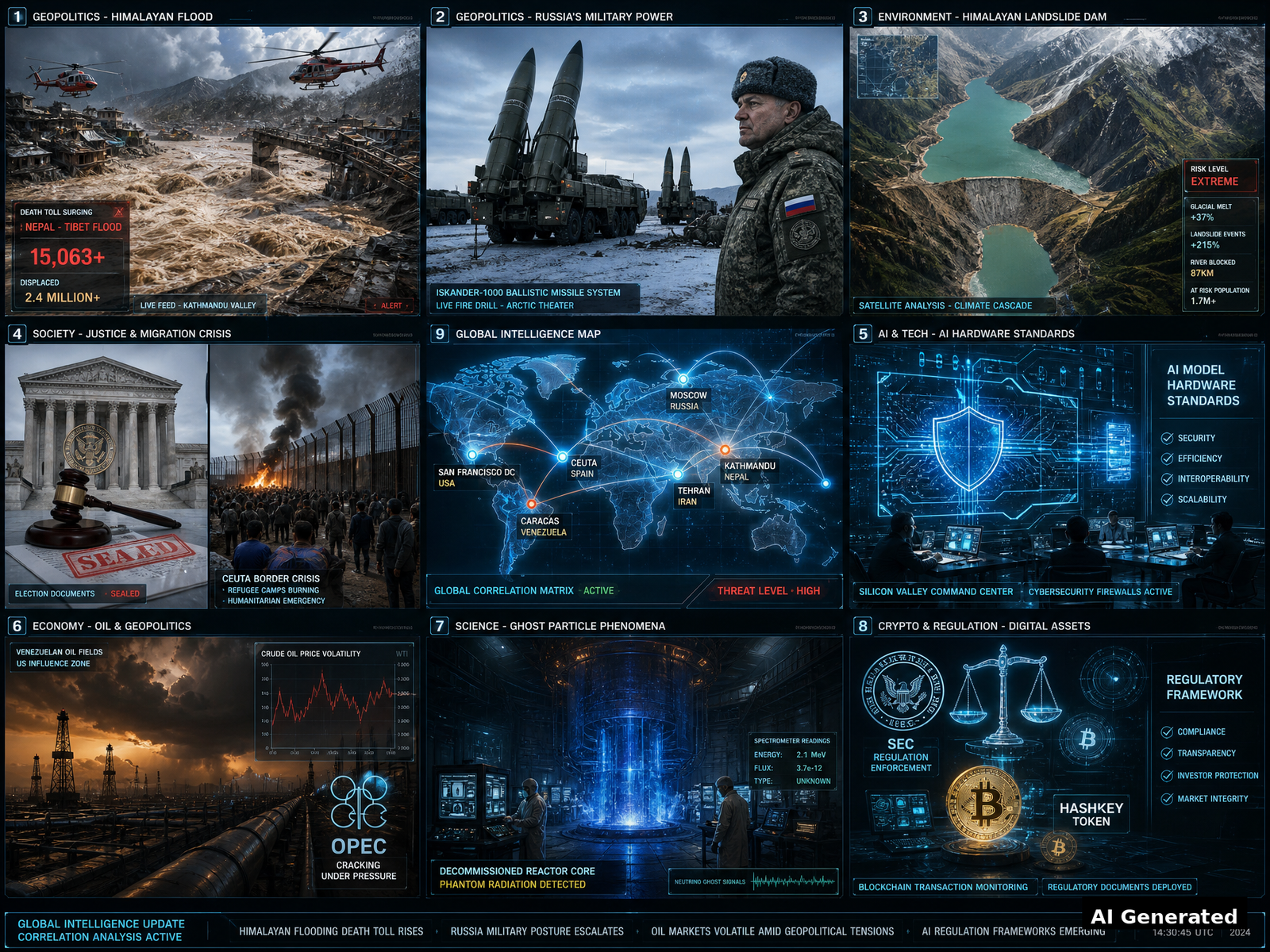


Contents
- 1. Geopolitics & Defence
- Nepal–Tibet Flood Death Toll Surges to 389; Over 1,300 Missing
- Russia Deploys Iskander-1000 Ballistic Missiles; Gerasimov Visits Donbas Frontline
- Ukraine Uses JDAM-LR for First Time; Italy Sends SAMP/T NG Air Defence
- Iran War Reaches Six-Month Mark; US Depleted Weapons Stocks Affect Indo-Pacific
- Chad Accuses Sudan of Air Strike; Somalia Piracy Surges to Highest Level Since 2013
- 2. Environment & Climate
- 3. Society & Civil Issues
- 4. AI & Technology
- 5. Economy & Business
- 6. Science & Space
- 7. Crypto, Digital Assets & Blockchain
- 8. Correlations & Analysis
Click any heading to jump to that section. Click the section heading to return to this menu.
Daily Intelligence Briefing — 2026-08-28 (D89)
Geopolitics & Defence
↑ ContentsNepal–Tibet Flood Death Toll Surges to 389; Over 1,300 Missing
The Nepal–Tibet glacial flood death toll has risen sharply to at least 389 people, with more than 1,300 still missing including numerous foreign tourists, as rescuers race against time on the third day of operations in the Himalayan border region[1]. Chinese state broadcaster CCTV reported that 555 tourists had been evacuated from Tibet alongside 499 local residents, but hundreds remain unaccounted for on both sides of the border[2]. Chinese authorities warned of a “high risk” of further flooding, noting that the dammed lake formed by the debris could swell to approximately three million cubic metres if incoming rains persist over the next three days[3]. The warning threatens to compound the devastation across the Gyirong border crossing and downstream areas that were already devastated by Wednesday’s initial flood wave. Scientists from the USGS and the International Centre for Integrated Mountain Development confirmed that the catastrophe was triggered by a glacial collapse — a geologically complex event where ice and rock debris accumulate on steep slopes before suddenly releasing in an avalanche that blocks river valleys, creating catastrophic dam-break floods[4]. The disaster’s international dimension has widened, with Australia confirming 39 Australians missing including children as young as 11 among a tour group of 47 that lost all contact[5]. Nepal’s tourism authority now reports at least 403 foreign nationals unaccounted for, including citizens from the United States, Britain, Germany, and South Korea, making this one of the worst international humanitarian disasters in recent Himalayan history. The potential for a secondary flood from the unstable debris lake adds an acute dimension to the crisis, as the same geophysical conditions that produced the first flood wave remain largely unchanged.
Russia Deploys Iskander-1000 Ballistic Missiles; Gerasimov Visits Donbas Frontline
Russia has for the first time deployed a longer-range variant of the Iskander ballistic missile system against Ukrainian targets, according to Ukraine’s Defence Intelligence Directorate (GUR), which identified the weapon as the updated 9M723-2 missile, codenamed “Iskander-1000,” with a maximum range of approximately 550 kilometres[6]. The increased range, achieved through a larger fuel compartment, extends the strike envelope by roughly 160 kilometres over the standard Iskander-M, potentially placing Ukrainian cities that were previously beyond the engagement zone within reach of ground-launched ballistic missiles. Russian paratroopers celebrated the development on Telegram, noting that “rearward facilities that were previously considered relatively safe are now within range,” while missile expert Fabian Hoffmann estimated Russia’s combined ballistic missile production at 600–800 units annually[7]. In a parallel development, Russian Chief of General Staff Valery Gerasimov reportedly made a surprise visit to forward positions in the Donbas, where Russian forces have reduced the distance to key urban centres — reportedly to approximately 3 kilometres from Kramatorsk and 4 kilometres from Sloviansk[8]. Ukrainian authorities simultaneously called on residents of Kherson to evacuate as intensifying Russian strikes on energy infrastructure threatened prolonged blackouts during the approaching autumn and winter months[9]. These developments trace a single coherent pattern: Russia is simultaneously building the offensive capacity for territorial gains in the Donbas while intensifying the attrition campaign against Ukrainian infrastructure and civilian population centres, signalling that the peace process referenced in previous reports remains effectively dead.
Ukraine Uses JDAM-LR for First Time; Italy Sends SAMP/T NG Air Defence
Ukraine may have used the U.S.-made JDAM-LR guided bomb for the first time in combat, according to Defense Express, which reported that Ukrainian Air Force aircraft likely employed the weapon against an underground Russian command centre in the occupied Donetsk region[10]. Fragments recovered after the strike appear to match experimental batches that underwent testing in April, and the weapon’s reported range of up to 550 kilometres would represent a significant expansion of Ukraine’s precision-strike capability, allowing attacks on high-value targets deep behind Russian lines from safer standoff distances. Separately, Italy has secretly approved its 13th military aid package to Ukraine, valued at nearly €3 billion and funded through EU loans, which will include four SAMP/T NG air defence battery sets comprising 16–24 launchers, Aster 30 interception missiles, and seven long-range radars[11]. The decision was kept quiet to avoid domestic political friction in Rome, but the capability — designed specifically to intercept ballistic missiles — addresses one of Ukraine’s most critical defensive requirements. The package represents the most significant European air defence transfer to Ukraine since the conflict began and comes at a moment when U.S. interceptor stocks have been severely depleted by the Iran war. Combined with the Pentagon’s earlier admission that approximately 1,000 Patriot and THAAD units remain from an originally much larger inventory, the Italian deployment highlights how the Iran conflict is reshaping the global air defence balance in ways that directly affect the Ukraine theatre.
Iran War Reaches Six-Month Mark; US Depleted Weapons Stocks Affect Indo-Pacific
The U.S.-Iran war has reached its six-month anniversary with no diplomatic off-ramp in sight, as the June memorandum of understanding has “fallen by the wayside” and no negotiations are currently taking place, according to White House Press Secretary Karoline Leavitt[12]. One of the most striking consequences of the prolonged conflict is the cascading effect on U.S. military readiness in the Indo-Pacific, where allies report “significant delays” in weapons deliveries because the Pentagon has diverted resources to the Middle East. A Taiwanese official described the shift as “concerning,” noting that $30 billion in approved arms for Taipei remain undelivered while the USS George Washington aircraft carrier has replaced the USS Abraham Lincoln in the Gulf[13]. American weapons stockpiles in the Korean Peninsula have been depleted, with General Xavier Branson confirming that Patriot radar systems were removed from South Korea before the June 2025 strikes on Iran. The gap has created an opening that China is actively exploiting: Beijing has expanded military infrastructure on disputed South China Sea reefs and conducted new coast guard exercises while diplomatic channels with Washington remain restricted[14]. The convergence of depleted interceptor stocks, carrier redeployments, and allied frustration represents a strategic vulnerability that compounds with each passing month of the Iran conflict, raising the question — articulated in the D87 report — of whether the U.S. can sustain simultaneous military commitments across two theatres of strategic competition.
Chad Accuses Sudan of Air Strike; Somalia Piracy Surges to Highest Level Since 2013
An air strike on a fuel market near Chad’s border with Sudan killed 12 people and injured seven, with Chadian officials accusing the Sudanese military of carrying out the attack — an allegation that, if confirmed, would represent a significant escalation of cross-border hostilities between the two nations[15]. Separately, piracy off the coast of Somalia has surged to its highest level since 2013, with at least 15 attacks recorded since the beginning of 2026 — a dramatic reversal of a decade-long decline that had made the threat appear largely contained[16]. The resurgence is concentrated in the Gulf of Aden, the vital waterway connecting the Red Sea to the Indian Ocean, where a petroleum tanker called Honour 25 was seized by approximately 30 armed pirates on April 21 and remains under pirate control with its 17-person crew still held hostage[17]. The revival of piracy is directly linked to the Iran war’s disruption of the Strait of Hormuz, which has diverted commercial shipping traffic through the Gulf of Aden and created both opportunity and chaos in the maritime corridor. The Norwegian Maritime Authority reports that vessels are now operating in increasingly dangerous conditions across the Horn of Africa, where the convergence of Houthi threats, Iranian-backed militia activity, and opportunistic Somali piracy creates an unprecedented multiplicative threat to global shipping.
What to watch: The fate of the debris-dammed lake in the Nepal–Tibet border region and whether a secondary flood wave materialises; continued Iskander-1000 deployment patterns and whether the extended range shifts the calculus of Ukrainian air defence planning; the trajectory of U.S. weapons stockpile replenishment and its effect on Indo-Pacific allied confidence.
Environment & Climate
↑ ContentsGermany Gas Storage at 52% as Green Party Demands Winter Crisis Summit
Germany’s gas storage facilities are running at only 52% capacity with just over two months remaining before the November 1 deadline requiring stocks to reach 70%, prompting the Green Party to demand an emergency supply security summit with the federal government[18]. Energy politician Michael Kellner described the situation as “frustrating” and “serious,” noting that storage levels are significantly below previous years due to the Iran war’s disruption of global gas supply chains and the resulting price spikes that have deterred traders from purchasing gas for winter resale[19]. The federal economics ministry under Minister Katherina Reiche (CDU) responded that a gas shortage this winter is “not expected based on current analysis” but acknowledged the situation is “more tense than the previous two winters.” If storage targets are not met by November, the state may need to purchase and inject gas at public expense — a scenario that played out during the 2022 energy crisis triggered by Russia’s invasion of Ukraine. The situation represents a direct consequence of the Iran war’s collateral damage on global energy infrastructure: the effective closure of the Strait of Hormuz has raised summer gas prices to unusual levels, squeezing the margins that importers typically depend on for winter storage procurement. The Green Party’s call for state intervention echoes the structural vulnerability that the D87 report identified in European energy systems dependent on global chokepoints that are now under intermittent military threat.
Nepal–Tibet Flood Secondary Risk Compounds Climate-Driven Disaster Pattern
The secondary flood risk from the debris-dammed lake in the Nepal–Tibet border region has become a critical concern as Chinese authorities warned that three million cubic metres of water could breach the unstable dam if incoming rains persist over the coming days[3]. The warning from China’s water ministry, reported through the Xinhua news agency, represents a cascading humanitarian emergency within an already catastrophic disaster — the original glacial flood has killed at least 389 people and left more than 1,300 missing across the border region[1]. The glacial collapse itself, confirmed by USGS seismological data as the source of what was initially detected as a 4.4-magnitude seismic event, represents a class of disaster that scientists have been warning about with increasing urgency as Himalayan glaciers retreat at accelerating rates due to global warming[4]. The event carries grim echoes of Nepal’s 2015 earthquake in both its scale and its cross-border dimension, but with a critical difference: the 2026 flood was climate-amplified rather than purely tectonic, meaning it is a type of event that may recur with increasing frequency as glacial instability compounds. The Australian Greens’ spokesperson David Shoebridge connected the disaster to climate obligations, arguing that Australia’s $5 million aid commitment “won’t come close to touching the sides” and that developed nations bear responsibility for addressing the carbon emissions driving glacial retreat[5]. This linking of disaster response to climate accountability reflects a growing trend in international discourse that the D87 report’s coverage of the Algeria wildfires and the D86 report’s coverage of El Niño drought impacts have tracked across multiple continental contexts.
California Big Sur Wildfires; Canadian Oil Executive Windfalls During Wildfire Season
Two wildfires are burning along California’s scenic Big Sur coast, with fire crews using water-dropping aircraft to attack the blazes that prompted new evacuations in the remote coastal area[20]. The fires arrive as the western United States faces one of its most active wildfire seasons, driven by the same pattern of prolonged drought and extreme heat that has characterised the summer of 2026. In Canada, the wildfire season is tracking as the fourth-worst on record, with scientists confirming that the crisis has been made twice as likely by fossil fuel combustion. Yet a DeSmog investigation revealed that three senior executives at Canada’s largest oil sands companies have seen the unrealised value of their personal stock holdings increase by more than $1 billion between January and August 2026, a period during which global oil prices surged due to the Iran war’s disruption of the Strait of Hormuz[21]. Murray Edwards of Canadian Natural Resources saw his holdings rise by over $1 billion, while Suncor CEO Rich Kruger’s paper gains exceeded $12 million — a dynamic that David Suzuki Foundation economist Thomas Green described as “soaring executive wealth on one side, and a double hit to affordability, health and safety on the other.” The irony is compounded by the fact that Prime Minister Mark Carney’s government has essentially capitulated on every major item on the oil industry wish list — scrapping carbon pricing, eliminating environmental laws for major projects, and repealing greenwashing rules — while offering a $34 million resilience fund for climate-affected communities, less than four percent of Edwards’s personal windfall[22]. The juxtaposition of record industry profits, accelerating wildfires, and weakened environmental regulation represents one starkest illustrations of the structural gap between climate rhetoric and energy-industrial policy that has characterised multiple previous reports in this series.
What to watch: Whether the Nepal–Tibet debris lake breaches, creating a secondary flood; Germany’s path to meeting the November 1 gas storage mandate as winter approaches; the broader pattern of wildfire-industrial profit convergence across North America and the Mediterranean.
Society & Civil Issues
↑ ContentsFederal Judge Halts Trump Mail Voting Order; Ceuta Anti-Migrant Protesters Burn Refugee Camps
A U.S. federal judge on Thursday imposed a 14-day hold on President Trump’s executive order limiting mail-in voting, the second time the directive has been blocked as it approaches implementation ahead of the midterm elections[23]. Judge Indira Talwani issued the stay in a case that may return to the Supreme Court, which had overturned an earlier ruling blocking the order just days before mail ballots are scheduled to begin being sent out. The judge argued that the regulation is most likely unlawful because the president cannot insert the federal government into elections without Congressional approval — a principle that represents one of the most significant judicial checks on executive power in the current political cycle. Separately, anti-migrant protests escalated sharply in the Spanish enclave of Ceuta, where demonstrators burned tents in a refugee camp, blocked Red Cross aid vehicles, and attempted to force the return of migrants to Morocco[24]. The violence erupted in the context of an estimated 80,000 migrants who crossed from Morocco to Ceuta in late July, with several thousand still remaining in the enclave[25]. Police intervention separated the protesters from migrants who retreated to a pier, while Spain’s conservative opposition led by the People’s Party and Vox characterised the situation as an “invasion” and demanded mass deportations — a framing that echoes the anti-immigrant rhetoric intensifying across multiple European countries. The Ceuta crisis is placing increasing political pressure on Prime Minister Pedro Sánchez’s government, with Defence Minister Margarita Robles confirming that Spain’s intelligence service had warned of the mass crossing one day before it occurred, while Interior Minister Fernando Grande-Marlaska maintained that no such advance notice had been received.
ICE Orders 6,000 Electric Shock Gloves; Federal Judge Faces Pro-Israel Bias Complaint
U.S. Immigration and Customs Enforcement has awarded a $16.7 million contract to purchase 6,000 electric shock gloves, drawing immediate criticism from civil rights advocates and Democratic members of Congress who warned that ICE officers cannot be trusted to deploy the equipment appropriately[26]. The contract arrives amid escalating concerns about the militarisation of immigration enforcement under the Trump administration, including the controversial deportation of a five-year-old boy that has become a rallying point ahead of the midterm elections. In a parallel development, a lawyer has filed a complaint against federal Judge Roy Altman over what he characterises as staunch pro-Israel advocacy, including Altman’s description of the keffiyeh as a “terror scarf” — raising questions about judicial impartiality in cases involving the Israeli-Palestinian conflict[27]. The complaint highlights the growing tension between political advocacy and judicial neutrality at a time when the courts are increasingly central to resolving disputes over both domestic governance and foreign policy. Together, these developments illustrate the expanding scope of executive power under the current administration and the legal and institutional friction it is generating across multiple branches of government and levels of civil society.
Germany’s National Security Council Criticised as “Paper Tiger”; France Presidential Debate Sharpens
Germany’s National Security Council, created just a year ago to coordinate crisis response across federal agencies, drew sharp criticism from lawmakers who described it as a “paper tiger” that has failed to deliver faster decision-making[28]. The criticism carries particular weight against the backdrop of Poland’s deployment of 28 K2 Black Panther tanks near the Kaliningrad border and the broader NATO security recalibration documented in the D88 report’s coverage of the CIA Moscow visit. Separately, seven French presidential candidates held their first debate ahead of the April 2027 election, with polls suggesting a potential runoff between left-wing candidate Jean-Luc Mélenchon and far-right candidate Marine Le Pen[29]. Former President François Hollande proposed raising the retirement age to 63 with a gradual extension of contribution requirements, while candidates across the spectrum acknowledged the need for economic reforms in the context of rising energy costs and defence spending demands. The French debate marks the formal beginning of a campaign season that will shape European political dynamics for the remainder of the decade, with the possibility of a Mélenchon-Le Pen runoff representing the most ideologically polarised contest for the French presidency in modern history. Former premiers Edouard Philippe and Gabriel Attal are competing from the centre-right, but current polling suggests they face an uphill battle against the two political extremes.
What to watch: The legal trajectory of the Trump mail voting order as it approaches the Supreme Court again; Ceuta’s political resolution and the broader impact on Spanish government stability; the French presidential campaign as it intensifies through the autumn.
AI & Technology
↑ ContentsAnthropic Launches Model Hardware Standard; Pentagon Blacklist Ruled Unconstitutional
Anthropic released the research preview of its Model Hardware Standard (MHS), a set of standardised drivers designed to allow AI agents to interface directly with and control arbitrary hardware devices — a development that could fundamentally extend the scope of autonomous AI systems beyond the digital realm into physical environments[30]. The MHS provides a common interface and data-sharing format enabling scientific instruments, industrial equipment, and other physical devices to communicate across a network “without needing a bespoke ‘translator’ programme in between,” potentially reducing months of custom experimental setup to “hours or minutes”[31]. In a separate but related development, a federal judge ruled that the Pentagon’s blacklisting of Anthropic over its refusal to allow unrestricted military use of its AI models was unconstitutional, calling it First Amendment retaliation against a company that exercised its right to set ethical boundaries on how its technology is deployed[32]. The ruling established an important legal precedent for AI companies’ ability to control how their products are used, including by government entities, and represents a significant check on executive power in the context of AI governance. Together, the MHS release and the blacklist ruling illustrate the twin pressures facing leading AI companies: the technology is becoming powerful enough to cross into physical-world applications, while the legal and ethical frameworks governing its use remain in active contestation between corporations, governments, and courts.
xAI Accused of Training Grok on Child Abuse Material; Ransomware Groups Use AI to Defeat Security
In what may be the most disturbing AI-related legal action to date, a lawsuit filed on Wednesday accused Elon Musk’s xAI of training its Grok models on child sexual abuse material (CSAM), with the plaintiff — identified as Jane Doe — alleging that AI-generated depictions of her were found on xAI platforms after her original childhood abuse imagery had been hashed by the National Centre for Missing and Exploited Children[33]. The complaint alleged that messages were found on online forums “between offenders chatting about creating AI generated CSAM of Plaintiff and other similarly situated known, legacy, victims of CSAM,” suggesting that the training process not only ingested existing abuse material but generated new depictions of real identified victims. Separately, German investigators reported that ransomware hackers have begun using AI tools — including the Cursor AI coding assistant developed by SpaceX — to bypass AI-based cybersecurity defences, with at least one German company confirmed among the victims[34]. The technique involves using AI to generate code and social engineering tactics that can fool security systems designed to detect automated attacks, effectively turning the defenders’ own AI tools into instruments of evasion. These two developments — CSAM in AI training data and AI-powered cyberattacks — represent converging threats at the intersection of artificial intelligence, cybersecurity, and criminal exploitation that the global AI safety community has been warning about with increasing urgency.
100+ Companies Call for Global AI Cybersecurity Response; OpenAI Announces Humanoid Robot Plans
More than 100 technology companies including OpenAI, Anthropic, and Google issued a joint call on Thursday for governments and businesses to urgently strengthen protection of critical infrastructure against AI-powered cyberattacks, warning that such attacks are expected to become “much more widespread and sophisticated” in coming months[35]. The joint statement represents an unprecedented coordination across normally competitive AI companies, reflecting the shared recognition that AI-enabled threats to critical infrastructure — power grids, financial systems, healthcare networks — have reached a level that no individual company can address alone. Separately, OpenAI CEO Sam Altman announced that the company plans to develop a humanoid robot, a significant expansion of the company’s scope beyond software into physical automation[36]. The announcement, while still in early stages, signals that the frontier of AI development is moving toward embodied intelligence — systems that can interact with the physical world through robotic form factors — building on the trajectory that Anthropic’s Model Hardware Standard represents at the infrastructure level. The combination of escalating cybersecurity threats, new capabilities in physical-world AI, and the expanding scope of AI companies’ ambitions creates a technological landscape where the pace of capability development continues to outstrip the regulatory frameworks designed to govern it.
What to watch: The legal implications of the Anthropic blacklist ruling for AI companies’ relationships with government agencies; whether the MHS standard gains adoption across scientific and industrial communities; the developing xAI CSAM case and its potential regulatory consequences.
Economy & Business
↑ ContentsVenezuela Weighs OPEC Exit as US Nears Control of Oil Fields
Venezuela is weighing whether to leave OPEC — a group it helped found in 1960 — as the United States moves to secure a stake in Venezuelan oil fields through a deal that would cement American influence over Caracas’s vast crude reserves for years to come[37]. The potential departure of one of the founding members of the Organisation of the Petroleum Exporting Countries would mark a symbolic and practical blow to the cartel’s cohesion at a moment when the Iran war’s disruption of the Strait of Hormuz has already placed enormous strain on global oil supply chains. President Trump has claimed that the U.S. has already collected more than $13 billion from the sale of Venezuelan crude oil, and the proposed deal would formalise that economic relationship while potentially bypassing OPEC production quotas that have historically constrained Venezuelan output[38]. The move carries broader implications for global energy governance: if Venezuela exits OPEC to deepen its ties with Washington, other producer nations may reassess their own cartel commitments, particularly as the Iran war has demonstrated that OPEC’s traditional market-management tools are insufficient to address the security-driven disruptions that now dominate global oil pricing dynamics. Saudi Aramco separately warned that oil inventories will require an 18-month recovery period after the Strait of Hormuz disruption, underscoring the lasting structural damage to global energy markets from the conflict[39].
Japan and US Intervene to Stem Yen’s Decline; Fed Chair Faces Market Scrutiny at Jackson Hole
Japan and the United States have intervened jointly to slow the yen’s decline, a coordinated action that highlights the complexities of currency stabilisation amid divergent monetary policies between the two economies[40]. Japanese Finance Minister Katayama confirmed that the Takaichi cabinet is “determined to strengthen economy and competitiveness” and that yen credibility would rise, while also indicating he would discuss global financial conditions with G20 peers at their upcoming meeting in Asheville, North Carolina[41]. The yen intervention follows weeks of selling pressure driven by the widening interest-rate differential between the Bank of Japan’s ultra-loose policy and the Federal Reserve’s restrictive stance. At the Fed’s annual retreat in Jackson Hole, Chair Kevin Warsh faced investor uncertainty over the central bank’s inflation strategy, with markets reacting negatively to what they perceived as unclear guidance on the path forward[42]. Tokyo’s August core inflation came in at 1.8%, slightly below the Bank of Japan’s 2% target, adding complexity to the monetary policy calculus at a time when Japan faces its own pressures from rising energy costs driven by the Iran war. The currency intervention underscores how global energy disruptions are creating cascading effects across monetary policy decisions in multiple major economies simultaneously.
Asset Management M&A Hits Record $54 Billion; Russia Industrial Production Decelerates
The global asset management industry saw a record $54 billion in merger and acquisition activity during the first half of 2026, reflecting a strategic shift toward consolidation driven by fee pressures, globalisation, and the integration of technology into investment operations[43]. The surge in deal-making comes at a time when traditional asset management business models are being challenged by passive investing, algorithmic trading, and the growing presence of AI-driven financial analysis — pressures that favour larger firms with the scale to invest in technological infrastructure. Separately, Russian industrial production decelerated in July, with output rising just 0.4% in annual terms compared to 0.7% the previous month, signalling the continued economic drag of the Iran war’s secondary effects on Russian trade and the ongoing depletion of the country’s industrial capacity[44]. The German Green Party simultaneously demanded a gas supply crisis summit as national storage levels sat at only 52% capacity, well below the 70% mandated by November 1[18]. These data points — record M&A in asset management, decelerating Russian industry, and German energy anxiety — trace the same underlying dynamic: the global economy is restructuring in response to the geopolitical shocks of the Iran conflict, with capital flowing toward consolidation and defensive positioning while the productive base of major economies faces sustained pressure from disrupted supply chains and elevated energy costs.
What to watch: The outcome of the G20 finance ministers meeting in Asheville and any coordinated response to the currency market disruptions; Venezuela’s formal OPEC membership decision and its implications for oil market governance; Germany’s path to meeting the November gas storage mandate as winter approaches.
Science & Space
↑ ContentsPhysicists Measure “Ghost Glow” From Shut-Down Nuclear Reactors for the First Time
In a breakthrough with significant implications for nuclear safety monitoring, physicists from the Double Chooz Collaboration have for the first time experimentally measured the residual antineutrino emission from shut-down nuclear reactor cores at the Chooz Nuclear Power Station in northern France[45]. The detection of 106 ±18 measured antineutrino events during 17.2 days of observation — compared with a predicted 88 ±7 events — represents the first direct confirmation of a theoretical prediction about the “ghost glow” of electron antineutrinos emanating from spent fuel even after a reactor has been switched off. Thierry Lasserre, a physicist at the Max Planck Institute for Nuclear Physics, explained that “antineutrinos interact only extremely rarely with matter, but when one interacts within the Double Chooz detector, a characteristic double-light signal is produced that can be distinguished from background events”[46]. The result represents less than 1% of the flux signal during reactor operation, requiring exceptionally low background conditions and years of careful analysis by the international collaboration. The technique’s potential for non-intrusive nuclear monitoring is significant: while it cannot yet detect whether individual spent fuel assemblies are missing, it provides a proof-of-concept for a monitoring method that could eventually inform international nuclear safeguard standards and provide verification tools that do not require physical access to reactor sites.
Satellite Images Reveal Bedrock Collapse; UK Teen Receives First Dissolvable Heart Implant
Earth scientists are analysing satellite imagery following the catastrophic Nepal–Tibet flooding to identify the specific geophysical mechanism behind the disaster, with early analysis confirming that both bedrock and glacier collapsed along the Nepal-China border before the resulting debris blocked rivers and triggered the devastating flood wave[47]. The satellite data provides crucial forensic evidence about the sequence of events — the initial collapse, the dam formation, and the catastrophic dam-break flood — that will inform both the immediate emergency response and longer-term disaster risk assessment for the Himalayan region. Separately, a British teenager has become the first UK patient to receive a dissolvable heart implant called MemoSorb, a bioresorbable device that performs its therapeutic function and then gradually dissolves into the body, eliminating the need for subsequent removal surgery[48]. The MemoSorb technology represents a growing field of temporary medical devices designed to address conditions that currently require permanent implants — bridging the gap between temporary stents, which must be removed, and permanent implants, which carry lifelong risks of complications. The UK first use follows clinical trials that demonstrated the device’s ability to support cardiac tissue during a critical healing window before being safely absorbed by the body.
NASA Begins Hunt for T-38 Replacement; Diamond-Cooled Microchips Boost Military Electronics
NASA’s Johnson Space Centre issued a market research notice seeking information about potential replacements for its fleet of 25 T-38 Talon jets, which have supported astronaut training since the 1960s but are approaching the end of their operational life as the U.S. Air Force plans to retire its own T-38 fleet by 2030–2035[49]. The notice specifically seeks “modern high-performance jet aircraft” capable of supporting spaceflight readiness training, noting that NASA’s astronaut training requirements may actually increase as the Artemis programme progresses toward its goal of returning astronauts to the lunar surface by 2028. Current administrator Jared Isaacman, who founded the private aggressor aviation company Draken International, has personal connections to the world of high-performance aircraft and advanced military aviation that may shape the procurement process. Separately, Northrop Grumman has received a $7 million DARPA contract to develop diamond-cooled microchips that could increase the power density of military electronics by more than three times beyond current limits[50]. The technology integrates diamond — which conducts heat approximately five times faster than copper — directly into semiconductor devices, providing a thermal management solution for advanced radio-frequency systems used in military communications, radar, and satellite links. During Phase 1 of the THREADS programme, Northrop Grumman achieved a 3.3x increase in power density; Phase 2 aims to achieve another threefold improvement, potentially enabling substantially more capable electronic warfare systems without requiring proportionally larger hardware platforms.
What to watch: The application of antineutrino detection technology to international nuclear monitoring and arms control verification; the development timeline for dissolvable medical devices as a new class of temporary implants; NASA’s T-38 replacement process and its implications for Artemis programme training capacity.
Crypto, Digital Assets & Blockchain
↑ ContentsSEC Proposes Regulation Crypto Assets; HashKey Backs Stacks Genesis Bond
The U.S. Securities and Exchange Commission has proposed Regulation Crypto Assets (Reg CA), a new regulatory framework that could redefine how token-based fundraising operates in the United States by establishing clear rules for initial coin offerings and similar mechanisms[51]. The proposal represents a significant shift from the SEC’s previous enforcement-heavy approach under the prior administration, potentially creating a pathway for compliant token issuance that balances innovation with investor protection. The framework is expected to bring clarity to a regulatory grey zone that has constrained institutional participation in crypto markets for years, though specific implementation details and compliance timelines remain under negotiation. Separately, HashKey Cloud has backed Stacks’ Genesis Bond pilot as the second institutional participant in the programme, deploying Bitcoin through a time-locked protocol that keeps the asset under the participant’s custody while generating yield through Stacks’ Proof-of-Transfer mechanism[52]. HashKey’s participation represents a significant signal of institutional appetite for Bitcoin-based yield products, though the bond’s design — which pairs the locked BTC with a 5% position in STX tokens — means that actual returns depend on Stacks miner economics and STX price movements rather than generating pure Bitcoin yield. The Genesis Bond activates at Bitcoin block 966,350, approximately September 10, and the total committed BTC should become visible on-chain at that time.
BitGo Acquires NYDIG Trading Business; New Zealand ACT Party Proposes Crypto Tax Waiver
BitGo has completed its acquisition of NYDIG’s institutional trading business, bringing approximately 30 NYDIG employees and their institutional trading relationships into the custody platform’s expanding derivatives offering[53]. The deal represents a strategic consolidation in the institutional crypto infrastructure space, where BitGo is positioning itself as a one-stop provider for custody, trading, and settlement — capabilities that have become increasingly important as institutional investors enter the market through regulated channels. Separately, New Zealand’s ACT Party — the fourth-largest party in parliament by representation — has proposed waiving the capital gains tax on cryptocurrency assets held for more than one year and exempting low-value purchases made with crypto[54]. The proposal, part of a broader digital finance modernisation pledge, would place New Zealand among the most crypto-friendly jurisdictions in the OECD and reflects growing political recognition that crypto-specific tax policy can serve as a competitive advantage in attracting digital asset businesses and investment. The ACT Party’s proposal also signals that crypto regulation is becoming a mainstream political issue in countries across the Asia-Pacific region, moving beyond the niche domain of financial technology policy into broader economic competitiveness debates.
Stripe Consortium Abandons PayPal Bid; US Treasury Expands Crypto Sanctions at G20
A consortium led by Stripe has reportedly abandoned its pursuit of PayPal after the fintech company’s board rejected a $53 billion acquisition offer, a failed deal that highlights the challenges of valuing large-scale fintech platforms and may signal a more cautious approach to future mega-mergers in the digital payments space[55]. The rejected bid, which would have combined two of the most significant players in digital payments, illustrates the tension between the strategic logic of consolidation and the valuation expectations of companies that have benefited from the post-pandemic acceleration of digital commerce. Separately, the U.S. Treasury Department used the G20 finance ministers meeting to expand sanctions targeting digital asset transactions linked to Iranian networks, building on the broader sanctions architecture that has accompanied the Iran war[56]. The expanded digital asset sanctions represent a growing recognition that cryptocurrency and stablecoin transactions can provide alternative financial channels that circumvent traditional banking restrictions, requiring sanctions regimes to evolve alongside the financial technologies they seek to regulate. The intersection of sanctions policy, crypto regulation, and institutional deal-making captured in today’s reporting reflects the rapidly maturing landscape of digital asset governance, where regulatory clarity, enforcement capacity, and market consolidation are all advancing simultaneously.
What to watch: The final form of SEC Regulation Crypto Assets and its timeline for implementation; the on-chain performance data from the Stacks Genesis Bond pilot; the ACT Party’s crypto tax proposal and whether it gains traction in New Zealand’s parliamentary politics.
Correlations & Analysis
↑ ContentsThe most significant pattern to emerge from today’s reporting is the accelerating depletion of U.S. military capacity as a consequence of the six-month Iran war — a trend that the D87 report identified as an emerging vulnerability but which has now crystallised into a strategic crisis. The diversion of more than 30 Navy ships from the Indo-Pacific to the Middle East, the removal of Patriot radar systems from the Korean Peninsula, the delivery delays for $30 billion in approved Taiwanese arms, and Italy’s decision to deploy its own air defence systems to Ukraine rather than relying on U.S. supply all trace the same structural problem: the Iran war is consuming weapons and platforms faster than they can be replaced, creating windows of vulnerability that adversaries are actively monitoring[13][14]. The Pentagon’s $58.6 billion contract with Lockheed Martin to triple Patriot production by 2030 implicitly acknowledges that the current inventory — estimated at roughly 1,000 units — is insufficient for simultaneous commitments across multiple theatres[7].
This depletion dynamic connects directly to the Ukraine battlefield developments documented in today’s report. Russia’s deployment of the extended-range Iskander-1000 missile and Gerasimov’s frontline visit to the Donbas suggest that Moscow is calibrating its escalation timeline against the perceived window of Western military distraction[6][8]. The Bloomberg report from D88 documenting Putin’s consideration of tactical nuclear weapons gains additional weight when viewed alongside the Pentagon’s demonstrated inability to sustain simultaneous commitments — a combination that would have been even more dangerous had the D86 report’s identification of the “last functioning line of communication” between Washington and Moscow not produced the CIA director’s warning visit. Yet as the D88 report noted, these back-channels are producing warnings but not de-escalation, and the new Iskander-1000 deployment confirms that Russia is investing in offensive capacity even as diplomatic channels remain open.
The pattern extends beyond the military domain into economic and technological competition. Germany’s gas storage sitting at only 52% — with the November 1 mandate to reach 70% now appearing increasingly difficult to meet — is a direct downstream consequence of the Hormuz disruption that the D88 report documented through the tanker attack and Iran-Oman corridor closure[18][19]. The economic pressure on European energy consumers compounds the political pressure created by the Ceuta migrant crisis, the German National Security Council’s institutional failure, and the French presidential campaign’s sharpening ideological divisions. These are not independent events; they are manifestations of a single system under stress — a system in which the disruption of global energy supply chains cascades through European politics, which in turn affects the continent’s capacity for collective security response.
In the technology sector, today’s reporting reveals a different but complementary form of systemic fragility. Anthropic’s Model Hardware Standard, the SEC’s proposed crypto regulation framework, and the joint call by 100+ companies for global AI cybersecurity response all represent attempts to build governance structures adequate to the pace of technological change[30][35]. Yet the xAI CSAM allegations and the ransomware groups’ use of AI to defeat security systems demonstrate that the same technologies being governed are simultaneously creating new categories of harm that existing frameworks cannot address[33][34]. The Anthropic blacklist ruling — establishing that AI companies have constitutional rights to control how their products are used — may prove to be one of the most consequential legal precedents of the AI era, precisely because it intervenes at the point where governmental power and corporate autonomy collide.
What to watch in the next reporting period: The fate of the Nepal–Tibet debris dam and whether a secondary flood materialises; the U.S. response to Russia’s Iskander-1000 deployment and any further escalation signals; the G20 finance ministers meeting in Asheville and its outcomes on currency intervention coordination; Germany’s emergency measures to address the gas storage shortfall; the legal trajectory of the Anthropic blacklist ruling and its implications for AI governance.
References
1. Nepal-Tibet flash flood live updates: debris-clogged river at risk of flooding again by The Guardian · 2026-08-28 Source ↑
2. Australia news live: Antarctic staff to withdraw from Macquarie Island amid bird flu risk by The Guardian · 2026-08-28 Source ↑
3. Sturzflut im Himalaya: Hohes Risiko für neue Überflutungen im Gebiet zwischen Tibet und Nepal by Die Zeit · 2026-08-28 Source ↑
4. Satellite images reveal bedrock and glacier collapsed on the Nepal-Tibet border by The Independent · 2026-08-28 Source ↑
5. 'We just want them to return': relatives of Australians missing in Nepal floods by The Guardian · 2026-08-28 Source ↑
6. Russia Is Now Using Longer-Range Iskander Ballistic Missiles: Ukraine Intel by The War Zone · 2026-08-28 Source ↑
7. Https://www.twz.com/land/russia-is-now-using-longer-range-iskander-ballistic-missiles-ukraine-intel by The War Zone (paratroopers’ commentary) · 2026-08-28 Source ↑
8. Ο Β.Γκερασίμοφ θα ηγηθεί της ρωσικής επίθεσης σε Σλάβιανσκ και Κραματόρσκ by Defencenet.gr · 2026-08-27 Source ↑
9. Έκκληση στους κατοίκους να εγκαταλείψουν τη Χερσώνα by Protothema.gr · 2026-08-28 Source ↑
10. Ουκρανία: Πρώτη χρήση της αμερικανικής JDAM-LR με βεληνεκές έως 550 χλμ. by Defencenet.gr · 2026-08-27 Source ↑
11. Η Ιταλία στέλνει στην Ουκρανία δεκάδες εκτοξευτές SAMP/T NG και πυραύλους Aster 30 by Defencenet.gr · 2026-08-27 Source ↑
12. After six months of war in Iran, is the US achieving its goals? by Scripps News/AP · 2026-08-27 Source ↑
13. Μετά τους Ευρωπαίους και οι Ασιάτες μένουν «μόνοι τους» από τις ΗΠΑ by Defencenet.gr · 2026-08-27 Source ↑
14. Μετά τους Ευρωπαίους και οι Ασιάτες by Defencenet.gr (Taiwan/Pacific section) · 2026-08-27 Source ↑
15. Chad accuses Sudan of deadly air strike near shared border by Al Jazeera · 2026-08-28 Source ↑
16. Συναγερμός στα νερά της Σομαλίας – Πολλαπλασιάζονται οι επιθέσεις πειρατών by Iefimerida.gr · 2026-08-28 Source ↑
17. Σομαλία: Αναζωπύρωση των επιθέσεων πειρατών το 2026 by In.gr · 2026-08-28 Source ↑
18. Gasspeicher: Niedrige Füllstände: Grüne fordern Gas-Krisengipfel by Stern.de · 2026-08-28 Source ↑
19. Gasspeicher: Niedrige Füllstände by Stern.de (Michael Kellner quotes) · 2026-08-28 Source ↑
20. 2 wildfires burn along California's scenic Big Sur coast by The Independent/AP · 2026-08-28 Source ↑
21. Canadian Oil Executives' Stock Holdings Increased by Over $1 Billion Amid War and Wildfires by DeSmog · 2026-08-27 Source ↑
22. Canadian Oil Executives' Stock Holdings by DeSmog (Thomas Green quote) · 2026-08-27 Source ↑
23. Federal judge again halts Trump's executive order limiting mail voting in midterms by The Guardian/AP · 2026-08-28 Source ↑
24. Anti-migrant protesters burn tents in Ceuta and block Red Cross aid by Al Jazeera · 2026-08-28 Source ↑
25. Ένταση στη Θέουτα: Διαδηλωτές έβαλαν φωτιά σε καταυλισμό μεταναστών by Iefimerida.gr · 2026-08-28 Source ↑
26. ICE orders 6,000 electric shock gloves in $16.7M deal despite backlash by The Independent · 2026-08-28 Source ↑
27. Federal US judge faces complaint over staunch pro-Israel advocacy by Al Jazeera · 2026-08-28 Source ↑
28. Leider ein Papiertiger: Politiker üben scharfe Kritik am Nationalen Sicherheitsrat by Handelsblatt · 2026-08-27 Source ↑
29. Hollande propose la retraite à 63 ans by Le Parisien · 2026-08-27 Source ↑
30. Anthropic's new hardware standard lets AI agents control the physical world by Ars Technica · 2026-08-27 Source ↑
31. Anthropic's new hardware standard by Ars Technica (MHS details) · 2026-08-27 Source ↑
32. Pentagon's blacklisting of Anthropic was unconstitutional, judge rules by Quartz · 2026-08-28 Source ↑
33. Elon Musk's xAI used child porn to train Grok models, lawsuit says by Ars Technica · 2026-08-27 Source ↑
34. Ransomware-Hacker tricksen KI-Sicherheitssysteme aus by FAZ.net · 2026-08-28 Source ↑
35. Les géants de la tech appellent à une 'réponse mondiale' face aux cyberattaques aidées par l'IA by France 24 · 2026-08-28 Source ↑
36. OpenAI plans to develop humanoid robot, says Sam Altman by Crypto Briefing · 2026-08-28 Source ↑
37. US nears deal to secure stake in Venezuelan oil fields, insiders say by Al Jazeera · 2026-08-28 Source ↑
38. US close to reaching a 'massive' deal to take control of Venezuela's oil by The Independent · 2026-08-28 Source ↑
39. Saudi Aramco warns of 18-month recovery for oil inventories after Strait of Hormuz disruption by Crypto Briefing · 2026-08-28 Source ↑
40. Japan and US intervention slows yen's decline, faces long-term challenges by Crypto Briefing · 2026-08-28 Source ↑
41. Japan finmin Katayama: Takaichi cabinet determined to strengthen economy by FinancialJuice · 2026-08-28 Source ↑
42. Investors react negatively to Federal Reserve chairman's press conference by Crypto Briefing · 2026-08-28 Source ↑
43. Asset management industry sees record $54B in M&A activity as firms scramble for scale by Crypto Briefing · 2026-08-28 Source ↑
44. Russia: Industrial production decelerates in July by FocusEconomics · 2026-08-27 Source ↑
45. Ghost in The Machine: Physicists Measure The Eerie 'Glow' From Shut-Down Nuclear Reactors For The First Time by ScienceAlert · 2026-08-28 Source ↑
46. Ghost in The Machine by ScienceAlert (Anthony Onillon quote) · 2026-08-28 Source ↑
47. Satellite images reveal bedrock and glacier collapsed on the Nepal-Tibet border by The Independent · 2026-08-28 Source ↑
48. Teen becomes first UK patient to receive dissolvable heart implant by The Independent · 2026-08-28 Source ↑
49. NASA's Hunt To Replace Its Iconic T-38 Talon Jets Kicks Off by The War Zone · 2026-08-28 Source ↑
50. Diamond-cooled microchips boost power density 3.3x for military radar signals by Interesting Engineering · 2026-08-27 Source ↑
51. SEC proposes Regulation Crypto Assets to bring back token fundraising under new rules by Crypto Briefing · 2026-08-28 Source ↑
52. HashKey Cloud backs Stacks' Genesis Bond to prove institutional appetite for native Bitcoin yield by CryptoSlate · 2026-08-28 Source ↑
53. BitGo buys NYDIG's institutional trading business, expanding derivatives offering by The Block · 2026-08-28 Source ↑
54. NZ's ACT Party Proposes Waiving Capital Gains Tax on Crypto by Bitcoin.com · 2026-08-28 Source ↑
55. Stripe consortium reportedly drops pursuit of PayPal after board rejects $53B bid by Crypto Briefing · 2026-08-28 Source ↑
56. US Treasury targets growth, imbalances at G20 finance meeting as digital asset sanctions expand by Crypto Briefing · 2026-08-28 Source ↑
AI Disclosure: This post was created with the assistance of artificial intelligence. The ideas, analysis, and opinions expressed are my own — AI was used to help compose, structure, and refine my personal notes and thoughts into the final written content. Images, videos and music featured in this post were also generated using AI tools, based on my own creative prompts and direction.