

Contents
Click any heading to jump to that section. Click the section heading to return to this menu.
Daily Intelligence Briefing — 2026-08-26 (D87)
Geopolitics & Defence
↑ ContentsSDF Formally Dissolves; Israeli Forces Advance Deeper Into Syria
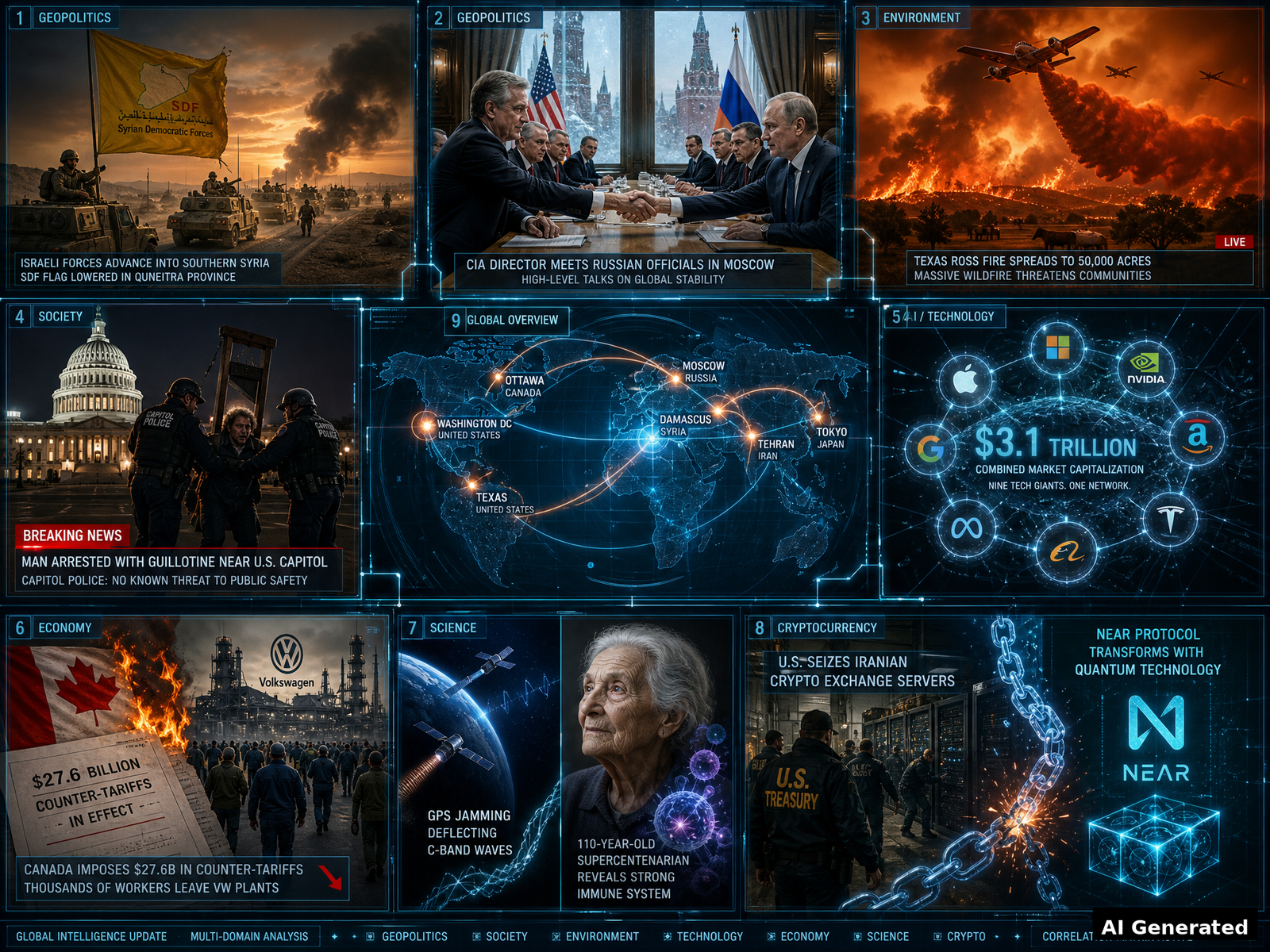
In what Le Monde described as “absolutely historic,” Mazloum Abdi, the commander of the Kurdish-led Syrian Democratic Forces, formally announced the dissolution of the SDF as an independent military force during a televised address from the presidential palace in Damascus[1]. The announcement came as part of the implementation of an agreement signed with Syria’s de facto president Ahmed al-Sharaa, integrating the former U.S.-backed fighting force into the regular Syrian army[2]. The SDF had been Washington’s principal partner in the fight against the Islamic State since 2015, and their dissolution marks a significant restructuring of the military architecture in northeastern Syria. The move follows the progressive erosion of SDF-held territory during a government offensive in January that captured most of their remaining holdings.
Simultaneously, Israeli forces pushed further into southern Syria, entering the village of Jumla in the western Daraa countryside with over ten military vehicles, searching homes and reportedly restricting residents[3]. The operation coincided with an Israeli airstrike on Dawhat Kfar Roummane in the Nabatieh district of southern Lebanon, extending Israeli military activity across multiple fronts in the region[4]. The dual operations — advancing into Syrian territory while striking Lebanon — suggest that Israel’s military posture in the region remains assertive despite ongoing diplomatic contacts. The developments build on the trajectory documented in D86, where Washington simultaneously removed Syria from the state sponsors of terrorism list and Israel conducted a raid into the Golan Heights. The SDF’s dissolution effectively removes the last independent armed actor in Syria’s northeast, consolidating power under Damascus while raising questions about the future of Kurdish autonomy.
CIA Director Ratcliffe Visits Moscow; Trump Asks Ukraine to Pause Strikes for Meeting
In a diplomatic development of extraordinary sensitivity, CIA Director John Ratcliffe traveled to Moscow for approximately four hours aboard a U.S. Air Force C-17A Globemaster III that flew from Riga to Vnukovo airport, according to reporting by the Wall Street Journal and confirmed by CBS News[5]. The visit, conducted through a channel linking Ratcliffe with Sergei Naryshkin, the head of Russia’s SVR foreign intelligence service, is understood to have been aimed at delivering a direct warning against a new Russian mobilization. Former Deputy Director of National Intelligence Beth Sanner suggested Ratcliffe may have met Putin himself to deliver the message that “we know what you are going to do, and you should not do it.”
Separately, the Financial Times reported that the Trump administration had asked Ukraine to temporarily suspend long-range missile and drone strikes against Moscow, St. Petersburg and other northern Russian regions for three days — Monday, Tuesday and Wednesday — to ensure the security of the high-level American diplomatic mission[6]. Ukraine agreed to the request, according to people familiar with the matter. The dual reporting creates a picture of intense back-channel diplomacy between Washington and Moscow, with the CIA channel and Ukrainian strike pause serving complementary functions in reducing escalation risk. This visit echoes the November 2021 trip by then-CIA Director William Burns to Moscow to warn Putin about Ukraine invasion preparations — a warning that proved prescient but went unheeded.
The visit also followed the revelation in D86 that Russian ambassador Andrei Kelin had departed London without replacement, and Kremlin adviser Andrei Fedorov had warned of potential “semi-military” action against British factories[7]. UK newspaper the Express reported that Britain had “accelerated major emergency planning” for a potential Russian attack after the Kremlin’s threat, creating a situation where transatlantic diplomatic channels between Washington and Moscow are active while London-Moscow relations have effectively collapsed[8].
Trump Signs Saudi Nuclear Deal Tied to Israel Normalization; First Known British Fighter Killed for Russia
President Trump signed a civil nuclear agreement with Saudi Arabia that explicitly ties cooperation to Riyadh’s progress toward normalization of relations with Israel[9]. The agreement could reshape Middle East alliances at a time when the region is consumed by the Iran confrontation, creating a potential pathway for Saudi-Israeli normalization even as the broader conflict with Tehran escalates. The signing represents one of the most concrete steps toward the Abraham Accords expansion that has been a signature goal of Trump’s Middle East diplomacy.
In a separate but related development, Bradley Townsend, a 33-year-old British national from Barnsley, has been identified as the first known British citizen killed while fighting for Russia in the Ukraine war. Townsend was killed on June 10 in the Donetsk region, reportedly by an FPV drone strike, according to BBC News Ukraine[10]. He had no previous military experience and spent approximately ten weeks on the front line. The British Foreign Office confirmed it was in contact with his family. The revelation adds another dimension to the internationalization of the Ukraine conflict, which now involves not only Western military aid but also individual foreign nationals fighting on both sides of the front line.
Russia-Ukraine Discuss Prisoner Exchange; Slovakia Prevents Drone Factory Attack
Russia and Ukraine are engaged in discussions about a prisoner of war exchange, according to TASS, the Russian state news agency[11]. While prisoner exchanges have been a recurring feature of the conflict, the announcement comes at a moment of heightened diplomatic activity surrounding the CIA visit and the reported request for Ukraine to pause strikes on Russian territory. Separately, Slovak authorities announced they had prevented a planned arson attack on a drone manufacturing facility in eastern Slovakia, arresting two suspects within the country and one in Germany[12]. Police seized incendiary materials, tools, mobile phones, cameras and a handwritten plan. The factory, located near Slovakia’s border with Ukraine, was believed to be manufacturing unmanned aerial vehicles. No injuries or damage occurred. The incident underscores the growing threat of sabotage directed at European defense industry infrastructure, a risk that was explicitly warned of in the D86 report when Kremlin adviser Fedorov suggested British factories could face attacks from “unknown sources.”
Volkswagen Announces 50,000 Additional Job Cuts
Volkswagen president Oliver Blume began a factory tour of the automotive group’s plants to convince workers of the necessity of cutting an additional 50,000 positions, approximately half of which will affect German facilities[13]. The announcement represents one of the largest industrial restructuring plans in recent European history and comes at a moment when the German automotive sector faces simultaneous pressures from the electric vehicle transition, Chinese competition, and the broader economic slowdown linked to the Iran war’s disruption of global trade routes. The cuts come on top of reductions already planned, pushing Volkswagen’s restructuring toward a scale not seen in the German automotive industry since reunification. Researchers at the Ifo Institute warned separately that an AfD government in Saxony-Anhalt would likely slow economic growth in the region, adding political uncertainty to the industrial restructuring environment[14].
Environment & Climate
↑ ContentsTexas Ross Fire Explodes to 50,000 Acres; El Niño Triggers Panama Emergency
A fast-moving wildfire in Texas, the Ross Fire, exploded to 50,000 acres after being whipped by strong winds, forcing evacuations across affected communities in the western part of the state[15]. Firefighters are battling numerous wildfires threatening homes across the western United States, adding to the crisis that began in Nevada where the Hawk Fire has already forced more than 90,000 evacuations in the Reno metropolitan area as documented in the D86 report. The intensification of multiple simultaneous wildfire events across the American West illustrates how extreme heat, drought conditions and climate change are compounding to create a sustained emergency that stretches firefighting resources to their limits.
In Central America, Panama declared a state of emergency due to the El Niño phenomenon, which has brought both intense rains and severe droughts across the region[16]. The declaration comes as Typhoon Narra forces mass evacuations in southern China, with authorities in Chongzuo, Guangxi province, evacuating more than 15,000 people after water levels surpassed a record high set in 2008[17]. Another storm system, Typhoon Saudel, is tracking toward Japan and Taiwan. The simultaneous occurrence of wildfires across the western United States, emergency declarations in Panama, record flooding in China and typhoon threats to multiple East Asian countries represents a global climate system under extraordinary stress, with El Niño amplifying extreme weather events across hemispheres.
France Mega-Fire in Gironde; Salamina Naval Base Fire Confirmed Unthreatened
France continued to battle what Le Monde described as a “mega-fire” in the Gironde department, with authorities defending their response to the fire that struck the commune of Le Porge[18]. The fire chief pushed back against criticism that the area had been abandoned, presenting a detailed timeline of resources deployed and decisions made during the crisis. Separately, in Greece, the General Staff of the Navy confirmed that the fire that broke out on Salamina island on August 25 did not threaten any naval installations or vessels, and that the affected area contained no ammunition depots or fuel storage[19]. The Greek government maintained a “Red Code” wildfire alert across the Ionian Islands due to extreme fire danger, continuing the pattern of heightened Mediterranean wildfire risk documented in both D85 and D86.
Indonesia Charges 72 Over Forest Fires; El Salvador in “Red Alert” for Drought
Indonesian authorities charged 72 individuals with intentionally igniting forest fires across nine provinces on the islands of Borneo and Sumatra, where fires have burned nearly 286,000 hectares — an area half the size of Bali — since the beginning of the year[20]. The prosecutions come as smoke from the wildfires has reduced visibility to as low as 10 meters in some areas and caused hazardous air quality across the region. Police seized lighters, fuel containers, machetes, and evidence samples from the suspects. In Central America, El Salvador also declared a “red alert” due to drought conditions linked to El Niño[21], while Sudan’s El Obeid refugee camps faced crippling water shortages amid the ongoing civil war[22]. The convergence of drought in Central America, wildfire in Southeast Asia, and water scarcity in conflict zones illustrates how El Niño and climate stress are amplifying humanitarian crises across vulnerable regions.
Society & Civil Issues
↑ ContentsUS Halts All Immigrant Visa Applications; Three Secret Service Officials Placed on Leave
The United States paused all immigrant visa applications across every embassy and consulate worldwide as part of the Trump administration’s tightening immigration restrictions[23]. The initiative, launched in early August, required visa appointments to be adjusted to accommodate “in-depth training” for consular officers, a State Department official confirmed. The department described the changes as ensuring officers are “fully equipped to evaluate every visa applicant comprehensively and consistently.” The move represents a dramatic expansion beyond the earlier D86 reporting on the planned revocation of 200,000 business and tourism visas, extending the immigration enforcement apparatus to encompass the entire visa application system globally.
Separately, three U.S. Secret Service officials were placed on administrative leave pending the outcome of an investigation by the agency’s professional standards office, according to reports from the Independent[24]. While the specific circumstances of the investigation were not disclosed, the placement of officials on administrative leave from the agency responsible for presidential protection represents an unusual internal disciplinary action. The combination of sweeping visa policy changes and internal security investigations creates a picture of an administration simultaneously expanding its immigration enforcement reach while managing internal accountability challenges.
Measles Deaths Rise in US; Cloud Seeding Promises and Perils in Alaska
Two new measles deaths in Pennsylvania brought the total to five since 2025 in a country that had declared the disease eliminated a quarter century ago through vaccination[25]. All deaths occurred in unvaccinated individuals, underscoring the public health consequences of declining vaccination rates — a trend that Health Secretary RFK Jr.’s proposed restructuring of vaccine recommendations, reported in D86, could further accelerate. The deaths follow the announcement that RFK Jr. may reclassify vaccines currently designated as “routine” or “universal” into categories that would effectively make vaccination decisions contingent on individual consultation rather than universal public health guidance.
In a contrasting development that blends technology with climate adaptation, a cloud seeding start-up used drones to generate 19 million gallons of water in Alaska in just three hours, claiming its technology will help refill the Colorado River and battle droughts across the West[26]. The project represents one of the most ambitious demonstrations of weather modification technology to date, coming just days after Nevada filed its first legal challenge against the Trump administration’s Colorado River management plan. The juxtaposition of cloud seeding promises against legal battles over water allocation illustrates the tension between technological optimism and institutional dysfunction in addressing the American West’s water crisis.
Man Arrested Near Capitol With Guillotine; US Military Strikes Caribbean Drug Boat
U.S. Capitol Police arrested a 35-year-old California man, Philan-Tam-Dui Le, after finding a guillotine in the bed of his pickup truck parked illegally on the eastern side of the Capitol complex[27]. K-9 units were called to sweep the vehicle, and investigators are examining the circumstances of the man’s cross-country journey from California to Washington. Separately, the U.S. military attacked a boat suspected of being used to smuggle drugs in the Caribbean Sea, killing four people[28]. The strike continues the pattern of military operations against suspected drug trafficking vessels that has marked the Trump administration’s approach to narco-trafficking, treating the issue as a national security matter warranting lethal force.
AI & Technology
↑ ContentsOff-Balance Sheet AI Commitments Hit $3.1 Trillion Across Nine Tech Giants
The scale of financial commitments tied to artificial intelligence infrastructure has reached a new threshold, with off-balance-sheet obligations totaling $3.1 trillion across nine major technology companies[29]. The commitments, largely in the form of long-term data center leases, power purchase agreements and infrastructure contracts, represent obligations that do not appear on the companies’ balance sheets but create substantial future financial liabilities. The finding raises concerns about the systemic risk embedded in the AI investment boom, particularly if demand growth for AI services fails to materialize at the scale these commitments assume. The financial exposure adds a new dimension to the concerns documented in D86 about the Stanford study showing AI’s accelerating impact on entry-level employment and the SEC investigation into the Situational Awareness hedge fund’s AI-linked portfolio collapse.
Hexaware Technologies CEO separately stated that AI could reduce IT project costs by as much as 25 percent, a projection that, if realized, would fundamentally reshape the economics of the global IT services industry and accelerate the displacement patterns the Stanford study identified[30]. The finding illustrates the paradox at the center of AI’s economic transformation: the same technology that eliminates entry-level positions also promises to dramatically reduce the cost of the knowledge work those positions performed, creating both displacement and productivity gains simultaneously.
China Launches AI Manufacturing Provider Program; NLR-NRRI Critical Minerals Partnership
China’s Ministry of Industry and Information Technology launched a program to cultivate AI application service providers across the manufacturing sector, with the goal of integrating artificial intelligence into industrial production processes by 2027[31]. The initiative represents Beijing’s latest effort to leverage AI as a tool for maintaining its manufacturing competitiveness, complementing earlier programs targeting AI development in other sectors. The program comes as China’s tax collectors have recovered billions from companies with hefty tax bills, creating a fiscal backdrop where the government is simultaneously investing in technological modernization and tightening revenue collection from the private sector[32].
HP’s decision to partner with US-blacklisted Huawei for WiFi technology licensing highlights the complex intersection of geopolitical restrictions and commercial technology partnerships[33]. The deal demonstrates that even in an environment of escalating tech decoupling between Washington and Beijing, specific commercial transactions continue to find pathways around sanctions frameworks, particularly in areas like wireless standards where interoperability demands override political restrictions.
OpenAI Loses Data Center Executive; Robotics Startup Reaches $3B Valuation
OpenAI lost a top executive from its data center operations, continuing a stream of high-profile departures that has marked the organization’s leadership in recent months[34]. The departure occurred after the company had already reshuffled its infrastructure organization, shifting the executive’s reporting line away from President Greg Brockman and placing Vice President Sachin Katti in charge of the group. The leadership turbulence at the company behind ChatGPT comes at a critical moment when the massive AI infrastructure commitments documented above require stable management to execute effectively.
Robotics startup Generalist reached a $3 billion valuation following a $200 million extension round, just months after reaching $2 billion, according to TechCrunch[35]. The rapid valuation increase reflects investor confidence in the intersection of AI and physical automation, a space where the practical applications of large language models are being translated into robots capable of performing real-world tasks. The company’s trajectory illustrates the broader pattern of AI capital flowing not just into software and data centers but increasingly into hardware applications that could reshape manufacturing, logistics and service industries.
Economy & Business
↑ ContentsCanada Announces $27.6 Billion Counter-Tariffs; China Yuan Strengthens
Canada announced $27.6 billion Canadian dollars in retaliatory tariffs against the United States, set to take effect September 8, in a dollar-for-dollar response to President Trump’s Section 338 tariffs that came into effect August 22[36]. The announcement followed weeks of escalating trade tensions that began with Trump’s threat of 50 percent tariffs on Canadian vehicles. Prime Minister Mark Carney’s government developed the counter-measures alongside a stimulus package designed to protect Canadian workers and businesses from the economic impact of the trade war. The trade escalation between the two largest North American economies represents a significant worsening of the global tariff landscape that has already prompted legal challenges from 25 U.S. states and disrupted supply chains across multiple sectors.
China’s onshore yuan strengthened to 6.7051 per dollar, its highest level since February 2, 2023, after the People’s Bank of China set the midpoint 633 pips below the market estimate — the largest deviation since February 27[37]. The deliberate weakening of the midpoint while the onshore rate appreciates suggests Beijing is managing the currency’s ascent to balance export competitiveness with capital flow stability. The yuan’s strength occurs against the backdrop of escalating U.S.-China tech restrictions and the ongoing Iran sanctions campaign, adding another dimension to the complex web of economic pressures that global markets are attempting to navigate.
Australia CPI Data Disappoints; BOJ Governor Skips Jackson Hole
Australia’s July CPI data showed inflation rising 3.5 percent year-over-year, above the forecast of 3.3 percent but below the previous reading of 3.8 percent, while the RBA trimmed mean CPI held at 3.6 percent — meeting the forecast but raising questions about the path of monetary policy[38]. The data came just days after the D86 report documented the RBA board’s internal debate about whether to raise rates, with the divided vote providing a roadmap for potential future action. Separately, Australian construction output fell 2.1 percent quarter-on-quarter, far worse than the expected 0.5 percent gain, suggesting a sharper economic slowdown than anticipated.
Bank of Japan Governor Kazuo Ueda will skip this week’s Jackson Hole symposium, with board member Tamura attending on his behalf and no media access permitted[39]. The absence of Japan’s central bank chief from the annual gathering of monetary policymakers in Wyoming comes at a moment when the BOJ’s September rate decision is being closely watched. Australia’s second-largest pension fund, ART, has built its biggest yen position in years, betting on BOJ rate hikes — a contrarian trade that illustrates how divergent monetary policy paths are creating opportunities for institutional investors[40].
SpaceX Announces $100 Billion Louisiana Spaceport; IMF Says Global Economy Resilient
SpaceX unveiled plans for a $100 billion rocket launch complex in southern Louisiana, its largest facility yet, with the 125,000-acre Starbase Louisiana site on Pecan Island capable of eventually handling thousands of Starship launches annually[41]. The company announced plans for construction to begin next year, with a first launch targeted for 2029. The announcement positions SpaceX to move beyond its Florida and Texas facilities at a scale that dwarfs any existing commercial spaceport, potentially transforming Louisiana’s Gulf Coast into the world’s busiest spaceport within a decade.
International Monetary Fund Managing Director Kristalina Georgieva stated that the global economy has proven more resilient than expected in absorbing the energy shock caused by the Iran war, though she identified a “tug of war” between the energy crisis and the AI investment boom[42]. The assessment provides a cautiously optimistic counterpoint to the D86 report’s documentation of deteriorating indicators including the US Strategic Petroleum Reserve crisis, rising rice prices, and dollar weakness, suggesting that while individual economies face severe pressures, the global system has so far avoided the cascading failures that many had feared.
Volkswagen Plans 50,000 Additional Cuts; DP World Maintains India Commitment
Volkswagen president Oliver Blume began a factory tour to convince workers of the need for an additional 50,000 job cuts, with approximately half affecting German facilities — one of the largest industrial restructuring plans in European history[43]. The cuts come on top of previously announced reductions and respond to the converging pressures of the electric vehicle transition, Chinese automotive competition, and the economic disruption from the Iran war. German researchers warned separately that Creditreform has identified a growing risk of over-indebtedness among German households, with high inflation and a weak labor market pushing more private households toward financial distress[44]. The combination of industrial restructuring and household financial stress creates a risk of economic destabilization that extends beyond the automotive sector into the broader German economy.
DP World confirmed it would maintain its planned $5 billion investment commitment to India despite the ongoing Gulf conflict, with the ports and logistics major expecting its investments to materialize over a five-year timeframe[45]. The statement represents one of the first explicit confirmations from a major Gulf-based multinational that its expansion plans remain intact despite regional instability, providing reassurance to Indian economic planners. The contrast between DP World’s India commitment and Volkswagen’s German job cuts illustrates the divergent trajectories of emerging and established industrial economies in the current geopolitical environment.
Science & Space
↑ ContentsC-Band Signals Demonstrate GPS Resilience Under Jamming; Supercentenarians Show Immune Reshaping
TrustPoint demonstrated that its C-band navigation signals can maintain positioning accuracy through satellite navigation interference on a standard commercial receiver platform, achieving what the company called an industry first[46]. The test, conducted under a U.S. Navy research contract, paired TrustPoint’s signals with an enhanced receiver from NovAtel, a Hexagon business, and showed the receiver acquired and tracked the signals despite active GNSS jamming. The development addresses one of the Pentagon’s most pressing operational challenges: maintaining reliable positioning when GPS signals are degraded or denied by adversary electronic warfare systems. Unlike existing anti-jam solutions that require specialized military hardware, TrustPoint’s approach works on receiver technology already deployed in commercial and defense applications, potentially accelerating deployment timelines.
Researchers at the University of Osaka published findings showing that cytotoxic CD4 T cells — a rare type of immune cell typically associated with direct cell-killing capability — made up nearly one-fifth of all T cells in ten supercentenarians aged 110 or older[47]. The median proportion was 17.6 percent in the oldest group, compared to 9.6 percent in centenarians aged 100-109 and 4.0 percent in participants aged 70-99. The expanded cell populations showed clonal expansion patterns — groups of nearly identical cells descended from single ancestors — and their receptor sequences resembled those seen in tumor-expanded T cells. While the finding does not establish a causal link between these cells and extreme longevity, it suggests that at 110, the human immune system may still be actively restructuring itself, shaped by a lifetime of immune challenges that each survivor met in a different way.
New Simulations Illuminate Galactic Center Formation; MIT AI Ecosystem Research
A team led by scientists from the Leibniz Institute for Astrophysics Potsdam used state-of-the-art galaxy simulations to gain new insights into the processes shaping galactic centers across the Universe and the formation history of the Milky Way[48]. The study, which produced the first simulations capable of resolving the detailed structure of galactic centers at cosmological scales, revealed that the formation of central bars and nuclear structures in galaxies like our own is driven by complex interactions between dark matter halos, stellar dynamics and gas inflows that had previously been impossible to model simultaneously. The findings advance understanding of how galaxies evolve from their initial conditions to the structured systems observed today.
In applied AI research, West Virginia University researchers are deploying artificial intelligence to accelerate environmental scientists’ access to time-sensitive ecosystem data, enabling faster responses to events like droughts and wildfires[49]. The system integrates satellite imagery, ground sensor data and weather models to provide near-real-time assessments of ecosystem health, representing a practical application of AI that moves beyond the economic displacement concerns documented in previous reports toward genuine public benefit. The juxtaposition of pure research advances and practical environmental applications illustrates how AI’s trajectory is producing both systemic economic risks and tangible improvements in humanity’s capacity to monitor and respond to environmental change.
Vaping Proves Most Effective Smoking Cessation Method; Soil Bacteria Protect Wheat
A comprehensive Cochrane review pooling data from 80 randomized controlled trials involving nearly 30,000 smokers found high-certainty evidence that regulated nicotine e-cigarettes are substantially more effective than nicotine replacement therapy options like patches and gum for smoking cessation[50]. Approximately four additional smokers per 100 found success using e-cigarettes compared with traditional nicotine replacement methods. The finding carries significant implications for public health policy, particularly as countries grapple with the tension between the documented effectiveness of vaping as a cessation tool and emerging evidence of its own health risks, including potential cancer causation. The review emphasized that its findings apply only to regulated nicotine e-cigarettes, not unlicensed devices or those containing other substances.
Researchers identified soil bacteria that can protect wheat from a pathogenic fungus, publishing their findings in the journal NPJ Biofilms and Microbiomes[51]. The study paves the way for developing microbial inoculants that could serve as biological alternatives to chemical fungicides in agriculture. Separately, a study in Finland established for the first time population-level norm values for productive healthy years, finding that while Finns may live to 80 or 85, their productive healthy years average only 43 to 46 — a gap that highlights the distinction between lifespan and healthspan that healthcare systems worldwide are increasingly being forced to address[52].
Crypto, Digital Assets & Blockchain
↑ ContentsTreasury Targets Iran Crypto Sector; Mabna Institute Flows Expand Beyond Previous Reporting
The U.S. Treasury’s Office of Foreign Assets Control opened Iran’s digital asset sector to broader sanctions while targeting a broker accused of processing over $100 million in cryptocurrency for oil sales supporting Iran’s military and its proxies[53]. The designation means foreign crypto businesses now face broader sanctions exposure when dealing with Iran-linked counterparties. The action extends the “Operation Economic Outcast” sanctions architecture documented in D86 into the digital asset domain, signaling that Washington views cryptocurrency networks as a significant channel for circumventing traditional financial sanctions. The enforcement action adds to the TRM Labs finding reported in D86 that the Mabna Institute — an entity linked to Iranian state-sponsored cyber operations — has moved $16.8 million through cryptocurrency addresses since 2018, demonstrating that sanctioned entities continue to exploit crypto networks despite increasingly comprehensive enforcement.
NEAR Protocol Adopts Post-Quantum Keys; Thailand Proposes Bitcoin and ETH ETF Rules
NEAR Protocol became the first major blockchain to implement support for post-quantum cryptographic keys, a forward-looking security measure designed to protect digital assets against potential future threats from quantum computing[54]. The adoption sets a precedent for blockchain security architecture, as the quantum computing threat — once theoretical — moves closer to practical reality with advances in quantum hardware. The implementation signals growing awareness within the blockchain industry that the current cryptographic foundations underpinning most digital assets may eventually require replacement, and that proactive preparation is preferable to reactive scrambling when quantum capabilities mature.
Thailand’s Securities and Exchange Commission opened a public comment period for draft regulations covering crypto exchange-traded funds, marking a formal step toward introducing regulated Bitcoin and Ethereum ETF products in the country[55]. The proposal covers both the regulatory framework for establishing crypto ETFs and revised qualification standards for foreign custodians, positioning Thailand alongside the growing number of Asian jurisdictions — including South Korea, Japan and Hong Kong — that are actively building regulatory frameworks to accommodate institutional crypto exposure. The development comes as the D86 report documented Bitwise’s XRP ETF volume exceeding $200 million across three consecutive sessions, illustrating the accelerating institutional demand for regulated crypto investment vehicles.
Banks Form ‘BankChain’ Alliance; Altcoin ETF Filings Withdrawn but Not Dead
Thirty-nine U.S. banking associations jointly formed the “BankChain Alliance,” a consortium designed to develop bank-governed on-chain banking services as a competitive response to the growing threat of client and capital flight into blockchain-based stablecoins[56]. Initiated by the Texas Banking Association, the consortium represents thousands of community and mid-sized commercial banks seeking to build 24/7, nationwide payment infrastructure on blockchain rails. The formation represents one of the most significant institutional responses to the stablecoin competitive threat, and comes as the CLARITY Act — legislation that would establish a federal regulatory framework for digital assets — faces uncertain prospects in Congress before the midterm elections.
Grayscale withdrew its ETF applications for Cardano, Hedera, and Polkadot this week, prompting questions about whether altcoin ETFs are losing momentum. Zach Pandl, Grayscale’s head of research, pushed back, stating “it would be a mistake to say that altcoins in some broader sense are dead,” noting that the crypto asset class remains large and diverse[57]. The withdrawals reflect regulatory uncertainty rather than diminished demand, with the firm continuing to pursue its Bitcoin and Ethereum ETF products while reassessing the timeline for more niche altcoin offerings.
Phantom Drops Sui; Turkey’s Opposition Sentences Raise Governance Concerns
Phantom, the crypto wallet used by over 15 million monthly active users, announced it will remove Sui blockchain support on September 24, one month after revealing the joint decision with the Sui Foundation to end the integration[58]. After the transition, Phantom will no longer display Sui balances, support Sui sends or swaps, or connect to decentralized applications built on the network. The decision demonstrates how wallet providers exercise significant distribution power over blockchain networks — a wallet cannot erase a user’s coins, but it can withdraw the interface through which those coins are accessed and used. The episode illustrates a form of power in the self-custodial crypto market that is rarely discussed: the ability of a single wallet provider to effectively remove a chain from mainstream user visibility.
Turkey sentenced five opposition mayors belonging to the Republican People’s Party to prison terms ranging from five to twenty-three years on corruption charges, in what observers describe as a systematic campaign to dismantle the CHP’s municipal infrastructure[59]. While primarily a governance and democracy story, the judicial actions have implications for Turkey’s crypto and digital asset regulatory environment, as the country has been emerging as a significant crypto market. Political instability and judicial overreach create regulatory uncertainty that could affect the pace of Turkey’s digital asset adoption and the country’s attractiveness as a crypto business hub.
Correlations & Analysis
↑ ContentsThe convergence of the CIA’s Moscow visit, Ukraine’s acceptance of the strike pause request, and the formal dissolution of the SDF in Syria creates a picture of a world in which back-channel diplomacy is attempting to contain multiple simultaneous military crises that the formal international system has proven unable to manage. The CIA channel — maintained despite the freezing of diplomatic relations — represents the last functioning line of communication between Washington and Moscow at a moment when traditional diplomatic channels have been severed or degraded. The pattern mirrors the trajectory documented across D81 through D86, where each report has recorded incremental deterioration in formal institutions alongside increasing reliance on informal, intelligence-led communication. The question is whether these back-channels can produce outcomes before the next escalation — whether in Hormuz, in Donbas, or in the skies above contested airspace — overtakes them[5][6][1].
The $3.1 trillion in off-balance-sheet AI commitments, the SEC’s subpoenas over the Situational Awareness fund, and the Stanford study on entry-level job displacement together trace a single arc: the financial and social infrastructure being built around artificial intelligence is simultaneously creating systemic economic risk and producing measurable labor market consequences. The AI investment boom has reached a scale where a failure of demand growth would cascade through the financial system, while the employment effects are already visible in the data for young workers. The IBM dual-architecture processor and the robotics startup’s $3 billion valuation demonstrate that genuine technological progress continues alongside the financial excess — the challenge for regulators and policymakers is distinguishing between productive investment and speculative overextension at precisely the moment when the technology’s consequences are becoming irreversible[29][34][35].
The Canadian counter-tariffs, Australia’s disappointing inflation data, and the yuan’s strength against the dollar collectively illustrate how the global economic system is fragmenting along geopolitical lines. Trade barriers are rising between historically allied nations, monetary policy is diverging across major economies, and currency movements are reflecting not just economic fundamentals but political positioning. The IMF’s assessment that the global economy has proven more resilient than expected provides a thin veneer of optimism over what is actually a system under increasing structural stress — one where individual economies may survive the energy shock but the international architecture that coordinated their responses is being dismantled by the very nations it was designed to serve[36][38][42].
The simultaneous occurrence of wildfires across the western United States, emergency declarations in Panama, record flooding in China, and the continued escalation of El Niño-related extreme weather events represents a climate system under extraordinary stress that is producing cascading humanitarian consequences across every continent. The connection between the Nevada wildfire crisis, now in its second consecutive day of major coverage, and the water allocation battles over the Colorado River illustrates how climate-driven disasters are colliding with institutional failures in water management, creating compound crises that exceed the capacity of individual governments to manage. The cloud seeding demonstration in Alaska offers a technological counterpoint, but the gap between small-scale proof-of-concept and systemic resilience remains vast[15][17][26].
What to watch in the next reporting period: Whether the CIA Moscow visit produces concrete results on Russian mobilization plans; the trajectory of U.S.-Canada trade relations after the $27.6 billion counter-tariffs take effect September 8; China’s MIIT AI manufacturing program and its implications for global industrial competition; the SEC’s next moves regarding off-balance-sheet AI commitments and their systemic risk implications; El Niño’s continued amplification of extreme weather across Central America, Southeast Asia and the Mediterranean; and the SDF’s integration into the Syrian army and its effects on Kurdish autonomy and U.S. influence in northeastern Syria.
References
↑ Contents1. En Syrie, le chef des puissantes forces kurdes annonce leur dissolution by Le Monde · Source ↩
2. Διάλυθηκε η ισχυρή κουρδική ένοπλη οργάνωση SDF και ενσωματώνεται στο συριακό κράτος by Protothema.gr · Source ↩
3. Λίβανος: Προέλαση ισραηλινών δυνάμεων στη νότια Συρία by Enikos.gr · Source ↩
4. Λίβανος: Προέλαση ισραηλινών δυνάμεων στη νότια Συρία by Enikos.gr · Source ↩
5. WSJ: Ο αρχηγός της CIA πήγε στη Μόσχα για να μπλοκάρει τη νέα επιστράτευση του Πούτιν by Defencenet.gr · Source ↩
6. FT: Ο Τραμπ ζήτησε από το Κίεβο να «παγώσει» τα πλήγματα σε Μόσχα και Αγία Πετρούπολη by Defencenet.gr · Source ↩
7. Kremlin adviser says UK factories could face attack from ‘unknown sources’ by Evening Standard · Source ↩
8. UK ‘accelerates major emergency planning’ for Russian attack after ‘consequences’ threat by Express.co.uk · Source ↩
9. Trump signs civil nuclear agreement with Saudi Arabia, ties it to Israel relations by CryptoBriefing · Source ↩
10. Μπράντλεϊ Τάουνσεντ: Νεκρός ο πρώτος καταγεγραμμένος Βρετανός μαχητής των ρωσικών δυνάμεων! by Defencenet.gr · Source ↩
11. Russia, Ukraine discuss prisoner of war exchange: Tass by FinancialJuice · Source ↩
12. Οι αρχές της Σλοβακίας ανακοίνωσαν την αποτροπή εμπρηστικής επίθεσης σε εργοστάσιο παραγωγής drones by Defencenet.gr · Source ↩
13. Γερμανία: 50.000 περικοπές θέσεων εργασίας σχεδιάζει η VW by Defence-point.gr · Source ↩
14. Forscher: AfD-Regierung würde Wirtschaft in Sachsen-Anhalt bremsen by Spiegel.de · Source ↩
15. Evacuations ordered as wind-whipped Ross Fire in Texas explodes to 50,000 acres by ABC News · Source ↩
16. Pluies, sécheresses intenses : le Panama déclare l’état d’urgence en raison du phénomène El Niño by Le Parisien · Source ↩
17. Typhoon Narra: record flood waters submerge homes and force mass evacuations in China by The Guardian · Source ↩
18. Mégafeu de Gironde : « Le Porge n’a pas été abandonné » by Le Monde · Source ↩
19. Το ΓΕΝ λέει ότι δεν απειλήθηκε ο ναύσταθμος από τη φωτιά στην Σαλαμίνα by Defencenet.gr · Source ↩
20. Indonesia charges 72 over fires as haze chokes Borneo and Sumatra by Mongabay · Source ↩
21. Σε «κόκκινο συναγερμό» το Ελ Σαλβαδόρ λόγω της ξηρασίας που οφείλεται στο Ελ Νίνιο by Protothema.gr · Source ↩
22. Water crisis makes life in Sudan’s El Obeid refugee camps even worse by Al Jazeera · Source ↩
23. US halts all immigrant visa applications amid tightening restrictions by The Guardian · Source ↩
24. Three Secret Service officials have been placed on administrative leave by The Independent · Source ↩
25. Rougeole aux Etats-Unis : deux nouveaux décès en Pennsylvanie by Le Monde · Source ↩
26. Cloud seeding start-up uses drones to generate 19 million gallons of water in Alaska by The Independent · Source ↩
27. Man arrested after guillotine is found in pickup truck near Capitol by NBC News · Source ↩
28. US military says it killed four in strike on alleged drug-smuggling boat in the Caribbean by The Independent · Source ↩
29. Off-balance sheet commitments tied to AI hit $3.1 trillion across nine tech giants by CryptoBriefing · Source ↩
30. Hexaware Technologies CEO says AI could cut IT project costs by 25% by CryptoBriefing · Source ↩
31. China’s MIIT launches program to cultivate AI application service providers across manufacturing by CryptoBriefing · Source ↩
32. China’s tax collectors recover billions from companies, targeting firms with hefty bills by CryptoBriefing · Source ↩
33. HP partners with US-blacklisted Huawei for WiFi tech licensing by CryptoBriefing · Source ↩
34. OpenAI loses a top data center exec, as stream of high-profile departures continues by TechCrunch · Source ↩
35. Robotics startup Generalist reaches $3B valuation, sources say by TechCrunch · Source ↩
36. Canada’s counterpunch: What’s inside the government’s tariff and stimulus packages? by Financial Post · Source ↩
37. China’s onshore yuan strengthens to 6.7051 per dollar by FinancialJuice · Source ↩
38. Australia July CPI (all groups) rises 3.5% year/year by FinancialJuice · Source ↩
39. BOJ: governor Ueda will skip this week’s Jackson Hole meeting by FinancialJuice · Source ↩
40. Australia’s second-largest pension fund builds biggest yen position in years by CryptoBriefing · Source ↩
41. Musk’s SpaceX to build $100bn launch facility in Louisiana by BBC News · Source ↩
42. IWF: Wirtschaft verkraftet Energieschock besser als gedacht by ZDF heute · Source ↩
43. Γερμανία: 50.000 περικοπές θέσεων εργασίας σχεδιάζει η VW by Defence-point.gr · Source ↩
44. Inflation: Hohe Lebenshaltungskosten, schwacher Arbeitsmarkt – Deutschland droht Überschuldungswelle by Handelsblatt · Source ↩
45. DP World to stay firm on its $5 billion India promise despite Gulf war by Business Standard · Source ↩
46. High-frequency C-band signals cut through severe GPS jamming on standard hardware by Interesting Engineering · Source ↩
47. Supercentenarians Have an Unusual Form of Immune Resilience by ScienceBlog · Source ↩
48. New Simulations Show How Galactic Centers Grow Together by UniverseToday · Source ↩
49. WVU AI Research Could Transform How Scientists Monitor Ecosystems by ENN · Source ↩
50. Massive Study Says Vaping Really Is The Most Effective Way to Quit Smoking by ScienceAlert · Source ↩
51. Soil Bacteria Protect Wheat From Pathogenic Fungus by ENN · Source ↩
52. Finns may live to 80 or 85, but productive healthy years average 43 to 46 by Phys.org · Source ↩
53. Treasury Targets Iran Crypto Sector and $100M Oil Payment Network by Bitcoin.com · Source ↩
54. NEAR Protocol becomes first major blockchain with post-quantum key support by CryptoBriefing · Source ↩
55. Thailand SEC Proposes Bitcoin, ETH ETF Rules by Coinpedia · Source ↩
56. Banks Unveil ‘BankChain’ Alliance to Rival Stablecoins Amid CLARITY Act Holdup by Coinpedia · Source ↩
57. Altcoin ETFs Aren’t Dead Despite Pulled Filings by Coinpedia · Source ↩
58. Phantom’s plan to drop Sui exposes the hidden power wallet interfaces hold over user funds by CryptoSlate · Source ↩
59. Τουρκία: Από 5 χρόνια φυλάκιση έως 23 κάθειρξη σε 5 δημάρχους της αντιπολίτευσης by in.gr · Source ↩
AI Disclosure: This post was created with the assistance of artificial intelligence. The ideas, analysis, and opinions expressed are my own — AI was used to help compose, structure, and refine my personal notes and thoughts into the final written content. Images, videos and music featured in this post were also generated using AI tools, based on my own creative prompts and direction.