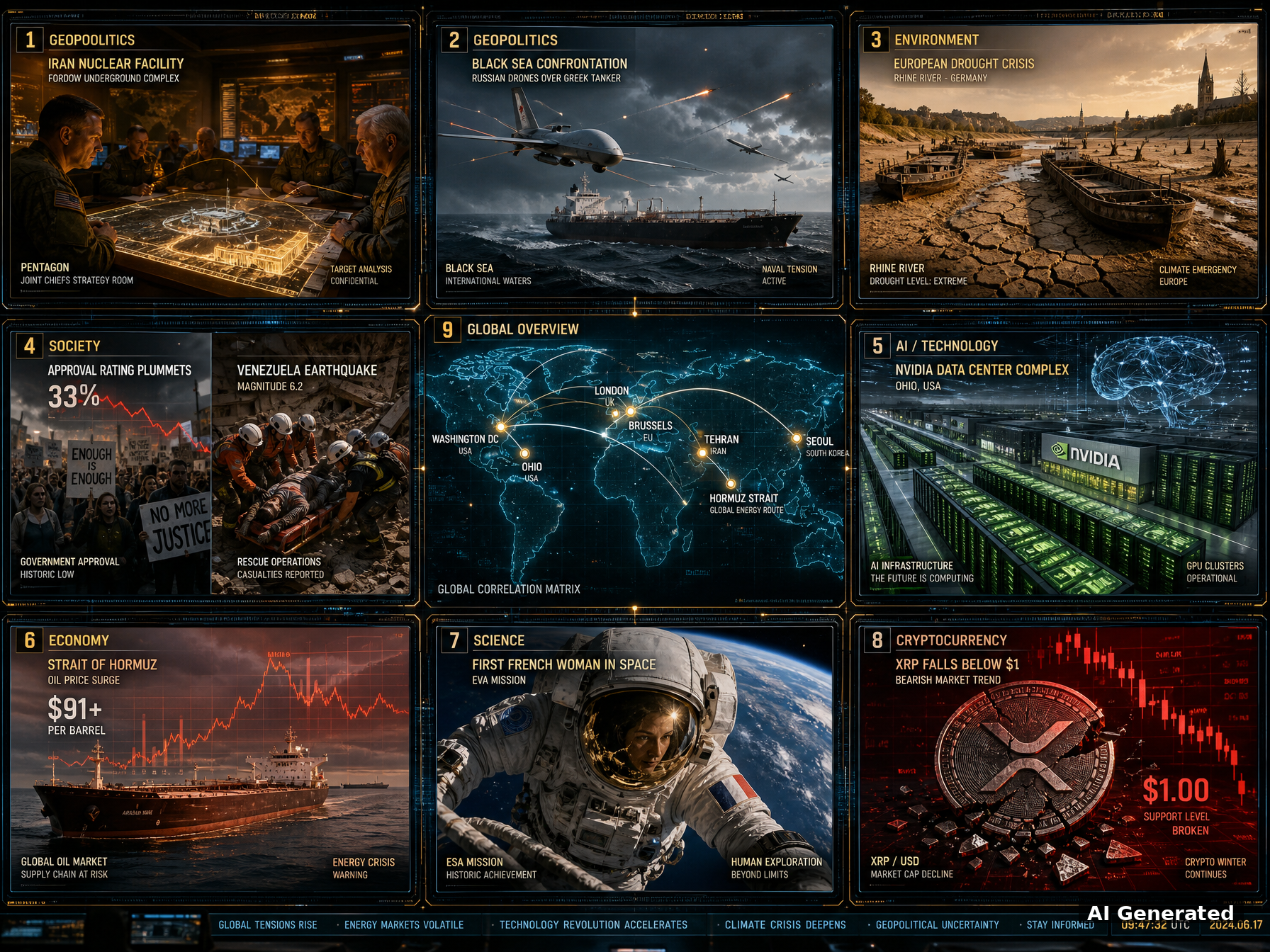


Contents
- 1. Geopolitics
&
Defence
- US Considers Tactical Nuclear Weapons Against Iran Underground Nuclear Facility
- Ship Attacked in Strait of Hormuz as Trump Threatens to Bomb US Ally Oman
- Trump Demands South Korea Pay $10 Billion Annually; US-Israel Agree on Hamas Disarmament
- Russia Threatens UK Over Drone Supply; Greek Tanker Attacked in Black Sea
- 2. Environment & Climate
- 3. Society & Civil Issues
- 4. AI
&
Technology
- Nvidia Guarantees $105 Billion for OpenAI’s Ohio Data Center; Qwen3.8-27B Achieves Frontier-Class Local AI
- Meta Faces 29-State Lawsuit Over Youth Addiction; China Axes Windows from State Agencies
- Cursor Launches Origin Code Hosting; GitHub Endures Six-Hour Outage; Anthropic Revenue Surges to $65 Billion
- 5. Economy & Business
- 6. Science & Space
- 7. Crypto, Digital Assets & Blockchain
- 8. Correlations & Analysis
Click any heading to jump to that section. Click the section heading to return to this menu.
Daily Intelligence Briefing — 2026-08-18 (D79)
Geopolitics & Defence
↑ ContentsUS Considers Tactical Nuclear Weapons Against Iran Underground Nuclear Facility
The United States government is actively studying the potential use of tactical nuclear weapons to destroy a deep underground storage facility belonging to the Iranian Atomic Energy Organisation at Mount Pikak, according to an Israeli government source speaking on condition of anonymity[1]. The consideration of one or two tactical nuclear bombs — as distinct from strategic weapons — represents the most dramatic escalation signal in the Iran conflict since the Hormuz crisis began in D64, and fundamentally changes the risk calculus for every other actor in the region. Tactical nuclear weapons carry yields significantly lower than the Hiroshima bomb but remain weapons of mass destruction by any legal or moral framework, and their use against a non-nuclear-armed state would shatter the post-1945 non-proliferation order that has governed international relations for eight decades.
The revelation comes as Iran’s Parliament speaker and chief negotiator Mohammad Bagher Ghalibaf declared both military and political victory over the United States and Israel in his weekend speech — a declaration that dramatically undercut the diplomatic framework being advanced by Trump’s envoys in Cairo[2]. Ghalibaf’s visit to Iraq, announced for Wednesday via the state-run IRNA news agency, suggests Tehran is pivoting toward regional alliance-building rather than negotiation, potentially establishing a parallel diplomatic track that bypasses Washington entirely[3]. The contrast between Washington’s nuclear contingency planning and Tehran’s triumphalist regional outreach creates a dangerous diplomatic vacuum where miscalculation becomes the most probable path to escalation.
The US Navy has simultaneously awarded Raytheon a contract worth $22.9 billion to accelerate Tomahawk cruise missile production to more than 1,000 units annually — the largest single munitions procurement in recent American history[4]. The seven-year agreement allows Raytheon to expand its workforce, increase production capacity and strengthen supply chain resilience while reducing delivery timelines. In the first half of 2026, Raytheon delivered three times as many Tomahawks as in the same period of 2025, indicating that the Pentagon’s industrial base is already ramping for sustained high-intensity operations well beyond the current Iran theatre.
Ship Attacked in Strait of Hormuz as Trump Threatens to Bomb US Ally Oman
A vessel was attacked in the Strait of Hormuz after President Trump issued an extraordinary threat to bomb Oman — a US treaty ally and the primary mediator of the fragile ceasefire framework[5]. Iran stated it had reached an agreement with Oman over a plan for ships to transit the strait, but the subsequent attack on the shipping lane demonstrates that the ceasefire mechanism remains fundamentally unstable. Brent crude surged above $91 per barrel for a third consecutive day, its highest level since late July, as the market priced in the reality that neither diplomatic engagement nor kinetic deterrence has produced a durable solution to the chokepoint crisis[6].
The attack escalates the Hormuz crisis into qualitatively new territory. Trump’s threat to bomb Oman — the country that has served as back-channel intermediary between Washington and Tehran since the earliest days of the conflict — signals either a collapse of the diplomatic architecture or a deliberate escalation strategy designed to force Iran into unconditional capitulation. Either interpretation is deeply destabilising for Gulf allies who have relied on Oman’s neutrality as a safety valve. As the Naftemporiki editorial board observed, “Someone needs to tell Trump: Pax Americana has collapsed” — reflecting a growing consensus across the Mediterranean and Gulf that American credibility as a security guarantor is irrevocably damaged[7].
Japan is now contemplating government support for reinsurance on oil tankers transiting the strait, an unprecedented peacetime intervention that would effectively nationalise the commercial risk of Persian Gulf shipping[8]. The move reflects the severity of the energy supply crisis for import-dependent economies and represents a direct challenge to the market-based insurance mechanisms that have governed maritime commerce for centuries.
Trump Demands South Korea Pay $10 Billion Annually; US-Israel Agree on Hamas Disarmament
President Trump demanded South Korea pay $10 billion per year for the presence of approximately 39,000 US troops on its territory — a tenfold increase from Seoul’s current contribution of roughly $1.1 billion under the existing Special Measures Agreement[9]. The demand came during a White House press conference in which Trump criticised Seoul for refusing to assist in the Iran war and questioned whether the US should continue defending South Korea against North Korea at American expense. South Korea’s Blue House responded by confirming that joint military exercises would proceed as planned despite Trump’s announcement that he would “considerably reduce” them — a rare and public defiance of presidential direction by a key Pacific ally[10].
The diplomatic implications extend far beyond the bilateral relationship. Trump’s decision to scale back exercises as a concession to Pyongyang — announced immediately after North Korea fired ballistic missiles toward Japan (documented in D73) — creates a precedent where military escalation by adversaries earns American concessions rather than punishment. The South Korean refusal to comply signals that alliance management under Trump 2.0 is entering uncharted territory, with allies increasingly willing to maintain their own defence posture regardless of American diplomatic preferences.
Separately, the United States and Israel have agreed on a framework for Hamas disarmament, with an American general designated to oversee the process[11]. Jared Kushner subsequently met with Hamas and Egyptian leadership in Cairo, advancing the diplomatic track even as Israel continued airstrikes in Gaza and escalated strikes in southern Lebanon targeting Hezbollah commanders[12]. The simultaneous pursuit of disarmament agreements and kinetic escalation reflects the fundamental contradiction that has characterised the Trump administration’s Middle East approach since the Hormuz crisis began.
Russia Threatens UK Over Drone Supply; Greek Tanker Attacked in Black Sea
Russia warned Britain it “will pay” for supplying drones used in Ukraine’s deep strikes into Russian territory, with Moscow’s Ministry of Defence issuing the threat after reports that UK-manufactured unmanned aerial vehicles participated in the massive 620-drone assault on the Moscow region[13]. Britain’s Ministry of Defence responded by affirming it stands “shoulder to shoulder” with Ukraine against Russian aggression. The exchange marks a significant escalation in the bilateral dimension of the conflict, moving beyond proxy competition into direct state-on-state threats between nuclear powers.
The threat gains additional weight in the context of Russia’s efforts to lower jet fuel standards following Ukrainian strikes on oil refineries. Ukrainian intelligence reports that Moscow’s Ministry of Transport is proposing to permit aviation fuel with a freezing point of up to minus 50 degrees Celsius instead of the current minus 60 degrees, along with the use of synthetic components and anti-wear additives that have not been fully tested[14]. The intelligence service noted that at cruising altitude, temperatures can drop below minus 50 degrees, meaning fuel crystallisation could clog engines and cause catastrophic failure. Russian officials are essentially proposing to compromise flight safety specifications to compensate for refinery capacity lost to Ukrainian strikes — a measure that would have been unthinkable before the conflict demonstrated how targeted kinetic operations can degrade an adversary’s industrial base.
In the Black Sea, the Greek-owned tanker Skiros, sailing under a Liberian flag, was attacked shortly after departing the Russian port of Novorossiysk where it had loaded oil[15]. The vessel continued its journey without injuries, but the incident illustrates how the conflict’s maritime dimension has expanded beyond the primary theatres to encompass commercial shipping across the broader Black Sea basin.
Environment & Climate
↑ ContentsEuropean Drought Reaches Crisis Point as Groundwater Hits Record Lows and Container Ships Vanish from Rhine
The European drought emergency documented across D68 through D78 has now reached a stage where the continent’s industrial and agricultural infrastructure faces systemic disruption. In Baden-Württemberg, groundwater levels have fallen to new August record lows at every fourth measurement station, with the State Institute for the Environment (LUBW) conducting an unscheduled update of its assessment because conditions deteriorated faster than expected[16]. “Since the end of June there has been no significant infiltration to groundwater and groundwater conditions are permanently declining across all regions,” the LUBW reported, warning that water scarcity in the Black Forest and other spring-fed areas “could intensify further in the coming weeks.”
The drought’s impact on logistics has become visible in devastating detail. At the port of Strasbourg — once one of Europe’s busiest inland waterway facilities — container ships have essentially vanished, with only a single barge transiting each week compared with the usual twenty[17]. France Info described the situation as “a slow decline” that threatens the economic viability of Rhine-side communities that have depended on river commerce for generations. The Rhine, the Danube, and the Elbe — Germany’s three great rivers — are simultaneously experiencing historically low flows, an unprecedented convergence that threatens logistics infrastructure, nuclear cooling systems, and agricultural irrigation across Europe’s industrial heartland.
Belgium’s High Fens wildfire remains “unpredictable” despite days of firefighting effort, with German Bundeswehr troops deployed across the border to assist[18]. The fire’s persistence in the Ardennes highlands illustrates how the drought has created fire conditions in regions where wildfires were historically rare — the High Fens is a protected peat bog ecosystem that, once ignited, can smoulder for weeks. Rain forecast for the Rhineland this week provides some hope, but meteorologists caution that the drought’s structural deficit cannot be resolved by isolated precipitation events.
Lake Powell Hits Record Low Threatening Power for 40 Million; Climate Damage Erodes European Public Finances
Lake Powell, the United States’ second-largest reservoir, has fallen to a record low, dropping to 3,519.91 feet above sea level — just 30 feet above the threshold at which the dam’s turbines would cease generating hydroelectric power[19]. The reservoir is more than 20 feet lower than at the start of the year, and federal officials warned in April that a “major intervention” would be necessary to avoid reaching the dead-pool threshold. The Bureau of Reclamation’s proposed 10-year management plan includes major potential water cuts for Arizona, California, and Nevada, but seven states have yet to reach agreement on long-term allocation of the Colorado River system that supports more than 40 million people.
Simultaneously, new analysis from Reuters and transport & Environment reveals that eight major oil companies generated €7.5 billion in excess profits across Europe in the first half of 2026, with profits doubling in the latest quarter as Brent crude surged above $91[20]. T&E is calling for a permanent windfall tax, arguing that the oil industry is profiting from a crisis that is simultaneously destroying European infrastructure and public finances. The analysis underscores the perverse economic dynamics of the current moment: the same energy price spikes that are driving wildfire risk, degrading water supplies, and reducing crop yields are simultaneously enriching the fossil fuel industry that created the conditions for these disasters.
US Vaccination Rates Fall Further; Nepal Tiger Recovery Shows Uneven Progress
The Centers for Disease Control and Prevention released data showing that US kindergarten vaccination rates have fallen again in the 2025-2026 school year, with only 92.4 percent of children receiving the MMR vaccine — down from 92.5 percent the previous year and well below the 95 percent threshold needed to prevent outbreaks of vaccine-preventable diseases[21]. The continued decline, occurring against a backdrop of the Trump administration’s executive order reducing recommended childhood vaccines from 17 to 11 (documented in D72), suggests that policy signals from the highest levels of government are translating into measurable changes in public health behaviour. Exemptions continued to rise across most states.
Nepal’s wild tiger population has reached an estimated 429 individuals — nearly a fourfold increase from 16 years ago — but the recovery is geographically uneven, concentrated almost entirely within the country’s newest national parks while the second-oldest Bardiya park experienced a population decline[22]. Researchers attribute the disparity to water availability, invasive weed species, and improved connectivity with potential habitats in India rather than administrative differences, suggesting that conservation success depends on landscape-level ecological factors that cannot be replicated through policy alone.
Society & Civil Issues
↑ ContentsUK Pay Growth Slows as Iran War Drives Cost-of-Living Squeeze; Job Vacancies Hit Five-Year Low
Official figures from the Office for National Statistics revealed that UK wage growth fell to 4.1 percent in the three months to June, down from 4.3 percent in the preceding period, as workers came under renewed pressure from a cost-of-living squeeze driven by the economic fallout from the Iran war[23]. Average weekly earnings excluding bonuses grew 3.5 percent, while the unemployment rate held at 4.9 percent. Critically, job vacancies slipped to their lowest level in five years, with the ONS noting that small firms appear to be scaling back recruitment due to increased labour costs and operating expenses — a pattern that suggests the Iran war’s economic transmission mechanism is operating through business confidence as much as through direct energy price inflation.
The data paints a picture of an economy caught between competing drags. Energy bills drove inflation close to 3 percent in July, house prices recorded their sharpest August decline since 2018, and private sector pay growth fell to a six-year low[24]. The new Labour government under Andy Burnham had been positioning itself as a pragmatic centrist capable of delivering both growth and social justice — analysts had compared his approach to Spain’s Pedro Sánchez — but the energy-driven inflation spike threatens to force painful trade-offs between fiscal discipline and the social spending commitments that form Labour’s political foundation.
Trump Approval Plummets to 33 Percent; Venezuela Earthquake Death Toll Reaches 6,438
A joint Ipsos-Reuters poll completed Monday found that only 33 percent of Americans approve of President Trump’s performance — the lowest figure of his presidency — with a majority of citizens expressing concern that the war against Iran will be prolonged[25]. The collapse in support reflects the cumulative weight of the Hormuz crisis, energy price spikes, the threatened bombing of a US treaty ally, and the consideration of tactical nuclear weapons, all within a compressed timeframe that has overwhelmed the administration’s capacity to manage its narrative.
The June earthquake in Venezuela has proven far deadlier than initially reported, with the death toll reaching 6,438 according to a new provisional count released by Congressional President Jorge Rodríguez[26]. The double earthquake measuring 7.2 and 7.5 magnitude struck the northern coast on June 24, collapsing at least 190 buildings and rendering more than 24,000 residences uninhabitable. Thousands remain missing and thousands more are living in temporary camps, often under dangerous conditions, while the interim government has distributed only 335 of the 4,000 new homes it pledged to deliver by year-end.
Berlin Cybersecurity Declared “Very Poor”; Ceuta Migration Crisis Intensifies
Cybersecurity expert Manuel Atug told Berlin’s RBB broadcaster that the city’s digital infrastructure is “very poor” and has deteriorated further since earlier assessments, despite the Berlin Senate’s claims of having implemented improvements[27]. The assessment came after a hacker attack forced two Senate departments — urban development and transport — to be disconnected from the network on Friday. Atug noted that when experts were asked to provide updates on Berlin’s cybersecurity posture, they found conditions had actually worsened, and that recommended improvements had not been implemented.
German agriculture minister Alois Rainer stated that he does not expect higher food prices despite the ongoing drought, though he acknowledged that reliable data for calculating farmer aid payments is not yet available[28]. The disconnect between the minister’s reassurance and the drought’s visible impact on groundwater, river levels, and crop conditions suggests a political establishment struggling to acknowledge the severity of a crisis that threatens the structural foundations of German food security.
AI & Technology
↑ ContentsNvidia Guarantees $105 Billion for OpenAI’s Ohio Data Center; Qwen3.8-27B Achieves Frontier-Class Local AI
Nvidia has committed a guarantee that could reach $105 billion to enable OpenAI to lease a massive computing campus in Ohio, developed by SB Energy, a subsidiary of SoftBank[29]. The financing arrangement does not directly fund chips but renders the infrastructure financeable — a structure that mirrors the increasingly complex capital stacks being deployed to sustain the AI industry’s exponential hardware appetite. The guarantee represents the largest single infrastructure commitment in the AI sector’s history and signals that Nvidia views the compute demand curve as durable enough to underwrite seven-figure bets on capacity that may not come online for years.
Meanwhile, Alibaba released Qwen3.8-27B, a 27-billion-parameter open-source model that has scored 52 on Artificial Analysis’ Intelligence Index — matching OpenAI’s proprietary GPT-5.6 Luna at maximum reasoning[30]. The model runs at full precision on roughly 56GB of GPU memory, with 4-bit quantisation cutting it to approximately 17GB — putting frontier-class capability within reach of high-end consumer hardware. The development agency Cline observed that “this is the first time a local model has scored frontier model capability,” while developer Simon Willison wrote that “the fact that a 17GB file can do all of this stuff on my home machines is a miracle.” The model’s rapid adoption — exceeding 3 million Hugging Face downloads in three days — suggests that the AI industry’s centre of gravity may be beginning to shift from cloud-dependent proprietary systems toward locally deployable open-weight alternatives.
Meta Faces 29-State Lawsuit Over Youth Addiction; China Axes Windows from State Agencies
Twenty-nine US states have filed a joint lawsuit against Meta seeking $1.4 trillion in damages, alleging that Facebook and Instagram were deliberately designed to addict minors to social media[31]. The lawsuit represents the largest coordinated state-level action against a technology company in US history and could establish precedents for platform liability that reshape the legal landscape for social media companies globally. The case centres on allegations that Meta’s algorithms were optimised for engagement metrics that it knew would be harmful to young users, creating a pattern of conduct that the states characterise as a public health crisis.
China has accelerated its plan to remove Microsoft Windows from government agencies ahead of schedule, according to a FinancialJuice report citing official sources[32]. The move, which extends the country’s broader push toward technological self-sufficiency, comes as Beijing simultaneously pursues an Arctic sea route to Europe that could reduce dependence on Middle East chokepoints currently disrupted by the Hormuz crisis. The convergence of operating system decoupling and maritime route diversification reflects a comprehensive strategy to insulate Chinese state infrastructure from Western leverage.
Cursor Launches Origin Code Hosting; GitHub Endures Six-Hour Outage; Anthropic Revenue Surges to $65 Billion
Cursor began rolling out Origin, its own code hosting platform, on Monday morning — roughly three and a half hours before GitHub experienced a six-hour global degradation affecting pull requests, issues, enterprise single sign-on, and Copilot[33]. The coincidence dramatised the argument Origin exists to make: that AI agents have created a new class of demand that GitHub’s architecture was not built to handle. RuntimeWire reported that 35 percent of pull requests merged inside Cursor were opened by autonomous agents running in cloud virtual machines, fundamentally changing the nature of code review from a human conversation to a scheduling problem.
Anthropic’s annualised revenue surged to $65 billion, adding $18 billion in just two months — a growth rate that suggests the AI industry’s commercial trajectory continues to accelerate despite increasing regulatory scrutiny[34]. The revenue figure places Anthropic on track to become one of the fastest-growing technology companies in history, driven primarily by enterprise API usage and the increasing integration of Claude into production workflows across industries.
Google is purchasing data from the failed US airline Spirit Airlines for potential use in AI training, paying millions of dollars for internal communications from the bankrupt carrier[35]. The transaction reflects a growing market for corporate data as AI training material, where even the records of failed companies have value as linguistic and operational datasets.
Economy & Business
↑ ContentsOil Prices Surge Past $91 as Hormuz Crisis Enters Third Month; US-Canada Hold Last-Minute Tariff Talks
Brent crude oil exceeded $91 per barrel for a third consecutive day, reaching its highest level since late July as the Hormuz crisis continued to disrupt global energy supply chains[36]. The sustained price elevation reflects the market’s assessment that neither the US-Iran ceasefire framework nor the diplomatic efforts being advanced by Trump’s envoys in Cairo have produced a durable solution to the strait’s closure. Eight major oil companies generated €7.5 billion in excess profits across Europe in the first half of 2026, with profits doubling in the latest quarter — a dynamic that has prompted Transport & Environment to call for a permanent windfall tax on fossil fuel companies profiting from the crisis[37].
The energy price surge is now visibly reshaping trade diplomacy. The United States and Canada held last-minute negotiations to prevent the imposition of 50 percent US tariffs, with tensions already elevated by trade disputes and President Trump’s inflammatory comments about making Canada the 51st state[38]. Canada is simultaneously reviewing a lithium sale to China that tests its warming ties with Beijing, adding another dimension to the critical minerals competition that has emerged as a central feature of the new economic geography shaped by the Hormuz disruption.
EBM-Papst Sold to US for €5.1 Billion; German Building Permits Surge 15 Percent
German ventilation specialist EBM-Papst, a family-owned Mittelstand company, has been sold to American buyer Madison Air for approximately €5.1 billion — the second major German climate technology company to fall into US hands after Viessmann’s acquisition[39]. The deal, completed in just ten weeks, illustrates both the accelerating pace of transatlantic M&A in climate technology and the vulnerability of Germany’s industrial mid-market to foreign acquisition during a period of acute economic stress caused by the drought and energy crisis.
Germany recorded its strongest increase in building permits since 2016, with permits for 126,300 apartments issued in the first half of the year — up 15.1 percent from the prior period[40]. Housing minister Verena Hubertz credited government policy, though she acknowledged the improvement came from a low base. However, the Federal Statistical Office simultaneously warned that housing completions face a 15-year low, suggesting that the pipeline of permitted but unbuilt apartments is growing at a pace that will not translate into actual housing supply for years.
India’s National Stock Exchange is seeking a valuation of up to $55 billion in its planned initial public offering, which would raise approximately $3.15 billion and surpass the country’s largest IPO to date[41]. The listing represents a milestone in India’s capital market development and arrives amid broader strategic positioning, with BRICS trade ministers meeting in Jaipur to discuss reducing dollar dependency in bilateral trade.
Science & Space
↑ ContentsSophie Adenot Set to Become First French Woman to Conduct Spacewalk
European Space Agency astronaut Sophie Adenot is scheduled to conduct a 6.5-hour spacewalk outside the International Space Station on Tuesday alongside NASA astronaut Anil Menon, becoming the first French woman ever to perform an extravehicular activity[42]. The pair will replace a space-to-ground antenna critical for high-speed communications between Mission Control in Houston and the station. The mission represents the 282nd spacewalk in ISS history and the second for Menon, whose first EVA on August 6 was delayed after a CO2 sensor anomaly on his spacesuit triggered additional safety checks.
Adenot, who arrived at the station aboard SpaceX’s Crew-12 mission in February, will not be the first French person to spacewalk — that distinction belongs to Jean-Loup Chrétien, who performed an EVA outside the Soviet Mir station in 1988 — but she will be the first woman. The mission also carries symbolic weight as Europe reasserts its presence in crewed spaceflight, with France positioning itself as a leader in the continent’s space ambitions even as its domestic infrastructure confronts drought-induced crises.
Quantum Internet Passes Real-World Test Over 38 Miles of Ordinary Cable; Mars Curiosity Discovers Polygon Field
Researchers at the US National Institute of Standards and Technology successfully transmitted entangled photons across 62 kilometres of existing network cabling without breaking their quantum state — a result notable not for the distance but for the hostile conditions under which it was achieved[43]. Much of the fibre-optic cable was strung above ground between street-side poles between NIST and the University of Maryland, exposed to wind, temperature fluctuations, and vibrations from traffic and passing birds. “It’s about as bad a connection as you can possibly have,” said physicist Oliver Slattery. The team used a laser reference signal to calculate and correct for environmental distortion, achieving stable quantum transmission 92.8 percent of the time.
NASA’s Curiosity Mars rover has discovered a massive field of polygon fractures on the Martian surface, providing new evidence of ancient geological processes that shaped the planet’s landscape[44]. The honeycomb-like formations, captured in close-up imagery, suggest patterns of repeated thermal stress and possibly ancient water interactions that continue to inform scientific understanding of Mars’ geological history.
Nuclear Asteroid Deflection Simulated Successfully; Egyptian Tomb Reveals 300 Years of Burial Evolution
A team led by astrophysicist Isaiah Santistevan of Lawrence Livermore National Laboratory ran detailed 3D simulations demonstrating that a one-megaton nuclear weapon detonated 10 to 25 metres from a 160-metre “city killer” asteroid could successfully disrupt it[45]. The mechanism is not the shockwave but X-rays — accounting for 70 to 80 percent of a nuclear explosion’s energy — which sear the asteroid’s surface, drive vaporisation, and launch material that imparts momentum change. At 10 metres above the surface, 98.2 percent of asteroid material became fully damaged and 97 percent exceeded escape velocity. Counterintuitively, detonation at 25 metres produced more widespread damage because the X-ray beam illuminated a larger surface area.
Archaeologists from Spain’s University of La Laguna have documented how Egyptian burial practices evolved across more than 300 years in a single tomb chamber in the Theban Necropolis, finding that later interments were carefully adapted to the presence of earlier burials rather than representing a decline in ritual care[46]. The study challenges previous theories that tomb reuse indicated chaos or disrespect, instead revealing a “spatial logic” in which each generation positioned its dead in conscious relationship to those already interred.
Crypto, Digital Assets & Blockchain
↑ ContentsXRP Sinks Below $1 for First Time Since 2024 as Ripple Partners with Korean Bank
XRP fell below $1 for the first time since 2024, settling around $0.99 as the broader crypto market experienced continued selling pressure driven by macro-economic uncertainty and the Iran war’s impact on risk appetite[47]. The price decline occurred even as Ripple announced a partnership with South Korea’s Jeonbuk Bank — the first regional bank in the country to deploy Ripple Payments for cross-border remittances, replacing the SWIFT network for business international transfers[48]. The disconnect between positive fundamental developments and price weakness reflects a market environment where institutional caution has overwhelmed protocol-level progress. Whale transactions spiked 280 percent during the period, with nearly 50,000 active addresses appearing on the XRP Ledger, suggesting that large holders are accumulating while retail sentiment remains bearish.
Ethereum Glamsterdam Upgrade Could Break Wallets; Monad Early Investors Refuse $60 Million Cash-Out
The Ethereum Foundation warned that wallets, indexers, and gas estimation tools could break when the Glamsterdam upgrade activates on the Platåberget testnet on August 20[49]. The upgrade changes the 21,000-gas assumption that many tools use for standard ETH transfers, introducing a new state-gas metric that requires developers to update their code before mainnet activation. The warning is notable because it comes less than three months after the Hegotá upgrade’s priorities were announced (covered in D78), suggesting that Ethereum’s development cadence is accelerating even as the complexity of each upgrade increases the risk of ecosystem disruption.
Monad, an Ethereum Layer 1 rival, offered early investors up to $60 million to cash out before investor token unlocks begin in November, but almost all declined[50]. The programme came three months before the unlocks begin, with MON trading below its public-sale price and most of the token supply still outside circulation. The refusal of early investors to exit — despite being offered substantial premiums — suggests either strong conviction in the project’s long-term potential or a calculation that selling into thin liquidity would crystallise losses worse than holding through the unlock.
CFTC Targets October Launch for Compute Futures; Jane Street Discloses $1 Billion Bitcoin ETF Holdings
The Commodity Futures Trading Commission plans to seek public input on AI compute futures as CME Group targets an October 5 launch for two contracts based on GPU rental prices[51]. The development represents the financialisation of AI infrastructure capacity — a market that did not exist eighteen months ago — and creates new hedging instruments for the data centre operators whose electricity consumption is reshaping power grids across North America. The CFTC’s willingness to regulate compute as a commodity futures product implicitly acknowledges that AI processing power has become a strategic resource comparable to oil or grain.
Jane Street disclosed more than $1 billion invested in US spot Bitcoin exchange-traded funds as of the second quarter, with BlackRock’s iShares Bitcoin Trust representing roughly $828 million of the total[52]. The firm also expanded its exposure to crypto ETFs beyond Bitcoin, holding more than 1.2 million shares of Bitwise’s spot XRP ETF compared with just 20,605 shares three months earlier. While Jane Street’s role as a major market maker means its ETF positions may reflect hedging rather than directional bets, the scale of the disclosed holdings underscores the depth of institutional integration with crypto market infrastructure.
South Korea’s two largest crypto exchanges, Upbit and Bithumb, reported 50 percent declines in first-half revenue as investor capital shifted toward domestic equities, with the benchmark KOSPI more than doubling in the same period[53]. The revenue contraction reflects a broader rotation from speculative crypto trading into traditional equity markets across Asia, accelerated by the macro-economic uncertainty generated by the Hormuz crisis.
Correlations & Analysis
↑ ContentsThe D79 reporting period captures a moment of profound strategic danger at multiple levels simultaneously. The most significant development is the revelation that the US government is actively studying the use of tactical nuclear weapons against Iran — a contemplation that, even as a contingency exercise, represents the most dangerous escalation signal since the crisis began in D64. The consideration must be read against the backdrop of Ghalibaf’s victory declaration and Iraq visit, Trump’s threat to bomb Oman, and the ship attack in the Hormuz strait, all of which suggest that the diplomatic and kinetic tracks are moving in opposite directions at precisely the moment when convergence is most needed. The $22.9 billion Tomahawk contract acceleration is not merely a procurement decision — it is an industrial signal that Washington is preparing for a sustained high-intensity operational tempo that extends well beyond the current Iran theatre.
The European drought has now crossed from an environmental crisis into an infrastructure emergency. With groundwater at record lows, container traffic vanishing from the Rhine, and wildfires burning in Belgium’s High Fens, the pattern documented across D68-D78 has matured into a structural transformation of European logistics, agriculture, and energy security. The convergence of three historically low river flows — Rhine, Elbe, and Danube — is not an isolated weather event but the manifestation of a climate regime shift that the political system has been reluctant to acknowledge. Germany’s agricultural minister dismissing food price concerns while the continent’s waterways dry up captures the gap between political messaging and physical reality.
In the technology sector, the Nvidia-OpenAI $105 billion guarantee and Qwen3.8-27B’s frontier-class local performance represent opposite poles of AI’s trajectory. One consolidates the cloud-dependent, capital-intensive model that has dominated the industry; the other demonstrates that comparable capabilities are becoming accessible on consumer hardware. The Cursor Origin launch against the backdrop of a six-hour GitHub outage illustrates how infrastructure fragility creates market openings — and how the question of who holds your source code has become a governance challenge as much as an engineering one.
The economic picture is dominated by the oil price’s third consecutive day above $91, which is now visibly reshaping trade diplomacy (US-Canada tariff talks), accelerating the energy transition (used EV sales surging 10 percent year-on-year despite the end of tax credits), and enriching the very industry whose product is driving the climate crisis. The UK’s labour market data — vacancies at five-year lows, pay growth slowing — demonstrates how the Iran war’s economic transmission operates through multiple channels simultaneously: direct energy costs, business confidence erosion, and the fiscal squeeze on governments forced to balance defence spending against social obligations.
What to watch in the next reporting period: The trajectory of the nuclear contingency discussion — whether it remains classified contingency planning or enters public debate. Japan’s monetary policy decision in the context of both the Q2 GDP miss and the potential tanker reinsurance programme. The Glamsterdam testnet activation on August 20 and whether Ethereum’s ecosystem handles the gas model change without disruption. Ghalibaf’s Iraq visit and whether it produces a regional alignment that excludes Washington. The US vaccination data’s implications for autumn school enrolment and disease surveillance.
References
1. Τακτικά πυρηνικά όπλα ΗΠΑ κατά ιρανικής πυρηνικής εγκατάστασης by Defence Point 18 Aug 2026 Source ↩
2. Iran warns US of severe consequences if conflict expands beyond Middle East by Crypto Briefing 17 Aug 2026 Source ↩
3. Irans Ghalibaf to visit Iraq on Wednesday by FinancialJuice 18 Aug 2026 Source ↩
4. ΗΠΑ: Συμβόλαιο-μαμούθ 22,9 δισ. δολαρίων για την επιτάχυνση της παραγωγής Tomahawk by Flight.com.gr 18 Aug 2026 Source ↩
5. Iran-US war latest: Ship attacked in Strait of Hormuz after Trump threatens to bomb US ally Oman by The Independent 18 Aug 2026 Source ↩
6. Κάποιος να το πει στον Τραμπ: Η Pax Americana έχει καταρρεύσει by Naftemporiki 18 Aug 2026 Source ↩
7. Ibid. ↩
8. Japan mulls support for reinsurance on oil tankers by FinancialJuice 18 Aug 2026 Source ↩
9. Trump Wants South Korea to Pay $10 Billion a Year for U.S. Troop Presence by Militarnyi 18 Aug 2026 Source ↩
10. Kim Jong Un et moi nous entendons tres bien! Trump announces reduce considerably military exercises by Le Parisien 17 Aug 2026 ↩
11. ΗΠΑ και Ισραήλ συμφώνησαν για τον αφοπλισμό της Χαμάς by DEFENCE ReDEFiNED 18 Aug 2026 Source ↩
12. Hamas calls for Trump’s Board of Peace to compel Israel over Gaza peace plan by The Guardian 17 Aug 2026 ↩
13. Russia says UK will pay for supplying drones to Ukraine by BBC News 18 Aug 2026 Source ↩
14. Russia Seeks to Lower Jet Fuel Standards Following Strikes on Oil Refineries by Militarnyi 18 Aug 2026 Source ↩
15. Επίθεση σε ελληνόκτητο δεξαμενόπλοιο στη Μαύρη Θάλασσα by Proto Thema 18 Aug 2026 Source ↩
16. Trockenheit: Grundwasser im Sudwesten erreicht neue Tiefststande by Stern 18 Aug 2026 Source ↩
17. Un lent declin: a cause de la secheresse, les porte-conteneurs ont disparu du port fluvial de Strasbourg by France Info 18 Aug 2026 Source ↩
18. Waldbrand im Hohen Venn bleibt unberechenbar by Handelsblatt 18 Aug 2026 Source ↩
19. Lake Powell hits record low, threatening key water and electricity supply for millions by Mongabay 17 Aug 2026 Source ↩
20. Oil Majors Double Profits in Europe in Latest Quarter by Transport & Environment / CleanTechnica 17 Aug 2026 Source ↩
21. US vaccination rates fall again as exemptions continue to rise, CDC data shows by Ars Technica 17 Aug 2026 Source ↩
22. Nepal’s newest national parks drive tiger recovery, but emerging concerns threaten progress by Mongabay 18 Aug 2026 Source ↩
23. UK pay growth slows as Iran war prompts cost of living squeeze by The Guardian 18 Aug 2026 Source ↩
24. UK job vacancies slip to five-year low by The Independent 18 Aug 2026 Source ↩
25. Ντοναλντ Τραμπ: Η δημοτικοτητα του κατρακυλησε στο 33% by Kathimerini 18 Aug 2026 Source ↩
26. Σεισμος στη Βενεζουελα: Στους 6.438 ο απολογισμος των νεκρων by Flight.com.gr 18 Aug 2026 Source ↩
27. Hackerangriff: IT-Experte: Berlin bei Cybersicherheit schlecht aufgestellt by Stern 18 Aug 2026 Source ↩
28. Alois Rainer: Minister erwartet trotz Durre vorerst keine hoheren Lebensmittelpreise by Die Zeit 18 Aug 2026 ↩
29. Nvidia garantit 105 milliards de dollars pour construire le futur data center d OpenAI by La Tribune 18 Aug 2026 Source ↩
30. Qwen3.8-27B runs frontier-class coding agents and reasoning locally by VentureBeat 18 Aug 2026 Source ↩
31. Facebook and Instagram could change forever as Zuckerberg faces his day in court by The Independent 18 Aug 2026 Source ↩
32. China axing Microsoft Windows from state agencies ahead of plan by FinancialJuice 18 Aug 2026 ↩
33. Cursor launches Origin code hosting platform as GitHub outage exposes opening by VentureBeat 17 Aug 2026 Source ↩
34. Anthropic’s annualized revenue surges to $65B by TechCrunch 17 Aug 2026 Source ↩
35. Millionen Dollar fur Daten: Fur KI-Training? Google kauft Daten gescheiterter US-Airline by WirtschaftsWoche 18 Aug 2026 ↩
36. FinancialJuice: Brent crude above $91 by FinancialJuice 18 Aug 2026 ↩
37. Oil Majors Double Profits in Europe by T&E / CleanTechnica 17 Aug 2026 ↩
38. US, Canada hold last-minute talks to stop 50% U.S. tariffs by ABC News 18 Aug 2026 Source ↩
39. EBM-Papst goes for 5.1 billion Euro to US corporation by Handelsblatt 18 Aug 2026 Source ↩
40. 15 Prozent mehr Baugenehmigungen im ersten Halbjahr by Stern 18 Aug 2026 ↩
41. NSE seeking valuation of as much as Rs 5.26 trillion in planned IPO by Business Standard 18 Aug 2026 ↩
42. Watch European astronaut make history during spacewalk today by Space.com 18 Aug 2026 Source ↩
43. The Quantum Internet Just Passed Its Toughest Real-World Test Yet by ScienceAlert 18 Aug 2026 Source ↩
44. Mars Curiosity Rover Discovers Massive Field of Polygons by Universe Today 18 Aug 2026 Source ↩
45. Our Survival Might One Day Rely on Nuking a City Killer Asteroid by ScienceAlert 18 Aug 2026 Source ↩
46. 300 years of mummies found in ancient Egyptian tomb by Popular Science 18 Aug 2026 Source ↩
47. XRP sinks below $1 for first time since 2024 by CoinDesk 18 Aug 2026 Source ↩
48. Important Ripple (XRP) Partnership Targets Cross-Border Remittances by CryptoPotato 18 Aug 2026 Source ↩
49. Ethereum devs warn Glamsterdam upgrade could break wallets and gas tools by Crypto News 18 Aug 2026 Source ↩
50. Monad offered early investors up to $60 million to cash out. Almost all said no by CoinDesk 18 Aug 2026 Source ↩
51. CFTC seeks input as CME targets Oct. 5 compute futures by Crypto News 18 Aug 2026 Source ↩
52. Jane Street Reveals Over $1 Billion Invested in Bitcoin ETFs by CryptoPotato 18 Aug 2026 Source ↩
53. Upbit and Bithumb report 50% declines in H1 revenue by The Block 18 Aug 2026 Source ↩
AI Disclosure: This post was created with the assistance of artificial intelligence. The ideas, analysis, and opinions expressed are my own — AI was used to help compose, structure, and refine my personal notes and thoughts into the final written content. Images, videos and music featured in this post were also generated using AI tools, based on my own creative prompts and direction.