

Contents
- 1. Geopolitics & Defence
- 2. Environment & Climate
- 3. Society & Civil Issues
- 4. AI & Technology
- 5. Economy & Business
- 6. Science & Space
- 7. Crypto, Digital Assets & Blockchain
- 8. Correlations & Analysis
- 9. References
Click any heading to jump to that section.
Click the section heading to return to this menu.
Daily Intelligence Briefing — 2026-07-30 (D60)
1. Geopolitics & Defence
1.1 US Resumes Heavy Strikes on Iran After Ceasefire Collapse; Hormuz Traffic Under Threat
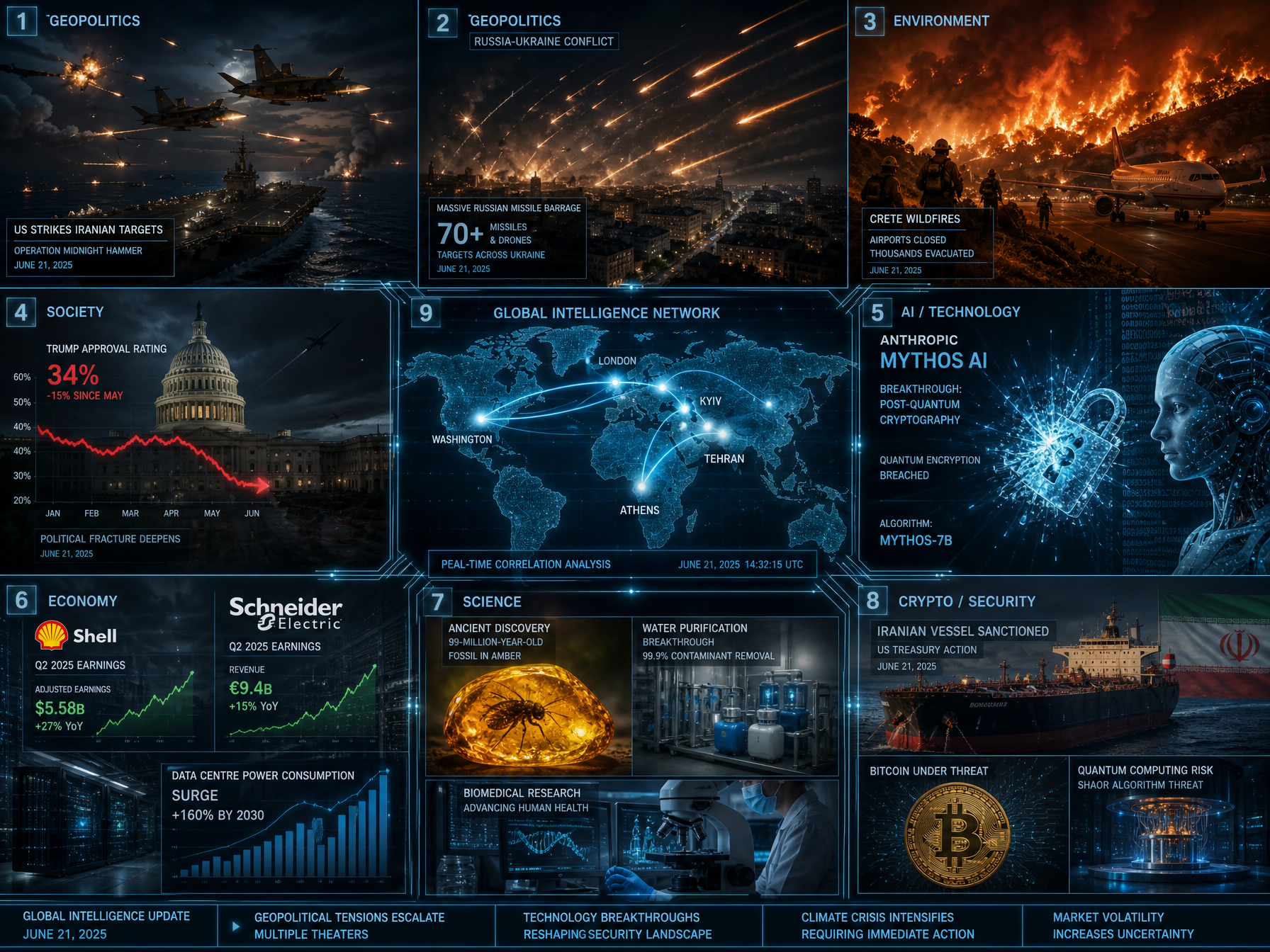
The most significant escalation in the Iran theatre since D59’s report of Tehran’s surprise missile attack on US forces in Jordan is Washington’s decision to resume heavy waves of air strikes on Iranian territory, targeting the strategically vital Qeshm Island and surrounding military installations. At least three people, including a child, have been confirmed killed in the latest round of bombardment, which came after the five-day ceasefire documented in D59 collapsed within hours of Iran’s missile launch.[1] The Trump administration, which had been publicly signalling a desire for a negotiated settlement — a posture that D59 noted was increasingly at odds with the military reality — has now pivoted decisively back to escalation. Reporting from the Independent confirms that President Trump has ordered “heavy waves” of strikes, phrasing that suggests a tempo of operations not seen since the opening salvos of the conflict in mid-July.[4] The Indian Defence News adds that the US renewed air strikes specifically in response to Iran’s missile attack on the Jordanian base, establishing a clear tit-for-tat escalation cycle that removes any remaining ambiguity about the conflict’s trajectory.[8]
The Strait of Hormuz remains the most dangerous flashpoint in this confrontation. CPC oil loadings have been halted following a tanker attack at mooring, an incident that directly threatens Kazakhstan’s export pipeline and reverberates through global crude supply chains.[5] Meanwhile, Iran’s Fars News Agency reports that a Qatari LNG vessel successfully transited through an Iran-designated Hormuz route, a development that signals Tehran is selectively permitting traffic through the strait — a strategy that allows it to maintain economic leverage with Gulf allies while keeping Western shipping under threat.[6] President Trump stated he would be “quite disappointed” if China arms Iran, a formulation that stops well short of a red line but acknowledges Beijing’s potential role as an enabler.[7] Pakistan’s Defence Minister has separately warned of deepening Israel-India military cooperation, framing the Iran conflict within a broader South Asian security realignment that complicates Islamabad’s own balancing act.[21] India, for its part, has urged the UN Security Council to balance its focus on Hormuz with attention to the Gaza crisis, reflecting New Delhi’s attempt to maintain diplomatic credibility across multiple theatres.[22]
The operational costs of the conflict are mounting on multiple fronts. The sinking of an American assault ship during the RIMPAC exercises by naval drones — an unprecedented attack during what is nominally a peacetime multinational exercise — demonstrates the proliferation of asymmetric maritime capabilities and raises questions about the survivability of amphibious assets in contested waters.[9] Somalia’s piracy resurgence has been directly linked to the Iran war, with disrupted shipping patterns and reduced naval patrols in the Gulf of Aden creating opportunities for maritime criminals, a spillover effect that was not anticipated in early conflict assessments.[18]
1.2 Ukraine: Russia Launches 70+ Missiles and 280+ Drones; Poland Scrambles Jets
The Ukraine theatre has undergone a dramatic intensification that eclipses D59’s coverage of Kyiv’s deep strikes into Russia. Overnight, Russia launched over 70 missiles and more than 280 drones in what constitutes one of the largest combined barrages of the war, killing at least eight civilians and causing widespread infrastructure damage.[2] The Independent reports that Poland scrambled fighter jets in response to the barrage, an escalation of NATO’s direct involvement that follows weeks of increasing airspace incursions along the alliance’s eastern flank.[3] Ukraine has now lost its fifth F-16 in combat, a rate of attrition that raises serious questions about the sustainability of Western-supplied air assets against Russia’s integrated air-defence network.[19] The cumulative effect of these losses, combined with the sheer volume of incoming ordnance, suggests that Kyiv’s air-defence capacity is being tested to its limits despite continued Western resupply.
The broader defence-industrial landscape continues to shift. China’s J-35 stealth fighter, now being offered to Pakistan, has reignited India’s debate over acquiring the F-35, a procurement decision that would fundamentally alter South Asian air-power dynamics and tie New Delhi more tightly into the US defence ecosystem.[10] Dassault Aviation has opened the door to non-European partners for its sixth-generation Future Combat Air System, a pragmatic acknowledgment that Europe’s indigenous fighter programmes may not achieve technological self-sufficiency without external collaboration.[11] Greece is pursuing a dual-track modernisation, with F-16 upgrades proceeding alongside the acquisition of new Bergamini-class frigates from Italy, while field tests of upgraded Steyr and Mercedes military vehicles signal a broader ground-force refresh.[12][14] Rheinmetall has received a new order for 56 Elefant 2 heavy transport vehicles, reinforcing Germany’s role as Europe’s principal land-systems supplier.[13] The US Air Force has expanded its $500 million counter-drone shield programme, an investment that reflects lessons drawn directly from the Ukraine conflict’s drone-heavy combat model.[15]
1.3 Geopolitical Friction: Balochistan, Falklands, and China’s Chip Sovereignty
A cluster of secondary geopolitical stories underscores the global diffusion of instability. Balochistan’s ongoing unrest has been characterised by Indian Defence News as involving “body bags and lies,” a framing that highlights the Pakistani state’s difficulty in controlling its largest province amid a persistent separatist insurgency that has intensified since the Iran conflict disrupted regional smuggling networks.[23] FIFA has opened a disciplinary investigation against Argentina over a Falklands banner displayed during a match, an incident that, while seemingly trivial, touches on the enduring sovereignty dispute between Buenos Aires and London and illustrates how sporting events remain flashpoints for nationalist expression.[16] The African Football Confederation has responded positively to FIFA’s investor deal, unlike UEFA, which continues to resist the governing body’s commercial expansion — a divergence that reflects deeper tensions between European and Global South football governance models.[17] In New Zealand, a minister’s backlash after telling a Chinese-origin MP to “go back to your own country” has triggered a national conversation about racism in politics and the treatment of immigrant communities in Western democracies.[24] Perhaps most consequentially, China has begun production of indigenous deep ultraviolet (DUV) chipmaking tools, a milestone in Beijing’s campaign to achieve semiconductor self-sufficiency that directly challenges ASML’s monopoly and reshapes the global technology supply chain.[20]
2. Environment & Climate
2.1 Greece and Crete Catastrophe: Firefighters Dead, Aircraft Grounded
The European wildfire crisis, which D59 reported as stabilising in France’s Gironde region, has erupted with catastrophic force in Greece and Crete. Extreme winds of up to 133 km/h grounded firefighting aircraft and turned a manageable vegetation fire into an uncontrollable inferno that has killed two firefighters and forced the evacuation of more than 3,000 residents.[25] The Greek authorities have issued a Red Code fire alert for Attica, Crete, and thirteen other regions, an extraordinary geographic scope that indicates the fire-weather conditions are not localised but systemic across the eastern Mediterranean.[26] The grounding of aircraft is a particularly alarming development, as it removes the most effective tool for containing fast-moving fires and leaves ground crews to operate in conditions that have already proven lethal. This marks the first time during the 2026 European fire season that aerial firefighting has been suspended due to wind rather than smoke visibility, establishing a new operational threshold that fire services across the continent will need to plan for.
France, which D59 reported was seeing stabilisation in the Gironde, has experienced new fire outbreaks in the Var department and a resumption of activity in the Fontainebleau forest near Paris, although both have since been contained.[27][28] In the United Kingdom, a major incident has been declared as firefighters battle a significant heath fire in Suffolk, a reminder that even temperate maritime climates are now vulnerable to fire events that would have been unthinkable a decade ago.[29] The EU’s crisis chief has called for a fundamental shift in funding toward prevention rather than response, arguing that the current model of emergency suppression is financially and operationally unsustainable.[30] Munich Re, the world’s largest reinsurer, has warned that wildfire damage costs will continue to rise, a signal that the insurance industry is now pricing in the structural reality of a warming climate rather than treating each season as an anomaly.[32]
2.2 Heat Trauma, Heatwaves, and the Compounding Climate Feedback Loop
Meteo-France’s CEO has warned that heatwaves will multiply fivefold by 2050, a projection that reframes the current crisis not as an exceptional event but as the baseline for mid-century Europe.[31] Reporting from Franceinfo introduces the concept of “traumatisés de la canicule” — heat trauma sufferers — a growing population of people who experience lasting psychological damage from extreme heat events, particularly the elderly and those who have lived through multiple successive crises.[34] In Germany, residents of Cologne have been cooling off in public fountains and parks as the country experiences its latest heatwave, while weather researchers have confirmed that the “weather whiplash” pattern — rapid oscillation between extreme dryness and intense precipitation — was a primary driver of the France and Spain wildfire outbreaks.[33][43] This whiplash pattern is particularly dangerous because it desiccates vegetation during dry phases, creating fuel loads that ignite explosively when heat returns.
At the policy level, the EU carbon market review proposes slower emission cuts, a concession to industrial lobbying that risks undermining the bloc’s climate commitments even as the physical evidence of climate change mounts.[36] Coulson Aviation has introduced its CFR HALO fire retardant, a new-generation suppression chemical designed for aerial deployment, but the Greek experience demonstrates that technology alone cannot overcome physics when wind speeds exceed operational limits.[35] Antarctic penguins have been found carrying forever chemicals in their feathers, evidence that PFAS contamination has reached the most remote ecosystems on Earth.[37] A global gold rush is consuming the Amazon through illegal mining operations, while Florida’s waterways are failing quality standards and a proposed mine expansion along the Canada-US border is raising pollution concerns — environmental degradation stories that collectively illustrate the breadth and depth of the planetary ecological crisis.[38][39][40] New research suggests that global crop models significantly underestimate rice’s vulnerability to heat, a finding with profound implications for food security in Asia.[42] The International Institute for Applied Systems Analysis has released a new climate risk assessment tool designed to help policymakers evaluate compound risks, an institutional response to the growing recognition that single-hazard planning is inadequate.[41]
3. Society & Civil Issues
3.1 Trump’s Approval at 34%: Domestic Politics Fracture Along New Lines
President Trump’s approval rating has fallen to 34%, its lowest point since the January 6 insurrection, a collapse driven by public fatigue over the Iran conflict and growing economic anxiety.[44] The decline is notable not only for its magnitude but for its timing: it comes despite a rally-round-the-flag effect that typically accompanies military operations, suggesting that the public has moved past reflexive support for the war and is now weighing its costs. Trump’s continued insistence that Iran wants a deal — weeks after publicly explaining why Iran would not accept one — has reinforced a perception of incoherence in the administration’s messaging.[45] The fracture has extended into the media ecosystem that has been one of Trump’s most reliable bases of support. Joe Rogan, whose podcast reaches tens of millions of American men, has publicly broken with the president over the Gaza genocide, a split that signals a broader erosion of the cultural coalition that carried Trump to his second term.[46]
In the judiciary, Hadi Matar has been convicted in the Salman Rushdie terrorism trial, a case that has been closely watched as a test of the American legal system’s ability to adjudicate ideologically motivated violence.[47] The Senate panel has delayed a vote on the Blanche nomination, a procedural move that reflects the deepening dysfunction in the upper chamber’s confirmation process.[48] In the United Kingdom, Andy Burnham has announced an £8.4 billion investment into nuclear submarines, a commitment that positions the Greater Manchester mayor as a serious defence hawk within the Labour Party and signals his willingness to match the Conservative record on military spending.[49] The Greater Manchester mayoral byelection has opened, setting the stage for a contest that will test Labour’s electoral resilience in its northern heartlands.[50] George Cottrell’s transfer of $2 million before Reform UK donations has raised questions about the party’s financial transparency and the provenance of its funding base.[51]
3.2 European Domestic Politics: German Threshold Debate, Greek Labour, and Australian Digital Regulation
Germany’s political landscape continues to fragment. The Linke party has called for lowering the 5% electoral threshold, a move that would benefit smaller parties but risks further splintering the Bundestag and complicating coalition formation.[52] The AfD now leads polls in Sachsen-Anhalt, continuing its advance in eastern German states where economic anxiety and anti-immigration sentiment provide fertile ground for right-wing populism.[53] A surge in queerphobic violence following the CSD attack has been documented by the Zeit, with advocacy organisations reporting that hate crimes against LGBTQ+ individuals have risen sharply in the wake of the incident.[54] On a more constructive note, Germany’s foreign credential recognition programme is expanding, a policy response to the country’s acute labour shortage that acknowledges the need to integrate skilled immigrants more effectively.[55]
Greek labour reporting has exposed systematic evasion of the digital work card, a monitoring system designed to ensure compliance with working-hours regulations. Employers have been found using various schemes to circumvent the system, undermining the government’s flagship labour-reform initiative.[56] A construction worker has died in a fall at a Lamia worksite, the latest in a string of workplace fatalities that has intensified demands for stronger safety enforcement.[58] In Athens, a metro alarm was triggered when a person entered the tunnels, causing temporary service disruption before the individual was safely removed.[59] Australia has filed legal action against Telegram, joining a growing list of jurisdictions that are using legal mechanisms to compel encrypted messaging platforms to cooperate with law enforcement — a trend that reflects the global tension between digital privacy and security imperatives.[57]
4. AI & Technology
4.1 Anthropic’s Mythos Breaks Post-Quantum Algorithm; Quantum Security Debate Intensifies
The most consequential technology story of the reporting period is Anthropic’s announcement that its Mythos model has broken the HAWK post-quantum cryptographic algorithm in just 60 hours, a result that has sent shockwaves through the cybersecurity community.[61] HAWK was one of the algorithms selected by NIST as a candidate for post-quantum standardisation, and its compromise by an AI system — rather than a quantum computer — upends the fundamental assumption that post-quantum cryptography is secure against classical attacks. The implications are severe: organisations that have invested heavily in migrating to HAWK-based systems now face the prospect that their defences may be inadequate, not because quantum computers have arrived, but because artificial intelligence has advanced faster than the cryptographic community anticipated. This finding aligns with CoinDesk’s earlier reporting, referenced in the crypto section, that Bitcoin’s quantum-resistance planning assumes algorithmic breaks from quantum computing, while AI may provide a more immediate vector.[99]
The broader AI industry continues to consolidate around a small number of dominant players. Microsoft is preparing to release an AI “super app” that integrates its Copilot capabilities across the Windows ecosystem, a move that leverages its operating-system monopoly to achieve distribution at a scale no competitor can match.[62] Samsung’s profit has surged 1,814% year-on-year, driven almost entirely by the AI boom’s insatiable demand for advanced memory chips, confirming the pattern identified in D59’s coverage of the data-centre arms race.[63] Meta, by contrast, is struggling to demonstrate returns on its massive AI investments, a divergence from the sector’s overall trajectory that suggests Mark Zuckerberg’s strategy of building general-purpose AI infrastructure may be less efficient than Microsoft’s targeted integration approach.[64] Zuckerberg has predicted that billions of people will have AI agents within five years, a vision that positions Meta as a platform for personal AI rather than a provider of enterprise solutions.[65]
4.2 Microsoft’s Dual Strategy: Competing with Partners and Scaling Copilot
Microsoft’s relationship with its AI partners has entered an openly competitive phase. The company is now competing directly with both OpenAI and Anthropic, even as it maintains significant equity stakes in both firms.[66] Microsoft has logged $3.2 billion in gains from its Anthropic investment alone, a return that demonstrates the financial logic of the “invest then compete” strategy that has characterised its approach to the AI sector.[67] Internally, Microsoft reports that workers are now using Copilot as frequently as Teams and Outlook, a usage metric that suggests the tool has crossed the threshold from novelty to utility within the enterprise.[69] The EU is reportedly preparing to designate ChatGPT and Roblox as “very large online platforms” under the Digital Services Act, a regulatory escalation that would impose transparency and content-moderation obligations on AI systems that their developers have so far resisted.[68]
China’s semiconductor progress continues to narrow the technology gap. The country has begun production of indigenous DUV chipmaking tools, as noted in the defence section, and a separate reporting assessment from Interesting Engineering evaluates the threat this poses to ASML’s market dominance.[70] Waymo has returned to freeways following a recall, signalling that the autonomous-vehicle sector is gradually recovering from safety setbacks.[71] Elon Musk has settled the X advertising boycott lawsuit, ending a case that had sought to punish advertisers for collectively withdrawing spending from the platform — a settlement that, while financially undisclosed, represents a strategic retreat from a legal theory that had alarmed the advertising industry.[72] A CNET investigation has linked Instagram and Facebook advertisements for AI “nudify” applications to a Chinese advertising partner of Meta, raising new questions about the company’s content-moderation failures and the complicity of its commercial infrastructure in facilitating non-consensual deepfake creation.[73] Mongabay reports that indigenous knowledge systems could reshape AI development by providing training data rooted in centuries of ecological observation, a perspective that challenges the sector’s overwhelmingly Western epistemological foundations.[75]
5. Economy & Business
5.1 Corporate Earnings: Shell, Schneider Electric, and the Data-Centre Dividend
Shell has reported strong second-quarter 2026 results and announced a new share buyback, a performance that reflects the elevated oil-price environment created by the Iran conflict and the Hormuz disruption documented in previous D-numbers.[76] The company’s results confirm that the energy majors are among the primary beneficiaries of the current geopolitical instability, a dynamic that has been a persistent theme since the conflict began. Schneider Electric has lifted its guidance on the back of booming data-centre demand, a trend that connects directly to the AI infrastructure story dominating the technology section. The convergence of AI-driven compute demand and the resulting power-infrastructure buildout is creating a new category of industrial winners — electrical-equipment manufacturers, cooling-system providers, and grid-component suppliers — that is partially offsetting the economic drag of the war.[78] Endeavour, the gold miner, has reported strong first-half results, benefiting from the elevated gold prices that have accompanied geopolitical uncertainty.[88]
France’s GDP has rebounded by 0.2% quarter-on-quarter in Q2, a modest but positive signal after a period of stagnation that was partly driven by the wildfire crisis’s impact on tourism and agriculture.[77] Central banks, however, have been buying far less gold than previously reported, a revision that calls into question the narrative of institutional de-dollarisation that has been a persistent feature of the precious-metals market.[79] BMW’s profit has dropped by more than a third, a decline driven by the Chinese market slowdown and rising competition from domestic EV manufacturers that has been a recurring theme in German auto-sector reporting.[80] Adidas, by contrast, expects double-digit growth following the World Cup, demonstrating the continued power of major sporting events to drive consumer spending in the apparel sector.[81]
5.2 Monetary Policy and the Jet Fuel Squeeze
J.P. Morgan has brought forward its forecast for the next Federal Reserve rate hike to December, a revision that reflects the inflationary pressure created by the Iran war’s impact on energy prices.[84] The Bank of England is set to hold rates at 3.75%, a decision that balances persistent domestic inflation against the risk of further economic slowdown.[85] Deutsche Bahn is reportedly profitable for the first time in years, a milestone for the German national railway that reflects the broader European push toward rail transport as a climate-friendly alternative to air travel.[82] BMW’s internal cost-cutting drive now targets high-performer salaries, a controversial move that signals the depth of the German auto industry’s restructuring challenge.[83] The Joker film producer has been arrested in connection with a $100 million Ponzi scheme, a case that has drawn attention to the intersection of entertainment financing and financial fraud.[86] CleanTechnica reports that jet fuel supplies are tightening as the Iran conflict disrupts refinery operations, raising the question of whether alternative fuels can fill the gap — a question with direct implications for the aviation industry’s climate commitments.[87]
6. Science & Space
6.1 Fossil Discovery, Water Purification, and Biomedical Advances
A remarkable “turducken” fossil has been discovered that reveals ancient marine reptiles devouring each other, providing direct evidence of Mesozoic predatory behaviour and food-chain dynamics that palaeontologists have long theorised but never observed in the fossil record.[101] In an equally surprising finding, researchers have demonstrated that chicken kidney sponges can clean dirty water with remarkable efficiency, a biomimetic approach to water purification that could have applications in developing countries where conventional filtration infrastructure is unavailable.[102] A study published in a leading medical journal suggests that a single vitamin could lower toxic Alzheimer’s proteins, a finding that, if replicated, could transform the treatment landscape for a disease that affects more than 50 million people worldwide.[108] Research on nanoplastics has found that these particles can cross into neonatal mouse brains, providing the first direct evidence that microplastic pollution poses a neurological risk to developing organisms.[109] A machine-learning-derived LDL cholesterol equation has been shown to be comparable to the established Martin-Hopkins formula, a result that demonstrates AI’s potential to enhance rather than replace traditional clinical tools.[113] A daily multivitamin may help older adults maintain functional independence, according to a randomised controlled trial that adds to the growing body of evidence supporting micronutrient supplementation in ageing populations.[114]
6.2 Space Infrastructure and the Search for Earth 2.0
Sophia Space and Caltech have jointly patented a concept for space-based data centres, an idea that leverages the vacuum of space for cooling and the abundance of solar energy for power, potentially addressing two of the most significant operational costs of terrestrial data-centre operations.[103] Astronomers have reported that alien signals may be hiding in unexplored high radio frequencies, a finding that broadens the search space for SETI programmes and suggests that decades of listening may have been focused on the wrong part of the electromagnetic spectrum.[104] A team has used blind stacking to uncover invisible space junk, a technique that could improve orbital debris tracking and reduce the risk of Kessler-syndrome cascades in increasingly crowded orbital lanes.[105] NASA scientists have mapped lunar regolith to aid the design of future moon bases, providing critical data on the physical and chemical properties of the surface material that Artemis missions will need to work with.[106]
Quantum physics may provide a pathway to finding Earth 2.0, according to researchers who are developing quantum-enhanced spectroscopy techniques that could detect biosignatures in exoplanet atmospheres with far greater sensitivity than current instruments.[107] Phys.org reports on the development of superconducting qubits small enough to fit in the palm of a hand, a miniaturisation milestone that could make quantum computing accessible outside laboratory settings.[112] NASA’s Earth Observatory has released imagery of New Zealand’s Southern Wilderness, providing a visual record of one of the planet’s last intact temperate ecosystems, while the Astronomy Picture of the Day features a striking image of the sun viewed through wildfire smoke — an unintentionally symbolic combination of natural beauty and environmental degradation.[110][111]
7. Crypto, Digital Assets & Blockchain
7.1 US Sanctions Iranian Maritime Firm Over Bitcoin Payments; Quantum Threat Materialises
The intersection of the Iran conflict and cryptocurrency has moved from theoretical to operational with the United States imposing sanctions on an Iranian maritime firm for using Bitcoin to circumvent the international financial system.[89] The designation, reported by both CryptoNews and CoinTelegraph, represents the first concrete action against a specific entity that has used cryptocurrency to facilitate sanctioned trade during the current conflict, and it establishes a precedent that will likely be applied to other Iranian entities engaged in similar evasion tactics. The move is significant because it demonstrates that the US Treasury’s blockchain analytics capabilities have advanced to the point where it can identify and attribute Bitcoin transactions to specific corporate entities, even when those entities are operating within Iran’s opaque maritime logistics network. This development also connects directly to the broader question of cryptocurrency’s role in geopolitical conflict — a question that has been a persistent theme since D55’s coverage of North Korea’s $2 billion crypto theft and D56’s reporting on Sberbank’s closed-loop crypto trading system.
The quantum computing threat to cryptocurrency, a topic that has featured intermittently across multiple D-numbers, has taken on new urgency following Anthropic’s demonstration that AI alone can compromise post-quantum cryptographic algorithms. BitGo has responded by adding four quantum-resistant controls for Bitcoin wallets, a proactive measure that positions the custodian as a leader in the nascent quantum-security market.[93] CoinDesk reports that Bitcoin’s quantum-resistance planning assumes that algorithms will be broken by quantum computers, but Anthropic’s HAWK breakthrough suggests that AI may arrive at the same destination first and by a different route.[99] This distinction matters enormously for the crypto ecosystem’s security planning, because AI-based attacks are available today and do not require the exotic hardware that quantum computing demands. The gap between the two threat vectors — AI as a near-term risk versus quantum as a medium-term risk — is narrowing, and the industry’s defensive posture will need to adapt accordingly.
7.2 Exploits, Institutional Moves, and Regulatory Convergence
The security landscape remains challenging. Blockaid reports that 212 onchain exploits stole $1.1 billion in the first half of 2026, a figure that, while lower than the peak of 2022, indicates that smart-contract vulnerabilities remain the primary attack vector for crypto theft.[90] Ostium has blamed an off-chain breach for a $24 million exploit, a distinction that highlights the growing complexity of attack surfaces as DeFi protocols increasingly depend on off-chain infrastructure for price feeds, governance, and operations.[91] Russia has detained the founder of BitRiver, the country’s largest crypto mining company, on fraud charges, an action that may reflect either genuine law enforcement or a Kremlin power play over the strategically important mining sector.[94]
On the regulatory front, Visa’s CEO has downplayed the Open USD threat to Tether and USDC, arguing that the payments giant’s existing infrastructure is more resilient than critics suggest.[92] South Korea’s stablecoin plan could bypass the country’s delayed crypto law, a legislative shortcut that would allow Seoul to establish a regulatory framework for won-pegged digital assets without waiting for the broader cryptocurrency bill to clear parliament.[95] Senator Tillis has pushed the Clarity Act ethics package to the White House with a Friday deadline, a move that reflects the accelerating pace of US crypto regulation.[96] Grayscale’s CEO has filed to sell $53,000 worth of GXRP shares, a modest transaction that nonetheless drew attention given the firm’s outsized influence on crypto market sentiment.[97] Ethereum and XRP traded flat as chip stocks stabilised on the Samsung surge, indicating that the crypto market remains tethered to broader technology-sector sentiment.[98] BetFury reports that it returned $140 million to players in the first half of 2026, a figure that speaks to the scale of the onchain gaming economy.[100]
8. Correlations & Analysis
The D60 intelligence picture confirms and extends the three structural trends identified in D59: the re-escalation of the Iran conflict after a brief ceasefire, the intensification of the Ukraine war’s aerial dimension, and the deepening of Europe’s climate emergency. Where D59 reported Iran’s surprise missile attack on US forces in Jordan as a ceasefire-breaking event, D60 documents Washington’s response — heavy strikes on Qeshm Island — and the emergence of a clear tit-for-tat escalation cycle that removes any remaining possibility of a near-term diplomatic resolution. The CPC tanker halt and the selective permitting of Qatari LNG through Iranian waters reveal that Tehran is pursuing a calibrated strategy of economic disruption rather than blanket blockade, an approach that maximises leverage while minimising the risk of a full-scale naval confrontation.[5][6]
The Ukraine conflict’s overnight barrage of 70+ missiles and 280+ drones represents a quantitative escalation that dwarfs the strikes D59 documented. Poland’s decision to scramble jets — the first such response during the current conflict cycle — signals that NATO’s eastern flank is approaching a threshold of direct involvement that alliance planners have spent months trying to avoid. The loss of a fifth F-16 compounds the challenge.[2][3][19]
Europe’s wildfire crisis has undergone a geographic shift from the Atlantic coast, which D59 reported as stabilising, to the eastern Mediterranean. The Greek catastrophe — with two firefighters dead, 3,000 evacuated, and aircraft grounded by 133 km/h winds — demonstrates that the 2026 fire season is not a single event but a rolling crisis that migrates across the continent as weather patterns shift.[25][26] The UK’s Suffolk heath fire and the German heatwave extend the geographic footprint further north, confirming Meteo-France’s projection that heatwaves will multiply fivefold by 2050.[29][31]
The AI sector presents a paradoxical picture. Samsung’s 1,814% profit surge and Microsoft’s aggressive Copilot rollout demonstrate the commercial viability of AI infrastructure, while Meta’s struggle to generate returns on its investments and Anthropic’s HAWK breakthrough — which has immediate negative implications for the cybersecurity industry — illustrate the technology’s disruptive potential in ways that are not always positive.[63][64][61] The convergence of the AI boom with the Iran-driven energy crisis creates a feedback loop in which data-centre demand drives Schneider Electric’s guidance higher even as jet fuel supplies tighten and oil prices remain elevated.[78][87]
In the crypto ecosystem, the US Treasury’s sanctioning of an Iranian maritime firm for Bitcoin payments and BitGo’s quantum-resistance controls represent two sides of the same coin: the maturation of cryptocurrency as a tool of geopolitical conflict, and the growing recognition that the security assumptions underpinning the entire ecosystem are under threat from multiple vectors simultaneously.[89][93] The Japan earthquake death toll’s rise to 30, while lower than initially feared, serves as a reminder that natural hazards continue to operate on a separate track from the human-made crises dominating the geopolitical landscape.[30]
Forward-looking assessment: The most likely near-term development is a further escalation of the Iran-US exchange, with Qeshm Island and the Strait of Hormuz remaining the primary axes of conflict. The CPC tanker halt and the selective Hormuz transit regime suggest that Iran is testing the boundaries of economic warfare without triggering a full naval confrontation — a strategy that will be tested as US forces push for more decisive results. In Europe, the wildfire crisis is likely to worsen as August approaches and Mediterranean temperatures peak, while the Greece catastrophe’s grounding of aircraft sets a precedent that could be repeated elsewhere. The Anthropic HAWK breakthrough will generate immediate regulatory and industry responses, particularly from NIST and the financial sector, and is likely to accelerate the timeline for post-quantum migration in ways that will be felt across the crypto, banking, and defence sectors within weeks rather than months.
9. References
↑ Contents
↑ Contents
↑ Contents
↑ Contents
↑ Contents
↑ Contents
↑ Contents
↑ Contents
1. France24. “US resumes heavy air strikes on Iran’s Qeshm island, kills 3 including child.” France24, 2026-07-30. (English) ↩
2. FinancialJuice. “Russia launches over 70 missiles and 280 drones at Ukraine overnight.” FinancialJuice, 2026-07-30. (English) ↩
3. The Independent. “Ukraine-Russia: At least 8 dead, Poland scrambles jets.” The Independent, 2026-07-30. (English) ↩
4. The Independent. “Iran-US war latest: Trump resumes heavy waves of strikes.” The Independent, 2026-07-30. (English) ↩
5. FinancialJuice. “CPC oil loadings halted after tanker attacked at mooring.” FinancialJuice, 2026-07-30. (English) ↩
6. FinancialJuice. “Iran Fars news: Qatari LNG ship passed through Iran-designated Hormuz route.” FinancialJuice, 2026-07-30. (English) ↩
7. Indian Defence News. “Trump says would be ‘quite disappointed’ if China arms Iran.” Indian Defence News, 2026-07-30. (English) ↩
8. Indian Defence News. “US renews air strikes on Iran after missile attack on base in Jordan.” Indian Defence News, 2026-07-30. (English) ↩
9. UK Defence Journal. “Naval drones attack and sink American assault ship (RIMPAC).” UK Defence Journal, 2026-07-30. (English) ↩
10. Indian Defence News. “China’s J-35 for Pakistan rekindles F-35 debate for India.” Indian Defence News, 2026-07-30. (English) ↩
11. Indian Defence News. “Dassault opens door to non-European partners for 6th-gen fighter.” Indian Defence News, 2026-07-30. (English) ↩
12. Tovima. “Greek armed forces: F-16 upgrades, new Bergamini frigates.” Tovima, 2026-07-30. (Greek — translated) ↩
13. Defence Point. “Rheinmetall receives new order for 56 Elefant 2 heavy vehicles.” Defence Point, 2026-07-30. (Greek — translated) ↩
14. Defence Point. “Greece field tests upgraded Steyr and Mercedes vehicles.” Defence Point, 2026-07-30. (Greek — translated) ↩
15. Interesting Engineering. “US Air Force expands $500M counter-drone shield.” Interesting Engineering, 2026-07-30. (English) ↩
16. Tanea. “FIFA disciplinary investigation against Argentina over Falklands banner.” Tanea, 2026-07-30. (Greek — translated) ↩
17. Frankfurter Allgemeine Zeitung. “AFC responds positively to FIFA investor deal unlike UEFA.” FAZ, 2026-07-30. (German — translated) ↩
18. Tagesschau. “Somalia piracy resurgence linked to Iran war.” Tagesschau, 2026-07-30. (German — translated) ↩
19. Zona Militar. “Ukraine loses fifth F-16 in combat.” Zona Militar, 2026-07-30. (Spanish — translated) ↩
20. Indian Defence News. “China begins production of indigenous DUV chipmaking tools.” Indian Defence News, 2026-07-30. (English) ↩
21. Indian Defence News. “Pakistan Defence Minister warns of Israel-India cooperation.” Indian Defence News, 2026-07-30. (English) ↩
22. Indian Defence News. “India urges UNSC to balance Hormuz focus with Gaza crisis.” Indian Defence News, 2026-07-30. (English) ↩
23. Indian Defence News. “Balochistan unrest: body bags and lies.” Indian Defence News, 2026-07-30. (English) ↩
24. The Independent. “New Zealand minister backlash over ‘go back to your own country’ to Chinese-origin MP.” The Independent, 2026-07-30. (English) ↩
25. Enikos. “Greece/Crete wildfire: 3000 evacuated, 2 firefighters dead, aircraft grounded by 133km/h winds.” Enikos, 2026-07-30. (Greek — translated) ↩
26. Kathimerini. “Greece Red Code fire alert for Attica, Crete and 13 other regions.” Kathimerini, 2026-07-30. (Greek — translated) ↩
27. Franceinfo. “France wildfires: situation stabilising, new fire in Var.” Franceinfo, 2026-07-30. (French — translated) ↩
28. Franceinfo. “France Fontainebleau forest reprise fires fixed.” Franceinfo, 2026-07-30. (French — translated) ↩
29. The Independent / BBC. “UK: Major incident declared as firefighters battle Suffolk heath fire.” The Independent / BBC, 2026-07-30. (English) ↩
30. RFI. “EU crisis chief calls for prevention funding amid French wildfire crisis.” RFI, 2026-07-30. (English) ↩
31. Franceinfo. “Heatwaves to multiply by 5 by 2050 warns Meteo-France CEO.” Franceinfo, 2026-07-30. (French — translated) ↩
32. Der Spiegel. “Munich Re warns of higher wildfire damage costs.” Der Spiegel, 2026-07-30. (German — translated) ↩
33. Euronews. “Germany heatwave: Cologne residents cool off.” Euronews, 2026-07-30. (English) ↩
34. Franceinfo. “‘Traumatisés de la canicule’ — heat trauma sufferers.” Franceinfo, 2026-07-30. (French — translated) ↩
35. Business Wire. “Coulson Aviation introduces CFR HALO fire retardant.” Business Wire, 2026-07-30. (English) ↩
36. CleanTechnica. “EU carbon market review: slower emission cuts proposed.” CleanTechnica, 2026-07-30. (English) ↩
37. New Atlas. “Antarctic penguins carry forever chemicals in feathers.” New Atlas, 2026-07-30. (English) ↩
38. Mongabay. “Global gold rush consuming the Amazon (illegal mining).” Mongabay, 2026-07-30. (English) ↩
39. Inside Climate News. “Florida waterways fail quality standards.” Inside Climate News, 2026-07-30. (English) ↩
40. Mongabay. “Proposed mine expansion raising pollution concerns in Canada/US.” Mongabay, 2026-07-30. (English) ↩
41. Phys.org. “Climate risk assessment new tool from IIASA.” Phys.org, 2026-07-30. (English) ↩
42. ENN. “Global crop models underestimate rice heat response.” ENN, 2026-07-30. (English) ↩
43. ENN. “Weather whiplash fuelled France/Spain wildfires.” ENN, 2026-07-30. (English) ↩
44. CNN / HuffPost. “Trump approval hits lowest since Jan 6 at 34%.” CNN / HuffPost, 2026-07-30. (English) ↩
45. HuffPost. “Trump keeps claiming Iran wants deal weeks after explaining why not.” HuffPost, 2026-07-30. (English) ↩
46. HuffPost. “Joe Rogan breaks with Trump on Gaza genocide.” HuffPost, 2026-07-30. (English) ↩
47. Le Parisien / Indian Defence News. “Hadi Matar convicted in Salman Rushdie terrorism trial.” Le Parisien / Indian Defence News, 2026-07-30. (French — translated / English) ↩
48. NPR. “Senate panel delays vote on Blanche nomination.” NPR, 2026-07-30. (English) ↩
49. The Independent. “Andy Burnham to invest £8.4bn into UK nuclear submarines.” The Independent, 2026-07-30. (English) ↩
50. The Guardian / BBC. “Greater Manchester mayoral byelection opens.” The Guardian / BBC, 2026-07-30. (English) ↩
51. The Independent. “George Cottrell transferred $2m before Reform UK donations.” The Independent, 2026-07-30. (English) ↩
52. Stern. “German debate: Linke for lowering 5% threshold.” Stern, 2026-07-30. (German — translated) ↩
53. Handelsblatt. “AfD leads polls in Sachsen-Anhalt.” Handelsblatt, 2026-07-30. (German — translated) ↩
54. Die Zeit. “Queerfeindlichkeit widespread after CSD attack.” Die Zeit, 2026-07-30. (German — translated) ↩
55. Stern. “Germany: migration and foreign credential recognition rising.” Stern, 2026-07-30. (German — translated) ↩
56. Tanea. “Greek labour: digital work card evasion schemes exposed.” Tanea, 2026-07-30. (Greek — translated) ↩
57. The Independent. “Australia files legal action against Telegram.” The Independent, 2026-07-30. (English) ↩
58. Tanea. “Greek worker dies in Lamia construction fall.” Tanea, 2026-07-30. (Greek — translated) ↩
59. Tanea. “Athens metro alarm ends: person removed from tunnels.” Tanea, 2026-07-30. (Greek — translated) ↩
60. Protothema. “Amy Winehouse father to pay £1m to friends after losing lawsuit.” Protothema, 2026-07-30. (Greek — translated) ↩
61. Ars Technica. “Anthropic’s Mythos breaks HAWK PQC algorithm in 60 hours.” Ars Technica, 2026-07-30. (English) ↩
62. Gizmodo. “Microsoft will soon release AI super app (Copilot).” Gizmodo, 2026-07-30. (English) ↩
63. Euronews. “Samsung profit jumps 1,814% as AI boom benefits tech giants.” Euronews, 2026-07-30. (English) ↩
64. Gizmodo. “Meta struggles with limited returns on AI spending.” Gizmodo, 2026-07-30. (English) ↩
65. TechCrunch. “Mark Zuckerberg predicts billions will have AI agents in 5 years.” TechCrunch, 2026-07-30. (English) ↩
66. TechCrunch. “Microsoft openly competing with OpenAI, Anthropic.” TechCrunch, 2026-07-30. (English) ↩
67. TechCrunch. “Microsoft logs $3.2B from Anthropic investment.” TechCrunch, 2026-07-30. (English) ↩
68. Gizmodo. “EU will reportedly label ChatGPT and Roblox ‘very large online platforms’.” Gizmodo, 2026-07-30. (English) ↩
69. CNET. “Microsoft says workers using Copilot as much as Teams/Outlook.” CNET, 2026-07-30. (English) ↩
70. Interesting Engineering. “China’s reported DUV breakthrough: ASML threat assessment.” Interesting Engineering, 2026-07-30. (English) ↩
71. Gizmodo. “Waymo returns to freeways after recall.” Gizmodo, 2026-07-30. (English) ↩
72. Ars Technica. “Musk settles X ad boycott lawsuit (case ends with whimper).” Ars Technica, 2026-07-30. (English) ↩
73. CNET. “Instagram/Facebook ads for AI nudify apps tied to Meta Chinese ad partner.” CNET, 2026-07-30. (English) ↩
74. CNET. “Meta’s Zuckerberg puts all chips on AI future.” CNET, 2026-07-30. (English) ↩
75. Mongabay. “Indigenous knowledge could reshape AI development.” Mongabay, 2026-07-30. (English) ↩
76. Financial Post / GlobeNewsWire. “Shell reports strong Q2 2026 results, announces share buyback.” Financial Post / GlobeNewsWire, 2026-07-30. (English) ↩
77. Bloomberg / Financial Post / FinancialJuice. “France GDP rebounds 0.2% QoQ in Q2.” Bloomberg / Financial Post / FinancialJuice, 2026-07-30. (English) ↩
78. Bloomberg / Financial Post. “Schneider Electric lifts guidance on booming data-center market.” Bloomberg / Financial Post, 2026-07-30. (English) ↩
79. Bloomberg / Financial Post. “Central banks bought far less gold than thought.” Bloomberg / Financial Post, 2026-07-30. (English) ↩
80. Frankfurter Allgemeine Zeitung. “BMW profit drops by more than a third.” FAZ, 2026-07-30. (German — translated) ↩
81. Wirtschaftswoche. “Adidas expects double-digit growth after World Cup.” WiWo, 2026-07-30. (German — translated) ↩
82. The Local Germany. “Deutsche Bahn reportedly profitable for first time in years.” Thelocal.de, 2026-07-30. (English) ↩
83. Wirtschaftswoche. “BMW targets high-performer salaries in cost-cutting drive.” WiWo, 2026-07-30. (German — translated) ↩
84. Reuters / Investing.com. “J.P.Morgan brings forward Fed rate hike call to December.” Reuters / Investing.com, 2026-07-30. (English) ↩
85. The Independent. “Bank of England set to hold rates at 3.75%.” The Independent, 2026-07-30. (English) ↩
86. Focus. “‘100M Dollar Betrug’: Joker producer arrested for Ponzi scheme.” Focus, 2026-07-30. (German — translated) ↩
87. CleanTechnica. “As jet fuel supplies tighten, can other fuels meet demand?” CleanTechnica, 2026-07-30. (English) ↩
88. GlobeNewsWire. “Endeavour reports strong H1-2026 results.” GlobeNewsWire, 2026-07-30. (English) ↩
89. CryptoNews / CoinTelegraph. “US sanctions Iranian maritime firm over Bitcoin payments.” CryptoNews / CoinTelegraph, 2026-07-30. (English) ↩
90. Bitcoin.com. “Blockaid: 212 onchain exploits stole $1.1B in H1 2026.” Bitcoin.com, 2026-07-30. (English) ↩
91. The Block. “Ostium blames off-chain breach for $24M exploit.” The Block, 2026-07-30. (English) ↩
92. CryptoNews. “Visa CEO downplays Open USD threat to Tether/USDC.” CryptoNews, 2026-07-30. (English) ↩
93. CryptoNews. “BitGo adds 4 quantum controls for Bitcoin wallets.” CryptoNews, 2026-07-30. (English) ↩
94. The Block. “Russia detains BitRiver crypto mining founder on fraud charges.” The Block, 2026-07-30. (English) ↩
95. CryptoNews / CoinGape. “South Korea stablecoin plan could bypass crypto law delay.” CryptoNews / CoinGape, 2026-07-30. (English) ↩
96. CoinGape. “Senator Tillis pushes Clarity Act ethics package to White House by Friday.” CoinGape, 2026-07-30. (English) ↩
97. CryptoPotato. “Grayscale CEO files to sell $53K of GXRP shares.” CryptoPotato, 2026-07-30. (English) ↩
98. CoinDesk. “Ether, XRP flat as chip stocks steady on Samsung surge.” CoinDesk, 2026-07-30. (English) ↩
99. CoinDesk. “Bitcoin’s quantum plan assumes algorithms break; AI just weakened one.” CoinDesk, 2026-07-30. (English) ↩
100. Coinpedia. “BetFury H1 2026: $140M returned to players.” Coinpedia, 2026-07-30. (English) ↩
101. ScienceAlert. “Epic ‘turducken’ fossil reveals ancient sea monsters devouring each other.” ScienceAlert, 2026-07-30. (English) ↩
102. Popular Science / Phys.org. “Chicken kidney sponge cleans dirty water surprisingly well.” PopSci / Phys.org, 2026-07-30. (English) ↩
103. SpaceNews. “Sophia Space and Caltech patent space data centers.” SpaceNews, 2026-07-30. (English) ↩
104. Universe Today. “Alien signals may hide in unexplored high radio frequencies.” Universe Today, 2026-07-30. (English) ↩
105. Universe Today. “Astronomers use blind stacking to uncover invisible space junk.” Universe Today, 2026-07-30. (English) ↩
106. Universe Today. “Scientists map Moon regolith to aid lunar bases.” Universe Today, 2026-07-30. (English) ↩
107. Universe Today. “Quantum physics could help find Earth 2.0.” Universe Today, 2026-07-30. (English) ↩
108. ScienceAlert. “One vitamin could lower toxic Alzheimer’s proteins.” ScienceAlert, 2026-07-30. (English) ↩
109. Phys.org. “Nanoplastics in neonatal mouse brain.” Phys.org, 2026-07-30. (English) ↩
110. NASA Earth Observatory. “New Zealand’s Southern Wilderness.” NASA Earth Observatory, 2026-07-30. (English) ↩
111. NASA APOD. “Red Sun through Wildfire Smoke.” NASA APOD, 2026-07-30. (English) ↩
112. Phys.org. “Quantum in the palm of your hand: superconducting qubits.” Phys.org, 2026-07-30. (English) ↩
113. Phys.org. “Machine learning LDL-C equation comparable to Martin-Hopkins.” Phys.org, 2026-07-30. (English) ↩
114. Science Daily. “Daily multivitamin may help older adults stay independent.” Science Daily, 2026-07-30. (English) ↩
AI Disclosure: This post was created with the assistance of artificial intelligence. The ideas, analysis, and opinions expressed are my own — AI was used to help compose, structure, and refine my personal notes and thoughts into the final written content. Images, videos and music featured in this post were also generated using AI tools, based on my own creative prompts and direction.