




Most coverage of quantum computing has a single obsession: raw processing power. A quantum computer, the story goes, will one day crack problems no classical machine can touch — simulating new drugs, breaking encryption, optimizing impossible supply chains.
But there’s a quieter, more consequential frontier that almost nobody is talking about. It isn’t about making one quantum computer more powerful. It’s about making many of them talk to each other.
And this month, a team of researchers proved something that moves us dramatically closer to that goal — not by breaking a distance record, but by surviving the worst possible conditions along the way.
The missing piece: networking
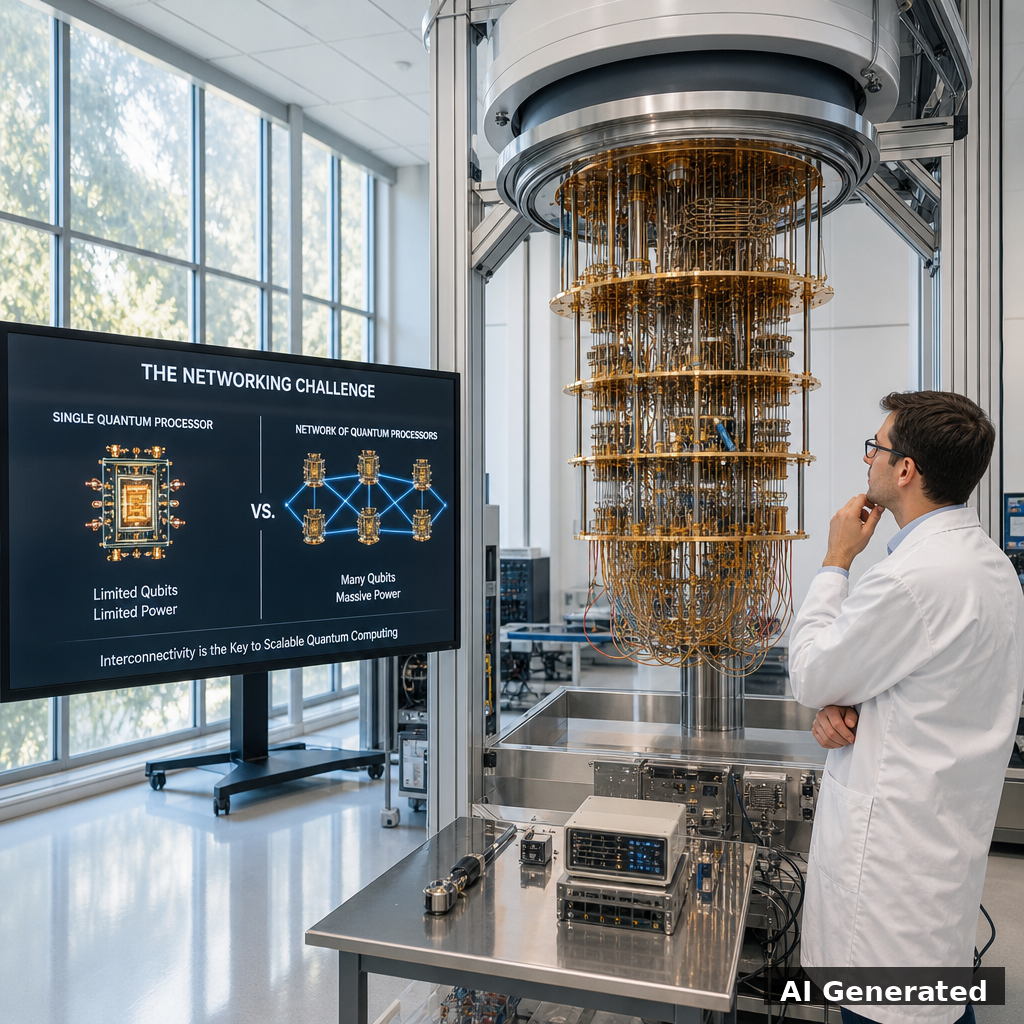
Here’s the uncomfortable truth about quantum computers that rarely makes headlines: a single one tops out. Today’s machines hold a few hundred to a few thousand qubits, and scaling them much further inside one device is brutally hard — limited by interference, cross-talk, overheating, and the sheer difficulty of controlling quantum systems [4].
IBM is blunt about this. To run truly useful computations, you need to scale to far more qubits than any single processor can hold — and the only realistic path is distributed quantum computing: connecting many processors so they act as one larger machine [3].
But there’s a catch that makes this fundamentally different from networking ordinary computers.
Classical computers can copy and forward data. A router reads a packet and resends it. That’s how the internet works. Quantum computers cannot do this. The no-cloning theorem — a hard law of physics — forbids copying an unknown quantum state. If you try to transmit a qubit directly down a cable and it gets damaged or lost, the information is destroyed forever [4].
So how do you connect quantum computers at all? The answer is entanglement — the mysterious link Einstein called “spooky action at a distance.” When two particles are entangled, measuring one instantly determines the state of the other, no matter how far apart they are. Entanglement lets quantum computers share quantum states without ever converting them to ordinary binary data — which would destroy the quantum advantage [1][4].
In other words: the only way to network quantum computers is through entanglement. And until recently, keeping that fragile entanglement alive outside a pristine lab was a near-impossible barrier [2][4].
The step taken: 62 km through the worst fiber on Earth
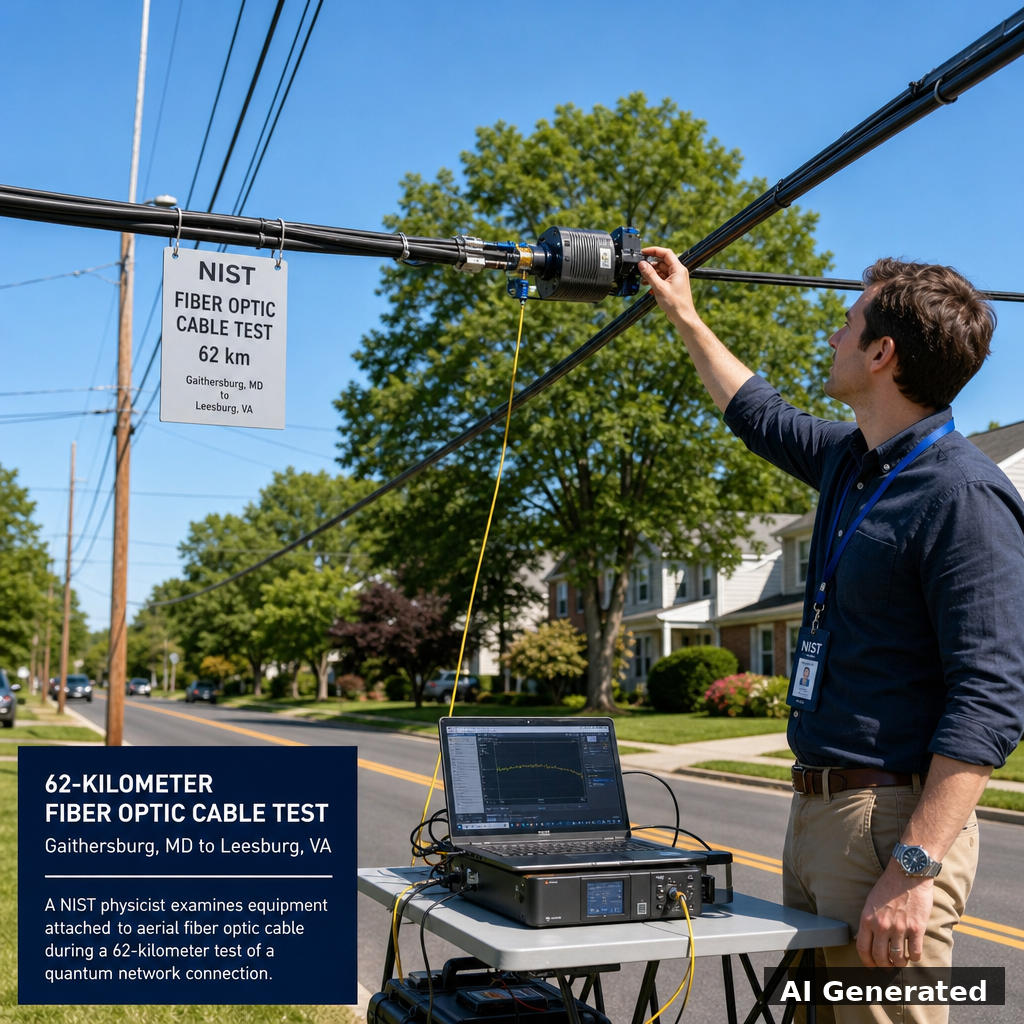
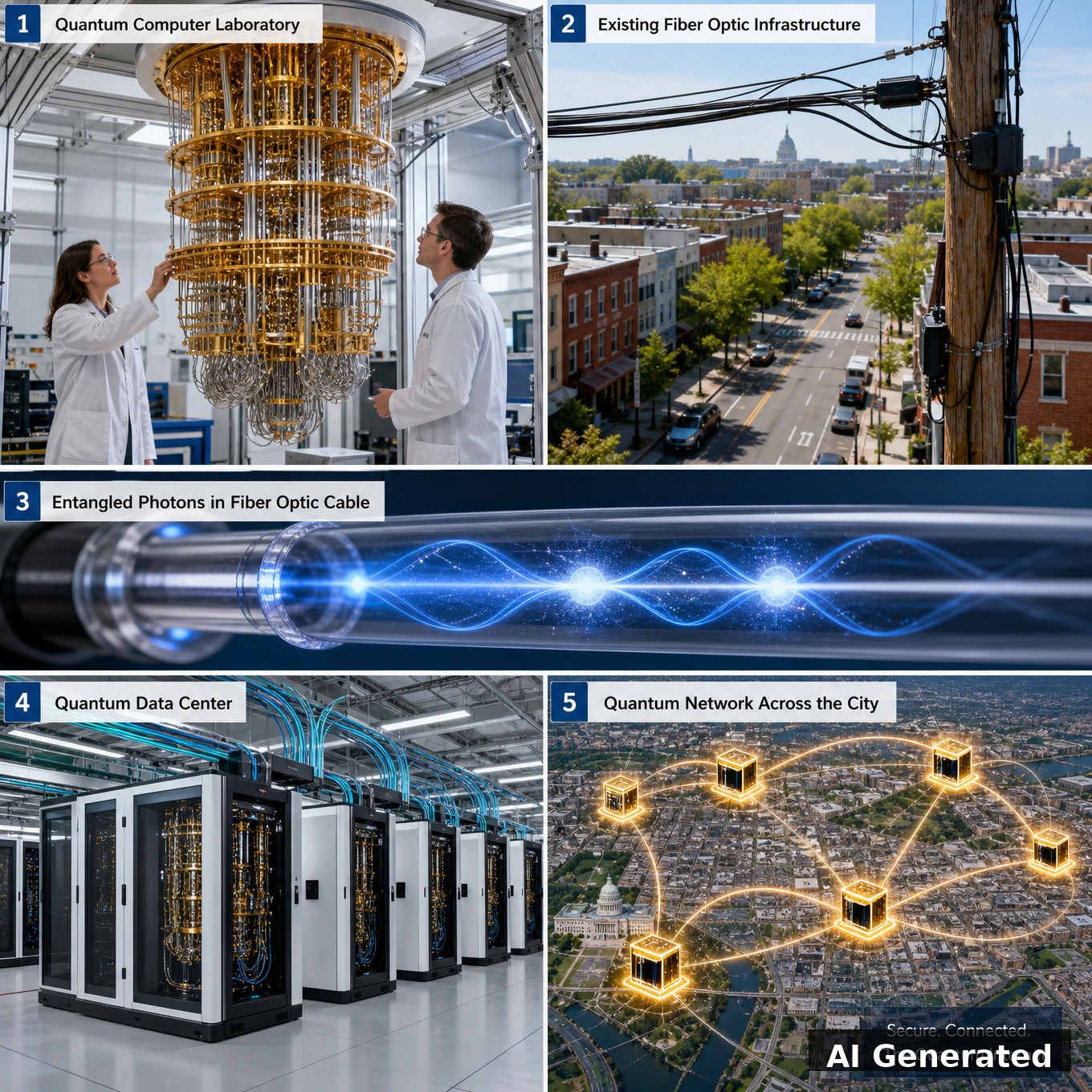
That’s what makes the new NIST result significant. A team from NIST, the Joint Quantum Institute (a NIST–University of Maryland partnership), and the company Qunnect transmitted entangled photons across 62 kilometers (about 38.5 miles) of existing commercial fiber — most of it strung above ground on street-side poles [1][2].
This wasn’t a friendly test environment. The cable expanded and contracted with temperature swings, swayed in the wind, and vibrated with traffic and birds landing on it. “It’s about as bad a connection as you can possibly have,” said NIST physicist Oliver Slattery [1][2].
Why does that matter? Entanglement is usually encoded in the polarization of photons — the direction their electric field vibrates. When a fiber twists and distorts, it scrambles that polarization and can destroy the entanglement. Ordinary internet data shrugs this off; quantum data cannot [1].
The team’s fix was elegant. They sent a reference laser through the same fiber, measured how much it got twisted, and applied the exact inverse correction to the entangled photons in real time. The result: stable quantum transmission 92.8% of the time over a 24-hour period, at a rate of roughly 1,500 entangled photons per second [1][2].
Lead author Yicheng Shi called it “a stress test of quantum networking systems” — and it passed [1][2].
The significance isn’t the distance. It’s the proof that quantum networking can run on the existing fiber infrastructure — the same cables already carrying your internet — even in the harshest, most exposed conditions. Nobody wants to build an entirely new fiber network just for quantum. This suggests we may not have to [1][2].
The next Himalaya: the quantum transducer
So is the barrier conquered? Not yet. One major engineering challenge remains — and it’s worth being honest about it.
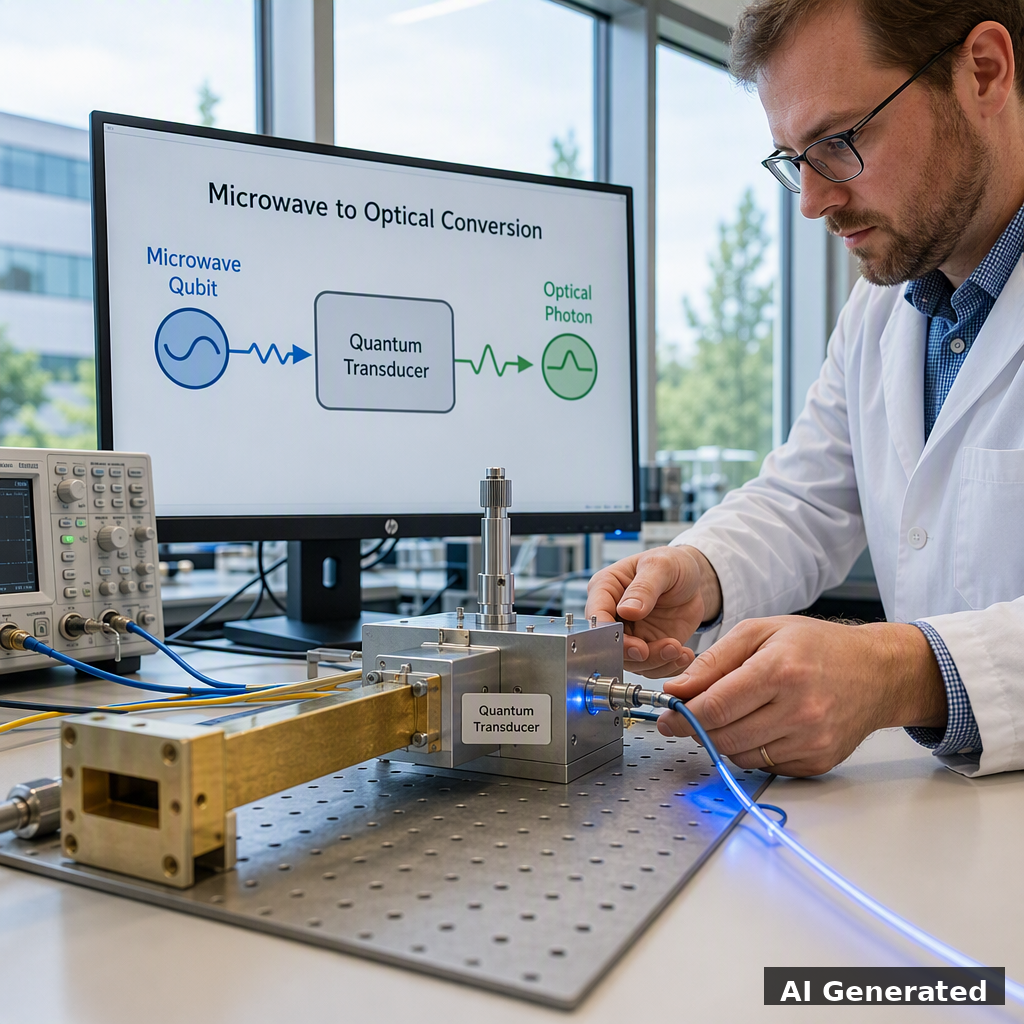
The NIST experiment used a photonic entanglement source: the entangled photons were already light, so they could travel the fiber directly. But the quantum computers you’ll find in a real data center — the superconducting machines from IBM and others — don’t run on light. They run on microwave qubits, inside cryogenic refrigerators at near-absolute-zero.
To connect those computers over fiber, you need a quantum transducer — a device that converts a quantum state from microwave to optical and back, without destroying the quantum information. This is a quantum-to-quantum translation, not a binary conversion. It’s the connector that lets a superconducting quantum computer “plug in” to the fiber network [4].
Researchers call this the main limitation in using fiber to connect superconducting nodes [4]. IBM and Cisco announced a partnership specifically to build these kilometer-scale couplers and transducers — and IBM describes them as “the most challenging to realize” [3].
So the honest picture is this: the entanglement distribution over fiber is proven. The device that lets today’s quantum computers reach that fiber is still being engineered.
The payoff: quantum data centers talking to each other
This is where the leap becomes worth it.
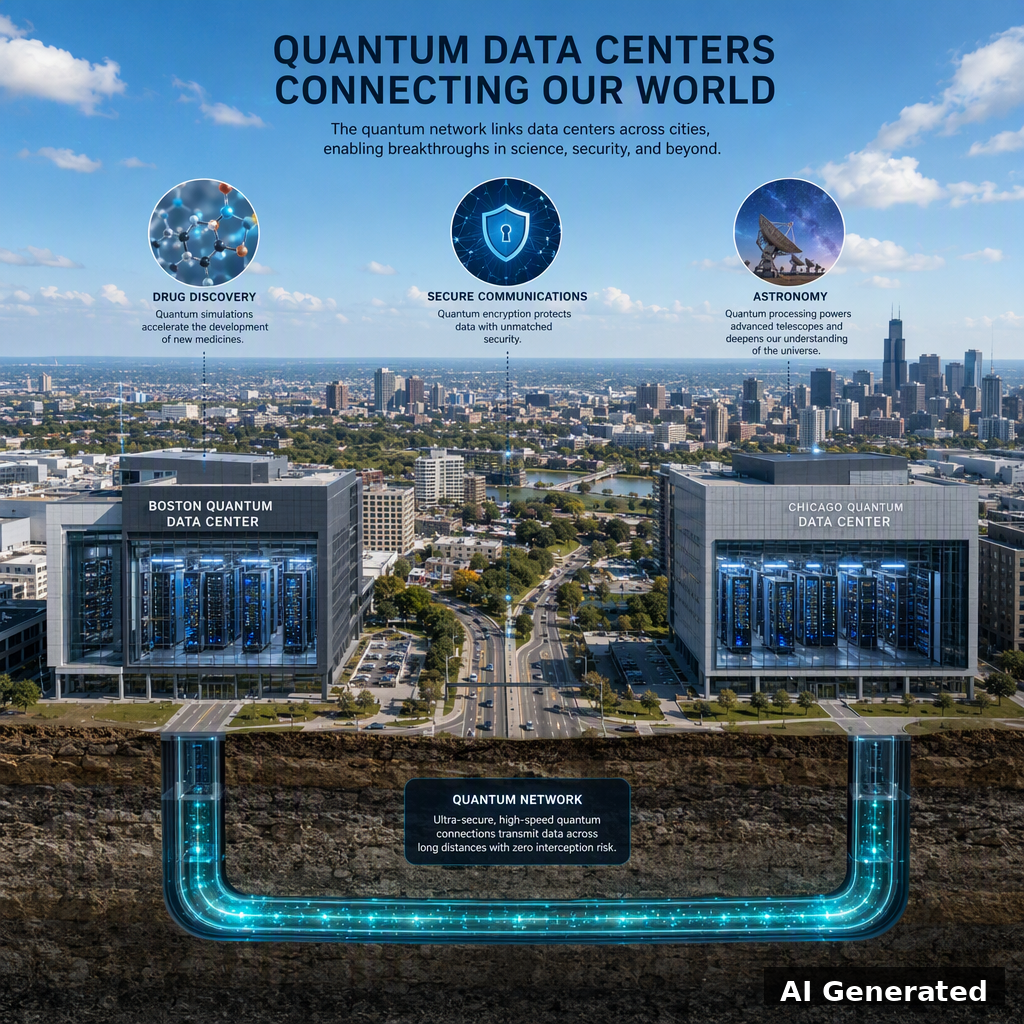
Once quantum computers can be networked over fiber, the vision unfolds in stages. Researchers at the University of Naples lay it out clearly: first, multi-core machines; then quantum data centers — many quantum computers in one facility, connected by a quantum local-area network; then quantum hubs — multiple data centers networked together; and ultimately a true quantum internet [4].
The payoff is exponential, not linear. In classical computing, connecting more machines adds power roughly linearly. In the quantum domain, thanks to entanglement, computational power can scale exponentially with the number of interconnected processors [4]. A network of quantum computers isn’t just a bigger computer — it’s a qualitatively more powerful one.
This would let researchers simulate new drugs and materials at a scale no single machine could reach [1]. It could connect distributed quantum sensors — telescopes thousands of kilometers apart acting as one giant instrument, or networks of sensors listening for subtle seismic signals [1][3]. And it lays the groundwork for ultrasecure communications where any attempt to intercept the data would be instantly detected [1].
The takeaway
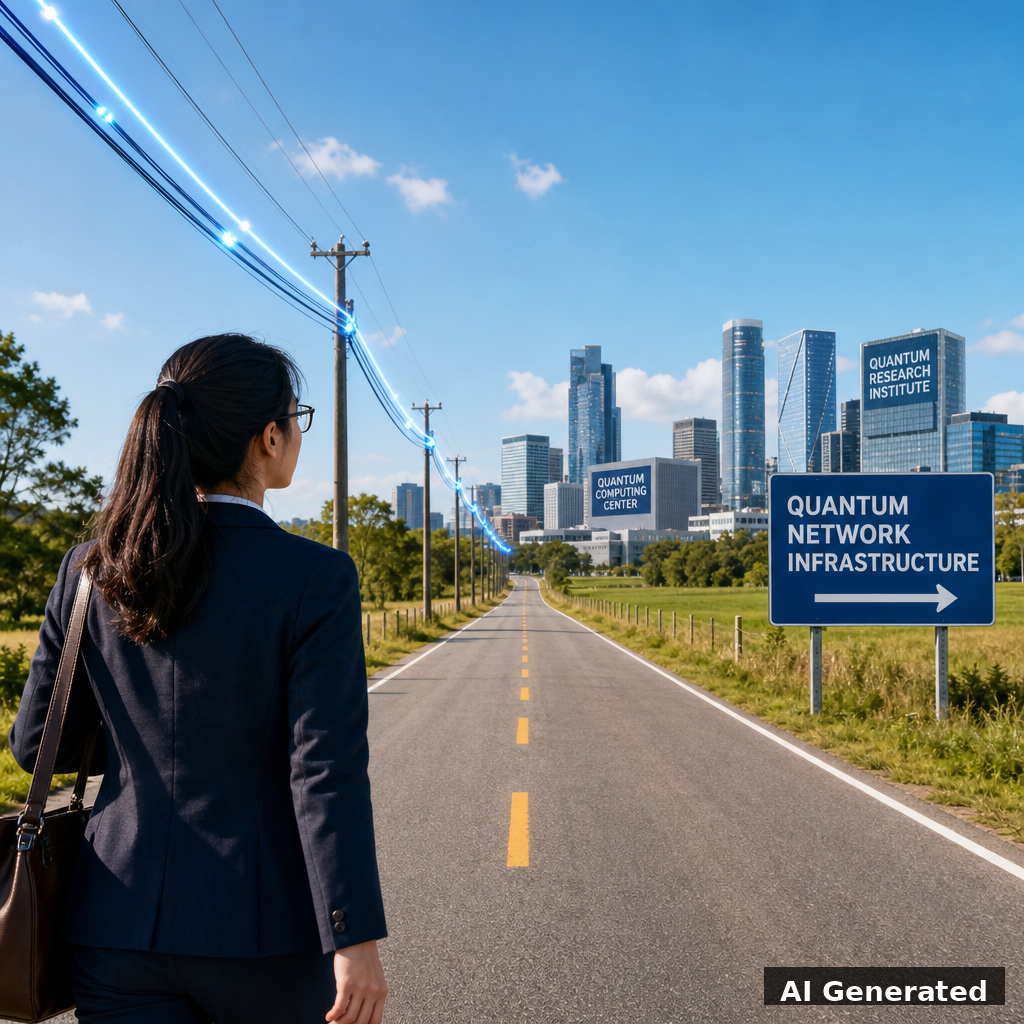
The quantum-computing story has been told as a race for more qubits. But the real breakthrough may not be a bigger machine — it’s many machines learning to speak the same quantum language over the fiber we already have.
The NIST result is a genuine step: it proves quantum networking can survive the real world. The transducer is the next mountain to climb. But the destination — quantum data centers, running on quantum processors, communicating directly with each other over a network of fiber optics — is no longer science fiction.
It’s an engineering problem with a clear path. And that’s the leap worth paying attention to.
References
[1] National Institute of Standards and Technology. (2026). ‘Spooky’ Particles Transit DC Suburbs, a Step Toward a Quantum Network. NIST. https://www.nist.gov/news-events/news/2026/08/spooky-particles-transit-dc-suburbs-step-toward-quantum-network
[2] Shi, Y., Su, J., Rahmouni, A., Shrestha, P., Merzouki, M., Bello Portmann, G., Lazenby, A., Flament, M., Namazi, M., Battou, A., Slattery, O., & Gerrits, T. (2026). Entanglement Distribution Over a Polarization-Stabilized Aerial Fiber. Journal of Optical Communications and Networking. https://doi.org/10.1364/JOCN.592521
[3] IBM Quantum. (2025). Scaling beyond our roadmap with networked quantum computers. IBM Quantum Blog. https://www.ibm.com/quantum/blog/networked-quantum-computers
[4] Pellitteri, C., Illiano, J., d’Avossa, L., Mazza, F., Chen, S., Caleffi, M., & Cacciapuoti, A. S. (2026). Quantum Data Centers: Why Entanglement Changes Everything. arXiv (arXiv:2506.02920). https://arxiv.org/html/2506.02920v1
[5] Nu Quantum & National Quantum Computing Centre. (2024). Project IDRA: A pioneering optically connected, multi-node distributed quantum computing system. Nu Quantum. https://www.nu-quantum.com/news/nu-quantum-s-platform-for-networking-quantum-computers-hosted-at-the-uk-s-national-quantum-computing-centre
[6] Hoyem, G. (2026). Why I joined Qunnect’s board — and what everyone gets wrong about quantum networks. Substack. https://hoyemgeorge.substack.com/p/why-i-joined-qunnects-board-and-what
AI Disclosure: This post was created with the assistance of artificial intelligence. The ideas, analysis, and opinions expressed are my own — AI was used to help compose, structure, and refine my personal notes and thoughts into the final written content. Images and video featured in this post were also generated using AI tools, based on my own creative prompts and direction.
