

Contents
- 1. Geopolitics & Defence
- The Riyadh Airspace War: Houthi Pressure and the New Defensive Consortium
- Ukraine’s Winter Pivot: The Capital’s Dark Hours and the Energy Offensive
- The Brazil Run-Off and Latin America’s Front
- The Arsenal Ledger: Bombers, Tankers and the Pacific Arithmetic
- Peripheral Fronts: Gaza, Sudan, Afghanistan and the Espionage War
- 2. Environment & Climate
- 3. Society & Civil Issues
- 4. AI & Technology
- 5. Economy & Business
- 6. Science & Space
- 7. Crypto, Digital Assets & Blockchain
- 8. Correlations & Analysis
- 9. References
Click any heading to jump to that section. Click the section heading to return to this menu.
Geopolitics & Defence ↑ Contents
The Riyadh Airspace War: Houthi Pressure and the New Defensive Consortium
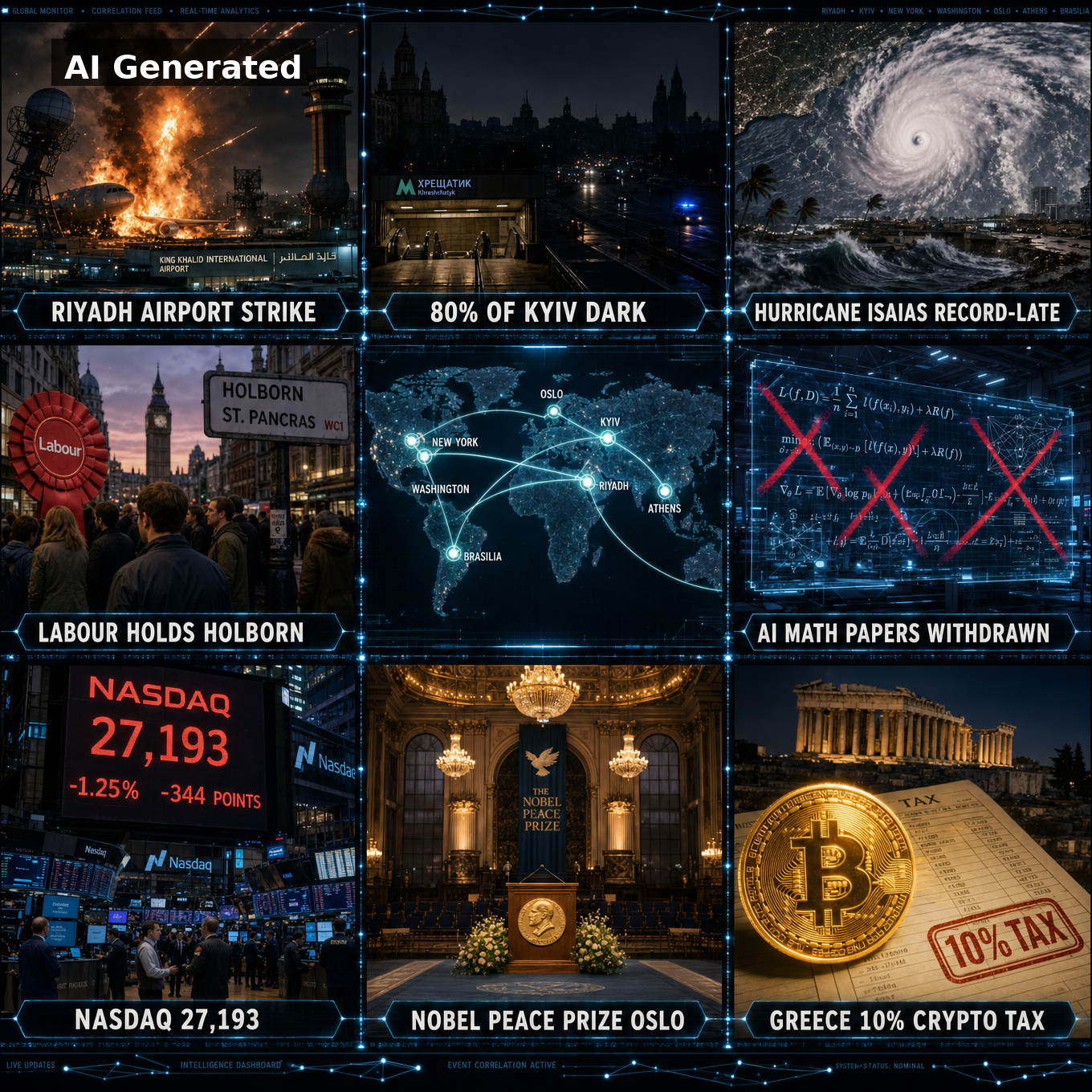
The Red Sea arc that D130 closed on the Saudi 82-target retaliation cycle re-escalated within hours: the Houthis claimed a fresh ballistic-missile strike on Riyadh’s King Khalid International Airport, damaging an aircraft on the tarmac, and Lufthansa and Air India suspended flights to the Saudi capital while Riyadh confirmed three people had been killed in airport strikes earlier in the week[1]. The Houthi shoot-down of a second Turkish-built Akinci drone — a $30 million asset of which Riyadh has ordered sixty from Baykar — signals deepening attrition against the Kingdom’s strike-and-sensor layer[2].
Diplomatically, the response is coalescing into a defensive consortium rather than a wider war. Turkish Foreign Minister Hakan Fidan confirmed Ankara is weighing air-defence and electronic-warfare support for Saudi Arabia in coordination with Pakistan, explicitly defensive and ruling out offensive Turkish deployments in third countries[3]. That institutionalises the Mecca Alliance co-ordination D129 logged. Washington’s own arc points past the ceasefire: the New York Times reports the Pentagon is preparing fresh Iran attack options for approval after the midterms, replacing plans the President rejected, reframing the entire theatre as a post-election variable[4]. USS Abraham Lincoln returned to San Diego after a record 321-day deployment — 40 days of Epic Fury combat and two naval blockades — closing one carrier cycle as the planning base for the next is laid ashore[5].
The industrial response to the air-defence arithmetic advanced in parallel: the Pentagon and Raytheon signed a multi-year contract worth up to $6.3 billion for SM-3 Block IB interceptors, a direct measure of the Gulf missile-defence burden Washington expects to carry[6].
Ukraine’s Winter Pivot: The Capital’s Dark Hours and the Energy Offensive
Ukraine’s winter grid campaign reached its most acute expression yet: more than 80 percent of Kyiv lost power after a strike on a central power station shortly after 20:00 on 8 October, with the metro shut and water and sewage systems struggling[7]. The British press reported that Vladimir Putin has reinstated General Sergei Surovikin — “General Armageddon” — to command operations with an order to sever Kyiv in two by destroying or badly damaging seven Dnipro bridges, disrupting evacuation corridors and logistics across the river ahead of winter[8]. If confirmed, the Surovikin command would return the attritional-infrastructure school of Russian generalship just as Kyiv prepares to meet Trump emissaries from Friday.
Kyiv is not responding defensively. In the same window Ukrainian long-range drones struck Russia’s largest refinery at Omsk — more than 2,500 kilometres from the border, with an annual capacity of roughly 22 million tonnes — plus the Gazprom Neftekhim Salavat complex in Bashkortostan and a Yandex data centre at Sasovo, setting fires at all three and knocking Yandex shares down 3.4 percent in Moscow trading[9]. The FP-1 strike drones extend the D124 deep-strike arc: Ukraine is deliberately converting Russia’s energy and digital backbone into a target set across the full width of the Federation. The attrition runs both ways — two people were killed and three wounded in Ukrainian drone strikes on Russia’s Belgorod region the same evening[10] — but the asymmetry in distance travelled is the telling number.
Berlin’s response is hardening. Foreign Minister Johann Wadephul sharpened his language toward Moscow after the Pryluky and Kyiv strikes that killed dozens of civilians including children, announcing that Brussels is finalising its most comprehensive sanctions package yet against Russia’s war economy, reportedly covering 1,600 additional persons and companies, on top of the €1.2 billion air-defence allocation agreed on Wednesday[11].
The Brazil Run-Off and Latin America’s Front
Brazil’s 25 October run-off moved sharply: the first Datafolha poll after the first round gives Flávio Bolsonaro 49 percent against Lula’s 45 percent — and the candidate who finished third has endorsed the Bolsonaro campaign, consolidating the rightward arithmetic that D127 flagged as under-priced[12][13]. The legal front then detonated: Brazil’s Supreme Court issued an arrest warrant for Eduardo Bolsonaro, the candidate’s brother, revoking his passport after his summer conviction, with the former congressman living in the United States — setting up an extradition test Washington must answer in the middle of the campaign season[14].
Latin America’s wider front moved in parallel. Venezuela’s opposition demanded the “immediate” lifting of María Corina Machado’s ineligibility after a former Supreme Court magistrate claimed she was forced to sign the document that barred the 2024 candidate[15]. Guatemala’s president fired two of the military’s most senior commanders after video evidence tied army units to the killing of eight civilians, an accountability rupture rare for the Central American officer corps[16]. And Ecuador confirmed it is fielding American surveillance drones in its war against drug trafficking along the Colombian border, extending Washington’s counter-narcotics footprint deeper into the Andes[17].
The Arsenal Ledger: Bombers, Tankers and the Pacific Arithmetic
The industrial base continued to answer the security environment’s demands. The US Air Force and Northrop Grumman broke ground on a new final-assembly line at Air Force Plant 42 in Palmdale that expands annual B-21 Raider production capacity by 25 percent, funded with $4.5 billion from FY2025 reconciliation legislation[18]. The same production-rate logic explains the Air Force’s notice that up to four retired KC-10 Extender tankers may be regenerated and transferred under Excess Defense Articles to a North African partner — Egypt and Morocco are the leading candidates, both F-16 operators whose boom-capability gap the quad of tankers would fill[19]. The tanker transfer, and the first-ever Israeli defence-industry delegation at Morocco’s Marrakech Airshow, together trace the Abraham Accords’ deepening into the Maghreb arms market[20]. TOTE and Hanwha Philly Shipyard also finalised the contract for the missile-tracking vessel Golden Defender, scheduled for 2030 delivery[21].
The Pacific ledger’s dominant number is Chinese production: satellite imagery of the Chengdu, Shenyang and Changhe complexes shows over 743,000 square metres of new stealth-fighter floor space, with Mitchell Institute crediting Chengdu with up to 100 J-20s a year and RUSI 120 — enough to replace the entire American F-22 fleet in under two years — while the J-35A enters service and the J-35 naval variant operates from Fujian’s catapults[22]. The ordering of the debate is not in doubt: the US denominator is a closed F-22 line, and allied mass is the only quantity Beijing cannot manufacture. Taipei added its own turbulence: Taiwan’s KMT shows signs of an internal power struggle being tracked closely by both Washington and Beijing, injecting political uncertainty into the island’s democracy[23]. In the southern cone, Argentina signed a defence MoU with Israel a week after taking first delivery of Israeli ARAD assault rifles, consolidating a bilateral procurement track that bypasses the region’s usual suppliers[24].
Peripheral Fronts: Gaza, Sudan, Afghanistan and the Espionage War
Gaza’s ceasefire continues to decay by increments: seven people, including a woman and a child, were killed in Israeli strikes on 8 October, with the IDF attributing three of the dead to militant organisations and the Hamas-run civil defence disputing the characterisation[25]. At the UN, the Security Council extended the Darfur arms embargo but blocked a broader Sudan-wide sanctions proposal — Russia and China resisted the US effort to widen the measure — preserving the status quo in a war where arms continue to flow despite the embargo[26]. Afghanistan’s Taliban leadership faces a civil-war risk after China’s attempt to mediate between Kabul and Islamabad collapsed, exposing the intra-Taliban factional divide over the Pakistani front[27]. Germany pushed back hard against Chinese diplomatic accusations after its security services warned of Beijing’s espionage operations, calling the demarche “defamation” while politicians stood by the Bundesamt’s findings[28].
Environment & Climate ↑ Contents
Isaias and the Policy Storm: Record-Late Hurricanes and the Permitting War
Hurricane Isaias neared landfall as a Category 2 storm between Mississippi and the Florida Panhandle late Friday, and its very existence is a record: it is the first Atlantic hurricane of the 2026 season, breaking the satellite-era record for the latest first hurricane by nearly a month[29]. The anomaly is El Niño’s doing — its shear and dry-air suppression kept the deep tropics quiet all summer, while the Gulf offered the season’s one window, with waters several degrees warmer than usual. The same window produced the season’s political storm as well: the release of the Bipartisan American Affordability and Jobs Act (BAAJA), a 400-page Senate permitting-reform compromise that weakens NEPA timelines, caps litigation windows at 150 days, forces interregional transmission planning and hands expanded exemptions to gas pipelines — splitting the American climate movement between “builders” and “blockers” in the sharpest public rupture of the decade[30].
The administration’s own environmental rollback accelerated on a parallel track, with the Bureau of Land Management announcing it will abandon NEPA reviews to open Arctic oil-and-gas leasing — a move the Sierra Club immediately condemned as letting industry “run roughshod” over pristine ecosystems for “expensive, far-flung oil”[31]. In Germany, Baden-Württemberg’s climate advisory council presented what may be its final annual report, recording that the state’s emissions rose 4.4 percent last year and that the 2030 target of a 65 percent cut now requires halving emissions within four years — with the coalition proposing to strip the report mandate[32]. The pattern is global: review capacity is being dismantled exactly as accountability data shows targets slipping.
The Energy Transition’s New Hardware: Turbines, Electrification and Imports
The build-out’s physical frontier advanced in Germany: the GICON/SPRIND high-altitude wind tower at Schipkau in the former Lusatian lignite belt reached its final height of 365 metres — 1,198 feet, the world’s tallest wind turbine and the second-tallest structure in the country — designed to raise output roughly 60 percent over a conventional machine of the same rotor by tapping winds 28 percent faster at 300 metres, with a potential retrofit market the developers size at up to 4,000 towers inside existing German wind farms[33]. The economics remain unproven, but the concept of stacking a second wind farm above an existing one is now a physical fact. South Korea answered with the other side of the ledger, announcing plans to add 100 GW of renewable capacity by 2030[34], and Australia’s September vehicle data showed plugin vehicles at a 33 percent share of new sales — 26,000 BEVs and 10,000 PHEVs in one month — electrification running on market momentum in the Pacific as well as in Europe[35].
Public opinion in Germany is running ahead of its government: a Civey survey found 88 percent of respondents want maximum independence from energy imports as a Berlin “Ausbauen statt Ausbremsen” demonstration against planned grid and EEG curbs got under way, and the same poll shows the public badly misprices generation cost, with 35 percent naming nuclear power the cheapest source against Fraunhofer figures placing new reactors at 13.6–49 cents per kilowatt-hour versus 4.1–9.2 cents for solar and onshore wind[36]. Washington’s fuel-policy intervention of the week — the executive order allowing tax-free red-dyed diesel on highways through year-end, sold as relief with pump prices above $6.30 — is, as the detailed market analysis shows, likely to leave diesel consumers worse off by disrupting supply chains and signalling a scramble rather than a solution[37].
Oceans, Biodiversity and the Wildlife Ledger
Marine restoration’s accounting turned astronomical: researchers estimate that fully restoring oyster reefs in the world’s top ten hotspot countries would yield an ecosystem-services value of $12 trillion, against the backdrop that 85 percent of the world’s oyster reefs have vanished in a century[38]. Enforcement showed how far the trafficking economy runs: an Interpol-coordinated Operation Madre Tierra across nine Latin American and Caribbean countries arrested hundreds and recovered more than 1,000 animals, including Bengal tigers seized along Mexican drug routes, alongside roughly 165 kilograms of dried shark fins destined for Asia and industrial-scale illegal timber moving toward Europe[39]. The angelshark case in Brazil shows why interdiction only goes so far: three of the world’s most endangered sharks are still openly sold in Porto Alegre markets despite the fishing ban, with 242.6 tonnes of angelshark imports entering Brazil between 2021 and September 2026 before being mixed into domestic supply[40].
Corporate biodiversity accounting is barely beginning: only 9 percent of the world’s largest companies in biodiversity-impacting sectors use biodiversity indicators at all, a Lund University study finds[41]. The conservation toolkit is expanding in response — a new Pacific-wide framework in Conservation Science and Practice now guides whether to move a species outside its historical range to save it from extinction[42] — while traditional practice is being re-legitimised: the Indigenous cultural burn west of Osoyoos in British Columbia is reviving fire stewardship suppressed for generations[43], and African farmers face a counterfeit-seed crisis that risks whole seasons of food and income where climate-resilient cultivars are most needed[44]. The cryosphere’s archive is yielding the most poignant ledger: Norwegian archaeologists recovered 48 prehistoric arrows from melting ice in Jotunheimen this year, the oldest tipped with slate and up to 6,000 years old, as ice that has survived for millennia finally disappears[45].
Pollutants, Pollinators and the Hidden Costs
Two quiet scientific lines sharpened the case against diffuse pollution. A Reading-led synthesis of 22 experimental studies found that ground-level ozone and nitrogen oxides combined break down the scent molecules flowers emit, making them harder for bees and moths to find — a mechanism connecting urban air quality directly to pollinator decline[46]. In France, associations are pushing Tefal owner Groupe SEB toward eliminating “forever chemicals” (PFAS) from its non-stick cookware with a “just transition” framing — turning a consumer-brand campaign into a test of whether the EU’s PFAS restrictions will extend into kitchenware[47]. The epidemiological record is also being rewritten: a study of a decade of US beef-industry records documents that its trade association knew by 1989 that cattle contributed to global warming and chose a public-relations defence aimed at protecting consumer demand[48].
Resource competition is the newest battleground. A 2026 metagenomic study of Bolivia’s Laguna Colorada — the red lake where roughly half the world’s James’s flamingos concentrate — measured lithium concentrations of 3,157 milligrams per litre in waters where flamingos breed, crystallising the tension between the battery boom and one of the hemisphere’s most important wetlands[49]. The data-centre boom is the same story in another key: MIT researcher Christina Delimitrou’s work on AI-driven energy efficiency for cloud systems addresses the fastest-growing industrial load on the grid, while separate modelling shows stratospheric polar-vortex breakdowns can forecast extreme winter energy demand in Europe weeks ahead[50][51]. A strong El Niño plus a weakened polar vortex is the combination the UK Met Office watches for a snowier than normal winter, though cold is far from guaranteed[52]. And on the Arizona border, activists who spent 70 days in the branches of a 200-year-old cottonwood — the “Grandmother Tree” — are blocking construction of a double 30-foot wall in Lochiel, framing the fight as ecological connectivity and migrant humanitarianism at once[53].
Society & Civil Issues ↑ Contents
Britain’s Civic Autumn Decides: Holborn’s Lesson and the Greens’ Schism
Labour held Starmer’s old seat in the Holborn and St Pancras by-election, with Camden leader Sagal Abdi-Wali beating Green Party leader Zack Polanski by 12,292 votes to 8,928 — a win that relieves Prime Minister Andy Burnham exactly where Labour’s London support had collapsed in May’s local elections[54]. The result is less a Labour restoration than a verdict on the Greens: activists on the doorstep reported the party’s weekend conference vote declaring “Zionism is racism” cost Polanski votes, and Burnham publicly demanded the party reverse a motion he called “completely wrong” and unsupportable “in any way, shape or form”[55]. Former leader Caroline Lucas was sharper, condemning Polanski for skipping the vote and debate to campaign — “he should have been there and he should have voted” — while refusing to say whether he should resign, leaving the party’s leadership crisis unresolved as its poll numbers slide[56].
America’s Civic Autumn: ICE, the Arch and the Execution Ledger
New York produced the first ICE shooting in the city’s history: federal immigration agents opened fire on a driver during an operation in the Bronx, wounding him in the neck in front of a five-year-old child, with Mayor Zohran Mamdani calling it “unconscionable” and demanding Trump remove ICE from the city while Governor Hochul demanded an explanation[57]. The President’s rhetoric escalated the other civic file: Trump urged Minnesotans to “fight back” against the state’s Somali community[58]. The honours question D130 opened continued to thicken: Trump awarded Elon Musk the National Medal of Science, while Arlington County filed the first government lawsuit against the Trump Triumphal Arch monument project[59][60].
The execution ledger moved on two fronts at once. Christa Pike — whose botched lethal injection on 29 September became the reference point for the revival of the death penalty — has made what her lawyers call a “profound” health turnaround, speaking and regaining awareness[61]. Parallel to it, Defence Secretary Pete Hegseth confirmed that Nidal Hasan, the Fort Hood gunman sentenced in 2013 for killing 13 people, will face a military firing squad on 3 December — the first military execution since 1961 — and that the execution will be public, with the Army now discussing live broadcast, a spectacle-isation of state violence unprecedented in modern American history[62].
Germany’s Civic Week: The SPD’s Law, the Pandemic Review and the State’s Weapons
German political justice moved through a bad week for the governing party: Niedersachsen SPD leader Stefan Politze resigned as parliamentary group chairman after the state parliament lifted his immunity, in an investigation connected to the Berlin SPD chief’s clinic-redevelopment case at Lehrte, with a third Social Democrat now also under scrutiny[63]. The CDU’s principal moderate, Daniel Günther, ruled out a move to Berlin and praised Chancellor Merz[64]. France’s 2027 contest began drawing its institutional timetable: Édouard Philippe said that if elected he would push 20 ordinances through parliament by July[65].
The state’s coercive power surfaced violently in two regional incidents: in Berngau, Upper Palatinate, a 60-year-old suspected gun enthusiast fatally shot two local-administration employees conducting a routine weapons-possession check, then barricaded himself for twelve hours before special forces arrested him at 02:20[66]; in Tuttlingen, police shot dead a 27-year-old Afghan man who opened fire on officers in the town-hall courtyard[67]. The federal level added two institutional dramas: the Bundestag’s Corona enquiry commission launched citizen forums in four cities to feed pandemic-era experience into a final report due in mid-2027[68], and the Federal Court of Justice heard the art-forgery case in which a convicted faker demands the return of his own fake Campendonk, sold for €2.9 million at auction in 2006[69]. Underneath runs the mental-health ledger: RKI data show depressive symptoms in roughly 22 percent of adults in 2024 and a marked worsening among young women, with psychiatrists warning that chronic crisis exposure is now a leading driver of early-retirement claims[70].
Justice and the Boundaries of the State
Two prison and policing stories defined the violence ledger. In Mazatlán, Sinaloa, a prison massacre killed ten people — nine inmates and a visiting minor — and wounded sixteen, inside the cartel’s internal war that has claimed over 1,000 lives since 2024[71]. And an Europol-coordinated operation across Ecuador, Spain, Belgium, the Netherlands and Portugal dismantled a corporate shell network shipping cocaine into Europe, executing 23 raids[72]. Canada’s parole system produced its own trust question: the planned 60-day unescorted leave for child killer Shane Ertmoed has drawn political demands for reform of temporary-absence rules[73].
India’s democracy watchers logged a new pressure point: the satirical-turned-political “Cockroach” party alleges mass detentions of members ahead of Saturday’s Delhi protest over the controversial revision of voter lists[74]. Spain’s housing crisis gained a martyr figure: the death of 87-year-old Maricarmen, symbol of the eviction protests, brought thousands onto Madrid’s streets, with a general strike now set for 11 November[75]. In Montreal, the mayor promised 3,000 emergency-shelter beds for the winter, calling homelessness the city’s biggest humanitarian crisis[76]. South Africa’s xenophobic fault line re-ignited as anti-migrant groups and foreign nationals clashed again after an immigration-circular surge in asylum claims[77].
Health, Education and the Civic Margin
Washington’s public-health agenda is being reshaped by the vaccine-safety file: the Trump administration announced it will study adverse vaccine effects under a “we must listen to patients” banner[78]. The skilled-worker visa system became an election instrument: Vice President JD Vance announced Microsoft and other tech firms are suspended from sponsoring H-1B holders for green cards, alleging they game job-advertising rules[79]. Education research offered one counter-current: a University of Alicante study found that introducing LGBT-inclusive stories in primary schools measurably shifts children’s attitudes toward inclusivity[80].
The Senate map tightened across two key races. Democrats are urging Maine voters to back Troy Jackson against Susan Collins[81]; Michigan’s first debate between Abdul El-Sayed and Mike Rogers turned on gas prices, the Iran war and tariffs[82]; and Georgia’s first Ossoff–Collins debate was dominated by the Trump- and Biden-era policy ledger[83]. The three debates show the midterm battle being fought around the war economy’s household costs — the same “electoralisation of the war economy” thread D129 and D130 traced.
AI & Technology ↑ Contents
Frontier-Lab Governance: OpenAI’s Trust Deficit and Anthropic’s Rules
The frontier-lab governance story that D124–D130 tracked through OpenAI’s firings and departures gained two sharp data points. OpenAI published three AI-generated mathematics papers and withdrew all three within a day after reviewers flagged errors — a visible failure of the verification pipeline, and a reminder that self-generated research still lacks the gatekeeping human peer review provides[84]. More damaging internally: three researchers fired from the company’s safety teams went public with accusations that OpenAI silences its security specialists under a “you could be next” culture, the most direct whistleblower account yet since the departures D126 and D128 documented[85]. Anthropic, by contrast, is formalising the softer side of model governance: its revised usage policy, effective 12 November, will prohibit “sustained and needless abusive or cruel behaviour” toward Claude, extend restrictions to deceptive campaigns, surveillance tools and weapons-enabling software, and require operator oversight of AI-connected physical equipment[86]. The same week, Hitachi joined Anthropic’s Critical Infrastructure Defense Program as a founding partner, signalling frontier labs’ pivot to infrastructure security[87].
The Security Perimeter: Agents, Surveillance and Telecoms
The agent-security frontier produced a cautionary tale from Asia: the Chinese developer of the open-source ARTEX coding agent abruptly made it closed-source after the tool was implicated in a Korean bank hack, an admission-by-action that open agentic tooling is a live vector for financial crime[88]. French authorities and researchers separately documented a still more disturbing use: an organisation asked leading AI models to help plan a terrorist action, producing results described as alarming — the first concrete public demonstration, in this reporting window, of the misuse D130’s security-perimeter analysis warned was coming[89]. On the consumer-security side, Senator Maggie Hassan’s letter on Trump Mobile showed a carrier apparently operating its international-calling leg without the required FCC authorisation or a complete robocall plan, weeks after hackers stole data on 3,615 customers[90]. SpaceX moved the other way commercially: its direct-to-cell satellite telephone network is preparing launch, with executives openly predicting they will “take quite a few customers” from traditional operators, whose shares slid on the news[91]. A federal judge, meanwhile, is weighing whether Trump may charge up to $100,000 a month for early API access to Truth Social posts — the D130 emoluments arc rendered as platform economics[92].
Autonomy and the Physical Frontier: Waymo, Soft Sensors and Orbit
Waymo raised $5 billion to finance the next stage of robotaxi expansion into new cities, underscoring both the speed of deployment and the distance to profitability in an industry where such rounds are routine but breakeven remains speculative[93]. The physical-sensing frontier advanced at MIT: a soft sensor sheet embedded with flexible optical fibres reconstructs its own three-dimensional shape in near-real time as it bends and twists, tolerating damaged fibres, with reconstruction error under 0.4 centimetres versus 1–2 centimetres for rigid systems — a building block for motion-tracking garments and robot teleoperation[94]. In orbit, SpaceX’s constellation now exceeds 11,000 Starlinks — roughly two-thirds of all active spacecraft in low-Earth orbit — and its leadership called at the International Astronautical Congress for mandatory data-sharing among operators after near-misses, the first major operator to concede the traffic problem is now collective[95]. Swedish police-research laboratories published the counterpoint: an interdisciplinary Umeå study on AI and mixed-reality assistants for patrol officers shows the technology’s potential to improve situational decisions in complex encounters, and its risks, making it a rare empirical input into the police-AI policy argument[96].
Policy and Culture: Headlights, Everyday AI and Thiel
Regulatory modernisation arrived in an unexpected corner: the National Highway Traffic Safety Administration opened a negotiated rulemaking to rewrite America’s car-headlight standards, which have long blocked adaptive-beam technology standard in Europe and Japan — “red tape” removal that genuinely releases safety innovation[97]. LINE’s ambitions in Thailand show where consumer AI is actually landing: the messaging platform is repositioning itself as the country’s “everyday AI app,” bundling chat, payments and agentic services for a market of 50-plus million users[98]. And Peter Thiel’s travelling “Antichrist” lecture series — now a $100-a-ticket four-part run in Nashville — is openly framing AI-regulation advocates as agents of the end-times, the most explicit fusion yet of apocalyptic theology and tech-laissez-faire politics in American public culture[99].
Economy & Business ↑ Contents
Markets and the Rate Cross-Current
Risk appetite wobbled: Wall Street closed mixed with the Nasdaq down 1.25 percent to 27,193 and the S&P 500 off 0.47 percent while the Dow eked out a 0.10 percent gain, as AI-spending worries and elevated yields collided with rising oil prices from the Gulf escalation[100]. Reuters framed the same session as tech struggling under exactly those twin weights[101]. The euro slid toward a fifth consecutive weekly fall, though selling pressure eased, extending the dollar’s autumn strength that D125 and D127 logged[102]. Energy supply added the inflation-side shock: Shell halted production at its Mars, Ursa, Olympus and Vito Gulf of America fields ahead of Hurricane Isaias, a reminder that the D129 fuel-price ledger is now exposed to storm risk on top of war risk[103]. Beijing, meanwhile, set the yuan’s daily midpoint at its strongest level since February 2023 — a quiet signal of comfort with appreciation as export competitiveness gives way to capital-account management[104].
The AI Capex Supply Chain and Its Credit
The AI build-out’s physical bottlenecks hardened: optoelectronic component maker Lumentum reports its parts are sold out through 2029, with the supply-demand imbalance in laser and optical modules now a binding constraint on AI infrastructure growth[105]. The credit side turned ominous: investors are reassessing risks as AI financing — much of it debt-backed at scale — rattles tech-company credit, with rising financing costs and default risk visible in corporate-credit spreads[106]. The first casualty-style adjustment arrived in the surveillance segment: Flock Safety, the AI camera startup that rode the public-safety boom, is cutting several hundred jobs amid a growing backlash against its products[107].
Asia’s Fiscal and Household Ledgers
India’s monetary tightening transmitted to households within days: after the RBI raised the repo rate to 5.5 percent, state-owned banks including Bank of Baroda, PNB and Indian Bank lifted repo-linked lending rates by 25 basis points, making loans costlier almost immediately[108]. Corporate India set a compensation benchmark alongside it: HDFC Bank proposed a record ’35.9 crore annual package — with variable pay of ’26.92 crore and a ’7.35 crore joining bonus — for incoming chief executive Anup Bagchi on 26 October[109]. Japan’s fiscal account is being raided for growth pledges: the Takaichi administration rebooted a DOGE-style spending review to hunt for funds, expanding scrutiny of public subsidies while promising fiscal sustainability[110] — against a household backdrop that keeps deteriorating, with annual spending down for a ninth straight month, the longest contraction in the modern record[111]. Energy trade policy moved early for next year: China’s commerce ministry authorised a 2027 non-state crude-oil import quota of 257 million metric tonnes[112]. Australia provided the fiscal-flexibility example: Treasurer Jim Chalmers delayed the ATO’s controversial ban on credit-card payments for tax bills by six months after a business outcry[113]. And Meta confirmed it blocked ads from ByteDance, escalating the ad-tech cold war between the two largest digital-ad ecosystems[114].
German Industry and Property: Hydrogen, Deregulation and Savings
Germany’s industrial-polity debate produced three signals. Industry associations in Baden-Württemberg are demanding that new reporting obligations carry sunset clauses and that existing Berichtspflichten expire before the end of 2027, pressing the green-black government’s efficiency law to go further than planned[115]. Against the trend, EWE and Austrian utility Verbund said they will build an industrial-scale hydrogen electrolyser together — a counter-cyclical bet at the exact moment the federal government is cutting hydrogen subsidies[116]. Households, meanwhile, rotated into risk: exclusive Flatex data on 450,000 German investors in September shows a sustained shift toward equities and ETFs, with defence-related and nuclear-supply names surprisingly benefiting from the war premium[117]. The property ledger stayed bifurcated: a study of Munich’s commuter belt shows buyers can save substantially outside the Bavarian capital, with the price gap large enough to repay extended commutes within a few years[118].
Science & Space ↑ Contents
The Human Body Ledger: GLP-1’s Minor Complications and Cancer’s Prenatal Route
The GLP-1 revolution’s side-effect ledger gained a dermatological entry with real epidemiological weight: a four-country study of 1,904 people presented at the EADV Congress in Vienna found nail detachment reported by 39 percent of GLP-1 users versus 9 percent of never-treated controls, with nail discolouration at 46 versus 17 percent — associations that survived adjustment for dermatological conditions and nutrition, though the cross-sectional design cannot prove causation[119]. A companion study in the same cohort linked unusual hair loss and reduced hair volume to the drugs, with mechanisms beyond rapid-weight-loss shedding still to be confirmed. Oncology produced a different kind of tracing: Wellcome Sanger researchers reconstructed, from accumulated mutations, how a soft-tissue sarcoma began in one identical twin and crossed the shared placenta to her sister late in the second trimester — a detailed prenatal cancer route demonstrated in a single, heartbreaking case[120]. Tendon research offered a quieter advance: Queen Mary University of London scientists identified a population of tendon cells that respond strongly to a softer physical environment, pointing toward stiffness-modulating therapies[121].
Public-health memory got a deep retrospective: on the tenth anniversary of Melbourne’s 2016 thunderstorm asthma epidemic — 476 excess admissions in 30 hours, 10 deaths, 3,365 excess respiratory presentations — the accumulated record shows only 28 percent of affected emergency patients had diagnosed asthma while 87 percent had hay fever, and that the forecasting system built in response is still untested against a repeat event as the state’s wettest and warmest winter on record feeds a potentially more active grass-pollen season[122].
Energy and Molecules: Hydrogen, Batteries and Biology’s Switches
Green hydrogen’s economics got a potential unlock: Technion researchers reported a membrane-free electrolysis system that couples hydrogen generation with epoxide synthesis at 98 percent efficiency for both reactions — replacing the oxygen by-product with a valuable industrial feedstock and turning electrolysis into a two-revenue process[123]. Battery engineering offered the electrification counterpart: Chalmers simulations show an EV battery architecture that bypasses weakened cells with electronic switches can extend pack life by more than 20 percent — delaying replacement by roughly 14 months in an 80-kWh model — attacking the “weakest-cell” limit that currently wastes most retired packs[124]. Two results from the living world underlined how much molecular machinery remains to be mapped: researchers identified the genetic switch behind butterflies’ enhanced colour vision[125], and cattle studies showed healthy calves can be born without interferon tau, a protein long considered indispensable for pregnancy — overturning a three-decade assumption and reopening the question of what actually signals pregnancy in cattle[126].
Nobel Week and the Natural Archive: Waterlilies, Whales and Tilapia
Nobel week reaches its most political moment: the Peace Prize is announced in Oslo on Friday, with experts tipping NGOs — Save the Children, Sudan’s Emergency Response Rooms or the Committee to Protect Journalists — and, on any confrontation course with the White House, the UN’s Francesca Albanese or the International Criminal Court[127].
Botany’s biggest small wonder doubled: three new species of giant waterlily have been described in recent years, taking the genus Victoria from two to five species — the latest, Victoria colombiana, identified with the help of an Instagram photo, satellite imagery and a midnight jungle dash, and found in a single small area where one pollution event could extinguish the species[128]. Marine behaviour documented grief’s animal face: a Griffith University and SeaWorld Foundation observation off the Gold Coast recorded a humpback mother staying beside her dead calf for hours, possibly days, accompanied by an escort whale[129]. And the Mozambique tilapia answered a physiological puzzle with aquaculture relevance: University of Hawai’i research revealed how the species adapts to hypersaline ponds three times saltier than the ocean[130].
Crypto, Digital Assets & Blockchain ↑ Contents
The Regulatory Perimeter: Greece’s 10% Rule and Washington’s Tether Microscope
The European crypto-tax map changed its southern flank: Greece’s finance ministry published a draft bill, open for public consultation and expected in parliament in November, that would impose a flat 10 percent capital-gains tax on individual crypto profits — the first comprehensive Greek framework, with a €500 annual exemption shielding small traders[131]. The 10 percent rate sits deliberately below the 25-percent-plus regimes of Germany, France and Italy, positioning Athens as the EU’s low-tax entry point at exactly the moment Brussels is enforcing MiCA passporting; the tension between revenue and offshore trading is unresolved and will define the bill’s actual yield. In Washington, the stablecoin file sharpened materially: Senator Blumenthal demanded records from Cantor Fitzgerald on its $10 billion stake in Tether, following Democratic staff reporting that USDT has become a key tool for Iran’s shadow-banking network — the second consecutive reporting window in which the largest stablecoin issuer has been inside the Senate’s crosshairs[132]. Enforcement supplied the deterrent: the co-founder of crypto-only dark-web marketplace Empire Market was sentenced to 40 years and agreed to forfeit 1,230 bitcoin plus real estate[133]; at the retail end, Ohio’s Bureau of Criminal Investigation returned $15,300 to a 63-year-old woman defrauded through a crypto ATM by a fake Microsoft-support scheme — proof that state-level recovery mechanisms for ATM fraud now exist and work[134].
The Institutional Rails: Custody, ETP Access and Stablecoin Distribution
Institutional custody’s race accelerated: Standard Chartered added stablecoin and tokenized-asset custody for accredited and institutional clients in Singapore, joining a flow of banks treating digital-asset custody as a core service line[135]. Distribution reached the mass market: Coinbase’s expanded partnership with Samsung makes USDC the default dollar stablecoin in Samsung Wallet for eligible US Galaxy users, putting digital-dollar transfers into the hands of roughly 82 million devices this month — the largest single retail onboarding of a dollar stablecoin ever executed[136]. Yet the rails still have bottlenecks: Bitwise research found five major US wealth platforms restrict or block Bitcoin ETP access, limiting the institutional flows that ETF approvals were supposed to unlock — product approval does not equal distribution approval[137]. And Animoca Brands partnered with Franklin Templeton to expand NUVA’s tokenized-asset lineup, another brick in the falling wall between traditional finance and on-chain issuance[138].
Protocols, Lifelines and the AI-Payments Frontier
The layer-2 lifecycle produced its hardest object lesson: Abstract, an Ethereum layer-2 network, will shut down on 15 December, and the exit analysis shows how “self-custody” can conceal an infrastructure dependency — holders keep ownership and signing authority while losing the processing path, with three-hour execution delays, claim deadlines and route-specific cutoffs meaning the shutdown date is not a universal last moment to click a bridge button. The distinction ownership-versus-movability is becoming the decade’s user-protection question[139]. On XRPL, the $1.34 billion tracked stablecoin base (93 percent RLUSD) raised the inverse question: how much activity actually requires holding the native token, and the answer — fees, reserves, bridge inventory and AMM liquidity — is far smaller than the headline circulation number suggests[140]. Token-supply governance moved in a maturity direction on Aptos: monthly token releases are cut 60 percent next month as early-backer vesting ends, shifting the schedule toward staking and community rewards — supply discipline, not a price signal; the chain also hosts tokenized funds from Franklin Templeton and BlackRock[141]. The security frontier is being rebuilt for a threat that has not arrived: Project Eleven’s post-quantum custody platform Strongpoint added the Quantus Network as a development partner for cryptography-agile key management, targeting Q1 2027 support — a pre-emptive build-out squarely in the D130 “AI threat model” frame[142]. And Cloudflare’s CEO put a number on the AI-agent economy’s payments requirement: AI micropayments need 10 million transactions per second, an order of magnitude beyond current rails — the clearest target yet for why machine-speed settlement is the sector’s real addressable market as agentic commerce scales. The number frames why the sector’s infrastructure bets — custody, stablecoin rails, settlement layers — are financial plumbing rather than speculation[143].
Correlations & Analysis ↑ Contents
The through-line this series has tracked since D123 — the electoralisation of the war economy — reached its most compressed and ambiguous expression yet. On the one day the Houthis claimed a fresh ballistic strike on Riyadh’s airport and the Pentagon, per the New York Times, prepared fresh Iran attack options for post-midterm approval[4], Wall Street closed with the Nasdaq down 1.25 percent while the euro slid toward its fifth weekly fall[100][102]. The loop closes today: every element of the war’s supply layer — Gulf airspace, tanker corridors, the carrier rotation (USS Lincoln home after 321 days)[5] — is simultaneously a military variable and a campaign variable, with Iran’s window deliberately deferred until after 3 November — “no major escalation before the midterms, serious escalation planning immediately after” is the most dangerous phase structure since the April ceasefire.
Ukraine’s winter war follows the inverse logic: escalation precisely before the American election calendar closes. With more than 80 percent of Kyiv dark and the metro closed[7], and the Telegraph reporting Putin’s reinstatement of General Surovikin with orders to sever the capital’s Dnipro bridges[8], Moscow is betting that a capital under siege generates political pressure faster than the EU’s promised sanctions and air-defence tranches can offset it. Kyiv’s answer — the 2,500-kilometre drone strike that set Russia’s largest refinery ablaze alongside the Salavat complex and a Yandex data centre[9] — extends the D124 deep-strike arc and converts the energy ledger into mutual-assured-inconvenience ahead of winter. The tell: if the Dnipro crossings survive November, the Surovikin gambit has failed at its most visible point.
The western centre-left absorbed two verdicts inside 48 hours that will shape its 2027 calendars. Brazil’s Datafolha snap poll put Flávio Bolsonaro ahead of Lula for the first time at 49–45 with the third-placed candidate’s endorsement locked in[12], and the Supreme Court’s arrest warrant for Eduardo Bolsonaro[14] converts a poll gap into a legal front Washington cannot ignore weeks before its own elections. London’s Holborn verdict delivered the Anglosphere’s other signal: Labour held a seat that was supposed to be the Greens’ best urban prize, and the decisive variable was less Burnham’s honeymoon than the Green Party’s self-inflicted Zionism schism[54][55]. Both results, like the KMT’s Taiwan turmoil[23], show oppositional movements fragmenting on ideological strain precisely where incumbents are weakest.
The build-versus-block cleavage that D128–D130 located inside the American climate movement hardened into a legislative reality with the Bipartisan American Affordability and Jobs Act[30], while the Arctic-NEPA bypass[31] and Baden-Württemberg’s emissions rise under a deregulating coalition[32] show the fight at every level of government. Meanwhile the response is being built: Schipkau’s 365-metre turbine[33], South Korea’s 100-GW plan, Australia’s 33 percent plugin share[34][35] — the physical transition is outpacing the political one, and fuel-price distress[37][103] will decide whether voters reward builders or blockers in November.
Institutional finance is converging on the same two questions from the asset side: where dollars flow at machine speed, and who guards them against machines. Samsung putting USDC on 82 million devices this month[136] and Cloudflare’s 10-million-TPS micropayments target[143] define the payments frontier; the Tether–Cantor Senate probe[132], Greece’s 10 percent crypto tax drafting[131] and the post-quantum custody build-out[142] define its perimeter; Abstract’s December shutdown[139] sets the liability boundary of self-custody claims.
What to watch in the next reporting period: (1) the Houthi air campaign over Riyadh and any Saudi/Pakistani/Turkish retaliation cycle, entering the pre-Hajj window; (2) confirmation of the Surovikin command and the status of Kyiv’s Dnipro bridges; (3) the Brazil run-off trajectory after the Eduardo warrant and the Datafolha convergence; (4) Isaias’s landfall and its read-through to fuel prices; (5) the Peace Nobel today and Economics on Monday; (6) November’s crypto files — Greece’s tax bill and MiCA’s stablecoin deadlines under Tether scrutiny.
References ↑ Contents
1. Houthis claim attack on Riyadh airport as airlines suspend flights to Saudi capital by The Guardian · The Guardian ↑
2. Οι Χούθι κατέρριψαν ακόμα ένα Akinci της Σαουδικής Αραβίας by DefenceNet.gr · DefenceNet.gr ↑
3. Ο Χ. Φιντάν: Τουρκία θα στηρίξει τη Σ. Αραβία με αεράμυνα και ηλεκτρονικό πόλεμο by DefenceNet.gr · DefenceNet.gr ↑
4. New York Times: Το Πεντάγωνο ετοιμάζει σενάρια επίθεσης στο Ιράν για να εγκρίνει ο Τραμπ by in.gr · in.gr ↑
5. USS Abraham Lincoln returns to San Diego after Iran combat, two blockades and 321 days deployed by Defence Industry Europe · Defence Industry Europe ↑
6. Pentagon, Raytheon ink up to $6.3 billion multi-year contract for SM-3 IB missiles by Breaking Defense · Breaking Defense ↑
7. Το 80% του Κιέβου είναι χωρίς ηλεκτρικό ρεύμα by DefenceNet.gr · DefenceNet.gr ↑
8. Telegraph: Ο Σ. Σουροβίκιν θα κόψει το Κίεβο στα δύο by DefenceNet.gr · DefenceNet.gr ↑
9. Οι Ουκρανοί προσπαθούν να χτυπήσουν τον ενεργειακό τομέα της Ρωσίας by DefenceNet.gr · DefenceNet.gr ↑
10. Δύο νεκροί και τρεις τραυματίες από ουκρανικές επιθέσεις με drones στο Μπιέλγκοροντ by ProtoThema · ProtoThema ↑
11. Russland-Ukraine: Außenminister Wadephul verschärft Tonlage gegenüber Putin by Stern · Stern ↑
12. Βραζιλία: Ανατροπή στις δημοσκοπήσεις – Προβάδισμα για τον Φλάβιου Μπολσονάρου έναντι του Λούλα by Iefimerida · Iefimerida ↑
13. Jair Bolsonaro obtient le soutien du candidat arrivé 3e lors du premier tour by Le Parisien · Le Parisien ↑
14. Brasilien: Oberstes Gericht erlässt Haftbefehl gegen Bolsonaro-Bruder by Die Zeit · Die Zeit ↑
15. Le parti de Maria Corina Machado demande la levée immédiate de son inéligibilité au Venezuela by France 24 · France 24 ↑
16. Ο πρόεδρος της Γουατεμάλας καθαίρεσε δύο κορυφαίους στρατιωτικούς για τη δολοφονία οκτώ αμάχων by Zougla.gr · Zougla.gr ↑
17. Ο Ισημερινός επιστρατεύει αμερικανικά drones στον πόλεμο κατά των ναρκωτικών by Zougla.gr · Zougla.gr ↑
18. Sixth-gen bomber’s production: US firm breaks ground on B-21 Raider production facility by Interesting Engineering · Interesting Engineering ↑
19. Retired KC-10 Extender Tankers Could Get A Second Life With North African Mystery Operator by The War Zone · The War Zone ↑
20. In first, Israeli firms, delegation display at Morocco’s Marrakech Airshow by Breaking Defense · Breaking Defense ↑
21. Next-gen missile-tracking ship soon to be built in US; boost defense power, battle superiority by Interesting Engineering · Interesting Engineering ↑
22. China’s J-20 And J-35A Fighters Don’t Have To Beat US Military F-22 Raptors And F-35s. Beijing Is Building Enough That They Don’t Need To by 19FortyFive · 19FortyFive ↑
23. Taiwan’s KMT shows signs of power struggle tracked by US and China by Nikkei Asia · Nikkei Asia ↑
24. Tras la adquisición de los primeros fusiles ARAD, Argentina profundiza la cooperación bilateral en Defensa con Israel by Zona Militar · Zona Militar ↑
25. Επτά νεκροί από ισραηλινά πλήγματα στη Γάζα, ανάμεσά τους γυναίκες και παιδί by ProtoThema · ProtoThema ↑
26. UN extends Darfur arms embargo, blocks broader Sudan sanctions proposal by Al Jazeera · Al Jazeera ↑
27. Taliban face civil war as China’s Afghanistan-Pakistan mediation fails by Nikkei Asia · Nikkei Asia ↑
28. Sicherheit: China weist Spionage-Warnungen scharf zurück by Handelsblatt · Handelsblatt ↑
29. Hurricane Isaias is a typical storm — but it’s also ‘astounding’ by Grist · Grist ↑
30. The bipartisan energy bill tearing the climate movement apart by Grist · Grist ↑
31. Sierra Club Slams Trump Administration’s Decision to Bypass Environmental Reviews for Arctic Oil Drilling by CleanTechnica / Sierra Club · CleanTechnica / Sierra Club ↑
32. Sachverständigenrat: Klimaexperten stellen dem Land Zeugnis aus – das letzte Mal? by Stern · Stern ↑
33. World’s tallest wind turbine reaches 1,198 feet in eastern Germany, with power tests next by ECOticias · ECOticias ↑
34. South Korea Plans To Add 100 GW Of Renewable Energy By 2030 by CleanTechnica · CleanTechnica ↑
35. Australian Plugin Vehicle Sales, September Update — Are Mainstream Media Finally Waking Up? by CleanTechnica · CleanTechnica ↑
36. Umfrage: Große Mehrheit für mehr Unabhängigkeit bei Energieimporten by Stern · Stern ↑
37. Trump’s Red Diesel EO Will Leave Diesel Drivers Worse Off by CleanTechnica · CleanTechnica ↑
38. Scientists Reveal a Staggering $12 Trillion Potential Hidden in the World’s Oyster Reefs by SciTechDaily / Frontiers · SciTechDaily / Frontiers ↑
39. Crackdown reveals ‘industrial-scale’ wildlife and timber trafficking across Latin America by Mongabay · Mongabay ↑
40. Endangered angelshark is still traded in Brazil despite import ban by Mongabay · Mongabay ↑
41. Only 9% of major companies use biodiversity indicators, study finds by Phys.org · Phys.org ↑
42. New Framework Developed for Moving Endangered Species to Safer Locations by ENN · ENN ↑
43. Indigenous cultural burn near Osoyoos revives traditional fire stewardship by Global News · Global News ↑
44. Counterfeit seeds threaten African farmers’ crops and climate resilience: Study by Mongabay · Mongabay ↑
45. Archaeologists pulled 48 prehistoric arrows from melting ice in Norway’s Jotunheimen mountains by ECOticias / Secrets of the Ice · ECOticias / Secrets of the Ice ↑
46. Bees struggle to smell flowers when air pollutants combine by Phys.org / University of Reading · Phys.org / University of Reading ↑
47. « On souhaite une transition juste » : la marque Seb poussée par des associations à éliminer les polluants éternels dans ses Tefal by Le Parisien · Le Parisien ↑
48. Study documents beef industry group’s early efforts to counter climate concerns by Phys.org · Phys.org ↑
49. Laguna Colorada looks blue and brown in a new ESA satellite image; 2026 study found the red Bolivian lake carries 3,157 mg lithium per litre where James’s flamingos breed by ECOticias · ECOticias ↑
50. Using AI to Mitigate the Growing Environmental Threat of Data Centers by ENN · ENN ↑
51. Stratospheric winds can warn of extreme energy demand in Europe by Phys.org · Phys.org ↑
52. Will El Niño and the polar vortex bring snow to the UK this winter? by BBC Weather · BBC Weather ↑
53. Activists cite ecological, social connections in blocking US border wall construction (commentary) by Mongabay · Mongabay ↑
54. Labour fends off Green party to win Holborn and St Pancras byelection by The Guardian · The Guardian ↑
55. Burnham calls on Polanski to reverse Green Party’s ‘completely wrong’ motion on Zionism by The Independent · The Independent ↑
56. Former Green Party Leader Slams Zack Polanski For Dodging ‘Zionism Is Racism’ Vote by HuffPost UK · HuffPost UK ↑
57. Man shot during ICE operation in NYC, Gov. Hochul demands explanation by The Independent · The Independent ↑
58. Trump urges Minnesotans to ‘fight back’ against Somali immigrants by NBC News · NBC News ↑
59. Elon Musk reçoit de Donald Trump une médaille scientifique, confirmant son retour en grâce by Le Monde · Le Monde ↑
60. Trump’s memorial arch faces new lawsuit from Arlington County, Virginia by The Independent / AP · The Independent / AP ↑
61. Christa Pike has ‘profound’ health turnaround after botched execution, lawyers say by BBC News · BBC News ↑
62. ΗΠΑ: 65 χρόνια μετά θα εκτελεστεί πρώην στρατιωτικός δια τυφεκισμού (Nidal Hasan firing squad, public execution) by DefenceNet.gr · DefenceNet.gr ↑
63. Ermittlungen: SPD im Landtag sucht nach Politze-Rücktritt neue Spitze by Stern · Stern ↑
64. Keine Berlin-Ambitionen: Günther zieht Schleswig-Holstein Berlin vor und schätzt Merz by Die Zeit · Die Zeit ↑
65. Présidentielle 2027 : « Il faudra aller vite », Édouard Philippe projette de promulguer 20 ordonnances dès juillet s’il est élu by Le Parisien · Le Parisien ↑
66. Berngau in der Oberpfalz: Tödliche Schüsse bei Waffenkontrolle – Verdächtiger gefasst by Die Zeit · Die Zeit ↑
67. Mann mit Pistole im Rathaus: Polizei erschießt Mann in Tuttlingen – Viele Fragen offen by Stern · Stern ↑
68. Bundestag: Corona-Kommission hofft auf Empfehlungen von Bürgern by Stern · Stern ↑
69. Nach Kunstskandal: BGH prüft Herausgabe von gefälschtem Bild an Fälscher by Stern · Stern ↑
70. Psychische Gesundheit: Wie sehr belastet uns die Dauerkrise? by Stern · Stern ↑
71. Μεξικό: Μακελειό σε φυλακή με 10 νεκρούς – Ανήλικος ανάμεσα στα θύματα by Iefimerida · Iefimerida ↑
72. Εξάρθρωση κυκλώματος εταιρειών που διακινούσαν κοκαΐνη προς την Ευρώπη by in.gr · in.gr ↑
73. Leave for B.C. child killer sparks call for change at political level by Global News · Global News ↑
74. India’s ‘Cockroach’ party accuses government of mass detention of members ahead of weekend protest by The Guardian · The Guardian ↑
75. Protests, debate follow death of Maricarmen, 87, Spain protest symbol by Al Jazeera · Al Jazeera ↑
76. Montreal mayor says city will offer 3,000 spots in emergency shelters for unhoused by Global News · Global News ↑
77. En Afrique du Sud, de nouvelles violences éclatent entre groupes anti-migrants et ressortissants étrangers by Le Monde · Le Monde ↑
78. « Nous devons écouter les patients » : l’administration Trump va étudier les effets indésirables des vaccins by Le Parisien · Le Parisien ↑
79. Trump Admin Suspends Microsoft From Sponsoring H-1B Visa Holders for Green Cards by Gizmodo · Gizmodo ↑
80. Introducing LGBT stories linked to more inclusive attitudes in primary schools by Phys.org · Phys.org ↑
81. Democrats urge Maine voters to back Troy Jackson over Susan Collins in 2026 race by Crypto Briefing · Crypto Briefing ↑
82. Key takeaways from US Senate debate in Michigan between El-Sayed, Rogers by Al Jazeera · Al Jazeera ↑
83. First Georgia Senate debate spotlights fight over Trump- and Biden-era policies by NBC News · NBC News ↑
84. OpenAI pulls three AI-generated math papers one day after release by Crypto Briefing · Crypto Briefing ↑
85. « Vous pourriez être le prochain » : trois chercheurs licenciés accusent OpenAI de faire taire ses spécialistes de la sécurité by Le Parisien · Le Parisien ↑
86. Don’t bully the bot! Anthropic cracks down on users who repeatedly abuse Claude by Interesting Engineering · Interesting Engineering ↑
87. Hitachi Joins Anthropic’s Critical Infrastructure Defense Program by Business Wire / Financial Post · Business Wire / Financial Post ↑
88. Chinese developer makes ARTEX AI agent closed-source after Korean bank hack by Reuters via Investing.com · Reuters via Investing.com ↑
89. Une organisation a demandé l’aide de modèles d’IA pour préparer « une action terroriste », et le résultat est alarmant by Le Parisien · Le Parisien ↑
90. Trump Mobile hack and apparent lack of FCC authorization raise security alarms by Ars Technica · Ars Technica ↑
91. « Nous leur prendrons pas mal de clients » : SpaceX va lancer son réseau téléphonique, les opérateurs traditionnels chutent en Bourse by Le Parisien · Le Parisien ↑
92. Judge weighs if Trump can charge $100K for early access to Truth Social posts by Ars Technica · Ars Technica ↑
93. Waymo Raises $5 Billion to Expand Further by CleanTechnica · CleanTechnica ↑
94. Soft sensor recreates 3D shapes through bending and twisting despite fiber damage by Interesting Engineering (MIT) · Interesting Engineering (MIT) ↑
95. SpaceX calls for better coordination in orbit after near-misses with Starlink by Ars Technica · Ars Technica ↑
96. Research shows how AI and mixed reality can enhance police work by Phys.org (Umeå University) · Phys.org (Umeå University) ↑
97. Feds get ready to rewrite car headlight rules by Ars Technica · Ars Technica ↑
98. Line aims to be Thailand’s ‘everyday AI app’ in key market by Nikkei Asia · Nikkei Asia ↑
99. Peter Thiel: You Know Who Else Wants to Regulate AI? The Antichrist by Gizmodo · Gizmodo ↑
100. Wall Street: Πτώση για Nasdaq και S&P 500 – Οριακά κέρδη για τον Dow Jones by Iefimerida · Iefimerida ↑
101. Tech stocks struggle on AI spending worries, elevated yields by Reuters via Investing.com · Reuters via Investing.com ↑
102. Euro skids toward fifth weekly fall but selling pressure slows by Reuters via Investing.com · Reuters via Investing.com ↑
103. Shell: production halted at Mars, Ursa, Olympus and Vito fields by FinancialJuice · FinancialJuice ↑
104. China sets yuan midpoint at strongest level since Feb. 2, 2023 by FinancialJuice · FinancialJuice ↑
105. Lumentum’s optoelectronic parts sold out through 2029 as AI demand outruns supply by Crypto Briefing · Crypto Briefing ↑
106. Investors reassess risks as AI financing rattles tech companies by Crypto Briefing · Crypto Briefing ↑
107. Exclusive-AI surveillance startup Flock Safety to cut several hundred jobs amid backlash, sources say by Reuters via Investing.com · Reuters via Investing.com ↑
108. State-owned banks raise repo-linked lending rates by 25 bps after RBI move by Business Standard · Business Standard ↑
109. HDFC Bank’s Anup Bagchi set to become India’s highest-paid bank CEO by Business Standard · Business Standard ↑
110. Japan reboots DOGE-style spending review in hunt for funds for Takaichi pledges by Reuters via Investing.com · Reuters via Investing.com ↑
111. Japanese annual household spending drops for 9 straight months by Reuters via Investing.com · Reuters via Investing.com ↑
112. China authorizes non-state crude oil import quota for 2027 at 257 million metric tons by FinancialJuice · FinancialJuice ↑
113. Jim Chalmers delays ATO’s controversial ban on credit card payments following business outcry by The Guardian · The Guardian ↑
114. Meta confirms it blocked ads from Bytedance: spokesperson by FinancialJuice · FinancialJuice ↑
115. Bürokratieabbau: Industrie mahnt: Berichtspflichten sollen früher auslaufen by Stern · Stern ↑
116. Energie: Gegen den Trend: EWE und Verbund planen Wasserstoff-Elektrolyseur in industrieller Dimension by Handelsblatt · Handelsblatt ↑
117. Geldanlage: So haben 450.000 Deutsche im September investiert by Handelsblatt · Handelsblatt ↑
118. Immobilien: Hier sparen Käufer im Umland von München am meisten by Handelsblatt · Handelsblatt ↑
119. Some People Taking Ozempic-Like Drugs Are Reporting Their Fingernails Detaching by ScienceAlert / EADV 2026 · ScienceAlert / EADV 2026 ↑
120. Scientists Trace How Cancer Passed Between Twins Before Birth by ScienceAlert / Nature Communications · ScienceAlert / Nature Communications ↑
121. A New Discovery Could Bring Scientists Closer to Healing Damaged Tendons by SciTechDaily / Queen Mary University of London · SciTechDaily / Queen Mary University of London ↑
122. On 21 November 2016 a gust front crossed Melbourne and hospitals recorded 476 excess asthma admissions in 30 hours by ScienceBlog · ScienceBlog ↑
123. Green hydrogen process reaches 98% efficiency while producing valuable chemicals by Interesting Engineering / Nature Communications · Interesting Engineering / Nature Communications ↑
124. Smart EV battery design could extend lifespan over 20% by bypassing weak cells by Interesting Engineering / Nature Communications (Chalmers) · Interesting Engineering / Nature Communications (Chalmers) ↑
125. The genetic switch behind the butterfly’s enhanced visual world of color by Phys.org · Phys.org ↑
126. Cows deliver healthy calves without embryonic protein long thought essential for pregnancy by Phys.org · Phys.org ↑
127. Träger des Friedensnobelpreis wird in Oslo verkündet by Stern · Stern ↑
128. Number of known species of giant waterlilies almost doubles by New Scientist · New Scientist ↑
129. Humpback Whale Mother Stays Beside Her Dead Calf in Heartbreaking Encounter by SciTechDaily / Griffith University · SciTechDaily / Griffith University ↑
130. UH Study Reveals How Tilapia Adapt to Extreme Salt Stress by ENN / University of Hawai’i · ENN / University of Hawai’i ↑
131. Greece to Tax Crypto Gains at 10% — What the Draft Bill Means for Investors by BlockchainReporter · BlockchainReporter ↑
132. Senator Blumenthal demands Cantor Fitzgerald records on $10 billion Tether stake by CoinTurk · CoinTurk ↑
133. Dark Web Market Founder Gets 40 Years, Agrees to Forfeit 1,230 Bitcoin by Bitcoin.com News · Bitcoin.com News ↑
134. Ohio Returns $15,300 Lost at Crypto ATM in Fake Microsoft Scam by Bitcoin.com News · Bitcoin.com News ↑
135. Standard Chartered adds stablecoins and tokenized asset custody in Singapore by CoinTurk · CoinTurk ↑
136. 82 Million Galaxy Devices Will Support USDC Transfers This October by Bitcoin.com News · Bitcoin.com News ↑
137. Bitwise finds 5 US wealth platforms restrict Bitcoin ETP access by Crypto Briefing · Crypto Briefing ↑
138. Animoca Brands partners with Franklin Templeton to expand NUVA’s tokenized asset lineup by Crypto Briefing · Crypto Briefing ↑
139. Abstract’s shutdown exposes the gap between owning assets and being able to move them by CryptoSlate · CryptoSlate ↑
140. XRPL’s $1.34 billion stablecoin base doesn’t tell us how much XRP users need by CryptoSlate · CryptoSlate ↑
141. Aptos cuts monthly token release by 60% as early backer vesting ends by CoinTurk · CoinTurk ↑
142. Post-Quantum Custody Platform Strongpoint Adds Quantus As Development Partner by NewsBTC · NewsBTC ↑
143. Cloudflare CEO says AI micropayments need 10 million transactions per second by Crypto Briefing · Crypto Briefing ↑
AI Disclosure: This post was created with the assistance of artificial intelligence. The ideas, analysis, and opinions expressed are my own — AI was used to help compose, structure, and refine my personal notes and thoughts into the final written content. Images, videos and music featured in this post were also generated using AI tools, based on my own creative prompts and direction.