




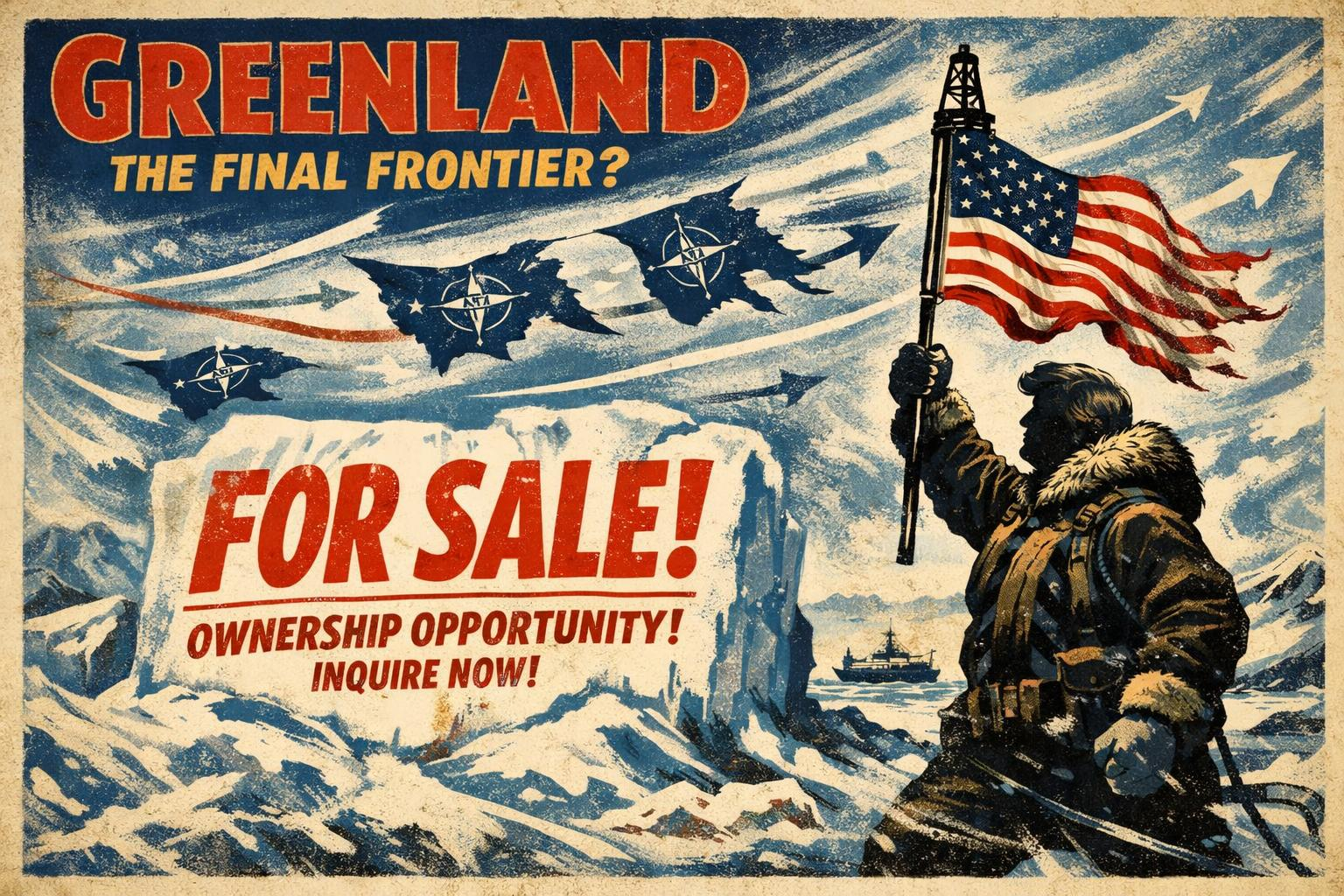


The Arctic Gambit: Inside Trump’s Audacious Greenland Bid.
Table Of Contents
- The Arctic Gambit: Inside Trump's Audacious Greenland Bid.
- The Strategic Case: Mining, Missiles, and the Arctic Race
- The Billionaire Dimension: Peter Thiel's Libertarian Frontier
- The Business Nexus: Trump Associates and Greenland Profits
- Congressional Support: The MAGA Wing Mobilizes
- The Pushback: NATO in Crisis
- The Hidden Agenda: Coercive Diplomacy
- The Real Problem: It May Not Actually Work
- What's at Stake
- References
A strategic mineral grab, tech billionaire ambitions, and the biggest challenge to NATO since the Cold War converge on a frozen island with 57,000 people
The image circulated on social media in a moment of calculated provocation: President Donald Trump, photoshopped into Arctic fatigues, planting an American flag on Greenland’s icy terrain. It was January 2026, and what began as a 2019 curiosity had transformed into something far more serious—a sustained, muscular campaign involving national security hawks, Silicon Valley libertarians, mining companies, and Trump’s closest advisers.
“We are going to take action regarding Greenland, whether the locals agree or not,” Trump declared aboard Air Force One earlier this month. “If we cannot approach it the straightforward way, we will resort to tougher measures.” When pressed at a Davos press conference on how far he would go, Trump offered a cryptic two-word response: “You’ll find out.”
For American allies in Europe, these were alarming words. NATO members watched as their most powerful partner threatened their collective security architecture. For Greenlanders—a population smaller than many American towns—the prospect was surreal. For a small constellation of billionaire investors, government officials, and mining companies, however, Trump’s Greenland obsession represented an unprecedented opportunity: the chance to reshape geopolitical power, access critical minerals worth billions, and establish a libertarian “freedom city” beyond the reach of democratic regulation.
The story of Trump’s Greenland initiative reveals far more than one man’s territorial ambitions. It exposes the convergence of three distinct power structures reshaping American policy in 2026: nationalist geopolitics, tech billionaire ideology, and the military-industrial complex’s hunger for critical resources in an era of great power competition.
The Strategic Case: Mining, Missiles, and the Arctic Race
Trump’s argument for Greenland begins with national security. The island sits at a critical chokepoint between the Atlantic Ocean and the Arctic Circle. As climate change recedes polar ice, shipping lanes that were impassable for centuries are suddenly viable. Russia and China have signaled serious Arctic ambitions. In 2019, a Chinese state company offered to fund airport improvements in Greenland; Denmark hastily countered with its own funding to block the move. China has invested in mining partnerships. Russia conducted military exercises. The strategic logic, from Washington’s perspective, is elementary: whoever controls the Arctic dominates the future.
But there is a more immediate driver: rare earth minerals.
Greenland sits atop vast reserves of neodymium, dysprosium, terbium, and other rare earth elements that modern warfare and technology cannot function without. Electric vehicle batteries, precision-guided missiles, fighter jet engines, MRI machines, advanced semiconductors—all require rare earths. Currently, China controls roughly 80 percent of global rare earth processing. For Pentagon planners, this dependency represents an existential vulnerability.
“We need Greenland,” Trump told journalists. “It’s incredibly strategic right now.”
The Trump administration has moved aggressively on this front. In June 2025, the U.S. Export-Import Bank sent a $120 million loan commitment to Critical Metals Corp to develop the Tanbreez rare earth mine—the largest undeveloped rare earth project in Greenland. Then, in October 2025, Reuters reported that Trump administration officials were discussing converting a $50 million grant into direct equity ownership of Critical Metals Corp, giving the U.S. government approximately 8 percent of the company. It would represent the first American government equity stake in an overseas mining venture[1].
The Tanbreez mine, if brought into production, could yield 85,000 metric tons of rare earth concentrate annually—a transformative amount of global supply. It would reduce American dependence on Chinese processing and create a strategic advantage in the technology and defense sectors that depend on rare earth elements.
On the surface, this is serious geopolitical strategy. Beneath the surface, however, it is also lucrative private business opportunity for people very close to Trump.
The Billionaire Dimension: Peter Thiel’s Libertarian Frontier
Peter Thiel, the co-founder of PayPal and Trump’s most influential Silicon Valley confidant, has long promoted a radical vision: that democracy is incompatible with freedom, and that the solution is escape—to outer space, to seasteads (unregulated ocean communities), or to new cities governed by private entrepreneurs rather than elected officials.
In April 2025, Reuters reported that Thiel, Silicon Valley venture capitalist Marc Andreessen, and tech investor Shervin Pishevar were exploring the creation of a “freedom city” in Greenland. This would not be a traditional municipality governed by elected officials. Instead, it would be a hyper-deregulated zone where artificial intelligence companies, autonomous vehicle manufacturers, space launch companies, and nuclear reactor startups could operate with minimal environmental or labor restrictions—a blank slate for libertarian experimentation[2].
“Expanding to Greenland can be the dawn of a new Manifest Destiny,” Pishevar stated, invoking the 19th-century ideology of American territorial expansion.
Ken Howery, Trump’s nominee for U.S. Ambassador to Denmark, stands at the nexus of these interests. Howery co-founded venture capital firms alongside Thiel and maintains long-standing ties to Elon Musk. Once confirmed by the Senate, Howery would be responsible for leading American negotiations to acquire Greenland. According to sources, Howery has already been involved in preliminary discussions about establishing the freedom city concept on the island.
The ideological motivation is clear: Thiel and his network view regulation—environmental, labor, democratic oversight—as obstacles to innovation.
Greenland represents a frontier where venture capitalists could implement their vision of governance. One source described the aspiration as encompassing an AI center, autonomous vehicle testing grounds, micro nuclear reactors, and space launch facilities, all operating under principles of minimal state intervention.
“This is not about contributing to the common good,” noted one analysis of the initiative. “It is about establishing a highly deregulated special zone—an experimental field for capital and technology, freed from the shackles we commonly refer to as democracy, law, and public order.”
“Freedom City” is a proposed libertarian tech utopia that Silicon Valley billionaires want to build in Greenland, characterized by minimal corporate regulation, no environmental oversight, and extreme technological experimentation. The vision includes AI hubs, autonomous vehicle testing, space launch sites, micro-nuclear reactors, and high-speed rail—all operating outside traditional democratic governance.
Who’s Behind It?
Key supporters include:
- Ken Howery: Trump’s ambassador to Denmark; PayPal co-founder with Peter Thiel; tasked with leading Greenland acquisition negotiations
- Peter Thiel: Billionaire libertarian who funded Pronomos Capital and Praxis, city-building ventures globally
- Marc Andreessen: Venture capitalist backing similar “charter city” projects
- Dryden Brown (Praxis co-founder): Visited Greenland in 2024, calling it “one of the last frontiers on earth”; sees it as a Mars colonization test site
Ideological Roots
Freedom cities stem from the “seasteading” movement—creating stateless societies free from regulation. Thiel stated in 2009 he no longer believes “freedom and democracy are compatible”. The concept revives 19th-century Manifest Destiny, framing Greenland as a new American frontier.
Reality Check
No concrete projects exist; discussions remain preliminary. Greenland’s government opposes U.S. annexation, and Denmark rejects the concept entirely. Critics warn these cities would become “mini-dictatorships” with no labor protections, unions, or safety standards.
Key Sources:
- Reuters Exclusive Report: https://www.reuters.com/world/europe/greenland-freedom-city-rich-donors-push-trump-tech-hub-up-north-2025-04-10/
- Popular Science: https://www.popsci.com/technology/billionaire-freedom-city-greenland/
- Responsible Statecraft: https://responsiblestatecraft.org/trump-greenland-billionaires/
- InsideHook (Praxis Deep Dive): https://www.insidehook.com/internet/peter-thiel-praxis-next-great-city-greenland
- Nextpit Analysis: https://www.nextpit.com/opinions/freedom-city-tech-billionaires-greenland
The Business Nexus: Trump Associates and Greenland Profits
The most troubling dimension involves the direct financial entanglement of Trump administration officials with companies positioned to profit from Greenland’s acquisition.
Reuters reported in January 2026 that Keith Sorial and Allen Horn—both former Trump Organization employees—hold financial interests in GreenMet, a company involved in developing Greenland’s mining sector. Horn personally briefed Trump with photographs of mining sites in Greenland. Another Trump associate, Keith Schiller (Trump’s former bodyguard and personal assistant), has pursued business interests in Greenland[3].
“Trump’s illegal and illegitimate designs on Greenland would be bad enough,” said Norman Eisen, former U.S. ambassador to the Czech Republic, speaking to OCCRP. “But they are made worse by allegations that Trump associates have ties to companies who could benefit from the president’s actions.”
Meanwhile, major billionaires with broader investment portfolios have positioned themselves for Greenland opportunities. According to reporting by Engineer Live in October 2024, Jeff Bezos, Bill Gates, and Michael Bloomberg have invested in Greenland mining ventures, drawn by the critical mineral deposits and geopolitical importance. Ronald Lauder, the Estée Lauder heir, is also an investor. According to John Bolton, Trump’s former National Security Adviser, Lauder first proposed Greenland acquisition to Trump during his first term.
The pattern is clear: those close to Trump administration power—both in government and in the broader billionaire investor class—stand to profit substantially if the U.S. acquires Greenland or even simply secures favorable mining concessions[4].
Congressional Support: The MAGA Wing Mobilizes
Within Congress, support for Greenland acquisition concentrates in the MAGA wing of the Republican Party—populist nationalists who view Trump’s territorial ambitions as a historic legacy achievement.
Rep. Andy Ogles (R-Tennessee) introduced legislation authorizing the acquisition of Greenland with a 60-day Congressional review process. Rep. Buddy Carter (R-Georgia) introduced the “Red, White, and Blueland Act of 2025.” Rep. Dan Crenshaw (R-Texas) co-sponsored the “Make Greenland Great Again Act.” Senators Ted Cruz and others have called the acquisition “overwhelmingly beneficial” to American interests.
These are not outliers within Republican circles. They represent a strand of nationalist-expansionist thinking that views Arctic territory as essential to American greatness. The rhetoric consistently invokes American westward expansion in the 19th century—the concept of “Manifest Destiny”—applied to the Arctic.
Definition and Core Concept
Manifest Destiny was a 19th-century American ideology asserting that the United States was divinely ordained to expand westward across North America to the Pacific Ocean. The phrase, coined by journalist John O’Sullivan in 1845, embodied the belief that U.S. territorial expansion was both “manifest” (obvious) and inevitable. It framed American expansion as a moral and religious duty to spread democracy and civilization.
Historical Impact
The doctrine justified major territorial acquisitions including the Louisiana Purchase (1803), the annexation of Texas, the Mexican-American War’s territorial gains (Arizona, California, Nevada, New Mexico, Utah), and later the purchase of Alaska (1867) and annexation of Hawaii (1893). These acquisitions roughly doubled or tripled the nation’s size, establishing the continental boundaries largely as they exist today.
Connection to Trump and Greenland
Remarkably, Trump explicitly revived Manifest Destiny rhetoric in his January 2025 inauguration speech and has applied it to Greenland. White House officials now argue Greenland “should have” belonged to the US and invoke Western Hemisphere dominance. Trump’s admiration for President James K. Polk—known for aggressive territorial expansion—exemplifies this revival. Analysts warn this represents a dangerous resurrection of 19th-century imperialism now targeting Arctic territories.
Key Sources:
The Atlantic: https://www.theatlantic.com/national-security/2026/01/trump-greenland-polk-manifest-destiny/685689
Britannica: https://www.britannica.com/event/Manifest-Destiny
Wikipedia Manifest Destiny: https://en.wikipedia.org/wiki/Manifest_destiny
News18 Analysis: https://www.news18.com/explainers/whats-manifest-destiny-and-why-its-being-linked-to-trumps-renewed-interest-in-greenland
However, support is far from universal. Senator Lisa Murkowski (R-Alaska), despite her state’s own history of acquisition (purchased from Russia in 1867), has voiced vocal criticism. Democratic senators introduced bills to prevent the acquisition. And European allies—particularly Denmark and the Nordic countries—have made clear that any American military action would trigger a NATO crisis[5].
The Pushback: NATO in Crisis
On January 21, 2026, European Parliament members debated Trump’s Greenland strategy as a matter of urgent continental security. “Greenland and the need for a united EU response to US blackmail attempts,”
French President Emmanuel Macron sent Trump a private message, later publicly released by Trump in a diplomatic breach, stating: “I do not understand what you are doing on Greenland.”
Danish officials have offered Trump numerous alternatives: expanded military cooperation, joint defense arrangements, shared investment in Arctic infrastructure. None has satisfied the president, who posted doctored images showing American flags planted on Greenland’s soil.
Trump has linked his demands to his grievance about not winning the Nobel Peace Prize—a connecting point that alarmed NATO strategists, who recognized that rational negotiation might prove impossible with a leader motivated by personal slights and legacy concerns.
Perhaps most concerning: Trump has not ruled out military action. When asked directly about the possibility, he offered only: “You’ll find out.”
A NATO war with its most powerful member over a Danish territory is a contingency that seemed impossible just years ago. Now it occupies serious strategic planning conversations in European defense ministries.
The Hidden Agenda: Coercive Diplomacy
Some international relations scholars argue that Trump’s Greenland acquisition threat may be less about actual annexation and more about extracting concessions. By threatening military action and imposing tariffs (Trump announced 10 percent tariffs on all European goods effective February 1 if opposition continues), Trump may be positioning himself to win favorable mining contracts, military base access, and investment opportunities—all while appearing to make a “deal” by accepting something short of full territorial acquisition.
This interpretation suggests Trump’s real goal: ensuring that Greenland’s resources flow to American companies (particularly those in which his associates have financial stakes) rather than to Chinese competitors, while maintaining the appearance of respecting Danish sovereignty.
If true, it represents a form of coercive diplomacy that threatens NATO cohesion and international law to extract private economic advantage.
Despite all this ambition and maneuvering, there is a fundamental obstacle that neither Trump, Thiel, nor mining executives can overcome: Greenland’s geography.
Roughly 80 percent of Greenland is covered by a mile-thick ice sheet. Arctic mining is five to ten times more expensive than comparable operations elsewhere. Infrastructure is minimal. The workforce is limited. Environmental regulations, valued by Greenlanders who depend on pristine Arctic conditions, would need to be dismantled.
“The notion of transforming Greenland into America’s rare-earth production hub is pure fantasy,” said a senior analyst at The Arctic Institute. “Mining on the moon would be just as feasible.”
Even with unlimited government funding and private capital, extracting minerals at scale from the Arctic would be extraordinarily challenging and expensive. Climate change is not solving this problem—slightly less ice does not translate into viable mining conditions.
This disconnect between Trump’s ambitions and physical reality has not dampened his determination. But it raises questions about whether the entire initiative is driven less by strategic reasoning and more by personal vanity, private profit-seeking, and the machinations of billionaire libertarians pursuing their ideological experiments.
What’s at Stake
The Greenland crisis illuminates how 21st-century geopolitics operates at the intersection of state power, billionaire ideology, and personal ambition. Trump’s push does reflect genuine strategic concerns about Arctic security and Chinese dominance in critical minerals. But it is also fueled by Silicon Valley libertarians seeking to build unregulated cities, mining companies seeking government support, Trump associates positioned to profit, and a president seeking to cement a legacy through territorial expansion—all while threatening NATO, alienating allies, and potentially destabilizing the international order.
Whether Trump succeeds in acquiring Greenland remains uncertain. Military action would trigger a NATO crisis. Congressional support exists but faces headwinds. Economic coercion may prove insufficient.
What is certain is this: the Arctic has become the new frontier for great power competition, and Trump’s crude, transactional approach to governance—combining nationalist ambition, billionaire influence, and personal profit incentive—represents the operating logic of American foreign policy in 2026.
On this frozen island at the top of the world, the future of NATO, American-European relations, and the shape of Arctic geopolitics hangs in the balance.
References
[1] Reuters, “Trump administration eyes stake in company developing Greenland rare earths mine,” October 3, 2025. https://www.reuters.com/business
[2] Reuters, “Greenland ‘Freedom City’? Rich donors push Trump for tech hub up north,” April 10, 2025. https://www.reuters.com/world/europe
[3] OCCRP, “As Trump Talked About Taking Greenland, Former Employees Gained a Foothold in the Arctic Island,” January 16, 2026. https://www.occrp.org/en/scoop
[4] Engineer Live, “Billionaires secretly invest in AI-driven rare earth mining in Greenland,” October 31, 2024. https://www.engineerlive.com/content
[5] Financial Times and Reuters reporting on NATO responses, January 2026. Multiple sources.
