




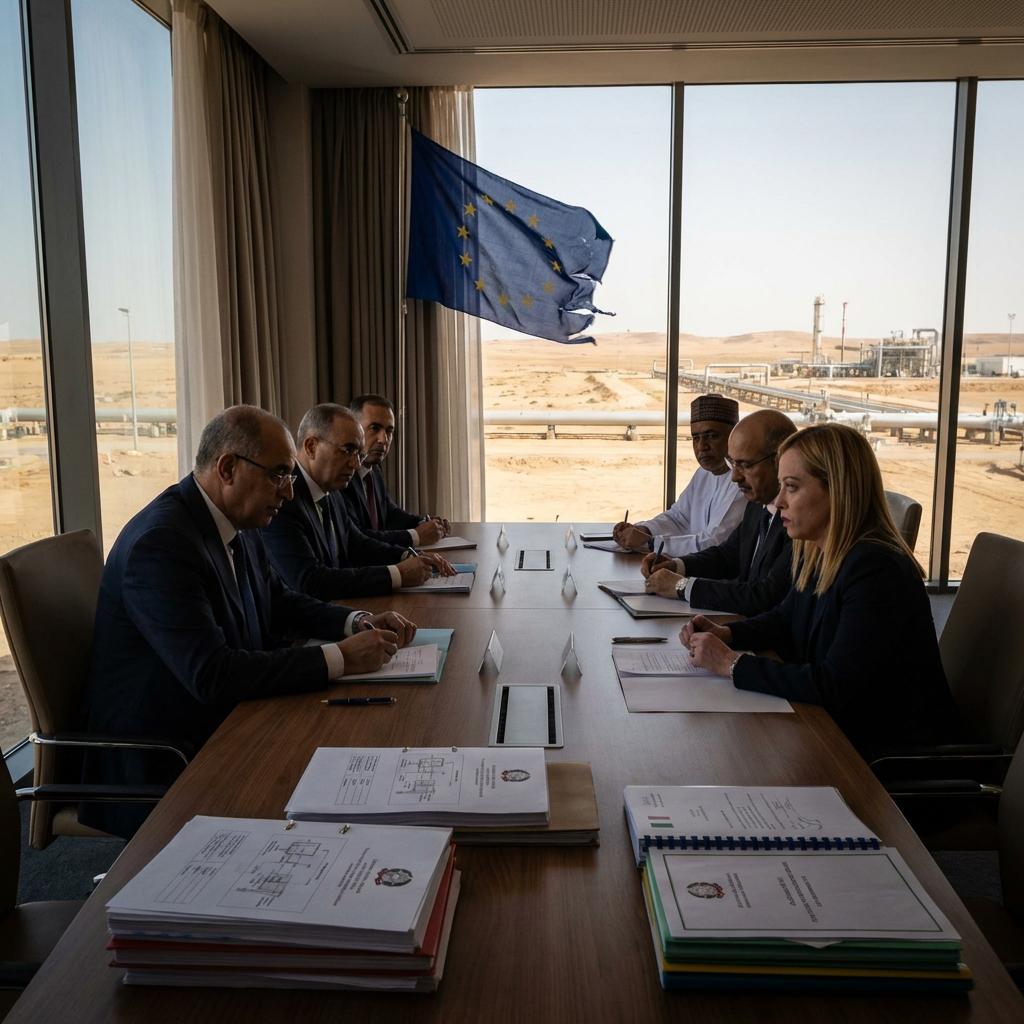
In a classic display of national interest trumping collective ambition, Italian Prime Minister Giorgia Meloni jetted to Algiers this week to seal a bilateral gas cooperation deal with Algeria, blatantly underscoring the European Union’s chronic inability to present a united front on energy security. The visit, confirmed in late March 2026, sidelines Brussels and highlights how member states continue to freelance on critical resource diplomacy, leaving the EU’s common energy policy looking more like a suggestion box than a strategy.
Background
The European Union’s quest for energy unity has been a saga of unfulfilled promises, particularly since Russia’s invasion of Ukraine in 2022 exposed the bloc’s dangerous dependence on Moscow’s hydrocarbons. Efforts like the REPowerEU plan aimed to diversify supplies and accelerate renewables, but national interests have persistently fragmented the approach. Italy, historically reliant on Russian gas, has aggressively sought alternatives, with Algeria emerging as a key partner through the TransMed pipeline.
Algeria, Africa’s largest gas exporter, has leveraged its position to negotiate directly with European nations, bypassing EU mechanisms. This bilateralism isn’t new; Germany’s rush for LNG terminals and France’s nuclear advocacy have similarly revealed cracks in the facade of solidarity. Meloni’s trip is merely the latest episode in this recurring drama of disjointed energy politics.
Italy’s Solo Flight in Energy Diplomacy
Meloni’s government framed the Algeria visit as a strategic move to bolster Italy’s energy security and reduce costs for consumers. The agreement focuses on increasing gas deliveries and enhancing infrastructure cooperation, with Italian energy giant ENI playing a central role. According to official statements, this could see Algerian gas exports to Italy rise by up to 20% over the next few years, providing a tangible buffer against market volatility.
Critics argue that such unilateral actions undermine the EU’s negotiating leverage with external suppliers. While the European Commission has pushed for joint procurement initiatives, Italy’s approach prioritizes swift, tangible gains over protracted multilateral talks. This divergence isn’t merely procedural; it reflects a deeper ideological rift between federalist aspirations and national sovereignty.
The Economic Calculus: Gas Markets and Beyond
Economically, Meloni’s move is a pragmatic response to persistent high energy prices that have squeezed Italian industry and households. Data from Eurostat shows that Italy’s gas import prices have fluctuated wildly since 2022, with Algerian supplies offering relative stability compared to spot market LNG. The deal aims to lock in longer-term contracts, potentially shielding Italy from future price spikes.
However, this bilateralism risks distorting the EU’s internal energy market. By securing preferential terms, Italy could gain a competitive edge in manufacturing, exacerbating economic disparities within the bloc. Analysts note that such fragmentation may lead to a ‘race to the bottom,’ where member states undercut each other for resources, ultimately driving up collective costs.
Geopolitical Ripples: EU Unity on the Rocks
Geopolitically, Italy’s outreach to Algeria signals a broader trend of EU nations pursuing independent foreign policies on energy. Algeria, while a stable partner, has its own complex relationships, including tensions with Morocco and Spain. Italy’s engagement could inadvertently strain EU cohesion on Mediterranean security issues, where a unified stance is often crucial.
Comparisons with Germany’s energy strategy are instructive. Berlin’s pivot to LNG from the U.S. and Qatar was equally nationalistic, yet it exposed the lack of an EU-wide crisis response mechanism. The European Council has repeatedly emphasized solidarity, but actions like Meloni’s reveal that, when push comes to shove, capitals revert to zero-sum games.
What Analysts Are Saying
Energy analysts at Bruegel, the Brussels-based think tank, argue that “bilateral deals like Italy’s with Algeria are symptomatic of the EU’s failure to institutionalize collective bargaining power. They provide short-term relief but erode long-term strategic autonomy.” In contrast, geopolitical experts from the International Crisis Group suggest that “national initiatives can complement EU efforts if coordinated, but the current ad hoc approach risks creating dependencies that weaken Europe’s global stance.”
Economists at the Oxford Institute for Energy Studies highlight the market implications: “Italy’s move may lower its import costs, but it could fragment the EU’s gas network, leading to inefficiencies and higher prices for landlocked countries without direct pipeline access.” These perspectives underscore the tension between national pragmatism and collective idealism.
The Real-World Impact
If you work for a living, this political maneuvering translates directly to your wallet and well-being. For Italian households, increased Algerian gas could mean slightly lower heating and electricity bills—perhaps a 5-10% reduction in energy costs over the next year, based on current projections. However, across the EU, fragmented deals might lead to uneven price relief, with countries like Bulgaria or Hungary facing steeper costs due to weaker bargaining positions.
Job security in energy-intensive sectors, such as manufacturing, could improve in Italy as cheaper gas boosts competitiveness, but workers in other EU nations might see industries relocate, chasing better energy terms. Transportation costs, tied to fuel prices, may stabilize in Italy but rise elsewhere. Public services, already strained by inflation, could suffer if EU funds are diverted to patch energy disparities, affecting healthcare and education access.
On civil liberties, while not directly impacted, the erosion of EU unity could weaken collective responses to crises, indirectly affecting personal freedoms through heightened economic insecurity. In plain terms: your energy bills might dip if you’re in Italy, but the broader European social fabric risks further tearing.
Political Accountability
Italian officials, led by Meloni, have acted decisively to secure bilateral energy agreements, citing national interest and consumer protection. At the EU level, the European Commission has proposed mechanisms like joint purchasing, but implementation remains sluggish, hampered by member state resistance. The European Council’s last summit in early 2026 reiterated calls for solidarity, yet no binding agreements were reached.
The Standard They Should Be Held To
Elected governments must foster economic growth through competitive markets and innovation, but not by sacrificing worker welfare or public infrastructure. Italy’s deal, while economically rational, bypasses opportunities for EU-wide coordination that could lift all boats. Social investment—universal healthcare, education, and housing—requires stable, equitable energy policies; fragmented deals risk exacerbating regional inequalities, undermining this baseline obligation.
Civil liberties, including freedom of speech and assembly, depend on a society where economic pressures don’t force trade-offs between heating and eating. Politicians should be held to a standard where energy security enhances, rather than erodes, democratic foundations. The gap here is clear: national actions are prioritized over collective safeguards, leaving ordinary citizens vulnerable to the whims of geopolitical freelancing.
The Next Chapter in Europe’s Energy Saga
Watch for the upcoming European Council meeting in June 2026, where energy policy will be debated again—expect fiery rhetoric but likely little concrete action. Key indicators include gas price trends on the TTF exchange and any shifts in Algeria’s export commitments to other EU states. Also, monitor Italy’s domestic approval ratings; if Meloni’s gamble pays off, other leaders may follow suit, further fracturing the bloc.
As Europe dithers, the real test will be whether the EU can muster a unified response before the next crisis hits, or if it will remain a patchwork of solo acts in a world that demands a chorus.
Giorgia Meloni, Italy Algeria gas deal, European energy security, EU energy disunity, Mediterranean gas hub, Qatar LNG disruptio
