





Kemi Badenoch Calls Donald Trumps Repeated Attacks on Keir Starmer Childish
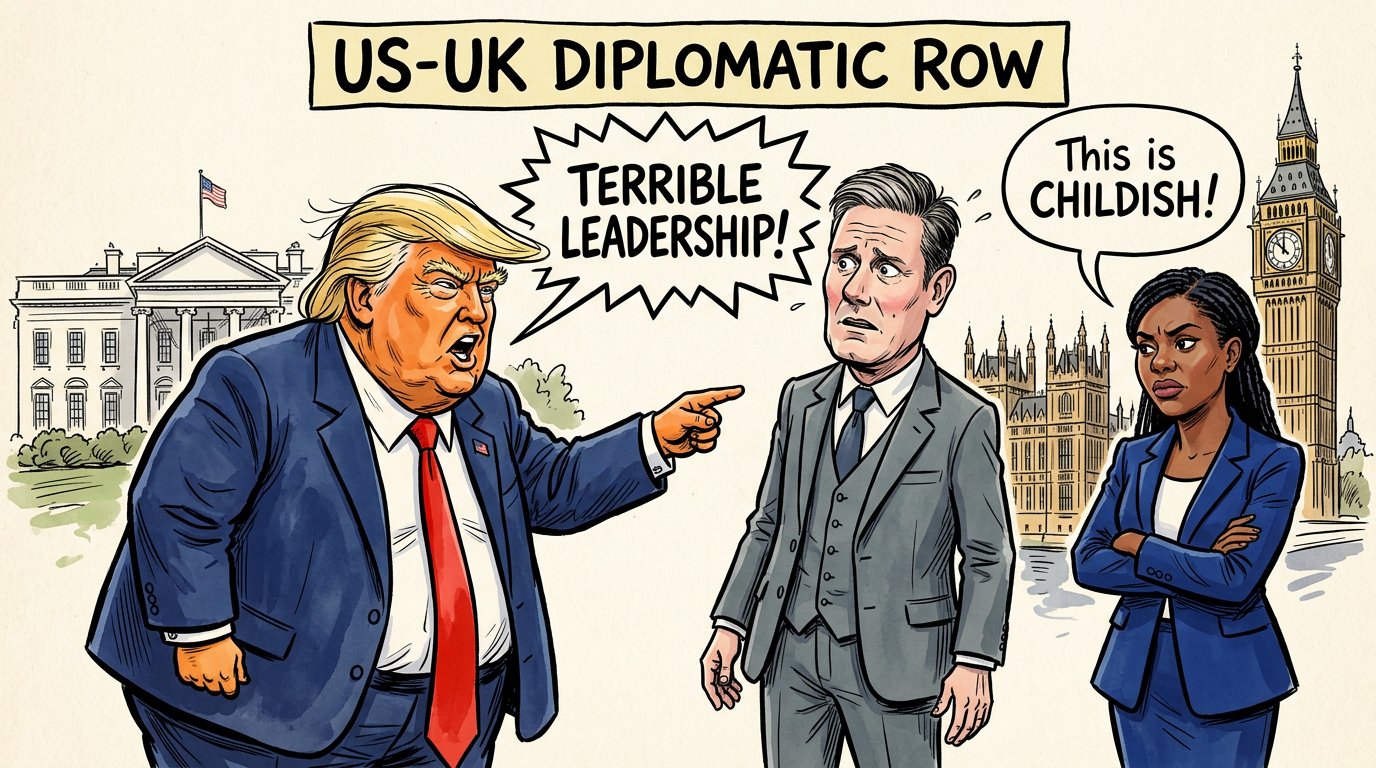
UK Conservative leader Kemi Badenoch publicly rebuked US President Donald Trump’s repeated attacks on Prime Minister Keir Starmer, calling the White House’s language “childish” and counterproductive as tensions over the Iran conflict spill into transatlantic politics.
In a social media video released shortly before another round of criticism from Trump, Badenoch said she was “Keir Starmer’s biggest critic” but argued that remarks coming from the White House were “completely wrong” and “actually quite childish.” She urged that disagreements be handled privately.
Badenoch linked her warning to the presence of Ukraine’s President Volodymyr Zelenskyy in the UK, saying visible infighting within the western alliance “sends the wrong signal to our opponents, in Iran or in Russia.” She added that ties between London and Washington should be strengthened “irrespective of who is president and who is prime minister.”
Her comments mark a notable shift. Badenoch has previously positioned herself close to Trump’s political style, praising him for what she described as the willingness to challenge a liberal elite. When the US and Israel first attacked Iran, she criticized Starmer for not allowing the US to use UK bases and said she stood “with our allies in the US and Israel as they take on the threat of the Islamic Republic of Iran and its vile regime.”
A week ago, however, Badenoch denied that she had ever called for the UK to join the war. Her evolving stance comes amid polling that has repeatedly shown the attack on Iran is unpopular with British voters, who do not want the UK to become more involved.
Trump intensified his criticism of Starmer overnight, faulting the prime minister for leaning on advisers and not immediately committing to send a minesweeper to help reopen the Strait of Hormuz. The charge focused on the UK’s willingness to support maritime operations tied to the conflict’s spillover risks in a critical shipping corridor.
Speaking at the White House on Tuesday while hosting Irish premier Micheál Martin, Trump again condemned Starmer, with whom he had previously enjoyed a relatively warm relationship. “Well, he hasn’t been supportive, and I think it’s a big mistake,” Trump said of the UK stance on Iran. He framed the issue as a matter of reciprocity, suggesting Britain owed greater support given US efforts on trade with the UK.
Trump said Starmer had told him the UK “was willing to send two aircraft carriers” to the Middle East, but only once the conflict was over. “And I said, ‘no, no, we want things sent before the war, not after the war is won’,” Trump recounted. “So, yeah, I’m disappointed with Keir. I like him, I think he’s a nice man, but I’m disappointed.” He added: “Unfortunately Keir is no Winston Churchill.”
UK government sources disputed the idea that the US had asked London to send aircraft carriers. They also said conditions in the Strait of Hormuz remained too volatile to send any vessels at this time. That stance points to an assessment in London that operational risks currently outweigh the benefits of a visible maritime deployment, even amid US pressure for more tangible UK support.
Badenoch’s intervention underscores a widening political gap over tone and tactics between the Conservative leadership and the White House, even as she insists on the importance of the broader UK-US alliance. Her critique targets the manner of Washington’s public messaging rather than the underlying security concerns, but it still represents an open rebuke of the sitting US president by a UK party leader who has previously aligned herself with him.
The timing also reflects a domestic recalibration. Polling indicates the Iran attack is largely unpopular in the UK, and voters do not want their country to become more involved. For Badenoch, who had initially signaled solidarity with US and Israeli actions, the political costs of appearing too close to Washington’s war posture have grown. Her recent denial that she wanted the UK to join the conflict — and now her dismissal of the White House’s rhetoric — suggests sensitivity to those public sentiments.
For Starmer, Trump’s accusations create pressure to demonstrate sufficient solidarity with the US while maintaining his government’s risk calculations and political room at home. The minesweeper debate and the reported aircraft carrier request highlight competing priorities: US expectations for allied contributions versus UK caution around escalation and maritime security in a volatile theater.
The episode also exposes the strains that high-profile public criticism can place on alliance cohesion. Badenoch’s warning about airing disputes in public — especially during Zelenskyy’s visit — reflects concern that internal divisions benefit adversaries. Her call for private diplomacy suggests a preference for managing transatlantic differences behind closed doors, particularly on war-related decisions that carry domestic political consequences.
Trump’s references to trade as a metric of alliance loyalty add another layer of complexity. By linking security support to perceptions of economic goodwill, the White House is setting a transactional tone that London may find difficult to meet while navigating public opposition to deeper involvement in the war.
UK government denials regarding aircraft carriers, and their caution over sending vessels into the Strait of Hormuz, underline London’s insistence on retaining operational control and timing. The government’s position indicates that any British deployments will be dictated by assessments of risk and necessity rather than rhetorical pressure.
The immediate result is a public, three-way friction: a UK prime minister resisting calls for rapid escalation, a US president pressing for more visible support and criticizing that caution, and a UK Conservative leader distancing herself from Washington’s tone while seeking to preserve alliance unity.
Why it matters – Public rifts between London and Washington over the Iran conflict risk signaling disunity to adversaries and complicating coordinated policy. – UK domestic opinion is shaping leaders’ positions, limiting London’s willingness to expand its military role. – Trump’s pressure and rhetoric, including trade-linked expectations, test the resilience of the UK-US relationship. – Operational caution in the Strait of Hormuz shows London prioritizing risk management over rapid deployments. – Badenoch’s shift from alignment with Trump to criticizing the White House suggests the UK’s political landscape is moving away from overt support for deeper involvement in the war.
