





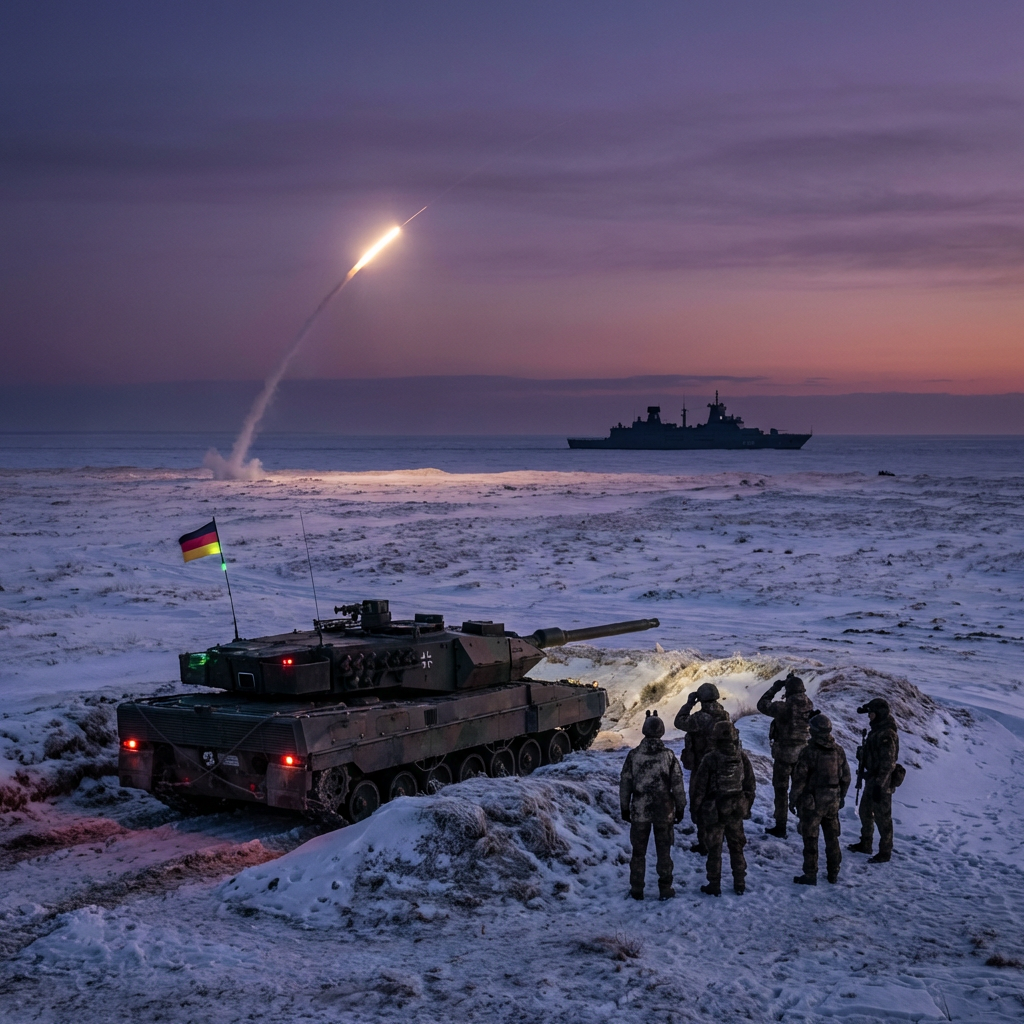
In a profound reversal of eight decades of strategic restraint, Germany is rapidly reconstituting itself as Europe’s preeminent military power. Under the urgent command of General Carsten Breuer, the Bundeswehr is undergoing its most significant expansion since the Cold War, driven by a stark intelligence assessment that Russia could be capable of a major attack on NATO territory by 2029. This seismic shift, fueled by the collapse of transatlantic certainty and the war on its eastern flank, is not merely a rearmament program—it is the definitive end of the post-1945 European order and the emergence of a new, Berlin-led security architecture.
Strategic Background
Germany’s postwar identity was built on the doctrine of ‘never again,’ manifested in a deliberately constrained military and a deep integration into the US-led NATO security umbrella. After the Cold War, this atrophy accelerated; by the 2010s, the Bundeswehr was chronically underfunded, with readiness so low that troops famously trained with broomsticks. The 2022 Russian full-scale invasion of Ukraine shattered this complacency, triggering a historic €100 billion special defense fund.
The current acceleration, however, represents a second, more radical phase. Chancellor Friedrich Merz’s government has now passed constitutional amendments to lift debt brakes for defense, targeting a staggering 5% of GDP—a figure surpassing most European allies. This move is directly catalyzed by the perceived withdrawal of American security guarantees under the second Trump administration, as signaled by Vice President JD Vance’s blunt Munich address and leaked messages dismissing European allies as ‘freeloaders.’
What This Move Signals
Berlin’s actions signal a fundamental strategic decoupling from Washington and an acceptance of sovereign responsibility for continental defense. The deployment of a full combat brigade to Lithuania—5,000 troops permanently stationed on NATO’s eastern border—is a concrete demonstration of this new resolve. It transforms Germany from a geopolitical ‘payer’ to a ‘player,’ projecting hard power into the Baltic buffer states that have long clamored for a credible tripwire force.
The intent is dual: to deter Moscow through unambiguous forward presence and to reassure nervous EU partners that Berlin, not Washington, is now the ultimate guarantor of Article 5. General Breuer’s prioritization of intelligence, drones, and deep-strike capabilities reveals an ambition to close critical capability gaps that only the US previously filled, pursuing ‘operational independence’ within the alliance. This is not mere rhetoric; it is a strategic blueprint for a European pillar of NATO that can function without American command-and-control.
Implications for European Security and Interests
Militarily, this shift is overwhelmingly positive for EU security. A powerful, combat-ready Bundeswehr anchored in the EU and NATO dramatically strengthens the collective defense posture against Russian revanchism. It provides a credible backbone for European defense that has been absent for a generation.
Economically, the surge in defense spending will reshape European industrial policy, redirecting capital and R&D towards munitions, aerospace, and advanced military technology. This creates both opportunities for growth and potential strains on social spending, testing public support.
Politically, it reorders the EU’s internal hierarchy. Berlin’s military weight will now match its economic heft, potentially centralizing security decision-making. This could either foster greater cohesion around a German-led strategic vision or exacerbate tensions with France, which has traditionally seen itself as the EU’s military leader.
Normatively, the move is complex. While it strengthens the EU’s ability to defend the rules-based order it champions, it also forces a pragmatic, interest-driven approach that may at times clash with purely normative foreign policy. The severity of this transformation is high; it fundamentally alters the EU from a civilian power to a strategic actor with serious military capacity.
Trans-Atlantic and Allied Dimensions
The German build-up is a direct response to American retrenchment and represents the most significant divergence in transatlantic strategic interests since the Suez Crisis. While it aligns with the long-standing US demand for greater European burden-sharing, its scale and autonomous intent—driven by distrust of Washington’s commitment—signal a potential fracture in the alliance’s integrated structure.
For NATO, this creates a paradox: a stronger European pillar is essential for the alliance’s resilience, yet one led by a Germany seeking ‘operational independence’ could challenge US leadership and create competing centers of gravity. The opportunity lies in forging a new, more balanced partnership; the risk is a gradual decoupling that Russia could exploit.
The Other Side of the Board
For Russia, Germany’s rearmament is a strategic setback. It invalidates the Kremlin’s bet on European, and specifically German, pacifism and economic dependence. The permanent deployment in Lithuania directly challenges Russia’s ability to intimidate the Baltic states and complicates its military planning on the Western border. Moscow will likely respond with intensified hybrid warfare, nuclear saber-rattling, and attempts to sow discord within the EU and NATO.
For China, a more strategically autonomous Europe complicates its calculus. A EU capable of independent defense action is less susceptible to pressure in a crisis over Taiwan or in trade disputes. However, it also reduces European reliance on the US, potentially opening space for Beijing to exploit divisions in the transatlantic alliance.
Brussels on the Chessboard
The EU institutions have largely facilitated this national shift through joint procurement initiatives and the relaxation of state aid rules for defense. However, the driving force has been Berlin and other national capitals, not Brussels. The European Commission has acted as an enabler, not a commander.
The Strategic Verdict
This is a positive and overdue strategic correction. Germany’s decisive action demonstrates that key EU member states can finally subordinate historical guilt and economic orthodoxy to existential security interests. It shows the EU can adapt with real-world speed when faced with a clear and present danger. The criticism is that this transformation remains nationally driven, not EU-led. True strategic autonomy would require a unified EU defense budget and command structure, which remains elusive. Berlin has acted; now it must lead in building the institutional architecture to make this power truly European.
Forward Outlook: The 2029 Countdown
All eyes are on the 2029 timeline set by General Breuer. The next 36 months will be a relentless test of German resolve, industrial capacity, and political cohesion. Watch for three specific indicators: first, the pace of Lithuanian base construction and integration of allied rotations; second, the success of the recruitment drive and whether conscription is reintroduced; third, the development of key capabilities like deep-strike missiles independent of US supply chains.
The strategic thesis is clear: Germany has chosen to re-enter history as a military power. Its success will determine whether Europe becomes a sovereign strategic actor or remains a vulnerable protectorate. The era of German restraint is over; the era of German responsibility has begun, and with it, the final remaking of the post-Cold War world.
