




Daily Intelligence Briefing — July 02, 2026 D32
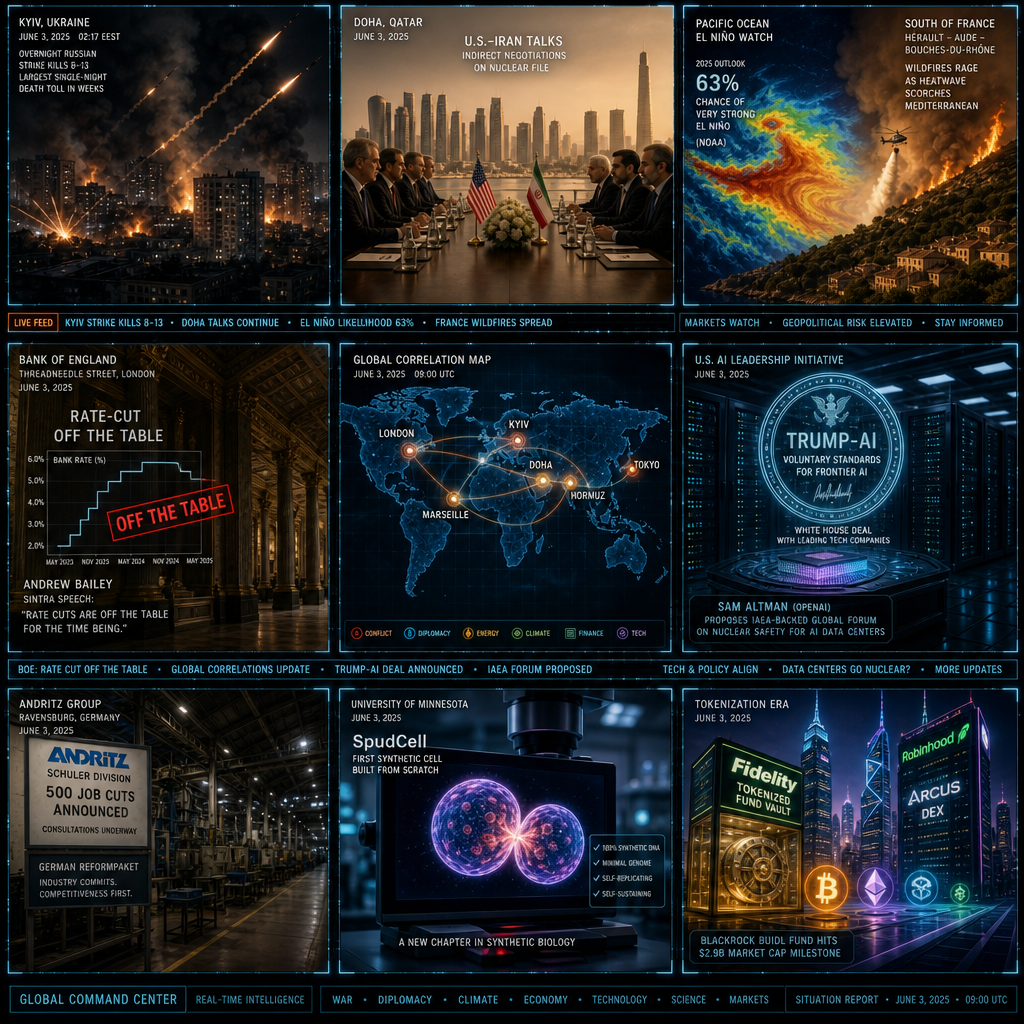
2026 07 02 D32. - Russia's massive overnight assault on Kyiv killed eight to thirteen people, including children, in the war's most intense combined missile-and-drone barrage. Hours earlier, JD Vance confirmed US-Iran Doha negotiations are progressing, while the US Navy now escorts supertanker transits through the Strait of Hormuz. The Bank of England placed rate cuts "off the table" as Iran-war inflation pushes prices higher. El Niño returned to the Pacific with a 63% chance of going "very strong" by winter, while France battles wildfires across Hérault, Aude, and Bouches-du-Rhône. The Trump administration nears an AI standards deal, and the Marines accepted six F-35s without radar installed. Will the Doha track converge with the kinetic escalation?
#Ukraine #RussiaUkraine #Kyiv #IranTalks #BankOfEngland #Geopolitics

Contents
- Geopolitics & Defence
- Environment & Climate
- Society & Civil Issues
- AI & Technology
- Economy & Business
- Science & Space
- Crypto, Digital Assets & Blockchain
- Correlations & Analysis
- References
Click any heading to jump to that section. Click the section heading to return to this menu.
Daily Intelligence Briefing — 2026-07-02 (D32)
Reporting window: 2026-07-01 22:00 UTC to 2026-07-02 06:00 UTC · Articles analyzed: 95 of 215 (after triage) · Sources: 12 Inoreader RSS feeds · This report covers entirely new topics from D31. Cross-referenced with running context from D26–D31.
Geopolitics & Defence ↑ Contents
Russia’s Massive Overnight Assault on Kyiv and the Doha Track
Russia launched what Ukrainian officials described as one of the most intense combined missile-and-drone barrages of the war against Kyiv in the early hours of 2 July, with air-raid sirens sounding across the capital and at least eight people killed, including children, and a fire breaking out in the city centre[1][2]. The Handelsblatt live blog documented eight fatalities, while France 24 put the toll at a dozen by Thursday morning, with the Ukrainian air force having issued missile warnings for both ballistic and cruise variants through the night[3]. The Independent’s live coverage noted that the attack came within hours of reporting that Vladimir Putin was personally evaluating scenarios for renewed operations to capture the capital, including potential axes of advance from Belarus and Bryansk[1]. The combination of an explicit strategic signal from Moscow and a kinetic demonstration a few hours later is unlikely to be coincidental. Russian sources have separately suggested that Ukraine may have used a ballistic missile in combat for the first time, a claim Crypto Briefing analysts say would mark a qualitative jump in Kyiv’s strike reach[4]. The two-sided escalation, with Russia hitting Kyiv harder and Ukraine pushing its long-range strike capability, deepens the spiral that the D31 Saab Gripen E contract and the EU’s €3.9 billion drone financing were designed to address on a multi-year horizon. The immediate variable is whether the overnight barrage represents a one-off pressure tactic or the opening of a new Russian air campaign, and the answer will be visible within days in the cadence of follow-on strikes.
Ukraine’s domestic defence-industrial response continues to mature. A Ukrainian company, the Center of Innovative Technologies Program, has developed a missile called DART that can be launched from a high-altitude balloon operating near the edge of the stratosphere, with the missile descending by satellite navigation, then shutting its receiver off at around 6.5 kilometres and igniting a solid-fuel rocket motor on a pre-programmed trajectory[5]. The flight profile is designed to make the weapon largely immune to Russian electronic warfare, since the missile no longer depends on satellite guidance during the final stage of its flight. The warhead, roughly 10 kilograms, disperses conductive graphite filaments intended to short-circuit electrical infrastructure, a payload optimised against power grids rather than mass casualties. The system is reportedly still undergoing evaluation and has not yet completed Ukraine’s military certification, but the broader lesson is that Western restrictions on the use of supplied weapons against targets inside Russia have pushed Kyiv to invest in domestically produced drones and missiles that can reach strategic facilities hundreds of kilometres from the front line.
The diplomatic track between the United States and Iran is the most consequential parallel development, and the most likely to shape the strategic context in which the Kyiv strikes are interpreted. US Vice President JD Vance confirmed on 2 July that the technical-level Doha negotiations are progressing, telling CNN after addressing US service members in Virginia that “it’s still pretty early, but talks are going well,” and that technical negotiators were meeting with Iranian counterparts while separate nuclear-track talks were set to begin shortly[6]. The Vance statement, coming on top of D31’s reporting that the United States is in a “great position” even if the talks fail, signals a deliberate public posture of confidence. Crypto Briefing reports that US naval forces are now protecting supertanker transits in the Strait of Hormuz, an operational decision that reduces the risk of further tanker incidents but also draws US forces into a routine presence in the waterway; the same day produced the news that Iran will host 600 foreign journalists for Ayatollah Khamenei’s funeral, an access decision that signals either confidence in the regime’s ability to manage the event or a desire to project a particular image to a global audience[7][8]. The contrast between the US naval protective posture and the Iranian media-access decision captures the central paradox of the negotiations: both sides are publicly positioning for a settlement while preparing for the possibility that the talks collapse. The operational risk of any incident in the Strait of Hormuz is now higher than at any point since the February conflict began.
India’s Defence Posture and the Indo-Pacific Tightening
India’s defence relationships with France, Japan, Malaysia, the European Union, and the United States tightened in ways that are individually modest and collectively significant. The Indian Air Force has moved quickly to secure the operational readiness of its 36 Rafale multi-role combat aircraft by requesting technical and logistical bridge support from French defence manufacturers ahead of the expiration of the original sustainment agreement in September 2026[9]. The request, issued through the Air Headquarters Directorate of Engineering-Rafale in New Delhi, highlights the gap between fleet induction and indigenous sustainment capacity, a gap that the Indian aerospace industry is working to close. India and Malaysia convened the 12th Sub Committee Meeting on Military Cooperation in New Delhi, comprehensively reviewing the full spectrum of bilateral military cooperation, including ongoing defence engagements, military-to-military exchanges, bilateral exercises, training programmes, staff talks, capacity building, and maritime cooperation[10]. The India-Malaysia meeting comes alongside the India-EU reaffirmation of cooperation on sustainable ship recycling, with both sides expressing confidence in the progress toward the inclusion of Indian ship recycling facilities under the European Union Ship Recycling Regulation[11]. India has also achieved a major milestone in accelerator science with the commissioning of the fifth heavy-ion LINAC module at the Variable Energy Cyclotron Centre in Kolkata, successfully accelerating a nitrogen ion beam to its designated energy, a step that strengthens the ANURIB project and India’s standing in atomic research[12]. US Ambassador to India Sergio Gor emphasised the strength of the partnership between New Delhi and Washington in shaping the global economy through trusted AI ecosystems, resilient supply chains, and innovation-led growth, while Sarla Aviation completed the flight-test campaign for its half-scale electric vertical take-off and landing technology demonstrator, Sylla 1.0, marking a significant milestone in India’s emerging eVTOL sector[13][14]. The combined picture is of an India that is managing the transition from a buyer of foreign defence systems to a participant in the development of next-generation platforms, while at the same time stabilising its senior diplomatic cadre after the formal extension of Foreign Secretary Vikram Misri’s tenure by one year, to mid-2027[15].
Serbia’s HQ-9, the F-35 Radar Gap, and Symbolic Politics of Strategic Waterways
Serbia is reportedly advancing the acquisition of the Chinese HQ-9 long-range air defence system, a step that Focus describes as making the country “a Trojan horse for Chinese weapons in Europe” at a moment when the rest of the continent is moving away from Chinese military hardware[16]. The Serbian move has significant implications for NATO’s southern flank and for the credibility of the EU accession framework, given that the deployment of a Chinese strategic air defence system on European soil is incompatible with the security commitments that candidate states are expected to assume. In a separate manufacturing story that captures the structural state of the US defence-industrial base, the Marine Corps has accepted six brand-new F-35s without radar installed, a fact the F-35 Joint Program Office confirmed to the Senate Armed Services Committee in a hearing on 23 June[17]. The new AN/APG-85 radar, the jets were built to carry, is not yet in production, and the older APG-81 does not fit the redesigned nose bulkhead used in production Lot 17 and beyond. A radar-less F-35 can still receive radar data from other F-35s over its datalinks, and its passive sensors still function, but its electronic warfare capability is curbed and its survivability degraded, and the program office has conceded that the six jets would not count as fully mission-capable. The full mission capable rate for the F-35 fleet has fallen from 38 percent in fiscal 2021 to 25 percent in fiscal 2025, with sustainment costs now projected at $1.6 trillion over the lifetime of the program and an additional $13.7 billion required beyond what was already planned through fiscal 2031. The contrast with the Oklo Groves Isotope Test Reactor in Texas, which won its final US Department of Energy safety approval this week and is on track for first criticality in July 2026, is instructive: Oklo is a privately developed advanced reactor that the company says demonstrates how advanced reactors could be deployed on privately owned land using commercially sourced fuel and equipment, an arrangement that bypasses the procurement and sustainment pathologies of the larger defence and nuclear complexes[18]. In the counter-drone domain, Innoviz Technologies has announced a collaboration with Regulus to combine automotive-grade LiDAR technology with counter-unmanned aircraft systems expertise, an effort that targets fiber-optic-controlled drones that have become harder to detect and disrupt using traditional counter-UAS methods[19]. France’s completion of the modernisation of its 50 Mirage 2000D aircraft to the RMV standard, with the last jet delivered in mid-June, is a more measured story but a useful one: it extends the operational life of the French combat aircraft fleet beyond 2030 and ensures interoperability with the Rafale force that India is now sustaining[20]. And Beehive Industries has acquired Ohio-based Able Tool Corporation and its subsidiary, Planet Products Corporation, expanding its manufacturing footprint to support more than 8,000 jet engines annually, with Greater Cincinnati becoming the Production Machining Center of Excellence and Knoxville, Tennessee, becoming the Production Additive Manufacturing Center of Excellence[21]. The combined picture across these stories is one of a defence-industrial base that is reorganising around new production geographies and new manufacturing methods, and around a more explicit acknowledgement of the cost and capability trade-offs that the next phase of military competition will impose.
India has strongly condemned the reported demolition of the historic 125-year-old Gurdwara Sri Guru Singh Sabha Sahib in Farooqabad, Pakistan, with the Ministry of External Affairs describing the incident as a “highly deplorable and targeted act of vandalism against a revered Sikh shrine”[22]. In East Asia, Hong Kong Chief Executive John Lee has tightened his political embrace of Xi Jinping, a move that Nikkei Asia frames as a pivotal year for him personally and that is consistent with the broader pattern of post-2019 governance in the territory[23]. In the Taiwan Strait, the de facto US ambassador Raymond Greene has said that drones represent a “game-changing opportunity” to enhance Taiwan’s security and that Taiwan needs to become a “hornet’s nest” of drones[24]. The same day, President Donald Trump used the opening of the Theodore Roosevelt Presidential Library in Medora, North Dakota, to argue that the United States should never have relinquished control of the Panama Canal and to claim that “China is trying to take over” the waterway[25]. The Trump statement is part of a longer-running pattern of pressure on Panama over Chinese influence at the canal, and the symbolic politics of strategic waterways are now a central element of the US-China competition.
Environment & Climate ↑ Contents
El Niño Returns, France Battles Wildfires Under a Heat Dome
NOAA’s Climate Prediction Center confirmed this week that El Niño conditions are now present in the tropical Pacific and are expected to strengthen into the Northern Hemisphere winter of 2026-27, with a 63 percent chance of reaching the “very strong” category during November through January[26]. The weekly Niño-3.4 region was 1.3 degrees Fahrenheit above average, while the far eastern Niño-1+2 region was about 3.8 degrees Fahrenheit above average. The World Meteorological Organization has warned that El Niño typically increases global temperatures and can drive more extreme weather and rainfall patterns. The next 90 days of Northern Hemisphere weather will be a high-priority watch. In France, the heat is already acute. Prime Minister Sébastien Lecornu convened a crisis cell in Marseille on Thursday on the canicule and the fires, with the Le Monde live blog documenting multiple fires in Hérault, Aude, and Bouches-du-Rhône, two of which were threatening the Marseille area on Wednesday evening[27][28]. Libération reported that hundreds of firefighters were mobilised and more than 1,000 hectares had been burned, with communes beginning to be evacuated. The political decision to convene the crisis cell in Marseille rather than in Paris is itself a signal: the local political cost of inadequate preparation is now high enough that the central government is taking ownership of the response. The interaction between the El Niño signal and the European heat dome is a leading indicator of what the rest of the summer will bring.
Climate Adaptation, Restoration, and the Industrial-Politics Connection
Adaptation is becoming a more visible element of the climate response. The Indonesia government is developing a roadmap to protect local wisdom in biodiversity conservation, a move aimed at strengthening the recognition and protection of Indigenous peoples and local communities[29]. The Society for Ecological Restoration has published an updated set of standards and principles for restoring ecosystems, the third edition since 2016, asserting do-no-harm principles and the importance of conserving native ecosystems[30]. A report from the Global Youth Biodiversity Network, The Iris Project, Synchronicity Earth, and the Global Landscapes Forum found that 85 percent of 161 surveyed youth-led biodiversity initiatives lack adequate funding, with 44 percent of organisations operating on less than $1,000 in 2024[31]. In Ireland, the Living Seawalls project has installed its first panels at Kennedy Pier in Cobh as part of a programme to retrofit seawalls and other hard coastal infrastructure to make it more hospitable to marine wildlife[32]. In the United States, the town of Estancia, New Mexico, is running out of water after years of drought, with both the town and a nearby ICE detention facility trucking in water until a new well is drilled[33]. And the colour pattern in songbird populations is more predictive of extinction risk than previously understood, with a study published in Conservation Biology showing that more colourful birds are at higher risk[34]. The combined picture is one of climate adaptation moving from a marginal concern to a central one.
The trade and industrial policy dimensions of the climate transition continue to evolve. The mandatory six-year review of the USMCA took effect on 1 July 2026, with the agreement now moving to automatic annual reviews through 2036[35]. In Missouri, the idled Magnitude 7 Metals aluminium smelter near New Madrid, formerly owned by Noranda, has announced its intent to restart production by the end of the year, a decision that CleanTechnica notes is being framed in the context of clean-energy and clean-air priorities even as the underlying economics are driven by US industrial policy[36]. Amazon, in its 2025 sustainability report published on 1 July, acknowledged that its carbon footprint rose 16 percent in 2025, a cumulative increase of 58 percent since the 2019 baseline year, but the company is “remaining confident and optimistic” in its long-term sustainability vision[37]. In Australia, Firmus has signed a landmark 12-year wholesale energy supply agreement with Gunvor Group for 600 MW of firm electricity to support the next phase of Project Southgate, with Gunvor supporting the development of 1.2 GW of new renewable generation and battery storage[38]. And in the US, the Earthjustice-led litigation campaign that ended detention operations at the Alligator Alcatraz immigration detention centre in the Florida Everglades is a precedent for the use of environmental law to constrain federal enforcement priorities[39]. The global electric vehicle market in May 2026 closed with BEV registrations up 15 percent year-on-year, while PHEVs were down 15 percent, with the pure-electric category now firmly in double-digit growth[40]. The combined picture is one of climate and industrial policy being increasingly intertwined.
Society & Civil Issues ↑ Contents
Bank of England Holds Rates as Iran War Inflation Pressure Builds
Bank of England Governor Andrew Bailey told business leaders at the European Central Bank’s annual forum in Sintra, Portugal, that cutting interest rates is “off the table at the moment,” a clear signal that the Bank will keep the cost of borrowing on hold when its rate-setters meet at the end of the month[41]. Bailey said that while financial markets had spent the early part of the year betting on further reductions, the war in Iran had forced policymakers to press pause. The internal position is one of caution rather than hawkishness: Bailey confirmed he had chosen not to back any increase so far this year, pointing to mounting evidence that both the economy and the jobs market are losing momentum. The surge in oil and gas prices triggered by the Iran conflict is pushing inflation higher, while the domestic economy is softening. Inflation stood at 2.8 percent in May, comfortably within touching distance of the 2 percent target, but it is now forecast to climb back towards 4 percent later this year. The Ofgem energy price cap rose on 1 July by £221 to £1,862 following the surge in oil and gas prices, and the new price cap runs until 30 September. The Bailey message is the most consequential UK monetary-policy statement since the Iran war began, and it sets the tone for the rest of the European central-bank community, with the ECB already signalling caution and the Fed expected to hold through 2026.
French State-Capacity Stress, Assisted Dying, and Civil-Society Strain
France’s prison overseer Dominique Simonnot has denounced what she describes as state inaction on chronic prison overcrowding, with nearly 89,000 detainees held in facilities designed for 63,000 places, a ratio of 1.41 prisoners per available bed that is now the highest in the European Union[42]. Simonnot has formulated three recommendations for the prisons of Fresnes and Grenoble, including regulating the number of places, adapting sentences, and creating a unified framework for the operation and licensing of prison facilities. The French drowning figures released this week by Sports Minister Marina Ferrari are a second indicator of state-capacity stress. More than 90 people have died by drowning since 19 June, a number that Ferrari described as “inquiétant”[43]. The combination of prison overcrowding, drowning deaths, and the wildfire crisis in the south is a portrait of a French state that is being asked to do more than its institutional capacity allows, and the political cost of the gap is likely to be felt in the 2027 presidential election. France’s National Assembly approved a new version of the bill creating a legal right to assisted dying on 1 July, bringing the country closer to a major change in end-of-life care[44]. In the same period, more than 180 French NGOs have launched a campaign for their survival, with the régies publicitaires of several media offering more than a million euros in free ad space[45]. In Greece, the political consequences of the Thessaloniki arsons of 1-2 July, in which a mother of a New Democracy official was killed, continue to unfold, with the anti-terrorism unit indicating that the investigation is at an advanced stage[46]. In Malta, businessman Yorgen Fenech is on trial for orchestrating the assassination of journalist Daphne Caruana Galizia[47]. And in a small but visible cultural story, Athens has been crowned the home of the best cocktail bars in Europe, with the city’s “Line” taking the top spot and “The Bar in Front of the Bar” in second place in the inaugural Europe’s 50 Best Bars ranking[48]. The combined picture across these stories is one of civil society and state institutions being tested simultaneously.
AI & Technology ↑ Contents
Trump Administration Nears AI Standards Deal as Frontier Capital Pressure Mounts
The Trump administration is on the verge of a standards deal with the major AI companies, with the agreement likely to take the form of voluntary commitments rather than binding regulation[49]. The voluntary-standards approach is the political compromise that satisfies the administration’s deregulatory posture while creating a framework that can be referenced in future regulatory action, and it is the natural successor to the Biden-era executive order on AI safety. The deal is likely to be followed by a series of test cases in which the voluntary commitments are made enforceable through procurement and export-control mechanisms. The same day, OpenAI CEO Sam Altman proposed a US-led international forum modelled after the International Atomic Energy Agency to set global AI safety standards, following G7 summit discussions[50]. The IAEA model has the advantage of being non-binding, technical, and politically neutral. Altman also published a separate proposal for a public equity wealth fund that would give every American a stake in OpenAI, an idea that, if implemented, would represent a fundamental change in the relationship between the US government and the major AI companies[51]. The Ford AI story is a useful counterpoint. The automaker became a case study in AI hubris, bringing back 350 veteran engineers to teach its automated quality systems to build cars that don’t suck, an admission that its early AI deployment had failed to deliver on the productivity gains promised[52]. The lesson generalises: the most successful enterprise AI deployments are the ones in which the AI is treated as a tool that augments human expertise rather than a replacement for it.
Hardware, Privacy, and the New Attack Surface
Apple is dealing with a major privacy bug in its “Hide My Email” feature, with a vulnerability allowing attackers to discover users’ real email addresses[53]. Bhavin Turakhia, the Indian tech entrepreneur behind Radix, Flock, Zeta, and Bhavin, has placed a $30 million bet of his own money on Neo, his fifth venture and his latest involving enterprise software, with the goal of building an AI alternative to Microsoft Office and Google Apps[54]. Google is partnering with researchers at the University of California, San Diego, to build a server from recovered phone processors, tackling the electronic-waste problem while providing low-carbon computing for AI workloads[55]. Chinese firm Hangzhou Garen Semiconductor has established the world’s first mass-production line compatible with both 6-inch and 8-inch homoepitaxial gallium oxide wafers, a milestone the company claims could accelerate commercial adoption of next-generation power semiconductors[56]. EVE Energy unveiled its Mr. Big Family series at the Smarter E Europe 2026 trade show in Munich, including a 6.9 MWh energy storage system, all-scenario storage solutions, and high-performance EV batteries[57]. Apple is reportedly planning a refresh of its entry-level MacBook Pro and the launch of several new iPad Pro models in 2027, with the new MacBook Pro keeping the 14-inch screen size but adopting a design “in line” with what the company is planning for the touch-screen MacBooks that are also in the works[58]. Bending Spoons, the Italian company that has grown rapidly by acquiring and revamping last-generation tech brands like AOL, Eventbrite, Evernote, Meetup, and Vimeo, surged 40 percent on its first day of trading[59]. The MIT DAAAM robot memory system, developed by Luca Carlone’s SPARK Laboratory, allows a moving robot to build a detailed map of its surroundings and then answer plain-language questions about objects in that space[60]. The XPENG X-Mind autonomous-driving architecture, unveiled at the CVPR 2026 Workshop on Foundation Model Deployment for Embodied Intelligence, is a representative example of how Chinese electric-vehicle companies are moving from rule-based to foundation-model-based autonomy[61]. The combined picture is one of a technology sector that is reorganising around the requirements of AI and energy, with the major US companies consolidating their position in the foundation-model layer, the major Chinese companies consolidating their position in the hardware and energy-storage layer.
Economy & Business ↑ Contents
Bank of Japan Tilts Toward Measured Tightening, BoE Advances Hedge-Fund-Leverage Plan
The Bank of Japan’s internal debate is tilting toward measured tightening, with government panel member Naokazu Nagahama calling for moderate rate hikes to rectify excessive yen weakness and arguing that the BoJ should raise rates at a pace of about once every six months[62]. The position is that delaying further hikes would cause excessive yen falls and hurt households, an argument that has gained traction as the yen has continued to weaken against the dollar despite Tokyo’s intervention efforts. The BoJ faces a difficult calibration: hiking too aggressively could destabilise the Japanese bond market and damage the economic recovery, while hiking too slowly could allow the yen to weaken further and undermine the consumption-led growth that the government is trying to engineer. The Fed, meanwhile, is expected to hold interest rates through 2026 amid inflation concerns from the Iran war[63]. The Bank of England, separately, is advancing its plan to limit hedge fund leverage in the gilt repo market, with the new rules designed to enhance financial stability but with the side effect of potentially driving trading offshore[64]. The combination of the BoE hold, the BoJ gradual tightening, and the Fed’s expected hold through 2026 suggests that the global interest-rate environment will remain restrictive through the second half of the year.
India’s Markets, German Coalition Reform, and the Magnificent Seven’s Worst Month
Indian markets are showing a mixed picture at the start of July, with the Nifty IT trading 20 percent below its 200-day moving average and 8 of 9 Nifty IT stocks down 21-26 percent from their respective 200-DMAs[65]. The Indian IT underperformance is the result of demand-side softness in the US and Europe and the structural pressure of AI on the legacy services model. TVS Motor Company, by contrast, reported a 47 percent year-on-year jump in June sales to 590,003 units, with EV sales more than tripling[66]. The Adani Group’s announcement of an $11.5 billion aluminium investment in Odisha with the UAE’s International Holding Company was the single largest corporate announcement of the day[67]. The European industrial policy framework is being tested by a series of stress events. Andritz, the Austrian machinery and plant engineering group, is cutting 500 more jobs at its German subsidiary Schuler, the latest move in a multi-year restructuring of the German mechanical-engineering sector[68]. The German coalition has agreed on a reform package, with the top tax rate kicking in later and a tiered wealth tax being introduced, alongside measures on the labour market and pensions[69]. In a separate European story, credit fund manager Hayfin has raised over 15 billion euros from investors, one of the largest fundraisings in the history of the European private credit market[70]. Chinese economic policy is also in a delicate phase, with subsidies for autos and appliances being withdrawn and the consumer-facing economy showing the first signs of strain[71]. And on the equity side, the Magnificent Seven had their worst month in years in June, with investors fleeing the AI-spending trade and capital quietly rotating elsewhere[72].
Science & Space ↑ Contents
SpudCell: The First Synthetic Cell From Scratch
Researchers at the University of Minnesota say they have created the first-ever synthetic cell built entirely from non-living components, and seen it go through an entire “life” cycle, including reproduction[73]. The project, called SpudCell, has a genome of just 90 kilobase pairs, compared to the human genome of about 3 million kilobase pairs, and the cell consists of a liposome, a sphere of fats that mimics the outer membrane of a real cell, wrapped around seven plasmids, small units of DNA often found in bacteria. The cell is equipped with an in-built protein expression system that translates the DNA’s genetic instructions into action. The SpudCell result has not yet been peer-reviewed, and the research has reportedly met some publication hurdles, with one reviewer at Cell reportedly saying the project was not real biology. The criticism is partially because SpudCell does not quite meet the requirements for real life: it cannot replicate itself over many generations and so it cannot evolve. The SpudCell result is a representative example of the slow but steady progress of synthetic biology, and the fact that the work was published through a new nonprofit bioengineering institution, Biotic, rather than through a traditional journal, is a sign of how the infrastructure of scientific publishing is adapting to the new research patterns. The implications for the development of biological factories for the production of drugs, biomaterials, and other useful substances are significant.
Cyclospora, Mosquitoes, Osteoarthritis, and the Basic-Research Enterprise
The CDC is reporting that cyclosporiasis food poisoning is surging across the United States, with hundreds of cases in the past two months and the specific Cyclospora parasite infections that have no clear single source[74]. The 190 cases reported between the start of May and the middle of June include 145 cases in 17 states involving people who had not travelled outside the US. The cyclosporiasis story is a useful reminder that the surveillance infrastructure for foodborne illness is now operating at a level of sensitivity that would not have been possible a decade ago. A separate life-sciences story is the malaria-control research published by Abba Gumel and C. Alex Safsten, showing that sterile male releases may only need to push the Anopheles mosquito population below a critical tipping point, where the remaining mosquitoes struggle to find mates and the collapse can continue on its own[75]. And a Phase 1 trial due to start in the coming months aims to test a method for rejuvenating the human immune system in older age, targeting senescent T cells that accumulate as we age[76]. Researchers at the University of Colorado Boulder have shown that injecting a carefully engineered, slow-release drug-delivery system into the damaged joint of an animal model of osteoarthritis can coax the body’s own cartilage and bone cells to carry out an effective repair job in just four to eight weeks[77]. A separate piece of research, published in Refractor, suggests that younger generations are ageing faster than previous generations, with the biological age acceleration providing a potential explanation for the rise in cancer among younger people worldwide[78]. In the UK, the e-MERLIN radio telescope network, which includes a site that is part of a globally significant group of seven radio telescopes, is under threat of being shut in upcoming budget cuts[79]. The Nature papers in the second half of the week, on topics ranging from plant-membrane lipid remodelling under heat stress to malaria-vaccine targets to the origin of chelicerae and book gills in Chelicerata, are representative of the continuing depth and breadth of the basic-research enterprise[80][81][82]. The basic-research output is not directly translatable into commercial outcomes, but it is the foundation on which the next generation of applied work will be built.
Crypto, Digital Assets & Blockchain ↑ Contents
Institutional Tokenization, Ethereum’s Non-Profit Push, and the Asset-Manager Pivot
The institutionalisation of the crypto asset class is producing a series of structural changes that are now visible in the headlines. Theo has allocated $20 million from its thBILL product into Fidelity International’s tokenized USD Digital Liquidity Fund, making thBILL one of the few onchain Treasury products backed by instruments from both Fidelity International and Wellington Management[83]. The Theo move is a representative example of the way in which traditional asset managers are using tokenization to extend the reach of their Treasury products, and the fact that the move is being made in collaboration with Sygnum, a Swiss digital-asset bank, is a sign of the maturing institutional infrastructure. Ethereum Institutional, a new independent non-profit announced on Wednesday, is the second major institutional-development story of the week[84][85]. The organisation, founded by the former Ethereum Foundation Enterprise team of David Walsh, Matthew Dawson, and Marius Smith, with funding from Bitmine, Sharplink, and Consensys CEO Joseph Lubin, will serve as a “neutral front door” for institutions navigating Ethereum, its layer-2s, tokenization, stablecoins, and on-chain markets. The launch comes at a crucial time for Ethereum, which is under an avalanche of FUD and trading at multi-year lows, and the rationale is to provide the institutional engagement and intelligence that the foundation itself has been unable to provide. The Ethereum Foundation has separately published a non-technical primer explaining Ethereum’s mechanics, governance model, and value as credibly neutral public infrastructure. The combined picture is one of the institutional layer of the Ethereum ecosystem reorganising around a new dedicated entity.
Corporate Treasuries, Exchange Rebranding, and the AI-Chip Export-Control Story
K Wave Media has sold all of its 88 Bitcoin holdings, eliminating crypto from its balance sheet, with the sale helping the company cut about $6 million in debt and redirecting its focus to AI infrastructure[86]. The K Wave sale is a representative example of the corporate-treasury retreat that is now underway. dYdX Labs has rebranded as Arcus and is joining Robinhood’s new blockchain to bring perpetual and tokenized stock trading to the platform[87]. The dYdX-to-Arcus rebranding is a significant restructuring of one of the most prominent perpetual-futures platforms, and the decision to align with the Robinhood ecosystem is a sign of the importance of distribution in the post-DeFi-summer landscape. Super Micro has reported that two of its Taiwan staff have been detained in an AI-server-smuggling investigation, and Singapore has seized a $42 million luxury home in a separate Nvidia AI-chip-smuggling probe[88][89]. The two stories are part of the broader pattern of US export controls on advanced AI chips being enforced against evasion attempts. ONDO rose 2.82 percent as Ondo Perps public-beta trading volume topped $1.5 billion, with strong activity in derivatives and a resilient support at $0.2850[90]. XRP network activity is improving after a sharp derivatives reset, with active addresses and wallet creation rates reportedly reaching a three-month high[91]. The CoinGape Web3 Innovation Awards, announced on Tuesday during a live virtual ceremony, attracted 180+ nominated projects across 32 award categories, a representative data point of the continuing depth and breadth of the Web3 ecosystem[92]. The combined picture is one of an industry that is continuing to mature, with the institutional-adoption infrastructure being built and the regulatory perimeter being clarified, even as the underlying market environment remains challenging.
Correlations & Analysis ↑ Contents
The single most consequential development of the past 24 hours is the combined effect of the Russian missile-and-drone barrage on Kyiv and the Vance confirmation of progress in the Doha negotiations, two story arcs that were already being tracked in the D31 report and that have now produced simultaneous kinetic and diplomatic events. The eight-to-thirteen fatalities in Kyiv, including children, are the largest single-night death toll in the capital in several weeks, and the timing, within hours of the Vance statement and within days of the press reporting that Putin was personally evaluating scenarios for renewed operations against the capital, is a deliberate signal of Russian willingness to escalate the kinetic pressure at the moment when the diplomatic track is supposedly narrowing. The combination is consistent with the late-stage negotiating pattern described in D30, in which the rising expectation of a settlement coexists with the rising risk that a kinetic event will destabilise the negotiations. The Indian response to the broader pattern, with the Rafale bridge-support request, the heavy-ion LINAC commissioning, the Misri tenure extension, and the Malaysia defence-cooperation meeting, is a representative example of how the Indo-Pacific states are building the institutional architecture that will be needed for the post-war period, regardless of how the immediate kinetic events unfold.
The Anthropic export-control resolution in D31 and the Trump administration’s near-standards deal with the major AI companies in the current cycle capture the two-sided nature of the US AI policy moment. The voluntary-standards approach is the political compromise that satisfies the administration’s deregulatory posture while creating a framework that can be referenced in future regulatory action, and the structural effect will be to consolidate the position of the major US AI companies while keeping the regulatory perimeter narrow. The Altman proposals for a US-led international AI safety forum and for a public equity wealth fund that would give every American a stake in OpenAI are the strategic complements to the domestic compromise: the international forum locks in the US advantage in AI governance, and the public equity wealth fund diffuses the political opposition to the AI build-out. The Ford AI reversal, with the rehiring of 350 veteran engineers to teach the AI how to build cars properly, is the useful counterpoint to the macro narrative, and it is a sign that the implementation discipline matters more than the underlying technology.
The El Niño signal and the European heat dome are the two climate stories that will dominate the rest of the summer. Lecornu’s decision to convene the crisis cell in Marseille rather than in Paris is a useful political signal, and the NOAA confirmation that El Niño conditions are now present and strengthening is the climate signal that will frame the rest of the Northern Hemisphere summer. The political economy of the climate transition is also becoming more visible, with the USMCA annual reviews, the Magnitude 7 Metals smelter restart, the Amazon net-zero disclosure, and the Firmus-Gunvor agreement all showing how the industrial, trade, and energy transition decisions are now being made in a single political frame.
The Bank of England’s rate-hold message and the Bank of Japan’s measured-tightening internal debate are the two monetary-policy stories that will frame the next phase of the global financial cycle. The Bailey statement at Sintra, with the explicit “off the table” message for rate cuts, is the most consequential UK monetary-policy statement since the Iran war began, and the Nagahama comments on the BoJ’s six-month rate-hike pace are the most explicit articulation of the measured-tightening case yet. The combination of the BoE hold, the BoJ gradual tightening, and the Fed’s expected hold through 2026 suggests that the global interest-rate environment will remain restrictive through the second half of the year, with the implications for emerging-market currencies, commodity prices, and the relative attractiveness of the US dollar all pointed in the same direction. The French state-capacity stress, with the prison overcrowding, the drowning deaths, and the wildfire crisis, is the European story that will be tracked most closely in the next several weeks.
What to watch in the next reporting period. The Doha negotiations, the Russian response to the Ukrainian ballistic-missile claim, the Trump administration’s AI standards deal, the El Niño signal and the European heat dome, the BoE’s 30 July rate decision, and the Ethereum Institutional non-profit launch will be the leading indicators of the next phase of the global cycle.
References
1. “Ukraine-Russia war latest: Children among 11 killed in ‘furious’ Russian attack on Kyiv” — The Independent, July 2, 2026. link
2. “Russia launches intense missile and drone assault on Kyiv” — Crypto Briefing, July 2, 2026. link
3. “Ukraine : Kiev ciblée par un barrage de missiles qui a fait une douzaine de morts” — France 24, July 2, 2026. link
4. “Russia suggests Ukraine may have used ballistic missile in combat for the first time” — Crypto Briefing, July 2, 2026. link
5. “Ukraine’s new missile can be launched from balloon, hit target even in jammed environment” — Interesting Engineering, July 2, 2026. link
6. “US Vice President JD Vance Confirms Progress In Doha Talks With Iran” — Indian Defence News, July 2, 2026. link
7. “US naval forces protect supertanker transits in Strait of Hormuz amid Iran conflict” — Crypto Briefing, July 2, 2026. link
8. “600 foreign journalists to cover Ayatollah Khamenei’s funeral in Iran” — Crypto Briefing, July 2, 2026. link
9. “India Secures Rafale Combat Readiness Through French Bridge Support Deal” — Indian Defence News, July 2, 2026. link
10. “India And Malaysia Strengthen Defence Cooperation With Focus On Indo-Pacific Security” — Indian Defence News, July 2, 2026. link
11. “India And EU Strengthen Cooperation On Sustainable Ship Recycling” — Indian Defence News, July 2, 2026. link
12. “India Commissions Fifth Advanced Heavy-Ion LINAC Module At VECC, Strengthening ANURIB Project” — Indian Defence News, July 2, 2026. link
13. “‘India-US Partnership Central To Building Trusted AI And Innovation-Led Growth’ Says US Envoy Gor” — Indian Defence News, July 2, 2026. link
14. “Sarla Aviation Completes Flight Tests of Sylla 1.0 eVTOL Demonstrator” — Indian Defence News, July 2, 2026. link
15. “Foreign Secretary Vikram Misri’s Tenure Extended By One Year” — Indian Defence News, July 2, 2026. link
16. “Serbien treibt Annäherung an Peking voran – HQ-9 macht das Land zum trojanischen Pferd chinesischer Waffen in Europa” — Focus, July 2, 2026. link
17. “The Marines Accepted Six Brand-New F-35s With No Radar Installed” — 19FortyFive, July 2, 2026. link
18. “Texas nuclear reactor wins final DOE safety approval before fuel loading and startup” — Interesting Engineering, July 2, 2026. link
19. “LiDAR expands counter-drone capabilities against fiber-optic-controlled aerial threats” — Interesting Engineering, July 2, 2026. link
20. “El Ejército del Aire y del Espacio francés recibió el último cazabombardero Mirage 2000D modernizado al estándar RMV” — Zona Militar, July 2, 2026. link
21. “US expands metal 3D printing for 8,000-plus annual defense jet engine output” — Interesting Engineering, July 2, 2026. link
22. “India Strongly Condemns Demolition of Historic Gurdwara In Pakistan, Calls It Targeted Vandalism” — Indian Defence News, July 2, 2026. link
23. “Hong Kong’s John Lee tightens embrace of Xi in pivotal year for himself” — Nikkei Asia, July 2, 2026. link
24. “Taiwan needs to become a ‘hornet’s nest’ of drones, US diplomat says” — Al Jazeera, July 2, 2026. link
25. “‘China Trying To Take Over Panama Canal’: Trump Says” — Indian Defence News, July 2, 2026. link
26. “The enormous mass of warm water in the Pacific that has just ‘woken up'” — ecoticias, July 2, 2026. link
27. “Plusieurs feux dans l’Hérault, l’Aude et les Bouches-du-Rhône; Sébastien Lecornu réunit à Marseille une cellule de crise sur la canicule et les incendies” — Le Monde, July 2, 2026. link
28. “Importants incendies dans l’Aude et l’Hérault : des centaines de pompiers mobilisés, plus de 1 000 hectares parcourus” — Libération, July 2, 2026. link
29. “New Indonesia roadmap aims to protect Indigenous knowledge for biodiversity” — Mongabay, July 2, 2026. link
30. “Updated standards make the case for restoration: ‘We have to create uplift'” — Mongabay, July 2, 2026. link
31. “Youth biodiversity conservation efforts face serious funding challenges, report finds” — Mongabay, July 2, 2026. link
32. “Can coastal infrastructure be engineered to harbor marine life instead of harming it?” — Mongabay, July 2, 2026. link
33. “A New Mexico Town Is Running Dry. An Immigration Detention Center Is Its Biggest Water Customer.” — Inside Climate News, July 2, 2026. link
34. “Colorful songbirds face higher risk of extinction” — Popular Science, July 2, 2026. link
35. “USMCA to Move to Automatic Annual Renewal As Countries Face July 1st Deadline” — CleanTechnica, July 2, 2026. link
36. “Southeast Missouri Smelter Announces Intent to Restart This Year” — CleanTechnica, July 2, 2026. link
37. “Amazon stays ‘stubborn’ on net-zero pledge” — Trellis, July 2, 2026. link
38. “Firmus Secures 600 MW Energy Supply Agreement in South Australia, Linked to 1.2 GW of New Renewable Generation & Battery Storage” — CleanTechnica, July 2, 2026. link
39. “‘Alligator Alcatraz’ Ends Immigration Detention After Earthjustice Lawsuits” — CleanTechnica, July 2, 2026. link
40. “Top Selling Electric Vehicles in the World — May 2026” — CleanTechnica, July 2, 2026. link
41. “Cutting rates is ‘off the table’, Bailey warns as Iran war stokes inflation” — Business Mag UK, July 2, 2026. link
42. “Près de 89 000 détenus pour 63 000 places : la contrôleure des prisons dénonce l’inaction de l’État face à la surpopulation carcérale” — Le Parisien, July 2, 2026. link
43. “‘Un chiffre inquiétant’ : le bilan monte à ‘plus de 90’ décès par noyade depuis le 19 juin” — France Info, July 2, 2026. link
44. “France advances assisted dying law with strict rules and safeguards” — RFI, July 2, 2026. link
45. “‘On vit un recul historique’ : plus de 180 ONG françaises lancent une campagne pour leur survie” — France Info, July 2, 2026. link
46. “Ζ.Ιωακείμοβιτς για επιθέσεις με γκαζάκια στη Θεσσαλονίκη” — DefenceNet, July 2, 2026. link
47. “Businessman on trial in Malta over prominent journalist’s murder” — Al Jazeera, July 2, 2026. link
48. “Athens Cocktail Bars Crowned Best in Europe, Leaving London and Paris in Their Wake” — iefimerida, July 2, 2026. link
49. “Trump Administration Reportedly on Verge of Standards Deal With Big AI” — Gizmodo, July 2, 2026. link
50. “OpenAI CEO Sam Altman calls for US-led global AI safety forum” — Crypto Briefing, July 2, 2026. link
51. “Sam Altman wants every American to own a piece of OpenAI” — Crypto Briefing, July 2, 2026. link
52. “Ford Had to Rehire Veteran Engineers After Its AI Flopped” — CNET, July 2, 2026. link
53. “Major Apple Bug Appears to Disclose All Real Emails for ‘Hide My Email’ Users” — CNET, July 2, 2026. link
54. “Indian tech tycoon bets $30M of his own money to build AI alternative to Microsoft Office” — TechCrunch, July 2, 2026. link
55. “Google looks to electronic waste as cost-effective AI server solution” — New Atlas, July 2, 2026. link
56. “Chinese firm claims world’s first 6-/8-inch gallium oxide wafer production line” — Interesting Engineering, July 2, 2026. link
57. “EVE Energy Strengthens European Operations Through Compliance, Local Manufacturing” — Financial Post, July 2, 2026. link
58. “Apple is reportedly planning new iPad Pro and MacBook Pro releases early next year” — TechCrunch, July 2, 2026. link
59. “Bending Spoons defies SaaS slump, surges 40% on first day of trading” — TechCrunch, July 2, 2026. link
60. “Scientists at MIT have created a robot with an ‘elephant’s memory'” — ecoticias, July 2, 2026. link
61. “XPENG Unveils X-Mind: Empowering Autonomous Driving With A ‘Future-Foresight’ Brain” — CleanTechnica, July 2, 2026. link
62. “Japan government panel member calls for moderate BOJ rate hikes” — Reuters via Investing.com, July 2, 2026. link
63. “Fed expected to hold interest rates through 2026 amid inflation concerns” — Crypto Briefing, July 2, 2026. link
64. “Bank of England advances plan to limit hedge fund leverage in gilt repo market” — Crypto Briefing, July 2, 2026. link
65. “TCS, Infosys: 8 out of 9 Nifty IT stocks trade up to 26% below 200-DMA” — Business Standard, July 2, 2026. link
66. “TVS Motor June sales jump 47% to 590,003 units, EV sales more than triple” — Business Standard, July 2, 2026. link
67. “Adani Group, UAE’s IHC plan $11.5 billion aluminium investment in Odisha” — Business Standard, July 2, 2026. link
68. “Andritz streicht 500 weitere Stellen bei deutscher Tochter Schuler” — Handelsblatt, July 2, 2026. link
69. “Bundesregierung: Reformpaket: Spitzensteuersatz greift später, Reichensteuer steigt” — Handelsblatt, July 2, 2026. link
70. “Hayfin sammelt über 15 Milliarden Euro ein” — Handelsblatt, July 2, 2026. link
71. “China faces policy test as subsidy pullback hits auto, appliance sales” — Nikkei Asia, July 2, 2026. link
72. “Why has Wall Street fallen out of love with the ‘Magnificent Seven’?” — Euronews, July 2, 2026. link
73. “For The First Time, Scientists Say They’ve Built a Synthetic Cell From Scratch” — ScienceAlert, July 2, 2026. link
74. “Explosive Diarrhea Is Surging Across The US Right Now” — ScienceAlert, July 2, 2026. link
75. “Science discovers the ‘point of no return’ for mosquitoes” — ecoticias, July 2, 2026. link
76. “Lifespan-extending human trial to rejuvenate old and tired immune cells” — New Atlas, July 2, 2026. link
77. “Single Injection Reverses Osteoarthritis in Animals in Just 4 Weeks” — ScienceAlert, July 2, 2026. link
78. “Younger people age faster than ever, and it could explain an alarming trend” — Refractor, July 2, 2026. link
79. “Scientists fear radio telescope may be shut in cuts” — BBC, July 2, 2026. link
80. “Plant membranes shuffle lipids around to stay firm under heat stress” — Nature, July 2, 2026. link
81. “Seeking universal malaria-vaccine targets” — Nature, July 2, 2026. link
82. “Urokodia sheds light on the origin of chelicerae and book gills of Chelicerata” — Nature, July 2, 2026. link
83. “Theo Invests $20 Million in Fidelity’s Tokenized Fund to Expand Onchain Treasuries” — Bitcoin News, July 2, 2026. link
84. “Ethereum Execs Launch Non-Profit to Accelerate Institutional Adoption” — CryptoPotato, July 2, 2026. link
85. “Ethereum Institutional leads adoption push with BitMine, SharpLink and Lubin backing” — Crypto.news, July 2, 2026. link
86. “K Wave Media sold all its Bitcoin holdings to reduce $6 million in debt” — COINTURK NEWS, July 2, 2026. link
87. “Robinhood links with dYdX Labs to launch new DEX Arcus” — Cointelegraph, July 2, 2026. link
88. “Super Micro reports two Taiwan staff detained in AI server smuggling probe” — Crypto Briefing, July 2, 2026. link
89. “Singapore seizes $42 million luxury home in Nvidia AI chips smuggling probe” — Crypto Briefing, July 2, 2026. link
90. “ONDO rose 2.82% as Ondo Perps trading volume surpassed $1.5 billion in public beta” — COINTURK NEWS, July 2, 2026. link
91. “XRP Network Activity Hits 3-Month High After Leverage Flush” — Bitcoinist, July 2, 2026. link
92. “CoinGape Announces Winners of the Web3 Innovation Awards 2026” — CoinGape, July 2, 2026. link
AI Disclosure: This post was created with the assistance of artificial intelligence. The ideas, analysis, and opinions expressed are my own — AI was used to help compose, structure, and refine my personal notes and thoughts into the final written content. Images, videos and music featured in this post were also generated using AI tools, based on my own creative prompts and direction.
