

Contents
- 1. Geopolitics & Defence
- The Gulf Clock: Ships, Pre-Positioning and the Home-Front Shield
- Ukraine’s Two Tracks: The Patriot Book and the Army Ledger
- The Polish Implosion: A Tribunal Under Police Lock
- The Eastern Mediterranean Ledger and the Wider Periphery
- The Indo-Pacific, the UN Succession and the Defence-Industrial Base
- 2. Environment & Climate
- 3. Society & Civil Issues
- 4. AI & Technology
- 5. Economy & Business
- 6. Science & Space
- 7. Crypto, Digital Assets & Blockchain
- 8. Correlations & Analysis
- 9. References
Click any heading to jump to that section. Click the section heading to return to this menu.
Geopolitics & Defence ↑ Contents
The Gulf Clock: Ships, Pre-Positioning and the Home-Front Shield
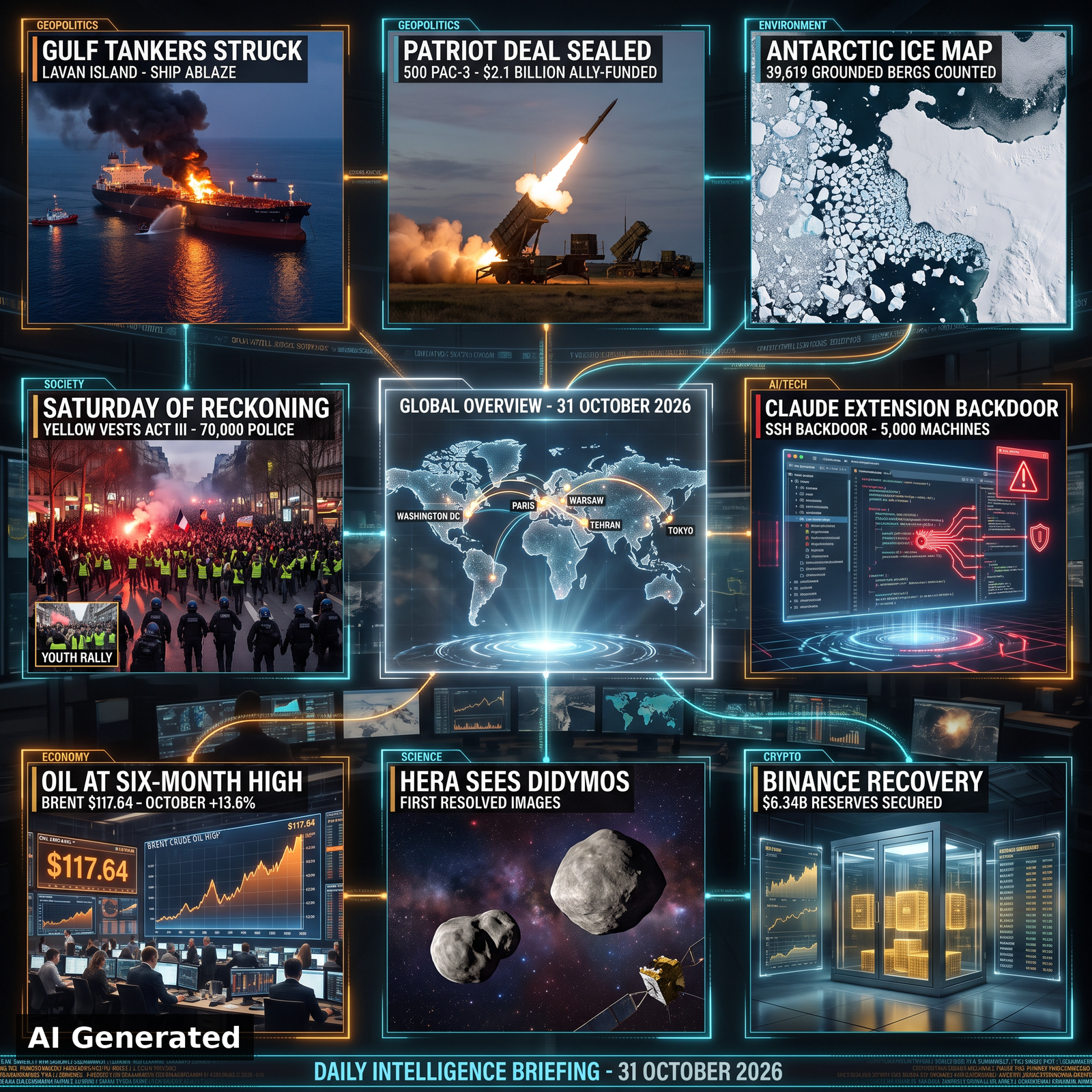
The D153 window opens with the Iran file past the threshold D152’s Correlations flagged: preparation has become execution, and the aftermath is being managed on three tracks at once. A vessel was struck by an unknown projectile south of Iran’s Lavan Island, catching fire with its crew reported safe by the UKMTO, and a second ship was hit near Iran’s coast in the same theatre — the latest in the sequence of four burning tankers and an Oman-side attack D152 logged [1] [2]. That the incidents cluster around the Lavan terminal, through which much of Iran’s crude transits, matters almost as much as the attacks themselves: every fire in the approach channels tightens the insurance and routing arithmetic already pushing Brent to six-month highs [3].
The American posture has hardened in parallel. Ten heavy U.S. military transports have delivered weapons and interceptor batteries to Israel’s Ovda and Nevatim bases, a pre-positioning step Israeli public broadcast reads as readiness to renew strikes on Iran [4]. And surface-to-air missile batteries have been emplaced around Mar-a-Lago and its nearby airport under NORAD/USNORTHCOM at the Secret Service’s request — the first visible layer of homeland air defence against the drone-threat stream D146-D147 documented, and an implicit admission that a revenge attack on the president is treated as a live scenario [5]. The two developments frame Washington as simultaneously escalating forward and fortifying at home: the classic signature of an operation believed imminent but not yet announced.
Ukraine’s Two Tracks: The Patriot Book and the Army Ledger
Ukraine’s file splits into procurement and force structure. The State Department cleared the sale of 500 Patriot PAC-3 interceptors worth $2.1 billion, funded entirely by allies — Canada, Germany, Norway via JUMPSTART plus EU credit — with no U.S. funds engaged [6] [7]. Zelenskyy praised the decision while warning delivery “could take years,” restating the timeline gap D150-D151 identified as the core air-defence vulnerability [6]. On force structure, he told interviewers Ukraine will maintain an army of 800,000 unless NATO membership changes its requirements, and that the West should finance it — a direct collision with the administration’s insistence that Europe carry the war’s cost and that Kyiv end the fight [8].
The diplomatic track is stuck on exactly those differences. Lavrov, seated at the G20 in Atlanta, boycotted the family photo, attacked the EU and the U.S., and restated that key issues remain unresolved [9]. Yet the humanitarian pilot advanced: hundreds of civilians were evacuated from Russian-occupied Oleshky under the truce brokered by Melania Trump, the first sustained outcome of the arrangement and a small proof-of-concept for the step-by-step de-escalation D151 framed through the same town [10].
The Polish Implosion: A Tribunal Under Police Lock
The window’s most acute institutional crisis is in Warsaw. Police entered the grounds around the Constitutional Tribunal, its PiS-era president Bogdan Święczkowski was suspended, and President Nawrocki aborted his flight to Senegal mid-air, returned, and forced his way into the sealed building amid protests and three arrests, with PiS denouncing a “coup d’état” [11]. The mechanism under the theatrics: parliament nominated five judges on the government’s arithmetic, Nawrocki refused to swear them in, the judges took oaths in parliament anyway citing the Venice Commission, and the suspended president had physically barred them from entering — so Friday’s police operation resolved by force a dispute no constitutional procedure had settled [11].
The EU dimension is inseparable. The Tribunal was already the point of maximum friction between Warsaw and Brussels during PiS rule, with the EU’s court ruling it could not be considered independent; Tusk’s government was elected to “depoliticise” it [11]. The crisis is the sharpest instance yet of the D151-D152 pattern in which democratic institutions resolve legitimacy questions under conflict pressure — here, Poland’s role as NATO’s logistics hub for Ukraine — and its outcome will test whether Brussels can restore rule-of-law norms in a member state without a domestic constitutional breakdown.
The Eastern Mediterranean Ledger and the Wider Periphery
In the East Med, Mitsotakis used the Manama Dialogue to call the Turkey-Libya memorandum “null, void and completely illegal,” invoked the Greece-Egypt delimitation as the lawful precedent, and insisted the Great Sea Interconnector and EMC data link not be held hostage to unresolved delimitation — consolidating the Greek-Israeli-Egyptian alignment that isolates Ankara’s position and tying the naval file to the Hormuz events [12]. Against that backdrop, nine Turkish aircraft flew violations over the Aegean with two simulated engagements, as Erdogan reiterated that no Cyprus settlement is possible without Turkish-Cypriot rights [13] [14]. The industrial counterweight arrived the same day: the Hellenic Navy took delivery of the second FDI frigate, HS Nearchos, with more than 75 Greek companies in the programme — procurement, not speeches, is changing the Aegean balance [15] [16]. The wider periphery moved too: the UN renewed UNSMIL in Libya with Greece and Russia abstaining — Athens over weakened law-of-the-sea language, Moscow over the “4+4” endorsement [17]; the Saudi-led coalition intercepted a Houthi drone over Medina, the second such engagement near the holy cities this week [18]; in the Sahel, the Chad-Niger crisis moved from accusation to Russian-mediated diplomacy at the Moscow summit after Niamey accused N’Djamena of a French-backed drone strike in Agadez [19]; Argentina’s La Libertad Avanza advertised three FREMM frigates and two Type 209NG submarines not yet selected, confirming a naval re-armament trajectory in the Falklands-shadowed South Atlantic [20]; and Canada and the EU announced a formal partnership against Trump’s tariff hostility, with Carney floating Canadian “Associate Membership” in the Union [21].
The Indo-Pacific, the UN Succession and the Defence-Industrial Base
Three strands complete the section. In the UN leadership race, the seventh informal vote under Greek presidency produced a setback for the Emirates’ Lana Nusseibeh while Costa Rica’s Rebeca Grynspan kept pole position [22]. The Western Sahara file reopened with Russia vetoing the U.S. resolution to renew the MINURSO mission, the first lapse of its mandate in fifty years [23]. In the Indo-Pacific, the US-Japan-South Korea ministers reaffirmed the denuclearisation pledge after an unscheduled North Korean launch, Albanese headed to the Commonwealth summit between domestic “spot fires” and a likely RBA hike, Japan’s Taigei-class submarine programme drew fresh attention as the PLAN counterweight, and China claimed launch-and-recovery of the stealth GJ-21 drone from the Type 076 — which, if confirmed, gives the PLAN the world’s first ship-borne fixed-wing UCAV [24] [25] [26] [27]. Moscow, meanwhile, pressed its split-the-West line with Putin declaring Russia “ready” for war with Europe while insisting it does not want one [28]. On the industrial base, the NSWC Corona 3D-printed submunition clip and the $660-million PAC-3 Edge hypersonic-interceptor contract confirm the ledger’s tilt toward cheap, incremental capability [29] [30].
Environment & Climate ↑ Contents
Biodiversity’s Global Ledger: COP17, the Nature Talks and the Money Gap
At COP17 in Yerevan, parties adopted a package of key texts late Friday — a global stocktake of the 2022 Kunming-Montreal framework plus widened donor arrangements — after two weeks of deep disagreement over finance [31]. The settlement mirrors the parallel biodiversity talks that reached “a deal while money remains an issue” [32]. For the D144-D151 biodiversity-governance thread, Yerevan is the first checkpoint that the 30×30 target can survive the donor politics D150 flagged as the movement’s weak point [32].
Two data points sharpen what “protection” means on the ground. McGill produced first detailed maps of threats to freshwater biodiversity — farming, dams, runoff dominant, Europe and Northwest Africa hardest-hit [33]. And a disease threat to cacao has researchers proposing a resistant new variety, a reminder that agricultural genetics is a frontline of species survival [34].
The Innovation and Infrastructure Front
As of September 2026, over 16% of new U.S. utility-scale solar capacity is co-located with operable battery storage, up from 2% in 2017 [35]. Storage is now a default co-investment, while Wyoming’s partnership with the administration on expedited permitting liberalises the approvals side [36]. The contested ground remains the one D148-D151 flagged in Texas and Alabama: community permission is the bottleneck, with data-centre developers who once counted on Texas as “the best place” to build forced to negotiate with localities wary of power-bill and water costs [37].
The same infrastructure logic is visible in transport and fuels. A bamboo-derived fuel priced at $2.75 per gallon entered the conversation as an alternative for the internal-combustion fleet that will outlive the passenger-EV transition, a niche but real complement to the electrification agenda [38]. The pace of fleet turnover, in the United States and elsewhere, remains a function of policy continuity — precisely the variable that the Trump administration’s rollback of methane rules and its state-level permitting acceleration keep testing on both sides of the ledger [36].
The Cryosphere and the Living Ledger
The Antarctic file produced what may be the most consequential dataset of the window: Australian scientists built the first high-resolution map of grounded icebergs around the entire continent, counting 39,619 bergs anchored in place from satellite radar imagery, and found the small bergs that most surveys overlook may be holding coastal fast ice in place “like posts in a picket fence” [39]. With 92.6% of the count and 53.9% of the mapped area composed of bergs under one square kilometre, and 2025 having brought the lowest summertime fast-ice extent on record, the study implies a feedback risk: the very features pinning the ice shelves that slow the glaciers behind them are the most vulnerable to warming-driven “ungrounding” — a mechanism that directly extends the D151 Antarctic-sea-ice-loss arc and sharpens the projections about Thwaites and the western Getz system [39].
Two further stories complete the living ledger. The microplastics-health file gained laboratory specificity: new research shows that contact between microplastic chips and water releases unstable molecules linked to inflammation in the human body, while a companion estimate puts Europe’s 2026 summer heat deaths at 50,000 in urban areas with human-induced climate change a significant contributor — the two findings forming a single grim equation about the physical cost of the fossil economy [40]. On the conservation-positive side, rescued orangutans returned to a Borneo forest and the lemur conservation coalition marked World Lemur Day with its corridor-reforestation programme in Madagascar — incremental, community-centred restorations that remain the counterpoint to the global frameworks’ funding gap [41] [42]. Even the environmental-justice periphery is represented: the women-led resistance to development harms across Asia, from the Pak Mun dam to other IMF/World-Bank-funded projects, held its people’s tribunal in Bangkok, keeping the distributional question of who pays for “development” firmly on the record [43].
Two weather-and-pollution items round out the environment file. The UK’s “wettest week in two years” is set to give way to as many as ten dry days as high pressure builds across the country at the start of November — a sharp swing that carries implications for flood recovery, water supply and the autumn harvest, and which the D151 Atlantic-winter ledger will need to track [44]. In the United States, lawmakers and Maryland regulators are still pressing the Air Force and the administration for answers on the continuing jet-fuel contamination from the Joint Base Andrews spill that has been threatening Piscataway Creek for more than seven months — a reminder that the environmental-accountability backlog the region faces is not confined to civilian industry [45].
Society & Civil Issues ↑ Contents
The European Street: France, Italy, Germany and the Saturday of Reckoning
France’s Yellow Vests “Act III — Halloween” brings an estimated 150 demonstrations and 70,000 police onto the streets under the shadow of the 17 October riots, while Germany’s “GenZ regelt!” network holds its first nationwide rallies for affordable living across four major cities and thirty more [46] [47]. The movements share the same grievance — housing, education, cost of living — but face opposite enforcement postures: Paris warns openly of “urban violence comparable to 17 October,” Berlin reports “no specific indications” of planned violence while flagging possible left-extremist infiltration [46] [47]. Italy adds a third point: tens of thousands marched in Rome and Turin for wages and public services, with police using water cannons in both cities [48].
Underneath the Saturday choreography sits the fiscal-space question this arc keeps circling. France’s answer is visibly constrained: Fitch affirmed the A+ rating while downgrading the outlook on slowing growth and fiscal “deterioration” [49]. Germany is similarly squeezed: Berlin’s Left Party holds its pivotal congress Saturday on whether to enter coalition talks with SPD and Greens, with Hamas-adjacency concerns and Mayor-Elect Eralp’s security fears the stated obstacles [50].
Britain’s Civic Files: Slavery, Fireworks and the Remote-Work Question
Prime Minister Andy Burnham’s Commonwealth week in Antigua fused the moral and the fiscal. He voiced “sorrow and regret” for the transatlantic slave trade and said he is “open” to a formal British apology, while firmly ruling out reparations as “not the right answer” — a calibrated position that keeps the UK’s Caribbean flank warm without committing to the ledger the Caribbean reparations commission has presented [51] [52]. The stance is the same triangulation D148 logged in the Commonwealth context: apologise for the past, decline the transfer, and use the summit to reposition Britain as the anchor of a post-Brexit Commonwealth economy.
On the domestic front, two data points profile the state of British civil society. NHS England recorded 85 firework-related hospital admissions last November, up from 60 a year earlier, prompting the usual pre-Bonfire-Night warnings — a small but telling indicator of how the annual spectacle taxes the health service [53]. And a new workplace survey found that nearly half of work-from-home adults aged 18-24 report feeling lonely, with young people more affected by workplace mental-health strain than the general population — the first hard generational evidence that the remote-work settlement negotiated during the pandemic has an unmeasured social cost, one that intersects with the Gen-Z affordability protests across the Channel [54].
Midterms Week Zero: Courts, Ballots and the Integrity Perimeter
With the American midterms now days away, the integrity file has gone tectonic. A federal judge issued a sweeping order blocking the Trump administration from threatening or intimidating election officials with criminal charges, and separately barred the federal government from moving to separate ballots in disputed counts — rulings that landed as civil-rights groups warned that citizenship-related ballot amendments on the slate could sideline millions of voters [55] [56] [57]. The Alaska Senate race, already the rawest nerve of the cycle, deepened: the House Oversight Committee is investigating whether a Democrat’s doppelgänger candidate was recruited to siphon votes from the incumbent Republican, and French coverage of the same cycle flags the administrative burden citizenship amendments place on naturalised voters in swing states [57] [56]. Michigan adds a sectarian temperature reading to the same file: former primary rivals Haley Stevens and Abdul El-Sayed are clashing over an Israel-related advertisement just as they are scheduled to appear at a joint rally in the state’s pivotal Senate race, showing how foreign policy has migrated into the final stretch of an American campaign [58].
The digital-integrity perimeter widened on the same clock. Graphika identified China-linked “Spamouflage” accounts posing as U.S. voters on X, active ahead of the midterms — the first confirmed foreign-influence operation of this cycle with a voter-identity angle [59]. The disclosure interlocks with the D142-D144 threads on authenticity and platform trust: when the state itself is litigating who may vote, and foreign actors are impersonating voters online, the electoral process becomes a dual computation of ballots and belief [59] [55].
Health, Violence and the State’s Reach
The Ebola ledger reached a grim milestone: the death toll in DR Congo passed 5,000, with authorities reporting they still lack approved treatments or vaccines and struggle to control the outbreak — the Region’s worst public-health emergency since the West African epidemic, and one that D141’s “Ebola readiness in 22 countries” arc explicitly warned about [60]. In the Americas, the New World Screwworm infestation spread to a third state this week — Arizona joining New Mexico and Texas with 74 animal cases confirmed since the flies re-invaded the U.S. in June, and pet owners now reporting attacks on dogs and cats, an animal-health and border-biosecurity file with livestock-sector stakes [61].
Brazil’s post-election integrity file also belongs to this ledger. Flávio Bolsonaro, the defeated candidate, has publicly stated he left Brazil to escape what he calls a prosecution that “began much earlier than I imagined,” travelling to the United States via Argentina and Ecuador and insisting the elections were rigged — claims his party has echoed even as Lula prepares for a fourth term mired in the same unresolved-annulment questions D148 documented [62] [63]. Meta’s role in the Brazilian campaign has come under scrutiny, with Greek press reporting the Zuckerberg platforms “openly favoured” Bolsonaro in their algorithms [64]. The pattern is the one D148-D151 named “the democratic test under escalation”: a narrow electoral outcome, a defeated camp that refuses recognition, and a platform layer that magnified the winner’s messaging — now exported to a U.S. midterm whose courts are already arbitrating the same questions [62] [64].
Finally, the human-cost ledger of the energy wars surfaced in a human story with systemic meaning: the Guardian documented how the MV Odyssey, a “never-ending” retirement cruise marketed as an escape from global turmoil, was abandoned in Cambodia when the oil shock triggered by the Iran war made its continuous voyage unviable — passengers given seven hours to disembark [65]. The episode is a small mirror of the wider finding that the war’s costs are being paid by the least-protected consumers, from cruise retirees to the Canadian paper-town workers D152 documented under Trump’s tariffs [65] [66].
The press-freedom and justice files complete the society ledger. Russia’s most prominent investigative newspaper, Novaya Gazeta, announced it is closing, with staff accusing the government of killing it off amid murders, arrests and legal pressure — the disappearance of the last major independent outlet in Moscow, a civic-infrastructure loss the D139 “press freedom” arc must register [67]. And Spain’s rail tragedy gained a cross-border judicial dimension: as the three-day national mourning for the 69 dead in the derailment ended, a Greek judge has been assigned to the investigation, and reports have emerged that warnings about signalling defects were available three weeks before the crash — the “chain of errors” D151 started documenting is now the focus of a formal judicial inquiry [68].
AI & Technology ↑ Contents
The Trust Perimeter: Red Teams, Backdoors and the Supply Chain
The model-security file produced its most damaging data point of the cycle. Anthropic’s Claude-code VS Code extension distributed through the Cursor marketplace was backdoored for nearly twelve hours, pushing malicious version 2.1.313 to as many as 5,000 developer machines before its replacement at 2.1.314; security researchers credit it as a supply-chain compromise in which the attacker gained control of Anthropic’s official distribution account — the strongest evidence yet that AI-tool distribution channels have inherited the same single-point-of-trust vulnerability the PHP ecosystem exposed in D144 [69]. The stakes are compounded by Anthropic’s own two-track story: a Sacks-linked report credits its AI with already handling some 26% of the company’s core R&D work, while separately the company has been deploying Claude agents to stress-test its training-data monitors, publishing findings that disguised harmful content can still bypass current safety measures — red-teaming the red-teamers, as it were [70] [71].
The governance perimeter is being drawn at the same seams. Pope Leo XIV used the platform of the papacy to restate that AIs are not conscious beings and to urge an autonomous-weapons ban, injecting a moral authority into the machine-consciousness debate that D149’s OpenAI-proofs arc had been conducting in purely technical terms [72]. And on the infrastructure side, Nvidia is weighing a role as cosigner for Nscale’s AI data centre in West Virginia — the chipmaker effectively guaranteeing the loan of a customer building on its own chips, a telling symbol of how capital and compute are now interlocking in the AI build-out [73].
Autonomy and the Consumer Layer
In the physical-autonomy lane, Toyota and Waymo announced the next phase of their autonomous-driving collaboration, moving from the 2025 preliminary agreement to initial operations validating a new generation of robotaxis in the UK and beyond [74]. The announcement continues the D143-D150 “autonomy at the physical frontier” thread, but its timing is notable: it lands the same week GM agreed a $220 million settlement over its OnStar Smart Driver programme’s covert collection and sale of driver data, with the FTC requiring express consent going forward [75]. Together the two stories frame the industry’s central bargain — autonomy’s promise of safer streets is being sold against a documented record of treating the driver’s data as a product, and regulation is beginning to price that record [74] [75].
Two corporate moves round out the sector. Salesforce’s reported $375 million acquisition of defence-tech startup Rune — an AI logistics company bolting onto its Missionforce platform — extends the CRM giant’s M&A spree into the military-logistics niche, evidence of the “defense-tech meets enterprise software” convergence D150 flagged in the F-47 and missile-procurement items [76]. And Boom Supersonic’s pivot to building gas turbines for AI data centres rather than airliners, with United’s CEO openly doubting the 2029 Overture timeline, shows the AI build-out absorbing even the supersonic-aviation supply chain [77]. Apple’s announcement that Apple Intelligence arrives in China with iOS 27.3, paired with Alibaba Qwen support, completes the geographic expansion of consumer AI — and sets up the compliance question of how a Western model stack operates under Chinese AI regulation, the inverse of the D147 “China already has AI rules” debate [78].
Economy & Business ↑ Contents
Oil at Six-Month Highs and the AI-Capital Reckoning
Brent settled above $117 a barrel, up 2.4% on the day and 13.6% for October, with WTI up 15.2% on the month; the six-month highs came as traders priced post-midterm strike risk on Iran at a moment when every Hormuz tanker incident tightens the supply-risk premium [3]. The October move completes a decisive leg of the D139-D152 “war premium” arc: energy now dominates the macro picture, and the month-on-month gains are large enough to feed the inflation read-outs central banks will confront in November [3].
The AI-capital ledger, meanwhile, produced its starkest single-day number since June: the Nasdaq 100 posted its largest one-day drop since June 5 on AI-spending fears, dragged by the mega-cap earnings that D151’s “AI-capital test” had flagged as the market’s single bet [79]. The same fears moved the private capital front: OpenAI cut its fundraising target by roughly a third to about $20 billion at a $1.25 trillion valuation as tech-stock volatility hit the IPO pipeline, while Barclays began mapping the AI credit-default-swap market — inventorying, in effect, the leverage that has financed the compute build-out and is now being hedged against exactly the outcome today’s sell-off implies [80] [81]. The BOJ’s warning, logged in D152, that AI earnings must grow with investment or “adjustment pressure could occur alongside asset-price shifts,” is now being stress-tested by the market itself [81].
China’s Two Numbers and the Banking Reforms
Beijing’s October PMIs broke below the expansion line for the first time in months: the official manufacturing PMI printed 49.3 against September’s 50.1, and the non-manufacturing gauge slipped to 49.7 from 50.2, the composite slipping below 50 as well [82]. The sub-50 readings matter because they arrive exactly as the fifth plenum consolidates Xi’s grip and as Beijing tries to present the economy as re-accelerating — the D148 yuan-strength and D150 GDP-acceleration narratives now collide with hard evidence that both factory and service activity are contracting at the margin [82] [83]. The Thai Dawei gateway story captures the same regional reality from the demand side: after three decades of struggles, Thailand is looking west to the Indian Ocean corridor as growth slows, a strategic-turn reminder that India-Pacific infrastructure projects are being re-weighted by exactly the global slowdown China’s PMIs are now measuring [83].
India’s policy machinery is reacting to the same global headwinds with institutional reform rather than stimulus. NITI Aayog vice-chairman Ashok Lahiri argued against a “knee-jerk expansionary” response to rising global inflation, El Niño risk and Hormuz uncertainty [84]. And the finance ministry constituted a six-member panel under former CVC Suresh N Patel to review banking regulation, capital requirements, priority-sector lending and digital innovation with an eye to global competitiveness — the clearest signal yet that New Delhi intends to answer the global credit tightening with structural supply-side reform, not demand management [85].
Europe’s Fiscal and Labour Files
France’s rating file was resolved for the moment but only just: Fitch affirmed the A+ sovereign rating while cutting the outlook to negative, warning that slowing growth and a “deteriorating” budget picture and borrowing costs are pressing on the rating; the move, a week after Moody’s held France, leaves the eurozone’s second-largest economy on a negative trajectory that D150-D151’s “French debt crisis” arc will track into the 2027 budget fight [49]. Germany’s IG Metall escalation belongs to the same cost-push story from the labour side: warning strikes become possible from Sunday as the union calls for 5% pay for roughly 900,000 metal-and-electrical workers in Baden-Württemberg against an employer offer worth about 1.3%, with Siemens, Porsche, Mercedes-Benz and ZF named as likely venues; the employers cite Europe’s largest structural industrial crisis in post-war history in their pushback [86]. The German retail-investment story adds a household dimension: a bank federation survey finds many Germans open to equities but deferring provision, a savings-culture shift D148’s “Altersvorsorgedepot” thread will need to absorb [87].
The transatlantic trade file produced its most concrete local casualty: the century-old paper mill in Témiscaming, Quebec, closed indefinitely after the U.S. imposed 50% tariffs on its products, putting hundreds out of work even as residents fight to save the town [66]. The closure is exactly the “tariff shock hits the periphery” outcome that the Canada-EU partnership story in the geopolitics section is meant to counter, and it gives a human ledger to the Section 232-style trade war [66] [21]. Finally, Greece’s enhanced-surveillance exit moved to the top of Athens’s agenda with the government seeking to end the post-memorandum supervision by year-end, a political and market-signal play that consolidates the D150-D152 “Greek fiscal success story” narrative as Mitsotakis borrows below several G7 peers [88].
The corporate file added a pharmaceutical-strategy datapoint: Boehringer Ingelheim’s CEO, speaking at the Asia-Pacific conference in Seoul, argued the West has “no monopoly on innovation” as Chinese drug development races ahead, and announced a Microsoft partnership to use AI in clinical trials that his firm says could halve development timelines [89].
Science & Space ↑ Contents
Spaceflight’s New Frontier: NavIC Refill, Hera and the Hubble Question
India’s GSLV placed the NVS-03 navigation satellite into orbit, restoring NavIC to four operational satellites and strengthening New Delhi’s indigenous positioning capability [90]. The milestone extends the D141-D146 Indian space arc into the civilian-military navigation layer [90].
ESA’s Hera probe returned the first resolved images of the Didymos-Dimorphos pair after DART’s 2022 impact, separating the two asteroids for the first time and providing the geological follow-up that will test whether kinetic deflection reshaped Dimorphos [91]. On the strategic-observation side, NASA issued a Request For Information to commercial companies on how to reboost, service or safely dispose of the Hubble Space Telescope, whose orbit is decaying with no shuttle to rescue it; responses are due 30 November, and the RFI effectively opens a market for commercial servicing of a flagship observatory [92]. And theoretical astrophysics pushed one step further into unsettled territory: a European group examined the conditions that could split a black hole apart, an exercise that strains the limits of how gravity, entropy and event-horizon mechanics are understood [93].
The Biomedical Ledger: Cancer, Diabetes and the Ageing Cell
Two translational-medicine findings dominated the human-health file. Georgetown researchers uncovered a mechanism explaining why breast cancer becomes deadlier with age — in older mice, tumours metastasised to the lungs far more readily even when primary growth rates matched younger animals’ — identifying the ageing microenvironment itself as a driver rather than just a passenger of disease severity [94]. And a Chinese team demonstrated that Huayu Wan, a 15-ingredient traditional-medicine formulation long used for abdominal masses, kills cisplatin-resistant oesophageal squamous-cell carcinoma cells in the lab by forcing ferroptosis and synergising with anti-PD-1 immunotherapy in mice — a rare mechanistic dissection of an ancient formula against the exact drug-resistance problem that defines modern chemoresistant disease [95]. Both studies are preclinical but both reposition “adjacent” variables — age and traditional pharmacology — as legitimate targets, themes D140-D151’s “human body ledger” has repeatedly circled [94] [95].
Metabolic science added two findings with direct prevention relevance. A clinical trial identified a molecular change in skeletal muscle — an unusually abundant protein in Type-2-diabetic patients that interferes with insulin response — helping explain why exercise improves insulin sensitivity, and opening a new drug target [96]. Separately, peanut consumption left a distinctive chemical fingerprint in blood linked to lower Type-2-diabetes risk in a German cohort study — a concrete dietary signal in the same prevention file [97]. Together the two data points reinforce the D145-D151 metabolic arc that has been accumulating evidence for modifiable lifestyle pathways in the diabetes epidemic [96] [97].
Materials, Cells and the Living Deep Archive
On the energy-materials front, South Korean researchers reported a polymer-based deep-eutectic-solvent electrolyte for sodium-metal batteries delivering 90.4% capacity retention after 1,000 cycles at 2C and non-flammability, addressing the dendrite and safety barriers that have blocked sodium — an abundant, cheap, lithium-alternative — as a grid-scale chemistry [98]. Chinese scientists published SmartPE, a gene-editing system that improves prime-editing efficiency in dicot crops such as tomato, soybean and rapeseed, directly addressing one of plant-genome-editing’s biggest bottlenecks [99].
The “deep archive” of biology produced two bracing results. Chernobyl’s dog populations — more than 30 generations removed from the 1986 disaster — carry genomic signatures of directional selection concentrated near genes for cancer, immune response, cell maintenance and infectious disease; the analysis suggests the dogs that survived initial exposures brought genetic variants conferring a higher fitness floor, a live experiment in adaptive genetics under toxic stress [100]. And Antarctica, it turns out, has its own microbiology: of 36 Arthrobacter strains found in Antarctic soils, 90% occur nowhere else on Earth, with smaller genomes and faster gene-swapping than global counterparts — endemism at the microbial level contradicting the “everything is everywhere” assumption, and raising conservation stakes for soils the ice pack is already exposing [101].
Two bioscience-technique stories complete the section. A spatial-mapping study reconstructed human urogenital organ development in its native context, revealing how neighbouring organs coordinate via cellular communication during embryogenesis — foundational anatomy with direct implications for congenital-disease research [102]. And Cortical Labs demonstrated a robot dog directed by lab-grown neurons grown directly on chips, the first physical-world embodiment of its DishBrain platform after Pong and Doom — a proof-of-concept for biological-compute control systems whose energy-efficiency advantages the Honda-partnered virtual grid experiments are beginning to quantify [103]. Chile’s 2,175-mile undersea cable converted into an earthquake sensor — magnitude estimated within five seconds of first arrivals via the Ps wave — closes the ledger with an applied-physics example that fuses telecom infrastructure and seismology [104].
Astrophysics closed with a detection-methodology story: radio telescopes are emerging as a viable route to the origins of cosmic neutrinos, the near-massless “ghost particles” that stream from supernovae and other exotica through the Earth undetected by conventional optics [105].
Crypto, Digital Assets & Blockchain ↑ Contents
The Record Theft’s Aftermath: Reserves, Laundering and the Withdrawal Clock
The Binance breach — the largest crypto theft on record at roughly $6.3 billion — entered its recovery phase in this window, and the numbers now on the public ledger tell a story that is simultaneously reassuring and unsettling. The exchange has set aside more than $6.34 billion in company funds, of which about $5 billion is already held in-kind in the exact token mix that was drained (USDC, USDT, BTC, ETH, BNB and others), with the remaining roughly $1.3 billion being acquired through market and OTC purchases; the co-CEOs signed the disclosure themselves, withdrawals were targeted to resume about 34 hours after Friday’s update, and a proof-of-reserves snapshot was due by 2 November [106] [107]. The in-kind composition is the detail analysts are watching hardest: roughly four-fifths of the liability is already “covered” in the same assets that just sold off, meaning the exchange’s balance sheet is, in part, a bet on the very tokens that were stolen [106].
The forensic picture worsened in parallel. Chainalysis identified “never-before-seen” laundering patterns as the attackers circulated stolen assets through thousands of transactions with automated obscuration, and tied the theft to North Korean hackers — the attribution previewed in D152’s coverage and now confirmed on the record [108]. The non-freezable reality of the haul is the structural weakness: while stablecoin issuers can blacklist Tether and USDC — and roughly $2.4 billion was frozen across issuers in the immediate aftermath, on top of $30.5 million frozen by the Arbitrum Security Council and $3 billion total frozen by the exchange — cryptocurrencies without an issuer freeze only come back if the attacker is identified; $120 million in TRX was already moving to an unknown wallet in plain sight, and exchanges industry-wide are tightening security precisely because the laundering pipeline has proven so adaptable [109] [110] [108]. The proof-of-reserves date, in other words, tests far more than Binance’s solvency: it tests whether the settlement layer’s stability model — centralised issuers and governance councils acting as fire departments — can survive its own largest failure, the exact question D152’s Correlations section posed for this reporting period [106] [107].
Institutional Rails Under Stress and in Expansion
The institutional story runs in both directions simultaneously. On the risk side, the industry’s revenue base is visibly contracting: global blockchain revenues are projected to fall about 30% year-on-year to $100 billion in 2026, with infrastructure revenues at their lowest since 2020 and DeFi/finance accounting for roughly two-thirds of what remains — a demand-side reality check on a sector that spent 2025 pricing in runaway growth [111]. The lending protocols are still unwinding their own stress events: Aave reopened several recently frozen markets but has blocked new collateral loans, with LlamaRisk reporting the main emergency batches executed while practical access still depends on available liquidity and collateral rules — a governance-recovery template that D144’s DeFi-consolidation arc predicted would follow the year’s freeze events [112].
On the expansion side, the rails keep multiplying. Franklin Templeton launched a pair of bitcoin dividend ETFs — FBEQ and FIBT — on Nasdaq, channelling company dividends into BTC with quarterly rebalancing, a $72,000 first-day trading debut that is small in volume but significant as the first dividend-to-bitcoin conduit marketed to the retail-adjacent income audience [113]. Mirae Asset launched tokenised notes and Kamino expanded lending on Solana, even as no verified retail purchase route for SOL exists in the U.S. — the institutional/retail access gap D148-D151 repeatedly identified on that chain [114]. And Strategy’s (MSTR) Q3 earnings call made two things explicit: the balance sheet is now dependent on “financialised” bitcoin products — digital credit, preferreds and tokenised MSTR — and the absence of a U.S. token standard is becoming the binding constraint on the treasury-company playbook, with the Euro-listed STRE preferreds singled out as structurally challenged [115]. The pattern across all four stories is the same one D147’s “institutional rails” section predicted: growth is real, but it is being financed and secured on terms that require issuers, ratings and standards — precisely the intermediaries the self-custody thesis D152 tested and found wanting [115] [114]. None of the new instruments removes the underlying exposure: a dividend-to-bitcoin ETF still depends on companies earning cash by other lines of business, tokenised notes still depend on the collateral quality behind them, and the treasury-company balance sheet still depends on bitcoin appreciating while the industry’s own revenue base contracts [113] [111].
Correlations & Analysis ↑ Contents
The governing fact of the D153 window is that the collapse between announcement and event — the organising logic this report has traced since D138 — has now completed its circuit in three theatres simultaneously. D152 documented the Gulf as the moment strike preparation became strike execution (Qeshm, Hormuz, four burning tankers); today’s window adds the pre-positioning ledger behind that execution: ten heavy transports delivering interceptors to Israeli bases, Patriot batteries relocated from Texas, and surface-to-air missiles deployed around Mar-a-Lago against the drone-threat stream the same reports had been tracking [4] [5]. The same 96-hour logic D150 imposed on the strike clock now applies to Washington’s own physical security: an administration preparing an operation after the midterms is simultaneously preparing the retaliation that operation invites, and the second week of November will test whether the conjunction of an Iranian revenge plot, a U.S. electoral calendar, and a homeland SHORADS deployment holds together without a detonation somewhere in the chain [5] [9].
The second thread uniting the window is the transformation of “rule of law” from a Brussels technicality into a live determinant of European security. D151 tracked France’s Senate, Germany’s coalition arithmetic and the Spanish rail inquiry as separate files; today Poland’s constitutional crisis fuses them. The Tusk government’s police action at the Constitutional Tribunal, Nawrocki’s mid-air abort and his forced entry into the sealed building, and the PiS “coup d’état” charge all occur in the NATO logistics hub for Ukraine — the same Poland whose courts, under PiS, were already the EU’s most contested institution [11]. The D148 finding that democratic outcomes under military-escalation pressure tilt toward security over pluralism is now visible inside the state apparatus itself: both sides are invoking security — Tusk’s restoration-of-law duty, Nawrocki’s defence of judicial independence — and the Tribunal’s fate will be decided by force if no constitutional mechanism reasserts itself [11]. The Paris “casseurs-payeurs” bill D150 logged, and the Berlin coalition talks’ antisemitism brawl in D152’s counterpart, are the same pattern in France and Germany: the state’s coercive instruments being re-legitimated against civil disruption [47] [46].
The third thread is the financialisation of both the war and the peace. The Binance recovery, engineered through $6.34 billion of set-asides and an in-kind reserve, is the perfect mirror of D152’s central warning about concentrated leverage: D142-D151 documented the exchange layer as the hardened settlement rail, and the $6.3 billion breach proved the hardening was a function of centralised issuers and governance councils acting as fire departments [106] [108]. The industry’s own revenues are now contracting 30% even as Franklin Templeton, Mirae, and Strategy push new tokenised products — growth purchased on the same credit terms that the Barclays AI-CDS map and the Nasdaq one-day crash are pricing into the AI complex [111] [79] [81]. The BOJ’s warning from D152 — that AI earnings must grow with investment or adjustment pressure will surface — now has a companion warning from the market itself: OpenAI has trimmed its funding target by a third in the same week the Nasdaq shed its largest one-day value since June, and the two facts are the same fact viewed from the private and public capital side [80] [79].
The cyber dimension crosses every thread. The Anthropic/Claude extension backdoor, Graphika’s Spamouflage voter-impersonation network, and the automated laundering of the Binance haul are three instances of the same structural truth: identity and trust layers — code-signing, platform accounts, on-chain attribution — are the soft underbelly of the digital state in 2026 [69] [59] [108]. D144’s PHP flaw taught that supply-chain trust is global; D153’s three incidents show the attack surface has migrated to the exact layers the AI economy and the electoral calendar now depend on. The judges blocking voter intimidation in Alaska and Washington, the FTC’s GM settlement on driver-data harvesting, and Pope Leo’s autonomous-weapon injunction are all responses to the same question: who is authorised to act, and who verifies the authorisation [55] [75] [72].
What to watch in the next reporting period: first, whether the post-midterm window produces the Gulf operation Washington’s pre-positioning implies, and whether the Mar-a-Lago SHORADS deployment is expanded as retaliation risk peaks [4] [5]. Second, the Polish Tribunal’s next acts — whether the newly sworn judges convene, whether Nawrocki escalates, and whether Brussels chooses instruments or silence [11]. Third, Binance’s proof-of-reserves result and the phased withdrawal restart, which will set the market’s verdict on whether the exchange model survives its own largest failure [106]. Fourth, the Saturday street calendar — France’s Halloween protests and Germany’s Gen-Z rallies — where the gap between professed non-violence and the security services’ infiltration warnings will be tested empirically [46] [47]. Fifth, the midterm integrity rulings and the Graphika disclosure, which together will provide the first sustained test of whether the U.S. can hold an election while its own institutions litigate the rules of that election [55] [59].
References ↑ Contents
1. Ιράν: Πλήγμα και πυρκαγιά σε πλοίο νότια του νησιού Λαβάν by Greece · Source ↑
2. Νέο πλήγμα σε πλοίο κοντά στο Ιράν: Χτυπήθηκε από άγνωστο βλήμα και ξέσπασε φωτιά by Greece · Source ↑
3. Ενεργειακός συναγερμός: Σε υψηλό εξαμήνου οι τιμές του πετρελαίου υπό τον φόβο κλιμάκωσης του πολέμου με το Ιράν by Σωτήρης Ζιώμας · Source ↑
4. ΗΠΑ-Ισραήλ ετοιμάζονται: 10 βαρέα αμερικανικά μεταφορικά με όπλα σε ισραηλινές βάσεις by DEFENCE · Source ↑
5. Surface-To-Air Missiles Deployed To Protect Trump’s Mar-a-Lago Estate by Howard Altman · Source ↑
6. Ukraine’s Zelenskyy praises US over $2.1bn Patriot missile deal but warns it could take years by Guardian staff and agencies · Source ↑
7. U.S. State Department Approved Sale of 500 Missiles to Ukraine for Patriot Air Defense System by Тарас Сафронов · Source ↑
8. Ο Β.Ζελένσκι θέλει να έχει στρατό 800.000 ανδρών – Ζητά η Δύση να τον πληρώνει by DEFENCE · Source ↑
9. Ukraine-Krieg: Lawrow poltert beim G20-Außenministertreffen in Atlanta by Jens Münchrath · Source ↑
10. Hundreds evacuated from Melania-brokered ceasefire town of Oleshky by NEWS · Source ↑
11. Πολωνία: Η αστυνομία εισέβαλε στο Ανώτατο Δικαστήριο με εντολή Ν.Τουσκ (βίντεο) by DEFENCE · Source ↑
12. Μητσοτάκης: Το τουρκολιβυκό μνημόνιο είναι «άκυρο, ανυπόστατο και εντελώς παράνομο» by Defence Review Newsroom · Source ↑
13. Μπαράζ τουρκικών παραβιάσεων με drones και οπλισμένα μαχητικά στο Αιγαίο by DEFENCE · Source ↑
14. Ερντογάν – Ερχιουρμαν: Καμία μόνιμη λύση στο Κυπριακό «χωρίς διασφάλιση των δικαιωμάτων των Τουρκοκυπρίων» by Greece · Source ↑
15. Naval Group delivers second FDI frigate HS Nearchos to the Hellenic Navy by admin-defence · Source ↑
16. Europe strengthens its naval capabilities as FEINDEF 27 opens up new opportunities for industrial cooperation by Dorothee Frank · Source ↑
17. Ανανέωση της αποστολής του Συμβουλίου Ασφαλείας του ΟΗΕ στη Λιβύη: Γιατί Ελλάδα & Ρωσία έμειναν εκτός by DEFENCE · Source ↑
18. Η Σαουδική Αραβία δηλώνει ότι αναχαίτισε drone των Χούθι πάνω από την Μεδίνα by DEFENCE · Source ↑
19. Διπλωματική προσπάθεια εκτόνωσης της κρίσης μεταξύ Τσαντ και Νίγηρα μετά τις αλληλοκατηγορίες by Σωτήρης Ζιώμας · Source ↑
20. Tres fragatas FREMM y dos submarinos Tipo 209NG: La Libertad Avanza difundió las plataformas navales que el Gobierno todavía no seleccionó by Redacción Zona Militar · Source ↑
21. Canada and EU announce new alliance in response to hostility from Trump by Dan Haygarth · Source ↑
22. Vote du prochain secrétaire général à l’ONU : revers pour l’Emiratie Lana Nusseibeh ; la Costaricaine Rebeca Grynspan conserve la tête by France · Source ↑
23. Sahara occidental : le mandat de la mission de l’ONU n’a pas été renouvelé by France · Source ↑
24. FinancialJuice: US, South Korea, Japan foreign ministers reaffirm pledge to finalize North Korea denuclearization – Yonhap by FinancialJuice · Source ↑
25. Albanese looks for reset on world stage as ‘spot fires burn’ domestically and likely interest rate hike looms by Ben Doherty and AAP · Source ↑
26. Japan’s New Taigei-class Lithium-Ion Attack Submarines Summed Up in 1 Word by Isaac Seitz · Source ↑
27. Stealthy GJ-21 Drone Has Launched And Recovered From Type 076 Amphibious Assault Ship, China Claims by Joseph Trevithick · Source ↑
28. Ο Πούτιν θέλει να διχάσει τη Δύση by Δρ. Αθανάσιος Ε. Δρούγος · Source ↑
29. US Navy engineers develop low-cost 3D-printed clip to help prevent deadly bomb blasts by Aamir Khollam · Source ↑
30. Hypersonic Missile Interceptors for Patriot: USA Allocates $660 Million to Develop PAC-3 Edge by Дмитро Шумлянський · Source ↑
31. A la COP17 d’Erevan, malgré les divergences, les Etats s’entendent sur des textes pour tenter de protéger la nature by France · Source ↑
32. Global nature talks reach deal but money remains an issue by Science & Space · Source ↑
33. McGill Researchers Produce Detailed Maps of Global Threats to Freshwater Biodiversity by Environment · Source ↑
34. Global Chocolate Supply Threatened by Disease, New Cacao Plant Offers Solution by Environment · Source ↑
35. The Share of Solar Generation with Co-located Battery Storage Is Increasing by US Energy Information Administration · Source ↑
36. Wyoming Teams With Trump Administration to Expedite Energy, Industrial Projects by Dustin Bleizeffer, WyoFile.com · Source ↑
37. Texas Used to Be ‘the Best Place’ to Build Data Centers—But Not Anymore by Arcelia Martin · Source ↑
38. Fuel From Bamboo Costs Just $2.75 Per Gallon by Steve Hanley · Source ↑
39. Satellites counted 39,619 icebergs stuck in place around Antarctica, and the small grounded icebergs that surveys usually overlook may be holding coastal sea ice together like posts in a picket fence by Adrian Villellas · Source ↑
40. Microplastics, Inflammation, and Your Health; 50,000 Dead from Europe’s 2026 Heat; Saving a Big Bug ‘Down Under’ and more. by World Media Foundation · Source ↑
41. New home for orangutans rescued from Indonesia’s burning forests by Science & Space · Source ↑
42. World Lemur Day: How can we save these primates’ forest homes? by Shreya Dasgupta · Source ↑
43. The women who won’t let go: Female-led resistance to development harms across Asia by Isabel Esterman · Source ↑
44. UK could see 10 days without rain after ‘wettest week in two years’ by Science & Space · Source ↑
45. Lawmakers and Regulators Press Air Force Over Continuing Pollution From Joint Base Andrews Fuel Spill by Aman Azhar · Source ↑
46. Halloween Protests & French Promises, US Mid Term Mood, What now for Israel? by Gavin LEE · Source ↑
47. Bundesweite Jugendproteste geplant – Forderung nach bezahlbarem Leben by Germany · Source ↑
48. Demonstrationen: Zehntausende protestieren in Italien – Kundgebungen auch in Deutschland erwartet by Reuters · Source ↑
49. L’agence de notation Fitch maintient la note A+ de la France, mais abaisse sa perspective by France · Source ↑
50. Parteitag der Linken in Berlin entscheidet über Koalitionsverhandlungen by Germany · Source ↑
51. Burnham ‘open’ to calls for slavery apology but not reparations by NEWS · Source ↑
52. Andy Burnham ‘open’ to calls for Britain to formally apologise for slavery by Oli · Source ↑
53. Firework warning as data shows rise in number of people admitted to hospital by Jane Kirby · Source ↑
54. Nearly half of young adults who work from home feel ‘lonely’, data shows – and it could get worse by Jane Kirby · Source ↑
55. Judge orders Trump administration to stop threatening election officials with criminal charges by Gary Grumbach · Source ↑
56. Voters weigh citizenship amendments as Trump fans fears of noncitizen election fraud by NEWS · Source ↑
57. EN DIRECT, midterms 2026 : en Alaska, la campagne de la candidate démocrate Mary Peltola visée par une enquête by France · Source ↑
58. Haley Stevens and Abdul El-Sayed clash over Israel ad ahead of planned rally together by Casey Wooten · Source ↑
59. Graphika finds China-linked Spamouflage accounts posing as US voters on X by Didi Tang · Source ↑
60. Ebola death toll in DR Congo passes 5,000 by NEWS · Source ↑
61. Flesh-eating screwworms are feasting on pets; 4 dogs and cat attacked this week by Beth Mole · Source ↑
62. «Έφυγα από τη Βραζιλία για να γλιτώσω τις διώξεις», λέει ο Φλάβιο Μπολσονάρου και αποκαλύπτει τι του είπε ο πατέρας του by Greece · Source ↑
63. Βραζιλία: Ο Φλάβιο Μπολσονάρο δηλώνει πως έφυγε από τη χώρα για να γλιτώσει τη δίωξη by Greece · Source ↑
64. Meta: Στο μικροσκόπιο ο ρόλος της στις βραζιλιάνικες εκλογές by Αλέξανδρος Καψύλης · Source ↑
65. The cursed cruise: how the dream of never-ending luxury at sea became a nightmare by Oliver Holmes in Bangkok, Daniel Boffey in London and Adeshola Ore in Melbourne · Source ↑
66. Trump’s tariffs could shutter this Canadian town – its residents are fighting to save it by NEWS · Source ↑
67. Russia’s Novaya Gazeta ‘killed off’ after murders, arrests and pressure by NEWS · Source ↑
68. Τραγωδία στην Ισπανία: Οργή και αναπάντητα γιατί – Ελληνίδα δικαστής αναλαμβάνει την έρευνα by Μαρία Σπηλιοπούλου · Source ↑
69. Anthropic VS code extension on Cursor backdoored for nearly 12 hours by Dan Goodin · Source ↑
70. Anthropic’s AI now handles 26% of core R&D work, report says by Diego Almada Lopez · Source ↑
71. Anthropic deploys Claude agents to stress-test training data monitors by Diego Almada Lopez · Source ↑
72. Pope Leo XIV Reminds World That AIs Aren’t Conscious Beings, Urges Autonomous Weapon Ban by Tom McKay · Source ↑
73. Nvidia weighs playing the cosigner for Nscale’s AI data center in West Virginia by Aditya Mehta · Source ↑
74. Toyota & Waymo Advance Autonomous Driving Collaboration for Safer Streets and Freedom of Movement for All by Press Release · Source ↑
75. GM’s $220M Payout Shows How Cars Can Secretly Sell Your Driving Data by Omar Gallaga · Source ↑
76. Salesforce’s M&A spree continues with a reported $375M deal for defense tech startup Rune by Marina Temkin · Source ↑
77. Supersonic airliner in doubt as company shifts to powering AI data centers by Jeremy Hsu · Source ↑
78. Apple Intelligence is finally coming to China with iOS 27.3 by Jay Peters · Source ↑
79. Nasdaq posts its largest one-day drop since June 5 as AI spending fears hit tech by Diego Almada Lopez · Source ↑
80. OpenAI cuts fundraising target to $20 billion as Nasdaq 100 falls 10% by Dr. Levent Kurt · Source ↑
81. Barclays maps the AI credit default swap market and lays out trades by Diego Almada Lopez · Source ↑
82. FinancialJuice: China October official manufacturing PMI at 49.3 vs 50.1 in September by FinancialJuice · Source ↑
83. Thailand looks west after 30 years of struggles over Dawei by Business · Source ↑
84. Expansionary policy not useful amid inflation risks, says Ashok Lahiri by Business · Source ↑
85. Former CVC Suresh N Patel to lead high-level banking reforms committee by Business · Source ↑
86. Tarifkonflikt: Warnstreiks ab Sonntag möglich – IG Metall erhöht den Druck by Germany · Source ↑
87. Bundesverband deutscher Banken: Umfrage: Viele offen für Aktien – Vorsorge wird aufgeschoben by DIE ZEIT: News – · Source ↑
88. Μπαίνει τέλος στην εποπτεία για την Ελλάδα by Τάσος Δασόπουλος · Source ↑
89. Asien-Pazifik-Konferenz: Boehringer-Chef: Westen hat „kein Monopol auf Innovation“ by Germany · Source ↑
90. Isro’s GSLV successfully places NVS-03 satellite into ‘designated’ orbit by Business · Source ↑
91. Hera Probe Sees Asteroid Pair Separately for First Time by Laurence Tognetti, MSc · Source ↑
92. Think you can save the Hubble Space Telescope? NASA wants to know. by Stephen Clark · Source ↑
93. What Could Split a Black Hole in Two? by Carolyn Collins Petersen · Source ↑
94. Scientists Uncover Why Breast Cancer Becomes Deadlier As We Age by Georgetown University Medical Center · Source ↑
95. Traditional Chinese Medicine Formula Kills Drug-Resistant Cancer Cells in The Lab by Peter Dockrill · Source ↑
96. Scientists Discover a Surprising New Target for Treating Type 2 Diabetes by Pennington Biomedical Research Center · Source ↑
97. Eating a Handful of Peanuts Could Change Your Blood in a Surprising Way, Study Finds by Deutsches Institut für Ernährungsforschung Potsdam-Rehbrücke · Source ↑
98. New polymer electrolyte helps sodium batteries retain 90% capacity after 1,000 cycles by Neetika Walter · Source ↑
99. Scientists develop new system to boost prime editing in dicot plants by Science & Space · Source ↑
100. Chernobyl’s Dogs Are Genetically Different, And We May Finally Know Why by Peter Dockrill · Source ↑
101. Antarctica has its own soil bacteria just as it has its own penguins, with 90 percent of the strains scientists tracked found nowhere else on Earth, and lab tests revealed something odd about them by ECONEWS · Source ↑
102. Spatial mapping reveals how human urogenital organs codevelop during organogenesis by Science & Space · Source ↑
103. Scientists Have Built a Robot Dog Powered by Human Brain Cells by David Nield · Source ↑
104. Chile is turning 2,175 miles of undersea internet cable into an earthquake sensor, and a study found it can size a quake five seconds after the first waves by Adrian Villellas · Source ↑
105. Figuring out where cosmic neutrinos come from is tricky—radio telescopes could help find ‘ghost particles’ origin by Science & Space · Source ↑
106. Binance Sets Aside $6.34B to Cover the Hack and Sets a Withdrawal Timeline by Ogwu Emmanuel · Source ↑
107. Binance hot wallet breach affects $6B, customer funds secure by Estefano Gomez · Source ↑
108. Binance Hackers Deploy ‘Never-Seen-Before’ Crypto Laundering Tactics by Kevin Helms · Source ↑
109. 120 million TRX from the Binance hack moves to an unknown wallet by John Chen · Source ↑
110. Crypto exchanges tighten security after $6.3 billion Binance hack by John Chen · Source ↑
111. Blockchain Revenues Plunge 30%, but a New Growth Engine Emerges by Terence Zimwara · Source ↑
112. Aave reopens frozen markets but blocks new collateral loans by Gino Matos · Source ↑
113. Franklin Templeton’s bitcoin dividend ETFs debut with $72,000 in first-day trading by Altar Kılıçarslan · Source ↑
114. Solana retail purchase route not verified as institutional products expand by Dr. Levent Kurt · Source ↑
115. MSTR Q3 2026 Earnings Call: Analyst Q&A by Mark Mason · Source ↑
AI Disclosure: This post was created with the assistance of artificial intelligence. The ideas, analysis, and opinions expressed are my own – AI was used to help compose, structure, and refine my personal notes and thoughts into the final written content. Images, videos and music featured in this post were also generated using AI tools, based on my own creative prompts and direction.