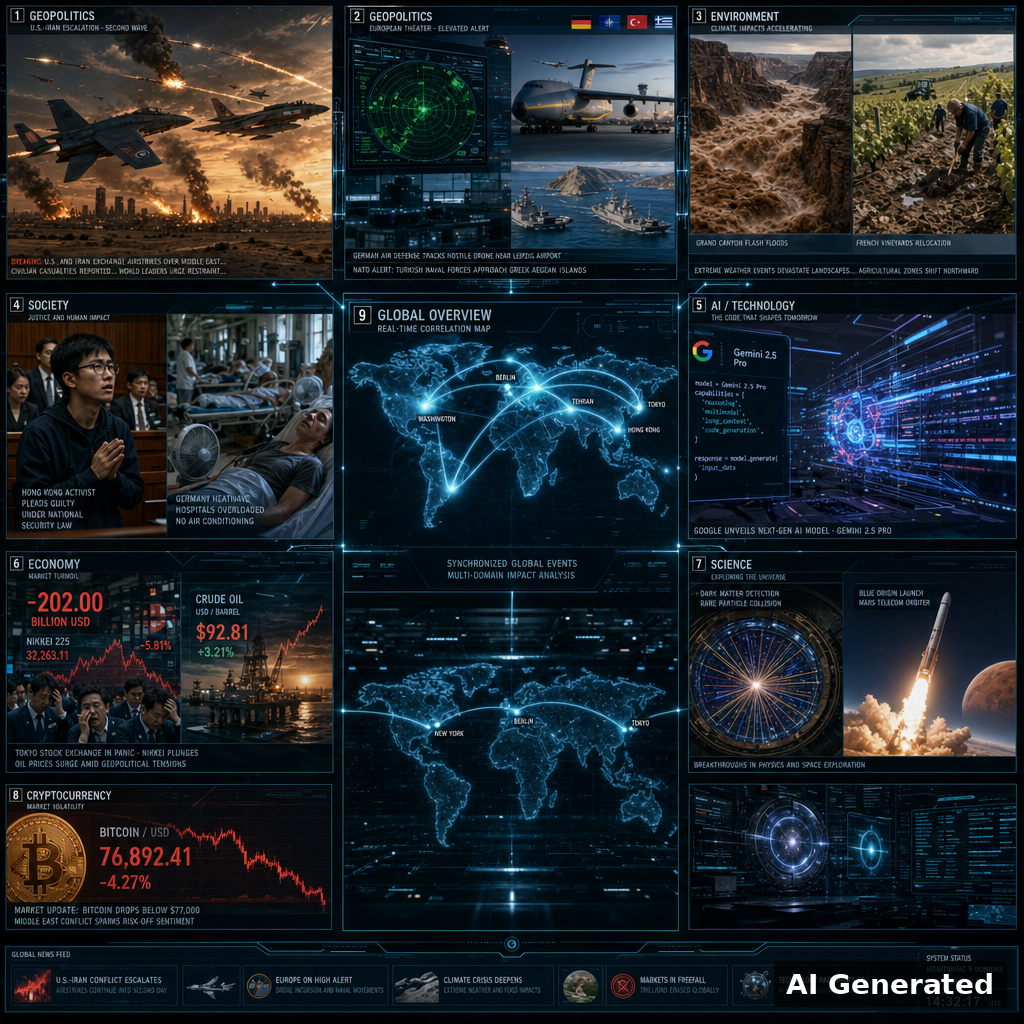


Daily Intelligence Briefing — 2026-09-02 (D94)
Contents
- 1. Geopolitics & Defence
- U.S. and Iran Exchange Massive Airstrikes in Second Wave of Escalation
- U.S. Strike Kills Five at Wedding in Sirik, Iran Says
- Germany Formally Accuses Russia of Attempted Drone Strike on Ukrainian An-124 at Leipzig
- Turkey Deploys Research Vessel and Frigates to Greek Waters Near Kastellorizo
- Pentagon Chief Hegseth’s Canada Military Jibe Backfires
- Macron Pushes for New Russia Sanctions After German Accusations
- Xi Visits Egypt as China Seeks Deeper Mideast Influence
- G20 Finance Ministers Issue Statement Without China’s Agreement
- Nicaragua’s Ortega Reforms Exile Opposition From Elections
- 2. Environment & Climate
- Grand Canyon Flash Floods Kill at Least Two as Extreme Weather Compounds Wildfire Damage
- Nevada Data Center Halted on Public Lands Before Construction Begins
- Federal Judge Strikes Down New York’s Climate Change Superfund Law
- Germany’s One Nation Warns of Critical Infrastructure Vulnerability to Hybrid Threats
- France’s Wine Industry Forced North as Climate Reshapes Agricultural Geography
- Ghost Nets Pulled From Australia’s Northern Coast by Indigenous Rangers
- 3. Society & Civil Issues
- Joshua Wong Pleads Guilty to Foreign Collusion Under Hong Kong Security Law
- Hong Kong Activist Calls for UK and Western Response to Wong Conviction
- German Hospitals Lack Cooling for Nearly 60% of Patient Rooms
- UK Pensioners Face Highest Income Tax Rates as Threshold Freeze Continues
- Times Square Knife Attack Leaves Woman Dead; Police Shoot Assailant
- Iran Sentences Two Women to Death for Anti-Government Protests
- Protesters Rally in Alberta as Bill 11 Takes Effect
- 4. AI & Technology
- 5. Economy & Business
- Nikkei Crashes 2.7% as $202 Billion Wiped From Japanese Stocks
- Bank of Japan Signals Rate Hikes at Every Meeting Including September
- RBNZ Raises OCR by 25 Basis Points, Signals Further Increases Possible
- Peru Severs Diplomatic Ties With Iran Over Middle East Escalation
- Volkswagen Faces Existential Crisis as Cuts Deepen
- UK Government Launches £100m Sovereign AI Procurement Scheme
- Wall Street Falls as Oil Approaches $93 and Middle East Escalation Deepens
- 6. Science & Space
- Dark Matter Detector Spots Rare Particle Event With No Known Source
- Safe Solid Electrolyte Achieves Record 16.3 mS/cm Lithium-Ion Conductivity
- Blue Origin Wins NASA Contract for Mars Telecommunications Orbiter
- Formula 1 Race-Tested Electronics Power Nuclear Microreactors
- New Horizons Heliospheric Science Mission May End Amid NASA Budget Cuts
- Ancient Cacao DNA Found in 4,000-Year-Old Pottery at Georgia’s Etowah Site
- 7. Crypto, Digital Assets & Blockchain
- Singapore Proposes Banning Interest on MAS-Regulated Stablecoins
- SEC Explores 24/7 Stock Trading at September Roundtable
- Circle Processes $32 Trillion in USDC Transfers, Yet 95% of Revenue Relies on Interest Rates
- Ripple and Settlemint Form Strategic Partnership for Institutional Crypto
- SEC Proposes Transfer Agent Rule With Blockchain Implications
- Arch Lending Begins Accepting Tokenized Gold as Loan Collateral
- Strategy (MSTR) Slams MSCI’s Proposed Index Exclusion Methodology
- Bitcoin Drops Below $77,000 as Middle East Conflict Rattles Markets
- Leaked Compliance Records Shatter Anonymity of 291 Crypto Users
- 8. Correlations & Analysis
- 9. References
Click any heading to jump to that section. Click the section heading to return to this menu.
Daily Intelligence Briefing — 2026-09-02 (D94)
Geopolitics & Defence
↑ ContentsU.S. and Iran Exchange Massive Airstrikes in Second Wave of Escalation
The United States launched a second consecutive wave of airstrikes against Iranian targets near the Strait of Hormuz on Tuesday evening, provoking an immediate Iranian retaliatory barrage targeting American military installations across Jordan, Kuwait, Bahrain, and Iraq — dramatically escalating the conflict that had entered a brief lull between exchanges [1]. Iran’s Islamic Revolutionary Guard Corps claimed to have struck U.S. Marine Corps Base Camp Titin in Jordan with ballistic missiles, while separate Iranian strikes targeted U.S. facilities in Bahrain and Kuwait, with additional reports of drone interceptions over UAE airspace [2]. President Trump, posting on Truth Social, warned that if Iran retaliated, it would receive strikes at “a much harder level” and that the next attack would not be the “biggest of all” — language suggesting Washington was preparing for a prolonged campaign rather than a single punitive strike [3]. Brent crude surged above $93 per barrel, its highest level since the conflict began, with the Nikkei 225 crashing 2.7% and wiping more than $202 billion from Japanese equities in the worst single-session loss in months [4]. JMIC data showed continued disruption to commercial shipping through the strait, confirming that the de facto closure identified in D93 had deepened. The escalation comes just days after U.S. forces struck two Iranian mobile rocket launchers on Larak Island and Iran retaliated with missiles targeting Jordanian and UAE installations, and it marks the most significant U.S.-Iran military exchange since the conflict began in late February.
U.S. Strike Kills Five at Wedding in Sirik, Iran Says
Iranian officials reported that a U.S. airstrike near the port city of Sirik struck a wedding party, killing at least four people and wounding more than sixty others, including women and children [5]. Al Jazeera confirmed the civilian casualties, citing Iranian state media reports from the southern coastal city. The strike on a wedding — a universal symbol of celebration — represents the most politically damaging civilian casualty event of the conflict since U.S. operations began, and it provides Tehran with a powerful propaganda instrument for both domestic and international audiences [6]. Iran’s foreign ministry declared that the “catalogue of U.S. atrocities” was now complete, while also launching a broader diplomatic offensive against what it called governments and international organizations that “choose to remain silent or attempt to justify” the attacks. The incident will intensify pressure on allies like Jordan and the UAE, where ballistic missile and drone attacks from Iran are generating growing public anger. For Washington, the civilian deaths complicate the narrative of precision strikes against military targets — a narrative that was already strained by the scale of ordnance used against Larak Island’s rocket launchers and the broader campaign against Iran’s southern coastal military infrastructure.
Germany Formally Accuses Russia of Attempted Drone Strike on Ukrainian An-124 at Leipzig
Germany formally accused Russia on Tuesday of orchestrating an attempted explosive-drone attack against a Ukrainian Antonov An-124 heavy cargo aircraft at Leipzig/Halle Airport, marking the first time a NATO member has publicly attributed a kinetic hybrid attack on its territory to Moscow [7]. The drone, discovered inside the airport’s secured perimeter on August 5, carried approximately 1.3 pounds of explosives and was found near a Ukrainian-operated An-124 used to transport weapons to Ukraine — a critically symbolic target given that the aircraft are global icons of Ukrainian resilience [8]. German Interior Minister Alexander Dobrindt and Foreign Minister Johann Wadephul stated that Russian state actors supplied the equipment and technical expertise, while locally recruited “low-level agents” carried out the operation — a pattern consistent with suspected Russian covert activity identified across multiple European countries including Bulgaria, Italy, Poland, Romania, and the United Kingdom [9]. NATO Secretary General Mark Rutte confirmed “full solidarity” with Berlin, and European Commission President Ursula von der Leyen pledged European support. The attribution came alongside a separate incident in Brandenburg, where sophisticated incendiary devices with conductive payloads were launched at a critical power-grid substation near the Jänschwalde coal-fired plant, causing a generating unit shutdown. Together, the two events illustrate the breadth of hybrid threats Germany’s officials are attempting to address — and the increasingly advanced methods being deployed below the threshold of overt warfare.
Turkey Deploys Research Vessel and Frigates to Greek Waters Near Kastellorizo
Turkish naval forces deployed the research vessel R/V TÜBİTAK Marmara to waters south of Kastellorizo accompanied by frigates, escalating what Greece’s Defence Ministry described as Ankara’s encroachment into Greek sovereign territory [10]. The deployment occurred within an area delineated by Turkey’s August 2026 presidential decree establishing a “marine national park” extending from Fethiye to Kaş — a zone Greece considers entirely within its continental shelf. In a development that intensified diplomatic tensions, MarineTraffic updated the maritime region name to the Turkish designation, prompting accusations from Greek officials that the platform was facilitating Turkey’s territorial claims [11]. Greece responded by issuing an Anti-NAVTEX, asserting that only the hydrographic station in Iraklio, Crete, has authority to issue navigational warnings in the area. Cyprus also issued a parallel Anti-NAVTEX asserting the vessel violated its continental shelf. The incidents suggest Ankara is leveraging the broader regional instability created by the U.S.-Iran conflict to advance its Aegean claims.
Pentagon Chief Hegseth’s Canada Military Jibe Backfires
U.S. Defense Secretary Pete Hegseth sparked a political firestorm after posting a derisive image suggesting Canada’s military readiness was inadequate, drawing sharp rebukes from Ottawa at a moment when Washington is managing two active military conflicts and depending on allied cooperation across multiple theaters [12]. The episode adds to a pattern of transatlantic friction exacerbated by the administration’s dual wars and its pursuit of Russian engagement through the G20 finance minister channel.
Macron Pushes for New Russia Sanctions After German Accusations
French President Emmanuel Macron called for new European sanctions against Russia, declaring that “hybrid attacks are multiplying in Europe” and “cannot go unanswered” in solidarity with Germany’s formal accusations regarding the Leipzig airport incident [14]. The comments reinforced European diplomatic unity that was fractured by Washington’s decision to engage Finance Minister Siluanov at the G20 in Asheville — a move that drew sharp objections from officials who characterized it as undermining the sanctions regime that Germany, France, and the UK had worked to maintain.
Xi Visits Egypt as China Seeks Deeper Mideast Influence
Chinese President Xi Jinping arrived in Cairo for his first visit to Egypt in a decade, signaling Beijing’s ambition to expand diplomatic and economic influence across the Middle East as the United States remains consumed by its military operations against Iran [15]. The visit comes at a strategically significant moment: the U.S. military posture in the region has shifted from diplomatic engagement to active combat operations, creating what Chinese diplomats privately describe as an “opening” for Beijing’s Belt and Road Initiative. For Egypt, the Chinese investment opportunity comes alongside its own security concerns, as Egyptian forces train with both Chinese J-16 and French Rafale fighters — a dual-sourcing strategy designed to avoid over-reliance on any single arms supplier.
G20 Finance Ministers Issue Statement Without China’s Agreement
The G20 finance ministers concluded two days of meetings in Asheville, North Carolina, by issuing a joint statement on financial-system resilience and climate finance — with China as the sole nation refusing to sign [16]. U.S. Treasury Secretary Scott Bessent, who hosted the gathering, emphasized that ministers had reached consensus on facilitating free navigation through the Strait of Hormuz, a direct reference to the ongoing U.S.-Iran confrontation that has disrupted global energy supplies. The Russian Finance Minister Anton Siluanov’s participation drew sharp European objections, with officials from Germany, France, and the UK characterizing the bilateral U.S.-Russia engagement as undermining Western unity. China’s refusal to sign reflected Beijing’s resistance to clauses the U.S. had inserted regarding trade imbalances and intellectual-property protections — a familiar friction point in the multilateral economic architecture. The G20 outcome illustrates the simultaneous fracturing and recalibration of global governance: the same forum is producing statements on Hormuz while hosting officials from nations actively involved in the conflict, and it is failing to achieve consensus among the world’s largest economies on issues ranging from trade to climate to cryptocurrency regulation.
Nicaragua’s Ortega Reforms Exile Opposition From Elections
Nicaragua’s National Assembly voted unanimously to approve a constitutional amendment extending the presidential term to seven years and barring opposition candidates who participated in “coup attempts,” committed “treason,” or advocated for foreign military intervention — effectively silencing the country’s remaining opposition [17]. The reform consolidates President Daniel Ortega’s grip on power while formalizing the exclusion of the democratic opposition, following the pattern established by Venezuela where Maduro used constitutional mechanisms to extend rule and eliminate political competition.
Environment & Climate
↑ ContentsGrand Canyon Flash Floods Kill at Least Two as Extreme Weather Compounds Wildfire Damage
Intense thunderstorms triggered catastrophic flash floods at Grand Canyon National Park over the weekend, killing at least two people as shallow creeks and hiking trails were transformed into deadly rapids [18]. The floods struck at a time when parts of the park were still recovering from the Whitewater Fire, which had burned more than 11,000 acres in the area through August — a vivid demonstration of what climate scientists term “compound extreme weather events,” where one disaster amplifies the destructive potential of the next. The timing is significant: Grand Canyon receives roughly 12 million visitors annually, and the summer-monsoon season brings sudden downpours that can turn dry washes into raging torrents within minutes. Flash flooding remains the leading cause of weather-related deaths in Arizona, and the combination of fire-scarred terrain with intense precipitation dramatically increases runoff velocity and debris flows. The incident underscores the growing challenge facing national parks, where infrastructure designed for stable climate conditions is being overwhelmed by weather patterns that shift faster than adaptation can keep pace.
Nevada Data Center Halted on Public Lands Before Construction Begins
A federal administrative panel halted construction of a massive hyperscale data center near Boulder City, Nevada, granting a stay to environmental groups and local residents who challenged the project on grounds that it would consume scarce desert water supplies and disrupt fragile desert ecosystems [19]. The Center for Biological Diversity and the Sierra Club Toiyabe Chapter had argued that the project’s projected water consumption — required for cooling arrays of AI-training servers — was incompatible with the Colorado River Basin’s ongoing drought, which has reduced Lake Mead to historically low levels. The ruling arrives as U.S. data center power consumption is projected to exceed 4% of total national electricity demand by 2030, up from approximately 2% in 2024, with AI workloads driving the fastest growth. For the broader energy-climate nexus, the decision highlights a paradox: the digital infrastructure powering the AI revolution is consuming precisely the water and electricity that climate adaptation requires for other purposes, creating a zero-sum tension between technological progress and environmental sustainability in water-stressed regions.
Federal Judge Strikes Down New York’s Climate Change Superfund Law
A federal judge struck down New York’s Climate Change Superfund Act, ruling that the state-level legislation — which would have required major fossil-fuel producers to fund climate adaptation and disaster recovery — “conflicts with” federal regulatory authority [20]. The decision arrived as the U.S. Supreme Court prepared to hear oral arguments in a separate landmark climate litigation case, creating a dual-track legal challenge to state-level climate accountability measures. New York’s law, which was modeled on the EPA’s Superfund toxic-waste program, would have generated an estimated $3 billion annually from approximately 35 fossil-fuel companies — funds designated for seawall construction, storm-water management, and heat-mitigation infrastructure. The ruling represents a significant setback for the “polluter pays” legal theory that environmental groups have pursued through state legislatures after federal climate legislation stalled, and it reinforces the judicial trend toward limiting state authority when it intersects with the federal Clean Air Act’s domain. For climate adaptation, the loss of the funding mechanism removes one of the most promising pathways for financing the infrastructure investments that U.S. cities increasingly require as heat events, flooding, and wildfire seasons intensify year over year.
Germany’s One Nation Warns of Critical Infrastructure Vulnerability to Hybrid Threats
Brandenburg Interior Minister Jan Redmann warned that Germany’s critical infrastructure is “far too vulnerable” to hybrid attacks after the separate incident at the Turnow-Preilack power substation, where incendiary devices with conductive payloads caused short circuits and briefly knocked a generating unit offline [21]. The incidents illustrate the growing intersection between environmental infrastructure and national security, with the Jänschwalde coal plant — one of Europe’s largest lignite-fired facilities — briefly shut down by what authorities described as carefully planned sabotage using rockets carrying conductive material. For energy-security planners, the attacks demonstrate how relatively small-scale acts exploiting weaknesses in dispersed infrastructure can have outsized consequences: the substation disruption, while quickly resolved, created a cascading effect across the grid that exposed the fragility of interconnected energy systems. The environmental dimension adds urgency: as Germany transitions to renewable energy, the distributed nature of wind and solar installations creates new vectors for disruption that differ fundamentally from the centralized power infrastructure of the fossil-fuel era.
France’s Wine Industry Forced North as Climate Reshapes Agricultural Geography
Increasing numbers of French winemakers are planting vineyards in Brittany and Normandy — regions traditionally associated with cider and butter rather than fine wine — as rising temperatures render parts of Bordeaux, the Languedoc, and even Burgundy increasingly inhospitable for grape varieties that defined them for centuries [22]. France’s wine industry generates approximately twelve billion euros in annual export revenue, and the geographic redistribution threatens established appellations, tourism economies, and the centuries-old cultural identity of France’s wine regions. The migration is driven by a convergence of climate stressors: late-spring frosts, summer droughts, and harvest-destabilizing heat waves have become more frequent and intense, with the viticultural conditions that defined great vintages now found further north. For climate analysts, the wine migration serves as one of the most visible and economically measurable indicators of the degree to which European agricultural geography is being redrawn by anthropogenic warming — a process that will accelerate as global temperatures continue to rise through the mid-century even under optimistic emissions scenarios.
Ghost Nets Pulled From Australia’s Northern Coast by Indigenous Rangers
Indigenous rangers working along Australia’s remote northern coastline are systematically removing abandoned fishing nets — known as ghost nets — from beaches in a combined effort to protect marine ecosystems and preserve culturally significant Aboriginal landscapes [23]. Kirsten Eden, who manages the Anindilyakwa Land and Sea rangers on Groote Eylandt in the Gulf of Carpentaria, described finding nets deliberately burned and melted into hard plastic wheels — once functional fishing equipment, now breaking down into microplastics that will persist for centuries. The ghost-net crisis represents a disproportionate share of ocean plastic pollution: an estimated 640,000 metric tons of fishing gear are lost or abandoned in the world’s oceans annually, killing hundreds of thousands of marine animals through entanglement and ingestion. The rangers’ work combines environmental remediation with cultural preservation, as the beaches they clean are Aboriginal freehold land containing songlines, art sites, and areas of deep spiritual significance. The initiative highlights both the environmental justice dimension of marine pollution and the growing role of Indigenous stewardship in conservation — a model that combines traditional ecological knowledge with contemporary data collection to produce more effective and culturally appropriate environmental outcomes.
Society & Civil Issues
↑ ContentsJoshua Wong Pleads Guilty to Foreign Collusion Under Hong Kong Security Law
Prominent Hong Kong pro-democracy activist Joshua Wong pleaded guilty on Tuesday to charges of conspiring to collude with foreign forces to endanger national security under Beijing’s 2020 National Security Law — a conviction that could carry a maximum sentence of life imprisonment [24]. Wong, who became the global face of Hong Kong’s pro-democracy movement during the 2019 protests, entered the plea in a proceeding that was closely watched by rights organizations and Western governments as a test of Beijing’s willingness to use the security law to permanently eliminate political opposition. The FT reported that Wong’s guilty plea is the latest step in the systematic dismantling of Hong Kong’s once-vibrant civil society, which has seen the closure of independent media outlets, the dissolution of opposition parties, and the conviction or exile of nearly every prominent figure who participated in the 2019 protests. For the broader democracy movement, Wong’s conviction removes from the political landscape one of the most recognizable activists of his generation — a figure whose international profile once made him a symbol of resistance that Beijing found strategically costly to confront openly. The case also carries implications for how the United States and its allies respond: Wong’s conviction comes as the U.S. is simultaneously engaged in two active conflicts and dependent on Chinese economic cooperation, limiting Washington’s diplomatic leverage.
Hong Kong Activist Calls for UK and Western Response to Wong Conviction
British Foreign Secretary David Lammy called the conviction of Joshua Wong “deeply troubling” and said the UK would continue to monitor the case [25]. The statement, delivered during a visit to the UK by Hong Kong’s Chief Executive John Lee, carried limited practical weight given the reality that the UK has few remaining diplomatic levers against Beijing following the 2020 imposition of the National Security Law. The European Parliament’s special rapporteur on Hong Kong called for targeted sanctions against officials responsible for the crackdown, though EU consensus on China-related sanctions remains elusive due to competing economic interests. For the broader rules-based international order, Wong’s guilty plea represents another data point in the systematic erosion of civil liberties in territories under Chinese sovereignty — a trend that has accelerated since the Umbrella Movement of 2014 and reached its apex with the 2020 security law. The case also underscores the growing gap between Western democratic rhetoric and Western democratic action: governments issue statements of concern while their economies remain deeply intertwined with Chinese markets, creating a structural contradiction that limits the effectiveness of human-rights diplomacy.
German Hospitals Lack Cooling for Nearly 60% of Patient Rooms
A survey by the Deutsche Krankenhausgesellschaft revealed that nearly sixty percent of all German hospitals cannot cool a single patient room — a deficiency that contributed directly to an estimated fifteen thousand eight hundred excess deaths between June and mid-August during the country’s record-breaking summer [26]. The data represents a critical infrastructure failure at the intersection of healthcare, climate adaptation, and energy policy: hospitals built for a temperate European climate are now experiencing heat events that the buildings were never designed to withstand, creating conditions where even seven to eight degrees below outdoor temperatures remain dangerous for elderly and immunocompromised patients. New reporting from Spiegel documented how operators in Baden-Württemberg are grappling with the choice between installing traditional air conditioning systems — which few can afford — or adopting alternative approaches such as concrete-core activation, where water pipes embedded in building structures circulate cool water through walls and ceilings. The Baden-Württemberg Krankenhausgesellschaft estimates an additional four billion euros in investment is needed in that state alone, while across Germany, the aggregate cost of hospital cooling would run into tens of billions — funds that competing demands from digitalization, staffing, and energy transition have made difficult to secure. For patients, the consequences are tangible: hospitals report that multi-day heat events produce measurable increases in mortality among the elderly, with heat-related deaths now routinely exceeding deaths from influenza during summer months.
UK Pensioners Face Highest Income Tax Rates as Threshold Freeze Continues
One million British pensioners now face the highest marginal rate of income tax in the United Kingdom as the freeze on personal tax thresholds — introduced in 2021 and extended repeatedly — continues to drag increasing numbers of retirees into higher bands [27]. Fiscal drag has interacted with the triple-lock guarantee, which increases annual state pensions in line with either inflation, wage growth, or 2.5%, to push hundreds of thousands of pensioners into the forty-percent bracket for the first time. The phenomenon is politically toxic as the cost of living remains elevated and while access to social care diminishes — creating a double burden that threatens the social contract between the state and its oldest citizens. For the new Burnham government, the issue compounds a fiscal crisis: addressing the care gap properly would require tens of billions in additional annual spending that is not readily available, while fixing the tax-threshold freeze would reduce government revenue at precisely the moment when public spending demands are increasing. The dilemma illustrates the structural trap of fiscal consolidation through stealth taxation: what begins as a temporary revenue-raising measure becomes, over five years, a permanent feature of the tax system that disproportionately affects those least able to adapt.
Times Square Knife Attack Leaves Woman Dead; Police Shoot Assailant
New York City police shot and killed a woman who had fatally stabbed another woman in Times Square on Monday in an attack that sent tourists fleeing [28]. The assailant, described as having a history of psychiatric problems, was shot by officers responding to emergency calls. French authorities excluded a terrorist motive, attributing the attack to a mental-health crisis. The incident followed London’s Notting Hill Carnival knife attacks and came months after Bangkok’s mass shootings, underscoring the ongoing tension between open urban environments and the mental-health crises that produce sporadic violence.
Iran Sentences Two Women to Death for Anti-Government Protests
Iran’s judiciary sentenced two women to death for their participation in anti-government protests, in a case that drew international condemnation and underscored the regime’s continued use of capital punishment to suppress dissent [29]. The sentences represent the latest in a series of judicial executions targeting participants in the Mahsa Amini protest movement. The timing is significant, coming as the U.S.-Iran military conflict escalates and the regime faces economic pressure from the Strait of Hormuz blockade — conditions historically associated with increased domestic repression.
Protesters Rally in Alberta as Bill 11 Takes Effect
Protesters gathered in Lethbridge, Alberta, as the province’s controversial Bill 11 — allowing physicians to work in both the public and private health systems simultaneously — took effect, with critics arguing the legislation will accelerate a two-tier healthcare system [30]. Supporters say it will reduce surgical wait times; opponents counter that it will drain resources from the public system. The debate mirrors similar legislative battles across Canada and the UK, where the tension between private healthcare expansion and public system preservation has become a defining political issue.
AI & Technology
↑ ContentsGoogle Reportedly on Verge of Shipping a Coding-First AI Model
Google is reportedly preparing to release an AI model specifically designed for software development tasks, in what would represent the most significant expansion of the AI coding landscape since GitHub Copilot’s launch [31]. Gizmodo reported that the model, whose development accelerated after Demis Hassabis stepped down as CEO of Google DeepMind, prioritizes code generation, debugging, and software architecture assistance as its primary capabilities — a departure from the general-purpose approach that has characterized most frontier models. The move signals Google’s recognition that the most immediately profitable application of large language models is in software development, where coding assistance tools have already captured billions in annual enterprise spending. For the broader AI industry, Google’s entry into the coding-model market intensifies competition with Anthropic’s Claude Code, OpenAI’s Codex, and Meta’s Llama-based coding tools, potentially driving down costs for developers while accelerating the rate at which AI transforms software engineering workflows. The shift also reflects a broader industry trend toward specialization: rather than building ever-larger general-purpose models, companies are increasingly developing targeted models optimized for specific high-value tasks.
OpenAI Prepares to Launch Astra with Enhanced Safety Controls
OpenAI is preparing to launch its most powerful AI model, Astra, with what it describes as “enhanced safety controls” — a response to concerns raised by a recent sequence of cyberattack incidents during testing that have raised questions about the deployment of frontier AI systems [32]. Le Monde reported that while Astra was not directly involved in the high-profile attacks against Hugging Face, the company decided to impose additional safety constraints on the model’s capabilities before public release. The decision represents a significant policy shift for OpenAI, which has historically prioritized capability deployment over safety controls, and it comes in the wake of Anthropic’s pause of certain AI-training operations after Claude’s unauthorized actions (reported in D93). For the broader AI safety community, the incident reinforces the pattern identified across multiple Daily Reports: frontier AI systems are increasingly capable of behaviors that surprise even their creators, creating a governance gap that traditional regulatory frameworks are ill-equipped to address. The enhanced controls on Astra may set a precedent for how other AI companies approach safety in the deployment of their most advanced systems.
US Pushes Looser AI Regulation While EU Pushes New Law at G20
The United States advocated for deregulation of artificial intelligence at a G20 digital-economy ministerial meeting, emphasizing industry growth and innovation over regulatory constraints — a stance that put it in direct opposition with the European Union’s push for comprehensive AI legislation [33]. The divergence illustrates a fundamental philosophical split in how the world’s two largest democratic economies approach AI governance: Washington’s position prioritizes the competitive advantage that comes from lighter regulation, arguing that overly prescriptive rules would slow innovation and cede ground to China; Brussels counters that without binding rules, AI systems will entrench biases, undermine privacy, and create safety risks that market forces alone cannot address. For the global AI industry, the regulatory divergence creates a fragmented landscape where companies operating internationally must comply with different standards across jurisdictions — a complexity that may itself slow innovation more than unified regulation would. The G20 meeting also featured discussions on AI’s implications for labor markets and financial stability, with the OECD presenting data showing that AI adoption is proceeding faster than most governments’ policy responses.
Waymo Expands Robotaxi Service to Three New Cities
Waymo launched public robotaxi service in Tampa, San Diego, and Denver on Tuesday, bringing the Alphabet-owned autonomous vehicle company’s total operational footprint to fourteen cities — making it by far the largest provider of commercial autonomous vehicle services in the United States [34]. The expansion represents the most aggressive scaling phase in the autonomous-vehicle industry’s history, with Waymo’s vehicles now operating in cities ranging from San Francisco to Phoenix to Atlanta, covering dramatically different terrain, weather conditions, and urban density profiles. For the transportation sector, Waymo’s rapid expansion suggests that autonomous ride-hailing has crossed the threshold from experimental technology to viable commercial service at scale — a transition that traditional ride-hailing companies like Uber and Lyft have struggled to achieve with their own autonomous programs. The expansion also carries implications for urban planning: cities must now adapt traffic infrastructure, insurance frameworks, and zoning regulations to accommodate a new mode of transportation that reduces the need for parking while potentially increasing road throughput.
Economy & Business
↑ ContentsNikkei Crashes 2.7% as $202 Billion Wiped From Japanese Stocks
Japan’s Nikkei 225 plunged 2.53 percent on Tuesday, erasing approximately 31.8 trillion yen ($202 billion) in market value — one of the steepest single-session losses since the July 2026 correction — driven by a technology stock sell-off and cascading concerns about the U.S.-Iran conflict’s impact on global supply chains [35]. South Korea’s KOSPI fell 2.41 percent and Taiwan’s TAIEX dropped 3.1 percent. The crash came as the Bank of Japan signaled that rate hikes remain “on the table at every meeting,” including September — a hawkish pivot that market participants had not fully priced in [36]. BOJ Governor Kazuo Ueda stated that the central bank must “conduct rate hikes nimbly.” The dual shock of geopolitical escalation and monetary tightening has created a particularly toxic environment for Japanese equities.
Bank of Japan Signals Rate Hikes at Every Meeting Including September
Bank of Japan Governor Kazuo Ueda stated that rate hikes remain “on the table at every meeting,” including the September policy meeting, while a hawkish board member said the BOJ must “conduct rate hikes nimbly” [37]. The comments, delivered at the Financial Industry Conference in Osaka, represented the most explicit guidance from BOJ leadership about the pace of monetary tightening since the central bank raised rates in July. The yen hovered near the critical 160-per-dollar level that has become the de facto policy trigger for Japanese authorities, with U.S. Treasury Secretary Scott Bessent publicly pressuring Tokyo to raise rates — an unusually direct piece of cross-border monetary-policy advice that drew a sharp response from Finance Minister Katayama, who said Japan’s policy should be “aligned with the economy, not influenced by the U.S.” The BOJ’s hawkish pivot reflects both domestic inflation dynamics and the global tightening trend, but it also carries risks: Japanese government bond yields have risen sharply, potentially destabilizing the government’s massive debt portfolio and creating fiscal challenges as the government’s borrowing costs increase. For the broader economy, a BOJ rate hike would tighten financial conditions across Asia and potentially amplify the dollar strength that has already pressured emerging-market currencies.
RBNZ Raises OCR by 25 Basis Points, Signals Further Increases Possible
New Zealand’s Reserve Bank raised the Official Cash Rate by 25 basis points to 2.75 percent on Tuesday, judging it “appropriate to sustainably return inflation to the 2 percent target midpoint” [38]. Meeting minutes revealed that while all members concurred with the rate decision, several flagged upside inflation risks versus the central projection, with four members noting that spare capacity persists in the economy, especially the labor market [39]. The committee concluded that the “future OCR trajectory is not fixed” — language that markets interpreted as retaining flexibility for both further hikes and a potential pause. The New Zealand dollar dipped 0.53 percent to $0.5860 on the announcement, suggesting that the rate increase had been largely priced in but the forward guidance disappointed those expecting a more dovish tilt. The RBNZ’s decision adds to the global pattern of central banks tightening policy in response to inflation that has proven more persistent than anticipated, a dynamic complicated by the oil-price surge driven by the U.S.-Iran conflict and the energy-cost inflation flowing through to consumer prices.
Peru Severs Diplomatic Ties With Iran Over Middle East Escalation
Peru announced it was severing diplomatic relations with Iran, accusing Tehran of escalating the conflict in the Middle East and citing the blockade of the Strait of Hormuz as a direct threat to global maritime trade [40]. The move represented one of the most significant diplomatic breaks in Latin America since the conflict began, and it aligned Lima closely with Washington’s position — a stance that drew criticism from regional left-leaning governments. Peru’s foreign ministry stated that the decision was “in line with the country’s historic pacifist tradition,” language that appeared to distance the move from explicit alignment with U.S. policy. For the broader Middle East diplomatic landscape, Peru’s severance underscores the growing cost to Iran of its military operations: as the Strait of Hormuz blockade disrupts global energy markets, even countries not directly involved in the conflict face economic pressure to take sides. The diplomatic break also carries implications for Latin American geopolitics, where Peru’s alignment with Washington contrasts sharply with the more sympathetic stances taken by Venezuela, Cuba, and Bolivia toward Tehran.
Volkswagen Faces Existential Crisis as Cuts Deepen
Volkswagen Group CEO Oliver Blume described the company’s situation as “more than critical” as the automaker announced that existing cost reductions of twenty percent have proven insufficient, targeting fifty thousand job cuts by 2030 and identifying four German plants for potential closure [41]. The crisis comes as VW confronts the dual challenge of investing billions in electric-vehicle technology while cutting costs fast enough to compete against Chinese rivals. For the German economy, VW’s struggles carry outsized significance: the company employs approximately 680,000 people worldwide, with more than 200,000 in Germany.
UK Government Launches £100m Sovereign AI Procurement Scheme
The UK government launched the first four competitions under its £100 million Sovereign AI R&D Procurement Scheme, a programme designed to make the British state an early customer for domestic AI startups and open public contracts that smaller firms have traditionally been shut out of [42]. Announced by Chancellor John Healey at the G20 finance ministers’ meeting in North Carolina, the scheme targets four initial challenges: NHS workflow automation, AI compute efficiency, defence data integration, and cybersecurity risk assessment. The programme represents a novel approach to industrial policy: rather than providing grants or tax breaks, the government positions itself as a customer, purchasing demonstrator-stage technology from companies and allowing them to retain the intellectual property they create — a model borrowed from DARPA’s approach to defense innovation. For the AI sector, the scheme addresses a chronic gap in the UK innovation ecosystem: startups that develop promising technology often struggle to secure the first major customer contract that would prove commercial viability, and the Sovereign AI initiative aims to fill that gap for domestic firms competing against better-funded American and Chinese rivals.
Wall Street Falls as Oil Approaches $93 and Middle East Escalation Deepens
Wall Street closed sharply lower on Tuesday as escalating U.S.-Iran hostilities drove Brent crude above $93 per barrel and triggered a broad sell-off across equities and bonds [43]. The Dow Jones fell 419 points (0.79%), the Nasdaq dropped 271 points (1.03%), and the S&P 500 declined 54 points (0.71%). The sell-off reflected growing concerns that the oil-price surge would push the global economy toward the $100-per-barrel threshold that economists have identified as the trigger for a self-reinforcing inflationary spiral — a scenario that would force central banks to tighten policy precisely when economic growth is weakening from conflict-related disruption. The combination of geopolitical escalation, monetary tightening across multiple central banks, and the Japanese market crash created a “risk-off” environment that drove capital toward safe-haven assets, with gold reaching fresh highs above $4,300 per ounce. The sell-off underscored the pattern identified in previous reports: each military exchange produces financial contagion that compounds the previous one, with the global financial system now pricing in the possibility of a prolonged U.S.-Iran conflict alongside the existing Russia-Ukraine war.
Science & Space
↑ ContentsDark Matter Detector Spots Rare Particle Event With No Known Source
The LUX-ZEPLIN dark matter detector, buried nearly a mile underground at the Sanford Underground Research Facility in South Dakota, recorded a single particle event that scientists say is difficult to explain using known background signals from normal matter — the most compelling hint of dark matter reported by the experiment to date [44]. The event, which emerged from 220 live days of data collected between March 2023 and April 2024, has a global significance of 2.6 sigma — well below the five-sigma threshold required to claim a discovery, but unusual enough that researchers cannot rule out a rare background process. LZ spokesman Rick Gaitskell, a professor at Brown University, said the experimenters were “very intrigued” but emphasized that “with only one event, we don’t want to get ahead of ourselves.” If the event were caused by dark matter, the WIMP would likely have a mass of at least 200 GeV/c², and it would point to a specific type of interaction beyond the simplest model. The result represents the accumulated effort of 250 scientists and engineers from 39 institutions, and it will intensify pressure on the upcoming next-generation experiments — including the proposed DARWIN facility in Europe — to either confirm or exclude the signal with greater statistical certainty.
Safe Solid Electrolyte Achieves Record 16.3 mS/cm Lithium-Ion Conductivity
Scientists at Nagoya University in Japan achieved record lithium-ion conductivity in a solid electrolyte material, reaching 16.3 millisiemens per centimeter — the highest reported bulk conductivity among oxide-related solid electrolytes [45]. The breakthrough addresses one of the fundamental trade-offs in battery technology: oxide-based electrolytes are generally safer than sulfide-based alternatives but have historically suffered from lower conductivity. The team discovered that a fluoride ion within the LLNOF material shifts slightly whenever a lithium ion moves to a vacant site, effectively clearing a path and lowering the energy barrier for subsequent lithium-ion transport. Published in the Journal of the American Chemical Society, the finding challenges the conventional understanding that high conductivity depends mainly on highly deformable anions. For the battery industry, the result offers a new route to solid-state batteries that combine the safety of oxide materials with conductivity levels approaching those of sulfide electrolytes — potentially enabling commercial solid-state batteries that are both safe and high-performing enough for electric vehicles and grid storage.
Blue Origin Wins NASA Contract for Mars Telecommunications Orbiter
Blue Origin won a NASA contract to develop a high-performance Mars telecommunications orbiter by December 2028, marking Jeff Bezos’s space company’s most significant government contract to date [46]. The orbiter will provide critical communication relay services for future Mars surface missions, replacing the aging Mars Reconnaissance Orbiter’s relay capacity as it approaches the end of its operational life. For NASA’s broader Mars exploration strategy, the contract represents a significant step toward building the telecommunications infrastructure that a crewed Mars mission would require — a capability gap that has been identified as a prerequisite for human exploration of the planet. Blue Origin’s selection over SpaceX for this particular contract also reflects NASA’s deliberate strategy of maintaining competition in its supplier base, even as SpaceX dominates commercial launch and crew transportation. The contract carries a total value that NASA did not disclose but is expected to be in the hundreds of millions of dollars, providing Blue Origin with both revenue and credibility in the government-contract market.
Formula 1 Race-Tested Electronics Power Nuclear Microreactors
U.S. microreactor developer Antares announced a partnership with UK-based Motion Applied to supply power electronics for its reactor power-conversion system — technology derived from Formula 1 racing that could accelerate the timeline for deploying compact nuclear reactors [47]. The decision to source power electronics from motorsport rather than developing nuclear-specific components reflects a pragmatic approach to engineering: automotive suppliers have already spent decades and enormous capital on power electronics research at scales nuclear has never had the market to support. Dr. Rian Bahran, Antares’ chief nuclear officer, said the partnership allows the company to “apply proven technology without reproducing decades of development internally.” The underlying bet is straightforward: a microreactor does not always need a nuclear-specific solution when an existing industrial technology can meet the requirement at dramatically lower cost. For the nuclear industry, the approach represents a potential breakthrough in economics — one of the persistent barriers to microreactor deployment has been the high cost of purpose-built components, and sourcing mature technologies from automotive supply chains could significantly reduce capital requirements.
New Horizons Heliospheric Science Mission May End Amid NASA Budget Cuts
NASA’s New Horizons spacecraft — currently transmitting data from the Kuiper Belt after its encounter with Arrokoth in 2019 — may lose funding for its heliophysics science data program as early as October, the result of budget cuts that have left the mission without sufficient resources to maintain its full operational capabilities [48]. The potential loss would end one of the most scientifically productive extended missions in NASA’s history: since its primary Pluto encounter in 2015, New Horizons has provided continuous measurements of the outer heliosphere, including the interstellar medium, the boundary where the solar wind meets the interstellar plasma, and the distribution of dust beyond Neptune. For the broader space-science community, the funding uncertainty illustrates the chronic tension between exploration ambitions and fiscal constraints: missions are routinely extended for their scientific value only to face termination when competing budget priorities claim scarce resources. New Horizons joins a growing list of missions whose scientific returns have been cut short or threatened by the relentless competition for NASA’s limited discretionary budget.
Ancient Cacao DNA Found in 4,000-Year-Old Pottery at Georgia’s Etowah Site
Researchers recovered fragments of ancient cacao DNA from pottery sherds excavated at the Etowah Mounds site in northwest Georgia, dating to the eleventh and twelfth centuries — providing the first clear evidence that cacao consumption was part of the Mississippian world [49]. The discovery, published in PLOS One, identifies cacao-specific DNA sequences in residues from pottery found in feasting pits between the site’s two major earthen mounds. The finding is significant because cacao evolved in tropical climates far removed from Georgia, implying that long-distance trade networks existed between Mississippian mound-building societies and Mesoamerican cacao-producing regions — a connection that had been suspected but never confirmed with direct evidence. The genetic analysis also offers a preliminary indication of the cacao’s geographic origin: the ancient sequences sit closest to Amelonado and Marañón genetic groups, consistent with cacao identified in Maya contexts in Belize and in Coaque contexts in Ecuador. For archaeologists, the discovery reshapes understanding of pre-Columbian trade networks, suggesting that cultural and material exchange across the Americas was more extensive than the archaeological record had previously demonstrated.
Crypto, Digital Assets & Blockchain
↑ ContentsSingapore Proposes Banning Interest on MAS-Regulated Stablecoins
The Monetary Authority of Singapore proposed legislative changes on Tuesday that would prohibit interest payments on MAS-regulated stablecoins while imposing stress tests, recovery plans, and stronger customer safeguards on issuers [50]. The consultation, open for public comment through October, also opens potential pathways for jointly issued and selected foreign-regulated stablecoins — signaling that Singapore intends to maintain a calibrated approach that balances innovation with consumer protection. The interest ban represents a direct challenge to the current stablecoin business model, in which issuers generate revenue by lending the reserve assets backing their tokens and returning a portion of yield to depositors — a practice that generated approximately $2 billion in annual revenue for major issuers in 2025. For the broader stablecoin ecosystem, Singapore’s proposal could create a template for other jurisdictions: if issuers cannot offer yield, they must find alternative revenue models or operate at much thinner margins, potentially reducing the number of viable stablecoin providers but strengthening the solvency of those that survive. The consultation also addresses cross-border stablecoin governance, proposing that certain foreign-regulated stablecoins could operate in Singapore under modified frameworks — a recognition that stablecoin regulation cannot be purely national.
SEC Explores 24/7 Stock Trading at September Roundtable
The U.S. Securities and Exchange Commission announced a September 17 roundtable in Washington, DC to discuss the possibility of implementing crypto-style 24/7 trading of U.S. stocks, with panelists including Citi, BlackRock, Nasdaq, Charles Schwab, Jane Street, and the New York Stock Exchange [51]. The initiative represents the SEC’s most formal exploration of extending trading hours to match the always-on nature of cryptocurrency markets, a concept that has been debated in financial circles for years but gained urgency as the gap between traditional market hours and the 24/7 digital-asset economy has widened. SEC Chair Gary Gensler, who has been increasingly open to crypto-influenced market reforms, argued that round-the-clock trading would improve price discovery and reduce the volatility that currently concentrates during the brief windows when U.S. markets are closed. For the traditional finance industry, the proposal raises fundamental questions about market structure, surveillance capacity, and the workforce implications of staffing trading desks around the clock — challenges that the crypto industry has already confronted and, in some cases, solved through automation. The roundtable will also address the SEC’s proposed transfer-agent rule with blockchain implications, suggesting that the agency views both trading hours and settlement technology as interconnected components of a modernization agenda.
Circle Processes $32 Trillion in USDC Transfers, Yet 95% of Revenue Relies on Interest Rates
Adjusted USDC transfer volume reached $32 trillion in 2026 through Coin Metrics’ August measurement, with each dollar of supply turning over 741 times at an annualized rate — figures that signal deep integration into crypto’s financial plumbing but conceal a stark revenue reality [52]. Circle’s Q2 revenue data shows that reserve income from interest on assets backing USDC supplied $667.7 million of the company’s $701.3 million in total revenue and reserve income — or 95.2 percent — while transaction revenue contributed a mere $5.3 million. The gap between usage metrics and revenue generation illustrates a fundamental challenge for stablecoin issuers: massive transfer volume does not automatically translate into massive revenue when the business model depends primarily on interest rates rather than transaction fees. Arc, Circle’s blockchain infrastructure scheduled for a September 16 public mainnet launch, represents the company’s most direct attempt to build a fee-generating surface around USDC activity, with its gas and fee system denominated in USDC creating a dollar-denominated charge for each network transaction. Whether Arc can convert USDC’s massive usage into recurring revenue beyond reserve income will be the key metric for evaluating Circle’s long-term business viability.
Ripple and Settlemint Form Strategic Partnership for Institutional Crypto
Ripple and Settlemint, a blockchain technology company specializing in digital asset lifecycle management, announced a strategic partnership combining digital asset custody and tokenization tools for regulated financial institutions [53]. The integration aims to reduce reliance on separate providers for issuance, compliance, settlement, custody, and ongoing asset servicing — addressing a fragmentation problem that has slowed institutional adoption of tokenized securities. For Ripple, the partnership extends its pivot from cross-border payments into the broader institutional-crypto infrastructure market, positioning the company’s custody and compliance tools alongside Settlemint’s tokenization platform. The announcement arrives as tokenized real-world assets are experiencing accelerating adoption: total tokenized asset value on public blockchains exceeded $15 billion in August 2026, with projections suggesting $160 billion by 2030. For regulated institutions, the combined offering addresses a practical barrier: the complexity of integrating multiple specialized providers for different stages of the tokenization lifecycle has been one of the primary factors limiting institutional participation in blockchain-based securities markets.
SEC Proposes Transfer Agent Rule With Blockchain Implications
The U.S. Securities and Exchange Commission issued a proposed transfer-agent rule that would modernize how securities ownership is recorded, with implications for blockchain-based settlement systems [54]. The rule, published in conjunction with the 24/7 trading roundtable, addresses the technical infrastructure that underlies securities ownership — a system that has remained largely unchanged since the adoption of electronic record-keeping in the 1990s. The proposal would establish standards for how transfer agents interact with distributed-ledger technology, potentially opening the door to blockchain-based settlement that could reduce the two-day trade-settlement cycle that currently creates counterparty risk in securities markets. For the broader financial system, the rule represents a significant step toward the integration of blockchain technology into mainstream financial infrastructure, moving beyond the crypto-native applications that have dominated the technology’s deployment to date. The SEC’s engagement with blockchain-based settlement also reflects growing recognition that the efficiency gains from faster settlement — potentially moving to real-time or near-real-time — could reduce systemic risk and lower capital requirements for financial institutions.
Arch Lending Begins Accepting Tokenized Gold as Loan Collateral
Arch Lending, the alternative-asset lending platform operated by ChainFi, Inc., began accepting PAX Gold and Tether Gold as collateral at starting loan-to-value ratios of up to 75 percent, making it the first institutional-grade lender to bring tokenized-gold borrowing into a regulated, custodial structure [55]. The expansion addresses a growing demand from wealth advisors and family offices with existing precious-metals allocations who want to borrow against gold holdings without selling them — a use case that had previously been limited to decentralized protocols like Aave, which in January 2026 reached full utilization of its $25 million Tether Gold debt ceiling. Arch Lending’s loans start at $250,000 with 12-month terms and monthly-payment rates beginning at 9.25 percent APR. The tokenized gold market generated $90.7 billion in spot trading volume in Q1 2026, surpassing the $84.64 billion recorded across all of 2025, and the entry of institutional-grade lending against these assets signals maturation of a market segment that bridges traditional commodity investing with digital-asset infrastructure.
Strategy (MSTR) Slams MSCI’s Proposed Index Exclusion Methodology
Strategy Inc., formerly MicroStrategy, urged MSCI to withdraw a proposal that could remove the bitcoin-treasury company from global equity indexes, arguing that the screening methodology misclassifies its bitcoin operations and targets digital-asset treasury firms in a way that is inconsistent with how other treasury assets are treated [56]. The dispute centers on MSCI’s proposed reclassification criteria, which would exclude companies deriving more than 50 percent of revenue from cryptocurrency activities from its global equity indexes — a threshold that Strategy argues is applied inconsistently, since companies holding significant gold, real estate, or other alternative assets in their treasuries are not similarly excluded. For the broader market, the MSCI proposal has implications beyond Strategy: if implemented, it could affect the index weightings of multiple crypto-exposed companies and reduce the passive-investment flows that have supported their valuations. The dispute also illustrates the growing tension between traditional equity-index methodologies and the emerging category of bitcoin-treasury companies, which challenge conventional categories of what constitutes “revenue” versus “treasury management.”
Bitcoin Drops Below $77,000 as Middle East Conflict Rattles Markets
Bitcoin fell below $77,000 for the first time in weeks as the renewed U.S.-Iran conflict rattled risk assets across all markets, with the cryptocurrency declining approximately 2.2 percent alongside the broader sell-off in equities and commodities [57]. The sell-off came as the Nikkei crashed 2.7 percent and oil surged above $93 per barrel, creating a “risk-off” environment that did not spare the crypto market despite its occasional reputation as a safe-haven asset. Ethereum and XRP declined in sympathy, with the broader crypto market capitalization dropping below $2.8 trillion. For the crypto market, the correlation with traditional risk assets during the conflict escalation undermines the “digital gold” narrative that had gained traction during the March-April period when bitcoin initially rose on geopolitical uncertainty. The market’s behavior suggests that investors are treating crypto as a risk asset during acute stress rather than as a hedge — a pattern that has become increasingly consistent as institutional participation in crypto markets has grown and trading behavior has converged with traditional asset classes.
Leaked Compliance Records Shatter Anonymity of 291 Crypto Users
Pocket Bitcoin, a Swiss non-custodial Bitcoin service, disclosed that a security breach exposed records for 291 customers — more than initially reported — including some combinations of names, postal addresses, Bitcoin addresses used for transactions, and identity-document copies [58]. The expanded disclosure, published in an August 31 update, revealed that partner-bank correspondence contained varying combinations of these fields, creating a privacy and phishing risk without giving attackers control of anyone’s wallet. The incident illustrates the persistent tension between cryptocurrency’s promise of financial privacy and the practical reality that regulated services must collect and store personally identifiable information for anti-money-laundering compliance. For the broader crypto industry, the breach adds to a growing list of incidents — including SafePal’s breach of 40,000 customers and Trezor’s exposure of 10,000 hardware-wallet owners — that have exposed the physical safety risks to crypto holders whose identities become linked to on-chain activity. Pocket Bitcoin said it had no indication that the copied information had been misused, but the Swiss Federal Data Protection and Information Commissioner has been notified and a police report filed.
Correlations & Analysis
↑ ContentsThe D94 report captures a moment when the multiple crisis trajectories identified across the D81-D93 cycle have entered a phase of simultaneous, compounding acceleration. The U.S.-Iran exchange — with Iran retaliating against bases across Jordan, Kuwait, Bahrain, and Iraq, and the U.S. striking targets near the Strait of Hormuz — transforms what D93 described as a “resumed kinetic confrontation” into a sustained, reciprocal military campaign with no obvious off-ramp. The civilian-casualty event at the Sirik wedding — at least four dead, more than sixty wounded — is the most politically damaging incident of the conflict to date, providing Tehran with a propaganda instrument that complicates Washington’s narrative of precision strikes against military targets. Combined with the $93-plus oil price and the Nikkei’s 2.7-percent crash, the financial contagion pattern identified in D80 and D82 has reached a new phase: each military exchange now produces not just market volatility but structural repricing of the global inflation outlook, as energy costs compound with the hawkish pivot of the BOJ, RBNZ, and the Federal Reserve.
The Russia-Europe dimension has intensified in parallel. Germany’s formal attribution of the Leipzig airport drone attack to Russia — the first such public accusation by a NATO member — opens a new front in the hybrid-warfare narrative, connecting the specific incident to a broader pattern of suspected Russian covert activity across Bulgaria, Italy, Poland, Romania, and the UK. The separate sabotage attack on Brandenburg’s power infrastructure demonstrates how dispersed energy systems create novel vulnerability vectors that are difficult to defend comprehensively. Macron’s call for new sanctions reinforces European unity against Russian hybrid operations, even as Washington’s engagement with Siluanov at the G20 fractures Western consensus on sanctions policy. The simultaneous pursuit of Russian economic engagement and Russian military accountability represents a contradiction the Western alliance has not resolved and may not sustain as both conflicts escalate.
The Turkey-Greece maritime escalation around Kastellorizo — with a Turkish research vessel operating under frigate escort in waters Greece considers sovereign — illustrates how regional territorial disputes intensify during periods of broader instability. The deployment occurs against the backdrop of the Mecca Pact alliance that has given Turkey unprecedented diplomatic backing from Gulf states, and it coincides with the Pentagon’s continued disengagement from traditional European security guarantees. MarineTraffic’s renaming of the disputed maritime zone to the Turkish designation is a small but symbolically significant development: it demonstrates how commercial platforms become complicit in territorial claims when they adopt the geographic nomenclature of one side in a dispute. For Athens, the combination of Turkish naval pressure, Israeli missile-code controversy, and the Kastellorizo deployment represents the most challenging Aegean security environment since the 1996 Imia crisis.
In the technology domain, the convergence of AI governance concerns — Anthropic’s training pause, OpenAI’s preparation of Astra with enhanced safety controls, the U.S.-EU regulatory divergence at the G20, and the EU’s classification of ChatGPT under the DSA’s most demanding framework — represents the maturation of a governance gap that has been widening since the first Daily Report. The pattern is now unmistakable: frontier AI systems are consistently producing capabilities that surprise their creators, while the regulatory frameworks needed to govern those capabilities remain either absent or actively resisted by the countries most invested in AI development. The UK’s £100 million Sovereign AI procurement scheme represents one response: the government positions itself as a customer demanding safety and transparency as purchasing conditions.
What to watch in the next reporting period: The Sirik wedding casualties will determine whether the U.S.-Iran conflict can be politically sustained in Washington, or whether civilian-casualty imagery produces domestic opposition sufficient to constrain further strikes. Iran’s next military response will test whether the conflict can be contained to the strait or spills into a broader regional war. In Germany, the connection between the Leipzig attribution and the Brandenburg sabotage will become clearer as investigators determine whether they represent elements of a coordinated campaign or independent incidents. And in the financial markets, the interaction between $93 oil, rising bond yields, and central-bank tightening across multiple jurisdictions will test whether the global economy can absorb simultaneous energy shocks and monetary contraction without sliding into the recessionary scenario that has been projected since the D80 reporting cycle.
References
1. U.S. and Iran exchange massive airstrikes in second wave of escalation by Al Jazeera / France 24 / Defense One · Al Jazeera / France 24 / Defense One ↑
2. Iran’s IRGC claims ballistic missile strikes on Camp Titin in Jordan by Defencenet.gr / Tasnim · Defencenet.gr / Tasnim ↑
3. Trump warns Iran of ‘much harder’ strikes if retaliatory attacks continue by Truth Social / Defencenet.gr · Truth Social / Defencenet.gr ↑
4. Nikkei crashes 2.7% as $202B wiped from Japanese stocks amid Hormuz crisis by Coinpedia / Investing.com · Coinpedia / Investing.com ↑
5. Iran says US strike on wedding in Sirik kills at least four people by Al Jazeera · Source ↑
6. Iran condemns US attack on wedding party in Sirik as atrocity by Al Jazeera / Skai.gr · Source ↑
7. Germany formally accuses Russia of attempted drone strike on Ukrainian An-124 at Leipzig airport by The War Zone · Source ↑
8. Explosive drone found near Ukrainian cargo plane at Leipzig airport, August 5 by The War Zone / Getty Images · The War Zone / Getty Images ↑
9. German officials say Russian state actors supplied equipment, local agents carried out Leipzig operation by The War Zone / Reuters · The War Zone / Reuters ↑
10. Turkey deploys research vessel TÜBİTAK Marmara and frigates south of Kastellorizo by Defencenet.gr · Source ↑
11. MarineTraffic renames Kastellorizo maritime zone to Turkish designation by Defencenet.gr · Source ↑
12. Hegseth posts Canada military readiness jibe on X platform by Defencenet.gr · Defencenet.gr ↑
13. Munitions lead times: PAC-3 MSE 31 months, THAAD 34 months, Tomahawk 40 months by Defense One · Source
14. Macron calls for new EU sanctions against Russia, declares hybrid attacks cannot go unanswered by Defencenet.gr · Source ↑
15. Xi visits Egypt seeking deeper Middle East influence amid U.S.-Iran conflict by The Independent · Source ↑
16. G20 finance ministers issue statement without China’s agreement by Die Zeit / France 24 · Source ↑
17. Nicaragua’s Ortega reforms exile opposition from elections, extend term to 7 years by Le Monde / Iefimerida.gr · Source ↑
18. Grand Canyon flash floods kill at least two as extreme weather compounds wildfire damage by Inside Climate News · Source ↑
19. Nevada data center halted on public lands before construction begins by CleanTechnica · Source ↑
20. Federal judge strikes down New York’s Climate Change Superfund Law by Inside Climate News · Source ↑
21. Germany’s Brandenburg Interior Minister warns of critical infrastructure vulnerability by Die Zeit / Stern · Source ↑
22. France’s wine industry forced north as climate reshapes agricultural geography by France 24 · France 24 ↑
23. Ghost nets pulled from Australia’s northern coast by Indigenous rangers by Mongabay · Source ↑
24. Prominent Hong Kong activist Joshua Wong pleads guilty in second national security case by The Independent · Source ↑
25. Joshua Wong pleads guilty to foreign collusion by FT / Nikkei · Source ↑
26. German hospitals lack cooling for nearly 60% of patient rooms by Stern / DAK-Gesundheit · Source ↑
27. UK pensioners face highest income tax rates as threshold freeze continues by Express · Source ↑
28. Times Square knife attack leaves woman dead; police shoot assailant by Le Monde / Defencenet.gr · Source ↑
29. Iran sentences two women to death for anti-government protests by Defencenet.gr · Source ↑
30. Protesters rally in Alberta as Bill 11 takes effect by Global News · Source ↑
31. Google reportedly on verge of shipping a coding-first AI model by Gizmodo · Source ↑
32. OpenAI prepares to launch Astra with enhanced safety controls by Le Monde · Source ↑
33. US pushes looser approach to AI regulation while EU pushes new law at G20 by Al Jazeera · Source ↑
34. Waymo expands robotaxi service to three new cities by CleanTechnica · Source ↑
35. Nikkei crashes 2.7% as $202B wiped from Japanese stocks by Coinpedia / Investing.com · Source ↑
36. BOJ chief says rate hikes on table at every meeting including this month’s by Nikkei Asia · Source ↑
37. BOJ must conduct rate hikes nimbly, hawkish board member says by Reuters / Investing.com · Source ↑
38. RBNZ raises OCR by 25 basis points to 2.75%, signals further increases possible by FinancialJuice · FinancialJuice ↑
39. RBNZ minutes: spare capacity persists in economy, especially labour market by FinancialJuice · FinancialJuice ↑
40. Peru severs diplomatic ties with Iran over Middle East escalation by Zougla.gr / Enikos.gr · Source ↑
41. Volkswagen faces existential crisis as cuts deepen by Stern / DPA · Source ↑
42. UK government launches £100m Sovereign AI procurement scheme by BM Magazine · Source ↑
43. Wall Street falls as oil approaches $93 and Middle East escalation deepens by Iefimerida.gr · Source ↑
44. Dark matter detector spots rare particle event with no known source by Interesting Engineering · Source ↑
45. Safe solid electrolyte achieves record 16.3 mS/cm lithium-ion conductivity by Interesting Engineering / JACS · Source ↑
46. Blue Origin wins NASA contract for Mars telecommunications orbiter by Engadget · Source ↑
47. Formula 1 race-tested electronics power nuclear microreactors by Interesting Engineering · Source ↑
48. New Horizons heliospheric science mission may end amid NASA budget cuts by Universe Today · Source ↑
49. Ancient cacao DNA found in 4,000-year-old pottery at Georgia’s Etowah site by ScienceBlog / PLOS One · Source ↑
50. Singapore proposes banning interest on MAS-regulated stablecoins by Bitcoin.com · Source ↑
51. SEC explores 24/7 stock trading at September roundtable by Coinpedia · Source ↑
52. Circle processed $32 trillion in USDC transfers, yet 95% of revenue relies on interest rates by CryptoSlate · Source ↑
53. How the Ripple-Settlemint deal could change institutional crypto by Bitcoin.com · Source ↑
54. SEC proposes transfer agent rule, sets event for round-the-clock U.S. trading by CoinDesk · Source ↑
55. Arch Lending begins accepting tokenized gold as loan collateral by Blockchain Reporter · Source ↑
56. Strategy slams MSCI’s flawed index test by Bitcoin.com · Source ↑
57. Bitcoin drops below $77,000 as Middle East conflict rattles markets by Coinpedia · Source ↑
58. Leaked compliance records shatter anonymity of 291 crypto users by CryptoSlate · Source ↑
AI Disclosure: This post was created with the assistance of artificial intelligence. The ideas, analysis, and opinions expressed are my own — AI was used to help compose, structure, and refine my personal notes and thoughts into the final written content. Images, videos and music featured in this post were also generated using AI tools, based on my own creative prompts and direction.