










Contents
- 1. Geopolitics & Defence
- 2. Environment & Climate
- 3. Society & Civil Issues
- 4. AI & Technology
- 5. Economy & Business
- 6. Science & Space
- 7. Crypto, Digital Assets & Blockchain
- 8. Correlations & Analysis
- 9. References
Click any heading to jump to that section. Click the section heading to return to this menu.
Geopolitics & Defence ↑ Contents
The Ukraine Long-Reach: Warnings of Mass Strikes and Deeper Atlantic Exposure
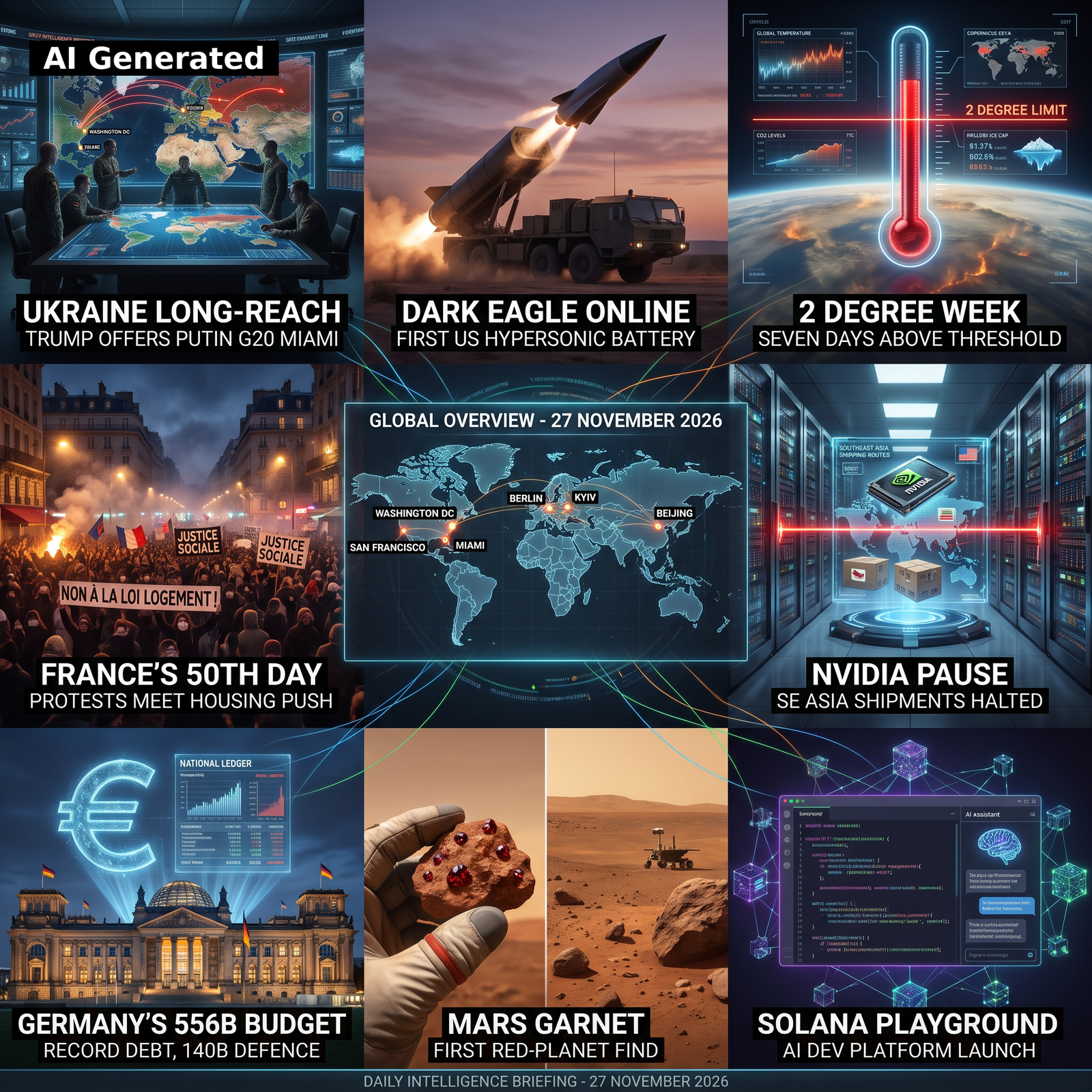
As the D180 window opened, the war in Ukraine returned to the summit of the geopolitical agenda through an unusually direct American axis. Donald Trump said Vladimir Putin could attend the G20 summit in Miami in mid-December, insisting he had urged the Russian leader to “stop the bloodbath” in Europe even as he continued to describe him as a friend from their trilateral meeting in China[1]. The concession effectively broke with the position of his own European allies, and it came at the exact moment Ukraine’s leadership insisted Moscow was preparing a new phase of escalation. Volodymyr Zelensky warned that Russian forces were planning a major mass attack in the coming days, and that Kyiv would respond to every strike, a warning he reiterated in a second nightly address within the same cycle[2][3]. Read against D179, where Russia escalated toward a NATO member for the first time since the war began, the G20 invitation reads less as an opening and more as Washington attempting to define the terms of an endgame it does not yet control.
The kinetic reality underneath reinforced the warning. Russian strikes hit Kryvyi Rih in central Ukraine with unusual severity, damaging industrial, customs and municipal infrastructure and knocking out electricity across the city centre, forcing heating and water systems onto generator backup[4]. Sweden, meanwhile, summoned the Russian ambassador to protest the violation of Polish airspace by Russian cruise missiles that crashed in south-western Poland the previous week, and simultaneously condemned the plan Moscow allegedly prepared to assassinate a Ukrainian-American citizen on Danish soil[5]. Kyiv also moved to defuse a dangerous new front, insisting it had no intention of extending the war to Libya after Ukraine claimed strikes against two Russian vessels near Benghazi that could have been misread as a widening of the theatre[6]. The clarification draws a line under Moscow’s attempt to frame Ukrainian deep-strike as a threat to third states.
The Defence-Industrial Ledger: Hypersonics and India’s Self-Reliance Push
The defence-industrial base delivered a milestone of its own. The US Army now fields its first operational battery of the long-delayed Dark Eagle hypersonic missile, a system exceeding 6,100 km/h that manoeuvres in flight and strikes targets out to roughly 2,775 km, each battery carrying four mobile launchers and two missiles[7]. Dark Eagle arrived nearly three years behind schedule after a succession of engineering setbacks, and its operational fielding hands Washington a second-generation strategic capability that compresses any adversary’s decision timelines — closing the gap between the hypersonic promise and American operational reality just as Russia and China run their own programmes.
On the Indo-Pacific side, India consolidated its indigenous defence-manufacturing posture. New Delhi and Abu Dhabi agreed to accelerate co-development and co-production of next-generation equipment at the 14th session of their Joint Defence Cooperation Committee[8]. Domestically, Solar Defence and Aerospace completed trials of Bhargavastra, India’s first indigenous two-layer vehicle-mounted counter-swarm drone system, at Pokhran[9]. Beijing insisted the border situation was “generally stable” despite concerns over posturing along the Line of Actual Control in Arunachal Pradesh[10] — a studied reassurance read by the Indian defence press through the lens of India’s own MUM-T shortfall, as the IAF’s CATS Warrior loyal-wingman programme risks falling behind China’s push, which has already embedded AI-enabled wingman drones into routine fighter-pilot training[11]. The gap sits atop a broader ambition: India’s drive toward 100 GW of nuclear capacity by 2047, seen as a transformation of nuclear power into a low-carbon pillar and a draw for global investors[12], while an IN-SPACe report warns satellite-manufacturing ambition remains constrained by import dependence and year-long component delays[13].
Contract-level momentum backed the strategy. BrahMos placed a development order with Omnitech Engineering for metallic airframe assemblies and canister subsystems[14], and Walchandnagar secured a ₹18.46-crore contract for two Universal Vertical Launcher systems, the canisterised cells that will host everything from BrahMos to future hypersonic interceptors on Indian vessels[15]. Upstream, parliament’s Standing Committee opened a review of India’s preparedness for cyber warfare, space warfare and AI-driven defence for 2026-27, acknowledging the next battlefield will be defined as much by algorithms and spectrum as by steel[16]. The week’s Indian defence news is a coherent signal: New Delhi is industrialising its missile and unmanned base, expanding nuclear and space infrastructure, and recalibrating doctrine for an AI-native strategic era, while managing a border relationship with Beijing that remains officially “stable” and pragmatically tense.
Washington’s Informational Geometry, the Venezuela Transition and the French Chessboard
Washington continued to manage overlapping files through reassurance and assertion. Trump played down intelligence suggesting Russia and China were providing meaningful assistance to Iran’s attacks on US bases, insisting “participation” would mean the two powers were firing, not just feeding information[17]. Compounding the message, he claimed the United States now holds “close to 50%” of the world’s oil, asserting the country no longer needs Middle East oil[18]. The claim matters for framing Washington’s strategic posture: if it genuinely believes in energy independence, its appetite for defending Gulf shipping lanes could narrow, a shift with profound consequences for global prices and the calculus tracked throughout D169-D179. In the Western Hemisphere, Venezuela’s caretaker government formally moved to repeal the Simón Bolívar law that had barred opposition figures from standing for election and imposed sentences of up to 30 years, a measure the opposition condemned as political persecution[19]. The repeal is a significant step toward the free elections the interim president has promised without yet scheduling, shadowed by the absence of Nobel laureate María Corina Machado from the transition talks.
Within Europe, the French 2027 campaign entered its most consequential phase. Éric Zemmour said the coming presidential contest would be his last[20]; the centre-right of that spectrum was the more destabilising story, as Jordan Bardella faced fresh allegations of antisemitic written material published by Mediapart and Le Monde that he denies, even as his party remains atop presidential voting intentions[21]. On the social-democratic flank, Raphaël Glucksmann unveiled a “Conseil des territoires” devolution project[22], while Emmanuel Macron publicly attacked Marine Le Pen’s “drôle d’arrogance”, deepening the personalisation defining the race[23]. To the south, Spain’s snap elections delivered a parallel controversy: claims of massive electoral fraud circulated before the vote, largely debunked but seeding distrust ahead of a closely contested poll[24]. Beyond Europe, Cyril Ramaphosa survived a motion that could have removed him from the South African presidency over allegations he concealed a 2020 burglary at his Phala Phala farm[25]. And in the Pacific, New Zealand’s final election count produced a hung parliament: neither the right-wing incumbents led by Christopher Luxon nor the left opposition won a majority, obliging the government to court the centrist newcomer Opportunity platform or face another election[26].
Environment & Climate ↑ Contents
The 2°C Week: A Threshold Crossed, and the Tempers of a Super-El Niño
The most consequential climate datum of the D180 window arrived from the EU’s Copernicus climate service: for the first time on record, the global average temperature stayed above two degrees Celsius over the pre-industrial baseline for seven consecutive days, from 18 to 24 November, with 23 November posting a record daily deviation of 2.25°C above its pre-industrial reference[27]. Analysts were careful to distinguish a “week over two degrees” from breaching the Paris Accord’s long-term 2°C threshold, which is a decades-scale average, but Copernicus’s senior strategist Samantha Burgess was unambiguous that the stretch is “a gripping foretaste of where our climate is heading”, combining greenhouse-forced warming with an El Niño the World Meteorological Organization expects to be among the strongest on record[27]. The event escalates the temperature ledger this series has carried since D179, and materially raises the probability that the world logs its first calendar year hugging or crossing the 1.5°C line even as the 2°C week becomes a recurring seasonal variable.
The wild weather accompanying that warmth underlined the compound-hazard signature. Southern California endured historic coastal flooding and devastating waves over Thanksgiving, as record king tides riding an overheated El Niño swamped beaches from San Diego to San Francisco and disrupted holiday travel, with forecasters warning the December inundation could be worse still[28]. The eastern seaboard was hit simultaneously: severe storms tore roofs off buildings and put streets under water across hundreds of thousands of homes as the Thanksgiving weekend began, prompting the first-ever postponement of New York City’s Macy’s parade and emergency declarations in New York and New Jersey[29][30]. The detail confirms a thesis D178 advanced under the 2026 hurricane ledger: an El Niño-amplified Atlantic and Pacific are producing twin-ocean flooding in a single season, and the municipal-preparedness systems built for “one seasonal storm” are being outpaced. Out west, an atmospheric river aimed at the Pacific Northwest brought 2-4 feet of coastal inundation and over a foot of mountain snow with gusts above 50 mph, creating “very difficult to impossible” travel conditions[31]. Australia braced for a weekend of weather extremes of its own, with bushfires ravaging Flinders Island even as storms, heavy rain, flooding and heatwaves were forecast simultaneously ahead of an election-day downpour[32] — two hemispheres, one pattern of drought and deluge accelerating together.
Beneath the storms, the continental water ledger shifted. The US Drought Monitor showed 33.6% of the country in moderate drought or worse, a modest improvement from 35.1% as Pacific storms soaked Nevada and Utah — Nevada’s drought share tumbling from 52.7% to 19.9% in a week — even as Vermont, Indiana and Illinois deteriorated sharply[33].
Hydropolitics, Ocean Carbon and the Permitting Bargain
Climate-driven hydrology is forcing hard policy choices in the Himalayas. In Nepal, where August’s avalanche-triggered flood killed more than 1,350 people and damaged at least a dozen hydropower projects, a policy debate has opened over whether the next generation of Himalayan dams should be mega-scale storage rather than run-of-river schemes — storage that could contain floods, manage winter shortages and prepare for a future without glaciers, but whose engineering demands collide with earthquake risk in the young mountains[34]. In the Congo Basin, community forests are offered as a conservation counterweight: the DRC is awarding community-based forestry titles to some 7.1 million hectares — an area the size of Ireland — with legally established local concessions rising from eight in 2017 to more than 350 in 2026, though experts caution the legal framework can only protect forest if paired with economic opportunity that keeps communities from exploiting their own timber[35].
The carbon-removal frontier was quietly recalibrated by a Yale study in Nature Communications arguing that the ocean is not a uniform carbon sink. Using a unified framework comparing ocean alkalinity enhancement and direct ocean removal worldwide over fifteen years, the team found effectiveness varies sharply by region and season — most carbon dioxide reduction came in summer at subpolar latitudes — and that anywhere from 3% to 20% of land-based enhanced-rock-weathering carbon could escape back into the atmosphere once it reaches the sea[36]. The finding cautions against billion-dollar ocean CDR schemes that treat the sea as a homogeneous sponge, and it deepens the measurement-and-verification gap this report has repeatedly identified as the binding constraint on scalable carbon removal. On the policy side, the US Senate passed the Bipartisan American Affordability and Jobs Act (BAAJA) on a 62-33 vote, a permitting-reform bill meant to speed up renewable energy and transmission, but which environmental organisations warn will also fast-track fossil-fuel projects and data centres by weakening NEPA, Clean Water Act and Endangered Species Act reviews and shortening the window to sue[37]. It is the classic bargain: a technology-neutral fast track that, in the hands of an administration openly hostile to clean energy, becomes a one-way ratchet for fossil fuels.
The Climate-Debt Nexus, Seabed Mining and the Commodity Front
Two research strands connected climate shocks directly to sovereign balance sheets. A Stanford-led study in PNAS estimated that tropical cyclones alone added nearly $450 billion in national debt worldwide in 2019, and that cyclones and human-caused warming together dragged down GDP across 181 countries by an average of 12% over 1980-2019, with small island states such as Jamaica, Barbados and Grenada facing the tightest squeeze because a storm can expose their entire territory to the strongest winds[38]. Every tenth of a country’s land exposed to Category-3 winds raises its debt-to-GDP ratio by roughly 5%, peaking five to ten years after the storm. The data give quantitative spine to the argument developing countries have made for years — climate shocks worsen indebtedness — and reframe the COP31 collapse D176 chronicled, since the refusal to advance climate finance is now legible as the centrepiece of that debt spiral.
Separately, the seabed-mining frontier ran into its industrial reality check. The Metals Company’s projection of extracting polymetallic nodules for nickel, copper, cobalt and manganese depends on an expensive refinery complex in Brownsville, Texas, and its November 2026 update exposed a billion-dollar refinery gap standing between its resource base and any revenue[39]. On the plastics front, a US national laboratory scientist who designs enzymes to break down plastic bottles, Gregg Beckham, won the Energy Department’s Ernest Orlando Lawrence Award, recognising work whose modelled enzymatic recycling now costs $1.51 per kilogram of PET — below the $1.87 price of US virgin plastic — a rare case where a circular-economy technology has crossed a real cost threshold[40]. And in Mexico, tequila’s environmental cost surfaced: agave farmers who shifted land to the export crop saw prices collapse by up to 92% between the 2017-2019 peak and 2023, abandoning fields and leaving a deforestation scar across Jalisco’s highlands[41] — a reminder that climate and conservation pressure frequently arrives through commodity markets as much as through weather.
Society & Civil Issues ↑ Contents
Germany’s Institutional-Ledger Reckonings
The German civic ledger this window was defined by the judiciary and the social state’s fraying edges. A Cologne court handed down the highest damages ever awarded in Germany to a victim of sexual abuse linked to the Catholic Church, setting a landmark for survivors who have fought the country’s abuse-cover-up record for decades[42]. The award matters beyond the individual case: it establishes a price signal that institutional liability for historical abuse is now high enough to change how dioceses assess their exposures, and it lands while the church’s independent-grievance machinery remains incomplete. The social-security bedrock, meanwhile, showed fresh cracks. Migration-counselling organisations are cutting staff because of financing shortfalls, precisely at the moment the demand for integration and asylum advice is structurally rising[43]. The disability-employment ledger deteriorated sharply: unemployment among people with disabilities reached a record high, exposing the persistence of a labour-market barrier that even a tight German economy has not eroded[44]. Both are signals that the German headline labour-market strength masks deep, systemic exclusion — a recurring theme in this report’s European civic reporting.
The migration system supplied its own data point on the machinery of the new Common European Asylum System. A new secondary-migration centre in Dresden — designed to house asylum-seekers whose applications are being processed or transferred under another EU state — is only about a quarter full four months after opening, with 100 of its 400 places occupied on an average stay of 26 days[45]. The low utilisation is read by the state as proof that voluntary returns and the GEAS machinery are working, but the Saxon refugee council challenges the restrictive movement and access rules that accompany the fortnightly stays, arguing the centre curtails freedom of movement and access to integration services in tension with constitutional and EU guarantees. The picture is one of a system being built — technically operational, legally contested and, for now, running well below capacity while the underlying asylum-intake numbers continue to fall nationwide.
North America’s Overdose, Fiscal and Protest Fronts
Across the Atlantic, a public-health emergency re-emerged in Canada. Saskatchewan health authorities detected a veterinary tranquilizer amid a spike in overdoses in Regina, where the substance may have been sold as fentanyl, methamphetamine, cocaine or other drugs, compounding the risk of the unregulated supply[46]. The veterinary-tranquilizer contamipient — the same class that has driven sharp mortality increases in parts of the United States — signals that Canada’s toxic-supply crisis is converging with the US pattern, and that harm-reduction and clinical responses now face an agent that resists conventional reversal-tool responses. Civic protest over the cost of living added a fiscal layer: in Montreal, activists staged a protest using Kraft Dinner boxes against Mayor Soraya Martinez Ferrada amid a historic property-tax increase, channelling food-bank aesthetics to dramatise the squeeze on households[47]. It is a resonant, low-cost form of municipal-revenue protest that frames the property-tax question as a food-security question, and it keeps the D177-D179 theme of Atlantic urban fiscal stress in view.
Migration’s Human Ledger: Senegal, Vietnam and Taiwan
The migration ledger carried its most human stories. From Senegal, a compelling account of why young people risk the Atlantic crossing — one man has tried three times to reach Spain from the West African coast — laid bare the structural hopelessness driving the world’s most dangerous migration route, where fishing boats become life-rafts and the “no future here” refrain is literal[48]. The story sits against Europe’s own hardening political response, and it complicates the headline framing of migration as a security problem by foregrounding the economic vacuum that produces it. Transnational repression provided a second, darker strand: an Australian man, Tran Hiep, was abducted abroad in what family and analysts describe as a Vietnamese operation against an exiled activist, with his wife publicly pressing the Albanese government to do far more to secure his release — part of a wider pattern of Vietnam’s targeting of dissidents across the region[49]. And in Taipei, the mayoral race produced an unexpected wildcard: Puma Shen, an opposition candidate sanctioned by Beijing, has risen rapidly in the polls, turning China’s restrictive blacklist into a badge of electoral authenticity in the capital’s contest[50]. Together, the three draw the civil-issue ledger across Africa, the Indo-Pacific and the South China Sea in a single window.
France’s Civic Square: Protest, Protection and Housing
France’s civic ledger remained among the most volatile in Europe. A comparative analysis situating the current French protests within Macron-era movements reached its 50th day on 6 November, merging a student movement with cost-of-living discontent in a way that echoes, but does not yet equal, the gilets jaunes and the 2023 pension protests[51]. On the policy front, a coalition of fifty organisations, including the Mutualité Française and the CFDT trade union, presented sixty measures to reform the social-security system and arrest its deficit, proposing a fairer and more efficient architecture in the context of the presidential campaign[52]. The proposal lands at a moment when the financing of pensions, health and social care is the fiscal question looming over every 2027 platform, and it gives organised labour an early stake in defining the post-2027 arrangement.
The judicial and housing fronts added texture. In Nice, ten members of a self-described “anticasseurs” group with links to the local far right, formed to “protect the shopkeepers” during the autumn protests, appeared before the correctional court charged with criminal association and arms-carriage — a test of how the state draws the line between lawful self-defence and vigilante organisation[53]. On housing, the “bail réel solidaire” (real solidarity lease) — which lets low-income households buy a home without owning the land beneath it — gained ground with both local officials and buyers, commended for combatting speculation and raising the share of primary residences in tight urban markets[54]. And an animal-welfare scandal rounded out the civic ledger: an abattoir in Haute-Saône became the target of a judicial inquiry after graphic images shot by the campaign group L214 showed unacceptable cruelty, reopening the recurring French debate over slaughterhouse oversight and the gap between animal-welfare law and its enforcement[55].
AI & Technology ↑ Contents
The Nvidia Governance Continuum and Export-Control Enforcement
The Nvidia governance saga that has dominated this series since D171 deepened this window with a decisive enforcement turn. Washington instructed Nvidia to pause shipments of AI servers to four Southeast Asian nations — Malaysia, Singapore, Thailand and Indonesia — as part of the tightening campaign to keep advanced chips out of Chinese hands[56]. The move signals that Southeast Asian intermediaries had become the favoured transit route for redirecting prohibited accelerators into China, and that the enforcement net is now reaching the re-export channels rather than only the final buyer. President Trump, alongside his G20 overtures tracked elsewhere, said he had not yet spoken to Jensen Huang since the board reinstated him, but would “probably” do so, and described Huang as excited about his “second term” at Nvidia[58].
The underlying scandal kept generating new questions. TechCrunch took up the central, still-unproven allegation in the affair: that Alice Huang, the former Megaspeed executive with whom the Nvidia CEO had an extramarital affair, is a Chinese spy[57]. The framing matters because the entire Nvidia governance crisis now rests on this single contested claim — whether an American technology champion’s leadership was compromised by foreign statecraft. Absent public evidence, the report’s read is that the allegation’s function may be as significant as its truth: it has reshaped the board, drawn the President into the company’s internal affairs, and placed a permanent question mark over the compute-crown-jewel that underpins both Western AI leadership and the export-control regime. Meanwhile, Huawei advanced its own counter: researchers outlined a high-bandwidth memory architecture with twice the data-pin density of Samsung’s and SK Hynix’s mass-produced products, a design aimed at reducing China’s dependence on memory suppliers barred from selling HBM to Chinese customers, though the theoretical design remains far from a manufacturable chip[59]. It is the compute-race’s memory front: even the domestic Chinese accelerator ecosystem stalls on the HBM bottleneck, and Huawei’s paper is a signal of intent, not yet a product.
The Embodied-Intelligence Frontier: Humanoids, Excavators and Biotechnological Drones
Beyond the chip wars, the embodied-AI frontier advanced on several industrial tracks. Volvo Cars began training AEON humanoid robots at its Ghent plant in Belgium, using imitation learning to teach the wheeled robots (built by Hexagon Robotics) to place components with high precision, with a scheduled factory pilot in 2027 and real production from mid-2027 — targeting the physically demanding tasks that strain human ergonomics[60]. In China, machinery giant Zoomlion unveiled an AI-powered autonomous excavator at bauma CHINA 2026 using a vision-language-action model and 540-degree 3D visibility to perform wall construction, pipe alignment and automated loading to centimetre precision, alongside its Z01 and Z03 humanoid robots and a shared “Zbrain” industrial-intelligence framework that transfers perception and navigation between heavy machines and robots[61]. The systematic approach — one intelligence system across excavators and humanoids, fed by a 1.8-million-machine industrial-data network — is a genuinely different industrial-AI paradigm from the Western, task-by-task approach, and it is precisely the theme D179 flagged under Chinese robotics and militarised autonomy.
The energy-transport interface also moved. CATL unveiled its 100 kWh “30# Chocolate Battery,” a swappable EV battery delivering up to 700 km of range on China’s CLTC cycle, peak 600 kW discharge, a 99-second station swap, fast charging that adds 400 km in ten minutes, and a design rated for a 27-year theoretical lifespan within its evolving swapping network of more than 2,500 stations[62]. The swappable-battery architecture is an industrial answer to the charging-time bottleneck that has constrained EV adoption, and CATL’s scaling ambition (30,000 stations) positions China’s swapping ecosystem as a global standard-setter. On the surveillance-technology frontier, a Russian startup called Neiry began commercialising “biodrones” — brain-implanted pigeons fitted with cameras and flight-control backpacks that operators steer from more than 62 miles away, pitched for aerial photography and infrastructure inspection with a cost of roughly $3,800 per square kilometre[63]. The technology raises acute animal-welfare and covert-surveillance questions, and although its operational effectiveness remains unproven and its Russian beta unreviewed, it is a disquieting example of autonomous-capability diffusion into the animal kingdom. A further Chinese sensor advance: researchers at Shanghai Jiao Tong University built a soft tungsten-silicone “contact lens” that sharpens underwater drone sonar by over 10 dB without extra power or complex processing, compressing a diffuse 65-degree acoustic beam to a focused 16-30 degrees, with applications from mine detection to industrial inspection[64].
The Compute-Materials Frontier and the Platform/Cybersecurity Ledger
At the materials and platform edges of the technology economy, several breakthroughs and vulnerabilities. A US study published in Nature found that nanoribbons of niobium phosphide — a topological semimetal — get more conductive as they thin, a property inverted from conventional metals whose resistivity rises at the nanoscale, potentially enabling far more energy-efficient sub-nanometre interconnects for future chips[65]. On the platform-regulatory front, X (formerly Twitter) finally introduced parental controls for younger users — two decades after its launch — allowing parents and guardians to manage what teenagers see, a belated response to the platform-safety scrutiny this series has tracked[66]. The cybersecurity ledger brought an inflection: Backloggd urged users to reset passwords after a breach[67], while 1Password confirmed it had been hacked — though it insisted users’ encrypted vaults and logins were not compromised[68]. The 1Password case is the more significant signal: even the security-infrastructure layer itself is now a target, and a breach at an identity-management provider is a chilling reminder that the very tools designed to protect credentials can become attack surfaces, echoing the fragility-wave narrative D174-D176 documented.
Two structural items rounded out the technology ledger. Elon Musk committed to donate an additional share of SpaceX to every American child each year, expanding his earlier two-share distribution (valued near $18 billion) into a recurring equity giveaway, announced the same week SpaceX won regulatory approval for an up-to-one-million-satellite orbital-computing network[69]. The philanthropy is striking for its scale and for what it signals about the concentration of equity wealth in private frontier-technology firms — ownership of the orbital-compute infrastructure increasingly resting, by design, in the hands of every US child. And NPR’s “case for data centers” captured the local political economy of the compute build-out: a Wisconsin mayor argued data-centre projects lower taxes and generate revenue in his community, pushing back against the national NIMBY wave the report documented across D171-D180 as the compute-infrastructure boom collides with grid, water and land constraints[70].
Economy & Business ↑ Contents
Markets, the Dollar and the AI-Worry Crosscurrent
Global markets opened the D180 window on a note of fragile recovery after a bruising month that this series has tracked since Anthropic’s record IPO wobbled the AI trade. Asian indices in Japan, South Korea, Australia and Hong Kong rose on Friday, recovering from an earlier tech-led rout as investors returned after the US Thanksgiving holiday[71]. The rebound was broad but shallow: world shares found footing after the bruising November, even as the US dollar headed for a third consecutive monthly gain against a backdrop of lingering AI-valuation anxiety[72]. The dollar’s strength, lingering near a 22-month peak, is a two-sided signal: it reflects the resilience of the American economy and rate differentials, but it also prints a tightening global-financial-condition that squeezes emerging-market borrowers and exporters simultaneously[73].
Germany’s Federal and the EU’s Empty Chair
The European fiscal picture supplied the window’s most consequential institutional scripts. The German Bundestag moved to pass the 2027 federal budget, a record-and-deficit moment in one: under the core budget, the federal government is authorised to spend roughly €556 billion next year, with about €123 billion financed through new debt after €98 billion this year, and defence spending climbing toward a post-Cold-War high of nearly €140 billion forecast to be the highest since 1945, including €12 billion in Ukraine support[74][75]. The fiscal architecture rests on two special-purpose funds — €57.8 billion for infrastructure and climate, and €29.6 billion for the Bundeswehr — onto which the coalition also grafted a set of contested tax measures, including a 20% hike in spirits duties, an expanded alcopop tax and a new sugar levy on beverages from 2028, alongside an electricity-tax cut financed, riskily, on the assumption that power prices stay high enough to leave renewable-support funds unused[74]. An EU special summit on the next seven-year budget (2028-2034), worth roughly €1.58 trillion and tied to further Ukraine financing, was broken off prematurely with hardened fronts and no progress, though Chancellor Merz insisted he still believed an agreement before the end of the year was possible[79][80]. The collapse is the structural consequence of the pressures D173-D179 documented: a bloc asked simultaneously to enlarge its strategic commitments, fund Ukraine, defend its eastern frontier and sustain cohesion transfers, all within a total budget volume that some members now want reduced. The empty chair joins a pattern of European decisions deferred precisely when they are most consequential.
The Equity Ledger: Stoxx, Anthropic and the Cartel Question
On the equity front, Europe’s 2026 stars told a concentrated story. The Stoxx Europe 600’s best performers since January include several little-known names, with one rising as much as 289%; the annual leaders come overwhelmingly from smaller and mid-cap companies rather than the AI mega-caps dominating US indexes, a reminder that European equity exposure to the AI trade runs at a fraction of America’s[76]. The signature capital event of the year remained the largest IPO ever — Anthropic’s listing — now framed by Handelsblatt as a “question of faith” as the company disappoints its early shareholders and the market debates whether its valuation rests on future compute dominance or present fundamentals[77]. The destination of that debate matters across the global equity complex, because the AI-capital cycle D172-D179 tracked is fundamentally a bet on whether frontier-lab revenue can eventually catch its enormous private-market valuations. On the corporate-consolidation side, the proposed merger of German DIY chains Obi and Toom faces cartel hurdles: post-merger Obi would command more than double the customers of its next competitor, prompting likely intervention by the Bundeskartellamt in many cities[78].
Trade, China’s Dual-Speed Economy and the Regional Ledgers
Trade policy reignited as a live variable. The Trump administration unveiled plans for a fresh round of tariffs targeting 14 major trading partners — including India, China, the EU, Japan, South Korea and Vietnam — on the argument that these economies have maintained excessive industrial capacity and market-distorting policies that weakened American manufacturing[82]. Yet analysts quickly tempered the impact for India: Jefferies and Emkay assessed proposed US tariffs of up to 25% would have a more limited effect than feared, because several of India’s largest export categories — electronics, pharmaceuticals and energy — are exempt or under review[83]. China’s own data underscored the dual-speed dynamic: industrial profits rose at their fastest pace in five months, an export-driven surge that coexists with visibly weak domestic demand — precisely the imbalance that makes Chinese industrial strength a deflationary export for the rest of the world even as it lifts the headline growth number[81]. The report’s read is that the tariff wave, the Chinese profit surge and continued dollar strength are three currents pulling the global trade system in contradictory directions at once.
Regional and corporate ledgers added texture. India’s Supreme Court directed the FSSAI food regulator to revise front-of-pack labelling norms within ten weeks, requiring recalculation of thresholds for nutrients of concern and separate warning labels for sugar, salt and saturated fat — a significant regulatory tightening of the consumer-food market[84]. In Asia’s aviation hub wars, Cathay reinforced its position as its parent conglomerate Swire cashed in, tightening the regional balance-of-hubs reading[85]. Pakistan-US economic ties were set to grow further despite Mr Trump’s midterm setback, underscoring how trade relations have run ahead of American domestic politics[86]. And in North America, Alberta reported an $18-billion budget turnaround propelled by oil royalties — resource revenues forecast to break the province’s record with nearly $29 billion this year — a vivid demonstration of how a commodities windfall can flip a subnational fiscal position[87]. Finally, New Zealand’s ruling coalition missed a majority as the final election results were announced, obliging Prime Minister Luxon to court a minor party and injecting a governing-instability variable into the Pacific economy’s otherwise open trade posture[88]. The D180 economy window is therefore one of dollar strength, German fiscal expansion, EU budget deadlock, a forward AI-capital re-rating and a tariff re-ignition — an Atlantic fisc organising for a more contested trade era.
Science & Space ↑ Contents
The Mars File: Garnet Surprise and the Deep-Time Archaeology of Life
The planetary-science ledger opened with a genuinely new discovery about the red planet. Scientists studying the Martian meteorite NWA 8171 — one of 18 fragments from the same fall, related to the famous “Black Beauty” — found a few grains of garnet, a mineral never before identified in a Martian sample[89]. On Earth, garnet typically forms under intense heat, pressure or chemical alteration, conditions not previously thought to exist on Mars, so the finding raises an acute question: whether a novel, impact- or magma-driven metamorphic process produced the garnet on the planet itself, or whether the fragment arrived from elsewhere before being caught up in the breccia. Because garnets are superb record-keepers of temperature-pressure histories, the grains could open a new window into Mars’s ancient crustal environments; the next step, isotope-ratio analysis to test whether they formed in situ, will determine whether this is the first garnet-bearing rock type recognised on the fourth planet.
The deep-time archive of life on Earth also contributed. A Texas site spanning three millennia of communal bison hunts challenged decades of archaeological assumptions about Southern Plains hunter-gatherers, revealing a sophisticated division of labour in which hunters located herds and guided them into prepared ambush zones — evidence of enduring Indigenous knowledge that rewrites how the archaeology community thinks about Plains subsistence[92]. And a newly described dinosaur, nicknamed the “hell chicken” (Infernogallus), evolved to eat fruit, with a resemblance to modern frugivorous parrots offering a window into how herbivorous dinosaurs adapted as flowering plants spread and fruits grew larger across the Cretaceous landscape[93]. Together, the Martian garnet and the Cretaceous fruit-eater frame a recurring theme of this series: that deep-time discovery keeps revising the boundaries of what environments — on this planet or any other — can produce.
From Soil Microbiomes to the Quantum Gravity Frontier
The biomedical and micro scale delivered remarkable results. Researchers at Columbia University collected soil from 25 public parks across Manhattan, isolated 17 bacterial cultures, and found all produced toxic compounds that killed cultured human lung cancer cells, with genetic sequencing showing over 80% belonged to the genus Bacillus and four strains also effective against lymphoma and colon-cancer cells and 3D tumour spheroids[90]. The potent strain B. wiedmannii likely relies on proteinaceous toxins, and a promising white-space prospect emerged: using the non-cytotoxic B. subtilis as a bacterial “Trojan Horse” to smuggle toxic compounds into tumours via synthetic biology — though the safety gap between lab efficacy and human use remains wide. A separate Nature paper reported that a system tested in mice mimics a chromosome ‘glue’ protein that declines with age, stabilising ageing eggs and boosting fertility — a potential step toward improving human fertility treatments as egg quality falls with maternal age[94]. Both are emblematic of a biomedical frontier increasingly working from mechanism rather than symptom.
At the cosmological edge, two findings drew the frontier outward. Astronomers discovered a hidden binary companion — a yellow-white dwarf orbiting the blue-white star HD 158485 — in a field used to calibrate the optics of the James Webb Space Telescope, a reminder that even the calibration standard itself is a dynamic, two-star system with implications for how instruments are referenced[95]. More speculatively, an OpenAI physicist, Venkatesa Chandrasekaran, proposed a new quantum-gravity framework — developed with approximately 400 million tokens of GPT-6 Astra across several months — that reproduces Einstein’s equations at low energy, includes the first quantum correction, and derives the black-hole entropy formula and a logarithmic correction matching a coefficient independently obtained by Ashoke Sen[96]. The preprint remains untested and describes gravity only in a vacuum, but it is a striking example of frontier-AI models now functioning as active collaborators in highly specialised theoretical physics — a theme the report’s mathematics-and-machine thread has tracked since D174. And on the energy frontier, Germany launched the ATLase project, pairing the Ferdinand-Braun-Institut with the national metrology body PTB to develop test standards for the high-power diode lasers that would pump a future laser-driven fusion plant, each facility potentially demanding 100 million laser bars firing 10-20 billion pulses without failure[97] — a reminder that commercial fusion’s economics hinge as much on component reliability as on plasma physics.
China’s Supergiant Gold and the Deliberate-Science Ledger
In the resource-science ledger, China confirmed a massive gold discovery. Buried beneath two provinces, the Dadonggou deposit in Liaoning holds more than 1,400 tons of gold — the largest single deposit found in China since 1949 — alongside the Wangu deposit in Hunan, potentially holding more than 1,000 tons; together they could be worth close to $300 billion at late-November 2026 prices, a $160-billion-plus valuation for Dadonggou alone[91]. The deposit’s science is as notable as its value: a 2026 study in Ore Geology Reviews found the gold lies in flat-lying phyllite-hosted zones rather than the steep quartz veins typical of the region, suggesting the ore formed as the crust switched from compression to extension, with fluid movement along detachment faults — a model prospectors could use to find similar, previously overlooked deposits around the Pacific Rim.
Finally, a piece of deliberate, health-framed science underscored how carefully careful studies must be. A review of evidence linking cat ownership to an increased risk of schizophrenia — driven by the toxoplasma gondii parasite carried by cats — concluded the association is real but modest, and that reverse causation is a central concern: people already exhibiting early psychotic or social-withdrawal features may be drawn to companion animals, creating a spurious pattern[98].
Crypto, Digital Assets & Blockchain ↑ Contents
The Developer-Experience Front: Solana’s AI Playground
The D180 crypto window was dominated less by price action and more by the compounding theme this series has tracked since D178: that the entire ecosystem is converging on developer tooling, institutional rails and compliance architecture even as the market languishes in a deep bear. Solana led the developer-experience effort with the introduction of an AI-assisted development platform called Solana Playground, which lets developers write, modify and deploy blockchain programs directly from a web browser, with the platform featuring an integrated AI agent intended to democratise smart-contract development[99]. The move is significant not because any single tool is transformative, but because it signals the direction of the competitive response to the AI-everything moment: layer-one ecosystems are now competing on how easily a non-expert can ship code, using AI agents as the abstraction layer that lowers the barrier to entry. It follows the Microsoft-study finding, discussed below, that AI coding agents increasingly write the validation layer of software themselves.
The developer-experience trend connects directly to a structural shift at the exchange level. Bluefin, a decentralised derivatives protocol built on the Sui network, announced it would shut down its perpetual-futures trading platform on 4 December, reallocating resources toward spot trading, tokenisation and real-world assets (RWAs)[100]. The decision is a market-microstructure into institutional-adoption signal: in a low-volatility, capital-constrained environment, a dedicated perps venue is harder to sustain, whereas tokenisation of tangible assets offers a steadier, relationships-based revenue base with clearer institutional demand. Bluefin’s pivot echoes a pattern D173-D179 repeatedly documented — the DEX ecosystem is shifting its centre of gravity away from speculative derivative volume and toward the compliant, asset-backed on-ramps that institutions actually use. Whether that transition sustains sufficient fee revenue while the bear persists remains the open question that will define the next phase of DeFi economics.
Privacy Infrastructure and the Security Ledger
On the protocol-privacy front, one of the more consequential technical discussions emerged from the Bitcoin Core developer community. A contributor demonstrated a long-standing privacy flaw in the software’s wallet that could allow attackers to associate Bitcoin addresses with the IP addresses of nodes monitoring them; the proposed fix — making wallet rebroadcasting optional — would close a gap that has effectively permitted network-level surveillance of transactions[101]. The issue is emblematic of the tension running beneath the entire protocol layer: Bitcoin’s design prioritises permissionless settlement and transparency, but that transparency, when combined with IP-level metadata, erodes the financial privacy that many users assume. Making rebroadcasting optional is a narrow, surgical change that would materially raise the cost of surveillance without altering Bitcoin’s core consensus rules — the kind of incremental hardening that this series has continually flagged as the real long-term driver of the asset class’s durability.
The security-and-custody ledger was further illuminated by the bug-bounty economy’s dramatic expansion. HackenProof and Immunefi, the two dominant bug-bounty platforms, reported a 136% surge in vulnerability reports in 2026, driven by the explosive growth of DeFi and the increasing automation of their own triage — both platforms are using AI to handle duplicate detection and initial triage to manage the flood, in some cases requiring researchers to pass identity checks or even burn tokens before submitting flaws[102]. The surge in reported flaws is a double-edged signal: it reflects both the surface area of a rapidly expanding codebase and a maturing professionalisation of the security-research community. That the platforms themselves now lean on AI to triage is a further illustration of the AI-everywhere theme — even the layer that guards against exploitation is being driven to algorithmic efficiency, which carries its own risk of automated false-negatives precisely where manual judgement matters most.
Capital, Governance and the Bear’s Institutional Footprint
The capital-and-governance ledger closed the window. A proposed $290-million settlement of a class action over Nvidia’s sale of GPUs during the 2017-2018 crypto-mining boom is open to investors who acquired Nvidia common stock between 10 August 2017 and 15 November 2018, pending court approval[103]. The case is a reminder of the historical entanglement between the crypto-mining cycle and the semiconductor industry — the same mining demand that fuelled Nvidia’s spectacular ascent now anchors a shareholder settlement, and it frames the extent to which the crypto economy’s earlier bull phases left durable financial-claims ledger onto the broader equity market. The D180 read of the crypto window is therefore coherent: while the bear persists, the ecosystem is not idle. It is quietly rebuilding its developer on-ramps with AI, pivoting its venues from speculative derivatives toward asset tokenisation, hardening its privacy infrastructure, industrialising its security apparatus, and liquidating the legacy claims left behind by its earlier boom. Each of these is an institutional-acceleration signal of the kind this series has consistently identified as the true measure of the sector’s maturation — occurring precisely because the price cycle has cleared out the speculation that once obscured them.
Correlations & Analysis ↑ Contents
The D180 window’s master variable is a striking continuity and escalation of the pattern D179 identified: after a period in which the gravitational pull of concentrated power — boardroom and courtroom drama — appeared to displace the war zones that dominated D171-D176, this window the cycles re-converged with unusual force. Where yesterday’s D179 report closed on Russia drawing a direct line toward a NATO member with the Estonia ultimatum[5], today the Atlantic and European systems re-coupled in a way that will reward reading the geopolitics, economy and AI sections together. Washington once again held the pen in both the war and the corporate file simultaneously: Trump granted Putin a G20 stage while the same administration pressured Nvidia and re-enforced chip export controls to Southeast Asia[56].
The most important cross-section is the reconnection of the climate-temperature ledger (Environment) with the sovereign-debt ledger (Economy). The first week above two degrees Celsius reported by Copernicus is not an isolated meteorological datum; the Stanford cyclone-debt study gives it an immediate fiscal meaning, showing tropical cyclones added nearly $450 billion to national debt in a single year and that small island states carry the tightest burden[38]. Read against the collapsed EU budget talks and the record German deficit that D180 documents[79][74], the correlation is stark: just as the climate data breaks through a two-degree symbolic threshold, the fiscal machinery meant to fund adaptation and transition is simultaneously expanding its own borrowing and failing to reach agreement on the shared European pot. The climate-debt nexus and the fiscal-deadlock are two halves of the same structural crisis — a governance system being asked to do more at the exact moment its fiscal cooperation is weakest.
A second cross-cutting correlation links the AI section to both geopolitics and economy more tightly than ever. The Nvidia export-control pause to Southeast Asia[56], the Alice Huang espionage question[57], and the tariff re-ignition against fourteen partners[82] are the same story at three scales: the West’s effort to control the compute frontier is now simultaneously a security question, a corporate-governance question and a trade question. The Hawk, in this frame, is China’s parallel push — the Huawei HBM-memory design and the Zoomlion embodied-AI industrial framework are bids to reach compute independence from inside a controlled ecosystem[59][61]. The AI-capital re-rating (Anthropic as a “question of faith”)[77] then becomes the market’s own test of whether that Chinese counter-strategy or Western export discipline wins, since frontier-lab valuations ultimately assume unconstrained access to the best compute. The compute race, the chip war and the AI-stock wobble are one loop, not three.
The European political weather offers a third correlation. The French 2027 chessboard — Zemmour’s farewell, the Bardella antisemitism claims, Macron’s attack on Le Pen, Glucksmann’s devolution project[20][21][23] — unrolls against the exhausted EU fiscal construction and the German record-deficit defence build[74]. The plausible synthesis is that the 2027-2028 electoral calendar becomes a referendum on the very European strategic-capacity question this window poses: can the Union both arm (German defence at post-1945 highs), fund Ukraine and its own cohesion within a shrinking budget pot? The answer the markets and the polls are starting to price is that it cannot do all three simultaneously, and that the coming elections will be fought over which commitment gets cut. This is the clear connecting thread: a Europe whose fiscal architecture, defence ambition and political legitimacy are all straining against each other at once.
What to watch in the next reporting period: First, whether Russia acts on Zelensky’s warned “mass attack” in the coming days and, if so, how Washington’s renewed G20 openness to Putin interacts with that escalation — the mismatch between Trump’s diplomacy and the battlefield could become the defining tension of December. Second, whether the two-degree week extends into a sustained overshoot as El Niño peaks, and whether the EU and German fiscal impasses force an emergency agreement before year-end — a December budget summit, if held, could break or confirm the empty-chair pattern. Third, the Nvidia Southeast-Asia pause bears watching for whether it triggers a sharper Chinese-response signal, whether the HBM work accelerates, and whether the perceived Alice Huang question ever resolves into evidence. Fourth, the New Zealand coalition arithmetic and the French campaign’s trajectory, which together will tell us how much political instability Europe and the Pacific are prepared to absorb into 2027. Finally, the Bluefin pivot to tokenisation and the crypto compliance build-out will indicate whether the bear has cleared the way for an institutional-deployable ecosystem.
References ↑ Contents
1. Ukraine-Russia war latest: Trump says Putin can attend G20 despite urging him to ‘stop the bloodbath’ in Europe by The Independent · Source ↑
2. Zelenskyy warns of major Russian attack as Trump urges Putin to ‘pull back’ by Al Jazeera · Source ↑
3. Β.Ζελένσκι: Φόβοι για νέα μαζικά ρωσικά πλήγματα τις επόμενες ημέρες by DefenceNet · Source ↑
4. Σφοδρά ρωσικά πλήγματα στο Κρίβι Ριχ: Προβλήματα με ρεύμα, νερό και θέρμανση by DefenceNet · Source ↑
5. Σουηδία: Kάλεσε τον Ρώσο πρέσβη για τους πυραύλους στην Πολωνία by DefenceNet · Source ↑
6. EN DIRECT, guerre en Ukraine : Kiev n’a aucune intention d’étendre la guerre à la Libye, assure le chef de la diplomatie ukrainienne by Le Monde · Source ↑
7. Οι ΗΠΑ απέκτησαν την πρώτη επιχειρησιακή πυροβολαρχία πυραύλων Dark Eagle by DefenceNet · Source ↑
8. India, UAE Fast-Track Next-Generation Defence Co-Development And Manufacturing Partnership by Indian Defence News · Source ↑
9. Bhargavastra Trials Mark Milestone For India’s Indigenous Vehicle-Mounted Counter-Swarm Drone Capability by Indian Defence News · Source ↑
10. China Says India Border Situation ‘Stable’ Amid Arunachal Pradesh Tensions by Indian Defence News · Source ↑
11. India’s CATS Warrior Loyal Wingman Program Risks Falling Behind China’s Operational MUM-T Push by Indian Defence News · Source ↑
12. India’s 100 GW Nuclear Drive Creates Major Opportunities For Global Partners And Investors by Indian Defence News · Source ↑
13. India’s Satellite Manufacturing Ambitions Hampered By Import Reliance And Year-Long Component Delays by Indian Defence News · Source ↑
14. BrahMos Development Order Strengthens Omnitech Engineering’s Defence Manufacturing Ambitions by Indian Defence News · Source ↑
15. Walchandnagar Secures ₹18.46 Crore Universal Vertical Launcher Contract by Indian Defence News · Source ↑
16. Parliamentary Panel To Assess India’s Preparedness For Cyber, Space Warfare And AI-Driven Defence by Indian Defence News · Source ↑
17. Trump spielt Berichte über Hilfe Russlands und Chinas für den Iran herunter by Stern · Source ↑
18. Trump says the US has ‘close to 50%’ of world’s oil by Al Jazeera · Source ↑
19. Βενεζουέλα: Η υπηρεσιακή κυβέρνηση δρομολογεί την κατάργηση νόμου που απέκλειε ισοβίως στελέχη της αντιπολίτευσης από τις εκλογές by enikos.gr · Source ↑
20. « C’est ma dernière campagne » : Éric Zemmour annonce qu’il ne briguera plus l’Élysée après la Présidentielle 2027 by Le Parisien · Source ↑
21. Jordan Bardella accusé de nouveaux écrits antisémites : comment réagissent les électeurs du RN ? by France Info · Source ↑
22. Présidentielle 2027 : depuis la Mayenne, Raphaël Glucksmann dévoile son projet de “Conseil des territoires” pour donner plus de pouvoir aux élus locaux by France Info · Source ↑
23. Il faut plus d’humilite quand on fait campagne : Emmanuel Macron tacle la drole d’arrogance de Marine Le Pen by France Info · Source ↑
24. Élections en Espagne : les socialistes de Pedro Sanchez orchestrent-ils une “fraude massive” ? by France 24 · Source ↑
25. Cyril Ramaphosa évite la destitution by France 24 · Source ↑
26. Final count in New Zealand’s election gives neither right nor left bloc enough seats for a majority by The Independent / AP · Source ↑
27. Klima: Globale Temperatur erstmals eine Woche über Zwei-Grad-Marke by Stern · Source ↑
28. Southern California Endures Historic Coastal Flooding and Devastating Waves Over Thanksgiving by InsideClimate News · Source ↑
29. Roofs torn off and streets under water as severe weather hits US on Thanksgiving by BBC · Source ↑
30. Σφοδρή κακοκαιρία σαρώνει τις ΗΠΑ: Σχεδόν ένα εκατομμύριο νοικοκυριά χωρίς ρεύμα, πλημμύρες και χάος στις πτήσεις, δείτε βίντεο by ProtoThema · Source ↑
31. Weekend weather: an atmospheric river aims at the Pacific Northwest, and Montana and Wyoming passes could get over a foot of snow with gusts above 50 mph by ECOnews · Source ↑
32. Heatwaves, floods, fires and rain: weekend of weather extremes expected across Australia by The Guardian · Source ↑
33. Drought now covers 33.6% of the US, down from 35.1% a week earlier, as storms soak Nevada and Utah while Vermont and Indiana dry out by ECOnews · Source ↑
34. In Nepal, experts debate future of mega-dams after August’s flood by Mongabay · Source ↑
35. Community forests offer hope for conservation in DRC, but major hurdles remain by Mongabay · Source ↑
36. Mary-Louise Timmermans, Yale earth scientist: “The ocean is not a uniform carbon sink,” and a Yale model finds 3% to 20% of rock-weathering carbon that reaches the sea could escape back by ECOnews · Source ↑
37. US bill to speed up clean energy projects could also fast-track fossil fuels by Mongabay · Source ↑
38. Stanford researchers estimate that tropical cyclones alone accounted for nearly $450 billion in national debt worldwide in 2019, and small island states face the tightest squeeze by ECOnews · Source ↑
39. Seabed Mining Has a Refinery Problem Worth Billions by CleanTechnica · Source ↑
40. A US national laboratory scientist who designs enzymes to break down plastic bottles has won the Energy Department’s Lawrence Award, one of the longest-running US science honors by ECOnews · Source ↑
41. Tequila’s hangover: How the drink’s success drove deforestation in Mexico by Mongabay · Source ↑
42. Germany news: Cologne court awards record damages in Catholic sex abuse case by DW · Source ↑
43. Soziales: Finanznot: Migrationsberatungen streichen Stellen by ZEIT · Source ↑
44. Arbeitskräfte: Arbeitslosigkeit von Menschen mit Behinderung auf Höchstwert by ZEIT · Source ↑
45. Asylbewerber: Neues Migrationszentrum zu einem Viertel ausgelastet by Stern · Source ↑
46. Veterinary tranquilizer detected amid spike in Regina drug overdoses by Global News · Source ↑
47. Kraft Dinner protest targets Montreal mayor over historic property tax hike by Global News · Source ↑
48. ‘No future here’: Why Senegal’s young people risk their lives to reach Europe by The Independent · Source ↑
49. My Australian husband was abducted by a foreign state. Why hasn’t PM Albanese done more to get him back? by The Independent · Source ↑
50. Meet the rising mayoral candidate in Taiwan who’s also sanctioned by China by The Independent · Source ↑
51. How France’s Current Protests Compare to Other Social Movements During Macron’s Presidency by Le Figaro · Source ↑
52. Cinquante organisations présentent 60 mesures pour refonder la protection sociale dans le cadre de la campagne présidentielle by France Info · Source ↑
53. A Nice, dix membres d’un groupe « anticasseurs » devant la justice : « On était là pour les commerçants » by Le Monde · Source ↑
54. Le bail réel solidaire, une forme de propriété du logement qui convainc élus et acheteurs by Le Monde · Source ↑
55. Cruaute inadmissible : un abattoir de Haute-Saone vise par une enquete apres des images chocs de L214 by Le Parisien · Source ↑
56. Nvidia hits pause on chip shipments to Southeast Asia by TechCrunch · Source ↑
57. Is Alice Huang a spy or not? by TechCrunch · Source ↑
58. Jensen Huang excited about his ‘second term’ at Nvidia, says Trump by Business Standard · Source ↑
59. Huawei targets Samsung, SK Hynix with memory design boasting 2X data-pin density by Interesting Engineering · Source ↑
60. Volvo trains humanoid robots to handle factory tasks, targets production in 2027 by Interesting Engineering · Source ↑
61. China debuts autonomous excavator robot with 540-degree 3D vision, centimeter precision by Interesting Engineering · Source ↑
62. CATL unveils 100 kWh swappable battery with 435-mile range, 99-second swap for EVs by Interesting Engineering · Source ↑
63. Brain-implanted pigeons offer 62-mile aerial photography with GPS and remote control by Interesting Engineering · Source ↑
64. Chinese team boosts underwater drone sonar by over 10 dB with tungsten-silicone lens by Interesting Engineering · Source ↑
65. 6nm niobium phosphide wires could improve ultra-small computer chips, US study finds by Interesting Engineering · Source ↑
66. X finally gets parental controls after 20 years by TechCrunch · Source ↑
67. Backloggd urges users to change their passwords after a breach by Engadget · Source ↑
68. 1Password says it was hacked but users’ vaults are safe by Engadget · Source ↑
69. Elon Musk doubles down on philanthropy with annual SpaceX shares for US children by Interesting Engineering · Source ↑
70. The case for data centers by NPR · Source ↑
71. Asian stock markets rise after earlier tech rout by Al Jazeera · Source ↑
72. Shares find footing after bruising month, dollar set for third monthly gain by Reuters · Source ↑
73. Dollar lingers near 22-month peak as AI worries simmer by Reuters · Source ↑
74. Budget und Steuern: Bundestag stimmt über Haushalt ab – aber nicht nur by Stern · Source ↑
75. Bundestag soll Haushalt 2027 verabschieden by Stern · Source ↑
76. Stoxx Europe 600: Kursplus von bis zu 289 Prozent – das sind Europas Top-Aktien by Handelsblatt · Source ↑
77. Aktie im Blick: Nach dem größten Börsengang aller Zeiten kommt es zur Glaubensfrage by Handelsblatt · Source ↑
78. Baumärkte: Kartellrechtliche Hürden könnten Fusion von Obi und Toom erschweren by Handelsblatt · Source ↑
79. EU-Haushalt: EU-Sondergipfel zum Haushalt wird vorzeitig beendet by Handelsblatt · Source ↑
80. Ohne Einigung: Gipfel zum EU-Haushalt vorzeitig beendet by FAZ · Source ↑
81. China’s industrial profits rise at fastest pace in five months by CryptoBriefing · Source ↑
82. Trump Renews Tariff Offensive Against India, China And Europe As Trade Tensions Escalate by Indian Defence News · Source ↑
83. US Tariffs May Have Smaller Impact on India As Major Export Sectors Remain Exempt by Indian Defence News · Source ↑
84. SC directs FSSAI to revise front-of-pack labelling norms within 10 weeks by Business Standard · Source ↑
85. Cathay reinforces position in Asian hub fight as parent Swire cashes in by Nikkei · Source ↑
86. Pakistan-US economic ties to grow further despite Trump’s midterm setback by Nikkei · Source ↑
87. Alberta expecting $18B budget turnaround propelled by oil royalties by Global News · Source ↑
88. New Zealand ruling coalition misses majority as election results announced by Nikkei · Source ↑
89. Scientists Cracked Open a Mars Meteorite And Found a Huge Surprise by ScienceAlert · Source ↑
90. Something in New York City’s Soil Kills Lung Cancer Cells by ScienceAlert · Source ↑
91. Confirmed: Massive Gold Deposit in China Worth Over US$160 Billion by ScienceAlert · Source ↑
92. Ancient Bison Hunting Site in Texas Challenges Decades of Archaeological Assumptions by SciTechDaily · Source ↑
93. Scientists Discover Strange Dinosaur That Evolved To Eat Fruit by SciTechDaily · Source ↑
94. Chromosome ‘glue’ could boost fertility by stabilizing ageing eggs by Nature · Source ↑
95. Astronomers Discover a Hidden Binary in a Star System Used to Calibrate the JWST by Universe Today · Source ↑
96. New quantum gravity theory explains black hole entropy using 400 million GPT-6 tokens by Interesting Engineering · Source ↑
97. 100 million laser bars: Germany launches project to power laser-driven fusion plants by Interesting Engineering · Source ↑
98. Cat Ownership Linked to Increased Risk of Schizophrenia, Evidence Suggests by ScienceAlert · Source ↑
99. Solana launches AI-assisted Playground for building programs in the browser by Crypto Briefing · Source ↑
100. Bluefin to shut down perpetuals trading on Sui, pivots to tokenization by Crypto.news · Source ↑
101. Why Bitcoin Core developers want to make wallet rebroadcasting optional by Crypto.news · Source ↑
102. HackenProof and Immunefi expand AI use as crypto bug reports surge 136% in 2026 by CoinTurk · Source ↑
103. Bought Nvidia stock during the 2017 crypto boom? You could qualify for a $290 million settlement by CryptoSlate · Source ↑
AI Disclosure: This post was created with the assistance of artificial intelligence. The ideas, analysis, and opinions expressed are my own — AI was used to help compose, structure, and refine my personal notes and thoughts into the final written content. Images, videos and music featured in this post were also generated using AI tools, based on my own creative prompts and direction.