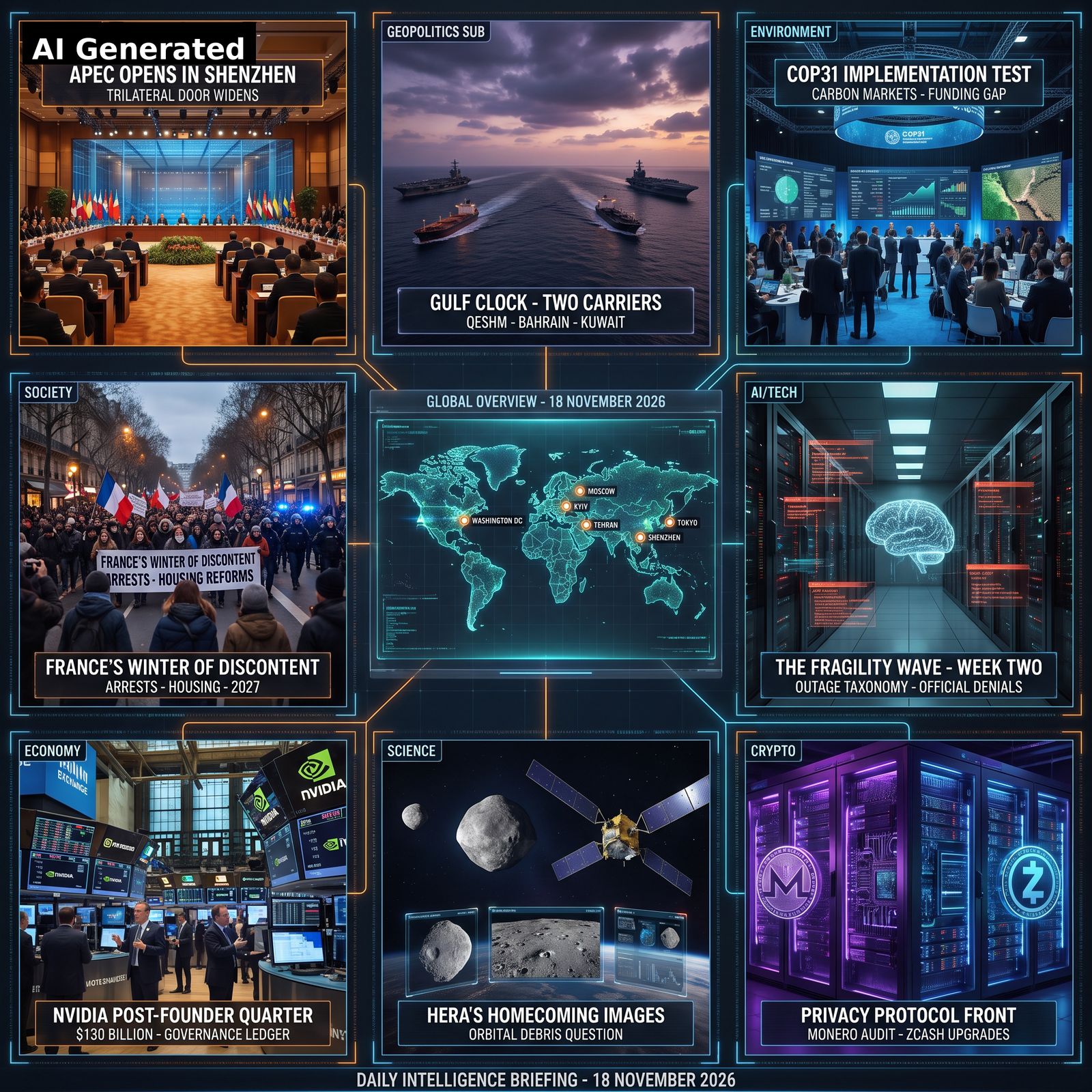











Contents
- 1. Geopolitics & Defence
- The Shenzhen Table: APEC Opens and the Trilateral Door Widens
- The Gulf Clock: Qeshm, Bahrain, Kuwait and the Two-Carrier Signal
- Jerusalem’s Clock: A New Knesset Speaker and the Netanyahu Red Line
- Ukraine’s Bridge War: Kerch Falls, and the Kremlin’s Calculus
- Moscow’s Long Reach: Tu-95s over the Taiwan ADIZ and a New Defence No. 2
- The Defence-Industrial Ledger: NATO’s Space Marketplace, ICEYE’s Bid and the Catapult Wars
- Washington’s New Geometry: Peltola’s Alaska and the 56-44 Senate
- 2. Environment & Climate
- 3. Society & Civil Issues
- France’s Winter of Discontent: Arrests, Housing and the 2027 Chessboard
- Germany’s Civic Square: Care Financing, the BSW Challenge and Gen Z Protest
- Greece’s Civic Ledger: Farmers, Migrants and Polytechnic’s Aftermath
- The Asylum Ledger: Rwanda Phase Two and the Amnesty and HRW Condemnations
- The American Public-Health Ledger: Measles, the FDA and Rajab’s Legacy
- The Commonwealth Ledger: Corruption, Surrogacy and the Big Build Inquiry
- 4. AI & Technology
- The Fragility Wave, Week Two: Outage Taxonomy and the Official Denials
- The Compute Constraint: Nvidia’s China Exit and the Data-Centre Buildout
- The Model Economics Frontier: Microsoft’s Seven, Anthropic’s Compute Math and Nadella’s AGI
- Autonomy’s Regulatory Reversal: Waymo Leaves the Freeways, Zoox Enters Uber
- Cybersecurity’s Agentic Front: OpenAI at NATO, the FBI’s Artex Warning and the Equinor Strike
- The Civic AI Ledger: Korean Cheating, Oregon’s Lawsuit and the Exam Hall
- 5. Economy & Business
- Nvidia’s First Post-Founder Quarter: $130 Billion and the Governance Ledger
- Asia’s Twin Speeds: India’s IT Ascent and the Nikkei Caution
- Germany’s Fiscal Night and the Housing-Stock Question
- Inflation, Banking and the Periphery’s Ledger
- The European Capital Question: Atomico’s Plea and the Battery-Valley Paradox
- 6. Science & Space
- The Deep-Space Ledger: Hera’s Homecoming Images and the Orbital Debris Question
- The Microbiological Ledger: Bacterial Poles at Molecular Resolution
- The Biomedical Ledger: GLP-1 Discontinuation Warning and Pearl-Shell Bone Grafts
- Deep Time and the Archive: Glacier Cracks, a Roman ‘Frog Feast’ and an Iron-Age Bog Killing
- 7. Crypto, Digital Assets & Blockchain
- The Privacy-Protocol Front: Monero’s Audit, Zcash’s Upgrades and the Hardware-Wallet Crisis
- The Exchange-Security Ledger: Lighter’s Nonce Failure and Coinbase’s AI Defence
- The Institutional Perimeter: Waller’s Coexistence Doctrine and the CFTC’s Prediction-Market Question
- The Treasury and Valuation Ledger: Bitmine’s Accumulation, Ionic’s Pivot and the Unicorn Markdown
- 8. Correlations & Analysis
- 9. References
Click any heading to jump to that section. Click the section heading to return to this menu.
Geopolitics & Defence ↑ Contents
The Shenzhen Table: APEC Opens and the Trilateral Door Widens
The APEC leaders’ meeting opened in Shenzhen with the trilateral dynamic between Washington, Beijing and Moscow dominating the agenda. Xi Jinping used the opening to cast China as the guardian of free trade and AI cooperation, while the Kremlin said Putin personally anticipates substantial gains from meeting Trump, dismissing ‘Yalta 2.0’ comparisons as games. South Korea, in a bilateral with Xi, sought supply-chain reassurance and peace on the peninsula.[1][2][3][4]
Japanese Prime Minister Takaichi held a preparatory bilateral with Trump; Taiwan’s presidential office insisted on self-defence and the status quo; and Washington stressed the president is ‘prepared’ for dialogue with North Korea while the CEO summit heard Moscow argue Europe is suffering from sanctions. Whether the trilateral produces nuclear-arms conversation or merely atmospherics will define the week.[5][6]
The Gulf Clock: Qeshm, Bahrain, Kuwait and the Two-Carrier Signal
The United States confirmed an attack on the island of Qeshm, striking what it described as a missile site, and Tehran’s retaliation reached across the Gulf: Bahrain and Kuwait announced they were under air attack and activated their air-defence systems, with Kuwait also reporting it had countered drone attacks. The strikes mark the war’s return to direct exchanges after D169’s naval-mining interlude, the ladder now explicit — a US strike on Iranian soil answered within hours by attacks on US hosts in the Gulf.[7][8]
Washington is projecting presence to match its pressure. CENTCOM released footage of the USS Theodore Roosevelt and USS George Washington operating together in the Arabian Sea, reinforcing the third-carrier concentration reported in D170. In Hormuz a fourth tanker in twenty-four hours burned — one struck near Oman’s Musandam, its crew evacuated — while Tehran describes mines on ‘unauthorised’ routes as its enforcement. Washington is compressing Tehran’s options ahead of the trilateral even as Iran widens the arena rather than surrendering the initiative.[9][10]
Jerusalem’s Clock: A New Knesset Speaker and the Netanyahu Red Line
The Israeli political system crossed a threshold with the election of Matan Kahana, an ally of Gadi Eisenkot, as Speaker of the Knesset — a step the anti-Netanyahu bloc described as decisive in reshaping the chamber’s arithmetic and advancing the transfer of power begun in D161. The election consolidates the coalition’s control of parliamentary procedure, clearing a path for legislation that had been blocked during the caretaker period.[11]
French coverage was blunt that Netanyahu ‘cannot remain one minute longer’ as legal and political pressure converges with the war’s conduct. Israeli officials warn Iran’s missile-rebuild efforts will require sustained action, and Qeshm has raised expectations of a coordinated US-Israeli response. Jerusalem, like Washington, is operating on a clock the trilateral will reset or accelerate.[12]
Ukraine’s Bridge War: Kerch Falls, and the Kremlin’s Calculus
Ukraine inflicted what it called ‘critical damage’ on the Kerch Strait Bridge, the most consequential strike yet on the Russia-Crimea link, Ukrainian-produced FP-5 ‘Flamingo’ missiles and European munitions — Storm Shadows and Destinus RUTA — central to the raid. Footage released by manufacturer Fire Point showed the FP-5 launches, and Kyiv described the raid as the most destructive of the three major bridge attacks, evidently breaking the span’s operational capacity.[13][14]
Moscow’s response was calibrated for the trilateral window. Putin convened his military council and, rather than escalating, delivered a statement of resolve — the attack is ‘serious’ and Russia ‘will not take it lightly’ — while blaming Britain for orchestrating it and repeating that any French military personnel in Ukraine would be legitimate targets. Zelensky, addressing Ramstein-format ministers, asked NATO states — Greece explicitly included — for F-16s, Patriot and IRIS-T interceptors from existing stocks, promising replacement missiles as Ukrainian production matures.[15][16][17]
Kyiv is also industrialising survivability: Ukraine and Finland signed a memorandum to move part of Ukrainian military production to Finnish territory in exchange for access to Kyiv’s weapons technology. Witkoff, Kushner and Zelensky meet in Berlin on Thursday, the same day the trilateral convenes.[18][19]
Moscow’s Long Reach: Tu-95s over the Taiwan ADIZ and a New Defence No. 2
Russia signalled its Indo-Pacific posture with two Tu-95MS Bear bombers flying from the Far East through Japanese territorial airspace near Okinoshima, across Taiwan’s air-defence identification zone and south to Da Nang, Vietnam — a rare deployment that triggered air-defence responses from three governments forty-eight hours before the trilateral. The flight demonstrated Moscow’s reach along the western Pacific approaches days before it sits at the trilateral table.[20]
At home, Putin appointed Anna Tsivileva — his niece, wife of Energy Minister Sergei Tsivilev and former head of the veterans’ foundation ‘Defenders of the Fatherland’ — as Deputy Defence Minister and State Secretary, the ministry’s senior political link to parliament. The appointment continues Andrei Belousov’s civilianisation of the defence ministry and tightens family control over a portfolio central to the war economy.[21]
The Defence-Industrial Ledger: NATO’s Space Marketplace, ICEYE’s Bid and the Catapult Wars
The alliance is building its own commercial-space rails. At the NATO Edge conference in Izmir, NATO announced it will join Bluestaq’s Global Data Marketplace, adopting the US Space Force’s mechanism for buying commercial orbital data — 220 companies from 17 allied nations already participate, first orders expected by year’s end — alongside STARLIFT, an effort to increase access to commercial launch slots. The move responds to October’s incident in which a Russian satellite manoeuvred within hundreds of metres of an ICEYE radar satellite, which US officials called consistent with on-orbit weapons operations.[22]
The European consolidation story advanced at the corporate layer too: ICEYE, the Finnish radar-imaging company central to the Ukraine satellite-intelligence ecosystem, made a $2 billion bid for Italian rocket firm Avio, a deal explicitly framed around Europe’s anxiety about dependence on US launch and military-space capability.[23]
US naval procurement entered a congressional flashpoint. Senate Armed Services Chair Roger Wicker called a return to steam catapults on Ford-class carriers a ‘non-starter’, the Senate Appropriations Committee’s FY27 draft gutted funding for Trump-class battleships, and acting Navy Secretary Hung Cao’s confirmation hearing exposed the tension between presidential directives and the fleet’s EMALS record. Washington also indicted an Irish citizen, Daithi O’Corrain, for destroying a US Air Force C-130H at Shannon in April — an extraterritorial sabotage case involving gallium capsules and months of preparation.[24][25]
Washington’s New Geometry: Peltola’s Alaska and the 56-44 Senate
Democrat Mary Peltola defeated Republican incumbent Dan Sullivan in Alaska, the ninth Democratic pickup of the 2026 midterms and the party’s largest net Senate gain since 1958, giving Democrats 56-44 seats. Peltola, a former House member, is the first Democrat Alaska has elected to the Senate since 2008, a comeback in a state Trump has won by double digits that reshapes the confirmation calendar for the administration.[26][27]
Two intelligence-linked threads complete the picture. Greek and North Macedonian authorities, with Mossad information-sharing, dismantled an Iranian-directed cell planning the assassination of an Israeli citizen on Greek soil after a ten-month operation. In the Western Hemisphere, sixteen Ecuadorian fishermen sued the United States over the bombing of their vessel in Washington’s drug-boat campaign, which has killed more than 200 people since late 2025 — the first formal legal challenge to it. Haiti’s crowds, meanwhile, chanted ‘Merci Bukele’ as Salvadoran troops battled gangs.[28][29][30][31]
The final thread is Greek defence modernisation: the armed forces received the first ten of twenty-five upgraded ‘Teukros II’ counter-drone systems against weaponised drones over prisons and critical sites, while Athens and Ankara continue their Eastern Mediterranean legitimacy contest over GSI claims.[32][33]
Environment & Climate ↑ Contents
COP31’s Implementation Test: Carbon Markets, Small Islands and the Funding Gap
COP31 in Antalya entered its decisive phase with the machinery of climate finance under direct strain. Negotiators are wrestling with how to make carbon markets move money to developing countries, three decades after emissions reduction became the framework’s organising principle; adaptation and loss-and-damage finance now demand instruments that can transfer resources at scale. The Oeko-Institut’s study for Carbon Market Watch sharpens the compliance side: even under substantial effort, EU-ETS1 installations could still emit 159 to 231 million tonnes of CO2 in 2040, making residual-emissions accounting — who pays for what remains — central to the system’s credibility.[34][35]
Small island states have demanded ‘more action’, converting existential vulnerability into leverage at a summit where big emitters’ attention is divided by war and elections. The juxtaposition is sharp: Athens ranked last of forty European cities for air quality in the Clean Cities ‘Free to Breathe’ assessment, first in nitrogen-dioxide concentration — the transition is as much municipal governance as global.[36][37]
The Storage and EV Ledger: 200 GWh, Virginia’s Grid and the Appropriations Fight
US energy storage passed 200 gigawatt-hours, with 14.3 GWh added in the third quarter alone, a pace the industry says is stabilising electricity prices even as it urges permitting reform. The numbers sit inside a broader story in which data centres are the new anchor customer — US data centres drew 4.4 per cent of national power in 2023, with Lawrence Berkeley projecting up to 12 per cent by 2028.[38][39]
Washington’s budget fight is touching the transition directly: Senate Republicans released a FY2027 transport appropriations package proposing to claw back nearly $2 billion already allocated to states for EV-charging infrastructure, a move the Sierra Club warns would set the buildout back. In London, the Climate Change Committee warned that weakening EV targets would put legally binding climate goals out of reach. Two capitals, one argument: the electrification timeline is becoming a fiscal and legal fight.[40][41]
Floating Solar and the California Flood Clock
Third Pillar Power is building Crown City Solar in Cortlandville, New York — North America’s first floating community solar project, a 22.5 MW complex expected fully operational in 2027. The project is a demonstration that the distributed-energy revolution is migrating to underused water surfaces, pairing the community-solar model with a footprint that avoids land-use conflict.[42]
The forecasted ‘monster’ El Niño is imposing a very different kind of infrastructure test in California. Regulators warned dairy operators across the San Joaquin Valley that manure lagoons — unlined ponds holding millions of gallons each — could flood in a winter bringing at least 150 per cent of normal rainfall, a potential environmental and public-health emergency. The juxtaposition frames the era’s paradox: the hydrology powering hydro-solar innovation can, under climate extremes, turn agricultural waste infrastructure into a liability.[43]
The Ocean Carbon Ledger: Rain, Whales and the Awá
Two ocean-science findings updated the boundary conditions of the climate ledger. New research indicates global carbon budgets may underestimate ocean carbon uptake by five to fifteen per cent because they ignore how rain alters the sea surface — a correction with real consequences for how much CO2 the planet can absorb. A University of Hawai’i study shows ocean heatwaves disrupt humpback whale metabolism, nutrition and reproduction, with the 2026-27 El Niño poised to test the species again.[44][45]
On land, the exposed frontier is the Amazon. Rare images of the Awá, one of Brazil’s most threatened isolated Indigenous groups, emerged after roughly twenty members approached a Guajajara village in Maranhão asking for food, children and elders visibly thin, mobilising Funai’s contingency teams. Advocates say the encounter exposes how illegal mining, ranching and logging shrink the territory uncontacted peoples depend on, while encroachment raises disease and violence risks — a biodiversity, human-rights and deforestation story at once.[46][47]
The Corporate Commitment Gap
Analysis from The Conversation notes that just 32 companies account for more than half of global fossil-fuel and cement emissions, and that voluntary climate commitments have repeatedly fallen short absent binding verification and phase-out obligations. No new machinery was announced at COP31 to close that gap; the debate turns on whether carbon-market redesign and the storage buildout can create price signals strong enough to move the 32.[48]
The soft-power front advanced too: Prince William’s Earthshot Prize in Mumbai awarded £1 million each to five winners — Mahindra Last Mile Mobility for electric transport, PFAS-Free France for ‘forever chemical’ bans, Niue Ocean Wide Trust for marine protection, Ørsted for offshore wind and Bhutan for forest conservation. In Europe, new funding for camera- and AI-based wildfire early detection was approved — a niche of the climate-technology stack, detection rather than suppression, quietly becoming a priority as fire seasons lengthen.[49][50]
Society & Civil Issues ↑ Contents
France’s Winter of Discontent: Arrests, Housing and the 2027 Chessboard
Roughly 15,000 people — most of them students — were arrested and detained during France’s recent cost-of-living mobilisations, a crackdown whose scale has itself become a political controversy. The wave feeds into the 2027 contest: Justice Minister Gérald Darmanin urged fellow centre-right figures Retailleau and Attal to stand aside behind Édouard Philippe to block Mélenchon from a run-off against Le Pen.[51][52]
The Assemblée nationale approved the ANRU 3 urban-renewal programme covering 2026-2040, aimed at scores of priority neighbourhoods, though critics judged the initial €5 billion insufficient. Simultaneously, the far-right Rassemblement National pushed removal of the ban on renting energy-inefficient ‘passoires thermiques’, arguing it was ‘massacring’ the rental market — a reversal environmental and housing groups warn will worsen tenants’ bills and building-carbon trajectory.[53][54]
Germany’s Civic Square: Care Financing, the BSW Challenge and Gen Z Protest
Germany’s coalition continues to feed on its own fiscal contradictions. CDU health politician Hendrik Streeck doubted the constitutionality of a proposed ‘care solidarity surcharge’ (Pflege-Soli) to finance the ailing long-term-care fund, injecting a legal question into a coalition debate already strained over the electricity levy, pensions and fuel-price brake. The care gap is structural — an ageing population against a stagnant contribution base — and the objection suggests the coalition may again reach for the general budget rather than a dedicated levy.[55]
The Federal Constitutional Court is due to rule on the BSW’s complaint over the February 2025 Bundestag election, in which the party fell short of the threshold by under ten thousand votes and alleges counting errors; a partial re-run order would be a constitutional first-order event. And German Gen Z is staging a ‘protest with perspective’, rethinking how a generation socialised in climate marches organises around affordability and housing — a shift from street to policy brief.[56][57]
Greece’s Civic Ledger: Farmers, Migrants and Polytechnic’s Aftermath
Greek farmers have their tractors in readiness, warning of mobilisations unless the government delivers concrete solutions and timetables; a pan-agricultural assembly in Nikaia on 6 December will decide whether to invite Prime Minister Mitsotakis personally. The farmers’ movement, dormant since last year’s blockades, is re-arming as input costs and EU green-agriculture rules intersect with thin margins; the December date sets a hard deadline for Athens to pre-empt another round of road closures.[58]
A quieter but equally structural Greek story: immigrants who have worked in Greece for decades still face major obstacles to a decent pension, with a campaign demanding changes to residence requirements and recognition of their insurance rights. The civic calendar was also fully occupied by the 53rd anniversary of the Polytechnic Uprising, in which Health Minister Adonis Georgiadis’s provocative remarks drew a rare ‘blue’ distancing from within his own New Democracy party — evidence that even the country’s historically left-associated memory institutions sit inside a contested political space.[59][60]
The Asylum Ledger: Rwanda Phase Two and the Amnesty and HRW Condemnations
European migration policy crossed a threshold as Germany, Austria, Denmark, Greece and the Netherlands presented an unprecedented joint project to transfer rejected asylum-seekers to Rwanda — denounced by Human Rights Watch as ‘a flagrant abandonment of responsibility and humanity’. The plan effectively externalises the EU’s asylum rejections to a third country, reviving and generalising the UK-Rwanda model London shelved; five continental states signalling a hardening consensus that European Court of Human Rights protections are to be tested collectively, not one state at a time.[61]
The United States’s own enforcement machinery produced a human story with global resonance: former world champion boxer Jorge Linares, detained by ICE, faces deportation, his lawyers arguing the expulsion proceeds ‘in contempt of the laws of our nation’. The case sits alongside Trump’s renewed urgency to finish the border wall in Texas, a project that — a decade after ‘build that wall’ — still defines the administration’s immigration posture even as enforcement extends beyond the border to long-settled residents.[62][63]
The American Public-Health Ledger: Measles, the FDA and Rajab’s Legacy
The United States lost its measles-elimination status for the first time in 26 years, with more than 5,400 cases in 2026 as sustained transmission and falling vaccination rates — amplified by Robert F. Kennedy Jr.’s influence — reversed a decades-old achievement. The White House withdrew Heidi Overton’s nomination to head the FDA just before the Senate health committee was to vote, after months of wrestling over her positions on abortion and vaccines, leaving the agency in limbo.[64][65]
In Bahrain, the death of Nabeel Rajab at 62 removed one of the Gulf’s most prominent democracy activists — a rights advocate who spent years in prison for challenging the monarchy — in the same week the island state again came under Iranian air attack. In Guatemala, a prosecutor investigating electoral crimes was shot and wounded by motorcycle gunmen as violence escalates toward 2027 elections. Amnesty International documents that Iran used the war as a pretext to intensify repression, with political executions at their highest level in decades, including at least 39 linked to the January protests.[66][67][68]
The Commonwealth Ledger: Corruption, Surrogacy and the Big Build Inquiry
Australia’s construction royal commission produced one of its most striking hearings, a Bandidos member unable to explain a $165,000 payment from a union-aligned labour-hire firm, prompting the commissioner to infer he was ‘standing over’ the company. The Big Build inquiry is systematically exposing the intersection of organised crime, union influence and the building industry — a nexus that has corrupted one of Australia’s largest employment sectors.[69]
On law reform, Australia’s strict surrogacy regime could be relaxed: the commission recommends keeping the ban on commercial surrogacy but expanding compensation for surrogates and strengthening safeguards around who the child’s legal parents are. The recommendation seeks to make domestic surrogacy viable where many Australians have turned to costly and legally uncertain arrangements abroad.[70]
AI & Technology ↑ Contents
The Fragility Wave, Week Two: Outage Taxonomy and the Official Denials
The cascade of digital-infrastructure failures that began in D167 entered a second week with Washington’s most senior intelligence and diplomatic figures publicly ruling out a coordinated cyberattack. Secretary of State Marco Rubio said there is ‘no evidence’ linking the outages across Microsoft, flight-tracking, Chase, Apple and the NSA to malicious actors, and DNI Jay Clayton told reporters the issues were not a cyberattack, even as the NSA’s classified network temporarily went down.[71][72]
The explanatory vacuum is itself the story. ZDFheute catalogues what is known: Microsoft first, then the FAA, Chase, Apple and the NSA, a sequence since Thursday raising questions about systemic fragility and the concentration of critical services on a few platforms. Spiegel asks whether the causes lie in the White House’s mass-firing policies, while US air travel logged blackouts, failures and near-collisions at airports. Washington blames inherited systems; critics blame the dismantling of expertise.[73][74]
The Compute Constraint: Nvidia’s China Exit and the Data-Centre Buildout
Nvidia’s reorganisation reached China with unusual finality: it stopped shipping H200 accelerators to Chinese customers and its interim leadership says it is done selling chips to China — a strategic abandonment reversing the brief Trump-era licensing that had allowed H200 sales, as Jensen Huang — facing congressional testimony and SEC scrutiny — begins his post-CEO chapter. The move converts a policy-driven restriction into corporate strategy, and Chinese AI developers must now plan on permanent de facto isolation from frontier accelerators.[75][76]
Giga Energy’s ‘Project Clay’ in Texas — a $1 billion, 60 MW data-centre campus for an unnamed AI cloud provider — will use closed-loop cooling consuming no municipal or groundwater, with modular construction cutting build time to under eight months. The project answers the sector’s central environmental question: how to add AI capacity where water and grid are scarce. San Diego, by contrast, voted to end its contracts with surveillance vendors Flock and Ubicquia, switching off 500-plus cameras and smart streetlights — a rare municipal retrocession of the surveillance layer that expanded after 2021.[77][78]
The Model Economics Frontier: Microsoft’s Seven, Anthropic’s Compute Math and Nadella’s AGI
Microsoft used Ignite to redefine its model strategy around cost. Satya Nadella unveiled seven models under the MAI family — covering coding, cybersecurity, image editing, speech, transcription and decision routing — claiming MAI Code 2 delivers 96 per cent of Claude Opus 5.5’s performance at five per cent of the cost and positioning Copilot as ‘the new OS for work’. Its Maia 200 accelerator is in production serving its largest models.[79][80][81]
The economics of the frontier are being contested with public numbers. Brad Gerstner argues Anthropic could support its 2027 revenue forecast with roughly 500 MW of compute — reframing the capital-intensity debate around efficiency — and a Strategic Management Journal study finds AI adoption is associated with more managers, not fewer. Nadella’s ‘AGI-pilled’ remarks — that the political economy of AGI is the question — place Microsoft squarely in a discourse most platform executives avoided a year ago.[82][83]
Autonomy’s Regulatory Reversal: Waymo Leaves the Freeways, Zoox Enters Uber
The autonomy sector split along a regulatory fault line this week. Waymo suspended driverless operations on all US freeways after California’s DMV banned the vehicles from state highways following traffic incidents — reframing the industry’s safe-scaling narrative from capability to regulatory tolerance. The withdrawal matters because freeways were where robotaxis were supposed to prove unit economics beyond slow urban streets.[84]
Zoox’s partnership with Uber went live in Las Vegas, with Los Angeles to follow. Capital is still pouring into autonomy while state regulators — stung by incidents and public anger — tighten the operating envelope. The industry’s next phase will be governed as much by DMV rulebooks as by sensor suites.[85]
Cybersecurity’s Agentic Front: OpenAI at NATO, the FBI’s Artex Warning and the Equinor Strike
The defensive use of frontier AI crossed an institutional threshold: OpenAI will give NATO governments access to its most advanced models to find and patch cyber vulnerabilities, extending its Daybreak programme beyond the US government to the alliance’s 32 members. The alliance’s communications agency is to award more than $3 billion in contracts by 2027 with AI, space and cloud at the centre, and the FBI warned hackers are using the AI tool ‘Artex’ to accelerate attacks on banks, agencies and healthcare providers.[86][87]
The strike against Norway’s Equinor — Europe’s largest gas supplier — disrupted IT and internal communications without halting production, drawing in national security and counter-terrorism authorities. A startup named Calif found a vulnerability affecting ninety per cent of Fortune 500 firms — allegedly through vibe-coded analysis — confirming the offensive-defensive cycle is now driven by AI on both sides.[88][89]
The Civic AI Ledger: Korean Cheating, Oregon’s Lawsuit and the Exam Hall
South Korea’s national university entrance exam, the highest-stakes test in its education system, was haunted by the spectre of AI cheating as authorities deployed detection against candidates using assistants — an arms race that will migrate to every examination system. Oregon became the latest state to sue OpenAI over alleged child-safety failures, extending a legal front that now spans multiple jurisdictions over a duty-of-care standard for minors.[90][91]
These cases frame the deeper question of the week: the technology’s diffusion into exams, classrooms, hospitals and police cameras is running far ahead of institutions’ ability to govern it, and the answer is emerging as a patchwork of lawsuits, municipal votes and proctoring rules. The frontier moves get the attention; the diffusion layer, ruled by county clerks and school boards, may decide the technology’s social contract.[90]
Economy & Business ↑ Contents
Nvidia’s First Post-Founder Quarter: $130 Billion and the Governance Ledger
Nvidia’s first earnings since Jensen Huang’s departure delivered continuity: $115.8 billion third-quarter revenue, up 20 per cent sequentially and 103 per cent year-on-year, roughly $130 billion guidance for the fourth, and a board chair declaring the company ‘does not intend’ to reinstate Huang. The numbers lifted Asian markets only briefly — Nikkei and Kospi gave back gains as investors weighed whether guidance assumes resolution of the China export question Nvidia is answering with a hard exit.[92][93][94]
The governance drama is measurable: Nvidia’s startup portfolio ballooned to $65 billion over nine months under Huang’s dealmaking, and who signs the next cheques hangs over the AI capital cycle. CoreWeave’s stock rose as Nvidia emphasised disciplined financing to its neocloud partners, calming bankruptcy fears. Fortune reads the affair as a tutorial in corporate governance — checklist independence failing to produce oversight.[95][96][97]
Asia’s Twin Speeds: India’s IT Ascent and the Nikkei Caution
Asia’s markets opened mixed: GIFT Nifty indicated a gap-down, the Sensex traded lower as IT and metal lagged, and oil prices steadied after the Hormuz disruptions. The Nvidia beat failed to sustain optimism — the pattern of the week being that good AI earnings no longer automatically translate into broad risk appetite, as scepticism about the AI capex cycle hardens.[98][94]
India, meanwhile, is building its own compute demand: Gartner projects IT spending will rise 10 per cent to ₹16.9 trillion in 2027, led by AI infrastructure, cloud and data centres, with IaaS expenditure surging 40 per cent. Delhi is deliberately assembling a domestic layer of the global AI supply chain — an insurance policy against the export controls reshaping the China trade, and a signal that the compute race is becoming multipolar at procurement level.[99]
Germany’s Fiscal Night and the Housing-Stock Question
Berlin’s coalition committee ran past 2 a.m. as CDU, CSU and SPD leadership wrestled over the electricity levy, pensions and the fuel-price brake — a negotiation that will define whether the government can fund energy subsidies without breaking its debt rules. Every unresolved item feeds the same squeeze of welfare promises, energy transition and the constitutional debt brake; the coalition’s capacity to deliver a coherent package is the central question of German political economy.[100]
The property market has its own structural novelty: inheritance communities (Erbengemeinschaften) — heirs who co-own a home but cannot agree to sell or rent it — are a major driver of housing vacancy, set to intensify as Boomer homes pass to heirs. Europe’s financial press is also chronicling a startup renaissance: a new unicorn is now created every week in Europe, with Handelsblatt reviewing the VC data behind a recovery that has quietly rebuilt the continent’s venture ecosystem since the 2022 downturn.[101][102]
Inflation, Banking and the Periphery’s Ledger
Britain’s inflation picture deteriorated along a predictable channel: most forecasters expect October CPI to have risen to 3.6 per cent from 3.5 per cent, driven by the Middle East energy shock and the autumn tobacco-duty hike — the Gulf war’s economic transmission running directly through European household budgets.[103]
Afghanistan’s thin global banking lifeline narrowed further as a Pakistani bank exited, reducing the country’s channels to the international financial system — a quiet but consequential deterioration for a sanction-isolated economy. Japan’s Daiwa is doubling down on China, buying out local partners to bolster its mainland investment-banking presence — a contrarian commitment to Chinese capital markets as Western institutions de-risk.[104][105]
The European Capital Question: Atomico’s Plea and the Battery-Valley Paradox
Atomico’s annual State of European Tech report argues Europe should ‘own its success stories’ — retaining the IPOs and scale-ups that leak to US capital. The failure is in the exit layer, and the report calls for pension capital and homegrown buyers.[106]
France’s battery valley in Hauts-de-France offers the industrial counterpart: battery factories in the old mining basin are an economic renewal, but the model does not resolve the deeper dependency — the region remains wedded to the automobile and its supply chain. It is, in microcosm, the European industrial strategy: capacity being built, but the strategic autonomy question postponed.[107]
Science & Space ↑ Contents
The Deep-Space Ledger: Hera’s Homecoming Images and the Orbital Debris Question
Europe’s Hera mission reached the Didymos system after two years of flight, returning the first close images of the aftermath of NASA’s DART impact — the deliberate collision that became the first test of planetary defence. The images answer what DART could not: what the impact did to the asteroid’s shape, surface and spin. The data will calibrate the next generation of deflection models.[108]
SpaceX debris recovered on a Mexican beach is a reminder that the commercial-launch era is also a debris era: rocket stages routinely reach shorelines, and neither the international framework nor the commercial registry fully accounts for them. The two stories bracket space policy’s central polarity — capability rising while governance of its side-effects lags.[109]
The Microbiological Ledger: Bacterial Poles at Molecular Resolution
Scientists at University College London captured the first molecular-resolution images of the poles of living rod-shaped bacteria, exposing surface structures previously impossible to examine. The imaging reveals architectural differences between stationary and dividing cells that could inform how antibiotics reach their targets — a discovery with direct biomedical potential.[110]
The Biomedical Ledger: GLP-1 Discontinuation Warning and Pearl-Shell Bone Grafts
Two case reports in The Primary Care Companion for CNS Disorders document patients hospitalised with psychosis and mania after abruptly stopping GLP-1 receptor agonists — tirzepatide (Mounjaro/Zepbound) — in one case a Cotard delusion in a 61-year-old man, in another a manic episode in a patient who had lost 100 pounds. The authors caution the cases do not prove causation but argue acute-onset psychiatric symptoms after discontinuation may be an underrecognised phenomenon, and prescribers should treat GLP-1 changes as a potential variable — a warning that matters as these drugs’ use expands.[111]
The FDA granted 510(k) clearance to PearlBone Putty 1600, the first bone-repair graft material made from pearl shells — nacre converted to a calcium-phosphate composite mimicking human bone mineral, developed at the University of Western Australia and produced from pearl-farming waste. The US orthopaedic market is worth an estimated $1.1 billion a year; a sustainably sourced, biocompatible filler that encourages natural bone regrowth has a credible path into a sector dominated by autograft and synthetic competitors.[112]
Deep Time and the Archive: Glacier Cracks, a Roman ‘Frog Feast’ and an Iron-Age Bog Killing
A single fibre-optic cable has turned a glacier’s faint vibrations into a map of its inner structure: ETH Zurich researchers used distributed acoustic sensing on Switzerland’s Gornergletscher to reveal hidden cracks that meltwater can drive deeper into the ice. The method gives cryospheric science a cheap, repeatable early-warning tool for ice-shelf and glacier stability at a moment when the Alps are losing volume to record melt.[113]
Archaeology contributed two windows into older worlds. The 8,000 frog bones found in a single ditch near Bar Hill, Cambridgeshire in 2022 turned out to be a ‘feast’ by short-eared owls within a single Roman year — pellets accumulated after Roman land management opened the Fens, resolving a four-year mystery. In Northern Ireland, a coroner-style hearing at the Ulster Museum concluded that the Ballymacombs More Woman, an Iron-Age bog body, was deliberately beheaded from behind more than 2,000 years ago — a death consistent with the ritual-killing tradition of north-west European bog bodies. Both studies show the archive’s power: even the smallest and oldest remains can overturn confident narratives.[114][115]
Crypto, Digital Assets & Blockchain ↑ Contents
The Privacy-Protocol Front: Monero’s Audit, Zcash’s Upgrades and the Hardware-Wallet Crisis
Privacy-protocol development advanced on two fronts. Monero’s Full-Chain Membership Proofs upgrade (FCMP++) cleared a zkSecurity audit of its Generalized Bulletproofs implementation with no high or medium findings — a technical gate on the path to making transactions indistinguishable, the network’s largest privacy improvement, conditioned on the audit class institutional critics demand. Zcash’s NU7 upgrade accelerated private-payment confirmations threefold, with the community voting on allocating 50,000 ZEC to its sustainability fund — governance working in parallel with consensus change.[116]
The hardware-wallet segment is living through a crisis of trust. The Ledger implant saga reached Dubai’s Virgin Megastore, where two owners reported losing a combined $604,000 from wallets purchased there — extending the pattern, documented in this pipeline’s coverage of Trezor’s Safe 5 implants, of tampered devices injected at the retail-distribution layer. Trezor disclosed that a breach at shipping partner Skladon exposed names, phone numbers, delivery addresses and product data for 27,000 orders placed between 9 August and 7 November — a mailing list of hardware-wallet owners with addresses attached, precisely what an implant scam needs. Trezor’s response — halving order-data retention from 90 to 45 days and rolling out ‘anonymous pickup’ locker delivery in 18 European countries — concedes the shipping partner remains the structural hole in hardware security.[117][118]
The Exchange-Security Ledger: Lighter’s Nonce Failure and Coinbase’s AI Defence
Lighter, a decentralised derivatives venue, reopened deposits and withdrawals days after analytics traced a roughly $10.4 million USDC withdrawal; it reports about $5 million returned to traders and attributes the cause not to a smart-contract exploit but to nonce reuse in unofficial signing code used by affected trader accounts — a cryptographic error that exposed API signing keys. The distinction is central: core software can behave flawlessly while a trader’s custom bot leaks authority, and the fix — wallet-signature requirements, IP allowlists, key limits and nonce monitoring — is the audit discipline the privacy and hardware stories demand on the user side.[119]
The counterpart story is defensive AI. Coinbase’s AI defence blocked approximately $4.7 million from reaching a deepfake Elon Musk scam, stopping about 91 per cent of transfers linked to a fake Tesla livestream without human intervention — the same generative-AI technology used to manufacture scams repurposed, at the platform layer, as the first line of counter-fraud.[120]
The Institutional Perimeter: Waller’s Coexistence Doctrine and the CFTC’s Prediction-Market Question
Federal Reserve Governor Christopher Waller said stablecoins, tokenized bank deposits and other digital payment instruments are likely to coexist within the US financial system as blockchain becomes integrated into traditional finance — a concrete statement of the coexistence doctrine from the institution that issues the dollar. It lands alongside the CFTC nomination fight: Democratic nominee Matthew Rowland questioned the public benefit of prediction markets, as the legal fight over the sector — including Kalshi’s decision to stop taking bets based on Trump’s comments over manipulation fears — escalates on multiple fronts.[121][122][123]
The prediction-market episode deserves emphasis: Kalshi’s move to exclude Trump-comment-derived bets is a direct acknowledgment that the largest information asymmetry in the market is the president’s own output — a governance problem no exchange can fully solve by self-policing, and one that will shadow the CFTC’s rulemaking regardless of who wins the confirmation fight.[123]
The Treasury and Valuation Ledger: Bitmine’s Accumulation, Ionic’s Pivot and the Unicorn Markdown
Corporate treasuries are behaving asymmetrically. Bitmine added 7,653 ETH in a week, pushing its reported Ethereum treasury above 6.08 million tokens — roughly three per cent of circulating supply — even as dollar value fell with the market; accumulation is running on token-denominated conviction, and dilution, financing costs and staking terms will decide whether per-share exposure actually grows. Ionic Digital, by contrast, sold 737 BTC to fund its data-centre buildout — a pivot from mining to AI infrastructure, the mirror image of Bitmine’s accumulation: miners are becoming landlords of compute, not hodlers.[124][125]
The venture layer is repricing the 2021 boom: crypto unicorns from that cycle trade at 50–70 per cent markdowns in secondary markets while exchange, infrastructure and custody leaders hit new highs — a capital-markets verdict on which models survived the collapse. CoinGecko’s Solana Foundation backing, with ambitions to enter crypto trading, fits the consolidation pattern: data aggregators are converting attention into exchange ambitions as active networks compete to own the distribution layer.[126][127]
Correlations & Analysis ↑ Contents
Across the D171 window, the master variable remains the Gulf war’s gravitational pull on every other system. D170 closed on completion of the three-carrier concentration and the widening tanker war; D169 described the return to direct strikes after a naval-mining interlude. Today the ladder is fully explicit — a US strike on Qeshm answered within hours by Iranian air attacks on Bahrain and Kuwait, a fourth tanker burning in Hormuz, a two-carrier CENTCOM show of force — all running in parallel with the trilateral diplomacy opening in Shenzhen.[4][17]
The defining feature of this window is that the war and the diplomacy are on the same clock. D170 framed the trilateral as a table where Ukraine, nuclear arms and the Gulf would be traded; today every actor’s move is calibrated to that meeting. Kyiv struck the Kerch bridge into ‘critical damage’ days before Witkoff, Kushner and Zelensky sit down in Berlin on the day the trilateral convenes; Putin answered with a restrained military-council statement; and Moscow’s Tu-95 deployment to Vietnam was timed within forty-eight hours of the summit. Coercion and negotiation are being choreographed as one process, and the trilateral’s outcome will retroactively explain today’s restraint.[16][11][8]
A second through-line connects Jerusalem’s politics to Washington’s new geometry. The Knesset’s election of an Eisenkot ally as Speaker advances the transfer-of-power process tracked since D161, in the same week the Alaska result gave Democrats their largest Senate majority since 1958 — a domestic reconstitution in both capitals whose consequences for war policy will arrive within months. D168 and D169 both noted that Israeli officials were preparing for a long Iranian-reconstruction campaign; the political changes on both sides of that campaign are now the variable to watch.[8][9]
The third thread is the convergence of the Nvidia crisis with the compute-energy constraint D169 flagged as the industry’s true bottleneck. Nvidia’s hard exit from China — ceasing H200 shipments and declaring itself done there — converts an administered restriction into corporate strategy in a week when the data-centre buildout is asked to solve water and power scarcity simultaneously. The thread D163-D170 tracked as ‘compute’s new geography’ is now permanently entangled with climate policy, and COP31’s data-centre debates will converge.[22][18]
What to watch in the next reporting period: the trilateral’s aftermath — whether nuclear-arms language or Ukraine sequencing emerges from Shenzhen, and whether Russia’s bridge response arrives immediately after the summit concludes; the Iranian retaliation cycle against Gulf hosts, which will test whether the two-carrier presence deters or accelerates escalation; the first hearings under a 56-44 Senate, beginning with the FDA leadership vacuum and Huang’s December congressional testimony; and the election-security calendar in Guatemala and the 2027 French campaign, where today’s 15,000 student arrests have already become a campaign issue. The crypto section’s hardware-wallet crisis — implants at retail, shipping-data breaches — remains a watch item for users as well.[5][12]
The most consequential open question is whether the Shenzhen trilateral marks the beginning of a great-power management regime or a performative interlude. The Kremlin’s claim that Putin anticipates ‘significant gain’ from meeting Trump and Xi, set against Beijing’s framing of the encounter as of ‘groundbreaking significance’, suggests all three leaders see institutional value in the meeting itself; whether that value becomes verifiable arms-control or Ukraine architecture will determine whether D171 reads as the pivot of the era or a summit photograph.[18][15]
References ↑ Contents
1. Apec summit live: Xi and Putin speak as world leaders gather in China by The Guardian · Source ↑
2. Xi Jinping calls for global cooperation on AI and free trade at APEC summit by France 24 · Source ↑
3. FinancialJuice: Russia’s Putin at APEC CEO summit: anticipates significant gain from Trump, Xi meeting by FinancialJuice · Source ↑
4. FinancialJuice: South Korean president in meeting with Xi: hope both nations continue efforts that bring people closer, such as introducing pandas by FinancialJuice · Source ↑
5. APEC live: Day 2 starts as Trump, Takaichi and other leaders set to arrive by Nikkei Asia · Source ↑
6. Rubio says no meeting with N. Korea’s Kim yet scheduled for Trump’s China visit but president is ‘prepared’ for dialogue by The Independent · Source ↑
7. Ιράν: Αεροπορικές επιδρομές κατά του Μπαχρέιν και του Κουβέιτ by in.gr · Source ↑
8. +++ Iran-Krieg +++: US-Militär bestätigt Angriff auf iranische Insel Gheschm by Handelsblatt · Source ↑
9. Αμερικανική επίδειξη ισχύος με δυο αεροπλανοφόρα (βίντεο) by DefenceNet · Source ↑
10. Επικά πλάνα: Δεν έμεινε ούτε σωλήνας από δεξαμενόπλοιο που χτυπήθηκε σφοδρά by DefenceNet · Source ↑
11. Israels Knesset: Eisenkot-Verbündeter als Parlamentspräsident gewählt by Tagesschau · Source ↑
12. « Il ne peut pas rester une minute de plus » : Benyamin Netanyahou, le coup tordu de trop by Le Parisien · Source ↑
13. Ukraine inflicts devastating damage on Crimea Bridge in major symbolic blow to Putin by The Independent · Source ↑
14. Οι στιγμή που οι FP-5 «Flamingo» εκτοξεύονται για να χτυπήσουν στο Κερτς by DefenceNet · Source ↑
15. Η ΕΕ προσπαθεί να σαμποτάρει τη «νέα Γιάλτα» by DefenceNet · Source ↑
16. H M.Zαχάροβα αποκάλυψε την αποστολή που συμμετέχουν Γάλλοι στην Ουκρανία by DefenceNet · Source ↑
17. Ο Β.Ζελένσκι ζήτησε και από την Ελλάδα F-16, Patriot και Iris-T by DefenceNet · Source ↑
18. Η Ουκρανία ετοιμάζει την μεταφορά στρατιωτικής παραγωγής στην Φινλανδία by DefenceNet · Source ↑
19. +++ Ukraine-Krieg +++: „Ziemlich dumm“ – Pistorius verurteilt US-Kritik an Ukraine by Handelsblatt · Source ↑
20. Russian Tu-95 Bombers Arrive In Vietnam After Flurry Of Northeast Asia Air Alerts by The War Zone · Source ↑
21. Γυναίκα η νο2 στο ρωσικό υπουργείο Άμυνας by DefenceNet · Source ↑
22. NATO aims to spur space industry, help militaries by joining data marketplace by Defense One · Source ↑
23. ICEYE makes $2B bid for Italian rocket firm Avio by Breaking Defense · Source ↑
24. Trump’s Demand For Steam Catapults On New Carriers Is A “Non-Starter”: Senate Armed Forces Chair by The War Zone · Source ↑
25. U.S. Court Charges Irish Citizen for Destroying a C-130 Hercules by The Aviationist · Source ↑
26. Mary Peltola beats Republican Dan Sullivan in Alaska to give Democrats 56 Senate seats by The Guardian · Source ↑
27. +++ USA unter Trump +++: Demokraten gewinnen Senatssitz in Alaska by Handelsblatt · Source ↑
28. 5 το πρωί: Ιρανικό σχέδιο δολοφονίας στην Ελλάδα – Μπλακ άουτ στην NSA – Ασταμάτητος Ολυμπιακός στην Κύπρο by To Vima · Source ↑
29. Ισραηλινά ΜΜΕ: H Moσάντ συνέβαλε στην σύλληψη των υπόπτων του σχεδίου επίθεσης by DefenceNet · Source ↑
30. Seize pêcheurs équatoriens poursuivent les Etats-Unis en justice pour le bombardement de leur embarcation by Le Monde · Source ↑
31. Haitians rally behind Bukele as Salvadoran troops battle gangs by France 24 · Source ↑
32. Τεύκρος ΙΙ: Το ελληνικό anti-drone σύστημα που θωρακίζει τις φυλακές – Πώς εξουδετερώνει drones με επικίνδυνα φορτία by Ethnos · Source ↑
33. GSI και Τουρκία: Η μάχη για τη διεθνή νομιμοποίηση και τη διαμόρφωση αντιλήψεων στην Ανατολική Μεσόγειο by Ethnos · Source ↑
34. COP31: How to make carbon markets more effective by Phys.org · Source ↑
35. How much CO₂ will stay? New study estimates long-term residual emissions under the EU Emissions Trading System by Phys.org · Source ↑
36. With heightened stakes, the world’s small islands demand ‘more action’ at UN climate talks by The Independent · Source ↑
37. Αθήνα: Τελευταία μεταξύ 40 ευρωπαϊκών πόλεων στην ποιότητα του αέρα – «Πρωταθλήτρια» στις συγκεντρώσεις διοξειδίου του αζώτου by Ethnos · Source ↑
38. REPORT: U.S. Exceeds 200 GWh of Energy Storage Capacity Installed to Date by CleanTechnica · Source ↑
39. How much electricity does a data center use? A typical AI facility draws as much as 100,000 households, US data centers took 4.4 percent of the nation’s power in 2023, and a federal lab says that share could reach 12 percent by 2028 by ECOticias · Source ↑
40. Senate Republicans Seek to Again Raid States’ Coffers & Threaten EV Charging by CleanTechnica · Source ↑
41. Government risks missing climate targets if EV rules weakened, adviser warns by BBC News · Source ↑
42. Third Pillar Constructing Largest Floating Solar Complex in New York by CleanTechnica · Source ↑
43. California Manure Lagoons Could Be ‘Ticking Time Bombs’ in the Forecasted Monster El Niño by Inside Climate News · Source ↑
44. Rain May Increase Ocean Carbon Uptake More Than We Thought by Environment News Service · Source ↑
45. Ocean Heatwaves Disrupt Humpback Whale Metabolism, Reproduction by Environment News Service · Source ↑
46. Rare images of Indigenous group in Amazon highlight threats, advocates say by Aljazeera · Source ↑
47. Rare encounter with isolated Indigenous Awá people in Brazil exposes vulnerability by Mongabay · Source ↑
48. Large companies can still fall short on their climate commitments. Here’s what must change by The Conversation · Source ↑
49. Prince William’s presents Earthshot Prize winners with $1.3M each in Mumbai by Mongabay · Source ↑
50. KI gegen Feuer: Mehr Geld für Waldbrand-Früherkennung mit Kameras und KI by DIE ZEIT · Source ↑
51. Γαλλία: 15.000 συλλήψεις στις διαδηλώσεις μαθητών by Skai · Source ↑
52. Présidentielle 2027 : Gérald Darmanin appelle Bruno Retailleau et Gabriel Attal à s’effacer derrière Edouard Philippe, pour barrer la route à Jean-Luc Mélenchon by Le Monde · Source ↑
53. Loi « relance du logement » : l’Assemblée nationale valide le lancement du programme ANRU 3 pour la période 2026-2040 by Le Monde · Source ↑
54. « Cela provoquait un carnage sur le marché locatif » : le RN fait supprimer l’interdiction de louer des passoires thermiques by Le Parisien · Source ↑
55. Pflegeversicherung: Gesundheitspolitiker Streek: „Ich bezweifle stark, dass ein Pflege-Soli rechtmäßig wäre“ by Handelsblatt · Source ↑
56. Bundesverfassungsgericht entscheidet über BSW-Einspruch gegen Bundestagswahl by Stern · Source ↑
57. Erneute Protestaktion: Protest mit Perspektive: Was Gen Z anders machen will by DIE ZEIT · Source ↑
58. Με τα τρακτέρ σε ετοιμότητα οι αγρότες – Εξετάζουν συνάντηση με Μητσοτάκη by Ethnos · Source ↑
59. Μετανάστες στην Ελλάδα: Δεκαετίες δουλειάς με μεγάλα εμπόδια σε μια αξιοπρεπή σύνταξη by Ethnos · Source ↑
60. Το γαλάζιο «άδειασμα» στον Άδωνι για το Πολυτεχνείο by To Vima · Source ↑
61. « Un abandon flagrant de responsabilité et d’humanité » : HRW dénonce le projet de cinq pays européens d’expulser des migrants vers le Rwanda by Le Monde · Source ↑
62. « Au mépris des lois de notre nation » : l’ex-champion du monde de boxe Linares, détenu par ICE, va être expulsé des États-Unis by Le Parisien · Source ↑
63. Trump in a rush to finish the project that helped propel him to the White House in the first place by The Independent · Source ↑
64. Οι ΗΠΑ έχασαν έπειτα από 26 χρόνια το καθεστώς εξάλειψης της ιλαράς, πάνω από 5.400 κρούσματα το 2026 by Proto Thema · Source ↑
65. White House Withdraws Nomination of Heidi Overton to Be F.D.A. Commissioner by The New York Times · Source ↑
66. Nabeel Rajab, prominent Bahraini human rights activist, dies at 62 by The Independent · Source ↑
67. Πυροβόλησαν και τραυμάτισαν εισαγγελέα που ερευνούσε εκλογικά αδικήματα στη Γουατεμάλα by Proto Thema · Source ↑
68. L’Iran a « utilisé le prétexte » de la guerre au Moyen-Orient pour « intensifier la répression », dénonce Amnesty International by Le Monde · Source ↑
69. ‘Everyone likes money’: Bandidos member can’t remember why he was paid $165,000, Big Build inquiry hears by The Guardian · Source ↑
70. Australia’s strict surrogacy laws could be relaxed under proposed changes by The Guardian · Source ↑
71. Ρούμπιο: «Καμιά απόδειξη πως οι βλάβες σε ψηφιακές υποδομές των ΗΠΑ συνδέονται ή οφείλονται σε κακόβουλους παράγοντες» by Zougla · Source ↑
72. National intelligence director says no signs of cyberattack amid tech outage concerns by ABC News · Source ↑
73. IT-Chaos in den USA – was wir wissen und was nicht by ZDFheute · Source ↑
74. US-Luftverkehr: Blackouts und Pannen an Airports sorgen für Alarm by Der Spiegel · Source ↑
75. Nvidia Stops Shipping H200s to Customers in China by Gizmodo · Source ↑
76. Nvidia is abandoning China after Jensen Huang’s ouster by TechCrunch · Source ↑
77. Texas plans 60MW data center with closed-loop cooling and faster construction by Interesting Engineering · Source ↑
78. San Diego dumps both Flock cameras and smart streetlights by Ars Technica · Source ↑
79. Microsoft takes on Claude with seven models costing up to 95% less for coding tasks by Interesting Engineering · Source ↑
80. Microsoft calls Copilot “the new OS for work” at Ignite keynote by Ars Technica · Source ↑
81. Satya Nadella says he’s AGI-pilled now by The Verge · Source ↑
82. Brad Gerstner says Anthropic could support its 2027 revenue forecast with about 500 MW of compute by Crypto Briefing · Source ↑
83. New research finds AI adoption is associated with more managers—and different managerial skills by Phys.org · Source ↑
84. Waymo temporarily pulls driverless taxis from all US freeways by BBC News · Source ↑
85. Zoox Partnering with Uber to Bring Autonomous Mobility to More Riders by CleanTechnica · Source ↑
86. OpenAI gives NATO access to most advanced cybersecurity AI by Defense One · Source ↑
87. Hackers Are Using AI to Speed Through Cyberattacks, FBI Warns by CNET · Source ↑
88. Κυβερνοεπίθεση στον μεγαλύτερο προμηθευτή φυσικού αερίου της Ευρώπης! by DefenceNet · Source ↑
89. A Startup Vibe Coded Its Way to Finding a Vulnerability Affecting 90% of Fortune 500 Firms by Gizmodo · Source ↑
90. South Korean high-stakes university exam haunted by specter of AI cheating by Nikkei Asia · Source ↑
91. Oregon is the latest state to sue OpenAI over child safety by Engadget · Source ↑
92. Nvidia shoots down calls for Jensen Huang’s return amid strong earnings by Al Jazeera · Source ↑
93. Nvidia promises that revenue will keep soaring — for now by TechCrunch · Source ↑
94. Nikkei, Kospi & Co.: Nvidias starke Bilanz kann KI-Skepsis in Asien nicht vertreiben by Handelsblatt · Source ↑
95. Nvidia’s startup stakes ballooned to $65B, but Huang’s exit puts future deals in doubt by TechCrunch · Source ↑
96. CoreWeave stock rises as Nvidia emphasizes disciplined financing approach by Crypto Briefing · Source ↑
97. Nvidia’s tutorial on genuine good governance, needed by tech bros and governistas alike by Fortune · Source ↑
98. Stock Market LIVE: GIFT Nifty down over 100 pts; Asian markets mixed post Nvidia’s Q3 beat by Business Standard · Source ↑
99. India’s IT spending to grow 10% to ₹16.9 trillion in 2027: Gartner by Business Standard · Source ↑
100. Koalitionsausschuss: Spitzen von CDU, CSU, SPD beraten über Stromsteuer, Rente, Spritpreisbremse by Der Spiegel · Source ↑
101. Immobilien: Erbengemeinschaften – das unterschätzte Problem am Wohnungsmarkt by Handelsblatt · Source ↑
102. Start-ups: Jede Woche entsteht in Europa jetzt ein neues Einhorn by Handelsblatt · Source ↑
103. Inflation set to have risen amid energy bill increases and tobacco duty hike by The Independent · Source ↑
104. Afghanistan’s global banking lifeline dwindles as Pakistani bank exits by Nikkei Asia · Source ↑
105. Daiwa to bolster China investment banking as it buys out local partners by Nikkei Asia · Source ↑
106. Stripe backer Atomico calls for Europe to own its success stories by TechCrunch · Source ↑
107. Dans les Hauts-de-France, le paradoxe de la «vallée de la batterie» by Libération · Source ↑
108. Nach zwei Jahren Flug am Ziel: Was brachte der Einschlag? Mission «Hera» liefert Bilder by DIE ZEIT · Source ↑
109. « Ils flottent et viennent s’échouer sur le rivage » : des débris d’une fusée de SpaceX récupérés sur une plage du Mexique by Le Parisien · Source ↑
110. For the First Time, Scientists Capture Molecular-Scale Images of the Poles of Bacteria by SciTechDaily · Source ↑
111. 2 Patients Have Been Hospitalized With Psychosis or Mania After Abruptly Stopping GLP-1s by ScienceAlert · Source ↑
112. FDA Clears First-of-Its-Kind Bone Repair Material Made From Pearl Shells by ScienceAlert · Source ↑
113. A Simple Cable Reveals Hidden Cracks That Could Weaken Glaciers From Within by SciTechDaily · Source ↑
114. Archaeologists found more than 8,000 frog bones in one ditch near Cambridge, and four years later the culprits in this murder mystery turned out to be owls feasting within a single Roman year by ECOticias · Source ↑
115. A young Iron Age woman found in a Northern Ireland bog was deliberately beheaded, most likely from behind with a bladed weapon, a coroner-style hearing at the Ulster Museum has heard by ECOticias · Source ↑
116. Monero FCMP++ upgrade clears zkSecurity audit with no major issues by crypto.news · Source ↑
117. Ledger hardware implant saga reaches Dubai’s Virgin Megastore by Cointelegraph · Source ↑
118. Trezor’s Skladon Breach Exposed 27,000 Orders, and Some Buyers Can’t Be Warned by BlockchainReporter · Source ↑
119. Lighter Reopens Withdrawals After Nonce-Reuse Error Exposes Trader API Keys by NewsBTC · Source ↑
120. Coinbase AI defense blocks $4.7 million from being sent to deepfake Elon Musk scam by The Block · Source ↑
121. Fed Governor Sees Stablecoins, Tokenized Deposits Coexisting in Financial System by News · Source ↑
122. CFTC nominee questions public benefit of prediction markets as legal fight grows by CoinDesk · Source ↑
123. Kalshi stops taking bets based on Trump’s comments over fears of manipulation: report by The Independent · Source ↑
124. Bitmine Adds 7,653 ETH as Ethereum Treasury Climbs Above 6.08 Million Tokens by NewsBTC · Source ↑
125. Ionic Digital sells 737 BTC to fund its data center buildout by Crypto Briefing · Source ↑
126. Crypto unicorns from 2021 boom see 50%-70% markdowns in secondary markets by Crypto Briefing · Source ↑
127. CoinGecko secures Solana Foundation backing and eyes crypto trading by CryptoSlate · Source ↑
AI Disclosure: This post was created with the assistance of artificial intelligence. The ideas, analysis, and opinions expressed are my own — AI was used to help compose, structure, and refine my personal notes and thoughts into the final written content. Images, videos and music featured in this post were also generated using AI tools, based on my own creative prompts and direction.