










Contents
- 1. Geopolitics & Defence
- 2. Environment & Climate
- 3. Society & Civil Issues
- 4. AI & Technology
- 5. Economy & Business
- 6. Science & Space
- 7. Crypto, Digital Assets & Blockchain
- 8. Correlations & Analysis
- 9. References
Click any heading to jump to that section. Click the section heading to return to this menu.
Geopolitics & Defence ↑ Contents
Hormuz’s Second Night: Mines, Riyadh Intercepts and the Assassination File
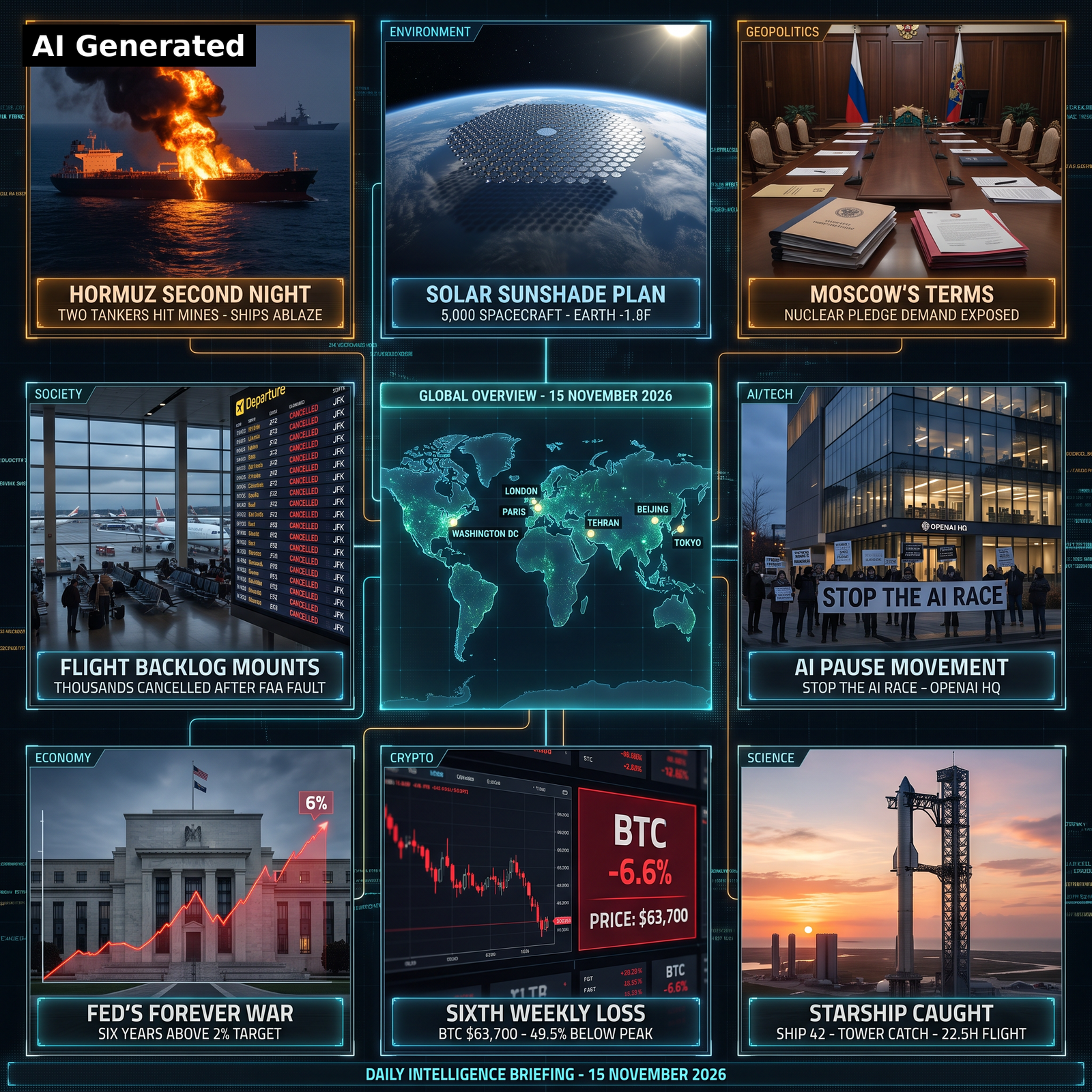
The Gulf war’s maritime front escalated this weekend in its most literal form yet: Iran’s Revolutionary Guard navy reported two oil tankers striking naval mines and igniting in the eastern Strait of Hormuz, taking the number of struck vessels in roughly twenty-four hours to seven[1][2]. Handelsblatt summarised the sequence as three tankers burning after mine contact, a Houthi missile interception, a Bahraini warning, and Tehran rejecting talks on nuclear inspections[3]. Mining is a slow, deniable instrument compared with the summer’s missile strikes, shifting the Gulf clock from spectacular attacks to cumulative attrition on shipping insurance and schedules — the pressure vector that keeps oil markets pricing a permanent war premium. The Saudi-led coalition intercepted two missiles and two drones over Riyadh as fighting intensified in Yemen’s Marib and al-Jawf, with the UN reporting more than 340,000 Yemenis displaced since August[4]; that the Houthi front still generates theatre-level munitions aimed at the Saudi capital, eleven months into a war nominally about Iran, underlines how Yemen remains a second, semi-autonomous front of the same conflict.
Alongside the maritime escalation came an intelligence file that, if confirmed, would mark a qualitative change in targeting. According to Israel Hayom, the Mossad passed specific information to the CIA about an alleged Iranian drone-attack plot against President Trump and senior officials, including Treasury Secretary Scott Bessent, who reports say have been moved to higher-security facilities[5]. Neither the White House nor the CIA has confirmed the threat, which revives unanswered questions from a Reuters investigation last August about repeated Israeli warnings of Iranian assassination planning[5]. Read alongside Netanyahu’s reported push for renewed operations against Iran, the file suggests a deliberate information campaign as much as a verifiable plot — but the security reaction itself, relocating a Treasury secretary onto a military-style footing, is the observable fact, and it tells allies that Washington now treats the Iranian threat as operating at the leadership layer.
Jerusalem’s Unity Plea and Gaza’s Winter Ledger
Inside Israel, Prime Minister Benjamin Netanyahu issued a public plea to opposition leader Gadi Eisenkot to join a unity government, as the mandate race continues to shape every military decision[6]. It signals a leadership calculating that the coming weeks — potential Iranian retaliation, resumed Gaza operations, an unpredictable White House — are too exposed to run with a narrow coalition. The military ledger in Gaza stayed active: an Israeli air strike killed Samir Abu Younis, the Hamas Rafah brigade commander who participated in planning the 7 October 2023 attacks; nearly 1,600 Palestinians have been killed since the ceasefire of 10 October 2025, against eight Israeli deaths reported by the military[7]. European diplomacy reacted with unusual directness: EU foreign-policy chief Kaja Kallas called on Israel to admit more humanitarian aid to Gaza as winter approached[8].
The Ankara Pivot and the Aegean Fault
A structural shift arrived via Istanbul: Turkey and Qatar signed a mutual defence agreement on 13 November, pledging a “unified position” against external armed attack and converting what had been a financial-and-brokerage relationship into formal collective defence[9][10]. For the Gulf clock, the pact matters not because Turkey will fight in the Strait — it will not — but because it turns the Gulf’s northern shore into an allied bloc at the moment Iran is mining its southern waters. Ankara’s eastern Mediterranean posture remained assertive: Turkish opposition leader Kilicdaroglu provoked Athens by floating the prospect of war with Greece “because of the arming of the Aegean islands,” rhetoric Greek media condemned but which keeps the Aegean sovereignty contest alive in Turkish domestic politics[11]. Greek Foreign Minister Giorgos Gerapetritis informed opposition leaders that no permission had been sought from Turkey for the Greece-Cyprus interconnector, with the French survey vessel working in international waters under Greek licensing and NAVTEX only — a firm restatement of Athens’ position in the creeping dispute flagged in the D162 report[12].
The Euro-Atlantic Perimeter: Moscow’s Terms and Britain’s Arctic Warning
The New York Times reported on a classified Russian document outlining Moscow’s settlement terms, and they are not about Ukraine alone: the Kremlin reportedly demands that Britain and France commit not to use their nuclear weapons to protect other European states, that NATO forces withdraw from Poland and the Baltic states, that US posture return to 1997 levels, that Western military aid to Kyiv stop, and that NATO membership for Ukraine be excluded[13]. It is the clearest statement yet that Moscow treats any Ukraine settlement as the opening bid for a broader European security renegotiation. Maria Zakharova publicly framed the same ambition, arguing Europe would be “safer without NATO,” which she likened to an aching tooth weakening the continent’s immune system[14]. Reports that Trump’s envoys floated NATO membership in exchange for Donbas cession, an idea Kyiv does not take seriously, show Washington’s oscillation continuing even as Moscow’s maximalism hardens[15]. London is preparing for a different contingency: former prime minister Rishi Sunak urged Britain to prepare for Arctic confrontation, arguing London must be able to strike Russian installations on the Kola Peninsula, and citing a 41 percent increase in Russian naval activity off British coasts plus the vulnerability of undersea cables carrying roughly 99 percent of intercontinental traffic[16]. The actual US drawdown from Europe looks far more modest than feared: Bloomberg reported the reduction is closer to 5,000 troops from ~80,000 rather than the 25,000 governments braced for, with the eastern flank to be reinforced and Germany most affected, ahead of Hegseth’s recommendations due by 1 December[17]. And an AFRICOM delegation led by Lt Gen Dagvin Anderson visited Sirte, received by Saddam Haftar, in what Greek defence media read as de facto recognition of the 2020 Turkey-Libya maritime pact — a development with direct implications for the Eastern Mediterranean legal framework Athens has contested for six years[18].
Defence-Industrial Signals: Radar, Missiles and Print
Belgium selected Thales’ GM200 MM/C radar as the sensor heart of its Blue Dome layered air-defence architecture, integrated with Kongsberg’s Fire Distribution Centre and Raytheon’s AMRAAM in the NASAMS configuration — a network shared with the Netherlands, Norway, Denmark, Sweden and Lithuania, and a concrete instance of European air-defence interoperability hardening after a year of drone and missile threats[19]. Russia released footage of a Mi-28NM helicopter launching the Dan-T low-cost cruise missile, a ~$65,000 weapon related to the Kronstadt Banderol, deployable from the Yak-130, MiG-29, Mi-8 and ground launchers; the naming confusion in Russian MoD videos signals that Moscow is mass-producing cheap precision munitions for attritable warfare[20]. China’s AVIC Shenyang institute publicised advances in metal 3D-printing of large load-bearing airframe components for the J-35 programme, including a 16.4-foot integrated fuselage structure[21]. The US Navy moved the Virginia-class USS North Dakota to Pearl Harbor, making it the sixth attack boat in Submarine Squadron 1, a quiet thickening of undersea deterrence in the Pacific[22], while Brazil began forming a squadron for naval surface and underwater drones[23]. In Iraq, Prime Minister Mohammed Shia al-Sudani sacked nine officials over illegal oil refineries and smuggling uncovered in a region run by Kataib Hezbollah — an anti-corruption strike aimed at the pro-Iranian militia complex around Hormuz[24]. The ASEAN summit opening in Manila rounded out a weekend in which the Indo-Pacific’s multilateral wing resumed business amid the Gulf storm[25].
Environment & Climate ↑ Contents
COP31’s Aftermath: The Coalition Without Its Champion
The Antalya climate conference has closed, and the first post-COP31 structural signal is curious: the coalition of 57 countries seeking to accelerate the global transition away from fossil fuels will press ahead even though Colombia, its founding champion, has withdrawn[26]. The departure of the country that first proposed the coalition strips the group of a moral anchor and confirms that fossil-fuel-exit coalitions fracture along the same subsidy-and-rent lines as the oil economy. In the United States, the midterm outcome reshapes the domestic horizon: with Congress’s makeup changed for the term beginning January 2027, analysts weigh whether federal climate progress stalls at the permitting front while states and corporations carry the burden[27]. A new analysis pinpoints which US states have warmed fastest since 1980, data framed as a guide for where adaptation dollars are needed — a reminder that even at roughly 1.63°C of global warming, the burden is distributed unevenly across the map[28].
The Geoengineering Ledger: A Sunshade That Needs the Moon
The most audacious climate story of the window is UK-backed research into a planetary sunshade: roughly 5,000 spacecraft that would block 1 percent of incoming sunlight and cool Earth by about 1.8°F, funded through Britain’s Advanced Research and Invention Agency[29]. Its Space Reflector Baseline Survey concludes the concept is “buildable with no new physics, but realistically 20-40 years away,” using heliogyro solar sails some 25 miles across stationed near the Sun-Earth L1 point. The crux is that most of the 50-100 million tonnes of hardware would come from lunar mining, and that “the capability to build a planetary sunshade is arriving faster than the governance to oversee it.” This is not a near-term plan but a signal that solar-geoengineering research is now framed as a hedge carbon dioxide cannot replace; its risk of tempting governments to ease decarbonisation is acknowledged even by its advocates[29].
The Compute-Energy Ledger: Gas, Rockets and $3.4 Billion
The largest climate-adjacent business story of the weekend is Anthropic’s reported $3.4 billion contract to buy gas-fired engines from Texas-based OnePWR Solutions to power its AI data centres[30]. The deal crystallises a tension running through the D160-D168 reports: AI’s compute demand is being met, at the margin, by natural gas — the very fuel the transition is supposed to retire. When a frontier AI lab spends billions on combustion capacity, the “compute is the constraint” thesis (D165) becomes an emissions thesis. The same fuel is quietly becoming the feedstock of rocketry: SpaceX is among the industrial-scale consumers of natural gas building new pipeline connections for methane for its rocket fleet[31]. Methane from the same grid increasingly powers both the AI frontier and the orbital economy — two of the fastest-growing energy demand sources, neither priced for its climate cost yet.
On the decarbonisation side, frontier technologies advanced. Quaise Energy is drilling a confirmation well beside Oregon’s Newberry Volcano for a superhot geothermal plant, aiming for ~15,000 feet with first power by 2030 — even as its millimetre-wave rock-melting drill is parked in favour of conventional drilling for the first, cooler wells[32]. MIT engineers cast a concrete beam using a sewn fabric mould with one-third the concrete and half the steel of a conventional beam[33]. And a “biosolar” roof on Australia’s first new city in a century — Bradfield City, west of Sydney — generated 11.1 percent more electricity than a conventional roof while sheltering 14,000 native plants and attracting a rare blue-banded bee, evidence that green roofs and solar can reinforce rather than compete[34].
The Waste Ledger: Panels, Seabeds and Salmon Feed
America’s solar boom is creating a waste problem it is not yet ready to price: NREL estimates recycling a US panel costs $15-$45 while landfilling costs under $1, which is why under 10 percent of retired panels reach recyclers — a gap that could produce up to 1 million tonnes of panel waste by 2030 and 10 million by 2050 unless economics or regulation shift[35]. The same arithmetic governs the seabed: the US auction of seabed mineral leases near American Samoa drew bids as low as $3 million, and the case for profitable deep-sea mining remains poor, raising the question of whether the auction is a critical-minerals gesture or a speculative grab[36]. In food systems, Norwegian salmon giant Leroy’s introduction of poultry by-products into feed cut the feed’s carbon footprint by up to 16 percent on paper, but its 2025 disclosures show wild forage fish taking a larger share of marine ingredients — a reminder that feed-swap decarbonisation can hide a worsening oceanic extraction ledger[37].
The Living Ledger and the Weather Front
On biodiversity, the weekend’s most consequential story is human: Raabia Hawa, the Kenyan founder of the Ulinzi Africa Foundation who has been designated a target by al-Shabaab for defending coastal ecosystems against poaching, illegal bottom-trawling and extractive mining, received the 2026 Tusk Award for Conservation in Africa[38]. Her case proves that environmental defence is a security occupation, not a hobby. The ecological ledger also registered a Brazilian warning: a study in Nature Cities found urban expansion in the Sao Paulo metropolitan area is collapsing stream food webs, with interaction networks of 190 connections falling to just three[39]. Supercell thunderstorms with giant hail and 98 km/h winds lashed eastern Australia, with a man struck by lightning while swimming on the NSW Central Coast — a violent close to a storm season testing the region’s emergency systems[40].
Society & Civil Issues ↑ Contents
America’s Civil Ledger: Airspace Aftershocks and the Courts
America’s weekend opened with the aftershock of Friday’s historic FAA ground stop: several thousand more US flights were cancelled through Saturday as airlines cleared the backlog from the technical fault, with the cause identified and normalisation expected by Sunday evening[41][42]. The incident, which stranded millions, continues the “airspace standstill” D167 flagged — and its second day shows how a single point of failure in the national air-traffic system ripples through an economy dependent on just-in-time air mobility. The courts, meanwhile, delivered a rebuke to presidential prerogative: a federal judge in Washington temporarily blocked the administration’s plan to close East Potomac Park for a 15-month golf-course renovation, ruling the public facility must remain open while the legality of the closure is tested[43].
Two further American civic stories bracket the ledger. In California, Governor Gavin Newsom’s decision to commute the death sentences of 548 condemned inmates to life imprisonment drew a furious response from President Trump, who branded him “Newscum” on Truth Social and claimed some offenders “make Hannibal Lecter look like a good kid” — underscoring how the death penalty remains a live partisan fault line[44]. In New Orleans, port authorities sued for more than $1 million against the owners and operators of the asphalt tanker “Atlantic Asphalt,” which slammed into the anchored cruise ship “American Heritage” on the Mississippi, injuring more than 30 people; a federal court authorised seizure of the tanker[45].
France’s Civic Square: Cost of Living, Police Powers and a Judoka
Paris’s Place de la Nation became the scene of the weekend’s most visible European unrest: roughly 9,000 people marched in the fifth consecutive weekly protest against the cost-of-living crisis, and after the official demonstration, groups of young protesters clashed with police, hurling Molotov cocktails while officers responded with tear gas and stun grenades[46]. Students, workers and Yellow Vests veterans channelled an anger that has grown for two months as household budgets are squeezed. A separate, largely peaceful mobilisation in Paris and Lyon was dominated by rejection of the government’s “permis de tuer” (license to kill) bill, which would introduce a presumption of self-defence for police and gendarmes; critics argue it would legalise police violence at a moment when public trust in law enforcement is fraying[47]. The tension is visible from within the police: a commissaire wounded in the 17 October riots denounced the “banalisation” of violence against officers, showing the crisis strains both sides of the blue line[48]. Even French politics absorbed the turbulence — judoka Teddy Riner launched an improbable candidacy for the 2027 presidential election, a move observers say risks damaging his image more than his rivals’[49].
The British Ledger: Consent, Ethics and Youth Jobs
Britain’s civic institutions faced a weekend of scrutiny on two fronts. The government said it will consider changing the age of consent after Mia Latter, now 37, waived her anonymity to allege she was raped by jailed comedian Russell Brand when she was 16; Deputy Prime Minister Louise Haigh called the change “a massive step” that “deserves proper consideration and scrutiny”[50]. And the head of the UK’s Ethics and Integrity Commission, Stuart Sterling, was suspended after the Sunday Times revealed past harassment allegations and a disciplinary penalty from his police years — a scandal that undermines the commission’s very purpose and raises questions about the vetting that appointed him[51]. On welfare, the government will expand the youth jobs scheme so every eligible 18-to-24-year-old is “guaranteed” a six-month job matched to their skills after twelve months on universal credit, an intervention aimed at the rising NEET population[52]. The Met Office issued yellow cold-health alerts for parts of the UK amid frosty weather, warning of increased pressure on health services[53].
Germany’s Civic Square: Protests, Pensions, SPD Succession
German civic life was dominated by three interlocking stories. First, the Gen-Z protest movement returns: after the largely peaceful 31 October demonstrations, authorities are preparing for renewed youth protests on 20 November across 34 cities, with the interior ministry vowing that “the loudness of violence must not drown out the voices of those peacefully standing up for their future”[54]. Second, the establishment moved on pensions and conscription: the Union faction voted for the pension package despite dissent, the controversial military service law passed the cabinet — with Defence Minister Pistorius expressing incomprehension at Interior Minister Wadephul’s objection — and Germany and Canada announced plans for a raw-materials agreement[55]. Third, the SPD succession battle took shape: former Labour Minister Hubertus Heil will run for party chair at the January party congress, positioning himself as the “party soldier” at a moment when the SPD is struggling with a male-dominated leadership and declining polls[56]. Heidelberg is also moving to allow topless swimming for women in municipal pools on equality grounds, following several other south-western cities[57].
The Global Civic Periphery: Executions, Elections, Institutions
Beyond the Atlantic cores, the civic ledger records institution-straining events. Saudi Arabia executed two men on “terrorism” charges, including one whom human-rights group Reprieve says was arrested at 14 for participating in social-media-coordinated protests and confessed under torture — among executions that Amnesty ranks third worldwide[58]. Cape Verde held the first round of its presidential election, with six candidates and the incumbent Jose Maria Neves favoured for a second term against Joana Rosa Amado, the first woman candidate — a test of democratic alternance in one of Africa’s most stable polities[59]. In Prague, hundreds of thousands of Czechs were expected to rally against the Babis government’s plan to cut funding for public radio and television, with public-media workers warning their institutions will “end up writing what the government wants”[60]. In Thailand, a nursing home has been accused of keeping dozens of elderly residents in metal cages, convulsing the care sector[61]; in Switzerland, hundreds of men marched against violence towards women after a study found half of men aged 18-24 hold restrictive views of masculinity[62]. In Cambodia, the battle for OIF leadership intensified as France reportedly asked Rwanda to withdraw Louise Mushikiwabo’s candidacy for secretary-general, with the incumbent vowing to stay “candidate jusqu’au bout”[63]. Greece closed the migrant facility at Kleidi Sintikis in Serres, moving the final 44 migrants to other structures, fulfilling a long-standing police and local demand[64], and mourned two firefighters killed in a blaze in an abandoned building in Zephyri[65]. Argentina’s President Javier Milei confirmed he will seek a second term, touting recovery even as his radical “chainsaw” austerity drives many into poverty[66]. Finally, a UPS cargo aircraft reportedly collided with a passenger plane on the ground at Miami airport, adding a further stress case to a week defined by America’s aviation system malfunctioning[67].
AI & Technology ↑ Contents
The Pause Movement Rises: “Stop The AI Race” and the APEC Moment
Artificial intelligence moved from the laboratory to the street this weekend in a form recalling the nuclear-disarmament movements of the Cold War. Roughly 150 protesters gathered outside OpenAI’s San Francisco headquarters under the banner “Stop The AI Race,” demanding that President Trump and China’s Xi Jinping negotiate a treaty — at next week’s APEC summit in Shenzhen — banning the development of “superintelligence” beyond human cognitive capability[68][69]. Organiser Michael Trazi and the MIRI-affiliated movement argue that US and Chinese companies are on track to build AI “so intelligent it could kill anyone,” and frame a treaty as the only exit from a prisoners’ dilemma in which neither side dares slow down unilaterally: “If only Anthropic slows down, OpenAI gains. If only the US slows down, China gains”[69]. The protest’s timing — days before Trump’s first meeting with Xi since the midterms — makes APEC the first genuine high-stakes test of AI governance at the heads-of-government level, a threshold no previous technology reached while still in deployment. Rallies are planned in about twenty cities, including Paris and Berlin. Public AI anxiety is also manifesting at the infrastructure layer: Edinburgh residents protested data-centre construction, citing noise, road closures and access problems — a preview of the social-licence battles that will accompany every major AI buildout[70].
The Nvidia Files: Security, Succession and Counterintelligence
The Nvidia saga gained two new dimensions. TechCrunch asked the generative question — “Where was Nvidia’s security team?” — after revealing the chipmaker’s security chief quietly left in August, months before CEO Jensen Huang’s resignation over his relationships, including one with an executive at a company suspected of funneling chips to China; a former intelligence officer notes this is “the kind of leak that runs through everyday conversations, which most corporate security teams are poorly equipped to catch”[71]. The affair has triggered a hiring boom in corporate counterintelligence: AI firms pay former spies $200,000-$500,000 to protect trade secrets, with Anthropic hiring 33 counterintelligence staff this year (up from 14), OpenAI 22 (from 9) — a formalisation of the intelligence community’s creep into the AI economy[72]. Silicon Valley is already planning Huang’s return, with reports detailing a founder with a $145 billion net worth, a deep network and an untarnished record in the industry’s eyes, suggesting the ouster may be temporary[73]. At the philanthropy layer, the $9 billion foundation led by Huang’s wife Lori is being scrutinised as the family’s soft-power instrument during the crisis[74].
Security and Privacy: The French Breach and Telegram’s Quiet Door
France was hit by one of its largest-ever data breaches: hackers accessed the personal data of 22 million people through La Poste subsidiary Maileva, a digital mail platform used by businesses to send salaries, invoices and registered letters — names, surnames and postal addresses were exposed in an attack occurring in mid-September but confirmed only now[75]. The breach follows Credit Mutuel Arkea’s ~EUR 100 million loss and the 2024 France Travail attack affecting 43 million people, underscoring the concentration risk of outsourced document processing. In messaging, Telegram quietly restricted new in-chat apps amid a “no-tap” hacking scare, with a Bot API contributor confirming the curbs and Pavel Durov asserting server-side remediation — a security posture shift for a platform prized for its permissiveness[76]. Regulatory divergence sharpened: Apple began shipping its “Home View” AI assistant in the US but not the EU, blaming a European regulation — a test case for how bloc rules shape the transatlantic AI product map[77].
Autonomy at the Edge: Robotaxis, Electric Aircraft, AI-Verified Science
Two transport-automation milestones frame the applied-AI ledger. Zoox launched commercial robotaxi service in Atlanta’s Northwest district, expanding beyond Las Vegas as the year of the robotaxi compounds[78]. And China’s COMAC completed the first crewed flight of its CE-25A electric commercial aircraft, a 10-ton-class, 19-passenger design for short intercity routes, having flown 19 autonomous missions; certification begins now, and the battery economics will determine whether electric regional aviation is a 2027 story or a 2035 one[79]. Finally, a quieter governance battle: Nikon stripped first place from the winner of its 2026 Small World in Motion microscopy contest after 469 scientists from 36 countries signed an open letter challenging a video supposedly showing a child’s airway cilia, which experts said violated the generative-AI rules — a landmark precedent for verifying AI-augmented scientific imagery[80].
Economy & Business ↑ Contents
The Fed’s Forever War: Inflation, Iran and the Rate Calculus
The defining macro question of the D168 window is whether the Federal Reserve is losing the inflation fight — and for how long. Within months the Fed will mark six years of inflation above its 2 percent target, with its own forecasts pushing the return to target into 2029, meaning the price-stability half of its dual mandate could be missed for eight straight years[81]. The current spike is inseparable from the Gulf war: after crude soared when Iran closed the Strait of Hormuz and attacked energy infrastructure, refined-product supplies — gasoline and diesel — remain tight even as oil exports rebounded under US military protection, and October’s CPI came in hotter than expected with inflation spreading beyond energy[81]. Chicago Fed’s Austan Goolsbee called the data “borderline disturbing”; Governor Christopher Waller said a 50-basis-point hike must be considered in December if core CPI rose 0.3 percent or more — which it did; Dallas Fed’s Lorie Logan warned the current 3.75-4.00 percent policy rate is too low and the Fed “may be able to move more rapidly”[81]. US diesel prices fell below $6 a gallon to a two-month low, a rare piece of relief in a hawkish landscape[82]. A more centrist voice counsels gradualism: the Fed’s Collins argued steady, incremental rate increases are the best way to manage economic risk, suggesting December will be a genuine hawk-vs-dove contest[83]. The irony is structural: the same Gulf war that inflates global energy prices is, through the AI buildout — including Anthropic’s $3.4 billion gas-power order — feeding a domestic growth boom that adds its own pricing pressure[84].
The Great Rotation: AI Retreat, India’s Ascent, Data Centres
Equity markets are repricing the AI trade in real time. The MSCI India gauge has rebounded 11 percent from its October six-month low, adding more than $400 billion in value and almost erasing this year’s losses, in what analysts describe as the “great rotation” — money rotating out of US AI-exposed equities into cheaper emerging-market champions as the AI-selloff narrative matures[85]. The rotation is a valuation signal that the AI capital cycle, which D160 tracked at OpenAI’s $1.25 trillion valuation, has entered a phase where investors demand evidence of cash conversion. The infrastructure ledger remains stubbornly expansionary: Digital Realty Trust announced a further $10 billion in Japan data-centre investment, a bet that Tokyo and Osaka become core compute nodes for the region’s AI workloads — and that the buildout’s electricity, land and capital demands have not hit their ceiling[86]. Despite billions in revenue and ubiquitous adoption, the sector’s core players are still “bleeding billions,” with the economics of AI-as-a-business yet to clear the capital-intensity hurdle that gas-power and data-centre orders only compound[87].
Bets, Booms and Balance Sheets
Two longer-horizon stories complete the ledger. In Germany, a FAZ analysis highlights the regulatory vacuum around prediction markets: platforms like Polymarket and Kalshi sell bets on everything from Venezuela’s Maduro to the Super Bowl as financial contracts, and a pending US Supreme Court ruling on whether such markets constitute sports betting could reshape the industry globally[88]. And Sri Lanka offers a case study in the gap between statistical upgrades and lived reality: the World Bank’s reclassification of the island as upper-middle-income contrasts with a population still recovering from default and crisis — a reminder that ratings measure fiscal categories, not household resilience[89].
Science & Space ↑ Contents
Starship’s Historic Day: Ship 42 Caught, the Booster Waits
The spaceflight story of the weekend — arguably of the year — is SpaceX’s successful capture of a Starship upper stage by the launch tower’s mechanical arms at Starbase, Texas. After a record 22.5-hour orbital flight during which Ship 42 completed roughly fourteen orbits and reached about 260 kilometres, the vehicle reignited its engines, survived re-entry heating at ~17,000 mph, and descended into the “chopsticks” — a first for the upper stage, which demands far more precision than the booster catches SpaceX has already mastered[90][91]. The Super Heavy booster aborted its landing attempt on a low-fuel warning and splashed down in the Gulf of Mexico, so the full rapid-reusability loop remains incomplete; but the significance is structural: catching both stages would collapse turnaround times toward airline-like cadence, unlocking the 100,000-satellite Starlink vision and, eventually, the Mars programme the architecture exists to serve[90]. The milestone’s timing is also worth noting — days after the FAA’s historic US ground stop raised questions about the resilience of the systems regulating such launches, and with the rocket’s methane appetite (Section 2) colliding with the same natural-gas grid powering the AI boom[92].
Cosmic and Lunar Frontiers
Beyond Starship, the cosmic ledger advanced on four fronts. Supercomputer simulations of neutron-star mergers showed some collisions, rather than collapsing straight to a black hole, can birth a magnetar with an extraordinarily powerful magnetic field within milliseconds[93]. An independent re-analysis of the iconic 2019 Event Horizon Telescope image of the M87 black hole delivered fresh verification of its accuracy[94]. Astronomers identified a long-period radio transient flashing every eight minutes in a binary with a sun-like companion, a new data point on a class first noticed in 2022 whose mechanism remains contested[95]. And China confirmed its first foreign astronaut: a Pakistani astronaut will ride Shenzhou 24 to Tiangong within two weeks, an explicit signal of the expanding geopolitical geometry in spaceflight[96]. On the lunar-construction front, researchers demonstrated simulated moon dust can be fused into interlocking, LEGO-like bricks without added binders — a technique that could let lunar bases be built largely from local regolith, sharply cutting the mass Earth must launch[97].
The Biomedical Ledger
Medicine delivered a cluster of findings with translational potential. A first-of-its-kind drug that turns cells’ protein-recycling machinery against advanced prostate cancer reduced tumour activity and pain in an early clinical trial, suggesting a route around the hormone-therapy resistance that eventually defeats most patients[98]. Trial data presented weight-loss injections as a plausible treatment for the millions suffering painful knee osteoarthritis, since the drug simultaneously drives the weight loss that relieves the joint[99]. Laboratory work showed multifloral honey could strengthen skin cells’ defences against UV radiation[100]. And a study in Gut Microbiology, using data from 61 participants including swallowed smart pills, linked habitual coffee consumption with altered small-intestinal pH and greater microbial richness, though the authors caution the effects’ clinical significance is unproven[101].
The Deep Archive: A 1,700-Year-Old Odyssey and Earth’s First Animals
The deep-time ledger produced two gems. At Utrecht University Library, a scrap of discoloured parchment long dismissed as unremarkable turned out to be a ~1,700-year-old fragment of Homer’s Odyssey — from Book 12, the moment Helios learns his sacred cattle have been eaten — likely from a pocket-sized codex owned by “a fan of Homer living in the Fayum oasis” around 300 CE; only about thirty such fragments exist worldwide[102]. And a study in Earth and Planetary Science Letters reconstructed how enormous underwater canyons cut across the continental shelf of what is now South Australia during the Ediacaran period, ~550 million years ago, and were then rapidly flooded — creating the exceptional preservation window that lets us study Earth’s first large, mostly soft-bodied animals[103].
Crypto, Digital Assets & Blockchain ↑ Contents
The Sixth Weekly Loss: Leverage, Liquidations and the Fed’s Stability Report
The defining crypto event of the D168 window is a market-structure event, not a price event — although the number is arresting on its own. Bitcoin traded near $63,700 at 02:11 UTC on Sunday, down 6.6 percent in 24 hours and 49.5 percent below its 6 October 2025 record of $126,080, after printing an intraday low of $62,603 that broke the 17 August support at $62,844 and marked the weakest price since mid-August, a four-month low[104][117]. Total crypto market capitalisation dropped 9.7 percent to $2.16 trillion in a single day, with ether down 8.5 percent, Solana 9.3, XRP 7.7 and Dogecoin 10.4[104]. The weekly arithmetic confirms a sequence, not a wobble: bitcoin closed last Sunday at $74,740, itself the fifth consecutive lower weekly close since the $86,490 print of 5 October, and the current week is on course to be the sixth straight loss, removing nearly a quarter of the asset’s value in a month[104]. Aggregate liquidations exceeded $1.9 billion as leveraged longs were force-closed into the cascade[105], and Glassnode flagged a large concentration of vulnerable leveraged trades near $60,000 that could deepen the spiral if pierced[106].
What separates this correction from a random drawdown is its documented transmission channel — and the fact that the Federal Reserve named the risk publicly before the move. The November Financial Stability Report, published 13 November, listed “elevated asset valuation pressures” as its first vulnerability and reported hedge-fund leverage “reached the highest level since the data began in 2013,” concentrated in a small number of large funds; it also noted Treasury yields “climbed markedly” and remained well above 15-year averages[104]. The report mentions bitcoin nowhere — its only digital-asset passage concerns stablecoins — but the transmission is real: a 10-year yield at 5.15 percent on 13 November repriced every long-duration, no-cash-flow asset, and ultra-high hedge-fund leverage is precisely the condition under which a 7 percent move in bitcoin becomes a 10 percent move in the average altcoin[104]. The flows confirm the story: US spot bitcoin ETFs recorded net redemptions in seven consecutive sessions through 13 November, totalling $1.9 billion, with IBIT and FBTC accounting for the entire 13 November outflow — a concentrated allocator decision, not a stampede[104]; broader tallies put two-week spot ETF outflows at $2.35 billion, with IBIT alone representing 90 percent[107]. XRP crashed to a 14-month low as ETF outflows and shrinking stablecoin supply compounded the pressure[108], and ether fell roughly 10 percent in the rout[109].
Institutional Mechanics: Meridian FX, the NYSE Door, the Brazilian Licence
Beneath the selloff, the institutional layer quietly advanced. The Bank of England, with the Monetary Authority of Singapore and the Bank of Thailand, published Project Meridian FX APAC, a three-ledger settlement experiment testing whether atomic payment-versus-payment can work across an RTGS system, a tokenised wholesale ledger and a wholesale CBDC testnet without forcing central banks onto one platform[110]. The headline: synchronisation worked. The detail that matters: in one environment, it only worked because the operator held participant cash in an escrow wallet — turning a “non-custodial coordinator” into a custody-bearing entity — and in the netting case the operator began assuming “functions traditionally associated with a clearing house”[110]. The experiment targets the $1.4 trillion a day of FX settling with no PvP protection, and informs the Bank of England’s commitment to a live synchronisation service by 2028[110]. Separately, Ava Labs said its NYSE tokenised-settlement partnership cost nothing and opened institutional doors[111]. In Brazil, neobank Nubank secured approval to purchase Banco Porto Real de Investimentos, becoming a licensed bank and preserving its “bank” moniker — a reminder that crypto-adjacent fintechs increasingly conclude the regulated banking perimeter is the durable home for their branding[112].
The Enforcement and Fragility Ledger
The enforcement and protocol layers delivered cautionary items. A Hong Kong man lost nearly HK$18 million in a crypto scam that began with a YouTube advertisement — a case study in how fraud has industrialised customer acquisition[113]. Vestige, a DeFi platform on Algorand, will shut down on 31 December 2026 citing costs, a concrete measure of how hard it is to sustain DeFi economics in low-activity ecosystems[114]. A study of the 2026 cohort of forced Bitcoin Lightning exits found the median cost a modest 925 satoshis per channel, yet broadcasters faced a median 2.5-day wait for settlement — evidence that Lightning’s exit frictions are about time and finality, not fees[115]. Finally, BitMine chairman Tom Lee linked the AI equity selloff, the cash demands of the Anthropic IPO, and crypto hacks into one interconnected risk picture — an acknowledgement that digital assets no longer trade in a vacuum but as part of the same liquidity system as frontier AI equities[116]. The window’s ledger reads exactly as the Fed’s stability report implied: a leveraged, high-valuation asset class unwinding inside a tighter rate environment, with flows pointing out and the Fear and Greed index printing 10, its lowest since early June[104].
Correlations & Analysis ↑ Contents
The D168 window’s master variable remains the Gulf war’s gravitational pull on every other system. What changed this weekend is the texture of coercion. The D167 report closed on the convergence of Washington, Beijing and Moscow into a trilateral diplomatic door and on the Tehran-Tel Aviv fulcrum moving toward preparation and pre-emption. Today the fulcrum has tilted from missile exchanges to two quieter instruments: naval mining in the Strait of Hormuz — seven ships struck in twenty-four hours — and an intelligence file alleging Iranian drone plots against President Trump and his senior officials[1][2][5]. Both instruments raise the cost of the status quo for a US leadership that declared the war “essentially over” (D163) while keeping combat below the threshold that would force reopening hostilities. The mining campaign attacks the one number the administration cannot ignore — the oil-derived inflation that D167’s fiscal section identified as the Fed’s binding constraint — linking the Gulf clock directly to the hawkish repricing in today’s Economy section.
The second correlation structures this report’s architecture: the AI capital cycle has become the primary transmission belt between geopolitics, energy and markets. Anthropic’s $3.4 billion gas-power order, Digital Realty’s $10 billion Japan data-centre expansion and the counterintelligence hiring boom triggered by the Nvidia affair are three facets of a single phenomenon — an industry so capital-hungry that it is now a first-order buyer of fossil generation, a first-order consumer of grid capacity, and a first-order consumer of former intelligence officers[30][86][72]. The Fed’s stability report named artificial intelligence, a risk-asset correction, higher long-term rates and fiscal debt sustainability as the top risks in its market-contacts survey; those four risks are interactive, and this weekend’s crypto liquidation cluster is the first visible intersection of all four. When bitcoin’s sixth weekly loss arrives on the same weekend as a $3.4 billion natural-gas deal for an AI lab, the “compute is the constraint” thesis of D165 meets the “AI businesses still bleeding billions” reality of D168 in a single, uncomfortable superposition[87].
The third correlation is institutional: the same weekend the FAA’s ground-stop recovery rolled into its second day saw a cascade of governance questions across the Atlantic — the UK’s ethics commissioner suspended over a scandal his commission was created to police, Prague’s public-media revolt against the Babis government’s funding cuts, the French police-immunity bill igniting its fifth weekly protest wave with Molotovs at Place de la Nation, and the German Gen-Z protest cycle preparing its second round[51][60][46][54]. D167 framed “trust in systems” as the through-line of the week; D168 confirms trust deficits are not resolving but rotating — from aircraft technology to police powers, public broadcasting and the party systems themselves. The common structural driver is the cost-of-living squeeze D161-D165 tracked through every European capital, now fused with a security-to-institution feedback loop in which each crack in a public institution justifies the next increment of state power — or of street resistance.
A fourth through-line deserves statement: the decoupling of American civil society’s visible politics from its actual governance. The East Potomac golf-course injunction, the Newsom commutation fight and the FAA recovery all played out in the same 48 hours[43][44][41]. Each is small; together they map a lame-duck presidency, a Fed that has lost patience with “mission accomplished” forecasts, and a midterm mandate still being interpreted. D161’s “Washington’s Personnel Reset” arc and D162’s “America’s Morning After” anticipated a governing vacuum; D168 shows that vacuum now filled by courts, central banks and states rather than the executive.
Forward-looking assessment for the next reporting period: (1) The APEC summit in Shenzhen, with Trump meeting Xi for the first time since the midterms, is the single highest-leverage event on the calendar; the “Stop The AI Race” treaty demand and the Hormuz file will both be in the room, and any announced AI framework would be the first such heads-of-government instrument[68]. (2) The Fed’s December meeting carries a credible 50-basis-point hike scenario after October core CPI met Waller’s trigger; watch the November CPI and the diesel and gasoline complex the Hormuz mines are inflating[81]. (3) Crypto’s falsification thresholds are clean: a daily close reclaiming the 200-day average near $72,900 would break the six-week downtrend; a close below $58,600 would confirm it — and bitcoin sits squarely between after a Fear-and-Greed print of 10[104]. (4) In space, the Starship upper-stage catch rewrites the orbital cost curve; whether SpaceX attempts the dual-stage catch on Flight 16 — and the response of an FAA still repairing its credibility — are the operational questions to track[90][91]. (5) On the Gulf clock, the Qatar-Turkey defence pact and the AFRICOM delegation’s Sirte visit signal that the region’s powers — and Washington — are already posturing for the day after an Iranian settlement, even as the mines keep detonating under the day’s tankers[9][18].
References ↑ Contents
1. Iran’s IRGC navy: two tankers ignite after hitting naval mines in Strait of Hormuz – state media by FinancialJuice · Source ↑
2. Iran war live: Coalition downs 2 Houthi drones; 7 ships hit mines in 24 hours as Qatar, Türkiye sign defence deal by Al Jazeera (liveblog) · Source ↑
3. Iran-Krieg: Drei Öltanker in Straße von Hormus nach Minenkontakt in Brand by Handelsblatt · Source ↑
4. Saudi-led coalition intercepts two missiles, two drones in Riyadh by Al Jazeera · Source ↑
5. Ανησυχία στις ΗΠΑ για ιρανικό σχέδιο επίθεσης με drones κατά του Ν.Τραμπ by DefenceNet (via Israel Hayom) · Source ↑
6. Netanyahu sends plea to Eisenkot for unity government by Al Jazeera · Source ↑
7. Israeli air strike kills senior Hamas commander in Gaza by Al Jazeera · Source ↑
8. «Bαθιά ανησυχία» ΕΕ για την ανθρωπιστική κρίση στη Γάζα ενώ έρχεται χειμώνας by in.gr · Source ↑
9. Turkey, Qatar sign mutual defence agreement, pledge unified stance by Reuters · Source ↑
10. Qatar and Turkiye sign a mutual defence pact: What do we know? by Al Jazeera · Source ↑
11. Προκλητικός Κιλιτζντάρογλου για πόλεμο με Ελλάδα – εξοπλισμούς by Defence-point.gr · Source ↑
12. Γ.Γεραπετρίτης: «Δεν ζητήθηκε άδεια από την Τουρκία για το καλώδιο» by DefenceNet · Source ↑
13. NYT: Οι όροι της Μόσχας για την πυρηνική προστασία της Ευρώπης by DefenceNet (via NYT) · Source ↑
14. Μαρία Ζαχάροβα: «Η Ευρώπη θα ήταν ασφαλέστερη χωρίς το ΝΑΤΟ» by DefenceNet (via TASS) · Source ↑
15. Ukraine : Volodymyr Zelensky évoque l’hypothèse américaine d’une adhésion de son pays à l’OTAN contre la cession du Donbass by Le Monde · Source ↑
16. Ρ.Σούνακ: «Η Βρετανία πρέπει να προετοιμαστεί για μάχη στην Αρκτική» by DefenceNet · Source ↑
17. Ο αριθμός των Αμερικανών στρατιωτών που θα αποχωρήσουν από την Ευρώπη by DefenceNet (via Bloomberg) · Source ↑
18. Οι ΗΠΑ αναγνωρίζουν de facto το τουρκολιβυκό σύμφωνο by DefenceNet · Source ↑
19. US ally to get extended air defense capability with radar that can accurately detect threats by Interesting Engineering · Source ↑
20. Russia’s Mi-28 Attack Helicopter Officially Shown Launching Dan-T Low-Cost Cruise Missile by The Aviationist · Source ↑
21. China’s fighter jet engineers 3D-print large load-bearing aircraft components, make stronger parts by Interesting Engineering · Source ↑
22. USS North Dakota changes home port to Pearl Harbor, becoming Submarine Squadron 1’s sixth Virginia-class attack submarine by Defence Industry EU · Source ↑
23. Brasil prepara la creación de un nuevo escuadrón para operar drones navales de superficie y submarinos by Zona Militar · Source ↑
24. Iraq PM sacks nine officials over oil smuggling in pro-Iran stronghold by Al Jazeera · Source ↑
25. ASEAN leaders kick off Manila summits as friction persists on Myanmar, haze by Nikkei Asia · Source ↑
26. Coalition to move away from fossil fuels presses ahead without Colombia, its original champion by The Independent · Source ↑
27. What The US Midterm Elections Mean For Climate Progress by CleanTechnica · Source ↑
28. Study Pinpoints States with Steepest Warming Trends Since 1980 by CleanTechnica · Source ↑
29. The UK is funding research on a planetary sunshade of 5,000 spacecraft between Earth and the sun by EcoTicias · Source ↑
30. $3.4 Billion — Anthropic Order for Gas Power Plants! by CleanTechnica · Source ↑
31. Rocket Fuel: The Last Frontier For Natural Gas by CleanTechnica · Source ↑
32. A company wants to melt rock with microwaves for a superhot geothermal plant beside an Oregon volcano by EcoTicias · Source ↑
33. Fabric Molds Could Bring Material-Saving Concrete Beams Within Reach by CleanTechnica · Source ↑
34. Australia planted 14,000 native plants around the solar panels on a rooftop in its first new city in a century by EcoTicias · Source ↑
35. Solar panel recycling in the US costs $15 to $45 per module while a landfill can take one for under $1 by EcoTicias · Source ↑
36. The US Is Auctioning Seabed Near American Samoa. A $3 Million Bid Will Not Build a Mine. by CleanTechnica · Source ↑
37. Some Norwegian salmon are eating poultry by-products people don’t eat by EcoTicias · Source ↑
38. Targeted by al-Shabaab for defending Kenya’s ecosystems: Foundation founder gets award by Mongabay · Source ↑
39. Urban expansion causes ecological collapse in streams in the São Paulo Metropolitan Area by Phys.org · Source ↑
40. Thunderstorms, giant hail and powerful winds forecast for NSW as wild weather hits east coast by The Guardian · Source ↑
41. US-Flugausfälle: „Das Schlimmste liegt hinter uns“ by FAZ · Source ↑
42. Flugverkehr: Weitere 4000 US-Flüge nach historischem Startverbot gestrichen by Handelsblatt / Reuters · Source ↑
43. Judge temporarily blocks Trump’s plan to redevelop East Potomac golf course in D.C. by NBC News · Source ↑
44. Γιατί ο Τραμπ χαρακτήρισε απόβρασμα τον απερχόμενο κυβερνήτη της Καλιφόρνια by enikos.gr · Source ↑
45. Νέα Ορλεάνη: Αγωγή αποζημίωσης ενός εκατ. δολαρίων για το τάνκερ που βύθισε το ποταμόπλοιο by enikos.gr (via Guardian) · Source ↑
46. Παρίσι: Επεισόδια με μολότοφ και συγκρούσεις διαδηλωτών με αστυνομικούς by DefenceNet · Source ↑
47. Manifestations du 14 novembre : à Paris comme à Lyon, des cortèges hétéroclites mais déterminés by Le Monde · Source ↑
48. « Un verrou a sauté » : une commissaire blessée le 17 octobre dénonce la banalisation de la violence contre les policiers by Le Parisien · Source ↑
49. Teddy Riner, la première semaine du reste de sa vie by La Tribune Dimanche · Source ↑
50. UK government to consider changing age of consent after allegations against Russell Brand by The Guardian · Source ↑
51. Σεξουαλικό σκάνδαλο στη Βρετανία: Απομακρύνθηκε ο Επίτροπος Ηθικής Ακεραιότητας by enikos.gr (via BBC/Sunday Times) · Source ↑
52. Taxpayer-funded youth jobs scheme to be expanded in bid to tackle Neets rise by Evening Standard · Source ↑
53. Yellow cold health alerts to come into force in parts of UK amid frosty weather by Evening Standard · Source ↑
54. Erneute Proteste: Wieder Gen-Z-Demos – Wie schätzt die Polizei die Lage ein? by Stern · Source ↑
55. +++ Bundesregierung +++: Union stimmt für Rentenpaket – aber einige Gegenstimmen by Handelsblatt · Source ↑
56. SPD-Vorsitz: Der Parteisoldat strebt an die Macht – Hubertus Heil will SPD-Chef werden by Handelsblatt · Source ↑
57. Gesellschaft: Heidelberg will Oben-Ohne-Baden auch für Frauen by Stern · Source ↑
58. Σαουδική Αραβία: Εκτελέστηκαν δύο άνδρες για «τρομοκρατία» by DefenceNet (via Reprieve/Amnesty) · Source ↑
59. Au Cap-Vert, modèle de stabilité démocratique, le président sortant José Maria Neves vise un second mandat by Le Monde · Source ↑
60. « Ils finiront par écrire ce que veut le gouvernement » : À Prague, la révolte de l’audiovisuel public by La Tribune · Source ↑
61. Thailand’s elderly kept in cages by Al Jazeera · Source ↑
62. Hundreds of men march in Switzerland to protest violence against women by Al Jazeera · Source ↑
63. Présidence de la Francophonie : Louise Mushikiwabo « candidate jusqu’au bout » by France 24 · Source ↑
64. Σέρρες: «Λουκέτο» στην κλειστή δομή μεταναστών στο Κλειδί Σιντικής by Zougla.gr · Source ↑
65. Ζεφύρι: Ανιψιός της αντιδημάρχου Ερέτριας ο ένας νεκρός πυροσβέστης by DefenceNet · Source ↑
66. Javier Milei: Argentiniens Präsident will erneut kandidieren by Spiegel · Source ↑
67. Αναφορές για σύγκρουση στο έδαφος ανάμεσα σε αεροπλάνα στη Φλόριντα by in.gr · Source ↑
68. Διαδήλωση στην OpenAI για την υπογραφή συνθήκης με την Κίνα για την τεχνητή νοημοσύνη by ProtoThema · Source ↑
69. «Stop The AI Race»: Συγκέντρωση διαμαρτυρίας στο Σαν Φρανσίσκο για να μπει φρένο στην κούρσα ΗΠΑ-Κίνας by enikos.gr (via AFP) · Source ↑
70. Διαδήλωση στο Εδιμβούργο κατά των data center για την τεχνητή νοημοσύνη by ProtoThema · Source ↑
71. Where was Nvidia’s security team? by TechCrunch · Source ↑
72. The hottest job in AI right now may be counterintelligence as companies pay former spooks $500,000 by Fortune (via Reuters) · Source ↑
73. Η Σίλικον Βάλεϊ σχεδιάζει την επιστροφή του Τζένσεν Χουάνγκ by in.gr · Source ↑
74. Nvidia’s AI boom created a $9 billion foundation led by Lori Huang. Here’s where the money has gone. by Business Insider · Source ↑
75. Γαλλία: Πώς χάκερς υπέκλεψαν τα στοιχεία 22.000.000 πολιτών by enikos.gr (via France 24) · Source ↑
76. Telegram curbs new in-chat apps amid a no-tap hacking scare by CryptoSlate · Source ↑
77. Streit um Datenschutz: Warum die Europäer Apples „Home View“ nicht kaufen dürfen by FAZ · Source ↑
78. Zoox Launches Robotaxis in Atlanta by CleanTechnica · Source ↑
79. China’s 22,000-pound electric aircraft completes major flight test milestone by Interesting Engineering · Source ↑
80. A microscope video won Nikon’s Small World in Motion contest, then lost first place over generative AI by EcoTicias · Source ↑
81. The Fed’s battle against inflation risks turning into a forever war by Fortune · Source ↑
82. U.S. diesel prices fall below $6 a gallon to two-month low by Investing.com · Source ↑
83. Κόλινς (Fed): Οι σταδιακές αυξήσεις επιτοκίων η καλύτερη λύση διαχείρισης οικονομικών κινδύνων by OT.gr · Source ↑
84. $3.4 Billion — Anthropic Order for Gas Power Plants! by CleanTechnica · Source ↑
85. AI retreat fuels India’s stock market comeback in great rotation trade by Business Standard · Source ↑
86. Digital Realty Trust to spend $10bn more on Japan data centers: CEO by Nikkei Asia · Source ↑
87. AI Businesses Still Bleeding Billions by CleanTechnica · Source ↑
88. Prognosemärkte: Wetten auf Maduro, Sweeney und den Superbowl: Wer kontrolliert das? by FAZ · Source ↑
89. Sri Lanka reality contrasts with new World Bank upper-middle-income status by Nikkei Asia · Source ↑
90. SpaceX catches Starship after blistering 17,000 mph orbital return in historic first by Interesting Engineering · Source ↑
91. With Starship catch, SpaceX still shows it can dazzle the world by Ars Technica · Source ↑
92. Rocket Fuel: The Last Frontier For Natural Gas by CleanTechnica · Source ↑
93. A Magnetar Is Born: Supercomputer Simulates One of the Universe’s Most Violent Collisions by SciTechDaily · Source ↑
94. Is this iconic black hole image accurate? New study delivers an independent result by Phys.org · Source ↑
95. A dead star is flashing radio waves every 8 minutes, and its partner looks a lot like the sun by Phys.org · Source ↑
96. The First Foreign Astronaut Will Visit China’s Tiangong Space Station in Two Weeks by Universe Today · Source ↑
97. Researchers Turn Moon Dust Into LEGO-Like Bricks That Could Build Future Lunar Bases by SciTechDaily / University of Arkansas · Source ↑
98. A First-of-Its-Kind Drug Could Change How Scientists Fight Prostate Cancer by SciTechDaily / Yale School of Medicine · Source ↑
99. Powerful New Weight-Loss Drug Could Change How Millions Treat Painful Knee Arthritis by SciTechDaily / Northwestern University · Source ↑
100. Scientists Discover a Surprising New Power of Honey That Could Protect Your Skin by SciTechDaily / Society for Experimental Biology · Source ↑
101. Coffee Doesn’t Just Help You Poop. It May Change The Physiology in Your Gut. by ScienceAlert · Source ↑
102. A scholar found a 1,700-year-old fragment of the Odyssey in a Dutch university library by EcoTicias · Source ↑
103. Secrets of Earth’s Oldest Animals Preserved by Ancient Underwater Canyons, Study Finds by ScienceAlert · Source ↑
104. Bitcoin Is Headed for a Sixth Straight Weekly Loss, and the Fed’s Report Named the Risk by Blockchain Reporter · Source ↑
105. Crypto liquidations surge past $1.9 billion as Bitcoin nears $63,000 by Crypto Briefing · Source ↑
106. Bitcoin Faces Massive Liquidation Cluster Near $60K, Glassnode Warns by News Bitcoin · Source ↑
107. Bitcoin ETF outflows hit $2.35 billion in two weeks, IBIT sees 90% of redemptions by CoinTurk News · Source ↑
108. XRP crashes to its lowest since November 2024 as money leaves crypto by CoinDesk · Source ↑
109. Ethereum Falls 10% In Rout by Investing.com · Source ↑
110. Three Central Banks Settled FX Across Separate Ledgers, and One Had to Hold the Money by Blockchain Reporter · Source ↑
111. Ava Labs says its NYSE deal cost nothing and opened doors with institutions by Crypto Briefing · Source ↑
112. Nubank Secures Brazil Banking License to Save Its Iconic Name by Bitcoin.com News · Source ↑
113. Hong Kong man loses nearly HK$18M in crypto scam that started with a YouTube ad by Crypto Briefing · Source ↑
114. Vestige to shut down Algorand DeFi platform on December 31, 2026, citing costs by Crypto Briefing · Source ↑
115. A forced Bitcoin Lightning exit can be cheap and still leave you waiting days by CryptoSlate · Source ↑
116. BitMine chairman Tom Lee links AI selloff and Anthropic IPO to crypto pressure by Crypto Briefing · Source ↑
117. Bitcoin tumbles to four-month low as leveraged bets face mass liquidations by Business Standard · Source ↑
AI Disclosure: This post was created with the assistance of artificial intelligence. The ideas, analysis, and opinions expressed are my own — AI was used to help compose, structure, and refine my personal notes and thoughts into the final written content. Images, videos and music featured in this post were also generated using AI tools, based on my own creative prompts and direction.