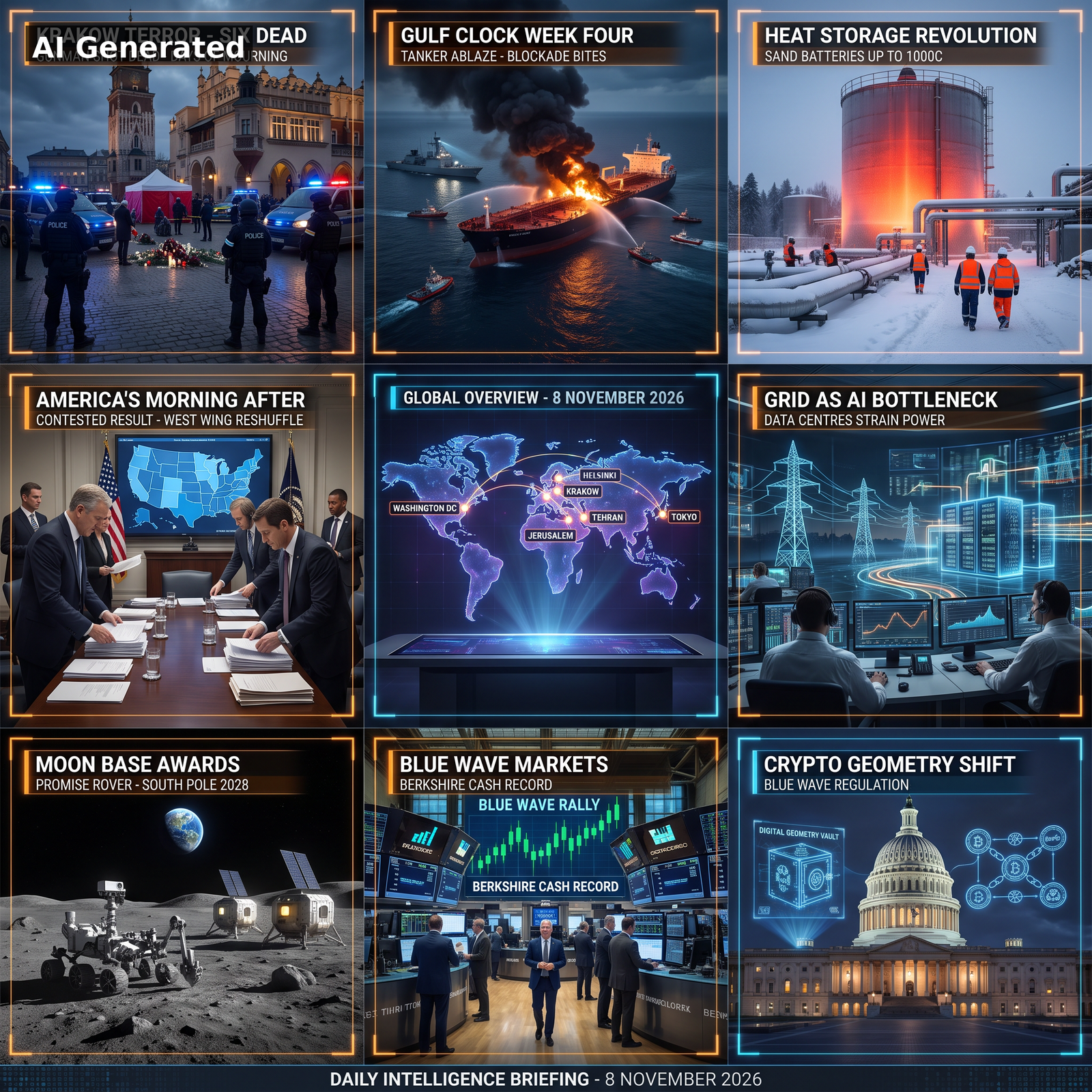










Contents
- 1. Geopolitics & Defence
- Krakow’s Saturday of Terror: Six Dead at the Main Square and a National Reckoning
- Jerusalem’s Transfer of the Mandate: Eisenkot Gets the First Bite
- The Gulf Clock’s Fourth Week: Blockade Enforcement, Explosions and the “Kharg” Gambit
- The Periphery’s Files: Pakistan, Ukraine’s Abu Dhabi Clock, Paraguay, Libya and Ankara
- 2. Environment & Climate
- 3. Society & Civil Issues
- 4. AI & Technology
- 5. Economy & Business
- 6. Science & Space
- 7. Crypto, Digital Assets & Blockchain
- 8. Correlations & Analysis
- 9. References
Click any heading to jump to that section. Click the section heading to return to this menu.
Geopolitics & Defence ↑ Contents
Krakow’s Saturday of Terror: Six Dead at the Main Square and a National Reckoning
Poland is in mourning after the worst mass shooting in the country’s recent history: on Saturday afternoon a 24-year-old gunman drove a black Subaru onto Krakow’s historic Main Square, opened fire with an AR-15-style rifle on pedestrians and killed six people — four women and two men — while wounding at least fifteen others, several of them foreigners, including a British man among the dead and citizens of Austria, Germany, Portugal and Russia among the injured[1]. Prime Minister Donald Tusk immediately labelled the act “terrorism” and declared Sunday and Monday national days of mourning, while police later found three further bodies — reportedly the suspect’s own relatives — in his flat, and the interior minister said the killer, a machinist by trade, appears to have been “fascinated by right-wing extremist ideologies”[1]. The profile that has emerged is a disturbingly familiar one: a young man with legal weapons permits (his own and his father’s for eleven firearms), no criminal record and full military-style tactical gear, who acted as a “lone wolf” before being shot dead by police[2]. The attack lands on a country already on edge after October’s knife attacks and a running constitutional crisis over the Constitutional Tribunal, and it immediately re-opens the debate about weapon-permit proliferation in a nation absorbing the long shadow of the Ukraine war[1].
Jerusalem’s Transfer of the Mandate: Eisenkot Gets the First Bite
Israeli President Isaac Herzog announced he will formally task opposition leader and former army chief Gadi Eisenkot with forming the next government on Sunday, after Eisenkot secured the recommendation of 67 of the Knesset’s 120 members — a striking margin that leaves caretaker Prime Minister Benjamin Netanyahu’s right-religious bloc short of a path[3]. The mandate does not guarantee success: Eisenkot still needs to bridge the gap with the ultra-Orthodox parties formerly aligned with Netanyahu, above all over military conscription for religious students, and an alternative arithmetic with the Arab parties remains contested. Netanyahu fought back hard on Saturday, warning that “a government with Arab parties would destroy us from within,” accusing them of supporting “terrorism” and demanding a “broad national unity government” under Likud leadership instead[4]. The political geometry matters beyond Jerusalem: with 28 days to negotiate, the formation battle — and the Netanyahu-versus-Eisenkot duel over how to handle the Iran confrontation — will run in parallel with whatever Washington and Tehran do next, prolonging the uncertainty that has gripped the region since the October 27 election produced no outright majority[3].
The Gulf Clock’s Fourth Week: Blockade Enforcement, Explosions and the “Kharg” Gambit
The US-Iran confrontation moved into a new, more kinetic phase. Iranian state media reported a series of explosions along the southern coast — at the port of Jask, on Qeshm Island and around Bandar Abbas — that Iranian sources variously linked to military exercises or to anti-ship missile fire by the Islamic Revolutionary Guard Corps toward US Navy vessels in the Arabian Sea[6][7]. Neither the Pentagon nor CENTCOM confirmed or denied intercepts, but the reports came the same day CENTCOM said it had disabled the St. Kitts-flagged cargo vessel M/V Huda in the Gulf of Oman after the crew repeatedly ignored warnings and tried to breach the naval blockade imposed on Iran, firing precision munitions at the stern after directing the crew to abandon the targeted spaces[8]. Hours earlier, the UAE’s National Guard rescued all 22 crew members of a cargo ship that caught fire in the Gulf of Oman after an apparent Iranian anti-ship cruise-missile strike, with the IRGC separately claiming two tankers hit mines near the Strait of Hormuz had switched off their tracking systems[5]. On the messaging front, Trump escalated rhetorically by posting an AI-generated image of a strike on Iran’s Kharg Island — the terminal that handles roughly 90 percent of Iranian crude exports — with the caption “BYE BYE, KHARG,” a signal that the oil-export hub is now the explicit target of coercive pressure[9].
Washington simultaneously announced a new task force dedicated to disrupting Iran’s land-based supply routes, an operation explicitly designed to prevent Tehran from using ground corridors to move weapons and materials, and the US published a $20 million reward for information on Iran’s nuclear programme in an earlier initiative; the cumulative effect is pressure on every node of the Iranian system — maritime, land, financial and nuclear — even as negotiations reportedly continue through Qatari mediation[10]. The Yemen front flared in parallel: the Houthis announced six precision operations with ballistic missiles, cruise missiles and drones against Riyadh’s King Khalid International Airport, Aramco installations in Riyadh and Khurais, pumping station No. 8 near Dawadmi, and Saudi troop concentrations in Najran, Al-Jawf and Marib, framed as retaliation for Saudi strikes in Taiz and Bani Hashish that they say killed 22 civilians[11].
The Periphery’s Files: Pakistan, Ukraine’s Abu Dhabi Clock, Paraguay, Libya and Ankara
Pakistan’s recently negotiated Hormuz arrangement with Iran is facing its first real test after a suspected attack on an LNG tanker in the Gulf, exposing the difficult position of a state that has tried to mediate while its own energy imports transit an increasingly mined waterway[12]. Ukraine, meanwhile, headed into a new round of negotiations in Abu Dhabi amid maximum battlefield pressure: Russia launched fresh ballistic-missile and drone strikes on Kyiv on the eve of the talks, while President Zelensky repeated his urgent request for Patriot systems and Moscow signalled it would remain immovable on core demands[13]. In South America, Paraguay’s deposed president Santiago Peña was moved into pre-trial detention in a military barracks on suspicion of embezzlement and self-dealing over the collapse of the Ueno bank, which has frozen the accounts of nearly three million people — more than half of the country’s adult population — in the deepest financial crisis the region has seen this decade[14]. In North Africa, Egypt reopened its embassy in Tripoli for the first time in twelve years, a striking realignment given Cairo’s long-standing support for eastern commander Khalifa Haftar, and signalled it is rebalancing toward the UN-recognised government in the west[15]. Two bilaterals rounded out the file: Trump and Turkish President Recep Tayyip Erdogan spoke by phone about the Middle East and Ukraine, with Ankara reiterating its role as a potential mediator, and Greek-Turkish friction over NAVTEX notices for the Aegean research of the French ship Abeille Marengo stayed pointedly low-key, with Turkish Foreign Minister Hakan Fidan declaring “everything is fine” even as the Greek side insists the surveys will proceed[16][17].
Environment & Climate ↑ Contents
The Electricity Bottleneck: America’s Grid as the AI Constraint
The most consequential environmental-economics story of the window is not a weather event but a wiring problem: the United States is building high-voltage transmission lines at roughly a quarter of the pace it managed a decade ago, and that shortfall is now the binding constraint on the AI build-out[18]. Analyses in the Greek business press this weekend underline that the same arithmetic applies across the Atlantic, where data-centre power demand is colliding with interconnection queues measured in years and gigawatt-scale facilities increasingly depend on behind-the-meter generation because grid upgrades cannot keep pace[19]. The finding reframes the climate debate: if the marginal new load cannot be met by new renewables delivered over an unbuilt grid, operators fall back on existing gas and coal capacity, which is exactly the dynamic that turned data-centre siting into a midterm electoral issue in the United States and is now forcing regulators and utilities — from Illinois to Texas — to design new permitting and cost-allocation rules that will determine whether the AI wave speeds or slows the energy transition[18].
Heat Storage’s Big Leap: Finland, New Zealand and Denmark Build the New Repository
Three infrastructure projects this week show thermal storage maturing into a utility-scale option rather than a niche experiment. In New Zealand, Genesis Energy switched on a 100 MW / 200 MWh grid-scale battery at the Huntly power station, the country’s largest, costing about NZ$130 million and capable of powering roughly 60,000 homes for two hours, with a second, identical unit already budgeted at NZ$106 million[20]. In Finland, the city of Hyvinkää is filling a former gravel pit with about 380,000 cubic metres of water to create what the local utility calls the world’s largest pit thermal-energy store — a 60 MW, 18,000 MWh basin charged by electric boilers and industrial waste heat in summer and discharged into the district-heating network in winter, targeting roughly a quarter of local heat demand and near-total fossil-fuel elimination from the network[21]. Denmark’s Esbjerg, meanwhile, is drawing heat out of cold North Sea water with two 19.9 MW electric heat pumps that supply 55.2 MW of district heat, a two-hour winter test delivered seawater at 3.3°C and returned it at 1.2°C[22]. Together the three projects mark the shift from hours-long battery storage toward seasonal reservoirs, and they show the same logic — bank cheap energy when it is abundant, spend it when it is scarce — migrating from electricity alone to the harder problem of heating, which is where half of Europe’s final energy goes[21].
Innovation at the Margin: Wind, Agrivoltaics and the Invasive-Coral Front
The innovation ledger had a distinctly pragmatic flavour. Repsol is proceeding with a 500 MW, roughly $1.5 billion wind farm in Peoria County, Illinois, despite last year’s sharp pivot in federal energy policy — a reminder that once transmission slots and offtake are locked, even hostile politics struggle to halt construction[23]. In Massachusetts, two cranberry bogs in Kingston and Plymouth are now in their second harvest season under operational solar arrays, the first “agrivoltaic” cranberry operations in the country; the projects pair an extra 9 cents per kilowatt-hour for dual-use solar with the discovery that bogs — protected wetlands that cannot be built on — are unusually well suited to panels mounted ten feet high on widely spaced pilings[24]. On the research side, University of Glasgow simulations of a bladeless, vortex-induced vibration turbine produced a striking design lesson: the geometry that maximises efficiency is not the geometry that maximises power, and a modest 460-watt, 0.8-metre mast is the point where output and structural safety (staying under nylon’s yield strength) reconcile[25]. Finally, off Brazil, the invasive Indo-Pacific sun coral continues its two-kilometres-a-year advance along 3,500 kilometres of coastline, and volunteer divers of the Chico Mendes Institute are manually removing colonies around the Cagarras Islands — a fight that illustrates both the scale of marine-biodiversity loss and the limits of national control plans against species with no natural predators[26].
Society & Civil Issues ↑ Contents
America’s Morning After: Contesting the Result and Reshuffling the West Wing
The first full day after the Democratic midterm sweep produced a revealing split in Washington: the president disputing the result, and the presidency reorganising for a hostile Congress. Trump publicly questioned the legitimacy of the Democratic victory and threatened investigations against Democratic politicians, even as his own Justice Department moved to withdraw its California ballot lawsuit and Houston scaled back cooperation with federal immigration enforcement[27]. The institutional counterweight was immediate: a federal judge ordered an ethics probe into the president’s Washington golf-course project, and the Democratic leadership prepared its own oversight agenda[31]. The staffing response was the elevation of Stephen Miller to White House chief of staff — a move his own allies reportedly lobbied for — which triggered fresh fallout inside and outside the building, including the extraordinary spectacle of the UFC’s Dana White being courted for press secretary[28][30]. Analysts framed the moment as the shattering of the Trump coalition: Republicans can double down on Trumpism with a weakened president or chart a new path, and the 2027-28 positioning has already begun[29].
France’s Civic Square: Le Pen at the Ambassadors’ Table and the Cost-of-Living Street
Two very different French civic stories ran in parallel. Marine Le Pen sat down with eight European ambassadors in Paris to outline her programme for the 2027 presidential election — the National Rally leader proposing to downgrade the European Commission to a secretariat, sharply cut France’s EU budget contribution and tighten migration controls, with a senior adviser conceding afterwards that he did not know whether the envoys left reassured or alarmed[32]. On the same day, roughly 46,000 people marched in Paris against the cost of living and for youth support, a largely calm demonstration that ended with tear gas and stun grenades at Place de la Nation as officers dispersed the tail of the march, while 15 arrests were made after thousands of identity checks[33].
Gaza’s Flooded Winter and the Migration Periphery
In Gaza, torrential rain overwhelmed the displacement camps: Palestinian authorities reported about 70,000 tents flooded on the first day of the storm, with walls and roofs collapsing, injuries and hundreds of families forced to abandon flooded camps in the central and northern Strip[34]. Civil-protection workers described operating “without any equipment,” receiving more than 1,500 distress calls overnight, and the municipality renewed its demand for 200,000 prefabricated homes — a winter crisis layered on a war economy, with the October 2025 ceasefire having done little to restore shelter or infrastructure[34]. Further west, Spain’s Canary Island of El Hierro declared an emergency after more than 3,300 migrants and refugees arrived by boat since the start of November, overwhelming the island’s reception capacity and prompting a formal plea for central-government help[35]. In Southeast Asia, two more Uyghur men face deportation from Thailand to China, where they fear torture and enforced disappearance; one told activists he would live “like a slave,” and rights groups warned Bangkok is again preparing to trade compliance with Beijing against the men’s safety, after the UN said the whereabouts of the 40 men deported last year remain unknown[36].
Public Health, UK Files and the Global Civic Ledger
Greece entered flu season with an early warning: two deaths, two patients in intensive care and 57 hospitalised, with the burden already higher than the same week last year and health authorities urging timely vaccination[37]. In Britain, the government confirmed the return of the Erasmus+ exchange programme, reversing the 2020 departure under Boris Johnson as part of a wider EU rapprochement that Prime Minister Burnham has tied explicitly to the cost of living[38]. The global civic ledger had two notable entries: China’s Fifth Plenum was marked by the striking absence of roughly a quarter of the Central Committee — the largest attendance loss since the Mao era — underscoring the scale of Xi Jinping’s purges, and New Zealand’s election left a tax-reform party in the kingmaker position with no clear majority[39][40]. Finally, Germany is debating what to do with the ruins of Hitler’s Kehlsteinhaus “Eagle’s Nest” retreat after a fire destroyed much of the structure — a debate between preservationists, who want the site kept as a warning, and those who would let it vanish[41].
AI & Technology ↑ Contents
Platform Regulation’s New Edge: Brussels Takes Aim at the Algorithm
The European Commission has put TikTok on notice, threatening ByteDance with fines of up to six percent of global annual turnover unless the platform changes its recommendation algorithms to stop pushing users down “rabbit holes” of escalating, self-reinforcing content[42]. The move is the first time Brussels has explicitly linked algorithmic design — not just content moderation — to systemic-risk obligations under the Digital Services Act, and it signals where the next generation of platform enforcement will bite: not at individual posts but at the curation machinery itself, which regulators increasingly treat as the true product. The significance extends beyond TikTok: any recommender-system dependent platform now faces a precedent that design choices, including engagement optimisation, are regulatory decisions[42].
The Efficiency Front: Distillation, Decision Models and Digital Twins
Three technical stories define the industry’s current efficiency push. Salesforce researchers reported that distilling reinforcement-learning-trained expert models into smaller generalist systems can cut compute use by roughly 42 percent without proportional accuracy loss — strong evidence that the industry’s reflex to scale up can, for many tasks, be replaced by a distillation-down-and-specialise pattern that lowers both cost and inference latency[43]. A new class of “decision models” — exemplified by TypeSafe AI’s Jev, Cloudflare’s Clef and OpenAI’s Decisions API — abandons verbose chain-of-thought output entirely, returning structured JSON and confidence scores in exchange for very low latency; the analysts point out that this makes the framing of the input context the entire game, because the models do not explain their answers[44]. And digital twins — data-connected virtual replicas of physical assets, from jet engines to wind turbines and buildings — continue their migration from aerospace into manufacturing, energy and healthcare, with the caveat that a twin is only as trustworthy as the sensors, models and update cadence behind it[45].
AI in the Consumer and Criminal Ledger
On the consumer side, the arrival of deep banking integration in assistants is creating a real differentiation debate: Claude’s personal-finance capability and ChatGPT’s rival offering both promise to analyse spending and bank accounts, but they differ sharply in privacy architecture, data handling and how much of the user’s financial life stays on-device versus in the cloud[46]. On the criminal side, US federal prosecutors unsealed charges against three suspects who allegedly used AI voice-cloning and image-spoofing tools to impersonate CEOs and law-firm partners in a fraud ring that extracted more than $129 million from hospitals, banks, a UK fintech and other firms between mid-2024 and early 2026 — the largest deepfake-corporate-fraud case to date, and a sharp reminder that the same synthesis technology powering productivity gains is now a standard tool of social engineering at the top of the corporate hierarchy[47].
Economy & Business ↑ Contents
Commodities’ New Interventionism: Olive Oil’s First Supply Withholding
In an unprecedented intervention, Spain’s agriculture ministry ordered farmers to hold back twelve percent of their olive-oil production until September 2027 — roughly 188,000 tonnes stored on farms or in third-party facilities — to protect producer margins after a bumper harvest projected a 23 percent jump to 1.6 million tonnes and prices fell about 15 percent in two months[48]. The measure uses an EU provision never before invoked at this scale, and it has split the industry: buyers warn the market is global while the order binds only Spanish producers, and analysts note that stored oil degrades — it will not remain “extra virgin” indefinitely — so the intervention is a bet on near-term price defence rather than a durable supply strategy[48]. It is the mirror image of the strategic-reserve economics visible elsewhere this year — Canada’s maple-syrup stockpile emptying, the US Strategic Petroleum Reserve at its lowest level since 1982, Japan turning a rice shortage into a record surplus — and it shows governments increasingly treating food-and-commodity storage as an active price-management tool in a world of climate and war shocks[48].
Markets and the Blue Wave: Berkshire’s Cash, EM Tightening and the Gas Winter Bet
Corporate caution is the theme of the earnings tail: Berkshire Hathaway disclosed $377 billion in cash while continuing to trim stockholdings, the clearest signal yet from Warren Buffett’s shop that equity valuations and the macro mix argue for liquidity over deployment[50]. Emerging-market central banks are swinging hawkish as inflation pressures accumulate, with Citi flagging a broad shift that will keep currency and rates volatility elevated into 2027[53]. In Germany, the energy dossier turned uncomfortable: with gas storage levels lagging targets, analysts at the FAZ describe the government’s long hesitation over the empty reservoirs as a “risky bet” repeating a familiar pattern of waiting out warnings, leaving Berlin exposed to another winter of price spikes[52]. The political economy of the US midterm outcome rounds out the ledger: the Democratic sweep reshapes the tariff and AI policy outlook — less unilateral trade shock therapy, more congressional oversight of data-centre build-out — even as the immediate market reaction showed investors pricing both developments simultaneously[49].
The Corporate and Scandal Files: Alabama Power’s Ad Bill and Turkey’s Ponzi Shock
Two regulatory and financial-integrity stories stand out. In Alabama, the Public Service Commission voted to ask the monopoly utility Alabama Power to stop billing customers immediately for half its advertising costs — more than $6 million in general ads last year, roughly four dollars per customer, which ratepayers can currently be charged for until the 2029 start of a new prohibition[51]. The decision, coming on election day, is a preview of the more aggressive regulatory posture a reconstituted seven-member commission plans, and it turns advertising cost-recovery into a national template for utility accountability[51]. In Turkey, the “Fonzi” scandal has exploded into a $20 billion Ponzi affair that press reports trace to the highest levels of government, dwarfing the Madoff comparison and threatening to become a systemic political and banking crisis[54].
Science & Space ↑ Contents
The Lunar Industrial Frontier: Moon Base Awards and the PROMISE Rover
NASA used the MAX POWER expo at Kennedy Space Center to convert its “Moon Base” campaign from vision to contract book: eight companies — Blue Origin, Firefly, Intuitive Machines, ispace-U.S., Lockheed Martin, Northrop Grumman, SpaceX and Voyager — were selected under a new CLPS 2 master contract worth up to $10 billion over ten years for lunar delivery services, while the agency moved forward with PROMISE, a nuclear-powered, six-wheeled South-Pole rover assembled largely from Curiosity and Perseverance spare parts and scheduled for launch in late 2028[60]. A further $1.3 billion in task orders covers orbital transfer vehicles and cislunar demonstration missions, plus a Starship-based communications deployment, and NASA plans a separate fully integrated lunar power-system solicitation in early 2027[60]. The programme’s defining logic is explicitly iterative — “fly often, learn, apply those lessons” — with the first infrastructure elements meant to be waiting on the surface before astronauts arrive; PROMISE itself is notable as a deliberate hardware-reuse exercise, repurposing proven Mars rover designs for a radiation-hardened, permanently-shadowed-crater mission that will drill a metre down to characterise ice resources[61].
Deep Earth and Deep Time: Tears, Heat and the Archive
Geophysics offered two complementary portraits of planetary machinery. A rock from Papua New Guinea observed during its descent was hotter than models of subduction predict, challenging assumptions about a process that shapes earthquakes, volcanoes and long-term climate[58]. And beneath southeastern Iran, seismic tomography using 69 stations has resolved two giant tears in the Arabian Plate — a horizontal rip where the Zagros continental collision meets the Makran oceanic subduction zone, and a vertical one propagating from the Makran Trench — a rare snapshot of the transition from oceanic subduction to continental collision that the authors expect will eventually coalesce[67]. The deep archive opened in parallel: the shrinking Danube exposed a giant-deer skull near Nagybajcs in Hungary, from Megaloceros giganteus, a species with antlers spanning nearly four metres[62]; radiocarbon analysis of eight bone fragments from a stone cist beside Norway’s Lake Aursjøen dated a high-mountain grave to roughly 2000 BC — the only securely dated Stone Age burial in southern Norway’s mountains, with isotope work confirming a land-based diet so the age could be trusted[71]; and a reassessment of the White Sea–Baltic Canal, dug by more than 100,000 Gulag prisoners in twenty months and opened too shallow for most seagoing vessels, put the arch of construction deaths at roughly 25,000 in one archival count — a reminder that ancient and modern landscapes alike carry engineered catastrophe[66]. On the materials side, a University of Sheffield technician has finally reverse-engineered the colour-shifting glass of the 1,600-year-old Lycurgus Cup — jade green in reflected light, ruby red in transmitted — a nanoscale colloid of gold and silver whose mechanism had eluded glassmakers for two centuries[56]
The Biomedical Ledger: Diets, Salt and the Light of Day
Three public-health studies sharpened the prevention message. A DZNE-led analysis of almost 6,500 adults tied ten established dietary patterns — Mediterranean, Nordic, DASH, MIND among them — to slower biological aging measured by DNA-methylation clocks, with more than seventy percent of the affected biological pathways shared across all diets, strengthening the case that “there is no single best diet” but adherence matters[57]. Modelling across 193 countries estimated that replacing ordinary sodium chloride with potassium-enriched salt could prevent nearly three million cardiovascular and kidney deaths a year — a population-scale intervention with negligible behavioural burden[63]. And in an 88,000-person UK Biobank cohort, daytime light exposure emerged as a stronger predictor of dementia risk than obesity, alcohol, air pollution or hearing loss: at least 42 minutes of bright light (≥5,000 lux) daily was associated with a 17 percent lower relative risk, rising to as much as 41 percent for night owls, with greater medial-temporal brain volume as a plausible pathway — evidence that cheap, non-pharmacological circadian interventions deserve a place in cognitive-risk reduction[65].
Radiation, Magnetism and Life at the Limits
Two animal studies probe survivability at the extremes. Rats receiving the galactic-cosmic-radiation dose of a three-year Mars mission developed roughly twice the perivascular collagen — a scarring precursor of heart disease — of controls, but the damage was only visible when hearts were examined 360 days after exposure, arguing that radiation risk must be modelled as a long biological process, not an acute event; follow-up sequencing also flagged clonal-haematopoiesis variants unique to irradiated animals[70]. Fruit flies carrying a Parkinson’s-linked Pink1 defect lived about twenty percent longer when shielded from Earth’s magnetic field in a 5.6-nanotesla enclosure, yet the same flies climbed worse — a paradoxical split that hints the magnetic field interacts differently with stressed versus healthy cells, with raised free-radical signalling as a possible mediator:[69] the implication for long-duration spaceflight is that magnetic environment may matter to health in ways still unmapped. On the engineering fringe, researchers demonstrated a battery-free sensor powered by ambient radiation harvested from local circuitry — a graphene-based temperature device that runs on stray electromagnetic surroundings[55].
The Cosmic Ledger: Asteroid KY26, Gliese 12 b and the Astronaut Exodus
Two planetary puzzles dominated the cosmic ledger. Asteroid 1998 KY26 keeps accelerating in ways inconsistent with its asteroid classification, but a Georgia Tech team now shows it is too warm to retain the buried ice that would power a “dark comet” interpretation — surface temperatures averaging above 212 K across its orbit would sublimate any water ice in decades to millennia — leaving radiation pressure or an undiscovered mechanism as explanations, with Hayabusa2’s 2031 rendezvous the planned arbiter[64]. For Gliese 12 b, a temperate exo-Earth candidate at 107°F under airless assumptions, three-dimensional climate simulations keep converging on Venus instead: an Earth-like sky runs away thermally while a thick CO2, 92-bar atmosphere settles at roughly 157°C, and tidal heating at several watts per square metre adds volcanic outgassing — a reminder that Earth-size does not imply Earth-like[68]. Finally, in the science-policy ledger, the departure of top astrophysicist Kelly Holley-Bockelmann from the United States, driven by federal policies that reached into every part of her research, stands as a concrete measure of the talent cost of the current Washington climate — and a preview of the discipline-migration effects the midterm wave may or may not reverse[59].
Crypto, Digital Assets & Blockchain ↑ Contents
The Regulatory Perimeter After the Blue Wave: Washington’s New Crypto Geometry
The Democratic capture of both chambers is reconfiguring US crypto policy on multiple planes. Galaxy Digital’s head of research flagged the obvious risk: Democratic committee leadership under Elizabeth Warren and Maxine Waters will translate into sharper congressional scrutiny of Trump-linked crypto businesses and a tougher oversight agenda, even though federal regulators will continue developing digital-asset rules under existing authority[72]. The regulatory-instrument ledger filled out immediately: the Treasury Department’s FinCEN issued a Section 9714 order prohibiting US financial institutions from processing fund transfers to or from MEXC Global, finding the Seychelles-based exchange a “primary money laundering concern” tied to Russian illicit finance, with at least $16 billion in suspected sanctions evasion, cybercrime and Iran-linked flows over five years — the first issuer, NatGold Digital, voluntarily delisted from MEXC within nineteen hours[81]. The EU answered in kind by deploying a dedicated crypto task force inside a new sanctions office to block Russian circumvention, explicitly targeting networks such as the A7 digital-ruble stablecoin used to skirt restrictions[83].
The Supply Ledger: Stablecoins Contract and Miners Consolidate
The on-chain dollar base is shrinking at its steepest rate of the year: stablecoin supply fell $6.66 billion in the week to 7 November to $292.31 billion — the largest weekly contraction since Terra’s UST collapse in 2022, with Tether and Circle accounting for two-thirds of the drop while neither token traded off its peg[74]. The run has now lasted 29 rolling seven-day periods, and because the cash leg of crypto positions is contracting, gross exposure is shrinking with it; the analytic question for the coming week is whether supply stabilises (a rotation within crypto) or keeps falling while TVL holds (a true dollar exit)[74]. Miners face the mirror image: Bitcoin difficulty has failed to set an all-time high for 374 days — the longest gap in network history — with hashprice near $33.4 per petahash before fees and the break-even for a 20 J/TH machine at roughly 7 cents per kilowatt-hour, which explains why public miners such as Core Scientific are pivoting revenue toward colocated AI compute rather than adding hashrate[82].
Institutional Rails: ETFs, Tokenisation and the Exchange-Governance Files
The institutional pipeline kept expanding. Nasdaq listed Canary Capital’s staked INJ ETF (ticker INJC), the first US spot product bundling Injective exposure with staking rewards — a structural innovation that tests whether yield-bearing single-asset wrappers find durable demand[77]. Amundi issued a tokenised share class of its Core STOXX Europe 600 equity fund on public Ethereum with CACEIS, moving one of Europe’s largest asset managers into onchain fund representation without claiming the underlying stocks are individually tokenised[75]. Coinbase pitched a full token-lifecycle platform — from public sales and listings through custody and liquidity — citing Monad, Ethena and Hyperliquid as case studies, while Ripple’s CEO reaffirmed XRP as the company’s “north star,” tying RLUSD expansion to deeper XRP liquidity and payments utility[73][79]. Avalanche’s tokenised RWA market hit a record $1.22 billion on its C-Chain, with institutional flows via BlackRock’s BUIDL fund prominent[85]. Exchange governance tightened in the shadow of the $6.3 billion Binance breach: the company’s CFO departed a week after the hack — officially a six-month-planned transition, though the optics were unavoidable — and OKX’s founder publicly urged users to avoid direct transfers to MEXC amid the FinCEN action[84][78][86].
The security file also moved: Chainalysis began restoring its KYT and address-screening services in phases after disclosing that a cyberattack exposed names, usernames, password hashes and live tokens of users — a reminder that compliance infrastructure itself is now an attack surface for the very community it polices[80]. Meanwhile Strategy’s Michael Saylor mounted a defence of the company’s income-share-financed bitcoin accumulation by tracing the model back through four centuries of financial history — Dutch trading companies, railroad financing and US tax law — a narrative exercise aimed at normalising a leverage structure whose critics see as pro-cyclical risk[76]. For the week ahead, the two levels that break or confirm the trend are unambiguous: a stablecoin close back above the $300 billion mark would signal that redemptions have stalled, while a print below $291.7 billion — roughly the September 2025 low — would extend the contraction into new territory and pull onchain credit conditions further toward scarcity at exactly the moment the Gulf clock and the formation of the new American Congress are both imposing fresh risk premia.
Correlations & Analysis ↑ Contents
D161 is the fourth post-midterm window, and it resolves the hinge question D160 posed in paradoxical form. Yesterday’s report closed on the observation that limited US strikes and active diplomacy were running in parallel; today’s window shows the coercion side of that duality hardening into an actual blockade regime. CENTCOM’s precision disabling of the M/V Huda, the new land-route task force, and Trump’s public “BYE BYE KHARG” threat against Iran’s oil-export terminal are not noise — they are the operationalisation of the maritime embargo that D155–D158 tracked from “nice threats” to Qeshm strikes. The simultaneous Iranian reports of anti-ship missile fire toward US vessels, and the UAE crew rescue after a strike in the Gulf of Oman, define a confrontation that is now routinely kinetic below the threshold of full war, exactly the “limited escalation” equilibrium this series has warned is unstable.
The parallel diplomatic track is not dead — Qatar’s prime minister insists a settlement is possible and Trump says negotiations are ongoing — which makes the current phase a bargaining standoff with the military clock still ticking. That is the same two-track geometry that produced the strikes of late October, and the new variable is the explicit targeting of Kharg Island, which would spike oil prices far more violently than anything so far. Traders are already telegraphing the connection: energy stocks rallied on the escalation while the stablecoin supply recorded its steepest weekly contraction since Terra — a liquidity pullback consistent with a market pricing genuine war risk. The German gas-storage warning published this weekend is the European echo of the same vulnerability: a cold winter compounded by a Hormuz closure is the scenario Berlin has repeatedly failed to pre-fund.
The midterm aftermath supplies the second master theme: the politics of the AI-and-energy build-out that dominated D150–D160 has moved from ballot boxes to committee rooms. The electricity-transmission bottleneck analyses land precisely as Democrats prepare to scrutinise data-centre permitting and grid costs — the “data-centre revolt” that powered red-state utility races now becomes the substance of congressional oversight, alongside new algorithmic-regulation pressure on platforms (TikTok) and a far more adversarial crypto agenda. The Galaxy memo and FinCEN’s MEXC order are the first concrete policy outputs of that shift, and they connect directly to the Binance breach arc this report has tracked since D152: the record theft has now produced leadership change at the exchange, a frozen-asset and laundering tail, and a regulatory environment that treats offshore exchanges as fixed targets.
Israel’s coalition arithmetic adds a third thread. D159’s “mandate moves to Eisenkot” became a formal commission this weekend, and Netanyahu’s rejection of Arab-party participation sets the ideological battle lines for a 28-day negotiation window. The significance extends beyond Jerusalem: a government led by Eisenkot would alter the region’s posture toward Iran exactly when Washington is escalating its own pressure, while Netanyahu’s warning that an Arab-backed coalition would “destroy us from within” risks deepening the domestic polarisation that has paralleled every Israeli election since D149. Poland’s Krakow massacre adds a distinct alarm: an EU and NATO frontier state, already convulsed by a constitutional crisis, now faces its worst mass shooting in decades by a right-wing-radicalised “lone wolf” with legal weapons — a reset of the European internal-security debate that will interact with the eastern-flank defence mobilisation this report has documented all autumn.
What to watch in the next reporting period: first, any Iranian response to the blockade-regime escalation — a Hormuz mining event or a US-vessel engagement would be the step-change signal; second, whether Eisenkot secures 61 seats, and at what price to the Arab parties; third, the US Congress’s first overtures on data-centre siting and permitting, and the FTC-style opening moves of Democratic committees on crypto; fourth, the $300-billion level on stablecoin supply as the cleanest risk-appetite gauge; fifth, the Iraqi NOTAMs and Gulf shipping advisories that will telegraph any new strike window; and finally, whether NASA’s Moon Base contract book translates into the first lunar logistics manifest of 2027, the industrial counterweight to a troubled terrestrial year.
References ↑ Contents
1. Polen trauert nach Schusswaffenvorfall im Zentrum Krakaus mit sechs Toten by Germany via d k on Inoreader · Source ↑
2. Κρακοβία: Αυτός είναι ο 24χρονος μακελάρης – Πάνοπλος με AR-15 by DEFENCE via d k on Inoreader · Source ↑
3. Israels Präsident Herzog will Eisenkot Auftrag zur Regierungsbildung erteilen by Germany via d k on Inoreader · Source ↑
4. Μ.Νετανιάχου: «Μια κυβέρνηση με αραβικά κόμματα θα μας διέλυε εκ των έσω» by DEFENCE via d k on Inoreader · Source ↑
5. ΗΑΕ: Διάσωση 22 ατόμων από φλεγόμενο φορτηγό πλοίο στον Κόλπο του Ομάν by Σωτήρης Ζιώμας · Source ↑
6. Αναφορές για εκτόξευση ιρανικών πυραύλων κατά αμερικανικών πολεμικών πλοίων by DEFENCE via d k on Inoreader · Source ↑
7. Σειρά ισχυρών εκρήξεων στο νότιο Ιράν και τα Στενά του Ορμούζ by DEFENCE via d k on Inoreader · Source ↑
8. U.S. military disables cargo vessel attempting to breach Iran blockade by Investing.com · Source ↑
9. «Αντίο Χαρργκ»: Η ανάρτηση Τραμπ για τον βασικό πετρελαϊκό κόμβο του Ιράν by DEFENCE via d k on Inoreader · Source ↑
10. US launches task force to disrupt Iran’s land-based supply routes by NEWS via d k on Inoreader · Source ↑
11. Οι Χούθι επιτέθηκαν με πυραύλους και drones στη Σαουδική Αραβία (βίντεο) by DEFENCE via d k on Inoreader · Source ↑
12. Pakistan’s Hormuz agreement with Iran faces test after LNG tanker attack by Business via d k on Inoreader · Source ↑
13. Ουκρανία: Κλιμάκωση με πυραύλους και drones πριν τις συνομιλίες στο Άμπου Ντάμπι – Επείγον αίτημα Ζελένσκι για Patriot, αμετακίνητος ο Πούτιν by Newsroom · Source ↑
14. Bankenskandal in Paraguay: Paraguays abgesetzter Präsident Peña muss in Untersuchungshaft by DIE ZEIT: Ausland – Simon Sales Prado · Source ↑
15. Η Αίγυπτος προσεγγίζει την δυτική Λιβύη: Ανοίγει πρεσβεία στην Τρίπολη by DEFENCE via d k on Inoreader · Source ↑
16. Τηλεφωνική επικοινωνία Ν.Τραμπ και Ρ.Τ.Ερντογάν: Τι συζήτησαν by DEFENCE via d k on Inoreader · Source ↑
17. Το τετ-α-τετ Κωστίδη με Φιντάν για τις NAVTEX: «Όλα πάνε καλά» by DEFENCE via d k on Inoreader · Source ↑
18. Το ρεύμα φρενάρει τις φιλοδοξίες των ΗΠΑ για ΑΙ by Ευθύμιος Τσιλιόπουλος · Source ↑
19. ΗΠΑ: Τα ηλεκτρικά δίκτυα είναι το αδύναμο σημείο της αμερικανικής κούρσας για ΑΙ by Ευθύμιος Τσιλιόπουλος · Source ↑
20. New Zealand’s largest power station just switched on a grid-scale battery that can power 60,000 homes for two hours, and the second one is already budgeted for less by ECONEWS · Source ↑
21. Finland is pouring 100 million gallons of water into an old gravel pit to build the world’s largest pit heat storage, and the summer warmth it saves will heat homes in winter by Adrian Villellas · Source ↑
22. Cold Seawater Is Supplying District Heat in Esbjerg, Denmark by Michael Barnard · Source ↑
23. A New $1.5 Billion Wind Farm Will Play In Peoria by Tina Casey · Source ↑
24. These cranberry bogs come with a side of solar by Sarah Shemkus, Canary Media · Source ↑
25. A bladeless wind turbine that sways in the wind could safely produce 460 watts in computer simulations, and the most efficient design turned out not to be the most powerful by Adrian Villellas · Source ↑
26. These divers are killing a beautiful coral to save Brazil’s marine life by Jonathan Vit · Source ↑
27. Trump stellt Wahlergebnis infrage und droht den Demokraten by Germany via d k on Inoreader · Source ↑
28. New fallout from White House staffing shake-up after midterms by NEWS via d k on Inoreader · Source ↑
29. The Trump coalition is shattered – what will Republicans do now? by NEWS via d k on Inoreader · Source ↑
30. Dana White: Trump will Kampfsport-Manager als Sprecher des Weißen Hauses by Reuters · Source ↑
31. Judge orders ethics probe into Trump’s Washington golf course project by Investing.com · Source ↑
32. Politico: Στο μικροσκόπιο των Ευρωπαίων πρέσβεων η Μαρίν Λεπέν – Τι σχεδιάζει για την Ευρωπαϊκή Ένωση by Σωτήρης Ζιώμας · Source ↑
33. Παρίσι: Επεισόδια & χρήση δακρυγόνων σε διαδήλωση κατά της ακρίβειας (βίντεο) by DEFENCE via d k on Inoreader · Source ↑
34. Καταρρακτώδεις βροχές στη Γάζα, δεκάδες χιλιάδες έμειναν χωρίς σκηνές by Greece via d k on Inoreader · Source ↑
35. Canary Islands’ El Hierro declares emergency amid migrant, refugee influx by NEWS via d k on Inoreader · Source ↑
36. Uyghurs facing deportation by Thailand say they will be ‘like slaves’ in China by Amy Hawkins · Source ↑
37. Γρίπη: 2 θάνατοι, 2 σε ΜΕΘ και 57 νοσηλευόμενοι – Ανησυχία και έκκληση για έγκαιρο εμβολιασμό by Newsroom · Source ↑
38. Nandy confirms Erasmus+ scheme return as UK eyes closer ties with EU by Ted Hennessey · Source ↑
39. Κίνα: Οι επικίνδυνες εκκαθαρίσεις του Σι by Business via d k on Inoreader · Source ↑
40. New Zealand election puts tax reform party in kingmaker role as majority hangs by Investing.com · Source ↑
41. Germans wrestle with what to do with Hitler’s destroyed Eagle’s Nest retreat by NEWS via d k on Inoreader · Source ↑
42. European Union Regulators Tell TikTok to Plug ‘Rabbit Holes’ or Else by Tom McKay · Source ↑
43. Salesforce study finds 42% compute savings by distilling RL-trained experts by Diego Almada Lopez · Source ↑
44. Decision models like Jev don’t explain their answers. That makes context your problem by dattarajraogravitar@gmail.com · Source ↑
45. Digital twins: How virtual copies of real objects are changing engineering by Kaif Shaikh · Source ↑
46. Claude Personal Finance vs. ChatGPT Finances: What sets them apart? by staff@engadget.com · Source ↑
47. Κύκλωμα στις ΗΠΑ χρησιμοποίησε AI για να υποδυθεί CEOs και δικηγόρους by DEFENCE via d k on Inoreader · Source ↑
48. So much ‘liquid gold’ could hit the market that the world’s top producer is withholding output—but supplies can’t stay ‘extra virgin’ for long by Jason Ma · Source ↑
49. What the Democratic sweep means for Trump’s tariffs and AI by Business via d k on Inoreader · Source ↑
50. Berkshire Hathaway holds $377B cash, sells more stocks amid market caution by Estefano Gomez · Source ↑
51. Alabama Power spent more than $6 million on ads last year — and customers can be billed for half of them until 2029 by Dennis Pillion, Inside Climate News · Source ↑
52. Energieversorgung: Deutschlands riskante Erdgas-Wette by Marcus Theurer, Ralph Bollmann · Source ↑
53. Emerging market central banks turn hawkish as inflation pressures mount, Citi says by Investing.com · Source ↑
54. Τουρκία: Το σκάνδαλο «Fonzi» των 20 δισ. δολαρίων που συγκλονίζει τη χώρα by Γρηγόρης Τραγγανίδας · Source ↑
55. Battery-free sensor powers up wirelessly via local circuitry radiation by Etiido Uko · Source ↑
56. Scientists Finally Crack a 1,600-Year-Old Roman Glass Mystery by University of Sheffield · Source ↑
57. Scientists Identified 10 Healthy Diets Linked to Slower Biological Aging by David Nield · Source ↑
58. Scientists Discover Something Unexpected 90 Kilometers Beneath Earth by University of Göttingen · Source ↑
59. Top Astrophysicist Leaves U.S. After Trump Policies Affect Her Work by Eli Saslow and Hilary Swift · Source ↑
60. NASA Awards Moon Base Transportation, Technology, Science Projects by Jessica Taveau · Source ↑
61. NASA reveals new lunar rover, PROMISE, to launch to moon in 2028 by Science & Space via d k on Inoreader · Source ↑
62. A resident gave a Hungarian museum a giant deer skull exposed by the shrinking Danube, from a species with antlers nearly 13 feet wide, and curators want to know what else the river reveals by ECONEWS · Source ↑
63. A Healthier Form of Salt Could Prevent Nearly 3 Million Deaths Every Year, Scientists Say by George Institute for Global Health · Source ↑
64. A Mysterious Asteroid Is Accelerating in Space, And We’re Running Out of Explanations by Michelle Starr · Source ↑
65. Less Than 42 Minutes of Bright Light Daily Is a Stronger Predictor of Dementia Than Obesity, Study Finds by Carly Cassella · Source ↑
66. The Soviet Union forced more than 100,000 prisoners to dig the White Sea-Baltic Canal with picks and wheelbarrows, and the waterway that cost thousands of lives ended up too shallow for most seagoing ships by ECONEWS · Source ↑
67. Scientists Discover Two Enormous Tears in a Tectonic Plate Beneath Iran by David Nield · Source ↑
68. Gliese 12 b, a rocky planet almost the size of Earth, looked surprisingly mild at 107°F, and new climate simulations keep pointing to something much closer to Venus by Adrian Villellas · Source ↑
69. Fruit flies with a Parkinson’s-linked gene defect lived about 20 percent longer when shielded from Earth’s magnetic field, and the same insects got worse at one simple everyday task by ECONEWS · Source ↑
70. Rats given the cosmic radiation dose of a Mars mission ended up with twice as much scar tissue around their heart vessels, and it only became clear when scientists looked nearly a year later by ECONEWS · Source ↑
71. English anglers found a skeleton in a stone coffin by a Norwegian mountain lake, and new tests reveal a 4,000-year-old Stone Age grave so rare that archaeologists almost doubted the date by ECONEWS · Source ↑
72. Galaxy Flags New Risks for Crypto as Democrats Take Both Chambers by Kevin Helms · Source ↑
73. Coinbase Pitches a Full Token Lifecycle Service, From Public Sales to Custody by NewsBTC Editorial Team · Source ↑
74. Stablecoin Supply Shrank $6.7 Billion in a Week, the Steepest Drop of 2026 by Tokoni Uti · Source ↑
75. Amundi Puts a European Equity Fund Share Class on Ethereum by NewsBTC Editorial Team · Source ↑
76. Michael Saylor Reveals 400-Year History Behind Bitcoin Income by Kevin Helms · Source ↑
77. Nasdaq Lists Canary’s Staked INJ ETF, Adding Another Route to Altcoin Exposure by NewsBTC Editorial Team · Source ↑
78. OKX founder Star Xu advises users to avoid direct MEXC transfers by John Chen · Source ↑
79. XRP Is Ripple’s North Star: CEO Centers Strategy on ‘Things That Are Good for XRP’ by Kevin Helms · Source ↑
80. Chainalysis Begins Restoring Screening Services After Disclosing Exposed Password Hashes by NewsBTC Editorial Team · Source ↑
81. Is MEXC Banned in the U.S.? What the FinCEN Order Covers and When It Bites by Samuel Edyme · Source ↑
82. Bitcoin Mining Difficulty Has Not Set a Record in 374 Days, Its Longest Gap on Record by Ogwu Emmanuel · Source ↑
83. EU Deploys Dedicated Crypto Task Force to Block Russian Evasion by Sergio Goschenko · Source ↑
84. Binance’s CFO Is Out a Week After $6.3 Billion Hack by Tom McKay · Source ↑
85. Avalanche’s tokenized RWA market reaches $1.22 billion, AVAX price eyes $10.50 breakout by Dr. Levent Kurt · Source ↑
86. Binance: Ανακοινώθηκε η αποχώρηση του CFO, μετά την κλοπή 6,3 δισ. δολ. by Business via d k on Inoreader · Source ↑
AI Disclosure: This post was created with the assistance of artificial intelligence. The ideas, analysis, and opinions expressed are my own — AI was used to help compose, structure, and refine my personal notes and thoughts into the final written content. Images, videos and music featured in this post were also generated using AI tools, based on my own creative prompts and direction.