









Contents
- 1. Geopolitics & Defence
- 2. Environment & Climate
- 3. Society & Civil Issues
- Paraguay’s Banking Implosion: Impeachment, Arrest and a Nation Without Accounts
- Haiti: The Drone Kill and the Salvadoran Experiment
- Public Health and the Anglo-Periphery: Measles, Rape-Trial Reform and Migration
- Washington’s Personnel Reset: Miller, the Statehouses and the Purged Admiral
- Germany’s Civic Square: Aigner, Emde and the Care Ledger
- Judicial and Civic Files Across Europe
- 4. AI & Technology
- Capital and the Corporate Frontier: OpenAI’s $1.25 Trillion and the Social-Licence Compact
- Frontier Memory and Reasoning: Claude’s “Dreaming” and Inkling 2 Small
- Quantum’s Twin Frontiers: Hardware in Chicago and a Formal Proof in Three Days
- Compute’s Geopolitics: The Jensen Huang Spy Case, Starlink Mobile and Orbital Supercomputers
- The Data-Centre and Chip Ledger: Arm, IREN and the Crusoe–Google Deal
- 5. Economy & Business
- 6. Science & Space
- The Spacefrontier: A Classified Launch, a New Private Rocket and the Cost Curve
- Deep Time and Deep Forces: A Jurassic Mammal, an 8,400-Year-Old Axe and True Polar Wander
- Biomedicine’s Ledger: Vitamin C, Wastewater Stress Signals and a Knife That Missed the Fatal Mark
- Biology, Psychology and Materials at the Frontier
- 7. Crypto, Digital Assets & Blockchain
- 8. Correlations & Analysis
- 9. References
Click any heading to jump to that section. Click the section heading to return to this menu.
Geopolitics & Defence ↑ Contents
The Iran Clock: Limited Strikes, a Downed Drone and an Unresolved Proposal
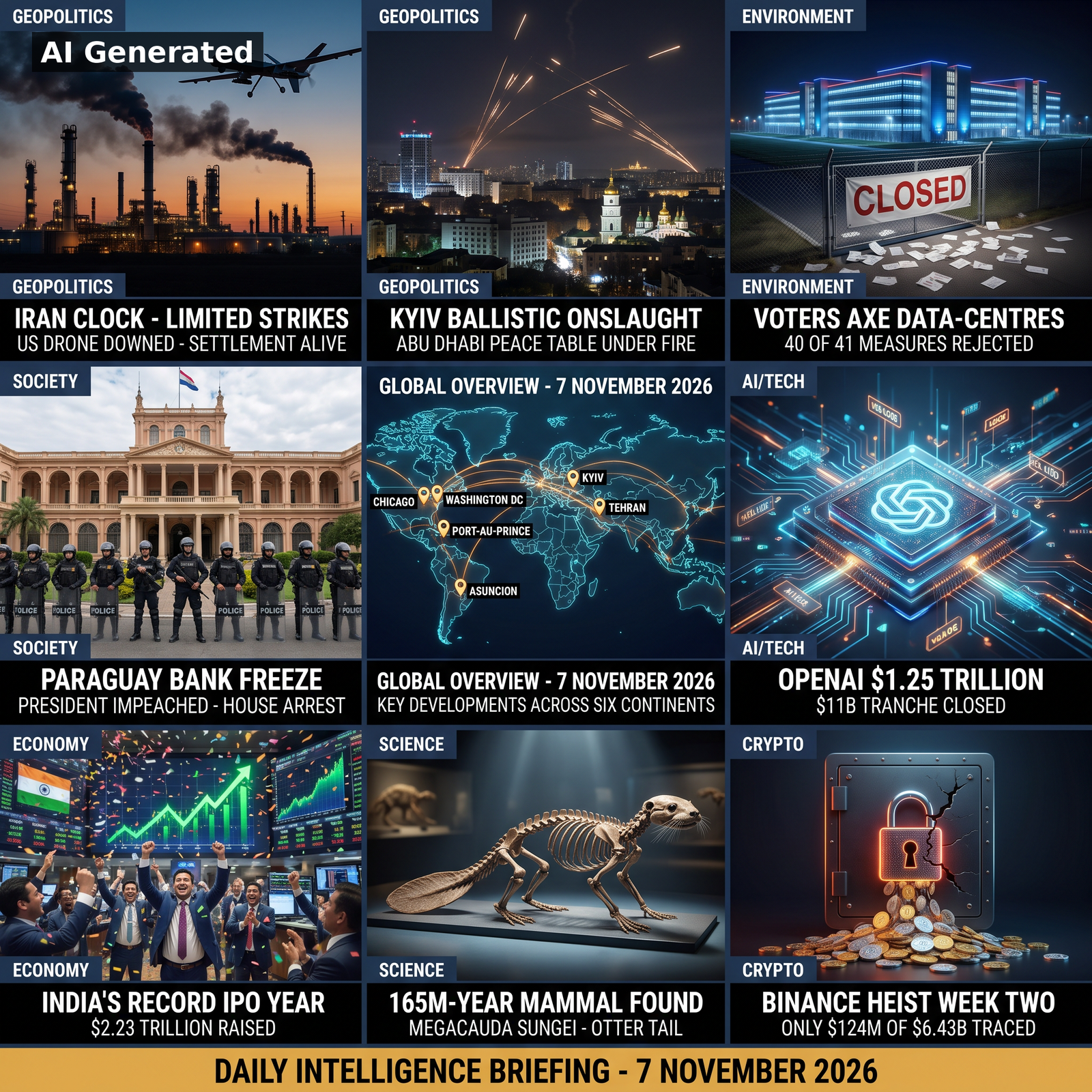
The Gulf has entered its sharpest phase since the war reopened in February, and today’s window is defined by the paradox that has governed the region since the midterm votes were counted: the United States is striking Iran in limited, deliberate increments even as its mediators insist a settlement remains within reach. President Donald Trump announced a fresh, “minor” operation on Friday against an Iranian air-defence system, framing it as a swift, contained action rather than the opening of a wider campaign[1]. The Guardian corroborated the strikes and reported two explosions in the Suza area of Qeshm Island—the same island the earlier post-midterm window had placed at the centre of the strike ledger[2]. Iranian state media claimed its forces brought down a US MQ-9 drone over Qeshm, a counterpoint that, if confirmed, would hand Tehran a visible trophy to offset the loss of its air-defence nodes[3]. The president framed the operation narrowly, saying Iran had “constructed a small anti-aircraft system, and we destroyed it,” and confirming that Washington remains in direct negotiation with Tehran[4].
What makes the exchange analytically significant is that the two tracks are feeding each other. US Central Command published a standing $20 million reward—plus the option of relocation—for information on Iran’s nuclear programme, soliciting details on installations, equipment and personnel[7]. Le Parisien reported how ordinary Iranians are being handed iodine tablets and survival instructions as the state prepares for a possible strike on its buried nuclear site[8]. In parallel, the Financial Times reported leaked Russian defence records showing Moscow has agreed to supply Iran with 90 helicopter-mounted launchers for precision-guided missiles, deepening the Kremlin–Tehran axis at the very moment Washington is trying to degrade Iranian air defences[5]. The Treasury matched the military pressure with fresh sanctions on Iran’s oil exports, aviation links and evasion networks[6].
Diplomacy has not retreated. Qatar’s Prime Minister insists “the Iran issue must be resolved” and another escalation is “unaffordable,” describing the US as still open to a solution and his mediation as working to prevent the situation from “spiralling out of control”[11]. Doha has denied that the US–Iran talks collapsed, stressing both sides continue to work toward an agreement[12]. The president calls the talks “great progress” and claims the American strikes “saved Israel,” warning Israel “would have been wiped off the face of the earth” had Iran been allowed nuclear weapons[13]. The read is that strikes are calibrated to keep Tehran’s ladder short and visible while a diplomatic landing is held open. The danger now includes the subsea-cable dimension: maritime-intelligence tracking has flagged Iranian-linked tankers loitering over undersea cables in the Gulf of Oman, hinting the conflict could migrate from shipping lanes to the fibre on which Omani, Qatari and Indian connectivity depends[10]. Israel has grown visibly anxious; with the Democratic wave in Congress and a surprise announcement ending unconditional US military support, Tel Aviv is questioning the alliance’s future, fearing Washington’s Iran calibration may extend to it[30]. The Houthis, meanwhile, now issue safe-passage authorisations by email to Red Sea ships, bureaucratizing the tolling of a chokepoint[9].
Ukraine’s Ballistic November and the Azov Mobilization Crisis
Ukraine opened the day under a ballistic onslaught timed precisely ahead of the Abu Dhabi peace table. Russia launched a ballistic-missile attack on Kyiv as the Emirati-hosted discussions were prepared, the air force reporting at least six missiles aimed at the capital[14]. Le Monde’s live coverage confirmed the scale; Zelensky had forewarned of strikes on energy infrastructure, the Dnipro bridges and civilian sites[15]. Yet Trump told reporters that Russia and Ukraine “seek to reach a settlement,” keeping the diplomatic frame alive even as missiles fell[16]. The more destabilizing story is internal: hundreds of civilians laid siege to a residential compound near Kyiv after reports that the Azov Brigade was holding AWOL soldiers there and torturing them. The crowd stormed a perimeter wall and security forces fired tear gas and warning shots; the National Guard’s first corps confirmed the site held conscripts arrested for desertion while denying torture[17]. Even Ukrainian and Western media concede the episode is a symptom of profound mobilization fatigue—a coercive conscription hunt that has generated unrest and now an open confrontation with an elite unit, exposing strain at the moment the diplomacy is set.
The Indo-Pacific Matrix and the Defence-Industrial Base
Beyond the Gulf, the Indo-Pacific’s calendar accelerated. The Quad navies launched Exercise Malabar 2026, and India briefed ASEAN ambassadors at its Indian Ocean fusion centre[20]. Analysts argue the next India–China shift may come less from fighters or missiles than from the PLA’s expanding high-altitude helicopter capability, a quieter but consequential build-up[18]; New Delhi answered with a successful user trial of the indigenous Pralay quasi-ballistic missile, positioned to counter a China–Pakistan threat[19]. Iran’s Rezaei revived a provocative claim that Pakistan’s Army Chief warned of the growing India–Israel bond as a threat to the Muslim world[21], and Turkey’s ratification of the Mecca Defence Agreement with Pakistan and Saudi Arabia sparked a parliamentary row over entanglement in an India confrontation[22]. Athens retorted crisply to Ankara over NAVTEX warnings around the cable-survey vessel, insisting the works would proceed in Greek and Cypriot waters because the law of the sea “is clear and admits of no different interpretations”[23].
On the capability ledger, states are hardening their bases. The United States restored production of the nuclear “binary” alloy at Y-12 for the first time in two decades, shoring up the deterrent’s supply chain[24]; the F-22 fleet-numbers gap—187 jets against a plan of 750—remains a cautionary tale motivating the F-47[25]; and Britain orbited the Titania observation satellite for a dedicated military “pair of eyes”[28]. Argentina set a path toward ten UH-60L Black Hawks by 2028[27], Washington sanctioned Cambodia’s Prince Group over online scams[26], and Guyana offered to meet up to 20 percent of India’s crude demand[29].
Environment & Climate ↑ Contents
The Midterm Verdict on Energy and the Data-Centre Revolt
The Democratic wave has an unusually sharp environmental echo: voters used the ballot to discipline exactly the growth engine most disputed in the energy transition. In the 41 local measures addressing data-centre development on Tuesday, voters rejected the projects in all but one jurisdiction—a near-total rebuke of the gigawatt campuses that define the AI build-out[31]. The clean-energy sector read the outcome as hope rather than a mandate for rollback, arguing the public embraces climate action so long as its costs are not socialized onto household bills[32]. The clearest institutional signal arrived in Georgia, where Democrats won a third seat on the Public Service Commission—their first control of the utility regulator in 30 years—and promised an affordability docket and scrutiny of the opaque Georgia Power/OpenAI contract[44].
Repricing has reached the boardrooms. Fortune argues the midterms did not stop the AI build-out; they put a new price on it, and OpenAI’s National Community Compact—paying for the electricity and grid infrastructure of its own campuses and posting financial guarantees—is the first explicit concession to that “social licence” arithmetic[72]. Meanwhile, Senator Alan Armstrong, a former gas-pipeline chief now in the upper chamber, quietly inserted a provision to limit state power to block interstate pipelines—a direct interest riding on what he championed[37].
The Cold and Potent Ledgers: SF6, Debt and a Disappearing Giant
The climate-diplomacy and finance fronts each warned today. UN Secretary-General António Guterres called the fight “a moment of truth,” using the Turkey-hosted COP31 to insist the window is closing faster than institutions move[33]. Germany launched an initiative to curb sulfur hexafluoride, an exceptionally potent greenhouse gas whose success hinges on China, the source of over half the world’s output[34]. And research on the “climate-debt doom loop” quantifies how disasters and debt compound—some 480,000 truckloads were needed to clear Hurricane Melissa’s rubble from Jamaica[35]. The living ledger alarms: Zavodovski Island, once the world’s largest penguin colony, has lost 63 percent of its chinstrap breeding pairs since 2011, the decline predating the island volcano and implicating warming-driven krill shifts[38]. Warming also pushes loggerhead turtles west across the Mediterranean, forcing Italian, French and Spanish resorts to share the sand[39], while a previously unseen baby North Atlantic right whale off Canada lifted the season’s count to 24[40].
Biodiversity, Glaciers and Water
Two findings underscore how little of the natural world is mapped. Botanists named Victoria colombiana, a giant water lily visible from space, after an Instagram photo; only 30–50 plants may remain[42]. At the opposite extreme, Peru’s drive for transition minerals threatens Quelccaya, the second-largest tropical ice cap, whose Indigenous alpaca herders call it the source of their water[41]. Germany raised bird-flu risk ratings as the virus spread through northern poultry holdings with colder weather[43], and the unfinished Deep Tunnel project has failed to stop billions of gallons of raw sewage reaching the Chicago River—infrastructure debt as a climate file[36].
Society & Civil Issues ↑ Contents
Paraguay’s Banking Implosion: Impeachment, Arrest and a Nation Without Accounts
Paraguay produced the most consequential state crisis of the window. President Santiago Peña was impeached, placed under house arrest within minutes, and replaced by Vice-President Pedro Alliana after a scandal in which the suspension of the rapidly expanded Ueno bank left up to 60 percent of Paraguayans unable to access their accounts[45]. Peña is being investigated over allegations he used his influence to favour a bank that grew under his government; the unanimous Senate vote also stripped him of his lifelong-senator seat[46]. Prosecutors swiftly moved on the former central-bank chief as savers demanded accountability[45]. Alliana, himself of Peña’s Colorado party, was sworn in pledging not to “leave alone” the victims of the “financial chaos,” testing whether the cleanup outlives a leadership change within one political family[46].
Haiti: The Drone Kill and the Salvadoran Experiment
Haiti delivered a landmark against its gangs with the death of leader Mathias Saintil, wounded in a drone strike in Port-au-Prince and dying in care[47]. The prime minister framed it as one of the most serious blows to gang leadership since 2024, declaring “one gang leader less”[47]. Yet even a powerful gang has now reached out to the state’s disarmament agency—offering “peace, stability and national reconciliation” even as gunfights persist—an overture to the very Salvadoran-backed force structure that killed Saintil[48]. The deployment of some 2,000 Salvadoran soldiers under Nayib Bukele’s hard-line model has divided Haitian society between those welcoming the crackdown and rights groups alarmed by unclear rules of engagement.
Public Health and the Anglo-Periphery: Measles, Rape-Trial Reform and Migration
The US public-health table turned alarming, with more than 5,000 measles cases this year—the highest in 35 years—children and teenagers making up almost 60 percent of cases, and the overwhelming majority of the infected unvaccinated[49]. In Britain, Russell Brand’s conviction on rape and sexual-assault charges catalysed a legislative moment: minister Andy Burnham is examining changes to rape-trial procedure to better protect victims[50]. On the Channel, Dover’s MP warned smugglers are simply adapting to disrupted launch sites, finding new methods[66]. And a medical-ethics case underscored doctrinal rigidity: a Jehovah’s Witness died after refusing a blood transfusion under rules relaxed just 23 days later[65].
Washington’s Personnel Reset: Miller, the Statehouses and the Purged Admiral
The American post-midterm picture is shadowed by hardline consolidation. President Trump named Stephen Miller to replace the moderate Susie Wiles as chief of staff, signalling he will double down rather than tack toward the Democratic Congress[52]. The verdict itself reached beyond Washington: Democrats flipped statehouses and gained trifectas in states like Wisconsin, Pennsylvania and Arizona[51], and the wave carried figures such as ex-Vice-Admiral Nancy Lacore—a victim of earlier Pentagon purges—to a surprise House seat in South Carolina[53]. The security perimeter sent its own signal: a man was arrested near the White House after telling Secret Service officers he heard voices ordering him to kill President Trump, found with multiple firearms[54].
Germany’s Civic Square: Aigner, Emde and the Care Ledger
German constitutional politics found its clearest shape in months. Ilse Aigner, the 61-year-old Bavarian state-parliament president, emerged as the Union’s near-unanimous candidate to succeed Frank-Walter Steinmeier, a move that would make her the first woman—and first CSU politician—to hold the federal presidency[56], even as critics attacked Chancellor Merz’s opaque, leaked “finding process” as “unworthy of the office”[57]. In Berlin, the Left escalated its internal crisis, demanding MP Vanessa Emde—under fire over Israel statements—return her mandate or face expulsion, threatening the red-green-red coalition talks[55]. Behind the politics, the care ledger tightened: the federal care-insurance system needed another emergency injection[58], and recognition of foreign nursing qualifications still takes over two years, straining a sector reliant on Vietnamese, Filipino and Indian recruits[59].
Judicial and Civic Files Across Europe
Across the continent, courts and civic squares moved in tandem. The EU prosecutor opened an investigation into the fatal Spanish train crash[60]. In France, the owner of the Wintzenheim gîte where eleven disabled holidaymakers died in a 2023 fire will stand trial for manslaughter[61]; activists emptied a Montparnasse news outlet to protest the Bolloré-owned media “monopoly”[62]; and Jordan Bardella accused La France insoumise of a “totalitarian temptation” over its drive to close CNews[63]. Pope Leo XIV, in Montevideo, defended health care “accessible to everyone”[64]. Further afield, a Sao Paulo building collapse injured four and trapped dozens[67], Guatemala was referred to the Inter-American Court over violent evictions of fourteen Maya Q’eqchi’ communities for sugarcane land[68], a wave of more than 30 bomb threats against European flights is testing aviation security[69], and German municipalities reported a rising tide of municipal burials of the isolated dead[70].
AI & Technology ↑ Contents
Capital and the Corporate Frontier: OpenAI’s $1.25 Trillion and the Social-Licence Compact
The AI capital table reached a scale that strains the imagination even by the sector’s inflated standards. OpenAI closed an $11 billion tranche of a new round at a $1.25 trillion valuation, only months after raising $122 billion at $852 billion—and Bloomberg reported it may still press toward a $20 billion total, even as a mooted higher valuation and $30 billion target were abandoned amid the post-midterm tech-stock slide[71]. Anthropic, meanwhile, is bearing down on its own listing, an IPO that will test whether the AI sector’s tail-risk valuations can survive a newly Democratic Congress disposed to question them[71]. The more instructive development is corporate rather than financial. Two days after voters rejected data centres almost everywhere they were on the ballot, OpenAI went public with a National Community Compact pledging to pay for the electricity and grid infrastructure of its own campuses, post financial guarantees before major spending, and spare ordinary utility customers the bill for delayed or cancelled projects[72]. Fortune frames this as the AI build-out’s first real concession to “social licence”—trading tax breaks for acceptance, and absorbing costs that communities used to bear—and it may well become the template every hyperscaler must now copy[72].
Frontier Memory and Reasoning: Claude’s “Dreaming” and Inkling 2 Small
On the model side, the frontier is being redefined less by raw benchmark spikes than by the architecture of memory itself. Anthropic published research into what it calls “dreaming”—an offline process in which Claude reviews past interactions during idle time, corrects faulty memories and reorganizes knowledge for future sessions. In the company’s tests, a model that curated its memory instead of recording everything navigated long-running tasks far more efficiently: Claude’s small memory system earned four badges in an autonomous-play test where a version that stored nearly a million characters of notes earned just one[73]. The mechanism also demonstrably repaired error: after an offline review corrected a wrongly-recorded location, the model completed a journey it had previously failed to finish. The implication is direct for anyone building persistent agents—memory hygiene, not brute context, is becoming the differentiator. Thinking Machines Lab’s Mira Murati–led startup reinforced the theme with Inkling 2 Small, a compact model aimed at agents that write software and parse documents, priced and sized for deployment in enterprise workflows where the frontier models are too heavy[74].
Quantum’s Twin Frontiers: Hardware in Chicago and a Formal Proof in Three Days
Quantum computing advanced on both the laboratory and the mathematical fronts. IBM brought its most advanced quantum computer—the System Two, powered by its Nighthawk processor—to the University of Chicago’s Hyde Park Labs, serving as the anchor of the National Quantum Algorithm Center en route to the Illinois Quantum and Microelectronics Park, with projects in drug discovery, grid optimization and high-energy physics already underway[75]. More strikingly, physics-research firm PSI claimed its automation on a non-public Anthropic model produced a Lean-verified proof of the 18-year-old Aaronson–Ambainis conjecture in just three days—a result concerning when quantum algorithms can be efficiently simulated classically. The proof still faces independent academic review, but if it holds it sharpens the boundary of when quantum machines genuinely outperform classical ones, and its rapid machine generation is itself a signal about the automation of theoretical physics[76].
Compute’s Geopolitics: The Jensen Huang Spy Case, Starlink Mobile and Orbital Supercomputers
The spy-and-infrastructure layer of compute continued to harden. The New York Times reported that China’s Ministry of State Security recruited an AI executive, Alice Huang of Nvidia customer Megaspeed, to cultivate a relationship with Nvidia CEO Jensen Huang and glean information that could push the company to make its most advanced chips available to China—a case that dramatizes how semiconductor access has become a first-order espionage target[77]. At the platform level, SpaceX’s Starlink Mobile push is now explicit about challenging the terrestrial carriers, with a reported Qualcomm deal and acquisition talks amplifying ambitions that telecom incumbents say could cost well over $200 billion to carry off[78]. And Elon Musk is taking the most radical step of all—orbital supercomputing: SpaceX plans to launch StarMind systems into orbit from 2027, pairing NVIDIA hardware with Starlink’s next-generation laser links, and argues that light travelling about 40 percent faster through space than through fibre could make space-based networks more competitive than undersea cables[79].
The Data-Centre and Chip Ledger: Arm, IREN and the Crusoe–Google Deal
The supply and infrastructure ledger showed both momentum and strain. Arm posted a record quarter and set a $15 billion revenue target for AI-CPU products by 2031, though the pivot from licensing to chip sales introduces new execution risk[80]. IREN, the bitcoin miner turned AI-cloud provider, saw its stock jump 20 percent after AI-cloud revenue surged 182 percent, though its reliance on a Microsoft-scale anchor tenant concentrates the risk[81]. And the other direction of the data-centre story surfaced at Crusoe, which sold a troubled Wyoming facility to Google—a reminder that not every gigawatt campus succeeds, and that even hyperscalers are forced to step in when smaller developers overreach[82].
Economy & Business ↑ Contents
The Central-Bank and Reserve Ledger: China’s Gold, Japan’s Deposits, Trade Thaw
The monetary and reserve picture is being quietly redrawn at the margins. China’s central bank reported gold holdings of 78.30 million fine troy ounces at end-October, up from 77.47 million a month earlier—the sixteenth straight month of accumulation in a de-dollarization and safe-haven buying spree that has made Beijing one of the world’s largest official gold buyers; the same report showed foreign-exchange reserves rising to $3.405 trillion[83]. In Japan, the structural ledger is more domestic: unprotected bank deposits have swollen to $890 billion as inheritance transfers inflate account balances, a demographic phenomenon with unsettling implications for financial-safety nets in an ageing society[84]. On the trade front, the signals pointed toward managed stability rather than open rupture: Chinese Vice-Premier He Lifeng held a video call with top US officials Treasury Secretary Bessent and trade envoy Greer, both sides vowing to keep talks going to maintain “stable, positive” trade ties even as Beijing formally voiced concerns over American restrictions[85].
Asia’s Twin Speeds: India’s Record Primary Market and China’s EV Push
Asia’s financial and industrial engines are running at very different rates. India’s primary market posted its best Samvat year on record, raising $2.23 trillion across 375 IPOs, a 19.6 percent year-on-year jump that underscores the depth of domestic retail participation[87]; the same week’s market mood was celebratory, with benchmark indices registering their best week in six years and the rupee shining against the euro even as Brent recorded its steepest weekly decline since the Covid era[88]. India’s aviation file opened a different tension, with airlines asking the civil-aviation ministry whether it ever formally approved MIAL’s plan to shift Gulf carriers to Navi Mumbai—a capacity question with large competitive stakes[89]. China, meanwhile, is pressing its EV advantage deeper into Europe: Seres and Li Auto have joined the charge of Chinese electric manufacturers entering the European market, intensifying the competitive pressure on incumbent automakers and the tariff politics that coverage of the sector now treats as permanent[86].
Households Under the Rate Squeeze, and Industrials Pivoting
At the household level, rising interest rates are beginning to bite with political force. Across Britain, mortgage-payers face increases of around £200 on their monthly bills as rates climb, a squeeze transmitted into credit cards and loans that millions will feel before the next election cycle[90]. In the United States, the gendered ledger of that pressure is stark: Quartz reports that millennial mothers face pay cuts at exactly the moment they need to earn most, rarely winning back lost wages after a first child in a system short on leave and affordable childcare[91]. In France, an 85 percent survey majority believes purchasing power has deteriorated over the past decade, feeding a national argument, examined through economist Philippe Trainar, over whether workers are “working to become poorer”[92]. And in Greece, the state has moved to cushion the winter: the heating allowance, raised 30 percent with payments from €130 to €1,560, opened for applications ahead of the Christmas payout of the minimum guaranteed income[93].
The Industrial Pivot: Tesla’s Cybertruck End and Amazon’s Indian Electrification
Two industrial decisions capture the direction of the automotive-electronics economy. Tesla announced it will wind down production of the Cybertruck, the boxy pickup Elon Musk once called the company’s “best product ever”—ending the model amid sagging sales and eleven recalls to make room for the autonomous Cybercab, as the company pivots its hopes toward robotaxis in the post-EV-tax-credit environment[94]. The retreat of the flagship from its storied launch is, for the analysts, less a confession than a reallocation: the truck’s production lines become capacity for the driverless future on which Tesla’s entire valuation increasingly rests. In the same sector, Amazon signalled where electrified logistics is headed next by committing to deploy more than 3,000 Tata electric delivery trucks in India, extending the EV-industrial transition into the subcontinent’s last-mile grid[95].
Science & Space ↑ Contents
The Spacefrontier: A Classified Launch, a New Private Rocket and the Cost Curve
Spaceflight’s institutional rhythm is accelerating even as the vehicle mix shifts. SpaceX launched the classified USSF-432 mission from Vandenberg for the US Space Force on a Falcon 9 whose booster—on its eighth flight—landed on a Pacific droneship, with the webcast cut once the mysterious payload was headed toward a suspected Starshield-based sensing-and-targeting orbit[96]. The classified-nature of such missions, carried under the Space-based Sensing and Targeting portfolio, underscores how much of the near-term orbital build-out is now in service of military awareness. On the commercial side, AST SpaceMobile announced it will build its own reusable rocket, Blacklift, targeting a 2028 debut to deploy its BlueBird direct-to-cell satellites, using Firefly Aerospace’s Miranda engines for the first three flights under a $500 million supply deal plus an $800 million licensing agreement[97]. The announcement lands amid a coming launch crunch as Falcon 9 is retired for Starship, and it signals that the direct-to-cell aspirant intends to take control of its own lift capacity rather than ride a tightening market.
Deep Time and Deep Forces: A Jurassic Mammal, an 8,400-Year-Old Axe and True Polar Wander
The deep archive delivered exceptional finds. A ~165-million-year-old Jurassic mammal relative, named Megacauda sungei, swam with a broad, otter-like tail and, crucially, preserved its throat bones and palate hooks in a configuration matching how modern mammals swallow and suckle—firmly dating the evolution of the efficient mammalian chewing-and-swallowing mechanism to the Jurassic[98]. On a far shorter but still ancient timescale, archaeologists digging the route of a new Danish motorway on the island of Egholm pulled an 8,400-year-old Stone Age axe from the wet mud with its wooden handle still attached—an extreme rarity, since organic shafts almost always rot away, and one that preserves the actual grip of Maglemose-culture hunter-gatherers[99]. And at planetary scale, geoscientists used the record of ancient seas to show that Earth’s crust and mantle shifted rapidly relative to the spin axis at least four times over the past 320 million years, in episodes of true polar wander that refute the idea such shifts were negligible or persistently slow[100].
Biomedicine’s Ledger: Vitamin C, Wastewater Stress Signals and a Knife That Missed the Fatal Mark
Medicine produced findings that range from the quietly promising to the medically extraordinary. A phase-2 trial of a cheap daily oral vitamin C dose (1,000 mg) in 109 people with pre-cancerous blood disorders linked the supplement to a 65 percent lower risk of death in an exploratory three-year analysis and fewer progressions to aggressive leukemia—possibly via the TET2 enzyme—offering a low-cost “cancer-interception” path that now needs a phase-3 confirmation[101]. New wastewater science from the University of Queensland showed that university examination periods produce a detectable, population-level spike in oxidative-stress biomarkers and even a suggestive rise in antidepressant consumption in university sewage—validating non-invasive surveillance as a population-stress tool[102]. And in a case that belongs in the record-books, a UK hospital pulled a knife that had entered a man’s eye and passed clean through his brain—the patient, remarkably, recovered and was reported “fine”[105].
Biology, Psychology and Materials at the Frontier
The biological and quantum-materials frontier pressed forward on several flanks. Biologists studying Darwin wasps—the parasitic insects that horrified Darwin—showed through their gruesome life-cycles how evolution enforces “one-way streets,” in findings on evolution’s directionality[104]; and octopus research, inspired by the animal’s ability to squeeze through impossibly small gaps, is informing search-and-rescue robotics[103]. On the psychology of experience, a small psychomanteum study found that prolonged mirror-gazing in a darkened chamber produced vivid felt-presence experiences of the dead, with the intensity linked to measures of creative fantasy[106]. In energy materials, both fronts moved: a Chinese-co-developed protective coating helped solid-state lithium-metal batteries retain 82.3 percent of capacity over 300 cycles, addressing a persistent dendrite-weakness[107], and Italian researchers demonstrated a room-temperature fluoride-exchange membrane bringing fluoride-ion batteries—a potentially lithium-free, higher-density chemistry—closer to practicality after 50-plus stable cycles[110]. In physics instrumentation, a simulation-based readout scheme suggests Andreev qubits could reveal their state through their own electric current, enabling less-disturbing quantum-computer monitoring[108], while teams in Antarctica keep untangling the cosmic microwave background’s polarization patterns to sharpen the picture of the early universe[109].
Crypto, Digital Assets & Blockchain ↑ Contents
The Record Theft’s Second Week: Conversion, Freezes and the Long Laundering Tail
The aftermath of the record Binance breach is now a forensic ledger in motion, and the Elliptic accounting published this window is the clearest quantitative read yet and a genuine evolution of the arc D152–D159 have tracked since the theft night. Eight days after $6.43 billion left Binance, only about $124 million—roughly 1,650 BTC—had been converted into bitcoin in newly created addresses, while $2.85 billion (44.3 percent of the haul) had been frozen or seized, and $3.11 billion still sat parked in addresses linked to the theft, almost none of it turned into spendable money[111]. What this report flagged as the central analytical uncertainty on D152—whether the parked stack would be hoarded as a state reserve or converted along the Bybit path—now leans toward the Bybit precedent: the conversion curve is climbing, but at a pace (< $16 million a day) that implies a long, gradual runway rather than a rapid exit. The conversion into bitcoin is deliberate rather than chaotic: bitcoin has no issuer, so it cannot be frozen the way USDT and USDC were—Tether froze the stolen USDT minutes after it arrived and Circle froze all $823 million in stolen USDC before a single token moved[111]. Elliptic attributes the theft to North Korea’s TraderTraitor operation on the FBI’s read, and maps how the funds were shuttled through thousands of wallets, bridges and privacy tools to buy distance from the theft moment rather than an exit. The $2.85 billion freeze rate is roughly 15 times higher than in the comparable Bybit case, but the analyst’s caution is precise: 44 percent frozen is not 44 percent recovered, and with a parked balance that could take near six months to convert at current rates, the tail of this laundering operation has barely begun[111]. Binance, for its part, has replenished 98 percent of stolen funds from its own balance sheet, shifting the loss to the exchange and its insurers rather than depositors[111].
The Enforcement Perimeter: FTX Clawback, Zero-Click Thefts and France’s Exit
On the enforcement and security perimeter, three files advanced. In the long-running FTX estate recovery, Binance and founder Changpeng Zhao subpoenaed Kevin O’Leary and Michael Lewis in their defence of the $1.76 billion clawback lawsuit—the former an investor who promoted the exchange, the latter the author who chronicled Sam Bankman-Fried’s rise and fall—widening the evidentiary net beyond the exchange’s own principals[112]. A separate attack file underscored the persistence of off-exchange risk: a zero-click iOS exploit drained $4 million in USDT from 365 active TRON wallets, a reminder that custody and endpoint security, not just exchange infrastructure, remain the soft underbelly of the ecosystem[113]. And the regulatory tide closed in on Binance in Europe: Binance France will shut all customer accounts by year-end, beginning to charge fees on idle balances from November 29, an exit that reflects the gathering compliance burden on the platform across the EU[117].
The Institutional On-Ramp: Charitable Rules, USDC on 82M Phones and the CFTC’s Geoblock Order
The adoption and regulatory rails continue to thicken in parallel. The IRS clarified the rules for crypto charitable deductions—spelling out holding-period, appraisal-threshold and documentation requirements for gifts of bitcoin and other digital assets to qualified organizations[114]. Samsung, in a significant mainstreaming step, teamed with Stripe to bring USDC payments to up to 82 million devices through Samsung Pay and cards, with New York excluded and fees varying by transaction—a move that puts a stablecoin rails inside one of the world’s largest device ecosystems[115]. Tokenization deepened through reality-token infrastructure as well, with Reality partnering with Merkl to ensure Bitget rToken holders continue receiving stock-or-ETF dividends even while their tokenized assets are employed in DeFi protocols[116]. On the regulatory-prediction front, the CFTC told federally regulated prediction markets to drop state-based geoblocking within 30 days, insisting no trader should be blocked by geography—guidance that arrived a day after a federal judge ordered Kalshi to block sports contracts[119]. And on the quantum-preparation file, Blockstream named Falcon-1024 its preferred post-quantum signature scheme for bitcoin, a pragmatic engineering choice that frames the trade-offs of the long transition to quantum-resistant signatures[118]. Taken together, the window shows an ecosystem separated into two speeds: the forensic and enforcement layer moving at high tempo against the Binance theft and endpoint exploits, while the adoption rails—phone-native stablecoin rails, tokenized dividends, clearer tax and prediction-market rules—advance steadily beneath it, preparing the compliance infrastructure the eventual cash-out of the parked haul will put to its hardest test.
Correlations & Analysis ↑ Contents
The D160 window is the third post-answer read of the master variable this report has tracked since midterm week, and it finally answers, in paradoxical form, the hinge question D159 posed. Yesterday’s D159 report closed on the striking observation that Hegseth’s explicit “there will be war” declaration and Trump’s diplomatic overtures were running in parallel at maximum intensity. Today proves both tracks are not merely parallel but mutually reinforcing: the United States fired fresh, “minor” strikes at Iranian air defences and published a $20 million bounty on Iran’s nuclear programme, while Qatar’s mediation and Trump’s “great progress” claim insist a settlement remains live[1][7][13]. Washington is calibrating an escalation ladder short enough to keep each rung below Tehran’s threshold, while the Kremlin’s reported missile-launcher supplies and Iran’s downing of a US drone both try to widen that ladder from outside[5][3].
The midterm verdict correlates with every major file this window. The Democratic sweep that D157 read as a verdict on the integrity perimeter has converted into two opposing currents: on energy and data-centres it is an accelerator of accountability—voters rejected data-centre development almost everywhere it was on the ballot, handing Democrats the Georgia utility regulator and forcing OpenAI into its first “social-licence” compact[31][44][72]. On the White House it prompted consolidation rather than moderation—the Miller appointment signals hardening[52]. Israel reads both currents at once: the wave raised the prospect of an end to unconditional US support just as Washington’s calibrated Iran approach was extended[30]. The outcome neither handed the administration a clean landing nor forbade a strike; it produced both simultaneously, the most dangerous combination.
Three institutional crises share one property: each tests whether a state can contain a failure without it cascading. Paraguay’s banking implosion removed a sitting president while 60 percent of savers lost access to accounts[45]. Haiti’s drone-kill of a gang leader is advertised as victory even as a gang opens a dialogue with the disarmament agency[47][48]. And Ukraine’s Azov mobilization confrontation exposes manpower and cohesion strain at the precise moment the Abu Dhabi table convenes under Russian missile fire[17][14]. In each, the raw event matters less than what it reveals about resilience under compound stress.
The continuum D158 and D159 identified as the era’s defining tension—between a connective, representative technology and the physical, corporate and geopolitical costs it demands—has sharpened. The data-centre defeats and OpenAI’s concession are its political expression; the Jensen Huang espionage affair and subsea-cable loitering its strategic expression; the quantum accelerations and machine-generated proof its intellectual one[77][10][76]. These are facets of one shift in which compute has become simultaneously the most valuable and most contested strategic asset.
What to watch in the next reporting period: whether the trinational Gulf calibration survives a single miscalculation and whether the parked Binance stack—still $3.11 billion—begins converting faster as a laundering proxy[111]; whether OpenAI’s compact becomes the industry norm data-centre defeats force on Microsoft, Google, Amazon and xAI[72]; whether Paraguay’s cleanup works on one man or the whole political family and Haiti’s overture is real or tactical; and whether Stephen Miller’s appointment finally breaks the running-parallel Iran structure into a settlement or a real escalation before Germany elects its first woman president on 30 January[56].
References ↑ Contents
1. US carries out fresh limited strike on Iran as Qatar pushes new nuclear de-escalation proposal by India Defence News · Source ↑
2. US carries out another round of ‘minor’ strikes on Iran, Trump says by The Guardian · Source ↑
3. Iran’s military: US MQ-9 drone downed over Qeshm island (state media) by Reuters · Source ↑
4. Trump: Iran constructed a ‘small anti-aircraft system,’ and we destroyed it; negotiating with Iranians by Reuters · Source ↑
5. Leaked files reveal Russia’s plan to supply Iran with 90 missile launchers by Financial Times · Source ↑
6. US unveils new Iran sanctions as crackdown on sanctions-evasion networks intensifies by India Defence News · Source ↑
7. Les Etats-Unis offrent 20 millions de dollars pour des informations sur le programme nucléaire iranien (originally in French) by Le Monde · Source ↑
8. Comprimés d’iode et consignes de survie : comment l’Iran se prépare à une attaque américaine sur un site nucléaire enfoui (originally in French) by Le Parisien · Source ↑
9. Les houthistes délivrent des autorisations par email aux navires pour traverser la mer Rouge (originally in French) by Le Monde · Source ↑
10. Ships loiter near subsea cables amid Iran’s warnings to Trump by Ars Technica · Source ↑
11. Qatar’s PM: Iran issue must be resolved, another escalation unaffordable; talks continuing by Reuters · Source ↑
12. Το Κατάρ διέψευσε τις πληροφορίες ότι οι συνομιλίες ΗΠΑ-Ιράν απέτυχαν (originally in Greek) by Skai · Source ↑
13. Τραμπ: «μεγάλη πρόοδος» στις συνομιλίες με το Ιράν, οι επιθέσεις «έσωσαν το Ισραήλ» (originally in Greek) by Skai · Source ↑
14. Russia launches ballistic missile attack on Kyiv ahead of Abu Dhabi peace talks by Investing.com · Source ↑
15. EN DIRECT, guerre en Ukraine : des explosions entendues à Kiev, visée par au moins six missiles balistiques (originally in French) by Le Monde · Source ↑
16. Trump: Russia and Ukraine seek to reach settlement by Reuters · Source ↑
17. Εκατοντάδες πολίτες πολιόρκησαν μυστικό κέντρο της Ταξιαρχίας Αζόφ (originally in Greek) by DefenceNet · Source ↑
18. China’s Helicopter Build-Up Raises The Stakes In The Himalayan Challenge: Is India Ready? by India Defence News · Source ↑
19. Pralay Missile Test: How India’s New Weapon Could Counter China-Pakistan Threats by India Defence News · Source ↑
20. Quad Navies Launch Malabar 2026 Multi-Domain Drills To Strengthen Free And Open Indo-Pacific by India Defence News · Source ↑
21. An Alternative View On India-Israel Convergence And Pakistan’s Strategic Anxiety by India Defence News · Source ↑
22. Mecca Defence Pact With Pakistan Sparks Row In Turkish Parliament by India Defence News · Source ↑
23. Απάντηση Αθήνας στο τουρκικό ΥΠΕΞ για τις NAVTEX: «Οι εργασίες θα πραγματοποιηθούν» (originally in Greek) by DefenceNet · Source ↑
24. US starts production of key material (‘binary’ alloy) used in nuclear weapons by Interesting Engineering · Source ↑
25. The US Air Force Wanted 750 F-22 Raptors But Was Forced to Accept Just 187 by 19FortyFive · Source ↑
26. US slaps sanctions on Cambodia’s Prince Group over online scams by Nikkei Asia · Source ↑
27. Tras la firma de la LOA por cuatro UH-60L, el Ejército Argentino define un esquema de diez helicópteros en 2028 (originally in Spanish) by Zona Militar · Source ↑
28. UK satellite launched into space to help armed forces monitor worldwide military activity (Titania) by The Independent · Source ↑
29. Guyana Ready To Meet Up To 20 Per Cent of India’s Crude Oil Demand by India Defence News · Source ↑
30. Après la déferlante démocrate, Israël redoute la fin d’un soutien inconditionnel (originally in French) by Libération · Source ↑
31. How the US midterm elections reflected resistance to data centres by Al Jazeera · Source ↑
32. Solar Industry Shows Hope After US Election, Focuses On Key Message by CleanTechnica · Source ↑
33. AP Exclusive: Departing UN chief calls this ‘a moment of truth’ in fight to curb global warming by The Independent / AP · Source ↑
34. Global Campaign Seeks to Curb Emissions of World’s Most Potent Greenhouse Gas (sulfur hexafluoride) by Inside Climate News · Source ↑
35. Disasters and debt. Escaping the ‘climate-debt doom loop’ by Phys.org · Source ↑
36. Billions of Gallons of Raw Sewage Are Pouring Into the Chicago River After Storms by Inside Climate News · Source ↑
37. A US Senator’s Push to Fast-Track Pipelines Would Benefit His Former Company by Inside Climate News · Source ↑
38. A remote volcanic island (Zavodovski) has lost 63 percent of its breeding chinstrap penguins by ECONEWS / Current Biology · Source ↑
39. As loggerhead turtles spread west, Mediterranean beach resorts learn to share the sand by Mongabay · Source ↑
40. Scientists discovered an unknown baby right whale off Canada by AP / Mongabay · Source ↑
41. Peru’s drive for critical minerals threatens a disappearing glacier (Quelccaya) by Mongabay · Source ↑
42. A single Instagram photo revealed a new giant water lily (Victoria colombiana) that can be seen from space by ECONEWS · Source ↑
43. Tierseuche: Vogelgrippe breitet sich aus – FLI erhöht Risikostufen (originally in German) by Stern · Source ↑
44. Democrats take control of Georgia’s powerful utility regulator (Public Service Commission) by Grist · Source ↑
45. Ousted Paraguay president (Santiago Peña) under house arrest after banking crisis leaves 60% of country unable to access accounts by The Guardian · Source ↑
46. Pedro Alliana investi président, le président destitué Santiago Peña placé en détention à domicile (originally in French) by Le Monde · Source ↑
47. Αϊτή: Επιβεβαιώθηκε ο θάνατος του ηγέτη συμμορίας Ματιάς Σεντίγ (originally in Greek) by Enikos · Source ↑
48. Powerful Haitian gang reaches out to state disarmament group as gunfights persist by AP / The Independent · Source ↑
49. CDC reports more than 5,000 measles cases, highest number in 35 years by Al Jazeera / Reuters · Source ↑
50. Andy Burnham to reform rape trials to back victims after Russell Brand conviction by Evening Standard · Source ↑
51. Democrats flip statehouses in midterm wave by ABC News · Source ↑
52. Donald Trump nomme le radical Stephen Miller au poste de chef de cabinet de la Maison Blanche (originally in French) by Le Parisien · Source ↑
53. Midterms 2026: l’ex-amirale Nancy Lacore, victime des purges de l’administration Trump, élue surprise en Caroline du Sud (originally in French) by Le Monde · Source ↑
54. Man arrested near White House after ‘weapons found’ in Trump ‘assassination bid’ by The Express · Source ↑
55. Regierungsbildung in Berlin: Linke-Abgeordnete Emde muss über Mandatsverzicht entscheiden (originally in German) by Stern · Source ↑
56. Bundespräsidentenwahl: Ilse Aigner ist die ungekürte Kandidatin – Kritik an Merz (originally in German) by Stern · Source ↑
57. Allemagne: Ilse Aigner, conservatrice bavaroise, pourrait devenir la première femme présidente (originally in French) by Le Monde · Source ↑
58. Pflegeversicherung braucht im November Extra-Geldspritze (originally in German) by Der Spiegel · Source ↑
59. Pflege: Anerkennung von Pflegeabschlüssen dauert bis zu zwei Jahre (originally in German) by Stern · Source ↑
60. EU prosecutor office investigates fatal train crash in Spain by Al Jazeera · Source ↑
61. La propriétaire du gîte touché par un incendie meurtrier en 2023 à Wintzenheim sera jugée (originally in French) by Franceinfo · Source ↑
62. «La propagande d’extrême droite tue»: à Paris, des activistes «déménagent» un Relay pour dénoncer le «monopole» de Bolloré (originally in French) by Le Monde · Source ↑
63. Jordan Bardella accuse La France insoumise de «tentation totalitaire» en voulant fermer CNews (originally in French) by Le Monde · Source ↑
64. Voyage de Léon XIV en Amérique latine: en Uruguay, le pape évoque sa maladie (originally in French) by Le Monde · Source ↑
65. This man refused life-saving treatment because of his religion – days later the rules changed by BBC · Source ↑
66. Dutch launch shows smugglers are adapting, says MP (Channel migration) by BBC · Source ↑
67. Βραζιλία: 4 τραυματίες σε κατάρρευση 4ώροφου εμπορικού κτιρίου στη Σάο Πάολο (originally in Greek) by in.gr · Source ↑
68. Guatemala faces a human rights court over violent evictions of Indigenous communities by Mongabay · Source ↑
69. Geißel der Luftfahrt: Wie mit Bombendrohungen umgegangen wird (originally in German) by Stern · Source ↑
70. Bestattungen: Wenn das Ordnungsamt die Beerdigung übernimmt (originally in German) by Stern · Source ↑
71. OpenAI valued at $1.25 trillion, as rival Anthropic nears its IPO by The Verge · Source ↑
72. The midterms didn’t stop the AI buildout. They simply repriced it—and OpenAI is already promising to pay up by Fortune · Source ↑
73. Can Claude dream now? Anthropic’s latest experiment gets eerily close to human thinking by Interesting Engineering · Source ↑
74. Thinking Machines launches Inkling 2 Small with near-frontier performance on enterprise benchmarks by VentureBeat · Source ↑
75. IBM brings its most advanced quantum computer (System Two) to Chicago by Interesting Engineering · Source ↑
76. Major quantum computing conjecture (Aaronson-Ambainis) solved in three days after 18 years by Interesting Engineering · Source ↑
77. Chinese Spy Who Targeted Jensen Huang Worked Directly for China’s Top Spy Agency by Gizmodo / NYT · Source ↑
78. Starlink Mobile: All the news on SpaceX’s major mobile carrier ambitions by The Verge · Source ↑
79. Elon Musk teases SpaceX’s orbital supercomputers (StarMind), says it will ‘blow people’s minds’ by Interesting Engineering · Source ↑
80. Arm Holdings posts record quarter, sets $15 billion AGI CPU revenue target for 2031 by Crypto Briefing · Source ↑
81. IREN stock surges 20% as AI cloud revenue jumps 182% by Crypto Briefing · Source ↑
82. Crusoe sells troubled Wyoming data center project to Google by TechCrunch · Source ↑
83. China’s gold holdings 78.30 million fine troy oz at end-October: central bank by Reuters / FinancialJuice · Source ↑
84. Japan’s unprotected deposits hit $890bn as inheritances inflate accounts by Nikkei Asia · Source ↑
85. Chinese vice premier He Lifeng holds video call with top US officials Bessent and Greer (Xinhua) by Xinhua / FinancialJuice · Source ↑
86. Seres, Li Auto join Chinese EVs’ charge into Europe by Nikkei Asia · Source ↑
87. Best-ever Samvat for IPOs: Record ₹2.23 trillion raised, up 19.6% by Business Standard · Source ↑
88. Street basks in Diwali glow: Benchmark indices post best week in 6 years; Brent sinks most in a week since Covid by Business Standard · Source ↑
89. Did you approve MIAL’s plan to shift Gulf carriers? Airlines ask MoCA by Business Standard · Source ↑
90. ‘My mortgage is going up £200’: How rising interest rates are hitting people’s pockets by BBC · Source ↑
91. Millennial moms are facing pay cuts at exactly the moment they need to earn more by Quartz · Source ↑
92. Pouvoir d’achat des Français: travailler et s’appauvrir ? (originally in French) by France 24 · Source ↑
93. Επίδομα θέρμανσης: Μέχρι πότε κάνετε αίτηση και τι ισχύει για την προκαταβολή (originally in Greek) by Ethnos · Source ↑
94. Elon Musk once said the Cybertruck would be Tesla’s ‘best product ever.’ Now he’s winding down production by Fortune · Source ↑
95. Amazon set to deploy more than 3,000 TATA electric delivery trucks by Electrek · Source ↑
96. SpaceX launches classified US military mission (USSF-432), Falcon 9 booster nails eighth landing by Interesting Engineering · Source ↑
97. AST SpaceMobile announces new ‘Blacklift’ rocket, targets 2028 launch debut by Space.com · Source ↑
98. A Jurassic mammal relative (Megacauda sungei) swam with a broad otter-like tail by ECONEWS / Nature · Source ↑
99. Archaeologists pulled an 8,400-year-old Stone Age axe out of the mud with its wooden handle attached by ECONEWS · Source ↑
100. Earth’s crust and mantle rapidly shifted relative to the planet’s spin axis four times in 320 million years (true polar wander) by ECONEWS / Science · Source ↑
101. A Cheap Daily Vitamin (vitamin C) Shows Promise For People at Risk of Leukemia by ScienceAlert · Source ↑
102. University Exams Produce a Distinct Chemical Signature in Sewage (wastewater stress biomarkers) by ScienceAlert / Nature Water · Source ↑
103. How octopuses squeeze through teeny tiny holes (search-and-rescue robotics) by NPR · Source ↑
104. The wasps that horrified Darwin reveal evolution’s one-way streets by Phys.org · Source ↑
105. Doctors pull knife from man’s eye that went through his brain—and he’s fine now by Ars Technica · Source ↑
106. Scientists Used a ‘Psychomanteum’ to Summon Ghostly Encounters by ScienceAlert · Source ↑
107. Chemical Breakthrough Could Unlock the ‘Holy Grail’ of Solid-State Battery Technology by SciTechDaily · Source ↑
108. Scientists Find a Clever Way to Read Quantum Information Without Destroying It (Andreev qubit) by SciTechDaily · Source ↑
109. Untangling the patterns of the cosmic microwave background to better understand the early universe by Phys.org · Source ↑
110. Fluoride-ion battery cells pass 50-plus cycles with new non-flammable membrane by Interesting Engineering · Source ↑
111. Eight Days After the Binance Breach, $124 Million Is Bitcoin (Elliptic laundering analysis) by Blockchain Reporter / Elliptic · Source ↑
112. Binance Pulls Kevin O’Leary, Michael Lewis Into $1.76B FTX Clawback Lawsuit by Bitcoin.com News · Source ↑
113. Zero-click iOS exploits drain $4M USDT from active TRON wallets by CryptoSlate · Source ↑
114. IRS sets new rules on crypto charity deductions, details holding period, appraisal limits by CoinTurk News · Source ↑
115. Samsung teams with Stripe to bring USDC to 82M phones by CryptoSlate · Source ↑
116. Reality Partners With Merkl To Bring Stablecoin Dividends To Bitget rToken Holders In DeFi by CoinGape · Source ↑
117. Binance France to close all customer accounts by year end, with fees on idle balances from November 29 by Crypto Briefing · Source ↑
118. Blockstream names Falcon-1024 its top quantum-resistant signature pick for Bitcoin by Crypto Briefing · Source ↑
119. CFTC Tells Prediction Markets to Drop State Geoblocks Within 30 Days by Bitcoin.com News · Source ↑
AI Disclosure: This post was created with the assistance of artificial intelligence. The ideas, analysis, and opinions expressed are my own — AI was used to help compose, structure, and refine my personal notes and thoughts into the final written content. Images, videos and music featured in this post were also generated using AI tools, based on my own creative prompts and direction.