

Contents
- 1. Geopolitics & Defence
- The Gulf Clock: Trump’s “Ten Minutes,” Tehran’s Conditions and the Riyadh Air Garotte
- Ukraine’s Negotiating Track and the Corridor War’s New Layer
- Warsaw and Sofia: The Rule-of-Law Front and Bulgaria’s Binary Choice
- The Periphery’s Geometry: Caracas, Brasilia, Tel Aviv, Damascus and the Naval Ledger
- 2. Environment & Climate
- 3. Society & Civil Issues
- 4. AI & Technology
- 5. Economy & Business
- 6. Science & Space
- 7. Crypto, Digital Assets & Blockchain
- 8. Correlations & Analysis
- 9. References
Click any heading to jump to that section. Click the section heading to return to this menu.
Daily Intelligence Briefing — 2026-11-01 (D154)
Geopolitics & Defence ↑ Contents
The Gulf Clock: Trump’s “Ten Minutes,” Tehran’s Conditions and the Riyadh Air Garotte
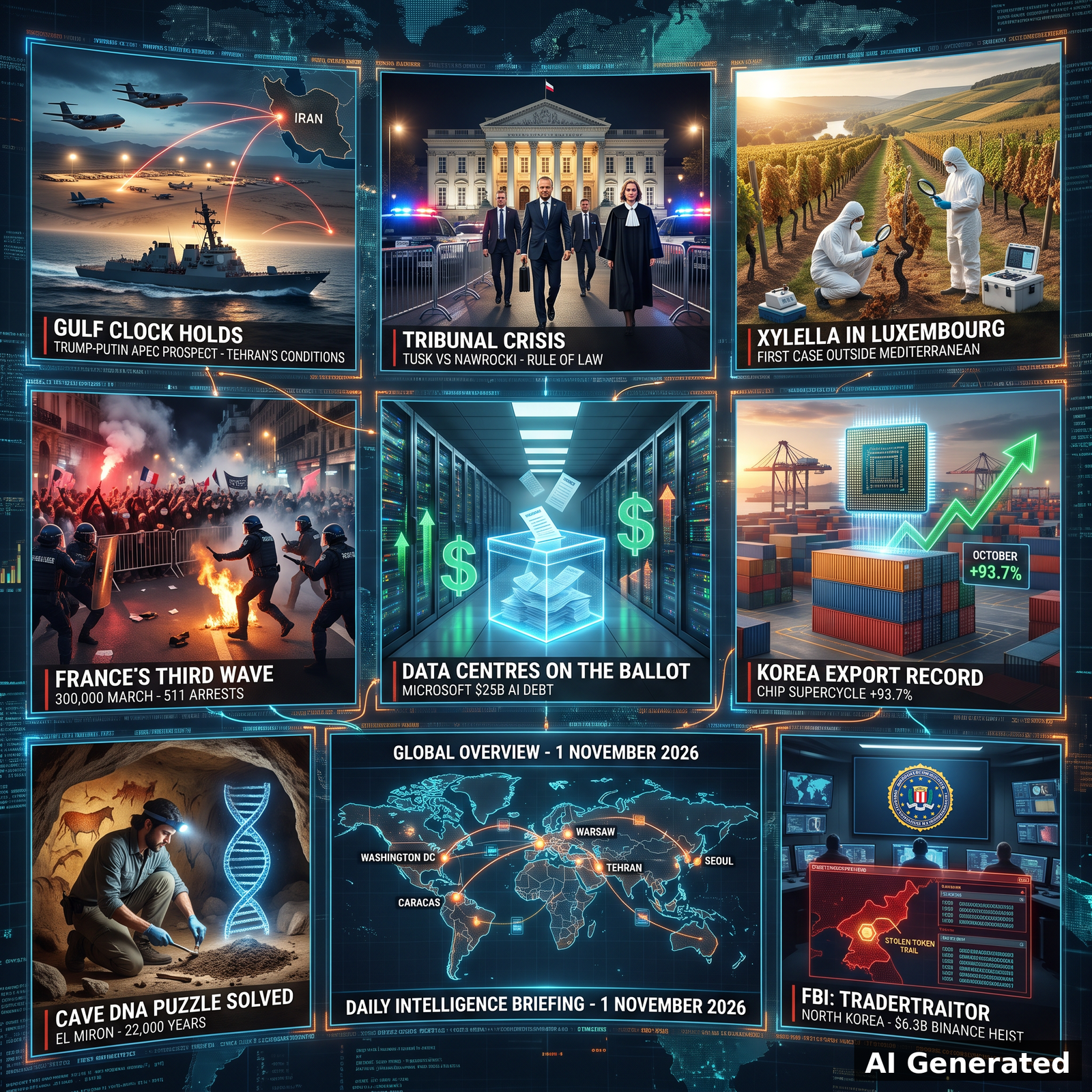
The D154 window opens with the Iran file suspended between public arithmetic and stated restraint, deepening rather than resolving the D150–D153 strike-clock suspense. Rubio told reporters at the Atlanta G20 that Washington and Moscow are discussing a possible Trump–Putin conversation on the margins of the APEC summit in China on 18–19 November — the first calendar anchor for presidential contact since the war escalated — while the Iranian foreign ministry insisted it sees no need for meetings with the United States [1] [2]. Khamenei-linked media threatened retaliation “without geographic restrictions,” Iran reported a wounded fisherman after an American strike on boats, and Egypt warned of massive consequences from any further escalation [2]. The most consequential framing came from Trump himself: nuclear capabilities are, in his telling, already “neutralised,” with only “one or two sites” left to “settle,” executable “within 10 minutes” — language that converts the remaining strike decision from strategy into logistics while keeping it explicitly pending [3].
Secretary of State Rubio’s clarification the same day was calibrated: no decision on further strikes, the US remains the world’s most capable military power, but the preference is diplomatic [4]. Tehran’s security chief Mohsen Rezaei supplied the mirror-image conditionality: the Strait of Hormuz stays closed until Iranian conditions are met, the war must end permanently with no nation daring to attack Iran again, and no new decision has been made on the nuclear doctrine, though whether it should apply in any future war remains under debate [5] [6] [7]. The practical cost of the standoff was visible in Saudi airspace: Riyadh’s King Khalid International Airport saw 94% of flights cancelled after renewed Houthi missile attacks, a logistics rupture with direct consequences for the region’s aviation economy and the D151–D153 Houthi-Saudi arc [8]. The Handelsblatt war blog added the human ledger the strike clock usually obscures: a UN staffer kidnapped by the Houthis has been confirmed dead, even as Tehran insists on its preconditions and threatens new weapons [9].
Ukraine’s Negotiating Track and the Corridor War’s New Layer
On Ukraine, Washington’s signals point toward process rather than settlement. Rubio told the G20 that a negotiated solution is not visible, and that the United States does not believe the war can be ended through negotiations as currently framed — the stalemate the APEC prospect is now tasked to break [10]. The humanitarian pilot, meanwhile, delivered its largest confirmed number yet: at least 700 residents of frontline Oleshky have been evacuated under the Melania-Trump-mediated truce, moved by bus and plane through Russia and Belarus into Ukrainian-controlled territory, with Zelensky publicly thanking the US delegation and First Lady — the strongest operational proof that the step-by-step de-escalation D149–D153 tracked through this town can produce movement even as the strategic file remains frozen [11].
The corridor war added a defensive innovation on the Russian side: oil tankers are now deploying makeshift drone defences — improvised countermeasures layered onto civilian hulls in response to Ukrainian attacks — an ad-hoc militarisation of the commercial fleet that extends the D143–D153 Black Sea ledger into the logistics layer [12]. Ankara positioned itself at the centre of the mediation geometry: Erdogan, after hosting Zelensky at Dolmabahce, declared Turkey ready to contribute to the peace process and to discuss the matter with Moscow, while condemning attacks on civilian ships in the Black Sea regardless of perpetrator — the familiar Turkish two-track [13].
Warsaw and Sofia: The Rule-of-Law Front and Bulgaria’s Binary Choice
Poland’s constitutional crisis entered its second act with the executive branches openly at war over the country’s highest court. In a televised address, Prime Minister Tusk declared that in a rule-of-law state, might and arrogance do not decide who is right, and that a judge must not retreat before an “aggressive thug” — an unmistakable reference to Nawrocki’s forced entry into the sealed Tribunal a night earlier, captured on video as he pushed past a female judge [14]. The political follow-up produced no breakthrough: Nawrocki convened party representatives, the governing camp declined to attend, and the EU Commission formally called on him to validate the new judges under the relevant jurisprudence — Brussels finally choosing instruments over silence, the option D153 flagged as decisive [15]. The dispute thus remains unresolved, the EU’s authority injected into a fight already settled once by police force [14] [15].
Bulgaria’s presidential run-off on Sunday condenses the wider European security choice: incumbent Iliana Yotova, aligned with the Russophile camp that won last year’s parliamentary election, faces pro-Western challenger Andrei Gyurov after a first round that Yotova led by only three points, with turnout historically low at 23% [16]. The contest arrives with the Black Sea war economy pressing directly on Bulgarian interests — the attacks on civilian shipping documented here are no abstraction for a state whose insurers price the same risk ledger as Greece and Romania [17] [12].
The Periphery’s Geometry: Caracas, Brasilia, Tel Aviv, Damascus and the Naval Ledger
South America produced the window’s clearest new escalation: Venezuela’s armed forces bombed a camp of the Colombian ELN guerrillas in Apure state near the porous 2,219-kilometre border, killing at least twenty people in what Fundaredes calls the first Venezuelan bombardment of the ELN since the FARC disarmament — an attack that deepens the regionalisation of the Andean counter-insurgency file D144–D152 tracked from the Colombian side [18]. In Brasilia’s aftermath, Trump confirmed that Flavio Bolsonaro may remain in the United States “as long as he wants,” while reiterating he has no meeting planned with the defeated senator — a status decision that converts Florida into the operational rear base of Brazil’s election-annulment movement — a status Rubio insisted involved no direct US role in his departure [19]. In Israel, thousands rallied in support of an Eisenkot-led government backed by Arab-list parties capable of removing Netanyahu, in counterpoint to pro-Netanyahu demonstrations — the coalition arithmetic of D149–D152 now moving from the Knesset to the streets [20]. Damascus, meanwhile, is formally weighing membership in the Mecca Pact — the mutual-defence compact of Saudi Arabia, Turkey and Pakistan — a move that would fold Syria into the anti-Houthi architecture just as Riyadh absorbs missile and drone attacks attributed to Iran’s proxies [21].
The defence-industrial ledger completes the section with procurement and posture moves that speak louder than rhetoric. Greek strategic journalism published detailed strike plans against Turkey’s Dalaman air base — the hub covering the Dodecanese — signalling Athens’ planning has moved past the D153 Aegean violations to target packages for the RM-70 and PULSE systems [22]. The S-400-vs-F-22/F-35 literature gained a sober appraisal: long-wave Russian AESA can probably detect fifth-generation fighters, but lock-on is the problem, and the system’s value is suppression cost rather than guaranteed kill [23]. Brazil commissioned the patrol vessel Mangaratiba for the Equatorial Margin and Amazon estuary, Britain confirmed delivery of the Dreadnought reactor-core upgrades critical to SSN-AUKUS, and Romania selected four deployable Thales radars to harden NATO’s Eastern-flank air picture — three answers to the same question of defending exposed coastlines [24] [25] [26]. Even Thailand’s Move Forward post-mortem belongs to the ledger: former leader Pita accuses his own camp of having become too technocratic — a critique that travels well beyond Bangkok [27].
Environment & Climate ↑ Contents
Biodiversity’s Global Checkpoint and the Nature Files
The biodiversity ledger opened with the formal confirmation D153 had anticipated: countries at COP17 in Yerevan agreed a package to speed up action under the 2022 Kunming-Montreal framework, with financing still the binding constraint — the money gap that defined the closing texts a day earlier [28]. The announcement landed against a sharper geographic counterpoint: India’s largest planned dam, conceived as an answer to China’s upstream hydropower on the Brahmaputra, faces open revolt from the Indigenous communities of Arunachal Pradesh whose lands it would flood — a clean illustration of the pattern in which climate-and-security megaprojects collide with the populations they are meant to protect [29].
The human-facing files of the living ledger are comparatively hopeful. Citizen-science bat surveys after dark are producing data that could reshape conservation priorities, and their volunteers, in the process, their own relationship to an under-appreciated mammal [30]. A rare short-necked oil beetle, feared extinct in Wales, reappeared after sixty years [31]. Tidepooling volunteers on India’s east coast are feeding marine-conservation planning with observations no institution can fund at scale [32]. The scale of what is moving overhead is meanwhile being quantified as never before: BirdCast radar counted 1.25 billion birds in flight over the United States on a single October night, a record haul doubling as the strongest argument yet for the bird-safe lighting rules cities are only beginning to adopt [33]. Kenya’s annual forest statistics added the accounting nuance to the same ledger: forest cover expanded, yet the country lost an estimated KSh48 billion ($369 million) in forest wealth as deforestation depleted mature, high-biomass ecosystems — a reminder that hectares are not health [34].
The Contested Living Layer: Pathogens, Invaders and Corridors
The biosecurity front produced a European first: the fire bacterium Xylella fastidiosa — the quarantine pest that has devastated olive groves in Apulia since 2013 — was detected for the first time outside the Mediterranean core, in Luxembourg vineyards on the Moselle and Sauer, forcing vine removals and pushing buffer zones into Germany’s Rheinland-Pfalz, where the industry admits it has no experience with the pathogen [35]. The invasive cascade continues on multiple fronts: Italy has now recorded the Chinese freshwater jellyfish Craspedacusta sowerbii at 61 sites from Lake Garda to the Swiss border, its polyp stage far outrunning detection and its range projected to widen with warming water [36]; and Minnesota — where released pet goldfish can grow to six pounds and churn sediment into algae-feeding phosphorus — has resorted to a rotenone permit for a Woodbury pond, a chemical the state’s own guidance calls “not preferred or recommended” [37]. Even well-intentioned nature infrastructure now comes with an attribution problem: Colorado’s acclaimed 200-foot I-25 wildlife overpass is credited with a 91% drop in wildlife-vehicle crashes, but the state’s own study shows the fences and underpasses hit that figure in 2024, before the bridge finished — a cautionary note on how conservation wins get marketed [38].
Energy’s Winter Arithmetic: Storage, Renewables and the Grid’s Tests
Europe’s energy-security ledger turned colder with the heating season. Germany’s gas storage entered November at roughly 61.4% against a legally required average of about 70%, with the industry’s own association calling the shortfall a “serious warning signal,” even as the regulator insists supply is secure because LNG capacity has reduced the storage dependence of previous winters — a dispute over what the buffer is for, just as the Iran war makes spot prices hostage to Hormuz closures [39]. The supply side is meanwhile renewing its oldest assets: Kenya’s KenGen completed a Sh15.6 billion rehabilitation of the 45-year-old Olkaria I geothermal plant, lifting capacity from 45MW to 60.5MW as it returns to the grid [40]. Morocco’s flagship Noor concentrating-solar complex, by contrast, shows the failure mode: a World Bank completion report found a cracked molten-salt tank at the 820-foot Noor III tower caused two multi-year outages and output 35% below plan, a $108 million impairment and a standing test of whether dispatchable solar can deliver on its contract [41].
The transition’s demand side advanced on two tracks that are converging on a safety question. Europe’s September sales data set a record: 422,000 fully electric passenger cars registered, a 31% BEV share and a 63% year-on-year jump that caught several OEMs under-supplied [42]. But the same electrified fleet is producing a new risk category in freight: the Tesla Semi fire on Interstate 880 in Hayward, with no collision, exposed how little experience exists in fighting large EV truck fires, and why Class 8 electrification may outpace firefighting doctrine [43]. Port infrastructure is answering with electrification of its own: Antwerp now runs all-electric mobile harbour cranes rated for 400-tonne paired lifts, a demonstration that heavy cargo handling can shed diesel without shedding capacity [44]. And on the cryosphere adaptation frontier, a Swiss student experiment found sheep’s-wool blankets on Glacier 3000 protected ice roughly as well as synthetic geotextiles — with obvious implications for the microplastic shedding of synthetics — even though no glacier can be saved at scale this way [45].
Environmental Governance and the Public Record
The governance layer of the environment file turned on the state’s own memory. The EPA has announced it will decommission its online web archive at year’s end — tens of thousands of documents spanning 20 years of policy and enforcement history — moments such as the Clear Skies Initiative and the Clean Power Plan the agency itself has scrubbed — would cease to exist online [46]. The extractive accountability front moved through the Inter-American Commission on Human Rights, where environmental defenders from six Latin American countries testified to attacks linked to Canadian mining operations — a hearing that lands months after Ottawa abolished the Corporate Responsibility Ombudsperson — the sector’s only soft check [47].
The water files close the section with three readings of the same scarcity. Six of seven Colorado River Basin states hold gubernatorial elections while the river’s operating rules remain unsettled, and the candidates are wading into water politics that incumbents have mostly preferred to offshore [48]. Indianapolis is tearing out the 127-year-old Emrichsville Dam on the White River — built for a boating lake, implicated in multiple drownings, and a century-plus barrier to fish migration — an unusually concrete reversal of the dam-building ledger [49]. And a year after Typhoon Halong swept through Kwigillingok, the Yup’ik village on the Bering Sea remains in limbo between rebuilding and relocation, its residents stranded far from home — the human cost of the managed-retreat question every coastal state faces [50].
Society & Civil Issues ↑ Contents
The European Street: France’s Third Wave, Germany’s Krawallnacht
The street calendar that D153’s Correlations section flagged for empirical testing produced its verdict on Halloween night: the marches were big but shrinking, and the violence followed the marches, not the other way round. More than 300,000 people demonstrated across France — official counts down from the 410,000 of 24 October and the estimated 500,000 claimed by youth organisers — with 70,000 police deployed and 511 arrests while a Molotov attack left one officer’s leg engulfed in flames — an episode Nunez called attempted assassination [51]. In Germany, shops were looted in Frankfurt’s Zeil after a Gen Z rally, with a water cannon and confiscated firearms; Cologne, Hamburg and Berlin reported barricades, fires and 27 injured police officers across 34 demonstration cities — the gap between professed non-violence and the infiltration warnings D153 projected would be tested [52].
The political reaction consolidated around consequences rather than causes. Hesse’s minister-president located the rioters “outside our society,” CDU politicians promised legal follow-through, and Stuttgart announced “regulatory consequences” after masked participants breached the ban on covering faces and lit fireworks — with roughly 50 offences logged and five officers injured in Stuttgart alone [53] [54]. The transnational character of the moment was sealed in Tirana, where Albanian students held their 19th consecutive day of protest against Prime Minister Edi Rama, refusing both dialogue and opposition-party absorption, and where police answered Molotov cocktails with water cannon and tear gas — the European street, in other words, has become a single weather system from Paris to the Balkans [55].
America’s Final Days: Midterm Integrity and the Cost Ledger
With four days to the American midterms, the integrity file moved from litigation to logistics. More than 52 million Americans had already voted by Saturday, and Trump traded planned Iowa and Kansas rallies for telephone events — schedule adjustments widely read as spring-loading for the post-midterm window [56]. Alaska’s Republican-led state government asked a federal judge to dismiss the administration’s “impossible” demand to set aside Senate ballots, sharpening the D153 confrontation between federal pressure and state election administration [57]. In Texas, Democrat James Talarico drew a packed campus rally at Texas A&M, betting the cycle’s youth surge against an administration that has made voter-integrity litigation its closing argument [58]. The money side of the same struggle is getting visible: Elon Musk’s $445 million of donations to Republican-aligned groups since last year are being read, including by Republicans, as attack ads that are backfiring with the swing voters they were meant to move [59]. Beneath the tactical layer sits the structural one the D153 report named “the democratic test under escalation”: Sistafabu Modupe, 77, still works a day job because her Social Security alone cannot cover her bills — the human ledger of the affordability crisis the midterms will adjudicate [60].
Britain’s Civic Files: The EU Question and the State’s Reach
Britain’s European question acquired a new voice: Rachel Reeves, in her first major intervention since leaving the Treasury, argues openly that the UK’s future lies inside the European Union and that Brexit has made the country “poorer, weaker and less secure” — the most senior Labour figure yet to break with the settlement, and one whose words carry the fiscal authority of the chancellorship she held [61]. The government’s own labour policy shows why the question will not go away: Chancellor John Healey hinted that the manifesto pledge to close the gap between the adult minimum wage and pay for 18–20-year-olds may not be certain before the next election, a fiscal-triangulation tell in the same mould D153 logged on side-hustle taxation [62]. The state’s operational reach produced a smaller but telling file: a second night of drone disruption at Jersey Airport, forcing inbound flights to be held — the airport-drone threat tracked since the autumn now hitting a civilian hub [63].
Justice, Health and the Human Cost
The justice file delivered one notable reversal and one grim data point. A federal judge dismissed Trump’s defamation suit against the Wall Street Journal over the 2003 Epstein letter, ruling the journalists acted in good faith in the public interest — a First Amendment rebuke days before the midterms [64]. In California, a 31-year-old pregnant woman was shot and killed inside a Spirit Halloween store on the eve of the holiday, the latest turn of the gun-violence file this report has tracked since mid-September [65]. The Bronx produced a civic wound of a different kind: thousands gathered for vigils for Javits Frimpong, a 15-year-old Ghanaian schoolboy chased down and killed in an attack his classmates tie to bullying — a reminder that the violence ledger runs from mass events to single victims [66]. The enforcement layer answered with its own controversy: an ICE officer indicted by a Houston grand jury for intentionally striking a man is expected to surrender Monday, and the administration chose Halloween to circulate mocked-up arrest videos of migrants — two stories that bracket how the immigration debate is now performed [67] [68].
The health-ledger stories of the window are about capacity at the margins. Germany’s blood banks are reporting shortages severe enough to force clinical restrictions, with the Red Cross warning that reserves are at a critical low entering winter [69]. And in Saarbrücken, volunteer Johanniter medics run a night “Pflasterlaster” treating homeless patients whose wounds went unattended because shame, lack of insurance or fear kept them out of the system — the informal net catching what the formal one misses [70].
AI & Technology ↑ Contents
The AI-Capital Perimeter: Data Centres as the Midterm Issue
The AI economy’s physical footprint has become a political variable in its own right, and the midterms are now where that variable is being priced. At a Brooklyn election party five days before election day, every conversation — from a council member’s fireside chat to a debate about the Democratic Party’s future — circled back to AI and data centres, an anecdotal tell that the D151–D153 “AI-capital test” has migrated from the earnings call into the ward meeting [71]. The structural reason is quantifiable: the firms feeding the AI build-out that most voters have never heard of are carrying tens of billions of pounds in data-centre debt, and the BBC’s investigation into that shadow balance sheet lands as the same anxiety — that the compute build-out is debt-financed faster than its earnings can grow — that D152’s BOJ warning and D153’s Nasdaq one-day crash priced into public markets [72]. The legal perimeter is hardening on the same seam: a federal judge allowed the NAACP’s Clean Air Act lawsuit over xAI’s data-centre pollution in Memphis to proceed, turning the environmental-justice challenge that Texas and Alabama regulators have been dodging into a court battle that discovery will now expose [73]. The three stories are one story: the AI build-out is being asked, for the first time, to answer for its land, its debt and its emissions in the same election cycle [71] [72] [73].
The Model Frontier’s Restraint, and Science’s New Co-Pilot
The vendor response to the AI-capital reckoning is a studied posture of restraint. Apple’s new chief executive used an earnings-adjacent interview to declare that the company does not “want to ship AI for AI’s sake,” a positioning line that reads as a direct counter to the feature-inflation the market punished in the same week — and that echoes the D153 finding, from the Anthropic backdoor to the OpenAI funding cut, that differentiation is now being sought in discipline rather than scale [74]. Where the technology is actually advancing, science is the quietest and most consequential beneficiary: Nvidia’s AI agents now steer the Allen Telescope Array’s observations in the search for extraterrestrial signals, automating real-time data triage across the 42-antenna radio field — a concrete instance of AI as scientific infrastructure rather than consumer feature, and an indicator of how the same automation will reshape observatories, labs and field science in the coming cycle [75]. Together with the chemistry department building enzyme-design tools and the planetary-AI landing-site work in the science section, the pattern is unmistakable: the frontier’s most durable applications in this window are not chatbots but instruments [75].
Economy & Business ↑ Contents
The Wage and Rate Front: IG Metall’s Midnight and the Fed’s Pause
Germany’s wage front moved from warning to action at one minute past midnight: IG Metall launched its warning strikes in the metal-and-electrical industry with “midnight actions,” pressing a 5% claim for roughly 900,000 workers in Baden-Württemberg against an employer offer worth about 1.3%, with Siemens, Porsche, Mercedes-Benz and ZF named as venues [76]. The strikes confirm the D153 escalation — when the union declared walkouts “possible from Sunday” — and they land inside the employers’ core counter-argument, that Europe’s largest structural industrial crisis since the war caps what the sector can pay; the outcome is a live referendum on whether the cost-push inflation D139–D152 tracked has now moved into wages [76]. Across the Atlantic, the Federal Reserve’s widely expected hold drew its first serious second-guessing: with inflation persisting, Greek business coverage asks whether keeping rates unchanged was a mistake, a question the central-bank week ahead will now answer under the same energy-led price pressure [77].
Asia’s Export and Currency Arithmetic
Asia’s trade data delivered the window’s most dramatic single number: South Korea’s October exports surged 93.7% year-on-year, the fastest growth since 1974, driven by the memory-chip supercycle that the AI build-out has created — a print that simultaneously validates the capex boom and deepens the concentration risk the AI-capital section documents [78]. The currency geometry around it is being redrawn deliberately: a Council on Foreign Relations analysis argues Beijing does not actually want the yuan to dethrone the dollar — the obligations of reserve status would threaten party control over capital — but does want a “Pepsi to the dollar’s Coca-Cola”: a second currency serviceable in a pinch, capable of bypassing US sanctions, and potentially anchored by a “green yuan” priced in the clean-energy supply chains China dominates [79]. The war in Iran is feeding the same calculation from the commodity side, with Deutsche Bank already flagging yuan-priced Hormuz passages as a petrodollar-erosion catalyst [79]. Beijing’s investment push meanwhile stays fiscally visible: the Dalian mega-complex showcases the state’s ability to mint demand even as property-led growth disappoints — the same dual-reading D153’s sub-50 PMIs captured [80]. India moved the opposite way: New Delhi raised export duties on diesel and aviation fuel while scrapping the petrol levy, taxing the energy windfall rather than subsidising through it [81].
The Corporate Capex Ledger: Microsoft, JPMorgan and the Chip Squeeze
The corporate capital-spending layer of the AI build-out is acquiring debt-financing landmarks. Microsoft plans to raise $25 billion through debt issuance to fund its AI expansion — the clearest signal yet of how the hyperscaler balance-sheet model depends on the credit markets the D153 Barclays AI-CDS map began to price [82]. JPMorgan’s new Manhattan headquarters, costed at $6 billion, embeds the same logic in real estate: the bank trades rented space for owned technology infrastructure, betting the AI-era return on its own campus rather than the lease market [83]. The memory market has meanwhile inverted the industry’s power structure: makers that Apple spent years pressuring for discounts are now extracting them in reverse, as AI infrastructure demand absorbs the entire flash supply — the revenge of the suppliers, and a live illustration of why the semiconductor bottleneck keeps re-pricing the whole complex [84].
Consumers, Trade Policy and the Fiscal Files
The consumer and trade-policy layer shows the squeeze from both ends. The EU’s new two-euro processing fee on parcels from third countries — applied to the 5.9 billion packages that entered the bloc last year, 93% of them from China — is a customs-revenue fix dressed as trade policy, and a deliberate friction on the cheap-online-retail model that the bloc has been circling since the July mini-parcel tariffs [85]. The G20 added a rhetorical layer: Washington used the Atlanta chair to declare that food must not be used as a tool of economic or political coercion — a line aimed at the grain weaponisation the war economy has normalised [86]. In the United States, the administration’s fuel-price promises are running on empty: petrol, diesel and jet fuel have risen rather than fallen through the Iran war, the exact inversion of the promised midterm relief [87]. The housing market is pricing the same squeeze: pending home sales have sunk to their lowest since Redfin’s records began, with ten demand signals across five metros now negative [88]. Britain’s fiscal response stays micro-targeted: the trading allowance triples to £3,000 from April 2027 with the reporting threshold to match, a side-hustle tax break Burnham is marketing as “your side hustle should be exactly that – yours” [89], while the British Business Bank doubles its women-led commitments to £200 million — both calibrations of a government that has made entrepreneurship policy its affordability answer [90]. The darker version of the same chapter is running in Istanbul, where the stock-exchange CEO was arrested in an investment-fund scandal that has already ensnared the former capital-markets regulator — a reminder that when retail investors are squeezed, the first frauds surface at the gatekeeper layer [91].
Science & Space ↑ Contents
The Deep Archive: DNA from Dirt, Teeth and a Re-Dated Coffin
The window’s most methodologically striking result came from a few grains of cave sediment: researchers at the University of Vienna recovered nuclear DNA of several humans from the floor of Spain’s El Mirón Cave, dating to roughly 22,000 years ago, with no bone, tooth or fossil present — sedimentary DNA that had to be sequenced a hundred times to yield signal, settling a long-open question about European ancestry during the Last Glacial Maximum [92]. The same insistence on squeezing data from reluctant substrates powered a first in paleontology: UCLA’s clumped-isotope work on two T. rex teeth fixed the predator’s body temperature at 97.3°F — essentially mammalian, warm enough to have survived Alaskan winters where crocodiles could not — the first direct temperature reading ever taken from dinosaur enamel [93]. Even a museum basement archive got rewritten: the Roman sarcophagus at Westminster Abbey, carved in the fourth century for a Londoner named Valerius Amandinus, turned out to hold a late Saxon abbot who died between 987 and 1052, narrowed by the Abbey’s archaeologist to two candidates — a seven-century gap inside a single stone box, and a small masterclass in how archaeological assumptions fail when bones and inscription disagree [94].
The Cosmic Ledger: An Interrupted Ice Age, Stranger Twins and Broken Limits
The cosmic ledger opened with a finding that reframes the climate present: the next ice age may have actually begun about 2,000 years ago — the Laurentide Ice Sheet’s last remnant, the Barnes Ice Cap, had started expanding — only to be terminated by anthropogenic warming beginning in the 1960s, so that baseline climate, on millennial timescales, is an anomaly engineered by emissions [95]. The solar system’s own history is being redrawn with equal confidence and caution. Uranus and Neptune, long treated as twins, may have formed from different material reservoirs — Neptune from debris that originated much closer to the young Sun — a provenance split challenging the canonical model of ice-giant formation [96]. Ultra-dense stars are pushing the same boundaries: simulations now suggest powerful internal magnetic fields could allow some white dwarfs to grow far beyond the Chandrasekhar limit long treated as absolute in astrophysics, with consequences for how type Ia supernovae are used as cosmic distance rulers [97]. Ceres re-entered the conversation as the belt’s most under-appreciated object, its bright salt deposits masked by water ice and implying a layered, cryovolcanically active interior [98], while an oddball ultra-short-period “lava world” with a reflective surface is challenging models of how such planets hold their atmospheres [99]. The observational ledger closed with a lava lake that will not die: Mount Michael in the South Sandwich Islands, continuously erupting since 2014, was imaged by Landsat 8 as a 360-foot pool of molten rock glowing through the Antarctic winter cloud gap — one of only a handful of persistent lava lakes on Earth, and a demonstration of what orbital monitoring can catch when the sky finally clears [100].
The Biomedical and Materials Frontier
The human-body ledger produced two results with direct translation potential. A two-day, 16-hour group therapy program built on “cognitive evolutionary therapy” — reframing post-breakup distress as a response to ancestral belonging needs — produced a large one-week improvement in depressive symptoms in a randomised trial, a brevity result that would be practically important if replicated, even as the three-month follow-up faded [101]. And in a controlled first, untrained dogs with no prior exposure to epilepsy preferentially approached sweat samples taken from a stranger during a seizure — at 40% above chance — suggesting the seizure signature is chemically detectable and spontaneously salient to canine olfaction, a finding with screening implications [102]. The nutrition file added a waste-into-asset twist: King’s College London researchers found that skins, peels, seeds and stalks of 12 common fruits and vegetables contain markedly more fibre per gram than the flesh — pineapple skin running 453% above the fruit — framing “root-to-tip” eating as a dietary lever on the UK’s 16.4-gram average fibre intake [103]. Psychology contributed a paradox with product-design consequences: people rate AI-generated empathy as higher quality than human empathy, yet still prefer the human version — a preference gap that the companion-AI industry is only beginning to price [104].
The physics and chemistry files were equally dense. Helsinki researchers built an invisible pipe of ultrasonic waves that guides liquids horizontally through open air with no physical walls — laboratory magic with eventual uses in material handling and contactless chemistry [105]. A self-assembled photonic-crystal scintillator raised X-ray imaging light output 4.6-fold without losing sharpness, a detector-level gain that could cut medical radiation doses [106]. A giant algal virus yielded a tandem potassium-channel gene, buttressing the argument that viruses have been major contributors to complex-protein evolution rather than bystanders to it [107]. And the AI-tooling theme recurred across disciplines: chemists published an AI tool that converts researcher hypotheses into life-enhancing enzyme designs, complementing the planetary-AI landing-site work that is optimising lunar outpost siting for NASA’s 2028 return — two ends of the same spectrum in which machine learning is becoming the scientist’s instrument rather than the scientist’s replacement [108] [109].
Crypto, Digital Assets & Blockchain ↑ Contents
The Record Theft’s Forensic Ledger: Attribution, Laundering and the Reserve Account
The Binance breach moved from accounting to attribution in the D154 window, and the two tracks together complete the forensic arc D152–D153 started. The FBI formally blamed North Korea’s state-sponsored “TraderTraitor” group — the same operators behind the $1.5 billion Bybit heist — for the $6.3 billion theft, in the process making the largest cyber-robbery in history an item of statecraft rather than merely of exchange risk [110]. The exchange simultaneously announced that 90% of losses are covered — with the remaining, less liquid 10% to be replaced over time and co-CEO Richard Teng explicitly committing that “users will not bear the financial impact” — a promise whose credibility now rests on the proof-of-reserves snapshot due by 2 November and on the in-kind reserve composition D153 flagged as a bet on the very assets stolen [111]. The FBI also asked the DeFi community and exchanges to block transactions from more than 600 flagged addresses across BTC, ETH and SOL, effectively deputising the settlement layer as a sanctions-enforcement arm — the clearest demonstration yet that the industry’s post-hack resilience runs through issuer blacklists and coalition coordination rather than through any protocol-native mechanism [112].
The laundering mechanics are what make the episode structurally dangerous. Blockchain forensics found XRP was hit first — roughly $296 million drained from five wallets in about four minutes, with Ripple freezing stolen RLUSD during the response — suggesting an automated attack pipeline rather than manual theft [113]. Within days the attackers moved $38 million through the Relay cross-chain protocol in seven hours, exploiting the interoperability layer whose fragmented liquidity makes tracing and freezing hardest; Chainalysis had already documented “never-before-seen” laundering patterns in the D153 window, and each bridge transaction extends the D142-D151 arc: the freezable share of crypto shrinks with every hop into DeFi’s cross-chain corridors [114]. The strategic read is unchanged from D153: the exchange model survived its own largest failure, but the survival mechanism — centralised issuers, governance councils and now states acting as fire departments — is exactly the layer the self-custody thesis treats as the problem, and no amount of in-kind reserving changes that balance-sheet exposure to the tokens that just sold off [111] [112].
Institutional Rails: Stablecoin Supply, Custody and Compliance Automation
On the institutional side, the rails are being stress-tested and extended in parallel. The stablecoin ledger is visibly contracting: Circle redeemed roughly $11.7 billion of USDC as supply slipped to about $70 billion, a retreat that cuts both issuer interest income and the liquidity cushion the Binance response relied upon [115]. US spot Ethereum ETFs logged a record 23-day net outflow streak, extending the D150-D153 retail-exodus pattern while on-chain staking activity rises — a divergence that suggests institutional conviction is thinning precisely as protocol usage firms [116]. The custody-and-compliance infrastructure responded with two notable integrations: Chainlink launched CustodySync with Anchorage Digital to synchronise qualified-custody positions with decentralised lending protocols — letting institutions borrow against assets without surrendering custody, and converting collateral-agency practice into a DeFi interface — while Further Asset Management integrated Chainlink’s Automated Compliance Engine into its Anubis platform for tokenised-asset operations inside Abu Dhabi Global Market [117] [118]. Both moves encode jurisdiction-specific rules into machine-readable workflows, which is precisely the “intermediaries as gatekeepers” turn D147&Dndash;D151 predicted tokenisation would require — the legal layer proving harder and slower than the ledger layer [117] [118].
The regional and usage data complete the picture. Chainalysis put the Middle East and North Africa crypto economy at $443 billion received for July 2025–June 2026, with the UAE growing 32% to about $105 billion even as the regional average dipped — evidence that licensing regimes concentrate activity rather than create it [119]. And a16z data shows AI-token spending jumping 122–160% over a period in which token prices fell 67% — a disconnection between usage economics and market pricing that reads as the crypto mirror of the AI-capex reckoning in the equity markets: adoption is real, the monetisation lag is real, and the price layer is pricing neither cleanly [120]. Together the D154 crypto files argue that the industry’s next phase — state attribution, machine-readable compliance, custody-linked DeFi — is being built exactly where D153’s Correlations section said it would be: not on the ledger’s promises, but on the institutional interfaces around it [112] [117].
Correlations & Analysis ↑ Contents
The D154 window is defined by the test D153 set: the Saturday street calendar D153 flagged as “the gap between professed non-violence and the security services’ infiltration warnings” was run empirically on Halloween night, and the verdict is consequential. More than 300,000 marched in France and roughly 120,000 in Germany’s “Gen Z regelt” cities, and in both the violence followed the protests rather than consuming them [51] [52]. The D148–D153 pattern of “democratic institutions resolving legitimacy questions under conflict pressure” has therefore crossed a threshold: from France’s casseurs-payeurs bills to the German CDU’s promised consequences to the Stuttgart regulatory orders, the state’s coercive instruments are being re-legitimated against a protest layer that is simultaneously shrinking and hardening. The street is not disappearing; it is professionalising at the margins, and that is the condition under which European governments now calibrate police budgets and coalition arithmetic alike [54].
The second thread D153 identified — the collapse between announcement and event completing its circuit in the Gulf — reached its most explicit formulation yet. Trump’s “one or two sites, ten minutes” is the rhetorical finish of the strike clock; Rubio’s “no decision made” is its institutional brake; Rezaei’s “Hormuz stays closed until conditions are met” is its strategic anchor; and the Riyadh airport’s 94% cancellation rate is its economic meter [3] [4] [5] [8]. The strike clock D150 tied to the midterm calendar is now visibly synchronised with it: >52 million early votes cast, Trump pulling in-person rallies for telephone events, and the entire Gulf decision set parked behind the 3 November result [56]. The conjunction D153 warned about — revenge-attack risk, an electoral calendar, and a strike option expressed in minutes — is still intact, and the second week of November remains the open question of the D138-D153 arc. The new element is that diplomacy now has a datable channel: the possible Trump–Putin contact at APEC on 18-19 November converts the post-midterm window into a two-track question — one measured in minutes, one in summit schedules [1].
The third thread — financialisation as the language of both war and peace — deepened on both sides of the ledger. The Binance recovery matured from accounting to statecraft: FBI attribution, 600+ flagged addresses, $38 million laundered through a cross-chain bridge, and an exchange promising users no loss minutes after a record haul [110] [111] [114]. D152’s warning about concentrated leverage, and D153’s reading of the exchange layer as a “hardened settlement rail” defended by issuers and governance councils, have now been confirmed and extended: the rail held only because the state entered the fire department — while the industry’s revenue base contracts 30% even as its institutional rails multiply [117] [118]. The same paradox defines the AI complex: South Korea’s 93.7% export surge, Microsoft’s $25 billion debt raise, and the data-centre debt the BBC quantified are the balance-sheet side of the AI-capex bet, while the equity side remains stuck at the “AI-capital test” D151-D153 defined [78] [82] [72].
The rule-of-law front completes the triangle. Poland’s constitutional crisis is no longer a Warsaw story: Brussels has now formally called on Nawrocki to validate the new judges, Tusk has framed the Tribunal’s defence in terms of the rule of law against the “law of the jungle,” and the governing coalition is boycotting presidential consultations — the dispute D153 said would be decided by force is now being decided in the gap between a police operation and an EU statement [14] [15]. Bulgaria’s run-off adds a second, quieter test of the same proposition from the athenian periphery: a binary choice between the Russophile status quo and a pro-Western challenger, held while the Black Sea corridor war grinds on within sight of its coast [16] [12]. And in the Americas, the post-electoral integrity playbook D148-D151 tracked through Brazil has been exported wholesale: a defeated candidate in US refuge, a sitting president declaring he may stay “as long as he wants,” and the annulment question migrating from Rio to Mar-a-Lago — the same structure, a different hemisphere, four days before an American election [19] [57].
What to watch in the next reporting period: first, the midterm result and the immediate disposition of the Gulf strike option — whether “ten minutes” becomes operational, the APEC channel becomes real, or Hormuz’s conditions soften [3] [1] [5]. Second, Binance’s proof-of-reserves result due 2 November and the phased withdrawal restart, which will set the market’s verdict on whether the exchange model survives its own largest failure [111] [112]. Third, the Polish Tribunal’s next acts under the Commission’s explicit demand — the first live test of whether Brussels can enforce rule-of-law conditionality without precipitating the break it seeks to prevent [15]. Fourth, the European street’s next scheduled wave — student and teacher unions have already called for fresh actions in the week ahead, and France’s police-deployment arithmetic (70,000 officers for a 300,000-person march) is not sustainable [51]. Fifth, the AI-capital ledger’s November stress points — hyperscaler debt, memory-chip export prints, and whether the data-centre backlash running through midterm races translates into permitting consequences after 3 November [82] [78] [71].
References ↑ Contents
1. EN DIRECT, guerre en Ukraine : Donald Trump et Vladimir Poutine pourraient s’entretenir à la mi-novembre, selon le chef de la diplomatie américaine by France via d k on Inoreader · Source ↑
2. Liveblog Nahost: Trump bringt Angriffe auf weitere Ziele in Iran ins Spiel by Germany via d k on Inoreader · Source ↑
3. Ο Τραμπ θέλει να «τακτοποιήσει ένα δύο πράγματα» ακόμα στο Ιράν by Γιάννης Συμεωνίδης · Source ↑
4. Μάρκο Ρούμπιο: «Ο Ντόναλντ Τραμπ δεν έχει αποφασίσει αν θα πλήξει το Ιράν» by DEFENCE via d k on Inoreader · Source ↑
5. FinancialJuice: Iran’s security chief Rezaei: Strait of Hormuz to stay closed until Tehran’s conditions fulfilled by FinancialJuice · Source ↑
6. FinancialJuice: Iran’s Rezaei: War must end permanently, no nation should dare attack Iran again by FinancialJuice · Source ↑
7. FinancialJuice: Iran security chief Rezaei: no new decision on changing nuclear doctrine, debate ongoing if same doctrine should continue in another war by FinancialJuice · Source ↑
8. Riyadh airport sees 94% flight cancellations after Houthi missile attacks by Estefano Gomez · Source ↑
9. +++ Iran-Krieg +++: Iran beharrt auf Bedingungen – und droht mit neuen Waffen by Redaktion Handelsblatt · Source ↑
10. Ρούμπιο για Ουκρανία: Δεν βλέπουμε λύση του πολέμου μέσω των διαπραγματεύσεων by Greece via d k on Inoreader · Source ↑
11. EN DIRECT, guerre en Ukraine : au moins 700 habitants d’Olechky, ville située sur la ligne de front, ont été évacués dans le nord de l’Ukraine après une opération d’aide humanitaire by France via d k on Inoreader · Source ↑
12. Russian oil tankers deploy makeshift drone defenses amid Ukraine attacks – WSJ by Investing.com · Source ↑
13. Ρ.Τ.Ερντογάν: «Έτοιμη η Άγκυρα να μεσολαβήσει για συμφωνία ειρήνης στην Ουκρανία» by DEFENCE via d k on Inoreader · Source ↑
14. Gerichtsstreit in Polen: Tusk: Im Rechtsstaat gilt nicht das Gesetz des Dschungels by Germany via d k on Inoreader · Source ↑
15. Crise politique en Pologne : Bruxelles appelle le président Karol Nawrocki à valider la nomination de nouveaux juges au Tribunal constitutionnel by France via d k on Inoreader · Source ↑
16. Στις κάλπες η Βουλγαρία για τον δεύτερο γύρο των προεδρικών εκλογών by Εβελίνα Δαβάκη · Source ↑
17. Αμφίρροπη εκλογική αναμέτρηση στη Βουλγαρία με φόντο την ένταση στη Μαύρη Θάλασσα και την Ουκρανία by Greece via d k on Inoreader · Source ↑
18. Βενεζουέλα: Τουλάχιστον 20 νεκροί από το βομβαρδισμό Κολομβιανών ανταρτών by Γιάννης Συμεωνίδης · Source ↑
19. Τραμπ για Φλάβιο Μπολσονάρου: Μπορεί να μείνει στις ΗΠΑ «όσο θέλει» μετά την εκλογική ήττα από τον Λούλα by Greece via d k on Inoreader · Source ↑
20. Thousands rally in Israel urging Eisenkot-Arab deal to remove Netanyahu by NEWS via d k on Inoreader · Source ↑
21. Συρία: Εξετάζει την ένταξή της στη Συμφωνία της Μέκκας με Τουρκία, Σαουδική Αραβία και Πακιστάν by DEFENCE via d k on Inoreader · Source ↑
22. Στη νέα ΣΤΡΑΤΗΓΙΚΗ: Αεροπορική Βάση Ντάλαμαν – Τα σχέδια καταστροφής της by DEFENCE via d k on Inoreader · Source ↑
23. Lockheed F-22 and F-35 Stealth Smasher: Russia’s S-400 Air Defense System Has 1 Mission by Isaac Seitz · Source ↑
24. La Marina de Brasil incorporó al patrullero Mangaratiba reforzando la vigilancia en el Margen Ecuatorial y la desembocadura del Amazonas by Angelo Daniel Nicolaci Mota · Source ↑
25. Reactor core plant upgrades for Dreadnought delivered by Craig Langford · Source ↑
26. Military airspace surveillance to get major boost, reveal aircraft’s accurate position with new radar by Prabhat Ranjan Mishra · Source ↑
27. Thai reformists became too technocratic, party ex-leader Pita says by Business via d k on Inoreader · Source ↑
28. Countries reach COP17 deal to speed up biodiversity action, but money still short by Reuters · Source ↑
29. India’s largest dam planned to counter China faces Indigenous revolt by NEWS via d k on Inoreader · Source ↑
30. Looking for bats after dark can help science—and change how we see them by Science & Space via d k on Inoreader · Source ↑
31. ‘Fascinating’ rare beetle found in Wales again after 60 years by Science & Space via d k on Inoreader · Source ↑
32. On India’s east coast, tidepooling inspires marine conservation by Business via d k on Inoreader · Source ↑
33. BirdCast tracked 1.25 billion birds over the US on the night of October 8, 2025, and most bird migration happens after dark, where city lights can pull flocks off course by Adrian Villellas · Source ↑
34. Kenya expanded its forest cover but lost KSh48 billion in forest wealth as deforestation depleted mature ecosystems by George Kamau · Source ↑
35. Pflanzenbakterium: Neues Feuerbakterium – „Winzer sind in großer Sorge“ by Germany via d k on Inoreader · Source ↑
36. Italy has recorded a nearly invisible freshwater jellyfish from China at 61 sites, and the bells swimmers spot each summer are only the visible part of a life spent mostly out of sight by ECONEWS · Source ↑
37. Minnesota keeps finding released pet goldfish that can grow to 6 pounds, and one suburb now has a permit for the fish toxicant the state itself does not recommend by Adrian Villellas · Source ↑
38. Colorado’s 200-foot wildlife bridge over I-25 is being credited with a 91% drop in crashes with animals, but the state’s own study shows fences and underpasses reached that figure in 2024, before the bridge was finished by Javier Niño · Source ↑
39. Gasversorgung: Vorgaben bei Gasspeichern verfehlt – was bedeutet das? by Germany via d k on Inoreader · Source ↑
40. KenGen completes Sh15.6bn overhaul of Kenya’s oldest geothermal plant as it prepares to return to the grid by George Kamau · Source ↑
41. Morocco built the Noor solar complex to keep the lights on after sunset, and the World Bank says a cracked molten salt tank at its 820-foot tower caused two long outages by ECONEWS · Source ↑
42. Record Demand Catches (Some) OEMs with Their Pants Down — Europe September 2026 by José Pontes · Source ↑
43. Can Silicon Valley Build A Safe Class 8 Truck? Early EV Semi Fires Expose The Experience Gap by Jennifer Sensiba · Source ↑
44. Antwerp’s Electric Cranes Can Handle More Than Today’s Cargo by Michael Barnard · Source ↑
45. Four students in Switzerland tested sheep’s wool blankets on a glacier for a whole summer, and the first readings put the wool roughly level with the synthetic sheets ski areas use to slow melting by Adrian Villellas · Source ↑
46. The EPA is quietly killing its web archive by Rachel Santarsiero, Mother Jones · Source ↑
47. Environmental defenders testify about attacks in Latin America linked to Canadian mining companies by Andy Lehren · Source ↑
48. Colorado River Basin Candidates Wade Into Water Politics, but Winners Are Unlikely to Make Big Changes by Wyatt Myskow, Jake Bolster · Source ↑
49. Indianapolis built the Emrichsville Dam on the White River in 1899 so Riverside Park could have a boating lake, and 127 years and several drownings later, crews are tearing it out so fish can move up and down the river again by Javier Niño · Source ↑
50. A Year After Floodwaters Swept Away an Alaskan Native Village, Residents Remain in Limbo by Olga Loginova · Source ↑
51. French police fire tear gas as more than 300,000 march across France in latest anti-government protests by Suha Kidwai and Nicole Wootton-Cane · Source ↑
52. Shops looted as German cost of living protests turn violent by NEWS via d k on Inoreader · Source ↑
53. Ausschreitungen in Deutschland: CDU-Politiker kündigen nach Krawallnacht Konsequenzen an by DIE ZEIT: Zeitgeschehen – Vera Sprothen · Source ↑
54. Demonstrationen: Stuttgart kündigt Konsequenzen nach Jugendprotesten an by Germany via d k on Inoreader · Source ↑
55. Αλβανία: Άγρια επεισόδια στα Τίρανα σε διαδήλωση κατά του Έντι Ράμα με μολότοφ και δακρυγόνα by DEFENCE via d k on Inoreader · Source ↑
56. EN DIRECT, midterms 2026 : plus de 52 millions d’Américains ont déjà voté par anticipation by France via d k on Inoreader · Source ↑
57. Alaska officials ask judge to deny Trump administration’s ‘impossible’ demand to set aside Senate ballots by Kyla Guilfoil · Source ↑
58. Talarico draws a packed campus rally, but can he win over young voters? by NEWS via d k on Inoreader · Source ↑
59. Elon Musk’s Attack Ads Are Backfiring As Midterms Near by Carolyn Fortuna · Source ↑
60. Affording America: Why one Texas grandmother can’t retire by NEWS via d k on Inoreader · Source ↑
61. Reeves says UK’s future should be inside the EU by NEWS via d k on Inoreader · Source ↑
62. Healey hints manifesto pledge on young worker pay not certain before election by Press Association Political Staff · Source ↑
63. Second night of drone disruption at Jersey Airport by NEWS via d k on Inoreader · Source ↑
64. La justice rejette la plainte en diffamation de Donald Trump contre le « Wall Street Journal » au sujet d’une lettre à Jeffrey Epstein by France via d k on Inoreader · Source ↑
65. ΗΠΑ: Νεκρή 31χρονη έγκυος από πυροβολισμούς σε κατάστημα Spirit Halloween στην Καλιφόρνια by DEFENCE via d k on Inoreader · Source ↑
66. The murder of Javits Frimpong, a bullied schoolboy in The Bronx by NEWS via d k on Inoreader · Source ↑
67. ICE officer accused of intentionally striking man expected to surrender on Monday by NEWS via d k on Inoreader · Source ↑
68. Halloween : l’administration Trump tourne en dérision les arrestations de migrants dans des vidéos chocs by France via d k on Inoreader · Source ↑
69. Blutspende: Blutkonserven werden knapp – Einschränkungen für Kliniken by DIE ZEIT: News – · Source ↑
70. Hilfe auf Rädern: Nachts im Rettungswagen – Johanniter versorgen Bedürftige by Germany via d k on Inoreader · Source ↑
71. Data centers are now a midterm issue, even in Brooklyn by Dominic-Madori Davis · Source ↑
72. These firms you’ve never heard of are feeding fears the AI bubble could burst by NEWS via d k on Inoreader · Source ↑
73. Judge allows NAACP lawsuit over xAI data center pollution to move forward by Anthony Ha · Source ↑
74. Apple CEO says the company doesn’t ‘want to ship AI for AI’s sake’ by Anthony Ha · Source ↑
75. Nvidia’s AI agents now steer the Allen Telescope Array in the search for alien signals by Diego Almada Lopez · Source ↑
76. Metall- und Elektroindustrie: Warnstreiks der IG Metall kurz nach Mitternacht gestartet by dpa · Source ↑
77. Fed: Ήταν λάθος να διατηρήσει αμετάβλητα τα επιτόκια; by Τζούλη Καλημέρη · Source ↑
78. South Korea exports surge 93.7% in October, fastest growth since 1974 by Investing.com · Source ↑
79. China sees the yuan vs. dollar rivalry like Pepsi vs. Coke, expert says — ‘never the market leader, but serviceable in a pinch’ by Jason Ma · Source ↑
80. China mega complex in Dalian puts spotlight on investment push by Business via d k on Inoreader · Source ↑
81. Govt raises export duty on diesel, aviation fuel; scraps petrol levy by Business via d k on Inoreader · Source ↑
82. Microsoft: Σχεδιάζει να αντλήσει 25 δισεκατομμύρια δολάρια μέσω δανεισμού by Business via d k on Inoreader · Source ↑
83. JPMorgan: Στα 6 δισ. δολάρια εκτιμάται το κόστος του νέου ουρανοξύστη της στη Νέα Υόρκη by Ευθύμιος Τσιλιόπουλος · Source ↑
84. Apple: Οι κατασκευαστές τσιπ που πίεζε παίρνουν την εκδίκησή τους by Business via d k on Inoreader · Source ↑
85. EU führt Bearbeitungsgebühr für Päckchen aus Drittländern ein by Germany via d k on Inoreader · Source ↑
86. ΗΠΑ προς G20: «Όχι» στα τρόφιμα ως όπλο εξαναγκασμού by Εβελίνα Δαβάκη · Source ↑
87. Τραμπ: Στο «κενό» οι υποσχέσεις για φθηνά καύσιμα by Business via d k on Inoreader · Source ↑
88. 10 signs U.S. homebuyer demand is sinking, from Seattle to Las Vegas by Cris Tolomia · Source ↑
89. Burnham says side hustle income tax-free up to £3,000 from April by Jamie Young · Source ↑
90. Healey doubles British Business Bank women-led backing to £200m by Jamie Young · Source ↑
91. Κορκμάζ Εργκιούν: Συνελήφθη ο CEO του Χρηματιστηρίου της Κωνσταντινούπολης by DEFENCE via d k on Inoreader · Source ↑
92. Scientists Recovered 22,000-Year-Old Human DNA From Cave Dirt by Carly Cassella · Source ↑
93. T. rex body temperature was about 97°F, almost the same as ours, according to enamel drilled from its fossil teeth, and that warmth may have let the predator live where crocodiles could not by ECONEWS · Source ↑
94. Westminster Abbey’s Roman stone coffin was made for a Londoner named Valerius Amandinus in the fourth century, yet the man inside died between 987 and 1052, and the Abbey’s archaeologist has narrowed him down to two Saxon abbots by Javier Niño · Source ↑
95. We’d Be Entering an Ice Age Right Now if Climate Change Hadn’t Terminated It, Study Suggests by Ivan Farkas · Source ↑
96. Uranus and Neptune May Have Been Cosmic Strangers All Along, New Research Reveals by Southwest Research Institute · Source ↑
97. Scientists Discover How Dead Stars Could Break One of Physics’ Most Famous Limits by Indian Institute of Science · Source ↑
98. Ceres’ Water Ice Can Mask Massive Surface Salt Deposits by Laurence Tognetti, MSc · Source ↑
99. This oddball reflective lava world is challenging to understand by Science & Space via d k on Inoreader · Source ↑
100. A volcano near Antarctica keeps a lava lake about 360 feet wide alive as the southern winter ends, and when the clouds finally parted in August a satellite caught more than just its heat by Adrian Villellas · Source ↑
101. Seeing Your Pain Through an Evolutionary Lens May Ease Depression, Early Trial Finds by Esra Öz · Source ↑
102. Dogs May Smell a Complete Stranger’s Seizure Without Ever Being Trained, Study Finds by Carly Cassella · Source ↑
103. Nearly half of 10 million ton food waste generated annually could help save environment by Maria Mocerino · Source ↑
104. Why do people prefer human empathy despite rating AI empathy higher? by Science & Space via d k on Inoreader · Source ↑
105. “The Closest Thing to Magic” – Researchers Create an Invisible Pipe That Moves Liquids Through Thin Air by University of Helsinki · Source ↑
106. New X-Ray Technology Captures 4.6 Times More Light Without Losing Sharpness by Editorial Office of Opto-Electronic Journals Group · Source ↑
107. Giant virus yields potassium channel gene that illuminates complex protein evolution by Science & Space via d k on Inoreader · Source ↑
108. Chemists develop AI tool to convert human ingenuity into life-enhancing enzymes by Science & Space via d k on Inoreader · Source ↑
109. Space Outposts Beyond the Moon May Rely on Planetary AI by Laurence Tognetti, MSc · Source ↑
110. FBI says North Korea behind $6 billion Binance crypto theft by NEWS via d k on Inoreader · Source ↑
111. Binance says 90% of losses from $6.3bn hack covered as FBI says North Korea behind attack by Guardian staff and agencies · Source ↑
112. FBI confirms North Korea’s role in $6 billion Binance hack, asks DeFi community to block BTC, ETH, SOL addresses by Nikhilesh De · Source ↑
113. XRP Hit First in Binance Hack: Five Wallets Drained in About Four Minutes by Kevin Helms · Source ↑
114. North Korean hackers move $38M through Relay Protocol in 7 hours by John Chen · Source ↑
115. Circle redeems roughly $11.7 billion in USDC as supply slips to $70 billion by Kaye Quema · Source ↑
116. US spot Ethereum ETFs log record 23-day net outflow streak by Vivian Nguyen · Source ↑
117. Chainlink Launches CustodySync With Anchorage to Link Custody and DeFi Loans by NewsBTC Editorial Team · Source ↑
118. Further Asset Management Taps Chainlink ACE for Abu Dhabi Compliance Platform by NewsBTC Editorial Team · Source ↑
119. Chainalysis Finds $443B MENA Crypto Economy as UAE Growth Outpaces Region by NewsBTC Editorial Team · Source ↑
120. AI token spending jumps 122% to 160% as prices fall 67%, a16z data shows by Diego Almada Lopez · Source ↑
AI Disclosure: This post was created with the assistance of artificial intelligence. The ideas, analysis, and opinions expressed are my own — AI was used to help compose, structure, and refine my personal notes and thoughts into the final written content. Images, videos and music featured in this post were also generated using AI tools, based on my own creative prompts and direction.