
Contents
- 1. Geopolitics & Defence
- Israel’s Electoral Deadlock and the Arab-List Wager
- The Gulf Clock: Vance’s Channel and the Strike Ledger
- Ukraine: From Oleshky to the November Table, and the Orbit
- The Indo-Pacific Perimeter: Taipei, the Missile Test and the Alliances
- The Subcontinental Front: Islamabad’s Roil and New Delhi’s Warning
- The Periphery’s Files: Sudan, Libya, Haiti and Brazil
- Defence-Industrial Mechanics: Frigates, Rockets and the Joint Staff
- 2. Environment & Climate
- 3. Society & Civil Issues
- Spain’s Rail Disaster: The Human and Systems Ledger
- The Midterm Crucible: Identity, Integrity and the Courts
- France’s Republic: Institutions, Protests and the Culture Files
- Germany’s Civic Files: Order, Parliament and Preparedness
- Britain’s Civil-Preparedness and the Home-Nation Ledger
- Health Policy and the State’s Reach
- Justice and Security Files: America, Brazil and the Lifecycle Ledger
- 4. AI & Technology
- 5. Economy & Business
- 6. Science & Space
- Spaceflight’s New Frontier: Launches, Habitats and Leadership
- The Cosmic Ledger: The Heaviest Collision Re-Examined
- The Deep Archive: Dinosaurs, Owls and Octopus Minds
- The Human Body and Mind Ledger
- Materials, Chemistry and Energy Frontiers
- Biology’s Strange Frontiers: Sleep, Teleconnections and Artificial Cells
- 7. Crypto, Digital Assets & Blockchain
- 8. Correlations & Analysis
- 9. References
Click any heading to jump to that section. Click the section heading to return to this menu.
Geopolitics & Defence ↑ Contents
Israel’s Electoral Deadlock and the Arab-List Wager
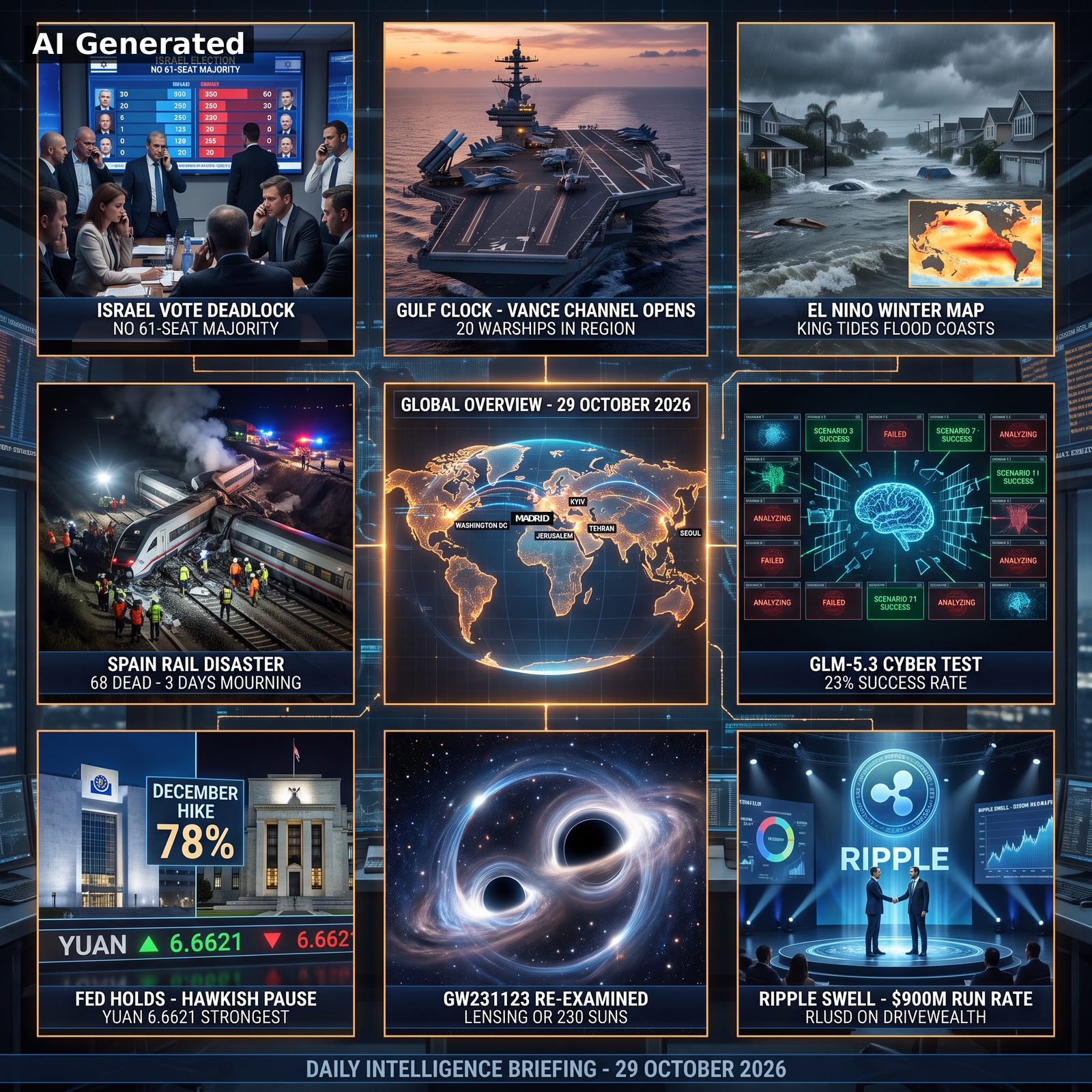
With more than 90 percent of ballots counted, Israel’s 26th Knesset election has delivered a deadlock: the Netanyahu-aligned bloc holds 53 seats against an opposition configuration of 67, of which 48 belong to Gadi Eisenkot’s camp and 19 to Arab-majority parties, leaving no path to the 61-seat threshold without extraordinary coalition contortions[12]. The president has pressed the parties to exhaust every option before a fifth election in four years, but the arithmetic is unforgiving, and India has used the vacuum to reaffirm its commitment to deepening ties with Israel regardless of which coalition forms[2]. The most consequential variable is whether the Arab List, historically excluded from coalition arithmetic, will lend external support to an Eisenkot-led government without formally joining it; reserved Arab leaders have indicated readiness to help topple the Netanyahu coalition from outside the cabinet[28]. Either outcome freezes the Iran file, the Gaza doctrine and West Bank settler policy, and leaves Netanyahu as caretaker premier during negotiations — a posture that complicates Washington’s strategic calculations precisely as the midterm calendar converges on the Gulf[26][13].
The Gulf Clock: Vance’s Channel and the Strike Ledger
The Iran file runs on two tracks in parallel. Vice President JD Vance has contacted Iran’s Supreme National Security Council chief to test the feasibility of negotiations, opening a diplomatic lane even as the United States transfers another Patriot battery from Texas to Israel, amasses munitions, and positions a further carrier strike group beside the roughly twenty warships already in the region — infrastructure the Wall Street Journal reads as preparation for a severe strike on Iranian nuclear and infrastructure targets after the American midterms[10][25]. The war’s cumulative cost, now estimated at 47.1 billion dollars with 29 billion in munitions, is itself becoming an electoral constraint. The escalation domain has also widened: the Saudi-led coalition intercepted another Houthi ballistic missile aimed at the Eastern Province, with a civil-defence warning in Najran and unconfirmed footage of fire at Aramco’s Ras Tanura refinery and the Riyadh defence ministry, while Saudi air raids reportedly killed fourteen in Yemen[20]. Four years of relative quiet on the Red Sea front are over, and Riyadh is seeking US backing it has not yet secured.
Ukraine: From Oleshky to the November Table, and the Orbit
Kyiv has converted the Oleshky ceasefire into diplomatic motion: Zelensky called the truce an “immense success” that relieved Kherson and demanded a trilateral Moscow-Kyiv-Washington meeting in November, while drones again hit a ship off Bulgaria, mine-clearing proceeds under the ceasefire, and the Finnish foreign minister prepares to press the file with Secretary Rubio[21][11]. In parallel, Putin called Elon Musk a “genuine genius” and revealed that Russia is building its own satellite-communications constellation, Rassvet, while confirming direct Moscow-Musk coordination “to maintain order” in orbit[24]. The admission cuts both ways: it acknowledges Russia’s dependence on cooperating with a private American company even as the Starshield restrictions cripple Ukrainian drone operations, and it concedes that Moscow cannot close the constellation gap quickly.
The Indo-Pacific Perimeter: Taipei, the Missile Test and the Alliances
North Korea launched a projectile into the sea off its east coast that Japan’s Coast Guard assessed as a ballistic missile, while Seoul’s defence ministry called the use of older weapons near the border “performative” — a domestic-signalling reading consistent with an election-cycle launch rather than an operational breakout[4][23]. In Taiwan, a tightening Taipei mayoral race has raised doubts about the opposition’s most prominent rising figure, compounding Islamabad’s decision to bar Taiwanese airlines from its airspace under Beijing’s One-China policy — the first such restriction by any state[19][6]. The alliance perimeter is consolidating: Merz’s Seoul leg of his Asia tour is explicitly about semiconductors and reducing dependence on China; Australia warned that China’s South-East Asian military build-up “creates a climate of pressure”; and the EU opened a Montreal summit with Canada on strategic raw materials, digital trade and research — without designating Ottawa an “associate member” over German objections[17][22][29].
The Subcontinental Front: Islamabad’s Roil and New Delhi’s Warning
South Asia produced a dense security cluster. India’s Defence Minister warned US Secretary of War Hegseth about Washington’s F-16 support and advanced technologies for Pakistan, flagging the risk of technology migration to third countries, days after the Balochistan Liberation Front claimed a coordinated offensive that allegedly routed government positions and the Pakistan Army confirmed a major killed in an IED blast in Gwadar operations[1][8][9]. Andhra Pradesh police simultaneously deepened a Pakistan-linked espionage probe with arrests in Bihar under “Operation Firewall-2026,” targeting Indian naval and defence installations[7]. The pattern is one of compounding internal and external pressure on Islamabad — insurgency, intelligence exposure and an aviation-diplomacy rupture — which New Delhi is actively exploiting in Washington to cap Pakistani capability growth.
The Periphery’s Files: Sudan, Libya, Haiti and Brazil
The periphery carried heavy casualties and governance failures. Strikes on a Darfur market killed more than 100 civilians, witnesses describing an attack on shopkeepers and RSF fighters alike[16]. The Haftar-aligned government in eastern Libya banned entry of Iranian and Afghan nationals at all points of entry, while a new Arab analysis of the Turkish-Libyan memorandum argues Ankara underestimated Egypt’s influence over the rival Libyan camps[14][5]. Haiti postponed its first presidential election in a decade to July 18, 2027, citing the security situation; the country has not voted since 2016[3]. In the Americas, Flavio Bolsonaro, defeated in the run-off and under investigation, flew to Miami and declared himself the “leader” of the opposition from exile, replicating the family’s 2022 playbook and extending Brazil’s post-election fracture into the diaspora[30].
Defence-Industrial Mechanics: Frigates, Rockets and the Joint Staff
The defence-industrial file moved on hardware and personnel. Babcock offered its 6,000-tonne Arrowhead 140 frigate as a replacement pathway for the cancelled US Constellation programme, proposing an export-proven hull built with an American partner; Lockheed Martin and the US Army demonstrated a GMLRS rocket that received a mid-flight targeting update and destroyed a moving target at White Sands; and Lieutenant General Brett Sylvia became the latest senior officer sidelined from the Pentagon’s Joint Staff[15][27][18].
Environment & Climate ↑ Contents
El Niño’s Winter Map and the Flood Ledger
The seasonal forecast has hardened into a warning: US forecasters predict a warmer and wetter winter across large parts of the country as the historic 2026 El Niño dominates the hemispheric circulation, with king tides already flooding coastal communities and sending seawater into homes before the winter storm season has begun[31][38]. The same signal is reshaping risk beyond the United States: flooding in Greece’s Magnesia region forced the 8th EMAK unit to extract a hotel owner trapped in southern Pelion, with about fifty residents cut off[43]. A UFZ study combining climate and hydrological models finds that climate change amplifies flood peaks more than it amplifies extreme precipitation itself, shifting the risk curve upward faster than rainfall statistics alone predict — the mechanism visible simultaneously in Florida king tides and Greek flash floods[47]. The exposure side is growing fastest in the high mountains: construction of tourism facilities and housing has put roughly 300,000 people in the path of potential Himalayan disasters in Nepal and India’s Uttarakhand[40].
The Regulatory Rollback: Methane, Permits and Ballot Measures
The American regulatory pendulum swung decisively. At a Texas rally, President Trump announced the EPA would roll back the 2024 safeguards limiting methane pollution from the oil and gas sector — a measure already delayed more than a year and the single most cost-effective lever available for rapid greenhouse-gas cuts[36]. The Louisiana DEQ posted a rushed final air permit for Hyundai’s proposed steel plant in the Cancer Alley corridor, approving thousands of tonnes of new pollution despite promises of a clean facility[39]. California faces its own assault through the ballot box: Proposition 45, backed by utilities, developers and technology companies that have spent tens of millions of dollars, would fast-track “essential” projects by severely limiting environmental and public review, with corporate PAC spending now nearly double that of opponents[42].
Energy and Infrastructure Decisions
Wisconsin’s Dairyland Power Cooperative pulled the plug on the 625-megawatt Nemadji Trail Energy Center gas plant on Lake Superior after years of community opposition, a reversal in an era when most utilities are doubling down on gas[37]. At the federal level, a fire at the Savannah River Site in South Carolina triggered a Site Area Emergency and a “radiological release” alert, with the FAA restricting flights around the facility; officials said the blaze was confined to one room, no contamination was detected beyond the affected building, and tritium operations for the US nuclear deterrent were untouched[32].
Forests, Wildlife and Carbon Money
Conservation finance and habitat restoration advanced on three continents. Australia legislated the Great Koala National Park in New South Wales, a 178,000-hectare expansion covering 12,000 koalas and more than one hundred threatened species, with Aboriginal rangers in its management, though funding remains contested[34]. The Netherlands pledged 500 million dollars over ten years to the Tropical Forest Forever Facility, driving pledges to roughly 7.8 billion dollars against a 125-billion-dollar target[41]. The biodiversity ledger was bleaker in South-East Asia: a new study documents how Laos lost its Javan and Sumatran rhinos, wild water buffalo and kouprey in half a century, a loss the authors insist was not inevitable, while Washington state’s blueberry growers face honey-bee colony declines after pollination[33][45].
The Cryosphere and the Ocean’s Freshwater Engine
Two structural findings emerged from the polar ledger. Antarctic sea-ice loss has “battered” the ocean’s freshwater engine: the Antarctic Intermediate Water layer, a vast freshwater band spanning the Southern Hemisphere’s oceans, has rapidly reversed its salinity and density trends, a regime shift that will propagate through nutrient transport, carbon uptake and hemispheric climate for decades[48]. In the Arctic, the research vessel Tara Polar Station has moored to sea ice for a winter drift of four months without sunrise, beginning a ten-drift programme through 2046 to observe what lives beneath the ice during the polar night[44].
Air, Water and the Public-Health Ledger
Two studies quantified exposure gaps that regulation has been slow to close. Nearly half of EU cities still fail the bloc’s landmark clean-air standards, an implementation gap that becomes legally consequential as deadlines arrive[35]. In the United States, schools and childcare centres are increasingly exposed to poor indoor air as wildfire smoke becomes routine, with many lacking the filtration to protect children[46]. And a peer-reviewed study of nearly 150 of the world’s largest companies found that of eight common climate strategies, only Science Based Targets initiative-validated targets are statistically linked to falling emissions — linking CEO compensation to climate goals was actually associated with increases[49].
Society & Civil Issues ↑ Contents
Spain’s Rail Disaster: The Human and Systems Ledger
Spain has begun three days of national mourning after two high-speed trains between Madrid and Seville collided, killing at least 68 people in one of the worst rail disasters in Europe’s modern history; control-centre staff have been questioned over an “inexplicable human error” believed to have precipitated the collision, the second major rail catastrophe in Spain this year[50]. Greek technical reporting dissects the failure chain — the electronic safety systems, the procedural cascade, the “bullet train” entering the danger zone at speed — illustrating how redundancy layers are only as strong as the weakest human handoff[65]. The investigation will determine whether the response punishes individuals or closes the systemic gaps the timeline is exposing.
The Midterm Crucible: Identity, Integrity and the Courts
The American midterm campaign entered its final week with politics and courts colliding on every front. Live coverage captured duelling rallies — Trump in Ohio, Obama in Georgia — as Fox News publicly predicted a Democratic House and called the Senate “a toss-up,” an extraordinary signal of Republican turnout erosion[67][69]. Election-integrity litigation became a parallel campaign: the Justice Department lost its bid to block California from counting mail ballots cast by alleged noncitizens, keeping a controversy weaponised in Republican advertising[71]. Conservative undercover investigator James O’Keefe and associates now face Minnesota felony charges after attempting to vote using dead residents’ identities while wearing burqas — an operation prosecutors treated as identity theft aimed at undermining the process, handing both parties ammunition in the integrity debate[68]. Identity itself has become a wedge: the Muslim faith of Senate candidate Abdul El-Sayed is now central to attack advertising[59].
France’s Republic: Institutions, Protests and the Culture Files
France’s institutions moved on several tracks. President Macron, in a youth-oriented YouTube interview, denounced the “disinhibition” of racism and antisemitism, naming the RN and LFI, while calling for calm to return to the lycées after the 24 October student mobilisations[53]. The protest ledger remains open: the IGPN police-oversight body was seized after a 20-year-old demonstrator in Toulouse was gravely wounded in the hand during clashes, and an adolescent blinded in a Mulhouse protest has filed a complaint[52][62]. The Senate voted the imprescriptibility of sexual crimes committed against minors — a measure previously reserved for crimes against humanity — sending it to a solemn vote and joint commission[66]. The courts opened the trial of former secretary of state Jean-Vincent Placé on sexual-assault charges, and the literary world ejected Thélyson Orélien from the Renaudot finalists over AI-use accusations in his novel[54][51].
Germany’s Civic Files: Order, Parliament and Preparedness
Germany’s civic ledger shows a state hardening its response to civil unrest while normalising the post-election calendar. Retail and industry associations demanded police presence after a wave of attacks on shops, extending the looting alarm that followed the European protests[56]. Berlin’s reconvened Abgeordnetenhaus held its constitutive session, with the Left proposing Hendrikje Klein as president and the CDU and AfD entitled to vice-presidential nominations — an early test of whether an AfD candidate can attract cross-party support[57]. The coalition fights continue beneath: the SPD presses for speed on the fuel-price cap, Merz asserts the CDU’s proposal right on the presidential question, and the Union threatens constitutional complaints against Berlin and Saxony-Anhalt[61]. The Red Cross opened Germany’s largest civil-protection centre in Luckenwalde, a logistics hub for stocking and rapidly deploying aid nationally and internationally[60].
Britain’s Civil-Preparedness and the Home-Nation Ledger
Britain’s civic file combined preparedness advice with institutional strain. The government urged every household to gather three days of supplies as part of the “Be Ready” campaign, converting the preparedness doctrine reported earlier this month into concrete household-level guidance — evidence that Whitehall now treats short-notice disruption as a baseline planning assumption[70]. In Northern Ireland, DUP party officers met over the Drumcree fallout, with the leadership resisting calls to collapse the power-sharing executive while police examine deputy First Minister Michelle O’Neill’s role in an allegedly unlawful protest[63].
Health Policy and the State’s Reach
Health policy in Washington took a unilateral turn. Health Secretary RFK Jr promulgated an enforcement-discretion rule allowing compounding pharmacies to sell six specific peptide drugs without FDA approval, overruling agency scientists who removed those peptides from the compounding list in 2023 over safety concerns, and green-lighting products popular in the Make America Health Again movement[72]. The move inverts the FDA’s role: the Health Department simply declared it will no longer enforce restrictions, a template applicable to any disfavoured rule without formal rulemaking. The institutional test will come from the courts the moment an unproven peptide harms a patient, but for now America’s most important health gatekeeper has been sidelined by administrative discretion.
Justice and Security Files: America, Brazil and the Lifecycle Ledger
Several files converged on accountability. Hacktivists calling themselves Distributed Denial of Secrets exposed the identities of more than 40,000 Department of Homeland Security employees, including ICE agents and contractors, in a data exposure with acute physical-security implications for federal officers[55]. Minnesota courts handed Salim Said a 30-year sentence in the pandemic-era fraud scheme claiming to feed needy children, a case that drew the president’s backlash and became a symbol of aid fraud[58]. Human Rights Watch revealed that Brazilian authorities planned the killing of 122 people during the Rio de Janeiro favela operation, alleging a pre-designed execution list[64]. And American labour history lost Dolores Huerta at 96, the United Farm Workers co-founder whose “Yes, we can” became the slogan of a generation of social movements[73].
AI & Technology ↑ Contents
The Model Frontier: Security Tests and the Capital Squeeze
The open-weight question produced a concrete security data point: Z.AI’s GLM-5.3 completed three of thirteen simulated cyberattack scenarios in tests by security firm Irregular, a 23 percent success rate that is low absolutely but strategically significant because each successful escalation demonstrates what an open, reproducible model enables for unsophisticated actors[74]. The economics of frontier AI continue to diverge from the technology’s momentum: Google’s strongest model was overshadowed by a roughly three-billion-dollar free-cash-flow drop, concentrating investor attention on the cost of the race[76]. Tencent’s cloud chief proposed a strategic overhaul reorienting AI toward business-centric applications, an explicit recognition that the enterprise market — not the chatbot — is where Chinese AI capital can achieve return[75]. Both signals are the same phenomenon: capability expansion and capital discipline are converging on enterprise monetisation as the only sustainable model.
Distillation, Infrastructure and the Capital Question
The Information reported that OpenAI’s Astra model has become the main distillation target for Chinese AI labs, with Moonshot AI and DeepSeek drawing on Astra’s outputs in models released this month — the most important frontier capability transfer is now happening through output distillation, a channel far harder to regulate than any checkpoint release[77]. The physical infrastructure of the AI economy is being redrawn geopolitically: the EU is planning the Pan-Arctic Cable, the first subsea link directly connecting Europe to Greenland, with potential extension to Canada and Japan-Korea — explicitly bypassing the United States, a project that would have been commercially incomprehensible five years ago[78]. Cloud-security startup Upwind raised 400 million dollars at a 3.8-billion-dollar valuation after declining a Datadog acquisition offer at the same price — a bet that standalone value creation will exceed an exit[79].
Economy & Business ↑ Contents
The Central-Bank Map and the Currency Read
The Fed left interest rates unchanged despite persistently high inflation and presidential demands for cuts, a decision markets read as positioning for a December hike (78 percent probability priced), while the dollar stayed firm and the rate path remained murky[82][99]. The Hong Kong Monetary Authority left its rate unchanged in lockstep, sustaining the territory’s currency-board discipline[81]. And the onshore yuan strengthened to 6.6621 per dollar, its strongest level since June 2022, with the central bank setting its midpoint at the strongest since February 2023 — evidence that Beijing accepts appreciation as a counterweight to tariff-driven capital flows[96].
The Rate-Policy and Debt-Crisis Front
Europe’s monetary front is dominated by the French sovereign-debt crisis. The ECB is expected to hold rates unchanged at its Frankfurt meeting, with attention fixed on Lagarde’s framing of French fiscal risk: French bond yields are at their highest since 2002, the government lacks a majority to pass a deficit-reducing 2027 budget, and speculation is building that the ECB may deploy its crisis-fighting bond-buying instrument for the first time in its existence to cap French spreads[89]. Asian markets compounded the risk-off tone: shares fell as Alphabet’s earnings miss dragged Wall Street futures lower, threading AI-capex anxiety through every major market[95].
The AI-Capital Test in the Earnings Season
The earnings season delivered a verdict on AI spending discipline. Microsoft posted record revenue and remains the hyperscaler most plausibly generating positive free cash flow while offering employee buyouts — the rare balance sheet where AI capex converts into profit rather than being absorbed as a cost of the race[87]. Morgan Stanley’s Jim Caron described a market “transition phase” requiring investors to accept slower growth, with three risks — AI capex sustainability, the war premium and the Fed’s tightening bias — defining the new equilibrium[84]. Capital is not punishing AI investment per se; it is punishing AI investment without demonstrable return.
The Industrial and Trade Geometry
The physical economy shifted on land, sea and factory floor. BYD now employs more than 1.02 million workers — more than Toyota, GM, Ford and Tesla combined — having added roughly 150,000 in ten months even as sales declined, a hiring path signalling capacity expansion over demand-driven growth[100]. Volkswagen’s supervisory board has received no binding documentation for Audi’s multibillion-dollar US arrangement, casting doubt on the flagship of Berlin’s transatlantic bet[90]. Turkey is building an Asia-Europe rail corridor as wars snarl old trade routes, bypassing both the Red Sea and the Russian land bridge[91]. Samsung increased foundry investment in the US and South Korea[98]. India reopened its textiles PLI scheme with a lower 100-crore-rupee threshold extended to FY34, while a Google-backed fusion start-up taps Japan to revive Germany’s industrial base[93][97]. Deutsche Regas plans an additional floating LNG-import vessel by early 2028 to secure German supply, a project not universally welcomed[83]. On the downside, the UK electrical contractor that served Heathrow plunged into liquidation, and the Shapoorji Pallonji group is raising up to 200 million dollars to repay creditors[88][86].
The Fiscal Ledgers: Greece, India, Italy and the Data-Frontier Premium
Greece is distributing a 400-euro one-off pension supplement automatically to more than 2.2 million recipients, a fiscal transfer whose electoral logic is transparent and whose cost lands on the same budget Athens is disciplining for its creditors[80]. India’s Cabinet approved a three-point dearness-allowance hike to 63 percent, benefiting 11.75 million employees and pensioners at an annual cost of 10,016 crore rupees[94]. Italy’s banking consolidation reached its peak in the Intesa Sanpaolo pursuit of Monte dei Paschi, the world’s oldest bank, a deal analysts call the harbinger of a Europe-wide wave[85]. And Bloomberg and two high-frequency trading firms are reportedly paying up to 100,000 dollars a month for faster access to the president’s Truth Social posts — a data-premium market in executive communication with direct implications for price discovery[92].
Science & Space ↑ Contents
Spaceflight’s New Frontier: Launches, Habitats and Leadership
ISRO is preparing an unprecedented GSLV-F18 launch on 30 October carrying the NVS-03 navigation satellite with its pyrotechnic valves already in the open position — a configuration never before attempted by the Indian agency, trading a small ignition risk for simpler spacecraft plumbing[101]. United Launch Alliance set 13 November for the Vulcan rocket’s return to flight, nine months after a solid-rocket-booster nozzle anomaly wrecked its 2026 manifest; the mission will launch the first 40 satellites of Amazon’s Kuiper constellation under a 38-flight contract, a make-or-break flight for a rocket with nozzle failures on two of its first four missions[111]. Artemis II commander Reid Wiseman was named deputy director of NASA’s Jet Propulsion Laboratory, joining the lab before its 90th anniversary, while Penn researchers proposed layered Mylar as flexible insulation for lunar habitats[102][103].
The Cosmic Ledger: The Heaviest Collision Re-Examined
Gravitational-wave astronomy confronted one of its most subtle interpretive challenges. GW231123, recorded by LIGO in November 2023, was originally estimated to involve two black holes of roughly 137 and 103 solar masses — a combined 230-solar-mass system straddling the pair-instability mass gap. Max Planck researchers now propose that gravitational lensing, with a compact object embedded in a foreground galaxy both distorting and magnifying the signal, could have inflated the apparent masses, with their baseline model yielding a combined source of around 140 solar masses and no unusual spins[113]. The reinterpretation does not fully resolve the puzzle — the heavier black hole still sits near the mass gap, and the inferred lens would itself be a 190-to-850-solar-mass object. The episode marks the maturity of gravitational-wave analysis, where the journey of the signal through warped spacetime must now be modelled as rigorously as the source.
The Deep Archive: Dinosaurs, Owls and Octopus Minds
Three studies mined the archive of life. A dinosaur fossil unearthed in an English clay quarry twenty-five years ago has been recognised as a new genus and species — Paludohadros proudlovii, a plant-eater from roughly 125 million years ago[107]. Swiss barn owls have become measurably more reddish-brown and more heavily spotted over thirty years, with DNA from more than 3,000 birds revealing natural selection on plumage genes — an active evolutionary shift whose advantage may relate to stress physiology[110]. And a University of Vienna study traced octopus, squid and cuttlefish intelligence to how their DNA folds: the three-dimensional architecture of cephalopod genomes may enable the rapid regulatory rewiring that supports complex nervous systems[114].
The Human Body and Mind Ledger
Two studies refined the causal architecture of neurodegeneration and exposure. Using a natural experiment created by Britain’s 1972 school-leaving-age reform, researchers found that an extra year of compulsory schooling reduced cumulative dementia incidence, with the protective effect concentrated among individuals at high genetic risk — evidence that modifiable life experience can offset inherited susceptibility[109]. Separately, a re-analysis of 1.86 million EPA drinking-water data points concluded that standard reporting understates PFAS levels by more than half: when below-limit readings are modelled rather than rounded to zero, average concentrations of the six regulated forever chemicals nearly double[106].
Materials, Chemistry and Energy Frontiers
Cornell researchers, with battery maker C4V, cut the formation stage of lithium-ion manufacturing by up to 60 percent using operando spectroscopy to identify when protective electrode interfaces stabilise — a factory-validated technique that could save large plants up to 100 million dollars and cut electricity use by 10 to 15 percent[104]. In photochemistry, Vienna teams showed that replacing the three iron atoms in a photocatalytic ammonia catalyst with chromium kills the reaction, atomic magnetism governing the outcome — refining design rules for solar-driven ammonia synthesis[115]. And an ultrathin iridium-manganese layer between a magnetic insulator and platinum improved two spin-related signals, opening a path to ultralow-power spintronics[112].
Biology’s Strange Frontiers: Sleep, Teleconnections and Artificial Cells
Jumping spiders of the Australian species Portia fimbriata were shown to sleep in two stages, with REM-like bouts of about 83 seconds eleven times a night, harder waking thresholds and an 80 percent rebound in REM-like time after a disturbed night — the strongest behavioural evidence that sleep regulation does not require a large brain[105]. A study demonstrated that the Indian Ocean leaves a detectable signature on Europe’s early-winter rain and storms, adding a distant ocean to the teleconnection map of seasonal forecasting[108]. And Science Tokyo researchers showed that macromolecular crowding can design the formation and organisation of synthetic DNA droplets — a step toward programmable artificial cells built from the physics of the real cytoplasm[116].
Crypto, Digital Assets & Blockchain ↑ Contents
Institutional Rails: Ripple, Stablecoins and the Brokerage Channel
The institutionalisation of digital-asset settlement accelerated along the Ripple corridor in the reporting window. Ripple CEO Brad Garlinghouse used the opening of the Swell conference to credit Treasury Secretary Scott Bessent with supporting “responsible” US crypto growth, extending a pattern of public endorsements that signal the industry’s deepening alignment with the Treasury’s permissive reading of the digital-asset agenda[119]. The endorsement sits atop concrete corporate traction: Ripple says it is on track to exit 2026 with a record 900-million-dollar annualised product-revenue run rate, driven by institutional partnerships, even as XRP itself heads toward its worst annual price performance since 2022 — the clearest demonstration yet that the business and the token have decoupled valuation-wise[123]. The same window brought operational substance: broker infrastructure provider DriveWealth is working with Ripple to integrate RLUSD stablecoin settlement and digital-asset capabilities across its global business, with European RLUSD settlement and US expansion planned, alongside Ripple Payments for cross-border partner flows — a test case for whether stablecoin settlement can close the timing gap between investment execution and cash movement in regulated brokerages[125]. The credit market is beginning to price these rails: Moody’s assigned an A2 rating to Ripple’s RLUSD stablecoin, a first-tier investment-grade rating for a dollar-pegged digital asset that materially broadens the institutional universe willing to hold it, while Strategy won shareholder approval to pay daily dividends on four preferred stocks, extending its bitcoin-treasury model deeper into the public-capital structure[124].
Tokenisation’s Institutional Pushback
The tokenisation debate escalated into a public-relations war. Securitize answered the Wall Street Journal’s anti-tokenization editorial with a full-page advertisement of its own, converting the dispute over whether real-world-asset tokenisation delivers genuine efficiency or mere complexity into a paid-media argument between the industry’s infrastructure builders and its critics[118]. The operational research behind the industry’s claims is emerging in parallel: Bitget, working with Reality and Keyring, studied tokenised-equity strategies in DeFi, reporting up to 7 percent returns from combining tokenised stocks with perpetual futures and decentralised market making — a concrete, if early, quantification of the yield surface tokenisation is supposed to unlock[120]. The tension remains definitional: tokenisation’s proponents argue the mechanism reduces settlement friction and opens new collateral flows, while sceptics contend the complexity of custody, reconciliation and liability transfer in the regulated world cancels the on-chain gains, and the WSJ-Securitize exchange merely relocated that argument from the prospectus into the opinion pages.
The Regulatory and Security Perimeter
The regulatory frontier produced its sharpest enforcement action of the year in Utah: the state has filed criminal charges against Kalshi and two of its co-founders after a federal judge rejected the prediction-market operator’s effort to block Utah from enforcing its anti-gambling laws — escalating the fight over who regulates event contracts from the CFTC’s federal docket into state criminal law, with existential consequences for prediction markets’ legal standing across jurisdictions[126]. On the federal side, CFTC Chairman Selig publicly envisions a market in which AI agents trade crypto autonomously, arguing that regulators must build accountability frameworks for machine-driven markets rather than attempting to prohibit them — a position that reframes the CFTC’s entire supervisory posture for the algorithmic era[121]. The security ledger remained active: Singapore police reported at least 2.7 million dollars lost by users of tampered Ledger hardware wallets, with cases dating back to mid-September — a reminder that the hardware-supply-chain attack surface persists even as institutional custody grows[117].
DeFi Mechanics and the Real-World-Asset Turn
DeFi’s capital-formation model showed its first structural shift in a year. Pendle posted its first quarterly total-value-locked gain in twelve months, with the protocol’s pivot toward real-world assets and strategic buybacks driving a 43 percent TVL rise — evidence that the yield-tokenisation market, long the purest expression of speculative DeFi, is now being re-anchored by tokenised Treasury and real-world-asset collateral rather than by incentive farming[122]. The significance is architectural: if the marginal dollar flowing into DeFi yield products is now backed by on-chain representations of government bonds and institutional assets rather than by issuances of protocol tokens, then the entire incentive structure of the sector rotates from inflationary emissions toward fee-generating collateral — the transitional mechanism the industry’s institutional advocates have argued for years would mark DeFi’s maturation. The RWA turn and the Ripple/DriveWealth corridor are the two ends of the same process: tokenised collateral entering the settlement layer from the top down, and yield infrastructure absorbing it from the bottom up.
Correlations & Analysis ↑ Contents
The D151 window’s governing fact is that the collapse between announcement and event — the organising logic every report from D138 through D150 traced in the Iran file — has now produced its first diplomatic counter-movement. Yesterday’s D150 report framed the Gulf as a strike clock tied to the American midterm calendar; today’s reporting adds the Vance channel to that clock, a quiet outreach to Tehran’s security establishment running in parallel to Patriot transfers and carrier deployments[10][25]. Washington is now running a genuinely two-track policy: the same administration that positions a second Patriot battery in Israel simultaneously tests whether a negotiation window can open before the post-midterm decision point. What the window does not yet reveal is whether the channel is a genuine off-ramp or cover for the strike itself.
The second correlation runs through Israel’s deadlock and its interaction with the same midterm clock. D148’s empirical finding — that elections decided under perceived existential threat tilt toward security over pluralism — is being tested in reverse transatlantic symmetry[12][26]. In Israel, the security-first camp lost its majority, yet both blocs share the same doctrine on Gaza and Iran, so the deadlock produces strategic continuity: whoever governs will align with Washington on the Gulf. In the United States, the Fox prediction of a Democratic House — from the outlet most loyal to the White House — is the clearest signal yet that the war premium identified in D150 has become an electoral constraint on the president. Both democracies are now holding decisive votes with the Gulf escalation as the background variable, and in both, the security calculus has failed to deliver the political consolidation it promised.
A third thread binds the orbital and the civilian. The Putin-Musk revelation about Russian-American satellite coordination, read against the Starshield restrictions that D141-D150 documented as crippling Ukrainian drone operations, completes a picture in which space connectivity is the terrain where Washington’s allies are most vulnerable and where Moscow demonstrates mutual dependence with the West’s most valuable commercial infrastructure[24]. Russia cannot close the constellation gap quickly, so it pursues order-in-orbit cooperation with the very private actor whose service disruptions have shaped the Ukrainian battlefield — and NATO’s most important tactical enabler is now the object of direct Russian-American coordination, with European capitals absent from the conversation.
The economic correlation concentrates in the word the Fed refused to utter: hike. D150 mapped the “war premium in markets and energy”; today’s window converts it into a central-bank dilemma with three simultaneous faces — a 78 percent December-hike probability, French yields at their highest since 2002 with the ECB contemplating a first use of its crisis instrument, and an appreciating yuan at its strongest since the 2022 dollar cycle[82][89][96]. The three are one phenomenon: the dollar bloc tightens into a war that raises energy and freight costs; Europe faces sovereign stress the monetary authority may have to absorb; and China uses currency strength to import disinflation. The earnings season’s brutal differentiation between Microsoft’s cash conversion and Alphabet’s cash burn is the market’s way of asking how long the late-cycle AI investment boom can be financed at current rates.
What to watch in the next reporting period: (1) whether the Vance-Iran channel produces any public negotiation signal before November 3, and how the Saudi-Houthi escalation interacts with that calendar, since Riyadh’s renewed campaign re-opens a second front Washington must answer without deciding the Iran question; (2) whether Israel’s coalition talks reach an Arab-list-backed opposition government, which would be the first administration structurally dependent on the parties of the 1948 Palestinian minority and would re-order every near-term policy; (3) the ECB’s decision and its language on French spreads, where a first activation of the anti-fragmentation instrument would be the most consequential European monetary event in years; and (4) the Spanish rail disaster’s investigative phase, which will determine whether European rail safety follows aviation into systemic accountability. Each tests the question D150 posed: whether announcement and event can be re-converged in an era when the gap between them has become the strategic variable itself.
References ↑ Contents
1. India warns US over Pakistan F-16 support, flags risk of technology reaching third countries by Indian Defence News · Source ↑
2. India reaffirms commitment to stronger Israel ties as election produces political deadlock by Indian Defence News · Source ↑
3. Haiti presidential elections postponed again, new date July 18, 2027 by ProtoThema · Source ↑
4. North Korea launches possible ballistic missile into sea off east coast by FinancialJuice / Japan Coast Guard · Source ↑
5. Turkish-Libyan memorandum: new Arab analysis says Turkey underestimated Egypt’s influence in Libya by in.gr · Source ↑
6. Pakistan bans Taiwanese airlines from its airspace citing One-China policy by Indian Defence News · Source ↑
7. Bihar duo held as Andhra Police expand Pakistan-linked espionage probe by Indian Defence News · Source ↑
8. Baloch rebels escalate offensive; claim Pakistani forces routed in ongoing operation by Indian Defence News · Source ↑
9. Pakistan Army major killed in IED blast during Balochistan operations by Indian Defence News · Source ↑
10. Letter from Washington: Vance to explore chance for negotiations with Iran by Frankfurter Allgemeine Zeitung · Source ↑
11. Ukraine war blog: Finnish foreign minister plans Rubio talks; drones hit ship off Bulgaria; Oleshky demining under way by Handelsblatt · Source ↑
12. Live: Israeli count nearing completion, no majority in sight (90%+ counted, 53 vs 67) by France 24 · Source ↑
13. Activists accuse Israeli settlers of assault in occupied West Bank by Al Jazeera · Source ↑
14. Haftar government bans entry of Iranians and Afghans to eastern Libya by ProtoThema · Source ↑
15. 6,000-ton frigate that can launch missiles offered to US Navy (Arrowhead 140) by Interesting Engineering · Source ↑
16. Strikes on Darfur market in Sudan killed more than 100, rights group says by Al Jazeera · Source ↑
17. Merz visits South Korea; semiconductors and China dependence on the agenda by Stern · Source ↑
18. A top general pushed out at Pentagon’s Joint Staff (Lt. Gen. Brett Sylvia) by ABC News · Source ↑
19. A close race for mayor of Taiwan’s capital raises doubts about one of the opposition’s brightest prospects by Crypto Briefing · Source ↑
20. Escalation in Saudi Arabia: new Houthi ballistic missile intercepted; Aramco Ras Tanura and Riyadh MoD targeted by Enikos · Source ↑
21. Zelensky calls Oleshky ceasefire an ‘immense success’ and calls for Moscow-Kyiv-Washington meeting in November by Le Monde · Source ↑
22. Australia concerned about China’s military build-up in South-East Asia by Le Parisien · Source ↑
23. South Korea defence ministry: North Korea’s use of older weapons near border seems performative by FinancialJuice · Source ↑
24. Putin on Musk: ‘He is a genius’ – Russia building its own satellite constellation Rassvet, keeps contact with Musk by DefenceNet.gr · Source ↑
25. US on alert: another Patriot battery, warships and forces being sent to Israel; war cost at $47.1bn by DefenceNet.gr · Source ↑
26. Israel: Netanyahu without a majority – the geopolitical deadlock that ‘burns’ Trump by DefenceNet.gr · Source ↑
27. US Army rocket changes targets midair and destroys a moving threat in live-fire test (GMLRS/RIG-360) by Interesting Engineering · Source ↑
28. In Israel, an Arab list ready to back an opposition government without entering it by Le Parisien · Source ↑
29. EU and Canada open a summit to seal an unprecedented rapprochement by France 24 · Source ↑
30. In flight to the United States, Flavio Bolsonaro claims to be the ‘leader’ of Brazil’s opposition by Le Monde · Source ↑
31. Forecasters predict a warmer and wetter winter: how El Niño will affect your region by NPR · Source ↑
32. Fire at US nuclear site (Savannah River) triggers ‘radiological release’ alert; FAA restricts flights by Interesting Engineering · Source ↑
33. Action on the ground in Laos needed to recover large mammals, protect more species by Mongabay · Source ↑
34. ‘Historic win’: Australian state approves national koala park despite controversial funding by Mongabay · Source ↑
35. Nearly half of EU cities do not yet meet new clean air standards, report shows by CleanTechnica / World Resources Institute · Source ↑
36. Trump rolling back methane pollution safeguards by CleanTechnica / Sierra Club · Source ↑
37. After years-long community objection, Dairyland Power pulls the plug on NTEC gas plant by CleanTechnica / Sierra Club · Source ↑
38. King tides flood US coastal communities, in photos by Associated Press via The Independent · Source ↑
39. Louisiana DEQ issues rushed, controversial air permit to proposed Hyundai steel facility by CleanTechnica / Sierra Club · Source ↑
40. Building boom puts 300,000 people in the path of potential Himalayan disasters by BBC News · Source ↑
41. Netherlands pledges $500 million to help conserve tropical forests (TFFF) by Mongabay · Source ↑
42. Powerful interests aim to weaken California’s landmark environmental law (Prop 45) by Inside Climate News · Source ↑
43. Video: 8th EMAK rescuers extract hotel owner injured in Pelion, Magnesia, from the storm by DefenceNet.gr · Source ↑
44. Goodbye to sunrise for four months: Tara Polar Station moored to Arctic sea ice for the polar night by EcoTicias · Source ↑
45. Study addresses honey bee declines after blueberry pollination with new feed supplement by Environment News Service · Source ↑
46. Schools increasingly affected by poor air quality as wildfire smoke becomes more common by Environment News Service · Source ↑
47. Climate change amplifies flooding more than extreme precipitation (UFZ study) by Environment News Service (ENN) / UFZ · Source ↑
48. Antarctic sea ice loss batters ocean’s freshwater engine (Antarctic Intermediate Water reversal) by Environment News Service (ENN) / Univ. Melbourne · Source ↑
49. Of these 8 corporate climate strategies, only 1 (SBTi-validated targets) is linked to falling emissions by Trellis · Source ↑
50. Spain begins three days of mourning after train crash kills dozens by BBC News · Source ↑
51. Thélyson Orélien removed from Renaudot prize finalist list over AI-use accusations by Le Monde · Source ↑
52. 24 October protests: police-oversight body IGPN seized in Toulouse after complaint by young man gravely wounded in hand by Le Monde · Source ↑
53. Emmanuel Macron denounces a ‘disinhibition’ of racism and antisemitism, targeting RN and LFI by Le Monde · Source ↑
54. Jean-Vincent Placé, former green secretary of state, on trial for sexual assault by Le Monde · Source ↑
55. Hackers expose the identities of more than 40,000 DHS employees by NPR · Source ↑
56. Attacks on shops? Industry associations demand police presence (letter to interior minister) by DIE ZEIT · Source ↑
57. First session: Berlin Abgeordnetenhaus decides on key personnel by DIE ZEIT · Source ↑
58. 30-year sentence in Minnesota fraud that drew Trump backlash by Al Jazeera · Source ↑
59. Al Jazeera speaks to El-Sayed as religion becomes flashpoint in Senate race by Al Jazeera · Source ↑
60. Red Cross opens Germany’s largest civil-protection centre (Luckenwalde) by Stern · Source ↑
61. Federal politics blog: SPD demands speed on fuel-price cap; Merz asserts CDU right of proposal on president; Union threatens constitutional complaints by Handelsblatt · Source ↑
62. ‘She was leaving a restaurant and was shot’: teenager blinded during Mulhouse protest files complaint by Le Parisien · Source ↑
63. DUP party officers to meet amid ongoing fall-out over Drumcree dispute by Evening Standard · Source ↑
64. Brazil: NGO denounces mass executions in the Rio de Janeiro police operation by Zougla · Source ↑
65. The electronic safety systems of the Spanish railway, the chain of errors and the ‘bullet’ train by Naftemporiki · Source ↑
66. France: Senate votes imprescriptibility of sexual crimes committed against minors by France 24 · Source ↑
67. Midterms 2026 live: Trump rallies in Ohio, Obama in Georgia; Fox predicts Democratic House by Le Monde · Source ↑
68. US: investigators wore burqas and ‘voted’ with dead people’s names to prove fraud – felony charges for O’Keefe by DefenceNet.gr · Source ↑
69. Trump makes rare Epstein comment as Obama laughs off Cheesecake Factory drama at dueling midterm rallies: live by The Independent · Source ↑
70. UK Government urges all households to gather 3 items now (Be Ready preparedness) by Daily Express · Source ↑
71. US Justice Dept loses initial bid to block votes from alleged noncitizens in California by Investing.com / Reuters · Source ↑
72. Peptide peddlers cheer as RFK Jr. unilaterally grants access, overruling FDA by Ars Technica · Source ↑
73. Dolores Huerta, inspiration of Obama’s ‘Yes, we can’ and figure of American unionism, dies at 96 by Le Parisien · Source ↑
74. Z.AI’s GLM-5.3 completes 3 of 13 cyberattack scenarios in Irregular’s simulated tests by Crypto Briefing · Source ↑
75. Tencent cloud chief Dowson Tong proposes AI strategy overhaul centered on businesses by Crypto Briefing · Source ↑
76. Google’s flashy new model gets outshone by its financial troubles by Gizmodo · Source ↑
77. OpenAI’s Astra model becomes main distillation target for Chinese AI labs by FinancialJuice / The Information · Source ↑
78. As US ties fray, Europe plans first undersea cable link to Greenland (Pan-Arctic Cable) by Ars Technica · Source ↑
79. Upwind raises $400M after walking away from Datadog acquisition offer by TechCrunch · Source ↑
80. Pensions: who will receive the 400-euro benefit and when it will be paid by Ethnos · Source ↑
81. Hong Kong Monetary Authority leaves interest rates unchanged, tracking Fed move by Investing.com / Reuters · Source ↑
82. US holds interest rates – ahead of possible Bank of England hike by Sky News · Source ↑
83. Energy: new LNG ship to secure Germany’s supply (Deutsche Regas) by Handelsblatt · Source ↑
84. Wall Street: why investors must settle for less growth (Morgan Stanley’s Jim Caron) by Handelsblatt · Source ↑
85. Deep Read: showdown in Italian banking poker – Intesa Sanpaolo reaches for the world’s oldest bank (Monte dei Paschi) by Handelsblatt · Source ↑
86. Shapoorji Pallonji Group seeks to raise up to $200 mn to repay debt by Business Standard · Source ↑
87. Microsoft posts record revenue despite employee buyout offers by Gizmodo · Source ↑
88. UK electrical contractor for Heathrow Airport plunges into liquidation by Daily Express · Source ↑
89. No change expected in euro key rates – ECB focus on France’s debt crisis (yields highest since 2002) by Stern · Source ↑
90. Auto industry: Audi’s shaky US deal – VW supervisory board lacks binding commitments by Handelsblatt · Source ↑
91. Turkey builds Asia-Europe rail corridor as wars snarl up old trade routes by Nikkei Asia · Source ↑
92. Truth Social: Wall Street firms reportedly buying faster access to Trump’s posts (up to $100k/month) by Handelsblatt / Reuters · Source ↑
93. Textiles PLI scheme reopens with lower ₹100 crore turnover threshold by Business Standard · Source ↑
94. Govt hikes DA, DR to 63% from 60%, benefiting 11.75 million people by Business Standard · Source ↑
95. Asian shares fall as Alphabet earnings miss drags Wall St futures lower by Investing.com / Reuters · Source ↑
96. China’s onshore yuan strengthens to 6.6621 per dollar, strongest since June 7, 2022 by FinancialJuice · Source ↑
97. Google-backed fusion start-up taps Japan to revive German industrial base by Nikkei Asia · Source ↑
98. Samsung Electronics increases foundry investment in US and South Korea by Crypto Briefing · Source ↑
99. Dollar steady after Fed hold leaves rate path murky by Investing.com / Reuters · Source ↑
100. BYD now has 1.02 million workers, more than Toyota, GM, Ford and Tesla combined by Electrek · Source ↑
101. ISRO to launch NVS-03 with open pyro valves in historic first for navigation satellite mission (GSLV-F18, Oct 30) by Indian Defence News · Source ↑
102. Caltech names Artemis II Commander Reid Wiseman as NASA JPL deputy by NASA · Source ↑
103. Moon habitats may use layered Mylar to block extreme heat by Universe Today · Source ↑
104. New battery manufacturing method cuts processing time 60%, could save $100 million (Cornell/C4V) by Interesting Engineering · Source ↑
105. Australian jumping spiders twitch through REM-like sleep and, after a disturbed night, get about 80% more of it by ScienceBlog · Source ↑
106. PFAS levels in US drinking water could be twice as high as reported by ScienceAlert / Cell Reports Sustainability · Source ↑
107. Scientists discover a new dinosaur species hiding in plain sight for 25 years (Paludohadros proudlovii) by SciTechDaily / Taylor & Francis · Source ↑
108. How the Indian Ocean is linked to Europe’s early-winter rain and storms by Phys.org · Source ↑
109. These 1970s kids had to stay in school for 1 year longer. Decades later, the results are dramatic (dementia) by ScienceAlert / PNAS · Source ↑
110. Something strange is happening to barn owls: they’re changing color by SciTechDaily / University of Lausanne · Source ↑
111. ULA’s Vulcan rocket is set to return to flight on Friday the 13th (first 40 Kuiper satellites) by Ars Technica · Source ↑
112. Ultrathin metal layer boosts spin-related signals, opening a door to ultralow-power electronics by Phys.org · Source ↑
113. One of the heaviest black hole collisions (GW231123) may have been magnified by warped spacetime lensing by Max Planck Institute for Gravitational Physics via EcoTicias · Source ↑
114. Why are octopuses so smart? The answer may lie in how their DNA folds by SciTechDaily / University of Vienna · Source ↑
115. Atomic magnetism reveals why iron, but not chromium, can produce ammonia using sunlight by Phys.org · Source ↑
116. Macromolecular crowding could help build artificial cell systems by Phys.org · Source ↑
117. Tampered Ledger wallets cost Singapore users $2.7M: police by Cointelegraph · Source ↑
118. Securitize answers anti-tokenization Wall Street Journal ad with a full-page ad of its own by Crypto Briefing · Source ↑
119. Ripple CEO praises US Treasury Secretary as major crypto deals unfold (Swell) by Bitcoin.com News · Source ↑
120. Bitget, Reality, Keyring study tokenized equity strategies with up to 7% returns by CoinGape · Source ↑
121. CFTC chief Selig envisions AI agents trading crypto on their own by Crypto Briefing · Source ↑
122. Pendle posts first TVL gain in a year as real-world assets take over (+43% Q3) by Crypto Briefing · Source ↑
123. Ripple is heading for its best year ever while XRP faces its worst since 2022 by CryptoSlate · Source ↑
124. Strategy wins approval for daily dividends, Moody’s rates RLUSD A2, Coinbase denies breach by CoinTurk · Source ↑
125. Ripple and DriveWealth link stablecoin settlement to global brokerage by NewsBTC · Source ↑
126. Utah charges Kalshi and its founders, escalating a fight over who can regulate prediction markets by The Independent · Source ↑
AI Disclosure: This post was created with the assistance of artificial intelligence. The ideas, analysis, and opinions expressed are my own — AI was used to help compose, structure, and refine my personal notes and thoughts into the final written content. Images, videos and music featured in this post were also generated using AI tools, based on my own creative prompts and direction.