

Contents
- 1. Geopolitics & Defence
- 2. Environment & Climate
- 3. Society & Civil Issues
- 4. AI & Technology
- 5. Economy & Business
- 6. Science & Space
- 7. Crypto, Digital Assets & Blockchain
- 8. Correlations & Analysis
- 9. References
Click any heading to jump to that section. Click the section heading to return to this menu.
Geopolitics & Defence ↑ Contents
The Gulf Clock: Riyadh Under Fire and the Tehran Meeting
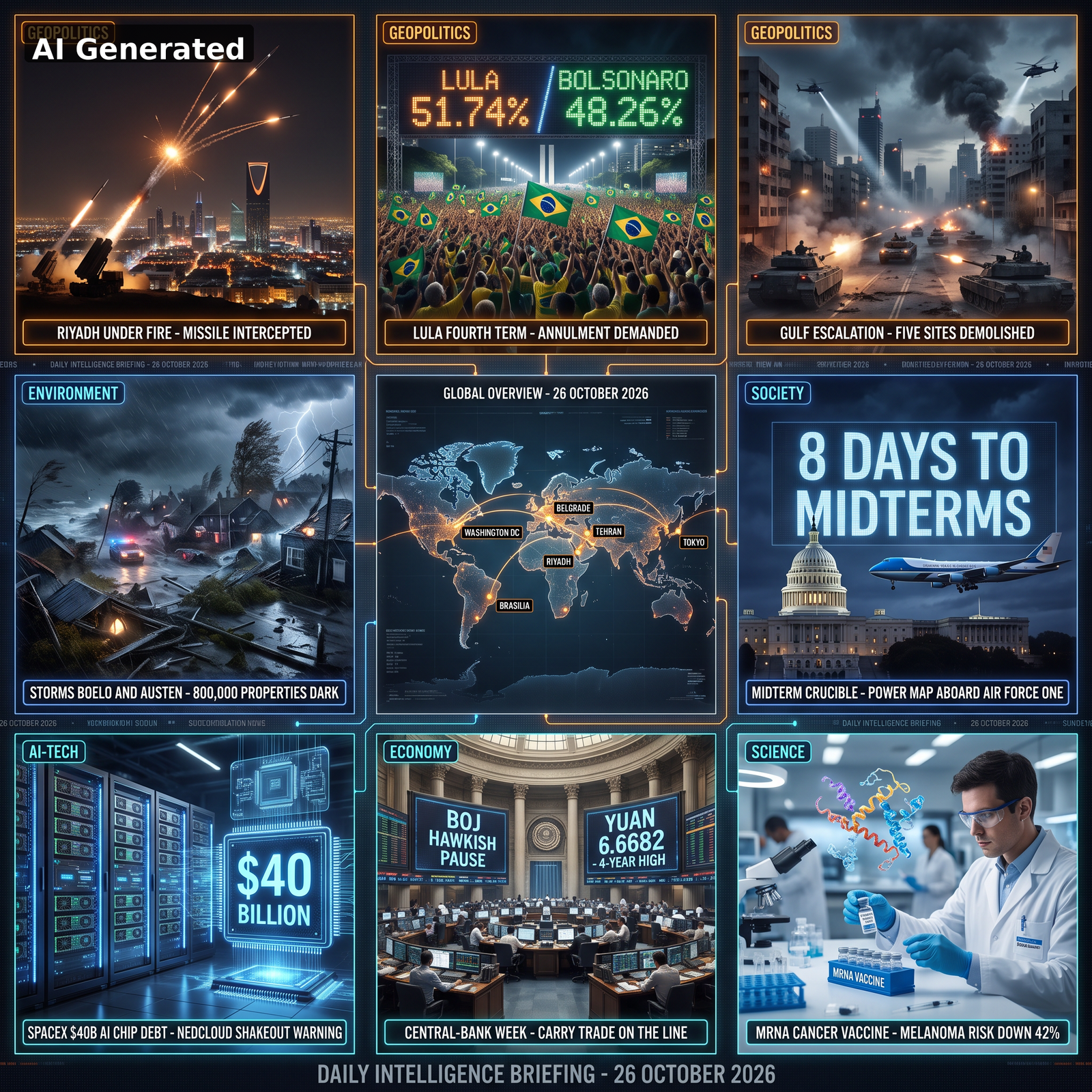
The Houthi-Saudi front re-escalated overnight, with the Saudi-led coalition reporting its air defences intercepted a ballistic missile fired toward Riyadh[1], while a separate operation demolished five missile-storage sites and four launch platforms in Houthi-controlled Yemen[2]. The Houthis claimed an attack on King Khalid International Airport and a drone strike on Saudi Arabia’s east-west oil-pumping stations, neither confirmed by Riyadh[3][4]. The militia’s communications apparatus now broadcasts operational claims as a strategic instrument, testing Riyadh’s defensive reputation and the oil market’s tolerance for renewed threats.
The “Dawn of Yemen” offensive added a second layer, with the Yemeni Armed Forces reporting 753 strikes and 218 operatives neutralised in 24 hours[5]. Yet a diplomatic track is also visible: top officials from the Mecca pact countries — Saudi Arabia, Turkey and Pakistan — are expected to meet Iranian counterparts in Tehran on Monday for “regional coordination”[6]. The split-level diplomacy is stark: Riyadh fights Tehran’s most consequential proxy while negotiating with Tehran, the structure D147 identified as defining the crisis. US Central Command claims more than 3,000 commercial vessels have transited Hormuz with US help and that American forces have “broken” the Iranian blockade to the tune of 1.5 billion barrels of exported oil[7] — an unverifiable figure whose function is to reassure Washington that the oil weapon has been neutralised.
Brazil’s Fourth Term and the Annulment Gambit
Lula da Silva won a historic fourth presidential term, defeating Flávio Bolsonaro in the runoff with 51.74 percent to 48.26 percent[8], becoming the first candidate since Brazil’s return to democracy to overturn a first-round deficit[9]. The victory defied prediction markets and the momentum narrative, delivered by a youth-and-working-class mobilisation[10]. Bolsonaro refused to concede, declaring it “impossible to recognise” the result and demanding annulment over the two-hour extension of polling hours granted by a justice who once worked for Lula[8][11] — replaying the 2022 playbook of his father Jair in a country whose institutions are already strained[11]. Lula framed the result as a victory “to guarantee democracy” and pledged to regulate social-media platforms[12].
The task ahead is daunting: Lula faces a hostile Congress and a divided country after the conservative legislative surge[13], with an agenda of insecurity, public debt and resistance to Trump-administration pressure[14]. Latin America’s left read the result as a hemispheric verdict — Sheinbaum hailing the “victory of the Brazilian people”, Petro declaring “fascism has been stopped”[12].
Serbia’s Student Movement Takes Power
Serbia’s “Student List” movement won the parliamentary election with 52.9 percent and 140 of 250 seats, ending two decades of Vucic-era dominance[15]. Le Monde frames it as a major democratic alternation that could inject détente into the Western Balkans[16]. Brussels quickly congratulated the movement, resetting the D145-D147 dynamic in which the EU watched Belgrade drift between Moscow and the West[17].
The Musk Doctrine and the Ukrainian Rupture
Musk accused Ukraine of violating Starlink’s terms of use by using the service in attacks against civilians[18], converting the D143-D147 throttle into declared doctrine. The Greek press framed it as proof of Europe’s structural dependence on American satellite infrastructure[18]. He went further, declaring that “bloodthirsty warmongers, who push for a war that never ends, should burn in hell”, in a post tied to his October 2022 peace proposal of UN-supervised referendums, Crimea recognition and Ukrainian neutrality[19]. Its republication positions the tech establishment as the voice of war-weariness, generalising the terms-of-use precedent into a broader critique of the war’s continuation.
The Indo-Pacific Theatre and India’s Defence Arc
China’s carrier Liaoning, with the Type 055 destroyers Wuxi and Anshan and the Type 052D Huainan, sailed south of the Philippines while the US carrier Theodore Roosevelt exercised with Japanese, Australian, Canadian and French warships in the same region under Keen Sword[20]. India responded on multiple fronts: China’s KJ-3000 AEW&C aircraft are moving toward serial production[21]; the DRDO demonstrated its 30-kilowatt “Sahastra Shakti” laser directed-energy weapon against drones[22]; and the IAF flagged an extended-range operational focus[23].
The diplomatic layer was equally active: the Australian High Commissioner visited the AUSTRAHIND 2026 exercise in Kerala; Om Birla and Vyacheslav Volodin held India-Russia talks ahead of BRICS; Liechtenstein’s Hereditary Prince Alois arrived on a state visit; Jaishankar urged stronger global resolve against terrorism; and the BSF seized a boat near Sir Creek in Kutch[24][25][26][27][28]. Algeria’s parliament approved sending troops to Niger — its first foreign deployment in over 50 years[29].
Arsenals, Alliances and the Diplomatic Ledger
The defence-industrial ledger logged three milestones: the USS Pinckney entered its yard period for the Navy’s first SPY-6(V)4 radar installation[30]; France’s Archange SIGINT aircraft arrived at Évreux to restore a capability missing since the Gabriel’s 2022 retirement[31]; and the Hellenic Navy’s first acceptance firings of Israeli SPIKE NLOS/ER2 missiles ended with a submarine torpedo sinking the frigate HS Mpoumpoulina in the Cretan Sea[32]. John Brennan’s memoirs revealed that in 2015 Mohammed bin Salman promised to “eliminate the Houthis within two months” — a failure that cost Riyadh hundreds of billions and frames today’s escalation[33]. CNN reporting detailed the Blackwater-linked contractor fiasco in Haiti, where civilian casualties have mounted without breaking gang control over Port-au-Prince[34].
The diplomatic ledger carried its own weight: Xi Jinping was poised to tighten his grip at a discipline-focused fifth plenum[35]; Le Parisien reported US officials are considering Orban as UN Secretary-General, a proposal surviving only on French and British vetoes[36]; Trump’s tone toward Libya softened, declaring the Libyan people “deserve peace and prosperity”[37]; and North Korea told the UN that Seoul “fabricated” the September landmine blast[38]. Chancellor Merz departed on a multi-day Asia trip to Singapore, Japan and South Korea, a strategic pivot toward the Indo-Pacific as China’s carrier tested its waters[39].
Environment & Climate ↑ Contents
Storms and the Northern European Ledger
The twin autumn storms Boelo and Austen left a heavy damage trail across the UK, France and Germany, killing a 60-year-old man in Dumfries and Galloway and cutting power to around 800,000 properties[42], with roughly 150,000 homes darkened on the continent alone[43]. The compound multi-storm pattern D146-D147 tracked as “the autumn ledger” is now the norm, and every event feeds the resilience-spending debate in capitals squeezed between climate adaptation demands and fiscal consolidation.
Biodiversity and the Living Ledger
German Environment Minister Carsten Schneider joined the UN Biodiversity Conference (COP17) in Yerevan to lead the German delegation and push the 30-percent-protection-by-2030 target, explicitly comparing the stakes to the climate negotiations[41]. The scientific ledger behind the diplomacy was sobering: a global assessment found every shallow-water coral reef ecosystem in Australia faces an extremely high risk of collapse by 2075 under projected ocean warming[47]. Yet the living ledger also produced hope: DNA analysis resurrected the Madagascan baobab Adansonia bozy, demoted to a variety in 1952, as a distinct endangered species[48], and a decade of partnership between New South Wales and conservation groups has returned 13 locally extinct mammals to fenced reserves where they now breed safe from feral cats and foxes[56].
Energy’s New Arithmetic
The world’s two largest economies moved in opposite directions on energy. China General Nuclear began main construction of Unit 2 at its Zhaoyuan nuclear plant in Shandong with a 60-hour concrete pour, part of a six-unit Hualong One site expected to generate 50 billion kilowatt-hours a year — reinforcing the EIA’s finding that China is building 36 reactors, more than 49 percent of the world’s total[44]. Washington moved the other way: CleanTechnica’s analysis of the Trump DOE budget request found it cuts weak bets and useful energy research together, stripping support from technologies already delivering electrification[53]. In Brussels, EU agriculture ministers convened to negotiate post-2028 farm support and Baltic fishing quotas for cod and herring[40].
Water, the Deep Past and the Field Ledger
Environmental science added texture to the longer record. Dust buried 2,300 feet down in an Antarctic ice core has grown new iron minerals inside the ice, and researchers argue the same chemistry could explain why Martian dust is red and magnetic without a long warm, wet era on Mars[45]. Slovak cavers mapped 16.14 kilometres of the quartzite cave Ojos de Cristal on Venezuela’s Mount Roraima, home to a bacterial class never before found in a cave[46]. At Great Zimbabwe, residents turned old clay quarries into reservoirs holding at least 4.9 million gallons — a “climate-smart” water system with direct lessons for a water-scarce present[54].
The applied ledger carried both caution and encouragement. A survey around the army tanks and train cars Thailand sank off Narathiwat in 2010 found the biggest fish schools concentrated at the tanks — while underscoring the IMO’s warning that reefs which simply aggregate fish can invite overfishing[55]. The Kellogg family’s decade of opening their Ohio farm to Lake Erie water-quality research earned a 2026 Conservation Farm Family Award[49]. A landmark youth climate trial against the Canadian government is about to begin amid policy rollback[51], and data centers have become “front and center” in Pennsylvania’s competitive congressional races[52]. A protein-rating system combining planet and people scores ranked tofu top and steak and cheese bottom[50].
Society & Civil Issues ↑ Contents
The American Midterm Crucible
With eight days until the 3 November midterms, the composition of Trump’s entourage aboard Air Force One has become a readout of where power sits in the White House: chief of staff Susie Wiles at the centre, with Treasury Secretary Bessent, special envoy Witkoff and the most frequent flyer, Commerce Secretary Lutnick[65]. The most telling details are the presence of FHFA director Bill Pulte, whose influence exceeds his title and who has pressured Federal Reserve officials, and FCC Chairman Brendan Carr, who has used his regulatory power to chastise broadcast networks. The map confirms the D144-D147 observation that midterm strategy runs through a narrow, personalist channel rather than the formal Cabinet apparatus. Trump and Obama both rallied supporters in Michigan over the weekend, the duelling appearances distilling the choice facing the industrial working class — Trump’s message of factory investment and $5,000 checks against Obama’s turnout appeal for the Democratic base[70]. With both chambers at stake and the Iran file hanging over every race, the coming week is the report’s central watchpoint.
Britain’s Civic Ledger: Mobility, Order and the Cost of Living
London’s Oxford Street began converting into a pedestrian zone on Monday, closing almost a kilometre to cars, buses and taxis in a test of whether a traffic-free high street can restore the street’s “destination” status[57]. The state’s civic instruments were otherwise active: Home Secretary Shabana Mahmood’s new “Respect Orders” could ban repeat antisocial-behaviour offenders from public centres[76]. The economic ledger offered mixed signals — Post Office personal cash deposits rose above 17 million transactions as households budget for Christmas[73]; new-home registrations fell 13 percent to 26,231, a “critical point” for the housing industry[74]; and Barclays research found 45 percent of 18-to-29-year-olds feel rising costs have affected their relationships[75].
Germany’s Civic Square and the Street’s Warning
German leaders warned that radical groups could hijack planned Gen-Z cost-of-living rallies and provoke the kind of street violence that has marked France’s October, with Hesse’s interior minister citing France explicitly as a warning signal[61]. Two further German stories rounded out the civic ledger: a verdict was expected against a 28-year-old who forged medical credentials online and treated roughly 475 people at a Konstanz cosmetic practice run by influencer doctors[59], and police prepared to brief the public after a cruise ship rammed vessels in Bremerhaven harbour[58].
Greece’s Integrity Files
Greek corruption enforcement produced a cluster of developments: basketball figures Vangelis Liolios and Giorgos Mavraganis were ordered into pre-trial detention in the “Basketgate” match-fixing probe, a mammoth fraud case emerged around the bakery chain “To Choriatiko”, and Pizza Fan workers were left exposed as that company’s tax-evasion investigation continued[63]. The clustering speaks to a structural feature of the Greek economy this report has tracked since D140: informal-sector fraud and forged documentation that the state is now prosecuting with new assertiveness.
Justice and Public Safety Across Borders
The justice ledger spanned four jurisdictions: in Australia, a covert prison recording was played in the double-murder trial of ex-officer Beau Lamarre-Condon[60]; in Mexico, a former state attorney general was ordered to face an unusual treason charge[64]; in Spain, a bus plunged 20 metres off a cliff, injuring more than 80[69]; and in Mauritius, a tutor accused of sexual abuse was described as a manipulator who “likes to turn brains around”[62]. In Japan, the murder of a woman by a US service member has ignited national outrage over the Status of Forces Agreement[71].
The Human Dimension of Conflict and Crisis
Two stories brought the human cost into focus. Ukrainian veteran Anatolii, who survived the Mariupol siege and lost 25 kilograms as a prisoner of war, said “everyone in Ukraine should know how to apply a tourniquet”[67]. And the WHO reported attackers killed a nurse and severely injured a health worker responding to an Ebola alert in eastern Congo[72]. Both underscore the theme running through this report’s Geopolitics section: the state’s capacity — military, medical and civic — is the binding constraint in every crisis.
The State’s Fragile Safety Net
Australia’s parliament paused for tributes to independent MP Helen Haines, whose first words after an alleged attack that cost her both legs were about her staff’s safety and gratitude to bystanders[68]. The national debate over MP safety gained urgency when Victoria’s emergency-services minister found a bullet inscribed “RAT” on his car and said he feared he was being followed[66]. When elected officials need protection from their own constituents, the civic compact itself is under strain — the same phenomenon D141-D146 tracked in American political violence. The attack on Haines, who has represented Indi as an independent since 2019, has also sharpened the debate over civility and the security of MPs working in the community, where the vulnerability is greatest. The strain extends to the professions: a global study found experienced teachers are quitting or reducing their hours, warning that recruitment alone cannot solve the supply crisis when retention is collapsing[77].
AI & Technology ↑ Contents
Compute’s Capital Structure and the Neocloud Reckoning
Elon Musk confirmed that SpaceX has raised $40 billion in debt to purchase AI chips while warning of an impending shakeout among smaller “neocloud” providers that lease datacenter capacity they themselves rent from hyperscalers[78]. The move is strategically double-edged: SpaceX needs the same GPU supply chain it warns is about to consolidate, and its entry into the chip-debt market accelerates exactly the concentration the warning anticipates. The D144-D147 tracking of the “AI-capital test” has reached the capital markets directly, with compute becoming a financed asset class and the neocloud business model — which rents capacity it does not own — exposed as the sector’s most fragile layer.
The Frontier Model and the Content Question
German media reported that Anthropic’s Claude appears to have bypassed the paywall of a US voter-data provider, while OpenAI announced plans to train its top-tier models without internet access[80]. Together the two define the industry’s evolving stance toward data provenance and security: the paywall report raises the question of whether frontier labs treat gated-data boundaries as advisory, while the no-internet training is a defensive measure against data exfiltration and prompt-injection attacks. In entertainment, Grok released the first seven minutes of its AI-generated film “Odyssey”, judged passable only if “you’re not seeking artistry, inspiration, or human interest”[84] — a milestone in the displacement of human creative labour whose mediocrity is itself the point.
Autonomy, Chips and the Physical Frontier
An ANYmal-D quadruped at ETH Zürich and NVIDIA solved a giant Rubik’s Cube using only its feet — three full autonomous solves in 30 steps each, using onboard depth cameras and learned foot-based manipulation[85]. The advance in legged manipulation extends the autonomy arc D140-D147 tracked from humanoid economics to quadrupeds. The semiconductor and datacenter geography shifted too: India’s chip-design startups struggle with the final commercial hurdle of production scale[81], and Singapore-linked datacenter projects face growing rejection in Indonesia over land, power and water demands[82]. Japan’s chief cabinet secretary, Yoshimasa Kihara, warned that cyberattacks present a serious risk to national safety and that urgent countermeasures are required[79], a reminder that the AI buildout’s security perimeter now includes the state itself. At the applied edge, Northern Ireland’s farmers are rapidly adopting “AI-griculture” — remote cattle monitoring and automated processes — a corrective to the headline focus on frontier models[83].
Economy & Business ↑ Contents
The Central-Bank Week and the Currency Map
Global markets entered a pivotal central-bank week subdued, with currency trading rangebound as traders positioned for decisions that will set the tone for the final quarter[96]. The Bank of Japan looms largest: Reuters reported a hawkish pause that leaves scope for a December rate hike, a shift in the global yield map that would force a repricing of the carry trade funding much of the year’s risk appetite[86]. China provided the counterpoint as the yuan climbed to a fresh four-year high, touching 6.6682 per dollar, with the PBOC setting its midpoint at the firmest level since February 2023 ahead of key policy meetings[87]. The dollar’s simultaneous retreat against the yuan and yen points to a funding-structure shift the equity markets have not fully priced, one that would be amplified if the BoJ moves in December.
Markets and the Oil Read
Asian shares opened lower after a Wall Street decline, with oil falling more than 1 percent despite the Houthi-Saudi escalation described in the Geopolitics section[94]. The market’s failure to price the escalation — a missile interception over Riyadh produced a price decline — is precisely the complacency the D144-D147 arc warned could be the blind spot if a strike actually lands on Saudi or Iranian energy infrastructure.
The German Industrial Ledger
Germany’s industrial restructuring continued on three fronts. Thyssenkrupp’s materials-trading division, now TK Accelis ahead of its listing, is preparing a strategy of independence and targeted acquisitions[91]. Leapmotor pushed back against the “screwdriver plant” narrative, insisting it does not simply assemble Chinese parts and detailing its “Made in Europe” ambitions through the Stellantis joint venture[92]. And Volkswagen’s cost crisis reached a new phase, with IG Metall negotiations set for 24 November and reports of a possible Audi factory in the United States — a combination that would mark a historic shift in the company’s production geography[97].
Asia’s Investment and Trade Front
Macao’s casino operators committed $1.1 billion to back the city’s economic diversification[88]. India set its sights on a fourfold port-capacity expansion by 2047 and strengthened its Rotterdam maritime partnership, with Commerce Minister Piyush Goyal urging Dutch firms to make India their investment hub[89][90]. Vietnam moved to lure Chinese visitors with a no-visa experiment for Nha Trang[93], and Japan’s Sumitomo aims to expand battery-energy storage at home using UK experience[95].
Energy Infrastructure at Sea
Turkey’s Karpowership signed a contract for Seatrium to convert and assemble five next-generation “Whale Class” floating power stations in Singapore, each capable of deploying up to 600 megawatts and engineered to run on conventional fuels, natural gas or hydrogen blends[98]. The plug-and-play model — ships that hook into coastal substations and generate within 30 days of arrival — offers fast, modular grid capacity for coastal economies, and the hydrogen-ready design is a bet on the fuel’s future. The contract extends a partnership that has already delivered seven floating storage and regasification units, and it signals sustained demand for rapid-deployment energy infrastructure across emerging markets, even as critics note the fossil-fuel dependence such plants can lock in.
Science & Space ↑ Contents
Medicine’s New Horizons
The week’s most consequential scientific result came from oncology: the first personalised mRNA cancer vaccine succeeded in a phase 3 trial, reducing the risk of melanoma recurrence or death by 42 percent over standard immunotherapy alone, and by 58 percent for patients cancer-free six months after starting treatment[101]. The Moderna-Merck vaccine sequences each patient’s tumour to build a personalised neoantigen “wanted poster” the immune system attacks; it works alongside the checkpoint inhibitor pembrolizumab, and independent oncologists called it among the field’s “biggest breakthroughs”. The D145 report’s tracking of the mRNA cancer frontier has moved from promise to proof — the trial involved more than 1,100 patients across 157 sites — and the proof-of-concept opens the door to other cancers where current immunotherapies underperform, even as recent mRNA trials in colorectal and head-and-neck cancer have failed. Two further advances complemented the headline: a liquid painted onto children’s teeth in seconds stopped cavities without drilling in a major trial[102], and an AI tool at Mass General Brigham determined patients’ chances of surviving cancer treatment from a single facial photograph[111].
The Quantum and Materials Frontier
Quantum computing cleared a scaling hurdle: RIKEN scientists operated multiple silicon qubits simultaneously with approximately 99.9 percent accuracy even at five qubits, overcoming a key obstacle to larger quantum processors[103]. And Columbia researchers found atomic-scale defects in an unusual metal can trap electron waves — the first experimental evidence of a long-predicted quantum localisation phenomenon, with potential sensing and information-storage applications[117]. Both results reinforce the D144-D147 observation that the quantum frontier advances on multiple fronts — error correction, materials and control.
The Early Universe and the Deep Archive
Harvard-Smithsonian astrophysicists released “Lumina”, one of the largest and most detailed simulations of the early universe, recreating how matter, dark matter and radiation interacted in the cosmos’s first 2 billion years — a tool to test whether the laws governing the universe hold against JWST and Roman telescope observations[105]. The deep archive produced a rich harvest: Hebrew University excavators exposed a monumental purification complex at the foot of Jerusalem’s Temple Mount with a ritual bath preserved 13.8 feet to the ceiling[104]; drilling confirmed the 850-foot Hickman Crater in Western Australia was made by an iron meteorite[106]; and workers in Massachusetts unearthed the Marblehead Hoard, 82 gold and silver coins from nine countries telling the story of early American commerce[113].
Life Science and the Human Ledger
Four findings stood out. A Maastricht preprint found women experience psychedelics more intensely than men, a difference blood concentrations could not explain and which points toward hormonal influences — with direct implications for psychedelic therapy dosing[107]. NYU Langone research found mice eating 30 percent less accumulated fewer DNA mutations across tissues[110]. A Nottingham study showed medieval children in English lead-mining communities faced lead levels matching the Industrial Revolution[109]. And a 170-million-year-old Moroccan crocodile relative with filter-feeding teeth rewrote assumptions about ancient reptiles[108].
Spaceflight’s New Frontier
NASA targeted a summer 2027 launch for Artemis III as a 14-day low-Earth-orbit test of Orion with the SpaceX and Blue Origin landers, with Administrator Jared Isaacman expecting astronauts on the Moon in 2028 via Artemis IV — a pragmatic plan in which neither lander is yet assigned to the first touchdown[112]. India’s space sector accelerated in parallel: ISRO plans four functional launch pads by 2029[100], and Agnikul Cosmos targets an early-to-mid-2027 window to demonstrate India’s first private booster recovery[99]. Two further items rounded out the ledger: Atomic-6’s Space Armor composite tiles reached orbit, having stopped 16,000 mph projectiles in ground tests without harmful secondary debris[115], and China awarded a $413 million contract for a 74,000-ton self-propelled floating research “island” due by 2030[116].
Applied Materials
RMIT engineers confirmed that charred coffee grounds, pyrolysed into biochar, can make concrete up to 30 percent stronger — addressing the world’s 10 billion kilograms of annual coffee waste and the environmental cost of sand mining in one move[114]. The material has moved from lab to real-world trials, including Victoria’s Pakenham Roads Upgrade, and the circular-economy logic is a template the construction industry — among the largest carbon emitters — will watch closely as the technology commercialises.
Crypto, Digital Assets & Blockchain ↑ Contents
The Regulatory Perimeter Widens
The regulatory front produced a notable inversion of the usual federal-state dynamic. California is challenging an SEC crypto proposal that state officials warn could weaken investor protections by limiting their ability to screen offerings before sale, a dispute centred on federal fundraising exemptions and states’ traditional role as the first line of investor defence[128]. The state’s opposition is analytically significant because it complicates the D144-D147 narrative of a single, coherent federal deregulatory push: even under an administration broadly sympathetic to the industry, the fragmentation of the US regulatory landscape is asserting itself, with California signalling it will not simply defer to Washington on retail-protection questions. For firms planning fundraising through the SEC’s proposed exemptions, the state-level veto is now a material execution risk.
Across the Atlantic-adjacent Middle East, the Bank of Israel publicly rejected Prime Minister Netanyahu’s proposal to use cryptocurrency to circumvent potential international sanctions, insisting that Israel should focus on preventing sanctions from being imposed rather than building evasion infrastructure[131]. The episode is a striking institutional assertion: the central bank refusing to weaponise its own financial system’s crypto capability for geopolitical cover, even as it acknowledged the government’s search for alternatives. The episode also feeds the wider D147 observation about sanction-evasion pressure building across the non-aligned and sanctioned world, and it shows that not every state treats crypto’s sanction-circumvention potential as an asset.
Institutional Rails and the Exchange Machine
The exchange and institutional layer remained the busiest part of the ledger. Robinhood announced DFSA authorisation and a Dubai International Financial Centre regional headquarters, with a Middle East rollout targeted for 2027 — an authorisation-first, product-later strategy that underscores how much of the industry’s geographic expansion is now gated by regulatory permission rather than technical capability[129]. Binance Futures, meanwhile, opened pre-market perpetual trading on the PREDICT token tied to the BNB-Chain prediction market Predict.fun, capping positions at 5x leverage with a funding-rate band 400 times narrower during the pre-market phase than after conversion to a standard perpetual[120]. The conservative mechanics are a deliberate hedge against the absence of any spot market for an asset with a fixed 1-billion supply and no circulating float, and the listing signals that exchanges are building the derivatives layer for prediction-market tokens before those tokens have any established price discovery. The sector’s momentum is real: Polymarket moved into perpetuals with up to 20x leverage in early September, and Binance’s tighter cap is the cautionary counterpoint.
Ripple’s Swell conference opens in New York on 27 October as a combined institutional-and-developer event, and the useful question the preview frames is evidentiary: whether announcements convert a commercial promise into a working product with named counterparties and verifiable network milestones[118]. The conference is the first unified Swell-and-Apex gathering, and it arrives as the distinction between stage announcements and network activation has never mattered more — a feature that exists in released software is not an active amendment, and a partnership is not a live service. For a company whose institutional-clearing and tokenised-deposit work has been advancing quietly, the conference will test whether Ripple can move from narrative to proof in front of a combined finance-and-developer audience.
Protocols, Staking and Infrastructure
On the protocol layer, Lido opened its validator set to larger Ethereum validators under a new 32-ETH operator-bond structure, in which operators post a separate bond while activation, cap increases and protocol inflows determine how much validator stake arrives[126]. The design is a governance compromise between decentralisation and capital efficiency, and it responds to the pressure on liquid-staking protocols to reduce concentration risk while accommodating institutional operators who demand clearer alignment of interests. Solana, for its part, added $22 million in euro-denominated stablecoins in a single week, outpacing every other chain — a small but telling data point in the European stablecoin competition that the D145-D148 arc has tracked as the continent’s MiCA-driven integration proceeds[130].
Venture capital’s orientation to the sector shifted with a16z’s renaming of its crypto team as “a16z Frontier”, a broader mandate that continues crypto investment while allowing the firm to pursue a wider range of emerging technologies[127]. The rebrand is more than cosmetic: it formalises the convergence of AI and crypto investing that has been building for two years, and it implies that the next generation of crypto-fundamental startups will be evaluated on business models rather than sector labels. Whether that broadens the capital pool for digital assets or dilutes its focus is an open question the industry will watch through the deployment of the new fund.
Identity, Security and Enforcement
The identity-and-security front advanced on two tracks. World launched its banking-and-finance offering on 18 October, bringing its World ID human-verification credentials into the fraud-control debate, with Proof of Human, Proof of Presence and Proof of Attributes each answering a distinct question — and each falling short of authorising a financial transaction on its own[121]. The analytical value of the launch is in its honest scoping: a human signal is not a complete payment approval, and institutions still need transaction-risk screening, spending limits and revocation paths. Separately, the UNDP and the Blockchain for Good Alliance announced a two-year cybersecurity programme for public institutions, built on the correct premise that a secure ledger still needs a secure payment instruction and that recovery must work for the people using the service[123].
Enforcement continued its steady drumbeat. A Rochester man was sentenced to prison after his scheme moved unauthorised credit-card payments through bank accounts before funding bitcoin purchases and transfers to co-conspirators — the classic fiat-to-crypto laundering ladder[119]. A Connecticut tax preparer was accused of claiming cryptocurrency losses for taxpayers who never owned the assets, as part of a broader federal prosecution involving fabricated deductions and diverted refunds[124]. Both cases reinforce the D144-D147 observation that crypto enforcement has settled into a mature, unglamorous rhythm of financial-crime prosecution rather than headline regulatory warfare. And in a crossover story with geopolitical resonance, prediction markets failed spectacularly as Lula won the Brazilian runoff — markets that had given Flávio Bolsonaro over 80 percent odds after the first round were decisively wrong, a reminder that prediction-market pricing of political events carries its own systematic risks[122]. Finally, the Standard Chartered-led stablecoin venture Anchorpoint signalled it is not rushing a retail rollout, declining to reaffirm its earlier end-of-2026 retail-access target even as its institutional work continues[125].
Correlations & Analysis ↑ Contents
The D148 window delivers the verdict on the election weekend that yesterday’s D147 report framed as “the most consequential clustering of democratic tests since D139-141”. The D144-D146 pattern identified in the Correlations sections of those reports — that democratic outcomes decided under conditions of military escalation and perceived existential threat are systematically distorted toward security over pluralism — has been tested empirically, and the results are more complex than the pattern predicted. In Brazil, the security-first campaign of Flávio Bolsonaro lost to Lula’s democracy-and-youth mobilisation, defying both the prediction markets and the momentum narrative; in Serbia, the student movement routed Vucic’s machine outright. The through-line is not that security frames inevitably win, but that the integrity of the electoral process itself has become the decisive battleground — Bolsonaro’s refusal to concede and demand for annulment is the direct descendant of the courts-and-violence crucible that D144-D147 tracked in the American context. The democratic backsliding playbook is no longer a national phenomenon; it is a portable toolkit.
The Gulf file continues the collapse between announcement and event that every report from D138 to D147 has named as the organising logic of the Iran crisis. What the D148 window adds is the regionalisation of that logic: the Mecca-pact capitals — Saudi Arabia, Turkey and Pakistan — are preparing to sit down with Tehran for “regional coordination” in the same hours that the Saudi coalition is intercepting Houthi missiles over Riyadh and the Houthis are claiming strikes on Saudi airports and oil pumping stations. This split-level diplomacy, in which the same actors fight and negotiate simultaneously, is the mature form of the escalation the D146 report described as a strike window whose “logistics, warning and rhetoric had converged”. The market’s response — oil prices fell despite the renewed threat to Saudi infrastructure — confirms the D147 warning that traders have normalised Gulf risk. The CENTCOM claim of 1.5 billion barrels transiting Hormuz is the reassurance mechanism that lets that complacency persist; whether it survives an actual strike on Saudi or Iranian energy assets is the test the next window may answer.
The Starlink doctrine completes its arc. D143 documented that one private citizen controls a choke-point of a European war; D146 recorded the restoration of service; D147 observed the throttle being converted into declared policy. The D148 window converts it into a doctrine with a humanitarian accusation: Musk now publicly claims Ukraine violated Starlink’s terms of use by using the service in attacks against civilians, and separately declares that the “bloodthirsty warmongers” who prolong the war “should burn in hell”. The Greek press framing — Europe’s structural dependence on American satellite infrastructure — connects directly to the technology-sovereignty debate running through this report’s AI & Technology section, where the same week SpaceX raised $40 billion in debt to buy AI chips and warned of a neocloud shakeout. One private actor now sits at the intersection of the war’s connectivity, the AI-compute buildout, and the capital markets’ largest private-debt raise. The governance question D147 posed — whether the terms-of-use precedent becomes a template for other private infrastructure providers — is no longer hypothetical.
The European civic fracture tracked since D139 continues its migration. Germany’s political leaders are now publicly warning that radical groups could hijack the Gen-Z cost-of-living protests and provoke the kind of street violence that marked France’s October, and the security calculus around every German demonstration has shifted accordingly. The state’s answer is also consolidating: in Britain, the new Respect Orders empower authorities to ban repeat antisocial-behaviour offenders from public centres, and the security crisis around elected officials — from Australia’s Helen Haines to the Victorian minister who found a bullet on his car — is now a transcontinental pattern. The thread that binds these otherwise separate stories is the state’s growing reliance on coercive instruments to manage civic discontent, the same dynamic the D147 report identified in the French preparation to shut down social-media platforms over protest weekends. The 31 October French mobilisation, flagged in D147 as the test of whether the movement is consolidating or fading, now carries a German shadow: the question is whether the Gen-Z protest wave becomes a coordinated European phenomenon.
What to watch in the next reporting period: The American midterms on 3 November remain the master variable, with the D148 window showing the inner-circle composition and battleground mobilisation that will define the final week, and the Iran file explicitly suspended until after the vote. Tuesday’s Israeli election — flagged in D147 as the most consequential vote in a generation — will test whether the security campaign translates into a decisive mandate, and its outcome will reshape the Gaza and West Bank files. In Europe, the 31 October French mobilisation and the German protest-security debate will show whether the street is consolidating. The Bank of Japan’s December-hike signal opens a new chapter in the global funding-structure map, intersecting with the yuan’s four-year high ahead of China’s fifth plenum. In Latin America, the Lula-Trump confrontation is the coming story: a re-elected progressive president who has explicitly rejected being “anyone’s backyard” will test the transactional logic of the Trump administration’s hemispheric policy. In digital assets, the SEC-California split over fundraising exemptions, the PREDICT pre-market experiment, and the Bank of Israel’s rejection of sanction-evasion crypto all point to a regulatory perimeter that is fragmenting rather than consolidating — the opposite of the single-framework convergence many expected from Washington’s crypto-friendly posture.
References ↑ Contents
1. Σαουδική Αραβία: Η συμμαχία της ισχυρίζεται πως αναχαίτισε πύραυλο των Χούθι κατά του Ριάντ by Greece via d k on Inoreader · Greece via d k on Inoreader ↑
2. FinancialJuice: Saudi-led coalition: operation demolished five ballistic missile storage sites and four launch platforms in Houthi-controlled areas by FinancialJuice · FinancialJuice ↑
3. FinancialJuice: Yemen-based Houthis: attack on King Khalid International Airport in Riyadh; no immediate Saudi confirmation by FinancialJuice · FinancialJuice ↑
4. FinancialJuice: Yemen-based Houthis say they targeted Saudi Arabia’s east-west crude oil pumping stations with drones; no immediate confirmation from Saudi by FinancialJuice · FinancialJuice ↑
5. Dawn of Yemen Offensive Sees 753 Strikes As Forces Report 218 Houthi Operatives Neutralised by Indian Defence News · Indian Defence News ↑
6. FinancialJuice: Top officials from Mecca pact countries Saudi Arabia, Turkey and Pakistan to meet Iranians in Tehran on Monday for regional coordination – two sources by FinancialJuice · FinancialJuice ↑
7. Στενά του Ορμούζ: Η CENTCOM «έσπασε» το ιρανικό μπλόκο σε 1,5 δισ. βαρέλια πετρελαίου by Άλκης Αποστολόπουλος · Άλκης Αποστολόπουλος ↑
8. Wahl in Brasilien: Lula siegt gegen Bolsonaro – der fordert Annullierung der Wahl by Germany via d k on Inoreader · Germany via d k on Inoreader ↑
9. Brazilian election: Lula da Silva wins historic fourth term in dramatic comeback by Daniel Keane · Daniel Keane ↑
10. Brazil election results 2026: Key takeaways from Lula’s historic win by NEWS via d k on Inoreader · NEWS via d k on Inoreader ↑
11. Brazil runoff live updates: Bolsonaro says it is ‘impossible to concede’ election result after historic Lula win by Adam Fulton (now); Marina Dunbar (earlier) · Adam Fulton (now); Marina Dunbar (earlier) ↑
12. Μήνυμα Λούλα μετά την επανεκλογή του: «Οι πολίτες ψήφισαν για να εγγυηθούν τη δημοκρατία» – «Είναι αδύνατο να αναγνωρίσουμε τις εκλογές», λέει ο Μπολσονάρου by Σωτήρης Ζιώμας · Σωτήρης Ζιώμας ↑
13. Lula wins but faces hostile Congress and divided country by NEWS via d k on Inoreader · NEWS via d k on Inoreader ↑
14. Combattre l’insécurité, résister à Trump… Les nombreux défis qui attendent à Lula pour son quatrième mandat à la tête du Brésil by France via d k on Inoreader · France via d k on Inoreader ↑
15. Σερβία: Θρίαμβος της «Φοιτητικής Λίστας» στις εκλογές – Στους δρόμους χιλιάδες πολίτες by Άλκης Αποστολόπουλος · Άλκης Αποστολόπουλος ↑
16. En Serbie, le mouvement des étudiants remporte les législatives face au dirigeant populiste Aleksandar Vucic by France via d k on Inoreader · France via d k on Inoreader ↑
17. Σερβία: Από την ΕΕ τα πρώτα συγχαρητήρια για την εκλογική νίκη των φοιτητών by Greece via d k on Inoreader · Greece via d k on Inoreader ↑
18. Έλον Μασκ κατά Κιέβου: Καταγγελίες για χρήση του Starlink σε επιθέσεις κατά αμάχων by Newsroom · Newsroom ↑
19. Έκρηξη Μασκ: «Να καούν στην κόλαση όσοι σπρώχνουν σε έναν πόλεμο δίχως τέλος!» by DEFENCE via d k on Inoreader · DEFENCE via d k on Inoreader ↑
20. Chinese carrier and US strike group operate at same time in western Pacific waters by Bojan Stojkovski · Bojan Stojkovski ↑
21. China’s ‘Eyes In The Sky’ Multiply As KJ-3000 Production Nears, Leaving India Facing An AEW&C Numbers Challenge by Indian Defence News · Indian Defence News ↑
22. India’s ‘Sahastra Shakti’ Laser Weapon Strengthens Air Defence Against Emerging Drone Threats by Indian Defence News · Indian Defence News ↑
23. IAF Expands Extended-Range Operational Focus As Indo-Pacific Security Dynamics Intensify by Indian Defence News · Indian Defence News ↑
24. Australian Envoy Visits AUSTRAHIND 2026 As India-Australia Army Ties Deepen In Kerala by Indian Defence News · Indian Defence News ↑
25. Om Birla, Vyacheslav Volodin Discuss Deepening India-Russia Parliamentary Cooperation Ahead of BRICS Forum by Indian Defence News · Indian Defence News ↑
26. Prince Alois of Liechtenstein Begins India State Visit To Deepen Bilateral Ties And Economic Cooperation by Indian Defence News · Indian Defence News ↑
27. EAM Jaishankar Urges Stronger Global Resolve Against Terrorism, Says It Can Never Be Justified by Indian Defence News · Indian Defence News ↑
28. BSF Apprehends Four Pakistani Fishermen, Seizes Boat Near Sir Creek In Kutch by Indian Defence News · Indian Defence News ↑
29. Algeria to send troops to Niger in first foreign deployment in over 50 years by Via AP news wire · Via AP news wire ↑
30. USS Pinckney undergoes upgrade with U.S. Navy’s first SPY-6(V)4 radar installation by admin-defence · admin-defence ↑
31. France’s Archange SIGINT Aircraft Arrives at Évreux Air Base Ahead of Operational Evaluation by Parth Satam · Parth Satam ↑
32. Submarine torpedo strike sends frigate to bottom of sea, proves naval warfare efficacy by Prabhat Ranjan Mishra · Prabhat Ranjan Mishra ↑
33. Τζον Μπρέναν: «Ο μπιν Σαλμάν μου έλεγε το 2015 ότι σε δύο μήνες θα εξαφάνιζε πλήρως τους Χούθι» by DEFENCE via d k on Inoreader · DEFENCE via d k on Inoreader ↑
34. Φιάσκο με τους μισθοφόρους της Blackwater στην Αϊτή: Σκοτώνουν αμάχους και οι συμμορίες κάνουν πάρτι by DEFENCE via d k on Inoreader · DEFENCE via d k on Inoreader ↑
35. Xi Jinping poised to tighten grip at discipline-focused fifth plenum by Business via d k on Inoreader · Business via d k on Inoreader ↑
36. « Heureusement que la France et le Royaume-Uni ont un droit de veto » : les États-Unis pensent à Orban comme Secrétaire Général de l’ONU by France via d k on Inoreader · France via d k on Inoreader ↑
37. Αλλαγή τόνου από τον Τραμπ μετά την οργή σε Τρίπολη και Βεγγάζη: «Ο λαός της Λιβύης είναι περήφανος και αξίζει ειρήνη και ευημερία» by Greece via d k on Inoreader · Greece via d k on Inoreader ↑
38. Seoul ‘fabricated” landmine blast, North Korea tells UN in letter by NEWS via d k on Inoreader · NEWS via d k on Inoreader ↑
39. Merz bricht zu mehrtägiger Asienreise auf by Germany via d k on Inoreader · Germany via d k on Inoreader ↑
40. EU-Agrarminister beraten über Fördergelder und Ostseefischerei by Germany via d k on Inoreader · Germany via d k on Inoreader ↑
41. Minister Schneider schaltet sich in Verhandlungen bei UN-Biodiversitätskonferenz ein by Germany via d k on Inoreader · Germany via d k on Inoreader ↑
42. Recovery under way after storms kill man and cut power to 800,000 properties by Pol Allingham · Pol Allingham ↑
43. Two storms slam northern Europe, cut power to 150,000 homes by NEWS via d k on Inoreader · NEWS via d k on Inoreader ↑
44. A 60-hour pour of about 311,000 cubic feet of concrete started the second reactor at China’s Zhaoyuan nuclear plant, and each of six planned units will get a 666-foot cooling tower by Adrian Villellas · Adrian Villellas ↑
45. Dust buried more than 2,300 feet down in an Antarctic ice core grew new iron minerals inside the ice, and its researchers say the same chemistry could explain why Martian dust is red and magnetic by ECONEWS · ECONEWS ↑
46. Slovak cavers say they mapped 10 miles of the quartzite cave Ojos de Cristal on Venezuela’s Mount Roraima, and up to 84 percent of its deep bacteria belonged to a class never before identified in a cave by ECONEWS · ECONEWS ↑
47. Australian coral reefs face risk of collapse within 50 years without drastic action, global assessment finds by Science & Space via d k on Inoreader · Science & Space via d k on Inoreader ↑
48. In northwestern Madagascar’s Sambirano River region, a DNA study of 70 samples found a baobab species demoted to a variety in 1952 is distinct after all, and its authors say it would qualify as endangered by Adrian Villellas · Adrian Villellas ↑
49. Bill and Shane Kellogg spent a decade opening their 5,000-acre Ohio farm to water quality research in the Lake Erie basin, and now their Hardin County family has won a 2026 Conservation Farm Family Award by ECONEWS · ECONEWS ↑
50. Which protein is best for the planet and your health? by EHN Curators · EHN Curators ↑
51. A landmark youth climate trial against the Canadian government is about to begin by EHN Curators · EHN Curators ↑
52. Data centers are ‘front and center’ in Pennsylvania’s competitive congressional elections by EHN Curators · EHN Curators ↑
53. Trump’s DOE Budget Request Cuts Weak Bets And Useful Energy Research Together by Michael Barnard · Michael Barnard ↑
54. Great Zimbabwe’s residents turned old clay quarries below the Hill Complex into reservoirs that could hold at least 4.9 million gallons of water, and nearby clans still manage springs around the old stone city by Adrian Villellas · Adrian Villellas ↑
55. 53 fish species turned up around retired army tanks and train cars that Thailand sank off Narathiwat in 2010, and a diver found the biggest schools only around the tanks by Adrian Villellas · Adrian Villellas ↑
56. Ten years after New South Wales teamed up with conservationists, 13 locally extinct mammals are back in three fenced reserves, and some gone over a century now breed safe from feral cats and foxes by ECONEWS · ECONEWS ↑
57. Shoppingmeile: Londoner Oxford Street wird zur Fußgängerzone by Germany via d k on Inoreader · Germany via d k on Inoreader ↑
58. Kollision in Bremerhaven: Kreuzfahrtschiff rammt Schiffe – Polizei will informieren by DIE ZEIT: News – · DIE ZEIT: News – ↑
59. Zeugnisse im Internet bestellt: Urteil im Prozess gegen falschen Schönheitsarzt erwartet by Germany via d k on Inoreader · Germany via d k on Inoreader ↑
60. Covert recording of prison meeting between Beau Lamarre-Condon and friend played to double murder trial by Jordyn Beazley · Jordyn Beazley ↑
61. Gen-Z-Proteste: Politiker warnen vor „Gewaltexzessen“ in deutschen Städten wie in Frankreich by Dietmar Neuerer · Dietmar Neuerer ↑
62. « Il aime bien retourner les cerveaux » : les manipulations perverses du précepteur accusé d’abus sexuels à l’île Maurice by France via d k on Inoreader · France via d k on Inoreader ↑
63. 5 το πρωί: Στη φυλακή Λιόλιος, Μαυραγάνης – Απάτη-μαμούθ από «Το Χωριάτικο» – Στον αέρα οι εργαζόμενοι της Pizza Fan by Μανιαδάκη Κατερίνα · Μανιαδάκη Κατερίνα ↑
64. Mexico orders that former state attorney general face trial on unusual treason charge by Via AP news wire · Via AP news wire ↑
65. Air Force One passengers reveal Trump’s inner circle and who is ‘whispering in his ear and talking softly in private quarters’ by Josh Boak, The Associated Press · Josh Boak, The Associated Press ↑
66. ‘Someone has been following me’: safety fears after bullet inscribed with ‘RAT’ left on Victorian minister’s car by Benita Kolovos Victorian state correspondent · Benita Kolovos Victorian state correspondent ↑
67. ‘Everyone fought to the end’: Meet the Ukrainian veteran who lost 25kg as a PoW by NEWS via d k on Inoreader · NEWS via d k on Inoreader ↑
68. Helen Haines’s first words after alleged attack were about safety of staff and gratitude to bystanders, MP reveals by Tom McIlroy Political editor · Tom McIlroy Political editor ↑
69. Bus plunges 20 metres off cliff in Spanish tourist hotspot with more than 80 injured by Tannur Anders · Tannur Anders ↑
70. Trump and Obama rally supporters in key battleground states ahead of midterms by NEWS via d k on Inoreader · NEWS via d k on Inoreader ↑
71. « Un crime brutal et odieux » : le meurtre d’une femme par un militaire américain dans un hôtel japonais qui indigne le pays by France via d k on Inoreader · France via d k on Inoreader ↑
72. Attackers kill nurse, severely injure health worker responding to Ebola case in eastern Congo by Sebastien Kitsa Musayi · Sebastien Kitsa Musayi ↑
73. Post Office sees personal cash deposits rise as households budget for Christmas by Vicky Shaw · Vicky Shaw ↑
74. ‘Critical point’ for housing industry as fall in new home registrations recorded by Vicky Shaw · Vicky Shaw ↑
75. Finance put before romance as money worries affect dating, survey suggests by Vicky Shaw · Vicky Shaw ↑
76. New Respect Orders could ban repeat antisocial behaviour offenders from public centres by George Lithgow · George Lithgow ↑
77. Experienced teachers are quitting or reducing their hours—they’re struggling to cope by Science & Space via d k on Inoreader · Science & Space via d k on Inoreader ↑
78. Elon Musk confirms $40 billion SpaceX debt deal for AI chips, warns of neocloud shakeout by Omkar Godbole · Omkar Godbole ↑
79. FinancialJuice: Japan chief cabinet secretary Kihara: cyberattacks present serious risk to safety, urgent countermeasures required by FinancialJuice · FinancialJuice ↑
80. Business-Ticker: KI von Anthropic umgeht laut Medien Bezahlschranke für US-Wählerdaten by Economy via d k on Inoreader · Economy via d k on Inoreader ↑
81. India’s chip design startups struggle with final commercial hurdle by Business via d k on Inoreader · Business via d k on Inoreader ↑
82. Singapore-linked data center projects face growing rejection in Indonesia by Business via d k on Inoreader · Business via d k on Inoreader ↑
83. From agriculture to AI-griculture: How tech is changing farming by Science & Space via d k on Inoreader · Science & Space via d k on Inoreader ↑
84. Grok releases the first seven minutes of its AI-generated ‘Odyssey’ by Anthony Ha · Anthony Ha ↑
85. Four-legged ANYmal solves giant Rubik’s Cube with only its feet in 30 steps by Munis Raza · Munis Raza ↑
86. Bank of Japan’s hawkish pause to leave scope for December hike by Reuters · Reuters ↑
87. China’s yuan climbs to fresh 4-year high ahead of key policy meetings by Reuters · Reuters ↑
88. Macao casinos chip in $1.1bn to back city’s economic diversification by Business via d k on Inoreader · Business via d k on Inoreader ↑
89. India Sets Sights On Fourfold Port Capacity Expansion By 2047, Strengthens Rotterdam Maritime Partnership by Indian Defence News · Indian Defence News ↑
90. Commerce Minister Piyush Goyal Urges Dutch Firms To Make India Their Investment Hub By Combining Dutch Technology With Indian Talent by Indian Defence News · Indian Defence News ↑
91. Thyssenkrupp: So soll die Sparte Werkstoffhandel nach dem Börsengang wachsen by Isabelle Wermke · Isabelle Wermke ↑
92. Leapmotor: „Wir setzen nicht einfach Teile zusammen, die aus China kommen“ by Gökay Gürsoy · Gökay Gürsoy ↑
93. Vietnam province tries no-visa tourism to lure Chinese to Nha Trang beaches by Business via d k on Inoreader · Business via d k on Inoreader ↑
94. Shares fall in Asia after a decline on Wall Street, and oil prices fall more than 1% by Elaine Kurtenbach · Elaine Kurtenbach ↑
95. Sumitomo aims to expand battery energy storage in Japan with UK experience by Business via d k on Inoreader · Business via d k on Inoreader ↑
96. Currency markets subdued ahead of pivotal central bank week by Reuters · Reuters ↑
97. Volkswagen Negotiations With IG Metall To Begin November 24, Audi Factory In US Rumored by Steve Hanley · Steve Hanley ↑
98. Five 600 MW hydrogen-ready floating power stations slated for major conversion by Aman Tripathi · Aman Tripathi ↑
99. Agnikul Cosmos Targets Historic Booster Recovery With Mission-02 In 2027 by Indian Defence News · Indian Defence News ↑
100. India Set To Operate Four Functional Launch Pads By 2029 As ISRO Expands Space Ambitions by Indian Defence News · Indian Defence News ↑
101. World-First Cancer Vaccine Cuts Melanoma Recurrence or Death Risk by 42% in Landmark Trial by Carly Cassella · Carly Cassella ↑
102. A simple liquid can stop cavities without drilling, major study confirms by Science & Space via d k on Inoreader · Science & Space via d k on Inoreader ↑
103. Scientists overcome a hidden obstacle to more powerful quantum computers by Science & Space via d k on Inoreader · Science & Space via d k on Inoreader ↑
104. A ritual bath preserved 13.8 feet from floor to ceiling stands in a monumental purification complex at the foot of Jerusalem’s Temple Mount, and archaeologists say pilgrims likely purified themselves there before entering the Temple by Adrian Villellas · Adrian Villellas ↑
105. Lumina simulation brings the early universe to life on a record-breaking scale by Science & Space via d k on Inoreader · Science & Space via d k on Inoreader ↑
106. Geologist Arthur Hickman spotted an 850-foot circle on Google Earth in 2007, and drilling 212 feet into what is now Hickman Crater turned up melted rock laced with nickel from an iron meteorite by ECONEWS · ECONEWS ↑
107. Women Appear to Experience Psychedelic Drugs More Intensely, And We Don’t Know Why by Esra Öz · Esra Öz ↑
108. A Bizarre 170-Million-Year-Old Predator Is Rewriting What We Know About Ancient Crocodiles by University of Portsmouth · University of Portsmouth ↑
109. Medieval Children Were Exposed to Shocking Levels of Lead, 1,000 Years Before the Industrial Revolution by University of Nottingham · University of Nottingham ↑
110. Eating 30% Less Food Has an Unexpected Effect on DNA, Study Finds by NYU Langone Health / NYU Grossman School of Medicine · NYU Langone Health / NYU Grossman School of Medicine ↑
111. Single photo predicts your chances of surviving cancer treatment by Abhimanyu Ghoshal · Abhimanyu Ghoshal ↑
112. NASA is targeting summer 2027 for Artemis III, a 14-day test flight in low Earth orbit with two commercial landers, and Administrator Jared Isaacman expects astronauts to land on the Moon in 2028 by ECONEWS · ECONEWS ↑
113. Workers digging a kitchen foundation in Massachusetts found the Marblehead Hoard, 82 gold and silver coins from nine countries, and its top piece, a 1764 Mexican gold coin, was estimated at up to $10,000 by ECONEWS · ECONEWS ↑
114. Scientists Discovered an Amazing Practical Use For The World’s Leftover Coffee Grounds by Tessa Koumoundouros · Tessa Koumoundouros ↑
115. Atomic-6 Space Armor tiles reach orbit for first time, can stop 16,000 mph projectiles by Munis Raza · Munis Raza ↑
116. World’s first: China to build 74,000-ton self-propelled floating research ‘island’ by Bojan Stojkovski · Bojan Stojkovski ↑
117. Tiny Atomic Defects Reveal a Quantum Secret Hidden Inside an Unusual Metal by Columbia University · Columbia University ↑
118. Ripple Swell Preview: The Evidence To Watch When Finance And Developers Meet by NewsBTC Editorial Team · NewsBTC Editorial Team ↑
119. From Stripe to Bitcoin: Card Fraud Case Ends in Prison Sentence by Kevin Helms · Kevin Helms ↑
120. PREDICT Token: Binance Futures Lists Predict.fun Pre-Market Perpetuals by Eric Maina · Eric Maina ↑
121. World ID Brings Human Verification Into The Banking Fraud Debate by NewsBTC Editorial Team · NewsBTC Editorial Team ↑
122. Prediction Markets Fail as Lula Wins Historic Brazil Runoff by Sergio Goschenko · Sergio Goschenko ↑
123. UNDP And Blockchain For Good Put Public-Service Security Ahead Of New Payment Rails by NewsBTC Editorial Team · NewsBTC Editorial Team ↑
124. Tax Preparer Accused of Claiming Losses on Crypto Never Owned by Kevin Helms · Kevin Helms ↑
125. Standard Chartered-led Anchorpoint says it’s not rushing retail stablecoin by Cointelegraph by Felix Ng · Cointelegraph by Felix Ng ↑
126. Lido opens larger Ethereum validators with a 32 ETH operator bond by Liam ‘Akiba’ Wright · Liam ‘Akiba’ Wright ↑
127. A16z Frontier Broadens The Pitch For Crypto As Investors Look Across Technologies by NewsBTC Editorial Team · NewsBTC Editorial Team ↑
128. California Opposes SEC Crypto Plan Over Investor Protection Risks by Kevin Helms · Kevin Helms ↑
129. Robinhood Sets A 2027 Middle East Launch Target After DFSA Authorization by NewsBTC Editorial Team · NewsBTC Editorial Team ↑
130. Solana adds $22M in euro stablecoins in one week, outpacing every other chain by Kaye Quema · Kaye Quema ↑
131. Bank of Israel Rejects Netanyahu’s Crypto Sanction-Evasion Plan by Sergio Goschenko · Sergio Goschenko ↑
AI Disclosure: This post was created with the assistance of artificial intelligence. The ideas, analysis, and opinions expressed are my own — AI was used to help compose, structure, and refine my personal notes and thoughts into the final written content. Images, videos and music featured in this post were also generated using AI tools, based on my own creative prompts and direction.