

Contents
- 1. Geopolitics & Defence
- 2. Environment & Climate
- 3. Society & Civil Issues
- 4. AI & Technology
- 5. Economy & Business
- 6. Science & Space
- 7. Crypto, Digital Assets & Blockchain
- 8. Correlations & Analysis
- 9. References
Click any heading to jump to that section. Click the section heading to return to this menu.
Geopolitics & Defence ↑ Contents
The European Street Erupts: Macron’s Address and the Looting Wave
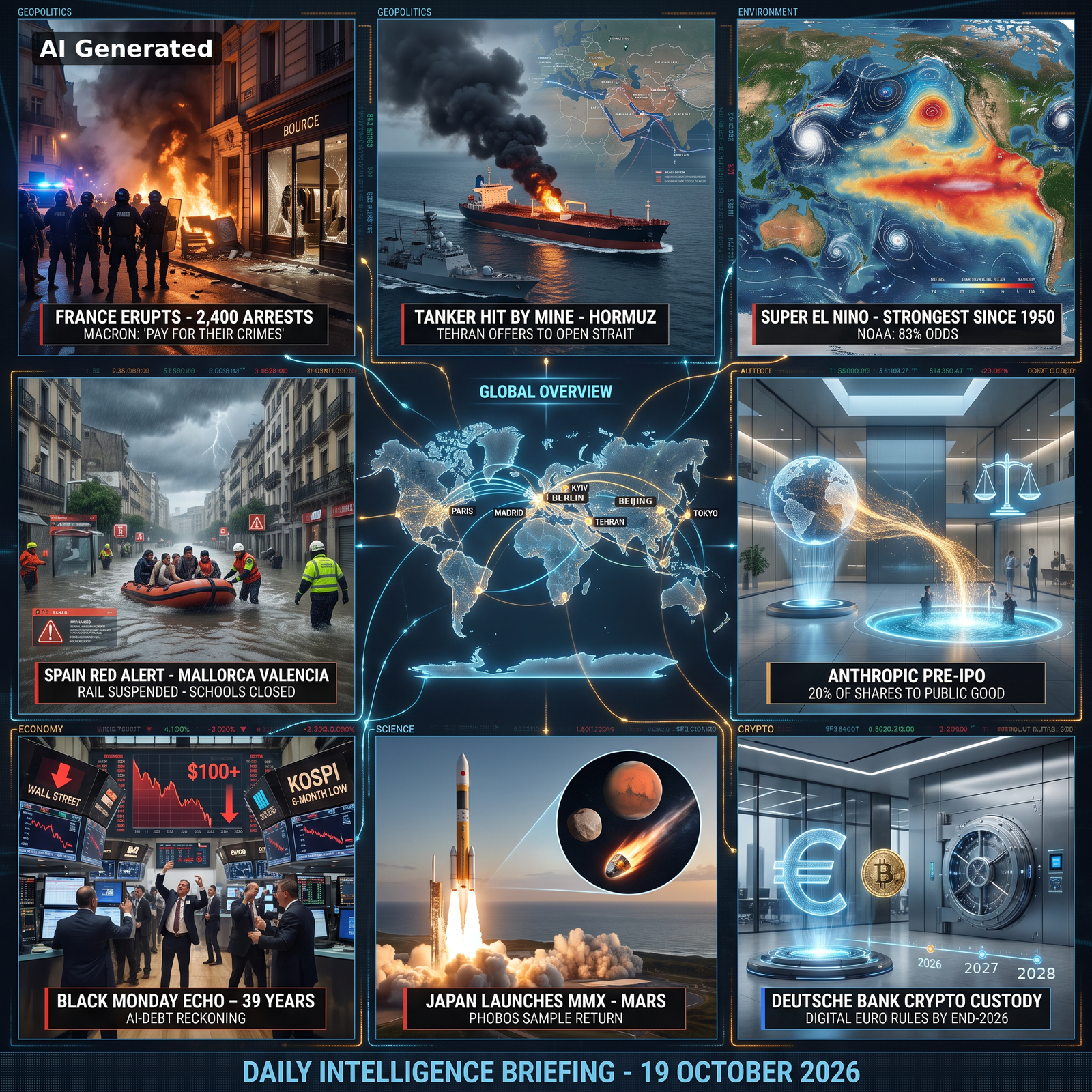
France moved from protest to insurrection this weekend. President Emmanuel Macron’s televised address on Sunday mixed “anger and shame” with a promise that rioters and looters would “pay for their crimes,” as official tallies put arrests at roughly 2,000 to 2,400 across the country [1]. The political class has split: Macronists and Marine Le Pen’s far right converge on the reading that the unrest is engineered by the radical left of Jean-Luc Mélenchon, while the left accuses the government of abandoning social protection six months before presidential elections [2]. Interior-ministry figures of more than 1,200 arrests and 150 injured police underline the policing failure that preceded the looting of flagship Louis Vuitton, Hermès, Rolex and Apple stores in Paris, Marseille, Lyon and Bordeaux [3].
The international press has read the violence as the emblem of a state losing control of its streets at the worst moment of the electoral cycle, with Le Figaro’s review of foreign coverage describing a “country more fractured than ever” and its own Republic-place reportage documenting running battles between masked casseurs and CRS police, with pillaging continuing as the president spoke [4][5]. The unrest is not contained to France. Milan suffered a second day of riots by hooded groups, with shops smashed and at least 50 people detained [6]. In Albania, Prime Minister Edi Rama refused to resign on the sixth day of protests, blaming an “outside hand” while the government reported 272 injured, including 169 police [7]. The CEO of Lacoste’s parent Maus Frères issued an unusually direct appeal — “I refuse to stay silent” — as stores are looted and police targeted [8]. The synchronised street wave across France, Italy and the Balkans is the gravest challenge to continental social stability since the gilets jaunes.
Ukraine’s Front Signals: Zaporizhzhia, Lyman and the Black Sea
Russia opened another night of missile attacks on Kyiv, killing a 21-year-old woman and wounding two others while damaging a metro station and a medical centre [9]. A command-level war of narratives broke out over the distance to Zaporizhzhia: Chief of the General Staff Valery Gerasimov told Putin that forces had taken Malokaterynivka and stood five kilometres from the city, while Zelensky retorted that Ukrainians were destroying the Russians at twenty kilometres and the front remained strong. Geolocated video showed Ukrainian units inside Malokaterynivka, and mapping puts the contact line 20–25 kilometres out — evidence that Moscow’s “flag-planting” has outpaced physical control [10]. Around Lyman, Russian forces claimed the capture of Yampil and Zarichne on the Zherebets river, threatening the rail hub of Lyman and, from the north, Sloviansk, though frontline accounts concede the defenders are well-entrenched and drones relentless [11].
The Black Sea has become a contested killing zone: a swarm of Russian Geran-4 jet drones and Lancet munitions struck a Turkish-interest cargo ship Moscow claimed was carrying military cargo to Ukraine [12], while Romania scored a first by shooting down two UAVs over its territorial waters days after a drone attack on two chemical tankers left seven sailors missing [13]. Ukraine answered with deep strikes on the Russian drone industry, hitting the Roboavia facility in Rostov that builds AI-equipped Klin kamikaze drones and Sarych-2 reconnaissance drones [14].
The rupture between Washington and Kyiv is now open hostility: Trump has accused Zelensky of not wanting to end the war, calling Ukraine “in shambles” [15], while Zelensky called Putin “a murderer” on NBC and warned against concessions [16]. Putin has reportedly proposed a trilateral summit with Trump and Xi Jinping at the Shenzhen APEC gathering in November, excluding Zelensky — a framework that alarms Kyiv and its allies [17]. Russia’s hybrid methods are generating friction inside Ukraine too: “busification,” illegal forced conscription, has provoked public anger, while reporting documents an active anti-Putin sabotage campaign run from within Russia in support of Ukrainian intelligence [18][19].
The Gulf’s Defensive Arithmetic and Moscow’s Diplomatic Surge
The Strait of Hormuz remained the maritime war’s epicentre: Iran’s Revolutionary Guard reported that an oil tanker struck a sea mine and caught fire, even as Tehran publicly offered to open the waterway [20]. Iran’s foreign minister accused Netanyahu of seeking more war before Israeli elections as fighting flared in Yemen [21]. Egypt’s National Defence Council has reportedly approved deploying troops to support Saudi Arabia against Iran-backed Houthi forces pressing toward Aden [22]. France is moving in the same direction: Foreign Minister Barrot arrived in Riyadh to confirm solidarity over Houthi attacks, and Macron will tour Kuwait, the UAE, Bahrain and Qatar from Monday to secure “diesel and oil” supplies [23].
Netanyahu used a presentation of Israel’s multi-year security strategy to signal restraint toward Turkey while preparing for every scenario, placing Greece, Cyprus, India and the UAE in the friendly camp and grouping Turkey with Pakistan, Egypt and Saudi Arabia in the “Mecca Accord” [24]. Trump, for his part, endorsed Netanyahu as “the kind of partner the United States asks of Israel” ahead of Israeli elections [25]. Moscow shored up its southern flank with a surprise visit by Foreign Minister Lavrov to Tehran to coordinate bilateral agreements [26].
Alliances, Arsenals and the Indo-Pacific Perimeter
Secretary of State Marco Rubio opened a strategic Central Asia tour in Samarkand, meeting the five former Soviet republics where China is now the dominant trading partner, before flying to India with a 200-strong business delegation, a senior official saying a trade deal is “very close” [27]. Taiwan and the Philippines are deepening maritime cooperation in the face of Chinese pressure [28], and Australia’s destroyer HMAS Sydney completed an Indo-Pacific deployment with live missile firings at RIMPAC and South China Sea presence operations [29].
The defence-industrial ledger turned over several entries: UK firm Stratonex unveiled the VARAN autonomous UGV, a 500 kg-payload platform navigating with passive cameras to reduce its electromagnetic signature under electronic warfare [30]; the US Navy faces the “long goodbye” of its Los Angeles-class submarines, 24 hulls still in service as reactors near end-of-life [31]; Peru’s submarine Pisagua began a 109-day SUBDIEX deployment [32], Paraguay concluded its Tebicuary exercise [33], and Chile is debating how to turn satellite capability into strategic knowledge [34]. Beijing is studying the Pentagon’s Project Meridian — co-chaired by Musk, Luckey and Gingrich — with a think tank urging adoption of the model while warning about conflicts of interest [35].
Peripheral Fronts and the Home Front
Canada reeled from one of the worst peacetime tragedies in its military’s history: four soldiers were killed and nineteen are critical after a fire and explosion at CFB Wainwright, with an internal memo revealing fire risk had been judged low before a sudden wind shift [36][37]. Prime Minister Carney called it a day of mourning, and Albertans vote Monday on whether to hold an independence referendum [38]. In Brazil, the run-off campaign descended into a televised war of insults between Lula and Flávio Bolsonaro ahead of the 25 October vote [39].
In Washington, Obama condemned the investigation of Representative Ilhan Omar as “appalling” [40], and prosecutors indicted a California woman on charges of spying for China, allegedly targeting a son of Taiwan’s president [41]. Somali piracy is staging a quiet return as anti-piracy crackdowns squeeze coastal fishermen [42], and the Polisario Front has contested the methods of UN envoy de Mistura over Western Sahara [43]. Greece underscored its red lines as seabed surveys for the Crete–Cyprus electricity interconnector resumed, with Gerapetritis warning Athens will “say the big OXI” again if needed [44]. A Tel Aviv-to-Vienna Austrian Airlines flight was diverted to Sofia over a bomb threat, escorted by a Bulgarian MiG-29, all 51 passengers and six crew safe [45].
Environment & Climate ↑ Contents
A Super El Niño Takes Shape and the Cryosphere’s Ledger
The strongest El Niño since 1950 is consolidating across the Pacific, with NOAA putting the odds of a strong-to-very-strong event for October to December at 83 percent and keeping an advisory in force through January-March 2027. NASA’s sea-level satellites show the eastern Pacific running up to 1.3 feet higher in places as Kelvin waves push warm water toward South America, while the PACE satellite records the equator turning measurably bluer as phytoplankton thin out across millions of square miles [46]. NOAA’s US outlook accordingly favours a wetter South and warmer North this winter. In the cryosphere, a new model in Nature Communications, checked against 27 years of satellite records, projects that West Antarctica’s Thwaites Glacier could add up to 1.2 inches to global sea level by 2100 — roughly double earlier ensemble estimates — because warm modified Circumpolar Deep Water is penetrating a kilometres-wide grounding zone, not a sharp line, and lifting the ice from beneath on the tides. Thwaites alone holds the equivalent of about 60 centimetres of sea-level rise [47].
The Iberian Storm and the Hemisphere’s Extremes
Spain entered another acute weather emergency as severe storms lashed the Mediterranean seaboard. AEMET issued red alerts for Mallorca and Valencia — the region of the 2024 fatal floods — after a woman was swept away by a torrent near Barcelona and found dead on Sunday. Schools closed across the Balearics, rail was suspended in Valencia, flights were cancelled or diverted at Ibiza’s airport, and the military was deployed to the islands, while Andalusia logged 37 rescues in 48 hours including ten people trapped in a flooded tunnel near Málaga [48]. In Southeast Asia, the BBC reported from central Kalimantan, where a toxic haze fuelled by wildfires is choking millions in Indonesian Borneo [49]. The Atlantic is also waking up: gales are possible later in the week as a deep low crosses the UK [50], and Vietnam’s Ho Chi Minh City is confronting chronic flooding that tests one of Asia’s fastest-growing urban economies [51].
Climate Policy’s Rollback and the Energy-Transition Front
UN Secretary-General Guterres urged governments to stop propping up fossil fuels, calling it “subsidizing suicide”, just as a report showed COP31 hosts Türkiye and Australia are simultaneously expanding their fossil industries [52]. In the United States, clean-energy employment fell in 2025 for the first time in years under the returning Trump administration, and many expected jobs will not materialise because of cancelled projects [53]. The administration has also formally asked to reconsider the construction permit it issued to an offshore wind project off Ocean City, Maryland [54]. The transition’s industrial face is nonetheless advancing: the Paris Auto Show marked a European OEM counter-attack against the confident stands of BYD, Geely and XPENG [55], and analysts argue electrification is redefining “energy security” from securing depletable fuels to securing the grid, minerals and manufacturing [56].
The Adaptation and Resilience Ledger
Adaptation gaps are becoming measurable. Pennsylvania’s aging prisons were not built for today’s extremes, leaving women and older inmates disproportionately vulnerable to heat and cold [57]. Arizona has moved to join a lawsuit against the federal Colorado River plan, warning it could dry up the Central Arizona Project serving nearly six million people [58], while Maine — despite recent rain — has drought in every county, squeezing the harvest and driving dry-well reports [59]. Even insulated institutions are preparing: New York City’s houses of worship are taking climate-readiness audits [60], and Colorado animal-control agencies report drought and heat are drawing more bears, coyotes and mountain lions into contact with humans [61]. Two ecological stories point to nature-based adaptation. In the Cambridgeshire Fens, scientists grew the UK’s first rice crop in four flooded paddies near Ely during the record-hot 2025 summer, a trial that could help farmers keep the region’s fast-disappearing peat soils wet while cutting carbon loss [62]. Off Mozambique, divers found that three submerged peat reefs — remains of coastal forests up to 5,000 years old — host 26 to 36 species of juvenile reef fish each, acting as nurseries in an ecosystem with almost no other hard substrate [63].
Society & Civil Issues ↑ Contents
Britain’s Civic Ledger: Youth, Transport and the European Question
The UK’s social state is under visible strain. Andy Burnham called the plight of roughly one million young people not in work, education or training a “moral failure” and warned of “economic catastrophe” [64]. On transport, a national “share the carriage, not the noise” campaign could see passengers who play music out loud on buses fined up to £100 [65]. The constitutional question returned when the Institute for Public Policy Research urged Britain to make EU membership its medium-term goal, a blueprint handed to Burnham, the most prominent pro-rejoin figure in Labour politics [66]. Housing costs continue to bite: newly agreed rents across Britain rose 2.7 percent annually in September, the fastest pace in nearly two years [67]. The digital civic ledger is also darkening: trading-standards officers warn AI is “super-charging” scams through voice cloning, deepfakes and fake websites [68].
Culture, Copyright and the Algorithm
The global music-publishing industry warned Australia that AI has already been trained on the works of artists including Kylie Minogue and Nick Cave without compensation, and that among countries approached by tech firms to weaken copyright law, Australia appears to be the only one considering it — a “strong-arming” that would make it a global outlier [69]. Australia’s integrity institutions are being reshaped from within: former attorney-general Robert McClelland was named head of the National Anti-Corruption Commission after Paul Brereton quit in May [70]. A separate inquiry into a February Sydney protest against Israeli President Isaac Herzog’s visit has found the protesters “largely peaceful”, with “limited evidence of physical violence” by demonstrators, while examining allegations of excessive police force including OC-spray use and officers boasting about gratuitous force on bodycam [71].
Germany’s Coalition Arithmetic and the Civic Square
Berlin’s would-be governing coalition is testing the limits of the consensus state. Defence Minister Boris Pistorius attacked plans by Berlin’s Left, Greens and SPD to end Bundeswehr cooperation with city schools as “completely incomprehensible” [72]. The Greens and SPD are separately deciding whether to open coalition talks with the Left, which became Berlin’s strongest party on 20 September with 25.7 percent; twenty SPD Bundestag members signed a declaration against such a coalition, citing the Left’s antisemitism conflicts, clan-milieu contacts and ties to extremist actors, while the most contested proposal — expropriating roughly 160,000 apartments from five housing corporations for compensation capped at €16 billion — would be unprecedented in Germany and is already rejected as the “dumbest” option by the CDU [73]. The backdrop is stark: a new IW study puts Germany’s median net household income at €2,419 a month for a single person, defining relative poverty at 60 percent and relative wealth at 250 percent of that figure [74].
Migration and the Greek Files
Europe’s migration machinery continues to generate news at both ends. Ireland flew 24 Romanian men out on criminality grounds under the Free Movement Directive, with the justice minister insisting “there must be consequences” [75]. Greece’s islands remain at the sharp end: migration flows surged in Crete, forcing gradual decongestion as 76 migrants were moved by bus from Heraklion to Rethymno, with local authorities under sustained pressure [78]. Athens is moving to legislate against “mass dormitories” for migrants in the city centre — capsule bed-sharing rentals at €10-30 a night that the ministry says enable exploitation, illegal residence and tax evasion [79]. The demographic pressures underneath are global: Beijing is becoming a “super-aged society”, with a third of residents projected to be 60 or older, as China spends an estimated 180 billion yuan (about €24 billion) this year on pro-natalist measures [76]. A magnitude 3.4 earthquake off Rafina was felt across Attica without damage [77], and France’s Guadeloupe imposed a curfew on minors after violence flared in the margins of cost-of-living protests [80].
Justice, Health and Public Safety
France’s justice system is processing the fallout of organised crime and social disorder simultaneously: the trial in Aix-en-Provence over the assassination of the brother of anti-drug activist Amine Kessaci opened under heavy security [81], and a new study warns that the convergence of gambling and video games is encouraging risky behaviour among minors [82]. The student unions, furious at Macron’s address, declared the president “off the mark” [83]. In Greece, the two men killed when a single-engine aircraft crashed in Pieria included a highly experienced Canadair firefighting pilot, with initial assessments pointing to a stall and uncontrolled spin during a low pass [84]. A year after thieves stole roughly $100 million of crown jewels from the Louvre, four suspects remain jailed but the treasures — including jewellery of Empress Eugénie — are still missing [85]. Kenya confirmed its eighth Ebola case amid a widening regional outbreak [86].
America’s Civic Files
The American civic calendar, weeks from midterms, continues to produce governance stories with a human edge. A new report reveals how short a leash Trump keeps on his personal physician, with a strict proximity rule in force despite glowing public medical reports [87]. In Massachusetts, the Republican lieutenant-governor candidate suspended his campaign hours after being arrested in a suspected drunk-driving crash [88].
AI & Technology ↑ Contents
Anthropic’s Pre-IPO Public-Benefit Pivot
Anthropic moved to lock in its distinctive governance identity on the eve of a public offering, committing 5 percent of its shares to a new Anthropic Public Benefit Fund. Combined with the founders’ pledge to donate 80 percent of their wealth and an employee equity-donation match, roughly 20 percent of the company’s shares will now be dedicated to the “public good”, a figure that can grow with valuation milestones. The fund’s charter explicitly contemplates large donations to traditional nonprofits or direct distributions to specific populations, with labour-market disruption a named priority — AI job impacts may demand “bolder approaches” than the $200 million already committed to studying them [89]. The timing is deliberate: with an IPO planned as soon as November, the announcement frames the listing as a vehicle for channelling model-scale wealth into social insurance, a governance innovation rivals will be pressed to match. The policy argument was reinforced the same day by Anthropic’s Jack Clark, who told US policymakers that AI is improving so rapidly it could “vastly boost” GDP — implicitly justifying both the technology’s capital intensity and the need for a social safety net built in advance of displacement [90].
Proof-of-Humanity and the Deepfake Counterattack
The race to authenticate humans in an AI-saturated internet produced its most concrete product yet: World — the proof-of-humanity network co-founded by Sam Altman — launched World ID for banking and finance at Money20/20, a suite helping institutions verify that customers, employees and AI agents are who they claim to be. Design partners include OpenExchange, Bain Capital and VanEck, with World ID for Zoom achieving general availability. The offering rests on a three-tier verification ladder (Proof of Attributes, Proof of Presence, Proof of Human) and more than 18 million existing holders, and arrives as Deloitte projects AI-enabled fraud in the US could reach $40 billion by 2027 [91]. The privacy case for iris-scanning orbs rests on cryptography — identity is encrypted and decentralised, with no central database — but the deeper signal is that verification is becoming infrastructure. The trend has a visible failure mode: Meta blamed a high-volume Claude AI tool used by the No Kings Coalition for erroneously suspending its Instagram account during the “No Kings: Vote Early” day on 17 October, when roughly 3,000 events were underway across all 50 states; the account was dark for 90 minutes and administrators locked out for hours, and Meta conceded the action was unintentional after organisers rejected its first explanation [92]. It is a case study in how AI-moderated platforms can break civic infrastructure precisely when it matters most.
Washington’s AI Czar and the Surveillance Perimeter
The Trump administration formalised its answer to AI governance by naming Director of National Intelligence Jay Clayton as AI czar, chairing a new task force called the Super Intelligence Force (SIF). Announced 4 October, the SIF is a 120-day effort to cement US dominance in “super intelligence”, identify risks, and improve incident reporting and preparedness — while explicitly avoiding overregulation, with former AI czar David Sacks and Condoleezza Rice among its advisors. A wrinkle reported by Punchbowl — that FTC Chair Andrew Ferguson may effectively steer the group — underscores the unresolved question of which agency owns AI enforcement [93]. The 120-day report clock is the number AI companies should watch: if the SIF recommends mandatory disclosure of AI failures, it adds a compliance layer and gives Washington visibility it currently lacks. At the civilian periphery, the surveillance perimeter keeps widening: a former Savannah police officer was fired for giving her Flock licence-plate-reader login to her ICE-agent husband, who conducted 983 searches across 97 plates overwhelmingly registered to Hispanic drivers — a concrete demonstration of how police-owned data infrastructure can leak into immigration enforcement through human relationships rather than formal agreements [94].
Economy & Business ↑ Contents
China’s Q3 Growth: The Export-Investment Divergence
China’s third-quarter GDP grew 4.5 percent year on year, beating the 4.4 percent forecast and accelerating from the second quarter’s 4.3 percent, with quarter-on-quarter growth of 1.2 percent against a 0.9 percent consensus [95][96]. The headline masks a deepening divergence: industrial output rose 5.5 percent and retail sales just 1.1 percent, while fixed-asset investment contracted 7.2 percent year to date and urban unemployment fell to 5.2 percent [97][98][99][100]. Officials stressed that consumption accounted for 46.7 percent of January-September growth and that high-end manufacturing and the digital economy contributed more than 40 percent, but the durable weakness in property and household demand is the structural story [101][102]. New-home prices fell again in September as the recovery remained elusive, underscoring why Beijing’s 4.5-5 percent target still depends on exports that are themselves generating trade friction [103]. That friction is collateralising into third countries: the boss of one of Ukraine’s biggest steel companies says Kyiv has been “bundled together” in EU measures aimed at cheap Chinese imports [104].
Germany’s Investment Gamble: The Berlin Summit and the Nvidia Bet
Germany is rolling out the red carpet for global capital with a two-day “Invest in Germany Summit” in Berlin, with Chancellor Merz hosting roughly 200 CEOs, half the cabinet, and Nvidia’s Jensen Huang as the “star guest” of a planned government cooperation on industrial AI. The summit is a “welcome signal” after Allianz Research found German investment fell 6.4 percent between 2019 and 2025 while it rose 20.2 percent in the US [105]. Sentiment is turning: 86 percent of German CEOs now expect growth in the next three years, up 14 points year on year, with 77 percent naming AI a top investment priority — though regulation, geopolitics and a weak world economy remain the biggest cited risks [106]. BlackRock CEO Larry Fink sharpened the challenge, telling Handelsblatt Germany does not invest enough in AI and must compete harder for capital [107]. The coalition’s reform agenda remains contested: CDU and SPD group leaders back pension reform but disagree on timing, with SPD whip Matthias Miersch warning against an “eyes shut and push through” approach [108]. The credit machinery is moving below the headline: fintech Iwoca secured €185 million in new lines from ABN Amro and Neuberger after German lending more than doubled [109], new data show how much longer it now takes to sell property in Germany’s pricier cities [110], and even Ryanair — cutting capacity in Berlin, Bremen and Hamburg over costs — is expanding at the cheaper southwest airports of Memmingen and Karlsruhe/Baden-Baden [111].
Markets and the AI-Debt Reckoning
Wall Street entered Monday — the 39th anniversary of the 1987 Black Monday crash, which falls on the same weekday — with oil above $100, AI stocks buckling and September CPI at 3.7 percent. Social media is drawing the parallel, but modern circuit breakers (7, 13 and 20 percent halts) did not exist in 1987, and Friday’s selling was concentrated in technology. Still, CoreWeave’s near-12 percent drop, with some debt yielding around 15 percent, focused attention on whether the AI infrastructure boom’s financing is sustainable [112]. The question is no longer theoretical in Asia: South Korean stocks slid as DeepSeek’s V4.1-Flash model — claiming a quarter of the high-bandwidth memory of its predecessors at inference — drove Samsung and SK Hynix down 9-11 percent and the KOSPI to a six-month low [113]. London is flashing the same anxiety: 17 percent of listed firms have issued a profit warning in the past year, the highest share in two years, ahead of the autumn Budget [114]. A phys.org analysis distilled the dynamic into one question: the AI boom increasingly resembles a circular money machine in which the same companies are supplier, investor and customer of each other’s infrastructure [115]. Corporate deal flow continues regardless — Brookfield’s $2.53 billion bid for Reliance Worldwide cleared its “go shop” period with no rival offer [116], activist Oasis is threatening an EGM to revamp Nidec’s board [117], and eBay’s boss warned the planned Budget reform making marketplaces directly liable for VAT must not unfairly hit small businesses [118]. In a signal of the era’s distrust, central banks are reshuffling their gold: France removed all of its gold from the New York Fed between 2025 and 2026, the Dutch central bank moved 78 tons to London, and lawmakers in Germany and Italy are demanding repatriation from the US [119]. Even Silicon Valley’s storied firms feel the shift: Benchmark’s five partners insist there is “no agenda, no rush” in a market many fear is frenzied [120].
Science & Space ↑ Contents
The Quantum and Materials Frontier
Physicists at the University of Illinois at Urbana-Champaign have found compelling evidence of a previously theoretical state of matter — pair density waves (PDWs), where Cooper pairs of electrons arrange into wave-like patterns — persisting on the surface of uranium ditelluride above the temperature at which superconductivity disappears, something never observed before. Using a vector-magnetic-field scanning tunnelling microscope on high-quality crystals, the team tracked the charge patterns responding to field and temperature exactly as PDWs should, deepening understanding of how Cooper pairs exist outside the conventional superconducting state and pointing toward higher-temperature superconductors [121]. In quantum computing, RIKEN researchers and partners reported that silicon spin qubits can maintain their precision while working together, opening a credible manufacturing path — using established chipmaking technology — to larger quantum processors [122]. A University of Oxford-led study identified two niobium-titanium alloys that refuse to crack even at -424°F by forming new crystal defects as they deform, promising tougher metals for cryogenic applications from spacecraft to MRI magnets [123]. Even Chernobyl still holds surprises: four decades after the disaster, researchers from Helmholtz-Zentrum Dresden-Rossendorf report some radioactive debris fragments are more resilient than expected, offering clues to when trapped material could escape into the environment [124].
Spaceflight and the Planetary Frontier
Japan is about to launch its most ambitious planetary mission to date: an H3 rocket from Tanegashima will carry the Martian Moons eXploration (MMX) probe toward Mars, where it will orbit Phobos, land, collect at least ten grams of regolith and return them to Earth — the first round trip to the Martian region. Developed with ESA and NASA, the mission aims to resolve how the Martian moons formed and whether Phobos could host a staging post for crewed Mars exploration [125]. The moon’s utility as infrastructure extends to timekeeping: delegates to the International Bureau of Weights and Measures are pressing for an agreed lunar time standard, without which cislunar navigation and surface operations become dangerously ambiguous [126].
Life’s Molecular Ledger and the Human Body
Medical science delivered two findings with direct clinical relevance. A small randomised trial in Radiology found that ultrasound-guided saline hydrodissection — injecting saline around the trapped median nerve — relieved carpal tunnel symptoms for six months, longer than a steroid injection, with measurable reductions in nerve swelling, suggesting the tissue-separation itself, not medication, drives the benefit [127]. A 51-study umbrella review in BMC Medicine found the only blood-group-disease association to survive rigorous statistical testing is a roughly 28 percent higher risk of type 2 diabetes in people with blood type B, a modest effect dwarfed by lifestyle factors but consistent enough to be credible [128]. In basic neuroscience, Northeastern University researchers mapped how nearly every chemosensory neuron in the roundworm C. elegans responds differently to chemical signals depending on sex, showing that sex differences in brain function are pervasive, stimulus-dependent and distinct from differences in synaptic wiring [129].
The Deep Archive: Archaeology, Ancient DNA and the Ice Age
The deep human archive produced several striking entries. At White Sands National Park in New Mexico, USGS-led researchers extended a footprint trench to reveal 152 human prints in 20 track layers dating to 23,500-21,700 years ago, the height of the last ice age — and pollen from the same sediments shows the pine forest those walkers crossed gave way to pinyon and juniper within about a century, documenting abrupt climate shifts early Americans witnessed within a lifetime [130]. In Alaska, University of Kansas archaeologists at the Shég’ Xdaltth’i’ site above the Tanana River recovered more than 80,000 objects from three occupation layers between 13,800 and 12,700 years old, including diamond-shaped points matched only on the Russian side of the Bering Land Bridge, evidence of a camp that hunted mammoth, bison and horse [131]. Stanford geneticists traced a 1,000-year-old DNA connection between Hawaii and Easter Island, finding globally rare disease-risk variants common enough among Eastern Polynesians to warrant screening — hidden genetic dangers carried across the Pacific [132]. Archaeologists also documented a faience workshop at the ancient Nubian capital of Napata, showing how the rulers of Kush used specialised craft production to reinforce royal power [133], while scientists warn that Earth’s earliest fossil evidence of life is at risk of disappearing [134]. Two museum discoveries rounded out the archive: a giant isopod collected off Puerto Rico in the 1980s and mislabelled for decades was identified as a new species, Bathynomus tuebingoborikensis, recognised only after micro-CT analysis [135]; and in western Arnhem Land, archaeologists documented 20 recently painted Rainbow Serpent images — one 6.88 metres long — arguing artists painted their most powerful Creation Being at unprecedented scale as colonisation upended their world [136].
The Applied Frontier: Materials and Water
Two applied-science stories point toward practical solutions to scarcity. Chemists at the University of Vienna showed that aromatic plastic wastes — packaging polystyrene, old CDs and even LEGO bricks — can be converted into polymer networks that adsorb water from air, capturing nearly 60 percent of their own weight from humid air and 20 percent in desert-like conditions, then releasing it under mild sunlight within about an hour — a route to atmospheric water harvesting from waste [137]. And a University of Kent analysis found the world may be far closer to its 30 percent land-conservation target than official tallies suggest, because many nationally protected areas are missing from global accounting — though gaps in grassland and shrubland protection show why acreage alone cannot safeguard wildlife [138].
Crypto, Digital Assets & Blockchain ↑ Contents
Institutional Custody and the Digital Euro’s Timetable
The institutionalisation of digital assets took another decisive step forward as Deutsche Bank confirmed plans to bring crypto custody to Asia in 2027 while its German launch is now expected within weeks. The bank’s corporate-bank co-head told Reuters the service will initially support bitcoin, ether and the stablecoins USDC, EURC and EURAU, with the bank managing clients’ wallets and private keys, and will be followed by stablecoin conversion, tokenized deposits and services helping clients issue digital bonds and other blockchain-based securities. The German launch received authorisation from BaFin under the EU’s MiCA rules on 12 October, and the Asia rollout is part of a plan to deliver roughly 8 percent compound annual revenue growth in the corporate bank from 2025 to 2028. Deutsche Bank joins Standard Chartered and BBVA in a fast-consolidating field of global custodians, and its choice to name EURC and EURAU alongside USDC signals that Europe’s euro-denominated stablecoin ecosystem is maturing in parallel with the digital-euro project [139]. That project, too, acquired a concrete timetable. ECB President Christine Lagarde told the IMF Annual Meetings that the euro area is “adamant” about advancing the digital euro as efficient digital cash, and that adopting the enabling regulation by the end of 2026 is “key”. The ECB will run a 12-month pilot in the second half of 2027 with 36 payment providers testing payments, merchant acceptance and offline functionality, aiming for a bloc-wide launch in 2028 or 2029. Lagarde framed the project explicitly as a defence of European monetary sovereignty against US-led stablecoins, warning that private money proxies could precede the “privatisation of money” and undermine monetary policy [140].
The SEC Tokenised-Stock Framework Meets Issuer Resistance
The SEC’s five-year “Innovation Exemption” for tokenized stocks is colliding with reality on Wall Street. Broadcom, Verizon and UnitedHealth are among nine issuers that have objected to trading their shares on OKXICE — the joint venture between OKX and NYSE parent Intercontinental Exchange that plans around-the-clock tokenized-stock trading on Uniswap v4 liquidity pools, settled in stablecoins on OKX’s XLayer chain, with underlying shares held one-for-one through a registered broker-dealer. Nasdaq has separately said it will opt out, arguing its shares should not trade on a venue that does not display best prices in real time or report to the consolidated tape. TD Securities analysts who canvassed dozens of issuers found “little interest in tokenizing their shares outside a small group of crypto-adjacent companies”, and identified the framework’s reliance on temporary exemptive relief — reversible by a future commission — as its largest structural hurdle [141]. The contrast with asset-management tokenization is stark. BlackRock has spent two months rewiring its plumbing on-chain: alongside BUIDL (now $2-2.5 billion across Ethereum and Solana), it launched BSTBL, a tokenized Treasury liquidity share class worth roughly $7 billion, and BRSRV, a stablecoin-reserve vehicle, both through Securitize; tokenized European money market funds totalling $311 billion on JPMorgan’s Kinexys; and seven tokenized model portfolios built with Ondo Finance — the first time an outside firm has tokenized BlackRock’s model portfolios. BlackRock is targeting $500 million in annual digital-asset revenue by 2030, a yardstick that will determine whether tokenization is a real business line [142].
Security, Enforcement and the Washington Vacuum
The security ledger recorded both a failure and a response. Layer-1 network Qubic halted operations after an attacker exploited weakly generated wallet seeds to drain roughly $1.4 million from more than 1,400 accounts. The vulnerability stemmed from browser-based seed generation using JavaScript’s Math.random() — unsuitable for cryptographic secrets — which Qubic has replaced with crypto.getRandomValues() in version 4.26.4. The project reports 87.1 percent of the stolen funds never left the network and remain frozen, while the rest sent to MEXC was frozen within about an hour, and validators will vote on a recovery plan — the latest in a chain of weak-seed exploits following Coldcard’s July disclosure [143]. Enforcement kept pace: HEX founder Richard Heart (Richard Schueler) was detained in an early-morning raid in Istanbul on 14 October, with police seizing $7.15 million in cash, firearms and ammunition across 15 addresses; Interpol had issued a Red Notice two years earlier at Finland’s request. The episode erased $246 million from HEX’s market cap. The same week, Starknet opened a vote to convert itself from an Ethereum layer-2 into a post-quantum layer-1, arguing AI’s improving mathematics could crack elliptic-curve cryptography before Ethereum’s own roadmap arrives; Standard Chartered pushed its stablecoin market-cap forecast to $2 trillion by 2030; and the European Banking Authority classified USDC as a significant e-money token under MiCA [144]. In Washington, the crypto-policy leadership has gone quiet at the worst possible time: Patrick Witt, executive director of the President’s Council of Advisors for Digital Assets, has departed for the private sector, following Bo Hines and Harry Jung. With no successor named, and Congress expected to revisit market-structure and tax legislation after the midterms, the White House enters its most consequential legislative window for digital assets without its designated coordinator — a vacuum the SEC and CFTC will fill in the interim [145].
Correlations & Analysis ↑ Contents
The reporting window of D141 completes the arc D138, D139 and D140 each named: the collapse of the distinction between announcement and event has become the organising principle of Washington’s diplomacy. Yesterday’s D140 brief documented Rubio framing the 60-day Russian-sanctions waiver as a period of “analysis” while Tehran escalated; today the rupture is total. Trump has branded Zelensky “foolish” [15], Zelensky has called Putin “a murderer” on American television [16], and Putin has responded by proposing a trilateral Trump-Xi summit in Shenzhen that excludes Kyiv [17]. When the men who would decide a war’s end cannot agree on whether its fourth participant is a partner or a pawn, the midterm election — three weeks away — becomes the clock against which every move is measured, exactly as D138 predicted when it noted the Pentagon’s delay of the Iran school-attack report until after the ballot.
A second arc, the European street, has escalated from the social crisis D139 named — France’s 17 October convergence of price anger and school anger — into a synchronised continental shock. The looting of luxury flagship stores in Paris, Marseille, Lyon and Bordeaux [3], the second night of hooded-group riots in Milan [6] and the sixth day of demonstrations in Albania [7] are not isolated outbreaks but a single pattern: cost-of-living fury, organised violence and a crisis of state authority six months before a French presidential election that the foreign press reads as a choice between extremes [4]. The Lacoste CEO’s intervention [8] and the student unions’ rejection of Macron’s address [83] bracket a government squeezed between the street and the bond market — the same fiscal-cum-social trap D140 identified when it covered the budget vote.
The geopolitical ledger shows a striking convergence around the Gulf. D136 through D140 tracked the Hormuz blockade and Yemen’s encirclement; D141 adds the mine-struck tanker and Iran’s offer to reopen the strait [20], Egypt’s troop approval for Saudi Arabia [22], Barrot in Riyadh and Macron’s four-nation Gulf tour for diesel [23], and Netanyahu’s public pivot toward a “Mecca Accord” world in which Turkey sits apart from Israel’s allies [24]. The through-line is that Washington’s midterm-driven withdrawal is being filled by middle powers — Egypt, France and the Gulf states — each hedging its own security. An Iranian academic’s public rebuke of Rubio’s Athens speech, insisting Tehran’s history be understood before its name is invoked, captures the mutual incomprehension at the heart of that system [146].
The economic narrative is dominated by one question the D137-D139 reports framed as the AI-debt reckoning: can the AI infrastructure boom’s financing survive an efficiency shock? D141 provides the sharpest evidence yet that it can wobble — DeepSeek’s claim that its model needs a quarter of the high-bandwidth memory of its predecessors sent Samsung and SK Hynix down 9-11 percent and the KOSPI to a six-month low [113], while CoreWeave’s Friday drop revived Black Monday comparisons on the crash’s 39th anniversary [112]. The circular-money-machine analysis [115] and Anthropic’s pre-IPO public-benefit pivot [89] are two responses to the same instability: one describes the circularity that makes the boom fragile, the other attempts to socialise its upside before the correction arrives. Germany’s investment summit, built around an Nvidia partnership and a “welcome signal” to global capital [105], is the clearest attempt yet by a European state to buy into the boom rather than be disrupted by it.
What to watch in the next reporting period: (1) whether Macron moves to restrict public gatherings and how the French street responds, and whether Milan and Tirana stay in phase with Paris; (2) whether the Putin-Trump-Xi framework hardens before the midterms and whether any European voice enters the room; (3) the first full trading day’s verdict on Black Monday fears, and whether the DeepSeek efficiency shock spreads from Korean memory stocks to US AI capex; (4) the digital-euro regulation timeline, Deutsche Bank’s German custody launch and OKXICE’s viability as issuer opt-outs accumulate; (5) NOAA’s November ENSO update and the first El Niño-driven winter impacts across the US South and Iberia. The D141 picture is of a world in which announcement and event, street and state, and capital and efficiency are all colliding at once — and in which no single actor, from Washington to Berlin to Beijing, appears to hold the dial.
References ↑ Contents
1. Macron addresses nation with ‘anger and shame’ after 2,400 arrested in violent protests by Express · Express ↑
2. Ausschreitungen in Frankreich: Fassungslosigkeit und Schuldzuweisungen (originally in German) by Tagesschau · Tagesschau ↑
3. Λεηλατήθηκαν όλες οι εμβληματικές φίρμες ρούχων στο Παρίσι (originally in Greek) by DefenceNet.gr · DefenceNet.gr ↑
4. ‘Un pays plus fracturé que jamais’ : la presse étrangère sidérée par les violences en France (originally in French) by Le Figaro · Le Figaro ↑
5. ‘Même si LFI passe, on continuera !’ : un dimanche après-midi à République (originally in French) by Le Figaro · Le Figaro ↑
6. Μιλάνο: Νέα επεισόδια από κουκουλοφόρους (originally in Greek) by DefenceNet.gr · DefenceNet.gr ↑
7. En Albanie, le premier ministre exclut toute démission au sixième jour de violentes manifestations (originally in French) by Le Monde · Le Monde ↑
8. Ξέσπασε ο CEO της Lacoste για το χάος στη Γαλλία (originally in Greek) by DefenceNet.gr · DefenceNet.gr ↑
9. Νέο μπαράζ ρωσικών πυραυλικών επιθέσεων στο Κίεβο: Νεκρή 21χρονη (originally in Greek) by ProtoThema · ProtoThema ↑
10. Σύγκρουση Ζελένσκι-Γκερασίμοφ για τα «5 χλμ. από τη Ζαπορίζια» (originally in Greek) by DefenceNet.gr · DefenceNet.gr ↑
11. Μέτωπο Λιμάν: Ρωσική προέλαση σε Γιαμπίλ και Ζαρίτσνε (originally in Greek) by DefenceNet.gr · DefenceNet.gr ↑
12. «Σμήνος» ρωσικών Geran-4 & Lancet χτύπησαν τουρκικών συμφερόντων πλοίο στη Μαύρη Θάλασσα (originally in Greek) by DefenceNet.gr · DefenceNet.gr ↑
13. Ρουμανικά F-16 κατέρριψαν για πρώτη φορά drones τύπου UAV (originally in Greek) by DefenceNet.gr · DefenceNet.gr ↑
14. Klin, Sarych-2 and Surprise: Ukrainian Forces Strike Drone Manufacturer Roboavia in Russia’s Rostov Region by Militarnyi · Militarnyi ↑
15. Ukraine : Donald Trump accuse Volodymyr Zelensky de « ne pas vouloir mettre fin » à la guerre (originally in French) by Le Parisien · Le Parisien ↑
16. Ζελένσκι κατά Πούτιν: «Είναι δολοφόνος» (originally in Greek) by DefenceNet.gr · DefenceNet.gr ↑
17. Breaking: Bitcoin Nears $82K As Russia’s Putin Invites Trump & Xi Jinping For Emergency Meeting by CoinGape · CoinGape ↑
18. Ukraine : la “busification”, l’enrôlement illégal d’hommes dans l’armée, crée des crispations (originally in French) by France 24 · France 24 ↑
19. Inside the shadowy world of anti-Putin sabotage from within Russia by BBC News · BBC News ↑
20. Liveblog Nahost: Revolutionsgarden: Öltanker trifft in Straße von Hormus auf Seemine und brennt (originally in German) by FAZ · FAZ ↑
21. Iran war live: Tehran says Netanyahu seeks more war; Yemen fighting flares by Al Jazeera · Al Jazeera ↑
22. Egypt approves troop deployment in support of Saudi Arabia by Crypto Briefing · Crypto Briefing ↑
23. Στον Κόλπο ο Μακρόν προς άγραν φτηνού πετρελαίου (originally in Greek) by Enikos · Enikos ↑
24. Νετανιάχου για Τουρκία: «Ελπίζω να μην φτάσουμε σε σύγκρουση» (originally in Greek) by DefenceNet.gr · DefenceNet.gr ↑
25. « C’est le genre de partenaire que les États-Unis demandent d’Israël » : Trump adoube Netanyahou (originally in French) by Le Parisien · Le Parisien ↑
26. Αιφνιδιαστική επίσκεψη Λαβρόφ στην Τεχεράνη για διμερείς συμφωνίες (originally in Greek) by DefenceNet.gr · DefenceNet.gr ↑
27. Στρατηγικής σημασίας για τις ΗΠΑ περιοδεία Ρούμπιο στην Κεντρική Ασία (originally in Greek) by Enikos · Enikos ↑
28. Taiwan, Philippines kindle maritime cooperation in face of Chinese pressure by Nikkei Asia · Nikkei Asia ↑
29. Australian destroyer HMAS Sydney completes Indo-Pacific deployment with live missile firings and South China Sea operations by Defence Industry EU · Defence Industry EU ↑
30. UK Develops VARAN Autonomous UGV Capable of Carrying Up to 500 kg by Militarnyi · Militarnyi ↑
31. The Los Angeles-class Nuclear Attack Submarine ‘Long Goodbye’ Is Going to Be Painful for the US Navy by 19FortyFive · 19FortyFive ↑
32. El submarino peruano B.A.P. ‘Pisagua’ se ejercitará 109 días con la Armada de EE.UU. (originally in Spanish) by Zona Militar · Zona Militar ↑
33. Las Fuerzas Armadas Paraguayas finalizaron el ejercicio ‘Tebicuary 2026’ (originally in Spanish) by Zona Militar · Zona Militar ↑
34. Chile mira al espacio: el desafío de convertir tecnología en capacidad estratégica (originally in Spanish) by Zona Militar · Zona Militar ↑
35. Chinese think tank calls for faster, more rigorous assessment of US defense technologies by Interesting Engineering · Interesting Engineering ↑
36. Canada : quatre morts et 19 blessés dans un incendie sur une base militaire en Alberta (originally in French) by Le Monde · Le Monde ↑
37. Fire risk was low before sudden wind shift sparked deadly base fire: CAF memo by Global News · Global News ↑
38. Kanadische Provinz Alberta entscheidet über Referendum zu Unabhängigkeit (originally in German) by Stern · Stern ↑
39. Brasilien: Lula und Bolsonaro überziehen sich in TV-Duell gegenseitig mit Vorwürfen (originally in German) by Stern · Stern ↑
40. Obama calls Trump officials’ investigation of Ilhan Omar ‘appalling’ by NBC News · NBC News ↑
41. California woman indicted on charges she was spying for China by NBC News · NBC News ↑
42. Kinship and surveillance: The return of Somali piracy by Al Jazeera · Al Jazeera ↑
43. Sahara occidental: le Polisario conteste l’envoyé spécial de l’ONU (originally in French) by France 24 · France 24 ↑
44. Γεραπετρίτης: «Το καλώδιο ηλεκτρικής διασύνδεσης θα προχωρήσει» (originally in Greek) by DefenceNet.gr · DefenceNet.gr ↑
45. Βουλγαρία: Αναγκαστική προσγείωση Austrian Airlines λόγω απειλής για βόμβα (originally in Greek) by Iefimerida · Iefimerida ↑
46. In the eastern Pacific, NASA satellites show seas up to 1.3 feet higher as NOAA gives the strongest El Nino since 1950 an 83 percent chance for October to December, and equatorial waters turn bluer by ECONEWS / NASA-NOAA · ECONEWS / NASA-NOAA ↑
47. In West Antarctica, a Thwaites Glacier model checked against 27 years of satellite records projects it could add up to about 1.2 inches to global seas by 2100, roughly double earlier estimates by ECONEWS / Nature Communications · ECONEWS / Nature Communications ↑
48. Sfodres kataigides sarwnoyn tin Ispania – nekri gynaika, plimmyres, kleista scholeia (originally in Greek) by Iefimerida · Iefimerida ↑
49. BBC visits wildfire front in haze-choked Indonesia by BBC News · BBC News ↑
50. Chance of storms this week as Atlantic jet stream roars into life by BBC News · BBC News ↑
51. Flooding tests Ho Chi Minh City’s growth ambitions by Nikkei Asia · Nikkei Asia ↑
52. ‘Subsidizing suicide’: UN chief urges governments to stop propping up polluting fossil fuels by Euronews · Euronews ↑
53. US clean energy jobs fell in 2025 for the first time in years by Canary Media · Canary Media ↑
54. Trump administration asks to reconsider Ocean City offshore wind permit by Maryland Matters · Maryland Matters ↑
55. Paris Auto Show — European OEMs Strike Back by CleanTechnica · CleanTechnica ↑
56. Electrification Changes What Energy Security Means by CleanTechnica · CleanTechnica ↑
57. Pennsylvania’s aging prisons weren’t built for today’s extreme weather by The Conversation · The Conversation ↑
58. Arizona moves to join lawsuit against federal Colorado River plan by Arizona Mirror · Arizona Mirror ↑
59. Despite recent rain, drought has reached all areas of Maine by Maine Morning Star · Maine Morning Star ↑
60. Houses of worship in New York City prepare for growing climate threats by Yale Climate Connections · Yale Climate Connections ↑
61. Animal control has always been tough work. Climate change is making it harder by 5280 Magazine · 5280 Magazine ↑
62. Scientists grew the UK’s first rice crop in four flooded paddies near Ely during the record-breaking summer of 2025 by ECONEWS / UKCEH · ECONEWS / UKCEH ↑
63. Off Mozambique, divers surveyed three peat reefs made of forest peat up to 5,000 years old, each holding 26 to 36 kinds of small fish with no living coral by ECONEWS / Scientific Reports · ECONEWS / Scientific Reports ↑
64. Burnham says youth employment and training crisis is a ‘moral failure’ by BBC News · BBC News ↑
65. People playing loud music on buses could face £100 fine by BBC News · BBC News ↑
66. Andy Burnham handed Brexit betrayal blueprint to rejoin EU with second referendum by Daily Express · Daily Express ↑
67. Newly agreed rents rise at fastest pace in nearly two years, index shows by The Independent · The Independent ↑
68. Don’t fall for this – how to protect yourself from AI scams by BBC News · BBC News ↑
69. Kylie Minogue songs already used to train AI as tech firms ‘strong-arm’ Australian government, music body warns by The Guardian · The Guardian ↑
70. Former Labor attorney general turned judge Robert McClelland named new anti-corruption boss by The Guardian · The Guardian ↑
71. ‘Limited evidence’ of protester violence at Sydney demonstration against Israeli president Isaac Herzog visit by The Guardian · The Guardian ↑
72. Berlin: Pistorius kritisiert mögliches Ende von Kooperation mit Bundeswehr (originally in German) by Die Zeit · Die Zeit ↑
73. Regierungsbildung: Zwei Parteien in Berlin entscheiden über Koalitionsgespräche (originally in German) by Stern · Stern ↑
74. Einkommens-Vergleich: Wann man in Deutschland reich oder arm ist (originally in German) by Stern · Stern ↑
75. ‘There must be consequences’ – 24 Romanian men flown out of Ireland on criminality grounds by Daily Express · Daily Express ↑
76. Beijing Daily: To ena trito tou plithysmou tou Pekinou tha einai 60 eton kai ano (originally in Greek) by Enikos / Beijing Daily · Enikos / Beijing Daily ↑
77. Seismos 3.4 Richter anoichta tis Rafinas (originally in Greek) by ProtoThema · ProtoThema ↑
78. Se exarsi oi metanasteftikes roes stin Kriti (originally in Greek) by Eleftheros Typos · Eleftheros Typos ↑
79. Bloko sta mazika ypnotiria metanaston (originally in Greek) by Eleftheros Typos · Eleftheros Typos ↑
80. En Guadeloupe, le préfet instaure un couvre-feu pour les mineurs (originally in French) by Le Parisien · Le Parisien ↑
81. Procès de l’assassinat du frère d’Amine Kessaci à Aix-en-Provence (originally in French) by Le Parisien · Le Parisien ↑
82. La convergence entre les jeux d’argent et les jeux vidéo favorise les comportements à risque des mineurs (originally in French) by Le Parisien · Le Parisien ↑
83. « Emmanuel Macron est à côté de la plaque » : les syndicats lycéens et étudiants en colère (originally in French) by Le Parisien · Le Parisien ↑
84. Tragodia tin Pieria: O moiraios eligmos pou odigise to aeroskafos sto edafos (originally in Greek) by DefenceNet.gr · DefenceNet.gr ↑
85. Louvre’s $100 million crown jewels still missing one year after daring heist by France 24 · France 24 ↑
86. Kenya confirms eighth Ebola case amid widening regional outbreak by Al Jazeera · Al Jazeera ↑
87. Trump keeps his doctor on a short leash. A new report reveals just how short by The Independent · The Independent ↑
88. Massachusetts GOP lieutenant governor candidate suspends campaign after arrest in car crash by The Independent · The Independent ↑
89. Anthropic commits 5% of its stock to a new ‘public benefit’ fund by Fortune / AP · Fortune / AP ↑
90. AI rapidly improving, could vastly boost US GDP, Anthropic’s Clark tells policymakers by Investing.com / Reuters · Investing.com / Reuters ↑
91. Zoom and big financial firms add ‘Proof of Human’ badges from Sam Altman’s World to stop fraud and deep fakes by Fortune · Fortune ↑
92. Meta blames AI tool for mistakenly suspending No Kings Coalition Instagram account by Crypto Briefing · Crypto Briefing ↑
93. Trump names Jay Clayton AI czar to lead new Super Intelligence Force by Crypto Briefing · Crypto Briefing ↑
94. A Savannah police officer gave her Flock login to her ICE agent husband by The Verge · The Verge ↑
95. China’s economic growth accelerates to 4.5% in third quarter by Investing.com / Reuters · Investing.com / Reuters ↑
96. Chinese GDP QoQ SA Actual 1.2% by FinancialJuice · FinancialJuice ↑
97. Chinese Retail Sales YoY Actual 1.1%; Industrial Output YoY 5.5% by FinancialJuice · FinancialJuice ↑
98. Chinese Industrial Output YoY Actual 5.5% by FinancialJuice · FinancialJuice ↑
99. China January-September fixed-asset investment declines 7.2% by FinancialJuice · FinancialJuice ↑
100. Chinese Unemployment Rate Actual 5.200% by FinancialJuice · FinancialJuice ↑
101. China stats bureau deputy head: consumption accounted for 46.7% of Jan-Sept GDP growth by FinancialJuice · FinancialJuice ↑
102. China stats bureau deputy head: new growth drivers account for over 40% of Jan-Sept economic growth by FinancialJuice · FinancialJuice ↑
103. China’s new home prices fall again in September as recovery stays elusive by Investing.com / Reuters · Investing.com / Reuters ↑
104. EU tariffs aimed at China hitting Ukraine, steel boss says by BBC News · BBC News ↑
105. Wirtschaftspolitik: Investitionsgipfel in Berlin – Merz rollt roten Teppich aus (originally in German) by Stern · Stern ↑
106. Umfrage: Firmenchefs werden erstmals seit Jahren optimistischer (originally in German) by Stern · Stern ↑
107. Interview: Blackrock-Chef Larry Fink: ‘Deutschland investiert nicht genug in KI’ (originally in German) by Handelsblatt · Handelsblatt ↑
108. Alterssicherung: Koalitions-Fraktionschefs für Rentenreform – aber unterschiedliche Zeitvorstellungen (originally in German) by Handelsblatt · Handelsblatt ↑
109. Fintechs: Iwoca holt ABN Amro und Neuberger an Bord (originally in German) by Handelsblatt · Handelsblatt ↑
110. Immobilien: Hier dauert ein Verkauf von Haus oder Wohnung jetzt länger (originally in German) by Handelsblatt · Handelsblatt ↑
111. Trotz Rückzug aus Deutschland: Warum der Südwesten für Ryanair attraktiv ist (originally in German) by Stern · Stern ↑
112. Wall Street Braces for Black Monday’s Return 39 Years Later by Bitcoin.com News · Bitcoin.com News ↑
113. South Korean stocks slide as DeepSeek model stokes memory chip demand fears by Crypto Briefing · Crypto Briefing ↑
114. UK profit warnings soar to two year high ahead of autumn Budget by The Independent · The Independent ↑
115. Who’s paying whom? The circular money machine behind the AI boom (or bubble) by Phys.org · Phys.org ↑
116. Brookfield’s $2.53 bn bid for Reliance Worldwide clears ‘go shop’ hurdle by Business Standard / Reuters · Business Standard / Reuters ↑
117. Oasis may seek extraordinary general meeting to revamp Nidec board by Nikkei Asia · Nikkei Asia ↑
118. eBay boss issues warning to Labour government over online tax crackdown by The Independent · The Independent ↑
119. Europe sent its gold to the U.S. for safe keeping during World War II. Central banks are now reshuffling their reserves by Fortune · Fortune ↑
120. No agenda, no rush, no leaving San Francisco: Benchmark’s partners on investing in a frenzied market by TechCrunch · TechCrunch ↑
121. New Form of Superconductor Behavior Discovered That We’ve Never Seen Before by ScienceAlert / PNAS · ScienceAlert / PNAS ↑
122. Quantum Computing Breakthrough Opens a New Path to Larger, More Powerful Processors by SciTechDaily / RIKEN · SciTechDaily / RIKEN ↑
123. Scientists Discover Metals That Refuse To Crack at an Astonishing -424°F by SciTechDaily / University of Oxford · SciTechDaily / University of Oxford ↑
124. Chernobyl’s Radioactive Debris Is Defying Scientists’ Expectations 40 Years Later by SciTechDaily / HZDR · SciTechDaily / HZDR ↑
125. Japan to launch historic round-trip mission to Mars moon by Phys.org · Phys.org ↑
126. What time is it on the moon? by NPR · NPR ↑
127. A Saline Injection Could Offer Longer Relief From Carpal Tunnel Pain by ScienceAlert / Radiology · ScienceAlert / Radiology ↑
128. One Blood Type Seems to Carry a Higher Risk of Type 2 Diabetes by ScienceAlert / BMC Medicine · ScienceAlert / BMC Medicine ↑
129. Tiny worm brains reveal surprising sex differences beyond neural wiring by Interesting Engineering / Current Biology · Interesting Engineering / Current Biology ↑
130. White Sands footprints date to 23,500-21,700 years ago; pollen shows pine forest turned to pinyon and juniper within ~100 years by ECONEWS / Science Advances · ECONEWS / Science Advances ↑
131. 13,800-year-old Ice Age Alaska camp reveals hunters who cooked, crafted and stayed by Interesting Engineering / Science Advances · Interesting Engineering / Science Advances ↑
132. A 1,000-Year-Old DNA Mystery Links Hawaii and Easter Island and Reveals Hidden Genetic Dangers by SciTechDaily / Stanford Medicine · SciTechDaily / Stanford Medicine ↑
133. Ancient Nubian temple faience workshop reveals links between craft production and royal power by Phys.org · Phys.org ↑
134. Earth’s oldest evidence of life is written in stone—but it’s at risk of disappearing by Phys.org · Phys.org ↑
135. A giant isopod brought from Puerto Rico in the 1980s sat in a Tübingen collection under the wrong name for decades – a new species by ECONEWS / Scientific Reports · ECONEWS / Scientific Reports ↑
136. Awunbarna in western Arnhem Land holds 20 of the 52 known recent Rainbow Serpent rock paintings by ECONEWS / Australian Archaeology · ECONEWS / Australian Archaeology ↑
137. Plastic waste to get second life as adsorbent for atmospheric water harvesting with new method by Interesting Engineering / Chem Circularity · Interesting Engineering / Chem Circularity ↑
138. The World May Be Much Closer to a Major Conservation Goal Than Scientists Thought by SciTechDaily / University of Kent · SciTechDaily / University of Kent ↑
139. Deutsche Bank targets Asia crypto custody expansion in 2027 as German launch nears by CoinDesk · CoinDesk ↑
140. Lagarde Advances Digital Euro to Defend EU Financial Autonomy by Bitcoin.com News · Bitcoin.com News ↑
141. SEC tokenized stock framework faces issuer pushback as Broadcom, Verizon object to OKX-ICE listing by CoinDesk · CoinDesk ↑
142. BlackRock pushes deeper into tokenization with funds, portfolios and stablecoin reserves by Crypto Briefing · Crypto Briefing ↑
143. Qubic freezes chain after attacker drains 1.4K wallets with weak seeds by Cointelegraph · Cointelegraph ↑
144. Richard Heart caught ‘off-guard,’ QDay gets even closer: Hodler’s Digest by Cointelegraph Magazine · Cointelegraph Magazine ↑
145. White House crypto head Patrick Witt exits, leaving leadership post vacant by CoinTurk News · CoinTurk News ↑
146. Iran: Panepistimiakos kathigitis apanta ston Roumpio gia tin omilia tou stin Pnyka (originally in Greek) by In.gr · In.gr ↑
AI Disclosure: This post was created with the assistance of artificial intelligence. The ideas, analysis, and opinions expressed are my own — AI was used to help compose, structure, and refine my personal notes and thoughts into the final written content. Images, videos and music featured in this post were also generated using AI tools, based on my own creative prompts and direction.