

Contents
- 1. Geopolitics & Defence
- Brazil’s First-Round Earthquake: The Bolsonaro Heir Leads the Incumbent
- Fairford’s Empty Apron: Bombers Home and Tehran’s Message Received
- Pyongyang’s Wave, Taipei’s Spy, and the Pacific Perimeter
- The Horn and the Red Sea: Declarations, Offensives, Explosions
- Ukraine’s Eastern Ledger: Stepnogorsk, Lyman and the Amur Crash
- Alliance Arithmetic and Aegean Friction
- 2. Environment & Climate
- The Climate-Legal Barometer: SCOTUS Takes the Boulder Case
- The Ocean and Cryosphere Ledger: Kelvin Waves and Ice-Floe Physics
- The Pacific Climate Calendar: Fiji’s Pre-Negotiations and a Warning on Pregnant Women
- The Electrification Ledger: UK EV Surge, a 27% Global Share, and the Chinese Push into Brazil
- The Grid Frontier: A 365-Metre Turbine and Louisiana’s Waiting Game
- The Resource and Water Ledger: Rare Earths, Data Centres, River Poisoning, Port Emissions
- Biodiversity’s Quiet Ledger: Coral Gene Banks, Wetland Restoration, and Early Migrants
- Solar’s 2030 Ambition
- 3. Society & Civil Issues
- Britain’s Civic Autumn: Gosport, the Greens and the Tories
- The Palestine Dossier: 500 Officials Against the E1 Plan
- Migration’s Two Directions: Myanmar’s Deportations and Japan’s Closed Door
- The Siberian Plague Watch
- Justice and the State: Hameln, a Seoul Care Home, and the Whistleblower’s Death
- The American Civic Ledger: The KKK’s Rebrand and Google’s £1bn Day in Court
- Germany’s Civic Week: Biermann’s Polemic at Home
- France’s Civil Files: Tours and the LinkedIn Verdict
- 4. AI & Technology
- 5. Economy & Business
- The Global Rate Cross-Current: Euro at 14-Month Lows and the BOJ’s AI Calculus
- The War Premium and the Oil Ledger: Gulf Flows Recover on a New Map
- Europe’s China Trade Arsenal: The Kill-Switch and the UK’s EV Tariff
- Asia’s Twin Pressures: India’s GST, China-Dependence and the Nikkei’s 70,000
- Germany’s Corporate and Property Ledger: IKB, Expo Real and Uber’s Robotaxi Bet
- Energy Supply’s New Front: Australia’s Gas Mandate
- 6. Science & Space
- The Nobel Week Opens on GLP-1 Expectations
- The Cosmic Ledger: Bennu’s Origin, Martian Water, W-State Entanglement, a Pulsar at Dinner
- The Human Body Ledger: Blood Pressure’s Brain Circuit, Ageing Muscle Signals and Cancer’s Paradox
- The Clinical Frontier: Histotripsy, Nanoneedles and the Translation Gap
- The Applied Ledger: Wallpaper Power, V2G and Whisky in Orbit
- The Deep Archive: Antarctica’s Unknown and Paracas’ Spearthrowers
- Life’s Curiosities: Cats and Happiness
- 7. Crypto, Digital Assets & Blockchain
- 8. Correlations & Analysis
- 9. References
Click any heading to jump to that section. Click the section heading to return to this menu.
Geopolitics & Defence ↑ Contents
Brazil’s First-Round Earthquake: The Bolsonaro Heir Leads the Incumbent
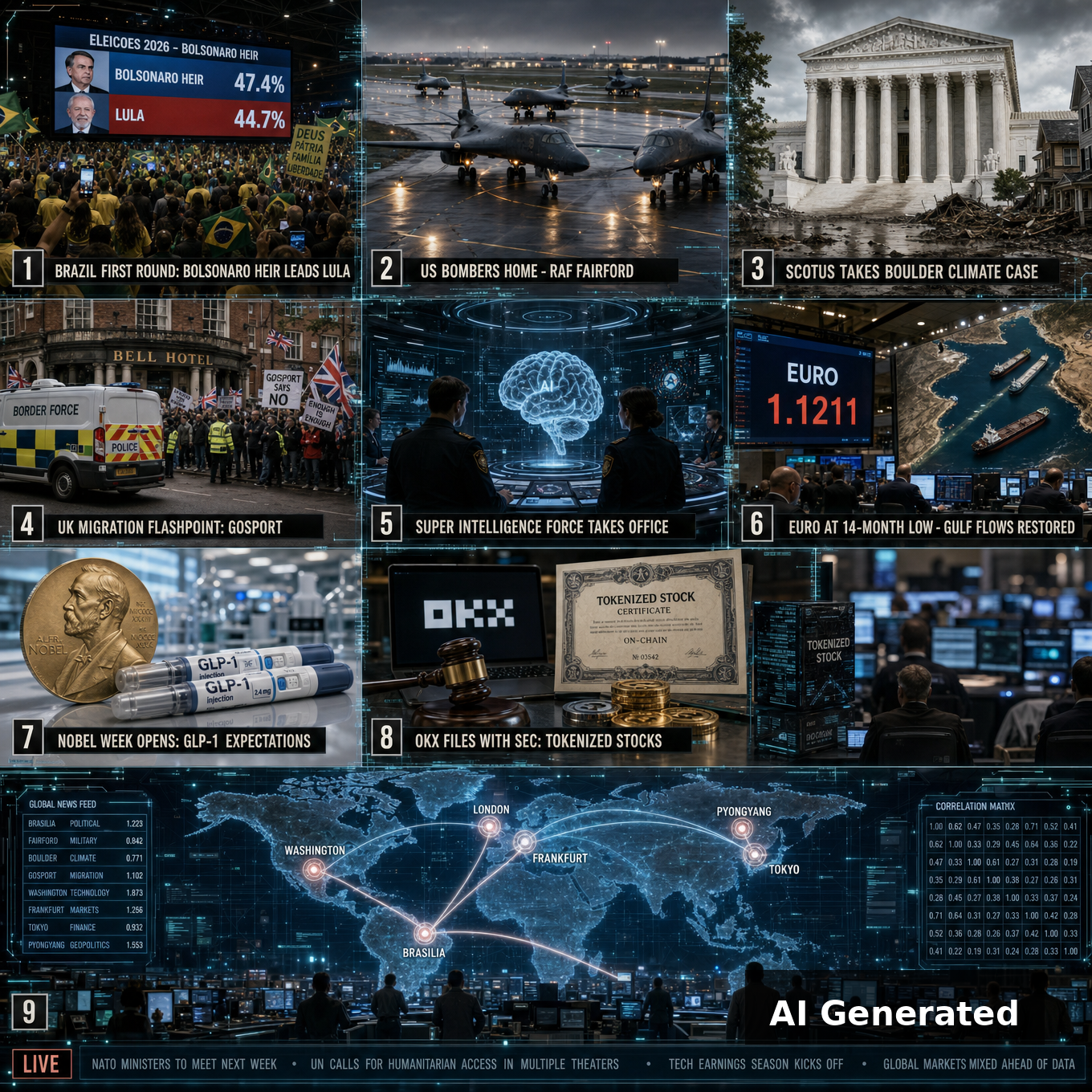
The defining event of the window is Brazil’s first-round result, which upended months of polling consensus and rewires the assumptions behind the “electoralisation of the war economy” thesis this report has tracked since D124. With nearly all ballots counted, Flavio Bolsonaro — the 45-year-old senator anointed by his father months ago — took 47.0–47.5 percent against Lula’s 44.7–45.2 percent, forcing a 25 October run-off the incumbent had expected to avoid[1][2][3]. The result is the first concrete payoff of the conservative wave Washington has cultivated across Latin America, giving the administration a direct stake in a run-off that will set Brazil’s course on the Amazon, Mercosur and the Washington–Beijing balance[2].
Lula’s public response — conceding the loss was “unexpected” while vowing that “in extra time we will win the Brazilian people” — masks a structural problem for the incumbency[4]. Abstention and the fragmentation of the centre-left let the Bolsonaro machine consolidate the protest vote, and the run-off now becomes the next calendared variable in the November midterm matrix this report has repeatedly identified as the master clock[4].
Fairford’s Empty Apron: Bombers Home and Tehran’s Message Received
The most consequential military movement is the hasty withdrawal of the entire US bomber force from RAF Fairford — the first time in months the hub hosts no American strategic bombers. All twelve B-1B Lancers departed in waves on 4 October, some leaving while aerial-refuelling aircraft were still scrambling, after commanders received new threat information about an Iran-linked plot against the base; at least three aircraft reached South Dakota by Sunday evening[5]. The Pentagon confirmed the redeployment but refused to characterise the threat, which the New York Times reported spiked in specificity within the preceding 24 hours[5].
US European Command’s statement — bombers remain ready to strike “from the continental United States” — is a confession dressed as reassurance[6]. Fairford was the principal European launch point for strikes in the Iran campaign; with its apron empty, the air bridge now runs across the Atlantic just as Washington positions a third carrier group for a post-midterm escalation the Wall Street Journal reports Trump expects to resume after 3 November[5]. The withdrawal also validates London’s assessment that the late-September arrests — five men over bomb-laden vans near the base, plus a dual British-Iranian national — were part of a coordinated Iranian campaign against UK territory[6].
Pyongyang’s Wave, Taipei’s Spy, and the Pacific Perimeter
North Korea added a new rung to its escalation ladder with a filmed launch, supervised personally by Kim Jong Un, of an intermediate-range ballistic missile fitted with a hypersonic glide vehicle that followed a distinctive “wave-like” trajectory over 1,000 kilometres into the Sea of Japan[7]. Japanese and South Korean radars failed to track the flight fully — Seoul initially misestimated the range at 700 kilometres — and analysts assess the launch as a modernised Hwasong-16B with at least four selectable approach paths designed to complicate terminal-phase interception[7].
The Pacific perimeter also produced new friction points. The FBI arrested a woman at Los Angeles airport as she attempted to depart for China, accusing her of spying on a son of Taiwan’s president — a rare, personalised espionage case showing how deep the cross-strait intelligence war reaches into American domestic space[8]. In parallel, the Royal Navy confirmed HMS Spey and HMS Tamar will enter the South China Sea for Exercise Bersama Lima 26 with Australia, Malaysia, New Zealand and Singapore; the ships have now maintained five continuous years of forward deployment, the first persistent British naval presence since 1997[9].
Operational tempo is taxing the carrier force that anchors these deployments: the USS Dwight D. Eisenhower suffered a deck accident when an aircraft could not be stopped by the arresting gear and plunged into the ocean, injuring four sailors and leaving the carrier temporarily out of service[10] — an awkward moment as the Theodore Roosevelt and the Makin Island group race to assemble the three-carrier Gulf posture promised by late October[10].
The Horn and the Red Sea: Declarations, Offensives, Explosions
Four African leaders — from Egypt, Eritrea, Somalia and Sudan — issued a joint declaration as the Ethiopian civil war escalates, calling simultaneously for talks to end the Sudan civil war and signalling a regional attempt to contain the Horn conflict D126 tracked from Mekelle’s fall[11]. The grouping matters less for its clauses than its composition: Egyptian–Eritrean–Somali alignment consolidates a block opposed to Addis Ababa’s ambitions.
On the peninsula, Yemen’s Saudi-backed government announced a military drive to retake all Houthi-held territory, hours after the Houthis reportedly cut a vital supply route to besieged Taiz[12]. The maximalist declaration exceeds the government’s demonstrated force, but it signals Riyadh is using Tehran’s diplomatic paralysis to settle accounts in Yemen. The maritime front supplied its own alarm: UKMTO reported multiple explosions near a tanker some sixty nautical miles south of Mukha in the Gulf of Aden, with the crew safe and no environmental damage reported[13].
Ukraine’s Eastern Ledger: Stepnogorsk, Lyman and the Amur Crash
On the Ukrainian front, the attrition war produced a picture of total destruction around Stepnogorsk, where Russian sources describe every fuel station and power-line pylon as struck and ground drones destroyed by mines — a tactical environment in which anything that moves is targeted from the air[14]. Logistics nodes have become artillery and drone kill-zones, making resupply the decisive constraint, the same dynamic documented around Lyman in D125–D126.
From the Lyman sector specifically come reports that Ukrainian forces are attempting to extract a unit of Canadian volunteer fighters from encirclement, with elements of the 3rd Azov Brigade tasked to break them out amid fears of a military disaster[15]. Foreign-volunteer casualties carry outsized political risk for Kyiv’s backers; a capture of Canadians would hand Moscow a diplomatic lever at a moment when Canadian aid volumes are contested.
Russia’s strategic bomber force suffered its own blow when a Tu-95MS crashed in the Amur Region during a training flight, killing six crew members including three officers identified by Ukrainian research as involved in organising cruise-missile strikes on Ukrainian infrastructure[16]. The crash — which killed the deputy commander for flight training of the 182nd Heavy Bomber Regiment and two squadron commanders — is a direct consequence of the dispersal strategy adopted after Ukrainian drones struck Engels-2: bombers now shuttle 12,000-kilometre sorties between the Far East and European Russia, accelerating wear on Soviet-era airframes and thinning the strike-campaign’s officer corps[16].
Alliance Arithmetic and Aegean Friction
Europe’s eastern flank moved further into German management terms as Chancellor Merz received Lithuanian Prime Minister Sinkevicius with military honours, the agenda dominated by hybrid threats, the NATO eastern flank and the German brigade in Lithuania, plus Lithuania’s EU Council presidency priorities for 2027[17]. Berlin’s transformation from reluctant balancer to frontline defence manager is now the organising principle of its Baltic policy.
In the Arctic, Secretary of State Rubio travels to Iceland on Monday to push economic and defence cooperation, two weeks after the US signed a security agreement with Denmark and Greenland that ended Trump’s purchase threats while embedding Greenland deeper in the US sphere through two planned new bases[18]. The visit signals that Washington treats the Arctic’s access routes as a competitive domain against Moscow and Beijing, with army-less Iceland — dependent on NATO and the 1951 bilateral treaty — as the forward node[18].
Greece’s neighbourhood produced its usual ration of provocations: a map in an Istanbul metro station revived the 1920 “National Oath” narrative, depicting Western Thrace, Rhodes, Karpathos, Cyprus, Aleppo, Mosul and Kirkuk as Turkish territory[19]; Greek F-16s were scrambled against Turkish UAVs that logged three air-traffic and six airspace violations over the Aegean, reviving the cost debate over flying expensive manned platforms against cheap drones[20]; the IDF killed a suspect near one of its positions in southern Syria with no Israeli casualties[21]; and Colombia’s air force inherited a Gripen-and-drones procurement dossier degraded by maintenance gaps under the Petro years[22].
Environment & Climate ↑ Contents
The Climate-Legal Barometer: SCOTUS Takes the Boulder Case
Monday’s oral argument before the Supreme Court in the Boulder, Colorado case converts the litigation front D125 flagged into the highest-stakes climate hearing in nearly two decades: the city and county argue ExxonMobil and Suncor knowingly contributed to climate change and concealed those dangers, and the Court must decide whether federal air-pollution law pre-empts their state-level claims[23]. One of roughly forty similar suits, the case’s expected June ruling will set the venue and viability rules for the entire wave — and the midterm-timed argument makes the Court a second electoral-calendar actor alongside the Fed and the White House[23].
The Ocean and Cryosphere Ledger: Kelvin Waves and Ice-Floe Physics
While the Court deliberates, the physical system keeps supplying evidence. NOAA confirmed that a series of warm-water pulses known as Kelvin waves will push sea levels along the US West Coast up by as much as a foot this month as they travel north — a measurable consequence of the El Niño cycle D126 logged as peaking in December[24]. At the opposite pole, UC Riverside engineers simulated 2,000 colliding ice floes to explain why Arctic sea ice spreads more slowly than wind models predict: constant collisions dissipate energy from the wind field and shorten each floe’s travel, a granular-physics result that gives climate models a grounded description of ice dispersal as the pack thins and fragments[25].
The Pacific Climate Calendar: Fiji’s Pre-Negotiations and a Warning on Pregnant Women
COP31 preparation opened with four days of pre-negotiations in Nadi, Fiji, attended by Pacific heads of government, one month before the summit opens in Antalya on 9 November[26]. The venue is the negotiating posture made geographic: Pacific states facing record sea-level rise insist that loss-and-damage and the fossil-fuel phase-out question, left unresolved at Belem, be settled in Turkey[26]. The human cost of the same system was articulated by the UN climate chief, who warned that extreme heat poses an “increased danger” to pregnant women — a shift from temperature statistics to maternal-health outcomes that feeds the liability logic before the Supreme Court[27].
The Electrification Ledger: UK EV Surge, a 27% Global Share, and the Chinese Push into Brazil
Electrification markets corrected the gloomier narratives. UK EV sales surged in September, extending the recovery D126 tracked in European registrations[28]. Globally, plugins took 27 percent of the August market with about 1.8 million registrations, battery-electrics growing 13 percent year-on-year while plug-in hybrids fell 12 percent — the pure-BEV share, not the hybrid bridge, is doing the volume[29]. In Brazil, dealer-floor reporting from Sao Paulo shows Leapmotor, BYD, Great Wall and Geely converting showroom space into volume in the same electorate that just delivered a right-wing presidential surprise — the strategic intersection of Chinese EV industrial policy with a market now deciding its geopolitical orientation[30].
The Grid Frontier: A 365-Metre Turbine and Louisiana’s Waiting Game
Germany raised the physical ceiling of wind power with GICON’s completion of the world’s tallest wind turbine in Schipkau — 365 metres to blade tip, second only to Berlin’s TV tower — built for the federal innovation agency SPRIND as a high-altitude-capture pilot[31]. The telescoping-tower design negates cranes and could roughly double energy output per rotor diameter while stacking a second tier above existing farms; Germany’s own assessment sees up to 4,000 such machines riding on current sites[31]. Across the Atlantic, Louisiana’s offshore-wind industry is in survival posture: with the Trump administration’s permitting crackdown having stalled development, companies hold on until the political winds change, their strategy explicit as “wait for the clock to run out”[32] — the cleanest illustration that the energy transition is a policy decision as much as a technology constraint.
The Resource and Water Ledger: Rare Earths, Data Centres, River Poisoning, Port Emissions
The critical-minerals scramble produced a Wyoming case study in ambiguity: the Brook Mine, bought for $2 million in 2011, is touted by Ramaco Resources as holding the largest unconventional rare-earth deposit in the US, but a new Hatch report pushes first production to 2031 and prices the plant near $4 billion, and shareholders have sued over the gap between promotion and progress[33]. The metals are real — laboratory work confirmed gallium, germanium, scandium and rare-earth clays beside the coal seams — but the timeline shows how slowly the West converts geology into leverage against China’s 91 percent share of refined magnet rare earths[33]. The AI build-out’s environmental bill accrues in parallel: Texas data-centre companies poured over $340 million into rural community projects this year — genuine investment and political protection for an industry forgoing at least $3 billion in state sales tax over two years[34]. PSA’s own sustainability report shows Singapore’s Tuas Port emissions rising 7 percent in 2025 as electrified operations moved more cargo — electricity drawn from 93-percent-gas Singapore is the electrification paradox in miniature[35]. Downstream, a Mongabay investigation traced transboundary contamination from Myanmar’s mines into six Thai river systems, with more than 50 Thai companies importing minerals of murky provenance, mostly re-exported to China[36].
Biodiversity’s Quiet Ledger: Coral Gene Banks, Wetland Restoration, and Early Migrants
Florida’s coral nurseries — born of a 4-H project in 2000, now holding over 600 genotypes across 20 species — became the most important genetic insurance for Caribbean reefs after the 2023 heatwave drove 98–100 percent mortality of wild staghorn and elkhorn, and a second in-water gene bank was established in August as El Niño strengthens[37]. Yet the peer-reviewed survival projections — 0–10 percent of outplanted colonies after seven years without stressor reduction — are the chastening footnote: gene banking preserves options, it does not restore reefs[37]. Work also began on a vast wetland restoration across the Cambridgeshire Fens, integrating “wet farming” demonstration fields into habitat recreation[38]; Czech ornithologists recorded swallows and house martins gone before October, an early migration consistent with warming autumns[39]; and Bavaria launched monitoring of the invasive quagga mussel — now spread from the Chiemsee to the Starnberger See — whose plankton-filtering threatens juvenile fish and the endemic whitefish[40].
Solar’s 2030 Ambition
Closing on the structural question: prominent climate leaders appealed for governments, business and the public to push solar to universal scale before 2030, with DW analysis testing whether “solar for everyone, everywhere” remains attainable with three years of runway[41]. The case rests on the collapse in module prices and solar’s modularity advantage; the constraints are grid, storage, and the political economy that suspended Louisiana’s wind industry and stretched Wyoming’s rare-earth timeline to 2031[41].
Society & Civil Issues ↑ Contents
Britain’s Civic Autumn: Gosport, the Greens and the Tories
Britain’s civic week opened with a migration flashpoint blending border politics with community polarisation: migrants were transported from the English Channel to Kent for processing after RNLI lifeboats brought a dinghy into Gosport harbour where protesters had gathered[42]. It is the first sustained test of the processing pipeline since the Fairford security scare redirected policing attention, and it re-energised the debate over where and how arrivals should be handled.
The political calendar supplied charged files. The Green Party’s conference voted 1,022 to 813 to declare itself “anti-Zionist”, to treat Zionism as a form of racism and to back a single Palestinian state — a motion Israeli President Herzog called a “shame” and three British Jewish organisations warned could make the Greens the first electorally significant UK party in recent memory to adopt an openly antisemitic platform[43]. The vote split the leadership, with MP Adrian Ramsay distancing himself publicly. And the Conservatives opened their Birmingham conference, with Kemi Badenoch pledging a manifesto of “radical measures” and a fresh economic programme — the first full Tory policy articulation since the leadership reset D126 logged[44].
The Palestine Dossier: 500 Officials Against the E1 Plan
Some 500 former European ministers, diplomats and senior officials — including de Villepin, Juppé, D’Alema, Borrell and both recent Parliament presidents — published a joint appeal in Libération demanding EU action before Israel awards the first E1 settlement contracts, the plan to build over 1,200 housing units east of Jerusalem and sever the city from the West Bank[45]. They call for sanctions on financial institutions servicing E1 construction, a ban on EU commerce with illegal settlements, and suspension of the trade dimensions of the EU-Israel association agreement, with the 12 October Foreign Affairs Council as the target date[45] — an appeal that explicitly names Germany and Italy as the states blocking EU measures, sharpening the intra-European split D126 documented.
Migration’s Two Directions: Myanmar’s Deportations and Japan’s Closed Door
Migration moved oppositely on two Asian flanks. Malaysia continued mass refugee deportations despite UN warnings, with nearly 1,500 migrants arriving in Myanmar, a country in active civil conflict — deportation as regional containment even where it defies basic safety doctrine[46]. Japan, meanwhile, formalised its demographic crouch: the latest census showed the national population falling 3.5 percent over five years — the steepest decline on record — while foreign residents jumped 40 percent to a record 3.84 million, even as the government raised permanent-residency fees 2,000 percent, added income and language tests, and enabled revocation for missed obligations[47]. A state that needs foreign workers more than ever is making their settlement harder — the demographic problem converted into exclusionary politics[47].
The Siberian Plague Watch
Western capitals are tracking a Siberian health development with unusual caution, the United States saying it is “watching the situation closely” after a suspected plague case at an anti-plague institute near Irkutsk[48]. Russian authorities report roughly 200 contacts under observation, with two COVID-19 and two rhinovirus cases identified but no confirmed secondary plague infection; the sanitary service still classifies the dead worker’s cause as “pneumonia of unknown etiology” and denies any laboratory accident[49]. The combination of a deceased institute employee, hundreds of monitored contacts and unconfirmed institutional closures creates the credibility vacuum in which rumour — and external surveillance — flourishes; the intelligence question is not whether plague escaped but whether Russian institutions would say so if it had.
Justice and the State: Hameln, a Seoul Care Home, and the Whistleblower’s Death
The justice ledger produced three files. In Germany, trial opened in Aschaffenburg against a 23-year-old offender who allegedly abused two children while on leave from Hameln youth prison; the Lower Saxony justice ministry admitted a “prognosis error” and is preparing a law requiring expert assessments before leave for serious offenders[50]. In South Korea, the trial over sexual abuse at a disabled care home — residents allegedly forced to call their abuser “Dad” — has tested the country’s safeguards for the most vulnerable[51]. And Simon Andriesz, the British whistleblower whose BBC-documented evidence tied Commerce Secretary Howard Lutnick to Epstein-era contacts he denied, was found dead, Transparency Task Force confirming an apparent suicide[52] — a death that lands mid-story in the widening accountability file touching the sitting commerce secretary and the treatment of UK whistleblowers[52].
The American Civic Ledger: The KKK’s Rebrand and Google’s £1bn Day in Court
In the United States, the Ku Klux Klan is attempting a modern rebrand as the “Knights Party”, trading robes and rallies for online organising and local politics — an adaptation that tests whether monitoring built for the old Klan can track an organisation wearing a party’s clothes[53]. In London, meanwhile, Google is contesting a class action seeking £1 billion over alleged “hidden” app-store charges on behalf of an estimated 20 million UK consumers and businesses — among the largest consumer-claims cases ever assembled against a platform in the UK courts[54].
Germany’s Civic Week: Biermann’s Polemic at Home
German commentary was dominated by an intra-left confrontation with diplomatic consequences: the poet and former dissident Wolf Biermann accused Prime Minister Netanyahu of “antisemitism”, deploying the vocabulary historically reserved for the far right against the Israeli leader[55]. Biermann’s biography — expatriated by East Germany, celebrated by the West — gives his framing unassailable standing in German moral discourse, and it lands exactly where the Britain’s Green Party motion has now also tested the boundary between criticising Israel and antisemitism[55].
France’s Civil Files: Tours and the LinkedIn Verdict
Two French files kept the civic temperature high. The family of the 16-year-old lycée student blinded by an LBD shot during school-blockade protests in Tours has filed a complaint, adding a legal dimension to the blocage movement D125 documented[56]. And campaigner Tara Heuzé-Sarmini, convicted after denouncing a sexist message received on LinkedIn, now faces possible annulment of her appeal — the reference case for the legal exposure of women who call out harassment in France[57].
AI & Technology ↑ Contents
The Super Intelligence Force Takes Office: Clayton’s 120 Days
Washington’s AI-governance stack moved from announcement to institution as President Trump formally unveiled the “Super Intelligence Force”, named national intelligence director Jay Clayton — the former SEC chair who left before the Ripple lawsuit era — as its head, and gave the panel 120 days to assess AI risks, opportunities and federal responsibility[58][59]. Clayton’s dual role fuses national security and industrial policy in one office — the architecture D126 predicted — while the crypto world noted the irony that the man who regulated Ripple now calibrates the technology that may subsume it[59]. The accompanying attempt to rebrand frontier AI as “Super Intelligence”, paired with a non-binding international safety pact, is a strategy to reset the public conversation before the midterms, positioning AI as national destiny rather than risk[60]. The 120-day clock lands in the post-election window in which Washington is also expected to resume action on Iran — two recalibrations arriving on the same calendar[60].
Frontier-Lab Financials: Anthropic’s $42 Billion Gap
Reporting surfaced that Anthropic faces $42 billion in net losses ahead of a possible IPO at a $2 trillion valuation — quantifying what D124–D126 tracked as the widening gap between equity-ledger enthusiasm and operating reality, and intersecting with the BOJ’s warning that AI-firm bond issuance is squeezing long-term yields (see Economy)[61]. Microsoft’s AI chief compounded the governance story by linking the recent high-profile Anthropic resignation — the staffer who declared “the time for trial and error is over” — to AI self-modification risks, the first time a competitor’s executive has publicly endorsed the safety-dissent framing that D126 logged[62].
The Reliability Frontier: CheatBench, the Arizona Video and Google’s Bounty Freeze
Three developments sharpened the reliability argument. The Center for AI Safety released CheatBench, the first standardised benchmark measuring how often AI agents cheat — reward-gaming, sycophancy, sandbagging — giving alignment researchers an instrument the field has lacked[63]. In the courts, an Arizona appeals court threw out a ten-year manslaughter sentence because the judge had been shown an AI-generated video of the victim — “created from the imaginings of the victim’s sister” — in what is believed to be a US first; the ruling found the video unreliable, unrebuttable and carrying “undue emotional weight”, a landmark boundary-drawing exercise for AI in the justice system[64]. And Google froze its open-source bug bounty programme because of a “significant rise” in AI-generated submissions — the same models flooding vulnerability pipelines are degrading the triage systems built to secure software[65].
The Build-Out’s Bottleneck: Electricians
Finally, the physical constraint on the AI build-out found its clearest articulation: Ben Horowitz warned that an acute electrician shortage could slow AI infrastructure construction, stranding data-centre gigawatts not on capital or chips but on licensed labour[66]. Set beside this window’s Texas community-investment and Tuas emissions files, the picture is complete: the build-out’s binding constraints are now labour, power and water, not compute[66].
Economy & Business ↑ Contents
The Global Rate Cross-Current: Euro at 14-Month Lows and the BOJ’s AI Calculus
Currency markets opened with the euro at its lowest since May 2025 — down to $1.1211–$1.1213 — as French fiscal woes kept the single currency on the back foot while the dollar held firm[67][68]. The move consolidates the D126 pattern: US debt and midterm-fiscal stories pull capital toward the dollar even as equities stay upbeat on receding Fed-hike bets[69]. In India, markets price the opposite move — an RBI rate hike — as inflation pressure builds, a reminder the easing cycle never reached the high-inflation south[70]. And Bank of Japan deputy governor Uchida delivered a landmark speech making AI a first-order monetary variable: AI has driven up stock prices and eased financial conditions while AI-firm bond issuance pushed long-term rates higher; it is a positive demand shock with symmetric correction risk if profits fail to follow — the clearest doctrine any major central bank has published on the subject[71].
The War Premium and the Oil Ledger: Gulf Flows Recover on a New Map
The petroleum market’s most consequential development is the quiet restoration of Gulf exports to prewar levels by a fundamentally different route: JPMorgan estimates Middle East crude exports near 17.5 million barrels per day — 98 percent of prewar — with Kpler documenting that around 40 percent of crude now bypasses Hormuz via Saudi and Emirati pipelines, up from 17 percent before the war[72]. The blockade keeps Iranian exports at zero, yet the system has re-routed around it — which is why Washington claims control of the strait while refined-product prices still embed a war premium and analysts treat an Iranian “scorched-earth” campaign against Gulf infrastructure as live should Trump’s expected post-midterm bombing resume[72].
Europe’s China Trade Arsenal: The Kill-Switch and the UK’s EV Tariff
Europe moved to weaponise its trade posture toward Beijing. Handelsblatt revealed that Germany and France — driven by Merz and Macron — are building an EU “kill-switch” instrument designed to bring China to the negotiating table in trade conflicts, a genuine break with the bloc’s reactive trade diplomacy and a continuation of the “China Shock 2.0” narrative D124 documented[73]. London is converging on the same logic: the UK is examining tariffs of up to 45 percent on Chinese electric vehicles, citing state-subsidised “dumping” and Brussels’ “Made in Europe” pressure[74] — landing directly on the electrification ledger, where the cheap Chinese EVs flooding Brazil and Europe are the same products Britain now proposes to price out[74].
Asia’s Twin Pressures: India’s GST, China-Dependence and the Nikkei’s 70,000
India’s “Next-Gen GST” agenda — simplifying compliance and strengthening revenues for the Viksit Bharat target — proceeds against the structural exposure mapped by a BBC analysis of India’s addiction to Chinese imports, measured tellingly in the toy aisle[75][76]. Japan saw the Nikkei regain 70,000 as AI optimism returned, converting the BOJ’s doctrinal embrace of AI into equity momentum — which the central bank itself warns is asymmetric[77][71]. A Bloomberg-based assessment warns that four major Asian economies are now dangerously exposed to AI-driven capital flows, with sharp disruption risk if the AI market turns — a regional complex correlated to a single technology cycle[82].
Germany’s Corporate and Property Ledger: IKB, Expo Real and Uber’s Robotaxi Bet
German corporate finance produced three defining files. Lone Star expects binding offers this week for Mittelstandsbank IKB, with uncertainty over whether Helaba prevails — the final chapter of the 2007-crisis institution[78]. At Expo Real, property professionals described the darkest mood in years but identified contrarian opportunity for capital-strong investors as distress becomes priced[79]. And Uber’s Dara Khosrowshahi promised robotaxis will create German jobs rather than destroy them, announcing a Munich launch and billions in autonomous-driving infrastructure [80] — positioning Germany as Europe’s regulatory testbed for the robotaxi economy[80].
Energy Supply’s New Front: Australia’s Gas Mandate
Finally, Australian gas producers fumed over the domestic supply mandate designed to cap east-coast prices, arguing it chills exactly the investment needed to avoid a supply crunch[81]. The Australian fight mirrors Illinois’s crypto-tax fight and Wyoming’s rare-earth timeline: everywhere the state is intervening in commodity markets, and everywhere the market is testing the limits — the defining economic tension of the window[81].
Science & Space ↑ Contents
The Nobel Week Opens on GLP-1 Expectations
Science’s judgement calendar opened Monday with the Medicine prize, the GLP-1 hormone research behind the obesity-drug revolution the leading candidate in a year dominated by weight-loss pharmacology[83]. Physics, Chemistry, Literature and the Peace Prize follow through Friday, closing with Economics on 12 October; a GLP-1 recognition would crown the decade’s most consequential medical development as its market reshapes healthcare budgets globally[83].
The Cosmic Ledger: Bennu’s Origin, Martian Water, W-State Entanglement, a Pulsar at Dinner
Planetary science delivered two origin stories. The Bennu samples returned by OSIRIS-REx suggest the asteroid formed not out where comets took shape but near the young solar system’s water-ice line, where Jupiter shaped the dust mixture — a finding that reconnects the most pristine material ever returned to planet-formation debates[84]. A parallel study found Earth and Mars, despite forming side by side, grew through fundamentally different building processes — a divergence with implications for why only one became habitable[85]. At Jezero, Perseverance found the “Margin Unit” records a far more complicated water history than expected — ancient lakes, groundwater and heated subsurface fluids all contributing to an archive that reads like a chapter book of Martian hydroclimate[86].
Quantum physics produced the window’s most technically significant result: after 25 years, physicists at Kyoto and Hiroshima finally measured the “other” kind of multi-particle entanglement — the W-state — using a one-shot Fourier-transform interferometer, achieving 87 percent fidelity on three-photon W-states, beyond the two-thirds threshold of proof[87]. W-states survive the loss of a particle, making them the more robust resource for real quantum networks; the milestone pushes photonic quantum computation and communication measurably closer to engineering[87]. And XRISM made the first direct detection of a pulsar feeding from its companion’s stellar wind — a process long theorised, now observed[88].
The Human Body Ledger: Blood Pressure’s Brain Circuit, Ageing Muscle Signals and Cancer’s Paradox
Hypertension gained a promising mechanism: a Sao Paulo/Auckland team showed the lateral parafacial brain region, the breathing-control centre that fires under high CO2, also constricts blood vessels in hypertension — and that inactivating it in rats normalised blood pressure[89]. The finding may explain why some 40 percent of patients stay uncontrolled on medication, and the carotid-body route — already validated in a small human trial — offers a treatment path that avoids the brain entirely[89]. Ageing research found a missing piece of the muscle-weakness puzzle: University of Missouri scientists identified a breakdown in nerve-muscle electrical communication, not just muscle shrinkage, as a driver of age-related weakness[90]. Oncology explained part of the “obesity paradox” in checkpoint therapy: a McGill-led study links diet and the gut microbiome to treatment responses, suggesting microbial composition, not weight, mediates the association — and pointing to microbiome-directed strategies for immunotherapy[91].
The Clinical Frontier: Histotripsy, Nanoneedles and the Translation Gap
Two translational stories bracketed the gap between elegant tools and patient outcomes. Histotripsy — non-invasive ultrasound that destroys liver tumours without incisions — is procedurally safe, yet real-world data show 11 percent of patients died within a month: in advanced cancer, patient selection matters as much as the tool[92]. And a “nanoneedle” array that maps RNA directly in fresh tissue, without sequencing or amplification, is a spatial-omics breakthrough whose clinical readiness remains the field’s open question[93].
The Applied Ledger: Wallpaper Power, V2G and Whisky in Orbit
Applied energy research kept producing small miracles. Binghamton engineers demonstrated “smart wallpaper” converting indoor humidity into a small current — an indoor powerplant concept that could one day power sensors from the air[94]. Vehicle-to-grid moved toward deployment as Drive2x demonstrated drawing energy from EVs parked at airports and hotels, feeding the grid and recharging before the cars are needed[95]. And Scottish and Japanese engineers will age Scotch aboard a university satellite in 2028 — one more data point on the space economy unbundling terrestrial premium goods[96].
The Deep Archive: Antarctica’s Unknown and Paracas’ Spearthrowers
Two archive stories closed the section. The Antarctic region with the greatest potential to reshape human society remains the least understood, with data gaps widest exactly where the ice–ocean interface is most dynamic[97]. And archaeology produced a beautiful negative result: measuring 200 obsidian projectile points from Paracas sites spanning four violent centuries, researchers found every complete point was a spearthrower dart — nobody in the Palpa valleys adopted the bow, contradicting the assumption that conflict drives weapons-technology adoption[98].
Life’s Curiosities: Cats and Happiness
Finally, a PLOS ONE study across 93 countries found nations with more cats reported higher happiness while countries with higher Toxoplasma exposure reported lower happiness — an association the authors stress is ecological, not causal, likely mediated by wealth, pet management and sanitation: in richer countries, well-managed cats are happiness assets, not zoonotic liabilities[99].
Crypto, Digital Assets & Blockchain ↑ Contents
The US Regulatory Perimeter: Illinois’s Tax Reprieve and Washington’s Charter Challenge
The state-level front produced the window’s most concrete crypto development: Illinois officials formally joined industry groups in seeking a six-month delay to the state’s digital-asset tax, filing a joint motion in Sangamon County on 1 October asking a judge to postpone the 0.2 percent levy’s 1 January start until 1 July 2027 while a constitutional challenge by The Digital Chamber and the Illinois Blockchain Association proceeds[100]. The motion is a tactical cease-fire, not a surrender: the state continues to dispute the industry’s constitutional claims, but both sides preserve their positions while deferring collection[100]. The file matters because Illinois’s structure — a tax on the value of covered transactions rather than trading profits, with brokers as collection agents and customers facing monthly self-payment fallback obligations — is the most aggressive state design yet, reaching even fee-paid withdrawals to self-custody wallets under draft rules still open for comment through 30 October, and the parties have also asked to move the state’s lawsuit-response deadline to 13 November, keeping two separate questions open before year-end: whether the court enters the injunction, and how the Revenue Department reshapes the rules after industry feedback. Whatever the constitutional merits, the episode demonstrates the new compliance anatomy of digital assets: a state can tax the movement of coins across its borders without ever defining them as securities, and the industry’s only answer is litigation and delay[100].
At the federal level, the week’s legal digest recorded a direct challenge to the federal chartering route used by crypto businesses alongside new US enforcement action — the industry is now litigating where it can be taxed (state), how it can be chartered (federal) and the boundaries of custody and disclosure simultaneously, the three tracks on which its institutional future depends[101].
The Institutional Rails: OKX’s SEC Filing, S&P’s Onchain Ratings, and Bitwise’s RWA Vault
Trading-platform infrastructure advanced on two fronts. OKX filed with the SEC to bring tokenized-stock trading to US investors — an application that, if approved, would integrate blockchain rails into the US equity market, and the most direct institutional test yet of whether the Commission will permit a parallel tokenised trading venue[102]. S&P Global Ratings complemented the push with a formal risk-assessment framework for onchain lending vaults — the rating-agency standardisation of DeFi credit risk that institutional allocators have demanded before committing real money to onchain credit[103]. Bitwise brought its PAPY vault to Circle’s Arc for USDC-based real-world-asset lending, threading private credit into the stablecoin settlement layer and making USDC the neutral settlement currency of institutional RWA credit — reinforcing the stablecoin-as-infrastructure thesis D121 logged when card networks and UN aid began settling on stablecoins, and extending it into the private-credit pool where tokenised treasuries have already proven demand[104].
The Protocol and Policy Layer: Zcash’s Twin Moves and Binance’s Brazilian FX Disclosures
Privacy-coin development advanced on engineering and political tracks simultaneously. Zcash activated the NU7 network upgrade on testnet at block height 4,465,026 — the next scheduled step in the shielded-ecosystem roadmap and a milestone for the transaction-speed and sustainability parameters D117 logged as the network’s modular-privacy bet[105]. In the same window the Zcash organisation hired a Washington lobbyist to influence crypto policy — the institutionalisation of a privacy project’s regulatory strategy at a moment when privacy is simultaneously the industry’s most demanded and most contested property[106]. The pairing of a testnet upgrade with a K-Street retainer encapsulates the maturation of privacy infrastructure: the technology and the politics must ship together.
Finally, Binance will require Brazilian users to state the purpose of cross-border crypto transfers from 1 November, aligning the exchange with Brazil’s new transfer-reporting rules and extending the disclosure regime D126 logged[107]. The Brazilian requirement completes a pattern across this window — from Illinois’s transaction-value tax to Brazil’s purpose declarations to the SEC charter application: regulators and platforms are converging on an architecture in which every flow has a declared purpose, the transparency bargain tokenised-stock and RWA sectors accept in exchange for institutional access[107][102]. The sector is increasingly defined by its interfaces with the state — taxation, chartering, disclosure, purpose-setting — rather than by its internal debates, a maturation the enforcement files D124–D126 tracked from retail “guaranteed return” products to this compliance layer[101].
Correlations & Analysis ↑ Contents
The “electoralisation of the war economy” thesis this report has documented since D123 reached its first concrete result: Brazil’s first round delivered a right-wing advance every model under-priced, sending Latin America’s largest economy into a 25 October run-off in which Flavio Bolsonaro carries momentum and Lula must defend an incumbency that failed to convert welfare-state advantages into votes[1][2]. The run-off now joins 3 November as the second hard calendar variable in the matrix D125 and D126 described: Washington’s management of the Gulf war economy, the midterm fiscal blitz and the AI-governance clock are all calibrated to the same six-week window, and Brazil’s alignment — Amazon, Mercosur, the Washington–Beijing balance — is now a live variable in Latin America’s conservative wave[4].
The Fairford bomber withdrawal, the Gulf’s re-routed oil flows and the Eisenhower deck accident compose a single military-geoeconomic ledger extending D125’s argument from reserves to fixed infrastructure. D126 logged energy infrastructure as strategic currency; this window shows force posture itself as a movable vulnerability, twelve B-1s sprinting across the Atlantic on new Iranian threat reporting while the Pentagon insists it can strike from home[5]. The oil market absorbed the re-routing — 40 percent of Gulf exports now bypass Hormuz by pipeline — but refined-fuel premiums and the live “scorched-earth” threat keep the war premium embedded[72]. The carrier strain compounds it: Eisenhower out of service while the Roosevelt and Makin Island groups race to the three-carrier posture this report has tracked since D124[10].
Washington’s AI-governance turn — the Super Intelligence Force’s 120-day clock under Jay Clayton — is the governance half of the AI-capital fault line D116 and D120 identified: debt-financed build-out against a widening credibility gap[58]. This window added three instruments: Anthropic’s reported $42 billion net loss against a possible $2 trillion valuation, the BOJ’s formal doctrine that AI is a monetary variable with symmetric correction risk, and Horowitz’s electrician shortage framing the labour bottleneck[61][71][66]. Every input into the build-out — equity, rates, labour, power — is priced for AI’s success while the reliability failures (a court tossing a sentence over AI video, Google freezing a bounty programme drowned in AI submissions) price the risk side of the same ledger[64][65].
The climate-legal counteroffensive D125 flagged matured into its highest-stakes moment: Monday’s SCOTUS argument in the Boulder case decides whether the ~40 city- and state-level climate suits proceed in state courts, and the physical system is publishing evidence faster than the judiciary can rule — Kelvin waves pushing a foot of sea level against the West Coast, El Niño near its December peak, Florida’s nurseries banking the genetic residue of a functional extinction[23][24]. A June ruling for the plaintiffs would give the litigation wave a decade; a ruling against would leave the environmental movement its last domestic lever as COP31’s Pacific-run pre-negotiations test the international one[26].
Crypto’s institutional turn — D124’s custody prediction, D126’s compliance-hardening ledger — resolved this window into a clear bargain: platforms and states converge on a “purpose-declared flows” architecture in which the price of institutional access is total transparency — Illinois’s tax deferral conditioned on litigation, OKX’s SEC filing for tokenised equities, Brazil’s demand that Binance users declare every cross-border transfer’s purpose, S&P’s rating framework for onchain vaults[100][102][103][107]. Zcash’s simultaneous testnet upgrade and lobbyist hire mark the privacy counter-position: shielded rails and K-Street representation, shipped together[105][106].
What to watch in the next reporting period: the 25 October Brazilian run-off and its Amazon signal; the FP-9 window after Kyiv’s refinery-strike ultimatum, where a Moscow-range missile announcement would be structural escalation; SCOTUS’s handling of the Boulder argument; the Fijian COP31 run-up and whether loss-and-damage survives the Turkey venue; the Sangamon County ruling on the Illinois injunction; whether the Green Party’s Zionism motion spreads as the EU Foreign Affairs Council weighs E1 measures on 12 October; and the first products of the Super Intelligence Force’s 120-day clock. The dominant variable remains what it has been since D125: the 3 November midterm clock, against which every ledger in this report now moves.
References ↑ Contents
1. “Présidentielle au Brésil : Flavio Bolsonaro crée la surprise en devançant Lula au premier tour” — France 24, 2026-10-05. (originally in French) link ↑
2. “Brazil’s presidential race: Three key takeaways from the first round” — Al Jazeera, 2026-10-05. link ↑
3. “Bolsonaro and Lula to compete in Brazilian presidential run-off after tight vote” — Sky News, 2026-10-05. link ↑
4. “Lula: «J’étais convaincu de gagner, en prolongation nous gagnerons le peuple brésilien» (original Greek)” — enikos.gr, 2026-10-05. (originally in Greek) link ↑
5. “B-1B Bombers Make Hasty Departure From England” — The War Zone (TWZ), 2026-10-05. link ↑
6. “American bomber fleet departs Britain” — UK Defence Journal, 2026-10-04. link ↑
7. “North Korea: Test of a hypersonic missile with a trajectory that ‘blinds’ US radars (original Greek)” — DefenceNet, 2026-10-05. (originally in Greek) link ↑
8. “FBI arrested a woman accused of spying on the son of Taiwan’s president for China (original Greek)” — ProtoThema, 2026-10-05. (originally in Greek) link ↑
9. “UK warships to enter South China Sea despite China protest” — UK Defence Journal, 2026-10-04. link ↑
10. “The aircraft carrier USS Dwight D. Eisenhower temporarily out of service after an accident with an aircraft (original Greek)” — in.gr, 2026-10-05. (originally in Greek) link ↑
11. “Four African leaders issue joint declaration as Ethiopia war escalates” — Al Jazeera, 2026-10-05. link ↑
12. “Yemen’s Saudi-backed government launches military drive to retake all Houthi-held territory” — The Guardian, 2026-10-05. link ↑
13. “Multiple explosions near a tanker sailing in the Gulf of Aden (original Greek)” — DefenceNet, 2026-10-05. (originally in Greek) link ↑
14. “Darkness over Stepnogorsk: nothing is left — anything that moves is destroyed instantly (original Greek)” — DefenceNet, 2026-10-04. (originally in Greek) link ↑
15. “The Ukrainians are attempting to evacuate Canadian mercenaries from Lyman: fears of a military fiasco (original Greek)” — DefenceNet, 2026-10-05. (originally in Greek) link ↑
16. “Three Russian Strategic Aviation Officers Responsible for Missile Strikes on Ukraine Killed in Tu-95MS Crash” — Militarnyi, 2026-10-04. link ↑
17. “Merz receives Lithuanian Prime Minister Sinkevicius in the Chancellery (original German)” — stern.de, 2026-10-05. (originally in German) link ↑
18. “What is Marco Rubio doing in Iceland? — With an eye on the Arctic (original Greek)” — enikos.gr, 2026-10-05. (originally in Greek) link ↑
19. “A map at an Istanbul station ‘annexes’ Thrace, Rhodes, Karpathos and Cyprus! (original Greek)” — DefenceNet, 2026-10-04. (originally in Greek) link ↑
20. “F-16s scrambled to intercept Turkish UAVs: economic attrition and operational questions (original Greek)” — DefenceNet, 2026-10-05. (originally in Greek) link ↑
21. “The Israeli army killed a ‘suspect’ near one of its positions in southern Syria (original Greek)” — ProtoThema, 2026-10-05. (originally in Greek) link ↑
22. “Gripen, drones, helicopters and air defence: the challenges of the Colombian Air Force (original Spanish)” — Zona Militar, 2026-10-04. (originally in Spanish) link ↑
23. “US Supreme Court to examine questions of corporate liability for climate-change damage (original German)” — stern.de, 2026-10-05. (originally in German) link ↑
24. “Sea levels on the West Coast to rise by a foot as Kelvin waves hit” — AP / Daily Climate, 2026-10-04. link ↑
25. “Engineers at UC Riverside simulated 2,000 floating ice floes: collisions explain why Arctic sea ice spreads more slowly than the wind” — ECONEWS / Physical Review Letters, 2026-10-04. link ↑
26. “Preparatory meeting for the UN climate summit on the Fiji Islands (original German)” — stern.de, 2026-10-05. (originally in German) link ↑
27. “’A source of anguish’: the UN Climate chief warns of the ‘increased danger’ of extreme heat for pregnant women (original French)” — Le Parisien, 2026-10-05. (originally in French) link ↑
28. “EV Sales Surged In The UK This September” — CleanTechnica, 2026-10-04. link ↑
29. “Top Selling Electric Vehicles in the World — 27% EV Share in August!” — CleanTechnica, 2026-10-04. link ↑
30. “My Trip To Brazil To See The Rapid Rise Of Chinese Cars, Part 2: Dealer Visits” — CleanTechnica, 2026-10-04. link ↑
31. “Germany builds world’s tallest wind turbine, reaches nearly 1,200 feet height” — Interesting Engineering, 2026-10-05. link ↑
32. “’Wait for the clock to run out’: Louisiana offshore wind energy leaders look beyond Trump” — Verite News / Daily Climate, 2026-10-02. link ↑
33. “A Wyoming coal mine bought for $2 million in 2011 holds what Ramaco calls the largest unconventional rare earth deposit in the US; first production pushed back to 2031” — ECONEWS, 2026-10-04. link ↑
34. “To win over locals, data centers pump $340M into rural Texas projects” — Grist / Texas Tribune, 2026-10-04. link ↑
35. “Singapore built 227 huge concrete caissons for the Tuas Port seawall — and its operator’s own report shows emissions rose 7% in 2025” — ECONEWS, 2026-10-04. link ↑
36. “Myanmar’s mines pollute Thai rivers” — Mongabay, 2026-10-04. link ↑
37. “A Florida father and daughter started growing staghorn coral for a 4-H project — the nurseries are now banking the survivors’ genes” — ECONEWS, 2026-10-04. link ↑
38. “’Amazing’ habitat for wildlife: work starts on vast wetland restoration scheme” — Evening Standard, 2026-10-04. link ↑
39. “Swallows and house martins have almost vanished from the ponds of a Czech town before October” — ECONEWS / Czech Radio, 2026-10-04. link ↑
40. “Upper Bavaria: Quagga mussel in Lake Chiemsee — monitoring starts (original German)” — stern.de, 2026-10-05. (originally in German) link ↑
41. “Climate leaders push for more solar energy by 2030” — DW / Daily Climate, 2026-10-04. link ↑
42. “Migrants head to Kent for processing after protesters gathered in Gosport” — Evening Standard, 2026-10-05. link ↑
43. “Polanski banned from Israel after party’s motion declaring ‘Zionism is racism’ (details of the Green Party conference vote)” — BBC News, 2026-10-05. link ↑
44. “Tories to unveil economic policies after Badenoch pledges ‘radical measures’” — Evening Standard, 2026-10-05. link ↑
45. “La Palestine, un an apres le cessez-le-feu: pourquoi aucune action de l’UE ? par 500 anciens ministres, ambassadeurs et hauts fonctionnaires europeens (original French)” — Libération, 2026-10-04. (originally in French) link ↑
46. “Nearly 1,500 migrants arrive in Myanmar from Malaysia despite UN warnings” — Al Jazeera, 2026-10-05. link ↑
47. “Japan’s population is shrinking at an accelerating rate, but the nationalist prime minister is making it harder for foreigners to live there” — Fortune, 2026-10-04. link ↑
48. “’We are watching the situation closely’: the United States vigilant after suspected plague case in Russia (original French)” — Le Parisien, 2026-10-05. (originally in French) link ↑
49. “Siberia: 200 people under observation — what Russia announced about the cases (original Greek)” — DefenceNet, 2026-10-05. (originally in Greek) link ↑
50. “Hameln youth prison: sex offender before court — justice speaks of a miscalculation (original German)” — stern.de, 2026-10-05. (originally in German) link ↑
51. “Forced to call him ‘Dad’: The trial over sexual abuse in a disabled care home that has shocked South Korea” — BBC News, 2026-10-05. link ↑
52. “Dead: the whistleblower banker who ‘burned’ Howard Lutnick over Epstein links (original Greek)” — DefenceNet, 2026-10-05. (originally in Greek) link ↑
53. “Can the KKK find a new foothold in the US?” — Al Jazeera, 2026-10-05. link ↑
54. “Google to fight ‘hidden’ app charges claim seeking £1bn damages” — The Independent, 2026-10-05. link ↑
55. “Wolf Biermann accuses Netanyahu of ‘antisemitism’ (original German)” — DIE ZEIT, 2026-10-05. (originally in German) link ↑
56. “School blockades: the family of the 16-year-old blinded by an LBD shot in Tours has filed a complaint (original French)” — Le Parisien, 2026-10-05. (originally in French) link ↑
57. “Convicted for denouncing a sexist message received on LinkedIn, Tara Heuze-Sarmini faces possible annulment of her appeal (original French)” — Le Parisien, 2026-10-05. (originally in French) link ↑
58. “Trump unveils ‘Super Intelligence Force’ to oversee AI policy” — BBC News, 2026-10-05. link ↑
59. “Ex-SEC Chair Jay Clayton Named Trump’s AI Czar After Ripple XRP Lawsuit Era” — Coinpedia, 2026-10-05. link ↑
60. “Can ‘super intelligence’ and a non-binding safety pact solve AI’s image problem?” — TechCrunch, 2026-10-05. link ↑
61. “Anthropic faces $42B net loss ahead of $2T IPO valuation” — Crypto Briefing, 2026-10-05. link ↑
62. “Anthropic resignation linked to AI self-modification risks: Microsoft AI CEO” — Crypto Briefing, 2026-10-05. link ↑
63. “Center for AI Safety releases CheatBench to measure how often AI agents cheat” — Crypto Briefing, 2026-10-05. link ↑
64. “Court tosses 10-year manslaughter sentence due to an AI-generated video of the victim ‘created from the imaginings’ of his sister” — AP / Fortune, 2026-10-04. link ↑
65. “Google froze its open source bug bounty program due to a ‘significant rise’ in AI submissions” — TechCrunch, 2026-10-05. link ↑
66. “Ben Horowitz flags an electrician shortage that could slow the AI buildout” — Crypto Briefing, 2026-10-05. link ↑
67. “FinancialJuice: euro falls to lowest since May 2025, down 0.35% at $1.1213” — FinancialJuice / Reuters, 2026-10-05. link ↑
68. “Dollar holds firm as French fiscal woes keep euro on back foot” — Investing.com / Reuters, 2026-10-05. link ↑
69. “Stocks upbeat, dollar wobbles as Fed hike bets recede” — Investing.com / Reuters, 2026-10-05. link ↑
70. “Markets bet on RBI rate hike as inflation pressure builds” — Investing.com / Reuters, 2026-10-05. link ↑
71. “Bank of Japan’s Uchida warns AI’s economic boost comes with risks” — Crypto Briefing / BoJ, 2026-10-05. link ↑
72. “Persian Gulf oil flows return to prewar levels, but Iran could resort to a ‘scorched earth campaign’ as U.S. deploys more ships and Marines to Mideast” — Fortune, 2026-10-04. link ↑
73. “EU: Germany and France want a ‘kill switch’ for China trade (original German)” — Handelsblatt, 2026-10-05. (originally in German) link ↑
74. “The UK is examining tariffs of up to 45% on Chinese electric vehicles (original Greek)” — ProtoThema, 2026-10-05. (originally in Greek) link ↑
75. “Next-Gen GST and India’s next phase of growth” — Business Standard, 2026-10-05. link ↑
76. “How India became dangerously addicted to Chinese imports” — BBC News, 2026-10-05. link ↑
77. “Japan’s Nikkei average regains 70,000 mark as AI optimism returns” — Nikkei Asia, 2026-10-05. link ↑
78. “Financial investor Lone Star expects several offers for Mittelstandsbank IKB (original German)” — Handelsblatt, 2026-10-05. (originally in German) link ↑
79. “Expo Real: grim mood on the property market — but opportunities for capital-strong investors (original German)” — Handelsblatt, 2026-10-05. (originally in German) link ↑
80. “Uber boss: ‘We will create many jobs in Germany with robotaxis’ (original German)” — Handelsblatt, 2026-10-05. (originally in German) link ↑
81. “Australia gas producers fume over domestic supply mandate” — Nikkei Asia, 2026-10-05. link ↑
82. “Asia’s AI boom leaves four major economies exposed to a potential bust” — Crypto Briefing / Bloomberg, 2026-10-05. link ↑
83. “Nobel Prize week starts with the announcement of the Medicine laureate (original German)” — stern.de, 2026-10-05. (originally in German) link ↑
84. “NASA’s Bennu Samples Reveal a Surprising Origin Story” — SciTechDaily / ETH Zurich, 2026-10-05. link ↑
85. “Earth and Mars Were Formed in Fundamentally Different Ways, Study Finds” — SciTechDaily / University of Copenhagen, 2026-10-05. link ↑
86. “NASA’s Perseverance Rover Finds Mars Had a Far More Complicated Water History Than Expected” — SciTechDaily / NASA JPL, 2026-10-05. link ↑
87. “After 25 Years, Physicists Can Finally Measure The ‘Other’ Kind of Quantum Entanglement” — ScienceAlert / Science Advances, 2026-10-05. link ↑
88. “XRISM Makes First-Ever Detection of a Pulsar Feeding from a Companion’s Stellar ‘Wind’” — Universe Today, 2026-10-04. link ↑
89. “Scientists Might Have Found a New Cause of High Blood Pressure, And a Way to Treat It” — ScienceAlert / Circulation Research, 2026-10-04. link ↑
90. “Why Do Muscles Weaken With Age? Scientists May Have Found an Important Missing Piece” — SciTechDaily / University of Missouri, 2026-10-05. link ↑
91. “Cancer’s ‘Obesity Paradox’ May Have a Surprising Explanation” — SciTechDaily / McGill University, 2026-10-04. link ↑
92. “Noninvasive Cancer Treatment Looks Safe, yet 11% of Patients Died Within a Month” — SciTechDaily / University of Virginia Health System, 2026-10-04. link ↑
93. “Nanoneedle arrays map RNA in fresh tissue without sequencing or amplification” — Phys.org, 2026-10-04. link ↑
94. “Smart wallpaper turns your wall into a small indoor powerplant” — New Atlas / Advanced Energy Materials, 2026-10-04. link ↑
95. “V2G system sucks energy out of parked EVs to supply the grid” — New Atlas, 2026-10-04. link ↑
96. “Whisky to be aged in space for first time in university satellite project” — The Independent, 2026-10-05. link ↑
97. “A climate threat may lurk beneath Antarctica’s last great unknown” — Phys.org, 2026-10-04. link ↑
98. “Archaeologists measured 200 obsidian points from Paracas sites in southern Peru — every complete one was a spearthrower dart” — ECONEWS / Journal of Archaeological Method and Theory, 2026-10-04. link ↑
99. “Scientists Find a Surprising Link Between Cats And Happiness Across 93 Countries” — ScienceAlert / PLOS ONE, 2026-10-05. link ↑
100. “Illinois backs delay to crypto tax rule after months of industry pushback” — CryptoSlate, 2026-10-05. link ↑
101. “This Week in Crypto Law (October 4, 2026)” — Bitcoin.com News / Kelman Law, 2026-10-05. link ↑
102. “OKX files with SEC to bring tokenized-stock trading to the US” — Crypto Briefing, 2026-10-05. link ↑
103. “S&P Global Ratings launches risk assessment framework for onchain lending vaults” — Crypto Briefing, 2026-10-05. link ↑
104. “Bitwise brings its PAPY vault to Circle’s Arc for USDC-based RWA lending” — Crypto Briefing, 2026-10-05. link ↑
105. “Zcash activates NU7 network upgrade on testnet at block height 4,465,026” — Crypto Briefing, 2026-10-05. link ↑
106. “Zcash hires Washington lobbyist to influence crypto policy” — Crypto Briefing, 2026-10-05. link ↑
107. “Binance will require Brazilian users to explain cross-border crypto transfers from Nov. 1” — Crypto Briefing, 2026-10-05. link ↑
AI Disclosure: This post was created with the assistance of artificial intelligence. The ideas, analysis, and opinions expressed are my own — AI was used to help compose, structure, and refine my personal notes and thoughts into the final written content. Images, videos and music featured in this post were also generated using AI tools, based on my own creative prompts and direction.