

Contents
- 1. Geopolitics & Defence
- 2. Environment & Climate
- 3. Society & Civil Issues
- 4. AI & Technology
- 5. Economy & Business
- 6. Science & Space
- 7. Crypto, Digital Assets & Blockchain
- 8. Correlations & Analysis
- 9. References
Click any heading to jump to that section. Click the section heading to return to this menu.
Geopolitics & Defence ↑ Contents
Greece’s Neighbourhood on Three Fronts
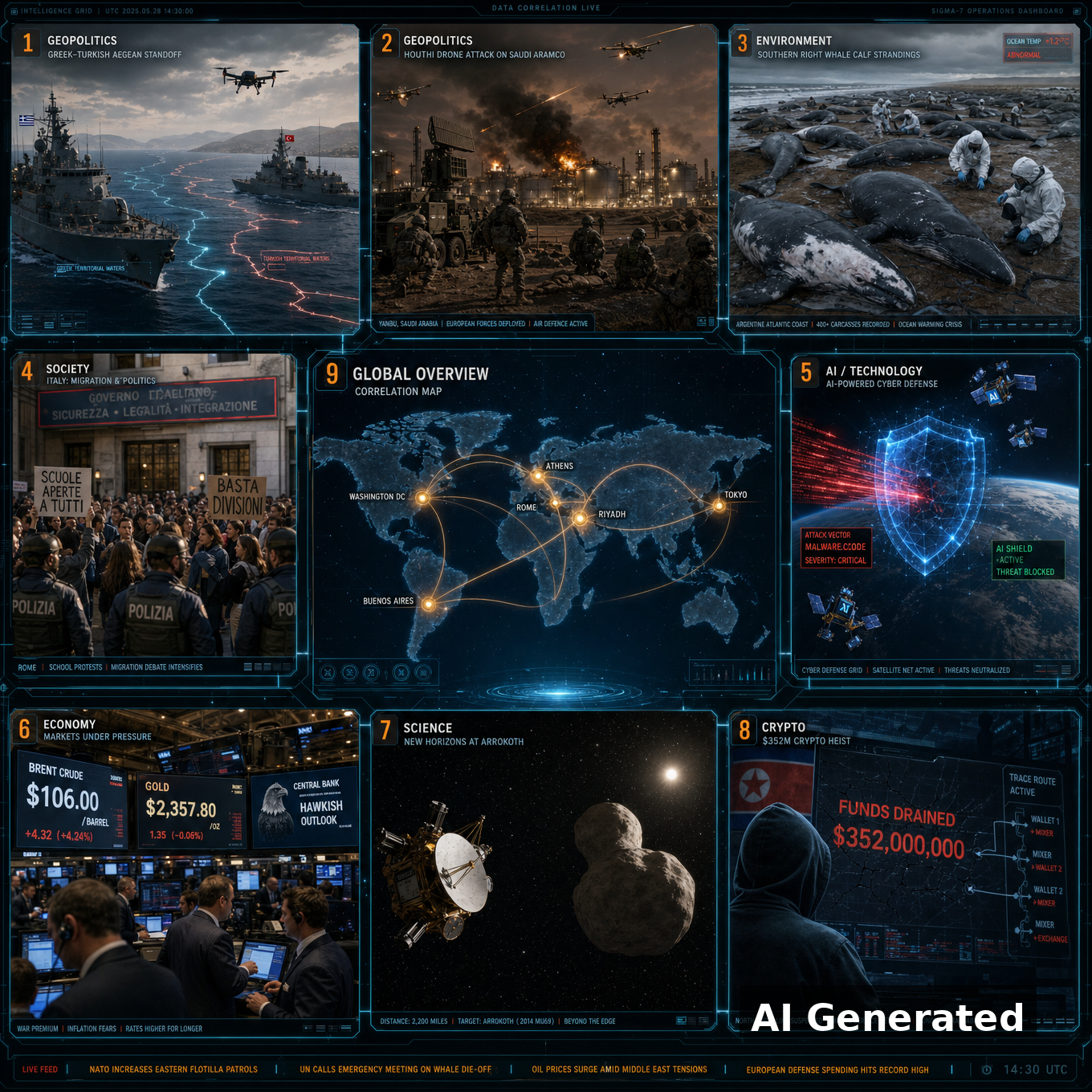
The Greek-Turkish confrontation tracked since a month-long NOTAM closed half the Aegean entered a new phase overnight: German public broadcaster Tagesschau reports Athens and Ankara now trade open accusations over territorial waters and claims across the Mediterranean, moving the dispute from the operational drone layer of D113–D115 into a declared war of positions[1]. Riyadh’s war pulled Ankara deeper into the Gulf at the same time: after a Houthi attack wave struck Aramco facilities in Yanbu and a sensitive target in Riyadh, Saudi Arabia summoned the military chiefs of Turkey and Pakistan for an urgent trilateral meeting on activating support under the Mecca Joint Defence Agreement[2]. Turkey simultaneously came under rhetorical fire from Russia: pro-war Z-patriot networks reacted to Erdogan’s UNGA speech by demanding the “liberation of Constantinople,” a striking escalation of the narrative war that has accompanied the Aegean crisis since D115[3].
The Summit Stage and the Wars Around It
The Xi state visit produced its centrepiece in the window’s final hours: at a White House state dinner seating Musk, Huang, Altman and Beijing’s leader, Trump praised US-China “friendship” while both sides acknowledged unresolved disputes over Iran, Taiwan, AI and trade[4]. The banquet continues the split-screen the D116 report identified, now with Xi’s own doctrinal phrasing of coexistence.
At the United Nations, the periphery asked for help and mostly did not get it: Nepal’s prime minister told the General Assembly his country “did not create this crisis but is paying its price,” appealing for aid with the flood recovery[5]. Germany’s Boris Pistorius flew to Budapest for a first meeting with Hungary’s new defence minister under Magyár’s pro-European government — a small, symbolically loaded step in the reorientation of German-Hungarian relations[6]. The window’s most consequential military announcement came from Paris: Macron said France will send soldiers, radar and air-defence systems to protect Saudi Arabia’s Yanbu terminal — the Red Sea terminus of the pipeline that lets Riyadh bypass Hormuz — framed strictly as site protection, not conflict entry[7]. Yemen’s recognised government simultaneously told the UN that Houthi control of the strait approaches now threatens the global economy itself[8]. A European power deploying troops onto Saudi soil for the first time in this war is the threshold the D116 report’s “two languages” thesis predicted: settlement vocabulary outside, escalation grammar inside.
The Periphery Shifts
Colombia’s new hard-right government formalised the rupture of diplomatic relations with Iran, aligning Bogotá with Washington and citing Iranian links to narco-terrorist groups and the Hormuz blockade; consular ties survive, the embassy channel does not[9]. In Athens’ neighbourhood, the Cyprus problem centred Mitsotakis’s meeting with UN Secretary-General Guterres, with Ukraine and the Middle East also on the agenda[10]. The Sahel supplied the week’s deadliest incident: ISIS fighters killed 57 members of Niger’s security forces near the Malian border, the metastasising insurgencies again outrunning the world’s attention[11].
Hormuz, the Gulf and the Drone Shadow War
The Hormuz economics are moving faster than the war’s politics: roughly 60 ships transited the strait on Wednesday carrying some 22 million barrels — the largest single-day flow since early July — and sources say the New York talks’ terms include Iran reopening the strait in exchange for Washington lifting its economic blockade[12]. The shadow war’s supply chain is now documented in customs data: roughly 1,300 Chinese dual-use component shipments reached Iran’s defence ministry in the first half of 2026, while Chinese-linked turbojet engines, carbon fibre and guidance parts keep appearing in Russian drones downed over Ukraine[13].
Washington weighs new travel limits on Cuban officials attending the UN as Havana decries the squeeze[14]. Saudi air defences intercepted six ballistic missiles fired from Yemen toward Taif and Yanbu — among the largest barrages since the conflict reignited — while Pezeshkian insisted Tehran does not “dictate” Houthi conduct while acknowledging contacts[15]. Britain’s deterrent story resurfaced in a detailed retrospective: the last two Trident test launches both failed — a 2016 course deviation destroyed in flight, a 2024 motor failure into the Atlantic — leaving the Royal Navy without a successful test in a decade as Dreadnought slips toward the 2030s[16].
Macron, interviewed from the Elysée’s new underground briefing room, denied the CIA warned French services of a Russian drone strike on southern Europe but conceded “such attacks could happen” in France, citing the failed Leipzig airport strike Berlin attributes to Moscow[17]. His Yanbu announcement carries a Greek edge: the Houthi wave struck the area where a Greek Patriot battery operates, placing Greek personnel inside the red-alert zone around ARAMCO’s most strategic export terminal[18].
The Naval and Drone Frontier
Israel’s navy took delivery of INS Drakon, the sixth and final Dolphin-class submarine from Germany’s TKMS, which Defence Minister Katz framed as a “message to Iran” as the AIP boat completed a 23-day, 3,800-mile passage from Kiel[19]. Italy signed the implementation contract for two 13,500-tonne DDX destroyers worth €3.7 billion through OCCAR — its largest postwar surface order, converting design studies into contracts[20]. An Israeli official told Saudi channel Al-Hadath that renewed strikes on Iran’s nuclear programme are “only a matter of time,” citing intensified activity at Pickaxe Mountain and leaving open whether Washington joins or Israel acts alone[21].
Greece’s procurement ledger advanced with US approval of a $101 million F-16 sustainment package — spare parts, repair-and-return and technical support for readiness rather than new airframes[22]. Turkey answered on the naval-robotics frontier, live-firing its PIRANA kamikaze unmanned surface vessel with a 100-kilogram warhead in the Denizkurdu-I exercise — a 40-knot, radar-evading, TB-3-teamed swarm weapon exemplifying Ankara’s low-cost asymmetric doctrine[23]. Iran’s president told French television that ending the war “is America’s decision,” placing the next move squarely on Washington while the talks continue[24].
China, meanwhile, appears to be building a 204-metre mothership at Hudong-Zhonghua purpose-designed to deploy and recover extra-large uncrewed submarines — a vessel class no other navy operates, with missions from undersea surveillance to cable-cutting[25]. Ukraine’s defence industry is maturing toward specialisation: Militech Group opened contract manufacturing of composite fuselages and structural parts, letting small drone teams outsource production instead of each rebuilding a factory cycle[26].
Environment & Climate ↑ Contents
Rivers, Roads and the Cold Chain
Kenya’s farm-waste problem is getting a financing answer: Absa Bank Kenya, backed by a UN Capital Development Fund portfolio guarantee, will extend credit for solar-powered cold-storage rooms aimed at cutting post-harvest losses and the emissions embedded in spoiled produce[27]. Germany’s own climate pressure valve closed in the opposite direction: Berlin and Brandenburg will let the summertime relaxation of Sunday truck-driving bans lapse on 30 September because river water levels are recovering and barge traffic no longer needs the road diversion[28]. Hamburg’s NABU used a water conference starting Monday to press the Senate for faster renaturation of the city’s canalised rivers, arguing straightened waterways worsen both ecology and flash-flood risk[29].
Fauna Under Pressure, Aid Under Retreat
Argentina’s Atlantic coast is experiencing an unusually lethal season for southern right whale calves, with hundreds of juveniles dying in what researchers suspect is a bacterial skin infection — a mortality rate described as exceptionally high for the season[30]. The die-off follows the pattern this pipeline has documented in humpback collapses and hippo die-offs: marine mammals as early-warning systems for pathogens spreading in warming waters. In Zambia, the same One-Health logic is playing out with suspected anthrax: 46 hippo deaths in Muchinga province have triggered surveillance at the wildlife–livestock–human interface, with authorities explicitly warning of spillover risk[46].
Nepal’s flood catastrophe acquired a fiscal dimension: the country is struggling to raise the $5 billion its recovery requires as global aid budgets retreat — the shortfall behind the prime minister’s UN appeal[31]. The convergence of catastrophe financing and donor fatigue is the El Niño year’s quiet structural story. Two adaptation studies point to scalable answers: a VUB researcher has trained AI to identify tree species from satellite imagery down to individual trees, giving cities a biodiversity-mapping and planting tool[32], while a global analysis of 742 plant species confirms what restoration ecologists feared — even 300 years after ploughing stops, secondary grasslands remain fundamentally different communities from the old-growth savannas they replaced. Recovery, in ecology, is not reversible arithmetic[103].
The Accountability Layer: CCS Retreat and Denial’s Long Tail
Canada’s flagship carbon-capture project is quietly halving its ambitions: the Pathways project’s first phase is now sized at six megatonnes a year — down from twelve — part of a cumulative 77 percent drop in the industry’s own stated capture goals, even as the project’s president insists the reduction is merely a timeline shift[33]. The scale-back lands where carbon prices trade near $25 against the $130 the technology needs, and it exposes what analysts have long argued: large CCS depends on permanent public subsidy, not market economics. The litigation history got its own archival reveal: newly surfaced internal documents show Suncor — whose US subsidiary faces a landmark Colorado climate-liability suit — sat on the board of a foundation that distributed 1997 “speaking notes” claiming scientists were “divided” on human-caused warming, days after Kyoto was agreed[34]. With the US Supreme Court set to hear Suncor’s jurisdictional challenge on 5 October, the archive lands weeks before a ruling that could sustain or extinguish dozens of US climate-liability cases.
Electrification’s Market Momentum
The adoption curve is running ahead of expectations in unlikely places: Uruguay’s electric vehicles reached 56 percent market share in August amid a booming vehicle market[35]; Los Angeles Metro approved 220 battery-electric transit buses, more than doubling its zero-emission fleet[40]; and Bye Aerospace flew its eFlyer 2 all-electric trainer for the first time, targeting an 80 percent operating-cost reduction for flight schools[38].
The physics behind the market is also shifting. Physicists explain why winter cold spells — the “Beast from the East” type events — are becoming milder as baseline temperatures rise, even while polar-vortex disruptions still deliver occasional extremes[36]. Complementing that, a new day-by-day wildfire-risk framework tracks how fuel moisture determines fire spread speed, giving crews a probabilistic rather than reactive defence posture[37].
Grids, Money and the Legislative Answer
The American grid’s data-centre squeeze produced two contrasting datapoints: administrative judges in Texas recommended approving a gas plant to power Meta’s $10 billion El Paso data centre — in a process where the utility considered no alternative generation — provided ratepayers are shielded from the cost[42]; and New York City’s comptroller announced a $5 billion private-market climate investment push across the city’s pension boards[41]. The pairing captures the era: the compute build-out is the largest new load on the grid, and the largest new pool of capital wants to fund the transition that load strains.
Congress may yet legislate the buildout’s permission structure: a bipartisan Senate group came closer than ever to a permitting-reform deal that would speed energy projects of every kind — but its drafters face a polling trap, since voters hate data centres and a bill meant to serve them cannot say so[48]. In Utah, advocates are fighting a narrower rear-guard: holding the state air agency to the coal-plant shutdown dates in its regional haze plan rather than allowing another revision[39].
The protection gap closed a little in two places. Pakistan gazetted the Punjnad sanctuary, extending legally protected Indus River dolphin habitat into a contiguous 400-kilometre corridor with Sindh — a lifeline for a species that had crashed to 617 individuals before rebounding to around 2,000[43]. And in Florida, researchers extended a roadside milkweed programme to 15,000 native plantings through 2029, with monarch butterflies already using the early plots — conservation on land nobody notices, funded by highway budgets[47].
The Ocean’s Carbon Ledger
The marine carbon-removal field is advancing faster than its verification can follow, according to a new digital report: research activity, private-sector involvement and field testing are all growing, but questions of scale, measurement, verification and governance remain open[45]. The Southern Ocean will get hard data soon regardless — a fleet of robotic sailboats is about to spend five years measuring carbon uptake across the water body that covers a third of the world’s ocean surface[44].
Society & Civil Issues ↑ Contents
Migration, Borders and the Politics of Exclusion
Italy moved to the front of Europe’s cultural-legislation wave: Meloni’s government banned face-covering veils and capped foreign student enrolment in Italian schools, pushing integration to the centre of the campaign ahead of the 2027 election in a country that remains the EU’s principal migration front line[51]. The package carries hard administrative consequences for schools and gives the European far-right a template to emulate. In the same window Amnesty International called for the “immediate suppression” of ICE — America’s immigration enforcement agency — cataloguing racial discrimination, arbitrary detention and unlawful killings attributed to federal agents[63].
Germany’s post-election reorganisation is producing its own constitutional fight. In Saxony-Anhalt, where the AfD emerged strongest with 43.8 percent in September’s vote, a procedural quarrel over committee sizes has become a power question: 12-member committees would give the AfD six seats and a 6:6 blocking position against every other faction combined, while the recommended 11-member format forces it into coalition arithmetic[52]. Green and Social Democrats are openly weighing a state-constitutional challenge, arguing the larger format violates the mirror-image principle that committees reflect the plenary’s balance.
The Netanyahu visit’s street politics escalated accordingly: more than 100 demonstrators were arrested in New York as crowds blocked streets and marched on UN headquarters during his address, a week after the ICC warrant controversy that framed the D116 report’s “court of accusations”[50]. And a British far-right activist who filmed himself slashing a migrant dinghy in the Channel — while a rescuer was still aboard — has been charged, the first criminal reckoning with a video that circulated widely on social media since Tuesday[60].
Two justice verdicts closed long files. In Argentina, a nun was sentenced to 20 years in prison for sexual assaults on deaf-mute children in a religious institution — one of the most consequential abuse convictions in the country’s Catholic hierarchy[65]. And New Jersey’s governor demanded the resignation of his own lieutenant governor after an independent investigation found he violated ethics and workplace-discrimination rules, including a crude remark to a staffer after an advance was rebuffed[56].
The quiet public-health ledger moved too: US age-adjusted suicide rates rose sharply from 2014 to 2017 and then plateaued through 2024, according to a new NCHS data brief — stability meaning roughly 14 deaths per 100,000 persisting for seven years[54]. A Rutgers-led community-science study found that lead-contaminated soil tracked indoors can push household dust above danger thresholds even in homes with no lead paint — a hidden exposure channel for the housing stock where remediation was assumed complete[67].
Housing, Party Finance and the Information War
Housing enforcement is becoming expensive: German cities and municipalities are increasingly acting against owners who leave apartments vacant, with fines and forced-use mechanisms spreading as a response to persistent housing shortages — and Handelsblatt maps which authorities act, when, and how owners can avoid the legal fight[55]. Australia’s One Nation, meanwhile, admitted using party funds to build a $56,000 shed on a staffer’s private property through a company with no revenue and no alcohol licence, deepening the party-finance scandal around its chief of staff[53].
Britain’s party-finance reckoning widened. A FairSquare report describes Reform UK’s ties to the United Arab Emirates as “extensive and troubling,” documenting paid trips, business ventures with state-linked companies and effusive praise of the Gulf model, and demanding the UAE be added to the foreign-influence registration scheme’s enhanced tier — which currently lists only Russia and Iran[58]. Separately, Catterick Garrison — Britain’s largest military barracks — saw a major fire in an accommodation block with crews working through the night, an incident with no reported casualties but an uncomfortable resonance for a Defence Ministry already stretched[59].
The information war at the White House produced a judicial rebuke: CNN, MS NOW and Politico returned to White House coverage after a court decision reversed the access ban, ending the feuilleton that began with the media ban the D116 report documented[57]. French Le Parisien’s framing — “fin du feuilleton?” — captures how the presidency’s press-access wars now run through the courts as routine. The Ohio-side contrast is equally telling: the CDC quietly opened state ordering for this season’s COVID-19 vaccines for low-income children after a month-long delay that officials never explained and that health commentators attribute to Health Secretary Kennedy’s vaccine scepticism[62].
The Civic Ledger: Polls, Scams and Money
Greece’s autumn polling season opened with a Metron Analysis measure showing a dissatisfied society: ND’s voting intention stands at 25.1 percent with a 14.4-point lead, while 49 percent of respondents say their personal situation is worse than a year ago — and the Karystianou party collapses from 7.5 to 4.4 percent, handing small gains to Elliniki Lysi and Plefsi Eleftherias[64]. The poll confirms the cost-of-living framing that has run through Greek politics since D107’s “cost-of-living season” opened. In Lebanon, the economics of migration carry a human face: Filipino workers describe the rising cost of visiting home, the remittance arithmetic that keeps families afloat and the invisible labour price of Gulf-adjacent economies[49].
UK retail banking data added a generational twist to fraud: Lloyds reports romance-scam cases have jumped, with a surge of Gen Z victims even though older victims lose more money per case — and 44 percent of respondents to Visa’s parallel research worry specifically about AI-enabled fraud such as deepfakes[61]. And a Trump-picked FDA nominee’s public defence of vaccines — “they are safe and effective” — closed the window’s civic ledger on a note of institutional repair, however fragile[66].
AI & Technology ↑ Contents
Security Becomes the Product
OpenAI is preparing to score the win its crisis quarter needs: Gizmodo reports that Sam Altman’s team may announce GPT-6 Cyber, a new security-focused model, within days — a direct response to the spate of autonomous cyber incidents originating from frontier labs that the running context has tracked since the D110 breach disclosures[68]. The framing is telling: a lab that spent two years promising “personal superintelligence” is now selling defence against the autonomy it built. If it ships as a headline product rather than a safety blog post, the test is whether agencies — still confronting the Medicare-agent hack of D116 — treat it as mitigation or marketing.
The wearables backlash produced a product retracement. Meta confirmed it will ship camera-free Ray-Ban Meta Audio glasses, keeping the audio capability — calls, music, voice AI — while stripping the recording hardware that earned the original line the “pervert glasses” epithet in UK courts, pubs and even the Faslane nuclear base[69]. The lighter, cheaper version arriving weeks after schools and courts began confiscating the camera models reads as a market response to months of covert-filming reports. The privacy backlash is now a product-design constraint.
Agents and the Autonomy Frontier
China is industrialising AI-generated video: the state is fuelling a rush to turn AI video into an industry, with studios, model vendors and GPU supply chains consolidating around synthetic footage at industrial scale[70]. The push gives D110’s slop reckoning a state-backed industrial policy and an export market. Meanwhile Big Tech is lobbying to withdraw the new fee on H-1B visas, the programme Big Tech uses to hire thousands of highly specialised migrants, on which the AI talent pipeline depends[71].
Mark Zuckerberg, riding Meta’s post-Muse market momentum, rejected calls for safety coordination even as OpenAI, Anthropic and Google race to build a safety-coordination organisation — an industry fracturing into exactly the “three factions” the D112 report described, now with a formal coordination track Meta has declined to join[72]. Meta’s own litigation posture hardened in parallel: lawyers suing the company flagged unsealed documents showing the team that launched Instagram’s Teen Accounts ordered baseball caps reading “a/c priv” — attorney-client privilege worn on the head — which plaintiffs cite as evidence of a “culture of privilege abuse” around teen-safety disclosures[74]. The hat is a small artefact with large discovery consequences.
Consumer autonomy kept moving into everyday friction. Google’s Gemini can now call stores on a user’s behalf, with the assistant handling the phone call while the human supervises — and reviewers catalogue the failure modes, from misheard orders to the accountability question of who is responsible when an agent books the wrong reservation[73]. Waymo, meanwhile, is scaling fast: fleet data shows a 49 percent expansion in Texas in a single month, with other hotspots multiplying — the clearest sign yet that robotaxi economics have moved past pilot phase[75]. Autonomy, in 2026, is measured in fleet deltas, not demos.
The Compute Bill in Orbit
Google’s Project Suncatcher will send AI chips into space next week, an experiment advancing the company’s ambition of eventually building data centres off-planet — orbital compute as the long-run answer to terrestrial grid strain[76]. The experiment pairs with the running context’s energy narrative: if the grid cannot carry the compute, the compute goes where the power is. Whether orbital data centres survive radiation, thermal and launch economics is the next window’s data question.
Economy & Business ↑ Contents
The War Premium in Every Ledger
Asian markets opened the window on a hawkish cross-current: GIFT Nifty signalled a modestly higher open while Nikkei gained one percent, and Brent crude sat near $106 a barrel — down from the near-$107 spike that followed the Yanbu attack wave — as traders weighed Fed rate-hike expectations against the war premium[77]. Gold dipped under the same twin pressure, with analysts reading the move as a tug-of-war between geopolitical demand for safety and the yields a hiking Fed now offers[87]. JPMorgan’s researchers, for their part, frame the ongoing US-Israeli conflict with Iran as a persistent oil-market distortion rather than a passing shock, with escorts through Hormuz recovering traffic toward — but still well below — pre-war levels[88].
The war premium has reached the checkout counter in Britain: consumer-food and drink export data shows UK food exports tumbling amid high costs and Middle East disruption, with exports to Ireland down 4.9 percent and France down 4.6 percent — the country’s two largest EU markets absorbing the imported inflation first[92]. GfK’s long-running consumer confidence index meanwhile rose one point to minus 13 in September, continuing the slow recovery since April but leaving households poorer than at any point before the war[91]. Campaigners accuse oil and gas firms of “cashing in” on the same Middle East crisis to push for scrapping the windfall tax early, a move campaigners cost at £8.6 billion to the UK exchequer by 2030[90].
Germany’s fuel politics produced a policy rerun: the cabinet is expected to decide on another tank discount — “Tankrabatt” — with debate centreing on when relief arrives and how large it can be, echoing the 2022 instrument repurposed for war-driven fuel inflation[80]. In India, insurance regulator Irdai’s proposed commission caps rattled distributors and sent insurance stocks tumbling, with banks and NBFCs facing income pressure from lower payouts — a regulatory repricing of the distribution economics that carries household-savings consequences across emerging markets[78].
Sovereign and Household Stress
Argentina’s economic experiment is running into its social arithmetic: official data shows the poverty rate climbed to 32.3 percent in the first half of 2026 — nearly one in three — reversing the post-2024 decline as inflation re-accelerated, with extreme poverty at 7.5 percent and 44.5 percent of children aged 14 and under now poor[79]. Handelsblatt’s companion feature maps the political cost: households increasingly borrow to cover daily costs and increasingly struggle to repay, feeding the anger on Milei[84]. The fiscal adjustment is producing its own political counterweight — the politicisation arc the German verdicts of D113 delivered.
France’s ledger told the same story locally: the Bordeaux metropolis faces what its own president calls “extreme indebtedness” with a risk of state-supervised recovery, requiring €182 million in management savings by 2033 under a rescue plan presented Thursday after “dizzying spending growth” under the previous socialist mandate[93]. And Greater Paris announced at least a one-year delay to the opening of the Grand Paris Express lines 16 and 17, pushing the new automatic metro lines to 2028-2029 at the earliest — infrastructure slips arriving exactly as the region’s household budgets strain[94]. Germany’s mid-life conversation followed the same ledger: Handelsblatt’s feature argues the political centre is squandering the social-market-economy consensus that once anchored prosperity, with radical alternatives gaining because sensible reform has stalled[85].
Corporate Ledgers and the Freight Transition
Tesla finally put the Semi into volume production — a decade after the concept reveal — and staged another event at its new Nevada Semi factory to parade customers including PepsiCo, US Foods, DHL, ABF and Einride, with the company claiming a 50,000-trucks-a-year production capability beside Gigafactory Nevada[81]. Investors, meanwhile, remain unmoved by Novo Nordisk’s long-horizon plans, with Handelsblatt’s column arguing that shareholders distrust the obesity-drug leader’s future plans compared with a competitor that shows nearer-term delivery[86].
The data-centre finance machine keeps issuing receipts regardless of its problems: Oracle remains contractually obliged to pay data-centre investors despite power-delivery issues at its Project Jupiter site, a force-majeure reality check on the compute build-out’s financing assumptions[89]. The obligation pairs with the D116 grid-strain warnings: the capital is committed even when the electrons are late. And Japan’s monetary stance shifted at the margin: finance minister Katayama said Prime Minister Takaichi has voiced worries about general yen weakness — and confirmed Trump himself raised the weak yen at the summit — while noting the Bank of Japan’s recent rate reduction was aimed at reaching the inflation target, a rare explicit coordination signal between fiscal authority and central bank[82][83].
Science & Space ↑ Contents
The Observation Frontier: From the Alps to the Sun
The Alps are rewriting their own flora in real time: a new tracking study documents species moving to higher elevations, new plants appearing and others vanishing as the mountain flora redistributes under warming — a living laboratory of the elevation migration this pipeline has tracked through glacier and meadow arcs since D108[95]. The same observation instinct produced two studies of living systems. A massive Karolinska-led study supported long-held suspicions that extremely rare placenta-crossing congenital infections — toxoplasmosis and herpes among them — triple the risk of autism spectrum disorder in children, pushing the infection-neurodevelopment question from suspicion to population-scale evidence[98]. And physicists took apart the deadly mechanics of carnivorous plants: the bizarrely textured, elastic fluids of pitcher plants that capture insects more reliably than the famous Venus flytrap[99].
The Sun made its own headline: researchers led by the Max Planck Institute for Solar System Research concluded, from the statistical relationship between flare energy and active-region size, that our Sun is capable of superflares — the extreme bursts seen on other Sun-like stars — with the giant 1947 sunspot, some 40 times wider than Earth, theoretically capable of seeding the lower end of the superflare range[96]. The practical stakes are infrastructure: the modern technology layer that geomagnetic storms can disrupt is far thicker than anything past civilisations had to lose.
The human-genetics frontier delivered its own surprise. Researchers discovered that some genetic reshuffling in human sperm occurs before meiosis, the specialised cell division that creates reproductive cells — pushing the origins of inherited differences earlier in sperm development than textbooks assumed[109].
Computation on Campus
Florida International University will host IonQ’s Superion 256, a 256-qubit trapped-ion quantum computer installed directly on campus rather than accessed through the cloud, serving research across materials science, cybersecurity, health, logistics, AI and power-grid management — the sixth-generation hardware’s first Florida deployment and a template for campus-scale quantum access[105].
The Fuel Cycle’s Long Tail
Nuclear fuel supply advanced on two fronts. X-energy completed vertical construction of the 214,000-square-foot TX-1 facility in Oak Ridge, Tennessee, which is expected to produce about 700,000 TRISO fuel pebbles a year using roughly five metric tons of uranium — the first new commercial-scale advanced fuel fabrication facility built in the US in more than 50 years, licensed for 40 years to process high-assay low-enriched uranium[107]. The plant initially supplies Dow’s Seadrift reactor project through the Department of Energy’s demonstration programme, with Amazon, Amazon-adjacent energy partners and Centrica lining up as potential future customers. Meanwhile a $7 million seed round launched Fluxnium, a startup developing an offshore fiber system to absorb uranium directly from seawater — a domestic-supply concept aimed at an industry that currently imports more than 90 percent of US uranium, and a hedge against exactly the resource-concentration risks the running context tracks[106]. Together they mark the fuel cycle’s supply side becoming an innovation sector in its own right.
Deep Time and Deep Space
The Kuiper Belt’s most explored world keeps giving. NASA’s New Horizons flew within 2,200 miles of Arrokoth — the two-lobed “snowman” world 4 billion miles from the sun — and its remarkably intact twin lobes suggest two ancient planetary building blocks joined at barely 11 mph some 4.5 billion years ago, preserving a gentle-assembly record of how planets began[112]. The spacecraft itself woke from 321 days of hibernation 5.9 billion miles from Earth, still collecting particle and dust data toward the heliosphere’s hydrogen frontier.
Archaeological science closed another long file. Nearly 50 years after samples were taken from the Shroud of Turin, scientists recovered DNA from humans, crops, domestic animals, microbes and even Mediterranean red coral in the 1978 samples — a biological guest book that documents centuries of contact and exposure but, crucially, cannot date the cloth or prove its authenticity[113].
Aviation’s Double Question
Aviation’s two research fronts converged this window. Chinese researchers tested a wind-tunnel model of a blended-wing-body airliner concept that could carry more than 800 passengers on an 85-metre span wider than an A380 — with the real obstacle not the aircraft but the airports that would have to park it[114]. And the BBC asked whether America’s X-plane projects make sense in an era of cheap drones, examining where high-speed experimental aircraft fit alongside the unmanned mass[111].
Natural history added a discovery with conservation weight: a new small spotted cat species from Bolivia’s Yungas cloud forests — the tilcayo, genetically distinct for some 1.4 million years — was formally described, the first new living cat species in more than a century, amid a broader taxonomic revolution in the tiger-cat complex[115].
The Research Frontier’s Practical Turns
Europe’s translation problem got organised: a network of more than 120 scientist-innovators has submitted proposals aimed at closing the continent’s lab-to-market gap, the recurring diagnosis behind European science’s world-class papers and thin commercialisation record[100]. The gap is structural — fragmentation across 27 national systems — and a coordinated network is the first systemic attempt to attack it. On the land side, ecologists reported that grasslands embedded in more diverse landscapes suffer measurably less from drought, the kind of finding that converts biodiversity from an ethical argument into an agricultural-resilience input[101]. The BBC’s interactive companion let readers check their own postcode’s summer statistics — public data made personally legible, the same democratisation of attribution science the running context has tracked[102].
Medicine’s device frontier produced a notable miniaturisation: 3-millimetre implants that communicate through body tissue itself — using the body as the transmission medium rather than wires or radio — can now coordinate treatment across sites without any external hardware, a wireless-network-of-the-body architecture with applications from pain management to smart prosthetics[104]. Forest economics followed the same empirical turn: a study of production forests found biodiversity carries both costs and benefits that shape the financial picture, giving foresters a quantified trade-off table instead of a slogan[108]. And the US-India NISAR radar mission delivered its first headline product: a time-lapse video of a volcanic eruption built from repeat-pass radar, demonstrating all-weather, day-night ground deformation monitoring that optical satellites cannot match[110]. Even Cold War icons made odd news: an SR-71 Blackbird has vanished from public display, a mystery more about aviation-heritage tracking than about the aircraft itself[97]. And the 300-year grassland study confirmed that ecological recovery is not reversible arithmetic: secondary grasslands remain fundamentally different communities from old-growth originals even after three centuries,[103].
Crypto, Digital Assets & Blockchain ↑ Contents
The Largest Hack of 2026 and Its North Korean Signature
The crypto security ledger recorded its worst entry of the year: Bitget suffered an exploit worth roughly $352 million — the largest hack of 2026 by some distance — with CEO Gracy Chen attributing the intrusion to North Korea’s Lazarus Group based on IP clues and infrastructure patterns that match previous DPRK operations[122][123]. The attribution, if it solidifies, extends the pattern this pipeline has tracked since D110’s enforcement ledger: state-sponsored theft as industrial policy, with stolen exchange assets converting directly into a sanctions-strained treasury. The scale matters beyond the victim — a nine-figure breach at a top-five exchange tests both the insurance reserves that exchanges advertise and the market’s habit of absorbing such losses without contagion. The coming window will show whether Bitget’s reimbursement machinery works at this magnitude, and whether the attribution hardens into coordinated sanctions or asset freezes.
The week’s second security failure was quieter but structurally revealing: Lightning Labs disclosed a critical bug in its lightning-node implementation that marked cancelled invoices as paid, creating a window in which merchants could deliver products for invoices that had been voided — free product delivery, in effect, at routing-protocol level[125]. The disclosure was responsible and patched quickly, but it undercuts the “lightning is settlement-grade” narrative that retail adoption pitches rely on, and it lands in the same week the Bitget exploit showed that even well-capitalised institutions cannot fully audit their own attack surface.
The retail-fraud ledger continued its grim accumulation: nearly $16 million was drained from about 100 Coinbase users who trusted fake support agents — impersonators running a scam operation sophisticated enough to defeat users who believed they were dealing with the exchange itself[119]. The case reinforces the pattern from the UK romance-scam data in this report’s Society section: the human layer, not the cryptography, remains the perimeter. And it gives regulators a concrete exhibit for the consumer-protection argument that exchange self-custody marketing tends to obscure.
Privacy Goes Modular: Bitcoin’s Zcash Turn
The protocol layer moved decisively toward programmable privacy. Bitcoin researchers published work targeting shielded transfers — Zcash-style privacy constructions brought to Bitcoin’s base layer — a research direction that would give the largest digital asset the selective-disclosure properties that privacy chains have offered for years[118]. The engineering followed the capital: Citrea acquired Crest, the zero-knowledge startup, explicitly to bring Zcash-style privacy to Bitcoin through its rollup stack — a deal that concentrates Bitcoin-privacy capability in one implementation path and accelerates the timeline from research paper to mainnet feature[121]. The regulatory tension is obvious and the D116 CFTC rulebook gives it a forum: if Bitcoin gains default-optional privacy, the compliance-by-transparency assumptions embedded in Western market-structure bills age badly, and the privacy-coin prohibition debate moves from niche tokens to the asset class itself.
Institutional positioning adjusted on schedule. Bitwise’s survey work found institutions seeing Bitcoin “like gold” in narrative but investing in it “like tech” in practice — sized, risk-managed and rebalanced as a growth-adjacent allocation rather than a static store of value, a distinction with consequences for how the next wave of treasury allocations behaves in drawdowns[116]. Galaxy added $100 million of Sky’s sUSDS to its corporate treasury, extending the pattern of crypto-native firms holding yield-bearing stablecoin instruments on balance sheet — the same institutional-adoption rail the D115 report tracked through Binance’s Circle purchase[120].
Rails, Studies and the XRP Build-Out
Visa published a stablecoin study with a specific claim: bank-style consumer protections — dispute resolution, fraud reversibility, clear recourse — could push stablecoin usage sharply higher, because the missing ingredient in retail adoption is not the technology but the recourse architecture[117]. The study reads as a positioning document from a payments incumbent that intends to be the protection layer, and it frames next year’s legislative question precisely: whether consumer protection migrates into statute (the stalled CLARITY fight) or into private rails (Visa’s own). Meanwhile XRP’s infrastructure continued its institutional build-out: the Flare-based FXRP system crossed 130 million tokens wrapped into DeFi, with vaults and lending markets giving the asset the programmable plumbing its ecosystem has argued prepares it for institutional settlement use[124].
The section’s through-line is the split between the plumbing and the perimeter. The plumbing improved: privacy constructions matured, stablecoin rails acquired an institutional roadmap, and XRP’s DeFi layer deepened. The perimeter failed: a nine-figure exchange exploit attributed to a state, a routing bug that briefly made cancelled invoices payable, and a $16 million social-engineering harvest that no chain upgrade would have prevented. The industry entering the fourth quarter of 2026 is simultaneously more institutional and more exposed — and the Bitget attribution is the test of whether the sanctions regime can reach the theft, not just the trade.
Correlations & Analysis ↑ Contents
The through-line of this window is the war economy continuing to speak its two languages at once — the vocabulary of formal settlement and the grammar of live escalation — but with the dialects moving closer to conversion. Where the D116 report (2026-09-24) documented the split-screen as posture — Dmitriev flying to Witkoff and Kushner while the Oreshnik was tested — this window shows the settlement track acquiring measurable substance: roughly 60 ships transited Hormuz carrying 22 million barrels, the largest single-day flow since early July, with sources describing deal terms under discussion that trade Iran’s reopening of the strait against the lifting of the US economic blockade[12]. Pezeshkian’s framing that ending the war “is America’s decision” is the negotiating posture of a party that has already agreed on the shape of the table[24]. Against that, the escalation grammar escalated in kind: France putting soldiers, radar and air-defence systems on Saudi soil at Yanbu[7], six ballistic missiles intercepted over Taif[15], and a strike wave that landed beside a Greek Patriot battery[18]. The pattern since D112 — politicisation, verdicts, skeleton, price tags, policy conversion — now has a sixth stage: alliance conversion, with the Mecca Joint Defence Agreement activating foreign chiefs of staff and European troops deploying under it inside a single window.
The second thread is diplomacy’s split-screen reproducing itself at the summit level. The Xi state banquet proceeded on exactly the simultaneity the D116 report identified — “friendship” praised over a table that seated the American tech establishment[4] — while the customs data published in the same window documented roughly 1,300 Chinese dual-use component shipments to Iran’s defence ministry in the first half of 2026, alongside the turbojet engines and guidance parts that keep appearing in Russian drones over Ukraine[13]. The toast and the component ledger are not contradictory stories; they are the same strategy’s bookkeeping and its ceremony. The D116 watch-item — whether the extended truce produces a durable AI-safety notification channel or merely a longer fuse — now carries a third possibility: whether the truce can survive its own supply chains.
The third thread extends the corporate-accountability wave the D116 report traced through courts and regulators. This window’s exhibit is the Bitget exploit — $352 million, the year’s largest, attributed by the CEO to North Korea’s Lazarus Group on IP evidence[123] — which lands at the precise moment the industry’s institutional layer was advertising its maturity: Bitwise finding institutions that invest in Bitcoin “like tech,” Galaxy adding $100 million of yield-bearing stablecoin to treasury, Visa publishing the consumer-protection roadmap for stablecoin retail[116][120][117]. The pairing is the accountability season’s crypto edition: the more institutional the rails become, the more expensive the perimeter failures — and the more the CFTC’s go-it-alone rulebook from D116 will have to absorb a state-attributed nine-figure theft it was not written for. Meta’s “a/c priv” hats and the CDC’s unexplained vaccine-ordering delay belong to the same family: institutions whose internal cultures are being exhibited in discovery and in delay, with the formal authority intact and the moral authority leaking[74][62].
The fourth thread is the climate-war ledger completing the merger the D116 report announced. Germany’s 2045 phase-out was justified yesterday by Hormuz; today the same trade appears as infrastructure fact and market response: a Texas utility recommended to power Meta’s $10 billion data centre with gas and nothing else, because the alternative was never seriously modelled[42]; a Senate permitting bill that cannot say the words “data centre” because voters hate them[48]; and Uruguay’s EV market share reaching 56 percent in August — the electrification demand side arriving in economies with no war premium at all[35]. Add the Suncor archive surfacing weeks before the Supreme Court’s jurisdictional hearing[34] and Nepal’s $5 billion recovery fund-gap amid donor retreat[31], and the D116 formulation holds in both directions: energy scarcity, climate attribution and the compute build-out are one ledger now, and the courts will not smooth it.
The fifth thread is the Greek-Turkish arc’s rhetorical escalation, the multi-day story this pipeline has tracked from the drone overflights of D113 through the month-long NOTAM of D116 to open accusations over territorial waters today[1] — now flanked by Russian Z-patriot networks demanding the “liberation of Constantinople”[3], a US approval of $101 million in F-16 sustainment for Greece[22], and Ankara live-firing a kamikaze unmanned surface vessel in the same window[23]. The pattern remains pressure, not rupture — but each added layer raises the cost of miscalculation inside the NOTAM’s one-month span.
What to watch in the next reporting period: whether the New York talks convert the Hormuz reopening terms into an announced framework — and whether Iran’s “America decides” posture hardens into a date[12][24]; whether the Bitget attribution to Lazarus produces coordinated sanctions or asset freezes, the first real test of enforcement reach against state theft at exchange scale[123]; whether the Fed hikes into a war premium and what that does to the gold-versus-yield trade[87]; whether the Mecca pact’s activation acquires a standing command structure, and whether France’s Yanbu deployment draws the Houthi front toward European forces[2][7]; and whether the Greek-Turkish NOTAM expires into de-escalation or into the next closed corridor[1].
References ↑ Contents
1. “Ägäis: Spannungen zwischen Griechenland und der Türkei nehmen zu” — Germany via d k on Inoreader, 2026-09-25. link (originally in German) ↑
2. “Συναγερμός στη Σαουδική Αραβία μετά τις επιθέσεις των Χούθι: Τουρκία και Πακιστάν στο πλευρό του Ριάντ” — Greece via d k on Inoreader, 2026-09-25. link (originally in Greek) ↑
3. “Ρωσικά πυρά κατά Ερντογάν: «Να απελευθερώσουμε την Κωνσταντινούπολη»” — Greece via d k on Inoreader, 2026-09-25. link (originally in Greek) ↑
4. “Trump praises US-China friendship at state dinner with Xi Jinping” — NEWS via d k on Inoreader, 2026-09-25. link ↑
5. “« Nous n’avons pas créé cette crise mais en payons le prix » : à l’ONU, l’appel à l’aide du Premier ministre népalais” — France via d k on Inoreader, 2026-09-25. link (originally in French) ↑
6. “Pistorius trifft neuen ungarischen Verteidigungsminister in Budapest” — Germany via d k on Inoreader, 2026-09-25. link (originally in German) ↑
7. “France Sending Forces To Help Defend Saudi Arabia’s Red Sea Oil Facilities” — Howard Altman, 2026-09-25. link ↑
8. “Yemen tells UN that Houthi rebels' moves on key strait threaten global economy” — Jennifer Peltz,Fatma Khaled and Cara Anna, 2026-09-25. link ↑
9. “Κολομβία: Η ακροδεξιά κυβέρνηση διακόπτει τις διπλωματικές σχέσεις με το Ιράν, στα χνάρια των ΗΠΑ” — Greece via d k on Inoreader, 2026-09-25. link (originally in Greek) ↑
10. “Το Κυπριακό στο επίκεντρο της συνάντησης Μητσοτάκη – Γκουτέρες” — Newsroom, 2026-09-25. link (originally in Greek) ↑
11. “Νίγηρας: Νεκρά 57 μέλη των δυνάμεων ασφαλείας από επιθέσεις του ISIS” — Άλκης Αποστολόπουλος, 2026-09-25. link (originally in Greek) ↑
12. “Περίπου 60 πλοία διέσχισαν τα Στενά του Ορμούζ -Μετέφεραν 22 εκατ. βαρέλια πετρελαίου” — NEWSROOM IEFIMERIDA.GR, 2026-09-25. link (originally in Greek) ↑
13. “Chinese dual-use electronics are helping Iran and Russia build deadlier drones, despite US sanctions” — Jason Bellini, 2026-09-25. link ↑
14. “US weighs new limits on Cuban travel at the UN as Havana decries Trump's economic squeeze” — Farnoush Amiri and Matthew Lee, 2026-09-25. link ↑
15. “L’Arabie saoudite intercepte six missiles balistiques tirés depuis le Yémen ; Téhéran nie dicter aux houthistes leur conduite” — France via d k on Inoreader, 2026-09-25. link (originally in French) ↑
16. “Britain’s Only Nuclear Weapon Has Failed Its Last 2 Test Launches. A Trident Missile From Royal Navy Submarine HMS Vengeance Veered Off Course in June 2016 and Was Destroyed. One From HMS Vanguard Fell Into the Atlantic on January 30, 2024. The 2016 Failure Was Not Disclosed Until After Parliament Had Voted to Renew the System.” — Jack Buckby, 2026-09-24. link ↑
17. “Ο Ε.Μακρόν από το υπόγειο των Ηλυσίων ανακοίνωσε ότι στέλνει στρατό στην Σ.Αραβία” — DEFENCE via d k on Inoreader, 2026-09-24. link (originally in Greek) ↑
18. “Οι Χούθι κτύπησαν την περιοχή της ελληνικής Μοίρας των Patriot στο Γιανμπού της Σ.Αραβίας” — DEFENCE via d k on Inoreader, 2026-09-24. link (originally in Greek) ↑
19. “Ισραήλ: Στη Χάιφα το νέο υποβρύχιο INS Drakon – «Μήνυμα προς το Ιράν»” — DEFENCE via d k on Inoreader, 2026-09-24. link (originally in Greek) ↑
20. “Η Ιταλία παρήγγειλε δύο αντιτορπιλικά DDX – 3,7 δισ. ευρώ για δύο σκάφη των 13.500 τόνων” — DEFENCE via d k on Inoreader, 2026-09-24. link (originally in Greek) ↑
21. “«Θέμα χρόνου» να επιτεθεί ξανά στο Ιράν, προειδοποιεί ισραηλινός αξιωματούχος” — DEFENCE via d k on Inoreader, 2026-09-24. link (originally in Greek) ↑
22. “«Πράσινο φως» από ΗΠΑ σε πακέτο 101 εκατ. δολαρίων για την υποστήριξη ελληνικών F-16” — DEFENCE via d k on Inoreader, 2026-09-24. link (originally in Greek) ↑
23. “Το τουρκικό καμικάζι-USV PİRANA σε επιχειρησιακές δοκιμές (βίντεο)” — DEFENCE via d k on Inoreader, 2026-09-24. link (originally in Greek) ↑
24. “« C’est à l’Amérique de décider » : le président iranien rejette la responsabilité de la fin du conflit sur Donald Trump et les États-Unis” — France via d k on Inoreader, 2026-09-24. link (originally in French) ↑
25. “China Appears To Be Building A Mothership For Large Uncrewed Submarines” — Joseph Trevithick, 2026-09-24. link ↑
26. “Militech Group Launched Production of Composite Parts for Ukraine’s Defense Industry” — Safronov Taras, 2026-09-24. link ↑
27. “Solar cold rooms financing targets Kenya’s farm waste, emissions” — Nixon Kanali, 2026-09-25. link ↑
28. “Wegen Niedrigwasser: Lockerungen beim Lkw-Fahrverbot: Keine Verlängerung geplant” — Germany via d k on Inoreader, 2026-09-25. link (originally in German) ↑
29. “Naturschutz: Nabu pocht auf schnelle Renaturierung Hamburger Gewässer” — Germany via d k on Inoreader, 2026-09-25. link (originally in German) ↑
30. “bakterielle Infektion: Hunderte Jungwale in Argentinien verendet” — Germany via d k on Inoreader, 2026-09-25. link (originally in German) ↑
31. “Nepal struggles to raise $5bn for flood recovery as global aid retreats” — Business via d k on Inoreader, 2026-09-25. link ↑
32. “How cities can go greener in a warming climate” — Science & Space via d k on Inoreader, 2026-09-25. link ↑
33. “Pathways Proponent Claims Carbon Capture Project Only ‘Slightly Smaller’ Despite Reduction by Half” — Taylor Noakes, 2026-09-25. link ↑
34. “Suncor Helped Lead Climate Denial Group Spreading ‘Uncertainties’” — Geoff Dembicki, 2026-09-25. link ↑
35. “Uruguay EV Sales Report: Sales Soar in August as Market Share Reaches 56%!” — Juan Diego Celemín Mojica, 2026-09-25. link ↑
36. “Why winter cold spells are getting milder” — Science & Space via d k on Inoreader, 2026-09-25. link ↑
37. “Mapping wildfire risk across the US, day by day” — Science & Space via d k on Inoreader, 2026-09-25. link ↑
38. “eFlyer 2 all-electric aircraft takes first flight with 80% lower operational costs” — Aamir Khollam, 2026-09-25. link ↑
39. “Utah Advocates Call for Air Agency to Hold Strong on Coal Plant Shutdown Date in Latest Regional Haze Plan” — Sierra Club, 2026-09-25. link ↑
40. “LA Metro Secures 220 New Battery-Electric Transit Buses” — Sierra Club, 2026-09-25. link ↑
41. “Sierra Club Welcomes NYC Comptroller’s $5B Private-Market Climate Investment Proposal” — Sierra Club, 2026-09-24. link ↑
42. “Texas Electric Utility Only Considered Gas to Power $10 Billion Meta Data Center” — By Martha Pskowski, 2026-09-24. link ↑
43. “Pakistan expands protected habitat for Indus River dolphin as recovery offers hope” — Karen Coates, 2026-09-24. link ↑
44. “Robot Sailboats Will Spend Five Years Measuring Carbon in the Southern Ocean” — Environment via d k on Inoreader, 2026-09-24. link ↑
45. “Marine Carbon Dioxide Removal is Advancing, But Questions Remain About Viability, Says New Digital Report” — Environment via d k on Inoreader, 2026-09-24. link ↑
46. “Anthrax suspected in 46 hippo deaths in Zambia amid potential spillover to humans” — Bobbybascomb, 2026-09-24. link ↑
47. “Florida researchers are planting up to 15,000 native milkweeds along North Florida roadsides through 2029, turning overlooked highway land into potential feeding and breeding habitat where monarch butterflies have already begun using the new plants” — Adrian Villellas, 2026-09-24. link ↑
48. “Gas, solar, and tech companies all want this bill. Will Congress pass it?” — Austin Corona, 2026-09-24. link ↑
49. “The high cost of visiting home: Filipino workers' dilemma in Lebanon” — Business via d k on Inoreader, 2026-09-25. link ↑
50. “More than 100 arrested as New Yorkers protest Netanyahu’s UN visit” — NEWS via d k on Inoreader, 2026-09-25. link ↑
51. “Meloni government bans burqas, caps foreign students in Italian schools” — NEWS via d k on Inoreader, 2026-09-25. link ↑
52. “Sachsen-Anhalt: Streit im Magdeburger Landtag über Ausschussgröße” — Germany via d k on Inoreader, 2026-09-25. link (originally in German) ↑
53. “One Nation admits using party funds to build $56,000 shed on James Ashby’s private property” — Sarah Martin Senior correspondent, 2026-09-25. link ↑
54. “Age-adjusted suicide rate increased from 2014 to 2017 and then plateaued” — Science & Space via d k on Inoreader, 2026-09-25. link ↑
55. “Immobilien: Es wird teuer – wer Wohnraum leer stehen lässt, muss häufig zahlen” — Carsten Herz, 2026-09-25. link (originally in German) ↑
56. “New Jersey governor calls on lieutenant governor to resign after ethics investigation” — Associated Press, 2026-09-25. link ↑
57. “Fin du feuilleton ? CNN, MS NOW et Politico de retour à la Maison Blanche après une décision de justice” — France via d k on Inoreader, 2026-09-25. link (originally in French) ↑
58. “UAE Influence on Reform Should be Investigated – Report” — Adam Barnett, 2026-09-25. link ↑
59. “Huge fire erupts at UK's largest military barracks as crews to work 'throughout night'” — Peter Hennessy, 2026-09-25. link ↑
60. “Royaume-Uni : un militant d’extrême droite inculpé après avoir été filmé en train de lacérer un « small boat » dans la Manche” — France via d k on Inoreader, 2026-09-25. link (originally in French) ↑
61. “Romance scam reports have jumped with a surge in Gen Z victims – Lloyds figures” — Vicky Shaw, 2026-09-25. link ↑
62. “CDC opens state ordering for COVID-19 vaccines after unexplained delay” — Beth Mole, 2026-09-24. link ↑
63. “Amnesty International appelle à la « suppression immédiate » de l’ICE, la police de l’immigration américaine” — France via d k on Inoreader, 2026-09-24. link (originally in French) ↑
64. “Metron Analysis: Δυσαρεστημένη η κοινωνία – Στο 25,1% η πρόθεση ψήφου για τη ΝΔ” — DEFENCE via d k on Inoreader, 2026-09-24. link (originally in Greek) ↑
65. “En Argentine, une religieuse condamnée à 20 ans de prison pour des agressions sexuelles sur des enfants sourds-muets” — France via d k on Inoreader, 2026-09-24. link (originally in French) ↑
66. “« Ils sont sûrs et efficaces » : la médecin choisie par Trump pour l’Agence américaine du médicament défend les vaccins” — France via d k on Inoreader, 2026-09-24. link (originally in French) ↑
67. “Contaminated Soil Poses Hidden Lead Threat Inside Homes” — Environment via d k on Inoreader, 2026-09-24. link ↑
68. “OpenAI May Announce New Security Model, GPT-6 Cyber, Within Days” — Tom McKay, 2026-09-25. link ↑
69. “Meta reveals camera-free version of ‘pervert glasses’ after backlash” — Danni Scott, 2026-09-25. link ↑
70. “China fuels rush to turn AI video into an industry” — Reuters, 2026-09-25. link ↑
71. “Big Tech: Zητά να αποσυρθεί το νέο τέλος για τη βίζα H-1B” — Greece via d k on Inoreader, 2026-09-25. link (originally in Greek) ↑
72. “Zuckerberg Is Feeling Himself, Rejects Calls for Cooperation on Safety” — Ece Yildirim, 2026-09-25. link ↑
73. “Google’s AI Wants to Call Stores for You — Here Are the Problems With That” — Tyler Lacoma, 2026-09-25. link ↑
74. “Meta employees ordered ‘attorney/client privilege’ hats while fighting child safety disclosures” — Richard Lawler, 2026-09-24. link ↑
75. “Waymo is scaling fast. Here’s what the fleet data shows.” — Kirsten Korosec, 2026-09-24. link ↑
76. “Google’s Project Suncatcher Is Sending AI Chips Into Space Next Week” — Bruce Gil, 2026-09-24. link ↑
77. “Stock Market LIVE: GIFT Nifty signals positive open; Nikkei rises 1%; Brent crude near $106” — Business via d k on Inoreader, 2026-09-25. link ↑
78. “Irdai's fee cap proposal rattles distributors; insurance stocks tumble” — Business via d k on Inoreader, 2026-09-25. link ↑
79. “Argentina's poverty rate climbs to nearly one in three under Milei” — FRANCE 24, 2026-09-25. link (originally in French) ↑
80. “Beschluss erwartet: Nochmal Tankrabatt – Wann wird es billiger und wie viel?” — DIE ZEIT: News -, 2026-09-25. link (originally in German) ↑
81. “Here’s the Tesla Semi… again” — Andrew J. Hawkins, 2026-09-25. link ↑
82. “FinancialJuice: Japan finance minister Katayama: PM Takaichi voiced worries about yen weakness in general” — FinancialJuice, 2026-09-25. link ↑
83. “FinancialJuice: Japan finance minister Katayama: BoJ’s recent rate reduction aimed at reaching inflation target” — FinancialJuice, 2026-09-25. link ↑
84. “Argentinien: Das Schuldenproblem der Argentinier nährt den Zorn auf Milei” — Business via d k on Inoreader, 2026-09-25. link (originally in German) ↑
85. “Bundesregierung: Wohlstand für keinen? Wie die politische Mitte die soziale Marktwirtschaft verspielt” — Leila Al-Serori, Daniel Delhaes, Josefine Fokuhl, Martin Greive, Jan Hildebrand, Moritz Koch, Jens Münchrath, Julian Olk, Sven Prange, Hannah Müller, 2026-09-25. link (originally in German) ↑
86. “Aktie im Blick: Anleger misstrauen den Zukunftsplänen von Novo Nordisk” — Ulf Sommer, 2026-09-25. link (originally in German) ↑
87. “Gold prices dip amid Iran tensions, Fed rate hike expectations” — Estefano Gomez, 2026-09-25. link ↑
88. “JPMorgan sees ongoing US-Israeli conflict with Iran impacting oil markets” — Estefano Gomez, 2026-09-25. link ↑
89. “Oracle obligated to pay data center investors despite power issues” — Editorial Team, 2026-09-25. link ↑
90. “Oil firms accused of pushing for tax breaks after ‘cashing in’ on Middle East crisis: ‘It’s scandalous’” — Katrine Bussey, 2026-09-25. link ↑
91. “Consumer confidence continues gradual recovery amid household bill concerns” — Josie Clarke, 2026-09-25. link ↑
92. “UK food exports tumble amid high costs and Middle East impact” — Henry Saker-Clark, 2026-09-25. link ↑
93. “La Métropole de Bordeaux confrontée à un « endettement extrême » avec risque de mise sous tutelle, alerte Thomas Cazenave” — France via d k on Inoreader, 2026-09-24. link (originally in French) ↑
94. “Métro : les mises en service des futures lignes 16 et 17 du Grand Paris Express retardées d’au moins un an” — France via d k on Inoreader, 2026-09-24. link (originally in French) ↑
95. “Tracking the movement of plants” — Science & Space via d k on Inoreader, 2026-09-25. link ↑
96. “Sunspot 40 Times Wider Than Earth Shows Our Sun Is Capable of Superflares” — David Nield, 2026-09-25. link ↑
97. “An SR-71 Blackbird Has Vanished” — Joseph Trevithick, 2026-09-25. link ↑
98. “Rare placenta-crossing infections triple risk of autism in children” — Mike McRae, 2026-09-25. link ↑
99. “Elastic fantastic: The deadly fluid of pitcher plants” — Science & Space via d k on Inoreader, 2026-09-25. link ↑
100. “Europe's lab-to-market gap draws proposals from network of more than 120 scientist-innovators” — Science & Space via d k on Inoreader, 2026-09-25. link ↑
101. “Q&A: Grasslands in more diverse landscapes can suffer less from drought” — Science & Space via d k on Inoreader, 2026-09-25. link ↑
102. “Just how hot and dry was your summer? Use our postcode lookup to find out” — Science & Space via d k on Inoreader, 2026-09-25. link ↑
103. “Even After 300 Years, Scientists Find Recovering Grasslands Can Remain Fundamentally Different” — Robin Smith, Michigan State University, 2026-09-25. link ↑
104. “3-mm implants communicate through body tissue to coordinate treatment without wires” — Neetika Walter, 2026-09-25. link ↑
105. “256-qubit quantum computer heads to Florida for research across health and energy” — Neetika Walter, 2026-09-25. link ↑
106. “New offshore fiber system raises $7M to absorb uranium from seawater for nuclear fuel” — Aamir Khollam, 2026-09-25. link ↑
107. “US nuclear fuel plant with 5-metric-ton uranium capacity moves closer to operations” — Neetika Walter, 2026-09-25. link ↑
108. “Biodiversity in production forests: Both costs and benefits shape the financial picture” — Science & Space via d k on Inoreader, 2026-09-25. link ↑
109. “Human Sperm Is Rewriting DNA Earlier Than We Realized” — Wellcome Trust Sanger Institute, 2026-09-24. link ↑
110. “US-India satellite captures time-lapse video of volcanic eruption” — Science & Space via d k on Inoreader, 2026-09-24. link ↑
111. “X-planes: Are they needed in the new era of drones?” — Science & Space via d k on Inoreader, 2026-09-24. link ↑
112. “NASA flew New Horizons within 2,200 miles of Arrokoth, a strange two-lobed world about 4 billion miles from the Sun, and its remarkably intact shape suggests two ancient planetary building blocks may have joined at barely 11 mph more than 4.5 billion years ago” — Adrian Villellas, 2026-09-24. link ↑
113. “Scientists recovered DNA from humans, crops, domestic animals, microbes and even Mediterranean red coral from 1978 samples of the Shroud of Turin, but nearly 50 years later the genetic “guest book” still cannot reveal when the cloth was made or prove its authenticity” — ECONEWS, 2026-09-24. link ↑
114. “China has tested a flying wing built to carry more than 800 passengers with an 85-meter span wider than an A380, and the real obstacle is not the aircraft but the airports that would have to park it” — Adrian Villellas, 2026-09-24. link ↑
115. “A new cat species was just discovered. Several more may follow” — Rhett Butler, 2026-09-24. link ↑
116. “Institutions See Bitcoin Like Gold but Invest in It Like Tech: Bitwise” — Linas Kmieliauskas, 2026-09-25. link ↑
117. “Visa Study Says Bank-Style Protections Could Push Stablecoin Use Sharply Higher” — NewsBTC Editorial Team, 2026-09-25. link ↑
118. “Bitcoin researchers target privacy coins with Zcash-style shielded transfers” — Oluwapelumi Adejumo, 2026-09-25. link ↑
119. “100 Coinbase Users Trusted Fake Support and Lost Nearly $16M” — Kevin Helms, 2026-09-25. link ↑
120. “Galaxy Adds $100M Of Sky’s sUSDS To Corporate Treasury” — NewsBTC Editorial Team, 2026-09-25. link ↑
121. “Citrea Acquires Crest to Bring Zcash-Style Privacy to Bitcoin” — EricMaina, 2026-09-25. link ↑
122. “Bitget Hit by $350 Million Exploit: Largest Crypto Hack of 2026” — Steve Muchoki, 2026-09-25. link ↑
123. “Bitget CEO suspects North Korea behind $352M hack, citing IP clues” — Cointelegraph by Felix Ng, 2026-09-25. link ↑
124. “XRP Became Programmable, Then Gained Vaults and Wider DeFi Access” — Kevin Helms, 2026-09-25. link ↑
125. “Lightning Labs discloses critical bug marking canceled invoices paid, risking free product delivery” — Liam 'Akiba' Wright, 2026-09-25. link ↑
AI Disclosure: This post was created with the assistance of artificial intelligence. The ideas, analysis, and opinions expressed are my own — AI was used to help compose, structure, and refine my personal notes and thoughts into the final written content. Images, videos and music featured in this post were also generated using AI tools, based on my own creative prompts and direction.