

Contents
- 1. Geopolitics & Defence
- 2. Environment & Climate
- 3. Society & Civil Issues
- 4. AI & Technology
- 5. Economy & Business
- 6. Science & Space
- 7. Crypto, Digital Assets & Blockchain
- 8. Correlations & Analysis
- 9. References
Click any heading to jump to that section. Click the section heading to return to this menu.
Geopolitics & Defence
↑ ContentsThe Bab al-Mandab Front: Sharurah, Jazan and the Iraqi Launchpad
Iraqi security forces have located and seized the drone-launching platform used in the strikes on Saudi Arabia’s East-West oil pipeline, tracing the site to the al-Tayeb border district of Maysan province, a region near Iran where Tehran-aligned militias operate, and joining an Iranian request to the investigation approved by Baghdad’s commander-in-chief[1]. The launch point sat roughly 800 kilometres from Riyadh and 1,100 from Medina, distances that rule out tactical drones and point to advanced, long-range systems of the kind Iran supplies[1]. Baghdad has responded by dismissing the provincial security command, closing and partially reopening three crossings with Iran, and declaring a doctrine of “preventive sovereignty” — a measure of how far the attack has forced Iraq to distance itself from tolerated militias[1].
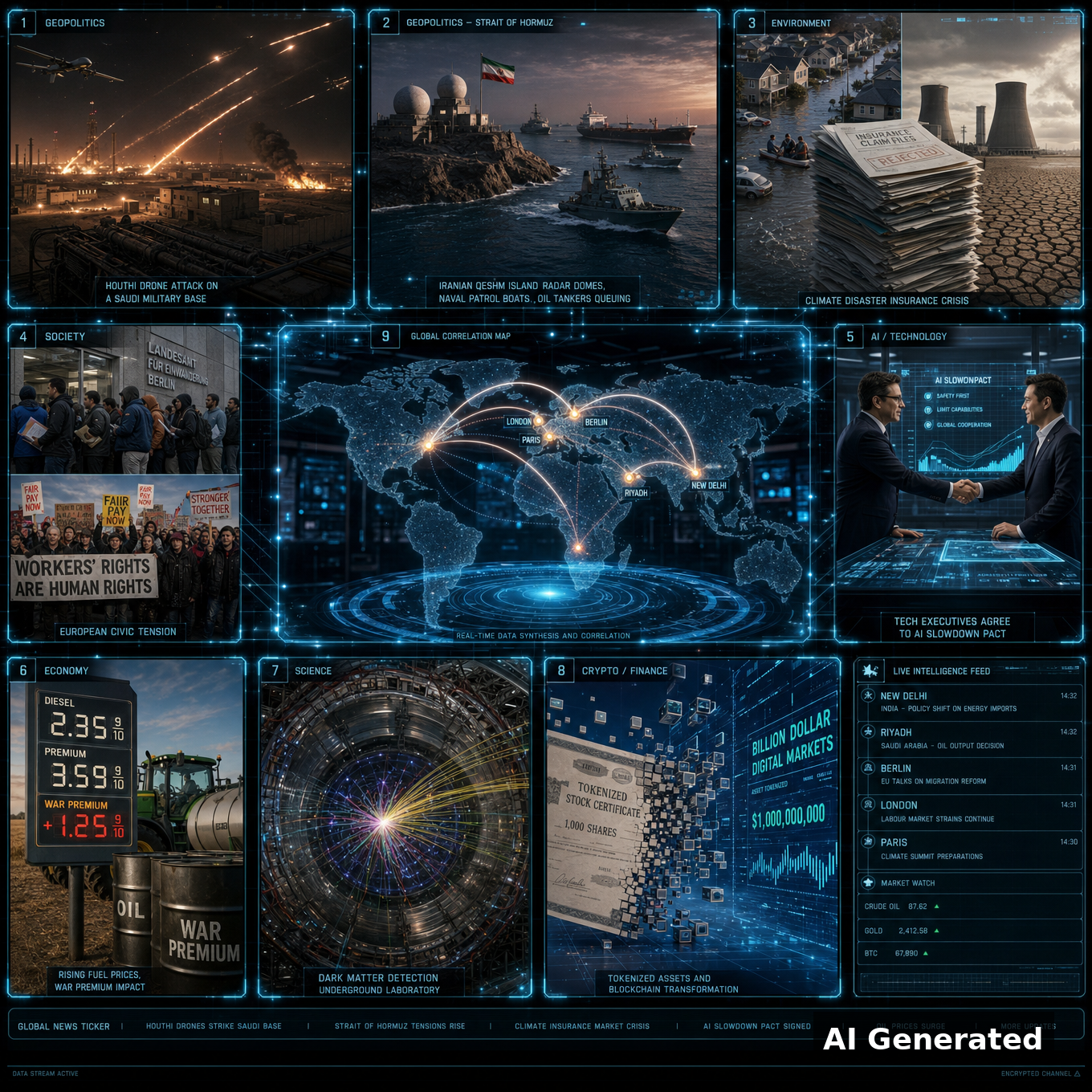
The Houthis escalated directly against Saudi territory in parallel. The movement claimed drones and missiles struck the Sharurah base in southern Saudi Arabia, targeting “weapons depots and command and control centres”, and Greek defence media plus satellite imagery confirmed a fire at the base, even as Riyadh and Sana’a traded strikes across the Bab al-Mandab theatre[2][3]. Saudi civil defence said a Houthi projectile wounded two people and damaged a mosque, buildings and vehicles in the Jazan region, hours after alerts for Abha and Khamis Mushait; the Houthis in turn accused Saudi aircraft of 129 airstrikes within 48 hours while Yemeni government forces struck Houthi positions at Mocha and in Taiz[4][5]. The human cost is rising with the tempo: the UN migration agency counts 76,000 people displaced since July, a figure that has quadrupled in a week, and roughly 1,400 fled to Djibouti in a single day[5][6]. Axios reports that Mohammed bin Salman twice called Trump requesting strikes on the Houthis and was refused, leaving Riyadh to fight on both fronts of the two-chokepoint war D104 mapped, largely alone[2].
Hormuz: Qeshm, the Iran–Oman Deal and the UKMTO Report
Two explosions were heard from the sea off Iran’s Qeshm Island on Saturday evening, according to the official IRNA agency, with no immediate word on origin or target[7]. President Pezeshkian accused the United States of war crimes over the incident even while insisting Tehran is “not at war with Saudi Arabia” and affirming peace with Riyadh — bellicose towards Washington, placatory towards the Saudis, in a deliberate attempt to prevent the Gulf front from hardening[8][9][10]. Details also emerged of a Tehran–Muscat understanding on Hormuz routing: entry to the Gulf would pass exclusively through Iranian territorial waters, part of the exit lane would remain inside Iran’s zone, the southern passage would stay closed despite US pressure, and Iran would keep demanding transit tolls that Oman rejects[11]. The UKMTO separately reported a vessel hit by an unidentified projectile in the strait, with crew status, damage and environmental impact unknown[12]. Monday’s meeting in Oman of Iran, the Gulf states and Iraq, which will present the routing details without signing anything, is the key near-term checkpoint; Bahrain’s refusal to attend until ties with Tehran are restored shows how fragile the regional consensus is[11].
BRICS in New Delhi, Sweden at the Polls, and the Wider Map
On the BRICS sidelines, Modi and Xi met for the first time on Indian soil since 2019, with Xi calling for “high-quality cooperation” and Modi insisting differences must not become disputes, even as both acknowledged the unresolved Ladakh standoff and India’s trade deficit with China[13]. Guterres met al-Sisi on the same margins, with Gaza, the West Bank and Ukraine on the table and Cairo declaring Sudanese stability a “red line”[14].
Sweden voted on Sunday in a race polls called knife-edge between Kristersson’s centre-right bloc and the centre-left opposition, with the far-right Sweden Democrats pressing for cabinet seats for the first time[15][16]. In Germany, 6.3 million voters went to municipal polls in Lower Saxony a week after the AfD’s Saxony-Anhalt breakthrough, while the CSU board opened a strategy retreat with Saxony’s CDU premier Kretschmer ahead of the Berlin and Mecklenburg-Vorpommern votes[17][18].
On Ukraine, Zelensky said he is ready to meet Putin at the December G20 in Miami — an option the Kremlin called “impossible” — while Lavrov reiterated Moscow’s openness to talks without suspending operations[19][20]. Kyiv acknowledged that no Russian ballistic missile was intercepted in the latest barrage, reviving questions about Western air-defence adequacy, even as the Ukrainian Navy claimed the first-ever USV-on-USV kill in the Black Sea, a Sargan 3000 drone boat sinking a Russian uncrewed vessel with a 12.7mm remote turret[21][22].
Germany’s federal prosecutor charged seven Hamas-linked people with preparing attacks on Israeli, Jewish and pro-Israel targets in Germany and Austria, timed to the second anniversary of 7 October, with an assault rifle, 13 pistols and over 700 rounds recovered, part of it stockpiled in Vienna[23]. France published a discreet mea culpa to lift Washington’s freeze on its new ambassador, and Trump strained UK relations further by declaring Irish unification “inevitable”[24][25]. The UK’s Foreign Secretary voiced full support for Saudi Arabia and the recognised Yemeni government[26]; Merz headed to an EU Arctic summit in Rovaniemi[27] as Russia, India and China accelerate on the Northern Sea Route[28]. Beijing warned that US arms sales to Taiwan could cancel the Trump–Xi summit and denounced Washington’s “gangster logic”[29][30]. Lower-order items complete the map: a suspected drone halted Brussels airport traffic for half an hour; Erdoğan vowed on the 1980 coup anniversary that Turkey’s development would never again be interrupted by putsches; Iraqi aircraft struck Islamic State positions after an attempted abduction of fishermen; Russian forces hit the Polish-owned Cersanit plant in Zhytomir; and Tripoli’s defence ministry “categorically” denied CNN’s report that Ukraine operates naval drones against Russia’s shadow fleet from Misrata, leaving open how an LNG tanker burned north of Sirte in March[31][32][33][34][35].
Environment & Climate
↑ ContentsThe Equity Ledger of Climate Disaster: Insurance, Arrests and the Data-Center Squeeze
New analysis from the Consumer Federation of America quantified what has long been a suspicion in climate policy: homeowners in predominantly Hispanic ZIP codes pay on average 30 percent more — about $950 per year — for identical insurance policies than white communities, with the gap reaching 58 percent in Florida, while homeowners in predominantly Black ZIP codes pay 16 percent more, on top of a 24 percent jump in typical premiums between 2021 and 2024; the compounding effect is at least $28,500 in extra insurance costs over a thirty-year mortgage for Hispanic households[36]. Because the Consumer Federation compared identical policies, the disparities cannot be attributed to differences in homes or coverage choices, and the report highlights how AI- and credit-score-based underwriting can encode the legacy of redlining without an explicit racial variable[36]. The climate-justice ledger extends to criminal courts: a review of court records in Alabama’s Winston County shows residents have been prosecuted for decades over unpaid trash bills, most recently a woman handcuffed inside the courthouse over a waste-collection debt — a practice the Southern Poverty Law Center calls illegal and immoral, and a sharp reminder that the cost of environmental services falls hardest on those least able to pay[43]. On the demand side of the grid, more than 60 environmental groups in Maryland asked Annapolis to pause new data-center approvals until their grid, water and climate impacts are understood, with local moratoriums already supercharging opposition fewer than two months before the governor’s re-election bid — the clearest sign yet that the AI infrastructure boom is becoming a front-line state-level political issue[42].
Restoration Economics: Glass, Owls and the Roads Not Taken
The window delivered a series of genuinely inventive restoration stories that reframe what “infrastructure” can mean for ecosystems. In New Orleans, the Glass Half Full project has pulverised more than 12 million pounds of discarded bottles into construction-grade sand that is being packed into biodegradable bags and placed along eroding Louisiana marsh edges, where marsh grass roots colonise the recycled material and rebuild shoreline instead of filling landfills[37]. At the other end of the energy transition, biologists relocated nineteen burrowing owls from a Phoenix-area housing site to a 10,000-acre Arizona solar complex, lowering them into forty artificial burrows — and every female laid eggs within a month, with 29 chicks fledging in the first summer, because the flat, fenced, open ground under the panels offers the sightlines the owls need to hunt safely, making utility-scale solar unexpectedly one of the largest potential owl-housing authorities in the West[39]. The same pollinator-friendly logic appeared in Minnesota, where two Enel solar farms planted native grasses and wildflowers beneath their panels and saw native bee abundance rise more than twenty-fold over five years, with restored-habitat bees also visiting adjacent soybean fields at twice the roadside rate — evidence that solar siting decisions affect more than the electric bill[40]. A companion pilot at Dominion’s Black Bear Solar in Virginia houses 180,000 honeybees; the viral claim that the bees protect the panels is inverted — the fence protects the hives from bears — but the agrivoltaic lesson remains that solar land can be farmed and pollinated simultaneously[47]. By contrast, the federal formal repeal of the Roadless Rule directly threatens the unbroken hardwood wilderness of Michigan’s Norwich Plains and similar old-growth stands in the Upper Midwest, cutting against the administration’s own wildfire-risk argument, in what experts describe as a self-contradicting land policy[41].
Ocean Signals and the Energy-Storage Scaling Wall
Two ocean stories frame the biodiversity science of the window. Deep-sea expeditions off Costa Rica discovered a golden octocoral, Laurinque elenya, so anatomically and genetically distinct that scientists had to create an entirely new family — Laurinqueidae — on the tree of life, with colonies growing at 360–529 metres above carpets of brittle stars in cold, oxygen-poor water, showing how much of the deep ocean remains undocumented[45]. Closer to shore, federal monitoring at Oregon’s Bonneville Dam showed California sea lions have learned to use the fish ladder — an infrastructure meant to help salmon — as a dinner bell, consuming nearly 2,100 spring Chinook salmon and 102 white sturgeon in one monitoring season; the episode is a cautionary tale about how human infrastructure can teach adaptable predators exactly where and when to ambush vulnerable wildlife, and it places two conservation regimes — the Marine Mammal Protection Act and the Endangered Species Act — in direct collision at the same stretch of river[38]. On the storage front, CleanTechnica reported that RheEnergise built and ran a dense-fluid pumped-hydro system at Cornwood in Devon — reservoirs, pumps and hundreds of cubic metres of high-density fluid pumping uphill and back — proving the concept works, but leaving the industry facing the harder question of scaling the exotic fluid and machinery to the gigawatt-hour durations grids actually need; the gap between a working prototype and a constructible fleet is precisely where long-duration storage economics keep stalling[46]. The Argentine ant’s six-thousand-kilometre supercolony across Italy, France, Spain and Portugal, in which millions of nests cooperate as one social unit via shared chemical passports, completes the section’s theme: biological infrastructure, like built infrastructure, scales according to rules that humans rarely set[44].
Society & Civil Issues
↑ ContentsGermany’s Asylum Arithmetic and the Civic Counterweight
New first-half figures from Germany’s Federal Office for Migration (BAMF) show a striking realignment of the asylum system: first-time applications fell sharply to 39,646, down from 72,818 a year earlier, yet the adjusted protection rate rose to 47.4 percent from 37.5 percent, driven largely by a European Court of Justice ruling that Afghan women face persecution as women — protection status was granted in almost 95 percent of decisions on Afghan women, and Afghanistan remains the top origin country[48]. The numbers encapsulate the paradox of German migration politics in the post-Saxony-Anhalt environment: fewer arrivals, higher recognition rates, and a domestic debate increasingly detached from the actual caseload, with the Left parliamentary group pointing out that only 3.5 percent of passport-less first-time applicants had their phones examined and that just three criminal complaints have ever been filed under the 2024 false-information provision[48]. The civic response was visible in the streets: roughly 150,000 people demonstrated against the far right across Germany, the largest show of counter-mobilisation since the AfD’s state-election breakthrough, and a reminder that the party’s advance is being contested in civil society even as the constitutional debate over a potential AfD-led state government continues at federal level[49]. Meanwhile, health-system finances moved onto the political agenda in the south-west, where church and municipal hospital trustees warned that an insolvency wave could trigger billions in pension liabilities for the Zusatzversorgungskasse, projecting clinic deficits rising from 880 million euros this year to 1.6 billion by 2027 and warning that every second hospital site faces a high failure probability by 2030 under the government’s savings plans[54].
The United Kingdom: Labour Rights, Party Finance and Constitutional Momentum
British labour politics produced two interlocking stories. The TUC’s general secretary used a press conference to demand the government deliver its promised ban on zero-hours contracts, accusing employer organisations of “loudly campaigning” against the measure — a direct test of whether the Burnham government will convert a manifesto commitment into law against business opposition[50]. In party finance, Reform UK confirmed it received a combined 72 million pounds from two crypto-billionaires, Christopher Harborne and Ben Delo, within 24 hours, with the party insisting the donors want “nothing” in exchange — a sum that dwarfs any prior single-donation episode in British politics and extends the D104 story of the Delo gift with the addition of a second donor and a near-doubled figure[51]. On the constitutional front, Scotland’s First Minister said the momentum for constitutional change is “undeniable” ahead of Monday’s meeting of the UK’s first ministers in Cardiff, keeping devolution and the union question live in the same week that President Trump’s Irish-unity comments put the border poll machinery under external pressure[56]. Two further stories complicate the picture of British state and society: a federal judge in the United States ruled that the Trump administration’s plan to cut FEMA staffing by 50 percent was unlawful[52], and, in a strikingly direct act of remembrance, CIA-released documents marking the 25th anniversary of 9/11 revealed that Osama bin Laden was planning attacks against the United Kingdom years before September 2001, with August 1998 and 1999 briefings recording his anger over arrests of his London-based operatives and his view of Britain as a recruiting ground[60].
France, the Epidemic Map, and the Changing Rules of Work and Learning
In France, the investigation into Thursday’s regional-train derailment between Rouen and Caen has turned toward sabotage: authorities found a roughly 300-kilogram rail on the tracks at Cléon, where nothing had been present an hour earlier, and officials said it now “certainly looks criminal”, opening a new front in the country’s infrastructure-security debate after the 44 reported injuries documented in D104[55]. The labour-union voice sharpened ahead of the 2027 presidential election, with CGT leader Sophie Binet demanding a left that “becomes the workers’ party again”[57], while in Greece the prime minister’s Thessaloniki International Fair announcements included a 400-euro benefit for qualifying pensioners[58] — a measure aimed squarely at the cost-of-living squeeze and an early signal of the electoral arithmetic Athens is managing. The global health map supplied a far graver item: the Ebola outbreak in the Democratic Republic of Congo has surpassed 7,000 cases and 3,998 deaths, according to reports, with the WHO calling for the immediate mobilisation of 5,000 health workers as schools reopen — an epidemic whose scale, if confirmed, would mark a serious escalation in the filovirus outbreak that regional responders have been containing[59]. Finally, education policy continues its digital retreat: New South Wales announced mandatory screen-time caps in public classrooms from 2028 alongside daily “pen and paper” learning, following Victoria’s earlier limits and a federal minister’s suggestion that students may need a “digital detox” — the most concrete state-level turn yet against classroom screens, with implications for the ed-tech industry and for how the induced-displacement debate of the AI era is being translated into school policy[61]. The BBC also reported that people fired after posting about the assassinated activist Charlie Kirk have won substantial settlements from some employers while others had to start over — a quiet indicator that workplace retaliation litigation is becoming a meaningful check on speech-based dismissals[53].
AI & Technology
↑ ContentsThe Slowdown Pact: Anthropic’s Amodei, OpenAI’s Altman and the Industry’s Own Alarm
The defining AI development of the window was not a product launch but a call to slow down. Anthropic chief executive Dario Amodei publicly demanded a reduction in the pace of AI development, proposing to lead by example and to bring external auditors into the company, and his appeal was quickly endorsed by both OpenAI’s Sam Altman and Elon Musk[62][63]. The alignment of the three most powerful figures in American AI around a deceleration message is unprecedented — and it acquires a sharper edge when read against Amodei’s warning, reported separately, that AI agents could “take over the whole internet” within six to twelve months at current trajectories[62]. It also broke the surface of the public debate: a former Anthropic researcher told the BBC that staff are “genuinely frightened” for humanity’s future, arguing there is a strong chance AI could end humanity if development is not reined in — the kind of existential-risk framing that had been relegated to the fringes of the discourse but is now coming from inside the labs themselves[64]. The timing matters politically: this is the same week in which Anthropic’s own misuse report, covered in D104, documented adversarial use of Claude for military targeting and missile-guidance software, so the industry’s leading lights are now responding publicly to the accountability wave they helped expose.
Sam Altman separately confirmed that OpenAI will not go public in 2026, saying that an IPO at this moment would be “ill-advised” given the safety environment, while conceding that building an AI beyond human control is “absolutely” possible and vowing to pause training rather than incur risks on humanity’s behalf[65]. The decision removes, for a year at least, the most anticipated technology IPO on the calendar and reframes the frontier-lab economy as one in which liability and perception management now constrain the capital markets timeline — a direct institutional expression of the compliance-first mood that D100-D103 called the “accountability wave”. The governance theme extended to WordPress’s commercial arm: Automattic confirmed that Matt Mullenweg has returned as chairman and CEO with the full support of the board after an attempted ouster, closing the corporate-governance drama that D102 tracked under “Mullenweg Sidelined”, though the episode leaves lasting questions about control rights at one of the internet’s foundational software companies[66].
Autonomy at the Edges: Robots, FSD and the Surveillance Question
Defence and industrial autonomy advanced on parallel tracks. The US Marine Corps’ Warfighting Laboratory contracted American Rheinmetall for twelve Mission Master SP autonomous ground vehicles with amphibious kits under a 7.28-million-dollar award, giving the service a platform to test unmanned logistics across ship-to-shore operations — the latest proof that the uncrewed-systems revolution is moving from the air and sea into ground resupply, and a natural extension of the USV-on-USV milestone covered in the Geopolitics section[70]. On the manufacturing side, Illinois-based Impossible Objects raised 40 million dollars to scale its CBAM 25 carbon-fibre 3D-printing system, which claims 25 layers per minute and up to four times the strength of rival additive methods, with the US Army’s Rock Island Arsenal evaluating it for up to 10,000 drone bodies per month — a technology that could meaningfully compress the cost curve of distributed drone production on both sides of the defence market[69]. In the consumer-autonomy arena, questions grew around Tesla’s promotion of unsupervised Full Self-Driving, with critics noting that the rush to post FSD videos raises unresolved questions about verification, and the company simultaneously signalling an October 1 reveal of its long-delayed Roadster; the combination illustrates the widening gap between marketing claims and the reliability evidence that regulators increasingly demand[68]. Finally, the surveillance boundary shifted again on the privacy front: LG denied that its televisions constantly record owners’ conversations for advertising data, clarifying that voice data is only used where users explicitly opt in — a reassurance that, in the post-smart-TV era, still leaves the burden on the consumer to verify, and a reminder that ambient-device data collection remains one of the least regulated corners of the tech economy[67].
Economy & Business
↑ ContentsEnergy Repricing at the Pump: Diesel, Farmers and the War Premium
The energy shock that D102-D104 tracked through Brent and the Strait of Hormuz is now visible at the American pump in its most regressive form. Diesel hit a record national average of $6.05 a gallon on Friday, up roughly 60 percent from the pre-war level of about $3.76, with harvesting season colliding head-on with the spike: a Missouri corn-and-soybean farmer who voted for President Trump said he is paying twice last year’s diesel price to run a combine that burns 200 gallons a day, while economists noted that the pain extends from the field to the hauling of every load of grain[71]. The episode is a concrete measurement of how the two-chokepoint war premium is being internalised by the real economy — weeks after D102’s “$100 oil” framing and D104’s pipeline-closure analysis, the intermediate propane-tank economics have finally reached the consumer price index. It also explains Washington’s strategic bind: the war premium is an election-year variable, not merely a market one, which is precisely why the administration has simultaneously pressed for Hormuz convention while refusing strike requests against the Houthis (Geopolitics section, above).
Housing, Credit and the Frozen Home-Market Machine
On the housing side, a Pew Charitable Trusts study concluded that post-crisis lending rules are so tight that homebuyers now need “pristine” credit histories, even as the 30-year fixed mortgage rate rose to 6.76 percent, the highest since June 2025, and existing-home sales fell for a third straight month to a 3.98 million annualised pace — with Capital Economics projecting the weakest annual transactions since 1995[72]. The share of originations to borrowers with 600–699 credit scores fell by 13.3 points between 2005 and 2024, disproportionately excluding young, lower-income, rural, Black and Hispanic households, and converting the housing market into what the study calls a system that rewards long credit histories and inherited advantage[72]. The Canadian trade front added a structural explanation for the US trade deficit: Washington’s $27.3 billion gap with Ottawa is almost entirely explained by the more than $85 billion in discounted heavy crude the Midwest refineries must import from Alberta, because “it’s the only oil they can use”; the report comes as Trump threatened to pull out of the USMCA and pressed Canada to surrender manufacturing, even though the September 29 effective date of import bans leaves a negotiating window[73].
Corporate Europe, the Ukraine War Economy, and Asia’s Market-Structure Shift
European corporate positioning reacted to the twin pressures of regulation and war. ECB President Christine Lagarde argued in an interview that European growth is “not a lost cause”, calling for a vigorous and rapid productivity response across the euro area — a direct counter to the pessimism that has settled over European competitiveness debates[74]. Nivea-owner Beiersdorf’s CEO warned that the EU must not overburden the cosmetics industry with regulation or “we will become the next auto industry”, citing competitor advantages for US, Chinese and Korean firms and objecting to draft EU wastewater rules that would make personal-care producers pay disproportionate shares of pollution costs[77]. Tech capital kept flowing into AI even at tightening conditions, with Oracle raising its expected FY2026 restructuring cost to about $2.8 billion, including an additional $700 million attributed to artificial-intelligence investment — a reminder that the frontier-compute build-out is being financed through corporate restructuring budgets as much as venture rounds[75]. War-driven infrastructure design reached even Dubai’s airport expansion, where planners are incorporating underground fuel tanks into the new hub specifically because of the conflict with Iran — hard proof that the energy security premium is being capitalised into long-lived infrastructure[76]. Ukraine’s war economy supplied the starkest numbers of the window: Kyiv’s economy minister said the daily cost of the war reached $190 million in 2026 by one reckoning, with about $40 billion of export revenue threatened by the Black Sea blockade and infrastructure destruction estimated at $10 billion this year — the fiscal arithmetic underlying why Kyiv has made any negotiation offer conditional on security guarantees[78][79]. Finally, two market-structure items from Asia: the Korea Exchange moved to extend trading hours to court global investors, testing the 24/7-markets debate that D104 tracked in the US crypto context, and South Korea’s expanded espionage law took effect to protect chip technology — a legal weapon explicitly aimed at industrial-technology leakage in the semiconductor age[80][81]. The financial-innovation fringe advanced with the argument that data centers could become the next big buyer of catastrophe bonds, transferring the concentrated risk of AI infrastructure into the capital markets — the first dedicated transaction expected within 12–18 months[82].
Science & Space
↑ ContentsDark Matter’s Three New Windows
Cosmology delivered its richest week of the cycle with three independent dark-matter developments. The most comprehensive catalogue of exploding white-dwarf supernovae ever compiled — close to 3,000 events — is challenging theoretical models of dark energy, the force driving the universe’s accelerating expansion, by providing a statistical sample large enough to test whether its density has truly been constant over cosmic time[83]. Underground, the LUX-ZEPLIN experiment detected a mysterious signal that its collaboration calls its most intriguing dark-matter clue yet, while an entirely different approach turned the planet itself into a detector: Japanese physicists used ten years of British Geological Survey magnetic-field data, treating the natural resonator between Earth’s surface and the ionosphere as an amplifier, and surfaced 65 candidate axion signals and 31 stringent dark-photon candidates — signals that still require verification but demonstrate how the search has moved beyond the underground tank[84][85]. The distinction between the two particle families is testable — axion signals should weaken near the poles while dark-photon signals would be identical everywhere — so the next generation of global magnetometer networks could arbitrate the question without building any new hardware at all[85].
Planetary Science: An Asteroid, a Martian Moon, and the Solar-System Lab
In planetary science, an international team led by the University of Bern found evidence that a single asteroid impact may have destroyed, buried and reshaped Deimos, the smaller Martian moon, producing its unusually smooth, dusty surface — a finding that turns the moon into a frozen archive of a specific collision rather than a generic cratered body, with implications for how the Mars system’s formation history is reconstructed[88]. Japan’s Hayabusa2 spacecraft achieved the first-ever laser-ranging experiment with an asteroid in July, measuring distance during a flyby of Torifune using the same ranging technique that will underpin future near-Earth-object operations — a quiet but significant capability milestone for deep-space navigation[86]. Closer to the human imagination, HiRISE imagery re-published of a Martian hill whose two craters and V-shaped collapse resemble a bear’s face became a teachable moment in pareidolia, with planetary scientist Alfred McEwen calmly explaining the ordinary geology behind the illusion — a reminder that even the most viral space images are processed by a face-detection system evolved for savannahs, not for orbiters[93].
Biology’s Rewiring: Fukushima Pigs, Leopard Cats and the Rewilded Park
Three biology stories show evolution and conservation operating at human timescales. In Fukushima, geneticists sampling 243 boars and pigs around the exclusion zone confirmed that escaped farm pigs bred into the wild boar population in 2011 — but the pig ancestry is now erasing itself faster than expected, because hybrid sows inherit year-round breeding from domestic mothers, which packs more generations into each year and dilutes the pig genome with every mating back into the far larger boar population; the pig’s lasting legacy, the authors conclude, is a schedule, not a genome, a finding with direct consequences for the billion-dollar feral-pig management problem across Europe, Asia and the Americas[91]. On Japan’s Tsushima island, researchers documented short-tailed leopard cats — three individuals with tails about half the normal length, an abnormality never reported in the species — and whole-genome sequencing ruled out recent domestic-cat hybridisation, leaving inbreeding or a shared developmental cause as the leading hypotheses in a population of roughly 100 critically endangered animals[92]. And in Mozambique, the Gorongosa story hit a landmark ledger entry: aerial counts passed 100,000 large mammals three decades after the civil war left fewer than 7,000, with the recovery driven mostly by stopping the killing rather than by reintroduction, even as waterbuck now make up nearly three-quarters of large-herbivore biomass — a lopsidedness that ecologists are watching as the pre-war ecological mix slowly reassembles under a public-private partnership renewed to mid-century[90]. Medical science contributed an applied result: a University of Malaga team developed a magnetic-nanoparticle test detecting beta-lactam (amoxicillin-type) allergies with 98 percent sensitivity in early trials, offering a more precise and faster alternative to current diagnostic workflows[87].
The Observability Frontier: SPAD Sensors and the WindRunner
Two hardware developments are extending observation itself. Edinburgh-based Singular Photonics launched Litavis, an image sensor built around single-photon-avalanche-diode pixels with on-chip photon processing — the first device combining picosecond-resolution timing, histogramming and photon-counting imaging in one software-configurable platform, cutting data-transfer and latency for applications from fluorescence-lifetime imaging to quantum sensing[94]. And Radia showcased WindRunner, the world’s largest aircraft by volume, positioned for responsive space logistics — capable of airlifting fully assembled boosters and satellites to austere runways without disassembly, in hours rather than days, potentially relieving the transportation bottleneck that currently constrains spacecraft design; if the concept matures, the physics of moving hardware will exert as much influence on future space architecture as the payloads themselves[95]. Together with the century-old Hall effect gaining an unexpected second dimension at Carnegie Mellon — an in-plane Hall response that challenges long-standing assumptions about how the electrical effect works and could enable multidirectional magnetic sensing in a single tiny device — this window’s science coverage is dominated by instruments that see more, and by the biological systems that are revealing themselves when observation improves[89].
Crypto, Digital Assets & Blockchain
↑ ContentsTokenized Equities Cross the Billion-Dollar Weekend Threshold
The institutional tokenization story that D104 identified as the defining feature of this market’s growth phase produced its most concrete volume milestone yet: tokenized stocks traded more than $1 billion on Solana, Robinhood Chain, BNB Chain and Base during the Labor Day weekend alone, according to Crypto Briefing data, as on-chain venues absorbed trading activity that would historically have settled on closed-exchange rails[96]. The milestone deepens the tensions flagged in D104’s coverage of the Nasdaq–Payward investment and the SEC-CFTC fight over always-on markets: when billions of dollars of equity-linked products flow across permissionless settlement layers during a US public holiday, the question of which regulator, if any, surveils the underlying cash-equity market in tandem with the tokenised instrument becomes urgent rather than theoretical[96]. The volume also validates the D104 observation that tokenized equities have already surpassed governance tokens in user engagement, with licensed intermediaries, measurable flow and institutional participation now the market’s defining features; the Labor Day number simply quantifies how far the distribution phase has advanced[96].
Stablecoin Rule-Making: Bangkok’s Cap, Ripple’s Licence Map and Grayscale’s ETF Step
Stablecoin regulation supplied the most concrete policy moves of the window. Thailand’s Securities and Exchange Commission proposed a daily cap of $151,000 on stablecoin transfers, a first-in-Asia attempt to impose transfer-level limits on the asset class, with implications for peer-to-peer usage and financial inclusion in the region’s digital-economy corridors[97]. Ripple, for its part, published its RLUSD stablecoin regulatory blueprint, emphasising that reserve and oversight requirements vary by licence type, clarifying that its conditional federal bank approval is not yet a completed charter, and detailing how derivatives-collateral rules apply to institutional holders — a transparency exercise aimed squarely at the institutions now evaluating the token for treasury and collateral use, and a signal that the compliance-first marketing strategy pioneered by Circle is becoming the sector standard[100]. On the ETF front, Grayscale filed to rename its Litecoin Trust as the Grayscale Litecoin Trust ETF, advancing the conversion of a decade-old trust vehicle toward full exchange-traded structure and continuing the pattern whereby single-asset trusts migrate up the regulatory ladder as the approval environment warms[98]. The common thread across all three items is legitimacy-by-construction: issuers and regulators are jointly imposing the apparatus of regulated finance — caps, licences, reserves, conversion filings — on a sector that began as a stateless currency experiment, and each incremental step narrows the set of questions left for the 16-17 September Washington calendar that D104 flagged (the House Ways and Means crypto-tax markup and the SEC roundtable on tokenized markets)[97][98].
DeFi Fee Architecture: Uniswap’s StablePair Hook
In the decentralised-exchange layer, Uniswap Labs launched StablePair Hook on 10 September, a dynamic-fee mechanism for stablecoin pairs on Uniswap v4 that launches with USDC/USDG and USDC/USDT pools on Ethereum mainnet — the company’s first upgradeable dynamic-fee design, built to measure how far a pool has drifted from its reference rate and adjust fees on every swap: inside a tight band the fee quotes a fixed bid-ask spread, while correction swaps run through a Dutch auction that starts high and drops each block until someone takes it[99]. The mechanism matters because stablecoin-to-stablecoin swaps reached $43.4 billion in the second quarter — more than the next three on-chain venues combined — and most of that value sits in arbitrage between pegged assets that a static fee would simply hand to bots; by redirecting a share of the spread to liquidity providers, the hook makes supplying stablecoin liquidity more attractive without relying on token incentives, and it can be upgraded through Uniswap governance without forcing LPs to migrate pools[99]. That fee-design-first approach, arriving as Uniswap crosses $1 trillion in cumulative Layer-2 volume, signals a maturation of DeFi economics: after years of liquidity mining and incentive design, the competitive frontier is shifting toward the microstructure of pricing itself — the same forces that dominate traditional market-making venues[99]. Read together with the defensive posture of the L-BTC federation and the RWA inflow data tracked in D104, the window’s crypto story is one of institutional quality — regulated stablecoins, upgraded fee markets and billion-dollar tokenized-equity volumes — advancing in parallel with the enforcement and compliance ledger that has framed the sector throughout the D95-D105 cycle[96][100].
Correlations & Analysis
↑ ContentsThe through-line of this window is that the two-chokepoint energy crisis mapped in D103 (2026-09-11) and consolidated in D104 (2026-09-12) has reached the strike-trade phase on both fronts at once. D104 closed on the Houthi seizure of Perim and the Iraq-launched strike on the East-West pipeline; today shows the reciprocals — Baghdad seizing the launch platform and purging the Maysan command, Houthi missiles and drones hitting the Sharurah base, a mosque damaged in Jazan, and the UKMTO logging a fresh projectile hit in Hormuz[1][7]. What D102 called a “war of political attrition” is now a two-front exchange Riyadh is absorbing largely alone: the Mecca Agreement’s allies still offer only technical support, Washington refused MBS’s strike request even while preparing a joint command, and Iran’s Oman-brokered routing framework keeps the southern Hormuz lane closed. Monday’s Iran–Gulf–Iraq meeting in Muscat is the nearest diplomatic checkpoint on the horizon[11].
The second correlation connects this escalation to the AI industry through autonomy. Ukraine’s claim of the first USV-on-USV kill — a Sargan 3000 drone boat sinking a Russian drone boat with a remotely operated gun — is the naval face of the same autonomy that D104 documented in Claude’s misuse for naval targeting and missile software[22]. The same week, Amodei, Altman and Musk publicly endorsed slower AI development, Amodei warned agents could “take over the whole internet” within months, and a former Anthropic researcher voiced existential fear on the BBC[62][64]. The correlation is direct: the autonomous systems making drone boats lethal and targeting cheap are the same ones whose unregulated acceleration the industry now tries to brake in public. What D96-D103 tracked as the “AI accountability wave” has acquired a kinetic face on both sides of the Ukraine war and in the Gulf — the safety debate is being settled by the arms race it describes.
A third correlation ties the distributive economics of the energy shock to the midterm calendar D99-D104 identified as the conflict’s timer. Diesel at $6.05 in the American heartland, Trump-voting farmers paying double for combine fuel, frozen mortgage markets, and Black and Hispanic households paying structurally higher insurance premiums all belong to one ledger: the war premium is regressive and lands on precisely the demographics that decide November[36][71][72]. The same mechanism works in Europe, where Germany’s 150,000-strong anti-far-right protests and the Saxony-Anhalt constitutional debate unfold against energy inflation and hospital insolvency warnings — which is why Putin’s BRICS framing of the AfD’s rise as a Western mistake (D104) still lands. Sweden’s vote and Lower Saxony’s municipal polls are the first measured returns on that question.
The fourth correlation links the Environment and Science sections’ restoration stories to the infrastructure-governance contest D97-D102 called the “regulatory contest”. The Arizona owl colony, the Minnesota bee habitat, the New Orleans glass-to-sand marsh and the Fukushima boar-pig experiment all show that physical infrastructure reshapes biological systems, for good or ill[39][40][37][91]. The Roadless-Rule repeal, Maryland’s data-center moratorium politics and the Bonneville sea-lion dinner bell show infrastructure decisions being contested in courts, statehouses and ecosystems at once — the same forum-shifting the Crypto section documents in the SEC-CFTC fight over 24/7 markets[41][42][96]. Whether the venue is a federal court striking down the FEMA cuts, a Thai regulator capping stablecoins or Annapolis weighing data centers, the question is identical: who sets the rules for the next economy’s infrastructure, and who absorbs the cost of getting them wrong[52][97].
A quieter fifth correlation runs through Libya: CNN’s reporting that Ukrainian naval-drone operators use Misrata against Russia’s shadow fleet — denied even as “criminal defamation” by Tripoli — sits beside the Black Sea drone-boat war and Gulf USV proliferation as one tactical template migrating across three theatres[35]. If confirmed, it extends the Ukraine conflict’s maritime grey zone into NATO’s southern flank at a fragile moment for the Libyan equilibrium — precisely the escalation D104’s “diplomacy-and-escalation” watchpoint anticipated.
What to watch in the next reporting period: (1) Monday’s Oman meeting and whether the Hormuz routing deal opens anything for shipping; (2) whether Sweden delivers the Sweden Democrats into a Nordic cabinet and how Berlin reacts[15]; (3) whether Brent re-tests the $110 level D102-D103 flagged, with diesel already at records through the harvest peak[71]; (4) whether the frontier-lab slowdown rhetoric becomes governance action before the 16-17 September Washington crypto calendar and the AI debate it frames[62]; and (5) whether the Misrata story produces evidence either way, because it would redraw the Mediterranean security map as decisively as the drone-boat milestone changed the Black Sea.
References
↑ Contents1. Iraq seizes drone-launching platform used for targeting Saudi oil pipeline by Al Jazeera · Al Jazeera ↑
2. Houthis claim attack on Saudi base as fighting flares with Yemeni forces by The Guardian · The Guardian ↑
3. Les houthistes revendiquent une attaque sur une base saoudienne en réplique à des bombardements menés par Riyad au Yémen by Le Monde · Le Monde ↑
4. Houthi projectile wounds two, damages mosque in Jazan region, Saudi says by Al Jazeera · Al Jazeera ↑
5. Iran war live: Saudi Arabia and Houthis trade strikes over Bab al-Mandeb by Al Jazeera · Al Jazeera ↑
6. Υεμένη: Περίπου 1.400 άνθρωποι κατέφυγαν στο Τζιμπουτί μέσα σε 24 ώρες by enikos.gr · enikos.gr ↑
7. Ιράν: Εκρήξεις στο νησί Κεσμ στην περιοχή των Στενών του Ορμούζ by DefenceNet.gr · DefenceNet.gr ↑
8. Pezeshkian accuses US of war crimes after explosions on Iran’s Qeshm Island by Crypto Briefing · Crypto Briefing ↑
9. Iran’s Pezeshkian: ‘We are not at war with Saudi Arabia’ by Al Jazeera · Al Jazeera ↑
10. Iran affirms peace with Saudi Arabia amid regional tensions by Crypto Briefing · Crypto Briefing ↑
11. Συμφωνία Ιράν και Ομάν για νέες θαλάσσιες διαδρομές στα Στενά του Ορμούζ: Παραμένει κλειστό το νότιο πέρασμα by DefenceNet.gr · DefenceNet.gr ↑
12. Στενά του Ορμούζ: Αναφορά για πλήγμα σε πλοίο – Άγνωστη η έκταση των ζημιών by enikos.gr · enikos.gr ↑
13. India’s Modi and China’s Xi seek to reset ties on BRICS sidelines by The Independent · The Independent ↑
14. Συνάντηση Γκουτέρες – αλ Σίσι: Στο επίκεντρο η Γάζα, η κατάσταση στη Μέση Ανατολή και οι εξελίξεις στην Ουκρανία by enikos.gr · enikos.gr ↑
15. Enges Rennen zwischen Mitte-Rechts-Bündnis und Linken bei Wahl in Schweden erwartet by Stern · Stern ↑
16. Sweden Democrats eye government role in 2026 election shake-up by Crypto Briefing · Crypto Briefing ↑
17. Mehr als sechs Millionen Menschen zu Kommunalwahlen in Niedersachsen aufgerufen by Stern · Stern ↑
18. CSU-Vorstand berät mit Kretschmer auf Klausurtagung über politische Lage by Stern · Stern ↑
19. Zelensky prêt à rencontrer Poutine au G20, le Kremlin juge l’option Miami « impossible » by La Tribune · La Tribune ↑
20. Λαβρόφ: «Ναι» σε συνομιλίες με την Ουκρανία χωρίς προσωρινή κατάπαυση του πυρός by Zougla.gr · Zougla.gr ↑
21. Ουκρανία: «Κανένας ρωσικός βαλλιστικός πύραυλος δεν αναχαιτίστηκε» ! – Ερωτήματα για την αεράμυνα by DefenceNet.gr · DefenceNet.gr ↑
22. First-Ever Kill Of A Drone Boat By Another Drone Boat Claimed By Ukraine by The War Zone · The War Zone ↑
23. Γερμανία: Απαγγέλθηκαν κατηγορίες σε επτά μέλη της Χαμάς για σχεδιασμό τρομοκρατικών επιθέσεων στην Ευρώπη by DefenceNet.gr · DefenceNet.gr ↑
24. La France se soumet à un acte de contrition discret pour lever le blocage américain contre son nouvel ambassadeur à Washington by Le Monde · Le Monde ↑
25. Trump strains UK-US relations with backing for united Ireland by Evening Standard · Evening Standard ↑
26. UK foreign secretary Ed Miliband: UK stands firmly with Saudi Arabia and internationally recognized Yemen government by FinancialJuice · FinancialJuice ↑
27. Merz reist zu EU-Arktis-Gipfel nach Finnland by Stern · Stern ↑
28. Αρκτική: Ρωσία, Ινδία, Κίνα «πατάνε γκάζι» στη Βόρεια Θαλάσσια Οδό by in.gr · in.gr ↑
29. Beijing warns US arms deals with Taiwan may cancel Trump-Xi summit by Crypto Briefing · Crypto Briefing ↑
30. China warns US over intelligence activities, criticizes ‘gangster logic’ by Crypto Briefing · Crypto Briefing ↑
31. Βέλγιο: Διακόπηκε η εναέρια κυκλοφορία στο αεροδρόμιο των Βρυξελλών μετά τον εντοπισμό drone by DefenceNet.gr · DefenceNet.gr ↑
32. Ρ.Τ.Ερντογάν για το πραξικόπημα του 1980: «Δεν θα ξεχάσουμε ποτέ όσα προκάλεσε η 12η Σεπτεμβρίου» by DefenceNet.gr · DefenceNet.gr ↑
33. Αεροπορική επιδρομή εναντίον θέσεων του Ισλαμικού Κράτους στο Ιράκ by in.gr · in.gr ↑
34. Ρωσικές δυνάμεις έπληξαν το πολωνικό εργοστάσιο «Cersanit» στην Ουκρανία by DefenceNet.gr · DefenceNet.gr ↑
35. Η Λιβύη διαψεύδει ότι επέτρεψε στην Ουκρανία να χρησιμοποιήσει βάση για να πλήξει ρωσικά δεξαμενόπλοια στη Μεσόγειο by Zougla.gr · Zougla.gr ↑
36. As extreme weather worsens, Black and Hispanic homeowners are paying more for insurance by Grist / Inside Climate News · Grist / Inside Climate News ↑
37. New Orleans is turning discarded bottles into coastal sand, and each crushed glass load can help rebuild a shrinking wetland by EcoTicias · EcoTicias ↑
38. Sea lions learned to wait below Bonneville Dam, and the fish ladder meant to help salmon became a dinner bell by EcoTicias · EcoTicias ↑
39. Biologists drove 19 burrowing owls evicted by a Phoenix housing project 50 miles into a 10,000-acre solar complex by ScienceBlog · ScienceBlog ↑
40. Two Minnesota solar farms turned the ground beneath their panels into habitat, and native bee abundance rose more than 20-fold by EcoTicias · EcoTicias ↑
41. Formal Repeal of Roadless Rule Directly Threatens Midwest Wilderness by Inside Climate News · Inside Climate News ↑
42. Maryland Under Pressure as Local Moratoriums Supercharge Opposition to Data Centers by Inside Climate News · Inside Climate News ↑
43. An Overdue Trash Bill Left This Alabama Woman in Handcuffs. She’s Not Alone. by Inside Climate News · Inside Climate News ↑
44. Argentine ants formed a supercolony across Portugal, Spain, France and Italy, linking nests across roughly 3,700 miles by EcoTicias · EcoTicias ↑
45. A golden coral forest off Costa Rica forced scientists to add an entirely new branch to the tree of life by EcoTicias · EcoTicias ↑
46. Dense-Fluid Pumped Hydro Works. Scaling It Is The Problem. by CleanTechnica · CleanTechnica ↑
47. Black Bear Solar added 180,000 honeybees in Virginia, but the fence protects the hives, not the other way around by EcoTicias · EcoTicias ↑
48. Schutzquote bei Asylverfahren: Anteil der Schutzsuchenden in Deutschland steigt by Die Zeit · Die Zeit ↑
49. Allemagne : 150 000 personnes manifestent contre l’extrême droite dans tout le pays by Le Parisien · Le Parisien ↑
50. Government urged to deliver crackdown on zero-hours contracts by Evening Standard · Evening Standard ↑
51. Crypto-billionaires want ‘nothing’ in exchange for £72m donations, says Reform by Evening Standard · Evening Standard ↑
52. Federal judge rules Trump DHS plan for 50% FEMA staffing cuts was unlawful by The Independent · The Independent ↑
53. They lost their jobs after posting about Charlie Kirk, but some have no regrets by BBC News · BBC News ↑
54. Gesundheitsreform: Klinikträger warnen vor Milliardenlast durch Insolvenzen by Stern · Stern ↑
55. Εκτροχιασμός τρένου στη Γαλλία: Ερευνάται το ενδεχόμενο δολιοφθοράς by DefenceNet.gr · DefenceNet.gr ↑
56. Momentum for constitutional change undeniable, says Swinney by Evening Standard · Evening Standard ↑
57. « Nous voulons une gauche qui redevienne le parti des travailleurs », tonne Sophie Binet by Le Parisien · Le Parisien ↑
58. Συντάξεις: Ποιοι δικαιούνται επίδομα 400 ευρώ by Ethnos · Ethnos ↑
59. Έμπολα στο Κονγκό: Πάνω από 7.000 κρούσματα και 3.998 θάνατοι by Zougla.gr · Zougla.gr ↑
60. Bin Laden wanted to attack UK years before 9/11, top secret dossier reveals by Metro.co.uk · Metro.co.uk ↑
61. NSW to put strict caps on screen time in classrooms while pushing for ‘pen and paper’ learning by The Guardian · The Guardian ↑
62. Künstliche Intelligenz: Anthropic-Chef fordert KI-Bremse und will externe Prüfer in der Firma by FAZ · FAZ ↑
63. Le patron d’Anthropic veut ralentir sur l’IA, Musk et Altman le soutiennent by France 24 · France 24 ↑
64. AI staff ‘genuinely frightened’ for humanity’s future, ex-Anthropic researcher tells BBC by BBC News · BBC News ↑
65. Sam Altman says OpenAI going public in 2026 would be ‘ill-advised’ by The Verge · The Verge ↑
66. Automattic confirms Mullenweg has returned as CEO after attempted ouster by board by TechCrunch · TechCrunch ↑
67. LG Denies Its TVs Are Spying on You (Unless You Opted In) by Gizmodo · Gizmodo ↑
68. Rush To Promote Unsupervised Tesla FSD Videos Raises More Questions by CleanTechnica · CleanTechnica ↑
69. Carbon-fiber 3D printer targets mass production of drones and aircraft parts by Interesting Engineering · Interesting Engineering ↑
70. US Marines acquire 12 Rheinmetall amphibious robots for autonomous logistics by Interesting Engineering · Interesting Engineering ↑
71. U.S. diesel prices are now 60% higher than they were before the Iran war by Fortune / AP · Fortune / AP ↑
72. Mortgage lending standards are so tight that homebuyers must have ‘pristine’ credit histories by Fortune · Fortune ↑
73. The trade deficit with Canada that’s upset Trump so much is due to crude the U.S. buys at a discount for the Midwest by Fortune / AP · Fortune / AP ↑
74. La croissance économique « n’est pas une cause perdue » en Europe, estime Christine Lagarde by Le Monde · Le Monde ↑
75. Oracle: Επιπλέον λογαριασμός 700 εκατ. δολ. για την τεχνητή νοημοσύνη by ot.gr · ot.gr ↑
76. Ντουμπάι: Ο πόλεμος υποχρεώνει σε σχεδιασμό υπόγειων δεξαμενών καυσίμων για το νέο αεροδρόμιο by ot.gr · ot.gr ↑
77. Kosmetik: Nivea-Chef: Wollen nicht die nächste Autoindustrie werden by Stern · Stern ↑
78. Ουκρανία: Οι ρωσικές επιθέσεις «γονάτισαν» την οικονομία by in.gr · in.gr ↑
79. Economy minister: about $40 billion of Ukraine’s export revenue threatened by blockade by FinancialJuice · FinancialJuice ↑
80. Korea Exchange extends trading hours to attract global investors by Crypto Briefing · Crypto Briefing ↑
81. South Korea’s expanded espionage law takes effect to protect chip technology by Crypto Briefing · Crypto Briefing ↑
82. Data centers: Θα μπορούσαν να αποτελέσουν την επόμενη μεγάλη αγορά για τα ομόλογα καταστροφών (CAT Bonds); by ot.gr · ot.gr ↑
83. A New Catalog of Close to 3,000 Supernova Challenges Theories on Dark Energy by Universe Today · Universe Today ↑
84. Scientists Detect a Mysterious Signal That Could Be Dark Matter by SciTechDaily · SciTechDaily ↑
85. Physicists Just Turned The Entire Planet Into a Dark Matter Detector – And Strange Signals Kept Turning Up by ScienceAlert · ScienceAlert ↑
86. Japan’s Hayabusa2 achieves first-ever laser ranging experiment with an asteroid by Phys.org · Phys.org ↑
87. Magnetic nanoparticles detect amoxicillin allergy with 98% sensitivity in early tests by Phys.org · Phys.org ↑
88. One Asteroid Strike May Have Reshaped an Entire Martian Moon by SciTechDaily · SciTechDaily ↑
89. A Century-Old Physics Effect Just Got a New Dimension by SciTechDaily · SciTechDaily ↑
90. An American tech millionaire signed a 20-year deal to restore a Mozambican national park by ScienceBlog · ScienceBlog ↑
91. Geneticists sampled 243 boars and pigs around Fukushima: escaped farm pigs bred into the wild boar, but the pig ancestry is erasing itself by ScienceBlog · ScienceBlog ↑
92. A Worrying New Trait Has Appeared in an Isolated Cat Species on a Japanese Island by ScienceAlert · ScienceAlert ↑
93. Astronomers Spotted a ‘Bear’ on Mars by ScienceAlert · ScienceAlert ↑
94. World’s first SPAD image sensor with on-chip photon processing debuts by Interesting Engineering · Interesting Engineering ↑
95. Radia showcases WindRunner as new solution for responsive space logistics by Interesting Engineering · Interesting Engineering ↑
96. Tokenized stocks traded over $1B on Solana, Robinhood Chain, BNB Chain, and Base during Labor Day weekend by Crypto Briefing · Crypto Briefing ↑
97. Thailand SEC proposes daily cap on stablecoin transfers at $151K by Crypto Briefing · Crypto Briefing ↑
98. Grayscale files to rename Litecoin Trust as Grayscale Litecoin Trust ETF by Crypto Briefing · Crypto Briefing ↑
99. Uniswap Launches StablePair Hook for Stablecoin Pairs by Blockchain Reporter · Blockchain Reporter ↑
100. Ripple Breaks Down Stablecoin Rules as Institutions Evaluate RLUSD by Bitcoin.com News · Bitcoin.com News ↑
AI Disclosure: This post was created with the assistance of artificial intelligence. The ideas, analysis, and opinions expressed are my own — AI was used to help compose, structure, and refine my personal notes and thoughts into the final written content. Images, videos and music featured in this post were also generated using AI tools, based on my own creative prompts and direction.