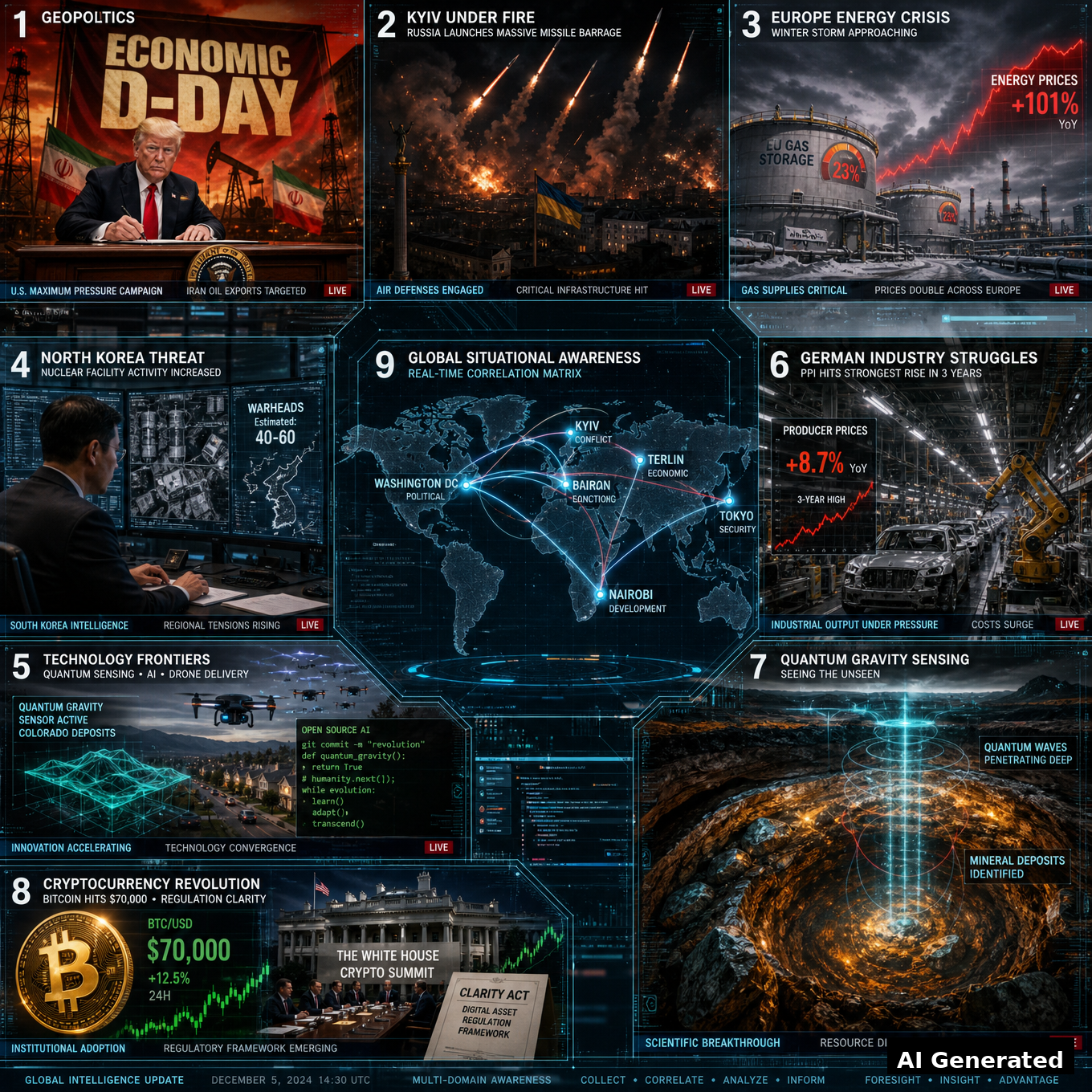


Contents
- 1. Geopolitics & Defence
- Trump Declares “Economic D-Day” Against Iran as Ceasefire Expires With No Diplomatic Off-Ramp
- Russia Launches Massive Strike on Kyiv Killing at Least Twelve as Ukraine Faces Air Defence Shortages
- US Military Secretly Established Oil Transport Corridor Through Strait of Hormuz
- Israel Strikes Syrian Airbase as “Warning” to Turkey; Defence Minister Issues Direct Threat
- Russia Threatens Britain Over Ukrainian Drone Strikes; Moscow Bans Anti-War Voting
- Zelensky Fires Senior Aide Amid Corruption Scandal; Ukraine Creates “Amazon for Military”
- Australia “Outraged” as Israel Drops World Central Kitchen Deaths Case; Five Americans Killed in Kenya Crash
- France Suspends Fillon From Legion of Honour; Tax Agency Suffers Major Data Breach
- Turkey Renews Aegean Energy Claims; Germany Launches Drone Countermeasures Center
- Philippines Expands BrahMos Missile Deployment; India’s Air Force Faces Critical Squadron Shortage
- Germany Opens Cochstedt Counter-Drone Centre; NATO 3.0 Rebrand Dismissed as Cosmetic
- 2. Environment & Climate
- UK Heavy Rain After Prolonged Drought Sparks Flash Flooding Fears
- France Begins Historically Early Harvest as Drought Devastates Agriculture
- Europe’s Gas Prices Double in 2026 as Storage Levels Raise Winter Crisis Fears
- Australia Declares “Significant H5 Escalation” as Bird Flu Kills 1,000+ Birds
- Lake Mead Drops Below Previous Record as Colorado River Crisis Deepens
- Kenya and World Bank Deepen Carbon Market Cooperation; Nepal Hydropower Faces Legal Challenge
- Wildfire Smoke Worsens Urban Air Quality Through Tree Emissions; 2 GW HVDC Becomes Grid Standard
- 3. Society & Civil Issues
- 4. AI & Technology
- Trump White House Crypto Summit Pushes CLARITY Act; Bitcoin Surges to $70,000
- TrueFoundry Releases Open-Source AI Agent Harness Claiming 30-75% Cost Savings
- Amazon Prime Air Expands to 500 US Neighbourhoods; Google Launches AI Study Tools
- Quantum Gravity Sensing Technology Tested for Mineral Exploration in Colorado
- 5. Economy & Business
- German Producer Prices Surge With Strongest Increase in Three Years as Drought and War Compound Pressures
- China Evergrande Founder Sentenced to Life Imprisonment as Property Crisis Deepens
- Oil Markets Rise on US Treasury Buyback Plan; Asian Shares Rebound Sharply
- Dutch Unemployment Rises; Portuguese Inflation Holds at 3.1%; Canada Nears Tariff Deal
- 6. Science & Space
- NASA Abandons Swift Gamma-Ray Observatory Rescue; Breakfast Timing Linked to Longevity
- Antarctic Isolation Study Reveals Crews Struggle With Too Much Contact; Psychological Peak at 55-60
- Whales Move Into Greenland Waters as Ice Disappears; Nuclear Heater Tested for Lunar Night
- New Zinc Battery Uses Protons as Energy Storage; Living GLP-1 Drug Shows Promise for Diabetes
- 7. Crypto, Digital Assets & Blockchain
- 8. Correlations & Analysis
Click any heading to jump to that section.
Click the section heading to return to this menu.
Daily Intelligence Briefing — 2026-08-12 (D73)
Geopolitics & Defence
Trump Declares “Economic D-Day” Against Iran as Ceasefire Expires With No Diplomatic Off-Ramp
President Donald Trump on Wednesday threatened what he called “the most crushing economic warfare operation ever conducted” against any country that permits financial institutions, businesses, airports, or government entities to offer “lifeline” support to Iran, escalating economic pressure on Tehran after the 60-day ceasefire expired Monday with no sign of a diplomatic or military off-ramp to the conflict[1]. In a post on Truth Social, Trump accused Iran of rejecting “the great opportunity” to reach a deal and pledged “economic warfare and isolation of an unprecedented level,” targeting oil smuggling, currency transfers, liquidity movements, exchange bureaux, flag-of-convenience shippers, and front companies. Despite the inflammatory rhetoric, the president did not specify concrete measures, leaving markets uncertain about whether the threats represented actionable policy or continued posturing.
The statement followed Treasury Secretary Scott Bessent’s warning and came as diplomatic architecture collapsed entirely. According to a French news agency source close to the American side, Trump ordered his teams to halt dialogue with Tehran until it accepts American positions[2]. Iran’s chief negotiator Mohammad Bagher Ghalibaf dismissed the “Economic D-Day” rhetoric as “a diversion from the US’ own crisis,” insisting on X that Washington cannot extract concessions beyond the original Islamabad memorandum of understanding signed by both presidents in June[3]. The International Energy Agency characterised the Iran war as producing “the largest oil market impact” in decades, exacerbating geopolitical tensions while hindering diplomatic resolutions and threatening global energy security[4].
Russia Launches Massive Strike on Kyiv Killing at Least Twelve as Ukraine Faces Air Defence Shortages
Russian forces launched a devastating overnight attack on Kyiv and its surrounding region on Thursday, killing at least twelve people and injuring thirty-three in what officials described as a “massive attack” targeting apartment blocks and warehouses[5]. Mayor Vitali Klitschko confirmed the preliminary death toll while Ukraine’s air force reported that Russian forces also struck munitions depots and a drone parts factory in the capital. Russia’s defence ministry claimed the strikes targeted “military facilities and a logistics hub” in Kyiv and the surrounding area, and separately confirmed bombardments of warehouses in the Black Sea ports of Chornomorsk and Pivdennyi[6].
The assault underscored Ukraine’s increasingly precarious air defence posture. President Trump had initially authorised Ukraine to obtain licences to manufacture Patriot air defence systems, but subsequently reversed the decision[7]. The reversal leaves Kyiv dependent on ageing Soviet-era systems and patchwork Western supplies at a moment when Russian missile and drone barrages have intensified on both sides of the front. In a separate development that illustrated Moscow’s widening targeting of Ukrainian infrastructure, financial news agencies reported Russia had begun importing fuel from allied states — a logistical shift suggesting Western sanctions have finally disrupted domestic refining capacity sufficiently to require external supply.
US Military Secretly Established Oil Transport Corridor Through Strait of Hormuz
The United States military has quietly established a shipping lane within and outside the Strait of Hormuz for transporting millions of barrels of oil daily, according to two American officials who spoke to Axios[8]. The revelation confirms that Washington has built operational logistics to maintain crude flows even as the eight-month Iran conflict has left the strategically vital waterway partially blocked by Iranian naval interdictions. The corridor represents a parallel infrastructure to the diplomatic efforts that have stalled, effectively creating a fait accompli that reduces American dependence on negotiated access to the strait.
The development adds a new dimension to the standoff between Washington and Tehran. While Iran insists the strait will remain closed until the US implements its Islamabad commitments, the existence of a functioning US-managed corridor means Washington may calculate it can sustain economic pressure without resolving the underlying diplomatic impasse. The revelation also complicates the position of Gulf monarchies — particularly Saudi Arabia and the UAE — that have been caught between Iranian threats against any country facilitating American military operations and their own dependence on unimpeded shipping through the strait.
Israel Strikes Syrian Airbase as “Warning” to Turkey; Defence Minister Issues Direct Threat
Israel acknowledged carrying out a bombing attack on an abandoned Syrian military airfield on Tuesday, with Prime Minister Benjamin Netanyahu describing the strike as a “warning” to Ankara[9]. Defence Minister Israel Katz went further in a post on X, directly accusing Turkish President Recep Tayyip Erdogan of “dragging Turkey into dangerous adventures in Syria” and issuing an explicit threat: “Don’t test us.”
The strike and accompanying threats represent a significant departure from the tacit coordination that had characterised Israeli-Turkish relations even at their lowest points. Germany’s Vice Chancellor Lars Klingbeil simultaneously called for the European Union to examine sanctions against Israeli Police Minister Itamar Ben-Gvir, whose public incitement against Palestinians has generated condemnation across European capitals and contributed to a broader diplomatic deterioration[10]. UK Foreign Secretary David Miliband summoned Israel’s top diplomat in London over what he called an “unacceptable and destructive” settlement expansion project, while Germany’s Chancellor Merz sharply criticised both Ben-Gvir’s rhetoric and settlement construction[11].
Russia Threatens Britain Over Ukrainian Drone Strikes; Moscow Bans Anti-War Voting
Russia accused London of deliberately escalating the war after Ukrainian forces used British-manufactured drones in successful strikes deep inside Russian territory, warning of “consequences” for UK involvement[12]. Moscow claimed that British-built unmanned aerial vehicles were deployed in attacks on Russian infrastructure, marking the first time the Kremlin has explicitly threatened the United Kingdom over specific weapons systems. The warning came as Ukraine continues to expand its long-range strike capability, with earlier reports documenting drone attacks on Russian refineries more than 700 kilometres from the frontline.
Simultaneously, the Russian government banned anti-war candidates from participating in September’s parliamentary elections, ensuring that no opposition voices critical of the Ukraine conflict will appear on ballots. The move consolidates the Kremlin’s control over the electoral process ahead of what analysts expect to be a mobilisation announcement. Earlier reports had documented plans for post-election troop call-ups, with Zelensky warning of potential escalation in the autumn period when both sides traditionally prepare for winter operations.
Zelensky Fires Senior Aide Amid Corruption Scandal; Ukraine Creates “Amazon for Military”
Under mounting pressure from investigative revelations by Ukraine’s National Anti-Corruption Bureau about the so-called “Midas” case, President Volodymyr Zelensky dismissed his senior aide Irina Moudra[13]. The NABU investigation reportedly uncovered significant corruption within the presidential administration’s procurement and logistics operations, striking at the heart of Zelensky’s anti-corruption credentials that had been central to Western support since Russia’s 2022 invasion. The dismissal comes at an awkward moment, with former Defence Minister Mykhailo Fedorov’s call for wartime elections — the first such demand by a major Ukrainian political figure — already testing the limits of democratic legitimacy under martial law.
On the battlefield logistics front, Le Parisien reported that Ukraine has created what analysts describe as an “Amazon for military” — a digital procurement platform that has revolutionised the country’s war economy and is now inspiring Western armed forces seeking to modernise their own logistics systems[14]. The platform reportedly streamlines everything from ammunition orders to medical supplies, reducing procurement delays that have historically plagued military operations.
Australia “Outraged” as Israel Drops World Central Kitchen Deaths Case; Five Americans Killed in Kenya Crash
Australia summoned the Israeli ambassador in Canberra after Israel announced it would not pursue criminal proceedings over the killing of aid workers — including Australian national Zomi Frankcom — in a strike on a World Central Kitchen convoy in Gaza[15]. Foreign Minister Penny Wong said Israel’s decision “falls far short of the accountability we expect,” adding that the outcome “outrages” Australians. The case had been one of the most high-profile incidents involving civilian casualties in the Gaza conflict, drawing international condemnation when it occurred.
In East Africa, seven people were killed when a helicopter crashed at Mount Ololokwe in Kenya’s Samburu County on Wednesday morning, including five American nationals and Ecuador’s intelligence chief Michele Sensi-Contugi[16]. Samburu County Police Commander David Nkoro confirmed all seven aboard lost their lives. The crash of a senior intelligence official alongside American citizens raises immediate questions about the nature of the mission, though no government has offered an official explanation.
France Suspends Fillon From Legion of Honour; Tax Agency Suffers Major Data Breach
Former French Prime Minister François Fillon was suspended for ten years from both the Légion d’honneur and the Ordre national du Mérite following his definitive conviction for the fictitious employment scandal, according to a decree published in the official journal[17]. The 2017 presidential candidate received a four-year prison sentence with suspension and a €375,000 fine in addition to five years of ineligibility. Separately, France’s tax agency website was breached in a major data hack affecting 678,000 taxpayers, with Jean-Baptiste Soufron, former secretary general of the National Digital Council, writing in Le Monde that “the credibility of the French state is undermined when it fails to protect one of its most regal fortresses”[18].
Turkey Renews Aegean Energy Claims; Germany Launches Drone Countermeasures Center
Turkey raised fresh objections to Greece’s spatial planning framework for renewable energy installations in the Aegean, reiterating its contested “grey zones” theory that Athens rejects as having no basis in international law[19]. Greece’s Coalition of the Left (SYRIZA) called on the government to respond “dynamically” to what it described as an unacceptable Turkish challenge, demanding European Union sanctions enforcement and a restart of exploratory contacts that Athens had severed. Meanwhile, Germany inaugurated a new drone detection and countermeasures testing center at Cochstedt in Saxony-Anhalt, with federal Interior Minister Alexander Dobrindt linking the investment to rising hybrid threats including espionage, sabotage, and critical infrastructure protection[20].
Philippines Expands BrahMos Missile Deployment; India’s Air Force Faces Critical Squadron Shortage
The Philippines is reportedly considering the purchase of up to nine additional BrahMos supersonic anti-ship missile batteries from India, aimed at strengthening the so-called “BrahMos Belt” — a chain of coastal defence installations across Southeast Asia designed to counter Chinese expansion in the South China Sea[21]. An independent study concluded India requires between 67 and 79 fighter squadrons for two-front air superiority — far exceeding its current 29 operational squadrons[22]. South Korea’s KAI and Hyundai Rotem signed an MoU to jointly develop weapons for the KF-21 Boramae fighter[23].
Germany Opens Cochstedt Counter-Drone Centre; NATO 3.0 Rebrand Dismissed as Cosmetic
Germany officially inaugurated a new technological centre at Cochstedt dedicated to the development and practical testing of drone countermeasures, with the federal government planning investments of up to €10 million over coming years[24]. The facility — operated by the German Aerospace Center — allows testing in controlled conditions including beyond visual line-of-sight flights and interference scenarios. The opening came two weeks after authorities discovered a modified drone with explosives hidden among Ukrainian cargo aircraft at Leipzig-Halle airport, an incident the federal prosecutor classified as a serious attack on transport and supply infrastructure.
On the alliance front, a former US ambassador dismissed the NATO 3.0 rebranding concept as “lipstick on a pig,” arguing that the transatlantic relationship has changed so profoundly under Donald Trump’s return to the White House that cosmetic rebranding cannot mask the underlying structural transformation[25]. The critique captures a broader scepticism within the alliance about whether institutional reform can keep pace with the speed of geopolitical realignment.
Environment & Climate
UK Heavy Rain After Prolonged Drought Sparks Flash Flooding Fears
Heavy rain and thunderstorms swept across the United Kingdom on Thursday, triggering yellow Met Office warnings for northern England and north Wales and raising fears of flash flooding on ground hardened by weeks of drought[26]. Between 15 and 20 millimetres of rain could fall in just one hour in affected areas, while some locations could see up to 30 to 50 millimetres over six hours. The return of rain after such a prolonged dry spell created dangerous conditions for motorists, with oil, fuel, and rubber deposits built up over weeks becoming greasy when mixed with initial rainfall rather than being washed away. The RAC warned that drivers face greater risk of skidding on surfaces that have accumulated months of contaminants.
Despite the downpours, forecasters cautioned that the drought affecting large parts of the UK will not disappear overnight, requiring sustained periods of rainfall to replenish depleted aquifers and reservoirs. Thursday could mark the first day since June 29 that temperatures failed to reach 25°C anywhere in the country, with overnight lows potentially dropping into single figures in parts of Scotland and northern England. The dramatic shift from the fifth heatwave of the year to thunderstorm conditions illustrates the volatility of the UK’s weather patterns during an increasingly unstable climate regime.
France Begins Historically Early Harvest as Drought Devastates Agriculture
French vineyards began their 2026 grape harvest as much as three weeks earlier than normal across multiple regions, with growers describing the temperatures, dates, and conditions as “entirely out of the ordinary”[27]. The early start — driven by exceptional summer heat that accelerated ripening — presents a fundamental challenge to quality wine production, as shorter maturation periods can compromise the complex flavour profiles that define French appellation wines. In Champagne, where timing is particularly critical for sparkling wine production, vignerons face the unprecedented prospect of harvesting before the traditional September start.
France’s former Environment Minister Corinne Lepage argued in Libération that summer 2026 represents not an anomaly but “the new normal,” calling for rapid policy adaptation to permanent drought and fire conditions[28].
Europe’s Gas Prices Double in 2026 as Storage Levels Raise Winter Crisis Fears
European natural gas prices surged approximately 120 percent over the course of 2026, with the worst potentially yet to come as low storage levels and ongoing supply risks leave the continent vulnerable to a costly winter[29]. The price escalation — driven primarily by the Iran war’s disruption of global energy supply chains and the Strait of Hormuz crisis — has forced European utilities and manufacturers to seek alternative suppliers at premium prices while attempting to fill storage facilities ahead of the heating season. The crisis has fundamentally altered the energy economics of European industry, compounding pressures on German manufacturing already struggling with drought-related logistics disruptions and rising producer prices.
The gas price surge intersects with Germany’s broader economic challenges, as the country’s producer prices recorded their strongest increase in three years, jumping 1.1 percent month-on-month and 3.0 percent year-on-year[30]. Low river levels on the Rhine — documented extensively in previous reports — have compounded the crisis by restricting barge transport of energy and raw materials, forcing expensive rerouting through rail and truck networks that lack capacity.
Australia Declares “Significant H5 Escalation” as Bird Flu Kills 1,000+ Birds
South Australian Premier Peter Malinauskas declared a “significant escalation” in H5 bird flu after three mass mortality events killed more than 1,000 greater crested terns across the state[31]. The deaths, presumed to be caused by the highly pathogenic avian influenza strain, represent the most serious wildlife mortality event in the current outbreak and raise concerns about potential spread to commercial poultry flocks. Malinauskas stressed that there have still been no detections in poultry or livestock and no mass deaths involving mammals, but the scale of the wild bird die-off has prompted enhanced surveillance across South Australia.
The Australian outbreak mirrors a broader pattern of H5 avian influenza spreading across wildlife populations globally, with previous reports documenting similar mass die-offs in Europe and North America. The disease’s jump between wild bird species and its proximity to agricultural zones creates a constant threat of economic disruption through poultry culling and trade restrictions.
Lake Mead Drops Below Previous Record as Colorado River Crisis Deepens
Lake Mead, America’s largest reservoir, fell below its previous record low of 1,040.58 feet to reach 1,039.70 feet on August 14, fully exposing the foundations of St. Thomas — a Nevada ghost town drowned when Hoover Dam began filling the reservoir in 1935[32]. The Bureau of Reclamation’s August hydrologic update projects the lake could fall to 1,037.31 feet by year-end, with storage at just 6.96 million acre-feet — roughly 27 percent of capacity. The current level is approximately five feet above an important hydropower threshold at 1,035 feet, below which Hoover Dam’s generating capacity would collapse from 1,274 megawatts to just 382 megawatts.
The exposed ruins of St. Thomas — a community of approximately 500 people that existed from 1865 to 1938 — have become a potent symbol of the Colorado River crisis. Foundations that once sat 60 feet underwater now stand on dry ground, providing what the Bureau of Reclamation describes as “human scale” to what is otherwise an abstraction of acre-feet and cubic metres per second. The federal government has announced a $52 million investment to replace aging turbines with wide-head models capable of operating at lower water levels.
Kenya and World Bank Deepen Carbon Market Cooperation; Nepal Hydropower Faces Legal Challenge
Kenya’s Principal Secretary for Environment and Climate Change held bilateral talks with World Bank Director Valerie Hickey on strengthening cooperation around the circular economy and carbon markets on the sidelines of the UN Convention to Combat Desertification COP17[33]. The meeting signals Kenya’s intent to position itself as a hub for carbon credit trading in East Africa, leveraging its existing renewable energy infrastructure and growing forest conservation programmes. In Nepal, meanwhile, the government has allowed several private hydropower producers to develop projects inside protected areas and their buffer zones — contravening a Supreme Court order that declared a 2024 amendment opening protected areas to commercial development “invalid” as it violated constitutional environmental protections[34].
Wildfire Smoke Worsens Urban Air Quality Through Tree Emissions; 2 GW HVDC Becomes Grid Standard
A study published in Nature revealed that trees themselves may be worsening air quality in cities by releasing compounds — particularly isoprene and other biogenic volatile organic compounds — that contribute to ground-level ozone formation[35]. The finding complicates urban forestry strategies, as rising temperatures are expected to increase these emissions, potentially offsetting the air quality benefits that trees provide through particulate filtration. The research suggests that urban planners must account for the specific species planted and local temperature conditions when designing green infrastructure.
Separately, high-voltage direct current transmission technology is advancing toward a new 2-gigawatt standard, with GE Vernova’s CTO describing HVDC as moving from specialist applications into mainstream grid deployment[36]. However, grid control systems — the software and infrastructure needed to manage power flows across long-distance HVDC links — are not keeping pace with the hardware advances, creating a potential bottleneck for the clean energy transition.
Society & Civil Issues
UK Government Issues Asylum Seeker Behaviour Guidance; GCSE Results Day Highlights Mental Health Concerns
The UK Home Office released a nine-page guidance document entitled “Understanding Behaviours and Expectations in the UK” distributed to asylum seekers, detailing rules on sex and consent, gender equality, and respect in public[37]. The document states that consent is required in every sexual situation, that rape remains rape even within marriages or relationships, and that domestic abuse constitutes a serious crime that can result in imprisonment and loss of accommodation. Shadow Home Secretary Chris Philp attacked the guidance on X, arguing the government should instead deport “mainly young, male illegal immigrants” rather than training them in civilised behaviour, while Reform UK’s Zia Yusuf called the guidance a “disgrace.”
The guidance emerged against the backdrop of several weeks of anti-asylum-seeker protests in England, including violent scenes near Thetford, Norfolk, where attempts were made to storm homes linked to asylum seekers and police officers were assaulted during three nights of unrest. UCL researchers found that forced GCSE resits in England — mandatory for students failing to reach grade 4 — are significantly harming teenagers’ mental wellbeing compared to Wales and Northern Ireland, where resits are not compulsory[38].
Former Archbishop Accuses Farage of Weaponising Christianity; Burnham Vows Waste Crime Crackdown
Dr Rowan Williams, the former Archbishop of Canterbury, accused Nigel Farage of using Christianity “to channel anti-Muslim feeling” and said he had “awkward questions” for far-right activist Tommy Robinson regarding his claimed faith[39]. The intervention represents the most senior religious critique of the growing Christian nationalist current in UK politics, where Reform UK has increasingly positioned itself as defender of Christian values against what it frames as Islamic cultural encroachment. Williams’ comments suggest the Church of England is preparing for a more confrontational posture toward the political right’s appropriation of religious identity.
Prime Minister Andy Burnham announced a crackdown on criminal gangs profiting from illegal waste, empowering more police officers to seize cash, cars, and houses while extending fines from £300 to £5,000 maximum[40]. AI-powered drones will be deployed to detect illegal dumping activity, with West Yorkshire and Greater Manchester set to pioneer region-led approaches to waste crime. The government also committed to funding the cleanup of three major illegal waste sites in West Yorkshire, Surrey, and Kent, holding an estimated 22,000 tonnes of illegally dumped waste.
South Korea Estimates North Korea Possesses 80-120 Nuclear Warheads, Far Above Trump’s Figure
South Korea’s intelligence assessment estimates that North Korea possesses between 80 and 120 nuclear warheads — significantly more than the 57 figure cited by President Trump, who claimed to be “very good friends” with Kim Jong Un and said he would meet the North Korean leader before year’s end[41]. The discrepancy between the American and South Korean estimates raises questions about intelligence sharing within the alliance and whether Trump’s lower figure reflects genuine analytical disagreement or political positioning ahead of potential negotiations. The gap is particularly notable given that Trump simultaneously announced the reduction of US-South Korea joint military exercises at Seoul’s request, a concession that Defence hawks in South Korea argue weakens deterrence without securing any concrete diplomatic commitment from Pyongyang.
AI & Technology
Trump White House Crypto Summit Pushes CLARITY Act; Bitcoin Surges to $70,000
President Trump met with executives from Coinbase, Ripple, Gemini, and other major cryptocurrency companies at the White House on Wednesday, using the occasion to push Congress to pass “a fair version” of the Digital Asset Market Clarity Act and declaring that the United States will “ensure America remains the undisputed leader” in Bitcoin, crypto, prediction markets, and artificial intelligence[42]. Trump also announced that the US has discussed plans to purchase “sizable” amounts of Bitcoin and other cryptocurrencies, and that Commodity Futures Trading Commission Chair Michael Selig is working to bring the Hyperliquid perpetuals trading platform into the US in a “fully compliant and legal fashion.”
Coinbase CEO Brian Armstrong projected the legislation would receive “more than 60 votes” when the Senate holds its cloture motion on September 15, while Trump backed Armstrong’s assessment as “very bipartisan.” Bitcoin surged approximately 7 percent to tap $70,000, Ethereum jumped nearly 18 percent to $2,327, and the HYPE token soared more than 20 percent following the Hyperliquid announcement. However, Democratic Senator Ruben Gallego warned at the SALT Wyoming Blockchain Symposium against rushing to a vote, noting that unresolved disagreements over ethics provisions and stablecoin yield remain. Senate Democrats have pushed for language preventing public officials, including the president, from selling digital currencies, but Gallego said repeated efforts to reach the White House on ethics language have made little progress.
TrueFoundry Releases Open-Source AI Agent Harness Claiming 30-75% Cost Savings
TrueFoundry, a San Francisco B2B machine learning startup, released TrueForge — an open-source AI agent harness under the MIT License that claims 30 to 75 percent cheaper task completion compared to Anthropic’s Claude Managed Agents[43]. When paired with the open-source GLM-5.2 model, TrueForge completed 11 of 14 tasks on DevRev’s Enterprise-Bench at a cost of $2.90 compared to $11.80 using Claude Managed Agents with the same underlying model. TrueForge’s architecture centres on context engineering — controlling how much information gets sent back to the model at each step — including delaying MCP tool schema loading, delegating isolated tasks to subagents, and automatically compacting long-running conversations.
The release extends TrueFoundry’s strategy from its AI Gateway governance layer upward into the agent runtime itself. Co-founder Anuraag Gutgutia described the relationship as complementary: organisations can run TrueForge independently while TrueFoundry’s commercial opportunity lies in providing governance infrastructure underneath whichever agent harnesses enterprises choose. NetApp was a beta user, deploying the technology for incident response and ticket triage. The company raised $19 million in Series A funding led by Intel Capital in February 2025 and acquired UK-based Seldon AI in June 2026.
Amazon Prime Air Expands to 500 US Neighbourhoods; Google Launches AI Study Tools
Amazon announced it would expand Prime Air drone delivery from 10 cities to approximately 500 metropolitan areas across the United States by year’s end, with immediate launches planned in Chicago, Cleveland, Atlanta, Syracuse, and Boise[44]. Each Prime Air site covers approximately 175 square miles with delivery times ranging from 30 minutes to one hour. The planned expansion represents a sixfold increase in coverage and will test community tolerance for daily drone flights in densely populated areas, particularly regarding noise pollution and privacy concerns.
Separately, Google launched new AI-powered study tools through its Gemini platform, introducing a dedicated study hub that includes a study notebook, customised flash cards, and practice quizzes[45]. The features represent Google’s latest push into educational technology, positioning AI as a personalised tutoring tool rather than just a search enhancement.
Quantum Gravity Sensing Technology Tested for Mineral Exploration in Colorado
Infleqtion, a neutral-atom quantum computing company, plans to test a quantum gravity gradiometry system in Colorado in 2027 that could help locate critical mineral deposits underground before exploration companies spend heavily on drilling[46]. The technology measures tiny variations in Earth’s gravitational field caused by differences in underground density, potentially identifying promising geological structures earlier in the mineral exploration process. CEO Matt Kinsella stated: “America cannot secure the supply chains it cannot see. The first step toward mineral independence is knowing what you actually have.”
The planned field demonstration supports the Quantum-Enhanced Critical Minerals Mapping Act of 2026, a proposed measure directing the US Geological Survey to incorporate quantum gravity gradiometry into its Earth Mapping Resources Initiative. If successful, the approach could reduce the number of low-potential sites advancing to expensive drilling stages, potentially accelerating the timeline for establishing Western supply chains for rare earth and other critical minerals currently dominated by Chinese suppliers.
Economy & Business
German Producer Prices Surge With Strongest Increase in Three Years as Drought and War Compound Pressures
German producer prices recorded their strongest increase in three years, jumping 1.1 percent month-on-month and 3.0 percent year-on-year as geopolitical tensions and critically low river levels drove manufacturing cost pressures to levels not seen since the initial energy crisis[47]. The Handelsblatt analysis attributed the surge primarily to shipping constraints on the Rhine, where water levels remain at near-record lows, forcing costly rerouting of raw materials and energy products through road and rail networks. Food producer prices actually declined, offering some relief to consumers, but industrial input costs accelerated sharply across metals, chemicals, and logistics-dependent sectors.
The producer price data compounds the challenges facing German industry already reeling from the compounding effects of the Iran war’s energy disruptions, drought-related logistics constraints, and persistent competitive pressure from Asian manufacturers. The Ifo business climate index, reported at 86.6 — marginally above forecast but reflecting deep structural anxiety — captures an industrial sector struggling simultaneously with multiple headwinds that individual policy interventions cannot address.
China Evergrande Founder Sentenced to Life Imprisonment as Property Crisis Deepens
A Chinese court sentenced Xu Jiayin, the founder of property giant China Evergrande Group, to life imprisonment and confiscated his entire personal wealth five years after the company’s catastrophic collapse triggered the country’s property crisis[48]. The sentencing — reported by state broadcaster CCTV — represents the most prominent accountability action in the ongoing property sector reckoning, as authorities seek to reassure the public that the architects of reckless leverage face consequences. Evergrande, once China’s largest property developer and among the biggest in the world, defaulted in late 2021 and has been in restructuring proceedings since.
The verdict comes as Shanghai eased housing purchase restrictions in a bid to stimulate property demand, the latest in a series of policy adjustments that have thus far failed to arrest the sector’s decline[49]. The juxtaposition of punishment for past excess with ongoing attempts to revive the sector captures the fundamental tension in Beijing’s approach: maintaining accountability while preventing systemic financial contagion.
Oil Markets Rise on US Treasury Buyback Plan; Asian Shares Rebound Sharply
Oil prices held near multi-week highs on Thursday as global markets rebounded following Washington’s announcement of expanded debt buybacks, while the US-Iran standoff continued to support energy prices at elevated levels[50]. The Treasury Department’s decision to increase the size of its routine bond buyback operations eased financing conditions and supported risk appetite across asset classes, with South Korea’s Kospi benchmark surging more than 6 percent — its strongest single-session gain in months[51].
The buyback expansion may complicate the Federal Reserve’s monetary policy by injecting liquidity while the central bank manages energy-driven inflation[52].
Dutch Unemployment Rises; Portuguese Inflation Holds at 3.1%; Canada Nears Tariff Deal
The Netherlands reported an increase in unemployment to 4.0 percent from 3.8 percent, the latest data point suggesting the eurozone labour market is softening under the weight of energy-driven cost pressures[53]. Portugal’s inflation held steady at 3.1 percent in July on a harmonised basis, with transportation costs surging 6.2 percent year-on-year while food price pressures eased[54]. The mixed signals across eurozone economies complicate the European Central Bank’s rate-setting calculus, with some members calling for continued vigilance while others argue the inflationary impulse is largely supply-driven and will pass.
Canada reportedly neared a deal with the United States on tariffs covering metals and automobiles, with negotiations focused on reducing the steel tariffs and auto levies that have threatened to escalate to 50 percent[55]. The agreement, if finalised, would represent a significant de-escalation in the trade tensions that have characterised the US-Canada relationship since Trump’s return to office.
Science & Space
NASA Abandons Swift Gamma-Ray Observatory Rescue; Breakfast Timing Linked to Longevity
NASA and Katalyst Space Technologies announced the abandonment of a robotic rescue mission to save the Neil Gehrels Swift Observatory before it falls out of orbit and burns up in Earth’s atmosphere[56]. The rescue satellite, named Link, launched July 3 on a journey to capture the telescope with three robotic arms and boost it into a safer orbit, but “ongoing attitude control issues” prevented the spacecraft from completing its mission. Katalyst said it will attempt a close-in navigation demonstration with the remaining capacity. The loss of Swift — which has been a cornerstone of gamma-ray burst astronomy since its 2004 launch — removes a critical capability for studying the universe’s most energetic explosions.
In a major public health finding, a study published in the European Journal of Clinical Nutrition analysing data from over 31,000 US adults found that eating the first meal of the day after noon was associated with a 46 percent higher risk of cardiovascular death compared to eating between 7 and 8am, while late eaters at age 50 faced an estimated 2.46-year reduction in life expectancy[57]. Senior author Zhilei Shan of Huazhong University cautioned that the findings represent an association rather than proof of causation, noting that very late eating may disrupt circadian rhythms and metabolism, but early eaters also tended to be older and sicker.
Antarctic Isolation Study Reveals Crews Struggle With Too Much Contact; Psychological Peak at 55-60
A study published in PNAS tracking twelve crew members through a ten-month Antarctic isolation experiment at Concordia Station found that crew members who spent the most time in close contact with others reported more conflict, more suspicious and mistrustful thoughts, and worse performance[58]. Researchers wearing proximity sensors discovered that the crew’s interactions increasingly clustered within national and language groups over the winter — a “tribal fragmentation” pattern that poses serious risks for multinational Mars mission crews. The finding challenges the assumption that social contact automatically counteracts isolation, suggesting that being unable to escape from specific individuals is fundamentally different from chosen supportive connection.
Separately, psychologists Gilles Gignac and Marcin Zajenkowski published an analysis in the journal Intelligence examining 16 psychological dimensions across the lifespan, finding that overall psychological functioning — combining raw mental speed, judgment, knowledge, emotional stability, and reasoning — does not peak until approximately age 55 to 60[59]. While raw processing speed crests around age 20, crystallised intelligence, conscientiousness, emotional stability, and resistance to cognitive biases continue improving for decades, with the gains outweighing the losses until the late fifties.
Whales Move Into Greenland Waters as Ice Disappears; Nuclear Heater Tested for Lunar Night
Melting sea ice from climate change has opened up the Greenland Sea for baleen whales to undertake unprecedented “feeding frenzies” in waters that were previously inaccessible due to ice cover[60]. The phenomenon — documented through aerial surveys and acoustic monitoring — represents one of the more visible ecological consequences of Arctic warming, as species shift their ranges to exploit newly available food resources. While the whales’ expanded range offers短期 benefits for the animals, marine ecologists warn that the disruption to established food webs could have cascading effects throughout the North Atlantic ecosystem.
In space technology, Firefly Aerospace announced a partnership with Zeno Power Systems to test a nuclear-powered heating package during a 2028 Blue Ghost lunar mission, designed to keep spacecraft operational through the Moon’s brutal two-week night when temperatures plunge below minus 275°F[61]. The five-watt radioisotope heater unit containing americium-241 would provide continuous thermal energy without dependence on solar panels — a critical capability for sustaining long-duration lunar surface operations and eventually supporting permanent Moon base infrastructure.
New Zinc Battery Uses Protons as Energy Storage; Living GLP-1 Drug Shows Promise for Diabetes
Researchers at KAIST developed an electrode for water-based zinc-ion batteries that uses protons — previously considered performance-degrading “troublemakers” — as an additional energy storage mechanism[62]. The two-dimensional conductive metal-organic framework material stores zinc ions first at higher voltages, then captures smaller protons as voltage falls, achieving a storage capacity of 368.7 mAh/g and maintaining 46.9% of initial capacity when the charge-discharge rate was increased 16-fold. The electrode remained stable for more than 500 rapid cycling cycles, suggesting the sequential storage process could make aqueous zinc-ion batteries practical for grid-scale energy storage.
In medical science, researchers demonstrated that bacteria engineered to sense and reduce glucose levels could represent a new approach to type 2 diabetes treatment[63]. The pre-clinical trials on animal models showed that the engineered organisms function as a “living GLP-1 drug” — potentially offering a cheaper, more accessible alternative to the expensive injectable GLP-1 agonists that have transformed diabetes and weight-loss treatment.
Crypto, Digital Assets & Blockchain
Bitcoin Surges Past $70,000 as Trump White House Meeting Signals Pro-Crypto Shift
Bitcoin surged approximately 7 percent to briefly touch $70,000 on Wednesday following President Trump’s White House meeting with cryptocurrency industry leaders, marking the highest price since the June sell-off and representing a significant shift in market sentiment[64]. The rally was accompanied by Ethereum posting an even larger jump of nearly 18 percent to reach $2,327, with every major cryptocurrency except Tron posting double-digit weekly gains. More than $2.74 billion in short positions were liquidated in 24 hours — the eighth-largest liquidation event in crypto history — as bearish bets were forcefully unwound by the sudden price appreciation[65].
The price surge was driven by multiple converging catalysts: Trump’s explicit endorsement of the CLARITY Act, his announcement that the US is planning “sizable” Bitcoin purchases, and the CFTC Chair’s commitment to bringing Hyperliquid into US markets in a compliant manner. Coinbase CEO Brian Armstrong projected the legislation would clear 60 Senate votes on September 15, while Trump characterised the bill as “very bipartisan.” The Hyperliquid HYPE token jumped more than 20 percent to $71 following Trump’s comments about the CFTC’s regulatory engagement with the platform. However, market analysts cautioned that the rally’s sustainability depends on actual legislative progress rather than political rhetoric, with Democratic Senator Gallego warning against rushing to a vote before resolving ethics provisions.
Grayscale Updates Zcash ETF Filing; Core Scientific’s $24 Billion AI Pivot Faces Debt Risks
Grayscale Investments filed its fourth amendment to convert the Grayscale Zcash Trust into an exchange-traded fund, while simultaneously disclosing that a Digital Currency Group subsidiary is weighing an investment representing approximately 200,000 ZEC — currently valued at roughly $110 million[66]. The filing represents the latest step in Grayscale’s broader strategy to convert its cryptocurrency trust products into regulated ETF structures, though the SEC has yet to approve a privacy-focused token product.
Meanwhile, former Bitcoin miner Core Scientific has secured more than $24 billion in potential AI hosting revenue, but its ambitious pivot from cryptocurrency mining to artificial intelligence data centres faces significant headwinds from construction costs and rising debt levels[67]. The company’s transformation mirrors a broader trend among crypto miners — including Riot Platforms, which signed a $9.1 billion data centre lease reportedly for Anthropic — seeking to repurpose their energy-intensive infrastructure for the AI compute boom. However, the capital requirements of transitioning from mining operations to enterprise-grade data centres have stretched balance sheets across the industry.
Nvidia Data Centres Exceed Utility Power Promises; IEA Warns of Iran War Energy Impact
Nvidia’s data centres are consuming more electricity than utility companies had promised when signing power purchase agreements, raising concerns about the AI industry’s accelerating energy demands and their impact on power grid infrastructure and energy policy priorities[68]. The discrepancy between projected and actual power consumption has created tensions between AI companies and the utilities that committed grid capacity based on lower estimates, potentially forcing upgrades to transmission infrastructure and raising electricity costs for residential and commercial consumers.
The International Energy Agency characterised the Iran war as producing “the largest oil market impact” in decades, with the conflict exacerbating geopolitical tensions while hindering diplomatic resolutions and threatening global energy security[69]. The energy disruption has particularly affected European gas prices, which have doubled in 2026, creating a challenging environment for energy-intensive industries including cryptocurrency mining and AI compute operations that compete for the same constrained electricity supplies.
Correlations & Analysis
D81 captures a day when the cascading crises documented across D65-D80 simultaneously intensified and diversified, with the most significant development being Trump’s declaration of what he termed “Economic D-Day” against Iran[1]. The rhetoric — targeting oil smuggling, currency exchanges, and any country facilitating Iranian commerce — represents a qualitative escalation from the military-focused pressure documented in D80’s “Iran-US Diplomatic Talks Suspended” analysis. What D80 described as a diplomatic vacuum has now become a stated policy of comprehensive economic warfare, though the absence of concrete implementation details raises questions about whether this represents genuine strategic commitment or rhetorical escalation designed to extract concessions in a conflict where military options have proven insufficient.
The Kyiv strikes[5] mark a grim continuation of the pattern identified in D72 and D73, where escalating Russian bombardment of Ukrainian cities coincided with Western debates about air defence provision. The twelve deaths documented today bring the civilian toll of August 2026 attacks to levels that dwarf the February 2022 invasion’s initial phase, yet the international response remains constrained by the same dynamics that have characterised the war’s third year: allied nations pledge support while carefully calibrating deliveries to avoid what they perceive as escalatory thresholds. Trump’s reversal on Patriot manufacturing licences — documented in D73 and now confirmed by multiple sources — represents perhaps the most consequential single policy decision affecting the war’s trajectory in months.
The economic data flowing from Germany today — producer prices at their strongest increase in three years[47], combined with the Rhine drought documented since D65 — illustrates how environmental, military, and economic crises are producing compound effects that individual policy responses cannot address. The same low water levels restricting barge traffic are driven by the same heat patterns pushing French vineyards into historically early harvests[27], while the energy costs squeezing German manufacturers are elevated by the Hormuz crisis documented continuously since D64. These are not parallel crises but interconnected manifestations of a single systemic stress event.
The crypto surge to $70,000 Bitcoin[64] following the White House meeting, accompanied by $2.74 billion in short liquidations[65], demonstrates how concentrated positioning amplifies political catalysts — though the disconnect between rhetorical support and unresolved Senate ethics provisions suggests the market may be pricing in legislative outcomes that remain uncertain.
What to watch in the next reporting period: The concrete implementation of Trump’s “Economic D-Day” — whether it translates into secondary sanctions on specific countries or remains rhetorical; the September 15 Senate cloture vote on the CLARITY Act; Ukraine’s air defence situation as Russian strikes intensify; European gas storage levels entering the heating season; and whether Germany’s producer price trajectory triggers ECB intervention beyond current forward guidance.
References
1. Trump vows tougher economic measures on Iran and supporting countries — BBC News Source ↩
2. Iran-Krieg: US-Militär soll geheimen Korridor für Öltransporte eingerichtet haben — Handelsblatt / Axios Source ↩
3. FinancialJuice: Iran’s Araghchi: ‘Economic D-Day’ is a diversion from the US’ crisis — FinancialJuice Source ↩
4. Iran war disrupts global energy supply, largest oil market impact: IEA — Crypto Briefing Source ↩
5. At least 12 killed in Kyiv as Ukraine grapples with air defence shortages — BBC News Source ↩
6. FinancialJuice: Russia strikes munitions depot in Kyiv; Russia hits drone parts factory — FinancialJuice Source ↩
7. Nine killed, 33 injured in Russian strikes on Kyiv and surrounding region — Euronews Source ↩
8. Axios: Μυστική επιχείρηση μεταφοράς πετρελαίου από τις ΗΠΑ μέσω του Ορμούζ — Kathimerini Source ↩
9. Syrien: Nach Angriff auf Militärflugplatz – Netanyahu spricht von ‘Warnung’ an die Türkei — Der Spiegel Source ↩
10. Miliband summons top Israeli diplomat over ‘unacceptable and destructive’ settlement project — Sky News Source ↩
11. Today in Germany: A roundup of the latest news on Thursday — The Local Source ↩
12. Η Μόσχα απειλεί το Λονδίνο με συνέπειες — Eleftherostypos Source ↩
13. Ουκρανία: Υπό πίεση ο Ζελένσκι, η αποπομπή της Ιρίνα Μούντρα και η υπόθεση ‘Midas’ — To Vima Source ↩
14. «Nous avons créé un Amazon pour les militaires»: comment l’Ukraine révolutionne l’économie de guerre — Le Parisien Source ↩
15. Australian anger as Israel drops World Central Kitchen deaths case — Al Jazeera Source ↩
16. Five Americans and Ecuador intelligence chief killed in Kenya helicopter crash — Indian Defence News Source ↩
17. François Fillon suspendu de la Légion d’honneur — France Info Source ↩
18. Piratage du site des impôts: «La crédibilité de l’Etat français est mise à mal» — Le Monde Source ↩
19. ΕΛΑΣ: Απαράδεκτες τουρκικές προκλήσεις για το χωροταξικό πλαίσιο των ΑΠΕ — Enikos Source ↩
20. Γερμανία, νέο κέντρο για δοκιμές εντοπισμού και αντιμετώπισης drones — Flight.gr Source ↩
21. Philippines reportedly plans nine more BrahMos batteries — Indian Defence News Source ↩
22. India’s Fighter Squadron Requirement Far Exceeds Current Strength — Indian Defence News Source ↩
23. KAI και Hyundai Rotem ενώνουν δυνάμεις για το οπλοστάσιο του KF-21 — Flight.gr Source ↩
24. Γερμανία, νέο κέντρο για δοκιμές εντοπισμού και αντιμετώπισης drones — Flight.gr Source ↩
25. NATO 3.0 rebrand is ‘lipstick on a pig’, says former US ambassador — Euronews Source ↩
26. Heavy rain sweeping across UK sparks fears of flash flooding — Metro Source ↩
27. «Les degrés, les dates, tout est hors norme»: dans les vignobles français, des vendanges historiquement précoces — Libération Source ↩
28. Les leçons à tirer d’un été brûlant, non pas hors norme, mais nouvelle norme — Libération Source ↩
29. Europe’s gas prices have doubled, with the worst yet to come — Euronews Source ↩
30. Konjunktur: Erzeugerpreise mit stärkstem Anstieg seit drei Jahren — Handelsblatt Source ↩
31. More than 1,000 birds found dead in three mass mortality events amid ‘significant’ H5 escalation in Australia — The Guardian Source ↩
32. Lake Mead dropped below its previous record at 1,039.70 feet — Ecoticias Source ↩
33. Kenya, World Bank explore deeper ties on carbon markets — EcoNews Kenya Source ↩
34. Nepal pushes for hydropower in protected areas through legal grey area — Mongabay Source ↩
35. These trees are making air quality in cities worse — Nature Source ↩
36. 2 GW HVDC Is Becoming Standard. The Rest Of The Grid Isn’t. — CleanTechnica Source ↩
37. Asylum seekers given leaflet explaining sex and consent guidance in UK — Metro Source ↩
38. GCSE results: hundreds of thousands of pupils across England, Wales and Northern Ireland await grades — The Guardian Source ↩
39. Farage using Christianity ‘to stir anti-Muslim feeling’, says Rowan Williams — The Guardian Source ↩
40. Andy Burnham Vows To Clear-Up ‘Toxic Dumps’ In New Drive To Tackle Illegal Waste — Huffington Post UK Source ↩
41. South Korea says North Korea nuclear warhead numbers are far above Trump’s guess — Independent Source ↩
42. Trump Wants the US to Lead Crypto: Here Are the Biggest Takeaways From the White House Meeting — CryptoPotato Source ↩
43. TrueFoundry’s open source AI agent harness TrueForge boasts 30%-75% cheaper task completion than Claude Managed Agents — VentureBeat Source ↩
44. Amazon aims for delivery drones to reach 500 US neighborhoods by end of 2026 — Ars Technica Source ↩
45. Google Goes Back to School With New AI Study Tools — CNET Source ↩
46. Quantum sensing to map hidden critical mineral deposits ahead of crucial 2027 test — Interesting Engineering Source ↩
47. Konjunktur: Erzeugerpreise mit stärkstem Anstieg seit drei Jahren — Handelsblatt Source ↩
48. China Evergrande founder sentenced to life imprisonment, CCTV reports — Reuters via Investing.com Source ↩
49. China’s Shanghai eases housing policies to spur demand — Reuters via Investing.com Source ↩
50. Oil rises as markets rebound on US Treasury debt buyback plan — Euronews Source ↩
51. Asian shares gain, with South Korea’s Kospi up 6%, after the US Treasury expands its debt buybacks — Independent Source ↩
52. Treasury’s upsized buybacks may complicate Fed’s monetary policy work — Reuters via Investing.com Source ↩
53. FinancialJuice: Dutch Unemployment rate SA Actual 4.0% — FinancialJuice Source ↩
54. Portugal: Inflation is unchanged in July — Focus Economics Source ↩
55. Καναδάς: Κοντά σε συμφωνία με ΗΠΑ για δασμούς σε μέταλλα και αυτοκίνητα — OT.gr Source ↩
56. NASA calls off mission to rescue Swift gamma-ray observatory — Ars Technica Source ↩
57. Massive Study Links The Time You Eat Breakfast to How Long You’ll Live — ScienceAlert Source ↩
58. Antarctic isolation study: Researchers tracked 12 people through ten-month experiment — ScienceBlog Source ↩
59. Raw mental speed peaks in your twenties, but overall functioning peaks at 55-60 — ScienceBlog Source ↩
60. Giant whales move into Greenland waters as ice disappears — BBC News Source ↩
61. Nuclear-powered heater to keep spacecraft alive through Moon’s freezing two-week night — Interesting Engineering Source ↩
62. New zinc battery uses ‘troublemaker’ protons to store more energy, lasts 500+ cycles — Interesting Engineering Source ↩
63. A ‘living GLP-1 drug’ could revolutionize diabetes treatment — New Atlas Source ↩
64. Bitcoin rebounds to near $70k on Trump comments, falling yields — Investing.com Source ↩
65. Bearish crypto bets lose record $2.7 billion as bitcoin surges toward $70,000 — CoinDesk Source ↩
66. Grayscale updates Zcash ETF filing as DCG unit weighs $110M ZEC buy — Crypto News Source ↩
67. Core Scientific’s $24B AI comeback faces debt test — Crypto News Source ↩
68. Nvidia data centers exceed utility power promises, raising concerns about AI’s energy appetite — Crypto Briefing Source ↩
69. Iran war disrupts global energy supply, largest oil market impact: IEA — Crypto Briefing Source ↩
AI Disclosure: This post was created with the assistance of artificial intelligence. The ideas, analysis, and opinions expressed are my own — AI was used to help compose, structure, and refine my personal notes and thoughts into the final written content. Images, videos and music featured in this post were also generated using AI tools, based on my own creative prompts and direction.